The Early Automobile Industry: It Doesn’t Pay to Pioneer
This article from the May 16, 1931, issue of the Saturday Evening Post was featured in the Post’s Special Collector’s Edition: Automobiles in America!
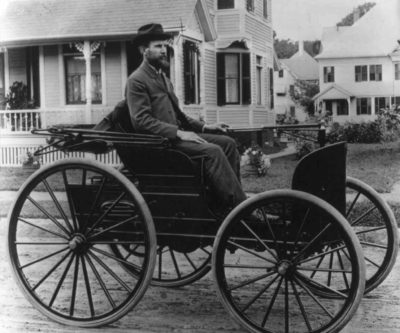
It doesn’t pay to pioneer; not in money, at any rate. Like my fellow pioneers, Haynes and the Appersons, C.B. King and Alex Winton, my name no longer is borne by any car. Only the name of our contemporary R.E. Olds is perpetuated in the Oldsmobile, though he long ago surrendered his interest in the names. Like most of them, I was a bicycle mechanic, and like all of them, a mechanic without technical training.
Why was the development of the automobile left to obscure mechanics without training rather than experienced engineers? Because of the weight of a unanimous and intolerant public opinion that the idea of a horseless carriage was too silly for words. In 1895, when I invited Samuel Bowles II, famous editor of the Springfield Republican, to ride in the Duryea which won the first American automobile race, his reply was: “I appreciate your kindness, but really, it would not be compatible with my position.”
The automobile was an absurdity, therefore it was ridiculous to be seen in one.
It is a mistake to suppose that the automobile was created to supply a demand. The demand was very painfully built up after the machines had been proved, and many of the pioneers foundered. Had I known historically what I was attempting I might have stopped with bicycles. I had the valor of ignorance. If Bishop Wright had sent his sons to engineering school, I wonder if they would have gone on to invent the airplane?
There are three reasons why America was destined to be the home of the automobile — great distances, scarce labor, and cheap fuel. It is surprising only that the automobile was so long delayed. The obvious ideal of mechanical locomotion was the greatest possible freedom of movement, but when Stephenson invented his steam locomotive, it was crudely heavy, while the public roads were bad. So railroads were built especially for the locomotive. In that way the cart got before the horse. Instead of simplifying and lightening the locomotive it was made heavier and heavier and more and more restricted to rails and a private right of way. That in turn fixed in the public mind the fallacy that no mechanically propelled vehicle belonged on the highway.
Hundreds of forgotten men however, did operate steam road vehicles of one kind or another in the century before the automobile age dawned. Nothing came of it because of public hostility. When the automobile era finally opened, the gas car was the Cinderella of the trade. The electric marvels of the trolley car, the telephone, and the Edison lamp had captured the public’s imagination. Until 1900 — and even later — one of the greatest obstacles the gasoline car had to overcome was the general conviction that any day Edison would invent a miraculous electric-powered auto that would sweep the market. Next to the electric came the steam car, because of public familiarity with steam and its 50 years’ advantage in engineering practice. Steam ran the railroads, electricity the trolley cars, while the internal-combustion engine was unknown to the layman.
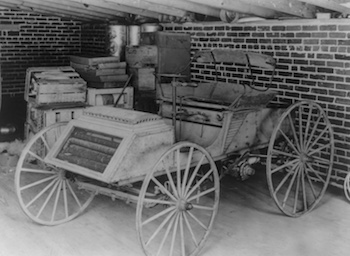
The Chicago World’s Fair, in my opinion, deserves first credit for the automobile. Just as the Philadelphia Centennial sponsored the bicycle, Chicago stood godmother to the motorcar. In 1890 and 1891, the fair’s promoters advertised throughout the world in many languages for exhibits, offering awards for “steam, electric, and other road vehicles propelled by other than animal power.” Note the absence of any specific mention of the internal-combustion engine.
The First Auto Races gave cars needed dignity and prestige. A thousand experimenters who had been discouraged by ridicule took a fresh hitch at their trousers. I was one of these. What we were able to produce by 1893 was pitifully meager, but 1894 brought enough cars to permit a race in France, won by a steamer, and the next year the first American race was run at Chicago. My third car, begun late in 1893, won that race and a $2,000 prize over Europe’s three entries. It was, in my judgment, the first true automobile combining all modern essentials for the first time. Four Duryeas won all prizes, totaling $3,000, in the second American race on Memorial Day 1896. The same year two Duryeas won the first British road race, London to Brighton, against the best foreign cars.
It doesn’t pay to pioneer, and yet the first American inventor to put money into an automobile venture got his capital back with a profit. He was Edwin F. Markham, a nurse, of Springfield, Massachusetts. I was canvassing for funds to build our first model. Banks were out of the question, of course. The tobacconists of Springfield seemed to be prosperous, and I was concentrating on them this day in the early 1890s. Markham, lounging in one shop, overheard my sales talk. In return for a 10th interest, he agreed to pay bills up to $1,000. If he financed us to a self-supporting basis he was to get a half interest. Eventually he put up $3,000 and got back about $5,000. He lived to see the automobile a commonplace and was very proud of his vision.
—“It Doesn’t Pay to Pioneer,”
The Saturday Evening Post, May 16, 1931
Eric Liddell’s Greatest Race
Photos courtesy Heather Liddell Ingham, Patricia Liddell Russell, Maureen Liddell Moore, and The Eric Liddell Centre/Shutterstock.
Weihsien, Shandong
Province, China: 1944
He is crouching on the start line, which has been scratched out with a stick across the parched earth. His upper body is thrust slightly forward and his arms are bent at the elbow. His left leg is planted ahead of the right, the heels of both feet raised slightly in preparation for a springy launch.
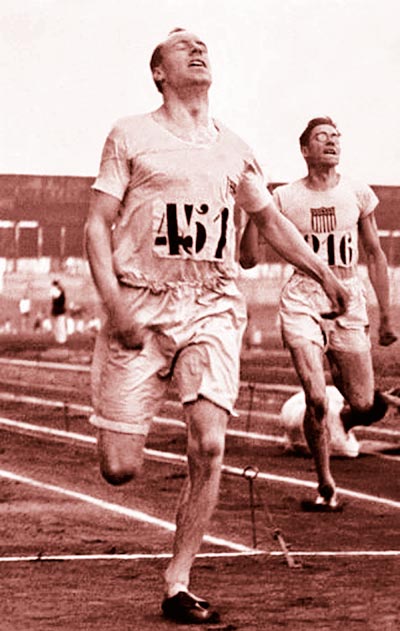
Exactly two decades earlier, he had won his Olympic title in the hot, shallow bowl of Paris’ Colombes Stadium. Afterward, the crowd in the yellow-painted grandstands gave him the longest and loudest ovation of those Games. What inspired them was not only his roaring performance, but also the element of sacrificial romance wound into his personal story, which unfolded in front of them like the plot of some thunderous novel.
Now, trapped in a Japanese prisoner of war camp, the internees have teemed out of the low dormitories and the camp’s bell tower to line the route of the makeshift course to see Eric Liddell again. Even the guards in the watchtowers peer down eagerly at the scene.
Most of the world knows Liddell from the Oscar-winning film Chariots of Fire. It frames him running across a screen, the composer Vangelis’ synthesized soundtrack accompanying every stride. The images, the music, the man, and what he achieved in the Olympics in 1924 are familiar to us because cinema made them so.
We know that Liddell, then a 22-year-old Edinburgh University student and already one of the fastest sprinters in the world, believed so strongly in the sanctity of the Sabbath that he sacrificed his chance to win the 100 meters. We know the early heats of that event were staged on a Sunday. We know that Liddell refused to run in them, leaving a gap that his British contemporary Harold Abrahams exploited. We know that Liddell resisted intense pressure — from the public, from his fellow Olympians, and from the British Olympic Association — to betray his conscience and change his mind about Sunday competition. We know that he entered the 400 meters, a distance he’d competed in only 10 times before. And we know that, against formidable odds and despite the predictions of gloomy naysayers, he won it with glorious ease.
In Paris, Liddell claimed his Olympic gold medal in a snow-white singlet, his country’s flag across his chest. Now, in China, he wears a shirt cut from patterned kitchen curtains, baggy khaki shorts, which are grubby and drop to the knee, and a pair of gray canvas “spikes,” almost identical to those he’d used during the Olympics.
Even though he is over 40 years old, practically bald, and pitifully thin, Liddell is the marquee attraction. Those who don’t run want to watch him. Those who do want to beat him.
As surreal as it seems, “Sports Days” such as this one are an established feature of the camp. For the internees, it is a way of forgetting — for a few hours at least — the reality of incarceration; a prisoner wistfully calls each of them “a speck of glitter amid the dull monotony.”
Until the Red Cross at last got food parcels to them in July, there were those who feared the slow death of starvation. Weight fell off everyone. Some lost 15 pounds or more, including Liddell. He dropped from 160 pounds to around 130. Morale sagged, a black depression ringing the camp as high as its walls.
While hunger stalked the camp, no one had the fuel or the inclination to run. So this race is a celebration, allowing the internees to express their relief at finally being fed.
Liddell shouldn’t be running in it.
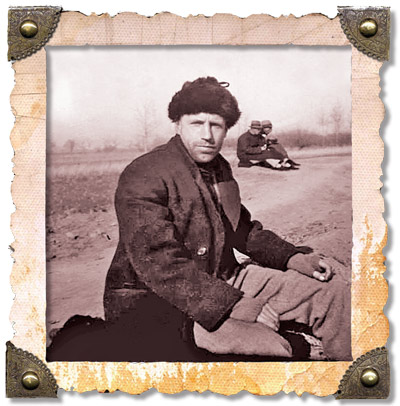
but slightly disheveled and unshaven, on his way
to Siaochang in late autumn 1937.
Photos courtesy Heather Liddell Ingham, Patricia Liddell Russell, Maureen Liddell Moore, and The Eric Liddell Centre/Shutterstock.
For months he’s felt weary and strangely disconnected. His walk has slowed. His speech has slowed too. He’s begun to do things ponderously and is sleeping only fitfully, the tiredness burrowing into his bones. He is stoop-shouldered. Mild dizzy spells cloud some of his days. Sometimes his vision is blurred. Though desperately sick, he casually dismisses his symptoms as “nothing to worry about,” blaming them on overwork.
Throughout the 18 months he’s already spent in Weihsien, Liddell has been a reassuring presence, always representing hope. He has toiled as if attempting to prove that perpetual motion is actually possible. He rises before dawn and labors until curfew at 10 p.m. Liddell is always doing something, and always doing it for others rather than for himself. He scrabbles for coal, which he carries in metal pails. He chops wood and totes bulky flour sacks. He cooks in the kitchens. He cleans and sweeps. He repairs whatever needs fixing. He teaches science to the children and teenagers of the camp and coaches them in sports too. He counsels and consoles the adults, who bring him their worries. Every Sunday he preaches in the church. Even when he works the hardest, Liddell still apologizes for not working hard enough.
The internees are so accustomed to his industriousness that no one pays much attention to it anymore; familiarity has allowed the camp to take both it and him a little for granted.
Since Liddell decades earlier first became public property — always walking in the arc light of fame — wherever he went and whatever he did or had once done was brightly illuminated. The sprinter whose locomotive speed inspired newspapers to call him “The Flying Scotsman.” The devout Christian who preached in congregational churches and meeting halls about scripture, temperance, morality, and Sunday observance. The Olympic champion who abandoned the track for the sake of his religious calling in China. The husband who booked boat passages for his pregnant wife and two infant daughters to enable them to escape the torment he was enduring in Weihsien. The father who had never met his third child, born without him at her bedside. The friend and colleague, so humbly modest, who treated everyone equally.
The internees assume nothing will harm such a good man, especially someone who is giving so much to them. And none of them has registered his deteriorating physical condition because he and everyone around him look too much alike to make his illness conspicuous.
Anyone else would find an excuse not to race. Liddell, however, doesn’t have it in him to back out. He is too conscientious. The camp expects him to compete, and he won’t let them down, however much the effort drains him and however shaky his legs feel. He is playing along with his role as Weihsien’s breezy optimist, a front concealing his distress. Every few weeks he merely slits a new notch-hole into the leather of his black belt and then pulls it tightly around his ever-shrinking waistline.
Liddell makes only one concession. Previously he has been scrupulously fair about leveling the field. He’s always started several yards behind the other runners, giving them an outside chance of beating him. This time there is no such handicap for him; that alone should alert everyone to the fact he is ailing.
Liddell says nothing about it. Instead, he takes his place, without pause or protest, in a pack of a dozen other runners, his eyes fixed on nothing but the narrow strip of land that constitutes the front straight.
The starter climbs onto an upturned packing crate, holding a white handkerchief aloft in his right hand. And then he barks out the three words Liddell has heard countless times in countless places:
Ready … Set … Go.
Present Day
He is waiting for me at the main gate on Guang-Wen Street. He is dressed smartly and formally: white shirt, dark tie, and an even darker suit, the lapels wide and well cut. He looks like someone about to make a speech or take a business meeting.
His blond hair is impeccably combed back, revealing a high widow’s peak. There’s the beginning of a smile on his slender lips, as if he knows a secret the rest of us don’t and is about to share it. Barely a wrinkle or a crease blemishes his pale skin, and his eyes are brightly alert. He is a handsome, eager fellow, still blazing with life.
On this warm spring morning, I am looking directly into Eric Liddell’s face.
He’s preserved in his absolute pomp, his photograph pressed onto a big square of metal. It is attached to an iron pole as tall as a lamppost. This is a communist homage to a Christian, a man China regards with paternal pride as its first Olympic champion. In Chinese eyes, he is a true son of their country; he belongs to no one else.
More than 70 years have passed since Liddell came here. He’s never gone home. He’s never grown old.
The place he knew as Weihsien is now called Weifang, the landscape unimaginably different.
When Liddell arrived in 1943, the locals, living as though time had stopped a century before, parked handheld barrows on whichever pitch suited them and bartered over homegrown vegetables, bolts of cloth, and tin pots and plates.
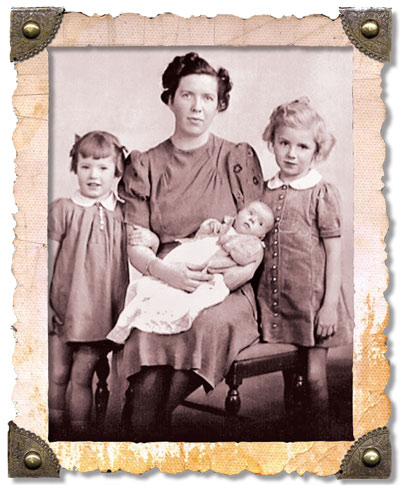
Photos courtesy Heather Liddell Ingham, Patricia Liddell Russell, Maureen Liddell Moore, and The Eric Liddell Centre/Shutterstock.
The camp once stood here. The Japanese called it a Civilian Assembly Center, a euphemism offering the flimsiest camouflage to the harsh truth. A United Nations of men, women, and children were prisoners alongside Liddell rather than comfy guests of Emperor Hirohito. There were Americans and Australians, South Americans and South Africans, Russians and Greeks, Dutch and Belgians and British, Scandinavians and Swiss and Filipinos. Among the nationalities there were disparate strata of society: merchant bankers, entrepreneurs, boardroom businessmen, solicitors, architects, teachers, and government officials. There were also drug addicts, alcoholics, prostitutes, and thieves, who coexisted beside monks and nuns and missionaries, such as Liddell.
Weihsien housed more than 2,100 internees during a period of two and a half years. At its terrible zenith, between 1,600 and 1,800 were shut into it at once.
A man’s labor can become his identity; Liddell testifies to that. Before internment, he worked in perilous outposts in China, dodging bullets and shells and always wary of the knife blade. After it, he dedicated himself to everyone around him, as though it were his responsibility alone to imbue the hardships and degradations with a proper purpose and make the long days bearable.
The short history of the camp emphasizes the impossibility of Liddell’s task. In the beginning, the camp was filthy and unsanitary, the pathways strewn with debris, and the living quarters squalid. The claustrophobic conditions brought predictable consequences. There were verbal squabbles, sometimes flaring into physical fights, over the meager portions at mealtimes and also the question of who was in front of whom in the line to receive them. There were disagreements, also frequently violent, over privacy and personal habits and hygiene as well as perceived idleness, selfishness, and pilfering.
Liddell was different. He overlooked the imperfections of character that beset even the best of us, doing so with a gentlemanly charm.
With infinite patience, he also gave special attention to the young, who affectionately called him “Uncle Eric.” He played chess with them. He built model boats for them. He fizzed with ideas, also arranging entertainments and sports, particularly softball and baseball, which were staged on a miniature diamond bare of grass.
Liddell became the camp’s conscience without ever being pious, sanctimonious, or judgmental. He forced his religion on no one. He didn’t expect others to share his beliefs, let alone live up to them. In his church sermons, and also during weekly scripture classes, Liddell didn’t preach grandiloquently. He did so conversationally, as if chatting over a picket fence, and those who heard him thought this gave his messages a solemn power that the louder, look-at-me sermonizers could never achieve. “You came away from his meetings as if you’d been given a dose of goodness,” said a member of the camp congregation.
In his own way, he proved that heroism in war exists beyond churned-up battlefields. His heroism was to be utterly forgiving in the most unforgiving of circumstances.
Liddell broke away from athletics at the peak of his flight. Sportsmen who reach the summit of their sport usually try to cling on there until their fingernails bleed. Well in advance of the Olympics, Liddell had talked of his intention to abdicate gracefully because his real calling was elsewhere. For most of us, that would be an easy vow to make before we became somebody — and an even easier one to break after the blandishments and the fancy trimmings of fame seduced us. Liddell never let it happen to him. He had promises to keep. That he kept them then and also subsequently is testament to exceptionally rare qualities in an exceptionally rare individual. Overnight, Liddell could have become one of the richest of “amateur” sportsmen. But he wouldn’t accept offers to write newspaper columns or make public speeches for cash. He wouldn’t say yes to prestigious teaching sinecures, refusing the benefits of a smart address and a high salary. He wouldn’t endorse products. He wouldn’t be flattered into business or banking either. He made only trivial concessions to his celebrity. He allowed his portrait to be painted. He let a gardener name a gladiolus in his honor at the Royal Horticultural Show. In everything else Liddell followed his conscience, choosing to do what was right because to do anything else, he felt, would sully the gift God had given him to run fast.
But what he did, and the way in which he inspired whoever watched him, doesn’t rank as his number-one achievement.
Surpassing his Olympic glory, and saying more about Liddell than any gold medal ever can, is the last race of his life — a race barely 1,500 people saw, making it almost a private event. A race he ought never to have attempted. A race no one registered as significant until much later.
Liddell began predictably, striding clear because he was aware of the need to establish an early lead. You could hear the stampede of thumping feet against the hard earth. You could see the short shadow each man cast and also the strain on their faces and in their eyes, the desperation of some who were already being left far behind.
Liddell was still ahead of them all at the halfway point of the second lap. This was the Olympian everyone knew — the frantic whirl of the arms, the high knee lift, the head back. The spectators, given another exhibition of it, waited for the climactic rush he always demonstrated. That assumption was wrong.
Worn down after his long months of illness, his legs let him down; he couldn’t find any “kick” in them. For once, throwing his head farther back wasn’t enough to give him that late spurt.
There was no spark, no extra burst of energy in him. His heart was willing. His body was not. Liddell came in second, several yards adrift.
This final race was Liddell’s best and unquestionably his bravest. Where his initial speed came from, and how he managed to sustain it for so long, is unfathomable. The courage he summoned to run at all is extraordinary, a testament to his will.
The passing years slowly assign context to things and place them in order of importance; we appreciate that only from the distance hindsight allows us. So it is with this race, a couple of minutes in a faraway corner of a faraway country that show the quintessential Liddell, a stricken man running because he felt it was the right thing to do. A man, moreover, who made no excuses for his defeat and got involved in no histrionics about it afterward. As the party-like atmosphere continued that day, he merely went back to his normal duties, still pretending there was nothing wrong with him.
Every morning in Weihsien, while the camp still slept, he lit a peanut oil lamp in the darkness and prayed for an hour. Every night, after studying the Bible, he prayed again. He did not discriminate. He prayed for everyone, even for his Japanese guards.
He died in the camp hospital in early 1945.
Whoever comes to this corner of China will always leave knowing that the full measure of the man is to be found here.
The place where his faith never broke under the immense weight it bore.
The place where his memory is imperishable.
The place where, even on the edge of death, the champion ran his last race.
From For the Glory: Eric Liddell’s Journey from Olympic Champion to Modern Martyr by Duncan Hamilton, Published by Penguin Press, an imprint of Penguin Publishing Group, a division of Penguin Random House LLC. Copyright © 2016 by Duncan Hamilton.
Duncan Hamilton is an investigative journalist and award-winning sports writer whose recent book Immortal, a biography of footballer George Best, was named a best sports book of 2013 by both The Times and The Guardian. The author lives in West Yorkshire, U.K.
The Coronation of Queen Victoria
The first episode of the PBS Masterpiece series Victoria concludes with the young queen being crowned at Westminster Abbey. The 1838 coronation greatly interested Americans. Then, as now, many Americans had an intense interest in the British royal family, so the Post published two lengthy articles about the coronation. A painstakingly detailed account published in the August 4, 1838, issue covered four columns of a large (27- by 19-inch) page with very small type. It would have satisfied anyone’s appetite for news of the event.
An earlier article, from July 28, 1838, offered more personal accounts of the occasion, viewed from Buckingham Palace and Hyde Park. The author was surprised that such an immense crowd — 400,000 according to one estimate — was so orderly, polite, and good humored. Watching the large number of riders and carriages in the procession, the author approved of its air of decorum and correctness and of the members as they passed.
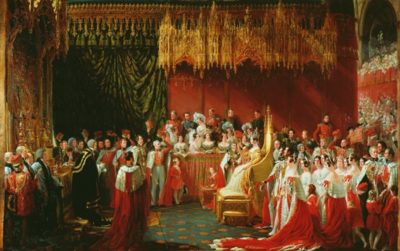
The coronation launched a 64-year reign for Victoria that saw immense changes for the United Kingdom. The country was excited by its booming industry and new technologies, like the telegraph and railway system. But there was also a sense of nostalgia for the old England that was passing away.
The coronation helped prepare the British for the new era by incorporating ancient tradition and customs. Consequently, the article on the ceremony was filled with references to archaic offices and terms.
- The “Bargemaster” and “Watermen” refer to traditional offices that were once filled by the men who took the kings and queens out on the Thames.
- The “Royal Equerry” was the person who attended the queen’s horses. An equipage is a coach and horses with servants.
- The “Yeoman Pickers” were mounted attendants at royal hunts.
- The “Exons of the Yeomans” were the most junior members of the Yeoman Guards.
- The “Marshalmen” (along with the Knight Marshal) was responsible for maintaining order within the queen’s court.
- The “State Hammercloth” is a heavy velvet curtain in which the royal coat of arms is elaborately embroidered, often with gold thread. During the coronation, it would have been seen draped on the driver’s seat of the royal coach.
- The Orb is a hollow gold ball surmounted by a cross, and is a Christian symbol of authority. The spurs were symbols of knighthood and chivalry.
- The Ring represented the sovereign’s marriage to the nation. The Archbishop put the ring on the wrong finger of Victoria’s hand. It was too small for the finger and she had to pull it painfully off during the ceremony to place it on the correct finger.
- “The rod with the dove” is the scepter held in the monarch’s left hand. It is topped by the figure of a dove, a reference to the Holy Spirit and wisdom.
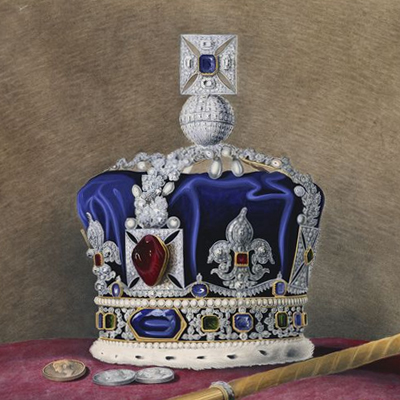
The Post author claimed that the royal crown made from Queen Victoria cost £112,800. An equivalent worth today would be about £70,000,000 ($85,000,000).
The author says little about the appearance of the queen, probably because it was impossible to get close enough to see her face.
In the Victoria TV series, the queen is played by Jenna Coleman. In stature, she appears to closely resemble Victoria’s 4-foot 11-inch height. But her face is another matter. Coleman is undeniably pretty, while Victoria was widely conceded to be plain and unremarkable.
An 1848 Post article about Queen Victoria reported one Briton’s comment on the queen’s looks:
While Victoria was on a visit to Brighton last year, a crowd gathered round to see her Majesty and the Prince when walking near the sea shore, the day after they arrived, which much annoyed the Queen. As she turned to avoid the crowd, a young woman cried out, loud enough for the Queen to hear, “Why, my sister Jane would make a better looking Queen any day.”
But at her coronation, when she was only 18 years old, she still had an aura of youthful appeal. A Post correspondent, just a year later, had this to say of the queen:
“It is certainly not the sort I should call beautiful, but, when lighted up by animated conversation, the face is full of expression and sweetness, and strongly indicative of character.”
Victoria begins this week with a two-hour presentation on PBS and will continue for another 14 weeks.
Coronation of Queen Victoria
Originally published in the Saturday Evening Post July 28, 1838
From an early our, indeed long before daylight, numbers of persons were to be seen gathering into little knots in the immediate vicinity of Buckingham Palace, and as the day advanced considerable additions tot that number continued to be made, until the hour of eight o’clock had arrived, when the whole line on either side of the road leading up Constitution hill from the New Palace, as well as the inner side of the iron railing which divides St. James from the Green Park, was crowded with well-dressed persons, of whom a large portion consisted of ladies —
Within the railing there were erected a series of platforms of various elevations, on which standings were obtainable at a charge of 2s 6d. per head. This accommodation extended nearly from the Duke of Sutherland’s residence up to the triumphal arch opposite to the entrance into Hyde Park, and, as far as we were enabled to see, not one was unoccupied. On either side of arch, and on both sides of the gate, spacious galleries were erected, which were filled principally by elegantly dressed females, many of whom on the arrival of the youthful Sovereign took off their bonnets. It was impossible not to have anticipated where so great an assemblage had congregated that some disturbance would have occurred. Not so in this instance, however, for throughout the whole day not an angry word reached our ears, except such as were rendered necessary every now and then by persons planting themselves in the trees along the side of the roads. Then the commands of the police assumed somewhat a tone of that character.
In the course of the night a detachment of the artillery from Woolwich had taken up their station in that part of St. James Park immediately behind Marlborough house, the residence of the Queen Dowager. About seven o’clock the outer line of the footpaths up Constitution hall were taken possession of by the twentieth regiment of foot and police. Shortly after the interstices between these official persons were filled up by a detachment of the Life Guards. The line toward the arch was made out of a portion of the Rifle Brigade. But so quiet, so peaceable, and so appropriately correct was the demeanor of the anxious spectators, that the presence of these authorities might have been safely dispensed with.
The monotony which at all times attends the waiting for the commencement of the set out of a procession, was yesterday but little relieved by casual occurrences. All was good humor, and it was evident, that so firm was the general resolve to be pleased, and to abstain from acrimonious conflict, that a total abandonment of the processions would alone have induced the slightest deviation therefore.
It should be here mentioned, that the whole of the eastern and northern sides of St. George’s Hospital, as well as the fronts of the roofs of the houses at the upper end of Grosvenor-place, presented one mass of galleries, the majority of their occupants being members of the fair sex.
The roof of the palace itself, too, was thickly studded with spectators.
Soon after half past nine detachments of the Blues and the Life Guards, accompanied with their respective bands, arrived opposite the entrance gate of the palace, and their appearance was quickly followed by that of twelve of Her Majesty’s dress carriages together with the state coach. The carriages of her Royal Highness the Duchess of Kent, with those of their Royal Highnesses the Duke of Cambridge, Duchess of Gloucester, and the Duke of Sussex next reached the Royal residence in rapid succession. The whole of these vehicles drove into the courtyard.
During this proceeding the various foreign ambassadors formed into line in the Birdcage walk.
The foreign ambassadors took place in the procession in the following order, from the Sultan, France, Portugal, Sweden, Sardinia, Hanover, Prussia, Spain, Netherlands, Austria, Russia, Belgium, and Sicily. At a quarter before 10 o’clock, the formation of the procession commenced, which when completed set out in the following manner.
- High Constable of the city of Westminster, squadron of life guards, carriages of foreign resident ministers in the following order, from Mexico, Portugal, Sweden, the Saxon minister, Hanover, Greece, Sardinia, Spain, United States, Netherlands, Brazil, Bavaria, Denmark, Belgium, Würtenburg, Prussia.
- Carriages of the foreign ambassadors and ministers extraordinary, in the order in which they respectively report their arrival.
- The Turkish, French, Russian, and the Austrian Ambassadors.
- Mounted Band of a Regiment of Household Brigade.
- Detachment of Life Guards.
- Carriages of the Branches of the Royal Family, with their respective Escorts.
- The Duchess of Kent and Attendants.
- The Duke and Duchess of Cambridge and Attendants.
- Mounted Band of a Regiment of the Household Brigade.
- The Queen’s Bargemaster.
- The Queen’s Forty-eight Watermen.
- HER MAJESTY’S TWELVE CARRIAGES, Each drawn by six horses.
- The Lord Chamberlain. The Duke of Argyll.
- A Squadron of Life Guards.
- Mounted Band of the Household Brigade.
- Military Staff and Aides-de-camp, on Horseback, Three and Three.
- First and Principal Aide-de-Camp to the Queen.
- Lieutenant General Sir Herbert Taylor, G.C.B. attended by the Equerry of the Crown Stable, Sir George Quentin.
- The Queen’s Gentleman Rider, J. Fozard, Esq.
- Deputy Adjutant-General, Major General J. Gardner
- Deputy Quartermaster-General, Col. Freeth, H.K.
- Deputy Adjutant-General, Royal Artillery, Sir Alexander Dickson.
- Quartermaster-General, Sir J. Willoughby Gordon Bart.
- Military Secretary to the Commander-in-Chief, Lord Fitzroy Somerset, K.C.B.
- The Royal Huntsmen, Yeoman Prickers, and Foresters
- Six of Her Majesty’s horses, with rich trappings, each horse led by two grooms.
- The Knight Marshal, Sir J. C. Lamb, Bart.
- Marshalmen in ranks of four.
- The Exons of the yeoman of the guard on horseback.
- One hundred yeomen of the guard, four and four.
- The clerk of the check, James Bunce Curling, Esq, Harbinger, Samuel Wilson, Esq.
- Ensign Sir Thomas N. Reeve,
- Lieutenant Sir Samuel Spry, M.P.
- THE STATE COACH, Drawn by eight cream colored horses, attended by a Yeoman of the Guard at each wheel, and two footmen at each door.
- The gold stick, Viscount Cambermere and the captain of the Yeomen of the Guard, the Earl of Ilchester, riding on either side, attended by two grooms, each, conveying
- THE QUEEN
- The mistress of the robes, the Duchess of Sutherland, the master of the horse.
- The Earl of Albermale.
- The Captain-general of the Royal Archers, the Duck of Buccleugh, attended by two grooms.
- A squadron of Life Guards.
HER MAJESTY’S STATE HAMMERCLOTH is covered with scarlet silk Genoa velvet, embroidered throughout with gold. The badges on each side and back, the fringes, ropes, and tassels, being of that valuable metal. We understand that it cost 1,000£
HYDE-PARK CORNER
Soon after 6 o’clock in the morning, Hyde-Park corner became a scene of the most animated and interesting character. The large galleries in front of St. George’s Hospital afforded places to a vast concourse of company, and several lf the houses along Grosvenor-place were occupied by numerous spectators. An inscription was placed on the front door of the hospital, stating that it would be closed during the day to all but cases of accidental injury. A large proportion of the military employed in the business of the splendid ceremonial passed either along Piccadilly or down Constitution hill, which of course much increased the bustle, the excitement, and the brilliancy of that neighborhood. Horse guards, grenadier guards, hussars, rifle brigade, in succession attracted the attention and called for the admiration of a multitude in whom 20 years of peace had not extinguished a sense of the gallant achievements which in time of danger had protected the independence and elevated the character of England.
Before 8 o’clock, the whole of the footways along Piccadilly and Constitution hill were filled with a dense multitude arrayed in their best attire, and fully resolved to enjoy to the utmost this universal holy-day. At a very early hour a work of perfect superogation was performed, namely, the watering of the roads, for that was quite enough of rain to prevent the least inconvenience from dust. The rifle brigade, mingled with police, lined the passage for the procession at this part of its course, the horde guards (red) being stationed at intervals of about 30 years. Soon after 8 o’clock a few of the peer’s carriages who possess the privilege of passing through that gate, proceeded down the hill on their way to the Abbey, but from an early hour Grosvenor place and Piccadilly were crowded with equipages, many of which were distinguished by greater splendor than perhaps was ever displayed on any similar occasion.
The representatives of foreign potentates at this Court certainly never made a display of magnificence which even in the remotest degree approached that which graced the coronation of Queen Victoria, and those who questioned that chasteness or elegance of those equipages should recollect that no inconsiderable number of them were manufactured in London, and that their gorgeousness, remarkable as it was, could not be regarded as going beyond what the dignity and interest of the occasion required.
A few of the foreign ambassadors were cheered as they passed through the gateway, the cheers given to the French ambassador extraordinary being by far the most market; he and the Turkish minister were considered the two great lions among the corps diplomatique.
In about an hour after leaving Buckingham Palace, her Majesty arrived at the west entrance of the Abbey, and was received by the great officers of state, the noblemen bearing the regalia, and the bishops, when her Majesty repaired to her robing chamber. Her Majesty having been robed, advanced up the nave into the choir, the choristers in the orchestra a singing the anthem, “I was glad when they said unto me, we will go into the house of the Lord.” When her Majesty took her seat in a chair before and below the throne, the spectacle was truly magnificent. Then followed the recognition, her Majesty’s oblation, the Litany and the remainder of the service. The sermon was preached by the Bishop of London, from Chron. xxxiv v 31. Archbishop of Canterbury then administered the oath, to a transcript of which her Majesty affixed her royal sign manual; after which the Archbishop anointed and consecrated her Majesty. Then followed the presentation of the spurs and sword, the investing with the royal robe, and the investing with the royal orb, the investitute of the ring and the gloves, and the delivery of the scepter and the rod with the doves.
The Archbishop then placed the crown on her Majesty’s head, and the peers and peeresses put on their cornets, the bishop their caps, and the king-of-arms their crowns. The effect was magnificent in the extreme. The shouts which followed this part of the ceremony was really tumultuous.
After this followed the anthem, “The Queen shall rejoice in thy strength O Lord”; at the conclusion of which the Archbishop and Bishops and other peers lifting up her Majesty into the throne, when the peers did homage. The solemnity of the coronation being thus ended, the Queen went down from her throne to the altar, made her second oblation, and returned to the chair. The Archbishop then read the prayers for the whole estate of Christ’s Church militant here on earth, etc. and the chorus, “Hallelujah! For the Lord God omnipotent reigneth,” having been sung, her Majesty proceeded to the altar, when the Archbishop read the final prayers. The whole coronation office being thus performed, the Queen proceeded, crowned, to King Edward’s Chapel, where she delivered the scepter with the (dove) to the Archbishop, who laid it on there altar there. His Grace then placed the orb in the Queen’s left hand, and the procession returned in the same state and order.
Her Majesty reached the palace at a quarter to six o’clock, and, as she descended from the carriage the cheers which saluted her in the morning were repeated with increased heartiness and renewed vigor. She appeared as steady in her bearing, notwithstanding the fatigue of the day, as when she set out in the morning, and recognized by her graceful acknowledgements the cheers and gratulations of her subject.
The night presented a scene of indescribable luster from the illumination throughout all the principal squares and streets in the metropolis, the inhabitants viewing with each other in doing honor to this interesting occasion. There was also a brilliant display of fireworks in Hyde Park.
The following is an estimate of the value of the different jewels contained in the late magnificent diadem, the “Queen’s rich Crown,” and from which the present one, manufacturers by Messrs. Rundell and Bridge, is composed, and which Her Majesty wore on Thursday:
- 20 diamonds round the circle, 1,500£ each£30,000
- 2 large center diamonds, 2,000£ each 4,000
- 54 smaller diamonds placed at the angles of the former 1,000
- 4 crosses, each composed of 25 diamonds, 12,000
- Four large diamonds on the top of the crosses, 40,000
- 12 diamonds covered in the fleur-de-lis 10,000
- 18 smaller diamonds contained in the same2,000
- Pearls, diamonds etc, on the arches and crosses 10,000
- 141 diamonds on the mound500
- 26 diamonds on the upper cross 3,000
- 2 circles of pearls about the rim 300
£112,800
Notwithstanding such an uncommon mass of jewellery, independent of the gold velvet cap, ermine, etc, this crown weighed only 19 ounces, 10 pennyweight—it measured seen inches in height from the gold circle to the upper cross, and its diameter at the rim was five inches.
The Coronation Medals — a great deal of amusement was occasioned by the eagerness displayed to obtain the medals which were scattered with a profuse hand, at intervals, by the Lord Treasurer of the Household, the Earl of Surry, whose dress was not a little disarranged by the rough manner in which he was treated. A son of the Duke of Richmond was exceedingly fortunate in his scrambles, for he contrived to gather up no fewer than 12 medals. The aldermen of the city of London were particularly conspicuous in their efforts to obtain some of the silver shower dropped around them. Mr. Alderman Harmer was sprawling on the floor, and a struggle ensued between him and another person near him for one which feel between them. We believe, however, that the worthy alderman obtained the prize. The judges were more dignified in their efforts, merely extending their hands in the air, not unlike the snatch that Macready makes at the aerial dagger in Macbeth, but one single medal did they catch in the fight. They, however, design not to stoop to pick up what had fallen to the ground.
Featured image: Coronation of Queen Victoria, 1838 by Sir George Hayter (Wikimedia Commons)

News of the Week: New Technology, Naming Winter Storms, and Nat Hentoff
CES 2017
When I was around 20 years old, in the mid-1980s, I was excited by technology. I loved working on my best friend’s Mac, I was really into the latest stereo equipment and science fiction magazines, and I dreamed of a future that was a mix of Star Trek space travel and Dick Tracy watches.
Now I’m just annoyed, disappointed, and exhausted by tech. We’re drowning in new this and new that, and most days all I want is my laptop and a pen and paper to get my work done. I don’t need to watch TV on my coffee mug, and I don’t need Wi-Fi-enabled pickles or whatever else they’re coming up with these days.
But don’t let me dissuade you from getting excited! The annual Consumer Electronics Show was just held in Las Vegas, and CNET has a good rundown of all the new toys and more serious products that were on display. There’s a new television from LG that is only 2.5mm thick! I don’t know why I’m supposed to be excited by that, but there you go. There’s also a motorcycle that balances itself, drones, and Sony’s fancy e-ink watch, which is also really, really thin! (I guess thin is in.)
There was something rather cool shown at CES: the Super Retro Boy, a new version of the original Nintendo Game Boy that plays all of the games and comes with a battery that lasts for 10 hours. We need more tech like that.
Snowstorms Have Names Now
We all know that hurricanes have names (here are the names for the next five years — what, no Bob or Robert?), but for the past couple of years, we’ve been giving snowstorms names too. Or more precisely, the Weather Channel has decided to give them names. The storm that hit the mid-Atlantic region and came northeast up the coast this week was named Helena.
Here’s the odd thing (besides the fact that we’re now giving snowstorms their own names): Campbell’s Soup has been running a commercial for the past couple of years, showing a mother shopping with kids as a winter storm approaches (she buys wine because the kids are going to be home from school and she needs alcohol). What’s interesting about the commercial is that they’ve been changing the words in the ad to reflect what storm is coming. The ads running this week add the words “Winter Storm Helena promises to be the biggest of the decade,” while previous versions of the commercial plugged in the name of whatever storm was coming that week (like Jonas, below, from last winter). Isn’t this a little misleading? I mean, this most recent storm, Helena, wasn’t one of the biggest of the decade, was it? Are they all dropping three feet of snow?
Alexa, What Should I Do If an Asteroid Hits?
Meanwhile, as you were shoveling snow and playing with new electronics, a giant asteroid almost hit the Earth.
It happened early Monday morning. Asteroid 2017 AG13, which scientists say was about the size of a 10-story building, passed within 100,000 miles of our planet. That may seem like a lot, but it’s actually pretty darn close.
The scary part? The asteroid was discovered only two days before it passed by us. We need a Bruce Willis/Ben Affleck-ish backup plan and we need it right now.
RIP Nat Hentoff, Buddy Greco, Buddy Bregman, Clare Hollingsworth, and Francine York
Nat Hentoff did a little bit of everything with words. He was a journalist, a jazz expert, a political and social commentator, and an essayist. Besides writing for places like The New Yorker, The Washington Post, and Downbeat, he wrote for The Village Voice for 50 years. He died Saturday at the age of 91. Terry Teachout of The Wall Street Journal has a nice tribute.
In the “odd timing” department comes this: I was listening to a Buddy Greco song on the Comcast music channels when word came that he had died at the age of 90. He was a pianist and singer known for his version of “The Lady Is a Tramp.” He released 60 albums in his career and played with everyone from Frank Sinatra and Dean Martin to Rosemary Clooney and Ella Fitzgerald.
Another Buddy of the music world passed away: Buddy Bregman. He was a veteran producer, composer, and arranger, working on such films as The Pajama Game, The Delicate Delinquent (one of the better Dean Martin-less Jerry Lewis films), and Born Reckless. He also worked with Frank Sinatra and Ella Fitzgerald, and worked on television with people like Ethel Merman and Eddie Fisher. He died Sunday at the age of 86. By the way, his former wife is actress Suzanne Lloyd, and his daughter Tracey plays Lauren on The Young and the Restless.
Clare Hollingsworth? She was the reporter who, in 1939, broke the news that World War II was starting, after only a week on the job. She was driving alone on a German road and happened to see massive troops being assembled after a tarp the Germans had put up to block the view had blown away in the wind. Hollingsworth was 105.
Francine York appeared in many TV shows, including Batman (she was The Bookworm’s girlfriend), The Odd Couple, Bewitched, Route 66, The Wild, Wild West, Columbo, Hot in Cleveland, The Mindy Project, The King of Queens, and a hundred more. She also appeared in films like Bedtime Story, Doll Squad, The Family Man, and several Jerry Lewis films. York died at the age of 80.
This Week in History
The Battle of New Orleans (January 8, 1815)
General Andrew Jackson defeated a British army at the important battle, which lasted until January 18.
Elvis Presley Born (January 8, 1935)
Although he’s been dead for 40 years, the King still brings in a lot of money.
Surgeon General Issues First Cigarette Warning (January 11, 1964)
On this day, Dr. Luther L. Terry released the first report on smoking and health. We don’t see TV commercials like this anymore:
Happy (?) Friday the 13th
I bet you don’t think of yourself as a superstitious person, but do you avoid walking under a ladder, just because? Do you avoid black cats, not because of superstition but because it just seems like good common sense? Do you wear your favorite team’s jersey when they’re in a big game because, hey, it seemed to work last time?
I don’t know if anyone “celebrates” Friday the 13th, but it got me thinking about recipes for the day. Are there such things? There are! The ones I’ve found are very scary/creepy/monster-related, so you can print them out and also use them for Halloween next October 31 — like this Camp Crystal Cake (a reference to the Friday the 13th slasher films) or these Black Cat Cupcakes. And if you want to play it safe today, there’s always this Lucky Chicken.
If any of those recipes call for salt, remember: If you spill any, throw some over your shoulder because … well, you know.
Next Week’s Holidays and Events
Martin Luther King, Jr. Day (January 16)
Here’s Saturday Evening Post Archive Director Jeff Nilsson on a 1963 article about the civil rights leader, written by Reese Cleghorn.
Thesaurus Day (January 18)
This holiday celebrates the day Peter Mark Roget was born in 1779. The first version of his famous language book, Roget’s Thesaurus, was published in 1852.
Presidential Inauguration (January 20)
Donald Trump gets sworn in as our 45th president in Washington, D.C. Here’s a guide to what we can expect to see.
Happy Anniversary to the Frisbee!
Happy 60th anniversary to the Frisbee! In 1961, the Post’s “People on the Way Up” section featured the co-founders Wham-O, the company that brought us not only the Frisbee, but also the Hula Hoop, the Slip ‘N Slide, and Silly String.
People on the Way Up
Originally published in the Saturday Evening Post on December 23, 1961
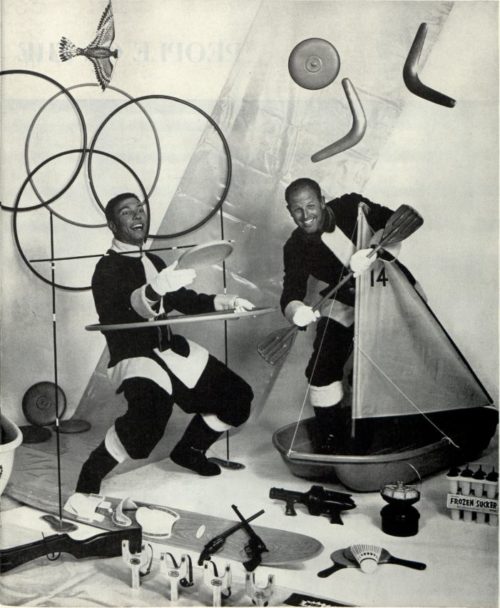
Knerr and Melin: Funmakers. Two of Santa’s happiest helpers are toymakers Richard (Rich) Knerr (right), 36, and Arthur (Spud) Melin, 36. Producers of the fabulous Hula Hoop, gadgeteers Knerr and Melin formed their Wham-O Manufacturing Company in 1947 while students at the University of Southern California. Their first factory was a Pasadena garage, their first product a slingshot, made with a band saw bought on credit. Today they turn out more than thirty toy and sporting-goods items, ranging from the 59-cent Frisbee Flying Saucer in Spud’s hand to the $130 sailboat at left, and sell to 25,000 stores. Hottest number in their line: Limbo, a movable bar to wiggle under, lower and lower, to the music of a recorded tune called Kookie Limbo. Each partner has a specialty. Knerr is salesman and promoter, Melin the research-and-development expert. Both have playrooms where their youngsters — seven in all — can test-play their dads’ brainchildren. The Wham-O owners now are plotting an invasion of the babyware business, also horsing around with pet supplies. “How can we run out of hot ideas,” Rich asks, “when inventors submit more than a hundred to us each week ?” “We can’t,” Spud assures him.
Long Past Time
In his dreams Rice Norris is purchasing pianos. It’s been two nights in a row, and Rice doesn’t even know how to play. He never plunked through “Chopsticks” as a kid or sat through a single lesson, but as of this morning, early, before the alarm, he has a baby grand and an upright, and he’s out $500. The grand he acquired at an auction. It took only one bid. The upright he bought from a friend, a woman he hasn’t seen for years.
The auction dream came this morning, reminding him of yesterday’s. He’d not thought of it in 24 hours, but then the gavel clacked. The man at the podium said, “Sold,” and Rice realized, as if it had slipped his mind, that he’d just bought a piano. It was in his living room, forcing the sofa and chairs and the coffee table to the walls. What he really needed was a lamp, or how would he ever read music?
He opened his eyes — quickly, as if hearing his name — and stared straight at his alarm clock. It made no sense at first. It looked like a small geometry problem, a white disc displaying an angle. One leg was shorter than the other. The hands were black lines poking into space.
He felt his dreams scumbling back where they came from. They dissolved. He remembered that they’d been there, and then they were gone.
It felt like being tricked.
Rice Norris is a big man. People he’s just met — men, anyway — feel comfortable calling him Big Guy. A panhandler to whom he gave a quarter twice a day used to sing, “Big Guy, my man,” and snap his fingers three times before opening his yellowed palm for the coin Rice pressed there with one finger, like pushing a button. This brought a quick “I thank you,” and a spin like a back-up singer’s. Rice always smiled because for 50 cents a day he received this one moment of good cheer. It was an act, of course, but an act someone bothered to put on. “Big Guy, my man” sounded affectionate. It wasn’t a total stranger asking permission to acknowledge his size.
The panhandler’s been gone for two or three years. Rice isn’t sure when he noticed the man’s absence. It just occurred to him as he waited on a light. It’s five blocks to the cheap lot where he parks his car. En route is a strip joint where he sees women rougher than he’ll ever be strolling in for work. The older ones are bored. Unruly customers are the least of their worries. The hardness is in the rest of their lives. The men entering at this hour are the middle-management guys sneaking out early or construction workers or Little League coaches stopping on their way home. It’s still daylight, because Rice himself gets off at four. He walks past and tries to peer in if the door is swinging, but it’s dark inside even without the bouncer blocking the view. The wall thumps as Rice passes. He can’t imagine holding a clear thought in the midst of that noise. He assumes that lights are flashing, too. It seems like a guaranteed headache.
The younger women coming in, some walking, some unloaded at the curb from beat-up cars or creaking pickups, look as hurried and uncomfortable making their entrances as he thinks he’d be as a customer. He watches their fear and distaste and their anger and keeps walking.
It used to be that 30 paces down he would hear “Big Guy, my man,” and he would grin, but he doesn’t anymore. One day he realized he’d got all the way to the light without a reason to stop thinking about the thin girl with the big, big breasts and the purple knot the size of a grapefruit on her face. And he’d been doing it for days, maybe even a month, without anyone, afterward, calling his name.
It is a pleasant day, a bit overcast with no real threat of rain. Rice is relaxed making the walk to work. At this hour much of the city is awake but not quite stirring. Lights are on, and there is traffic, but the buses aren’t filled and office buildings still look dormant. Only a few necessary personnel and the early bird workaholics are at their desks. Other people are pouring down coffee at restaurants or buying papers from the twins at the newsstand or, like Rice, breathing the cool morning air and admiring the fact of another sunrise.
Or not. He knows there are people stewing in miseries that make them wish they were dead. Or simply gone. His ex-wife picked that approach. She left town. Flat out disappeared, but for a year or two he used to see her. She puttered around the city. He’d see her at movies with a man he didn’t know, a different man every time who never seemed her type, but then neither did she. Her hair stuck out like fins or curled close to her scalp, and her clothes looked borrowed from people she’d never met. He couldn’t imagine that woman on his arm, or what she ever saw in him. They were strangers who’d somehow fooled themselves for being young. Life was supposed to work that way. This was when you did all that.
Rice was startled by their sex. She’d turn quick and strong and impatient. He was too slow. He was sleepwalking, she said. She’d slap at him. He felt dead still inside his stinging flesh. She wrenched him closer or jammed herself against him, and he knelt or lay or stood baffled by her strength. She was right, it seemed. He was sleepwalking, or maybe she was and he was the one awake watching a person in a trance. She ground through love like a routine made up that very moment. Her teeth clenched in concentration, and she shuddered to a stop. Rice was equipment she gripped and set aside, and by morning he found bruises the size of coins, some debt he sensed he owed her.
Melissa took that life with her when she left, for which Rice now is grateful. It is a relief it took a while to recognize.
He isn’t sure what he wanted then, but it might have been as simple as love.
For Melissa, that was one item only on a list which itself changed almost daily. Rice knows a list is not the best conception. It’s too methodical. In those days nothing happened point by point, but he used to find sheets of paper with her plans for the day or sometimes the next two hours: laundry, lunch, bathroom, Rice.
There he was, something else to do.
She never wrote them in his sight, but he found the lists so often he thought they were intended as code. Behind the cinnamon or the deodorant or balled up beneath the couch were scraps with her handwriting. He should find them, perhaps, and know the secrets of her heart.
Except he would throw them away, and they were never mentioned.
She was talking to herself. It didn’t matter if he overheard.
Rice remembers his marriage as if he’s been told about it. The anecdotes aren’t quite his own. Moments are vivid. Whole years have vanished.
He was thin. He lost weight without thinking. His job was physical. He delivered furniture and installed it. Days and days he spent in office buildings without lunch. Secretaries heated soup and nibbled crackers. He assembled credenzas and desks. When he got home he was exhausted but didn’t care to eat. It was too much work. A beer wasn’t bad, but that was it. He’d fall asleep and in the morning pour most of it down the sink.
The mirror showed a stick man in coveralls. The fabric hung off his ribs. In wind it pulled like a sail.
His face was someone else’s, someone tired, with shadows cupped beneath his eyes.
“Hey, Big Guy.”
Every morning it is the same. Lonnie, who has not bought a new tie in 15 years, throws a few feints and shadow punches. Some of them graze Rice’s arm. Lonnie has come up from circulation for his fifth cup of coffee. Rice is picking powdered sugar doughnuts and a cup of yogurt. The doughnuts will go in his mouth whole, and the yogurt will last him till lunch.
Both men spend a lot of time on the phone. Lonnie takes irate calls from customers whose papers have not landed on the porch. The most angry customers are his responsibility, the ones who will not be placated by assurances from underlings. If need be, Lonnie will drive a paper to the address, but his crews are good. He trains them himself, and even during the paperboy murders most deliveries were on time. He is proud of that accomplishment and has management’s letter of commendation framed on his cork panel wall. It’s beside the fading city map stuck with pins and above the green steel file cabinets. Lonnie seems to glance at it often and always smiles before he speaks. And then again after.
Rice typed the obits on the paperboys, but in cases like that he knows virtually nobody reads the notices. The stories are splashed all over page one. People watch them on TV. He hardly needed the mortuaries’ calls. They provided confirmation more than data. The public record machine did its work.
Rice is a relay switch. News comes in. He shunts it out.
Lonnie makes sure it arrives at front steps, paper boxes, stores, and gas stations to the western border and beyond. Satellite printers outstate have made his job easier but less satisfying. His excitement in bad weather was a kind of joy. Rice listened to stories of trucks swallowed by snowdrifts and kept expecting Lonnie to say he’d hired dog sleds. Lonnie himself might be crying “Mush!” Nowadays trucks radiate from two or three hubs. They don’t have to snake across the state from the loading docks downstairs, so Lonnie’s frenzy for logistics is exercised in organizing events.
“Hey, Big Guy,” he says. “I haven’t seen your picnic memo.”
“I keep forgetting to fill it out,” Rice says. He thinks it’s in the trash. It’s probably already shredded.
“Lots of fun,” says Lonnie. “You won’t want to miss it.”
“I probably will,” says Rice.
“I’m not counting you out till I see it on paper,” says Lonnie. His paper cup of coffee is shaking in his hand. Rice steps back, just in case, as Lonnie says, “There’s that new girl in advertising. She’s signed up for volleyball.”
Rice picks up a plastic spoon and a napkin. Lonnie is always telling him about women. Rice wishes he could make clear his lack of interest, but he thinks Lonnie would never understand. At best, he’d misinterpret. So Rice says, “I’ll think about it.”
“There you go, Big Guy.” He reaches up to punch at Rice’s shoulder and happens to see his watch. “Duty calls,” he says. “Send in that memo.”
“Volleyball,” says Rice.
“In a bikini, I bet.” Lonnie smiles with his mouth wide open, letting Rice see his lumpy teeth, and then he scurries back downstairs.
And Lonnie, somehow, stays married. His 20th anniversary was just a year or two ago. Rice remembers the hoopla. Lonnie’s wife sent a singing telegram, and Rice watched Lonnie hug the woman in her little red cap and scarlet skirt as if an engagement had been announced. She managed to position a balloon between them. It made a useful buffer. Rice caught her eye and winked. She actually winked back and let Lonnie go as the lunchroom joined in. “Happy anniversary to you,” people sang and draped him with crepe paper ribbons.
On Lonnie’s desk are pictures of his wife. The expression on her face never changes. Candid shots and posed photos alike show the same crooked smile that might just as easily be taken for a sneer or a grimace. They’re such perfect replicas they look like icons. Rice imagines her washing dishes, lying in bed, even staring out the window with that steady gaze and suspects that Lonnie doesn’t see it at all. It’s as if they view two separate people. Rice hasn’t even spoken to her, but he is sure she’d recognize him as sympathetic. They both would roll their eyes at Lonnie and cluck together at his antics. They would share a deep silence, the stillness of people long accustomed to holding their tongues.
Rice sits at his desk, hooks on his headpiece, and begins taking calls. The day starts slowly, with a couple of dead letters. These are messages in memoriam, Item 3 of the Deaths and Funerals section. The first is so long that he eats two doughnuts without having to speak. His typing is fast, and Belle, the woman whose voice fills his head, reads a message that sounds like a Christmas letter. Her husband is dead three years ago today, and Rice thinks that if there’s an afterlife the man must already know this stuff. Surely the departed are not reading the paper to catch up on the accomplishments of their children and grandchildren. Belle runs through a list of colleges and trophies and a wrap-up on the weather, so much like that sadly remembered day, then mentions shed tears and the reunion to come, when they will be a complete and happy family once again and forever. It sounds like she’s bringing potato salad. Rice reads the message back, correcting spellings on the screen, and promises the notice will appear in four days.
She hangs up happy, and he takes another call. It’s routine. Then a funeral home calls with the death of a banker, a once big name retired 25 years. He takes the information and calls it over to news side. They will want to run a squib.
The next call is Del Hehnke of Hehnke & Sons.
“We’ve got an ugly one,” he says. “Attorney’s wife. Suicide. Socially prominent. She’s made his life a mess.”
“How about the living room?”
“Very neat and tidy. Pills and liquor, nothing quicker. Didn’t even need to pump her stomach. She was already gone. He came home and found her.”
“Sounds like she meant it,” Rice says.
“She had the doses right. It wasn’t a cry for help. And get this,” says Del, “he’s insisting on an open casket. Suicides, usually, that’s the last thing they want.”
“Keeping up appearances,” says Rice.
“I think very much so. His ‘in lieu of flowers’ is the American Lung Association. I don’t think it’s fooling anybody. He’s hovering around, very fussy. I came up here just to hide.”
“You need another line of work, Del.”
“I inherited this. It’s cushy.”
“The lap of luxury,” says Rice. “What’s the drill?”
“Okay, ready? Ross, Alice, 67 years,” and Del Hehnke recites at a speed perfect for typing.
Rice Norris hesitates, then continues without saying a word because he knows most of these facts and does not need to check spellings for people to whom he used to be related.
Melissa still goes by Ross, and she’s living in Kentucky, a place he can’t imagine. It’s as good as the end of the world. It cancels her somehow. He already can’t remember her face. He remembers three freckles on her collarbone and that her eyes are blue, but that’s a fact, something memorized even then so he could answer questions from clerks who thought it cute a man went shopping for his wife. He could rattle off sizes and favorite colors, anything to keep the salesladies charmed, but now he can’t recall her voice or face or even her sense of humor.
Instead he sees her mother standing in the kitchen with sherry in a glass, for my nerves, she always said, just one for my nerves. It was well-past midnight, and she was pouring one for him. Melissa was upstairs, asleep, or throwing up, the truth be known, from alcohol this time. It was too early for the food. He didn’t know yet he’d find candy bars and cookies in every corner of the house. He was with her mother, the two of them the only upright adults in a house with the dishwasher running to be ready by breakfast and a single light glowing over the kitchen sink. Rice remembers seeing his reflection on the window’s black glass. He was a wraith made of light. Alice handed him a glass and topped off her own, and she asked him, “What makes you think you’re going to be happy married to my daughter?”
She was sloshed and staring at him with all the pity he had ever seen. She wanted him to run away that night not for Melissa’s sake but his own. He didn’t, of course, but seeing now the facts of her death typed on a screen and his own face faint against the glass, Rices realizes it is Alice he misses from that marriage. She is the only soul.
The one he must imagine dead.
He should have spoken to her when it ended, but he felt he’d lost the privilege. He wasn’t entitled to the confidence.
They never spoke another word, and now their silence is the one fact left.
Hutton Ross enjoyed the nickname Hut. Rice believed from the start he’d conferred it on himself. It made him feel like one of the boys, or let him act like one, if he wanted, if it might be an advantage. Rice hated his crushing handshake the first time they met, that and the smirk on his face, which dared the world to be worth his time. And some aspects were, if they confirmed his good taste and largess and expansiveness and wit. Anything less was pending. He was reserving judgment.
That was his message to the world, especially those close enough to hear it often. Those for whom his beneficence was expected to be expected, as a gift, as the grace he granted. Or might.
There were the usual talks. Rice’s family, Rice’s plans, Rice’s prospects, which ought to have been good. Advertising, PR, that sort of thing. The future was vague, but he had an idea. Trucks and furniture weren’t his whole goal for life. He thought working his way through college showed gumption.
Somehow it didn’t register with Hut. He’d ask a question and look distracted, as if hearing someone summarize a movie he couldn’t find less interesting.
Only one remark brought him into the room. Rice sneezed and complained about the ragweed.
“Hay fever!” Hut bellowed and came in from the kitchen. A glass of bourbon clinked in his hand. He wore a madras shirt and khaki pants, and his hair was combed straight back and stiff. It was three in the afternoon. “Hay fever,” he repeated. “That’s a hell of a note to stir into the gene pool. Mel?” he said.
Melissa pointed Rice toward a trash can for the Kleenex he’d just used. “Yes, Daddy?” she said.
“Mel, I thought you were better trained. I thought you were screening these boys.”
“Some things just slip through, Daddy.” She waggled her eyebrows and Rice felt himself blush.
Hut’s hand without the glass rubbed and scratched against his stomach. “Slipping in’s one thing,” he said. “I’m more worried what follows in its wake.” He sipped his bourbon and started moving. “But time will tell. It’s theoretically possible to hit the jackpot. Sometimes you must remind yourself. Eh?”
And from the next room he said, “Achoo.”
“Hutton,” Alice said, but under her breath.
Melissa asked, “Anyone want ice cream?”
“Mel?” said Rice.
“He’s called me that since I was 6. Earlier, really. I think he wanted a boy.”
Rice trailed a hand down Melissa’s stomach and pressed against her abdomen. He cupped its flesh and squeezed. He felt himself tighten. “He must have been disappointed,” Rice said and kissed each perfect freckle.
“Not always,” Melissa said. Her hand caught his and stopped it. Held it. Held it still.
When he awoke her back was to him. Her fingers were guides. “Here,” she said.
Rice shifted. His hips rolled.
“Yes,” she said. “Here.” Her hand was ungiving. “Yes.”
Del Hehnke’s last words on the phone stay with Rice all morning.
“This guy must be drunk. Look, I’ve gotta go. The husband’s making noises.”
The remark so nearly echoes Alice that Rice is surprised by what he remembers, by what he’s not considered for 20 years.
“Hut’s a drunk,” she told him once. “He makes his noises. We applaud them. The show goes on.” She splashed more in both their glasses. “Cheers,” she said. “Everyone’s happy.”
Rice never saw the man in public without the calm of an emperor.
“That’s just a matter of timing,” Alice said. “Those three more drinks at home make all the difference. He’s never sloppy. He’s just insistent.” She stared at her own black ghost in the window. “He dislikes women over the age of 30. It doesn’t matter how thin you are.” She smiled. “I can fit in my wedding dress anyway. That’s one fact I do control.” She turned to Rice and said, “You are such a sweet boy. I don’t mean to ramble. It’s late or I would play some Chopin. That always puts me in a better mood.”
Rice, in the lunchroom, does not feel like eating. He watches Lonnie, who is off duty but tirelessly talking up the picnic. He flits from table to table and makes himself at home. People chat and joke back. He is goofy and earnest and absolutely dedicated to making you feel welcome. It’s surprising he doesn’t work in sales.
Rice wonders how many of the women here have spent their time throwing up.
When he first discovered Melissa, he thought she was actually sick. He’d come home later than usual but earlier than expected because half the units were missing shelves. Delivery was made with installation to follow. He got off at seven instead of nine and brought a pizza home to celebrate, a nice surprise, but Melissa was nowhere to be seen until he got to the bathroom, where she crouched in a dingy gray bra and panties over the toilet.
“Are you okay?” he asked. “Are you sick?” He tried to hold her forehead and let her rest it in his hand.
She sprang away, swatting and crying No and Yes and No and scrambling into the tub. “Go away, just go away.” She sobbed and flattened her face against the cold tile wall. Pale yellow water shined on her chin, and she swiped one hand in the air as if erasing the sight of him. And so he left, and in an hour she came out and never said a word.
Some nights he woke to hear her retching. He lay in bed wanting to cry, and sometimes managing, while she turned her stomach inside out and emptied it of the smallest scrap. Or he’d hear her wolfing ice cream, half a gallon in the middle of the night, and go to throw it up. He’d hear her fingers in her throat, and it would start again, the quick, convulsive spurts, the push to finish, and her return to bed.
His pretense of sleep.
He was so thin then and hardly ever slept.
“You’re wasting away,” she told him. “Why don’t you ever eat?”
“It doesn’t occur to me,” he said. “I get too busy.”
She slapped him in the face. “You’re doing it on purpose. I hate you. I hate everything you do.”
Rice sees women hunched over salads and picking dry tuna from cans. If they are vomiting after midnight or hiding candy bars behind the mixing bowls or canisters of flour, they show no sign. But some surely are. This very newspaper tells him so. A “New Findings” story appears every several months. It’s on TV and in the magazines. It’s now a public secret life.
Back then it was quick, more furtive than sex. She was throwing up. She did it in hiding, deliberately, and eating was just as secret.
She foraged and snatched the food up to her lips. She listened like an animal chewing quickly in the dark. Every day was judged by what she had contained.
“My M.R.S. degree,” said Alice. “That was my goal in college. And I got it, too. Can I pour you another?”
“You take care of my daughter,” Hut told him, but it sounded like a threat. They were shaking hands, with Rice held close. Hut’s smile was fixed for the photographers.
Melissa spent half the day in tears. Rice remembers that much. She sobbed and hugged her father at every turn. Hut drew her in. He enclosed her, pressed her head against his chest, and stood, smiling, for all the world to see.
Rice walked the wedding’s outskirts. He posed when it was called for. He shook hands and acted happy. He told about his plans. People nodded and patted his shoulder.
They murmured, “Good luck.”
He could have been anyone.
“It’s long past time she left,” said Alice. She kissed his cheek and whispered, “Oh, Rice, I hope you’re not mistaken.”
A camera flashed.
Hut Ross hugs his daughter. Hut Ross beams at Mel. He offers toasts and blessings. It is a festival.
Hut Ross presides.
In the photos Alice is not much older than Rice is now. He realizes this by doing the arithmetic. The pictures themselves are gone. Melissa took them, like evidence he has to reconstruct.
Rice wonders how he’s been remembered, what blame he’s been assigned.
If any. He may merely be a shadow. It’s been 20 years. He might be little more than recollection, an experiment that failed.
A pivot. A hinge. The device Melissa needed to think that she had left.
To believe it possible she could escape the country of that king.
Lonnie leaves the table of an admittedly beautiful woman and makes hubba-hubba faces on his way to visit Rice. That’s her, he mouths, the girl from advertising. He glows like the man responsible, as if she’s gorgeous because he’s commanded it.
Behind his back she looks not annoyed but befuddled. She catches Rice’s eye. He shoots a glance at Lonnie, and then he winks, tossing in the smallest shrug.
She does not return the favor. She stares so long at him that Rice thinks he must look like just another lug. And bigger than most, which would only make it worse. At least he is not standing. Rice offers a smile and hopes it’s not assumed to be a leer.
“Hey, Big Guy.” Lonnie scrapes a chair away from the table and drops into it. His teeth flash. “She’s the one,” he rasps. His voice is like a scratch of sandpaper. Rice tries to guess if she’s heard from across the room, but Lonnie asks, “Hey, where’s your sack of lunch?”
“I don’t bring a lunch,” Rice says.
“No, but you buy one. Curly’s burger and fries, double-decker, extra cheese, with 11 packets of ketchup. A milkshake, chocolate or vanilla, alternating every other day, a glass of water, and a fruit pie from Mr. Vend-O. Or a honey bun, if they’re out.”
“And if it’s not a Curly’s burger,” says Rice, “and so on?”
“You’ve been known to eat a corn dog.”
“Anything else?”
“That awful sweet-and-sour pork from Wong’s.”
“What’s wrong with that?”
“Those guys can’t cook,” says Lonnie. “That’s grape jelly or something with a little horseradish thrown in.”
“That sounds horrible.”
“Hooray. Maybe we’re making progress. So, what’s the deal?”
“What deal?”
Lonnie’s fingers walk across the table. “You’ve got a glass of water that’s full to the brim. There’s not even yogurt on your breath.”
“I’m not hungry,” Rice says.
“Next stop, you’re 95 and living with a hundred cats.”
“I’ll name them all after you.”
“I didn’t even think you liked me,” Lonnie says. “All I wanted was your picnic memo.”
“My mother-in-law died yesterday.”
Lonnie looks at Rice’s left hand and says, “I didn’t know you were ever married.”
“A long time ago.”
“Was it expected?” Lonnie asks. “Your mother-in-law?”
“Only by her, I think.” Rice imagines Alice with a glass of sherry, opening a book of études. It’s late afternoon. The light is gray. “Probably nobody else had a clue.” He doesn’t add, We should have.
“You need to take the day off, Rice. Don’t stay here a minute longer. Okay? I’ll sign you out.” Lonnie slides his chair backward, then waits. He’s braced to stand up.
“I can do that,” Rice says. “I can do that myself.”
“Come on, then. Let’s go.” Lonnie rises gently and offers Rice his hand.
Bad Wrap
Last fall my sump pump drain line plugged, and I decided to fix it myself instead of paying a plumber. So I went to the hardware store and bought a rubber doodad called a Drain King that fit inside the pipe and theoretically blasted through the clog. I say theoretically because I never got to use it. The Drain King came packaged in stiff, heavy plastic, and when I used my pocketknife to open it, the knife slipped and punctured the Drain King, rendering it useless. By then, my basement was taking on water, so I had to call a plumber after all.
The Drain King would have fit perfectly inside a cardboard carton. I could have opened it easily, attached the Drain King to my garden hose, threaded it through the pipe to the clog, turned on the hose, and then sat back and eaten a bowl of ice cream while the Drain King was working away, deep in the bowels of my drainage system. But some genius at the Drain King company thought it should be packaged in a clamshell container that can’t be opened with a chain saw. People gripe about all the troubles in our country, and the problems our next president will have to solve, but no one points out that it’s nearly impossible to open the things we buy. We’ll eventually all die of starvation when we’re unable to open the packages our food comes in.
The Hints from Heloise lady says the clamshell package that the Drain King came in can be handily opened with a can opener, which I tried, but it didn’t work. You can go on Amazon and buy a special cutting tool that opens plastic packaging, but it comes in a plastic container and so can’t be opened. One of the reviewers said, “You won’t know how you lived without it,” though it appears I’ll have to find out.
The second-worst package ever invented is the blister pack that pills come in. The pills break apart when you try to push them through the foil backing. I had a horrible cold not long ago and tried to take NyQuil so I could sleep. By the time I got the package open, my cold was gone. I don’t like taking pills, so when I finally break down and take one, I’m too weak to open the package.
The most sensible container ever devised was the 6.5-ounce Coke bottle. It fit comfortably in the hand, held just the right amount of pop, and could be easily opened on the machine from which it was purchased. Jerry Sikes, a kid I grew up with, could open Coke bottles with his teeth, which had a slight overbite and fit perfectly under the knurled edges of the cap. I didn’t much care for Jerry, but he was certainly handy to have around.
The best packages are the ones that fit seamlessly with the product they contain. The Pringles can is a marvel of human invention. Mother Nature is a whiz at packaging, too. Humans could have thought for centuries and not devised a better package than the orange. Sufficiently protective, yet easily cut. Attractive, without any loss of function. Eggshells are another example of fine packaging. Amazingly rigid given their weight, yet flexible enough to withstand the rigors of birth. Pharmaceutical companies could learn a lot from the average egg.
Engineers predict that, within a few years, our cars will be driverless. We’ll tell them where we want to go and then settle in and read a book or take a nap while our cars deliver us safely to our destinations. I hate driving, so I’m looking forward to that. But just think how much better our lives would be if the engineers devoted their considerable skill to inventing better packaging. Yes, we’ll have driverless cars, but we won’t have time to go anywhere for all the time we’ll spend opening packages.
If I were the new president, I’d put our nation’s engineers to work on that. The economy, climate change, and world peace would have to wait until we got our packaging problem sorted out.
Philip Gulley is the author of A Place Called Hope.
The Surgeon General and the Search for a Safer Cigarette
Generations of Americans grew up hearing that smoking was an immoral, dirty habit that was doubtless bad for your health. But prior to 1964, there was no official link between cigarettes and serious illness. Then, on January 11, Surgeon General Luther Terry issued a 387-page report based on 7,000 pieces of research. He concluded that “cigarette smoking is a health hazard of sufficient importance in the United States to warrant appropriate remedial action.”
His unequivocal statement was the push millions of Americans needed to quit smoking. The tobacco industry, which had enjoyed continually rising sales since 1900, now saw its revenues drop alarmingly.
The industry, as well as its addicted smokers, clung to the idea that the report was somehow flawed. “The report is filled with discrepancies and unanswered questions,” complained one industry executive. Cigarette makers hired their own scientists to pick apart the Surgeon General’s findings. They argued there was no definitive proof of smoking’s connection to heart disease or cancer. Air pollution was just as likely a cause of lung cancer as cigarettes, they retorted.
But industry executives couldn’t argue away the drop in sales, which had fallen by 30 percent in some regions. The companies began multi-million-dollar marketing efforts. The number of smokers stopped its decline and started showing an increase.
The industry also spent millions to make cigarettes less dangerous. As Bill Davidson reported in “Crash Effort for a Safer Cigarette,” there was still a desperate hope that American ingenuity would develop a cigarette that could be smoked without guilt or fear.
Much of the industry’s hope was pinned on filtered cigarettes. The Surgeon General’s report had focused on cigarettes without filter tips, and Terry himself agreed it would be wrong to conclude that filters had no beneficial effect. It wasn’t an endorsement, but it was an encouragement.
One study found that charcoal filters eliminated toxins that interfered with some of the body’s defenses against cancer. When a new charcoal-tipped cigarette, named Lark, was launched, its sales skyrocketed.
Another approach was to mix the tobacco with presumably less toxic organic material like lettuce, spinach, and petunia leaves. But these adulterations often proved more carcinogenic than the tobacco. The Surgeon General’s report was the first of several setbacks that caused the tobacco industry to decline from its peak in 1964.
In 1965, the Federal Trade Commission required all cigarette packs to include the warning that “cigarette smoking is dangerous to health. It may cause death from cancer and other diseases.” In 1976, the Federal Communications Commission banned cigarette advertising from the airwaves.
In 1998, the four biggest tobacco companies settled a lawsuit brought by 46 states, which had spent billions caring for residents with tobacco-related illnesses. The states wanted some reimbursement from the companies. The settlement required the tobacco companies to change their marketing practices and to pay medical costs. In just the first 25 years, the companies are expected to pay $206 billion.
In the 2000s, electronic cigarettes began crossing the ocean from China to the U.S. They delivered the nicotine of cigarettes without the carcinogens of tobacco smoke. Within six years, the e-cigarette industry exceeded $1 billion in sales.
Definitive clinical studies on e-cigarettes’ health effects have not yet been submitted to the Food and Drug Administration. Doctors are already warning of e-cigarettes’ drawbacks: addiction to nicotine, damage to the heart and circulatory system, and developmental problems in fetuses, not to mention the toxic effect of flavoring additives.
Maybe somewhere down the road, another bomb will be dropped.
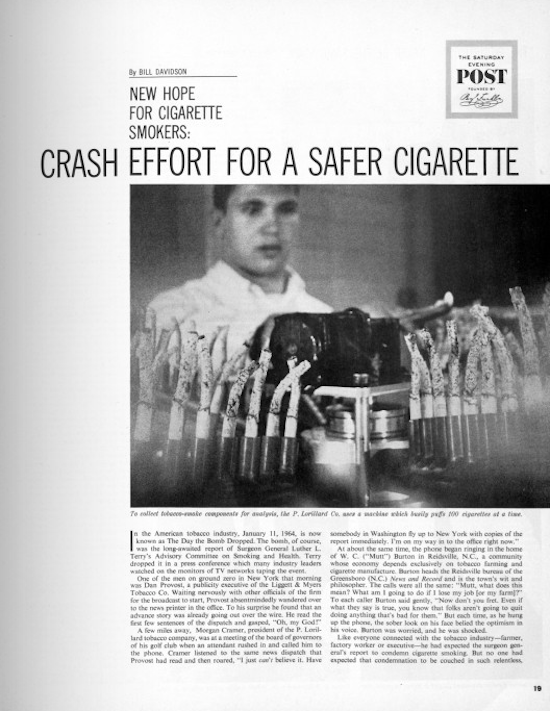
Featured image: Photo by Jim Mahan (SEPS)
Cover Gallery: The Wisdom of Ben Franklin
Every January between 1943 and 1961, the Saturday Evening Post featured an image of Benjamin Franklin on its cover, along with a quote from the famed inventor, printer, and statesman. Below is a selection of those covers along with his wise words, which still resonate hundreds of years later.
John Falter
“God grant that not only the love of liberty but a thorough Knowledge of the Rights of Man may pervade all the Nations of the Earth so that a Philosopher may set his foot anywhere and say This is my Country.”
John Atherton
“The Eyes of Christendom are upon us, and our honor as a People has become a matter of Utmost Consequence to be taken care of. If we give up our Rights in this Contest, a Century to come will not Restore us to the Opinion of the World; we shall be stamped with the character of Poltroons & Fools — Present Inconveniences are, therefore, to be Borne with Fortitude, and Better Times expected.”
John Atherton
“The Rapid Progress True Science now makes, occasions my regretting sometimes that I was born so soon. It is Impossible to imagine the Height to which may be carried, in a Thousand Years, the Power of Man over Matter…O that Moral Science were in a fair way of improvement, that Men would cease to be Wolves to one another, and that Human Beings would at length learn what they now improperly call Humanity!”
John Atherton
“Friends and Neighbors, the Taxes are indeed very heavy, if those laid on by Government were the only Ones we had to pay, we might more easily discharge them; but we have many others, and much more grievous to some of us. We are taxed twice as much by our Idleness, three times as much by our Pride, and four times as much by our Folly; and from these Taxes the Commissioners cannot ease or deliver us.
John Atherton
“I think with you, that nothing is of more importance for the public weal, than to form and train up youth in wisdom and virtue. Wise and good men are, in my opinion, the strength of a state for more so than riches or arms.”
John Atherton
“Do not believe the reports you hear of our internal Divisions. We are, I believe, as much united as any People ever were, and as firmly.”
Stanley Meltzoff
“If all Printers were determin’d not to print any thing till they were sure it would offend no body, there would be very little printed.”
Stanley Meltzoff
“Happiness consists more in small conveniences or pleasures that occur every day, than in great pieces of good fortune that happen but seldom to a man in the course of his life.”
50 Years Ago This Week: Can Basketball Survive Lew Alcindor?
On January 14, 1967, the Saturday Evening Post published an article about rising basketball phenomenon Lew Alcindor, who at the time was a sophomore at UCLA playing under coach John Wooden. Author Rex Lardner predicted that college basketball was entering the Alcindor Era.
Lardner was dead right. The 7’1 3/8” Alcindor led Wooden’s Bruins to three consecutive victories, and then steered the Milwaukee Bucks to an NBA championship in 1971. The day after the win, Alcindor changed his name to Kareem Abdul-Jabbar, and then went on to break a list of records as long as his arm.
As this article clearly illustrates, his greatness was evident even at 19. Alcindor’s many honors that 1967 sophomore season included Associated Press College Basketball Player of the Year, First Team All-American, Most Outstanding Player in the NCAA Tournament, Oscar Robertson Trophy winner, and Helms Foundation Player of the Year. His playing style made most games so lopsided that it led to the NCAA banning the slam-dunk until 1976.
Some thought Alcindor was foolish to go to college instead of turn pro. Bill Sharman, then coach of the San Francisco Warriors, commented that “He could be earning $100,000 a year for the next three years.” (In fact, his first year salary with the Bucks was $1.4 million.)
In the 1967 article, even the normally understated Wooden saw potential greatness. When asked what he thought of his new player, Wooden simply said, “Awesome.”
Rex Lardner
“Today, a Woman Went Mad in the Supermarket” by Hilma Wolitzer
Originally published on March 12 1966.
Even now, saying it aloud or, later, repeating that sentence to my husband, I will see that it is meant to amuse, to attract interest, to get attention. Of course, I am too sophisticated in things psychological (isn’t everyone today?) to think that one goes mad at a moment’s notice. There are insipid beginnings to a nervous breakdown. There is lonely crying in the bathroom, balanced on the edge of the tub, and in the kitchen, weeping into the dishwater, tears breaking the surface of the suds. There is forgetting, or wishing to forget, the names of the children, the way to the local bank, the reason for getting up in the morning. There is loss of vanity — toenails growing long and dirty into prehensile claws, hair uncombed, eyebrows unplucked. Yet, somehow there seems to me something very right about going mad in a supermarket: painted oranges, threatening to burst at the navel; formations of cans, armored with labels and prices and weights; cuts of meat, aggressively bloody; and crafty peaches and apples, showing only their glowing perfect faces, hiding the rot and soft spots on their undersides.
Nevertheless, this woman did not go trundling her cart through the ordered chaos. She stood transfixed, as if caught in some great thought. She was blocking the aisle.
“Excuse me,” I said tentatively, hesitant and self-protective as only a woman expecting her first child can be. “Pardon me, could I just get through?”
She turned slowly, and the two small children clinging to her skirt held on and tightened the cloth across her hips. Perhaps for the glory of the retelling, I might say that she was a great beauty, that her beauty was marred (or enhanced) only by her wild expression. In truth, she was pretty in a common sort of way, with conventional hair and eyes and nose. Only what she said then stopped me from clearing my throat and asking again if she would move and let me through.
She gripped the handle of her empty cart and said, “There is no end to it.” It was said so simply and undramatically, but with great honest conviction, that for a moment I thought she was referring to the aisle of the supermarket. Perhaps it was blocked ahead of us, and she could not move up farther. But then she said, “I have tried and I have tried, and there is no end to it. Ask Harold. Ask anybody, ask my mother.”
“Do you feel all right?” I asked. “Can I help you?”
Her knuckles were white and hard as she clung to the cart. She did not answer.
I looked around me self-consciously, and then I leaned toward her and said, “Would you like to go home?”
“You know,” she said severely, “that I can’t go there.”
Then a woman rattled her cart toward us from the other end of the aisle. “Excuse me,” she called out cheerfully. “Coming through!”
“Could you go the other way?” I asked her.
“Why should I go the other way?” she demanded.
“Because this aisle is blocked,” I answered, grimacing and rolling my eyes. She looked at me suspiciously and walked briskly back in the other direction. A chain of voices began in the back of the store. I heard the last one call, “Mr. A.! Mr. A.!”
Then for a few minutes we were alone, the woman and her children and myself. We stood in the supermarket as if primed for a television commercial in which the magical product would come winging from the shelves, where brand X would forever stay, unwanted and untried. The manager, Mr. A., came eagerly toward us. He is a kindly fellow with dull eyes, who perhaps could seem even kinder in a small, intimate grocery store. He will sprint off on a given signal and bring back the bread crumbs or the baking soda or the canned crab meat that you cannot seem to find anywhere. He rubbed his hands nervously.
“How can I bear it?” the woman cried in grief.
Mr. A. looked at her questioningly. “Can I get you some water?” he asked.
She did not answer him, but covered her mouth with her hand, so that all her anguish was concentrated in her eyes. I began to tremble, and I worried that my concern for her would somehow affect the child I was carrying. Didn’t I worry two aisles back, if, when the time came, I would choose the right baby food, that my milk would flow, that I would be a wise mother? All this time the two small children did not release their grip on their mother’s skirt.
“She’s very ill,” I told Mr. A.
“Shall I call the police?” he asked. The woman began to weep big flowing tears, and I thought then that all the priests and plumbers and policemen of the world could not stay them.
“No, no,” I said quickly, looking at the children. Bending at the knees, I leaned toward the taller child. “What’s your name?” I asked him. I was close enough to smell his milky breath and to see that his nose was running onto a crusty sore right under it. He turned his face away from mine and did not answer. Feeling balder, I took the handbag that was looped over the woman’s wrist, and she did not resist me. She did not seem to notice.
“There must be something, if only I could remember,” she said vaguely. The pocketbook creaked open, as if from long disuse, or like the mouth of a nervous child at the dentist’s. Mr. A. peered over my shoulder. There was a sweet, hair-tonic smell. The pocketbook was empty. We peered into it, unbelieving. It was the saddest thing I had ever seen, that empty pocketbook.
“Jeez,” Mr. A. whispered. But then he brightened. “Say,” he said, “say, if her pocketbook’s empty, then she doesn’t have any car keys. She must have walked here. If she walked here, then she can’t live too far.”
I looked at him coldly. “Maybe she left them in the car,” I said. “Or maybe she cleaned out her purse somewhere, or left home with it empty.”
This deflated him for only a moment. He looked thoughtful, then called to a stock boy who had been staring at us. Mr. A. sent him out into the parking lot and told him to look at the ignitions of all the cars.
“Pee-pee,” said the smaller child suddenly, tugging at his mother’s skirt.
“Oh,” I said. “He has to go to the bathroom.” I took his fist and tried to detach it from his mother’s skirt. He held fast with the tenacity of a tick in a dog’s coat.
“Mama, pee-pee,” the child insisted.
“He only wants his mother to take him,” I told Mr. A., and he nodded as if I was translating from a foreign language. The child stuck his thumb into his mouth and sucked greedily. Then the stock boy came back and said that there was no car with a key in it.
A small group of women had gathered at the end of the aisle, curiosity drawing them close, fear keeping them distant. “Do any of you know this woman?” I shouted to them.
They mumbled among themselves, and then a tall, rawboned woman in a Girl Scout uniform walked closer. “ I don’t know her — “ she began, and from the rear someone called, “Why don’t you look in her pocketbook?”
“I don’t know her.” the tall woman repeated, “but I know who she is.” She ducked her head and then glanced up guiltily. “Her name is Shirley Lewis. Mrs. Harold Lewis,” she whispered, and then fell back into the crowd of women like a frightened informer.
“But where does she live?” I asked irritably.
“Oh-oh, pee-pee,” sighed the little boy, and a stream of urine, tentatively begun, ran down his leg.
“Never rush into anything,” his mother stated. And then nostalgically, “How nice it was to be children!”
“Where? Where?” I snapped at the woman in the Girl Scout uniform. I knew that I was vying with Mr. A. We were playing detective, savior, twenty questions, God. Who would win this terrible contest and solve the mystery and set things right again? I had a good lead. All-powerful, matriarchal, replete with swollen belly.
The woman came forward again. She mumbled an address and stepped back into the group of women. Mr. A. scribbled the information in a little notebook and went to the telephone in his office. One point for Mr. A.
“Where is Harold?” I asked slyly when Mr. A. had gone. Shirley Lewis looked at me with real interest. “Ha, ha,” she said, and smirked, squinting her eyes, as if I had said something vulgar but worth noting. The little boy stood, straddling his puddle, miserable with his public act. I looked into my shopping cart and saw that the frozen things had begun to sweat and thaw. I was very tired. My legs were singing with fatigue. I wanted to sit down. I wanted to go home and take a bath. The woman was tiresome, the game was tedious, the supermarket was boring.
“We sat at the table,” Shirley Lewis began. “My grandmother brought in the soup. It was so heavy, her hands trembled. Uncle Al brought everybody in the car. He had a Pontiac.”
Mr. A. came back. He was smiling. The game was over. “Her husband is home! He was sleeping; he didn’t even know she was out.”
“Ahhhhh,” moaned the crowd of women, like a Greek chorus.
Soon, the husband came. He had the car, after all. The children rushed from their mother to him. Fair-weather friends, I thought. He was tall and heavy. He was wearing work clothes, and his shoes were untied. There were sleep creases down the side of one cheek. He ignored everyone else, although we looked eagerly to him as we might to the comedy relief in a melodrama. Incredibly, he scolded the small boy for wetting his pants. To his wife, he said, “What’s the matter with you?”, and he took her arm. She went with him, and then it was all over. Several women broke away from the crowd and went to the window. They watched Harold and Shirley and the children get into the car.
I looked dully into my shopping cart. It was impossible to remember the other things I had wanted to buy. Shirley Lewis’s pocketbook lay gaping on top of my own. I wondered if it would be returned to her. I thought, whimsically, that we would not be hearing from her. Harold had not said thank you to anyone. I imagined, giddily, an engraved card coming in the mail: “Mr. Harold Lewis and family thank you for the kindness extended to Mrs. Lewis in her time of need.”
Mr. A. was extremely gracious. He guided me to an unopened check-out counter and personally rang up the few items in my cart. “Some fun,” he said, clucking his tone. “You were swell.” He was the master detective congratulating the cop on the beat. His glory knew no bounds. He offered to take my package to the car.
“No, no,” I said, yawning in his face. I left the pocketbook on his counter, sneakily, as one leaves a litter of kittens in a vacant lot. “
Good-bye,” some of the women called to me. I had proved myself after all, and someday they would ask me to join committees and PTA’s and protest groups. I went home. My matriarchal stature had changed to a pregnant waddle. When my husband came home from work, I was sitting in the bathtub and weeping.
“What — what is it?” he cried, primed for catastrophe.
“Everything,” I said, gesturing at the swelling that rose above the water level. “Everything. The human condition. The world.”
His face relaxed slightly, and he waited for me to go on.
I rose, the water spiraling from my belly. “A woman went mad in the supermarket today.”
He managed to look both compassionate and questioning. “What did you do?”
I waved the towel as if it were a banner, a piece of evidence. “There was nothing I could do. Nothing at all. I mean, I tried, but there was simply no way that I could help her.”
He took the towel and began to dry my back.
“I think I know how you feel,” he said, “but you can’t mother the whole world.”
“No,” I said. “I guess I can’t, can I?” I turned around and threw myself awkwardly into his arms, the only world, at that moment, that seemed safe for me and my child.
Psst! Wanna Hear a Secret?

Have you heard the story behind Rockwell’s cover The Gossips? Some say the painting was Rockwell’s revenge on a woman in Arlington, Vermont, who’d spread an ugly rumor about him. He re-created the life of the rumor, beginning with an elderly woman whispering about Rockwell to a neighbor. From there the tale takes wing, speeding through town from one eager gossip to the next, until it comes back to Rockwell himself, who confronts the rumor’s originator in the bottom right.
The faces are so carefully delineated you can almost hear the sound of their voices passing along the story in tones of shock or malevolent glee. But when the work was completed, Rockwell worried he had gone too far in caricaturing the neighbors he’d used as models. He even went so far as to ask the Post to assure readers that the people of his hometown were much better looking in life than the way he portrayed them.
Was the painting truly an act of revenge? It seems to have been regarded as such. When The Gossips appeared on the Post’s cover, what we heard is that the woman never spoke to Rockwell again. In fact, some say she left town. (Of course, this has to stay just between us.)
100 Years Before the iPhone: Early Telephone Innovations
For once, the word “revolutionary” might have been an understatement. On January 9, 2007, Steve Jobs told the crowd at San Francisco’s Moscone Center that Apple was introducing three revolutionary products.
“The first one is a widescreen iPod with touch controls. The second is a revolutionary mobile phone. And the third is a breakthrough internet communication device.”
“So… an iPod, a phone, and an internet communicator. Are you getting it? These are not three separate devices. This is one device. And we are calling it iPhone. Today, Apple is going to reinvent the phone.”
Despite the newness of the device, its tiny, virtual keyboard, and its high introductory price of $600, Apple sold over a million units in the first three months.
Soon programmers were extending the usefulness of the phone with thousands of new applications. By the third generation, you could make a movie, hail a car service, find a date, or translate a foreign language. The U.S., and the world, had fully entered the age of the smartphone.
Technology revolutions, like electric lighting and landline telephones, used to take decades to enter the lives of all Americans. The iPhone was not only adopted quickly but also started to become a bigger part of Americans’ lives than anyone could have predicted. Today, average Americans check their cellphones 46 times a day. If they’re millennials, they check it more than 157 times.
The growth of the iPhone is unprecedented, but not all its features are. The idea of adding innovative features to the telephone is almost as old as the telephone itself.
On April 26, 1913, for example, the Post reported primitive solutions to common telephone annoyances.
Telephoning Simplified
To do away with two of the worst irritations of telephoning — the possible missing of an important message if the telephone is left unattended and the “Line busy” annoyance — telephone exchanges now often have a message operator.
A doctor may be forced to leave his office or his home when there is no person available to answer the telephone during his absence, and by so doing he risks missing a call from some patient. Under the new system he tells the message operator at the telephone exchange that he is obliged to leave his telephone unattended and gives her his number. She has his telephone line switched to her own desk, so that any call for his number rings her bell. If a call comes for the doctor she takes the message, promising to deliver it to him later. All that the doctor has to do on his return to his house or office is to call up the message operator and inquire whether any message has been left for him.
The message operator is useful also when the report “Line busy” or “No answer” is given repeatedly to some important call. She is notified that a certain number is wanted and at regular intervals she makes the call. When she finally succeeds in getting the number, she calls up the man who desired it and connects his line.
It may not strike you as sophisticated technology, but the thinking behind this concept evolved in time into call forwarding, call waiting, voicemail, and texting.
Even the idea of a wireless personal phone is not new, as the Post reported in May 31, 1913.
Pocket Wireless Outfits
A pocket wireless receiving station has now been perfected, bringing a little nearer to accomplishment the dream of pocket wireless telephones, though the actual use of the new device is very limited.
The outfit is equipped only for receiving messages and not for sending them. It could be used, for instance, to catch the time signals that are sent out at Arlington or from the Eiffel Tower, in Paris. The instrument measures only six by three inches, and consists of an electrolytic detector, a battery of three volts, two condensers, and a telephone in which to catch the wireless message.
In order to use it one must attach it to some elevated wires, or antenna, which will pick up the message, and also to some metal connection with the ground; so that, even when equipped with the pocket wireless, an enthusiast is liable to have difficulty in finding the necessary wires.
Nor is the idea of accessing information by phone new. In 1952, the Post told readers that Vienna’s phone system offered online information, though much of it was powered by humans.
Telephones That Tell All
Although the United States has the greatest number of telephones per capita, it isn’t world champion when it comes to getting the most from Mr. Bell’s invention. That title belongs to Vienna, where having a phone is much like having a vocal encyclopedia, a nursemaid and an extra right arm.
The Vienna telephone company starts its helpfulness program with such familiar American services as providing the correct time and the weather forecast. It goes on to give subscribers the winning numbers of the national lottery, the latest stock-market quotations, a menu with recipes, skiing conditions at Austria’s winter resorts, and rail, bus and plane schedules.
A Viennese violinist with insomnia can dial A069 at any hour of the night and get the normal “A” tone for fiddle-tuning purposes.
Another number gives the tone common to 1000 vibrations per second, which is handy in case you have steel to test. Industries use this tone to find flaws in metals.
Along with this cluster of services, the phone company maintains its own information bureau. Operators in this department will tell you all about night clubs, concerts, sports events or other Austrian festivities. They will give you the standard width of a baby carriage for twins, the color of a cow’s eyes or the word for nine-down in the daily crossword puzzle.
Children telephone Information for help with their homework, and if the operators can’t answer their questions immediately, they will call back later with the requested data. Information draws the line only at questions on morals and politics.
Recently one operator got a call from a harassed father, who said his wife was in the hospital and that his two young children were driving him the Austrian equivalent of “nuts.”
“Can’t you do something to calm them down?” he asked. The operator got their names and asked to speak to one of them.
Then, dropping her voice to a lower register, she said, “This is Santa Claus speaking, Johann. I understand you are being a bad boy. Don’t you know Christmas is coming?”
This reformed the children, but for the next two weeks the Santa operator got daily calls from Johann, who naturally was eager to mend his fences.
The Vienna phone company started its program for making subscribers happy with extra service in 1947. Since then the information bureau alone has received more than 160,000 calls, including a query that always leaves officials somewhat bewildered.
Several times each day operators are asked, “Would you please tell me today’s date?”
These early solutions might not rival modern smartphones for convenience, but they are a testament to the human race’s ingenuity and dogged pursuit of the next new thing.
Featured image: telephone operators ca. 1914 (Library of Congress)
Get A Horse! America’s Skepticism Toward the First Automobiles
This article from the February 8, 1930, issue of the Saturday Evening Post was featured in the Post’s Special Collector’s Edition: Automobiles in America!
In 1930, Alexander Winton, by then one of the legends of the auto industry, wrote this article for the Post about the wild early days when even promoting the idea of a self-propelling machine would make you the object of ridicule. Winton was a bicycle maker, and as he writes below, he soon became infatuated with the idea of a bicycle that “a rider wouldn’t have to push and keep pushing.” In 1896, he founded the Winton Motor Carriage company, and soon began turning out cars at the dizzying rate of four per year. He would sell his first car in 1897 — arguably the first automobile sold in the U.S. — for the princely sum of $1,000.
There has been much argument as to who made the first automobile in this country. My own conviction is that the honor belongs to Charles E. Duryea. I began serious experiments in 1893, and I am sure Duryea was conducting them prior to that year. But whether Duryea built the first automobile or whether he didn’t, the fact remains I built, and sold, the first American- made gasoline car.
The exact date of the sale was March 24, 1898, and about a week later — on April 1, 1898 — I received payment and shipped the car to its new owner, Robert Allison, a mechanical engineer of Port Carbon, Pennsylvania. I bought it back after Allison had used it a few years, and it is now in the Smithsonian Institution, in Washington.
When I first contemplated the application of gasoline for vehicles, I had a bicycle plant in Cleveland. Because bikes interested me, my mind naturally turned to something a rider wouldn’t have to push and keep pushing if he was trying to get some place. But the great obstacle to the development of the automobile was the lack of public inter- est. To advocate replacing the horse, which had served man through centuries, marked one as an imbecile. Things are very different today. But in the ’90s, even though I had a successful bicycle business, and was building my first car in the privacy of the cellar in my home, I began to be pointed out as “the fool who is fiddling with a buggy that will run without being hitched to a horse.” My banker called on me to say: “Winton, I am disappointed in you.”
That riled me, but I held my temper as I asked, “What’s the matter with you?” He bellowed: “There’s nothing the matter with me. It’s you! You’re crazy if you think this fool contraption you’ve been wasting your time on will ever displace the horse.”
From my pocket I took a clipping from the New York World of November 17, 1895, and asked him to read it. He brushed it aside. I insisted. It was an interview with Thomas A. Edison: “Talking of horseless carriage suggests to my mind that the horse is doomed. The bicycle, which, 10 years ago, was a curiosity, is now a necessity. It is found everywhere. Ten years from now you will be able to buy a horseless vehicle for what you would pay today for a wagon and a pair of horses. The money spent in the keep of the horses will be saved and the danger to life will be much reduced.”
“It is only a question of a short time when the carriages and trucks of every large city will be run by motors. The expense of keeping and feeding horses in a great city like New York is very heavy, and all this will be done away with. You must remember that every invention of this kind which is made adds to the general wealth by introducing a new system of greater economy of force. A great invention which facilitates commerce, enriches a country just as much as the discovery of vast hoards of gold.”
The banker threw back the clipping and snorted, “Another inventor talking.”
Wild Ideas
In the uncertainty of what the public would want, a great many strange contraptions were put together. Joseph Barsaleaux, a blacksmith of Sandy Hill, New York, built a motor horse. In his device, the horse moved on a single wheel about two feet in diameter, with the wheel attached to the shafts just as was a live horse. Reins attached to the mouth of the horse served as a steering gear, because the machinery was inside the horse and had to be regulated some way. The contraption weighed about 550 pounds, had a cruising speed of six miles an hour, and attracted some serious attention.
In Washington there was a vehicle which gained its power by using compressed city gas. George Elrick of Joliet, Illinois, was busy with an engine having no wheels or gears and which manufactured its own gas as it went along. D.I. Lybe of Sidney, Iowa, was the owner of patents on a spring-motor device which stored energy running downhill and used it going uphill, while on level ground he claimed his vehicle would cover 2,000 feet at a maximum speed of 30 miles an hour. Compressed air and superheated water were to be employed by another company. At the time there was more money and in uence back of that idea than was behind all the gasoline-car manufacturers put together.
Cars with steam propulsion came in — not one or two but more than 100. Electric vehicles clogged the market, but in the end, public opinion turned to gasoline because it was clean, safe, and dependable.
In spite of my banker’s displeasure, I went ahead with my model and finally had it in such shape that I thought it would run. All I needed to finish the job was a set of tires. I went to the Goodrich Company, in Akron, and told them I wanted something bigger than their biggest bicycle tire, something that would fit the wheels of a horseless carriage.
“That’s a new one on us,” cried a man to whom I had been directed.
“A horseless carriage, eh? Hmph! Will it run?”
“You bet it will.”
“Well, I guess we can make them, although we never have.”
“That’s fine.”
The man hesitated, rubbed his chin, and observed: “We will make them, but you will have to pay for the molds.”
“Do what?”
“Yes, sir. There won’t be enough call for tires for horseless carriages, and we can’t afford to pay for the molds. Also, you will have to pay for them in advance — and the tires too. We’ll have them on our hands if you don’t get them.”
I paid.
They were single-tube affairs, and were pretty expensive. It wasn’t long before I got a puncture, and while I thought of patching the tire I figured out what I considered a better idea. Molasses was heavy and would stop leaks if they weren’t too large, so I began pumping it into the tube. I pumped too hard. The rubber gave way and the molasses came out too quickly to be dodged.
The First Road Trip
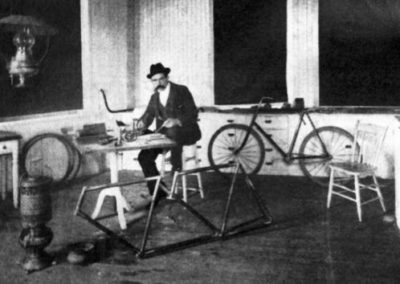
That first car worked pretty well, but I saw so many things wrong with it that I started another, using part of my bicycle factory for the work. I foresaw a future in automobiles and tried to interest some people in starting a manufacturing plant. Failing in that, I decided to go on a long trip, hoping attention would be attracted to the machine.
In July 1897, I confided in a friend: “I am going to drive my horseless carriage from Cleveland to New York. I am inviting you to come with me.”
He laughed at me. I sought another friend.
On the morning of July 28, 1897, Bert Hatcher and I left Cleveland. The Horseless Age, one of the few motor publications of that time, wrote about us this way: “Combining business with recreation, Alexander Winton left Cleveland with a companion in a new motor carriage on the morning of July 28, and after a leisurely journey he reached New York City Saturday, August 7. From Mr. Winton’s account, no greater test could have been given the machine as, to use his own words, ‘the roads were simply outrageous.’ Fully two weeks of rainy weather had preceded him on the journey, and in many places the mud and water were hub deep, and in some places the sand was equally as bad. He traveled fully 800 miles, and the best day’s run was 150 miles. The machine consumed on an average of six gallons of gasoline a day, which would be little more than half a cent a mile for the trip. Much interest was shown by the people on the road and especially by those in the mountains.”
Hatcher and I did not return by motor. We had blisters enough. You may wonder why, on this first trip ever attempted by an automobile over a long distance, we were able to complete a day’s journey on an average of six gallons of gasoline. The fuel was more volatile in those days, and we had a low-speed motor. The present high-speed motor uses a great deal more fuel, but it is a more adaptable engine for the needs of modern travel.
In those days there were no gasoline stations, and the only place the fuel could be purchased was in a drug store. If, by chance, the druggist had a gallon of it, we were happy. Seldom were we able to buy in such a large quantity and usually we had to be content with a pint or a quart.
But aside from generous newspaper space, the trip attracted no attention. I waited for months, but no financiers came to put their tall silk hats on my desk.
Finally, however, the afternoon came when an assistant told me: “Mr. Metcalf is waiting to see you.”
“Who is he?”
“I don’t know.”
I hesitated, then said; “Send him in.”
The man came in and introduced himself. “My name is Irving D. Metcalf. I am from Oberlin College.”
“A professor?”
“Yes, sir.”
“You want to see my horseless carriage?”
“Yes, I do.”
“There it is” — and I jerked my thumb over my shoulder to indicate the machine standing in a corner of the room.
I turned to resume some sketching I was doing when I heard Mr. Metcalf say: “Would you mind explaining it to me? I’ve read so much about that machine that I’m convinced you have a good thing and, if you have no objections, I’d like to invest a little money with you.”
I wasted no time in accompanying him to the machine and explaining its workings.
“How many can you build and sell the first year?” he finally asked.
“Four.”
“Sell me some stock?“
“If you want it!”
“How much can you spare?”
I almost held my breath. “Five thousand dollars’ worth.”
“All right.”
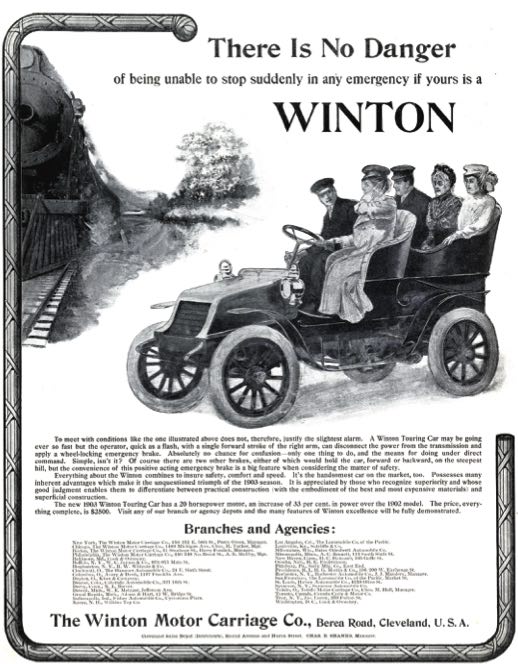
Up to that time no company had been organized to build and sell a gasoline automobile.
Not in this country, at least. So Metcalf became the first outside holder of stock in such a company.
We did not know where our customers would come from, but we were sure they would come. We started building four machines, and when one was finished, Robert Allison, hearing that I was manufacturing automobiles, came to Cleveland.
He wanted a ride. I told him to hop in, and then proceeded to give the first of many millions of demonstrations that since have preceded the sale of automobiles. We started out about noon and did not return until after supper. During the afternoon he had me drive to a dozen places where friends of his were working, and from each he sought advice. After each stop he had a new set of questions, but apparently I answered them satisfactorily, for when we returned to the factory he asked: “How much do you want for this carriage?”
“One thousand dollars.”
“I’ll buy it.”
Within a short time we sold the other three machines, getting $1,000 apiece. Our profit on each was $400. By the end of 1898 we had built and sold 25 carriages, and this was such an amazing production that no one believed it. I had to publish a statement telling the names of the owners and when their machines had been delivered.
We were beginning to show a return on the original in- vestment, to build a business, and to start a gigantic industry. Those were vastly different days in manufacturing to what we now have. We had no long lines of broaching machines, multiple drills, cylinder grinders; no endless chains moving along parts to points needed. There was little of the time-saving of modern manufacturing methods. We had to develop to meet those demands, and in starting off, our tools consisted of the standard drills and lathes, plus good mechanics. Every workman we had in those days was a good mechanic. He could not hold a job unless he was. He didn’t spend his days or his years putting on a nut here or a screw there. If we needed spark plugs, he had to jump in and make them. He had to know how to ream out a cylinder. All argument to the contrary, I believe American life has lost something in the passing of the good mechanic and the widespread adoption of the automatic machine. For one thing, men have lost much of their usefulness to themselves. But that is beside the point.
No Secrets
We used foundry castings for cylinder blocks and, usually, the castings came to us with holes in them. Such a thing as rejecting the castings never occurred to us; we were too glad to get them, because foundry men weren’t entirely sold on the idea of making them. We plugged the holes with cast iron and said nothing. We made our own spark plugs — first out of mica, and then out of porcelain. Steering wheels were individualized ideas, not standardized equipment. One day Henry Ford came to Cleveland with a racing car. He had a steering wheel he had made himself and which spun around a number of times before he could get the car going in the desired direction. “Ford” I told him, “you are going to kill yourself with that thing.”
“Why?” he asked.
“Because you can’t control your car with it.”
He allowed as though I might be right.
“You know I’m right,” I told him, and added I would send him blueprints of the wheel and gear I was using.
He thanked me, but instead of sending him the blue prints, I boxed up a complete outfit and shipped it to Detroit. He found plenty of use for it. The steering wheel was one of my early patents, and it was the same wheel that came into later and general use. It is but one of more than a hundred patents I hold on different parts for automobiles.
I believe I am entitled to say I have never collected a cent in royalties from them, nor will I. Lawyers have tried to argue me into bringing suits for infringements, but it so happened we pioneers always worked together. We loaned ideas. We loaned tools. We loaned patents. If we worked out a good idea, we loaned that. You see, some 20 years ago there was a man named George Baldwin Selden, a lawyer and inventor living in Rochester, New York, who caused a lot of trouble and expense to the automobile industry by bringing suit against all of us for the infringement of a patent that had been granted him on May 8, 1879. His patent covered a machine containing the essential principles of an automobile.
He tried to interest various persons in his idea, failed for years, and then entered into an agreement with William C. Whitney, an Eastern capitalist, on November 4, 1899, under which he turned over exclusive rights to his idea. Whitney purchased control of the Electric Vehicle Company and then began a vigorous enforcement of his claims. The Winton company was the first to be attacked because it was the largest, and though we put up a vigorous defense, we lost the first court fight. We appealed the case and, while waiting to be again heard, entered into an agreement with other manufacturers to pay certain royalties to Selden and Whitney.
For years Selden was in the courts, until, in January 1911, in the United States Circuit Court of Appeals, the validity of the Selden patent was upheld, but the defendant — the Ford Motor Company — was held to be not liable, because it was manufacturing a motor of a type known as the Otto engine, whereas Selden’s claims described one known as the Brayton type.
All of us were following the Otto principles, so that decision relieved us of further contributions to Selden and his backers. But the unpleasantness of all those suits brought together the manufacturers for an exchange of ideas and mutual protection. I am still old-fashioned and believe it was a good thing.
Self-Reliance
We made our own radiators. These cooling devices were nothing more than banks of tubes through which water could ow. During summer months, on Saturdays and after-school hours, we used to have boys come in and string square tin washers, with a jagged hole punched in the center of each, on the tubes. When the washers were all in place we would dip the tubes in solder so as to make them one part.
We made our own carburetors. The first device used was a tube which went down nearly to the bottom of the gasoline tank. Air went through it, was forced into the gasoline, and when the impregnated mixture reached the top, it was suctioned off and passed through a valve between the tank and the engine, so the mixture would be made lean enough to be combustible. That contrivance didn’t work any too well, so we made a mixer which was an ordinary valve and pipe through which the gasoline could pass on its way to the motor. Out of the mixer came the present carburetor. In the one we built I had a hole punched in the bottom so the air could reach the gasoline. One day I received a frantic letter from a Brooklyn doctor who had purchased one of my cars.
A few days later I was standing in his barn, looking at the machine, which, he said, wouldn’t run.
I examined the gas tank. It was all right. I looked over the spark plugs. Tested the batteries. Got down under the car and stared up underneath. Everything seemed all right, so I went around in front and spun the motor. It was dead. Finally I ran my fingers under the mixer.
Then I broke in on the physician’s sarcastic twitterings with this question: “Why did you plug the hole in the bottom of the mixer?
“To keep the gasoline from leaking.”
“Have you ever studied chemistry?”
“Certainly.”
“I see. But you never learned that an explosion is impossible without a mixture of some sort. In this case it happens that gasoline has to be mixed with air before results can be obtained.”
It was my turn to be sarcastic. I punched another hole in the mixer, drained off the gasoline which had flooded the cylinders, put the fluid back in the tank, turned the crank, and started the motor.
That was one thing we pioneers in automobiles had to do that presidents of companies miss today. We had to give personal service to our customers. Many times I have piled out of bed on a winter’s night to aid a stranded driver. A good many times, too, I left my telephone receiver off the hook so I could get some sleep.
Batteries, so dependable now, were practically useless as they then made them. The battery was nothing but a receptacle holding containers, or cups, filled with the active acid fluid. These cups were made of carbon, and after a car had traveled a couple of blocks the cups were almost sure to break, spilling their contents and rendering them useless.
A man named Nungesser was building ours, and they were causing me so much trouble that I refused to put them in the cars. I went to Nungesser and said to him: “I want you to tell me the truth. For weeks you have been promising a dependable battery and you haven’t delivered. What’s wrong? Can’t you make one?”
His face flushed as he admitted: “I can’t, Mr. Winton. I’ve tried everything and can find nothing.”
That was bad news for me. I went into his plant, looked over various experiments and finally suggested: “Why don’t you use a wire gauze for your cup instead of carbon?”
“A wire gauze?”
“Yes. Use copper. It is flexible and will not deteriorate in the acid solution.”
He tried it and it worked. Worked so well that he o ered me a half interest in his business. I declined, although it would not have cost me a cent. I told him I was having troubles enough in the automobile business. That suggestion solved battery difficulties for a good many years and was really the beginning of the present storage battery. Nungesser later sold out to one of the big battery companies for an appreciable sum of money.
The Demise of the Half-Cranked Starter
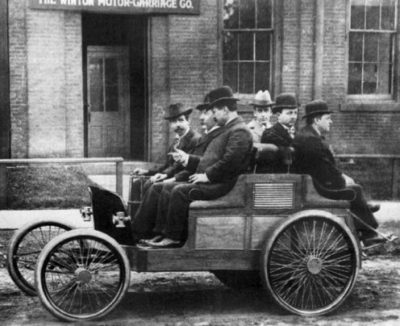
We made our own fans, our own differentials, transmissions, frames, brakes. I built the first two-braking system, and a Winton car was first to be equipped with internal and external brakes on the one drum.
This was another of my patents, and it is only in the last few years that four-wheel brakes have taken the place of those I worked out. We built our own starters. We had an air starter that took the pressure from the cylinders, stored it in a tank, and kept it ready for use. This air starter was the forerunner, in a sense, of the present electric starter.
It came about in a simple way. I was looking at a car one day when one of my men came along and began cranking it. The motor was cold and it was hard work.
“Next year we are going to equip our cars with starters,” I told an associate, standing with me.
“You mean so cars won’t have to be cranked?”
“Yes.”
“How can you do that?” There was doubt in his voice.
“That’s what I’m thinking about.”
I went inside, made a drawing of the idea that had come, built a mechanism that could be operated by pressing down a foot, and we had the starter.
Dishonest Practices
If there was orderliness in our shops, there was vast confusion in the fledgling industry. Not only did we have to fight all the time to get things done but after we had them finished we had to pitch in and fight the wildcat automobile companies on the outside. It was difficult for the public to distinguish between the genuine and the ephemeral, and there are towns that can still point to windowless factories that were built from the stock sold by glib promoters, but which never manufactured more than two or three cars. Orphan cars were numerous and always were a 100 percent liability, because it was impossible to get replacements for broken parts. The big accessory companies that now help the industry did not exist.
Dishonest practices did much harm during years when support was most needed.
The orphan-car situation became so serious that the White Company — another of the pioneers — gave publication to this advertisement: “In a reserved and guarded way we have several times spoken of the desirability of purchasing a car made by a substantial firm possessing ample capital. In the last few months many concerns which have embarked in the manufacture of automobiles have discontinued, while others have withdrawn from actual business and their organizations have been scattered.
“The man who has bought a car from such a concern learns too late that he has a car on his hands which is the next best thing to useless and worthless simply because duplicate parts cannot be obtained. It is of utmost importance that the purchaser should inquire very thoroughly into the stability of the concern from which he buys, and that the order of a car at a special price is apt to be an incident of a closing-out sale.”
When you know that more than 500 automobile companies came in and went out in those first few years, you will better understand some of the forces working against those of us who were honestly trying to succeed. We pioneers had to be conservative.
‘Visionary to the Point of Lunacy’
I remember that back in 1899 a bus line was announced to operate between Chicago and St. Louis. All of us believed bus lines would come some day, but we knew the public was not ready to accept such a dream. And, indeed, E.P. Ingersoll, a reporter on automobile topics, wrote the following widely circulated opinion piece: “The notion that electric vehicles, or vehicles of any other kind, will be able to compete with railroad trains for long-distance traffic is visionary to the point of lunacy. The fool who hatched out this latest motor canard was conscience-stricken enough to add that the whole matter was still in an exceedingly hazy state. But,if it ever emerges from the nebulous state,it will be in a world where natural laws are all turned topsy-turvy, and time and space are no more. Were it not for the surprising persistence of this delusion, the yarn would not be worthy of notice.”
We were trying to keep public interest, suddenly aroused, within reasonable boundaries. Aside from making cautious predictions, we had other diversions. Stirring word battles were fought in the greatest wilderness of all — the wilderness of terminology. Some wanted “horseless carriage” as a standard description; others recommended “polycycle,” “syke,” “motor wagon,” “motorcycle,” “horseless-carriage bicycle,” “road locomotive” — I guess there were a hundred names, but “automobile,” because of its easy rhythm, won out.
The Ford-Winton Race
Another thing we had to do which no president or executive of an automobile company of today would think of doing was to compete against each other on race tracks. Duryea, Walter C. White, Ford — we all used to race. That is how we attracted attention to our products. The public looked upon racing as a test of an automobile’s worth, and to a great extent it guided its buying habits by the results of the contests.
Ford got his first big reputation when he raced me at the Grosse Pointe track in Detroit. The day was October 10, 1901. Prior to that time Ford was little known. The first mention of him in connection with the motor industry, so far as I have been able to find, was in a small item in an issue of The Horseless Age, printed in 1898. It read: “Henry Ford, of Detroit, Michigan, chief engineer of the Edison Electric Company of that city, has built a number of gasoline vehicles which are said to have been successfully operated. He is reported to be financially supported by several prominent men of the city who intend to manufacture the Ford vehicle. From Mr. Ford himself no information can be gleaned regarding his vehicle or his plans for manufacture.”
For some time prior to 1901, I had been the dirt-track champion driver, and when I received a challenge to race Ford in Detroit I accepted. A number of cars started, but the event soon narrowed into a test between my car and Ford’s. The Detroit News, on the day following the race, described the event: “Winton took the lead at the start and held it easily for five miles. Then the Detroit car began to creep up, and right in front of the grandstand, on the seventh lap, Ford forged ahead. Winton seemed to lose his power. His great car began to smoke and he was out of the race.”
Ford won, of course, and in winning, attracted national attention. Afterward he said, “Put Winton in my car and he’ll beat anything in this country.”
I told him I’d put myself back in my own car and beat him any time he came on the track.
The following day he announced: “I will never again be seen in a race.” Nor was he.
Those were great days. Lots of hardships. Lots of quarreling. Lots of satisfaction too. No paved highways for automobiles to shoot along at 60 and 70 miles an hour; just country roads, filled with ruts, sand, and mud, over which no one wanted to drive at the maximum speed of passenger cars, which was about 30 miles an hour. But every trip was a different adventure.
—“Get a Horse,”
The Saturday Evening Post, February 8, 1930
Artist in Residence
Something about the car parked beside the house — a red Chevy Aveo — Alex did not like. It aroused vague disquiet, like the scent of a predator. The license plate jumped at him: the ghostly visage of Abraham Lincoln and “Illinois” in rolling blue script. His jaw tightened. What was she doing here today? He considered driving off before someone inside saw him. But suppose someone already had?
It didn’t matter. The battle lines had moved. The front had advanced. Retreat was not an option.
Creaking steps announced him at the back porch. Through the screen door, he saw Sean spring up from the kitchen table. Sean’s voice cracked with surprise as he unlatched the door. “Uncle Alex?”
Alex shuffled inside. “Hey, Slim.”
Across the table, eyes bright and flashing behind Oleg Cassini frames fixed him in the doorway. She greeted him: “Speak of the devil.”
“Hi, Claire. I thought y’all did this on Tuesdays.” Today was Thursday.
“We changed it this week,” Sean said. “Miss Claire had detention hall Tuesday.”
Claire hoisted the Bible-sized Norton Anthology of American Fiction on her lap. “I thought of you when I read this story again. The main character is a musician. And the bandleader is named Creole. Your timing just now was perfect. You came in right on cue.”
No. His timing could not have been worse.
He gestured with the fiddle case in his hand. “I was out this way, so I figured me and Sean’d run through a few songs for Sunday. Sorry to interrupt.”
“We can wrap this up if you want,” Claire said. “Sean told me he’s sitting in with you for a few numbers at Festival Acadiens. I think that’s terrific.”
She sounded so generous, even flattering. But Alex always heard more than her words.
They’d met last July at the Creole Folklife Festival at LSU-Alexandria, where he was giving a fiddle workshop. He’d stopped in to hear his old friend Lorene Broussard spin tales in the Black Storytellers Alliance tent. As they talked afterward, a woman approached, dressed in crisp khaki shorts and yellow polo shirt, with bobbing copper ponytail and freckled cheeks, peering into the grease-stained lunch sack in her hands.
Lorene seemed to know her. “You get you some cracklins, boo?”
The reply came in a flattened Midwestern twang: “Yeah, I thought I’d see what I been missing all these years. Anyone?” She offered the bag to them, then picked out a chunk of pork skin. She studied, crunched, and critiqued. “Hmm. I think there was a piece of fat on this one. Deep-fried pork fat. I knew there was something I loved about this place. Seriously, Miss Lorene, it’s a wonder you people have survived this long.”
Lorene laughed, but the remark bothered Alex. Something in her tone sounded so … Yankee. So … white.
Lorene introduced them. This was Miss Claire, Claire Hopkins, come down from Rockford to teach a few years at the high school. “That far?” he asked. “What’s down here to bring you all that way?”
“Teach for America. I teach for a couple of years at a small-town school and get brownie points on my résumé. I also get to immerse myself in Louisiana culture. Pretty sweet deal, if you ask me.”
“And what do you think of Louisiana culture?”
She rattled the bag of cracklins. “The more I get into it, the more I like. Except the cockroaches. One skittered across the kitchen floor last night the size of a medjool date. Indestructible, too. I gave him my best Wayne Gretzky slap shot. Barely fazed him.”
“And the names? At first I thought half the parish was Italian. I met more Comos and Dimaggios than there are in the Rockford phone book. Then I saw it written. C-o-m-e-a-u-x. D-o-m-i-n-g-e-a-u-x. And me, an English teacher. I’m learning to spell all over again.”
Alex smiled. But something in her humor set him on edge. Exactly what, or who, was she laughing at?
Seeing her at Eva Crochet’s gallery a week later salted the sore. Eva was helping her pick out a present to send to the school where she taught back home. They went through the alligator skull paperweight, the corn husk dolls, and every Floyd Sonnier sketch in the shop before Claire decided on the hand-carved miniature pirogue. All the while, she marveled at the craftsmanship, the ingenuity of the local artists. She told Eva her place was a treasure, passing on traditions to a younger generation almost a sacred trust — as if Eva didn’t know that.
The same with her lecture on the virtues of buying local, delivered at Lejeune’s Automotive. Pete Lejeune’s son Gerald had planned to take over the business, until the Walmart Tire & Lube opened on the highway west of town. Now Gerald was night manager at the Best Western in Kinder, while his wife, Eloise, bused tables and refilled steam pans at the Coushatta Casino buffet.
And that was before Teresa heard from another parent what Teach for America was: bright young teachers coming to poor, failing schools. It all added up. And it made this habit of hers, which was only a nuisance on neutral ground, almost an insult here. Here in his sister’s home, a converted shotgun house on Bayou des Cannes, where added rooms with sheet vinyl floors settled unevenly with the prairie soil, and wooden doors and window panes swelled and stuck, open or shut, with the humidity. Where his father’s family had sharecropped into the ’50s. And now where she came every week to tutor Sean, his nephew, his student in the Creole fiddle tradition.
He should be grateful; his sister was. Sean was struggling as he started high school. Teresa had threatened to banish the fiddle to the closet as a distraction, like TV, where it might go untouched for weeks at a time, as wrist and shoulder muscles shrunk and interest waned. Then Claire came to the rescue, refusing pay, wanting only to help. Apparently, she was: Sean was still playing.
Her offer now raised the ante, and she held the stronger hand. If he left and let them finish the lesson, she won. If he let her cut it short, she still won.
He set down his fiddle and pulled out a stool at the counter behind her. “Y’all take your time. You don’t mind if I listen in?”
Claire flexed the book at its binding, a warm-up exercise. “Take notes. There will be a test.”
With that she plunged back into the discussion, leaving Alex to piece together fragments of the story: the younger brother, Sonny, had a drug problem and wanted to be jazz pianist, the older brother was set against it. Mostly, though, it was Claire who commanded his attention. Quick, witty, intense — did she ever let up? — she led Sean through scenes and lines of dialog, laying clues to help him discover how everything fit together, how this action revealed that character and that image carried the theme. With pride — selfish pride — he thought that Sean was more adept at learning double stops from him than making literary connections with Claire.
“What’s the big deal about music?” Claire was asking. “Why doesn’t Sonny just grow up and get a real job?”
“It’s too important. His music is like, a part of him. It’s real to him.”
“It’s real? You mean it’s not real to the rest of us?”
Sean tried again. “I mean, he’s lived it.”
“What does that mean — he’s lived his music? How can you live music?”
Sean was getting frustrated. Alex too. “He knows what it means,” Sean said. “It’s like, he knows what it’s talking about.”
“Talking?” Claire riffled the pages. “I didn’t see any lyrics here.”
Sean sighed. Alex too.
Claire cocked her head, glancing from the corner of her eye. A smile trickled across her face. She straightened her satiny violet bookmark on the page, nestling the cord in the binding, letting the gold star hang over the top. Squeezing the book shut, she pronounced: “To be continued. You’re getting it, Sean. You’re very close to the heart of this story. You just have to be precise. Then we’ll both know you’ve nailed it.”
Sean nodded, slumping as though winded. Alex felt his own spine loosen, his mood lighten. He reached for his fiddle case. “See you ‘round, Claire.”
“You’ll see me Sunday for sure. Slim, you better be good. And don’t let your uncle steal your licks.” Her hand was on the screen door, her foot on the threshold, when she paused and turned back, her eyes hopeful.
“Can I ask a favor? Is there some musicians’ code against having an audience when you rehearse? Is that like watching a magician practice his tricks?”
The tension returned. Why didn’t she just say it? “You wanna listen to us rehearse?”
“If you don’t mind. I’ve been to festivals and clubs and all, but there’s something about being one-on-one. It’s like reading a writer’s first drafts of a novel. You learn more about it that way. About what makes it good.”
Alex looked at Sean. Sean shrugged. “Okay by me.”
With anyone else, it would have been okay by him too. But the urge to make a new convert soured with the suspicion that the faith wouldn’t grow here. She said so herself: She wanted to learn about it. For all he knew, it was something she could use on her résumé.
It wouldn’t be the first time. Obscurity had one consolation: People weren’t fans of this music because it was trendy. They might come from curiosity, but it was love that brought them back. Yet for every one who stayed, who-knows-how-many shook their heads and walked away and maybe told their friends back home, with amused smiles, about that scratchy folk music those people liked.
Claire to her credit had signed on for two years. That entitled her to something.
He picked up the stool. “We use the back porch. The floorboards sound better.”
He and Claire went out front while Sean went for his fiddle. Alex scanned the shorn, burnt-umber rice fields of the neighbor’s farm. White egrets speckled the marshy tractor treads, stalking frogs. Farther beyond, a few Angus cattle grazed against the backdrop of a clear October sky. Perfect for making music. He settled on the stool and bowed the strings lightly, like a vodou conjurer in the presence of spirits, the fiddle giving them voice.
Claire perched on the railing. “That’s beautiful. The fiddle, I mean. Even I’m not impressed by a few notes.”
It was beautiful: the patina on the neck worn and polished with sweat and oil from his hand; the nicks in the scroll from a car crash, re-stained by rubbing with pecans; the pegs scorched from a small kitchen fire one Mardi Gras. “It’s seen some years.”
“Is it true that older fiddles sound better?”
“If they’re made right. The wood relaxes. The sound … mellows. And the longer you play it, the better you play it.”
She nodded. “Have you played that one since it was a baby?”
“No. I bought it from my teacher.”
“Is that how most people learn, by taking lessons?”
Was she thinking of taking it up? “And sitting in with older guys at jams and parties.”
“Do you do that a lot down here? Do people bring their fiddles to a party instead of CDs?”
Alex slashed his bow across the strings. The fiddle shrieked, silencing her. He smiled. Friendly spirits. “So how’s Sean doing? His grades are better?”
“Oh, yeah. He’s a sharp kid. He could do even better if he put more effort into it, but that’s true of 90 percent of the students. A lot of kids have trouble jumping from grade to high school. But he has his music, that grounds him. It’s what sports or science club does for the others.”
“Did you tell his mom that?”
A quick, fleeting lift of her brow made him sorry he’d said that. He felt exposed.
“I tell him he should use it as a subject for an essay or a history project,” Claire went on, “but he seems kind of shy about it. Maybe you would have some pull with that.”
Alex shrugged. He didn’t involve himself with Sean’s school life. Theresa kept after him enough. But he liked that idea. Her idea. Claire’s idea.
A sudden boom shook the air. The house trembled. Claire startled. “Is someone hunting?”
Other than her? “Wild hogs,” he said, calmly inspecting the fiddle pegs. “Big ugly things with tusks? They run around all over out here.”
“They do not. Uncle Alex.” Sean’s voice cracked with accusation as his fiddle case shoved open the screen door. “It’s farmers, scaring off cowbirds.”
“Yeah, they’re worse than hogs,” Alex said. “They eat the rice and lay their eggs in other birds’ nests. They came with the buffalo a hundred years ago and never left. What do they call that? Invasive species? Sean, you remember to roll your wrists?”
They warmed up playing scales, Claire looking from one to the other in fascination. Alex trusted she at least knew not to ask questions while they played. “All set, Slim? All right. Let’s try ‘Allons Danser.’ You lead, I’ll second.”
Sean swung into the song. Alex, backing him, listened for technical mastery: “You’re starting to saw. Keep a loose wrist. You got it.” But more for the style marks of Creole fiddle, the bowing patterns, the shuffling and slurs. Occasional glances at Claire found her swaying lightly, toes tapping the air, pantomiming their own feet slapping the boards.
They moved on to “Lake Arthur Stomp.” Sean seconded Alex with understated rhythm. Together they attacked the rapid-fire trills of “Bernadette,” as much percussion as strings, friendly rivals daring each other. In Sean’s swaggering strokes on “Shoo Black,” Alex heard hints of a personal style emerging. Without realizing it, Sean was making the song his own. It reminded Alex, with fresh amazement, how the music renewed itself, like yeast: A little added to the dough, and the bread would nourish another generation. All it wanted was someone to knead it in.
“Sounding good, Slim.” Alex would have ended the session there and left victorious, but Claire jumped in.
“Sean, do you ever sing?” she asked.
“Nah, I can’t sing.” Sean’s nose wrinkled. “And they’re mostly love songs anyway.”
“Oh.” Claire nodded sagely and stage whispered at Alex. “Love songs.”
“The lyrics were mostly place holders,” Alex explained. “The music is the important thing.”
“Hmm. Lorene’s trying to teach me a song. You probably know it. So far I’ve got this.” Claire sang, in a painful attempt at the characteristic, across-the-prairie cry:
“Soleil après coucher, et la lune après briller
Coosh-coosh après brûler, et caillet n’est pas tire.
Faut voir qu’elle heure est-il.”
Alex winced. She had moxie, he had to admit.
She looked at Sean. “Slim. You know what that song is saying?”
Sean looked bewildered. “Something about the coosh-coosh burning.”
“Yes. And why should anyone sing about burning corn mush?”
Sean looked at Alex. Alex looked at Claire. The teacher had returned in her voice, she had retaken center stage. Where was she going?
“Uncle Alex, help me out here. I’m out on a limb,” Claire said. “Soleil après coucher. ‘The sun is setting,’ right?”
Alex nodded. “Et la lune après briller.”
“And the moon is shining.”
From the end of the first verse on to the second, Alex recited in Creole French, Claire echoed in English:
The coosh-coosh is burning
Look what time it is
The cow hasn’t been milked
Me, I’m crying
My man isn’t come back
Look what time it is
Sean still looked lost, waiting for the point. “So. The coosh-coosh is burning and the cow didn’t get milked.”
“And my man isn’t home and it’s after dark,” Claire said.
Alex saw where she was going. “When the song was written, that was bad news, Sean. For a black man to be out after sunset.”
“And not because his wife would lock him out of the house,” Claire said. “Think of her there. Fussing that the cow needs milking. Lifting the lid on that skillet of burnt mush, maybe burning her fingers, scraping it out. Complaining that her man is out late. Saying ‘Doesn’t that fool know what time it is?’ She’s scared to death.”
“Oh — yeah.” Sean fingered his bow, his gaze dropping to the floorboards.
Alex felt his nephew’s unease. Any particular reason Claire was dredging up this humiliating piece of the past?
“Why would anyone write a song about that?” she said. “I thought this music was supposed to make you forget hard times.”
Alex answered for them both. “Because some things you can’t keep inside. You gotta let people know what’s going on.”
“But it isn’t going on. Things may not be perfect today, but from what I’ve seen, nobody here worries about being out after sundown. Not the crowd at El Sido’s or Blue Moon Saloon. Why do you keep singing it?”
“It’s a part of who we are. You can’t understand us today if you don’t know where we come from.”
“So … it’s important for me to know how your great-granddaddy felt about something I will probably never experience myself. Is that it? Even something as painful and frightening as being lynched?”
“Especially something —” Alex stopped. She was acting too dense, too naïve.
“And the best way for me to do that is through his music? Sean. Any of this sound familiar? Pain? Fear? Music? Sonny?”
Alex corrected himself. Claire wasn’t bold. She was reckless. She had entered the lion’s den, waving red meat, daring him to react, provoking him to think. She could be cut to pieces, shredded like ribbon by his anger, his confusion, his rejection. Or he might open his eyes, the lion might. Her lion.
“You were right, Sean. Music does talk. And sometimes — at its best — this is what it says. It tells a story. Sometimes an ugly story. But one that people won’t listen to any other way.”
Suddenly the lion awakened, with the excitement of discovery. “That’s why Sonny wanted his brother to go hear him play. His brother didn’t want to hear about the drugs and prison and all. But Sonny had to tell him.”
“Yes. And you were right when you said Sonny had lived his music.” Claire’s face was vivid, her eyes glistened. “His music was his life story. It was his autobiography.”
“And why Sonny’s brother has a problem with that, we’ll get into next time. Alex, you’re welcome to join us.”
The offer caught him off guard, but Claire didn’t wait for a reply. She dropped from the railing and assumed a Midwestern drawl. “Because now, the soleil après coucher. Time for me to partîr. I’ll see you tomorrow, Sean. Alex, I’ll see you Sunday.”
She’d reached the bottom step when Alex spoke. “Sounds like Miss Lorene taught you that song pretty good.”
She shrugged. “I’m just a sucker for a good story. Lucky for me I’m an English teacher.”
Alex spoke loudly as Claire headed for her car. “Someday, Slim, Miss Claire is going to have to tell us her story.”
She answered without turning. “My story? Oh, it’s not very interesting. Not at all worth putting to music. Put y’all to sleep, more like.”
“Yeah, I bet.” The Aveo’s door slammed, gravel crunched. The engine rumbled, then faded into the prairie.
“Uncle Alex.” Sean called him back. “Should we go through a few more?”
Alex considered, then shook his head. “Nah, here’s good. You get to a point where more practice doesn’t help.”
“Are you sure?” For the first time, Sean sounded anxious. “’Cause … I’m still kinda … scared.”
Scared. Alex’s chest swelled, as if Sean had played one perfect, sweet, mournful, soulful note. He almost wished Claire were there to hear that. Almost.
“Good.”
News of the Week: Those We Lost in 2016, Words to Banish in 2017, and Soup to Eat Right Now
In Memoriam
It really does seem that more celebrities died in 2016, doesn’t it? But I’m not sure if that’s actually true. We probably saw the same number of celebrities pass away, it’s just that we’re all getting older, and a lot of our big cultural icons — David Bowie, Muhammad Ali, Prince, Nancy Reagan, Garry Shandling, George Michael, John Glenn, Florence Henderson, Alan Thicke, almost the entire cast of The Patty Duke Show — passed away in the same year, sometimes so close together it seemed like an onslaught.
Of all of the year-end tributes and memorials, CBS Sunday Morning always has the best:
(By the way, if you’re wondering why Debbie Reynolds and Carrie Fisher aren’t in there, they got their own separate tribute.)
Of course, celebrity deaths don’t stop just because someone makes a compilation video. Since this aired, we lost M*A*S*H actor William Christopher, actresses Barbara Tarbuck and Sandra Giles, Walt Disney animator Tyrus Wong, red plastic Solo Cup inventor Robert Hulseman, and Jeffrey Hayden, husband of Eva Marie Saint and director of dozens and dozens of classic TV shows.
Don’t Use These Words in 2017
Every year, Lake Superior State University in Michigan unveils its list of words and phrases from the previous year that need to be banished. Last year’s list included breaking the internet, but that phrase is still being used every single day, so some people just aren’t listening.
This year’s list includes listicle, dadbod, guesstimate, echo chamber, on fleek, and bigly. That last one is interesting because it’s not even a word, it’s a misheard phrase. President-elect Donald Trump often says “big league,” but it comes out sounding like “bigly.” But maybe we should banish big league too, unless we’re talking about baseball.
The list also includes “831” which I have never heard or seen anyone use. Apparently, it’s an encrypted way to say “I love you”: Eight letters, three words, one meaning.
Things We Remember That Younger People Won’t Understand
Over on Twitter, Eric Alper posted a query that got a lot of attention:
https://twitter.com/ThatEricAlper/status/813972907252649984
The first thing that comes to my mind are all phone-related: busy signals, only having one phone in your house (and it was attached by a cord!), answering machines, having to carry change for the phone booth, etc. You can click on the tweet’s date above to see what other people suggested, and a lot of them are technology-oriented. Younger people will never know the frustration of waiting for someone to get off the phone so we could get online, back when downloading something took 37 hours.
Or how about how there used to be great songs on AM radio (if they can understand what “radio” is beyond SiriusXM)? Having to type a letter on a typewriter (or writing it by hand) and having to put it in an envelope and take it to a mailbox, and the other person wouldn’t get it for days? More freedom at airports? Having a stranger come to your home to take off the back of your TV to repair it (and before remotes, having to walk over to your TV and turn a knob to change the channel)? Having to call someone you knew or go to a library to find out a fact? Carbon paper? Having to wait months and months to see the repeat of a TV show you missed (and how TV channels actually ended their broadcast day late at night)? Or how as teens we had to somehow catch a glimpse of Playboy because the web wasn’t invented yet and all that stuff wasn’t available with only a few clicks.
Not that I ever did that or anything.
What other joys and frustrations from your formative years will today’s young people never experience? Let us know your ideas in the comments below.
Singin’ in the Rain

Considering she was only 19 and had very little dancing experience, she really does an amazing job in Singin’ in the Rain, holding her own with Gene Kelly and Donald O’Connor. She once said that “Singin in the Rain and childbirth were the two hardest things I ever had to do in my life.”
Hanna Barbera Meets Norman Rockwell
Many people may not realize that the Norman Rockwell Museum in Stockbridge, Massachusetts, not only celebrates the life and work of the Saturday Evening Post artist, it holds other events as well. From now until May, the museum is going to concentrate on the work of Hanna Barbera, makers of such classic cartoons as The Flintstones, Tom & Jerry, Yogi Bear, The Jetsons, and Scooby-Doo. There will be guest speakers, visitors will be able to take art classes, and there will even be breakfast served, so you can pretend you’re home eating cereal and watching Saturday-morning cartoons (another experience lost to today’s youth).
But if you’re thinking about wearing your pajamas, I’d call ahead first.
This Week in History
George Washington Unveils First American Flag (January 1, 1776)
The flag is usually called the “Grand Union” but some sources say it can also be called the “Great Union.”
Ellis Island Opens (January 1, 1892)
Over 12 million immigrants came to the U.S. through Ellis Island from 1892 until it closed November 12, 1954.
Alaska Becomes 49th State (January 3, 1959)
Did you know that Alaska has more coastline than all of the lower 48 states? It even has several beaches.
Soup Is Good Food

January is National Soup Month, and eating soup in January is the very definition of “comfort food,” isn’t it? In the current issue of The Saturday Evening Post, food columnist Curtis Stone gives us the recipes for some soups to warm both the body and the soul, including Weeknight Navy Bean and Ham and Creamy Celery Root Soup. You can also make Stone’s Homemade-Chicken-Soup-Makes-Me-Feel-Better Soup or his Winter Vegetable Minestrone.
The good thing about soup is that it can be rather healthy for you, to help you stick to those New Year’s resolutions you’ve made. It might even give you a dadbod. This is only a guesstimate, but I think many people might even say that soup is on fleek.
Next Week’s Holidays and Events
Houseplant Appreciation Day (January 10)
Just a week or so after you threw out one giant plant that was shedding needles on your carpet, you can learn how to take care of the smaller ones you have around your house.
Stephen Foster Memorial Day (January 13)
This day celebrates the life of the American songwriter, famous for songs like “Oh, Susanna,” “Old Folks at Home” (aka “Swanee River”), “Camptown Races,” and “My Old Kentucky Home.”
National Blame Someone Else Day (January 13)
Supposedly this day, “celebrated” on the first Friday the 13th of the year, was invented by Anne Moeller of Clio, Michigan, one morning in 1982, when her alarm clock didn’t go off. But I don’t know if that’s true or just a joke to blame her for it. If you don’t like the day, don’t blame her, blame someone else.