Jackie Kennedy’s Final Moments with JFK
Moviegoers are revisiting the charming and enigmatic Jacqueline Kennedy in the new film Jackie, starring Natalie Portman as the legendary first lady. The film focuses on Kennedy’s life during the aftermath of the assassination of her husband, and Portman portrays a widow not only stricken with grief, but also concerned for her late husband’s legacy.
Jackie Kennedy’s elegance and sophistication created an enduring icon of the ’60s woman, and her quiet, dignified response to tragedy tended a mourning nation. The Saturday Evening Post covered Jackie as first lady — from her solo travels in India and Pakistan to her reinvigoration of White House décor — but few reports captured her with such intimacy and gravity as Pulitzer Prize-winner Jimmy Breslin’s account “A Death in Emergency Room No. One,” published in the December 14, 1963, issue of the Post.
The story documented Dr. Malcolm Perry’s futile attempts to revive John F. Kennedy at Parkland Memorial Hospital immediately after gunshot wounds had torn through the president’s cerebellum. Breslin reported on JFK’s bleeding and Dr. Perry’s medical procedures with cold accuracy, but the great consequence of the situation was not lost. The First Family’s regal and civilian qualities, simultaneously, were displayed to the nation in the wake of the assassination. Jackie’s presence in the emergency room was documented as well as her characteristic resolve:
[Perry] noticed the tall, dark-haired girl in the pink suit that had her husband’s blood all over the front of the skirt. She was standing out of the way, over against the gray tile wall. Her face was tearless and it was set, and it was to stay that way because Jacqueline Kennedy, with a terrible discipline, was not going to take her eyes from her husband’s face.
After Parkland Memorial’s chief neurosurgeon arrived, the president’s condition was deemed all but futile. Upon inquiry of whether the first lady would like to become more comfortable outside the emergency room, Breslin wrote, “Just the lips moved. ‘No,’ Jacqueline Kennedy said.”
Father Oscar Huber then entered the room to perform the last sacrament.
Jacqueline Kennedy kept praying aloud with him. Her voice did not waver. She did not cry. From the moment the bullets hit her husband and he went down onto his face in the back of the car on the street in Dallas, there was something about this woman that everybody who saw her keeps talking about. She was in shock. But somewhere, down under that shock some place, she seemed to know that there is a way to act when the President of the United States has been assassinated. She was going to act that way, and the fact that the President was her husband only seemed to make it more important that she stand and look at him and not cry.
The first lady displayed what many would consider to be unprecedented fortitude in the wake of national and personal tragedy. Moreover, Jackie received more scrutiny from the press than was afforded to previous first ladies. Her retreat from discussions of policy and governance contrasts significantly with the outspoken campaigns of Nancy Reagan, Hillary Clinton, and Michelle Obama. It could be the mystery behind Jackie’s reserve that holds the attention of a nation more than 50 years after her husband’s death.
A Death in Emergency Room No. One
By Jimmy Breslin
Originally published December 14, 1963
He Walked Past the Girl in Pink and Took on the Hopeless Job.
The call bothered Malcolm Perry. “Dr. Tom Shires, STAT,” the girl’s voice said over the loudspeaker in the doctor’s cafeteria at Parkland Memorial Hospital. The “STAT” meant emergency. Nobody ever called Tom Shires, the hospital’s chief resident in surgery, for an emergency. And Shires, Perry’s superior, was out of town for the day. Malcolm Perry looked at the salmon croquettes on the plate in front of him. Then he put down his fork and went over to a telephone.
“This is Doctor Perry taking Doctor Shires’s place,” he said.
“President Kennedy has been shot, STAT,” the operator said. “They are bringing him into the emergency room right now.”
Perry hung up and walked quickly out of the cafeteria and down a flight of stairs and pushed through a brown door, and a nurse pointed to emergency room No. 1 and Doctor Perry walked into it. The room is narrow and has gray-tiled walls and a cream-colored ceiling. In the middle of it, on an aluminum hospital cart, the President of the United States had been placed on his back and he was dying while a huge lamp glared in his face.
John Kennedy already had been stripped of his jacket, shirt and T-shirt, and a staff doctor was starting to place an endotracheal tube down the throat. Oxygen would be forced down the tube. Breathing was the first thing to attack. The President was not breathing.
Malcolm Perry unbuttoned his dark blue glen-plaid jacket and threw it onto the floor. He held out his hands while the nurse helped him put on gloves.
The President, Perry thought. He’s bigger than I thought he was.
He noticed the tall, dark-haired girl in the pink suit that had her husband’s blood all over the front of the skirt. She was standing out of the way, over against the gray tile wall. Her face was tearless and it was set, and it was to stay that way because Jacqueline Kennedy, with a terrible discipline, was not going to take her eyes from her husband’s face.
Then Malcolm Perry stepped up to the aluminum hospital cart and he took charge of the hopeless job of trying to keep the 35th President of the United States from death. And now, the enormousness of what had happened to John Kennedy came over him.
Here is the most important man in the world, Perry thought.
The chest was not moving. And there was no apparent heartbeat inside it. The wound in the throat was small and neat. Blood was running out of it. It was running out too fast. The occipitoparietal, which is a part of the back of the head, had a huge flap. The damage a rifle bullet does as it comes out of a person’s body is unbelievable. Bleeding from the head wound covered the floor.
There was a mediastinal wound in connection with the bullet hole in the throat. This means air and blood were being packed together in the chest. Perry called for a scalpel. He was going to start a tracheotomy, which is opening the throat and inserting a tube into the windpipe. The incision had to be made below the small bullet wound.
“Get me Doctors Clark, McClelland and Baxter right away,” he said.
Then he started the tracheotomy. There was no anesthesia. John Kennedy could feel nothing now. The wound in the back of the head told Doctor Perry that the President never knew a thing about it when he was shot, either. (The second bullet tore through his cerebellum, the lower part of the brain.)
While Perry worked on the throat, he said, quietly, “Will somebody put a right chest tube in, please.”
The tube was to be inserted so it could suction out the blood and air packed in the chest and prevent the lung from collapsing. A transfusion was begun, with O-negative type blood.
These things he was doing took only small minutes, and other doctors and nurses were in the room and talking and moving, but Perry does not remember them. He saw only the throat and chest, shining under the huge lamp, and when he would look up or move his eyes between motions, he would see this pink suit and the terribly disciplined face standing over against the gray tile wall.
Just as he finished the tracheotomy, Malcolm Perry looked up and Dr. Kemp Clark, chief neurosurgeon in residency at Parkland, came in through the door. Clark was looking at the President of the United States. Then he looked at Malcolm Perry and the look told Malcolm Perry something he already knew. There was no way to save the patient.
“Would you like to leave, ma’am?” Kemp Clark said to Jacqueline Kennedy. “We can make you more comfortable outside.”
Just the lips moved. “No,” Jacqueline Kennedy said.
Now Malcolm Perry’s long fingers ran over the chest under him and he tried to get a heartbeat, and even the suggestion of breathing, and there was nothing. There was only the still body, pale white in the light, and it kept bleeding, and now Malcolm Perry started to call for things and move his hands quickly because it all was running out.
There was no time
He began to massage the chest. He had to do something to stimulate the heart. There was not time to open the chest and take the heart in his hands, so he had to massage on the surface. The aluminum cart was high. It was too high. Perry was up on his toes so he could have leverage.
“Will somebody please get me a stool.” he said.
One was placed under him. He sat on it, and for ten minutes he massaged the chest. Over in one corner of the room Dr. Kemp Clark kept watching an electrocardiogram for some sign that the massaging was creating action in the President’s heart. There was none. Doctor Clark sadly turned his head away from the electrocardiogram.
“It’s too late, Mac,” he said to Malcolm Perry.
The long fingers stopped massaging and they were lifted from the white chest. Perry got off the stool and stepped back.
Dr. M. T. Jenkins, who had been working the oxygen flow, reached down from the head of the aluminum cart. He took the edges of a white sheet in his hands. He pulled the sheet up over the face of John Fitzgerald Kennedy. The IBM clock on the wall of the room said it was one P.M. The date was November 22, 1963.
Three policemen were moving down the hall outside emergency room No. 1 now, and they were calling to everybody to get out of the way. But this was not needed, because everybody stepped out of the way automatically when they saw the priest who was behind the police. He was the Rev. Oscar Huber, a small, 70-year-old man. He was walking quickly.
Malcom Perry turned to leave the room as Father Huber came in. Perry remembers seeing the priest go by him. And he remembers his eyes seeing that pink suit and that terribly disciplined face for the last time as he walked out of emergency room No. 1 and slumped into a chair out in the hall.
Everything that was inside that room now belonged to Jacqueline Kennedy and Father Oscar Huber and the things in which they believe.
“I’m sorry. You have my deepest sympathies,” Father Huber said.
“Thank you,” Jacqueline Kennedy said.
Father Huber pulled the white sheet down so he could anoint the forehead of John Fitzgerald Kennedy. Jacqueline Kennedy was standing beside the priest, her head bowed, her hands clasped across the front of the pink suit that was stained with blood which came from her husband’s head. Now this old priest held up his right hand and he began the chant that Roman Catholic priests have said over their dead for centuries.
“Si vivis, ego to absolvo a peccatis tuis. In nomine Patris et Filii et Spiritus Sancti. Amen.”
The prayer said, “If you are living, I absolve you from your sins. In the name of the Father and of the Son and of the Holy Ghost. Amen.”
The priest reached into his pocket and took out a small vial of holy oil. He put the oil on his right thumb and made a cross on President Kennedy’s forehead. Then he blessed the body again and started to pray quietly.
“Eternal rest, grant unto him, O Lord,” Father Huber said.
“And let perpetual light shine upon him,” Jacqueline Kennedy answered. She did not cry. Father Huber prayed like this for 15 minutes. And for 15 minutes Jacqueline Kennedy kept praying aloud with him. Her voice did not waver. She did not cry. From the moment the bullets hit her husband and he went down onto his face in the back of the car on the street in Dallas, there was something about this woman that everybody who saw her keeps talking about. She was in shock. But somewhere, down under that shock some place, she seemed to know that there is a way to act when the President of the United States has been assassinated. She was going to act that way, and the fact that the President was her husband only seemed to make it more important that she stand and look at him and not cry.
When he was finished praying, Father Huber turned and took her hand. “I am shocked,” he said.
“Thank you for taking care of the President,” Jacqueline Kennedy said.
“I am convinced that his soul had not left his body,” Father Huber said. “This was a valid last sacrament.”
“Thank you,” she said.
Then he left. He had been eating lunch it his rectory at Holy Trinity Church when he heard the news. He had an assistant drive him to the hospital immediately. After that, everything happened quickly and he did not feel anything until later. He sat behind his desk in the rectory, and the magnitude of what had happened came over him.
“I’ve been a priest for thirty-two years,” Father Huber said.
“The first time I was present at a death? A long time ago. Back in my home in Perryville, Mo., I attended a lady who was dying of pneumonia. She was in her own bed. But I remember that. But this. This is different. Oh, it isn’t the blood. You see, I’ve anointed so many. Accident victims. I anointed once a boy who was only in pieces. No, it wasn’t the blood. It was the enormity of it. I’m just starting to realize it now.”
Then Father Huber showed you to the door. He was going to say prayers.
It came the same way to Malcolm Perry. When the day was through, he drove to his home in the Walnut Hill section. When he walked into the house, his daughter, Jolene, six and a half, ran up to him. She had some of her papers from school in her hand.
“Look what I did today in school, daddy,” she said.
She made her father sit down in a chair and look at her schoolwork. The papers were covered with block letters and numbers. Perry looked at them. He thought they were good. He said so, and his daughter chattered happily. Malcolm, his three-year-old son, ran into the room after him, and Perry started to reach out to the little boy.
Then it hit him. He dropped the papers with the block letters and numbers and he did not notice his son.
“I’m tired,” he said to his wife, Jennine. “I’ve never been tired like this in my life.”
Tired is the only way one felt in Dallas the next day too. Tired and confused and wondering why it was that everything looked so different. This was a bright Texas day with a snap to the air, and there were many cars on the streets, and people on the sidewalks. But everything in this town seemed unreal.
At 10 A.M. we dodged cars and went out and stood in the middle lane of Elm Street, just before the second street light; right where the road goes down and, 20 yards farther, starts to turn to go under the overpass. It was right at this spot, right where this long crack ran through the gray Texas asphalt, that the bullets reached President Kennedy’s car.
Right up the little hill, and towering over you, was the building. Once it was dull red brick. But that was a long time ago when it housed the Deere Plow Co. It has been sandblasted since, and now the bricks are a light rust color. The windows on the first three floors are covered by closed Venetian blinds, but the windows on the other floors are bare. Bare and dust-streaked and high. Factory-window high. The ugly kind of factory window. Particularly at the corner window on the sixth floor, the one where this Oswald and his scrambled egg of a mind stood with the rifle so he could kill the President.
You stood and memorized the spot. It is just another roadway in a big, Texas city, but now it joins Ford’s Theater in the history of this nation.
R. L. THORNTON FREEWAY. KEEP RIGHT, the sign said. STEMMONS FREEWAY. KEEP RIGHT, another sign said. You went back between the cars and stood on a small grassy hill which overlooks the road. A red convertible turned onto Elm Street and went down the hill. It went past the spot with the crack in the asphalt and then, with every foot, you could see that it was getting out of range of the sixth-floor window of the building behind you. A couple of yards. That’s all John Kennedy needed on this road.
But he did not get them. So when a little bit after one o’clock that bitter Friday afternoon the phone rang in the Oneal Funeral Home, 3206 Oak Lawn, Vernon B. Oneal answered.
The voice on the other end spoke quickly. “This is the Secret Service calling from Parkland Hospital,” it said. “Please select the best casket in your house and put it in a general coach and arrange for a police escort and bring it here to the hospital as quickly as you humanly can. It is for the President of the United States.”
The voice went off the phone. Oneal called for Ray Gleason, his bookkeeper, and a workman to help him take a solid bronze casket out of the place and load it onto a hearse. It was for President John Fitzgerald Kennedy.
Saturday, Oneal left his shop early. He said he was too tired to work.
Malcolm Perry was at the hospital. He had on a blue suit and a dark blue-striped tie and he sat in a big conference room and looked out the window. He is a tall, reddish-haired, 34-year-old, who understands that everything he saw or heard is a part of history and he is trying to get down, for the record, everything he knows about the death of the 35th President of the United States.
“I never saw a President before,” Dr. Malcolm Perry said.
© 1963. New York Herald Tribune, Inc.
A Remembrance of John Glenn: To Congress by Way of Outer Space
Baby boomers may remember the day John Glenn, who passed away Thursday at the age of 95, became an American hero. It was February 20, 1962, when he orbited the Earth three times in the Friendship 7 spacecraft. That flight wouldn’t seem much of an accomplishment today, but 54 years ago it marked a milestone in the American space program.
Glenn was good material for an American hero. He was modest, dedicated, and patriotic, and he appeared in the media spotlight at a time when Americans worried about Russia’s growing power and achievements in space. Two Russian cosmonauts had already completed single orbits of the Earth. As Glenn later said, “the Soviets were using space as a selling point for communism.” His flight reassured Americans that the country still had the expertise and courage to accomplish great things.
In 1998, he made history again by flying the space shuttle Discovery at age 77. In the years between, Glenn served as an Ohio senator.
He was strongly criticized in 1964 for campaigning without any prior political experience. A Post editorial from February 22, 1964, defended Glenn’s decision. The editors cited his Marine Corps service and his many nonpolitical achievements. They also pointed out that Congress desperately needed young, enthusiastic, and inspired Americans like Glenn.
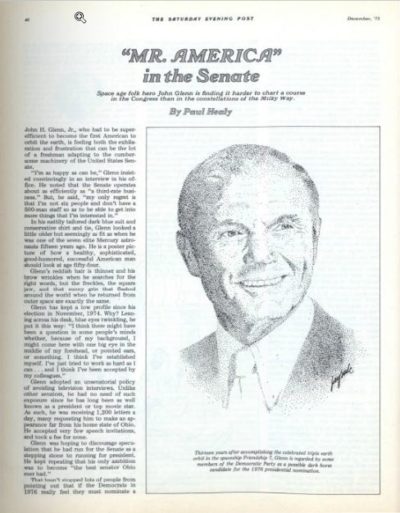
Glenn withdrew from the race for medical reasons shortly after that editorial, but he finally won the Senate race in 1974. The next year, the Post ran “Mr. America in the Senate” by Paul Healy, a lengthy interview with the junior senator. It concluded with an observation by Glenn that is relevant today:
“One of the most frightening things in my campaign was cynicism toward government. It wasn’t all just Watergate — it’s something that I think has been building for years. Polls last year showed a confidence level in Congress of only 26 percent! I think the decline started when the cost of campaigning got so high 12 or 13 years ago, and when the big lobbyists and the big spenders moved in and filled the financial gap. The little guy wonders why he should waste his $25 or $100 on anybody. He feels his voice doesn’t count anymore and he’s alienated.”
His 25-year tenure in the Senate testifies to his ability to make voters feel that they counted. As he once said, “The political graveyards are full of people who don’t respond.”
News of the Week: 12 Days of Christmas, Kirk Douglas at 100, and 90 Years of Route 66
Maybe I Can Just Get You a Gift Card?

If you were thinking of getting someone two turtle doves for Christmas, they’ll cost you $375. That’s up from $290 last year.
That’s one of the revelations from the 30th annual PNC Christmas Price Index. You probably didn’t know that for the past 30 years there has been a PNC Christmas Price Index, but it keeps track of what things cost every holiday season, and that includes the items in the “12 Days of Christmas” song.
Four Calling Birds will run you $599.96, while Six Geese-a-Laying go for $360. Don’t even think of getting anyone Seven Swans-a-Singing though; that will cost you $13,125 (I’d stick with the geese). If you have a lot of people on your list, buying or hiring the gift for each day will cost you $34,363.49, with the cumulative total for all 364 gifts, including 12 partridges and 40 golden rings, hitting $156,507.88.
What I want to know is, how do they figure out the price for hiring Ten Lords-a-Leaping?
RIP Van Williams, Billy Chapin, Andrew Sachs, Margaret Whitton, Don Calfa, Alice Drummond, and Milt Moss
Van Williams is most famous for playing Britt Reid — a.k.a. The Green Hornet — on the series of the same name in the ’60s. He also starred in Bourbon Street Beat and Surfside 6 (playing the same character, private eye Ken Madison), as well as Westwind and The Tycoon. He also appeared in The Dick Van Dyke Show, How the West Was Won, and The Rockford Files. He passed away last week in Arizona at the age of 82.
Billy Chapin was a child actor who won acclaim opposite Robert Mitchum in 1957’s The Night of the Hunter and in the movies The Kid from Left Field and Tension at Table Rock. He also appeared in TV shows like Leave it to Beaver, Fury, and Dragnet. He died at the age of 72. His sister, Lauren Chapin of Father Knows Best, announced the passing on Facebook.
Andrew Sachs also died last week, at the age of 86. He played the waiter Manuel on the classic John Cleese sitcom Fawlty Towers.
Margaret Whitton played the baseball team owner in the Major League films. She also appeared on the stage and in movies like The Secret of My Success, 9 1/2 Weeks, Ironweed, as well as the TV shows A Fine Romance, Cutters, One Life to Live, and Spenser: For Hire. She was 67 when she died on Sunday.
Don Calfa was a veteran character actor who you might remember as the guy who kills Bernie in Weekend at Bernie’s. He also appeared in New York, New York; Foul Play; 1941; Bugsy; 10; Running Scared; Cinderella Liberty; and Return of the Living Dead. He also had a recurring role on Doogie Howser, M.D. He died last week at the age of 76.
Alice Drummond was another veteran character actor, appearing in such movies as Ghostbusters, Doubt, Joe Gould’s Secret, and Awakenings. A stage actress, she also appeared on TV in Dark Shadows, Lenny, Spin City, Ed, and Kate & Allie. She died at the age of 88.
Milt Moss? He was a comic and actor who couldn’t believe he at that whole thing:
Now, if all of these passings depress you, please take note that Kirk Douglas is still with us. Today is his 100th birthday.
Get Your Kicks
Route 66, the iconic American highway that runs from Chicago to Santa Monica, turns 90 years old this year. In this Wall Street Journal video, reporter Jeff Bush explains that even though it’s arguably the most famous road in the United States and people want to preserve it, parts of it are in danger of vanishing.
By the way, if you’re doing the math, that’s right: Kirk Douglas is older than Route 66.
What Are Your Favorite Christmas Songs?
We all have our favorites. My taste is rather old school — Dean Martin, Perry Como, Jo Stafford, the Charlie Brown Christmas soundtrack — but there are some modern holiday songs worth a listen, too (beyond that Mariah Carey song, which I’ve heard 15 times since I started writing this paragraph), like the several versions of “This Christmas” (Seal’s is quite good), Kelly Clarkson’s “Underneath the Tree,” and anything by Josh Groban.
“Hard Candy Christmas” is a beautiful tune. It’s one of those not-really-a-Christmas-song songs that has become a Christmas song. It was performed by Dolly Parton in The Best Little Whorehouse in Texas, and this version by Leigh Nash will really get to you:
Gifts You Never Thought Of: The Phone Bed
You own a cellphone, right? At the end of the day, you probably put it on a table or your nightstand to recharge, not even giving any thought to whether or not the phone is going to be warm and comfortable. No worries, because The Phone Bed solves your problem!
The Phone Bed is a bed. For your phone. It’s from ex-Huffington Post chief Arianna Huffington, who has made it her mission to make sure everyone gets enough sleep. I think everyone should get enough sleep too; I just didn’t realize that mission included phones.
It costs $100, but your phone will charge on top of a silk-clad mattress, and the frame is made of solid wood and includes velvet-lined compartments for tablets. Hey, it’s a neat thing, I’m just not sure it’s $100 neat.
Hopefully next year someone will make a gilded, jewel-encrusted altar where I can put my keys.
This Week in History
President Martin Van Buren Born (December 5, 1782)
Our eighth president served one term in office, from 1837 to 1841. His political enemies once tried to smear him by saying he was too close to the Pope.
And remember: if you encounter the notorious Van Buren Boys gang, flash their sign.
Walt Disney Born (December 5, 1901)
Disney’s very first TV special, One Hour in Wonderland, aired on Christmas Day in 1950 and was sponsored by Coca-Cola.
13th Amendment Ratified (December 6, 1865)
The Constitutional amendment abolished slavery and involuntary servitude.
Tuesday is National Cocoa Day

As the air gets colder and colder, our desire for hot drinks that include some type of chocolate grows stronger and stronger. There comes a point in the season where you shift into “hot cocoa mode.” Before you reach for that hot cocoa or hot chocolate, please note that there are differences between the two, even if a lot of people think they are interchangeable.
As The Nibble explains, hot chocolate is made from actual shaved chocolate, while hot cocoa is made from cocoa powder. Now, you could just go out and buy some Swiss Miss or Carnation packets — both are completely acceptable! — but how about making your own? Here’s a classic recipe from Momables, and here’s a slightly different take from Alton Brown.
I always add a little French Vanilla Coffeemate to mine. I’m drinking a cup right now.
Next Week’s Holidays and Events
Jane Addams Day (December 10)
This memorial to the cofounder of Hull House, the NAACP, and the ACLU doesn’t mark her birthday but the day 85 years ago when she became the first American woman to win the Nobel Peace Prize.
Poinsettia Day (December 12)
Did you know that the poinsettia is named after an American botanist named Joel Roberts Poinsett? This day marks his death and also honors Paul Ecke Jr., whose experiments pretty much created the entire poinsettia industry.
Like It’s Your Last
Bernie’s last day on Earth. He put on his good suit. Had a good cry. (The cry lasted two hours.) Then 10 a.m. Time to say goodbyes. Time to call those he loved and tell them they meant the world to him. Yes. The world. The world that, today, like every day for the past while, he would leave.
Best to call Susan first. That way he could say goodbye to the kids. When Susan didn’t answer, he called again. This time Wendy answered. Sweet, little 6-year-old Wendy. He loved hearing her voice usually, but now he choked up. “Hello?” she said. He couldn’t respond. Finally Wendy continued, “Daddy, is it you again?”
“I love you, sweetie,” he stammered.
“Daddy. It’s okay. You’re not going to die.”
“Is Bernie Jr. there?”
“No. He’s with Frank.”
Frank. Taking Bernie’s only son away when he was going to tell him goodbye; that was just like Frank, always thinking of himself. (Like when he married Bernie’s ex-wife — didn’t give a damn about how Bernie would feel. They’d only been divorced for six months!)
“Is Mommy there?” “Yes, but …” “But what?” “I don’t think she wants to talk right now.” “This is important, Wendy.”
“She’s —” Wendy said. “Busy.”
“I can call back later,” Bernie said, starting to tear up. “I love you, Wendy. I love you, and I love Bernie Jr., and you’re both going to do just fine, okay? After I’m gone?”
“Quit being silly, Daddy.”
Bernie called his parents next. His mom answered and she didn’t seem to want to talk either. Her exact words were, “Bernie, quit this dying nonsense, you sound like a fool! Six or whatever months of this and I’m sick of it, you hear me? Sick of it.” Then (surrendering to the very last option), in a quiet but stern voice, “Go out and get laid, all right? Your father did something similar when I quit giving it to him back in ’80s. Bunch of pansies, the both of you.”
Bernie knew they loved him. His parents. Wendy. Bernie Jr. Even Susan, but in a different way now, of course. Their harsh words (or lack of words) were just the way they were coping with the impending grief. Of his death. Of when he would be gone from this world and on to whatever was next …
Bernie had coped with his own grief in a similar way after the divorce: He bought a bottle of Jack Daniels, poured himself a shot, and managed to swallow down half of it before dumping the rest of the bottle down the drain.
“That’ll show them,” he’d said. As if by dumping it out he was proving some victory over whoever had sold him the bottle.
He’d bought a pack of cigarettes, too, despite not being a smoker. “A broken man turns to vices,” he told himself. “And I am broken.” So grief-stricken was Bernie, he lit three of the cigarettes at once and positioned them in the spaces between his fingers. But that had been in the park; a police officer came by and told him he couldn’t smoke there. And what the hell was he doing smoking three cigarettes at once? Bernie apologized and snuffed out the cigarettes, wondering what it was he was doing wrong with this grief business.
It was the self-help books, ultimately, that brought him to the revelation of his mortality. What was the line in the book? He’d read it over and over and over. Wrote it on the dry-erase board on the fridge (erasing the month-old grocery list with food for the kids who no longer lived with him). Bought wooden-block letters and arranged them above his bed (except he’d forgotten a letter and so took them down in sobbing frustration. “I can’t even spell!”). He’d tried to brand himself with the line, marking the words in blood on the skin of his forearm, but the first prick of the knife left him groaning in pain. “It hurts to bleed!” But what was the sentence that he’d read in that book? Live each day like it’s your last. That was it.
Well, so he had. Every day in the last six months had been his last. Which is why he had the coroner prepared to certify his death, the embalmer ready to pretty up his corpse (there were specific instructions: for example, he wanted to be smiling so that his family remembered him as happy), and the stonecutter paid in advance for the tombstone.
BERNIE BENNIS — March 3, 1971–“TODAY”
EVERY DAY WAS HIS LAST
*
His affairs had to be in order. After calling his family, he reconfirmed his life insurance policy and then called his lawyer. As always, the secretary answered. “Oh yes, Mr. Bennis. I’ll make a note of it. He’s at lunch right now.” (Her legs propped up on the desk, eating a homemade turkey-cucumber sandwich, writing no notes, and looking at her boss who was in fact right there trying not to laugh.) Bernie thanked her. He thanked her graciously. He thanked her profusely. It meant a lot that she would pass along the message.
A little past noon, and what did a dying man do knowing his last day had finally come? Well, a dying man still had to eat, so he drove himself to the deli where most of the staff was familiar with him.
He sat in his car for a while, in the parking lot. Deep breath in. Deep breath out. The employees at Halula’s Deli would be sad to see him go. He was a regular. (Inside the store, the cashier, making change for another customer, glanced out the front-store window. She turned around, to the kitchen, where the manager was texting on his phone. “Izzy, Bernie’s here!” Not looking up from his phone, Izzy gave her a thumbs-up.)
Bernie walked into the deli dragging his feet, staring at the floor. How to break it to them? Quick and easy, or long and drawn-out? Mumbling, he ordered the usual: French onion soup and a grilled cheese, no jalapenos. But he couldn’t meet the cashier’s eye. “That’ll be $9.51,” she said. Bernie gave her a 20 and glanced up at her.
Watery-eyed, eyebrows like two capsized boats (in an ocean of despair!), he said, “Keep the change. I won’t be needing it.”
“Thank you so much,” the cashier said, looking somewhere else — anywhere else. She didn’t inquire as to what he meant by “not needing it.”
He sat in his usual booth. The man in the booth in front of where Bernie sat craned his neck over. “Bernie?” Then another voice, quiet, a boy’s, “Frank, don’t.”
It was Frank. And Bernie Jr.
A food-runner brought Bernie’s food.
Bernie immediately broke into tears that dribbled down and off his chin. (The French onion soup was plenty salty enough, but it was too late to do anything about it now.)
All three of them stood up to greet each other, and after a prolonged hug between Bernie and his son (Bernie Jr.’s arms by his side, mumbling, “Dad, stop.”), Bernie left the deli in a hurry. Didn’t touch his soup or the grilled cheese. He’d lost his appetite.
Bernie’s vision was blurred by tears, and in the heat of passion he drove faster than he normally would. Six miles above the speed limit. And he only put on the brakes lightly when he turned, making big, sweeping arcs into other lanes. This was a man who was soon to die! The world would just have to suffer him as he’d suffered it. Grief left no room for empathy.
Six miles over, seven, eight. What a rush! The thrill of driving fast was amazing — why hadn’t he ever done this before? In the movies when characters were upset or emotional they drove like maniacs, but it always seemed so reckless to Bernie, who was, as Susan had once called him, “too prude.” Bernie muttered this to himself in the car. “Too prude.”
And he drove faster, faster, and faster — 10 miles over the speed limit, now. Ten miles!
By the time he came to the sharp right turn off the service road, it began to rain. It was now or never. He’d driven 10 miles over the speed limit, so why not take the (final) chance to try and drift? Like they did in the movies. Handsome, sensitive men with perfect stubble and nice form-fitting clothes that contrasted their inner misery. Yes, he would try to drift. It was now or never.
He didn’t slow down. He pressed his foot hard on the brakes. And then, with reckless abandon, he yanked the steering wheel to the right.
The car skidded as it should, and then started to skid as it shouldn’t; the newly wet road was too slippery and the car wiggled and wobbled and whirled full-speed off the shoulder of the road, off into the neighboring field and headfirst into a wide-trunked tree.
*
When Bernie woke, there were many lights flashing. People’s voices could be heard as if from a great distance, but in reality they were quite near. The rain had stopped. The picture came to him in pieces at first before coming together all at once: a splintered, heavy-breasted branch from the wide-trunked tree had shattered the windshield and pierced through the headrest approximately a half-inch, at most, from his head.
He should’ve been dead. But he wasn’t. Was he? It hurt to breathe a little, but yes, he was alive. He’d run headfirst into a tree at full-speed, and he hadn’t died!
Bernie waited until the police cranked the door open with a crowbar to get out. One of the cops walked Bernie away from the scene to ask him what had happened. But Bernie wasn’t listening. Eventually the cop put his hands on Bernie’s shoulders and shook him.
“Mr. Bennis! Are you all right?”
“Am I,” Bernie said. “Alive?”
“Yes, but are you all right?”
“I’m not dead?”
“No. Your car is totaled, but you’re not dead. Listen, Bernie, if you need any assistance, there’s an ambulance here. Just let us know.”
Bernie placed a hand on his ribs and pressed down. His jaw clenched. “Oof.”
A different police officer drove him home. Inside the house, alone, he immediately went to the kitchen and sat down at the table. His mind was blank — or at least on a conscious level it felt so. He pulled out his cellphone and set it on the table. No voicemails. No one had called him back from this morning (meaning Susan and his lawyer), and no one had called yet to check up on him. Not that anyone would know, just yet, about the wreck.
Bernie got up and stepped over to the fridge. He frowned.
LIVE EACH DAY LIKE IT’S YOUR LAST, the message on the dry-erase board read.
And what a frown it was, that frown! Bernie was certainly a crier, but frowning was different somehow. One was a release and one was quite the opposite. Something had changed. Hadn’t it? He erased the last word of the message and wrote a new one in its place.
LIVE EACH DAY LIKE IT’S YOUR FIRST.
He went to the table, picked up his phone, and dialed the number for his lawyer’s office.
“Hi Bernie,” the secretary said. “Sorry, he just stepped out.”
“That’s okay. Write this down, please. I have some news.”
“What is it?”
“I had an accident today,” he said. “Ran into a tree.”
“You ran into a tree?”
“In my car. Not on foot. I crashed into a tree and a huge branch went through my windshield and almost killed me. I have a bruised rib, I think, but that’s it. I was very lucky.”
This time she scrambled to write down what he said. “I’m so sorry that happened.”
“I’m not finished. I won’t be needing the will drawn up. I’m not dying today.”
“You’re — not?”
“No. Tell him to tear it to shreds.”
“O — kay. Will do.”
“And one more thing.”
“Yes?”
“Five seven one, six three four, nine six three seven. That’s my mother’s number. I need you to call her and leave a message for me.”
“Um, well, it’s not really my job to call your mother —”
“Tell her I almost died. But that I’m not taking her advice. It’s hard to do what she suggested with a broken rib.”
“I don’t —”
“She’ll understand. Promise.”
Bernie hung up. Immediately after he did, Susan called.
“Bernie, I just got a call from the police — are you okay?”
“I’m fine.” He paused. “Listen, I want to take the kids camping this weekend.”
“You — wait, what? Camping?”
“Yes. First time for everything, right?”
There was the half-hope that his assertiveness might make her remember why she fell in love with him. But, and he knew this, it was never really his assertiveness that made anyone love him in the first place — it was his careful way of life.
“Don’t give them a choice,” he continued. “I think it’ll be fun.”
“Aren’t you — I mean, what about the? —”
“Dying?” He paused again. After all, it was just this morning that he’d been sure today would be his last day on Earth. The memory was still fresh. “No. Not today, anyway. I guess you never know. But today is different. Today’s my first day in a long, long time.”
“Bernie, are you sure you’re okay?” Then, “Does this have anything to do with your mother’s advice?”
Better than he’d ever been.
He didn’t ask how she knew what his mom had suggested.
*
That night Bernie went to an art gallery, spent far too much money on a painting he liked, and hung it over his bed where the wooden-block letters had been for that brief, misspelled moment. It was an abstract painting — so a little less than realistic — but the colors were beautiful. And so long as you had someone to tell you what it was supposed to be, you could just sort of make out the phoenix rising from its own gritty, abstract ashes.
Kirk Douglas: Still a Tough Guy at 100
The Post interviewed Kirk Douglas at in 1957 and again in 1986. Thirty years later, on the occasion of his 100th birthday on December 9, we share these earlier interviews.
The first time the Post interviewed Douglas, he was 40 years old, and some of his best work still lay ahead of him.
He had yet to star in Gunfight at the O.K. Corral, Paths of Glory, Seven Days in May, or the quintessential Douglas film, Spartacus.
In that 1957 interview, he talked of the hard times he’d known growing up in the 1920s.
“For my lunch at school, ma beat up one egg with water, then she fried the egg and cut it in half to make two sandwiches for me. There was no butter on my sandwich bread. If I had a nickel I bought milk to slosh it down; otherwise I drank water. Whatever we had to eat, whether it was boiled soup bones, stale bread or pumpernickel, we ate every scrap. That habit has lasted all my life. I seldom leave anything on my plate.”
He took whatever work he could find. “I’ve held down more than forty jobs in my life. Among other things, I’ve been a dishwasher, a punch-press operator, a cashier, a night watchman, a lifeguard.” He worked his way through college as a janitor, then talked his way into drama school.
It was while working in summer stock that a director helped him settle on a stage name. He thought his original name, Issur Danielovitch, “sounded like a sneeze reverberating in a bowl of borsch.” A “glossier label,” he thought, “would raise my audience appeal. I chose the name Douglas— I can’t remember why. Perhaps if a psychiatrist drained my mind he would find the name ‘Douglas Fairbanks’ floating in the sludge. Anyhow, I remember that we decided to put Kirk in front of Douglas because it would sound ‘snazzy’.”
Thirty years after that interview, the Post interviewed him again as he approached his 70th birthday. He talked about his new movie and his work with co-star Burt Lancaster. He also referred to the acting career of his son, Michael, who’d won an Oscar for producing the movie One Flew Over the Cuckoo’s Nest and had already starred in several popular films by that year.
Back in 1986, Douglas had no plans to retire. He continued working in film until 2008.
Now, with another thirty years passed, the Post is happy, again, to wish Kirk Douglas a happy birthday.
“Tough Guy” Kirk Douglas
By Donald Chase
October 1986
Soon to be 70, with 73 movies behind him, Hollywood’s versatile hero is still looking for obstacles to overcome.
“I’m extremely flexible—very few people can do this,” Kirk Douglas says with just a touch of braggadocio. In sneakers and exercise suit, the screen legend bolts from the plush easy chair in his Manhattan hotel suite and goes into a flatfooted squat with his buttocks just inches off the floor. There’s no strain in his tanned face. Only the quizzical creases in his brow, the smile lines about his eyes and mouth, and the gray in his thick, sandy hair betray his age, 69. And that number doesn’t stop him from sprinting across the top of a moving train with his costar, Burt Lancaster, in the new Disney action comedy Tough Guys.
Douglas has always been tough, but flexible, in more ways than one. He risked going against the prevailing nice-guyism of postwar leading men to play Champion‘s exploitative boxer, arguably Hollywood’s first “antihero.” One of the first actors who produced their own films, he created starring roles for himself as well as a platform for important issues. His company, Bryna Productions (named after his mother), made the controversial 1957 antiwar statement Paths of Glory and broke the infamous Hollywood blacklist by hiring Dalton Trumbo to write Spartacus. Last year, Bryna made the TV movie Amos, on the prickly subject of elderly abuse.
“As an actor and a producer,” Douglas says reflectively, “I’ve always been drawn to stories about people overcoming obstacles. I’m sure it must be because I’ve had to overcome so many myself.” Douglas was born Issur Danielovitch in Amsterdam, New York, one of seven children of an impoverished immigrant Russian-Jewish peddler and his wife. “But also,” he adds, “I believe that challenge is what keeps you young, strong, and flexible, physically and mentally.”
The physical challenges Douglas sets for himself these days may be a tad less strenuous than those of his youth. The former collegiate wrestler prefers a moderate regimen of calisthenics, weight lifting, walking, and tennis, and “though you don’t have to be a monk,” a low-cholesterol diet and low alcohol consumption. But his mental challenges are as rigorous, now that he’s a successful actor and the owner of homes in Beverly Hills and in Palm Springs, as when he was a struggling performer trying to afford Saint Lawrence University and the American Academy of Dramatic Arts. And his skills are as avidly courted.
“That’s why,” he says, “I don’t keep any of my awards around; they’re all packed away.” They include three Academy Award nominations (for Champion, The Bad and the Beautiful, and Lust for Life) and the Presidential Medal of Freedom, conferred upon him by President Carter for his good-will work worldwide. “They’re the past, and I’m looking forward to future challenges. When people want to know when I’m going to stop making movies, I always say, ‘When they stop asking me to, and when I no longer find them challenging,’ ” he says.
“They,” the Disney people, asked Douglas and Lancaster to costar in Tough Guys after seeing a film clip, shown on the 1984 Academy Awards telecast, from an Oscarcast of the late 1950s. The two sang a sour-grapes spoof called “It’s Great Not to Be Nominated This Year.” The duet was a reminder of the rapport the actors had developed in six movies together: Walk Alone, Gunfight at the OK Corral, The Devil’s Disciple, Seven Days in May, The List of Adrian Messenger, and the made-for-TV Victory at Entebbe. And in 1981, Lancaster and Douglas played the aging Huck Finn and Tom Sawyer, respectively, in a San Francisco staging of The Boys in Autumn a Broadway hit…
Working again with Lancaster triggered memories of 30 years ago. “When Burt and I were on location in Tucson for Gunfight at the OK Corral in 1956,” Douglas recalls, “we used to have dinner together every night and talk until one-thirty or two in the morning.” But for all that Douglas and Lancaster did — and do — have to talk about, Douglas says they are “not close, intimate friends. A year might go by when we don’t see each other, except at industry functions. And yet I feel that if I needed Burt and called on him, he’d be there. And 1 think he feels the same way about me.
“I’m probably more gregarious,” Douglas adds. “But then I’m married” — for 32 years to a Belgian-born former publicist, Anne Buydens — “and now Burt is not, and I think that makes a difference.”
One similarity Douglas finds in himself and Lancaster is their determination to give value for money. “We’re both hard working; we’re always on time — professional. Maybe it’s because we’re both closer to the hard-work ethic of the immigrant generation than a lot of today’s actors, but we couldn’t conceive of holding up production. When we were coming up, we used to average three pictures a year—Tough Guys is my 73rd — and to make just one picture a year now, forget about one every three years as Warren Beatty and Dustin Hoffman do, seems like sloughing off,” he says.
Douglas didn’t know if his four sons would have the incentive to make it in show business. “I always figured that by starting life with nothing, by having nowhere to go but up, I really had all the advantages,” he says. “My sons didn’t have the same impetus — the old man could take care of them if things didn’t work out. And the chances for success in the movie business are so remote, especially for actors, who constantly face rejection and just can’t help but take it personally. So 1 advised each of them from entering it — you see, I felt that if you could discourage somebody from going into it, they shouldn’t be in it.”
None of the boys was discouraged. Michael, now 42, won an Academy Award for producing One Flew over the Cuckoo’s Nest —a personal vindication for dad, who had starred, none too successfully, in a Broadway version of the material and failed to get it going as a film. Michael also did double duty as actor and producer in The China Syndrome, Romancing the Stone, and the latter’s sequel, Jewel of the Nile.
Douglas says of his sons; “Possibly, in the past, they might have learned something from me, but I now learn a lot more from them. 1 ask more questions than they do; they keep me au courant. And Peter, don’t forget, brought the Amos project to me, not the other way around. Working on it with him was so gratifying because it was not the father looking down on the son, but if anything, the son looking after the father.” As for Michael, “I said to Burt Lancaster on that Academy Awards show, ‘If 1 had known he was going to be so important, I would have been nicer to him when he was young!’ ”
Yet Michael’s professional success is not what makes his father happiest. “It’s that he’s done so many things to help other people,” Douglas says. “It’s that he gets involved, that he went to Central America about a year ago and got people from both ends of the political spectrum to come to Los Angeles for a discussion of their differences. He’s backing a theater group in Santa Barbara composed only of handicapped kids. Those are the things 1 admire most about Michael. Because that’s character. Then, secondly, 1 admire him as an artist.”
Michael is, in a way, just a chip off the old block. For 20 years Kirk Douglas has been traveling the globe at his own expense for the United States Information Agency and addressing student groups about America. He also made a TV documentary about the Afghanistan refugees fleeing Soviet domination.
“I use myself as the most immediate example of what America means,” Douglas says. He likes to recall taking his immigrant mother in a limousine to see the block-long Times Square billboard announcing “BRYNA PRESENTS SPARTACUS. His mother was not overwhelmed, as he had expected. She simply remarked, as she had so often before: “America is a wonderful land.”
“It was as if to say, ‘Well, of course, this can happen here,’ ” Douglas says. “She believed that, and she also instilled in me a sense of paying back. That’s why, having benefited from our system and having the opportunity, I try to do something in return from time to time.”
Though it was President Carter who awarded Douglas the Medal of Freedom for his unofficial ambassadorial work, the actor’s trips have taken place under both Democratic and Republican administrations.
“It’s something that I try to divorce from politics,” he stresses. “Not that I don’t have strong opinions about politics, because I do. In the past I’ve supported various candidates, [but that can be] difficult and dangerous.” It’s dangerous, he says, because “people in my position, with access to the media, have an unfair advantage. I also shy away from it now because I feel that sometimes politicians will use an actor like a hunk of meat.” And he feels it’s difficult because partisanship might diminish his clout as a spokesman on “themes that affect us all in a humanitarian way.”
His latest cause is elderly abuse, “which is universal,” he says. “Republicans get old; Democrats get old; Communists get old.” He has written about the subject in the New York Times and spoken on it at a Congressional hearing; he used the research he did for Amos.
“I was appalled,” Douglas says, “at the kind of abuse the elderly suffer.”
Douglas refuses to wear blinders against his country’s defects. “I think we have the best system,” he says, “but it can remain so and become better, stronger, only if we recognize that we have faults and work to correct them, whatever the obstacles.” And though we may never reach perfection, he says, either as individuals or collectively, we must never stop striving. “There’s a passage in Browning,” Douglas says, “that goes: ‘A man’s reach should far exceed his grasp/Else what’s a heaven for?’ “
Featured image: Wikimedia Commons / public domain

Cover Gallery: World War II
During World War II, the covers of The Saturday Evening Post illustrated many facets of the war, from the grit of battle to lighter moments on the home front. Many of the Post’s illustrators, including Norman Rockwell, Mead Schaeffer, and Constantin Alajalov, were there to evoke the most poignant and pleasing moments.
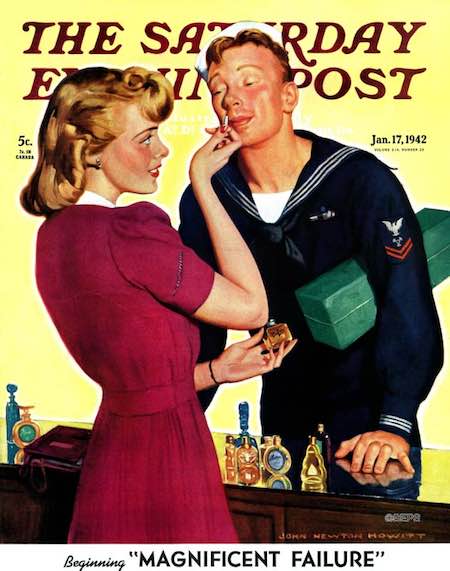
John Newton Howitt
January 17, 1942
America had just entered the war, passions still blazing from the attack on Pearl Harbor. It seems that other passions were blazing as well.
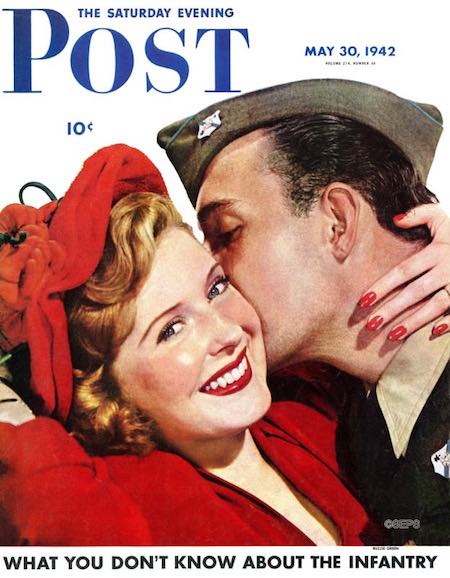
Ruzzie Green
May 30, 1942
This photograph by Ruzzie Green suggests that every soldier could come home to a gorgeous woman in red. The truth may not have been so glamourous, but it was still early in the war. Spirits – and hopes – ran high.
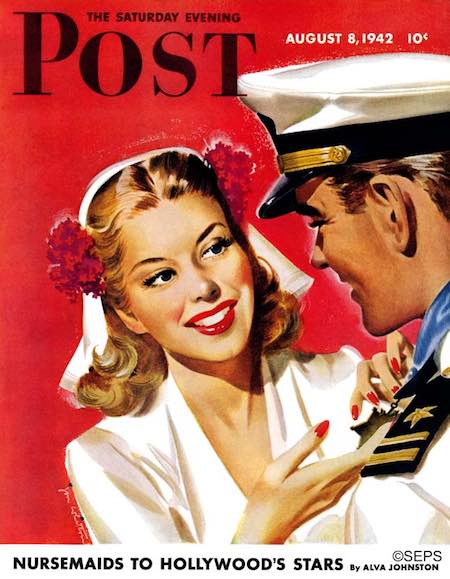
Jon Whitcomb
August 8, 1942
Illustrator Jon Whitcomb was a Lieutenant in the Navy during World War II, so he knew a thing or two about war, and the spoils therein. In addition to having a knack for illustrating beautiful women, he also served as a combat artist (who knew there was such a post?) in the South Pacific.
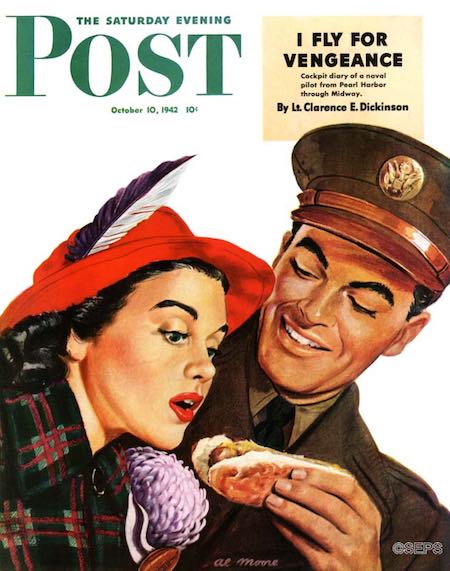
Al Moore
October 10, 1942
He thinks he’s being chivalrous, but she looks like she just spotted a worm on that wiener. Will she still take a bite?
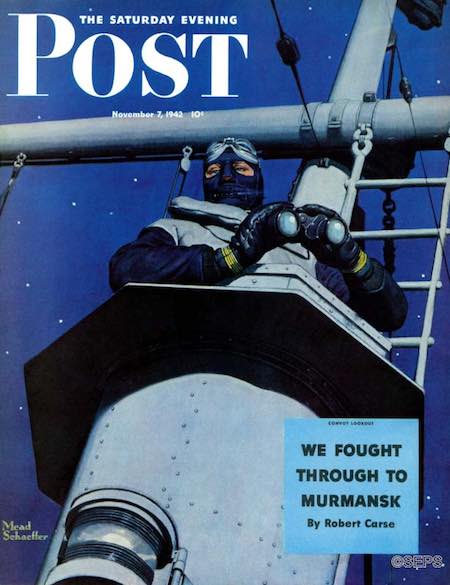
Mead Schaeffer
November 7, 1942
The Post’s war covers turned a bit more serious at the end of 1942, as American’s involvement approached the one-year mark. 1942 marked the beginning of a prolific period for artist Mead Schaeffer, who Illustrated 46 covers for the magazine.
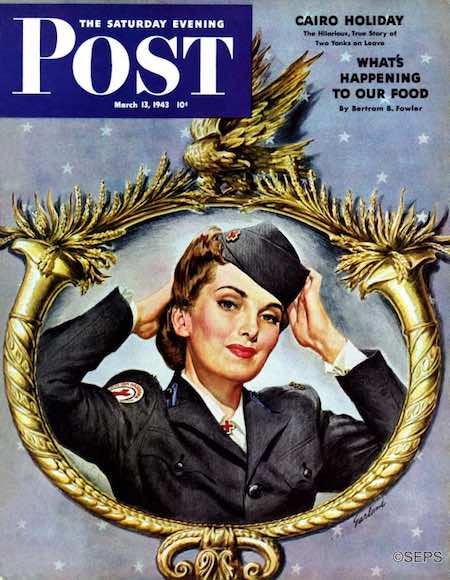
George Garland
March 13, 1943
While women were not on the front lines in World War II, they played many critical roles, including volunteering with the Red Cross. The women (and men) of the Red Cross made enormous contributions during the war, both at home and overseas.
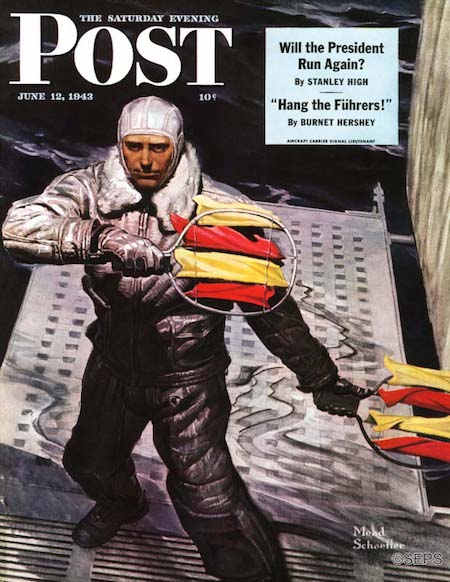
Mead Schaeffer
June 12, 1943
Early in his career, Mead Schaeffer created illustrations for Moby Dick and Les Miserables, so he was not unfamiliar with water or war.

Ken Stuart
July 31, 1943
Prior to joining The Saturday Evening Post in 1943 as the art editor, Ken Stuart was an illustrator for the magazine, poking equal fun at Hitler, chickens, and children.
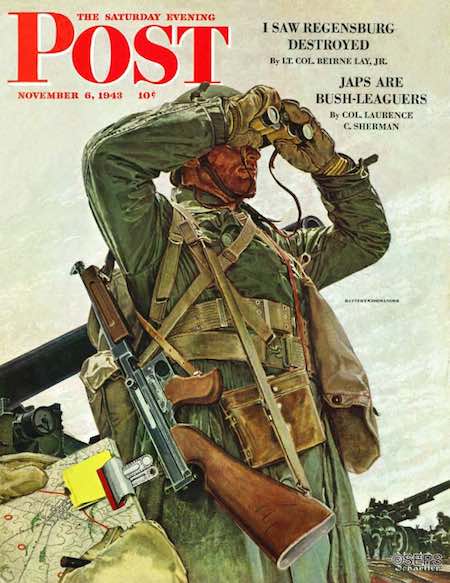
Mead Schaeffer
November 6, 1943
Mead Schaeffer often portrayed soldiers as ever-vigilant, as with this tank patrolman with his binoculars at the ready and his trusty Tommy gun by his side.
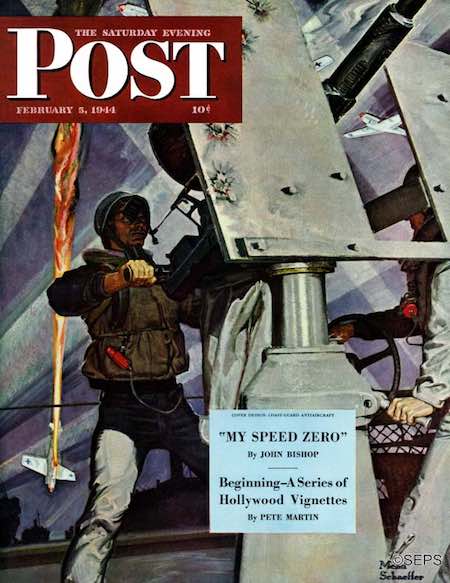
Mead Schaeffer
February 5, 1944
This soldier mans his anti-aircraft gun, with the evidence of his handiwork making a fiery red streak behind him.
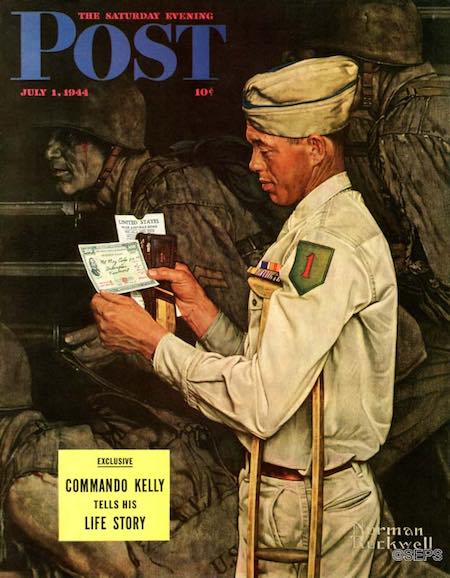
Norman Rockwell
July 1, 1944
Norman Rockwell captures the emotions of a wounded veteran returning home.
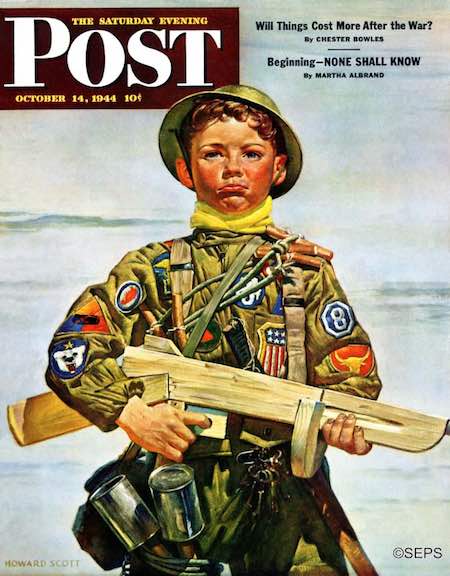
Howard Scott
October 14, 1944
The war might be over, but this young man is ready for any enemies that might come his way.
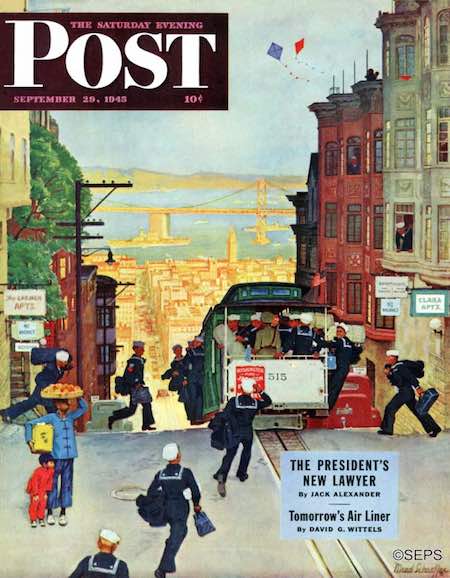
Mead Schaeffer
September 29, 1945
The war behind them, these servicemen are heading out for a night on the town in San Francisco.
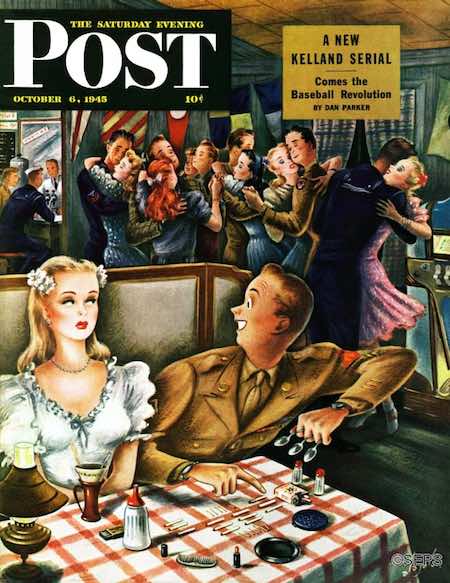
Constantin Alajalov
October 6, 1945
It looks like someone would rather be dancing.
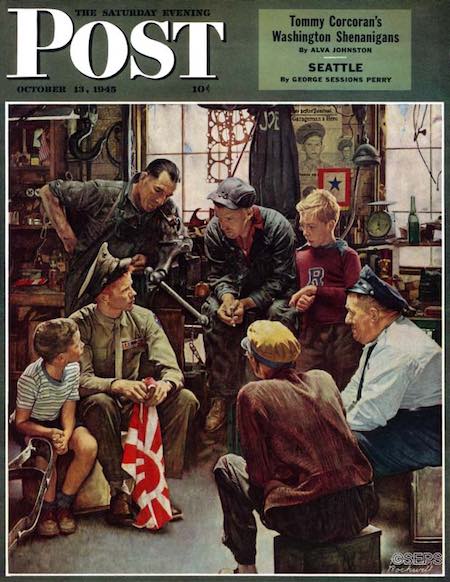
Norman Rockwell
October 13, 1945
A soldier’s friends and family sit, rapt, while the young man recounts tales of overseas adventures.
Making Holiday Heirlooms from Clothespins and Crepe Paper
Most of the ornaments on our Christmas tree are store-bought, but a few homemade ones have survived a dozen moves, sticky toddler fingers, and several Labrador Retrievers. I still have the Lifesaver doll made with yarn arms and a Styrofoam head. The Lifesavers are more than 40 years old and probably don’t qualify as food anymore. There’s also the wise man made of Popsicle sticks that was hastily painted at the end of a Sunday school lesson. These handmade ornaments from my childhood are not exactly “museum quality,” but they mean a lot to me.

My great-grandmother made stunningly beautiful ornaments — shoeboxes full of 16-sided German stars made from strips of paper, dipped in wax, and sprinkled with glitter. When I was a kid, we would cover our tree with them, and they would spin and glimmer in the tree lights.
My great-grandmother considered their design and execution a family secret. I wonder what she would think about the fact that anyone can learn to make these stars from the internet now.
Regrettably, her stars are all gone, lost to damp basements and cleaning frenzies. I’m sure I could fill a shoebox with new ones, but they wouldn’t be the ones my grandmother made.
Take care of those old ornaments. You never know who might cherish them decades later.
Below is an article we found in the December 1, 1933, issue of Country Gentleman. When Mary Frances Shinn wrote it, I’m sure she never imagined that Christmas decorations made from spools and clothespins might one day become family heirlooms.
Do you have a special Christmas ornament or other holiday decoration with a family story behind it? We’d love to hear about it. Please share your story in the Comments section at the end of this article.
Sparkling Tree Ornaments
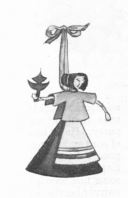 CHRISTMAS comes but once a year, and why not — even if you never have before — celebrate it this year with a tree gayly trimmed with many bright-colored ornaments and
  balls, tinsel and colored lights! From the simplicity of the earliest decorated trees ornaments have gradually become more lavish, reflecting the decoration of the period; and since modern decoration and clothes are dependent upon the gay nineties for much inspiration, it is natural that tree ornaments should be, also. Being easy to make, there is a decided satisfaction in creating tricky ornaments. Foundations are ridiculously within reach of most housekeepers, such as discarded spools, pill boxes, small evaporated milk cans, clothespins, Cellophane—white and colored, saved from package wrapping—gold and silver tin foil, green and white wire, ribbons, cords, old gift and Christmas cards, heavy gay-colored papers, white crêpe paper, and cotton wool. A Christmas tree topped with a big star follows traditional ideas, and here is one that may be made in a twinkling. Some pieces of COUNTRY purple and gold cardboard form the star, outlined with clipped Cellophane taken from choice pieces of fruit. Another ornament that will add color to the tree is a drum, made by covering a small milk can with gay colored paper. Two holes close together at the top and side of the can are punched with a can opener, through which a string hanger is run. Or dress some clothespins to resemble a peasant girl or a butterfly. A spool makes a foundation for a small Christmas tree base. Cover it and wire some graduated strips of narrow paper together at right angles to form a tree. It’s easy, too, to make a pill box dressy with a rose-colored paper cover. Cut tinfoil star decorations for the front and back, cut white Cellophane to form a long narrow tail, which is pulled through slits in the top and bottom of the box. Fake bonbons that are “everlasting” are made of scrap paper rolled over clipped white Cellophane, tied with a bit of ribbon. An up-to-date-cut-out from a gift card may be pasted over it. And of course, cornucopias are always welcome as containers for homemade goodies of all kinds.
The Saturday Evening Podcast: The Days Before Pearl Harbor
The attitude of pre-World War II America was quite different from the heroic era of the war years. The U.S. was still a modest, isolationist nation, with limited industry, a tiny army, and the hope that, by minding its own business, it could remain untouched by war. Although the December 6, 1941, issue of the Post shows a country at peace, the signs that war was spreading are evident throughout its pages.
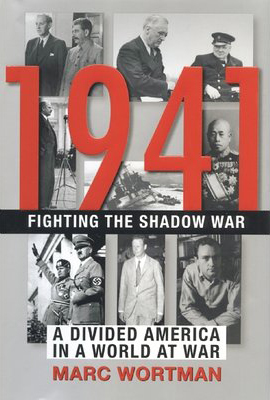
In this podcast, Jeff Nilsson interviews historian Marc Wortman. In his book 1941: Fighting the Shadow War, Wortman reveals the depths to which the United States had already been involved in World War II before the attack on Pearl Harbor. Dispelling the myth that the United States was a neutral nation caught flat-footed by the Japanese attack, Wortman shows how the U.S., through military deployments, the Lend-Lease Program, and actual confrontations with Axis forces, was “neck-deep in the war before December 7.”
Sound files excerpted in the podcast:
- News announcement of the Pearl Harbor attack, December 7, 1941, station unidentified
- NBC radio announcement of the attack on Pearl Harbor
- Eleanor Roosevelt speaking for the Pan-American Coffee Bureau Series, episode 11, December 7, 1941
- “Boogie Woogie Bugle Boy,” Andrews Sisters, 1941
- G. Wodehouse’s second broadcast on Reich Broadcasting Service, July 9, 1941
- “Moonlight Cocktail,” Glenn Miller Band, 1941
- “World News Today,” CBS radio, December 6, 1941
- Winston Churchill speech to Parliament, July 14, 1941
- Charles Lindbergh, America First Committee speech, Des Moines, Iowa, September 11, 1941
- “Chattanooga Choo Choo,” Glen Miller Band, 1941, the top song in the U.S. on December 7, 1941
Featured image: By United States Air Force [Public domain], via Wikimedia Commons

Garm – A Hostage
Originally published on December 23, 1899
I drove one night to a military cantonment called Mian Mir to see amateur theatricals. At the back of the Infantry barracks a soldier, his cap over one eye, rushed in front of the horses and shouted that he was a dangerous highway robber. As a matter of fact, he was a friend of mine, so I told him to go home before anyone caught him; but he fell under the pole, and it was then that I heard voices of a military guard in search of someone.
The driver and I threw him into the carriage — he was a little man — drove home swiftly, undressed him and put him to bed, where he waked next morning with a sore headache, very much ashamed. Now that man bore two good conduct stripes on his sleeve, and I did not wish him to lose them. When his uniform was cleaned and dried, and he had been shaved and washed and made neat, I drove him back to barracks with his arm in a fine white sling, and reported that I had accidentally run over him. I did not tell this story to my friend’s sergeant, who was a hostile and unbelieving person, but to his Lieutenant, who did not know me quite so well.
Three days later, my friend came to call, and at his heels slobbered and fawned one of the finest bull-terriers — the old-fashioned breed, two parts bull and one terrier — that I had ever set eyes on. He was pure white, with a fawn-colored saddle just behind his neck, and a fawn diamond at the root of his thin, whippy tail. I had admired him distantly for more than a year; and Vixen, my own fox-terrier, knew him, too.
“‘E’s for you,” said my friend; but he did not look as though he liked parting with him.
“Nonsense! That dog’s worth more than most men, Stanley,” I said.
“‘E’s that an’ more. Tention!”
The dog rose on his hind legs and stood upright for a full minute.
“Eyes right!”
He sat on his haunches and turned his head sharp to the right. At a sign he rose and barked thrice. Then he shook hands with his right paw and bounded lightly to my shoulder. Here he made a necktie, limp and lifeless, hanging down on either side of my neck. I was told to pick him up and throw him in the air. He fell with a howl, and held up one leg.
“Part o’ the trick,” said his owner. “You’re goin’ to die now. Dig yourself your little grave, an’ shut your little eye.”
Still limping, the dog hobbled to the garden-edge, dug himself a hole and lay down in it. When told that he was cured he jumped out, wagging his tail and whining for applause.
He was put through half a dozen other tricks, such as showing how he would hold a man safe (I was that man, and he sat down before me, his teeth bared, ready to spring), and how he would stop eating at the word of command. I had no more than finished praising him when my friend made some sort of gesture that stopped the dog as though he had been shot, took a piece of blue, ruled canteen-paper from his helmet, handed it to me and ran away, while the dog looked after him and howled:
Sir, — I give you the dog because of what you got me out of. He is the best I know, for I made him myself, and he is just as good as a man. Please do not give him too much to eat, and please do not give him back to me. for I am not going to take him, and I am not going to be the fool any more if you will keep him. So please do not try to give him hack any more. I have kept his name hack, so you can call him anything and he will answer, but please do not give him hack. He can kill a man as easy as anything, but please do not give him too much. He knows more than a man.
Vixen sympathetically joined her shrill little yap to the bull-terrier’s despairing cry, and I was annoyed, for I knew that a man who cares for dogs is one thing, but a man who loves one dog is quite another. Dogs are at the best no more than verminous persons, self-scratchers, foul-feeders, and unclean by the law of Moses and Mohammed; but a dog with whom one lives alone for at least six months in the year; a free thing, tied to you so strictly by love that without you he will not stir; a patient, temperate, humorous wise soul, who knows your moods before you know them yourself, is not a dog under any ruling.
I had Vixen, who was all my dog to me; and l felt what my friend must have felt at tearing out his heart in this style and leaving it in my garden. However, the dog understood clearly enough that I was his master, and did not follow the soldier. As soon as he drew breath I made much of him, and Vixen, yelling with jealousy, flew at him. Had she been of his own sex, he might have cheered himself with a fight, but he only looked worriedly when she hit his broad iron sides, laid his heavy head on my knee, and howled anew. I was dining at the Club that night, but as darkness drew in, and the dog snuffed through the empty house like a child trying to recover from a fit of sobbing, I felt that I could not leave him to suffer his first evening alone; and so we fed at home, Vixen on one side and the stranger-dog on the other.
It was Vixen’s custom, till the weather grew hot, to sleep in my bed, her head on the pillow like a Christian, and when morning came I would always find that the little thing had pushed me to the very edge of the cot. This night she hurried to bed, every hair on end, one eye on the stranger who had dropped on a mat in a helpless hopeless sort of way, all four feet spread out, sighing heavily. Vixen settled her head on the pillow several times, to show her little airs and graces, and struck up her comfortable whiney singsong before slumber. The dog softly edged toward me. I put out my hand and he licked it. Instantly my wrist was between Vixen’s teeth, and her warning aaarh! said as plainly as speech that if I took any notice of the stranger she would bite.
I caught her behind her fat neck with my left hand, shook her severely, and said: “Vixen, if you do that again you’ll be put into the verandah. Now, remember!”
She understood, but the minute I released her she mouthed my wrist once more and waited with her ears back and all her body flattened, ready to bite. The big dog’s tail thumped the floor in a humble and peacemaking way.
I grabbed Vixen a second time, lifted her out of bed like a rabbit (she hated that and yelled), and, as I had promised, set her out in the verandah with the bats and the moonlight. At this, she howled. Then she used coarse language — not to me, but to the bull-terrier — till she coughed with exhaustion. Then she ran round the house, trying every door. Then she went off to the stables and barked as though someone were stealing the horses — that was an old trick of hers. Last she returned, and her snuffling yelp said: I’ll be good! Let me in and I’ll be good!
She was admitted and flew to her pillow. When she was quieted I whispered: “You can lie at the foot of the bed.
The bull jumped up at once, and though I felt Vixen quiver with rage, she knew better than to protest. So we slept till the morning, and they had early breakfast with me, bite for bite, till the horse came round and we went for a ride, I don’t think the bull had ever followed a horse before. He was wild with excitement; and Vixen, as usual, squealed, and scuttered, and scooted, and took charge of the procession.
There was one corner of a village called Mozang which we generally passed with caution, because all the yellow pariah-dogs of the place gathered about it. They are half-wild starving beasts, and though they are utter cowards, yet when nine or ten of them get together they will mob and kill and eat an English dog. I kept a whip, with a long lash, for them. That morning they attacked Vixen, who. perhaps of purpose, had moved from my horse’s shadow. The bull was ploughing along in the dust, a hundred yards behind, rolling in his run and smiling as a bull-terrier will. I heard Vixen squeal; half a dozen of the curs closed in on her; a white streak came up behind me; a cloud of dust broke near Vixen, and when it cleared I saw one tall pariah with his back broken, and the bull wrenching another to the earth. Vixen retreated to the protection of my whip, und the bull paddled back covered with the blood of his enemies. That decided me to call him “Garm of the Bloody Breast,” who was a great person in his time — or “Garm” for short; so leaning forward I informed him what his name would be. He looked up while I repeated it, and then raced away. I shouted “Garm!” He stopped, raced back, and came up to ask my will.
Then I saw that my friend was right; and that the dog was worth more than a man. I gave an order which Vixen knew and hated: “Go home and be washed!” Garm understood the first part of it, and Vixen the second, the two trotted off together soberly. When I came in Vixen had been washed and was very proud of herself, but the dog-boy would not touch Garm; he was afraid. I stood by while he was scrubbed, and Garm looked at me to make sure that the soap and the sluicing was what I expected him to endure. “Another time.” I said to the dog-boy, “you will wash him with Vixen when I send them home.”
“Does he know?” said the dog-boy, who understood the ways of dogs.
“Garm,” I said, “you will be washed with Vixen another time.”
The great, holiest eyes were full on me. and I knew that Garm understood. Indeed, next washing-day when Vixen, as usual, fled under my bed. Garm stared at the doubtful dog-boy, stalked to the place where he had been washed last time, and stood rigid in the tub.
But the long days in my office tried him sorely. We three would drive off in the morning at half past eight, and come away at six or later. Vixen, knowing the routine of it, went to sleep under my table; but the confinement ate into Garm’s soul. He generally sat on the verandah looking out on the Mall, and I well knew what he expected. Sometimes a company of soldiers would move along on their way to the Fort, and Garm rolled forth to see them; or an officer in uniform entered into the office, and it was pitiful to see poor Garm’s welcome to the cloth — not the man. He would leap at him, and sniff and bark joyously, then run to the door and back again. One afternoon I heard him bay with a full throat — a thing I had never heard before — and he disappeared. When I drove into my garden at the end of the day, a soldier in white uniform scrambled over the wall at the far end, and the Garm that met me was a joyous dog. This happened twice or thrice a week for a month. I pretended not to notice, but Garm knew and Vixen knew. He would glide home from the office about four o’clock, as though he were only going to look at the scenery, and this he did so quietly that but for Vixen I should not have noticed him. The jealous little dog under the table would give a sniff and a snort just loud enough to call my attention to the flight. Garm might go out forty times in the day and Vixen would never stir, but when he slunk off to see his master in my garden, she told me in her own tongue. That was the one sign she made to prove that Garm did not altogether belong to the family. They were the best of friends at all times, but — I was never to forget Garm did not love me as she loved me.
I never expected it. The dog was not my dog — could never be my dog — and I knew he was as miserable as his master, who tramped eight miles a day to see him. So it seemed to me that the sooner the two were reunited the better for all. One afternoon I sent Vixen home alone in the dog-cart (Garm had gone before), and rode over to cantonments to find another friend of mine, who was an Irish soldier and a great friend of the dog’s master.
I explained the whole case; and wound up with:
“And now Stanley’s in my garden crying over his dog. Why doesn’t he take him back? They’re both unhappy.”
“Unhappy! There’s no sense in the little man any more, an’ we’ve tould him so a hunder times. But ‘tis his fit.”
“What is his fit? He travels thirty miles a week to see the brute, and he pretends not to notice me when he sees me on the road; and I’m as unhappy as he is. Make him take the dog back, Terence.”
“‘Tis his penance he’s set himself. I tould him by way of a joke, afther you’d run over him so convenient that night whin he was strapped — I said if he was a Catholic he’d do penance bekaze you’d saved him his sthripes. Off he wint wid that fit in his little head an’ a dose of fever, an’ nothin’ would suit but givin’ you the dog as hostage. We laughed at him, but he hild on, an’ he’s broke in two wid it.”
“Hostage for what? I don’t want hostages from Stanley.”
“For his good behavior, av coorse. He’s keepin’ straight now, so as ut’s no pleasure to associate wid him.”
“Has he taken the pledge?”
“If ‘twas only that I need not care — nor Jock, either. Ye can take the pledge for three months on an’ off. He sez he’ll never see the dog again, an’ so, mark you, he’ll be straight forevermore. Ye know his fits? Well, this is wan of thim. Faith, the longer I live the less do I know what any man will do or why. How’s the dog takin’ it?”
“Like a man. He’s the best dog in India today. Can’t you make Stanley take him back?”
“I can do no more than I have done. I’ve been over the little man twice wid a belt. But ye know his fits. He’s just doin’ his penance. What will he do when he goes to the Hills? The doctor’s put him on the list.”
It is the custom in India to send a certain number of invalids from each regiment up to stations in the Himalayas for the hot weather; and though the men ought to enjoy the cool and the comfort, they miss the society of the barracks down below, and do their best to come back or to avoid going. I felt that this move would bring matters to a head, so I left Terence hopefully, though he called after me: —
“He won’t take the dog, sorr. Lay your month’s pay on that. Ye know his fits.”
I never pretended to understand Private Stanley Ortheris; and so I did the next best thing — I left him alone.
That summer, the invalids of the regiment to which my friend belonged were ordered off to the Hills early, because the doctors thought marching in the cool of the day would do them good. Their route lay south to a place called Umballa, a hundred and twenty miles or more. Then they would turn east and march up into the Hills to Kasauli, or Dugshai, or Subathoo. I dined with the officers the night before they left — they were marching at five in the morning. It was midnight when I drove into my garden, and surprised a white figure flying over the wall.
“That man,” said my butler,” has been here since nine, making talk to that dog. He is quite mad. I did not tell him to go away because he has been here many times before, and because the dog-boy told me that if I told him to go away that dog would immediately slay me. He did not wish to speak to the Protector of the Poor, and he did not ask for anything to eat or drink.”
“Kadir Buksh,” said I, “that was well done, for the dog would surely have killed thee, and, afterward, I believe the white soldier man, who, as thou knowest, is a friend of mine, would have slain thee a second time. But I do not think he will come any more.”
Garm slept ill that night, and he whimpered in his dreams. Once he sprang up with a clear, ringing bark, and I heard him wag his tail till it waked him and the bark died out in a howl. He had dreamed he was with his master again, and I nearly cried. It was all Stanley’s fault.
The first halt which the detachment of invalids made was some six miles from their barracks, on the Amritsar Road, and ten miles distant from my house. By a mere chance one of the officers drove back for another good dinner at the Club (cooking on the line of march is always bad) and there I met him. He was a particular friend of mine, and I knew that he knew how to love a dog properly. His pet was a big fat retriever who was going up to the Hills for his health, and, though it was still April, the round, brown brute puffed and panted in the Club verandah as though he would burst.
“It’s amazing,” said the officer, “what excuses these invalids of mine make to get back to barracks. There’s a man in my company now asked me for leave to go back to Mian Mir to pay a debt, he’d forgotten. Fancy Tommy paying a debt! I was so taken back by the idea I let him go and he jingled off in an ekka as pleased as Punch. Ten miles to pay a debt! Wonder what it was, really?”
“If you’ll drive me home I think I can show you,” I said.
So we went over in his dog-cart with the retriever; and on the way I told him the story of Garm.
“I was wondering where that brute had gone to. He’s the best dog in the regiment,” said my friend. “I offered the little fellow twenty rupees for him a month ago. But he’s a hostage, you say, for Stanley’s good conduct. Stanley’s one of the best men I have.”
“That’s the reason why,” I said. “A second-rate man wouldn’t have taken things to heart as he has done.”
We drove in quietly at the far end of the garden, and crept round the house. There was a place close to the wall all grown about with tamarisk trees where I knew Garm kept his bones. Even Vixen was not allowed to sit near it. In the full Indian moonlight I could see a white uniform bending over the dog.
“Good-by, old man,” we could not help hearing Stanley’s voice. “For ‘Eving’s sake, don’t get bit and go mad by any measly pi-dog. But you can look after yourself, old man. You don’t get your stripes an’ get drunk an’ run about ‘ittin’ your friends. You takes your bones an’ you eats your biscuit, an’ you kills your enemy like a gentleman. I’m goin’ away — don’t ‘owl — I’m goin’ off to Kasauli, where I won’t see you no more.”
I could hear him holding Garm’s nose as the dog threw it up to the stars.
“You’ll stay ‘ere an’ be’ave an’ — an’ I’ll go away an’ try to be’ave, an’ I don’t know ‘ow to leave you. I don’t know —”
“I don’t care for this,” said the officer, patting his foolish, fubsy old retriever. He called to the private, who leaped to his feet, marched forward, and saluted.
“You here?” said the officer, turning away his head.
“Yes, sir. I’m just goin’ back.”
“I shall be leaving here at eleven in my cart. You will come with me. I can’t have sick men running about all over the place. Report yourself at eleven here.”
We did not say much when we went indoors, but the officer muttered and pulled his retriever’s ears. He was a disgraceful, over-fed doormat of a dog; and when he waddled off to my cook-house I had a brilliant idea.
At eleven o’clock that dog was nowhere to be found, and you never heard such a fuss as his owner made. He called and shouted, and grew angry, and hunted through my garden for half an hour.
Then I said: “He’s sure to turn up in the morning. Send a man in by rail, and I’ll find the beast and return him.”
“Beast?” said the officer, “I value that dog considerably more than I value any man I know. It’s all very fine for you to talk — your dog’s here.”
So she was — under my feet — and, had she been missing, food and wages would have stopped in my house till her return. But some people grow fond of dogs not worth a cut of the whip. He had to drive away, at last, with Stanley in the back seat; and the dog-boy said to me:
“What kind of animal is Sullen Sahib’s dog? Look at him!”
I went to the boy’s but and the fat old reprobate was lying on a mat, carefully chained up. He must have heard his master calling for twenty minutes, but had not attempted to join him.
“He has no face,” said the dog-boy scornfully. “He is a punnio-kooter (a spaniel). He never tried to get that dishclout off his mouth when his master called. Now Vixen-baba would have jumped through the window, and that other dog would have slain me with his feet. It is true that there are many kinds of dogs.”
Next evening who should turn up but Stanley. He had been sent back fourteen miles by rail, with a note begging me to return the retriever if I had found him, and, if I had not, to offer huge rewards. The last train to camp left at half-past ten, and Stanley stayed till ten talking to Garm. I argued and intreated, and even threatened to shoot the bull-terrier, but the little man was as firm as a rock, though I gave him a good dinner and talked to him most severely. Garm knew as well as I that this was the last time he could hope to see his man, and followed Stanley like a shadow. The retriever said nothing, but licked his lips after his meal and waddled off without so much as saying “thank-you” to the disgusted dog-boy.
So that last meeting was over, and I felt as wretched as Garm, who moaned in his sleep all night. When we went to the office he found a place under the table close to Vixen, and dropped flat till it was time to go home. There was no more running out into the verandahs; no slinking away for stolen talks with Stanley. As the weather grew warmer the dogs were forbidden to run beside the cart, but sat at my side, Vixen with her head under the crook of my left elbow, and Garm hugging the left handrail.
Here Vixen was ever in great form. She had to attend to all the moving traffic, such as bullock-carts that blocked the way, and camels and led ponies; as well as to keep up her dignity when she passed low friends running in the dust. She never yapped for yapping’s sake, but her shrill, high bark was known all along the Mall, and other men’s terriers ki-yied in reply and bullock-drivers looked over their shoulders and gave us the road, with a grin. But Garm cared for none of these things. His big eyes were on the horizon and his terrible mouth was shut. There was another dog in the office who belonged to my chief. We called him “Bob the Librarian,” because he always imagined vain rats behind the bookshelves, and in hunting for them would drag out half the old newspaper-files. Bob was a well-meaning idiot, but Garm did not encourage him. He would slide his head round the door, panting, “Rats! Come along Garm!” and Garm would shift one fore-paw over the other and curl himself round, leaving Bob to whine at a most uninterested back. The office was nearly as cheerful as a tomb in those days.
Once, and only once, did I see Garm at all interested in his surroundings. He had gone for an unauthorized walk with Vixen early one Sunday morning, and a very young and foolish artilleryman (his battery was just moved to that part of the world) tried to steal them both. Vixen, of course, knew better than to take food from soldiers, and, besides, she had just finished her breakfast. So she trotted back with a large piece of the mutton that they issue to our troops, laid it down on my verandah, and looked up to see what I thought. I asked her where Garin was, and she ran in front of the horse to show me the way.
About a mile up the road we came across our artilleryman sitting very stiffly on the edge of a culvert with a greasy handkerchief on his knees. Garm was in front of him looking rather pleased. When the man moved leg or hand Garm bared his teeth in silence. A broken string hung from his collar, and the other half of it lay, all warm, in the artilleryman’s still hand. He explained to me, keeping his. eyes straight in front of him, that he had met this dog (he called him awful names) walking alone, and was going to take him to the Fort to be killed for a masterless pariah.
I said that Garm did not seem’ to me much of a pariah-dog, but that he had better take him to the Fort if he thought best. He said he did not care to do so. I told him to go to the Fort alone. He said he did not want to go at that hour, but would follow my advice as soon as I had called off the dog. I instructed Garm to take him to the Fort, and Garm marched him solemnly up to the gate, one mile and a half under a hot sun, and I told the Quarter-guard what had happened; but the young artilleryman was more angry than was at all necessary when they began to laugh. Several regiments had tried to steal Garm in their time.
That month the hot weather shut down in earnest and the dogs slept in the bathroom on the cool, wet bricks where the bath is placed. Every morning as soon as the man filled the bath the two jumped in, and every morning the man filled the bath a second time. I said to him that he might as well fill a small tub specially for the dogs. “Nay,” said he, smiling. “It is not their custom. They would not understand. Remember, it is always thus in the hot weather.”
The punkah-coolies who pull the punkahs day and night came to know Garm intimately. He noticed that when the swaying fan stopped I would call out to the coolie and bid him pull with a long stroke. If the man still slept I would wake him up. He discovered, too, that it was a good thing to lie in the wave of air under the punkah. Maybe Stanley had taught him all about this in barracks. At any rate, when the punkah stopped Garm would first growl and cock his eye at the rope. If that did not wake the man — and it nearly always did — he would tip-toe forth and talk in the sleeper’s ear. Vixen was a clever little dog, but she could never connect the punkah and the coolie: so Garm gave me grateful hours of cool sleep. But he was utterly wretched — as miserable as a human being; and in his misery he clung so closely to me that other men noticed it and were envious. If I moved from one room to another Garm followed; if my pen stopped scratching, Garm’s head was thrust into my hand; if I turned, half awake, on the pillow Garm was up and at my side, for he knew that I was his only link to his master, and day and night, and night and day, his eyes asked one question — “When is this going to end?”
Living with the dog as I did, I never noticed that he was more than ordinarily upset by the hot weather, till one day at the Club a man said: “That dog of yours will die in a week or two. He’s a shadow.” Then I dosed Garm with iron and quinine, which he hated: and I felt very anxious. He lost his appetite, and Vixen was allowed to eat his dinner under his eyes. Even that did not make him swallow, and we held a consultation on him, of the best man-doctor in the place; a lady-doctor who cured sick wives of Kings, and the Deputy Inspector-General of the Veterinary Service of all India. They pronounced upon his symptoms, and I told them his story, and Garm lay on a sofa licking my hand.
“He’s dying of a broken heart,” said the lady-doctor.
“‘Pon my word,” said the Deputy Inspector-General, “I believe Mrs. Macrae is perfectly right.”
The best doctor in the place wrote a prescription, and the Veterinary Deputy Inspector-General went over it afterwards to be sure that the drugs were in the proper dog proportions; and that was the first time in his life that our doctor ever allowed his prescriptions to be tampered with. It was a strong tonic, and it put the dear boy on his feet for a week or two; then he lost flesh again. I asked a man I knew to take him up to the Hills with him when he went, and the man came to the door with his kit packed on the top of the carriage. Garm took in the situation at a glance. The hair rose along his back; he sat down in front of me and delivered the most awful growl I have ever heard in the jaws of a dog. I shouted to my friend to get away at once, and, as soon as the carriage was out of the garden, Garm laid his head on my knee and whined. So I knew his answer, and devoted myself to getting Stanley’s address in the Hills.
My turn to go to the cool came late in August. We were allowed thirty days’ holiday in a year if no one fell sick, and we took it as we could be spared. My chief and Bob the Librarian had their holiday first, and when they were gone I made a calendar, as I always did, and hung it up at the head of my cot, tearing off one day at a time till they returned. Vixen had gone up to the Hills with me five times before; and she appreciated the cold and the damp and the beautiful wood fires there as much as I did.
“Garm,” I said, “we are going back to Stanley at Kasauli. Kasauli — Stanley; Stanley — Kasauli.” And I repeated it twenty times. It was not Kasauli, really, but another place. Still, I remembered what Stanley had said in my garden on the last night, and I dared not change the name. Then he began to tremble; then he barked; and then he leaped up at me, frisking and wagging his tail.
“Not now,” I said, holding up my hand. “When I say ‘Go,’ we’ll go, Garm.” I pulled out the little blanket-coat and spiked collar that Vixen always wore in the Hills to protect her against sudden chills and thieving leopards, and I let the two smell them and talk it over. What they said of course I do not know, but it made a new dog of Garm. His eyes were bright; and he barked joyfully when I spoke to him. He ate his food and he killed his rats for the next three weeks, and when he began to whine I had only to say “Stanley — Kasauli; Kasauli — Stanley,” to wake him up. I wish I had thought of it before.
My chief came back, all brown with living in the open air, and very angry at finding it so hot in the plains. That same afternoon, we three and Kadir Buksh began to pack for our month’s holiday, Vixen rolling in and out of the bullock-trunk twenty times a minute, and Garm grinning all over and thumping on the floor with his tail. Vixen knew the routine of traveling as well as she knew my office-work. She went to the station, singing songs, on the front seat of the carriage, while Garm sat with me. She hurried into the railway carriage, saw Kadir Buksh make up my bed for the night, got her drink of water, and curled up with her black-patch eye on the tumult of the platform. Garm followed her (the crowd gave him a lane all to himself) and sat down on the pillows with his eyes blazing and his tail a haze behind.
We came to Umballa in the hot misty dawn, four or five men who had been working hard for eleven months, shouting for our daks — the two-horse traveling carriages that were to take us up to Kalka at the foot of Hills. It was all new to Garm. He did not understand carriages where you lay at full length on your bedding, but Vixen knew and hopped into her place at once; Garm following. The Kalka Road is about forty-seven miles long and the horses are changed every eight miles. Most of them jib and kick and plunge, but go they must, and they went rather better than usual for Garm’s deep bay in their rear.
There was a river to be forded, and four bullocks pulled the carriage and Vixen stuck her head out of the sliding-door and nearly fell into the water while she gave directions. Garm was silent and curious, and needed reassuring about Stanley, and Kasauli. So we rolled, barking and yelping, into Kalka for lunch, and Garm ate enough for two. After Kalka the road winds among the hills, and you must take a curricle with two half-broken ponies, which are changed every six miles. Simla is seven thousand feet up in the Hills, and the road is more than fifty miles long, and the regulation pace is just as fast as the ponies can go. Here again, Vixen led Garm from one carriage to the other; jumped into the back seat, and shouted. A cool breath from the snows met us about five miles out of Kalka, and she whined for her coat, wisely fearing a chill on her liver. I had had one made for Garm, too; and, as we climbed and climbed to the fresh breezes, I put it on, and Garm chewed it uncomprehendingly.
“Hi-yi-yi-yi!” sang Vixen, as we shot round the curves; Toot-toot-toot! went the driver’s bugle at the dangerous places, and “Yow! Yow! Yow!” bayed Garm. Kadir Buksh sat on the front seat and smiled. Even he was glad to get away from the heat of the plains that stewed and simmered in the haze behind us. Now and then we would meet a man we knew flying down to his work again, and he would say: “What’s it like below?” and I would shout: “Hotter than cinders. What’s it like up above?” and he would shout back: “Just perfect!” and away we would go.
Suddenly Kadir Buksh said, over his shoulder: “Here is Solon;” and Garm snored where he lay with his head on my knee. Solon is an unpleasant little cantonment, but it has the advantage of being cool and healthy. It is all bare and windy, and one generally stops at a rest-house nearby for something to eat. I got out and took both dogs with me while Kadir Buksh made tea. A soldier told us we should find Stanley “out there” nodding his head toward a bare, bleak hill.
When we climbed to the top we spied Stanley, who had given me all this trouble, sitting on a rock with his face in his hands and his overcoat hanging loose about him. I never saw anything so lonely and dejected in my life — this one little man crumpled up and thinking, on the great gray hillside. Here Garm left me.
He departed without a word, and, so far as I could see, without moving his legs. He flew through the air bodily, and I heard the whack of him as he flung himself at Stanley, knocking the little man over. They rolled on the ground together, shouting and yelping and hugging. I could not see which was dog and which was man till Stanley got up and whimpered.
He told me that he had been suffering from fever at intervals, and was very weak. He looked all he said, but even while I watched both dog and man plumped out to their natural sizes, precisely as dried apples swell in water. Garm was on his shoulder and his breast and his feet all at the same time, so that Stanley spoke through a haze of Garm — gulping, sobbing, slavering Garm. He did not say anything that I could understand — except that he had fancied he was going to die, but that now he was quite well, and that he was not going to give up Garm any more to anybody under the rank of Beelzebub.
Then he said he felt hungry, and thirsty, and happy.
We went down to tea at the rest-house, where Stanley stuffed himself with sardines, and raspberry jam, and beer, and cold mutton and pickles, when Garm wasn’t climbing over him; and then Vixen and I went on.
Garm saw how it was at once.
He said good-by to me three times, licking my face from the chin to the hair, and giving me both paws one after another, and leaping on to my shoulder. He further escorted us, singing Hosannas at the top of his voice, two miles down the road. Then he raced back to his own little master.
Vixen never opened her mouth, but as the cold twilight came, and we could see the lights of Simla far away across the hills, she snuffled with her nose in the breast of my ulster till I unbuttoned it, and tucked her within. Then she licked my chin, gave a contented little sniff, and fell fast asleep, with her head on my breast, till we bundled out at Simla, two of the four happiest people in all the world that night.
The Magic of Barbra Streisand: Interview with Neal Gabler
Neal Gabler admits that he wasn’t a devoted Streisand fan when he started to write Barbra Streisand: Redefining Beauty, Femininity, and Power. As he explains it, he became more of a gaga Streisand fan over the course of writing the book. “But I wrote it because I realized she was one of those rare performers who not only changed their art, but who changed their culture.”
Gabler has written award-winning books about people in the entertainment industry and politics, including such legends as Walter Winchell and Walt Disney. He’s currently working on a book about Senator Edward Kennedy.
Jeanne Wolf: It’s hard to analyze or quantify magic or greatness. Do you think you now understand Barbra Streisand’s power?
Neal Gabler: I don’t think you ever really understand magic, but you can understand things in her life that connected her to audiences. Barbra is every marginalized human being, everyone who’s ever been humiliated — and that’s most of us. When she said that she wanted to become a movie star, her own mother told her, “You’re not pretty enough.” Her stepfather, who abused her, would say to her, “You’re just too ugly for me to give you ice cream.” She went before talent agents and producers and every one of them said, “You’re just not pretty enough.” I think her art was to take that life experience and turn it into song.
JW: But she is also known for being tough.
NG: Barbra has said that it was her mother’s abuse that energized her. Somehow she decided, “I’m going to show you.” Where that fortitude came from, I don’t think we will ever know. I don’t think any Freudian explanation is satisfactory. But for all of the talk about her being impregnable and being a diva, one of the things that makes her great is that beneath that toughness, there’s enormous sensitivity. I am impressed that she said, “I remember every negative word that has ever been written about me. I remember none of the good reviews. I can recite every negative review verbatim.” We understand the obstacles that she faced, and her triumphs become our triumphs.
JW: I just saw her husband, James Brolin, and he spoke to me with such pride about his wife’s new album and tour. Are you surprised that she says her marriage is another thing she longed for and now she’s got it?
NG: You know, she once said her entire career was sublimation for the kind of romance and love that she never achieved. Even in most of her films, she winds up alone. I think, if you’re a woman like Barbra Streisand and you can find a man who understands that strength and who appreciates that strength, it’s the basis for a very strong relationship.
‘Hello, Gorgeous’: How Barbra Streisand Redefined Beauty, Femininity, and Power
To read how author Neal Gabler first became fascinated with Streisand, read “The Magic of Barbra Streisand: Interview with Neal Gabler” online December 6, 2016.

Photo by Russell James/Copyright Barwood Films, Ltd.
It is one of the seminal moments in American film and, quite possibly, American culture generally. The camera dollies in toward a woman in a leopard-skin coat and matching hat, her back to the camera, then veers slightly to the left to reveal an ornate, gold-framed, full-length mirror in which we see the woman’s image, though her face is obscured by the coat’s collar. She pulls down the collar just enough to reveal that inimitable Streisand visage, arches her brows, and assesses herself — coolly. Then she purrs, “Hello, gorgeous.” There is a cut to a close-up, and Streisand emits the tiniest, almost inaudible laugh/snort, as if it were a joke, though she acts as if the joke is on us. It is. But then her expression turns dark, wistful, as if to tell us how far she has had to come to utter those words.
This is how Barbra Streisand introduced herself to the film audience in Funny Girl in 1968, and what an introduction it was! First, there is her look — a kind of exoticism, half Afghan hound, half Jewess. And then there is the manner — the secretiveness, the cool, diva elegance only slightly betrayed by those arched brows, the self-scrutiny that gives way to self-consciousness that gives way to self-confidence that gives way to self-doubt. And then there is the voice — that unmistakable Brooklyn accent, the “gorgeous” elongated to “gaaaaw-jus,” an accent that just didn’t comport with the regal bearing, the expensive coat, the sense of control. And then there is that laugh, as if to say … well, it said a lot. And then that sadness, which said even more.
One of the things it said is that Streisand wasn’t making fun of herself or being ironic — she was gorgeous — even though no one who looked like Streisand or had Streisand’s obvious ethnicity, that double whammy of Judaism and Brooklyn, or had that strange self-regard Streisand had, had ever become an American movie star, certainly not a dramatic star, and Streisand would become the biggest. When Streisand addressed her image in that mirror, she was asserting her beauty and validating a new kind of glamour, a new kind of star, a new kind of power. “Hello, gorgeous” was Streisand’s way of ushering in a new era, and just about everybody seemed to recognize it. Although there had never been anyone on movie screens like Streisand, there were millions of Streisands, tens of millions, watching those screens, as Streisand herself had before she became a star. Now they had someone of their own — someone whom they didn’t have to dream of becoming, which was the general vicarious transaction for movie audiences, but someone they felt they already were.
It may seem peculiar to freight an entertainer with that much psychological and cultural weight, but Streisand isn’t just an entertainer. She has long been a cultural force — the kind of personality who inspires effusions, poems, stage plays, art, songs, even a viciously hostile South Park episode. After 50 years in our eyes and our ears, she is part of the American consciousness as few entertainers have been.
Obviously, none of this would have happened without her enormous talent. She was the “most successful, and perhaps talented, performer of her generation,” Michael Shnayerson wrote in Vanity Fair. Almost from the moment she first sang publicly, at the age of 17, she elicited adulation. The classical pianist Glenn Gould called her voice “one of the natural wonders of the age,” and composer Quincy Jones called it a “Stradivarius of a voice.” Most music critics regard her as the greatest popular female vocalist, and the only singer to stand comparison to Frank Sinatra. Like Sinatra, she changed the dynamics of American popular singing, and she spawned a generation of imitators. Every time you hear a female vocalist trilling in the highest registers or stretching a vowel or shaping the air with her hands or putting on the Bernhardt, you can rest assured that Streisand was there first.
But talent alone, even talent as abundant as Streisand’s, doesn’t make a cultural icon. It may not even be a prerequisite. What makes an entertainer into a cultural icon is the way in which he or she strums our psychic chords and comes to serve as an embodiment of our own deep impulses. He or she seems not only to understand us but to express us. The lives of such rare entertainers, or at least the lives they express through their work, comprise a theme about us.
Usually this appeal is subtext, a whisper under the performance: Marlon Brando’s brooding iconoclasm, Sinatra’s cool, the Beatles’ irreverence. In Streisand’s case, it was all text — a shout rather than a whisper. Streisand, whose mother discouraged her from pursuing show business because she felt her daughter was too unattractive to succeed; Streisand, who never even got the solo in her own high school chorus because a classmate sang more operatically; Streisand, who was immediately dismissed when she auditioned for parts because of her looks; Streisand, who seemed to be an afterthought in everything she attempted — Streisand stood for every plain girl who had ever been rejected.
She sang songs of loneliness and despair and longing. “People who need people …” “What’s too painful to remember, we simply choose to forget …” “You don’t bring me flowers anymore …” In her plaintive voice, one could hear and feel every slight, every insult, every wound. Tennessee Williams said of that voice that it was “pure and sweet but bolstered by so much rage, all of which had been invested in the pursuit of artistic excellence.” Only Streisand could take Franklin Roosevelt’s cheery campaign song, “Happy Days Are Here Again,” and turn it into a dirge. Streisand seemed to understand in the very depths of her soul how arduous life was. And her fans responded — responded because they knew she knew. One artist said of her, “To be an adolescent coming across Barbra Streisand was the most exhilarating moment of identification” Streisand was the girl who beat the odds, not by assimilating or changing but by not assimilating and not changing. As she herself put it, “You know, maybe not being a beauty explains my success. Maybe being the girl that guys never look at twice, and when I sing about that — about being like an invisible woman — people feel like protecting me.”
And hers was a Jewish-American success story, too. When she entered show business, she was told repeatedly that she would have to get a nose job if she were to have any hope of succeeding. Of course, she refused, in large part because, she said, she did not want to betray herself, which also meant betraying her Jewishness. As she once put it, “No nose job. Because most of all I want to be true to myself. Really, people should be left to themselves, instead of everyone trying to change everyone else.” Her Jewishness was both her social burden and her triumph. She was the entertainer of the marginal, the disenfranchised, the disadvantaged, the disaffected, the put-upon, and, not least of all, the different. Only Streisand, among all Hollywood’s blonde gentile beauties with their pert little noses, or its sexy bombshells, could really understand them.
And not only understand them but win for them. If in her songs she conveyed the pangs of lost love, she also conveyed the defiance to soldier on. Just listen to her rendition of “Cry Me a River” and you hear the anguish turn into strength. And if, in her films, she always portrayed the ugly duckling, she also made that duckling into someone indomitable and self-confident. She was neither sultry nor sweet, neither a siren nor the girl next door — unless you happened to live in one of America’s urban enclaves. She played a woman who was loud, uninhibited, smart, brassy, sassy, and kooky (a word frequently used to describe the young Streisand) — the point being that if she didn’t look like any female star, she didn’t act like one either. She was a force of nature.
Streisand began as a coterie entertainer, winning favor with those who were a little off-center as she herself was, rather than an entertainer with immediate mass appeal. By 1963, when she hit the hungry in San Francisco, the word of mouth had built, the coterie had grown, and she was beginning to attract larger audiences, just as she had done earlier in New York. And by the time she hit the Basin Street East back in New York that May, with its 450-seat room and on the same bill with Benny Goodman, her first album had become a full-fledged success. Radio DJs had even begun playing “Happy Days,” and The Barbra Streisand Album slowly climbed the Billboard album list until it hit No. 8, making her the best-selling female vocalist in the country. It would stay on the list for 24 weeks and win her a gold record.
Her manager, Marty Erlichman, would call The Barbra Streisand Album the “turning point” in her career — the moment she went from being a New York phenomenon to a performer with a “national reputation.” The proof may have been that President John F. Kennedy had caught her appearance on The Dinah Shore Show early that May — a performance of which one critic said she was a “Flatbush gamine with the tonsils of a fish peddler” — and asked that she be invited to perform at the White House Correspondents Dinner. “How long have you been singing?” the president asked her afterward. “About as long as you’ve been president,” she shot back.
When she opened at the Cocoanut Grove at the Ambassador Hotel in Los Angeles, the audience was a who’s who of moviedom, but Streisand didn’t trim her sails to appease them. Instead, she took the stage by walking up the aisle from the back of the room, wearing a pink gingham dress intended as a spoof on The Sound of Music, then looked out at the audience, said she was the only one she didn’t recognize, and delivered a line that couldn’t help but bring down the house: “If I’d known you were going to be on both sides of me, I’d have gotten my nose fixed.” This was Streisand in her element, which was people who really appreciated her.
She was on a roll, and she knew it. Taping The Judy Garland Show the next month, Judy, who was clearly intimidated, nervously asked Streisand if there was anything more she could possibly want in life. To which Streisand blurted, “Yes, there is. I’d like to take over your show.” She effectively did, scoring with a brilliant duet with Garland that remains Streisand lore: Garland sang “Get Happy,” while Streisand counterpointed with “Happy Days.” It ended with Ethel Merman pretending to wander onto the set: one former diva, one current diva, and one future diva all sharing the stage. The murmurs about the show at CBS were so strong that the network decided to rearrange its schedule and rush it onto the air the following week.
There may be no other entertainer whose own life conflates with her work as much as Streisand’s does. That life, which traced an arc from a poor, awkward, neglected Brooklyn girl to a self-possessed woman, from an outsider to a guiding light, was also the story she repeatedly told in her films. In effect, she was simultaneously living her story and telling her story in her work, basically performing her life. She became popular by demonstrating how someone like her, someone with her seeming disadvantages, could become popular.

Russell James/Copyright Barwood Films, Ltd
While this forged an iron bond between performer and audience that has lasted decades, it also turned Streisand into a cultural trailblazer — again, in a way that no other entertainer was or is. Streisand arrived at the beginning of the feminist movement, and her gutsy, unsinkable, indomitable persona resonated with women. “Today you cannot imagine what it was like when Streisand burst on the scene in the 1960s,” Camille Paglia wrote. “There was nothing like her. … Barbra Streisand broke the mold, she revolutionized gender roles.” It wasn’t only that she was tough and tough-minded. It was that Streisand never let herself be defined by a man, which is why her untraditional looks didn’t seem to cause her the anguish women had always suffered under the withering judgment of men. She found a lure beyond conventional attractiveness — something deeper. It was the critic Pauline Kael who identified it and made what may be the most astute appraisal of this psychological legacy of Streisand’s: Streisand was proof that “talent is beauty.”
Almost singlehandedly in the world of entertainment, Streisand demonstrated that, for a woman, looks weren’t everything. She had this uncanny confidence that her talent was what counted, that it would trump everything else, and that embracing who she was became instrumental to that talent as it became instrumental to her admirers. This is how Tennessee Williams, a huge Streisand fan, put it to a friend: “She makes me believe in my talent, because she so passionately believes in and shares her own. She makes me believe in all the talents in all of the world.”
As odd as it may seem now, this idea that women were more than the sum of their looks was so original and empowering that Streisand changed or, at the very least, signified the change in how women came to think of themselves. It is not too much to say that she helped redefine femininity and beauty. And she did more. She became an example of empowerment — first as a star who made her own decisions; then as a producer who controlled her own films; and then as a director who bulled her way into Hollywood’s creative sanctum sanctorum, where women had never been welcome.
With Streisand, Hollywood had no choice. She was a force with whom everyone in the film industry had to reckon. No woman in film had ever had that kind of power, save possibly for Mary Pickford at her peak. All of these qualities made Streisand arguably the most important entertainer of her time — as Paglia wrote, a revolutionary. Just how much she challenged the prevailing moral, social, sexual, and cultural order may be seen in even greater focus by those who detested her. Streisand was a threat to every verity of traditional America — to conventional ideas of beauty, conventional ideas of female roles and femininity, conventional ideas of decorum, conventional ideas of the exercise of power, conventional ideas of what it meant to be American.
But it testifies to her iconic position in the culture that she could be a diva, which, for a poor, plain Jewish girl from Brooklyn, may be the greatest transformation of all. Streisand isn’t just a brilliant singer and actress, not even just a significant cultural figure. She has ascended into the American pantheon, where — ironically, for someone who made it by seeming ordinary — the normal rules no longer apply.
—
Excerpted from Barbra Streisand: Redefining Beauty, Femininity, and Power, by Neal Gabler, new from Yale University Press/Jewish Lives, copyright © 2016 by Neal Gabler. Reprinted by permission. Gabler’s next book is Against the Wind: Edward Kennedy and the Tortuous Course of American Liberalism.
Barbra Streisand: A Star is Born
Read “‘Hello, Gorgeous’: How Barbra Streisand Redefined Beauty, Femininity, and Power” in the November/December 2016 issue.
Excerpted from “Good-bye Brooklyn, Hello Fame” by Pete Hamill, July 27, 1963

On a recent Sunday afternoon in New York, an angular young girl with the nose of an eagle, slightly out-of-focus eyes, and a mouth engaged in battle with a wad of gum walked up to the stage entrance of the theater that houses The Ed Sullivan Show. A beefy young man in a guard’s gray uniform stopped her. “Whattaya want, girlie?” the guard said, looking for the inevitable autograph book. “I want to go in,” she said. “I’m in the show.” After a brief debate, the girl proved that she was not there to acquire the signatures of Sullivan, the McGuire Sisters, or the 27 members of the visiting Mexican soccer team scheduled for the TV program. She was there to rehearse, and her name was indeed plastered across the theater’s marquee.
“Barbra Streisand,” the guard said admiringly at the close of the show. “To tell you the truth, I never heard of her. But she’s really something, ain’t she? Really something.”
Such long, low expressions of approval are being echoed by an ever-widening circle of admirers whose members range from Truman Capote to a president named Kennedy. At 21, with only three and a half years of professional experience, Barbra Streisand is on her way to becoming one of the most glittering stars of the 1960s.
As a singer, Barbra Streisand cut her first album for Columbia Records this year, and four weeks after its release she was the best-selling female vocalist in the country. As a nightclub performer, she has graduated from the Greenwich Village coffee circuit to such opulent drinking emporiums as New York’s Persian Room. Her fee has jumped in three years from $108 a week to $7,500, and is climbing. As a television performer, she came across with such vigah on a Dinah Shore special that one viewer — President Kennedy — promptly had her invited to perform at a White House correspondents dinner. And although her Broadway credits consist only of a supporting role in the musical I Can Get It for You Wholesale, she will star next winter in a musical comedy based on the life of the late comedienne Fanny Brice. “She will knock everyone dead,” predicts the musical’s producer, David Merrick.
To many observers her overnight success is bewildering. Show business, after all, is largely a bazaar for that tinselly commodity, glamour. To achieve stardom, unendowed young girls customarily acquire bobbed noses, capped teeth, and cantilevered underwear. Not Barbra Streisand. “I’m me,” she says with a disarming shrug. “And that’s all there is.”
What there is would hardly launch a thousand ships. Her blowzy, reddish-brown hair slops over a pair of blue eyes that appear crossed, and her nose would fit just as comfortably on Basil Rathbone. She is 5 feet 5, but looks taller because of the boniness of her 110-pound body.
But when she begins to sing, Barbra Streisand suddenly is transformed. Her eyes fixed on some distant point in space, her voice moony, her head cocked to the side, she somehow manages to combine the most engaging qualities of an Egyptian wall painting and a seductive spook. … She has a large voice, rich with nuance, and throbbing with so much feeling that some critics have accused her of laying it on too thick. But if the voice were all, it would not explain why watching her is such a moving experience.
“It takes a fantastic amount of ego and immaturity to stand on a stage and do absolutely nothing and yet be powerful,” she says. “Acting is really so ludicrous, so childish. But it’s something you must do. And yet it’s something you have to keep in perspective too.
“They tell me I’ll eventually win everything. The Emmy for TV, the Grammy for records, the Tony on Broadway, and the Oscar for movies. It would be beautiful to win all those awards, to be rich, to have my name on marquees all over the world. And I guess a lot of those things will happen to me. I kind of feel they will. It could be good or it could be bad, but I’m living my life one day at a time. And I don’t see why it shouldn’t always be fun. Do you?”
—Excerpted from “Good-bye Brooklyn, Hello Fame” by Pete Hamill, July 27, 1963
Click here to read the article in its entirety.
The Birthday Call
It was three weeks past her birthday when her dad called.
Dad — with the weathered hands and pale blue eyes.
Dad, who served her TV dinners on her visits.
Dad, whose love for language runs rippling through her veins.
He began the conversation with her mother.
“How’s her health?” he asked.
“She’s fine,” she said.
“And otherwise?” he asked, hungry for an update — a new boyfriend? a new job? Does she miss me?
“She’s the same,” she reassured him, then Mom was put to rest.
It’s strange how Mom’s become, she thought — in the years they’ve been apart — the ice breaker in these conversations. No matter where they end up, no matter where they go, they always start with Mom.
As was format, she then asked about Dad’s family. The phone call swung around upon its axis.
“So, tell me about Sissy,” she said. Sissy’s her half-sister.
“She’s driving,” Dad said.
“Really?” she said smiling, with Dad’s collie in the background.
“Life moves too fast,” he said, as the dog whined for attention.
“It does,” she said agreeing. Yes, it does.
Then for a moment she turned inward; the phone call lay suspended; pictures flashed before her eyes:
She was sitting in a tide pool … 5 or 6 years old … while the water coursed and crashed around her feet … while the seagulls screamed and foraged overhead … while Dad and Mom ran laughing on the beach …
These images dissolved. She was sitting in New York — with Dad and his dad at the kitchen table. The two conversed in Yiddish.
She could smell the crepes and bug spray, when the sound of Dad’s voice beckoned from the phone:
“I’ll be sending something to you for your birthday …”
The smell of the apartment slowly faded.
She struggled; she finally found her bearings.
“Please, Dad,” she said, remembering and bristling at the thought of the year he sent the hand-clipped coupons.
“Let’s make it simple. Just a book.”
In her mind she pictured Dad’s floor-to-ceiling library — as a child, that’s where she’d often be. With its playwrights on the corners and Ruskies on the sides, Flannery O’Connor owned the middle. She was sitting on Dad’s lap while he smoked his pipe and read. The tobacco smoke curled up to the ceiling.
“I’ll send you out a box,” he said. They’re back now in the present.
“No, Dad,” she said, “just one. Let’s make it easy.”
“Just one?” He hesitated.
The conversation paused. The collie had gone silent; in the background beat the mantel clock.
“I’ll bring it back the next time that I visit.”
Through the phone she heard the rhythm of his breathing.
“As a loan,” she reassured him.
And yet another pause … then finally his agreement.
The phone call then resumed its proper course.
There was talk of private schools and the cost of car insurance and the downside of today’s technology. They rattled on and on, fulfilling all the topics, then said goodnight and wished each other well.
*
Two weeks later. A box was at her door.
With hands and fingers shaking, she tore apart the package. Her heart was racing — pounding. She wondered what the book inside might be.
Was it fiction?
Was it mystery?
Was it history or sci-fi?
Was it one of Dad’s pet Southern Gothic writers?
But much to her surprise, inside the shredded box, she found not a yellowed page, or a dog-eared paperback, but instead a plug-in water sculpture. With rippling rocks and UL guarantee. Just like the one inside her dentist’s office. The water, they say, masks the sound of screaming.
“But where’s my book?’ she said, shaking out the box.
The book was nowhere to be found.
Then she recalled a gentle heartache with her dad — a heartache that she often overlooked: that Dad can be partaking in a cogent conversation and later not remember what was said …
With heavy heart, she tendered her acceptance.
She placed the water sculpture on a table near her bed. That night she filled its basin full of water.
As she dreamed her dreams that night, she was a girl of 5 or 6, in the summer with her parents up in Maine. The water spun and splashed as the gulls cried overhead. In the morning she’d forgotten about the book.
News of the Week: Christmas in Connecticut, Culinary Lawsuits, and Comfort Food
Three Movies You Should Watch
Yes, it’s December, and the holiday season has officially begun. We all know what the greatest Christmas movies are. They’re the ones we’ve all watched a million times and watch every year: It’s a Wonderful Life (my favorite movie of all time), Miracle on 34th Street, A Christmas Story, Holiday Inn, the 97 versions of A Christmas Carol, and all of those TV specials where noses glow red and grinches steal. But I’d like to point you to three Christmas movies that are pretty terrific that you might not be aware of:
- Christmas in Connecticut (1945). This film, like all of the films on this list, is starting to become more known and popular thanks to annual showings on Turner Classic Movies. It stars Barbara Stanwyck as a Martha Stewart-ish columnist who actually knows nothing about the home or cooking and is only pretending to be married with a child. When her boss (Sydney Greenstreet) and a war hero (Dennis Morgan) come to her home for Christmas, chaos ensues! A really fun film.
- Holiday Affair (1949). A Christmas movie with hard-boiled Robert Mitchum might not scream “festive” at first, but he’s actually quite good in this comedy-drama. He plays a department store salesman who falls in love with customer Connie (Janet Leigh), which is a problem because she’s engaged to someone else. (Gordon Gebert, who plays Leigh’s young son, talked about his role at a screening in 2014).
- It Happened on Fifth Avenue (1947). Wouldn’t it be fun to break into a mansion owned by a millionaire who spends the holidays someplace else and have complete run of the place with your friends and your dog? That’s the premise of this comedy starring Don DeFore, Victor Moore, Ann Harding, and Alan Hale, Jr.
You can find out when these movies will be shown this month by checking out TCM’s schedule.
In This Corner …
I’ve been keeping you up to date on what’s going on with former America’s Test Kitchen host Christopher Kimball and his new venture, Milk Street Kitchen. The latest news is a plot twist to say the least.

The company that owns America’s Test Kitchen and Cook’s Illustrated has filed a lawsuit accusing Kimball of many things since he left to form the new company, including the poaching of employees and transferring to himself relationships with vendors. Now, lawsuits happen every single day, and it’s not really surprising. What is surprising, however, is that ATK has created an entire website devoted to the lawsuit! It explains why they’re suing, has the text of the complaint, and even has a chronology of what transpired, with copies of Kimball’s emails that supposedly show he did something illegal. This is all pretty stunning (I don’t think I’ve seen anything like it before), and like a lot of people I’m curious about how the site will affect the legal proceedings. It must be doubly odd because Kimball still hosts the weekly ATK radio show.
By the way, if you noticed, the URL of the lawsuit’s site is WhyWeAreSuingChristopherKimball.com. It can’t be a good feeling to see a website address that has your name and the word suing in it.
RIP Ron Glass, Fritz Weaver, Ralph Branca, Grant Tinker, and Jim Delligatti
By Raven Underwood [CC BY 2.0], via Wikimedia Commons

Fritz Weaver was an acclaimed actor on the stage, in film, and on television. He appeared in such stage plays as Baker Street (playing Sherlock Holmes), Child’s Play, The Chalk Garden, and Angels Fall. He made his film debut in 1964’s Fail-Safe and also appeared in Marathon Man, Black Sunday, Creepshow, and the Pierce Brosnan remake of The Thomas Crown Affair, along with TV shows like Armstrong Circle Theatre, The Man from U.N.C.L.E., Mission: Impossible, The Twilight Zone, Gunsmoke, Mannix, The X-Files, Law & Order, and the miniseries Holocaust. He passed away last weekend at the age of 90.
Bobby Thompson hit “The Shot Heard ’Round the World” in the final game of the 1951 National League championship series in which the New York Giants beat the Brooklyn Dodgers. The pitcher who gave up that famous home run, Ralph Branca, passed away last week. He was 90.
Grant Tinker was the head of MTM Enterprises in the 1970s. MTM stands for Mary Tyler Moore, whom Tinker was married to for several years. As head of the production company, he was responsible for shows like The Mary Tyler Moore Show, The Bob Newhart Show, Rhoda, and Phyllis.
As if that wasn’t enough, in the 1980s he helped save NBC by bringing us The Cosby Show, Cheers, Family Ties, The Golden Girls, Miami Vice, Remington Steele, and Night Court. He was also in charge of the TV department of the advertising agency McCann Erickson (which you might remember from Mad Men) in the ’50s and later was an executive with Benton and Bowles, where he got a sponsorship for his client Procter & Gamble on The Dick Van Dyke Show, where he met Moore. I should add that over the last five decades, he also had a hand in shows like Marcus Welby, M.D., I Spy, It Takes a Thief, Dr. Kildare, and Get Smart. That’s quite a track record.
Tinker passed away Wednesday at the age of 90.
Jim Delligatti? He invented the Big Mac! He passed away this week at the age of 98.
What Does Your Smartphone Say about You?
Do you use an iPhone? You might be a liar.
That’s one of the findings of this study from England’s Lancaster University. Researchers concluded that iPhone users tend to be female, younger, and extroverted, while Android users tend to be male, older, more honest, and more agreeable.
In related news, an ex-Google exec says that we’re all addicted to our phones and it might be time to kick the habit. If any of these cartoons look like a scene from your life, you might have a problem. Another good way to check if you’re addicted: Do you keep your phone with you all the time, even when you’re eating holiday dinner with your family? There you go.
La La Land
Sometimes a film comes along and people say, “They don’t make movies like this anymore.” But it’s usually not true. Whatever movie they’re talking about has probably been done a dozen times recently.
La La Land, the new film starring Ryan Gosling and Emma Stone, can really be described that way, though. He plays a pianist who falls in love with an aspiring actress in Los Angeles. That makes the film sound rather dull, so here’s a trailer that shows what the movie is all about. It seems to be a modern-day homage to the musicals of the ’40s and ’50s. I can imagine this being shown on Turner Classic Movies in 40 years.
I’m looking forward to this more than I am any Star Wars or Marvel movie. It opens in selected cities on December 9 and elsewhere later in the month.
This Week in History
Samuel Clemens Born (November 30, 1835)
Was the young Clemens — a.k.a. Mark Twain — an amusing scoundrel, a storytelling genius, or both?
Rosa Parks Arrested (December 1, 1955)
The National Archives has a fascinating record of the arrest of the civil rights icon after she refused to move to the back of a bus in Montgomery, Alabama.
Senate Votes to Censure Joseph McCarthy (December 2, 1954)
The senator’s attack on the U.S. Army was too much for his Congressional colleagues.
National Comfort Food Day

Comfort food is a form of nostalgia. It’s the food that reminds us of our childhoods or a good time in our lives. It’s a memory that figuratively warms us and foods that may literally warm us (even if those foods happen to be cold). Music and movies and TV shows and relationships can take us back to certain times in our lives, and so can food.
This Monday is National Comfort Food Day, and since it’s the holiday season, it’s a food holiday whose placement on the calendar actually makes sense. I don’t know what your personal favorite comfort foods are, but maybe they could include this Cowboy Beef and Black Bean Chili or this Rich Roasted Tomato Soup. Or maybe it’s a Red Velvet dessert that warms your heart. Or maybe a Classic Chicken Soup is all you need.
I like all those things. Which probably says a lot more about me than any smartphone could.
Next Week’s Holidays and Events
Pearl Harbor Day (December 7)
It’s the 75th anniversary of the attack on Pearl Harbor. Here’s an excerpt from a feature that ran in The Saturday Evening Post in October 1942, part of our Pearl Harbor special edition available in bookstores now.
Christmas Card Day (December 9)
Facebook may be hurting Christmas card sales, but maybe it’s something you should start doing again. I still send them out every year. So go out and buy some real cards and actually mail them to those you love, instead of sending a text or social media post to wish someone happy holidays.
Are Americans Less Truthful Today?
Would you consider yourself a basically truthful person? (Discounting, of course, the little white lies that oil the gears of conversation.) What about Americans as a whole?
Politicians have always embellished the, um, facts, to make their cases. But some would say the recent presidential election was a watershed moment, with major politicians showing a startling disregard for truth. Certifying this trend, the Oxford English Dictionary (OED) was recently inspired to name post-truth the 2016 word of the year: The OED defines post-truth as “denoting circumstances in which objective facts are less influential in shaping public opinion than appeals to emotion and personal belief.”
Likewise in the British vote to leave the European Union (otherwise known as Brexit, which, coincidentally, was Collins Dictionary’s word of the year), the winning campaign used highly emotional appeal but included, according CBS news reports, “numerous factual evasions.”
So, is it just politicians who’ve lowered the bar on facts, or is dishonesty more widely acceptable today? A 2002 study by the University of Massachusetts suggests it may be. Researchers there observed 60 percent of test subjects telling two to three lies in a 10-minute conversation.
However, honesty won the day in a study by Honest Tea Company in 2013. They set up 61 self-service tea stands, covering each of the 50 states and Washington, D.C., offering cups of tea for $1 each. Payment was made on the honor system. On average, 92 percent of Americans in the study paid for their drinks. Women were more honest than men — 95 vs. 91 percent — and Alabamans and Hawaiians were the most honest.
The least honest people, with 80 percent payments, were from Washington, D.C.
For some additional perspective on the matter, take a look at a 1925 essay from the Post, “Is Common Honesty Common?” in which the author argues that Americans were “99% on the level.” (Article below).
By Clara Belle Thompson
June 20, 1925
Featured image: Shutterstock
Surprise! Women Do the Heavy Lifting During World War II
After the bombing of Pearl Harbor in 1941, men went off to fight. Women became essential on the factory floor as industrial production soared to support the war effort. Read this excerpt, Surprise! Women Do the Heavy Lifting, from the print publication, Pearl Harbor: 75th Anniversary Special.
Originally published on May 30, 1942
Fuming over the sneak bombing of Pearl Harbor, Mrs. Clover Hoffman, diminutive and spirited mother of Cliff and Charlotte, twins aged 3½, reached a decision important in the task of defeating the Japs and the Nazis. Resigning her job as waitress in a San Diego restaurant, and parking the twins with her mother, Mrs. Hoffman presented herself at the employment office of the Consolidated Aircraft Corporation.
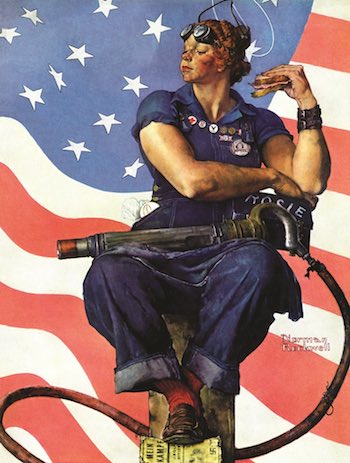
“I want to work on a bomber,” she told Mrs. Mamie Kipple, assistant employment director in charge of hiring the women who work in the company’s two sprawling plants.
“Why do you want to work on a bomber?” asked Mrs. Kipple.
“That’s something I can do to help bring Harry back.”
“Who is Harry?”
“My husband. He’s machinist’s mate on a destroyer at Pearl Harbor.”
“Have you ever worked in a factory?”
“No; but I can learn, if you’ll give me a chance.”
Like other aircraft manufacturers of Southern California, where half the country’s bombers and fighters first take wing, the Consolidated management, which began employing women for factory work last September, had a soft spot for Pearl Harbor wives and widows. The following day, Mrs. Hoffman, in trim blue jumperalls, was busily sorting and testing small parts in the blister department. A blister is a transparent plastic turret from which gunners aboard the huge
flying boats and heavy-bombardment bombers fight off enemy attackers.
Within a month, with nimble fingers and a will to learn, Mrs. Hoffman was rated as a veteran factory hand among the thousands of “Keep-’Em-Flying girls” helping to build planes in West Coast aircraft plants, strictly a man’s world until eight months ago. When they first appeared on the assembly benches, the women were “the lipsticks” to the men. Workers and bosses alike said, as did hard-boiled Bert Bowler, plant manager for Consolidated, “The factory’s no place for women.”
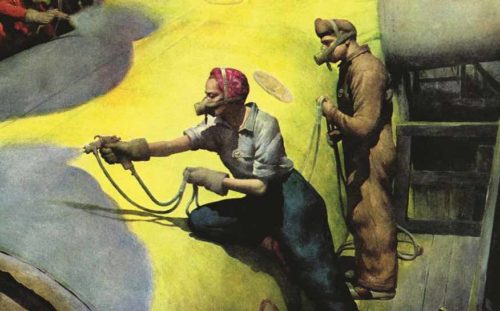
Now Bowler says, “They’re better than men for jobs calling for finger work. They will stick on a tedious assembly line long after the men quit. Women can do from 22 to 25 percent of the work in this plant as efficiently as men.” At the Inglewood plant of North American Aviation, Inc., with 1,100 women on the payroll, M.E. Beaman, industrial-relations director, goes further than that. “Women can do approximately 50 percent of the work required to construct a modern airplane,” he estimated. Douglas Aircraft, which started late in the employing of women in the factory, expects to have 40,000 on the payrolls of its four plants by the end of 1942. After a study of British plants, Douglas engineers think women may have to do 60 percent of the building of planes before the aircraft plants reach all-out production. Lockheed and Vega, with 2,000 women filtered into groups working on everything from radio wiring to tubing-detail assemblies — plumbing, in plain English — are hiring and training housewives and girls fresh out of school at the rate of 200 a week. Vultee, which pioneered the use of women in aircraft building one year ago, rates them as indispensable. At Seattle, the Boeing Aircraft Company launched courses for women factory hands on the first of the year. In Midwestern cities, all the major Pacific Coast plane builders except Lockheed and Vega are rushing supplementary plants in which approximately 50 percent of the work will be handled by women. By the end of the year, it is estimated that 200,000 housewives will have left their homes for the aircraft factories.

“If they’re not wives when they are hired, they soon will be,” laughed Mrs. Kipple. “Around San Diego the saying is, ‘If you want to find a husband, get a job at Consolidated.’ That’s how I found mine.”
“Work on planes is a natural for women,” a Consolidated engineer explained. “There are more than 101,000 separate and distinct parts in one of our bombers, counting rivets, and most of them are so light in weight that women can assemble and test them as easily as men. Better, in some cases.”
“Every woman we train for some simple step in aircraft work releases a man for a job calling for more experience,” pointed out Aileen Carmichael, assistant personnel director, who started as a clerk on the night shift, learned mechanics in a trade school, then took charge of hiring women for the new Vega factory. “You ought to talk with some of the girls on the assembly lines and see why they are here and what they say about the work. It will give you a lift.”
So I did. I talked with dozens of them above the din of the riveting and stamping machines. It was an eye opener, not only in wartime industrial readjustment but in devotion to purpose. In every plant, foremen who once dreaded the influx of “the lipsticks” told with enthusiasm how mixing women workers in the teams had stepped up both morale and the output of planes.
Kitchen Technique

“The main problem with women,” one foreman told me, “is to get them to take it easy for a while and not rush and worry about the work. So I tell ’em, ‘Just imagine you’re in a kitchen baking a cake instead of in a factory building a bomber.’
“Women workers handle the repetitive jobs without losing interest or a letdown in efficiency,” he continued. “I guess it’s because this is win-the-war work for them, while men are eager to get ahead personally. We team the women with the men because they learn faster from men than from women.”
In the Vega sheet-metal department, I watched Mrs. Mary Rozar, barely 5 feet tall, dressed in slacks and blouse, protected by a leather apron, absorbed in smoothing the edges of odd-shaped parts for Flying Fortresses. Mrs. Rozar appeared at the employment office when the Vega management announced it would give preference to wives and widows of men in service at Pearl Harbor and in the Philippines.
“I’m not a Pearl Harbor widow,” she told Miss Carmichael, apologetically, “but I’m a Pearl Harbor mother. My Johnny boy lost his life on the Arizona. I have another son, Earl, somewhere in Alaska with the United States Army. I want to help build planes.”
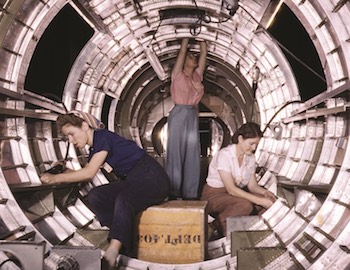
Upstairs, where hundreds of girls deftly connect and mark wires for the electrical-control assemblies, I noticed an attractive young woman with much poise who came in with the second shift and hit her stride in nothing flat. The foreman introduced her as “Jerry” Patterson.
“You don’t look like a factory worker,” I said.
“Maybe I don’t, and maybe I’m not, but I can put these assemblies together,” she replied. Her husband, Capt. Russell Patterson, was on Bataan Peninsula under General Wainwright, she said. The young Pattersons were living in Chicago, where he was an attorney when called to the service early in 1941.
“I tried working in a dentist’s office first,” she said. “That gave me no satisfaction, so I came out here, took the tests, and they put me to work on these assemblies. I haven’t heard from Russell, and I can’t get word to him, but every night I write half a page of a letter to tell him what I did that day to help finish a plane. I’m saving the letters for the day when General MacArthur goes back to the Philippines.”
At the Lockheed factory, one of the plant’s best woman spot welders is Mrs. Prisalla Maury. Her father is Col. Paul D. Bunker, in command of a coast-artillery unit at Fort Mills, “topside” of Corregidor. Across the narrow strait on the Bataan Peninsula, her husband, Major Thompson B. Maury III, was in a field-artillery unit that repeatedly hurled back the Japs. To most women, that might seem enough to do to beat the Japs. Not for Prisalla Maury, who, trained as a chemist, goes to the factory each morning, leaving four red-headed young Maurys, Richard, 6, Ann, 5, William, 2½, and Sarah, 1, at home with her mother.
“They need planes over there,” she declared. “This is the best thing I can do to help get them there.”
“She’s doing her share all right,” added John Ferguson, group leader of the spot-welding unit to which Mrs. Maury belongs. “She likes to stand on her own. If any man tries to help her, she shoos him off in a hurry.”
Two-Way Whistle
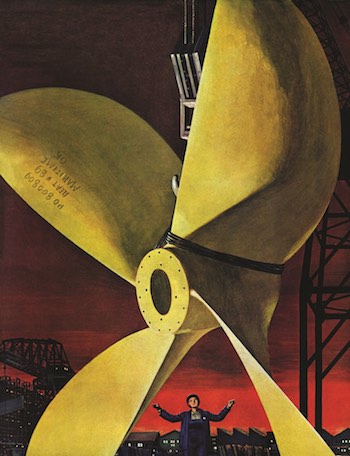
At Douglas, shortly after the first woman appeared on the assemblies, the men began whistling when an attractive young girl in bright-colored slacks and blouse walked down the aisle. The women held an indignation meeting. The following day, as the men spewed out of the plant for lunch, the girls were waiting for them. Every time a handsome young buck came through the door, they whistled and shouted, “Look at Tarzan! Isn’t he wonderful? Oh, Handsome!”
The whistling in the factory ended abruptly.
“Women are in the airplane plants to stay,” predicted Mrs. Kipple at Consolidated. “Our idea at first was they would step into the men’s shoes as the men were called for military service. They would build the planes and they would be the earners, until the men came back. But there will be a lot of jobs in the factory that the men will never get back. The women have demonstrated they can handle them better.”