If you’re tired of your same old stuffing recipe, need a new twist on turkey, or want to get more creative than slicing canned cranberry sauce, then take a look at these fall-flavored recipes we’ve curated from our archive.
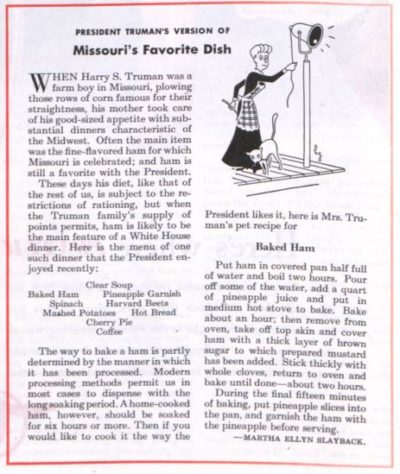
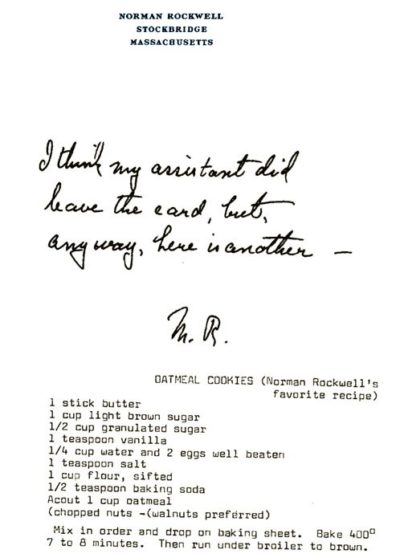
You can also sprinkle some history into your Thanksgiving traditions with Harry Truman’s ham recipe and Norman Rockwell’s oatmeal cookie recipe. We found the ham recipe tucked in the September 22, 1945, issue of the Post. While President Truman gets the headline, a closer read reveals it to be Mrs. Truman’s recipe.
Spiced Cider
“Spiced” Cider
By Post Editors
Published October 20, 2009
1.5 part Tuaca or Frangelica
1 part apple cider
Garnish with whipped cream and cinnamon
For party-sized batch:
1 (750ml) bottle Tuaca (can replace with Frangelica)
When cool, peel shells from hard-boiled eggs. Carefully cut each egg in half, lengthwise. Gently scoop out yolks and place in bowl. Add all remaining ingredients and mash together. Taste for seasoning and adjust accordingly. Using a pastry bag or spoon, fill each egg white with mixture. Refrigerate until ready to serve.
Harry Truman’s Baked Ham
By Martha Ellyn Slayback
Published September 22, 1945
Put ham in covered pan half full of water and boil two hours. Pour off some of the water, add a quart of pineapple juice and put in medium hot stove to bake. Bake about an hour; then remove from oven, take off top skin and cover ham with a thick layer of brown sugar to which prepared mustard has been added. Stick thickly with whole cloves, return to oven and bake until done—about two hours. During the final fifteen minutes of baking, put pineapple slices into the pan, and garnish the ham with the pineapple before serving.
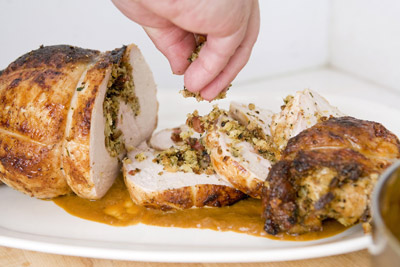
Combine water, brown sugar, and salt in 2-gallon or larger stockpot, and whisk until sugar and salt have dissolved. Place turkey breast in stockpot and refrigerate for 8 hours.
Remove turkey breast from brine, and pat dry with paper towels. (At this point you can proceed with recipe or refrigerate turkey up to 1 day until ready to cook.)
Preheat oven to 350° F.
Cut three lengths of kitchen twine to 32 inches, and lay across cutting board. Making sure skin is pulled down to cover as much of breast meat as possible, lay turkey breast, skin side down, on top of strings. Cover turkey with parchment paper or plastic wrap, and pound with heavy mallet or bottom of cast-iron skillet until thickest part of breast is no more than 2 inches thick.
In large mixing bowl, use rubber spatula to combine breadcrumbs, bacon, ¼ cup reserved bacon fat, butter, garlic, parsley, and Original Essence or other seasoning.
Lightly season turkey breast with Original Essence. Pack stuffing mixture tightly into 1-cup measure, and then empty stuffing onto middle of breast. Repeat two more times. Roll breast up as tightly as you can to form a cylinder, and use twine to tie breast together in three places. Snip off extra length of twine. (You can also tie twine vertically around breast, tucking in flaps at ends, if necessary to keep stuffing inside.) Brush olive oil all over roulade, and season lightly with Original Essence, kosher salt, and pepper.
Heat large skillet or ovenproof roasting pan over medium-high heat. When hot, place turkey roulade into pan and sear until golden brown on all sides. Transfer pan to preheated oven and cook uncovered until center reaches an internal temperature of 155° to 160°F when tested with instant-read thermometer, 60 to 90 minutes. Remove turkey from oven and let rest for 20 minutes before carving.
Remove strings and slice roulade crosswise into ½-inch-thick slices. Serve with Peach and Sage Gravy.
Recipe courtesy of Emeril Lagasse, adapted from Emeril at the Grill, HarperCollins Publisher, New York, 2009, copyright MSLO Inc.
Peach and Sage Gravy
By Emeril Lagasse
Published October 17, 2012 (Makes about 3 cups)
2 tablespoons unsalted butter, at room temperature
2 tablespoons all-purpose flour
¼ teaspoon salt
¾ teaspoon freshly ground black pepper
⅟₃ cup fresh sage leaves
Directions
Set 2-quart saucepan over medium heat and add olive oil. Once oil is hot, add shallots and garlic and sauté, stirring often, until shallots are fragrant and lightly caramelized, about 1 minute.
Add white wine vinegar and cook until nearly completely reduced, about 1 minute.
Add stock and preserves, and raise heat to high. While stock is coming to boil, combine butter and flour in small bowl and, using back of spoon, blend to form smooth paste.
Add butter-flour paste to stock and use whisk to stir in, making sure it is well incorporated. Bring gravy to boil, season with salt and pepper, and reduce heat to simmer. Cook until gravy has reduced by one quarter, about 20 minutes.
Remove pan from heat and add sage leaves to gravy. Allow flavors to steep for about 3 minutes, and then strain gravy. Serve gravy with slices of turkey roulade (click here for recipe).
Recipe courtesy of Emeril Lagasse, adapted from Emeril at the Grill, HarperCollins Publisher, New York, 2009, copyright MSLO Inc.
2 tablespoons chopped flat-leaf parsley, for garnish
Directions
Preheat oven to 350°F.
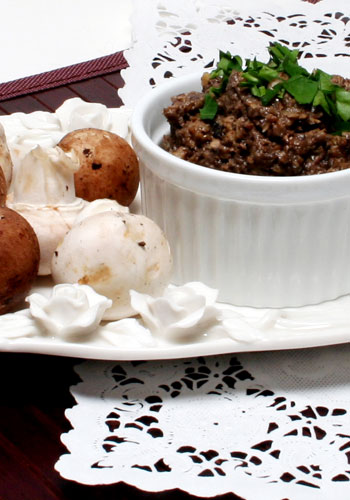
Spread walnuts on baking sheet. Stir and toast 5 minutes, until nuts are colored and fragrant. Transfer nuts to plate, cool and set aside.
In small bowl, soak dried mushrooms in water until soft, 20–30 minutes. When soft, squeeze mushrooms until dry, catching liquid in small bowl. Strain liquid through paper coffee filter or fine strainer and set liquid aside. Coarsely chop soaked mushrooms and set aside.
In food processor, combine half fresh mushrooms with shallots, garlic, and half soaked wild mushrooms. Pulse to chop very fine, 20 times; take care not to overprocess. In large skillet, heat oil over medium-high heat. Add chopped mushroom mixture, mixing to combine with oil. In food processor, finely chop remaining fresh and soaked mushrooms, then add to pan. (Do not clean out food processor.) Cook until mushrooms look wet, 8-10 minutes, stirring often. Add thyme, soy sauce, and reserved mushroom liquid. Continue cooking until mushrooms are golden and cling together, 8 minutes. Set aside.
Add walnuts to food processor, and then cooked mushrooms. Pulse until mushroom-walnut mixture is nubbly; do not purée. Turn warm pâté into serving bowl and season to taste with salt and pepper. Or season pâté and cool to room temperature, cover tightly, and refrigerate for up to 5 days. Garnish with parsley and serve with toast points, crackers, or pita chips.
Nutrition Facts
Per Serving (1 tablespoon)
Calories: 25 Total fat: 2 g Saturated fat: 0 g Carbohydrate: 2 g Fiber: 0 g Protein: 1 g Sodium: 10 mg
Carrot Top Pesto
By Anna Buss of Cookin’ the Market
Published June 28, 2013 (Serves 4–6)
Ingredients
1 bunch young carrots
1 cup arugula (optional)
¼ cup almonds in shell
1-2 teaspoons green garlic
½ cup olive oil
Juice of ½ lemon
Salt and pepper to taste
Directions
Remove greens from carrots.
Blanch greens in salted water until tender and bright green.
Remove greens from water and shock in ice bath. Squeeze out water and set aside.
Repeat steps 2 and 3 with arugula, and then with carrot bottoms.
Blanch almonds until shells become loose. Remove almonds from water and allow to cool. Shell and set aside.
Combine carrot greens, arugula, garlic, almonds, olive oil, and lemon in food processor. Blend until smooth, adding salt and pepper to taste.
Toss pesto with blanched carrots, and serve. Pesto can also be tossed with your favorite spring salads, pasta, and veggies, or spread it on a sandwich.
Recipe created by Mario Hernandez, program coordinator and market chef for Cookin’ the Market
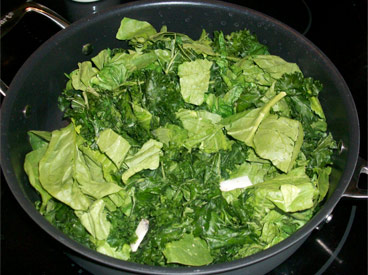
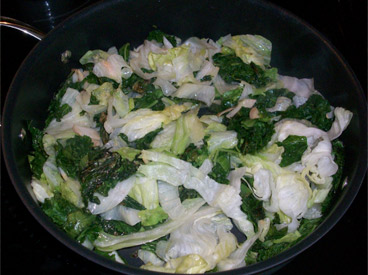
Christy’s Greens
By Elizabeth Murphy of West End Farmers Market/International Institute St. Louis
Published September 20, 2013
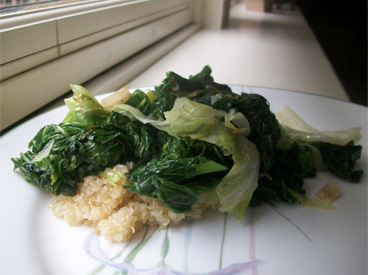
Add gusto to your grains! Serve Christy’s Greens over quinoa for a flavor-filled lunch.Packed with vitamins, iron, and fiber, the hardy greens in this recipe are as nutritious as they are delicious.Iceberg lettuce wilts faster than the hardier mustard greens, spinach, and kale, so add these leaves last.
Ingredients
1 head mustard greens
2 cups kale
1 cup fresh spinach
½ head iceberg lettuce
1 turnip
4 medium cloves garlic
2 Tablespoons olive oil
½ teaspoon salt
½ teaspoon ground black pepper
Directions
Remove hard stems from kale and mustard greens (leave stems if desired).
Stack leaves on top of each other. Use knife to slice mustard greens, spinach, and kale into ¼-inch strips. Slice iceberg lettuce, but keep separate from other greens.
In large bowl filled with cold water, add cut greens. Allow dirt to settle to bottom of bowl. Lift greens out of bowl. Shake off excess water. Repeat step with lettuce.
Peel and mince garlic. Peel and slice turnip. Set aside.
In a large skillet over medium-high heat, heat oil.
Add mustard greens, spinach, and kale.
Stir greens until wilted, about 1-2 minutes.
Reduce heat to medium. Add garlic and turnip. Cook until greens are soft and excess water is gone, about 5-7 minutes. Add iceberg lettuce, cook for 1-2 minutes.
Photograph by Antonis Achilleos. Excerpted from Roots by Diane Morgan.
Ingredients
2 tablespoons unsalted butter
1 tablespoon extra-virgin olive oil
1 large yellow onion, about 12 ounces, thinly sliced
2 tablespoons firmly packed dark brown sugar
4 teaspoons kosher or fine sea salt
½ teaspoon ground Aleppo chile
¼ teaspoon freshly ground black pepper
¼ teaspoon ground cinnamon
2 pounds rutabagas, ends trimmed, peeled, and cut into ½-inch wedges
One 12-ounce bottle porter-style beer
1½ cups canned low-sodium vegetable broth
2 teaspoons finely chopped fresh oregano
2 teaspoons finely chopped fresh thyme
Directions
In Dutch oven or other heavy pot, melt butter with oil over medium-low heat until butter is foamy. Add onion and stir to coat evenly. Cover and cook until onion begins to soften, about 5 minutes. Uncover and continue to cook, stirring frequently, until onion is evenly golden brown and caramelized, about 20 minutes.
Add brown sugar, salt, Aleppo pepper, black pepper, and cinnamon and stir constantly until brown sugar has melted and spices are aromatic, about 1 minute. Add rutabagas and stir to coat. Add beer and stock, pressing down on vegetables to submerge them. Liquid should just cover vegetables. If it doesn’t, add more stock or water as needed. Increase heat to medium-high and bring to a boil. Reduce heat until liquid is at a simmer, cover, and cook for 20 minutes. Stir in oregano and thyme, re-cover, and continue to cook until rutabagas are fork-tender, 5 to 10 minutes more. Using a slotted spoon, transfer rutabagas and onions to serving bowl, cover, and keep warm.
Increase heat to high and boil braising liquid, stirring occasionally, until it reduces to about ¼ cup and has thickened to syrup consistency, 10 to 15 minutes. Reduce the heat to low, return rutabagas and onion to pan, and toss to coat in sauce. Heat until vegetables are hot, and then taste and adjust the seasoning. Serve immediately.
6 tablespoons unsalted butter, chilled and cut into small pieces
2 tablespoons vegetable shortening, chilled
1/4 teaspoon salt
4 tablespoons ice water, or more as needed
Place gluten-free flour and salt in medium bowl. Using pastry cutter or 2 knives, cut in butter and shortening until mixture resembles coarse crumbs. Add 2 tablespoons ice water, mix just until incorporated. Continue adding ice water as needed, 1 tablespoon at a time, until dough is smooth. Form dough into disk, wrap tightly with plastic wrap. Refrigerate 1 hour.
Preheat oven to 400 F. Remove dough from refrigerator, place on lightly gluten-free floured surface (we use an extra large Silpat-a sort of “rubber” nonstick mat, which really helps prevent dough from sticking to bottom surface). Lightly flour surface of dough with gluten-free flour. Roll pastry to large round, about 12 inches in diameter. Transfer to deep 9-inch pie plate, trim to within 1/2 inch of pan, crimp decoratively. If outer edges break off before folded under and crimped, just use excess dough. Press onto outer edge to form an even edge, then crimp. Prick with fork, cover. Refrigerate 20 to 30 minutes. Reserve any excess dough, reform into ball. Bake 15 to 30 minutes or until light brown. Remove form oven, let cool completely on wire rack.
Filling:
1 cup water
1 1/2 cups dried cherries
1 1/4 cups dried cranberries
1 (12 ounce) package fresh cranberries
1 1/4 cups granulated sugar
3 tablespoons gluten-free flour
Zest of 1 lemon
1 tablespoon milk
1 tablespoon sugar
1 teaspoon cinnamon
In small saucepan, bring 1 cup water to simmer. Add dried cranberries and cherries. Remove from heat. Cover, let stand 20 minutes.
In large bowl, stir together fresh cranberries, undrained dried cherry-cranberry mixture, 1 1/4 cups sugar, gluten-free flour, and lemon zest. Pour mixture into prepared pie crust. Preheat oven to 375 F.
Roll out excess dough. Using small knife, cut out leaf shapes. Using tip of knife, vein leaves without cutting through dough. Using spatula, remove “leaves” and place on top of pie in decorative fashion. Using pastry brush, brush “leaves” with milk. Sprinkle top with sugar and cinnamon.
Cover pie edges with foil. Bake 45 to 50 minutes or until juices bubble and top of “leaves” are lightly browned. Transfer pie to cooling rack to cool.
Sauce:
1 cup crème fraîche
3 tablespoons wildflower honey
In medium bowl, whisk together crème fraîche and honey. To serve, place slice of pie on plate, drizzle sauce over top.
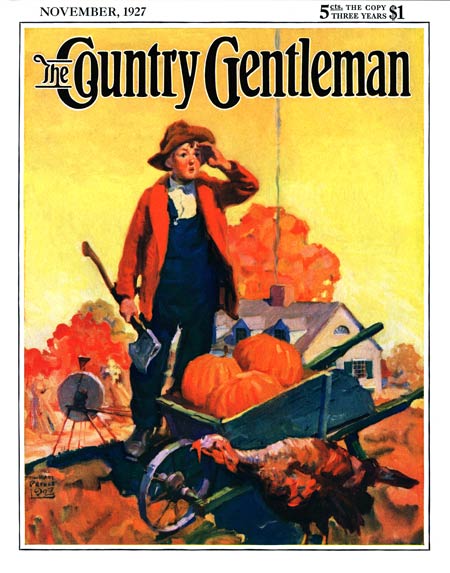
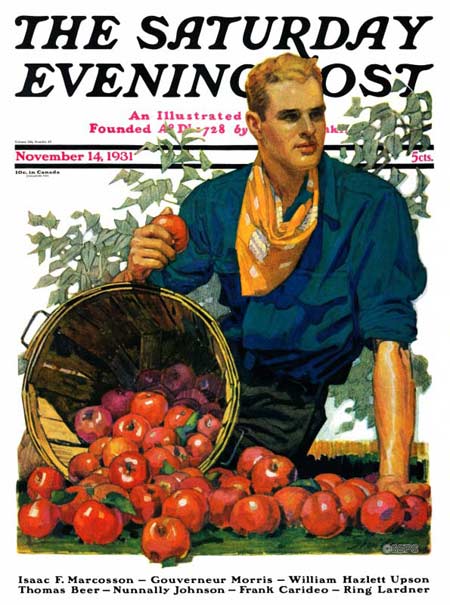
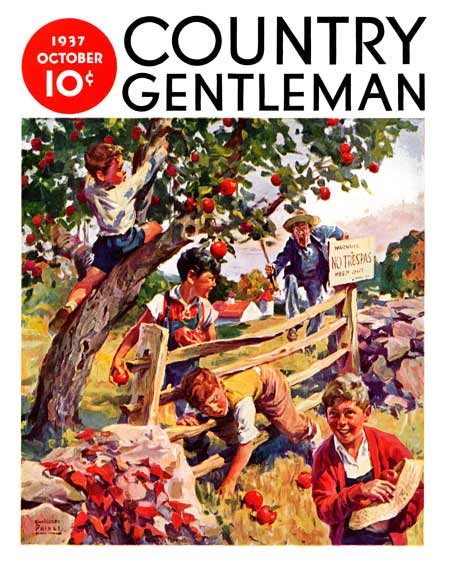
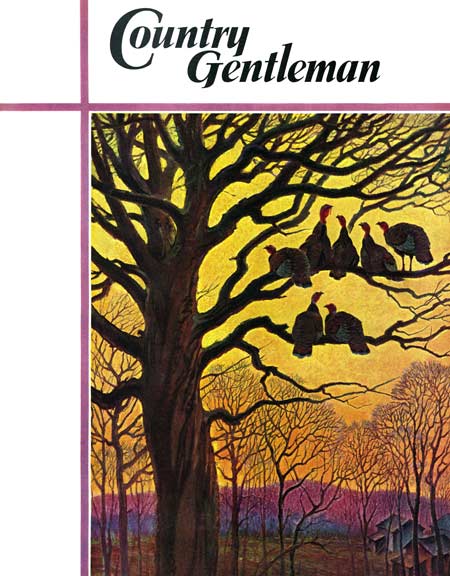
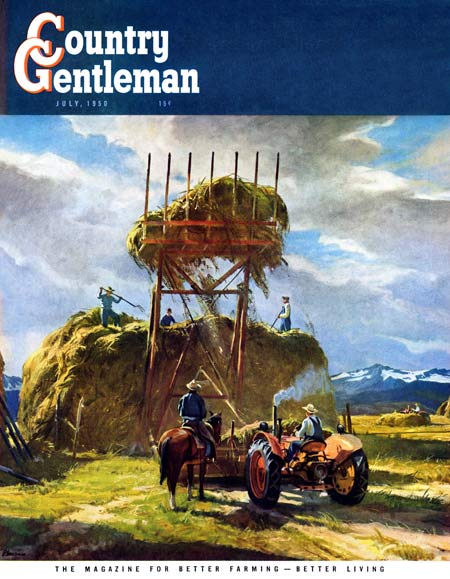
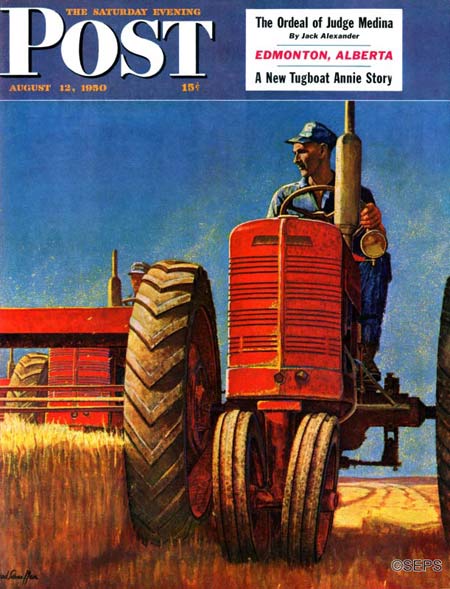
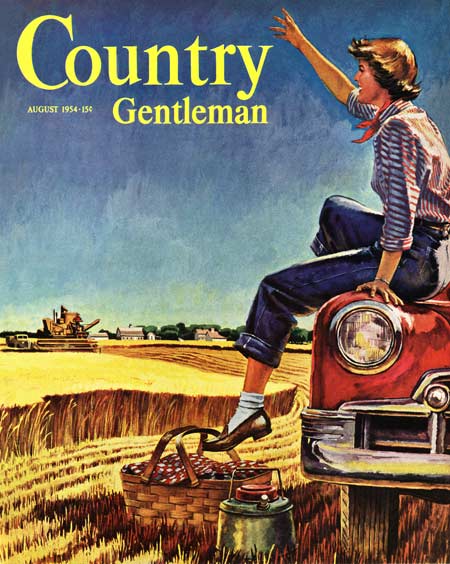
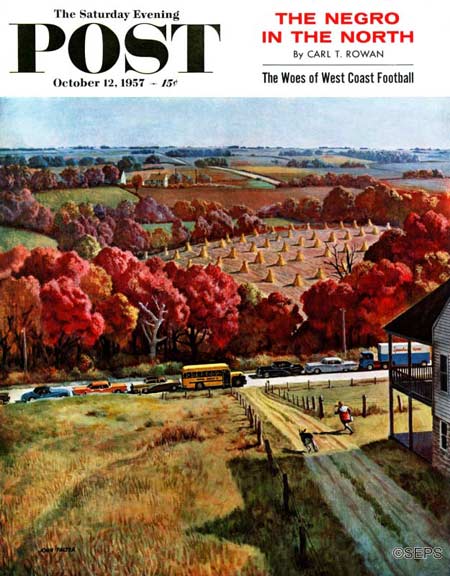
The air is crisp, leaves are aflame, and the fruit of the fields and orchards has been gathered. We hope our Fall Harvest gallery kindles memories of the bounty of Thanksgivings past.
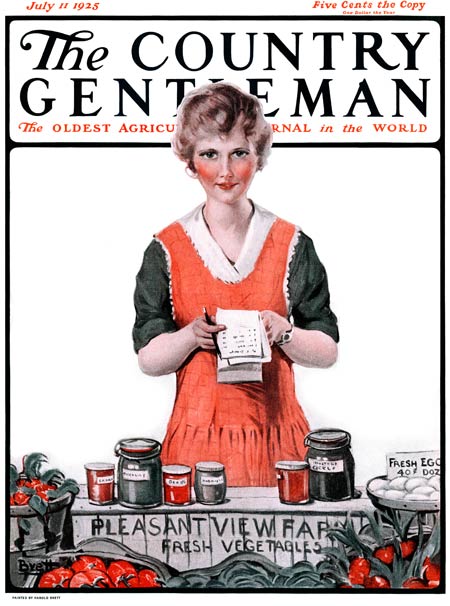
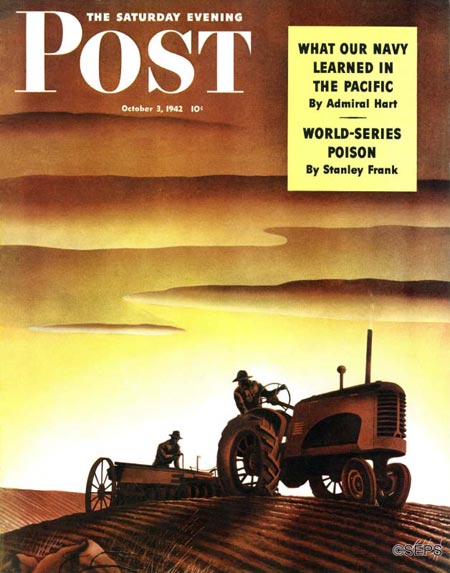
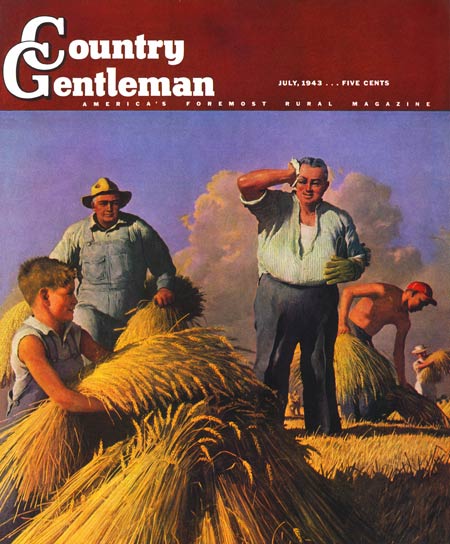
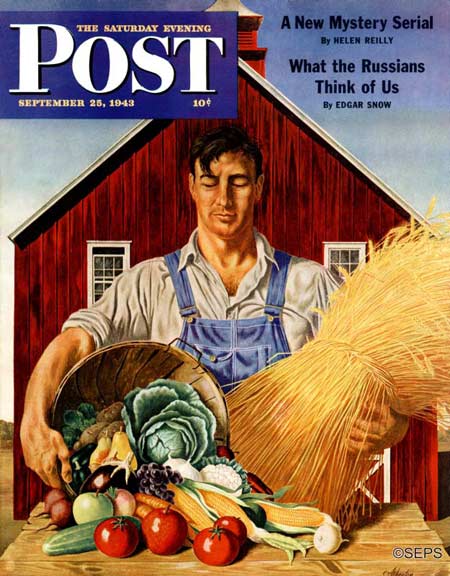
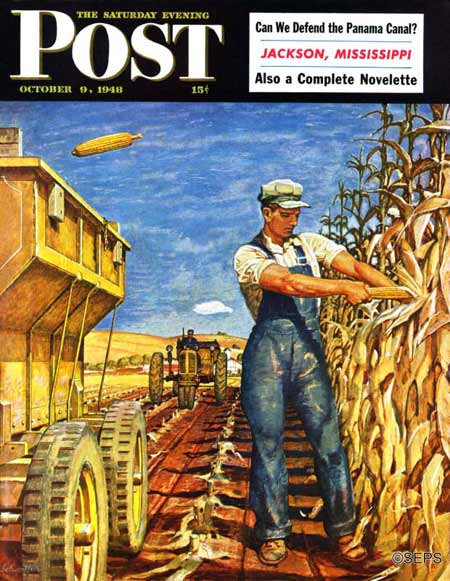
Pleasant View Farms Harold Brett July 11, 1925Where’s That Turkey? William Meade Prince November 1, 1927Bushel of Apples John E. Sheridan November 14, 1931Stealing Apples William Meade Prince October 1, 1937Wild Turkeys Roosting Paul Bransom November 11, 1938Tractors at Sunset Arthur C. Radebaugh October 3, 1942Wheat Harvest Robert Riggs July 1, 1943Fall Bounty John Atherton September 25, 1943Corn Harvest Mead Shaeffer October 9, 1948Stacking Hay Ogden M. Pleissner July 1, 1950Wheat Harvest Mead Shaeffer August 12, 1950Woman on Car with Lunch Waving in Field Bob Addison August 1, 1954Running to Meet the Bus John Falter October 12, 1957
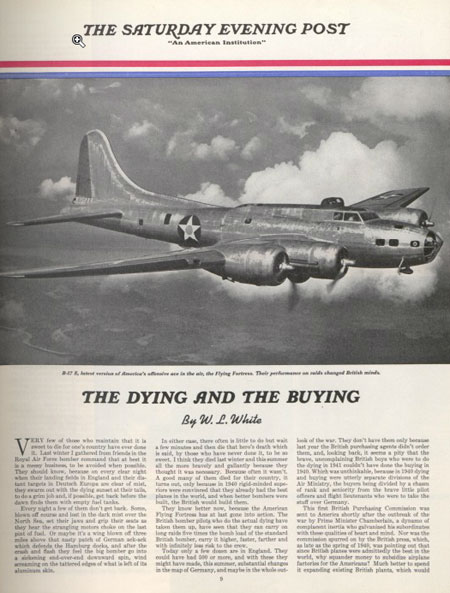
America debuted the Boeing B-17, its latest development in military bombers, in 1940. The B-17 included a feature so advanced — the turbo-supercharger — that the Army had originally prohibited its sale to any foreign power. But that prohibition had been eased for the British now that they were fighting for their survival.
The British weren’t impressed.
They dismissed Boeing’s Flying Fortress as too new and too complicated. Also, it wasn’t British. So the Royal Air Force launched its air offensive against Germany with the older British bombers. In the following months, the RAF suffered losses so heavy, they reconsidered the American bomber.
By 1941, the British were flying B-17s and, according to author W. L. White, they were hitting the enemy harder, more frequently, and with less risk to the crew. This prompted White to reflect on the lives of airmen lost to the stubborn thinking of British military planners.
For the first few years of the war, the Allies — both British and American — struggled to get ahead of the Germans on the technology curve. The Nazis had been planning their conquest for years. Their opponents had looked away from the growing crisis, not wanting to think about another war so soon after the last one.
When war began, the Allied nations assumed it would be fought much like the First World War: a long stalemate with trench-bound troops and occasional bombings. That notion was shattered in June of 1940, when the Germans swept across Europe to conquer France, Belgium, Luxembourg, and the Netherlands. The world was stunned.
Here in America, many who had considered the new war as a pointless repeat of World War I now began to urge the U.S. to rebuild and modernize its military.
But re-arming the nation would be expensive and time-consuming. On December 7, two months after “The Dying and the Buying” appeared in the Post, the Japanese sped up the modernization of the U.S. Pacific fleet by destroying much of its power at Pearl Harbor.
As you read this article, keep in mind that Flying Fortresses were taking people farther from earth than ever before: the turbo-supercharger enabled the B-17 to operate at 30,000 feet. White explains how designers overcame the challenges to aviators operating at such high altitudes.
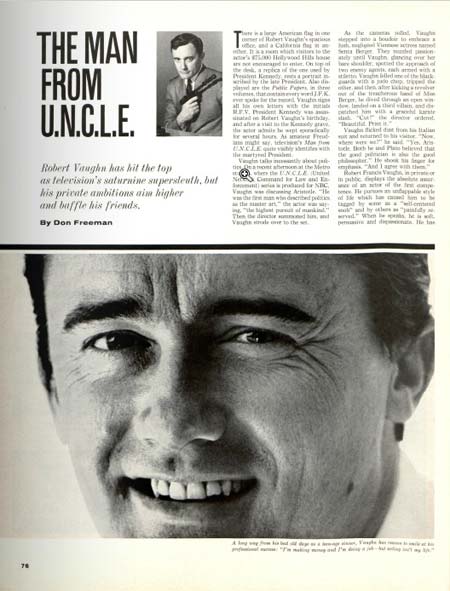
When The Post’s profile of Robert Vaughn appeared in 1965, he was as big a star as television had. He was receiving 2,500 pieces of fan mail every week, and frequently mobbed by female admirers.
The Man from U.N.C.L.E. played to America’s fascination with spies, which had begun with the James Bond novels and motion pictures. It was easy to imagine a world of spies during the Cold War. Throughout the 1950s, Americans had repeatedly heard warnings that Communist agents were at work in business, government, and schools to undermine the U.S.
But U.N.C.L.E. never took espionage seriously. Vaughn’s character, Napoleon Solo, gently spoofed the spy genre just as his contemporary, Adam West, played a campy version of Batman. (The character’s unusual name was lifted from a mobster in Ian Fleming’s James Bond story, Goldfinger.)
Before Ronald Reagan rose to national prominence, the idea of a performer running for office seemed ridiculous. Vaughn, a long-time liberal Democrat, dismissed the idea of his running for office in Don Freeman’s interview, but he never lost an interest in politics. He was one of the first actors to publicly state opposition to the Vietnam War. With other entertainers, he formed an anti-war wing of the party, which promoted Eugene McCarthy for president.
It was John F. Kennedy who inspired political interests in Vaughn. He remained involved after JFK was killed. But with the death of Robert Kennedy, Vaughn—like many of his contemporaries—lost heart for politics.
We’d like to wish a very happy birthday to the memory of Kurt Vonnegut. Mr. Vonnegut wrote numerous stories for The Saturday Evening Post, and was kind enough to sit down for an interview with us in 1982:
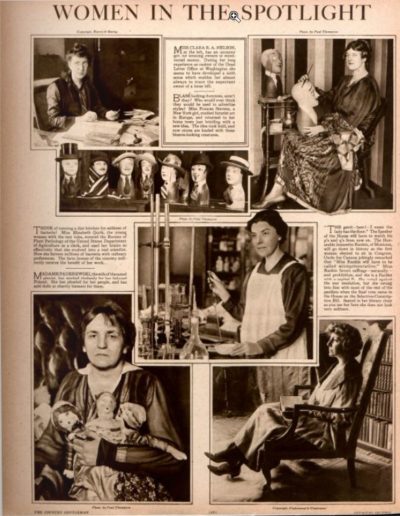
One hundred years ago, Jeannette Rankin’s home state of Montana voted to send her to Washington, making her the first female member of Congress.
She had long been an advocate for women’s rights, but she was also gaining a national reputation for being, as this Country Gentleman item notes, “a Pacifist with a capital P.”
Pacifism was consistent with western politics in those days. Farmers and ranchers were strongly opposed to the U.S. getting involved in foreign affairs. Rankin remained faithful to her principles in 1917, when President Wilson asked Congress to declare war on the Central Powers in Europe. She, and 50 other congressmen, voted against entering the war.
While she had remained faithful to her pacifism, the country was changing its mind under the influence of pro-war propaganda. Pacifism became suspect, and there were accusations of disloyalty to anyone who didn’t fully support the war.
Rankin’s now unpopular principles, and a reapportionment that put her in a Democratic district, resulted in her losing a bid for reelection in 1919.
She retired to the country, though she continued to speak out for peace and the prevention of war. She also lobbied for progressive reforms, such as ending child labor and providing relief to working women with children.
In 1940, she ran for Congress again and won. Rankin believed that campaigns should be run from the bottom up. She and her mother, who was past eighty at the time, drove from ranch to ranch. She believed “that the country people are the best informed people in our country.”
She was now one of nine women in the House. She gained new notoriety for resisting President Roosevelt’s efforts to aid Great Britain. The day after the Japanese attack on Pearl Harbor, she was the only member of Congress to vote against the declaration of war. This time, her pacifism drew even stronger criticism and anger from the American public. When President Roosevelt asked for a second declaration of war, this time against Germany and Italy, Rankin abstained to make the vote unanimous. She recognized how unpopular she’d become, and so didn’t run for reelection the following year.
However, she continued to advocate pacifism over the decades, and as late as 1972 was considering running for Congress again. Her position on war had become far more popular as opposition to the Vietnam war drew thousands to the cause.
Several other women were elected to Congress after Rankin. But she was first, and, for many decades, one of the very few women who were elected for their own merits and not simply to fill an office vacated by a husband or father.
Just as fascinating as the actual election results was the coverage of it on television and social media. I was up until 2 a.m., surfing around the various channels. You had CNN’s John King and his wondrous magic wall (at one point I think he wanted to strangle Wolf Blitzer for all of his interruptions), and MSNBC’s Rachel Maddow looking rather perplexed. You had CBS’s Bob Schieffer not knowing what to make of the results, and over on Fox News they wanted to be more cautious after getting 2012 so wrong. The election was all that Twitter could talk about for 24 hours straight, and helped prove once again that maybe, just maybe, most of us shouldn’t be on Twitter.
To summarize this election: A lot of the “experts” didn’t know what the heck they were talking about.
One last thing about the 2016 election: Have you heard about the new web craze, The Mannequin Challenge? It’s when you stand still like a mannequin and film yourself. It’s one of those internet memes like the Ice Bucket Challenge and planking and the one where you smush bread into your face for some reason. Everyone on the Clinton campaign plane took part in The Mannequin Challenge the day before the election, and someone added an REM song to it after the results came in. I think it pretty much describes how Clinton supporters feel:
Oprah Winfrey doesn’t have her daily talk show anymore, so she can’t freak out her audience by surprising them with so many Christmas gifts that many of them have heart attacks. But she still picks her favorite things every year, only now it’s in her magazine and online with help from Amazon.
I don’t know if you have any Saturday Evening Post columnists on your Christmas list this year, but if there are, I wouldn’t hate it if you bought me, I mean them, this Bialatti Pasta Pot.
Breaking Starbucks Coffee Cup News!
Last week we told you about the latest controversy involving the Starbucks Christmas cups. Turns out those weren’t the Christmas cups at all! They were unity cups, for the election (not sure if that worked out that well).
Yesterday, Starbucks made their cups for the holiday season available, and if you thought there wasn’t enough seasonal joy in last year’s plain red, green, and white cups, there’s plenty of that this year to make up for it. This season they have 13 different cups designed by Starbucks customers all over the world. There were 1,200 submissions to the contest on Instagram, which seems like a rather low number for a worldwide Starbucks contest. If for some reason you don’t like fancy designs on your coffee cups, those regular red, green, and white cups will be available too.
By the way, from now until Monday, if you buy a holiday drink at Starbucks between 2 p.m. and 5 p.m., you get a holiday drink for free!
Courtesy Starbucks
RIP Leonard Cohen and Kay Starr
Leonard Cohen was one of the most influential and respected singer/songwriters of the past several decades. His song “Hallelujah” has been featured in many TV shows over the years and has been covered by dozens of artists, including Jeff Buckley:
Cohen passed away last night at the age of 82. No cause of death was given, but he told The New Yorker in a recent interview, “I am ready to die. I hope it’s not too uncomfortable. That’s about it for me.”
Kay Starr had one of the great voices in American pop music. She recorded many well-known songs, including “The Rock and Roll Waltz” and the Christmas classic “(Everybody’s Waiting For) The Man with the Bag,” which Target used in commercials a few Christmases past. But she’s probably best known for the No. 1 song “Wheel of Fortune,” which was used in L.A. Confidential:
Starr died last week at the age of 94 from complications of Alzheimer’s disease.
This Week in History
Franklin Delano Roosevelt Elected President Again(November 7, 1944)
The comet named after Halley won’t be seen again until July 28, 2061.
Berlin Wall Opens (November 9, 1989)
At least 130 people were killed trying to escape East Germany from 1961 to 1989.
Monday Is National Pickle Day!
I would lump pickles into the same category as ketchup, mustard, pasta, and beer, and that category is “Things I’m Never Going to Make at Home — I’ll Just Buy Them from the Store, Thanks.” But if you’re ambitious, AllRecipes has a bunch of recipes for both dill and sweet pickles. Whether you make them yourself or just go with Vlasic, you can include them in this Cuban Sandwich from Bobby Flay or this meatloaf, or you could fry them.
You could also make pickle-infused vodka, which I don’t think is one of Oprah’s favorite things.
Next Week’s Holidays and Events
Sadie Hawkins Day (November 13)
I can’t remember having a Sadie Hawkins Dance when I was in school. If we did, I was never asked! I also didn’t know that it all started with Li’l Abner.
The bank’s letters had taken a threatening tone. “Contact us to begin payment of your student loans, or we will pursue legal remedy through the courts.”
Margot slumped onto her threadbare couch. She ruffled her short brown hair. To avoid plunging her into bankruptcy, Wells Fargo demanded $1,000. The corners of Margot’s mouth turned down, and tears welled. Her grandfather would’ve been crestfallen by her financial plight. Margo’s single mother had disappeared, abandoning Margot into his care. Grandpa beamed as he told friends at the senior center that Margot was the first in their family to attend college. He’d passed before seeing her graduate from the University of Texas.
Where could she possibly get $1,000? Her resume had been posted on Monster and Career Builder for months. No job, not even an interview invitation. The world demonstrated little demand for an English major who could quote Chaucer. The local MacDonald’s displayed a “Staff Wanted” sign for slinging hamburgers. How could she serve Big Macs to her friends when they’d attended college together? There had to be another way.
Margot’s gaze went to the television. A little diversion was needed. She pressed the remote. Sound rose, but the cathode ray tube remained gray. On the blink. What next? Margot sighed. She supposed that electronic problems didn’t solve themselves. At Best Buy, she’d strolled past dozens of LCD TVs for sale. Spectacular resolution and clarity. As Chaucer wrote, We love newfangledness. Forbid us something, and that’s the thing we desire. Margot shook her head. Her friend Jessica had purchased a 60-inch Samsung. Jessica majored in computer science. After graduation, she was awash with job offers. Jessica’s signing bonus covered the TV’s purchase.
Margot’s eyes lighted on a ship’s bell pushed into a corner of her studio apartment. She’d grown up with the clumsy knickknack used by her grandfather as a paper weight for his magazine collection. The relic was the single piece of inheritance from Grandpa, inscribed with the marking VOC, Vereenigde Oost-Indische Compagnie. The Dutch East India Company was the incredibly wealthy Netherlands spice and silk trading empire that had flourished in Asia for 200 years. Her grandfather spent his career in the Merchant Marines. In his will, he alluded to the bell’s rarity and that it had been passed down through generations of sailors in Margot’s family. Grandpa’s bequest advised that the piece would increase in value and that Margot shouldn’t sell it, “unless you’re down to your last penny.”
Margot bit her lip as she stared at the bell. She bent to examine the piece. Sea corrosion on the once-sunken artifact had been slight. Clearly visible was an embossed coat of arms flanked by clawing lions with the VOC marking. What could something like this be worth? She had to find out.
Margot visited the University of Texas library and researched the piece. She found abstracts, but no value was indicated. Where does one sell a few hundred-year-old ship’s bell? Then, the light bulb lit. The bell had some heft, but Margot lugged the piece to the Pawn Your Mother shop not far from the University on Guadalupe. The owner was bulky with a gray-speckled goatee. His gruff demeanor reflected the dollars-and-cents calculation of a million sad customer stories. Margot plopped the bell onto the counter. The owner’s eyebrows rose.
Margo said, “This is a very rare Dutch East India Company ship’s bell. I’m selling. What will you give me for it?”
The owner smirked. “Not much demand for a ship’s bell in Austin. How much do you want?”
Margot said, “Twenty thousand dollars.”
The owner stifled a laugh. “Not going to happen.”
“How much will you give me?”
The pawn dealer puffed out a breath. “A hundred bucks. Maybe the metal is worth that much in scrap.”
The tinkle of the front door’s bell signaled that someone else had entered. An older gentleman in a tweed jacket with a still-smoldering pipe began to browse. He spotted Margot’s bell on the counter and sprang forward.
“Oh my goodness. This is wonderful. May I touch the piece?”
Margot nodded.
The professor pointed with his pipe stem. “This is a wonderful example of a Dutch East India Company ship’s bell. Seventeenth century. Surprisingly good condition. Not encrusted with marine corrosion. I suspect that the ship sunk near shore, and the bell was salvaged soon after the wreck went down. Amazing. This would fetch at least $10,000 at auction.”
Margot brightened. “Really?”
The pawn shop owner’s shoulders sagged.
Margot said, “Did you hear that? Ten thousand.”
The owner shrugged. “Even if you interested Sotheby’s in a single piece, you’d need the perfect buyer to bid full price, and the auction house would take half.”
Margot turned toward the professor.
He tilted his head. “Perhaps that’s correct.”
Margot asked the owner. “How much will you give me?”
The man pulled at his goatee. “Five hundred.”
“No way.” Margot grasped the bell.
The pawn shop owner said, “You’re living in a dream world.”
Margot began to leave.
The pawn shop owner raised his palms. “Okay. One thousand. That’s my final offer.”
Margot paused. “A thousand dollars? Cash? Today?”
The man nodded. “Yes.”
“You have a deal.”
The professor waited while Margot counted the money. He walked her to the street. He said, “I detected that you had a special need for $1,000?”
Margot smiled. “Absolutely. I’m buying a flat-screen TV.”
The nation is still stunned by Donald Trump’s successful run for the presidency.
Only a few weeks ago, the predictors were giving Hillary Clinton a healthy margin of victory. The New York Times put her chances of winning at 85 percent. There was talk of a Democratic landslide. Pundits wrote that the Republican Party was finished, split between irreconcilable factions: conservative and extra-conservative.
Only in the last few days before the election was there any talk that Trump’s defeat wasn’t assured. Nate Silver, the founder of FiveThirtyEight, a respected website that statistically analyzes politics, economics, and sports, suddenly reversed his predictions to give Trump a 35% chance of winning. He was criticized for changing his data points to where he thought they should be.
It turns out he was right, but he was quite alone. The media generally dismissed Trump’s chances, believing that only Americans on the political fringes would take him seriously. Now comes the second-guessing. Reporters are now revisiting what the media got wrong. Esme Murphy, of CBS affiliate WCCO in Minneapolis, believes that journalists and politicians underestimated Trump’s support from rural, white voters, both male and female. Another factor was resentment against the Affordable Care Act and its rising premiums. The persistent media coverage of Clinton’s emails counted heavily against her. And finally, Trump was able to stir his audiences.
The situation is reminiscent of the presidential election of 1948, when Democrat Harry Truman defeated Republican Thomas Dewey, contrary to the expectations of the media.
Well before voting began, major columnists were convinced Dewey had already won the contest. Newspapers and magazines had printed their “Dewey Defeats Truman” stories before the election was decided.
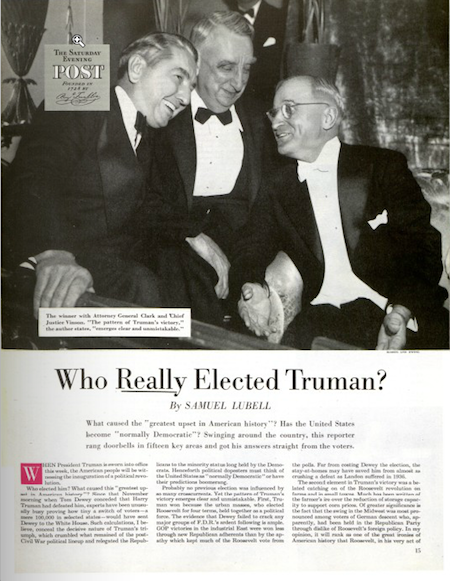
Then, on November 3, 1948, America was shocked by the news that Truman had, in fact, won. Political analyst Samuel Lubell promptly set out across the country to talk to voters and GOP officials, hoping to understand what happened.
In his Post article, “Who Really Elected Truman?” from January of 1949, he spelled out the reason for the unexpected Democratic victory in 15 cities. There are several parallels to this week’s election upset, including tightly aligned voting blocs that showed up in force (urban voters for Truman; rural for Trump), apathetic or undecided stay-at-home voters, a stronger-than-expected showing in the Midwest, and, for both Truman and Trump, a “fighting, folksy tone.”
Who Really Elected Truman?
By Samuel Lubell
Excerpted from an article 0riginally published Jan. 22, 1949
When President Truman is sworn into office this week, the American people will be witnessing the inauguration of a political revolution.
Who elected him? What caused this “greatest upset in American history”? Since that November morning when Tom Dewey conceded that Harry Truman had defeated him, experts have been unusually busy proving how tiny a switch of voters — a mere 100,000 in selected states — would have sent Dewey to the White House. Such calculations, I believe, conceal the decisive nature of Truman’s triumph, which crumbled what remained of the post–Civil War political lineup and relegated the Republicans to the minority status long held by the Democrats. Henceforth political dopesters must think of the United States as “normally Democratic” or have their predictions boomerang.
Probably no previous election was influenced by so many crosscurrents. Yet the pattern of Truman’s victory emerges clear and unmistakable. First, Truman won because the urban masses, who elected Roosevelt for four terms, held together as a political force. The evidence that Dewey failed to crack any major groups of F.D.R.’s ardent following is ample. GOP victories in the industrial East were won less through new Republican adherents than by the apathy which kept much of the Roosevelt vote from the polls. Far from costing Dewey the election, the stay-at-homes may have saved him from almost as crushing a defeat as Landon suffered in 1936.
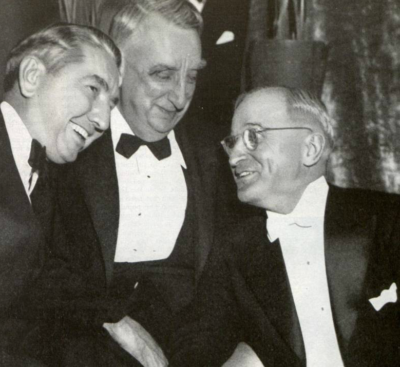
The winner with General Clark and Chief Justice Vinson. “The pattern of Truman’s victory,” the author states, “emerges clear and unmistakable.” (Harris and Ewing)
The second element in Truman’s victory was a belated catching on of the Roosevelt revolution on farms and in small towns. Much has been written of the farmer’s ire over the reduction of storage capacity to support corn prices. Of greater significance is the fact that the swing in the Midwest was most pronounced among voters of German descent who, apparently, had been held in the Republican Party through dislike of Roosevelt’s foreign policy. In my opinion, it will rank as one of the great ironies of American history that Roosevelt, in his very act of dying, removed the roadblock to a successful assault upon the staunchest Republican citadels.
Whether victory might have gone to Dewey had he slugged it out, issue for issue, will be debated endlessly. This much is clear: Dewey’s “high-level” talks on “unity” bear no relation to the way the vote broke. In contrast, Truman’s efforts seem tailored to the returns and constitute quite a tribute to Democratic Chairman J. Howard McGrath, to whom Truman owes more than Roosevelt did to Farley. In Roosevelt, the “common people” saw their benefactor. Truman hit just the right pitch in the matter of issues. He had fighting, folksy tones to appeal to the Roosevelt elements — labor, unorganized as well as organized; the foreign-born and their first- and second-generation offspring; also Negroes and Catholics. Helping him was something Dewey sorely lacked — enemies to dramatize his political convictions. Although Henry Wallace cost the Democrats New York and Maryland, he appears to have helped elect Truman. So do the Dixiecrats.
The election has been dismissed as a vote for prevailing prosperity — that plus popular anger against high living costs, inadequate housing, and the Taft-Hartley Law. With the Democrats controlling Congress and the presidency, Republicans now take comfort in the belief that they will profit from the voters’ wrath in 1952. But the 1948 vote resulted from factors which have been remaking our political life for at least a generation — birth rates, economic status, racial groups, the rise of government as an employer, the development of a new middle class with underdog memories. In terms of these forces, the Republicans appear, to me, weaker today than during Roosevelt’s dazzling victories.
Each city offered a different explanation for voting for Truman.
BOSTON
“Dewey by 60,000” was the forecast for Massachusetts. But Truman’s astonishing plurality topped 240,000, for a larger popular vote than Roosevelt ever got. Why?
Clumsily, the Republican state legislature put on the ballot proposals to legalize birth control and to crack down on trade unions. No two issues could have more effectively aroused the Democratic vote, concentrated among working-class elements of Irish, Italian, French-Canadian, and Polish descent, all predominantly Catholic. One observer told me, “The church did a job on the women, while the unions got out the men.”
STETTIN, WISCONSIN
With anti-Roosevelt feeling no longer a factor in 1948, farmers found it easier to vote their economic interests. … The greatest Truman swing came in Western Wisconsin, rolling dairy country which raises no price-support crops. Eastern Wisconsin, which does, held for Dewey. What the western counties do share is having suffered greater privations during the depression — twice as many farms were foreclosed — than Eastern Wisconsin.
GUTHRIE CENTER, IOWA
Throughout the Farm Belt, it seemed, farmers were seeking down-to-earth promises which they didn’t find in Dewey’s speeches. The pre-election drop in farm prices had the psychological effect of making them fear they were going to lose all their gains. These fears were stimulated when Congress reduced the storage capacity available for supporting corn loans.
DETROIT
Steady employment undoubtedly has contributed to [workers’ satisfaction with the Democrats]. On nearby streets, every fourth or fifth house is freshly painted. The grocery which handled food stamps in 1940 gleams with fluorescent lighting. Many union members are property owners.
HARLEM, NEW YORK CITY
Negro voters are no longer swayed by the naming of a few colored persons to well-paying jobs. … the Republicans have no labor program to attract the 1,000,000 Negro workers, now unionized. They frown on public housing, which to Negroes promises relief from both squalor and segregation.
CLEVELAND
The younger people voted for Truman. The Dewey ballots were invariably among older folk. Typical of the reasons given by Truman supporters were, “We were high-school kids during the depression, but remember how tough it was,” or “It seemed the safest thing to do.”
CHICAGO
The depression first split the allegiance of the middle class — three banks in [one] neighborhood failed. Few “lost Republicans” have been won back. One woman, who drove 60-odd miles to vote for Hoover in 1928, felt that Truman was “one of the people,” while Dewey was “It’s all been said before.”
PITTSBURGH
The great Republican mistake, I believe, was to assume there was a “natural pendulum swing” which had won them control of Congress in 1946 and which would carry them the rest of the way into the White House.
From his national canvass, Lubell saw a new appreciation of the Democrats and a dismissal of the Republicans that the pollsters and politicians missed. And as this year’s election shows, it wasn’t the last time the experts overlooked critical signs of change.
Overall, I found that in city after city through the Roosevelt years, the former “minorities” became the new majority. This indicates what has become of the GOP pendulum. That pendulum reflected the normally Republican majority which evolved from the Civil War. With each successive election the proportion of the population to whom 1860 has any political meaning dwindles. The Republican problem becomes increasingly one of finding a new political vehicle of a design to attract new passengers.
From the Republican viewpoint, perhaps the harshest fact the 1948 returns reveal is how many ordinarily conservative persons feared a Republican victory. Is this because the processes of inflation, government infiltration, and global power politics have already gone so far that people feel our whole social structure rests upon government supports?
Whatever the reason, the doctrine of too little government seems to have become as frightening as that of too much government. Unless the Republicans can develop their own concept of the positive role that government is to play in American life, they will have to resign themselves, in the judgment of this reporter, to a minority status, with their best hope for victory lying in a Democratic equivalent of the Bull Moose split. Dewey, in fact, came close to becoming a minority president, as Wilson was in 1912.
Whether the Democrats can hold together is still the crucial question. Can they cement their new farmer allies with their older labor following?
You can speculate from now until 1952 on how the reshuffling of both major parties — now so clearly under way — will eventually come out. So far — and this is perhaps the crowning irony to this most paradoxical election — the Republicans seem to have suffered more from Roosevelt’s death than the Democrats. Roosevelt’s passing removed the common foe who united some Republican elements, while plenty of enemies for the Democrats to vote against survived.
Perhaps that is the moral of the 1948 election — that Americans like to elect their presidents on the basis of the enemies that they have made. Dewey’s fatal error may have been that he did not choose to run against anybody, especially.
The idiosyncrasies of the Electoral College system come into sharp focus every four years, as Americans scratch their heads over the fact that, in presidential elections, one person does not equal one vote. It becomes particularly fraught when the winner of the Electoral College is not the winner of the popular vote. That was the case in the 2000 election of Bush vs. Gore, and appears to be the situation in 2016, where Donald Trump surpassed the 270 electoral votes needed to secure the presidency, but Hillary Clinton squeaked by President-elect Trump in the popular vote (as of this writing, votes are still being counted).
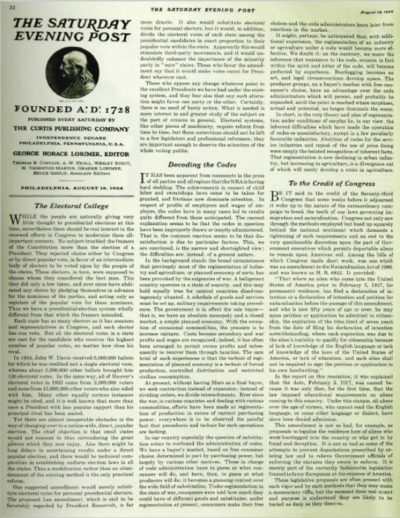
The Electoral College system was a worry even in 1934, as this editorial in The Saturday Evening Post shows. The editors write, “No subject troubled the framers of the Constitution more than the election of a President.” They consider amendments to the process and conclude that changing it is a complex business. Some issues that plagued them then are less worrisome today, such as our ability to quickly ascertain results of a popular vote. Other considerations, such as the impact of popular voting on small-population states, may still be contentious.
The way the Electoral College works has indeed been tweaked over the years, in the Twelfth, Fourteenth, and Twenty-Third Amendments. And while dramatic overhauls have been demanded, none have been implemented. Even in 1932, the editors emphasized that there was “no need of hasty action.” 84 years later, our method of choosing our president remains a steadfast, if imperfect, part of our American story.
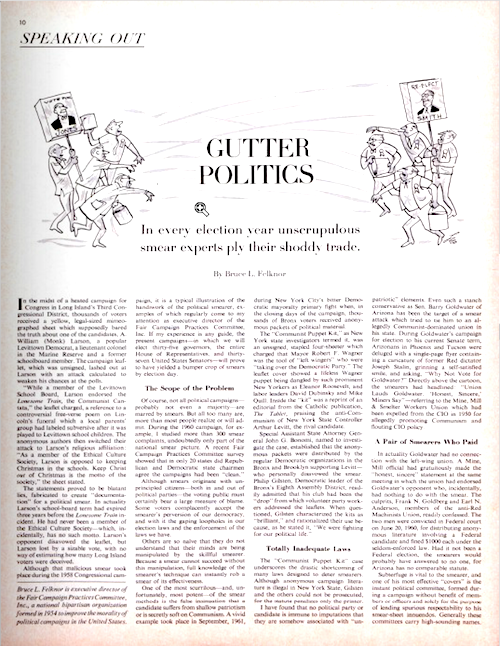
In the last few weeks of the recent election, it wasn’t uncommon to hear people say, “I wish it were already over.” Americans, it seemed, had heard enough negative campaigning. This year, the tone was particularly bitter. When a recent poll asked voters if they were “excited,” “disgusted,” or neither by the 2016 campaign, 82 percent chose “disgusted.”
Americans have come to expect negative, attacking campaigning in our elections, but the speeches and advertisements seem to have grown more bitter and offensive with each campaign.
He wasn’t just worried about the tone of campaigning. He feared that the rise of smear campaigns would discourage qualified people from running for office. Who, after all, would subject themselves to having their past mistakes publicized and exaggerated, or tolerate listening to vicious lies endlessly repeated in the media?
Negative ads have another drawback. One group of researchers found that negative ads “slightly lower feelings of political efficacy, trust in government, and possibly overall public mood.”
Campaign managers would stop using attack ads if they proved ineffective. Here opinion is divided.
It is generally agreed that negative ads work only on undecided voters, but a study by the Ohio Media Project says that they also reduce overall voter turnout. Moderate voters, it says, prefer to stay home rather than vote in bitter elections. An extensive Rutgers/George Washington University study, however, found no correlation between voter turnout and the tone of the campaign.
Can we expect future campaigns to get even uglier than this year’s? While it’s hard to imagine a more combative campaign, no doubt someone could find a way to take campaigning down an even darker path.
Negative campaigning will probably continue until it loses its influence on voters. But even now it isn’t necessary to a successful campaign. John Hickenlooper won the 2014 governor’s race in Colorado without running any negative ads, showing that it’s still possible to get into office without stepping into the gutter.
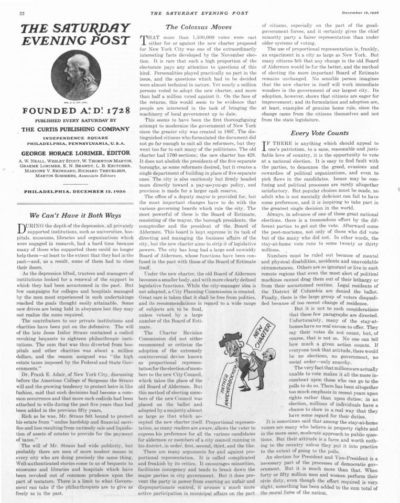
This editorial was originally published December 12, 1936.
IF THERE is anything which should appeal to one’s patriotism, to a sane, reasonable and justifiable love of country, it is the opportunity to vote at a national election. It is easy to find fault with the parties, to denounce the greed, evasions and cowardice of political organizations, and even to pick flaws in the candidates. Issues may be confusing and political processes are rarely altogether satisfactory. But popular choices must be made, no adult who is not mentally deficient can fail to have some preference, and it is inspiring to take part in the greatest single decision in the world. Always, in advance of one of these great national elections, there is a tremendous effort by the different parties to get out the vote. Afterward come the post-mortems, not only of those who did vote but of the many who did not. In other words, the stay-at-home vote runs to some twenty or thirty millions. Numbers must be ruled out because of mental and physical disabilities, accidents and unavoidable circumstances. Others are so ignorant or live in such remote regions that even the most alert of political machines cannot drag them out of their lethargy or from their accustomed routine. Legal residents of the District of Columbia are denied the ballot. Finally, there is the large group of voters disqualified because of too recent change of residence. But it is not to such considerations that these few paragraphs are directed. Unfortunately, many of the stay-at-homes have no real excuse to offer. They say their votes do not count, but, of course, that is not so. No one can tell how much a given action counts. If everyone took that attitude, there would be no elections, no government, no social order—only anarchy. The very fact that millions are actually unable to vote makes it all the more incumbent upon those who can go to the polls to do so. There has been altogether too much emphasis in recent years upon rights rather than upon duties; in an election, millions of individuals have a chance to show in a real way that they have some regard for their duties. It is sometimes said that among the stay-at-home voters are many who believe in property rights and in the more sane, moderate approach to public questions. But their attitude is a farce and worth nothing to the country unless they put it into practice to the extent of going to the polls. An election for President and Vice-President is a necessary part of the processes of democratic government. But it is much more than that. When forty or fifty million men and women perform their civic duty, even though the effort required is very slight, something has been added to the sum total of the moral force of the nation.
The two men surprised each other. Surprised each other so badly that neither made a sound and stood, only 10 feet apart, shocked into almost comical stasis; one was pushing aside a birch branch, the other had just raised his right boot, preparing to crush a pathway through the ferns. Both had been in the act of puckering their lips just so, the mouths now mute in the warm lake air. Both saw exactly what the other had been doing.
*
I’ll be the first to say bad habits are hard to kick. So perhaps it wasn’t hate exactly, more the long established habit of dislike. However, I would also be the first to say that Roger Gilbert and I were actively unpleasant to each other for a good 35 years. Which in terms of duration is only three years short of my marriage to Dorothy. We were simply good at disliking each other and never quite kicked the tendency.
I can pinpoint precisely the year Roger and his wife, Addie, moved to Parker and, by extension, the house next door to us, because it was the first year the whippoorwill turned up on the banks of Lake Filene. Filene is, by all popular accounts, one of the more forgettable of the great lakes that straddle the border between here and Canada. It’s smaller than the others, and boringly symmetrical for those who love the capaciousness of Superior or Huron. Dorothy and I, by contrast, loved Lake Filene for all the things it was not. We were not sailors or hunters or artists. We baked, and bird-watched, and as such Filene suited us down to the ground.
We’d had a cabin there for a year before I heard her. The whippoorwill, I mean. In a twist of personal eccentricity that never fails to annoy my colleagues at the Audubon, I refer to all birds as female, like a mariner and his boat. Her call lacks sophisticated musicality and opts instead for an appealing cheekiness; the few jolly syllables and trill are bright and clear and as such the simplicity of sound begs imitation. She’s a shy bird, mottled brown and disinclined to company. Just like Dorothy, who was my own little hard-to-catch brown bird, or so I joked to her that August when I did nothing else but sit on the porch and practice my whippoorwill whistle. Dorothy would poke me in the arm with the affection I’d worked so hard to win, and I’d pull her into my lap and whippoorwill into her ears till bedtime. I couldn’t believe one man could get so lucky, though of course I was young then and didn’t see it like that yet.
When we returned home that September, I failed to notice that the house next to us had finally sold. It had been empty for so long, we’d simply grown accustomed to a kind of polite disinterest when it came to place. Plus we were busy and wrapped up in our own little republic of two. That blissful acquiescence to social norms: picking paint for the baby’s room, applying for a promotion, extra pints of ice cream in the freezer so Dorothy could get good and fat. And of course there was my Audubon club.
As with most things, it began with the women. Dorothy mentioned one day she’d had the neighbor’s wife over for coffee that morning. In a declaration that forever sealed the two as friends, my wife deemed Addie clean, smart, and likable. She was also pregnant with a due date only three days behind Dorothy. For the women, it was the first in a series of life events that would mirror each other with almost eerie synchronicity, like two runners keeping pace and lighting parallel beacons along a ridge.
For Roger and myself, there would be no such harmony. In fact the first time we met was at my Audubon meeting some time in early October. Suffice to say it went downhill from there.
“I’m sorry, but that’s simply inaccurate.” Those were the first words he ever spoke to me. “Simply inaccurate.” The pedant. Pompous, and so pleased with himself. I had been talking about taking Dorothy up to the cabin for Thanksgiving, and of course with the lake in mind was practicing my whippoorwill whistle. And Roger said it was all wrong. He’d walked in late to the meeting (a habit that annoyed me for years to come) helped himself to a cookie (even though we don’t touch the cookies until the second half-hour) and declared, calm as you please, that the whistle went like this. Then he gave an impression of what was clearly a chuck-will’s-widow. And I told him so. Clearly not a whippoorwill, I said. The rest of the boys didn’t pick up on the tension that blossomed faster than bonfire smoke and were soon laughing about how much Roger and I had in common. Both emerging university professors, both with wives expecting, both rather good at recreating bird whistles. I left the meeting early that night to the sound of Roger making my friends laugh.
Thus began a small lifetime of back and forth resentments. Where one of us would succeed or seek to outdo, the other would quickly follow, and vice versa. Our careers and pleasures were so similar that there were very few contexts in which I was free of the man. Of course, if wives dislike each other it means the death of any two-couple friendship. Had Dot decided Addie was bad people, I would have had an ally. However, if the wives decide to like each other, then they are content to observe, sipping coffee, and shaking their heads over the men and their scrapping. I even think that as the years went by, Addie and Dorothy got to be amused by our growing repertoire of disagreements. Funny to think now how much I cared.
I’ll never forget the year he bought that red Ford pickup truck. Or the countless times he “forgot” to let me know the time of the Audubon’s field trip. Or the time he beat me to tenure and was given the keynote address at one of the last graduations we saw together. Or the trip to Boston. Or the fact that my Edith dated his Andy for two years in high school and I was so scared they’d marry I said yes to sending her to Paris for a semester. And of course, I thought I would just dry up and die when he and Addie bought a summer cabin one lot down from us on Lake Filene. Dorothy was ecstatic. I said I wanted a gun.
They had left buying a second place to later in life, to the point where retirement was on the horizon for both of us. It was the same year that Edith and Michael were expecting our first and much-anticipated grandchild. I remember so well because I had wanted to buy a new pair of binoculars and Dorothy said I shouldn’t because we should save for the baby. I said I didn’t see what the cost of binoculars had to do with the cost of a Donald Duck romper suit. Roger had looked as smug as cream with his new Viess binoculars just the week before, all excited to get up to Filene and try them out.
But I never lost the habit of trying to please my wife. I was always so happy to see her happy. And I mean happy on some concrete, deep down level, a level below the part of me that stung like a salted wound to see Roger wave those glasses around so proud you’d think he’d invented them. No I mean deep down like where spring water starts in the earth, below the topsoil and the roots and the gravel that sends a twang through a spade, the deepest you can go without hitting the heart of the earth. It’s that part of me that seemed to sing out when I held Edith for the first time, or when I heard the whippoorwill on summer nights, or when I helped Dorothy get her way in life. I was so happy to see her happy, and it made it so much worse when she only got to see the twins a few times. Just a few times before everything folded in upon itself and that deep reserve of happiness went sour. My little brown bird went quiet.
In a way I should have been ready for it, the pattern so predictable I barely noticed, but six months after Dorothy died, Addie passed away as well. I heard later on, when I finally returned to the Audubon, that it was a quick and pernicious cancer, the kind that kills before it has barely introduced itself. The loss of Dorothy had loosened my grasp on anything outside the boundaries of my own coping. I spent my days, now stripped of their purpose and company, relearning how to occupy myself with loneliness. Thus I missed the final chapter of Addie’s life and the first chapter of Roger’s grieving, where perhaps I could have been of comfort. But as I said before, habits are hard to kick. By the time I had regained a little sense of myself — walking by the river, grilled cheese sandwiches, attending the Audubon — Roger had vacated his house to go stay with Andy, closer to Springfield. He hadn’t sold his home, and in a kind of bookend to our neighborly narrative, the house next door stood empty once again. Thus, what with one thing and another and the passage of the year, Roger and I lost track of each other. Though I’ll admit, bonded now by something greater than pickup trucks or promotions, I thought of him sometimes, and wondered.
It was about a year and a half after Dorothy died that I finally returned to the cabin. Neighbors had looked in on it and reported it safe, if a little damp. But I knew it was time. If nothing else, Edith said she wanted her children to know and love it the way she had. I didn’t say it, but I wasn’t sure how that would be possible without Dorothy there.
Prepared as I was for loneliness, like one braced before a blow, I didn’t spare a thought for Roger as I cracked the car door open and let in the smell of water and mossy pebbles. I didn’t pause to wonder if he still owned the next-door property. The onslaught of memory was disabling, and I made no attempt to clean or air the place, and instead sat on the porch that first evening thinking about the whippoorwill. I hadn’t practiced birdcalls in ages. So I tried it. I was out of practice, but the whistle came back easily enough, as did the feeling of missing Dorothy so much it drove me to my feet and to the edge of the woods. I was whistling the whole time, trying to take my mind off that missing and casting the feeling out on the tune. Listening. Hoping to find her. And then I heard it. My little brown bird was whistling back. The whippoorwill was in the woods calling out. I whistled again. She whistled back. I pushed my way into the tree line, my lips puckered, my feet crushing the ferns out of the way.
*
And then both men saw what the other had been doing. Both were whistling the same tune and following not the call of something longed for, but the call of each other. Without saying anything but with unsure smiles that broke into laughter, the two approached each other and embraced, smacking their backs in rough camaraderie and shaking hands. For the first time in months, both men felt slightly less alone. And then suddenly, without warning, they fell silent, their heads tilting back in the darkening air. They were listening.
If a Hollywood script writer wrote the plot of the 2016 World Series for a movie, it wouldn’t have been believable. Two teams that haven’t won a championship in decades playing against each other? The series goes seven games after one team is down three games to one? And the seventh game goes into extra innings?
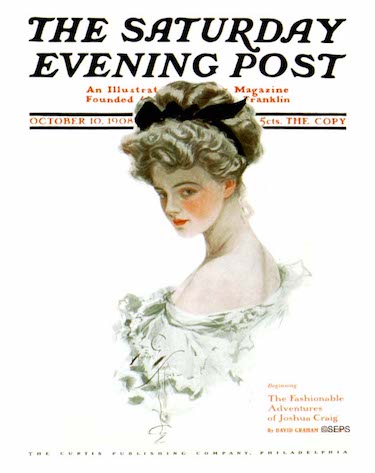
The last time the the Chicago Cubs won The World Series, in 1908, Henry Ford produced his first Model T car, the Titanic hadn’t even been built yet, and a loaf of bread was five cents. Jimmy Stewart was born in 1908 and Mark Twain was still alive.
Here’s what was on the cover of The Saturday Evening Post on October 10, 1908.
November 4, 1908
I’m happy for Bill Murray and all of the other Cubs fans. As a Red Sox fan who went through a lot of pain for a lot of years until they won in 2004, I know how they’ve felt.
I Didn’t Win $250,000
Quaker Oats had a contest earlier this year where the public could go on their web site and create a new oatmeal flavor. If they picked your recipe you’d win $250,000! I didn’t win, so I guess I’ll cancel that order for a Lamborghini.
The three finalists have been announced. It’s down to Vanilla Chai, Lemon Ricotta Pancake, and Apple Cheddar Rosemary. My choice is Vanilla Chai. Voting ends November 19.
And no, I’m not telling you what my flavor entry was. There’s always next year.
Starbucks and the Coffee Cup Wars: The Sequel
Courtesy Starbucks
Remember last year when people got upset because the coffee cups at Starbucks weren’t Christmas-y enough? It’s happening again this year. This is becoming an annual Christmas tradition, like watching It’s A Wonderful Life, decorating your house with colorful lights, and punching people in the face as you fight over the last toaster on sale on Black Friday.
Here’s the new Starbucks cup. It’s a green and white cup with a drawing of several faces all close to each other in a big circle, and while Starbucks doesn’t specifically say it’s the cup for the holiday season, it’s November 4 and you’d think the holiday cups would have been unveiled by now. Starbucks CEO Howard Schultz says that “during a divisive time in our country, Starbucks wanted to create a symbol of unity as a reminder of our shared values.” Oh, if only a coffee cup could solve our nation’s problems. I was really looking forward to this election being over concentrating on the Christmas season – a non-politicized Christmas season.
Maybe next year Starbucks can go back to snowmen and trees and angels and Santa?
Hello Bye Bye Birdie
I think that the live events that NBC has been producing the past few years are one of the great things on television right now. So far we’ve seen Peter Pan, The Wiz, and Grease (with Hairspray coming next month and A Few Good Men in the spring) and while we can say that not all of them have worked 100%, it’s great that someone is doing something that harkens back to the live performances we saw in the 1950’s during The Golden Age of Television (the first Golden Age of Television).
Next up is a new version of Bye, Bye Birdie. It was first a Broadway musical in 1960, with Dick Van Dyke and Chita Rivera, and then a 1963 film with Van Dyke, Janet Leigh, and Ann-Margret. This version will star Jennifer Lopez and will air some time during the holiday season of 2017.
If you’ve never seen the film, it’s about the craziness that occurs when rock star Conrad Birdie visits the president of his fan club in a small Ohio town. Mad Men did an episode about it. They were going do a tie-in with Patio Cola:
RIP Tammy Grimes, Michael Massee, Hazel Shermet, Don Marshall, and John Zacherle
Michael Massee was in a ton of movies, including Se7en, The Game, and The Amazing Spider-Man 2, along with TV shows like The Blacklist, The X-Files, Alias, House, Rizzoli & Isles, and 24, but he will probably be remembered as the man who accidentally shot and killed actor Brandon Lee on the set of The Crow in 1993.
Hazel Shermet was one of those people you’d see on TV and say “I know her!” even if you didn’t know her name. She appeared on shows like I Dream of Jeannie, That Girl, The Beverly Hillbillies, and The Facts of Life, as well as over 100 commercials. If you were a kid in the ’70’s you heard her voice as Henrietta Hippo on a really bizarre show called New Zoo Revue that I watched every single weekend for some reason:
Shermet, an actress and singer who also appeared on Broadway, was 96.
Don Marshall played one of the crewmen trapped in the Land of the Giants on ABC in the ’60s. He also appeared in the series Julia and several other TV shows and movies. He passed away last weekend at the age of 80.
John Zacherle? He was one of the first horror movie hosts on television, appearing as Roland/Zacherley on local stations in New York and Philadelphia in the 1950’s. He even had a hit song in 1958 called “Dinner with Drac.” He passed away on October 27 at the age of 98.
You can thank Zacherle for opening the door to other horror movie hosts like Svengoolie, who hosts his own show every Saturday night on Me-TV.
This Week in History
“Dewey Defeats Truman” Headline (November 3, 1948)
Why didn’t Thomas Dewey actually win that election? Maybe it was his mustache.
Walter Cronkite Born (November 4, 1916)
That’s right, the CBS newsman would be turning 100 this year. Here’s Jeff Nilsson with a look back at his influence.
Abraham Lincoln Elected President (November 6, 1860)
The Republican candidate defeated Democrats Stephen A. Douglas and John C. Breckinridge and John Bell of the Constitutional Union party.
It’s National Candy Day
Didn’t we just celebrate a candy day, on October 31? Seems like we should just combine National Candy Day with Halloween. It seems more efficient and we can spend our energies celebrating Love Your Lawyer Day (which is also today). But I guess we shouldn’t dismiss any day that helps give us two candy holidays in one week.
Regardless of who wins, the 2016 presidential election has broken new ground in American history. For the first time ever, a major political party nominated a woman, Hillary Rodham Clinton, as its presidential candidate. Seeing a woman’s name on the ballot has been a long time coming, and in this podcast, Jeff Nilsson and Andy Hollandbeck talk about just how long it’s been and how we finally got here.
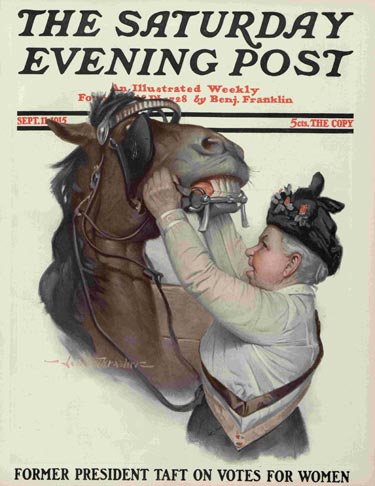
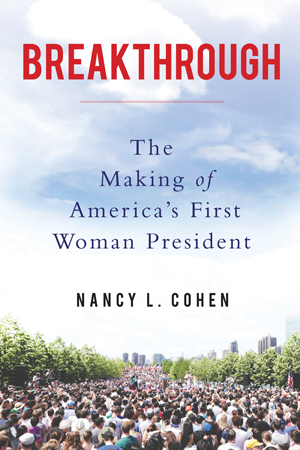
In this podcast, Jeff interviews Nancy L. Cohen, author of Breakthrough: The Making of America’s First Woman President. You’ll also hear the words of President William Howard Taft; Susan B. Anthony II, grandniece of the famed feminist and suffragist; Margaret Chase Smith, who in 1964 campaigned for the Republican Party’s presidential nomination; Shirley Chisholm, who campaigned for the presidency in 1972; and current U.S. Representative Marsha Blackburn of Tennessee.
From the Fourth Estate, this “Female Voices in Media” infographic shows a surprising gender gap in who was quoted in stories about women’s issues during the 2012 election.
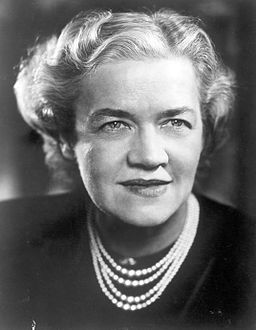
Margaret Chase Smith was the first woman to serve in both houses of Congress. She represented Maine in the House of Representatives from 1940 to 1949 and in the Senate from 1949 to 1973. In 1964, she ran against Barry Goldwater for the Republican Party’s presidential nomination. Goldwater won but was defeated in a landslide by democrat Lyndon B. Johnson in the general election. One wonders what the electoral count would have looked like if Smith had been the party’s candidate.
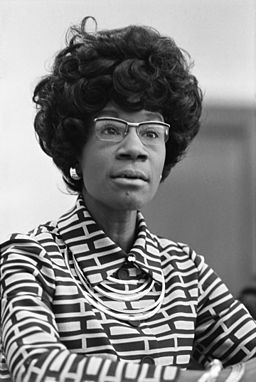
Shirley Chisholm
New York’s Shirley Chisholm was the first African-American woman elected to Congress, serving in the House of Representatives from 1969 to 1983. In 1972, she became the first African American to run for the presidential nomination in a major political party. The Democratic Party instead chose George McGovern, who was soundly defeat in the general election by Richard Nixon. In 2015, Chisholm was posthumously award the Presidential Medal of Freedom.
In 1948, the grandniece of Susan B. Anthony looked back at what women had accomplished politically since women’s suffrage had passed, She was not impressed. She wrote “We Women Throw Our Votes Away” for the post that year.
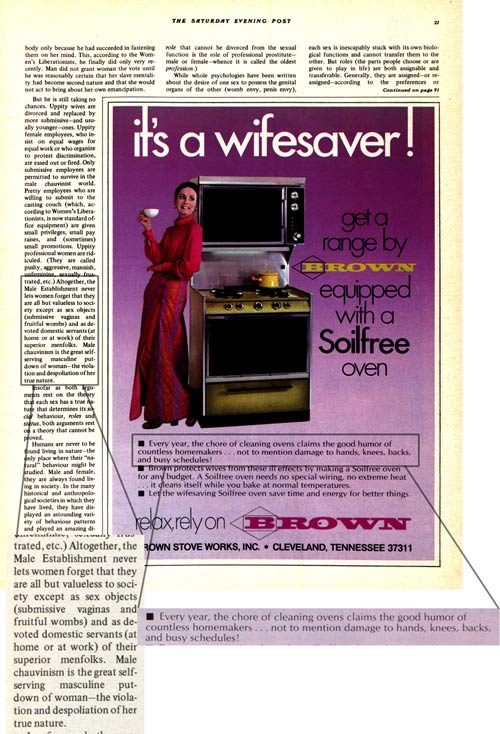
Google’s NGram viewer shows that the phrase “gender role” was practically nonexistence before 1956. Throughout the ’60s, the phrase become much more common in print.
This decidedly unfeminist ad appeared in the Post in the middle of Clare Boothe Luce’s feminist article, “Woman: A Technological Castaway,” on January 1, 1974. “When I think of old-fashioned views of gender roles, I think 1940s and ’50s, not 1974.”Breakthrough By Nancy L. Cohen
Nancy L. Cohen’s book, Breakthrough: The Making of America’s First Woman President, draws from hundreds of hours of interviews with women governors, Senators, experts, operatives, and a diverse array of voters to explore why women’s leadership matters and how the history of women’s rights activism culminated in the nomination of Hillary Rodham Clinton for president of the United States.
Sound files heard in the podcast:
“Hail to the Chief” played by the U.S. Army Ceremonial Band
“Respect” by Aretha Franklin, 1967
“Woman in the White House” by Sheryl Crow, 2012
“Margaret Chase Smith” at the Women’s National Press Club, January 27, 1964
Katie Couric interviews Rep. Marsha Blackburn, May 19, 2014
“Hail to the Chief” performed by the Mormon Tabernacle Choir, 1973
“Jeanne Wolf interviewed John Lithgow for The Crown“
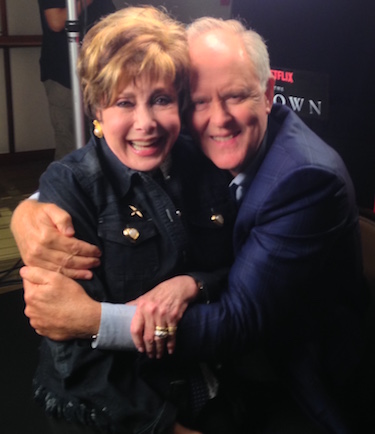
When I heard that John Lithgow was cast to play Winston Churchill in the new Netflix series, “The Crown,” I had to wonder. Lithgow as the legendary Prime Minister? The short and rotund Sir Winston hardly resembles the tall, slim Lithgow. The show, written by Peter Morgan, who also wrote “The Queen,” is a serious drama about the royal family and I knew he wouldn’t entrust the role to an American actor on a whim. Then I watched John on screen. He’s properly paunchy thanks to some padding under that waistcoat. Add a dead-on English accent and a stubby cigar clenched between his teeth, and it’s an amazing transformation. I got to congratulate John personally. He towers over me and had to lean down to give me a kiss on the cheek. As he bent way over I said, “Ok, you are more than a foot taller than Churchill – How did you handle that?” His eyes twinkled and he replied, “I relied on a special acting technique. I just kept telling myself, think short!”
Jeanne Wolf: You’ve often said that your life is a lot of lucky happenstance. How much does luck play into your life and how much does all your hard work, your talent?
John Lithgow: Well, luck plays into it of course. Actors just never know what’s coming along. You depend so much on bright ideas that other people have for you because very often they think of things you would never think of yourself. I would never cast myself as Winston Churchill but when Steven Daldry cast me as Winston Churchill, I couldn’t say yes fast enough.
JW: Fears and all?
JL: I trusted him. He’s a director that I’ve always wanted to work with. I knew Peter Morgan created the series. I just figured, “Well, if you want me, I may be scared of this but I’m certainly not gonna say no.”
JW: I have to know at which point you looked in the mirror and said, “Why did I ever say yes to this? What am I doing? How do I pull this off?”
JL: You know, in my career, I am fortified by the fact that the work that I’ve done that has been most satisfying to me, I have been scared to do. It was other people’s bright ideas that kind of took me aback. I went over to England and started working with the actors of “The Crown,” none of whom seemed to have the slightest problem with an American playing Winston Churchill, much to my surprise. My confidence grew and grew and grew. I collaborated with all these wonderful people—costume and makeup and dialect coaches—in every area.
JW: Did you have a cigar coach?
JL: I needed no coaching with the cigar. Unfortunately, I didn’t get to smoke good cigars. Just like in America, you’re only allowed to smoke these kind of dreadful, vegetable cigars on set, but I made it look like I enjoyed it.
JW: Yes you did. You know, as the series begins, we don’t get a picture of him that reminds us of the statesman that we all have idealized. Even his colleagues think they’re going to take over for him. Do you think that’s part of his trick that he didn’t let everyone see what he was seeing or see what he knew?
JL: Well that’s an interesting question. I think Churchill was so completely himself to a fault. He hadn’t the slightest problem with offending people or making enemies. He had a sort of reckless courage about his own convictions. It’s what made him incredibly unpopular until he became incredibly popular and his whole career was made up of those highs and lows and it was usually his bulldog personality which accounted for both.
JW: Did he know that they were practically making fun of him and trying to get him kicked out? Did he sense that? Was he enjoying it?
JL: I think both. I think he was threatened and I think his response is to fight back. He was a man with tremendous insecurities, a propensity for depression, and a sense of constant impending defeat and yet he fought back in all sorts of ways – and fascinating ways! He fought off depression by sitting outdoors and painting landscapes. He was a man full of conflicts, contradictions, and colors.
JW: Let’s talk about the moment where he has to speak to the radio audience and tell about the king being dead and all of a sudden, he looks different and sounds different. You understand what they meant for charisma with this strange guy and you understood how he commanded the room and the nation. Can you talk about his genius and can I use the word ‘charisma?’
JL: Of course! I think that’s wonderful that you took that away because it was certainly our intention. This was a man who was destroyed with grief at the loss of the king and fear of whether or not the monarchy would survive and he knew that if he failed in that speech on the radio then he was a goner. He knew that his rivals in the Tory party were counting on him to do a bad job. He did a magnificent job and I think it is that wonderful duality – a man who appears so defeated and so frail and incompetent suddenly being so much more than competent.
There’s something about British royalty, say what you like about the whole idea of a monarchy in the modern day, it’s got some sort of mysterious importance to the whole British experience. That’s why it makes such incredible drama. You can’t quite define what that importance is but you know the stakes are very high. Can this young girl be a queen at a moment when British society is in economic rubble post war? Do they really need a queen? Half of them don’t want it anymore. Churchill believed so fervently that they have got to have a strong sovereign. He’s the only Victorian left standing and he takes it upon himself to turn her into a great queen.