Our First Steps to the Stars
Humans could be landing on Mars as early as 2030 according to NASA administrator Charles Bolden. Which means that Americans who saw man first step on the moon may be alive to see a repeat event some 225 million miles away on the red planet.
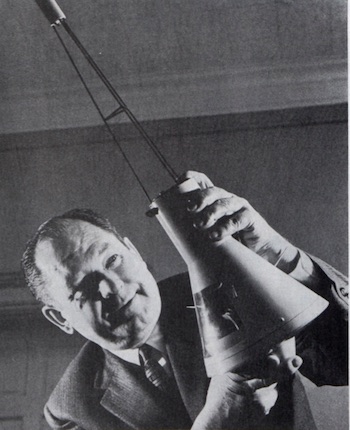
When space exploration was still new, the National Aeronautics and Space Administration had to convince the nation that it would benefit from space exploration. In the 1959 Post article “Our Plans for Outer Space,” NASA’s first administrator argued for the fledgling space program and laid out plans for the first manned-spacecraft.
Our Plans for Outer Space
By T. Keith Glennan, NASA Administrator, as told to Robert Cahn
Excerpt from article originally published on February 2, 1959
Some people have asked, why all this urgency about a space program? There are several good reasons. The simplest is man’s basic curiosity. Throughout history he has attempted to get away from being earth-bound. He finally made it on a limited scale with the airplane. Now, for the first time, the advancements of science and technology have made it possible for him to take his first faltering steps toward the stars. …
Every week we get hundreds of letters with inquiries about manned space flight. Just the other day three boys in Oklahoma wrote, “… We would like to be on your first manned rocket to the moon, on the condition that you don’t send it in the next ten years. After that it will be O.K. because we will have finished college.”
While we can’t give encouragement to these Oklahoma youngsters, it is a fact that our present budget contains a project for a manned earth satellite. We call this effort Project Mercury, and the objective is to send a man into orbit around the earth and return him safely. …
No date has been set for this first manned-satellite operation. … We must establish adequate tracking and communications systems all over the world to monitor the orbit of our first man in space. We do not want to have him off in space without contact with our ground stations. We must be able to find him quickly if he lands in the jungle or the sea.
We will take no chances on Project Mercury. People may be killed in space exploration — many have lost their lives in aviation-flight testing. But no life will be lost because we tried to do something before we were ready.
In space exploration we are working with systems in which perfection is necessary. It is not like building a new airplane, where a pilot can test it and say, “Well, it doesn’t quite come up to maximum speed and is a little sluggish on the controls, but it is still a darned good air-plane.” For the highly complicated and difficult space missions, we have to expect that some developments will go slowly and some test vehicles will fail. We don’t like delays. But when pushing the state of the art so far and so fast, we have to operate on a flexible timetable to avoid disastrous failures. …
Once we have succeeded with Project Mercury and repeat manned orbital flights enough times to work out all the problems, it will be time to worry about journeys to the moon and the planets in our solar system. From our present viewpoint, manned exploration of the moon is dependent upon a technology not yet achieved. But we do have a long-range research-and-development program looking toward such a possibility.
Several items in our budget are vital to this long-range planning. Midcourse and terminal guidance systems to orient space vehicles is one research project. Developing improved tracking systems and better methods for transmitting and receiving data are others. We are also doing research toward launching into space laboratories themselves, which can be stabilized and used for experimental purposes. We are sponsoring a study of the systems and subsystems necessary for space rendezvous, where vehicles can be sent up to join satellites already in orbit. These space stations could be used for the assembly of large pieces of equipment — possibly nuclear reactors — needed in such really long-distance space travel as going to the far planets. …
The task ahead is not easy. It is going to cost a great deal of money. Our first year’s budget was $301,000,000, and for fiscal 1960 we will need nearly $500,000,000 to carry out our program. We hope and fully expect, however, that the long-range benefits in even the few practical applications we now foresee in weather forecasting and improved communications will far outweigh the costs.
I will not even try to predict when we will land a man on the moon. Nor will I try to predict what great things may be ahead for mankind resulting from our space exploration — although we already have learned enough not to be surprised at any possibility. I learned my lesson about crystal gazing more than thirty years ago when I was a young engineer installing sound-motion-picture equipment in theaters in the West. At that time, I made the bold prediction that there would never be a full-length all-talking motion picture. I don’t intend to repeat that kind of mistake.
Today, the benefits of space exploration and its refinement of satellite technology should be obvious to anyone using the Global Positioning System on their phones. Satellites are also tracking weather; relaying radio, TV, and telephone signals; and providing military surveillance. To see just how far NASA planned ahead, read Glennan’s entire article, “Our Plans for Outer Space.”
America Gets Weight Conscious
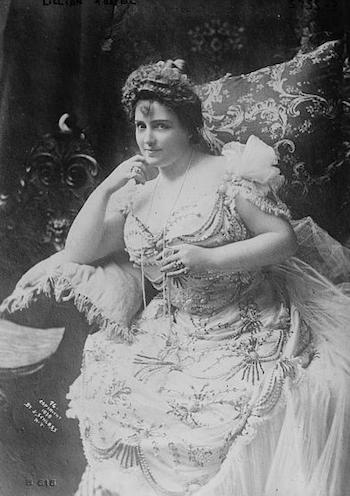
In the days of rotund President Taft, curvaceous Lillian Russell represented an ideal figure for women. “There was nothing wraithlike about Lillian Russell,” wrote Clarence Day in the Post, recalling Russell’s popularity. “She was a voluptuous beauty, and there was plenty of her to see. We liked that. Our tastes were not thin or ethereal. We liked flesh in the ’90s. It didn’t have to be bare, and it wasn’t, but it had to be there.”
Excess fat was regarded as a sign of beauty, maturity, prosperity, and even protection against wasting disease like tuberculosis. But in the new century, values were changing. The excerpt below is from an article that would have been many readers’ introduction to dieting.
Fear of Fat
By Margaretta Tuttle
Excerpt from article originally printed July 29, 1916
Twenty years ago, no man of 50 expected to have a waist and no woman of 40 a figure. If you looked pleasant and comfortable that was enough. You could wallow in fat and grow old in peace. … Nobody looked askance at you and said: “Why don’t you reduce?” Fat was fate, and no more to be helped than a crooked nose or big feet. …
These are the days of efficiency. … Fat has gone out with bonnets, and caps with lavender bows, and mufflers round the neck. … The fact is that we are eating more than we need, and working both brain and body less than we should, or we shouldn’t be fat.
You can’t get away from it. You may like to eat better than you do anything else, or you may think you need food ever so often to keep up your strength; but if you are fat you are eating more than you should or you are doing less than you ought, and both of these mean inefficiency. You cure yourself by eating less or doing more, or both; but it’s work and hard work either way.
The concept of healthy eating was so new when Tuttle wrote this article, she had to explain to readers what proteins and carbohydrates were. She also included a sample diet, which would probably not enjoy a doctor’s recommendation today. For more on 20th-century weight-loss, read the full text to Margaretta Tuttle’s “Fear of Fat.”
News of the Week: Star Trek 4, Retro Nintendo, and a Little Penuche (What the Heck Is Penuche?)
Beyond Star Trek Beyond
The third of J.J. Abrams’ Star Trek movies, Star Trek Beyond, hasn’t even hit theaters yet — it opens later today — but we’re already getting news about the fourth one. And this movie will be tied into events from the first.
In a press release this week, Abrams says that the fourth film will feature Chris Hemsworth as Kirk’s father. Hemsworth played the role in the first film in the series but only for what amounted to a cameo, as he quickly died. So it looks like this will be another time-travel adventure. I wonder if they’ll once again mess with the Trek timeline, maybe somehow putting it back to the way it was after changing it in the first film.
Abrams also says that the role of Chekov will not be recast in the fourth movie, following the death of Anton Yelchin.
Nintendo Goes Retro
I don’t play video games anymore, but if I did, I might buy something like this. It’s not the first game system of its type, but it comes with a lot of games and it’s pretty inexpensive. It’s the NES Classic Edition. It’s a mini-console that comes with 30 games already built in (no need for cartridges), including The Legend of Zelda, Donkey Kong, Galaga (which I was addicted to as a teen), Mario Bros., and Pac-Man. It will sell for $59.99 and will come out in November, just in time for Christmas.
Los Angeles: 1940s vs. 2016
The most recent video game I’ve played is L.A. Noire, a fun game that makes you a detective in 1940’s Los Angeles. It looks fantastic, with beautifully rendered cars and buildings. It’s the type of game where you don’t even have to play it. It’s a joy just to get into one of the cars and drive around.
I thought of the game after watching this video by Keven McAlester. It’s a 2016 retracing of a car trip someone made in the Bunker Hill section of Los Angeles in 1940. You get to watch the two videos side by side to see the changes (and there are many) to the area in the past 70 years. Bunker Hill was used in a lot of movies back then, especially film noir, but the city started a large redevelopment project in the area in 1959, which ended only a few years ago.
Confessions of a Republican, Part II
Remember back in March when I posted the video of the famous 1964 LBJ ad “Confessions of a Republican”? A lot of people thought that if you inserted the name “Trump” for “Goldwater,” it still works today. Well, it looks like Hillary Clinton’s campaign thought the same thing, as this week they released an update of the ad … with the same actor, William Bogert!
Oddly, I didn’t see this ad played at this week’s GOP convention in Cleveland.
RIP Garry Marshall and Norman Abbott
Garry Marshall passed away Tuesday at the age of 81. Before directing such movies as Pretty Woman, The Flamingo Kid, and The Princess Diaries, he was a writer/director/producer on a ton of classic shows, including The Dick Van Dyke Show, The Odd Couple, Happy Days, Laverne & Shirley, Mork & Mindy, The Lucy Show, and Make Room For Daddy. He acted in over 80 TV shows and movies, too. His sister is director and actress Penny Marshall.
The Washington Post has a list of careers that Marshall helped launch.
Norman Abbott was the nephew of comic Bud Abbott. After starting out as an actor, appearing in such films as the Abbott and Costello comedy Who Done It? and Walking My Baby Back Home, he became a top sitcom director. He directed many episodes of Leave It to Beaver, including the classic episode where Beaver falls into a giant bowl of soup, as well as The Jack Benny Program, Get Smart, McHale’s Navy, The Brady Bunch, Welcome Back, Kotter, Alice, The Munsters, and Sanford and Son. He was also a stage manager on I Love Lucy and the man behind the Broadway hit Sugar Babies. He served in World War II in the original Navy SEALs unit.
Abbott passed away at the age of 93 in Valencia, California.
How Did They Do That?
Last week I showed you a video of one of the finalists for the 2016 Illusion of the Year Award, and I promised that this week I’d tell you how it’s done.
The answer: It’s real magic!
Well, no. It’s actually simpler than that. There really is no “trick”; the shapes used look different depending on what angle you’re viewing them from. You can even see that if you pause the video when the shapes are turned around in front of the mirror.
Here’s a video that explains how it’s done:
Today Is National Penuche Day

Penuche is one of those foods that I’ve never heard of before but have eaten plenty of. Does that make sense? I mean I’ve eaten it but never knew what it was really called. I always just called it fudge, But penuche is lighter in color and made with brown sugar.
Here’s a recipe for penuche from Fearless Fresh. In fact, it’s two recipes. A new recipe was created for the site because the original didn’t set right. Both are included if you want to experiment and see which one works.
Or if you don’t want to bother making penuche, you could just buy some.
Upcoming Events and Anniversaries
Pioneer Day in Utah (July 24)
This official holiday celebrates the arrival of Brigham Young and his group of Mormon pioneers into Salt Lake Valley.


Discovery of Machu Picchu (July 24, 1911)
Archaeologists believe the mountain sanctuary was built for Incan emperor Pachacuti.
Mick Jagger born (July 25, 1943)
He may have been born during World War II, but he’s about to become a father again.
Sinking of the Andrea Doria (July 25, 1956)
The Italian passenger liner collided with the Stockholm near Nantucket, Massachusetts; 46 passengers and crew died.
United States Post Office established (July 26, 1775)
What became the United States Postal Service in 1970 has gone through financial problems in recent years, and the idea of stopping Saturday delivery is brought up every now and then.
Jacqueline Bouvier Kennedy Onassis born (July 28, 1929)
After the deaths of husbands John F. Kennedy and Aristotle Onassis, she became a respected editor at Viking Press and Doubleday.
Comfort
My 10-year-old nephew is skinny and has big ears. He admits to being timid about certain things — jumping off the raft into the lake, meeting new kids, hearing sudden noises. I too was afraid of things as a child — I like to think I understand David. I was delighted when his mother, my sister, asked me to take him to the circus. “Buy only one bag of popcorn,” she ordered.
“Is there anything we should avoid?”
“Yes, but you can’t avoid it. It’s the elephants’ parade around the ring.”
Oh, I remembered that circle of mournful pachyderms, plodding along until the crack of the master’s whip commands them to halt, to stand on their hind legs one animal by one, to place their front hooves on the hips of the poor guy in front of them, and then simultaneously to drop. Tail behind swings trunk in front. The act humiliates us all. David has read that the circus elephants are the most unhappy creatures in the universe. They’d rather be ripped open by a lion than make fools of themselves before a crowd. And so, when they start their act, his mother told me, David starts to cry. “Those big, big tears …”
“Is he scared of anything else?”
“If a clown boots another one across the ring, he winces. But he knows that the performers are padded. Those suffering elephants, though … Comfort him. Put your arms around him. Whisper into his ear.”
“Whisper what?”
“You’ll think of something.”
And so, eyes still dry, sharing popcorn, we watched the entire human and simian cast rush into the ring to a blare of trumpets. Then we watched the individual acts — the pyramids of acrobats, the monkeys from the Bolshoi, the famous clown who climbs the tallest pole and slips from noose to noose, hanging on by a finger, a knee, a nose. The clown raised laughter and gasps from the audience of children, and from their parents in puffy parkas, and from a group of oldsters in the row in front of us who had been hauled out of their Home for a treat, better than another afternoon of Bingo, I suppose. If the clown slipped, the net would catch him, although I have read that no net is ever to be trusted; it’s easy to fall wrong, and if you fall wrong you can break your silly neck. I would keep that information from David, I promised my schoolteacher self. I was the cool adult here.
Then jugglers threw their balls and dancers spun within hoops flung by other dancers. I waited for the elephants that would wring our hearts.
At last they came, each wearing a fez. If I were Turkish, I’d have been sorely affronted. The animals did their wretched parade. My arm slipped around my beloved nephew.
“Aunt Ella, they are so unhappy.”
“I believe they are. But some day this act will be outlawed.”
“Really?”
“Yes,” I hoped. “And the elephants will be returned to the savannah.”
“Georgia?”
“That’s Savannah capital S, a city in the United States. Our friends out there come from savannahs small s, grasslands in Africa. They’ll retire there and spend the rest of their long lives chomping green stuff and never having to grab a tail, only a banana.” I put my arms around him and whispered in his ear. “I love you,” I murmured.
And so he did not quite sob. He nestled closer to me.
The elephants were the last act of the first half of the show, and enduring their performance earned us another box of popcorn (I am not the most trustworthy escort).
The second half started with more clowns and then dogs jumping over each other.
The second half started with more clowns and then dogs jumping over each other. Next, a Cinderella ballet, mostly in the air.
My eyes wandered to the high corners of the big top. I could not make sense of the complication of guide lines, and pulleys, and ladders, and hooded lights turned this way and that, and cruel hooks dangling from ropes. While I was squinting at them, the high-wire funnymen appeared, riding small bicycles forward and backward across steel cables. And then came the high-wire acrobats, not at all funny, hurling each other from trapeze to trapeze, and then from person to person, one sequined performer hanging by his knees swinging another by her feet and letting go of her ankles a second too late, and she somersaulting through the air and then stretching out her hands to be caught, again at the wrong second, by someone on another trapeze. Only it was never the wrong second, it was the right second — how? In a flash, I remembered my childhood fears of falling, clawing at the air, smashing. My arm crept around David. “David!” I shamefully hissed. “A split second mistake could …”
“They don’t make mistakes. They practice and practice.”
Every time someone was in air, I buried my nose in his bony shoulder.
“He made it, Aunt Ella!” I heard.
And the next time …
“She made it!”
“Anyone could plunge,” I moaned.
“There’s a net,” he reassured me.
“It’s made of Kleenex,” I said. Where was my schoolteacher self?
“Oh, be quiet,” said an old man in front of us, and then put his head back and began to snore.
“There are wires at their waists, you just can’t quite see the wires,” said my nephew. “Or the ones at their wrists.”
I raised my head. Airborne twirls revealed no wires. “The wires are too narrow to see,” he explained. “The nets are strong. The performers know how to fall. Oh, dear Aunt Ella, I brought something for you,” and my magician of a relative withdrew from his pocket a red bandanna and lifted my head, which was now glued to his chest, and drew the cloth across my eyes as the stars of the show performed terrifying twists and somersaults and twists and somersaults combined … I had to guess what they were doing from the applause, which seemed to well up from the entire audience (excepting the one woman whose blindfolded head was now between her knees).
The applause rose again. Shrieks pierced our eardrums. But it was not the screaming that follows a disaster witnessed but one who pays tribute to disaster averted. I lifted my head from the vise of my knees and my eyes peeked above my bandanna. The stars were standing safely on their platforms, arms raised in triumph; and then, one by one, they swung themselves down on thick ropes and landed with a bounce on the safety net.
I untied the bandanna and held it in front of me as if I’d never met it before. “Well, well, well,” I said in a hearty voice.
David put his arms around me. “I love the circus,” he whispered into my ear. And then: “I love you, too.”
Getting Arrested at the Democratic National Convention
Hillary’s upcoming shindig is likely to seem sedate in comparison to the zaniness of last week’s spectacle in Cleveland. But, if anything, this is a turnaround from tradition. Historically, the Democrats have been the raucous ones.
Just look at the 1968 Chicago convention. For context, recall that President Lyndon Johnson, amidst abysmally low ratings due to the unpopularity of the Vietnam War, had announced in spring that he would not run for a second term. That decision opened up the Democratic field to JFK’s brother Robert Kennedy and antiwar candidate Eugene McCarthy, as well as the more centrist Hubert Humphrey, the incumbent vice president.
In the months before the convention, both Martin Luther King Jr. and Robert Kennedy were assassinated. There was the palpable sense that America was coming apart at the seams. On the convention floor, the bitterness boiled over into shouting and shoving matches, but ultimately Humphrey and the status quo prevailed.
If this angered the antiwar delegates to the convention, it drove the 10,000 protesters outside into a pure and dangerous frenzy. Throughout the week, protesters were in open conflict with Chicago Mayor Daley’s security detail of 11,900 Chicago police — reinforced by more than 10,000 Army troops, National Guardsmen, and Secret Service agents.
Murray Kempton, a columnist for the New York Post and editor of The New Republic, was in Chicago to serve as a delegate for the liberal Senator Eugene McCarthy and also to write about the proceedings for the Post. After watching his candidate lose, he stepped outside to bear witness to the rioting in the streets, where he quickly found himself arrested along with hundreds of others.
The Decline and Fall of the Democratic Party
By Murray Kempton
Excerpted from an article originally published on November 2, 1968
We had arrived at 18th and Michigan, where the [national] guard and the police waited to say we could not go farther. The delegates had all found us and efficiently lined up behind Rev. Richard Neuhaus and me, since, for reasons obscure but connected with the failure of its beginning, ours was known as the Neuhaus-Kempton group. Such then was my last caucus; and, when Dick Gregory [the former comedian turned antiwar activist] went forward to get himself arrested and the Rev. Mr. Neuhaus to treat with the police, not knowing the procedure for getting arrested in Chicago as well as Gregory, I found myself stranded as its leader. Gregory’s blacks were juking in front of us; and [pacifist David] Dellinger’s strayed grays were no doubt preparing some manifestation behind us; and there fell upon me the sickening dread that at least two of our repertory companies were about to start their productions while ours, the amateur one, could not even think of its script.
Then Neuhaus returned at last, welcomed as no servant of the Lord often is, and said we should advance to confront the guard. There was nothing to do but get arrested, which took an unconscionably long time, during which we sat down symbolically, and then got up, because Gregory’s pards felt that it was about time to go into their performance and that we ought to stand and afford them free passage. A National Guard lieutenant colonel finally read his office over me, and I was moved, correctly but not cordially, into the wagon. Its bag was a mixed one of delegates and stray young people; riding over, the young called out “Free Vietnam” to the invisible streets outside. “Free assembly,” I ridiculously croaked.
In my usual job, you come to think of policemen as very much the same; when you are under arrest, they turn out to have quite extraordinary range. I should say that I met three nice cops for every nasty one; what surprised me was how far our permissive society has gone even with cops: A pleasant one feels free to be unusually pleasant and a mean one feels free to be unusually mean, neither of which tones is exactly what the book must command for treatment of that offender against society who is also its ward.
“Give me everything you’ve got with a sharp point,” the one who searched said. “One of you peace lovers put out an officer’s eye with a pin once. Do you know that?” He found a token that somebody had slipped me a long day ago and that I had put in my pocket without even looking at. It turned out to have the likeness of Martin Luther King on it; and he threw it to the floor. “Martin Luther Coon,” he said, grinding it with his shoe; “you all come from the same bag.” To my shame I did not make reply and only shuffled along, which is why it is so necessary never to be surprised. Yet, after this caricature, the trip to the Dark Tower, while tedious, had illogical moments of good manners. “What is a distinguished-looking man like you doing being arrested?” one of the booking detectives asked. I had no answer; the question, kindly meant, could only make me understand that I was getting old.
But, after a while, these desultory excursions into the study of policemen were driven away by the revelation of the other persons who had been arrested that night. The journey crept along in the company of The Professor of Physics at Stevens Institute and The Personnel Director of the Perth Amboy Hospital, The Telephone Company Lawyer, and then it would end in the waiting outside Riot Court, the Dark Tower itself, with the finding there of Harris Wofford, the President of A New York State University, of The Man from The New York Times, and The Rockefeller Man from Kentucky.
What could have brought them here in police custody? I knew why I was here; I had taken a contract. But what brought them, these safe men who had never before been arrested and probably never would be arrested again? It must be the indefinite suspension of their assurance of the virtue and redemption of America. The means of grace and the hope of glory had been taken away, because, after all, America had been their real God. And this night, otherwise inconsequential in our dreadful recent history, was The Night They Knew It.
But I could almost feel each of them, in his private heart, tending all afternoon toward this least dignified of places as the only one where they could be sure of being alone with their dignity. For them to have been in public that night would have been to rail or make bad jokes there; they had gone to the patrol wagon for privacy.
We stood about and talked among ourselves as men unused to arrest probably do; Dellinger’s stray young grays, who had been there before and would be again, slept on the floor. I felt quite tender about them, because I had noticed that although they sometimes carry signs bearing the device of some four-letter word or other when they are on-camera, they do not write dirty words on the walls of detention rooms. Do they, among other reasons, go to jail for privacy too?
There is very little to the rest. We went on talking; The Man from the Times came out from the Dark Tower and said this was a rough judge; he had been told to stop slouching. (I cherish The Man from the Times, but, in fairness to the judiciary, he does slouch.) My name was called; I entered the Dark Tower. And there, as usual with me, the first sight, instead of the Beast, was the warm bright greeting of William Fitts Ryan, my congressman; the convention was over and he had generously come down to be my lawyer. Bill Ryan unsheathed his congressional identification card and gave rein to his imagination for hyperbolic explanations of the distinction of his client; the judge struggled to the summit of whatever foothills of grace are afforded by night courts, and I was set loose.
For a complete inside look on the 1968 Democratic National Convention, read the full text to Murray Kempton’s “The Decline and Fall of the Democratic Party.”
Gallery from the Archive: The Brandywine School
Art, American-style
In 1900, frustrated with formal art instruction, renowned illustrator Howard Pyle opened his own art school in the Brandywine Valley. Rather than teach technique, he encouraged students to capture a moment and bring it to life. His teachings would influence such greats as Maxfield Parrish and Norman Rockwell.

Andrew Wyeth
The Saturday Evening Post
October 16, 1943
The Wyeth Family
Pyle accepted only the most promising students. One of his most well-known was N.C. Wyeth, who enrolled in 1902 and who shared Pyle’s fascination with the landscape and history of America. Wyeth soon became a celebrity in his own right, painting several of the greatest early covers for the Post and, later, for The Country Gentleman. His work is known for its vibrant color and frequent high drama.

N.C. Wyeth
The Country Gentleman
June 1, 1944
N.C. Wyeth’s son Andrew, too, was inspired by the realism of the Brandywine School. But unlike his father, Andrew was a reserved and subtle artist who restricted himself to a limited color palette. Although he frequently painted landscapes like the one below, he described himself as an abstractionist.

Andrew Wyeth
The Country Gentleman
October 1, 1950
A Woman’s Place
In Pyle’s time, a career as an artist was not generally considered suitable for women. In a bold challenge to the art establishment, Pyle admitted as many women as men to his school. Several of his alumnae would become quite successful, including Sarah Stilwell-Weber and Katherine R. Wireman, both of whom contributed regularly to the Post.

Sarah Stilwel-Weber
The Saturday Evening Post
August 25, 1917

Katherine R. Wireman
The Saturday Evening Post
June 28, 1924
Down to the Sea
Anton Otto Fischer came to Brandywine after serving as a deckhand for three years. Under Pyle, he learned to apply his nautical experience to vivid seascapes like the one below.

Anton Otto Fischer
The Saturday Evening Post
September 20, 1930
Frank E. Schoonover’s early work was influenced by Pyle’s paintings of knights and pirates, but he soon developed his own style. He is remembered today for scenes of action and romance, frequently set in the wilderness.

Frank E. Schoonover
The Country Gentleman
March 1, 1930
Jamie Wyeth: Born to Paint
After the September 11 attacks, Jamie Wyeth was driving along the country roads — some as bumpy as washboards — in Pennsylvania’s pastoral Brandywine Valley when he saw a white barn with a huge American flag painted on it. The barn sat on top of a hill; a pond at the bottom of the hill reflected the stars and stripes. He immediately decided to paint it. He called this painting Patriot’s Barn.
“I had to record this stunning image,” he says. He goes on to call himself a diarist or recorder of everyday events and people. “I hate the idea of ‘now I’m creating a painting for an audience.’ My painting is simply recording my life and my thoughts, as if I were doing a diary.”
But if you look at the breadth of his work — from sketches to miniature mixed-media dioramas to children’s book illustrations to monumental landscapes to life-sized portraits — Jamie is much more than just a recorder. He is an expert painter of imposing realist paintings whose goal is to describe something authentic and American. “Whether I’m painting a person or a seagull or a pig, I like to think that if that pig painted, he’d paint himself exactly the way I was doing it. That’s what thrills me,” he says.

Jamie Wyeth
Jamie Wyeth was born in 1946 with a silver paintbrush in his mouth as the third-generation champion for America’s first family of art — a family famous for distinctive and imaginative realism. Wyeth’s grandfather, Newell Convers Wyeth, better known as N.C. Wyeth, was an important illustrator whose swarthy, swashbuckling pirates, noble pilgrims, cowboys, and Indians embellished many children’s books — Treasure Island, The Last of the Mohicans, and The Yearling, to name a few. His very first sale (a cowboy riding a bronco) was for the cover of the February 21, 1903, issue of The Saturday Evening Post. N.C. was born in 1882 and died tragically in 1945 when his car stalled on the railroad tracks in the path of an oncoming freight train — just a few miles from his home near the village of Chadds Ford, Pennsylvania.
Jamie’s father, Andrew (1917–2009), was world famous for painting stark, melancholy scenes depicting the hardscrabble life of farmers in rural Pennsylvania and fishermen in coastal Maine — people and places that seem worn down by time, the tides, and life’s worries. He worked in egg tempera — a medium dating back to the Middle Ages but not much in favor with 20th-century artists — to create his matte, mostly monochromatic, and often brooding images. He captured the same desolation seen in the lonely landscapes, Depression-era cityscapes, and isolated figures of painter Edward Hopper and that photographers Dorthea Lange, Diane Arbus, and Walker Evans captured on film.

Jamie Wyeth
Andrew’s loyalty to realism when every other artist in the world was going abstract marks him as both an iconoclast and a rebel in his time. Art critic Ray Mark Rinaldi notes, “No American painter was more skilled than [Andrew] Wyeth or possessed a greater ability to make marks with his artist’s tools, or with tempera paint, or pencil, or — and this is the revelation to most folks — watercolor.”
Jamie learned the family trade from his father and the basics of drawing from his aunt, Carolyn Wyeth (1909–1994), who, like her brother, learned painting at N.C.’s knee. “My grandfather’s studio was physically just up the hill from our house. It was left just as he left it,” Jamie says. “It was full of costumes and guns and all the other trappings of illustration. I would spend days upon days up there.”
“Both trained as if they were apprentices, Andrew to his father, N.C. Wyeth, and Jamie to both his father and his aunt Carolyn,” says Timothy Standring, Gates Foundation Curator of Painting and Sculpture at the Denver Art Museum and curator of Wyeth: Andrew and Jamie in the Studio. While organizing this exhibition, Standring was given unprecedented access to the Wyeth archives and papers and could freely rummage through all the drawers of Jamie’s studios in Maine and Delaware, sometimes finding early sketches that Jamie had completely forgotten.
Jamie Wyeth started drawing when he was three and became a working artist when still quite young. “I had gone to public school like every other kid my age, but I was not interested in basketball or football. … I only wanted to paint,” he recalls. “My father was taken out of school because of illness when he was young. I thought that was a great pattern and determined that I was going to do the same thing,” he adds. His family agreed to let him leave school after the sixth grade, and that’s when he “seriously started painting.”
His father, Andrew, gave Jamie half the studio to work in. Jamie recalls that Andrew was a feverish worker who loved to play classical music loudly while he worked. Jamie preferred — and still does — working alone and in silence. “The only problem is that the record player was in my part of the studio, so I’d stuff my ears with wax.” Father and son painted together on many occasions, even modeling for each other. But were they pals or rivals? Jamie says that it was always a little bit of both.
Although their studio practices were different, they were similar in many ways. “Both used media in a highly unorthodox manner,” Standring says, noting that, even early in his career, Andrew blotted and smeared washes or scored through washes of ink with wire brushes or even his fingernails to get the desired effect. Similarly, Jamie often paints in mixed media — sometimes using watercolor, wash, and oil in a single painting. “I put paint in my mouth, on my fingers, on toothpicks, and often paint with the wrong end of the brush,” Jamie says. “I’m a terrible technician.” There was a period of time when he put his paintings into the oven because he wanted them to dry quickly, and when he wanted his paintings to dry slowly, he put oil of clove into the paint. “They smelled great,” he says, “but I think that Portrait of Lady took about a decade to dry completely.”
After a brief fling with egg tempera, Jamie chose to work mainly in oils, allowing him a broader and brighter palette than his father’s and bringing him into a direct line with his grandfather N.C. Wyeth, whose love of color and texture was legendary.
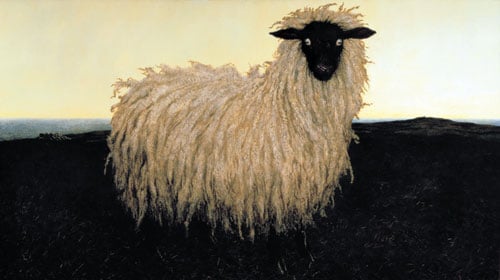
“But … like his father, he [Jamie] doesn’t want to paint under any fixed method or system, and instead treats each work individually as its images demand, which helps explain his obsessive search for new and interesting materials to experiment with,” Standring notes. “By allowing himself full rein with a multitude of media applied any which way, Jamie ultimately began to distinguish himself from Andrew.”
When he was just 17, Jamie painted Portrait of Shorty, an oil depicting a haggard, unshaven Chadds Ford neighbor wearing a dirty undershirt but sitting in what looks like a damask-covered antique wing chair. Jamie’s very first commission, the Portrait of Helen Taussig, was painted the same year. It was a commission from Johns Hopkins University, which wanted to honor Dr. Helen Brooke Taussig, a pioneer in pediatric cardiology. They could not afford Andrew Wyeth’s fee, but agreed when he recommended his son. Jamie recalls a gasp of horror from the assembled crowd when the flinty, intense portrait was unveiled. In fact, Johns Hopkins did not hang the portrait but gave it to Dr. Taussig, who wrapped it in a big towel and stuck it in her attic. “It is not a Betty Crocker portrait,” Jamie acknowledges.

Jamie Wyeth

Jamie Wyeth

Jamie Wyeth
But still, not an auspicious beginning to Jamie’s career, and in fact, he was quite devastated at the time and has done very few commissioned portraits since. It was a pleasant surprise when Johns Hopkins reached out to him recently to say that, after all these years, they were going to display the original portrait. But the mixed reaction to his portrayal of Helen Taussig was certainly a harbinger of the later reaction to portraits he did of Andy Warhol, which set off a tsunami of both praise and criticism in the art world.
“I work every day all day,” Jamie says. “I’m kind of a boring person because that’s all I do and that’s all I want to do. I don’t have any hobbies.” He goes on to say that painting does not require editors, sound people, lighting engineers, or an orchestra. “All you need is a stick with some hair on the end of it and sticky stuff called paint and a piece of cloth.” Jamie, by the way, paints with his father’s old paintbrushes because “they already made a lot of great paintings, so they know what to do,” he says with a smile.
“Although Jamie’s settings may look like the Brandywine Valley or Midcoast Maine of his father’s works, they are more a scenic backdrop for his quirky sensibility, which seeks out overlooked or peculiar objects, such as docking posts, plow blades, buzz saws, storage tanks, or sewer pipes,” Standring says. “One can look at his compositions as if they were repurposed accidental photographs; unintended compositions fraught with meaning,”
The subjects of Jamie Wyeth’s Pennsylvania paintings are agrarian — chickens, pigs, goats, horses, dogs, and barns — but freer and more humorous than those of his father. He also paints his wife Phyllis — a DuPont descendent and champion equestrian before she was disabled in an auto accident when she was in her 20s — standing in a doorway (Southern Light, opposite page) or capably at the reins of a carriage pulled by her Connemara ponies (And Then into the Deep Gorge and Connemara Four). In Maine, he paints lobster traps, circling gulls, white clapboard churches, weathered gray-shingled houses, and the lighthouse in which he lives (Tenants Harbor Light, aka Southern Island Light). “The sea has always attracted me,” he says, “and what’s more emblematic of the sea than to live in a lighthouse? It could be very cliché-ridden, but who cares … it is my home.
“My life is solitary. I’m alone on this island out at sea in Maine, but I don’t find it lonely,” Jamie says. “Here I am a mile offshore. I have to row back and forth, and that gives me focus in my work.”
He enjoys the solitary life when working. Sometimes, when painting outdoors on Monhegan Island, he sets up his easel inside an old, rank-smelling plywood fish-bait box (about the size of a refrigerator, with one side missing) to hide from tourists. “It is distracting when people talk to me while I’m painting,” he says. “When I’m inside the box, they can see that I don’t want to talk and, eventually, they go away.”
But when not painting, he’s quite welcoming to visitors, entertaining them with the stories behind his works. And every painting has one. For example, he painted Winter Pig (opposite page) in the dead of winter. In the midst of the project, he was called away. “When I returned, I discovered my model had eaten most of my pigments — some of which were very toxic,” he says. “For the next week, the farmer and I noticed that the pig was producing the most amazing rainbow-colored poop.” The 600-pounder survived the incident and stayed on as Jamie’s pet.
Jamie is always asked about Kleberg, the yellow lab with the black circle around his eye. “There’s a simple story,” he says. One day when Kleberg got too close to his easel, Jamie dipped his brush into black paint and put a circle around the dog’s eye. A few days later, a deliveryman remarked on the amazing marking on the dog — so did everyone who saw the dog. “Kleberg looked at me and I looked at him and we decided that the marking was here to stay,” he says. Eventually, he used mustache dye instead of black paint because the dye would last around a month. The dog seemed to enjoy the notoriety his marking gave him: “He would come to me when it needed to be redone,” Jamie says with a smile.

Jamie Wyeth

Jamie Wyeth

Jamie Wyeth
Although he demurs when you ask him about it, there is no doubt that Jamie Wyeth is the modern standard-bearer for the Brandywine School of art, founded by one of America’s foremost illustrators, Howard Pyle (1853–1911), who illustrated books by such luminaries as Mark Twain and Robert Louis Stevenson.
Pyle’s influence was rooted in his dissatisfaction with the confines of formal art education. His art school, set on the scenic banks of the Brandywine River, attracted such star pupils as Jamie’s grandfather N.C. Wyeth, Harvey Dunn, W.H.D. Koerner, Frank Schoonover, Jessie Willcox Smith, and Elizabeth Shippen Green. Pyle’s teaching was unique in that he rarely taught his students technique. Nor did he dictate what kind of paint or brushes to use. Instead, he taught what he referred to as “the pictorial idea” that an illustration should capture a powerful moment in time, a moment the viewer could comprehend in a single glance.
Pyle said that an illustration should make an impact and tell a dramatic story from a distance of 10 feet. He famously told his students: “Don’t make it necessary to ask questions about your picture. It’s utterly impossible for you to go to all the newsstands and explain your pictures.”
What became known as the Brandywine School of Illustration would influence many others at the turn of the 20th century and beyond, including Maxfield Parrish and Norman Rockwell. Howard Pyle’s school was also famous for admitting women in equal numbers to men. Many of his students, including Sarah Stilwell-Weber and Kathleen Richardson Wireman, went on to illustrate covers for The Saturday Evening Post and numerous other magazines.
By the middle of the 20th century, realism (but, interestingly, not the Wyeths) fell out of favor, and illustration became a pejorative term in the art critic’s vocabulary. Abstract expressionism, minimalism, existentialism, pop art, and op art ruled the art world. “For years, you didn’t see art history or studio art students in the museum looking at illustration,” says James Duff, director emeritus of the Brandywine River Museum of Art. “About a dozen years ago, I became aware that professors were bringing their classes specifically to look at illustration … to look at Howard Pyle.” So, according to Duff, realism and illustration have come full circle. “If you live long enough, everything comes around again,” he says. Indeed, contemporary scholars and art critics are seeing Pyle’s influence in many spheres, from cartoonists Walt Disney and Charles Schulz to the current group of graphic-novel illustrators and beyond.

Jamie, too, has noticed that more and more young people are getting into making art and illustration, and he calls it an exciting profession. “I encourage art,” he says, “because you can work anywhere and with anything. Sometimes terrible messes come out of making art” — he admits to destroying half of what he creates — “but that’s okay, too.”
What is the Wyeth family’s place in the firmament of art today? Thomas Padon, director of the Brandywine River Museum of Art, summarizes: “Just as there’s a remarkable continuity in the three generations of Wyeth family artists in the sense of their shared creativity and abiding sense of place, there are interesting differences that set them apart in distinct ways. Taken together, their body of work is one of the major achievements in American art.”
Duff concurs: “N.C. Wyeth, Andrew Wyeth, and Jamie Wyeth are being increasingly recognized for their unique contributions to American art, and their importance will continue to grow through the decades with recognition of their amazing technical abilities, their perspectives on the human condition, and the sheer beauty of their accomplishments.”
Read our 2011 story about Jamie and his father and grandfather, “Wyeth Family Genius.”
News of the Week: Bad Emmy Noms, Brains on Facebook, and the Best Baked Beans in the World
And the Nominees Are …

Emmy nominations were announced yesterday morning. You can read the complete list of nominees here, but let’s talk about a few nods that stand out.
I don’t see how Cuba Gooding Jr. was nominated for Outstanding Lead Actor in a Limited Series or Movie for his portrayal of O.J. Simpson in The People v. O.J. Simpson. Talk about a miscast. But it was great to see Bryan Cranston nominated in the same category for playing LBJ in All The Way, and Benedict Cumberbatch as Sherlock Holmes in The Abominable Bride. Tom Hiddleston was nominated for The Night Manager. If he wins, maybe Taylor Swift will write a song about it after they break up, about how he cared more about the award than her.
The Outstanding Comedy Series category is a complete mystery to me. The Middle — the best comedy on television — wasn’t nominated yet again. Veep probably deserves to be there, but Modern Family for the 300th year in a row? Ahem.
It’s great to see Comedians in Cars Getting Coffee nominated for Outstanding Talk Variety Series, though we truly are in a different Emmy world now because that show is online-only. But I hope Seinfeld gets the award over Fallon, Kimmel, Corden, Maher, and Oliver. They’re fine, but CCC is truly something different.
The Emmy Awards will air September 18 at 7 p.m. ET on ABC.
Did anyone else find it odd that the nominations for the Emmys — the award that honors television — weren’t televised on television? They had a livestream online, but E! or one of the networks usually airs it. It’s true the nominees are announced later now — 8:30 a.m. PT instead of 5:30 a.m. — but one of the networks could have shown it, too.
This Is Your Brain. This Is Your Brain on Facebook. Any Questions?
I used Facebook a few times for around nine months total. I used Twitter every single day for eight years. I had to leave both of them for many, many reasons, and at the top of the list was that they were too much of a distraction. So I can believe the results of this study, which says that being addicted to Facebook isn’t that much different from being addicted to drugs.
Researchers at California State University-Fullerton published the findings in Psychological Reports: Disability and Trauma. They found that the brains of people who compulsively used Facebook showed the same brain patterns as people who used drugs and people addicted to gambling.
I bet a lot of people won’t pay any attention to studies like this, but you should think about it the next time Facebook is down and you go to Facebook to … post that Facebook is down, or go to Twitter to post that Facebook is down (or vice versa). If you use Facebook regularly, can you go even a few days without checking it?
Pokémon Go (No, Seriously, Please Go)
Sometimes a pop culture phenomenon comes along that completely takes me by surprise and confuses me. As I’m now in my 50s, I often think of what Danny Glover said in Lethal Weapon: “I’m too old for this &#*!”
The latest craze appears to be Pokémon. No, you haven’t traveled back in time to 1995; it’s something new, Pokémon Go, and it has apparently taken over the lives of everyone from the ages of 5 to 25. At least I hope that’s the cutoff age, because I don’t want to think about 47-year-olds walking around town with their smart phones, looking for various Pokémon (if that indeed is the plural — the name is short for the original Japanese name “Pocket Monsters”) that are hidden from view until you use that smartphone to see and “capture” them.
It sounds harmless enough, until you’re not watching where you’re going and you walk into another person or crash your car. Or you go to the 9/11 Memorial or Holocaust Museum to play your game. Both are official Poké Stops. And now I hope this is the last time I have to type Poké Stop.
Who Was D.B. Cooper?
Last week, the FBI officially closed one of the most famous hijacking cases in U.S. history, the D.B. Cooper case.
If you’re not familiar with the 1971 mystery, Cooper got $200,000 in ransom after hijacking a Northwest Orient plane to Seattle. He told everyone he had a bomb, and he then jumped out of the plane with a parachute and vanished forever. Cooper was never found — in fact, no one even knows if that was his real name — and a lot of investigators don’t even think someone could have survived the jump from a Boeing 727. In the past 45 years, none of the many tips have panned out (though a young boy did find a bunch of old $20 bills in 1980), so the FBI has decided to officially close the case. They say, however, that if any solid lead comes up, they’ll look into it.
One of the theories about the end of Mad Men was that Don Draper would turn out to be D.B. Cooper and vanish forever. It was a really goofy theory, but if you look at the artist’s sketch of Cooper, they do look a bit alike.
Is There Something Wrong with Lena Dunham?
If you’re at college and you eat sushi in the dining hall, you’re probably a terrible person.
That is apparently the opinion of Girls actress Lena Dunham, who says that serving sushi in the dining hall of her alma mater Oberlin (or any college or university) is “cultural appropriation.” It’s not only wrong that they’re serving things like sushi and banh mi, they’re serving bad sushi and banh mi, which is “disrespectful.” As The New York Post reports , Oberlin students protested because the sub-par versions of the ethnic foods served at the school disrespect the countries the foods are from and the people of those countries.
Sigh. I’m too old for this … well, you know.
Someone should tell Dunham that, in America, a lot of foods are “culturally appropriated.” I’ve had loads of bad pizza in my life, but I didn’t protest about how it was an insult to Italy (and I’m Italian). I’m not even sure the words “disrespectful” and “food” should appear in the same sentence. This whole thing is so stupid it’s almost painful.
By the way, Dunham also wants to remove guns from the subway ads for the action movie Jason Bourne. She wants you to deface the ads by actually ripping out the section where he’s holding a gun. (Note: please don’t do this.)
Maybe in the next movie, Bourne can attack the bad guys with culturally appropriated sushi instead.
The Ambiguous Cylinder Illusion
Can you guess the secret behind this finalist for the 2016 Best Illusion of the Year? It’s not special effects or an unfair trick, there really is something going on (and don’t read the YouTube comments, because that’s cheating):
I’ll have the answer next week.
It’s National Baked Bean Month

July is National Hot Dog Month, and last week I told you about this year’s hot dog eating contest at Nathan’s. And what goes better with hot dogs than baked beans? July is National Baked Bean Month, too.
Here are two recipes for beans, one sober and one not-so-much. The first is Boston Baked Beans, because I’m from Boston and I get to pick the recipes that go here. It features molasses, brown sugar, bacon, ketchup, mustard, and Worcestershire sauce. And here’s a recipe from Epicurious for Drunken Beans. The “drunken” part comes from the bottle of beer you add.
Upcoming Events and Anniversaries
Joe DiMaggio’s streak ends (July 17, 1941)
The official Joe DiMaggio site has a multi-part podcast about his 56-game hitting streak.
Hunter S. Thompson born (July 18, 1937)
I wonder what the Gonzo journalist would think of this year’s election?
Bruce Lee dies (July 20, 1973)
Lee was in Hong Kong to have dinner with former James Bond George Lazenby when he collapsed from an acute cerebral edema caused by a reaction to medication.
Comic-Con opens (July 21)
Here’s the complete schedule for the San Diego pop culture convention.
Marshall McLuhan born (July 21, 1911)
The professor and philosopher who thought up the idea that “the medium is the message” also wrote a book a few years later called The Medium Is the Massage.
An Unobstructed View
Truth be told, Miriam was terrified of her grandson. When she looked at Mikie, she saw a shrunken version of her son. A brown cowlick sat straight up on his head like a pickaxe. The look of a serial killer flashed over his eyes when he was crossed. For Miriam, the pictures in her photo albums never aged. Life repeated itself in a continuous loop.
“It’ll only be for a weekend,” said Wendell. He didn’t have the nerve to lower the boom in person. Instead he phoned his mother at home.
“That’s, fine, Wendell, click, that’s fine.” It was 6 o’clock, dinnertime, the time of day when every taped political message, consumer survey and solicitor robo-called Miriam’s number. Miriam wistfully remembered when telephones were simple, when all your finger had to do was find the right hole and turn the dial. Now every conversation was punctuated by clicks.
“We’ll leave Miami Friday afternoon and be back Sunday click. Jolene’s making you a list. New York’s click just a phone call away. Heather and Glen click are down the street you remember Heather and Glen …”
Wendell and Jolene rarely left the boy. First her daughter-in-law nursed for two years. Then they spent the next two years trying to get Mikie to sleep in his own bed. The child was reading menus at restaurants but couldn’t cast his own shadow.
“We’ll be fine, Wendell. I can take click of a 4-year-old. We’ll be fine.”
“You’ve got to use call waiting, Mother! For the love of God use call waiting!”
Miriam pictured her son’s face reddening, exasperation working its way up from his starched shirt collar to his arched eyebrows. “You press FLASH,” boomed Wendell. “It’s that simple. You just click press FLASH.”
Miriam closed her eyes and kneaded the lids with her thumbs. “Add that to the list, Wendell. Add that to the list.”
The list was 10 pages by the time the weekend rolled around. Miriam arrived at Wendell’s home with an overnight suitcase in one hand and a sack filled with puzzles and toys in the other. Even though Miriam visited her son’s home each week, this was the first time she was asked to babysit overnight. Miriam wanted to meet the challenge head-on.
As usual, she had sought advice from her best friend. They ate at their usual lunch place at the usual time. The two elderly women sat face to face in a booth, bookended on each side by piles of sweaters, shopping bags, totes within totes.
“The child doesn’t like me,” said Miriam.
Sylvia was a breast cancer survivor. Her diet consisted of macrobiotic foods and the occasional pastrami sandwich. She Facebooked all of her grandchildren and prided herself on her computer savvy.
“Of course he likes you. It’s just that you’re a 33 and he’s a 45. Get with the program, Miriam.”
The past opened like a door. As if it were yesterday, Miriam pictured Wendell watching the black vinyl disc spin on the turntable, stepping first on one foot then the other, doing his own little dance. He especially loved those chipmunks, the ones with the high screechy voices.
“It’s all about Angry Birds,” said Sylvia, “and Power Rangers and Mutant Ninja Turtles. You can kiss Roy Rogers goodbye.”
Miriam blinked. There for an instant, for a fleeting moment, was Wendell’s arm sweeping the floor of his cowboys and Indians, his beloved fiefdom of plastic men.
“If it doesn’t have a battery,” said Sylvia, “if it doesn’t light up and make noise and give you a headache, don’t even bother.”
If Miriam expected to be greeted like Santa Claus, her fantasies were dispelled the moment she entered Wendell’s house. Her grandson thrust his head, neck, and elbows into the large plastic bag, rummaged around, and came up for air five seconds later.
“I don’t like dees toys,” said Mikie.
Miriam smiled. Then she craned her neck to the left and the right, listening. Wendell’s car had peeled out of the driveway. The coast was clear. Slowly she reached into her purse and retrieved the toy pistol.
“This was your grandfather’s,” said Miriam. “You feed the red paper in here and then you pull back the trigger …”
Mikie inched closer. He nestled Miriam like a cat, leaning into her body, clutching her blouse with his dimpled hands. “Can I touch it?” he whispered.
“Outside, on the sidewalk. This is an outside toy.”
They practiced for a full hour, aiming at the concrete. The air smelled like burnt toast. Wisps of smoke curled over their heads. Mikie jumped each time the gun snapped then just as quickly moved in for another try. Soon a parade of toys joined them. Star Wars stormtroopers, Buzz Lightyear, Wreck-it Ralph. With two hands clutching the gun, Mikie pointed the barrel and shot every toy figure dead.
Miriam looked to the left and to the right but not a single neighbor was in sight. She remembered streets filled with children, the ice cream truck drawing them like flies, mothers sitting on lawn chairs, fathers pulling up in driveways dressed in suits and ties. Like all of her memories, they were in black and white. Just like the television shows. Sometimes she couldn’t tell if the movies in her head were celluloid or real, the past blurred, the memories seeping like a sieve.
“It’s time to put the gun away,” said Miriam. She took Mikie’s hand and guided him inside the house. “We put it back in Grandma’s purse, and tomorrow we take it out again.”
He opened and closed his mouth like a small fish gasping for air. “But, I like it, Grandma. I really like it.” Again he leaned against her, his cheek rubbing against her leg.
“This is our little secret, sweetheart. The gun stays with me. When you come to my house, you can play with it there.”
She found Mikie’s favorite television channel and gave him a bowl of grapes to munch on. Then she grabbed both of his elbows and steered him towards the couch. “I’ll be right back,” she told him. “I have to warm up dinner.”
For three, maybe four minutes, her back was turned. The child was probably 15 feet away. If she pivoted counterclockwise at the sink, gazing over the counter and past the dinette set, she had an unobstructed view. Miriam put the frozen fish sticks in the microwave and pushed the buttons. For three, maybe four minutes, her back was turned. But when she glanced his way, the couch was empty.
The TV sang. Sunny days sweeping the clouds away.
“Mikie, sweetheart, dinner’s almost ready!”
On my way to where the air is sweet …
“Mikie! Mikie!” she yelled. “It’s time to wash up for supper.”
She sprinted into the den and ran her hand over the couch, as if the touching could magically summon her grandson’s bottom. It was still warm. In the middle of the cushion was a pancake-size depression, the soft weight of a child’s body pressing down.
She looked first in the downstairs bathroom, then in the living room. Next she opened the closet doors.
“Mikie!” her voice was louder now, a mix of irritation and fear. Fumbling at the locks, once twice three times pulling at the pegs, Miriam opened the sliding doors onto the patio. An uncle, it was Mortie or Bertie or Herbie, who could remember the name, had drowned at Coney Island. Her parents feared the water, were terrorized by the ocean, tucked her into bed with nightmare stories of people found beached on the sand like dead whales. The childproof fence was still intact. The water of the swimming pool clear.
She ran upstairs next, opening each door, checking under beds and behind curtains. Her heart pounded like a drumbeat. Mikie was nowhere to be found.
The gun! She must have been out of her mind to let him play with the gun! She flew downstairs and ran into the guest bedroom. There on the bureau was her purse. She poured the contents on the bed and shook it hard until every penny and pen rolled out. The toy pistol was gone.
She opened the front door slowly, whispering a little prayer as daylight inched in. Please God, let the child be there. Please God, let the child be on the sidewalk playing with the toy. She breathed in and out, prolonging the moment of knowing and not knowing, working up the courage to face the sun.
Her eyes swept the yard, the sidewalk, the neighbor’s yard to her left and to her right. There was no sign of her grandson.
Think, Miriam! Think! She ran inside and glanced at the list lying on the kitchen counter. There was a name. The name of a neighbor. But when she lifted the phone from its cradle, the touchpad looked foreign. It might as well have been written in Chinese with TALK and END in places where they shouldn’t have been and buttons, endless buttons that seemed totally irrelevant — why would anyone need so many buttons to make a simple call? She punched the numbers into the phone, but it wouldn’t ring. Instead she heard an electronic beeping, this house was filled with beeping, the doors beeped, computers beeped, appliances beeped, the beeping startling her and tormenting her like a finger poke in the ribs.
Miriam walked back into her bedroom, found her cell phone, and dialed 911. She could hear the blood pulsing through her ears.
“I’d like to report a missing child.”
They put her on hold. Beep. Can I help you?
“I’d like to report a missing child.” Miriam shouted into the phone as if the shouting would make them pay attention, would make them come faster, would bring the child who had disappeared back home.
How long has he been missing? someone asked.
She looked at her watch. “Maybe a half hour,” she said.
They put her on hold again.
“That doesn’t qualify as missing, you say?” Miriam paced the room, shouting. “Have you ever lost a child? Do you know what a half hour feels like when you’ve lost a child? It feels like an eternity,” said Miriam. “It feels like a lifetime.”
Suddenly the image of the Sears building in the Hollywood Mall flashed before her. More than 30 years back. She remembered when that little boy disappeared, the same age as Wendell. They had shopped in the store so many times, walking down the same aisles, the poor mother turning her back for a moment to look at a lamp. All it took was a moment.
Miriam hung up and dialed 911 again. “This is Miriam Lefkowitz and I’m having a heart attack,” she shouted. “3272 Andalusia. You better hurry.” Then she waited in front of the house.
Five minutes later a rescue truck pulled into the driveway. Miriam stood on the curb and waved her arms. Two people in uniform jumped out of the vehicle. A man and a woman.
“Is someone having a heart attack? We heard someone’s having a heart attack.”
“I was babysitting my 4-year-old grandson,” said Miriam. She pressed her palm to her chest. “It’s been 45 minutes. My hand to God if I don’t find that child I might as well be dead.”
“He probably ran to a friend’s house,” said the woman.
“I gave him a toy gun,” said Miriam. “He was playing with a gun.”
“The kind of gun that looks real?” asked the man.
Miriam squinted. Of course the gun didn’t look real. It was small and shiny and silver with a trail of red paper caps. What kind of an idiot would think that it was real? She smacked herself on the head.
The woman took to the street calling Mikie’s name as she made her way down the block. The man walked inside the house with Miriam. Hispanic. Tall. Beefy. Someone who couldn’t chase down a kidnapper but could easily tear him apart.
“Let’s look over the house one more time.”
Miriam nodded.
“If we don’t find him in five minutes, it’s time to call his parents.” The man looked over first one shoulder then the other. Then he stood up a little straighter and raised his voice. “Did you hear what I said, Miriam? IF WE DON’T FIND HIM IN FIVE MINUTES, HIS PARENTS WILL DEFINITELY FIND OUT.”
The man went to the kitchen and made a ruckus, opening and slamming the doors. Then he walked to the staircase, stomping his feet so hard the wood floors shook. “I’M WALKING UP THE STAIRS NOW, MIRIAM. I HATE WALKING UP STAIRS. WALKING UP STAIRS MAKES ME REALLY ANGRY. REALLY REALLY ANGRY.” When he got to the foot of the stairs, he stood like a statue and waited.
The sounds came from the powder room. The squeak of a cabinet hinge, the clink of metal falling onto tile. A roll of toilet paper unraveled down the hallway. Then a child’s voice.
“It’s me, Grandma!” Mikie rushed into his grandmother’s arms, buried his face into her lap, and started crying.
They ate their dinner of fish sticks cold and sipped their glasses of water. Miriam had never known such relief. She was too tired to be upset. She was too emptied to be mad.
Mikie finished his plate and licked his ice cream bowl clean. Then he sat and watched Miriam sip her tea. She took her time, swallowing hard, savoring each sip, willing her heartbeat to find a rhythm.
“Would you like to color with me?” asked Mikie.
“I’m not a very good artist,” said Miriam.
Mikie ran to get his crayons and a pad of drawing paper. He lay them on Miriam’s placemat, looked up at her and waited.
“Well, I do know one trick,” said Miriam. She took his water glass and traced the bottom.
“First you start with a circle,” said Miriam. Then she drew on whiskers, pointy ears, and a tail. “Now you have a cat.”
“More! More!” shouted Mikie.
She thought back and saw their kitchen in Brooklyn, the plastic peeling on the table, an icebox, a TV with rabbit ears. There was a child sitting at the table coloring. A little girl with skinned knees wearing an Annie Oakley hat. God, how she loved that hat.
“Now you have a dog,” said Miriam. “Now you have a rabbit.”
Mikie looked up. “Can I try?”
Together they traced the glass, her hand upon his. But this time when she pulled the glass away, the circle was broken. The crayon curved but one end didn’t meet the other. In seconds, Mikie’s face reddened and his lower lip shook.
“Let’s see what happens if we follow the line,” said Miriam. She took the crayon and continued the spiral toward its center. When she finished she added a small head with two tiny antennae. “Look what we’ve got now!”
“It’s a snail, Grandma! I made a snail!”
For the rest of the evening, until it was time for bed, they sat at the table and drew. Wendell and Jolene called. Sylvia checked in to make sure that Miriam was following the program.
“Couldn’t be better!” said Miriam. “We’re having a wonderful time.”
And when they woke up in the morning the kitchen was littered with papers. Spiral upon spiral. Coil upon coil. One unfinished circle after another. Their future lay before Miriam like a map. Clear. Unfettered and unencumbered. The Milky Way in the palm of her hand.
That Wild GOP: A History of Chaos at the Republican Convention
Anticipating fireworks at next week’s Republican convention? Think it’s going to be a huge shift from staid politics of the past now that Trump is leading the charge?
Turns out, those supposedly sober Republicans have a pretty raucous history. At the 1912 convention, barbed wire was secretly rigged under the bunting around the stage, presumably to keep Teddy Roosevelt’s rabble at bay. And, sure enough, TR stormed out of that one to hold a renegade convention a few weeks later. At that event, one of his Rough Riders was observed drunkenly walking the floor with guns drawn.
While there was no violence at the 1940 Republican convention, it is, to this day, considered one of the most dramatic of all time. Wendell Willke — like Donald Trump, a Democrat for many years, and also a businessman who had never held office — came out of left field to grab the nomination. He arrived with a committed delegate count of precisely zero. Through his attacks on FDR and his opposition to the isolationist policies of Republican leaders, he slowly gained ground and was nominated after an astounding six rounds of balloting. (He received only 10 percent of the vote in the first round.)
So, while it may be counterintuitive, Republican conventioneers have historically been a wild bunch, as the following report from the Post archive attests:
Who Said Republicans are Respectable?
By Beverly Smith
Excerpted from an article originally published on June 19, 1948It is commonly said that Republican conventions are more decorous, cut and dried, and businesslike than the Democratic assemblies. Possibly this is true on average, but don’t bet on it. When did the Democrats ever see an amateur — a former member of the opposite party at that — barge into one of their conventions and, by a combination of personality, popular appeal, publicity, and high pressure, take the whole show right away from the professionals? Willkie did that at the Republican Convention of 1940.
Did the Democrats ever stage a convention so tense with fears of violence that the platform railings, beneath their gay bunting, were strung with barbed wire to stop a possible charge of armed men? No, that was the Republican Convention of 1912. It was at that same 1912 convention, by the way, that the Taft members of the Georgia delegation were shut up in a hospital until the voting began, to protect them against the blandishments of Teddy Roosevelt missionaries.
But surely, it may be argued, the famous convention of 1860, which nominated Lincoln, was a dignified affair? That was the impression I gathered in school: a picture of a group of solemn and dedicated men, assembling in the shadow of civil war to choose their man of destiny. It wasn’t that way. The contemporary documents show that the Republican Convention of 1860 in Chicago was a wild, woolly, convivial, confused, and unpredictable affair, which might not have nominated Lincoln at all except for a lucky blunder of the convention clerks. For the benefit of any who may still think that those antebellum Republican delegates were a lot of grave, superannuated old tintypes, consider the following report from the convention, May 18, 1860, by a brilliant young reporter for the Cincinnati Commercial, Murat Halstead: “I do not wish to convey the impression that drunkenness prevails here to an extent very unusual in National Conventions,” he wrote, “For that would be doing an injustice. I do not feel competent to state the precise proportions of those who are drunk, and those who are sober. There are large numbers of both classes.”
On the first ballot on Friday, Seward got 173 ½ votes — far fewer than expected. Lincoln was second with 102, with Cameron, Chase, and Bates trailing. On the second ballot, Seward was 184 ½; Lincoln had moved up to 181. On the third ballot, Lincoln was 231 ½ — just a vote and a half from a majority. Then Cartter, of Ohio, a big man with bristling black hair, a pock-marked face, and a stammer, jumped up to announce the shift of four Ohio votes to Lincoln. The victory howl broke loose. A man on the roof at the skylight gave the signal to a battery of artillery in the street.
“The thunder of the salute rose above the din,” wrote Halstead, “and the shouting was repeated with such tremendous fury that some discharges of the cannon were absolutely not heard by those on the stage. Puffs of smoke drifting by the open doors, and the smell of gunpowder, told what was going on.”
Conventions frequently make history, but they seldom know what kind of history they are making. The Republican Convention of 1900, for example, thought its main job was the renomination of President McKinley. It made its history, absent-mindedly, just before leaving for home, when it nominated a vice president — the reluctant Theodore Roosevelt. Teddy tried to block the move, but once his name came before the convention, the enthusiasm was so great that he could not reject the nomination without hurting his party standing. McKinley was assassinated in September of 1901, and Theodore Roosevelt began his famous presidential career.
Now about those barbed-wire entanglements of 1912: The regular Republican convention of that year was held in the Chicago Coliseum. The defeated T.R. and his followers walked out and founded the Progressive, or Bull Moose, Party. A few weeks later they staged their own convention, to nominate T.R., in the same hall. In preparation for this second shindig, Teddy’s supporters went to the Coliseum to redecorate it. When they removed the earlier convention bunting from the platform, they were astounded to find the railings strung with barbed wire. “I was hopping mad,” wrote one of the supporters.
At T.R.’s convention, an observer described a half-drunken Rough Rider brandishing two six-guns and vowing to kill anyone who opposed the Colonel. One popular rumor was that Teddy planned to mount a white horse, lead a cavalry charge down the aisles, and reenact the battle of San Juan Hill. While this event did not come to pass, Teddy did whip his followers to a frenzy with his famous cry: “We stand at Armageddon, and we battle for the Lord!”
Hearing this, a wild crowd of T.R. rooters in the park across Michigan Avenue jumped up and down like maniacs for two solid hours in rain and deep mud, yelling, “We want Teddy!”
In 1940, many considered Wendell Willkie a Johnny-come-lately amateur, an ex-Democrat who was “damn near a Socialist.” As the 1940 gathering got rolling and Willkie’s surprising strength began to build up, Senator Jim Watson tried desperately to stem the tide. He got the Bob Taft and Tom Dewey forces into a room and pleaded with them to compromise and join their strength. But the old smoking process didn’t work. Neither man would step down. Finally Jim gave up and stalked glumly out into the corridor, where he ran smack into Willkie. Here is Watson’s version of what they said:
WILLKIE: Jim, couldn’t you be for me?
WATSON: No, Wendell. You’re just not my kind of a Republican.
WILLKIE: I admit I used to be a Democrat.
WATSON (with a snort): Used to be?
WILLKIE: You’re a good Methodist. Don’t you believe in conversion?
WATSON: Yes, Wendell. If a fancy woman truly repented and wanted to join my church, I’d welcome her. I would greet her personally and lead her up the aisle to a front pew. But — by the Eternal! — I wouldn’t ask her to lead the choir.
WILLKIE (turning on his heel): Aw, Jim, you just go to hell.Old Jim won that one on points, but Willkie had the last word as the balloting proceeded. With the galleries chanting “We want Willkie!”; with a blizzard of pro-Willkie telegrams blowing in from all over the country; with most of the press [including The Saturday Evening Post], the columnists, and the radio commentators cheering for him — Willkie swept on to victory.
It was a fascinating performance, because it violated so many of the axioms. Cynical old-timers cherish the belief that all conventions are run and manipulated by a few powerful insiders; that the delegates are mere puppets; that the demonstrations are purely synthetic; that the screaming of the galleries is meaningless; and that public opinion is irrelevant.
In some conventions this is true. In others it just isn’t.
Intellectual Adult, Emotional Child: Balancing the Growth of a Child Prodigy
In October 1956, a photographer taking pictures of Harvard’s incoming freshmen noticed a young boy in the middle of one shot. He assumed the youngster had simply wandered into the registration process at Memorial Hall. He later discovered that the 12-year-old boy, Fred Safier, was not there by accident; this child prodigy was part of the class of 1960.
LIFE magazine heard about Safier and ran an article about him. The story led with the line, “At 12, Freshman Fred Safier is tops at calculus and reads Hegel for fun,” and like most LIFE articles, it was long on pictures and brief on text.
The next year, The Saturday Evening Post ran the article below about Safier. Early in the article, the boy’s father dispels the sensationalism offered by the LIFE article: “Fred is not a walking brain. He does not read Hegel for fun, and he has a long way to go before he can hope to become a whiz at calculus.”
LIFE’s inflation of Safier’s talents is not unusual. People seem to have a natural tendency to ascribe incredible and strange behaviors to exceptional children. Some grown-ups are willing to believe that prodigies are capable of all sorts of fantastic accomplishments.
But that sensationalism can contribute to a prodigy’s perception that the world regards them as a sideshow attraction, leading to feelings of isolation from peers and a malformed sense of self-worth and self-determination. Like all children, prodigies react to these social and societal pressures in different ways, resulting in wildly different outcomes in adulthood.
The only two students ever to have been admitted to Harvard at a younger age than Fred Safier are prime examples; they were William Sidis, in 1909, and Cotton Mather, in 1674. The lives of these two Harvard alumni show how unpredictable adulthood can be for exceptional children, and how poisonous constant public scrutiny and expectation can be.
A Harvard student by age 12, Cotton Mather became the most famous preacher in New England, a man whose judgment was sought in all sorts of matters both civil and spiritual. Although he is remembered more for supporting the witch trials in Salem in 1692, he was also an early proponent of science in the colonies. He studied crop hybridization and encouraged the use of inoculation to control smallpox.
William Sidis is another matter. This genius was reading The New York Times at 18 months, wrote a treatise on anatomy at age 5, and by age 8 had mastered eight languages and invented a ninth. That year, he applied for admission to Harvard. The admissions board convinced him to take off a few years to gain experience, so he enrolled at age 11.
The press could not get enough of this precocious man-child, but their stories were often riddled with errors and exaggerations. He began to feel like he was being represented as a freak. After graduation, the 17-year-old Sidis took a teaching position at Rice University, but he was unhappy at the media’s continued tracking his career. Less than a year later, he returned to Harvard to study law but left before graduating.
For the rest of his life, he tried to disappear from the public eye, supporting himself with undistinguished jobs and menial tasks. In 1937, the New Yorker discovered him, surreptitiously gathered information, and published an article about him.
Sidis sued the magazine for libel and invasion of privacy and, after a long battle through numerous courts, eventually accepted a $600 settlement from the magazine in 1944. He died later that year at the age of 46. The press represented him as a child of promise who’d lived “a futile life,” a lonely, neurotic, obscure eccentric whose genius was replaced by the mundane hobby of collecting streetcar transfers.
Many children stumble over the high expectations set by their parents, but prodigies can have impossible expectations built for them not only by their families, but by the public and the press. Trying to live their own lives and ignore the careers that others make for them is an imposing challenge, one that can’t be solved by genius alone.
Prodigy at Harvard
By Al Hirshberg
Originally published September 14, 1957
When Fred Safier Jr., of Berkeley, California, became a Harvard freshman a month before his 13th birthday last fall, he was quickly hailed as a combination of prodigy and genius, a walking brain, who, presumably, read Hegel for fun and was a whiz at calculus, a sure candidate for jackpot honors in the highest television-quiz circles. But after this initial flurry of attention, he dropped out of the public eye. Now entering his sophomore year, the youngest Harvard freshman in nearly half a century and the third-youngest in the long history of this country’s oldest university has slipped back into the realm of anonymity from which he had come.
It didn’t happen by accident. Fred’s parents, Dr. and Mrs. Fred Safier, do not think that a high concentration of publicity lends itself to the healthy development of normal children, and they are determined that their son shall enjoy a normal childhood. They shudder at descriptions of Fred that include such terms as prodigy or genius, and congeal at the thought of exploiting his unusual mental capacity on television or anywhere else.
“Fred is not a walking brain. He does not read Hegel for fun, and he has a long way to go before he can hope to become a whiz at calculus,” says his father, a former philosophy professor, who taught at George Washington University and the University of Puerto Rico. “He is simply a normal little boy with a high capacity for learning.”
Fred, a handsome child with a ready smile and a mischievous glint in his hazel eyes, is pretty much like any other American youngster of 13. He likes sports, movies, dogs, and mystery stories, is fascinated by scientific problems of almost any description, and is proud of his stamp collection. He enjoys being a Harvard man, but he missed his mother, who was unable to join him and his father when they moved to Cambridge for the first college year. And he will miss her again this year.
“It’s lonesome without her,” he said, one day last spring. “But I write her long letters every Sunday, and we hear from her all the time. She was here right after Christmas, and she could see for herself how much I like Harvard. If it weren’t for her not living with us, it would be perfect. I’m having a wonderful time. I like my work and my professors so much that I couldn’t imagine going anywhere else to school. And I’m having lots of fun too.”
When, clad in a tweed jacket, with his necktie neatly knotted and his trousers sharply pressed, he mingled with other freshmen in the Harvard Yard last fall, he looked like a small boy who had wandered into the wrong place. But he had every right to be there, for he was a full-fledged member of the Class of 1960.
There have been other children at or near Fred’s age who entered Harvard in past years, and most of them did well in later life. Cotton Mather was an 11-year-old freshman in 1674, and he lived to a full, productive, useful maturity. Adolph A. Berle Jr., a freshman at 14, later served as Assistant Secretary of State under Franklin D. Roosevelt; and Norbert Wiener, a Harvard student at 13, is now a professor at Massachusetts Institute of Technology and one of the world’s leading mathematicians. Only Willie Sidis, an 11-year-old freshman in 1909, failed to live up to his early promise. He was a college lecturer at 14 and a full professor at 19, but he grew up to become an embittered malcontent who died in obscurity at 46. Sidis, Berle, and Wiener were all at Harvard at the same time, although in different classes. And only Sidis and Cotton Mather were younger than Fred Safier Jr.
Fred’s parents do everything possible to keep their boy’s life on an even keel. Since the youngster, who will turn 14 October 6, studies and works among boys four and five years older, this takes some doing. Fred’s father, a scholar who is inclined to live in an ivory tower, is surprisingly realistic about his son. He goes out of his way to help Fred develop a child’s social life while pursuing a young man’s college career. He sees to it that Fred plays as often as possible with his chronological contemporaries while working with his intellectual equals. He encourages the boy to relax as much as he can. He enthusiastically approved an arrangement made by Harvard for Fred to take part in sports with the boys at Browne and Nichols, a nearby prep school.
“This,” said Doctor Safier, “is typical of the many ways in which Harvard has generously accommodated itself to Fred’s special needs.”
Naturally Fred couldn’t be a member of any of the school teams, but he played soccer there in the fall and tennis in the spring with boys of his own age. However, he did not confine his exercise only to contemporaries, since he often played squash last spring with a Harvard friend of 17. He also made other friends while writing for the Yardling, the Harvard-freshman newspaper.
One of Fred’s closest friends is an 18-year-old Harvard junior, who likes to take him to shows, movies, and symphony concerts. “Fred is such a nice kid,” he said. “I like having him around. And I never think about his age. He has wonderfully good taste, and his comments on everything are bright and mature. When he’s with me he seems 18, not 13.”
Fred also plays with a 14-year-old prep-school ninth-grader whom he met at Browne and Nichols. He indulges in childish horseplay with the same enthusiasm he applies to a tennis match or an evening at a symphony concert. This makes for a gratifying combination of man and boy, for Fred is capable of concentrating on higher mathematics one minute and looking forward to a Christmas party the next.
His room at home in Berkeley is the room of both a child and a man. There he keeps his tennis racket, his chess set, his stamps, his puppet theater, his books, and many of the toys and games with which he grew up. When he is at home, he loves to play with the two family dogs, mother-and-daughter dachshunds named Heidi and Sieglinde.
“We are trying to build a man as well as a thinker,” his father said in the three-room Cambridge apartment which he shared with Fred last year. “And we know you cannot build a man until you have permitted him to be a boy first. At the same time, we feel that Fred should be given every opportunity to take full advantage of his capacity for learning.
“We’re convinced that, in spite of his years, our boy leads a richer life in college than he would if he were still in high school. He has friends of several different ages. The older ones like to talk to him, and the others like to play with him. Meanwhile, he has enough to do to maintain keen interest in his studies. In high school he would be bored with his work and isolated from his fellows.”
Fred’s mother is in hearty agreement, although at one time she was a little fearful that the child was being pushed too fast. “As Fred kept skipping grades and shooting far ahead of other children his own age, I sometimes wondered if we ought to try to hold him back a little,” she said. “I didn’t quite understand where we were heading with him during those early years, and I was a little uneasy about it. But now all my fears are gone. Fred is a happy, well-adjusted child who loves to laugh and have fun. I no longer worry about his social life, since he has plenty of friends. He’s not a bookworm. He can forget books and studies and enjoy himself. All his life I’ve tried to make sure he’s happy in what he’s doing, and my husband has been the same way. Fred’s very happy now, and growing intellectually at the same time.”
Mrs. Safier is a medical-social worker in San Francisco. When her husband and son went to Cambridge, she had to remain with her elderly parents, who live with her in Berkeley. The enforced separation of mother and son was unavoidable if Fred was to go to Harvard. The university agreed to accept the boy only on condition that one or both his parents establish a home for him in Cambridge, as he could not live in a dormitory at his age. His father, a writer of philosophical plays, essays, and parables, had supervised Fred’s education from the beginning. Since he could do his own work as well in one place as another, he, rather than Mrs. Safier, took Fred east.
Fred knew his letters at 22 months, had a reading vocabulary before he was 3 and a working knowledge of addition, subtraction, and simple fractions before he reached kindergarten age. By the time he was 4, he had read the Iliad and the Odyssey in translation, and Alice in Wonderland.
Even at that point in his life, his parents saw him only as a fast learner, perhaps considerably brighter than the average, but certainly not a budding prodigy. When he was 4, they sent him to nursery school, where he shared the simple fun and games of other children his age. Later that year, he went to a kindergarten in Oakland, two blocks from the family home, which is just over the city line in Berkeley.
The Safiers’ first inkling that they might have to face a problem in the education of their son came after they entered him, at the age of 5, in the first grade of public school. When the child seemed bored and restless, his father visited the school to see what was going on.
“The children were copying numbers off the blackboard,” he recalled, “and Fred was going quietly mad. I talked to the teacher, but there wasn’t much she could do. After all, she had a whole class to consider, not one child. It was obvious that we’d have to send Fred to private school. It meant a financial sacrifice, but we felt it was worth it. We were very fortunate to find Bentley School nearby. Not only was it good but both the principal and the teachers understood the need for Fred to strike a good balance between his work and his play.”
Fred started in the second grade at Bentley, after having spent only a few weeks in the first grade of public school. A month or so later he had absorbed all the second grade had to offer and was moved into the third. Now he was two years ahead of his own age group, and his parents became more concerned about his play than his work. If something weren’t done quickly, he might lose contact with other children.
Doctor Safier asked the school authorities if there was some way in which Fred could be affiliated with the same group of children without being held back in his work. They decided to keep him with his third-grade schoolmates, no matter how fast he advanced in his studies. So, for the next 4 years, he had the same classmates and the same outside interests as children near his age.
One day when Fred, then 9, was still in the seventh-grade group, his father received a call from Mrs. Gerald K. Branch, principal of Bentley’s upper school.
“Do you mind if we graduate Fred with the ninth-graders?” she asked. “He’s completed all his work.”
“It’s all right if you think he’s ready,” replied Doctor Safier.
“He’s not only ready,” said Mrs. Branch, “but I’m afraid there’s just nothing more that we can teach him here.”
Now the Safiers had to face squarely the problem they had always known was inevitable — what to do with Fred when he had outgrown his friends and school intellectually. They decided to ask the child what he’d like to do.
“I don’t want to leave Bentley yet,” Fred said. “I’d like to stay just one more year with my friends there.”
Mrs. Branch was willing to keep him, but the Safiers had to make their own arrangements for Fred to continue his studies. They solved that problem through University of California extension courses. They hired a tutor to help the child at Bentley. In the meantime Fred continued with his old familiar pattern of going back and forth to school every day.
Fred’s curriculum during his last year at Bentley included English, Latin, physics, analytic geometry, calculus, and trigonometry. He also played a great deal of tennis, discovered jazz music, and spent many happy though unsuccessful hours trying to learn to ice-skate. He worked hard on his studies, but never at the expense of his play.
When he was 10 years old, it was time to leave Bentley. His parents entered him in Drew, a private school in San Francisco, which specialized in helping children with special talents or problems. It was a happy arrangement. His mother drove him to and from school every day. His mathematics teacher, Mrs. Bertha Hunter, who had no other calculus students that year, took a close personal interest in him. She led him through some of the further intricacies of analytic geometry and calculus. He also took Latin, French, and chemistry. He was not a straight-A student, but he piled up sufficient credits to enter the University of California.
Once again, the Safiers were faced with a major decision. Fred was only 11 years old, yet, from the standpoint of studies alone, he was ready for college. He didn’t need another year at Drew, but his parents wanted him to have it because of his extreme youth. If they had had the money, they would have taken him to Europe. It was at about this time that they came to the conclusion that Fred should apply for Harvard. Doctor Safier had obtained his Ph.D. there, and his wife, a Boston girl and a Simmons College graduate, was well aware of the opportunities Harvard had to offer a boy like Fred.
Fred went back to Drew for another year. There, he added history to a curriculum which included more advanced courses in the subjects he had taken the year before. He did well enough to win prizes in French, Latin, and history and, in fact, satisfied all of Harvard’s language requirements for a degree.
When the time came for him to fill out a Harvard application, Fred, for the second time in his short life, was given a chance to determine his own course of action.
“What shall I put down for my major?” he asked his father.
“You always put down biochemistry whenever you filled out a college application,” Doctor Safier reminded him.
“Dad, biochemistry was your idea, not mine.”
“What’s your idea?”
“I’d like to major in nuclear physics,” the child said.
“Well, put it down then,” said his father.
While Fred studied hard his last year at Drew, he still had plenty of time for recreation. His favorite outdoor sport was tennis, and he often entertained himself and his friends with his puppet theater. He also enjoyed a Japanese game, similar to chess, called Go, which he later introduced to some of his Harvard friends. His reading habits were somewhat staggering for an 11-year-old, but he was quite capable of enjoying light reading, too.
One day, shortly before Fred graduated from Drew, his father commented that the boy seemed to be spending an inordinate amount of time in the public library.
“I have to do a lot of reading, dad.”
“I know that, but you’re doing more than usual. Is it all necessary?”
“Well,” said Fred, “pretty necessary.”
His father looked at him, then, with a smile, asked, “How many Erle Stanley Gardner mysteries have you read in the last month?”
“Forty-two” was the laconic reply.
But last fall, when he spent his birthday money in a Cambridge bookstore, his purchases were a far cry from whodunits. Permitted to buy whatever he wanted, he came home loaded down with some of the world’s great works. Among them were such titles as Plato’s Republic, Virgil’s Aeneid, The Venerable Bede, and Shaw’s The Devil’s Disciple.
One of Fred’s major problems at Harvard last year was trying to synchronize his work-and-play routine with a proper sleeping schedule. The average college freshman, often on his own for the first time in his life at the age of 18, can get by with astonishingly little sleep. Between studies, bull sessions, and a multitude of new-found pleasures, he can stay up until the wee small hours and still arise in time to make early morning classes, with apparently little ill effect. One long sleep will usually bring him back nicely after a cramming siege at exam time that might find him working from midnight until dawn several nights in a row.
For Fred, of course, this sort of thing was impossible. He needed two or three hours’ more sleep a night than his classmates, yet carried just as heavy a work schedule. His sleeping requirements placed a big burden on his waking hours. Yet, perhaps for that very reason, the boy grew physically, emotionally, and mentally. He was not only one of the busiest members of his class but one of the happiest. Once he got into a steady groove, he thrived on a work schedule that included the humanities, physics, advanced calculus, and chemistry.
His father, who worried constantly that Fred was trying to do more than he could handle, was surprised one afternoon when his son told him about a fine arts lecture he had just heard.
“How did you have time to attend a fine-arts lecture?” Doctor Safier asked.
“Oh, I sometimes audit the course when I have nothing else to do,” the boy replied airily. It developed, on further inquiry, that he also audited courses in astronomy and advanced mathematics as well when he “had nothing else to do.”
Actually, Fred’s adjustment to a college study program was no easier than anyone else’s. He did not sail through his courses in the manner of a whiz kid. On the contrary, he had so much trouble with some of them that only a great deal of concentrated effort on his part pulled him through early snags. Later, he leveled off so well that his marks carried him beyond anything his parents had expected. “His age helped carry him over those early setbacks,” said Doctor Safier. “If Fred were 17 or 18, he would have been afraid of flunking, and his morale would have suffered so badly that the results could have been disastrous. But young children have defenses that help them through such difficulties. An older boy might have brooded and worried. Fred hasn’t developed far enough emotionally to do either. Instead, he simply goes ahead and tries to solve problems in his own way.”
Except for his studies, Fred was blithely unaware of the potential problems that worried his elders. As far as he was concerned, there were no problems. The fact that he was five years younger, nearly a foot shorter and some 40 pounds lighter than most of his classmates — he stood four feet eight inches and weighed 75 pounds when he entered Harvard — was nothing new to him. He had been the smallest student in his class at Drew, and he didn’t mind being the smallest at Harvard. He felt he belonged there, and he enjoyed every minute.
Because his parents have always been careful to keep him from assuming the attitude of arrogant superiority which often makes unusually gifted children insufferable to others, Fred gets along well with children of his own age. When he is with them, he acts as they do. One night last winter, he and a prep-school friend fenced and wrestled and made so much noise that their elders had to tell them to quiet down.
His friend’s mother later said, “The thing that amazed us most was that there was nothing amazing about Fred. We thought we’d meet a miracle child. Instead, we met a normal youngster full of life and fun, and quite as capable as our own boy of making a nuisance of himself at times.”
On another occasion, while his mother was visiting him in Cambridge, he went with her and his father to the home of friends who had a 12-year-old daughter. The little girl was apprehensive about meeting Fred because she couldn’t imagine what she could say that would interest him. “I don’t know anything about physics or college or things like that,” she wailed. “And he won’t want to waste time talking about anything else.”
The natural shyness of children kept the two at arm’s length when they first met, and they sat for long minutes saying nothing and carefully avoiding each other’s eyes. An offer of candy on the part of the host helped break the ice. They began talking about sweets, then moved to other subjects. By dinnertime, they were chatting like old friends. After Fred and his parents had left, the little girl exclaimed to her father, “Why, daddy, he’s no different from the other kids!”
While he realizes he is not yet old enough for dormitory life, Fred hopes he’ll be able to go to Cambridge by himself before he graduates. He would like to live in one of the Harvard houses, as the dormitories there are called, by the time he is a junior or senior.
Since his parents want Fred to enjoy a complete college career, his grade-skipping days are behind him. He entered Harvard with the Class of 1960, and he will not graduate before then. Even if he shows he can satisfy the requirements for a degree in less time, he’ll be a four-year undergraduate student.
“There’s no good purpose to be served by letting him rush now,” said his father. “It made sense when he was younger, because he could learn all that was available so fast. But now it would be just a stunt. There’s no limit to what a student can learn in four years at Harvard. Besides, Fred needs those years to help him mature outside the classroom.”
As it is, Fred will be a college graduate at 16. He still wants to become a nuclear physicist, although he reserves the right to change his mind. His present hope, however, is to go to graduate school, possibly somewhere on the West Coast, after he has completed his work at Harvard.
In the meantime, the Safiers are under some financial pressure since they are temporarily forced to maintain two households. Fred had a tuition scholarship, but no other source of income last year. He had several opportunities to take part in national television quiz programs, which might have eased the problem, but his family was afraid that such an appearance might create new problems.
“It’s pretty hard for anyone to keep a level head when he is lionized as a genius throughout the country,” his father says. “And I would say it’s almost impossible for a 13-year-old. We’ve spent too many years making sure that Fred keeps his feet on the ground, and we don’t want him to lose his equilibrium now. In any case, it is unfair to burden a child with the responsibility of genius, or even future genius. No one will know whether he is a genius or not until he matures and does something that stamps him as one.”
The Safiers like Fred the way he is. They feel that up to this point they have avoided mistakes which might have had a ruinous effect on the development of his personality, and they hope to continue to do so. They have never pressed Fred to do anything against his will, never demanded too much of him, and never made a move with regard to him without closely examining all its phases.
“We want Fred to be happy,” says his father. “We want him to grow up into a well-adjusted man capable of living a full life. We don’t care whether he achieves anything outstanding or not. All we ask is that he enjoy life. We have tried to give him the tools by setting him on what we think is the right path. As parents, that’s all we can do. I’m sure we’ll have no regrets. We don’t think Fred will either.”
Forester in Chief

Editor’s note: We remember President Franklin Delano Roosevelt as a leader who took the reins of office in the depths of the Great Depression and, in a record-setting span of nearly four terms in office, steered a course back to prosperity. But few of us are aware just how much we owe FDR for his crusading efforts to save and improve America’s forests. “Think 3 billion trees planted, crucial landscapes saved, from the Okefenokee Swamp to the Olympic Mountains — and more acreage conserved than the size of California,” writes historian Nigel Hamilton.
Growing up in Hyde Park, New York, on a 600-acre family farm, FDR had learned at an early age how to manage land. When his father died while the future president was at Harvard, he took over the farm. “It was the beginning of FDR’s lifelong obsession with trees and the importance of trees to the environment,” Hamilton writes.
Just days after his inauguration, Roosevelt ordered that thousands of trees be planted in Hyde Park, New York.
That FDR, with the crushing weight of the Great Depression on his shoulders, found time for planting trees was tangible proof of his long-held conservationist convictions. “Forests, like people, must be constantly productive,” Roosevelt told the Forestry News Digest. “The problems of the future of both are interlocked. American forestry efforts must be consolidated, and advanced.” To that end he wanted to use forests to ease the economic crisis at hand.
On March 14, 1933, Roosevelt issued a memorandum for the secretaries of war, the interior, labor, and agriculture. “I am asking you to constitute yourselves an informal committee of the Cabinet to coordinate the plans for the proposed Civilian Conservation Corps [CCC]. These plans include the necessity of checking up on all kinds of suggestions that are coming in relating to public works of various kinds. I suggest that the Secretary of the Interior act as a kind of clearing house to digest the suggestions and to discuss them with the other three members of this informal committee.”
FDR convened the first meeting of the quartet of Cabinet members that March. The team was composed of George Dern, from War; Henry A. Wallace, from Agriculture; Harold Ickes, from Interior; and Frances Perkins, from Labor. During the meeting, Roosevelt nonchalantly sketched, on a scrap of paper, a flowchart of the CCC chain of command. As Perkins later explained, Roosevelt “put the dynamite” under his Cabinet members and let them “fumble for their own methods.” Roosevelt envisioned three types of camps: forestry (concentrated in national forest sites); soil (dedicated to combating erosion and implementing other soil conservation measures); and recreational (focused on developing parks and other scenic areas). From the get-go, Ickes was the New Deal’s taskmaster, with the impatience of a drill sergeant. In a symbolic gesture, Ickes ordered the doors to the Interior headquarters locked every morning at 9:01. Showing up late for work, by even a few minutes, meant instant dismissal. Throughout Roosevelt’s first term, Ickes promoted state and national parks with pluck and vigor, rebuffing right-wing senators who claimed the CCC was a Bolshevist threat to democracy.
Frances Perkins — the first female Cabinet officer in U.S. history and one of only two Cabinet secretaries to work for the entirety of Roosevelt’s tenure in the White House (the other being Ickes) — was tasked with coordinating the recruitment and selection of able-bodied CCC enrollees. Initially a quarter of a million unemployed, unmarried “boys” or juniors between ages 18 and 23 (later expanded to 28) were sought. The pool was later widened to include 25,000 veterans of World War I who had fallen on hard times; 25,000 “Local Experienced Men” (LEM) who worked as project leaders in the junior camps; 10,000 Native Americans, who would be assigned to improve reservations; and 5,000 residents of the territories of Alaska, Hawaii, Puerto Rico, and the Virgin Islands. Perkins worried that Roosevelt was biting off more than he could chew. However, as the trees got planted, she soon became a believer.
What made the CCC more than just a dazzling work-relief program was the professional expertise the LEM brought to land reclamation. Skilled young physicians, architects, biologists, teachers, climatologists, and naturalists learned about conservation in a tangible, hands-on way. If not for the Great Depression, these workers would have found themselves engaged in upwardly mobile jobs. But by a twist of fate, as many of their diaries and letters home make clear, these LEM were indoctrinated in New Deal land stewardship principles. Later in life, after World War II, many became environmental warriors, challenging developers who polluted aquifers and unregulated factories that befouled the air.
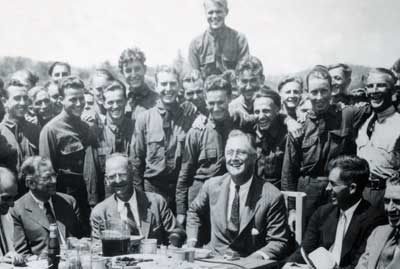
Courtesy FDR Library
Having developed a working model for the CCC, Roosevelt delivered his plea to launch it with the passage of the Emergency Conservation Work Act, which would provide the authority to create, by statute, a “tree army” to provide employment (plus vocational training) and conserve and develop “the natural resources of the United States.” He sent his bill to Congress on March 21. Roosevelt made it very clear that reforestation projects wouldn’t interfere with “normal employment.” In a message to Congress, Roosevelt stated in part:
I propose to create a Civilian Conservation Corps to be used in simple work, not interfering with normal employment, and confining itself to forestry, the prevention of soil erosion, flood control, and similar projects. …
More important, however, than the material gains will be the moral and spiritual value of such work. The overwhelming majority of unemployed Americans, who are now walking the streets and receiving private or public relief, would infinitely prefer to work. We can take a vast army of these unemployed out into healthful surroundings. We can eliminate to some extent at least the threat that enforced idleness brings to spiritual and moral stability.
Roosevelt did a marvelous job of selling the CCC, answering congressmen’s questions forcefully but politely. At six press conferences, he invoked public works and the CCC. After a round of debate, the 73rd Congress passed S. 598, Public Law No. 5 on March 31, creating the CCC as a temporary emergency work-relief program. Roosevelt’s unstated hope was that what the New Republic called his “tree army” would eventually become a permanent agency.
Roosevelt hired American Federation of Labor leader Robert Fechner as the first director of the CCC. Originally from Chattanooga, Tennessee, Fechner, born in poverty, left school at age 16 and moved to Georgia to become a “candy butcher” on trains. Mild-mannered and collaborative by nature, Fechner was an intrepid labor reformer. Because of his sterling reputation for fairness — as well as his union background — he proved an inspired choice.
By mid-April, the program was coming to life. According to Roosevelt’s estimation, an 11-man CCC crew could, weather permitting, plant 5,000 to 6,000 trees per day. Surrounded by maps of America, the president studied rivers and streams, deserts and forestlands. “I want,” Roosevelt declared, “to personally check the location and scope of the camps.”
Roosevelt’s “tree army” became a legend from the start, and he became a forester-in-chief hero to many conservation groups. As historian David M. Kennedy noted, the public quickly understood that Roosevelt had a “lover’s passion” for trees.
All over America, CCC tent cities popped up like Boy Scout camps; they were soon replaced with rustic barracks. Each company unit of 200 CCC “boys” was a temporary village in itself. All sorts of bylaws, pledges, and rules of engagement were announced. The “CCCers” received three full meals each day and were issued olive-drab uniforms, which included pants, a shirt, gloves, two pairs of underwear, a canteen, and a pair of heavy, steel-toed boots. In time, Roosevelt and Fechner changed the uniform to a spruce-green color for the coat, pants, overseas cap, and mackinaw (the shirt remained olive). “The issuance of a new uniform distinctive from other governmental services will improve the appearance of the corps,” Fechner noted. “It will also aid in building up and maintaining high morale in the camps.”
Unlike the army, there were no guard houses, drills, saluting, or court-martials. But morale was important from 6 a.m. reveille to taps at 10 p.m. At just $30 per month, these young men weren’t going to get rich: $22 to $25 of their pay was mandated to be sent home to their families; what remained was spent at the canteen, on haircuts and snacks, or at the local nickelodeon. Topnotchers were able to boost their salary by becoming technicians. A gag circulated among new enrollees — “Another day, another dollar; a million days, I’ll be a millionaire.”
Uniformed enrollees started working at a breakneck pace to plant millions of trees, restore grass, build check dams, practice rodent control and kill invasive or destructive animals, prevent wildfires, and teach bankrupt farmers how to form soil conservation districts. Particularly concerned about California’s forests — which drought and arid conditions had made hyper-vulnerable to fire — Roosevelt instructed CCC crews to cut a 600-mile Ponderosa Way firebreak along the base of the Sierra Nevada in California, the longest such protective barrier in the nation. The CCC “boys” were also dispatched to do immediate battle in the drought-ravaged Great Plains and the soil-stricken American South. Even Puerto Rico had CCC camps, employing 2,400 men.
Roosevelt never meant the CCC to be a panacea for the systemic woes of the Great Depression, but it did save a vast number of young men from homelessness or, even worse, hopelessness. Roosevelt viewed his “boys” not merely as temporary relief workers, but as makers of a permanent, greener new America. Bursting with optimism, he believed the work-relief experience would transform the young recruits intellectually as well as physically. Teamwork and citizenship and conservation would all be learned in the CCC. Only 37 days after Roosevelt took office, the first CCC enrollee — Henry Rich of Virginia — was dispatched to Camp Roosevelt near Luray, Virginia, located in the 649,500-acre George Washington National Forest, the first camp to open. Six additional CCC camps soon followed in Virginia’s Shenandoah National Park, employing nearly a thousand men to thin overcrowded stands, remove dead chestnut trees, plant saplings, install water systems, build overlooks, and lay stone walls. Between 1933 and 1938, owing to New Deal care, state park acreage in America increased by 70 percent. When FDR became president, Virginia had only two state parks. Determined to rectify the recreation crisis, Roosevelt sent 107,000 CCC enrollees into the state, and within three years, six more parks would open.
Courtesy of The National Archives and Records Administration
Although the CCC actually started in Virginia, it was the trans-Mississippi West that the “boys” quickly occupied like an invading army. In the early and mid-1930s, perhaps the most notable CCC infrastructure work in the West was in Colorado, a state ideally suited for a youth corps. Only five states exceeded Colorado’s native forest acreage. Meanwhile, unemployment was at 25 percent. So in the summer of 1933, 29 CCC camps were established.
Many CCC recruits lived in the gateway town of Estes Park and rode red tourist buses (called “woodpeckers” by locals) up to the construction sites. It took six CCC companies, working on a dozen mountain peaks, to help turn FDR’s “Top of the World” road into a 48-mile reality. “A few months ago I was broke,” Charles Bartell Loomis wrote in Liberty magazine in 1934. “At this writing I am sitting on top of the world. Almost literally so, because National Park No. 1 CCC Camp near Estes Park … is 9,000 feet up. Instead of holding down a park bench or pounding the pavements looking for work, today I have work, plenty of good food, and a view of the sort that people pay money to see.”
In the state of New York, enlistment in the CCC began on April 7 and 8 with 1,800 young unemployed men, all carrying welfare agency certificates, showing up at the Army Building at 39 Whitehall Street in lower Manhattan. Cheers and renditions of “Happy Days Are Here Again” were heard. From the Wall Street area, these initial New York City recruits were bused to Fort Slocum in Westchester County, Fort Hamilton in Brooklyn, and a segregated African-American CCC camp at Fort Dix in New Jersey.
Roosevelt ordered that half of New York’s 66 CCC camps were to be based in state parks. Four innovative New York CCC camps were erected on private land with the cooperation of the owners. Throughout the Adirondacks were numerous old dams, once installed for logging purposes but now collapsed, leaving flats overrun with sumps and bog vegetation. The CCC, by improving these old dams or building new ones, created nine new lakes.
Pennsylvania boasted the second-highest number of CCC camps of any state, trailing only California. Federally funded historical restoration projects took place at Fort Necessity and Valley Forge. Thirty-seven new fire observation towers were erected in state parks. Ickes, an ardent supporter of the NAACP, dispatched an African-American CCC company (led by black military officers) to landscape and renovate Gettysburg National Military Park with the hope that the experience would foster pride in the unit.
What Roosevelt hoped to do by employing youths, whether rural or urban, was to reduce juvenile delinquency. The New Republic went so far as to editorialize that the CCC was Roosevelt’s way to “prevent the nation’s male youth from becoming semi-criminal hitchhikers.” Education was a key component of the camps. Once the young men were officially enrolled, they would take classes in Forestry, Soil Conservation, and Conservation of Natural Resources. CCCers were further required only to do calisthenics, polish their shoes, brush their teeth clean, and maintain a sense of humor.
From inauguration day forward, Roosevelt ably projected the image of an open-hearted liberal who cared mightily about the downtrodden, struggling families, and the homeless. Increasing the size and scope of the federal government to alleviate suffering blindsided the GOP opposition. The CCC was part of this expansion. The public response was so favorable to the CCC that on October 1, 1933, Roosevelt instituted a second period of enrollment. Three months later, 300,000 CCCers were serving America. In 1935, Congress renewed the program, allowing participation to be over 350,000.
CCCers could initially sign up for only six-month stints. Later they could re-up for a total of 18 months, but after that time expired they had to leave the CCC for six months before they could reenlist.
When CCC acceptance letters arrived by mail or telegram or even word of mouth in Missouri, whoops and celebrations usually occurred. While there is no proper documentation of how precisely the CCC office in St. Louis selected the first 25,000 men from Missouri, a distinctive pattern emerged. Most Missouri CCCers were skinny as a rail, Caucasian, averaging an eighth-grade education, and lacking meaningful work experience. After passing a strict physical evaluation and receiving vaccinations, they were clay ready to be molded.
Within a year, over 4,000 CCCers, directed by the National Park Service, fanned out in 22 CCC camps and worked in 15 Missouri state parks, the majority in the Ozarks. A total of 342 examples of “rustic architecture” erected in these state parks by the CCC have been listed in the National Register of Historic Places as of 2015 — an astounding testimonial to the craftsmanship of the CCCers.
Tainting this fine record of achievement in Missouri, however, was the institutionalization of racial prejudice. Although Roosevelt had originally considered integrating the CCC, the program wasn’t sold to Congress as a civil rights crusade. Nor did he want to offend his Democratic political base in the South — which had been instrumental in his election — by attacking Jim Crow. Early on, the CCC created separate companies for African-American enrollees; 250,000 blacks enrolled in 150 “all-Negro” CCC companies throughout the nation from 1933 to 1942. The president’s uninspired “separate but equal” principle regarding the CCC infuriated civil rights groups.
Each Missouri camp had a company commander, a project superintendent, and an educational adviser. There were also chaplains, doctors, silviculturists (tree experts), agronomists, and engineers. At bugle call, the enrollees made their beds and scrubbed the barracks under the watchful eye of an Army foreman. Because the CCC had certain practices in common with the U.S. Army, it isn’t surprising that many military leaders, after initial skepticism, appreciated the CCC. Reserve officers were often in charge of a camp’s transportation needs, day-to-day management, and operational regulations. Part of the attraction of the CCC for many men was the seductive promise of three meals a day. Once the orange juice was downed and plates of eggs and sausage were consumed, the shovel-ax brigade climbed into the pickup trucks that drove them to work sites. At some sites, CCCers drove giant bulldozers and concrete mixers and wielded hydraulic rock-busters and electric saws. It’s been said that the CCC recruits in Missouri were more likely to stink of gasoline than smell of pine.
Not long after the CCC was established, the mushrooming camps each launched their own newspapers or mimeographed newsletters to chronicle daily life. Roosevelt asked Melvin Ryder — who had served on the staff of Stars and Stripes during World War I — to publish from Washington a nationally distributed weekly newspaper, Happy Days, which would feature propagandistic pieces on life in the CCC camps, sporting events, entertainment, and developments in conservation education. Happy Days sometimes printed entries for the best CCC motto. Many were funny, such as “They Came, They Saw(ed), They Conquered,” or bittersweet: “Farewell to Alms.” The New York Daily News approvingly quoted from Happy Days that the CCC motto was “They’ve Made the Good Earth Better.”
Even though the CCC was dissolved in 1942, the work of the “boys” remains visible from coast to coast. Over the course of its nine-year existence, the CCC conserved more than 118 million acres of national resources throughout America — more acreage than all of California. As the plaque at the School of Conservation in Branchville, New Jersey, reads: “These men participated in the world’s most famous conservation program. America will never be able to repay them. All that is great and good about conservation we owe to the CCC.”
From the Archive
Post Editorials Supported the CCC
The Post’s editorial board generally hewed to a conservative line. But when it came to the CCC, a program many on the right vilified as a socialist initiative, our support was wholehearted.
Better Than Welfare
All manner of schemes have been tried and very large sums have been spent for unemployment relief during the past three years. But no attack upon unemployment yet attempted has in it a greater element of hope and inspiration than the emergency conservation work of the Federal Government. This gives 250,000 men the opportunity of working for six months this summer in the nation’s parks and forests in return for food, clothing, medical attention, shelter and $30 a month, most of which the workers are expected to allot to their families at home.
Great numbers of young men have felt themselves a burden upon their families. Relief efforts in general have been directed to the unemployed married worker with dependents; the unmarried young men have been, until now, largely neglected. The forest camp work is aimed at these youths; its purpose is to redeem them from incipient social rebellion, to raise their depressed morale, to build up their health, to help their families with the allotments sent home, and incidentally to accomplish needed work in the forests and parks.
These young men will put in their six months under wholesome and uplifting conditions. They cannot fail to be better citizens for having spent that length of time in constructive manual labor in forests and parks. Nor can they fail to receive new hope and strength. After all, it is dreary business just to feed people and leave them in idleness. Details may prove thorny, but the idea is definitely promising and the attack upon the problem of idle youth is strategic and direct.
—“Hope for Young Men,” Editorial, June 17, 1933
Self-Respect, Confidence, and Fortitude
How might morality be strengthened in the individual? Above all, by strengthening courage; therefore, proximately, by developing hardiness and health; a fit and ready body is a sturdy prop to self-respect, confidence and fortitude. How admirable it would be if the Civilian Conservation Corps would raise its remuneration, widen its purposes, and draw every American youth for a year into its character-forming discipline, its wholesome friendship with forest, stream and sky!
—“Our Morals,” by Will Durant, January 26, 1935
Some Mistakes Were Made
Recent admissions that political influence has been a factor in selecting part of the CCC personnel are exceedingly distasteful to large numbers of fair-minded and unprejudiced people. … Surely, in the hasty finding of work projects for nearly half a million young men, it is more than likely that some mistakes were made. But the idea of putting hundreds of thousands of otherwise idle youths into wholesome outdoor work amid healthful and often beautiful and inspiring surroundings has appealed to everybody.
—“The Trail of the Politician,” Editorial, September 5, 1936
News of the Week: Chestnut’s Hot Dogs, Crystal Pepsi, and the Comforts of Classic TV
Joey Chestnut Is Back!
 Nathan’s Famous held its annual hot dog eating contest on July 4, and an old champion regained his crown — or should I say the official Mustard Yellow International Belt. Joey Chestnut, who won the contest eight years in a row until he was beaten last year, ate 70 hot dogs (with buns) in 10 minutes. Chestnut, whose nickname is Jaws, beat the person who stole his crown last year, Matt Stonie, whose nickname is The Megatoad.
I don’t think I’ve eaten 70 hot dogs in my life.
Crystal Pepsi Is Back Too!
Maybe Joey can wash down those hot dogs with Crystal Pepsi next year, though that might be against the rules. PepsiCo has announced that the ’90’s clear soda will be coming back this summer. This comes on the heels of Ecto Cooler returning because of the new Ghostbusters movie. Please note that both of these sodas are back “for a limited time only,” so stock up this summer so you can serve them during the holidays.
Hey, if Donald Trump picks Newt Gingrich as his running mate, the ’90s comeback will be complete.
RIP Elie Wiesel, Noel Neill, and J.P. Warwick
Elie Wiesel, Holocaust survivor and 1986 winner of the Nobel Peace Prize, passed away last Sunday at the age of 87. He was also known for his 1958 memoir Night, about his family being sent to concentration camps, a book which is now on the curriculum of many high schools and colleges.
You’ll remember Noel Neill from her role as Lois Lane on the 1950s series The Adventures of Superman (though she was in many other movies and TV shows too). There’s an interesting story about that role. Neill played Lane in the first Superman serial, 1948’s Superman. She played the role again in the 1950 serial Atom Man vs. Superman (Kirk Alyn played Superman in both). But when the TV show debuted in 1952, with George Reeves donning the cape, it was Phyllis Coates in the role of the Daily Planet reporter. She only lasted for one season, and Neill took over the role in season two. She made an appearance in the 1978 Superman film, too, playing Lois Lane’s mom, and in an episode of the TV series Superboy in 1991. She can also be seen in 2006’s Superman Returns.
Neill passed away last Sunday at the age of 95.
John Petersen Warwick has also died, at the age of 90. His agency came up with the classic Timex “It Takes a Licking and Keeps On Ticking” ads. Here’s the first commercial for that campaign, performed live on television with John Cameron Swayze. It doesn’t go as planned:
Serena Williams Fined $10,000
I get a little ill when I hear ESPN tennis announcers like Chris Evert either defend Serena Williams when she does something awful on the court or simply shrug off those actions. Serena doesn’t deserve anything more than any other player just because she’s one of the greatest tennis players in history. Remember a few years ago at the U.S. Open when she threatened to shove a ball down a linesperson’s throat?
It happened again last week when Serena, angry at how a match was going, smashed her racket while sitting down during a changeover. She then threw the racket behind her, without looking, and it landed softly in the lap of a photographer. Now, I smashed a racket or two when I played tennis, but I never threw it at anyone. Besides, there weren’t any ball kids or people photographing me, so even if I had thrown a racket, it wouldn’t have mattered. Serena had no idea who was behind her when she threw it. What if a ball boy was behind her, or an official? Or what if that photographer had been hurt? It was a dumb thing to do, and she was fined $10,000, which she can probably find between her couch cushions. It’s not a lot of money, and you know something similar is going to happen again. But Serena said she did it because she was “really, really, really angry” and she was “in warrior mode,” so I guess that makes it okay.
Are You Addicted to Classic TV?
It’s an interesting question, and I would answer it with another question: Can you be addicted to oxygen? That’s how I feel. I can’t imagine living on a TV diet of just current shows and news. That’s why you’ll find my television tuned to channels like MeTV, COZI TV, and Turner Classic Movies. It’s like comfort food to me.
The New York Post’s Michael Starr has a piece on why he’s addicted to classic television, and I agree with a lot of what he has to say. As I’ve mentioned here before in my writing about classic game shows like What’s My Line? and To Tell The Truth, I like seeing the people and places and products of the ’50s and ’60s and ’70s. And let’s face it, a lot of the shows from decades ago are better than what you’ll find on TV today. The Dick Van Dyke Show and Leave It to Beaver aren’t fantastic just because they’re “classic” or “retro”; they’re fantastic, quality shows, period.
One thing I hate, though, is how the shows on these channels are edited. I love The Andy Griffith Show, but both MeTV and TV Land chop them up, either because that’s how they got them for syndication or they’re editing them more to fit in more commercials. If you’ve ever watched the shows uncut (for example, on DVD), then you know how they’ve been edited. But I don’t know what’s worse, having episodes edited like that or having them sped up, like channels do with ’90s shows like Friends and Seinfeld, to fit in more ads.
Pasta Is Good for You Again
If you’re trying to lose weight but you love pasta, here’s some good news: According to scientists in Italy, it doesn’t make you gain weight. The researchers studied 23,000 people in Italy and found out that eating pasta has no bearing on weight gain or overall health. This contradicts earlier research that said eating too much pasta and other carbs was bad for you, which contradicted other research that said carbs were okay in moderation, which followed another study that said carbs were okay, but only the “right” kind of carbs. Got that?
Please note the headline on that CNBC story: “Pasta Doesn’t Make You Fat, Say Italian Scientists.” Italian Scientists. The next study will be from beer companies who will say that more beer consumption will solve our national debt problems.
Monday is National Blueberry Muffin Day
When you have a good blueberry muffin — a really good blueberry muffin and not a packaged thing you can tell came off a conveyor belt somewhere six months ago — there’s nothing better. Well, there are plenty of things better. But in the world of muffins, it’s pretty hard to beat.
Here’s a recipe for The Best Blueberry Muffin from Food.com. I don’t know who voted them “the best,” but I don’t think there are any laws that govern these things.
Some of the truly best blueberry muffins were served at Jordan Marsh, the New England department store chain. The New York Times has the recipe for them, along with the interesting story from 1987 that tells of a battle between these muffins and those from another department store, Gilchrist’s.
Upcoming Events and Anniversaries
John Quincy Adams born (July 11, 1767)
The son of John and Abigail Adams was the sixth President of the United States.
Hollywood Bowl opens (July 11, 1922)
Last Friday, Garrison Keillor recorded his last Prairie Home Companion at the famed amphitheater.
Skylab falls to Earth (July 11, 1979)
It was big news when the first U.S. space station crashed to Earth. I remember the sub shop around the corner from my house sold a sub called “The Skylab.” I don’t remember what was in it.
Major League Baseball All-Star Game (July 12)
The annual game, played this year at Petco Field in San Diego, airs on Fox at 7:30 p.m. ET.
Henry David Thoreau born (July 12, 1817)
The writer and philosopher “sought freedom not from government or capital, but from human nature.” He also had a beard a lot of hipsters today would die to have.
Apollo 11 takes off (July 16, 1969)
The flight, with astronauts Neil Armstrong, Buzz Aldrin, and Michael Collins aboard, landed on the moon four days later.
The Other Sock
Morris had a dozen paperbacks about Zen Buddhism and a shoebox full of audio — taped lectures, guided trances, and soothing tones. But Nigel had been to Japan. Nigel wore parachute pants from the Army/Navy Surplus that flowed like an aikido skirt. Nigel said he could summon winds.
The basin of the picnic ground was well below sidewalk level. The mud never fully dried, and that kept the Frisbee players away. After a bit of posing and making of signs, a wind did kick up. Morris didn’t know much about the physics of air currents, but he thought, Yeah. Well of course. We’re in a bowl. There’s always going to be a breeze bouncing off the hill.
But he didn’t challenge the summoning. Karen seemed impressed. Morris figured it was Nigel’s intensity that held her rapt, not any particular connection to wind and swirling leaves she might have.
The three of them went for coffee.
Karen sat on Nigel’s side of the booth. Morris held his mug with two hands.
So, said Nigel, have you sussed out the sound of one hand clapping yet?
Morris knew all the answers, as explicated in all the books, and knew that the mere recitation of them was no answer at all. He also knew that the trace of British accent in Nigel’s voice only surfaced when he wanted to impress girls. He and Nigel had lived on the same block of row houses since the fourth grade, when Nigel’s dad took a position at the college. His accent had waned well before high school.
Morris shrugged. It’s not the answer to the koan that matters, he said. It’s just the engagement.
I have a koan, said Karen.
I’m sure you do, said Nigel. He inched closer to her on the bench.
Which one? asked Morris.
Where’s my other sock? said Karen.
Morris smiled. That’s not a koan; that’s an epistemological quandary.
It is a koan, she said. Because which sock is the other one? The one I have could be the other-sock, while the one that’s missing could be the Ur sock.
Ur sock? asked Morris.
Yes, the primal sock which is the measure of sockness. It could go either way. It’s the need to seat otherness in either presence or absence that’s at the root of the koan.
Morris met her eyes across the table. I see what you’re saying. But I think the sock question leads to speculation about parallel worlds and alternate timelines. If the other sock persists but is absent, it may be with another Karen or a series of other-Karens, each Karen one sock shy of a unified sock drawer. A koan, on the other hand, is not expansive —
Nigel interrupted. It may have ended up at my place, he said. If you mean the yellow one.
Karen blushed. Morris looked at his coffee.
When I was in Kyoto, a Zen student died trying to solve a koan, said Nigel. It was in the news.
What happened? Morris and Karen asked at the same time. Their eyes met again for an instant before returning to Nigel.
His master asked him how to stop the 5:00 train from Tokyo.
That’s a classic, said Morris.
He jumped in front of it, said Nigel. I’d say he was on the wrong track.
Karen groaned.
What would your answer be? asked Morris. Would you conjure a storm to derail it?
Koans are for people who need answers, said Nigel. I’m not bogged down with riddles. I find answers.
You blow a lot of air, said Morris. Or try to.
I work with the elements, said Nigel. Crowley said that Taoism and Buddhism are just baby steps. An adept soon leaves them behind.
Is that what he said? asked Morris. Did you actually read that or did you see it on Tumblr?
My practice is an active lineage. It isn’t dependent on used bookstores, said Nigel.
Crowley was an asshole, said Morris.
Don’t fight, said Karen. This is our last time together before I leave for the summer. I need you to be good to each other while I’m away. I’ll want a full report from each of you.
Leave the tip, said Nigel to Morris.
Outside, Karen said, I guess this is it then.
Actually, you should come over, said Nigel. I think I still have your sketchbook. He was speaking to Karen, though he looked at Morris when he said it.
Okay, but just for a bit. My parents are picking me up in an hour.
Nigel put his hand in Karen’s.
Go, she told him. I’ll catch up in a sec.
Nigel let go. He walked up the block to linger in front of a shop window.
Karen turned to Morris. She fished in her purse.
I thought about getting two of these, she said. The other one must have slipped into an alternate ending.
What? said Morris.
I know how to stop the train, said Karen.
How? said Morris.
She placed an envelope in his hand and touched his face.
To stop the 5:00 train, she said, all you need is a ticket.
Karen went after Nigel and joined him at the window.
Morris walked away, headed in the other direction. When he turned the corner, he opened the envelope.
Inside was an open Amtrak ticket for the small station that was a short walk from the shady street where Karen’s room, she once said, had a clear view of the local mountain that was not Mount Fuji but was never the same mountain from one timeless moment to the next.
The Fate of Child Prodigies
In the current issue of the Post, Lini S. Kadaba’s “The Eureka Factor” explores the ongoing research into the source of those sparks of brilliant insight that people sometimes experience — those aha! moments when they have a sense of what it’s like to be a genius.
For some people, that sense begins when they are quite young and lasts a lifetime. These so-called child prodigies are children under the age of 10 who display the skills of an accomplished adult. They usually demonstrate their advanced intelligence in fields that work with narrow parameters and repetition, like mathematics, science, music, and chess.
Like the denizens of Garrison Keillor’s fictional Lake Wobegon — where “all the children are above average” — every parent wants to believe his or her child is a genius. But only a small percentage — 6 to 10 percent — are smart enough to be classified as “gifted.” True prodigies are even rarer: just one in 5 or 10 million, according to one psychologist.
Parents eagerly look for signs of brilliance in their offspring because they believe that high intelligence, exhibited at an early age, means a promising future for their child. It wasn’t very long ago, however, that parents worried whether their child was too smart. They believed that child prodigies grew into sickly, awkward adults who usually failed in their careers.
According to the authors of “So That’s What Happens to Child Prodigies,” reprinted below, this myth of the handicapped prodigy was born in the 1700s when the idea of universal equality was born. Believing all men were born equal and enjoyed equal opportunities in life, Americans were uncomfortable with the fact that some children were born with far greater intelligence than most.
So a myth began that prodigies were doomed to lives of obscurity and ill health. The myth was still very much alive in the 1950s, when Dr. Lewis Terman released his 30-year study of 1,500 child prodigies. In his conclusions, he wrote that child prodigies not only didn’t develop into sickly, lonely losers, but generally grew into well-adjusted, healthy, highly successful adults. His findings prompted many people to label him undemocratic.
Terman championed the case of prodigies. He promoted the idea of testing the IQ of all American schoolchildren, so the precocious few could be discovered and properly nurtured. He believed prodigies should become the leaders of America’s future.
That belief has persisted among the general public, which believes that children with extraordinary intelligence should achieve great things. Not all of them live up to the high expectations, but they are far from failures. Many pursue and often find their own happiness, even if it doesn’t involve creating a masterpiece or finding a valuable cure. A page on the Mental Floss website even describes “9 Child Prodigies (Who Actually Ended Up Doing Something),” as if most prodigies normally accomplish nothing.
It is probably unfair to set such high expectations for children with elevated IQs. Researchers now see that achieving success as an adult involves more than simply being born smart. According to Malcolm Gladwell, a successful adult genius is the product of habits and personality. Unless precocious children show “curiosity, doggedness, [and] determinedness,” they may never realize all the potential of their intelligence.
The last quality is particularly important for musical prodigies. They must possess a fierce desire to master the challenge of performance. This character trait enables them to keep practicing 6, 7, 8 hours a day, seven days a week. Determinedness may, in fact, be a stronger determinant than IQ of their future success.
So That’s What Happens to Child Prodigies
By Milton and Margaret Silverman
Originally published on February 2, 1952
To many people, precocity in someone else’s child calls for heartfelt sympathy. The typical precocious child, they believe, is the one who learns Greek at the age of 4, calculus at 6, and nuclear physics at 8, is graduated from Harvard at 12, and at 30 is an addlepate who can barely hold a job selling crockery in the local department store.
Recently a small army of workers has been conducting a study to determine once and for all whether infant prodigies really do “get over it” or whether they will maintain their mental superiority in adulthood. These workers — interviewers, mental testers, statisticians, physicians, and psychologists — have investigated some 1,500 of these prodigies and have checked with their parents, teachers, relatives, friends, wives, husbands, and children. They have obtained information which few people will give to their doctor, lawyer, or even clergyman. They have learned what becomes of the typical prodigy, how he grows up, what kind of job he gets, and what happens to his marriage.
Their study — a two-generation, $200,000 research project — actually began 30 years ago, and is just now reaching its climax. It has been hailed as one of the most exciting and significant investigations in psychology. It has yielded data which may eventually bring drastic changes in the American system of public education. And it has upset many of the time-honored beliefs dear to the hearts of parents, doctors, educators, and the public at large.
The investigators demolished one cherished superstition when they found there is nothing to the idea that precocious children — those with high IQs — are pathetic creatures, overserious and undersized, hollow-chested, stoop-shouldered, clumsy, tense, and neurotic.
“It would help our ego to believe that this is true,” one of them says, “but it is entirely false.”
Furthermore, they reported, precocious youngsters are generally not obnoxious little brats; most of them are remarkably free from behavior problems. And the child who learns Greek at the age of 4 and calculus at 6, they discovered, does not become an addlepate. The chances are greater that he will become an executive vice president, make $20,000 a year, and marry the best-looking girl in town.
These and similar findings have brought surprise, disillusionment, and considerable annoyance to some people, and the investigators have been berated for wrecking many popular and comforting misconceptions. Oddly enough, they have also been denounced in some circles as subversive, un-American, and undemocratic.
The Man Behind the Test Behind the IQ
To the leader of these scientists, sprightly Dr. Lewis Terman, of Stanford University, such charges are the standard payment for exploding myths. Professor Terman is in a position to know. He had already caused a row when he proved he could learn more about a child’s intelligence with appropriate mental tests than a teacher could discover in a year or than some parents could discover in 10 years. He saddened some educators when he stated that too many teachers failed to recognize exceptionally brilliant students. He stirred up resentment when he and his fellow brain testers reported that the average American adult had the mental age of a 15-year-old. He aroused wrath when he denied that any child could be made a genius by intensive mental calisthenics during the first four or five years of life, and when he disproved the widely accepted belief that many if not most of the world’s great geniuses were dunces in childhood.
“It is true that Charles Darwin was rated as an intellectual failure by his teacher,” he said. “This was quite probably due to the fact that young Darwin was addicted to carrying insects and small animals in his pockets — a habit which disturbed the serenity of the classroom.”
The great author Sir Walter Scott was reputed to have been a mental flop when he attended a certain private school. Careful study revealed later that Scott never attended the school, and that in early childhood he was demonstrating remarkable literary skill. Other investigators have noted that Thomas Edison, usually at the foot of his class in school and considered bird-brained by his teacher, was showing an intellectual curiosity and reading books far beyond his years.
“The evidence,” Terman said, “seems to show that mentally gifted children are most likely to develop into the world’s leaders in politics, science, education, business, and the arts.” Therefore, he suggested, such children deserve particular attention in the public schools and should have special classes, special training, and special educational advantages. This sounded like heresy to some educators, and they assailed him as the No. 1 enemy of democracy.
“These little disagreements have been inevitable,” he observed. “Some of our findings have made some people see red, and when they see red, they do not see very clearly.”
This year, Terman celebrated his 75th birthday. At an age when most men are content to retire and relax or are too exhausted to do anything else, he is still working 30 or 40 hours a week. His position is assured as one of the foremost psychologists of our times, the greatest living exponent of intelligence testing, and the man who largely popularized — although he did not invent — the phrase “intelligence quotient,” or “IQ.”
He and his cohorts have sold intelligence testing as a valuable measuring tool to almost everybody but the communists. Russia has ruled out the tests as undemocratic and denounced Terman as a vile fascist.
Undemocratic or not, the idea of training and utilizing specially gifted children is not new. “For many centuries,” Terman says, “the youthful prodigy was generally regarded with a mixture of admiration, awe, and hopeful expectation. His parents were envied, and the child was likely to be made the protégé of a prince or a king.”
Then the stock of child prodigies plummeted. This nose dive came in the 18th century, along with the rise of Western democracy and the popularization of the idea that all men are born equal — not physically, of course, but mentally. It was widely held — and is still apparently believed by a substantial proportion of the population — that all men are born with equal native intelligence, and that, with the proper education, any boy can become wise, wealthy, and even President.
Terman entered this emotionally supercharged field with what he termed all the misconceptions obtained from the most illustrious textbooks of the time. Born in Johnson County, Indiana, he was the 12th of 14 children. “My elementary education,” he recalls, “was obtained in a one-room ‘little red schoolhouse’ which could not boast a single library book. … I entered this school three months before my sixth birthday, and at the end of the first term of six months was promoted to the third grade. Habitually, I memorized most of the contents of my textbooks. The school day was long, and the time had to be put in somehow.”
At the age of 15, he went to a teachers college, later to Indiana University, and then to Clark University at Worcester, Massachusetts, where he worked on early mental-testing techniques. He had tuberculosis and during his years at Clark he suffered his third and most serious pulmonary hemorrhage. “It was perhaps fortunate for me that the doctors of that time knew so little,” he says. “Probably I should have been put to bed for from 6 to about 12 months, whereupon I would have gone to pieces from worrying about my wife, my two young children, and my debts. As it was, I merely rested for a couple of weeks until my temperature had subsided, and then went back to work.”
Although other physicians periodically warned him that his habits of intense work would bring him to an early grave from tuberculosis, Terman refused to change his schedule. He followed their advice only so far as to turn down glowing offers of jobs elsewhere and accept the position of high school principal in the reputedly healthy climate of San Bernardino, California. He stayed there for a year, then moved to a state teachers college — now the University of California at Los Angeles — where he worked closely with Arnold and Beatrice Gesell, later to become famous for their studies in child psychology. In 1910 he accepted an invitation to join the faculty of Stanford University.
While he was preparing material for his first lectures at Stanford, Terman became intrigued with the new mental tests recently devised in France by Dr. Alfred Binet. Introduced into the United States a few years before, the tests were still being attacked and ridiculed. Terman found nothing ridiculous in them, but he did see where they might be improved, expanded, and made more useful. In 1916, he and his Stanford coworkers came out with their first of several revisions — the Stanford-Binet test, now probably the best known and most widely applied mental test in the world. Terman’s book on the examination, The Measurement of Intelligence, has been translated into nearly two dozen languages — including Egyptian, Syrian, and Afrikaans — and its sales have passed the 200,000 mark. They are still going up.
The Stanford-Binet tests, like those developed by Edward Thorndike, of Columbia; Robert Yerkes, of Yale; Fred Kuhlmann, of Minnesota; Arthur Otis — a student of Terman at Stanford — and others, were designed to show the mental age of a child. From that, it is simple to get the intelligence quotient, or IQ, a term devised by the late William Stern, a pioneer investigator in the field of individual differences. To calculate the IQ, once you have measured a child’s mental age, you merely divide the mental age by the child’s chronological age, and multiply this answer by 100.
Today it is generally accepted that average children have IQs ranging from about 90 to 110. Most feebleminded score 70 or less. Superior or gifted children usually rate at 130 or higher.
Perhaps the most exciting and certainly one of the most significant investigations stemming from these intelligence measurements is Stanford’s large-scale psychological study of gifted children.
“What we proposed,” Terman says,” was to sift a school population of a quarter of a million, identify about a thousand children with the highest IQs, and study them — find their characteristic physical, mental, and personality traits — and learn what sort of adults they would become.”
He obtained sizable grants, first from the Commonwealth Fund of New York, and later on from the Carnegie Corporation and the Rockefeller Foundation, of New York; the Columbia Foundation, of San Francisco; the National Research Council; the Marsden Foundation, of Palm Springs; and the Thomas Welton Stanford Fund, of Stanford University. In addition, Terman made substantial contributions from the royalties he received from the sale of his tests.
When the task of selecting the gifted children was begun, trained field workers went to the classroom teachers of hundreds of California primary schools and got the names of the brightest and youngest students in each class. These nominees were given standard mental tests, and the ones with IQs of 140 or higher became the first gifted children for the experiment. Others were chosen when their high IQs were discovered during routine mental testing in other schools. Eventually there were some 1,500 of them (857 boys, 671 girls), ranging in age from 3 to 18, and representing the top 1 percent or less of the school population. Their IQs ranged from about 140 to 200, with an average of approximately 150 for the group. The top score was that of a 7-year-old girl with a mental age of 14.
These 1,500 boys and girls soon became known as the “Termites,” although few of them were told of their selection as gifted children until many years had passed. They were also known for a short time as Terman’s Geniuses — a name which the professor strongly opposed. To date, none of them has become a rival of Einstein or Leonardo da Vinci. Nevertheless the group has become internationally famous by the manner in which it has upset hallowed traditions.
The Termites first made news in psychological and educational circles when they showed up for their physical examinations. Doctors reported they were not the pathetic, hollow-chested, round-shouldered, colorless, puny specimens supposedly typical of precocious children. Instead the Termites were stronger, huskier, taller, and healthier than their average classmates.
The typical gifted child was the child of parents who had had more than the average amount of education and were enjoying a higher-than-average income. His father was a professional man — a doctor, lawyer, professor, or businessman. His home library contained an average of 328 books. He learned to read easily at the age of 5 or 6. By the time he was 10, he had been skipped one grade beyond his age group; actually, however, careful tests showed that he had already mastered the school curriculum two or three grades beyond the one in which he was enrolled.
At home, the typical Termite read more and better books than did most children, but he was clearly no bookworm. He played and knew the rules of more games than did his average schoolmates, engaged in sports just as successfully, and enthusiastically made collections of beetles, coins, Indian arrowheads, and match covers.
He was emotionally stable, quick in understanding and insatiably curious. He had a retentive memory and a large vocabulary, and was unusually interested in such things as number relations, atlases, and encyclopedias. He was more trustworthy when under temptation to cheat, and less inclined to boast or overstate his knowledge. His tendency to boast about his knowledge was determined by several methods, in one of which he was asked to indicate whether or not he had read such books as Dickens’ David Copperfield, Alger’s The Boy Inventor, Henty’s Running Away With the Circus, and Mark Twain’s Hobo Stories. Many children of average IQ reported they had read two or more of these; the typical Termite admitted he had read none or only the first. The three other books have never existed.
The investigators emphasized that the gifted children ranged widely in all their personality characteristics and family background. For example, although the average Termite came from a family with better-than-average income, some came from extremely wealthy homes, while others were brought up in families with barely enough money to keep going. One boy, raised in poverty, had started his schooling at the age of 17; within a relatively short time he had become a musical composer of wide reputation, the author of three books and dozens of articles on musical theory, and in the space of three years he wrote a book on melody, composed 60 major orchestral pieces and learned two foreign languages.
“These were our gifted children,” Terman says. “We knew what they were like as children. But how would they turn out as adults? Would they live up to their promise of youth? Or, as the textbooks predicted, would they fail miserably?”
Terman and his associates urged the parents of the Termites to raise their children as normally as possible. “Don’t place your child in a position which practically compels him to play the role of the child prodigy,” they said. “Don’t make him be a show-off. Let him associate normally in play and other social activities with children not too far from his own age.”
They also advised the parents to refrain from hurrying the child through school in the shortest possible time. “Keep him profitably employed and give him every opportunity for normal social development. Give information when it is called for and help the child to help himself. Encourage hobbies. Provide the best books, and provide them in large variety. But remember that books are not everything.”
One mother of a Termite told the investigators she was still dressing and undressing her 8-year-old son, giving him his bath and providing all kinds of assistance which most sensible mothers teach their offspring to provide for themselves at an early age.
“For my boy to do such commonplace things for himself,” she explained, “would rob him of the time he needs for creative thinking.”
“Ye gods!” cried Terman. “Creative thinking at the age of 8? It makes no difference how gifted your child may be, he must be trained to be helpful and to have a sense of responsibility.”
Most parents, he says, proved to be more sensible. As the years passed, they continued to welcome field workers into their homes and answer their questions, and to fill out the questionnaires which were periodically sent to them. Terman pledged to hold secret the identity and exact IQ of his Termites — a pledge which he has continued to keep, although some of the children or their parents divulged their identities themselves. He likewise has kept under lock and key the intimate details which many of the subjects began to reveal to him.
Some of Terman’s questions called for surprisingly intimate information.
“Those questionnaires he sent us every year wanted all the details,” relates Hollywood star Dennis O’Keefe, who recently revealed his membership in the Termite clan. “He kept close check, all right. Even knew who my first date was, and how I made out. My mother did most of it, but when I hit the late teens, the questions got specific. Mother handed over the blank for me to fill out in private.”
By the end of the war, when a major follow-up was under way, it was felt in some circles that the big chance had come too late for Terman himself.
He was 68. Three years before, reaching Stanford’s retirement age, he had become professor emeritus. Cataracts on both eyes had come close to destroying his vision, although successful operations were later able to restore his sight. He suffered second-degree burns when his campus home caught fire. Later he slipped and smashed his hip, and the doctors warned him he might be bedridden for life.
Limping, scarred, wearing thick glasses, but just as perky as ever, Lewis Terman kept on the job. With him were many of the skilled associates who had collaborated in the previous surveys 5, 10, 20, and even 25 years before, and who had taken leave from important and better-paying positions elsewhere and postponed their own researches to work again with their former chief.
When their report was finally published, it had heartening news for the parents of gifted children. The typical precocious child had not become stupid, committed suicide or, as some vulgarians observed, flipped his lid.
The successful, healthy young Termite had grown up into a successful, healthy, well-adapted, versatile, happily married adult with a good job and a good income, many friends, a respected position in his community, and a respectable record of contributing to his nation’s welfare.
In comparison with average men and women of similar age, the gifted group as a whole had a lower over-all mortality rate. The divorce rate and the insanity rate were the same as the national average, but there was less alcoholism and much less delinquency. Roughly 88 percent of the Termites had entered college, and 68 percent had been graduated, nearly half of these with high honors. Surprisingly, however, some 60 of them flunked out of college; investigation revealed that these students were lazy, bored, unwilling to follow a professor’s instructions, or were spending too much time in social life or earning a living.
“It was obvious that a high IQ isn’t the whole story,” one observer noted. “It’s important, but it’s not everything.”
Most of those who flunked out of school returned and were graduated later, and some went on to advanced training.
Of the men who had completed their formal education and were working, a remarkably high proportion — slightly more than 80 percent — had become professional or semiprofessional men or business executives. They were making brilliant records as lawyers, college professors, engineers, physicians, chemists, authors, newspapermen, artists, and architects. The average income of the working Termites was about 70 percent greater than that of average American men of the same age.
“It would have been even higher if fewer of the men had become college professors,” Terman observed. “A professor’s salary always seems to bring down the average.”
By 1945 about 85 percent of both the gifted men and the gifted women had married. When the investigators checked on the spouses, they found that in most instances each Termite had married someone who also possessed a high IQ. In 10 cases, one Termite married another.
“In those 10 cases,” said the professor, “it was usually the man who first told his spouse he was a Termite. The woman more often played it safe by keeping her intelligence a secret.”
The survey likewise showed that the Termites had at least their fair share of military service. More than 40 percent of the men served in the armed forces, rating everywhere from buck private to brigadier general. A hundred or more served in hush-hush military research projects.
Politically, they were about equally divided between Republicans and Democrats. Only one member of the group admitted he was a communist. Eighty percent of the eligible voters in the group reported that they had voted in the last national elections, in contrast to about 60 percent for the national average.
Finally, the investigators found, the Termites had made a significant impact on their country. Nearly 400 of the group had published more than 100 books or monographs and 1,500 technical, scholarly, or popular articles. The group had more than 100 patents to its credit, together with numerous scientific and medical discoveries. One Termite, who took his master’s degree in classical literature at the age of 20, had turned to business, and at 27 was chief investment analyst for a $40,000,000 educational foundation. Another, at the age of 32, was coordinator of research in a $10,000,000 aeronautical laboratory. One woman, by the age of 30, had become a successful professional actress, a professional dancer, an illustrator of anatomy and physiology textbooks, a novelist, and a champion ice skater. Another was director of one of the biggest atomic research laboratories in the world.
In contrast, one Termite listed as his major accomplishment, “I have just acquired my fifth wife.”
Some of the Termites had run into trouble. One of these was a brilliant Hollywood director who recently admitted he had been converted at least temporarily to communism. Four of the men had been sent to jail — three as juvenile delinquents and one as an adult offender — for infractions ranging from minor thefts to forgery.
A few others had close brushes with the law. One was a young boy whose zeal for scientific investigations led him to steal equipment needed in his experiments. “After his arrest,” his report reads, “the police department was so impressed by his ability that it gave him a job. His inventions later enabled him to earn $7,000 while in his undergraduate years at college. Today he ranks among the most successful men in the gifted group.”
Among the women, only two were reported to have had encounters with the police. One was arrested for vagrancy and sent to jail. The other, a professional prostitute for several years, was arrested a few times, but never served a jail sentence. “Both of these women,” it was announced later, “have apparently made normal behavior adjustments.”
Although the group varied in extremes from complete business failures to one man now making nearly $300,000 a year, and from a jailbird to a judge, Terman and his colleagues were far more interested in what happened to the average — to the group as a whole. And, they concluded, on the average, the gifted group “is assuming responsibility and leadership in far greater proportion than the general public or even college graduates in general.”
A new survey, being conducted this year, seems to be furnishing further evidence to support this conclusion and, of particular importance, is indicating that the children of these Termites also have high IQs.
For these and his other studies, and for building the Stanford psychology department into one of the best in the country, Terman was awarded what are probably the two highest honors in his field — presidency of the American Psychological Association and membership in America’s “scientific senate,” the National Academy of Sciences.
After winning such distinctions, an ordinary man might sit down and relax for the rest of his life. Terman, however, has demonstrated no ability to relax. He has used his latest findings as ammunition in his toughest battle of all, his strenuously opposed attempt to have mentally superior youngsters given the same degree of specialized schooling which educators sympathetically give to the mentally defective.
Actually a few such attempts have been made throughout the country. Special “enrichment classes” and “opportunity groups” have proved highly successful for gifted youngsters allowed to learn as rapidly as their mental, physical, and social powers permit. These classes have been expensive — yet rarely more so than those for subnormal children — and often were dropped for budgetary reasons. Although it was recently estimated that more than 1,000,000 of America’s schoolchildren have “superior intelligence needing special education,” scarcely 21,000 of these 1,000,000 potential leaders were found enrolled in special classes.
Terman himself has vigorously defended special training, for those who can assimilate it, as being thoroughly in line with the basic ideals of democracy. “It is no more undemocratic or discriminatory to provide special classes and instructors for the mentally gifted at the taxpayer’s expense,” he says, “than it is to provide football stadiums and expensive coaching staffs for the physically gifted.”
He told a recent international meeting in San Francisco, “Surely the school has no more important task than to foster the development of the mentally gifted. Never has our country stood in greater need of intelligence in high places. Our chances of survival in another war may well depend upon the discovery and utilization of highly superior abilities of every kind.”
Bad Manners on the Line
People staring at their smartphones during dinner or inconsiderately yakking away in public may be modern annoyances — but it’s only part of a long history of bad telephone manners.
Just two years after Alexander Graham Bell first demonstrated his invention in 1876, telephone lines were growing thick above the streets of New York City. Americans were amazed to learn their voices could be carried anywhere by wire. And many, noted the Post, were mystified by the technology: “A woman who was having her first introduction to the telephone was told by the operator to place the instrument to her ear and listen to the words the wire would speak to her. ‘And now,’ said she, in all innocence, ‘shall I talk with the other ear?’”
But within a few years after becoming accustomed the phone, customers were already complaining about the service.
Much like today’s anxious texters, early telephone users didn’t accept that the person they wished to speak to wasn’t waiting by the phone. And callers would vent their frustrations to the operators if their party didn’t answer or the line was busy or, as often happened, they were connected to the wrong phone.
Operators weren’t the only ones noticing rude behavior. Angus S. Hibbard, the general manager of the Chicago Telephone Company, noticed that something about the phone seemed to bring out the rudeness in people. And it prompted him to write this lesson in phone etiquette for Post readers:
How to Use a Telephone
By Angus S. Hibbard, general manager of the Chicago Telephone Company
Originally published on November 24, 1900
The man who knows how to use a telephone properly is comparatively a rare personage, and the observance of a few simple rules and suggestions in relation to telephone usage would accomplish, for any busy man, a great economy in money, time, and vital energy.
The telephone has done more to lay bare a latent strain of belligerency in all mankind than any other feature of modern experience, and this element offers the greatest obstacle known to the universal success of telephone operation. But this attitude is not the only abnormal development attending the act of telephoning.
A man refuses to recognize plain physical conditions that would be apparent to a child in the primary grades. What man of affairs would willingly give a second audience to a caller who turned his back to his host and directed his voice in a direction away from him? Yet the majority of businessmen keep their faces a foot or more from the telephone and turned away from the instrument. To expect satisfactory results under such conditions is preposterous. The lips should not be an inch away from the rim of the receiver and the voice should beat squarely upon the drum to which the little “sound hopper” leads. Give a telephone instrument a “square chance” and it will do its work, unless radically deranged or defective.
This, however, is not the main difficulty. It is only the symptom of the disease. Lack of mental focus is the real trouble, both in talking and hearing — or, in telephone parlance, in transmitting and receiving. If your thought is not concentrated on the transmission of your message you will not make yourself heard or hear what is said to you. This is where a failure to realize that you are holding actual conversation is apparent. No person understands this phase of telephonic trouble better than the operator of long-distance lines, where conversations are important and comparatively expensive, and time is limited. He knows that, in case the two on the line do not readily hear each other, he must make each realize he is not talking into a hole in the end of an iron arm, but speaking into the ear of a man.
Shocking a Man into Attention
Sometimes it takes sound shock to effect this focus of mental faculties. Once, when hard pushed, I resorted to a desperate expedient, which demonstrated this point with indisputable force. That was several years ago, when prominent men were not so accustomed as at present to use the telephone. They generally delegated the task to their assistants — a practice now much in vogue in England, where it is well-nigh impossible personally to engage the head of an establishment in telephonic conversation.
But in case of calls on the long-distance wires the conversations were generally of a confidential nature. Therefore the “parties,” although not thoroughly accustomed to using the telephone, must be made instantly to understand each other, despite the added disadvantages of the “long range.” At that time I was in charge of certain long-distance lines in the East, and was called upon to engineer a conversation of the utmost importance between a Baltimore capitalist and a Boston financier. Time was an essential in the transaction, which involved thousands of dollars.
The Boston man seated himself at the instrument, in my office, and waited for me to get the Baltimore capitalist properly started. At the first sound of the latter’s voice I knew he was “not there,” mentally speaking. Then I resorted to the usual expedients to impress on him the realization that he was talking with a person instead of at an inanimate object.
“Don’t hear a word! This thing is —” he was saying.
“I’m not a thing, Mr. Smith,” I interrupted; “I’m a man, about 30 years old, prematurely bald, with dark hair and gray eyes. I can hear you because I know you’re a real, live man doing business with your voice, right now. I can hear you because I’m thinking right to the point — and you’re that point! Now listen to Mr. Jones.”
But still I heard an irascible repetition of:
“Can’t hear! Can’t hear! Better give the thing up and telegraph. No use trying this old thing! It’s no account. I tell you I can’t hear a word!”
Meantime my Boston man was growing restless and excited. Every moment was of great value in the affair. Turning to him I said:
“If I were to tell Mr. Smith that he lies he’d learn how to hear every word you say in one second. Shall I do it?”
“Yes,” was the quick response; “and I’ll square it completely, later. “Very clearly I spoke into the receiver the words:
“Mr. Smith, you lie!”
“What’s that, sir?” came the instantaneous answer. “You call me a liar? Why, I’ll, I’ll —”
“You will understand,” I interrupted, “that I mean nothing of the kind — only that you do hear distinctly every word I say, and you are proving it. Now listen, quick, to Mr. Jones!”
He had no difficulty in hearing the Boston financier and the day was saved — simply because he was shocked into realizing that he was not talking at a thing, but conversing with a man.
Women are keenest to grasp the personality of the invisible conversationalist. A telephone is not a dead thing to them. They bow and smile into it and even stop before the mirror to touch up their hair when about to answer a call on a telephone in their own rooms.
Only a few days ago a man in Chicago decided to give his wife a novel surprise on her birthday anniversary. He arranged that, at a certain moment, her mother, whom she had not seen for years, should be at the long-distance telephone office in Philadelphia and should call up the daughter in Chicago. There was a telephone in the Chicago house and the husband answered the prearranged call. Turning from the instrument he said to his wife:
“Helen — here’s your mother on the wire in Philadelphia.”
The wife seated herself at the instrument and heard the familiar voice of her mother. It uttered one word: “Daughter!”
Suddenly the young matron in Chicago gripped the instrument and poured out her heart in the response: “Oh, Mother! Mother!”
Then, as she heard the sob that came over the wire from the aged mother, she answered in kind, still keeping the receiver at her ear. Speaking literally, those two women cried to each other until the tolls amounted to $15. Later they both said that it was the sweetest experience they had known since their long separation began! Nothing could more effectively demonstrate the sympathetic possibilities of the telephone or better illustrate the vital point of realizing the personality behind the voice.
Fist Fights Following Phone Talks
Lest any should think I have spoken with ill-advised harshness on the subject of the belligerency aroused by the telephone, let me say that I could give definite instances where men have put down their telephone receivers to meet each other in personal combat — and all owing to the fact that the instrument tempted them into a manner of expression that they would not have employed for an instant in a personal interview.
There are records in every metropolitan office which bear sad testimony to the cowardly, profane, and even vulgar abuse which some classes of men pour into the ears of telephone operatives who are innocent of blame — and who are also young women of refinement and respectability.
Such offenses are made of record, and their repetition leads to investigation, with the result that the offender is notified that he must mend his ways or his telephone will be taken out, and he will be denied the use of any telephone whenever his identity is recognized.
One way in which a large volume of time is wasted is in foolish preliminaries to the process of identification. Brown desires to speak with Abbott. Brown calls Abbott’s office. The person answering the call properly responds, “Hello!”
“Who is this?” brusquely asks Brown.
“This is Central 120. Who are you and whom do you want?”
“Look here! Who is this talking?” returns Brown. This kind of thing continues indefinitely until Brown finally says that he is Mr. Brown and that he wishes to speak with Mr. Abbott. By the time Brown gets Abbott on the wire he is thoroughly irritated and in no mood to conduct a business conversation of any importance. All this waste of time and energy could have been avoided had Brown responded to the clerk’s “Hello” in this manner: “Abbott & Co.?”
He is answered “Yes,” and quickly proceeds: “This is Mr. Brown. I wish to talk with Mr. Abbott personally.”
Always respond to a “Hello” by giving your name and asking for the individual with whom you desire to talk. Universal observance of this rule would save a vast amount of time.
In a face-to-face talk no man of ordinary judgment will speak in a mumble, a growl, a whisper, or a shout. A calm, even voice and a distinct but natural enunciation are the chief considerations, aside from those already mentioned.
Many a man who holds a telephone receiver so carelessly that its rim barely touches his ear wonders why he does not hear. I have even seen a bald-headed man clap the receiver against his pate and expect to hear when the instrument did not touch his ear at all. Reasonable results in telephonic communication cannot be expected unless the receiver is held firmly against the ear.
Rudeness to Unoffending Persons
With few exceptions, the man who finds he has secured a telephone number other than the one desired sharply tells the innocent party to “Get off the line!” or to “Ring off there!” A quick and polite apology, instead of a gruff order, is due the man who has been taken from his business on a matter in which he has no interest.
“Holding the wire” is another matter of constant and radical abuse. Your office boy calls up Attorney Jones; who is told you desire to speak with him. You are in the middle of the dictation of a letter and finishes it before starting for the telephone. Then a clerk stops you with a question which you pause to answer. Then you are waylaid by friends who have just entered. Finally you take up the telephone receiver. If Jones has not left the wire in disgust he is irritated. You cannot understand it!
Trouble will inevitably occur in telephone work. Errors occur from carelessness and from lack of acuteness on the part of operators. They are human. But they are also trained experts and the number of mistakes made by them is a marvelously small percentage of the total volume of connections made. When it is remembered that more than one large city of this country has, say, 30,000 telephone lines, over which are daily originated fully 300,000 calls, what wonder that some mistakes occur? Many of these calls are over “trunk” lines involving a secondary call, so the total of calls would be considerably more than half a million.
Every complaint is made a matter of record and filed in the “Trouble Cabinet.” At regular intervals an expert analyzes the records, making charts which show, at a glance, the nature, duration, and scope of the troubles which have assailed the lines in a given period. If asked to reduce to epigrammatic form the best advice to the telephone patron I would say, “Be courteous.” A broad application of this rule would work wonders in the effective use of the telephone.