10 Things to Know If You Haven’t Been to Disney World in 10 Years
Since 1971 millions of people have visited Walt Disney World in Central Florida. With 40 square miles of theme parks, resort hotels, and shops, a lot has changed at the “Vacation Kingdom.” Many loyal Disney fans will tell you that’s just the way Walt Disney wanted it. Walt never intended for his theme parks to become museums that never changed or updated. He said of his beloved Disneyland park in California, “Disneyland will never be completed. It will continue to grow as long as there is imagination left in the world.” That sentiment continues with Disney World in Florida.
Over the last ten years there have been many changes to Walt Disney World. Some of them have been huge success and widely embraced by Disney fans, and others have been met with skepticism. If you haven’t visited Walt Disney World in the last ten years, here are ten very important things you need to know.
1. Magic Bands Are Your Key to the World

One of the biggest changes you will experience at Walt Disney World is the use of Magic Bands. Introduced to guests in 2013, the RFID-enabled bands are meant to enhance your Disney World vacation.
The plastic bands serve many purposes. Using short and long range radio frequency readers, your Magic Band allows you to open your hotel room, gain access to Walt Disney World theme parks, buy merchandise, and use Fastpass + (more on that later).
It’s all part of a next generation technology effort Disney calls, MyMagic+. The idea behind the new technology is to make a Disney World vacation more convenient for guests. From booking hotels to making advance dining reservations, Disney is trying to take away some of the hassle and stress that comes with booking a Disney World vacation.
In an effort to enhance the Magic Band experience, Disney now allows you to customize your Magic Band. Guests can choose from over 49 different colors and designs.
Magic Bands are free to Walt Disney World hotel guests and annual passholders. Guests who are not passholders or staying off site can purchase a Magic Band. If you don’t wish to wear a Magic Band, Disney provides an RFID card that performs most of the Magic Band functions.
2. Fastpass Has Been Upgraded
With the introduction of Magic Bands in 2013, Disney also introduced another game changing experience for guests. A Disney Fastpass allows you front of the line access to an attraction. A decade ago, getting a Fastpass for a Disney attraction involved darting around a theme park to find a kiosk that would spit out a paper Fastpass. The paper Fastpass would assign a time for you and your family to come back and skip the line.
Fastpass+ allows you to book your Fastpass online with the My Disney Experience app. Guests who are staying at a Disney World hotel can book Fastpass+ 60 days in advance. Guests staying offsite and annual passholders can book Fastpass+ 30 days in advance.
For many Disney World fans the switch to Fastpass+ was unwelcome. Before the implementation of next generation technology, getting a Fastpass to the most popular Disney attractions involved arriving to the park early and finding one of those kiosks. Now, guests can reserve a Fastpass+ up to 60 days in advance. This means that very little effort goes into getting a Fastpass, which results in more guests using the system. Because of this, the same day availability of a Fastpass to some of Disney’s most popular attractions is incredibly scarce. When you combine this with the ability of guests to book dining reservations at Disney’s best table service restaurants up to 180 days in advance, a lot of people who take a spontaneous trip to Disney World end up having to wait in long lines for popular attractions and have only quick service options for dining.
One of the advantages for Disney in using Fastpass+ is their ability to know almost exactly how many people are going to be in their parks at any given time. This means they can more efficiently schedule staff around the resort. However, many Disney World fans resent having to plan and book so much of their vacation in advance. To them, much of the spontaneous fun has been taken out of a Disney vacation.
3. Be Prepared to Pay More
It’s no secret that a family vacation to Walt Disney World can be expensive. But just how much have tickets to Walt Disney World theme parks increased over the last ten years?
In 2008 the price of a one-day single park ticket for a family of four was $276. Those same tickets in 2018 will cost you $504 during peak season and $422 during value season, an average increase of 68%. Remember, that is the price for a family of four, visiting one park, for one day.
Annual pass prices have seen a similar sharp increase. In 2008 an adult Premium Annual Pass, which features access to all Walt Disney World theme parks with no blackout dates or restrictions, was $599. In 2018 the price of a Platinum Plus Annual Pass, which features access to all Walt Disney World theme parks with no blackout dates or restrictions, is $949 — an increase of 58%.
To many, these price increases can be a bit jarring, especially since the cost of living in the last ten years has only increased 16.6%, according to the United States Social Security Administration.
To justify the increases in theme park admission, Disney points to the amount of new offerings in its theme parks. Over the last decade high profile attractions such as Toy Story Midway Mania have been added, and they have reimagined classic attractions like Star Tours: The Adventure Continues.
4. Star Wars is Coming

One of the most anticipated additions to Walt Disney World, Star Wars: Galaxy’s Edge, is set to open at Disney World in Fall 2019. Even though the themed land inside Disney’s Hollywood Studios is not finished yet, guests can already begin to see what lies ahead.
Star Wars: Galaxy’s Edge is occupying the space that formerly housed the Streets of America and the Hollywood Backlot Tour at Disney’s Hollywood Studios theme park. The setting for the land is the fictional planet of Batuu. From smugglers to rebels, guests will have the opportunity to meet and interact with the inhabitants of Batuu.
The land will be anchored by two major attractions. The first is a yet-to-be-titled ride where fans go on a mission and, “fly” the famed Millennium Falcon. To add more drama, Disney has announced that your “performance” on this mission can affect your experience in the rest of the land. For instance, if you prove to be an expert at flying the Millennium Falcon, you may be treated as a hero at the local cantina. However, if you return from your mission with a banged up and dented ship, the locals may not receive you so well.
The second major attraction inside Star Wars: Galaxy’s Edge will place guests inside a hangar bay right in the middle of a fierce battle between the dreaded First Order and the Resistance. In a recent statement Disney announced that the attraction is “built on a scale we have never done before.”
When it opens in the Fall of 2019, Star Wars: Galaxy’s Edge will change the landscape of themed entertainment. Disney is already preparing for record crowds at Disney’s Hollywood Studios. The attraction is going to change the way guests experience themed environments.
5. The Magic Kingdom Now Serves Alcohol
After being alcohol free for 41 years, Disney finally took the lid off of beer and wine sales in the Magic Kingdom in 2012. With the opening of the Be Our Guest restaurant, Disney announced that limited alcoholic beverages would be sold for lunch and dinner service.
Alcohol has always been available at all other Walt Disney World theme parks. The Food and Wine Festival has been a staple at Epcot for many years. Once Disney announced the sale of beer and wine at Be Our Guest inside Magic Kingdom, many guests feared that people would bring their rowdy “drinking around the world” attitude to the tranquil, and until now, alcohol free Magic Kingdom.
To the surprise of some, hordes of drunken millennials have not descended upon the Magic Kingdom. In fact, in late 2016 Disney announced the expansion of alcohol service in the Magic Kingdom. Alcoholic beverages were added to four new locations across the theme park.
For Disney, the move was a no brainer. The opportunity to increase food and beverage revenues by offering alcohol to guests seemed to have outweighed almost four decades of keeping the Magic Kingdom “dry”.
6. Animal Kingdom Has New Residents

When Disney first opened Animal Kingdom in 1998 it was billed as “Nahtazu,” as in, “not a zoo.” Fearful that guests would see the theme park as just another zoo, Disney also teased that the park would soon host animals and creatures from myths and legends.
It may have taken almost 20 years for the tease to pay off, but in May of 2017 Disney opened Pandora: The World of Avatar in Animal Kingdom. The themed land is filled with exotic plant life, food, and creatures from the blockbuster 2009 James Cameron film, Avatar.
Ten years ago the area looked a lot different. Instead of ten-foot-tall blue people and plants that light up with a touch of a finger, the space was host to a quiet faux campground called Camp Minnie-Mickey. Inside the land, you could meet your favorite classic Disney characters in a relaxing setting.
Pandora: The World of Avatar showcases two groundbreaking attractions. The first is a scenic boat ride through the fictional Kasvapan River. In the Na’vi River Journey your boat floats past the creatures and plants that inhabit the world of Pandora. The end of the attraction is highlighted by a singing Na’vi Shaman of Songs.
The second attraction anchors the themed land. Avatar Flight of Passage is a 3D flying simulator that gives you the feeling of riding on the back of a Banshee through the mythical Valley of Mo’ara. Disney managed to improve on their previous versions of flying simulators by adding another level of depth to Flight of Passage. As riders glide on the back of the banshee, you can feel the mythical creature breathing underneath you and the rush of air on your cheek as you dive around mountains. Water splashes on your face as your creature glides inches from the surface of the ocean.
Unlike Camp Minnie-Mickey, Pandora: The World of Avatar draws massive crowds to Disney’s Animal Kingdom every day. It has transformed the theme park into a full-day experience and adds a new level of depth and dramatic storytelling to a park that was lacking both.
7. New Hotels Enhance Your Vacation
Disney owns and operates 26 resort hotels inside Walt Disney World. Each hotel has its own unique theme and design. With new additions since 2008, and even more ambitious hotels on the horizon, Disney continues to add on to its already impressive portfolio of resort hotels.
In 2012 Disney opened the Art of Animation hotel. The 87-acre hotel is themed around popular Disney animated films. What really makes this resort unique are its themed family suites that fit up to six guests. The hotel is also surrounded by larger-than-life sculptures and themed environments that place you right in the middle of a scene from a Disney animated film. The Art of Animation hotel also houses the largest hotel pool of any Walt Disney World resort.
Another new addition to Disney’s hotel portfolio is easy to spot for any Magic Kingdom visitor. Bay Lake Tower is located right next to Disney’s Contemporary hotel, alongside the Magic Kingdom theme park. The deluxe tower features a rooftop viewing area where guests can get a one-of-a-kind view of the nightly fireworks over Magic Kingdom.
Disney has promised even more ambitious hotels for the future. In early 2018 Disney announced that it will be building a Star Wars theme hotel for Walt Disney World. In a statement, Disney said the yet to be named hotel will be “unlike anything that exist today.” While very few details about the hotel are known, Disney fans are preparing themselves for a truly unique experience.
8. Epcot Is Not Living Up to Its Legacy

For many years if you asked theme park enthusiasts what their favorite theme park in the world is, a lot of them would have answered, “Epcot.” The theme park is what remains of Walt Disney’s long sought futuristic city. By 2008 the theme park had long since shed the facade of trying to be the “Community of Tomorrow.” Disney faced a constant battle of trying to showcase futuristic technology and innovative designs while trying to attract and maintain corporate sponsors. Since its opening in 1982, Epcot’s attractions have been heavily reliant on money from corporate sponsors. If an attraction’s sponsor does not renew an agreement with Disney, then that attraction is pretty much doomed to a fate of not being refurbished or reimagined.
Today, this is painfully obvious as many iconic buildings in Epcot sit empty or underused. Closed in 2007, the Wonders of Life pavilion was once home to innovative attractions that centered around human biology. But a decade after those attractions have closed, the Wonders of Life building sits mostly unused, only occasionally being put to work as a festival center where Flower and Garden or Food and Wine festival guests can get a break from the heat and use the bathroom.
While some Epcot attractions have been given a facelift, like Test Track and Soarin’, Epcot still feels like the boneyard of a park long gone. On their way to the World Showcase, many guests walk past the now empty Odyssey restaurant. The building that housed the restaurant has sat mostly empty and unused since 2001, leaving many passing guests to ask aloud, “What’s in there?” only to be greeted by blacked out windows and locked doors.
There still may be hope for Epcot. In a series of recent announcements, Disney has promised to bring new attractions and experiences to the beleaguered park, starting with a new Guardians of the Galaxy roller coaster. In a statement, Disney announced the new attraction will be “one of the world’s longest enclosed coasters.”
Disney has also started building an attraction based off the Pixar film Ratatouille. The innovative trackless ride is already operating at the Walt Disney Studio Park in Paris, France. Appropriately, the Epcot attraction will be located in the France pavilion.
But any hope that the park will return to its idealistic, future driven past is probably long gone. In the place of Dreamfinder and Horizons, Disney has given us intellectual property-driven attractions and months of festivals.
9. Intellectual Property Has Taken a Front Seat
Some of the most popular attractions at Walt Disney World were created entirely from the imaginations of Disney’s Imagineers. Imagineers are responsible for designing, creating, and building all of the attractions you see at a Disney theme park.
Classics like Pirates of the Caribbean and the Haunted Mansion were created during a time when attractions were not based on of an existing Disney film, TV show, or cartoon, but were created from original themes and back stories. Because of this, Disney fans can now enjoy rides and shows that have lasted decades.
In today’s content-heavy environment, Disney has shifted the focus of the Imagineers to develop attractions that are based on of existing films or TV shows. This type of synergy does have an upside for Disney and its large fan base. Take Cars Land at Disney’s California Adventure. Throughout this themed land Disney has created an exact replica of a Radiator Springs. Fans can wander the streets of the small town and relive popular moments from the Disney/Pixar film, Cars. The incredible attention to detail in the land makes you feel as if you are living in the film.
For Disney, being able to sell theme park tickets, merchandise, and food based on content that is already proven to be a success is a no brainer. If your audience has already spent $600 million on tickets for the film, chances are they are willing to visit the themed land.
10. Fantasyland Looks a Lot Different

Fantasyland, inside Walt Disney World’s Magic Kingdom, is widely considered to be the most popular themed land in all of Orlando. It houses some of Disney’s most famous rides and attractions. When people remember their favorite Disney rides from childhood, they often think of ones located in Fantasyland.
But over the last ten years, Magic Kingdom’s Fantasyland has gone through a transformation and expansion. In 2009 Disney began work on doubling the size of Fantasyland. Over the next five years, four major attractions were included in the Fantasyland expansion.
The largest addition to Fantasyland is the Seven Dwarfs Mine Train. The attraction is a family friendly coaster that features scenes and songs from the classic Disney animated film, Snow White.
Another new attraction replaced Snow White’s Scary Adventures. Princess Fairytale Hall is an interactive meet and greet that allows you to visit two of your favorite Disney princesses.
Combined with the additions of Enchanted Tales with Belle and Under the Sea: Journey of the Little Mermaid, the new and improved Fantasyland i allows guests to be immersed in some of the most iconic Disney animated films. While the land may look very different from a decade ago, Disney has managed to maintain the same nostalgic feeling you get when you walk under Cinderella’s Castle and into Fantasyland.
North Country Girl: Chapter 59 — Of Magazines and (Naked) Men
For more about Gay Haubner’s life in the North Country, read the other chapters in her serialized memoir.
Some names have been changed.
My artist lover, Michael, and I were broke newcomers to New York City, about to move into an apartment we weren’t sure we could afford. I thought I could go back to waitressing — the most lucrative job I had ever had — but not a single restaurant would hire someone who had no experience in the hectic New York dining scene. Even McDonald’s probably would have shown me the door. My resumes and cover letters to magazines got the same non-response. I had swallowed hard, screwed up my courage, and cold-called a name I had gotten from the editor of Oui, Gerald Sussman. Now I had an appointment with Gordon Lish at Esquire.
As a freelance writer of fripperies and pornography for Oui, a second-tier men’s magazine, I knew as much about magazine publishing as I did about the oil industry. I had no idea that struggling Esquire had just been bought by Clay Felker, who had made a huge success of New York magazine. Everyone in New York but me knew that big changes were coming to Esquire, and it was probably the world’s worst timing to pursue a job there. I also had no idea who Gordon Lish was: the pre-eminent fiction editor of the day, the man who invented Raymond Carver and discovered Richard Ford, Don DeLillo, and Cynthia Ozick.
The Esquire offices in midtown were a dim, dusty, rambling warren. There was none of the bustle and laughter and loud coarse jokes of the Oui offices, just murmurs behind closed doors. The carpet, the walls, and the torn leather chairs in the reception area were uniformly brown. Translucent glass fixtures tried to dispel the gloom, but the only thing that reflected light was the gilt lettering that read “Gordon Lish Fiction Editor” on the glass panel of his door. Mr. Lish ushered me into his small office, which like our sublet apartment, overlooked an airshaft. Crammed on shelves and across his desk and covering the floor were hundreds of books, interspersed with magazines, newspapers, and typed manuscripts held together with brass paper fasteners.
I thought Gordon Lish looked incredibly old; he had pale longish hair and deep parentheses around his mouth and a sweetish scent that reminded me of my grandfather. We shook hands, I shifted a few books off a chair and sat down, and passed him my resume and my writing, née modeling, portfolio.
Mr. Lish turned the crackling acetate pages slowly, looking thoughtful and taking intermittent swigs from a silver flask.
“Ah, the female body has truly unending variations of beauty,” he sighed. He gently touched the tip of his index finger to one photo of an especially pretty girl with especially large breasts. Wait, I thought, he isn’t reading a word of my copy, he’s just looking at the photos!
I suddenly realized that even at Esquire, the birthplace of the Vargas girl, my writing clips featuring nude women playing volleyball, making spaghetti sauce, and riding unicycles were highly inappropriate and, even worse, unlikely to get me a job. But if I threw out all the nudes and made my writing portfolio G-rated, I would be left with five or six paragraph-length captions to funny news photos and a handful of 150-word book and album reviews.
Mr. Lish closed my portfolio with another sigh. “So Gerald Sussman sent you. Pompous twit. I never could stand that man. Would you care for a drink?” Mr. Lish passed me his flask. I took a small sip of what I recognized as Scotch whiskey, trying not to choke on its doused campfire taste.
“Let’s get out of here before I have to hear any more dreadful news. A lunch interview, hmm?”
There was no interview and there was no lunch at the Spanish restaurant Mr. Lish took me to. There was a small half-moon bar, where Mr. Lish and I sat for three hours, and there was a dark, silent bartender in a white jacket who refilled our drinks without asking. There was also a Chivas-fueled monologue from Mr. Lish on the perfidy and consummate evil of Clay Felker, the disgusting decline of magazine and book publishing, the idiocy and ineptitude of all publishers and most executive editors, and the ingratitude of the writers he had made famous, none of whose names I recognized.
By some miracle, the Spanish restaurant Mr. Lish and I got drunk at was on Greenwich Avenue, a few blocks from my miniature apartment. When I realized it would be death if I had another drink, I thanked Mr. Lish, who waved me off, and I staggered home.

The next day at noon, the apartment phone rang.
“Gay, it’s Gordon Lish,” whispered Michael as he handed me the phone.
Oh my gosh, I thought. He’s going to offer me a job!
“I’m at La Casa des Borrachos. Come have a drink with me.” And nitwit that I am, I met him at the bar of that Spanish restaurant. At least this time I covered my glass with my hand when the bartender approached, but I still had to listen to pretty much the exact same litany of injustices Mr. Lish had related the day before. Because I am a slow learner, I met him there a third day, before I finally realized that there was no job for me, and there probably would be no job for Mr. Lish either if he kept spending his days drinking at a bar. On the fourth day I made Michael answer the phone and say that I wasn’t there.
The next phone call for me came from Bernie Exeter, the managing editor of Viva magazine; he had read my resume and asked me to come in for an interview.
I was excited, but not surprised. Mindy, my clairvoyant friend, had predicted my move to New York and reunion with Michael and that I would get a job at Viva magazine. And I knew that I still had my best good fairy gift, my incredible luck. An interview at my favorite magazine seemed like nothing more than my fair due, what the world owed me just for showing up.
Like Mindy I was a big fan of Viva, the sister magazine to Penthouse, created to appeal to an imaginary female counterpart to the male Penthouse reader: a woman who was worldly, curious, sexually liberated, independent, adventurous, fashion crazy, and a drinker and smoker with a sizable disposable income. “The world’s most sophisticated erotic magazine for women” was Viva’s claim, which, when translated meant “We think women like to look at pornography too.”

I had been a faithful reader for years, gazing at clothes I couldn’t afford and admiring makeup I had no idea how to apply. There was lots of erotica; Anaïs Nin and her racy diaries managed to make it into every other issue. I appreciated Viva’s almost realistic attitude to sex, as opposed to the coy tips offered by Cosmopolitan, or the way Glamour and Mademoiselle magazines approached sex, which was hardly at all. But I shuffled through Viva’s pages and pages of steamy photos of amorous couples that were supposed to be titillating with barely a glance. It was hard not to laugh at those buff, handsome men and pretty, large-breasted women in tender embraces, lips pouted, limbs entwined, eyes rolled upward, everything screaming fake, fake, fake. To me the photos were not erotic at all; the only thing that crossed my mind was, “I wonder how much the models were paid?”
The morning of my interview, I pored through that month’s Viva and tried to commit the articles and writers to memory; I was going to wow Bernie Exeter with my knowledge of the magazine. Then I tore through my still packed suitcases for interview attire that said erotic sophisticate. I stupidly chose a Kenzo ensemble purchased back in Chicago from the car trunk clothes dealer: a lavender tunic that tied at the shoulders, worn without a bra but with white harem pants.
Bernie Exeter seemed a bit taken aback at me and my louche outfit when he came to fetch me from the Penthouse lobby, which except for the oversized posters of Penthouse covers, was as grey and anonymous as any insurance or accounting firm.
Bernie Exeter looked like a mustachioed, homelier Chuck Barris. He was wearing a short-sleeved polyester shirt, yellow knit tie, and pleated pants. He led me to his office overlooking the Roosevelt Island tramway, and I handed him my unexpurgated portfolio. I wasn’t worried that I would shock him with my R-rated writing samples; Viva was full of breasts, as well as other body parts. Bernie flipped through the pages for all of ten seconds then slapped the portfolio closed and looked at me. I had no idea what kind of questions he would ask; my last job interview had landed me in the coat check.

“What do you know about the magazine?” he asked, and then, before I had even opened my mouth, he started in on the rise and fall of Viva.
Viva was officially the brainchild of Penthouse owner Bob Guccione and his girlfriend, Kathy Keeton. (Whenever Bob was not around, Kathy insisted that she had thought up the idea for Viva all by herself, which was probably true; Kathy was the fox to Bob’s hedgehog). Bob Guccione was busy lying to, seducing, and taking nude photos of silly young girls and buying Old Masters, Impressionist, and Modern paintings by the crate with the deluge of cash generated by Penthouse magazine. This left Kathy in charge of the new-born Viva, as publisher and executive editor. Under her guidance, and with Bob’s money, Viva enjoyed a few years of success. Write a big enough check and you can get Helmut Newton photographs and Joyce Carol Oates stories to run alongside of shots of bare-chested, smoldering firemen stroking their hoses. A few daring advertisers bought pages and a few desperate starlets posed for the cover, despite Viva’s association with the beyond-the-pale Penthouse. Thousands of young women signed up for subscriptions; a lot more, like me, with my constant lack of a fixed address, bought our copies on the newsstand. Viva’s first print run was a record-breaking 1,002,000 issues.
Kathy Keeton would never have called herself a feminist, but she was a firm believer that women had as much right as men to look at naked photos of the opposite sex. When Bob’s camera started focusing in closer between the spread legs of those silly girls, Kathy set her sights lower too. She decided that the Viva reader was entitled to look at the Full Monty. Kathy was going beyond Viva’s coquettish “love sets” where the male member was always coyly covered by a feather boa or chiffon scarf, beyond the teasing photos, like those of Joe Namath and Burt Reynolds in Cosmopolitan magazine, where the men had one leg demurely cocked forward, as unsexed as a Ken doll.
I was familiar with this part of the story, having bought the issue of Viva that proclaimed “First Penises Ever!” though not for that reason. Maybe Kathy Keeton enjoyed looking at photos of penises. I didn’t especially, and I thought of myself as the epitome of the sophisticated Viva reader. I continued to buy the magazine, flipping quickly past the beefcake with their strangely flaccid penises to get to an article about the world’s sexiest perfumes or a short story by Tom Wolfe.
I was alone in my nonchalance about male nudity. Viva, Bernie Exeter told me, went from overnight success to being on life-support, a pariah among publications. Readers canceled their subscriptions in droves. Newsstands refused to carry Viva, even if the offending magazine was safely swaddled in plain brown paper and hidden away under the counter. Those companies that had been okay advertising in a magazine that ran stories such as “My First Orgy” and “The Good News about Rape” blanched at penises; the only advertisers that had stuck with Viva were cigarettes and a few brave liquor companies, most of whom had gotten their ads highly discounted or free with their purchase of exorbitantly expensive pages in booming Penthouse magazine.
For a few months, Kathy Keeton clung to her X-rated vision of Viva, until the head of advertising sales, Beverly Wardale, a booming Brit in the Margaret Thatcher-She-Who-Must-Be-Obeyed mold, informed her that either the penises went or she did. Kathy Keeton would have brushed off a threat from a lesser mortal, but Beverly was also her best friend. The penises went with zero fanfare, but Viva could not shake its bad reputation.
“’Cause what are you going do?” asked Bernie, “Run a cover line that says, ‘No more penises?’” I shrugged, not knowing the answer; I was busy trying to figure out where this was going and if there was a job for me at the end of it.
“But that’s all changing,” said Bernie, rubbing his hands together. “We’ve got a new editor, she’s a smart cookie, and you’re going to see some feminist articles, and the subscription department’s come up with some neat umbrellas and t-shirts to give away — here, take one.“ Bernie tossed me a tiny white tee with a hot pink “Viva” printed in a hideous fake Art Deco font. Within a year, every other bag lady in New York City would be wearing one of those shirts.
“Well,” said Bernie Exeter, “Do you want the job?”
“I do, I do.…Um, what is the job?”
Image Gallery: Glorious Fourth!
Pride of country
Holidays were always a source of inspiration for Post illustrators, and no day could be more inspiring than the glorious Fourth of July. Here, a variety of Post illustrators give their tributes to the day, the country, and the American people.
Ka-Boom!
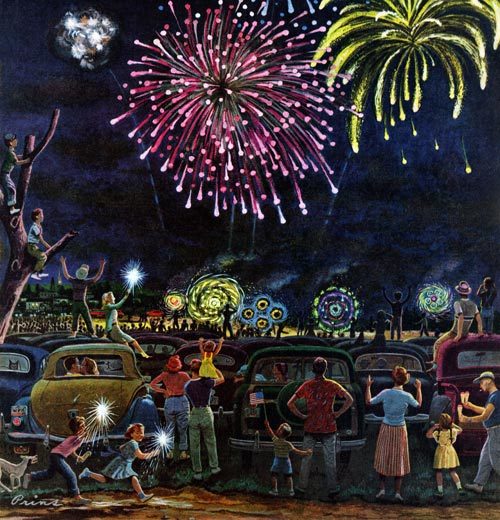
Rockets, thunder, and explosions of light were a sign of rejoicing in 1953 America. While such a display would inspire terror in war-torn countries of this time, Post editors noted that for Americans, “the roaring fire in the sky is nothing to be afraid of; it is beautiful.”
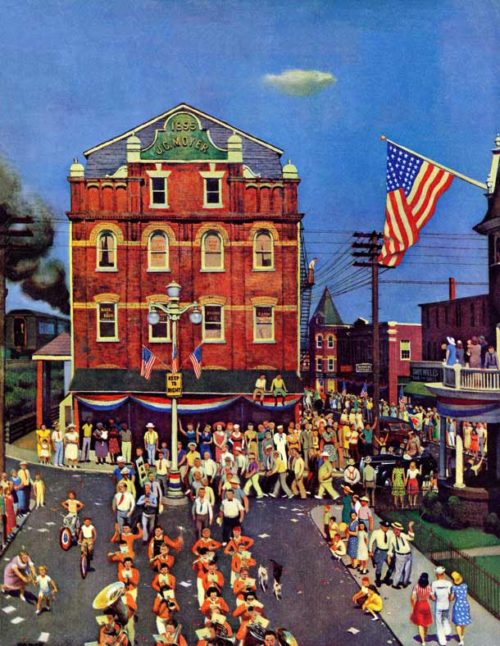
John Falter, famous for his portrayals of small-town America, captures the atmosphere of the Fourth in Perkasie, Pennsylvania. To GIs still in the Pacific in 1945, the image of this humble celebration must have been a reminder of what they were fighting for.
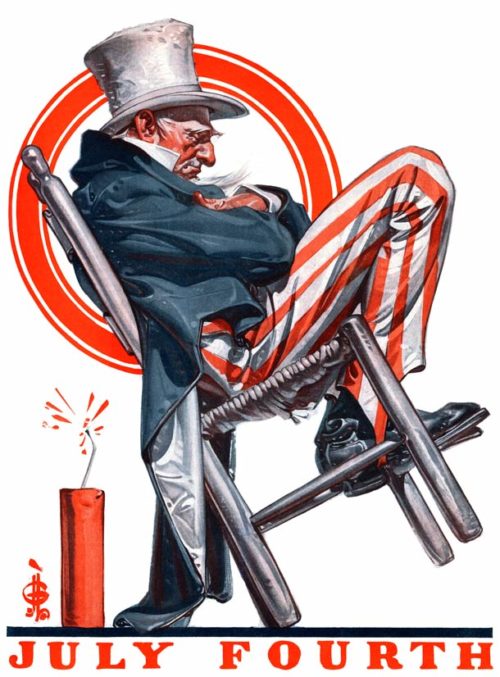
J.C. Leyendecker has Uncle Sam somnolently posed over a lit firecracker. Was the artist suggesting that the Roaring ’20s would soon wake Sam up?
Light of Liberty
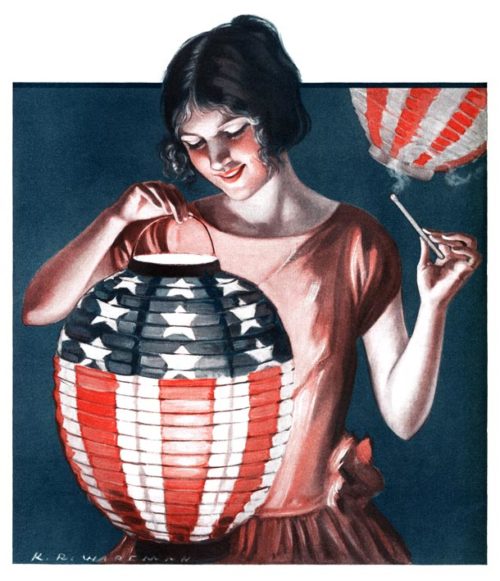
In an intriguing interplay between light and shadow, artist Katherine Wireman evokes the delight of a just-lit holiday lantern.
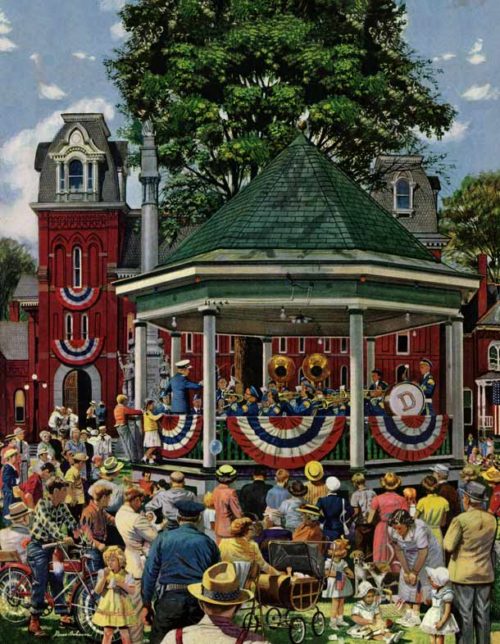
Stevan Dohanos tried to fit the entire Delaware Academy Central School Band on the bandshell in Delhi, New York. But the small stage wouldn’t permit it, so he dedicated this cover to the full third of the band members who had to sit this one out.
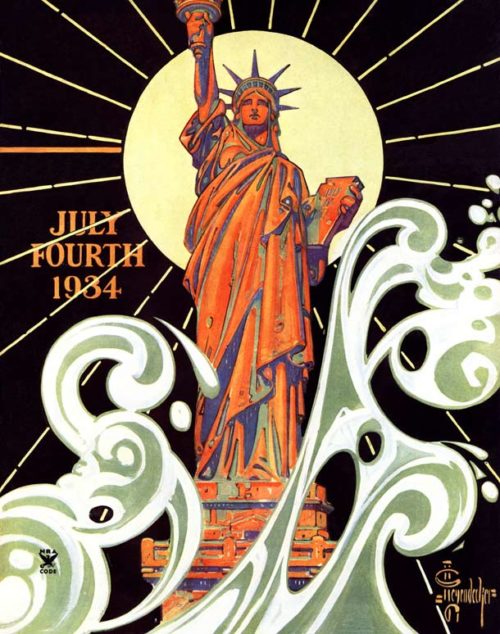
Leyendecker’s Fourth of July cover for 1934 presents an electric figure whose torch shines brightly even at the height of the Great Depression.
This article is featured in the July/August 2018 issue of The Saturday Evening Post. Subscribe to the magazine for more art, inspiring stories, fiction, humor, and features from our archives.
Considering History: Slavery, Race, and the Declaration of Independence
This column by American studies professor Ben Railton explores the connections between America’s past and present.
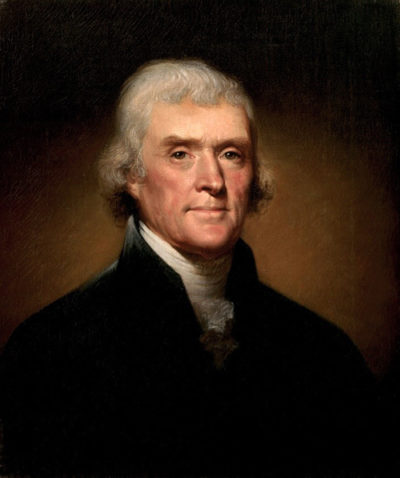
As with so many historical debates in our 21st century moment, the question of race and the Declaration of Independence has become a divided and often overtly partisan one. Those working to highlight and challenge social and cultural injustices will note that Thomas Jefferson, author of the Declaration and its “All men are created equal” sentiment, was, like many of his fellow Revolutionary Founders, a slave-owner, and moreover one who almost certainly fathered illegitimate children with one of his slaves, Sally Hemings. In response, those looking to defend Jefferson and the nation’s founding ideals will push back on these histories as anachronistic, overly simplistic, or exemplifying the worst forms of “revisionist history.”
If we push beyond those divided perspectives, however, we can find a trio of more complex intersections of race and the Declaration, historical moments and figures that embody both the limitations and the possibilities of America’s ideals. Each can become part of what we remember on the Fourth of July; taken together, they offer a nicely rounded picture of our evolving community.
For one thing, Jefferson did directly engage with slavery in his initial draft of the Declaration. He did so by turning the practice of slavery into one of his litany of critiques of King George:
He has waged cruel war against human nature itself, violating its most sacred rights of life and liberty in the persons of a distant people who never offended him, captivating and carrying them into slavery in another hemisphere, or to incur miserable death in their transportation hither. … And he is now exciting those very people to rise in arms among us, and to purchase that liberty of which he had deprived them, by murdering the people upon whom he also obtruded them: thus paying off former crimes committed against the liberties of one people, with crimes which he urges them to commit against the lives of another.
Jefferson here both blames the king of England for bringing the human horrors of chattel slavery to America, and expresses the fear that England will now use those same slaves as part of their conflict with the colonial revolutionaries. That latter critique did have a particular historical context: the British colonial governor of Virginia, Lord Dunmore, had issue a November 1775 proclamation that offered freedom to slaves and other “bonded servants” if they fought for the British against the rebels. But by putting this individual moment into the Declaration, Jefferson overtly framed not just Dunmore’s idea but slavery itself in opposition to both the Revolution and a new American identity. That is, his draft paragraph defines this “distant people” as having been “obtruded” upon the colonists, an artificial and foreign community whose human desire for “liberty” in this framing represents a direct and violent threat to the American project.
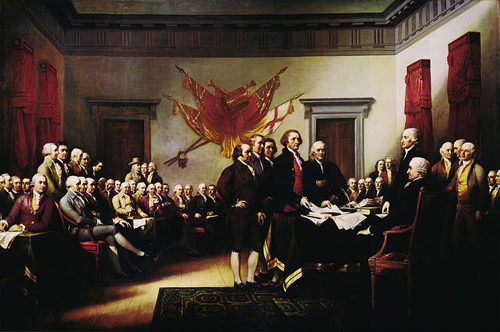
Not surprisingly, this complex, contradictory paragraph did not survive the Declaration’s communal revisions, and the final document makes no mention of slavery or African Americans. Yet the absence of race from the final draft of the Declaration did not keep Revolutionary-era African Americans from using the document’s language and ideals for their own political and social purposes. As early as 1777, a group of Massachusetts slaves and their abolitionist allies brought a petition for freedom based directly on the Declaration before the Massachusetts legislature. “Your petitioners … cannot but express their astonishment,” they wrote, “that it has never been considered that every principle from which America has acted in the course of their unhappy difficulties with Great Britain pleads stronger than a thousand arguments in favor of your petitioners.”
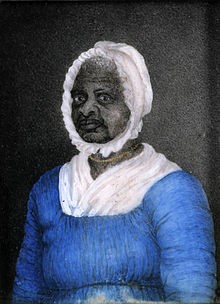
When Massachusetts drafted its own 1780 state constitution, the first in the new nation, it began with a direct echo of the Declaration: its Article 1 opens “All men are born free and equal, and have certain natural, essential, and unalienable rights.” Enshrining that concept in the state’s legal framework added more ammunition to slave petitions. And between 1781 and 1783, two Massachusetts slaves, Elizabeth Freeman and Quock Walker, worked with abolitionist allies to bring legal suits for their freedom, leading to a groundbreaking 1783 Supreme Judicial Court ruling that declared slavery incompatible with both the Massachusetts Constitution and American ideals. With the Revolution and America’s political future still unfolding, these slaves and cases made clear that, elisions from the Declaration notwithstanding, the new nation’s ideals and actions would influence all of its communities.
Although Massachusetts never passed a law rendering slavery illegal, thanks to the Freeman and Walker cases and the 1783 ruling, slavery disappeared entirely from the state: the 1790 census included no slaves, making Massachusetts the first state to abolish slavery (others such as Pennsylvania passed abolitionist laws in the same era, but because they only affected those born after their passage, many African Americans remained enslaved in these states for decades). The nation as a whole did not follow Massachusetts’ example in the aftermath of the Revolution, however. Indeed, the U.S. Constitution solidified the legality of slavery by defining slaves as 3/5ths of a person for the purposes of state populations and political representations.
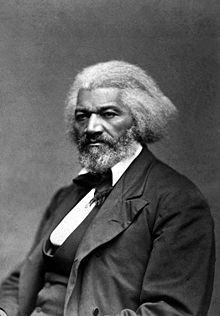
Yet the debate over race and the nation’s founding ideals did not cease, and more than 75 years after the Declaration, Frederick Douglass gave voice to the most impassioned and potent argument in that ongoing debate. In his speech “The Meaning of July Fourth for the Negro,” delivered at Rochester’s Corinthian Hall on July 5, 1852, and later renamed “What to the Slave is the Fourth of July?,” Douglass lays into the hypocrisies and ironies of the occasion and holiday. “Do you mean, citizens, to mock me, by asking me to speak to-day?,” he inquires, adding “This Fourth of July is yours, not mine. You may rejoice, I must mourn.” Yet as he did throughout his long career, Douglass weds such biting critiques to powerful arguments for the urgency of moving toward a more perfect union, one inspired by our national ideals. “I, therefore, leave off where I began, with hope,” he concludes. “While drawing encouragement from the Declaration of Independence, the great principles it contains, and the genius of American Institutions, my spirit is also cheered by the obvious tendencies of the age.”
Those tendencies did indeed result in the abolition of American slavery, an abolition begun by the same president who once more called upon the Declaration’s moment and history in his famous “Four score and seven years ago” opening to the Gettysburg Address. Yet as recent events have so fully reminded us, the debate over race and American identity and ideals and the role of slavery within those histories continues. As we celebrate the Fourth of July this year, remember not only Jefferson and his cohort, but also Elizabeth Freeman, Quock Walker, and Frederick Douglass, each in their own vital ways part of the nation’s Revolutionary founding.
“Marriage Is Not for Me!” by Nancy Pope Mayorga
Summer is for steamy romance. Our new series of classic fiction from the 1940s and ’50s features sexy intrigue from the archives for all of your beach reading needs. Read “Marriage Is Not for Me!” from 1957, in which Maxine must decide whether to listen to her mother and marry John Milpagas or to run off “to Paris to the Left Bank, to Greenwich Village, to Acapulco” to live the life of an artist.
Julie Kramer was going out to lunch. She was always going out to lunch, out to dinner, out somewhere. Restless, energetic, efficient, too, she was a product of her age. She was clean-lined, thinned down and angular, twentieth century. Her black hair, untouched by gray or dye, was molded to her head as her clothes were molded to her figure. She looked hard. Those who loved her knew that she was not. She looked self-assured. But her eyes were easily panicked.
She stopped for a minute in the doorway of the north room, which they had turned into a studio for Maxine.
“Lunch, baby, at the Statler. I’ll be back about three. Have you had anything to eat?”
“No, mother.”
“Well, eat something! You hear?” Julie shouted at her as people shout at foreigners who don’t understand English. “There’s plenty in the refrigerator. Or go out somewhere.” She considered briefly Maxine’s paint-covered smock, paint-smudged face and blond hair falling in disarray. “Or have something sent in. But eat, Maxine!”
“Yes, mother. I will.”
“Maxine!”
“I’ll eat. I promise.”
Julie hesitated. She tapped thoughtfully on the door frame with long, perfect, crimson nails. “I wish you’d get married,” she sighed.
Maxine laughed. “What a thing to wish on some poor guy. Even if you want to get rid of me.”
Julie smiled her brittle smile, but her eyes were soft and fond. “Marry John Milpagas. Why don’t you, Max?”
“All right, mother. I will.”
“You ought to be living a life of your own!” Julie was beginning to shout again. “Twenty-six years and you’ve done nothing so far but devote yourself to me! It isn’t fair! You should cut me off! Do you hear, Maxine?”
“Yes, mother.” She smiled. “I’ll cut you off.”
“Marry John! And eat something! You hear? Goodbye.”
Maxine laughed. She sat for a moment to let the room recover its quiet after her mother’s electric presence. Then she fished around in the pocket of her smock, brought out her glasses and put them on. Her mother despised those spectacles.
“I don’t know why you wear those terrible glasses!” she had said to her sharply on more than one occasion.
“Because I don’t see very well without them,” Maxine always answered mildly.
“I mean, why can’t you get something good looking, up-to-date?” And finally Julie had delved into her bag and brought up a fifty dollar bill. “For heaven’s sake,” she shouted, “go get yourself some smart ones, jeweled ones or something! And if they cost more, pay more! You hear?”
Maxine didn’t mind the shouting because she knew that her mother loved her with an immense, yearning love bordering on the painful. She took the fifty dollars and got herself a stunning pair of glasses. But when she was painting, she wore the old ones with the hooks over her ears because they stayed on better. Whenever her mother came in, whenever the door chimes sounded, sometimes when the telephone rang, she would hastily slip them off and into her pocket.
As she turned again to her easel, she was thinking about John Milpagas. She wondered what ever made her mother think that if she married John she would be living her own life. John was just like Julie — efficient, restless, fond and domineering, always wanting to go someplace, always telling her she ought to get out — out of the house, out of herself. She would be exchanging Julie for John, that’s all. No, to be quite honest, that wasn’t all of the matter. When he ranted and raved and shouted at her, he was like her mother, and Maxine could smile. But when he stood close above her in a sudden onslaught of tenderness and put his arms around her, gently, fervently, she lost the advantage her sense of humor gave her and became breathless, unsure, a little frightened. He had that power over her.
But at such moments, at those very moments, she often thought to herself, “I should run now — to Paris to the Left Bank, to Greenwich Village, to Acapulco — with my own life and my painting.”
At first she didn’t run because her mother needed her so badly. When Joe Kramer died suddenly, and Julie, shocked, sat day after day with her grief bottled up inside her hard shell, she needed Maxine desperately. Maxine was soft and pliant where her mother was hard and brittle. Although she missed her father cruelly, she was able to absorb the blow, bend with it, diminish her grief by pouring out comfort — wordless, intangible, ever-present comfort, for her mother. And for three years John Milpagas waited with a patience that was astounding and meritorious.
Now Julie was her old self again. Now it could be the Left Bank at last. Maxine felt a surge of triumph at the thought, for she was a very good painter, with small recognition as yet. But nevertheless with a divine gift and a complete, calm confidence in her ability to use it.
The Left Bank, of course, was just a symbol. It might just as well be here, Hollywood. But freedom. Freedom to eat or not, as she chose. Freedom to emerge even on to the street with her spectacles hooked over her ears and paint on her face and hands. Freedom to hole up for days on end, to leave the phone on the hook while it rang and rang and she laughed at it. To wrestle with truth, and, sweating, demand of her soul the highest refinement. In a word, to live alone on the lofty rack of artistic endeavor. To die alone, striving!
She sat hunched over on the high stool, so lost in the intensity of her thought that the synthetic chimes of the front door broke in upon her as a shock. She forgot about her glasses and went to the door with them on. And through them she blinked in surprise at John Milpagas.
He stood tall in his immaculate, well pressed suit against the high-glossed wall of the air-conditioned corridor. Twentieth century. He belonged here in these Towers with their seventy-degree, filtered air, their stainless-steel elevators, metal windows and doors, soundproof walls, built-in planters with great, dark, horrible, shining leaves. If she married him, this is where she would have to live, no doubt. He thought it was the last word. And so it was.
“Come on, kitten,” he said. “Take off those terrible glasses, clean yourself up. We’re going out to lunch.”
“Oh, John!” she said crossly.
“I met your mother downstairs. She said you had a cup of coffee for breakfast, and that’s all today. Come on. I can’t kiss you till you get cleaned up.”
“Oh, John!” she said despairingly, and went to change.
When she reappeared, he looked at her in approval.
“It’s always astonishing to me,” he said, “that from such a hopeless, paint-covered little grub can come such a pretty — such a very, very pretty girl.”
“Thank you, I think.” She laughed up at him.
“Oh, Maxine!” he said with sudden, yearning intensity.
“Farmers’ Market? ’’ she asked quickly, parrying that moment of intensity. She loved the press and color of the market place. She fed both her persons there, the animal and the artist.
“No.”
She was surprised by the seriousness of his tone. “Aren’t you going to kiss me, now that I won’t get paint on your suit?”
“On second thought, no. Not yet.” He shook his head slowly, his eyes brooding upon her.
Her smile faded and her heart gave a little jump of fear. Evidently this was not going to be a casual luncheon date. Maybe she wouldn’t eat after all. Maybe he wouldn’t eat either. And above all things in the world she hated to cause pain.
They sat in a private back booth of the Luncheon Club on Wilshire Boulevard. John ordered. He said not a word to disturb her, not a personal word at all, except “Eat your lunch.” She was hungry and did eat. When she had finished, he said, “I have something to say.”
“Yes.”
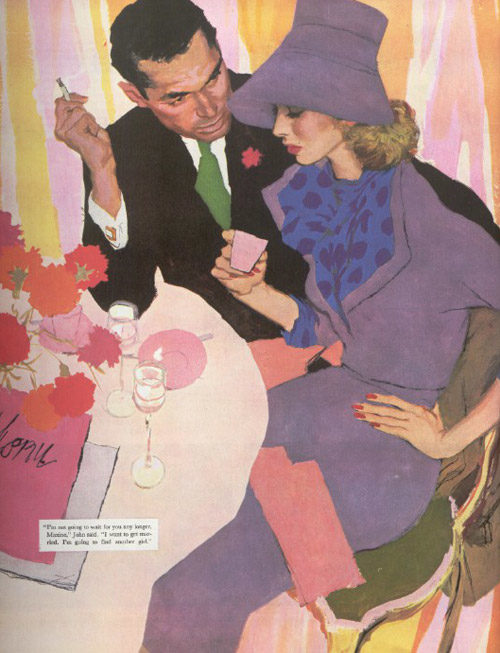
“It’s this: I’m not going to wait for you any longer, Maxine.”
“What are you going to do?” she asked in a small voice.
“I want to get married. I’m going to find another girl.”
Maxine stared at him. “But I thought—-You said you loved me.”
“You said you loved me,” he returned. “What does that have to do with it?”
“But when two people love—-”
“Exactly.”
She opened her mouth and then closed it without saying a word.
“It’s been three years and a half, Maxine!”
“Don’t shout, John.”
“I’m not shouting!” he shouted. Then he lowered his voice. His lips were twisted slightly with hurt. “I know how you feel about your great gift and all that, Max, but I wouldn’t be a Victorian husband. Good Lord, I don’t object to your painting.”
“That’s just it,” said Maxine miserably. “You don’t object — you don’t object. That’s a very peculiar attitude toward art.”
John looked bewildered. “You don’t want me to object, do you?” Then, as she did not answer, he rose abruptly, turning away to hide the pain in his eyes. “Come on, let’s get out of here.” Disappointment and frustration were choking him. “I’ll take you home.”
When they stepped out on the street, a fresh wind was blowing. There were billowy, peppermint-white clouds against the blue, blue sky. The sun sparkled on them, on everything. Three white gulls wheeled overhead with their small, wild, mewing cry. Maxine forgot John, forgot her misery, forgot the world, as her artist’s heart lifted with joy on the white wings of those three gulls. The next minute she had overlooked the curb, missed her footing, and would have gone down hard if John’s arm had not been there, reaching out quickly to save her.
She looked up, startled. He was looking down at her, holding her firmly, smiling with tight lips. There was significance for him in that incident, she could see. She felt it too. And suddenly, by magic, there was no barrier between them at all. They were soul to open soul for an instant. No words. No silly words. Then it was over. But Maxine was shaken. She had no idea that John could look into her like that, so deeply.
Then he was holding the car door for her. Then they were back at the Towers. He put her in the elevator.
“You have your key? You don’t need me to go up?”
“No. Thanks.”
“Then, goodbye.” As the elevator door closed, he was looking at her with a steady, calm air of finality.
After all, she had forgotten her key. But she knew her mother would be home shortly.
When Julie got out of the elevator some twenty minutes later, she found Maxine sitting on the highly polished floor of the corridor, her back against the wall, waiting.
Julie laughed. “You forgot your key again?”
“I forgot my key,” said Maxine, and burst into tears.
“Maxine!” shouted her mother, dismayed.
“It’s all right, mother,” said Maxine quickly. She laughed a little and wiped her eyes.
“But just forgetting your key is no reason to —-” Julie fussed, slightly frantic. “Why didn’t you go to the superintendent’s office?”
“It’s all right, mother. Truly.”
“I can’t make you out at all. Did something happen between you and John? I wish your father were alive. He used to be able to talk to you.”
“I’m all right, mother. It’s nothing,” said Maxine with patient insistence.
“Nobody can be all right who cries about nothing,” said Julie, and gave up.
Maxine laughed. But when she went into her own room, the slow tears began to run down her cheeks again, and she looked at herself in the mirror with exasperation. For she knew from the beginning that the Left Bank was going to be a lonesome place. Why should she cry? Was it because, with all the calm and finality in John’s last look, there was also pain and bewilderment? Was it her loneliness or his that made her cry?
After that, for a couple of weeks, she seemed to be living a life in limbo, suspended between realities. She wore her spectacles all the time. Her mother did not shout at her. When Julie was out, she could leave the ringing phone endlessly on its hook and laugh at it. That was one reality. But the other reality was that the phone did not ring. She was free to starve herself if she wished. Actually, she nibbled all day — crackers and cheese, cookies, fruit, and cup after cup of coffee.
One morning, as a gesture of freedom, she went up to Hollywood Boulevard in her smock, gold-rimmed spectacles and all. She was coming, more or less happy and relaxed, out of an art-supply store when she saw John’s tall, man of distinction figure striding along toward her. He did not see her. Quickly she scurried back into the shop. And through the window, with reluctant eyes, she watched him go by. His face looked drawn, unhappy, not well. The tug on her heart and the pity in her breast were uncomplicated, unreasoning pain. What am I? she asked herself. A monster?
She went home, sat down with determination in front of her easel and pretended to be an artist. But all the time she knew in her terribly honest heart that it was not artistic truth she was wrestling with now, but doubt, self-reproach and longing. She sat hunched over her problem on the high stool, a small, nearsighted, unhappy monster.
As once before, into her intense thought broke the musical chimes of the front door. Surely not John! And her mother never forgot her key. On the way to answer, she removed her spectacles and dropped them into the pocket of her smock.
The strange man who stood in blurred outline before her seemed completely sure of his right to be there, and his welcome. Yet he certainly did not belong there in that shining, sterile, aseptic corridor. He was even eager to get in out of it.
“You’re Maxine. I’m the man who’s going to marry your mother. May I come in?” His voice was crisp, staccato.
Maxine grabbed a breath of surprise. “Come in. Of course.” She was flustered. “Come in. Sit down, please. Does she know you’re going to marry her? She hasn’t said—-”
“She knew it before I did.” He followed her into the living room, but did not sit down.
“Yes.” Maxine laughed. “Yes, I suppose she did.” She sat uneasily on the end of the couch. “But she won’t like your coming here like this, unannounced. She likes everything to be planned and the stage set.”
“I know. I came unannounced because I thought it was the better way, and because, as yet, I haven’t promised to love, honor and obey her.”
Maxine was seized by a momentary annoyance. She took her spectacles out of her pocket and hooked them over her ears. His face came into focus. He was standing, smiling down at her, scrutinizing her. He had a rounded face, high forehead, vigorous hair, and keen, burning black eyes. His fine smile took all the sting out of his last words. She was reassured.
“Who are you?” she asked.
“My name is Maurice Fowler.” He nodded quickly at the question in her wide, surprised eyes. “Yes.”
“How strange,” she whispered slowly, unable to take her eyes from his face. “How absolutely astonishing. And you’re going to be my stepfather. You, of all people. She has never once mentioned you.”
“I’m sorry,” he said in a gentler voice. “I have the advantage over you, Maxine. I know all about you.”
“I know all about you,” she returned quickly, with a smile. “Everything that’s essential.”
She struck a sudden spark in his eyes with that remark. “Thanks.” He gave her a wide smile.
And she did too. Through his work. Probably every painting that he had ever released, she had seen and studied. Among all the present-day American painters, he was the one for whom she had an absolutely unreserved admiration. Maurice Fowler! This was an astonishment that would take time to digest.
“Look, Maxine,” he was continuing, “do you know why I have come here? I’m not going to pretend it isn’t self-interest. It is. I love your mother. I can’t bear to see her anxious and worried. Besides, I want to marry her. And she will never marry while you are in this — er — crisis. And you’re right; she wouldn’t like it if she knew I was here. She is afraid of forcing your hand.”
“Forcing my hand?” repeated Maxine faintly.
“But I’m not afraid. Because I have a hunch that you and I speak the same language.” He stood above her now. His voice was quiet; his words came out concise, relentless. “Now forgive me. It is a man. It is marriage or art. You have chosen art. You loved him, but that’s all over now. Is it?”
Maxine looked down without answering. Instead, she said, “Would you — would you look at my work? I have a few that—-”
He put his hand under her chin and lifted her delicate, reserved little face so that he could look into it. And after looking, “It’s too late,” he said, and laughed. “My dear girl, the question of marriage is inconsequential now. It became too late the minute you fell in love. He isn’t one of us, eh? Well, sometimes it works out better that way. Leaves you freer, really.”
He released her chin and turned away to take several vigorous strides around the room. He noticed his surroundings for the first time.
“My heaven!” he said. “What a horribly tasteful room! Now I’ll make a pact with you. If there is such a thing as reincarnation and you and I do meet in another life, I’ll remind you and you remind me, don’t fall in love! Agreed?” She was smiling again. “All right! Let’s see your work.”
She led him into the north room. He glanced at the painting on the easel; then threw her a quick, surprised, appraising look from his black eyes. Respectful too. Maxine felt her heart beat hard in tremendous elation. She stood still while he stepped around the room quickly, turning over canvases that were leaning against the wall.
“Yes, yes, yes!” he said. “You’re on your way surely. Firm, fine draftsmanship. I never hoped—You fooled me with your little myopic, indecisive manner. And they have an alluring air of health and youth! They certainly have! Oh, Maxine!” He threw his arm for a moment across her shoulder and held her tight. “What else? Crayon? Good! Let’s see.”
She opened a portfolio. He fell silent. They were all portraits of her mother.
“I’m a little — overwhelmed,” he said finally. “You know her very well — much better than she knows you. Her chin, though. She holds it higher. Look.” He took a crayon and made a few explicit, telling lines. “She leads with her chin all the time. It makes her very vulnerable.” He became still, gazing down.
“Yes,” agreed Maxine, with unexplained tears in her eyes. Yet she felt compelled to ask, “Why are you marrying my mother?”
“Because she needs me,” he answered promptly. “Don’t mistake me. If I didn’t love her, her needing me wouldn’t matter to me — so excruciatingly. Undoubtedly your young man needs you, and if you love him — which I more than suspect you do — it is of excruciating importance to you. That’s probably what’s the matter with you now. But what you really mean to ask me is why I marry at all, isn’t it?”
“Yes. That’s it.”
“Yes, well, let’s face it — because I made the big mistake of falling in love, and because, in the tradition of my family and my society, falling in love means marriage. Now that I’ve seen your work, I see that for you it’s a big mistake too. From an absolute viewpoint, that is. Probably a worse mistake, because women get so — tied up, emotionally and physiologically.”
She nodded. “That’s what I’ve been afraid of.”
“Of course. And that’s what I’m here for, really. And now we come to the mystery of mysteries, the inner shrine, the paradoxical secret of the brotherhood.”
He smiled with his lips alone. Maxine was so intent on his words that it seemed there was nothing in the world now but that man of controlled energy, half sitting on the stool with one foot on the rung, and she, leaning against the door jamb with her hands behind her back, waiting to hear the words that would mean her whole life.
“It’s this: you and I are strong, Maxine, with a strength that people more active, yet more dependent, can never understand. We don’t have the same needs at all. Your mother would be shocked to know how little it would matter to you if she got married and took herself off. No, rather, how very happy you would be, deep down under the surface agitation of your emotions.”
Maxine felt her face flush guiltily under the honest, wise look he was giving her. He noticed and smiled.
“We are strong because we have a central drive, primal, unremitting, indomitable. When it takes over, you are tireless. You can paint all day without food, all night without sleep. You have tapped the source of all power. But you can’t hug it to yourself, Maxine; it will tear you to pieces if you don’t share it. Nor am I sure that one outlet, art alone, is enough to keep the tremendous pressure down. For Van Gogh it wasn’t.
“Now, if you’re not interested in keeping the pressure down, then go ahead, use just one channel, force the stream upwards and the result may be something sublime. A few have done it — Michelangelo, Beethoven.” He paused. “I admit to you, Maxine, I am not that great an instrument. I need other outlets.”
Her eyes were far away. When he spoke again, she knew that his mood had changed. She felt in him a kind of secret laughter. At her? At himself? At life?
“I forgot,” he said, “the comfort of the memory of Johann Sebastian Bach, that superbly adjusted genius, who managed to be earthy and sublime at the same time, and to produce prodigiously at both levels. Maxine—-”
He called her back gently from her other world. It was significant that he did not have to shout.
“—-I give you my word, there is no limit to the kind of energy we artists have access to. It is possible for you to raise twenty kids and to be painting even better when you’re a grandmother.”
She took a deep breath and opened her heart to him in a wide, beautiful smile. “I love you!” she burst forth intensely.
He nodded vigorously. “I love you too. It’s going to be a great life!”
A little later she called up John and invited herself to have luncheon with him.
“Oh, Max!” he said, and she felt shamed by the joy in his voice. Then he added, unfortunately, “I knew you’d see the light.”
“Yes,” she said resignedly.
“Can you meet me? In the Roosevelt lobby? At one?”
“All right, John.”
She had been waiting for him about ten minutes when she heard her name called over the public-address system: “Miss Maxine Kramer. At the information desk, please.”
Surprised and puzzled, she crossed the lobby.
“It’s a telephone call. Will you take it in Booth Two, please?” The clerk indicated the phones.
It was John. He said, “Hi.” His voice had a hint of suppressed laughter.
“Where are you, John?”
“In the next booth.”
“Where?”
“In the next booth. Number Three.”
She laughed.
“I like to hear you laugh,” he said, his voice deep with feeling. “I like to see you coming across the lobby looking surprised and puzzled.”
“I hate you,” she said good-naturedly.
“You also love me, Maxine?”
“Yes, I do. Yes, I do.”
She heard the receiver go down and turned to see his bulk in the doorway of her booth, blocking it. She had just a brief moment of feeling trapped. He saw it in her face and hesitated. Then, swept with compassion, she reached out quickly, drew him in to her and raised her face to be kissed.
The Harrowing Story of the Civil War’s Refugees

This article and other stories of the Civil War can be found in the Post’s Special Collector’s Edition, The Saturday Evening Post: Untold Stories of the Civil War.
—This account appeared in the October 1, 1864, issue of The Saturday Evening Post.
It may seem superfluous to dwell upon a theme that everybody knows by heart. Hospital scenes have been recorded until all are familiar with them — but if you will permit me, reader, I will throw the door open upon another phase of life, and if you can look on unmoved, with no stirrings of divine pity and sympathy — I will not be your judge.
The headquarters of the ——— Army Corps was a large, beautiful building, and we took possession of it in the spring of ‘64 with not a little satisfaction. The rooms were numerous and comfortable, and by a little careful management we got enough furniture together to serve our purposes admirably. When all the arrangements were completed, I looked about me with the joyousness of a child, and, for the moment, gave myself up to anticipations of something like ease and pleasure, after long, tedious journeyings, and the hardships attendant upon the removal of headquarters from one point to another.
Several days passed away in a comfortable frame of mind, when I was suddenly startled from my serenity by a fearful announcement. The Rebels had risen up against the women and children within their lines, and they had driven them out by hundreds, seizing their scanty means, and leaving them destitute to wander off in search of aid and protection.
These people had friends in the Federal service, of course — hence this cruelty. But until that time I never dreamed that people could suffer what they were made to suffer, and live.
I remembered the evenings at Corinth, after its evacuation, when the Refugees had come in upon the trains in large numbers, half starved and destitute of money or clothing beyond what they wore. Gen. McPherson was then superintendent of the military railroads there, and I shall never forget the deep, pitying look of his eyes as he glanced upward to my window, where I stood tearfully regarding this miserable mass of humanity. I recognized in him then a nobility few saw, when he stretched his arms forth to help some poor old man or woman as they tottered to the platform, or to lift some little ragged child—white or black— gently to the ground. I thought of the misery of those people there and what labor it had cost us to save them from star- vation. Could assistance be less imperatively needed now?
As I passed beyond the threshold and entered the ambulance that stood waiting my orders, a thrill of shame swept through me at the sight of a squalid troop that crept hesitatingly toward business headquarters.
My driver was dispatched for a pass through the “picket lines,” in case it should be needed, and while he was gone, a negro boy told me of a family that were “starving to death,” just a little beyond the limits of the town. I made up my mind to go there first, leaving those within the place to the mercy of those who saw to their needs, and when the driver came, I bade him drive as rapidly as possible to the place.
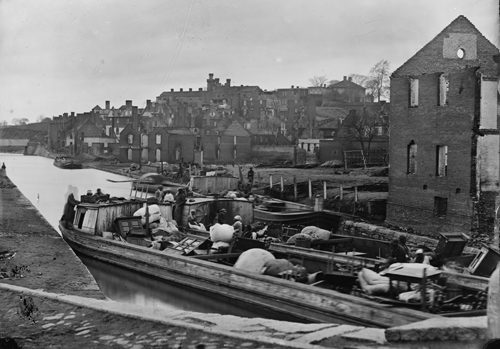
After driving about one mile and a half, we came to an old house before which little fires were kindled, and the pickets sat by and chatted while on “guard.” I leaned forward and asked them some questions.
“Are there people ill in that house — refugees?”
“Yes, ma’am.”
“How long have they been here?”
“Three or four days.”
“How is it then that none of you have reported it at head- quarters. Have you no feeling of pity?”
“Well, ma’am, I have, for one, but this is my first day on duty. I was sent to relieve a boy who is sick and was sent to the hospital yesterday. It was me that sent word to town about them.”
Waiting to say no more, I bade the man drive on, and the next moment alighted before the door.
All the lower rooms were bleak and desolate. The windows were broken, the floors covered with heaps of shattered plastering, sticks, and broken glass. Failing here to find any trace of human life, I mounted the stairs to the second floor, and stood mute with consternation upon the threshold of the wretched chamber.
This, like the room below, was open, bleak and dreary. A faint spark of fire glowed in the midst of a great heap of ashes upon the hearth, and before it, upon the bare, dirt-strewn floor, lay the insensible bodies of a mother and her son—a boy of about 14 years of age. Upon beds made of straw and old clothing, lay two daughters of about 18 and 20, likewise insensible from suffering. They occupied the farthest corner of the room; and in another corner, close to the mother were two more children upon an old bed—prob- ably the only thing they had succeeded in saving from the household wreck — and one was dead — the other too ill to help himself to a cup of water!
My heart ached — my eyes grew dim. For one moment, I breathed despairingly “what can I do, oh, what can I do?” In the next, a willing brain found a way to direct its energies, and I flew down stairs in eager haste, to the driver, who quietly awaited my orders.
“Go back to headquarters and tell the medical director to send me the articles marked down upon this paper,” I said, tearing a leaf from my diary and writing upon it. “You had better take out one of the horses, and have the other fastened securely in the yard. Hasten, for it is a matter of life
and death.”
He obeyed me readily, and in a moment or two after I went up stairs, I heard the horses’ feet clattering down the road in the direction of A———.
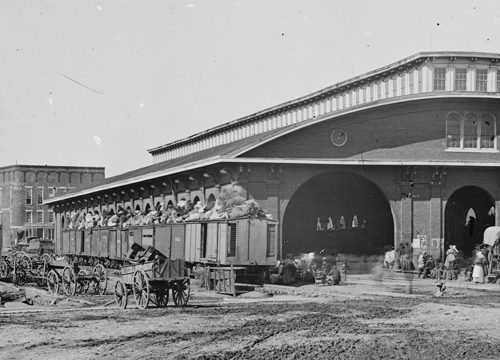
An old adage says “Where there is a will, there is a way,” and I realized its truth that day, if I never did before. There seemed ab- solutely nothing to do anything with, when I came to look about me for means to ac- complish the ends in view. One tin-cup and a water-pail, half full of water, constituted the furniture of the room; and a thorough search through the house and negro quarters, failed to produce anything better than an old tea-kettle with a broken nose, a sauce- pan cracked down one side, and a large tin pan, too full of tiny, rust-eaten holes for any other use than that I put it to—that of relieving the hearth of its too great abundance of ashes.
I found a little negro girl curiously peeping round, and pressed her into service to carry out the ashes, while one of the soldiers on picket duty, kindly cut up an armful of wood to build a fire. This done, I filled the tea-kettle and set it on the logs to heat, while I went out into the field to get a broom. This may sound oddly to the uninitiated, but for the benefit of the ignorant I will say that there is a tall, coarse kind of grass that grows South in the old fields and waste places, called “Broom sedge,” which when gathered and tied together, makes a tolerable broom. It enabled me to sweep a place large enough to draw the sick into, and by dint of much pulling and lifting, I finally succeeded in getting the room free of clay and ashes. The kind-hearted soldier gave me an old blanket he had outside, which I spread upon the floor to lay the dead child upon, covering the little stiffened form from sight while I worked. The mother was soon in his place upon the rude bed, and then began the task of bathing their faces and hands.
By the time this was finished, the boy came back with the articles I had sent for — some hot punch, in bottles — dried apples — bread — tea — sugar, and butter, with some potatoes and onions. I was exultant now. Before this generous supply, want shrank abashed, and the groans of the sick sounded positively sweet to my ears, since they proved that life was not yet extinct. I could not have borne to think they had all died almost within sound of my voice, while I sat in easy ignorance of their fate! That would have proved a bitter cup, to the end of my days.
The punch was administered first, all round — then I made some tea, which with crackers broken into it, I forced them to swallow. In less than an hour, the moans and broken exclamations subsided, and they slept almost peacefully!
Darkness came at last, and I must go home! Other duties as pressing, claimed my attention. But I found an old negro woman who promised to take my place, and watch with them through the night — for a consideration. So, leaving them to her care, I entered the ambulance to return to town, feeling exceedingly weary, but glad and grateful to have been instrumental in relieving suffering of such magnitude.
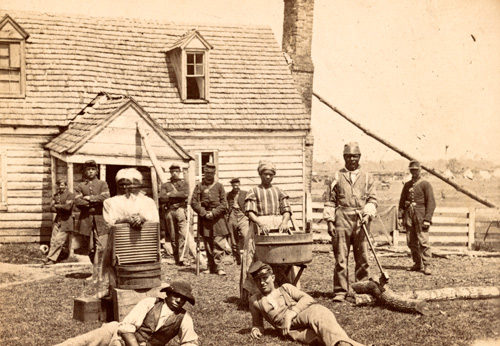
The rain had begun to fall by this time, and came down in a brisk shower as we drove through the streets by the depot. There I observed that the whole platform and build- ing, where a human being could creep for shelter, had been filled up — and some unable to get under a protecting roof, were gathered about fires in the open air, the rain pattering upon the little children, who clung to their mothers’ dresses and wept piteously.
Such experiences as this were not new to me. I was but living over the old time at Corinth; yet it affected me strangely. Perhaps I had grown more thoughtful as I grew older, and through suffering learned to sympathize more deeply with suffering. Not a few of my best beloved and honored friends had fallen, leaving my heart tender for blows that might come hereafter. This was one that wound- ed me. I was touched most deeply, when touched through remembrance of pain. Every heart-pang found a responsive throb in my own.
Lights blazed from every room in the house, and the table looked invitingly tempting, with its array of nice dishes, around which merry faces gathered as the officers came in and took their places; but I could not eat that night.
Those pinched and pallid faces of little wailing children rose up before my eyes, and arrested the food ere it touched my lips. It was with difficulty that I could command my- self long enough to utter an excuse and withdraw from the room, which I did amid smiles and exchanged glances. Even the sweet, earnest face of Gen. Grenville’s wife relaxed as one of the officers remarked jestingly:
“Mrs. ——— found those refugees too much for her appetite, I guess,” — and then a general laugh followed.
Alas! even in the midst of woe, there are few to care for the most wretched of human beings, with a care that can withstand all things.
I sat up until late that night, making a shroud for the dead boy, tears dropping often upon the shining needle as I sewed. …
The following morning I rode out very early, and found a decided improvement in the patients, which encouraged me very much. The death of the child had been properly reported the night previous, and soon after my arrival two or three men were sent to bury it. No tears fell for the little form when it was carried out. No eyes followed it with the wistful tenderness of love, or the mournful outbreaking of sorrow. But, all unconscious of the broken link, the mother, brother and sisters lay there upon the floor, while the sol- diers lifted the coffin and bore it thence, where they buried it among strangers, in an old graveyard, where the gray tombstones bore the traces of an hundred years on their defaced sides. Think of it, mothers, think of that unwept child — its lonely burial, and the condition of that mother who loved her darling children!
For many days I watched over this poor family at the picket lines, until they be- gan to recover — all except the eldest boy. There was no hope for him, and the week after my first visit he died. But the mother and daughters improved rapidly, and after a while could walk about the rooms with a dawning of hope upon their pale faces.
The noble-hearted physician who had attended them through their illness, had proved a great assistance to me in more ways than one during those trying days. Men from his corps of assistants at the hospital had been de- tailed to make bunks for the invalids, and by sewing wagon covers together, and filling them with husks, we succeeded in getting them off the hard floor and placing them in a much more comfortable position.
Others, as badly in need of help, claimed my attention at every turn.
Every vacant house and cellar in town were crowded with them. Provisions were scarce, and to get clothing was utterly impossible, except a few cast-oft garments that I begged from the few loyal ladies of the town. Everything that could be spared from my husband’s and my own ward- robes, as well as Mrs. Grenville’s, was used to clothe the little children until such a time as they could be sent North and properly provided for—a thing which could not be done until they recovered sufficiently to travel. In families of 10 and 15 members, scarcely one could be found well enough to wait upon the sick, and often not one. The most singular fatality seemed to attend them, and none escaped prostration by disease brought on by expo- sure, excitement, and want.
Reader, if you are disposed to look upon this as an overdrawn picture, go to Memphis or Nashville where they come in by thou- sands, and note the condition of that most miserable class of beings called Refugees.
“The Southern Refugees,” October 1, 1864
Your Weekly Checkup: Many Common Medications May Cause Depression
“Your Weekly Checkup” is our online column by Dr. Douglas Zipes, an internationally acclaimed cardiologist, professor, author, inventor, and authority on pacing and electrophysiology. Dr. Zipes is also a contributor to The Saturday Evening Post print magazine. Subscribe to receive thoughtful articles, new fiction, health and wellness advice, and gems from our archive.
Order Dr. Zipes’ new book, Damn the Naysayers: A Doctor’s Memoir.
I infrequently get depressed — at least, not severely. One of the only times I can remember experiencing significant depression was during a very difficult medical internship year more than 50 years ago. I wrote about it in my memoir Damn the Naysayers.
I was surprised to read in a recent survey of more than 26,000 adults that 37 percent of Americans take at least one medication that lists depression or suicidal symptoms as a potential side effect. People using such drugs had higher rates of depression than those who didn’t take them. The risk of depression increased with each additional drug taken at the same time: 7 percent for those taking one drug; 9 percent for two drugs; 15% for three or more; versus only 4.7 percent for those not taking any drug.
The overall use of any prescription medication that had depression as a potential adverse effect increased from 35 percent to 38.4 percent between 2005 and 2014. The percentage of adults taking three or more drugs with a depression side effect increased from 6.9 percent to 9.5 percent, and the use of medications with suicidal symptoms as potential side effects increased from 17.3 percent to 23.5 percent. This certainly cannot be helping the well-being of people in our society, already on edge dealing with a variety of issues.
The list of drugs with depression or suicidal thoughts as a side effect include 200 prescription drugs, some well-known to have those side effects, like beta-blockers (e.g., Toprol), but some that may be surprises: common medications like proton pump inhibitors used to treat acid reflux, birth control pills and emergency contraceptives, anticonvulsants like gabapentin, corticosteroids like prednisone, and prescription-strength ibuprofen. Some drugs with depressive side effects are sold over-the-counter.
It’s important to stress that the study, while important, doesn’t establish causality but only an association between these medications and depression. It’s possible people already had a medical history of depression prior to taking the drugs, or the medical conditions they were being treated for might have contributed to their depression. However, the findings persisted when the researchers excluded anyone using psychotropic medications, considered an indicator of underlying depression unrelated to medication use. In addition, the dose-response pattern, i.e., more medications linked to more depression, lends additional credence to the observation.
It is quite clear that polypharmacy can be dangerous and can lead to depressive or suicidal symptoms. Know your drugs! Read the labels! Be sure to review your entire medication list, even dietary supplements, at each encounter with your health care provider, especially if you are cared for by multiple physicians. Take responsibility for your own health. Do not leave it entirely in the hands of someone else. No one will be more concerned about your well-being than you.
If you are having thoughts of suicide, please reach out and talk to someone.
- In the U.S., call the National Suicide Prevention Lifeline, available 24/7 at 1-800-273-TALK (8255)
- The Trevor Project— 866-488-7386 — is a hotline for LGBT youth
- The International Association for Suicide Prevention and Befrienders Worldwidealso provides contact information for crisis centers around the world
8 Things You Don’t Know about “The Star-Spangled Banner”
How and why Francis Scott Key wrote the poem that would eventually become our national anthem is a well-known American legend. What is less known is that the journey from poem to anthem was long — more than a century — and fraught with controversy. Here are eight things that might surprise you about “The Star-Spangled Banner” and its divisive history:
1. Francis Scott Key did not compose “The Star-Spangled Banner.”
On a list of the country’s greatest composers, you’ll find familiar names like Aaron Copland, Leonard Bernstein, and George Gershwin. Francis Scott Key will not — and should not — appear on that list. He was a lawyer and an amateur poet who, on September 14, 1814, wrote a poem called “The Defence of Fort M’Henry” while aboard a British ship during the night-long bombardment of Fort McHenry, Baltimore. Though you might say he “composed” the poem in a broad sense, he was not what is considered “a composer.” Some historians even believe he was tone deaf.
2. The tune for the national anthem is a British song about sex and drinking.
The Anacreontic Society was a gentlemen’s club of amateur musicians founded in 18th-century London and named for Anacreon, a 6th century B.C. Greek poet. Sometime in the late 1760s or early 1770s, John Stafford Smith wrote music to accompany words written by Society President Ralph Tomlinson. The result was “The Anacreontic Song,” or “To Anacreon in Heaven,” and its lyrics were no staid bastion of propriety. It ends like this (starting where “And the rockets’ red glare” is sung in the national anthem):
Voice, fiddle, and flute, no longer be mute,
I’ll lend you my name and inspire you to boot
And besides I’ll instruct you like me to entwine
The myrtle of Venus with Bacchus’s vine.
Venus is the Greek goddess of love and sex, and Bacchus the god of wine. This last line is an invitation to get drunk and naughty.
Stafford’s tune was often appropriated for patriotic songs, and Francis Scott Key would have been familiar with it. It’s likely he intentionally fit the words of his “Defence of Fort M’Henry” to the tune of “The Anacreontic Song.” It quickly became the standard tune to which Key’s poem was sung, and it is now the national anthem of the United States.
3. The first word of “The Star-Spangled Banner” is not “Oh.”
Used almost exclusively in verse, the real first word of “The Star-Spangled Banner” — O — is, according to linguist Arika Okrent, a vocative O. “It indicates that someone or something is being directly addressed,” she writes, comparing it to a number of other well-known Os, including “O captain, my captain,” “O ye of little faith,” and “O Christmas tree.”
“Oh has a wider range,” she continues. “It can indicate pain, surprise, disappointment, or really any emotional state.”
And yes, it appears again in the penultimate line of the anthem: “O say does that star-spangled banner yet wave …”
4. Many people opposed “The Star-Spangled Banner” as the national anthem.
It seems there were many reasons to dislike “The Star-Spangled Banner.” Music teachers and professional vocalists complained that the range of the song made it difficult to sing and to teach. Pacifists believed it was too violent in tone, a glorification of war. Nationalists didn’t like that the tune was of British origin. And Prohibitionists protested that our national anthem shouldn’t be what is essentially a drinking song. Other songs that were considered anthem-worthy were “America the Beautiful,” “Hail Columbia” (now the ceremonial march for the vice president), and even “Yankee Doodle Dandy.”
5. The original poem had four verses and specifically mentioned slavery.
Thankfully, we don’t sing all four verses of Key’s original poem. Not only would that stretch the pregame anthem to more than six minutes, but the third verse would be a constant source of controversy. It contains the lines
No refuge could save the hireling and slave
From the terror of flight or the gloom of the grave
During the War of 1812, hirelings were black slaves hired to fight for the British military on the promise of freedom should they survive the war. Slaves and hirelings are the only people singled out for death or defeat in the poem.
Francis Scott Key, a slaveholder himself, certainly didn’t extend his vision of “the land of the free and the home of the brave” to people of color. As Jefferson Morley reports in his book about the race riots of 1835, Snow-Storm in August, Key was known to have publicly spoken about African Americans as “a distinct and inferior race of people, which all experience proves to be the greatest evil that afflicts a community.”
6. A fifth verse appeared 47 years later.
In 1861, as the Civil War was spreading across the young country, American poet Oliver Wendell Holmes Sr. (father of the future Supreme Court justice) penned a fifth verse that spread widely in the north but eventually faded from the public consciousness. It, too, mentions slavery, but welcomes the “millions unchain’d” to “the land of the free and the home of the brave.”
When our land is illum’d with Liberty’s smile,
If a foe from within strike a blow at her glory,
Down, down, with the traitor that dares to defile
The flag of her stars and the page of her story!
By the millions unchain’d who our birthright have gained
We will keep her bright blazon forever unstained!
And the Star-Spangled Banner in triumph shall wave
While the land of the free is the home of the brave.
According to the Library of Congress, the significance of “The Star-Spangled Banner” was not lost on the Confederacy during the Civil War: Songs with names like “Farewell to the Star-Spangled Banner” and “Adieu to the Star-Spangled Banner Forever” — clearly a reference to Key’s song — were published and sung all around the South.
7. The U.S. had no official national anthem during World War I or the first eight Summer Olympic Games.
“The Star-Spangled Banner” found its first official use in 1889, when Secretary of the Navy Benjamin F. Tracy directed that it be the official tune to accompany the raising of the flag by the Navy. In 1916, the year before the U.S. entered World War I, President Woodrow Wilson signed an executive order stating that “The Star-Spangled Banner” should be played whenever the performance of a national anthem was appropriate.
Not until 1930 did a congressional bill to establish a national anthem find any traction. In that year, Maryland Representative John Linthicum (D) introduced a bill to make “The Star-Spangled Banner” the national anthem. President Herbert Hoover signed it into law on March 3, 1931, almost 117 years after the poem was first penned. March 3 is still celebrated as National Anthem Day in the U.S.
8. There’s still plenty of opposition to “The Star-Spangled Banner.”
In July of 1976 — shortly after Independence Day in America’s bicentennial year — Texas Representative James Collins (R) introduced a bill to the House of Representatives to change the national anthem to “God Bless America.” Indiana Representative Andrew Jacobs Jr. (D) introduced not one but six separate bills to change the national anthem, one bill for each term he served between 1985 and 1996. His choice for anthem was “America the Beautiful” because not only is it easier to sing, but it also is more representative — the music was written by Samuel Augustus Ward and the words by Katharine Lee Bates, a man and a woman, both Americans.
More recently, Senator Tom Harkin (D) of Iowa took up the cause. At the end of 2014, he introduced a bill to the Senate to replace the national anthem, again with “America the Beautiful” because it “far better represents the scope and majesty of the geography of the United States of America as well as the principles of freedom, liberty, fraternity, and progress that are the unifying beliefs of our democracy.”
In each case, the bill was referred to a committee and never heard from again.
8 Other Things That Happened on the Fourth of July, and One That Didn’t
Independence Day is such an institution in the United States that when we hear “Fourth of July,” many of us think of it first as the name of a holiday and not simply — as it is in so many other countries — a calendar date. Considered the birthday of America, the holiday commemorates the adoption of the Declaration of Independence in 1776, but in the more than two centuries since, it isn’t the only notable event to have happened on that date.
Here are eight other things that happened on that day, plus one thing that surprisingly didn’t happen on the Fourth of July.
1. 1802: The Military Academy at West Point Opens for Instruction
What began as fortifications at the mouth of the Hudson River in 1778 is now the oldest continuously occupied military post in the U.S. In 1802, President Thomas Jefferson signed the Military Peace Establishment Act into law, which in part established a new U.S. Military Academy at West Point whose primary purpose at the time was to train expert engineers. On July 4 of that year, the new academy formally opened for instruction.
Ulysses S. Grant and Robert E. Lee were both West Point graduates, as was Confederate President Jefferson Davis. West Point grads played a big role in the U.S. military during World War II: General George Patton, General Douglas MacArthur, and General (later President) Dwight D. Eisenhower were all alumni.
West Point grads have distinguished themselves outside the military, too. Other successful alumni include astronaut Edwin “Buzz” Aldrin, Pittsburgh Steelers left tackle Alejandro Villanueva, and Duke University head basketball coach Mike Krzyzewski.
2. 1817: Construction Begins on the Erie Canal
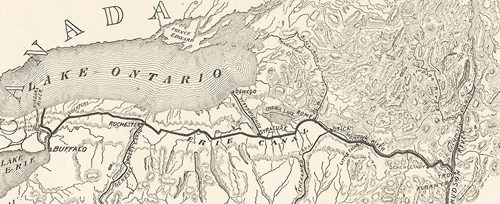
It took eight years for engineers and laborers to create the 4-foot-deep, 40-foot wide, 363-mile-long canal that would connect Albany and the Hudson River to Buffalo and Lake Erie. But it was worth it: This massive public works project opened up travel to the west and was a key influence in turning New York City into America’s principal seaport and a center of business and finance.
In 2000, the U.S. National Parks Service designated the Erie Canalway National Heritage Corridor.
3. 1826: Thomas Jefferson Dies
It seems a poetic justice that the man most responsible for writing the Declaration of Independence should die on the 50th anniversary of its adoption. Though his exact cause of death at age 83 is unknown, his health had been in steady decline since 1818.
4. 1826: John Adams Dies
The second and third presidents of the United States died within five hours of each other. Though they fought side by side to create a free America, after they had achieved that goal, they discovered they had very different ideas about what these new United States should look like. They became bitter political rivals for decades, only rekindling their friendship later in life.
It’s a part of American legend that the 90-year-old John Adams’ last words were “Jefferson still survives,” not knowing that the younger man had passed earlier that day, but the veracity of this legend is questionable.
5. 1845: Henry David Thoreau Moves to Walden Pond
The American transcendentalist began his two-year experiment in simple living on the Fourth of July. On that date, he moved into a small cabin he had built himself on the shores of Walden Pond, near Concord, Massachusetts, on land owned by fellow philosopher Ralph Waldo Emerson. In 1854, he published his record of the experience in Walden, or Life in the Woods to moderate success.
6. 1855: Leaves of Grass published
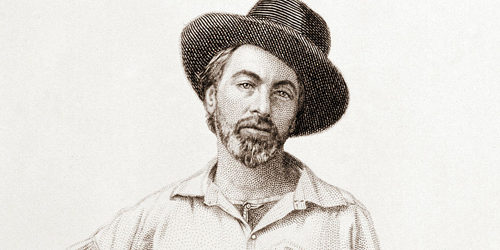
Though the 795 copies of the first edition of Leaves of Grass — which Walt Whitman designed and published himself — included only 12 poems over 95 pages, it changed the course of poetry in America for good. Whitman added, revised, and republished his poems throughout his life so that, by the time he died and after several editions, Leaves of Grass contained 389 poems.
7. 1939: Lou Gehrig’s “Luckiest Man” Speech
On May 2, 1939, New York Yankees first baseman Lou Gehrig ended his record-setting streak of 2,130 consecutive games by benching himself for poor play. He would never play again. A month and a half later, he was diagnosed with amyotrophic lateral sclerosis.
On July 4, the Yankees held Lou Gehrig Appreciation Day in a sold-out Yankee Stadium. Gehrig, who was petrified of crowds, wasn’t originally expected to speak, but such an outpouring of love pushed him to it. That afternoon, he stepped up to the mic and delivered his “Luckiest Man” speech, which is still considered one of the most moving speeches ever given at a sporting event. In it, he acknowledged not only the fans and the other players, but even the groundskeepers and his own mother-in-law.
8. 1997: Pathfinder Lands on Mars
After a six-month journey, the first Mars Pathfinder landed on the Red Planet on July 4, 1997. It became the base station for the free-range robotic rover Sojourner — Earth’s first (successful) interplanetary rover. NASA received its first picture of Mars at about 9 p.m. that day.
Pathfinder and Sojourner collected 2.3 billion bits of data during their lifespan and sparked two decades of Mars exploration. Though the mission was only supposed to last up to 30 days, NASA continued to receive data for 83 days.
Not on the Fourth of July: The American Colonies Declare Independence from Great Britain
The members of the Second Continental Congress voted 12-0 with one abstention (New York) on a motion to officially separate the American colonies from British rule on July 2, 1776. By July 3, two Philadelphia newspapers, the Pennsylvania Evening Post and the Pennsylvania Gazette, were already reporting that “the Continental Congress declared the United States Colonies free and independent States.” That same day, John Adams wrote home to his wife, Abigail: “The Second Day of July 1776, will be the most memorable Epocha, in the History of America.” Adams believed the Second of July, not the Fourth, would become a national holiday.
What we celebrate now as Independence Day marks the day in 1776 when the final edited version of the Declaration of Independence was adopted by the Continental Congress, though the final signatures on it wouldn’t be collected until early August.
Healthy Weight, Healthy Mind: 8 Negative Thoughts that Interfere with Weight Loss
We are pleased to bring you this regular column by Dr. David Creel, a licensed psychologist, certified clinical exercise physiologist and registered dietitian. He is also credentialed as a certified diabetes educator and the author of A Size That Fits: Lose Weight and Keep it off, One Thought at a Time (NorLightsPress, 2017).
Do you have a weight loss question for Dr. Creel? Email him at [email protected]. He may answer your question in a future column.
One of the first steps to changing your thinking is to identify thoughts that get in your way. Categorizing these irrational beliefs can lead to building a shortcut that will help lead to functional thinking and healthier behavior. Here are seven types of negative thinking that can interfere with weight loss.
1. All or Nothing Thinking
Did you go to bed as a late-night snacking bug and hope to awaken in the morning as a die-hard dedicated dieter? Motivation, drive, and excitement can be instrumental in helping us accomplish important goals such as losing weight. But when we look at things in a polarized way, we end up repeating cycles of weight loss and regain.
To learn more about how to combat this pattern of thinking, read Avoid “All or Nothing” Thinking.
2. Filter Focus
Some people filter out accomplishments and focus only on their deficiencies, especially those related to weight. An example would be ignoring the two pounds you lost, while focusing on a package of cookies you ate this morning. This viewpoint leads down a road of frustration and hopelessness, paved with the perceived tragedy of many failures. Don’t get me wrong, we do need to understand and evaluate our mishaps, but only if we also enjoy our positive attributes and success.
Learn how choosing to mainly focus on the positive aspects of life changes your outlook on every situation, the people you encounter, and yourself, in The Problem with Filter Focus.
3. Mind Reading
Mind reading can obstruct weight management by causing anxiety and concern over what others think about us. Thinking this way can result in self-imposed pressure to prove something to a boss, sibling, spouse, or co-worker. As a result, we may eat to help relieve the stress caused by these feelings — or we may lose focus on weight-related goals.
Mind reading can directly impact health behavior if we make assumptions about what others think about our size, what we eat, or our competence using exercise equipment at the gym.
Learn how trying to be a mind reader can obstruct weight management by causing anxiety and concern over what others think about us in Stop Trying to Be a Mind Reader.
4. Catastrophic Predictions
The idea that you’ll never lose weight if you don’t do it now is a good example of a catastrophic prediction. This way of thinking creates enormous pressure to change. Although this pressure can yield results in the short run, it doesn’t work well as a long-term perspective. A now-or-never mindset builds resentment and is emotionally exhausting. You may believe that putting intense pressure on yourself to change NOW will eventually lead to healthy habits. But our minds don’t work that way.
5. Labeling
In most instances, labeling is a poor way of explaining our behavior. We are unintentionally reasoning our way out of a solution. In other situations, using labels can be a copout. When you label yourself stupid, lazy, disorganized, or lacking willpower, you’re saying you can’t change — and that lets you off the hook for managing your weight.
Read how Catastrophic Predictions and Labeling Won’t Help You Lose Weight.
6. Emotional Reasoning
Emotional reasoning permeates many areas of our lives, including relationships, career, self-image, and certainly weight management. Having a strong emotional reaction each time you see the scale move in the wrong direction may cause a surge of negative emotions that leads to irrational thinking. Maybe you vow to eat nothing all day forgetting that each time you try this it ends in disaster. Or perhaps you feel strongly that you’ll never succeed and, as a result, you stop trying to eat right or stay active.
Read The Problem with Emotional Reasoning.
7. Demands
If you want to manage your weight long-term, “shoulding” yourself is not the best strategy. It may actually prevent us from doing what’s important. Even if you have short-term success guilting yourself into action, this won’t be effective in the long run. Even if it worked, who wants to feel guilty or pressured all the time? Telling yourself you have to do something strips away your perception of freedom and can lead to feeling disgruntled and even angry.
If we want to make lasting behavior changes and feel good about it, we need to stop talking to ourselves that way. Be nice to yourself. A simple change in words can make all the difference.
Read Why Making Demands on Yourself Won’t Help You Reach Your Goals.
8. Rationalization
Instead of blaming themselves for everything, some people blame others or their situation in life. Sometimes we come up with complicated explanations for our behavior so we don’t have to take responsibility for it. Yes, we do live in a culture that promotes weight gain and inactivity, but we still have choices. Some rationalizers are the defensive, angry types and others are intellectuals, debating like high paid defense attorneys. Some of us have spent years “spinning” the responsibility of our actions to make it someone else’s fault when we can’t reach our goals. Always shifting the blame bogs down our ability to achieve health goals.
Read Rationalization — It’s Not My Fault.
Curtis Stone’s Summer on a Plate
Summer is my favorite season for vegetables. It’s the perfect time to hit the farmer’s market and take advantage of the incredible bounty of fresh produce. Not only do vegetables like zucchini, eggplant, peppers, onions, and chilies grill well, but pairing them with lean proteins, like tuna, won’t wreak havoc on the waistline. A sturdy fish with an almost steak-like texture, tuna flips easily and cooks quickly on the grill. I like to keep a nice, red center and serve tuna medium rare.
Grilling adds a brilliant smokiness to food and is a quintessential summer flavor — whatever the recipe. At my restaurant, Gwen, we use almond wood to impart a distinct delicious taste to our steaks, pork, and chicken coming off the grill, but mesquite, hickory, and even charcoal are great alternatives.
Low in calories and high in flavor, Grilled Tuna and Vegetables with Garlic Oil is a one-dish dinner that takes no time to prep and cook. Feel free to improvise by choosing vegetables of different colors, shapes, and textures — whatever strikes your fancy.
During the summer months, I enjoy meals served family-style and dining al fresco. If you’re hosting a get-together, a little planning will make the party easier to pull off. Get as much prep as possible done ahead of time so when guests arrive, you’re relaxed and ready to enjoy yourself. The more fun you have, the more fun your guests will have.
Grilled Tuna and Vegetables with Garlic Oil

(Makes 4 servings)
7 tablespoons extra-virgin olive oil
4 garlic cloves, minced
2 tablespoons chopped fresh flat-leaf parsley
4 small Japanese eggplants (about 1 pound total), halved lengthwise
4 small zucchini (about 1 pound total), halved lengthwise
1 large yellow onion, cut into 1/2-inch-thick rounds
4 5-ounce tuna steaks (about 1 inch thick)
2 lemons, cut in half and seeds removed
Prepare outdoor grill for medium-high cooking over direct heat. In small bowl, mix oil, garlic, and parsley. Season to taste with salt and pepper. Put eggplant, zucchini, and onions on large, rimmed baking sheet and coat with 2 tablespoons garlic oil. Arrange vegetables on grill and cook, turning occasionally, for 6 minutes, or until zucchini and onion are barely tender. Transfer zucchini and onions to plate. Grill eggplant for 4 minutes more, or until tender and lightly charred. Transfer to plate. Brush vegetables with 2 tablespoons garlic oil and tent with aluminum foil to keep warm.
Coat tuna with 1 tablespoon garlic oil and season to taste. Grill tuna 1 ½ minutes, or until bottom is opaque and seared with grill marks. Starting at corner nearest to you, slide metal spatula under each tuna steak and turn over. Add lemon halves, cut-side down, to grill. Cook tuna 1 ½ minutes longer or until just seared and opaque on outside but still red in center. Cook lemons 2 minutes total, or until seared with grill marks, and remove from grill. Transfer vegetables and tuna to plates and drizzle with remaining garlic oil. Serve with grilled lemons so guests can squeeze juice over tuna and vegetables.
Per serving
Calories: 507
Total Fat: 30 g
Saturated Fat: 5 g
Sodium: 550 mg
Carbohydrate: 21 g
Fiber: 6.5 g
Protein: 37 g
Diabetic Exchanges: 4 ½ lean meat, 3 vegetables, 4 fat
Tropical Smoothie

(Makes 2 servings)
1/4 pineapple, peeled, cored, coarsely chopped (about 2 cups)
1 mango, peeled, pitted, coarsely chopped (about 2 cups)
1/2 papaya, peeled, seeded, coarsely chopped (about 1 1/2 cups)
1 kiwi fruit, peeled, coarsely chopped (about 1⁄³ cup)
3/4 cup fresh coconut water
1 cup ice cubes
Blend ingredients in blender until smooth. Divide smoothie between 2 tall glasses and serve immediately.
Make-Ahead: This smoothie is best enjoyed as soon as it is made. The fruit can be chopped 1 day ahead, covered, and refrigerated.
Per serving
Calories: 263
Total Fat: 1.4 g
Saturated Fat: .4 g
Sodium: 107 mg
Carbohydrate: 66 g
Fiber: 9 g
Protein: 3.7 g
Diabetic Exchanges: 4 ½ fruit
Seasonal Side: Curtis Stone shares another favorite recipe, Green Bean and Cherry Tomato Gratin, at saturdayeveningpost.com/greenbean.
Excerpted from What’s for Dinner? by Curtis Stone. Copyright © 2013 by Curtis Stone. Excerpted by permission of Ballantine Books, a division of Random House LLC. All rights reserved. Not part of this excerpt my be reproduced or reprinted without permission in writing from the publisher.
This article is featured in the July/August 2018 issue of The Saturday Evening Post. Subscribe to the magazine for more art, inspiring stories, fiction, humor, and features from our archives.
He Mattered. Harlan Ellison Makes His Exit
How do you memorialize genius? When you’re confronted with the indisputable evidence that a creative mind left behind more than 1,700 short stories, screenplays, novellas, television scripts, comic book scripts, essays and articles, where do you begin? Perhaps you take the author’s own advice from the introduction of his short story, “Night Vigil”, which is “DO THE DAMNED JOB. Just do it.” In that case, you simply begin with fact that Harlan Ellison died on Thursday. He was 84.
A staggeringly influential and award-winning writer, Ellison cultivated a legion of fans for his ability to slip effortlessly between genres and formats, his ability to dissect the culture, and his hard-nosed persona. His worked challenged social norms and ills while asking larger questions about existence. He did not shy away from harsh reality, and had no qualms about shocking the reader. Despite his well-earned reputation for being combative, Ellison’s friends frequently noted his generosity, with many writers posting on social media after his passing about various times when Ellison would call to check in on a sick child or to express condolences upon a familial loss.
Born in Cleveland in 1934, Ellison broke into writing with two short stories published in the Cleveland News in 1949, The Gloconda and The Sword of Parmagon. He moved to New York in 1955, pursuing his writing career. In two years, he published more than 100 stories before serving in the U.S. Army from 1957 to 1959.
After his service, Ellison leaned fully into the writing and constant motion that would mark his life. It’s frankly impossible to list his work and activities. It’s a challenge to even list the highlights. He participated in the Selma marches led by Martin Luther King, Jr. He worked for Disney for one day but was fired for inappropriate jokes. He wrote for a number of classic television series, including The Twilight Zone, The Outer Limits, and Star Trek; his screenplay for the Trek episode “The City on the Edge of Forever” earned a Writer’s Guild of America Award and a Hugo Award after it aired in 1967 (The full episode of “The City on the Edge of Forever” is available for viewing at StarTrek.com).
A number of Ellison’s works have been adapted for other media. The novella A Boy and His Dog was filmed in 1975. Dark Horse Comics ran a series called Harlan Ellison’s Dream Corridor featuring popular comic writers and artists interpreting various works, with collections printed in 1996 and 2007.
It is perhaps his robust collection of short fiction for which he is best known. Though Ellison resisted the easy categorization of being called a “science-fiction writer”, he nevertheless made a major impact on science-fiction, fantasy, horror, crime, and more with his easy transitions and combinations of subject matter. Ellison adapted “Soldier From Tomorrow” into the “Soldier” episode of The Outer Limits, and later successfully sued James Cameron for uncredited similarities to The Terminator; those films now carry a creator credit for Ellison. “Repent, Harlequin! Said The Ticktockman” won a Hugo Award, a Nebula Award, and is acknowledged as one of the most reprinted short stories in the English language.
Other writers frequently point to Ellison as both inspiration and mentor. In his non-fiction treatise on horror, Danse Macabre, Stephen King devoted considerable space to Ellison, mining many quotes from their correspondence and friendship. When King asked Ellison to describe himself and his work, Ellison’s lengthy answer finished with, “From time to time some denigrater or critic with umbrage will say of my work, ‘He only wrote that to shock.’ I smile and nod. Precisely.”
Ellison married his fifth wife, Susan, in 1986, and they remained together until his passing. At her request on Thursday, a statement announcing Ellison’s death was released. The statement included a final quote from Ellison. It read, “For a brief time I was here, and for a brief time, I mattered.”
The Lost Art of the Phone Call
For the better part of the life of the telephone — more than 100 years — a phone call was an event. The jarring ring would set a household in motion to discover what the mysterious caller had to say.
The family phone had its own table to rest upon, and a pen and notepad waited nearby in case someone needed to take an important message. If you missed the call, you were missing out.
Today, we might be missing out more than ever.
The flat devices we now carry around like life support can hardly be called phones anymore. Since 2007, Americans have been texting more than calling, and in 2015 an Informate report found that we send more than five times as many text messages as phone calls. Some recent reports even claim that 40 percent of 18-24 year-olds are anxious about speaking on the phone. Smartphone users — particularly younger ones — are communicating more overall, but the trend of typing it out is killing some crucial aspects of conversation.
The proclivity to text instead of call is about control, according to Ken Sereno, an expert in interpersonal communication at University of Southern California. “When you use text or e-mail, you have a chance to compose yourself before you respond, and you can carefully choose the words you say,” Sereno says. While it may be a comfort to present a polished version of oneself in lieu of the awkward and messy affair of “going live,” Sereno says text messaging leaves out some important aspects of conversation like vocal intonation, rate of speech, and pauses: “You can only make a judgement based upon your own interpretation of the text, and those are made based on past experiences.”
If someone responds to your knee-slapper text with “lol,” they might be lying, but you know they understood your punchline. You probably have experience with the “laughing out loud” abbreviation, even if you’re unfamiliar with the more esoteric diminutives, “lolz” and “I’m dying [laughing].” But you’re still not experiencing their reaction. The rich connection of a shared chuckle is lost, along with the inevitable risk of your quip landing flat.
This is all to say that text communication is… boring. And formulaic.
MIT professor Sherry Turkle studied the communication habits of each generation for her book Reclaiming Conversation: The Power of Talk in a Digital Age, and she notes that the aversion to real-time talking is intergenerational. The Guggenheim fellow explains, “The anxiety about spontaneity and the desire to manage our time means that certain conversations tend to fall away.” Namely, the ones in which we discover something unexpected about each other. An instant message-based relationship — unsurprisingly — delivers the lowest amount of emotional connection while giving users the illusion of it, or at least the absence of loneliness.
Turkle follows the phone phobia of 2008 and ’09 high school graduates into their post-college careers, where phone conversations and personal connections are often a necessary undertaking. The millennial group finds dialing others to be “exhausting and, whenever possible, something to avoid,” and “very few will use the phone unless specifically instructed to do so.”
Worse yet, the calls that are being dialed are coming from robot salespeople and scammers. If you had a feeling that “Rachel from cardholder services” is calling more than ever lately, you aren’t imagining things. Last month, the number of robocalls was at an all-time high — more than quadruple the numbers from fall of 2015. It’s no wonder that no one wants to pick up.
The phone call appears to be in danger of becoming a bygone oddity if current trends keep up. The implications for romance, family, and the workplace could be severe and lasting.
We have another, perhaps better, option, though, and it’s been gaining traction for years: video calling. In a Cyberpsychology study of 58 female college students, video calling was found to be only slightly less personal than in-person conversation, as measured by empirical signals of bonding like affirmative nods, leaning in, and the Duchenne smile: “Video chat, which affords the ability to exchange both verbal and visual cues, more closely resembled in-person communication in terms of bonding than it did [instant messaging].”
To date, the feature hasn’t yet prompted a cottage industry of anxiety-induced masks and prostheses as David Foster Wallace satirically predicted in Infinite Jest, but video calling is taking off. Just this year, Snapchat and Instagram — two wildly popular apps among Millennials and Generation Z — have added video chat options. Along with Skype, FaceTime, Messenger, WhatsApp, and Zoom, that makes for a host of options for video calls that can include up to 50 participants.
“People use live video to just hang out,” Facebook founder and CEO Mark Zuckerberg said at the company’s annual conference in May. “Hanging out” seems far less stressful than “having a conversation,” particularly if a handful of people are on the line. Teens use group video chatting more often than adults, and they use it for everything from homework to gossip. While it may trigger the anxiety of real-time communication, the presence of several other friends can make a call seem more casual. Also, teenagers value privacy, and a video call cannot likely be accessed later on by parents like a text message can.
The future of communication won’t likely resemble any romantic notion we have of the past, but that doesn’t mean we shouldn’t take the time to evaluate the outcomes of our new conversational spaces. Rapid advancement can make that a difficult task. The value of meaningful personal connection should be the focus of any communication technology, and, since it’s a natural human inclination, perhaps a balance can arrive organically. Then again, synthetic telepathy could be just around the corner.
Big Rocks and Rock Stars: An Unlikely Alliance Tries to Save the World

Warning: objects in space may be closer than they appear. That type of interstellar awareness stands out as a primary feature of International Asteroid Day, recognized around the world on June 30. More than 2500 events in 193 countries will mark this campaign to teach the Earth’s population about asteroids, the danger of impacts, and what communities can do to help protect the planet.
The origins of Asteroid Day come from a seemingly unlikely source: Queen guitarist Brian May. The Rock and Roll Hall of Famer also happens to hold a Ph.D. in astrophysics from Imperial College in London. As such, May was Chancellor of Liverpool John Moores University from 2008 to 2013 and was announced as a member of NASA’s New Horizons team in 2015. Even with this background, music still served as the catalyst for the celebration.
May had the opportunity to compose music for a film for director Grigorij Richters in 2014. That film, 51 Degrees North, told the tale of an asteroid strike on London and its aftermath. May urged Richters to show the film at the Starmus Festival of science communication and art. The screening kicked off discussions among a number of other prominent scientists and entertainers, which led to May introducing Richters to the B612 Foundation, an American non-profit that deals with early asteroid detection. The outcome of all these meetings was the formation of Asteroid Day, with the four official founders being May, Richters, B612 COO Danica Remy, and Rusty Schweickart, an Apollo 9 astronaut and B612 co-founder. June 30 was set as the date as it was the anniversary of the Tunguska Event in Russia in 1908, an explosion attributed to a meteoroid crash that wiped out 770 square miles of forest.
Sarah Brightman and Brian May will be among the dozens of notables joining Professor Brian Cox on the Asteroid Day LIVE Broadcast. (Via AsteroidDay.org)
This year, the United Nations-sanctioned program will combine live events around the world with the Asteroid Day LIVE broadcast from its website. That will be hosted by Professor Brian Cox and a number of other experts and celebrities. Official events in the United States include Asteroid Awareness Day at the Museum of Flight in Seattle, Space Rock! at the Fernbank Science Center in Atlanta, and more than a dozen others.
If you were skeptical that the effort to raise asteroid awareness was all rock stars and Armageddon fantasists, note that NASA and the ESA (European Space Agency) just confirmed plans for a co-operative asteroid deflection mission. The DART (Double Asteroid Redirection Test) is set for 2022, and involves the controlled crash of a spacecraft into the Didymos asteroid in an effort to test if its course can be effectively altered.
Matt Brady, science teacher and co-creator of TheScienceOf.org, explains why events like Asteroid Day and the NASA/ESA mission are necessary. He says, “The bad thing about asteroids is that movies and television have given us these big ideas of last-minute saves or plans that can limit the damage. The real plans are a lot more boring and a lot more science-based, but have the potential to save us all. We’ve just got to decide, as a population, that the idea of going out like the dinosaurs is something that we really want to avoid.”
Local News
It was in the middle of a modest home, located in the middle of nowhere, that a sigh issued forth and seemed to pervade every nook and every cranny. Any wind sweeping over the grassland that surrounded the home for miles in all directions, grown brown during the winter months, would have sounded just the same. In point of fact, the sigh in question originated in the middle of Mr. Reed’s chest, and escaped his lips as he sank down into the middle of his armchair after his supper.
“Let’s see what’s on TV,” he muttered to no one in particular, once he reclaimed the breath that had escaped him. And, being a man of his word, he lifted the remote and began a thorough survey of the evening’s programs, looking very much like a bored king forced atop his throne, wielding a scepter to impose his will, head askance either due to the weight of the crown or else the weight of sleep, which slowly forced by turns his chin to his chest and his ear to his shoulder.
Just as one ear succeeded in making contact with the shoulder, resulting in Mr. Reed’s mouth to drop open in sleep, his wife walked in and asked whether he had indeed found something on TV. It would be impossible to state, however, if she was genuinely desirous of receiving an answer, or merely asked the question through force of habit — asked, one would think, every night without interruption since their last child had left the house several years prior.
As Mrs. Reed collapsed onto her chair, Mr. Reed regained consciousness and coughed, or feigned to cough, as though to prove he had not really been asleep. Their two chairs, looking like enormous cubes with a seat and a back cut into them, were exactly alike except in their orientation in the room: Mr. Reed’s had planted itself in the middle of the room, beside a small coffee table exclusively used to support cabernet, and beneath a lamp which once in a great while illuminated an open book or magazine, but more often than not illuminated only his bobbing head and drooping eyelids. Mrs. Reed’s chair apparently felt some aversion toward its twin, having wedged itself against the left-hand wall and behind a much larger coffee table piled high with a tremendous amount of beads, needles, threads, and various books on the subject, looking like the fortress walls of a jaunty castle.
The Saturday Evening Post Great American Fiction Contest is underway!
Enter for a chance to win $500 and have your work appear in the magazine that published Zora Neale Hurston, F. Scott Fitzgerald, Anne Tyler, and Kurt Vonnegut!
To enter, visit saturdayeveningpost.com/fiction-contest.
“Here,” said Mr. Reed, gruffly, tossing the remote like a stone from a trebuchet over the castle walls and into Mrs. Reed’s outstretched arms. “Nothing on.”
“Well, there has to be something on,” she said.
“Friday nights are terrible; there’s nothing on.”
Unwilling to believe this without checking for herself, Mrs. Reed pulled up the guide and began methodically clicking through every channel.
“There has to be something on,” she repeated as she approached the end of the listings.
If Mr. Reed was the king, then Mrs. Reed was undoubtedly the queen, holding the scepter in both hands, pronouncing judgment on the offered entertainment with a downward stroke of her thumb. When she reached the end of the listings, she started the whole process over, either believing she chanced to miss something worthwhile, or believing the guide contained trickery and would present something different after an interval of one minute. If one were to listen closely, one would have heard her muttering again, “There must be something on,” but of course Mr. Reed was not in the listening mode, having dropped off to sleep by watching the rhythmic scrolling through the TV guide.
The evening progressed in such fashion quite slowly, as it always did, with Mr. Reed occasionally waking and opening his copy of Churchill: A Life. He, now being on page 872, would read a little bit about that august person’s youth and upbringing, and would close the book again on page 873, still mired in childhood and thoroughly exhausted from the effort. Mrs. Reed, meanwhile, having eventually succeeded in landing upon a channel, watched hardly a second of it, but immediately took up her beads and needles and thread so as to ward off sleep.
If allowed to proceed unchecked, there is no telling what might have happened to Mr. and Mrs. Reed. Very likely they would have entered a twilight zone, condemned to sink ever deeper into their chairs — he asleep or lost in Churchill’s youth, she oblivious behind a flurry of beading — to wink eventually out of existence. Such, however, was thankfully not meant to be, and into this darkness and silence was thrown a ray of light, shocking them both out of their stupor: the local news.
As the clock turned 10, Mrs. Reed turned the volume up, so as to catch every word.
“Ed,” she said, “wake up. The news is on.”
Ed mumbled something about not having been asleep and sat up.
“Oh look, it’s that new girl,” she continued. “You know, I think she does a fine job, but I’m not sure she’s mature enough to be an anchor.”
“Whatever happened to that other lady — what’s her name? Lida? I thought she was good.”
Mrs. Reed made a face and shook her head.
“I suppose she could read the news okay, but she had a terrible fashion sense. She had all those weirdly cut tops in bizarre colors, and wore those necklaces. You remember those, don’t you?”
“Course I do,” said Ed. “Whatever happened to her? She was professional.”
“They said she retired to spend more time with her family, but I don’t buy it. I think,” she said, lowering her voice conspiratorially, “there’s some difficult producer behind the scenes. It’s why they have so much turnover.”
Mr. Reed harrumphed, indicating either disbelief in his wife’s investigative abilities, or appreciation of them.
“They do seem to go through a lot of people,” he consented after a few minutes. “Like this guy, have you ever seen this reporter before? They hauled him out of somewhere and stuck him in a suit. Looks freezing out there. Poor guy.”
“Oh, lovely,” returned Mrs. Reed. “Another murder. It just gets worse and worse.”
“Doesn’t it seem that a few years ago we didn’t get these murders?”
“Don’t forget the car thefts.”
“Right. Those too. We didn’t used to have crimes like those, did we?”
Mrs. Reed thought a moment, and agreed they were a new phenomenon.
“Ah!” she yelled suddenly, pointing at the screen. “Did you see that?”
“Did I see what?” asked Mr. Reed, looking sideways at her.
Mrs. Reed pointed at the screen again. “Them, look at them. There’s bad blood there between them.”
Mr. Reed looked closely at the co-anchors on the screen.
“You’re crazy. I don’t see it.”
“Look,” she repeated. “When she’s talking, he gives her the evil eye. I bet he wishes he had Lida back.”
“They look completely normal. They’re reading the news, not best friends.”
“But they don’t joke around like he and Lida used to do, or like they do on the morning news. There’s no warmth between them.”
Mr. Reed, having never witnessed the morning news, had no answer to this charge. Instead, he returned to one of his favorite subjects when yet another reporter detailed another murder in the area.
“You know, the news has become a crime report. It’s a police blotter! There’s no work in it, either. They just trot out all the crimes as though it were news, but it’s not.”
“No, it’s not,” echoed Mrs. Reed, apparently familiar with this line of reproach.
“As though the world were not depressing enough already, you mean to tell me they can’t dredge up one or two positive — or if not positive, at least neutral and informative — stories?”
“You would think they could,” added Mrs. Reed. “For starters, why don’t they do a profile of your work at the mission? There’s plenty going on there.”
Mr. Reed gave an exhausted chuckle, as though you did not need to tell him there was plenty going on, and that “plenty” was a nice understatement.
The local crime report, however, eventually gave way to the weather.
“And here,” said Mr. Reed with a flourish of his arm to include to the weatherman, “we have the world’s tallest person.”
Mrs. Reed frowned.
“Oh, that’s not very nice,” she said. “And besides, how do you know he’s tall when you only ever see him on TV? There’s no perspective.”
“He just looks tall. You can always tell a tall one.”
“How?”
“I don’t know,” said Mr. Reed, screwing up his face so as to get a bit of wisdom out. “It’s something about his bones.”
“His bones?”
“Yes, his bones. And his clothes. They hang on him like clothes always hang on a tall person. And here we go, look at him! Did you catch it?”
Mrs. Reed laughed.
“It is strange,” she said, “but he does seem to do it.”
“Why would he do it, is the question,” asked Mr. Reed. “Why would a weatherman start the show without wearing his jacket, and then midway through — always at the same point midway through — put his jacket back on again? The camera cuts away and then — boom! — there he is in the jacket. Houdini, this guy. It just doesn’t make any sense.”
Here he screwed up his eyes once more and leaned forward, as though to indicate to this inscrutable weatherman that he was onto him, and would be watching his behavior closely.
“And now we have,” said Mr. Reed, “for the finale, the Meathead.” Upon finishing this declaration, he looked over at his wife and smiled, for she had said “meathead” at the same time.
“You know,” Mrs. Reed said, “it isn’t very nice, but he is a meathead. Look at the size of his neck! And that watch! And I am sick of hearing about football. It’s all football, all the time. ‘Today,’” she quoted, “‘we’re only 95 weeks away from Browns preseason.’ And in the meantime we need to hear about some Division II team no one cares about that’s 1-12.”
“Except for him,” said Mr. Reed, pointing to the meathead.
“Did I ever tell you I posted on their Facebook page about this? I wrote them a very polite but honest note about how there are more sports besides football, and how it would be nice to hear about them every once in a while.”
“It would be nice,” added Mr. Reed.
“And you know what?” she asked, aware that he knew very well what. “They deleted the message! Couldn’t take a little honesty, I suppose. At least I told them what I think.”
“Yes you did, my dear. Chin up, though. With the turnover on this channel, we’ll get someone new soon.”
Mrs. Reed grumbled something about it being in all probability another meathead, and that such would undoubtedly be the death of her.
At the conclusion of these grumblings, and with the conclusion of the local news, Mr. Reed made the herculean effort of extricating himself from his chair, emitting in the process a sound more naturally heard in a gym beneath 500 pounds of metal. Once upright, he stretched his arms out to the sides, made a brief, though wildly unsuccessful, attempt to touch his toes, and finished his floor routine with a yawn that threatened to overtake his face.
“Well,” he said, with the air of one who says the same thing every night, “I’m heading in. Are you coming to bed soon?”
“In a minute,” said Mrs. Reed, giving her familiar refrain. “I just have a few more knots to make and then I’ll be done for the night.”
Here she looked up from the nearly completed necklace in her hands and the two met each other’s gaze from across the room. It only lasted a moment, but there was an undeniable sense of tenderness in the act; they appeared to congratulate the other on making it through another evening, as though they, in defiance of innumerable forces working to drive them apart and into their own silent worlds, felt victorious in keeping the silence at bay.
Movies for the Rest of Us with Bill Newcott: Jessica Chastain, Paul Rudd, and the Beatles
Bill Newcott reviews Woman Walks Ahead starring Jessica Chastain, Michael Grayeyes, and Sam Rockwell; Paul Rudd and Steve Coogan playing and odd couple for our time in Ideal Home; and the re-release of the Beatles’ psychedelic classic, Yellow Submarine. He also looks at the latest out on home video, including Chappaquiddick and Walt Disney’s Peter Pan (including an interview with the voice of Wendy, Kathryn Beaumont).