Lily Manheim has a new lover. Howard is slightly too young, too tall, and too nice, but he is, for the moment, hers. Lily’s daughter Natalie would not approve of him, her estranged husband Del would not like him, but her dog, Britney Spears, who actually shares her life and home, adores him.
And, Lily thinks, when she isn’t overanalyzing, she may adore him too. But such moments, when she is not overanalyzing, are remarkably few.
Her lover knows this. He knows that her ongoing divorce has left her uncertain and fearful, angry, and afraid. That Howard knows this and allows her to talk about it already makes him different from Del, who wants to talk about anger and uncertainty and fear, but only if they involve him.
Otherwise, Del isn’t all that interested.
All of which would make her lover “touchy-feely” as defined by Del. Lily hasn’t actually introduced the two men, but since Howard is only her third lover in 23 years of marriage — a list that includes Del, Howard, and a six-week fling with a Chestnut Hill coffee barista named Fred Willobee — her mind filters him through Del’s imaginary judgments. She doesn’t want to think about Del in relation to Howard, yet she can’t help but make comparisons: how Howard breathes (Del is a mouth breather), how he smells (Del smells of vanilla and toothpaste mint), how he strokes her body or her hair (Del strokes her with an intense care, as though he were molding her on the spot).
“Stop thinking so much,” Howard advises. Lily nods, but thinking too much is an occupational hazard, one that she cannot abandon. Thinking too much is her private nicotine, the drug that gives meaning to everything else, an addiction that doesn’t have a patch. She wonders if there might be a 12-step program to forget your old husband, or at least to stop expecting him to come into the room while you and your new lover are in bed. Or while she is with a client, practicing therapy.
“It’s too soon,” her mother Ruth rules over the phone. “What will your neighbors think?”
“Neighbors?” Lily asks.
“A new one coming in and out every other day,” Ruth says. “I hope you’re taking precautions.”
“What precautions?” Lily asks. Of course she knows what precautions, but it was worth it to hear what her mother might say.
“Don’t be coy,” Ruth says. She hangs up the phone.
On days she can stop thinking, Lily’s cells feel renewed. Today, a March Saturday, she moves around the rooms of her Chestnut Hill house infused with energy, tossing newspapers, cardboard, old refrigerator containers of Chinese food. She rolls throw rugs, pushes chairs against walls to damp-mop floors. She wipes around the edge of a picture frame and throws the gray paper towel into a green plastic bag and then repeats the gesture until a towel shows white. She works for two hours, scrubbing and shining, polishing and tossing.
At 3 o’clock, Britney starts to emit a long, low howl that Lily recognizes at once. To Lily’s horror, she looks up from her work to spot her estranged husband Del, nose pressed against the window of the front door.
“What?” she calls.
Del mimes opening the door, and though she suspects it is not going to end well, she lets him in. In the hallway, he raises both hands to greet Britney, who was originally his dog, but rather than leap into his arms, as was once her wont, the giant schnauzer stays splayed on the worn Oriental carpet, tail down, head pressed to her paws. Lily ties shut the last of the green plastic bags, makes a note to buy more, and only then turns to Del, who is staring at the dog.
“What did you do to her?” he asks.
Lily glances at Britney, who has not moved.
“She’s behaving,” Lily says.
“Something’s different,” says Del. He runs a hand through his crinkly curly hair. Dark circles round his eyes as though he has been missing sleep. This is a surprise: When he lived with Lily, Del had been an extremely sound sleeper; she was the one who traced cracks in the ceiling above their conjugal bed, counting his numerous infidelities.
Del leans over Britney.
“Are you my best girl?” he asks. Kneeling, he studies the dog. “You’re seeing someone, Lily,” he says.
Lily doesn’t answer. Instead, she takes in Del’s denim-covered back, once long and lean, muscular from his regular workouts, and notes that his shoulders show a little slump and his waist has thickened. Not a lot; not much. But little things, tells that he is no longer exactly young.
“Del, what do you want?”
“Who is he?” he asks. He keeps his eyes on the dog. “When you kiss him, do you think of me?”
“Del!”
He jumps to his feet, bends to rub his right knee, and then lifts his eyes to meet Lily’s.
“I came to talk about Natalie.”
“What about her?”
“She’s making a mistake. This Jonah. He’s not trustworthy. They’re too young.”
Lily sighs. A month earlier, their daughter Natalie had phoned with the stunning announcement that she planned to get married this June after she graduated from Bard. An uncomfortable dinner in Center City had followed, where it was clear that neither set of parents believed this was the best of ideas. But the young couple had stubbornness in their favor. They weren’t looking for blessings or anything else. They had answers for everything.
“A little late to get involved now,” Lily says. “They’ve already bought the rings.”
Del waves his hands. “Do you want them to get married? Is this something you desire?”
“We’re not talking about what I want,” she says with more confidence than she actually feels. “We’re talking about two grown people getting on with their lives.”
“I’m not ready for this,” Del says. “I don’t want to be the father of the bride. I don’t want to have grandchildren. I don’t want …” he pauses. “I’m getting on, Lily, ” he says.
Lily surveys the room. Fourteen bags of trash sit in one corner, and she has only begun. Six months ago, Del insisted that they sell the Chestnut Hill house they had shared for 23 years and split the proceeds. Lily lobbied to stay, and she lost; she and the house would be gone in a month.
“It isn’t how I imagined it,” he says.
Lily puts her dust rag down and walks around the kitchen counter. Del settles on one of the kitchen stools. When Lily reaches where Del sits, Britney starts to growl. How Britney has managed to change loyalties so quickly in the space of three months of Lily’s time with Howard she didn’t know, but the dog had.
“Natalie is happy,” Lily tells Del. “She’s not asking our opinion. She’s 22. She gets to make her own mistakes.”
“Why?” Del asks. His voice is plaintive as a toddler’s. “Can’t we stop her? Buy her off?”
Ignoring Britney’s growls, Lily steps closer. Del’s vegan diet has thinned his skin; she can trace a blue thread in his right cheek, pulsing. Once, years and years ago, she had gone into Del’s cardiology research lab at Penn, where he had shown her stem cells drawn from the heart, bumping rhythmically in tiny petri dishes. If left alone, Del said, they would evolve into heart muscles; each one capable of pumping blood through arteries and veins, powerful enough to sustain life.
Lily steps near. “Nothing lasts forever, Del.”
He looks at the dog who, seeing Lily close to her former owner, jumps to attention, tail up, teeth bared. “Don’t I know it?”
And then, with a bitter glance at both Britney and Lily, Del stands and pushes out the front door.
***
Amanda Rodgers has a new lover, an older married lawyer who works in the firm where she is also employed. Because his firm sometimes shows up in the newspapers and online, Amanda doesn’t think she should tell Lily, her therapist, his name. Lily has agreed; they call him Mr. X to protect his anonymity.
“Here is the thing,” Amanda says during her regular 5 o’clock Friday appointment with Lily. “I don’t really believe in men and women finding happiness. It seems racked by futility.”
In her comfortable chair, Lily nods. In the two years that she has been Lily’s patient, Amanda has had an ongoing problem with trusting intimacy, which is not helped by a predilection for married men.
“Why do you feel that?” Lily asks.
Amanda stares at the spaces between her fingers. “Where are the models?” she asks. “Who has a good marriage these days?”
Lily thinks. Amanda has the disturbing habit of asking rather than answering questions, which makes their sessions more like Ping-Pong than therapy. This happens a lot with patients who believe that really, they are smarter than their therapists; that they have little to learn.
“There are some,” Lily offers.
In the office, Lily has a patience she lacks in real life. Inside these four closely set walls, at times, Lily’s problems fall away. She doesn’t think about her divorce, or losing the house, or Natalie, who is probably making an awful mistake. Or even Britney, who had smiled when Del shut the door on Saturday, as though she too were glad to see him gone.
But today, for some reason, she does think of Mr. X’s wife.
“Why are we talking about marriage?” Lily asks, shaking her head to unleash the thought of Mrs. X, who, betrayed and most likely bereft, has no part in this conversation. “Do you think about marrying Mr. X?”
“Doesn’t every girl think about marriage?” Amanda returns.
The endless queries exhaust Lily, as does Amanda’s protective sarcasm. Lily decides not to answer, to let Amanda stew in her own question porridge. She wants to tell Amanda that she for one had never dreamed of marriage, that she had dropped into it with Del without a single logical thought. In the corner of her mind, against her will, Lily spies Del, young and spindly and dark haired, wobbling at the end of the wedding aisle on his parents’ backyard, his face turned toward the Philadelphia sky. Pale pink and orange, the sunset was glorious, but why was his gaze not on Lily as she moved toward him in her wedding gown, at that most momentous time?
“Here’s the thing,” Amanda breaks in. “What if Mr. X is the one?”
“Do you think he is?” Lily asks.
“Do you?”
“No. I don’t, ” Lily says. The words spill out. What the hell was Del looking at? Turn your head, she wants to yell at Del. Pay attention to your bride!
She turns to Amanda instead.
“What about his wife?”
“What does she have to do with it?” Amanda asks, clearly puzzled by the path the conversation has taken.
“Everything?” Lily bites back.
The second the word is out, Lily realizes she is out of line. Across from her, Amanda’s face flushes, her lips tight.
Del has disappeared.
“We should stop,” Lily decides quickly. “We can pick this up next week.” Unsteady, she swings around in her swivel chair and fills out Amanda’s discharge sheet, ignoring her trembling fingers. “Same time next week?”
This time, Amanda doesn’t answer, question or otherwise. Before Lily can hand over the paper, Amanda rises from her seat, grabs the sheet from Lily’s hand, and barrels out the door.
Alone in her office, the air stills, the heater hums. Rattled, Lily rises and stands by the one-way reflective window in her office — you can see out but not in — and stares at the bleak landscape: the ever-present Mexican food truck and a single bare maple tree.
Then Amanda appears.
Embarrassed and annoyed, Lily prays for Amanda to move on, to go home, but Amanda stays put. At first, Lily thinks that Amanda might settle in for a smoke or buy a coffee at the gaily painted food truck, but before Lily fully registers what is happening, Amanda steps to one side of the window and, head bowed, begins to cry.
In the two years she has been Lily’s patient, Amanda Rodgers has never wept. Not about Mr. X, Mrs. X, or anything else. Lily’s first thought, as a therapist, is that tears may be good for Amanda; they may provide a cathartic release. But as Lily watches normally composed Amanda alone on the sidewalk, shoulders heaving, face crumpling, Lily is struck by doubt. She had no right bringing her private demons to the session; she didn’t know if her words had been meant for Amanda or Del. From behind her protective window, Lily considers heading out to apologize, but Amanda is outside. If there is one thing Lily believes it is that her jurisdiction, as a therapist, does not reach into the actual world. What happens out there belongs to the patient; the only things that Lily is privy to are what the patient shares with her inside.
Outside, Amanda’s life is her own.
Lily looks up; Amanda has stopped crying. Dabbing her damp face on her woolen sleeve, she slowly buttons up her coat.
And then, shoulders straightened, Amanda lifts her downturned head and stares straight into Lily’s face. Of course, she cannot see Lily. The window only goes one way. Still, Lily sits down at once, feeling exposed. Red-eyed and buttoned up, her lips chapped from cold, Amanda appears as though she might pose a question, and Lily realizes it might be a question that she wants to hear. Before she can change her mind, she grabs a sweater, opens her office door and rushes down the beige carpeted hallway and into the waiting room, past her next patient, who sits leafing through a WebMD Magazine, to find Amanda. She has a vision of the two of them standing in the chilly air, betrayer and betrayed, talking, maybe even embracing, but when Amanda spots Lily heading from the corner toward her, she turns on one heel and takes off.
“Amanda!” Lily calls. Amanda ignores her; she picks up her pace. Lily starts to run after her, but Amanda lifts a hand over her head and sends a middle finger into the air as she takes a right on the cross street and vanishes from sight.
Left alone on the sidewalk, poised before the mirrored window, Lily turns and catches her reflection: a tall, narrowly built woman with flyaway black hair and a reddened nose, arms crossed over her skinny chest against the early March cold. She wants to curse Del and the Mr. Xes of the world; look what they have done! And yet, at the same time, she wonders: What if Amanda is truly in love? What if Mr. X is the one? A taste of tin rises in Lily’s throat: what the hell does she know? To be in love is different than having a lover. To be in love is overwhelming, a state Lily had lived in for almost 23 years. But what did love have to do with marriage? And did love end when a marriage dissolved? If so, where did it go? Did it simply disappear?
“I have my own questions!” she cries.
***
After work, Howard meets her at the new skating rink at Dilworth Plaza downtown. Shaken by her afternoon, Lily considers canceling, heading home, and crawling under the covers, but, hating to disappoint Howard and thinking it might be good to be out in the frigid night air, that it might clear her head, she drives to the rink.
The last time Lily went ice skating, she was 8 years old. She had discovered her ankles were too weak to support her frame. That, unfortunately, hasn’t changed.
But tonight with Howard, her weakness turns out to be an advantage. Howard, born in Calgary, Canada, grew up playing ice hockey and is an excellent skater, with a grace that belies his size. He ties on his own skates while she loops on a rented pair, and then he offers her his arm. He wraps it around her waist, takes her into his hold and before she can decide how she feels about this public intimacy, he whisks her around the glittering rink at a breathtaking speed. In Howard’s large grasp she weighs nothing. He deposits her to cling to the railing where they started and says, “Be right back,” and heads for the center of the rink, where he does two figure eights and a fancy twirl, then returns for her like a summoned Uber car. The night goes on like that: a few swipes around the rink in Howard’s arms, then a few fancy moves by Howard alone.
Freezing yet elated, Lily strains to find Howard at the center of the rink while she waits his return. Graceful couples in colorful puffer coats block her view; newbies struggle to stay upright. Howard, seemingly oblivious to everything around him, dips and rises, sways and circles. Eyes closed, lips sealed, he looks like a man perfectly at peace.
Lights twinkle on the edge of her sight; overhead, the Decemberists sing about longing. If Del were standing beside her right now, watching Howard, what would he see? What would he say? A grown man practicing twirls? Del’s vision blocks everything; how can she take Howard seriously? But why is Del here? What does he matter? She closes her eyes to escape him, but all she sees is Amanda crying, Natalie insisting on getting married. We know what we’re doing, she told her parents at the dinner. As though anyone ever really did.
Stop thinking so much, Howard says. As though it were the easiest thing in the world.
“Hey,” Howard calls. Back from the center of the rink, he brakes and bends over to nuzzle her ear; his lips are ice. One gloved hand stretches toward her, he reaches for her waist, but for this moment, beset by Del and Natalie and Amanda, she ignores his hand and steps away from the rail. She lets go.
Howard hovers, a half smile across his happy face. She looks away from the lights, into the darkness around the edges of the rink. Everything in her wants to grab him, to lean on him, to make him hold her up. Lily knows if she pushes herself forward she is going to fall. She knows that there is a chance it will hurt, that she will break something — a wrist, a bone, a nose. She wobbles on her fragile ankles, and Howard’s hand shoots out, but before he can touch her, Lily pushes herself forward, caught between knowing and not knowing, every muscle and sinew in her body clutched against gravity and fear.
Writing, rehearsing, and putting on a live, 90-minute sketch comedy show every Saturday evening takes energy and determination. Saturday Night Live has been doing this successfully for more than 40 years, but it wasn’t the first show to use the format. In the early 1950s, when SNL creator Lorne Michaels was still in elementary school, Sid Caesar was blazing the trail that SNL would follow into the 21st century.
His weekly broadcast, Your Show of Shows, successfully translated vaudevillian comedy for the small screen. It featured satirical sketches that highlighted human foibles and failings. Its production schedule, however, taxed the talents of its young writing staff, which included upstarts Larry Gelbart, Mel Brooks, Neil Simon, Carl Reiner, and, later, Woody Allen.
Creating 90 minutes of TV from scratch each week was a grueling task, and no one felt the stress more than the show’s principal figure, Sid Caesar. And people recognized it. As the Post’s Maurice Zolotow put it in the following portrait of Caesar, “for three years, experts have expected him to crack.”
The “mad pace” of Caesar’s professional life eventually took its toll. By 1960, Caesar was off the airwaves and struggling with drug and alcohol addiction. Mel Brooks, Caesar’s friend and cowriter, later wrote, “Nobody’s talent was ever more used up than Sid’s.”
But in 1953, when we first published “TV Gives Him Nightmares,” Caesar and Your Show of Shows were still going strong. That show and its successor, Caesar’s Hour, changed the nature of TV humor and America’s sense of what was funny, and it served as a standard for later variety shows like The Carol Burnett Show, Saturday Night Live, Mad TV, and even The Muppet Show.
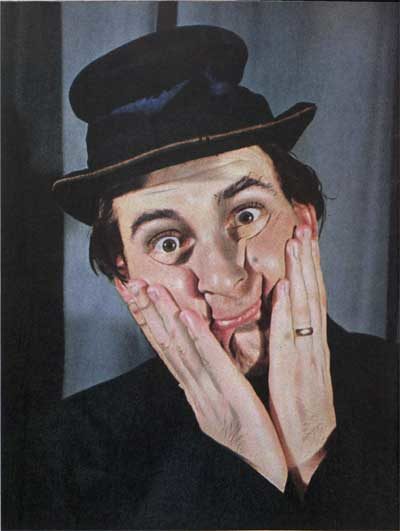
TV Gives Him Nightmares
Sid Caesar
By Maurice Zolotow
Originally published May 16, 1953
For his 90-minute Saturday-night stint on TV, Sid Caesar trains like a boxer, suffers horrible torments in recurrent dreams, lives in a state of tension that normal men would find unbearable. For three years, experts have expected him to crack — but his mad pace still goes on.
A horrible dream regularly torments Sid Caesar, the powerfully built gentleman with a nervous twitch in his personality who headlines a Saturday-evening television extravaganza entitled Your Show of Shows. In the dream, Caesar suddenly awakens at 9 p.m. on a Saturday. He is stricken with terror, realizing that his program is already on the air. In a panic, he dresses himself and runs outside to catch a train to the studio. Alas, after racing for several miles, he finally arrives at the station just as the train is leaving. Something Caesar is constantly afraid will actually happen has taken place in the nightmare — he has missed a show — he has frustrated 20,000,000 televiewers.
This nightmare turns up periodically to scare Caesar out of his extremely witty wits. The vision dramatically symbolizes the terror and the tension that beset the hardest-working performer in television today, a man who, for three years in a row, has been named “best comedian in television” in nationwide polls of radio editors, and whose collection of awards, statuettes, plaques, scrolls and medals would choke a Third Avenue curiosity shop. Everybody in show business considers it a sheer miracle that after so many years, Caesar is still able to keep up the mad pace. No other comedian has dared to take on the challenge of a 90-minute show week after week. The prospect of just having to memorize and rehearse six new sketches every week literally terrifies older comedians, especially stage comedians, who are used to building up effects slowly, often over a period of years. For instance, Bobby Clark’s leering caricature of Robert the Roué from Reading, Pa., has been gradually sculptured to perfection in 15 years.
Actually, in temperament, physique, and technique of operation, Caesar represents a new species of comedian, completely unknown to the entertainment world up to now. This new breed has sprung up in response to television’s rapacious craving for new material hurriedly contrived, speedily rehearsed, swiftly staged. Gone are the leisurely days when comedians performed the same routine for years without changing one syllable.
Every seven days Caesar has to come up with an entirely new act. I was once discussing this problem with Bert Lahr, one of the greatest of all living revue comics. Lahr mulled over Caesar’s complications and then he flatly announced, “It’s impossible.”
Caesar himself is often convinced the whole thing is impossible. “On Monday morning,” he recently remarked, as he chewed on a long, slender cigar, “I ask myself: Is it possible we’ll really do a show this Saturday? No, it’s not possible. This is the week we’re dead. This week we don’t go on. We got no show. This week from nine to half past ten they put on the old Rod La Rocque picture or wrestling matches from Queensboro Stadium.”
As he fumes away, Sid strides nervously up and down, weaves from side to side like a caged polar bear and buttons and unbuttons his coat. Caesar is no happy-go-lucky jester, full of sound and gaiety. His forehead is etched by deep frowns, his large liquid brown eyes are as morose as a cocker spaniel’s, his chin drags and he constantly exhales mournful sighs.
Theoretically, Caesar makes lots of money. But even his salary is like the pay in a wild nightmare. This season he got $15,000 a week, and in 1953–54 he will be raised to $25,000. But he never sees the big money. NBC sends the $15,000 check to Max Liebman, his producer; Liebman sends it to the William Morris office, Caesar’s agent, and they deduct 10 percent and send the balance to Milton Mound, Caesar’s attorney and personal representative; Mound takes his 10 percent cut and then ships most of the balance to an address on Lexington Avenue, which happens to be the location of a convenient and friendly branch of the Bureau of Internal Revenue.
The first requirement of the 1953 comedian is that he must have no interest in life except television, to which he is completely enslaved. In the legitimate theater, a performer has huge stretches of free time — his afternoons, except on matinee days, are his own to enjoy, and he can lounge around until two or three in the morning and sleep till noon. And during the halcyon days of big-time radio, comedians like Jack Benny, George Burns, Edgar Bergen, and Bob Hope were able to do a show in one day of rehearsing.
Caesar’s pattern of living is almost ascetic. From Monday to Friday, Caesar is in one or another of the rooms at Liebman’s offices, either sweating out material with his four writers or rehearsing. He labors from 10 a.m. until 7 p.m. On Saturday he is at work from 1 p.m. until almost 11. By the time he staggers home and puts away a heavy dinner, he has only strength enough to slump on a couch, where he stretches in exhaustion until about midnight. Caesar lies barefooted and wearing only a silk robe: As he lies supinely on the couch he stares grimly at a television screen opposite. He watches all the programs every night. He must keep abreast of what his competitors are up to. Maybe one night a week he goes out, but even his evenings out must provide grist for his programs. He and his wife will dine in a French, Italian, Chinese, German, or Greek restaurant, and then he will see a foreign picture. Caesar likes to cavort in double-talk routines in which he plays Italians, Germans, or Frenchmen, and he finds that he keeps his accent and intonations legitimate by listening to European waiters.
The next requirement of the television comedian is that he be husky and healthy. Television is no medium for frail and emaciated men. Caesar has the physique of a Notre Dame tackle — he stands six feet one, with broad shoulders, a muscular chest, a firm stomach, biceps like iron, legs like steel columns, and his weight is a solid 195 pounds. Since boyhood he has been working out with barbells and dumbbells. He can heft a hundred-pound barbell 10 times above his head.
Since a weekly television program takes a terrific toll on the human body, the video buffoon must have a healthy appetite. He must be able to consume enormous meals no matter how intense the pressure. Caesar meets this requirement perfectly. The man loves to eat. On a recent day, for instance, he started out with a breakfast of freshly squeezed juice of four oranges, two eggs, a rasher of bacon, a kippered herring, three slices of stale white bread— he hates the fresh kind — and two glasses of yoghurt. He hates coffee. Caesar is a big yoghurt drinker and often takes a pint with every meal. He also is crazy about rice, in every form. At 11 o’clock he had an egg-salad sandwich and a cherry soda. For lunch he put away a whole turkey leg, plus a wing and neck. This was washed down with a bottle of celery tonic. At 3:00 he had four frankfurters and two glasses of chocolate milk. For dinner he ate lightly— just shrimp cocktail, cream-of-tomato soup, sirloin steak, and home-fried potatoes, apple pie, and yoghurt.
Max Liebman relates that when he goes into a restaurant with Caesar, the comedian orders everything double — double Scotch, double lobster, double sirloin steak, double lamb chop. “One night there was a half broiled spring chicken on the menu, and he asked for a double order of that. I told him, ‘Why not simplify it—and just order a whole chicken?’ He took me seriously and ordered the whole chicken, and then finished half a porterhouse steak I hadn’t been able to do justice to. I remember his playing a date at the Chase Hotel in St. Louis — a two weeks’ engagement. He ate all his meals in the hotel dining room and he had the waiters staggering under heavy trays bringing his orders. On the last night, the manager of the Chase said that in appreciation for all the business Caesar had brought in, he would like to make him a present, and asked if there was anything Sid needed. Sid said, ‘Cancel our food bill.’ The manager smiled and said he would be delighted. A few hours later, he came back and said, ‘Mr. Caesar, I’m afraid it will be impossible. If I cancel your food bill, the hotel will show a loss for the entire month.’”
Another basic secret of Caesar’s success in television is that he conserves his energy by talking as little as possible. He can sit around at a party all night without saying 10 words. Even with close friends, he stares off into space for hours, lost in a fog of his own meditations. “A hello from Sid is a big conversation,” one of his friends said. “I once drove him from Forest Hills to New York and he didn’t say a thing. He’s got no talent for small talk; also he’s always brooding about his program and is very busy looking around for material he can adapt.”
His personal physician, Dr. Irving Somach, claims Caesar has abnormal powers of observation and a brilliantly retentive memory. “ He can go into a room in which he’s never been,” Somach says, “and look around him for a few minutes and he’ll be able to describe everything in the room, even small details like the color of an ash tray or the number of lamps.”
In place of language, Caesar relies upon grunts and grimaces to express a vast range of ideas and emotions. This naturally saves his writers a great deal of trouble and they do not have to invent as much material as they might otherwise have to do. Mel Tolkin, one of Caesar’s writers, explains, “If we do a sketch where Sid is stuck with a girl who’s not so pretty — well, if I was writing for Berle or Hope, I would have to produce a line like, ‘My girl is so thin that when she drinks tomato juice she looks like a thermometer.’ Sid just has to look at the dame with a nauseous expression and grunt ‘Yugh,’ and right away you know she’s the homeliest female on earth.”
Unlike other comedians, Caesar is never presented with a finished script which he then proceeds to memorize. Caesar has never studied a script in three years. He helps to write the sketches by talking them out with his writers, and he memorizes the words as he goes along and any time the mood is upon him he simply changes a sentence or inserts something new. Caesar is responsible for 25 percent of the material. Caesar hates to memorize, hates to rehearse and hates to do the same lines night after night. He is ideal for television. He was driven out of his mind when he played in Make Mine Manhattan, a Broadway revue which ran for 10 months. He had to repeat the same words at every performance.
Another advantage that Caesar has is that he is an adept pantomimist. He has an uncanny ability to project the quality of an object or the feel of an action — like unscrewing a jar lid or putting on a belt — by adroitly going through motions in empty air without any props. Some of the best sketches he has done are not written down at all. The script merely reads: “Sid does man coming home from business mad.” This naturally saves everybody a great deal of wear and tear.
He is also a shrewd mimic of foreign languages and domestic actors. One of the choicest items in his repertoire is a German professor who is an expert on everything from the mating habits of guppies to the flora of Patagonia. Recently, as Professor Siegfried von Sedative, he was an authority on sleep. He is being interviewed by a reporter:
INTERVIEWER: Doctor, would you explain to the audience in simple language the basis for your theory of sleep?
PROF. VON SEDATIVE: Yab. Schleep is vunderbar. Schleep is beautiful. But schleep is no good to you if you is vide avake. . . . I haff a friend vunce, he could schleep anywheres. In der boiler factory, in der foundry, in a shtock yard. He could go on a train and right avay he fall aschleep. Pass all the stations.
INTERVIEWER: That’s wonderful.
PROF. VON SEDATIVE: It was lousy. He was the engineer. He wrecked more trains, dot friend of mine.
A very important reason that Caesar has been able to keep his head above the airwaves for so long is that, unlike other comedians, he doesn’t just rely on human characterizations. Whereas Red Skelton knocks himself out concocting bits like Clem Kadiddlehopper and San Fernando Red, and Milton Berle knocks himself out concocting Milton Berle, Caesar has portrayed such interesting personalities as a gum machine, a whitewall tire, a lion, dog, punching bag, dial telephone, elevator, railroad train, herd of horses, a piano, a rattlesnake, and a soda-water bottle. Other comedians may groan that television is a monster which devours gags and comedy ideas faster than you can dream them up, but Caesar never has to worry about new material, since there is an infinite number of objects and things in the world. Recently, for example, he did a nine-minute routine of life as seen through the eyes of a fly.
He got the idea one Friday night while having a drink in a Greek restaurant, when he happened to notice a specimen of Musca domestica hovering around a tray of canapés on the table. Caesar stared at the housefly as it crawled around on the tray and finally settled on a chunk of goat’s-milk cheese.
“I studied this fly,” Caesar recalls. “ He kept hopping on that crumb of cheese. I figured he was gloating, ‘It’s mine, all mine,’ like a guy who gets a brand-new convertible he’s wanted for years. So I come into Max Liebman’s office on Monday and everybody is sitting around looking sick and miserable, and one of the writers is staring out the window like he wants to take a dive because Monday is bleeding-to-death day on the show. The floor is covered with gallons of blood. So I say, ‘Fellers, this week I wanna do a fly.’ They all look nauseous. I say, ‘It’s gonna be great because he flies around and that’s it.’ I’d been working it out in my mind all Sunday, and I figured out the psychology of the fly, so I showed them the thing, and I started rubbing my wrists, wrist against wrist, you know, the way a fly keeps washing his claws or whatever they call his feet, and then I showed them the fly buzzing and whishing through the air, so they agreed it had possibilities and we went to work on it.”
We see him waking, yawning, rubbing himself, cleaning his wings and murmuring through rounded lips, “Ah, it’s morning.”
FLY: Look at the sun coming in through the window. What a house I live in. It’s my house. I was so lucky to find this house. Always something to eat. Crumbs on the table, banana peels on the floor, lettuce leaves in the sink. … What a nice sloppy house. Well, I’m hungry. I’ll see what there is in the sink.
He folds his insect feet and buzzes to the sink. The sink is empty. Nothing is left on the table. There aren’t even any crumbs under the toaster.
They cleaned up the house. It’s disgusting! They must be expecting guests. … Oh, well, why should I aggravate myself? So I’ll eat out today. It won’t kill me. But I hate restaurants. That greasy food. I can’t stand greasy food. I keep slipping off, I can’t get a hold on it, and it gets on my wings, makes me sluggish and I can’t fly good.
On his way to a restaurant, the fly encounters a moth.
He’s crazy, that guy. Eats wool, blue serge … All that dry stuff. Yugh. And then every night he throws himself against an electric light bulb, knocking his brains out. He’s crazy!
Flying downtown, he is happily humming a song when he suddenly sees a sign that depresses him.
Look at that. ‘Get the new powerful DDT, Kills Flies Instantly!’ The fly frowns and solemnly remarks: Oh, my, there’s a lot of hatred in the world.
If you are planning to become a television comedian, it is advisable never to study the art of humor. Do not say funny things or be the life of the party when you are a young man. Master a wind instrument, like the trumpet or saxophone, as this will develop your lungs and your vocal cords, strengthen your lips, and teach you to improvise — all of which are very important to the television clown.
Caesar was born in Yonkers, New York, on September 8, 1922, the youngest of three sons. His father, Max Caesar, operated a one-arm cafeteria, the St. Clair Lunch, near the railroad depot in Yonkers. He had a sardonic sense of humor. He was the type of individual who, if he came home from business and Mrs. Caesar inquired how things were down at the St. Clair, would reply, in a serious tone, “Business is marvelous. I’m making so much money I expect to buy out Horn and Hardart tomorrow, and The Waldorf-Astoria next month.”
Once, when he was about 8, Sid went to the movies and stayed through three showings of Frankenstein. It was after dark when he walked into the restaurant.
“Where you been, Sidney?” papa asked, smiling pleasantly.
“To the movies.”
“All afternoon?”
“Yes, papa,” Sidney replied.
“How nice,” Mr. Caesar genially said. “And now how’s about a little supper, and then I’ll give you a quarter and you could go back to the movies and see the picture a couple more times, yes?”
He put his hand in his pocket as if he were searching for a coin. Sid was delighted with the entire plan and extended his hand for the quarter. At this point his father pulled out his hand and, instead of a coin, Sid received a terrific swat across the face that jolted him against a wall.
Caesar is a master of this kind of ironic bitterness. In a recent married-life sketch in which he and Imogene Coca portray a married couple named Doris and Charlie Hickenlooper, Charlie was trying to pacify his wife, who is planning to leave home and get a divorce. He says:
Let’s talk this over. We’ve been a normal, happily married couple. We’ve had our little spats, sure. We’ve had a few fights. We’ve had the doctor over a few times for a few simple fractures, and a couple of times we needed a specialist, but outside of that, we’re a normal, average married couple.
At the age of 8, Sid fell in love with the saxophone, and he blew it like a fanatic three and four hours a day until, at the tender age of 12, he became the outstanding hot tenor sax player in lower Westchester and was working in swing bands for a dollar a night. Later on, he played in the saxophone section of such eminent jive aggregations as Claude Thornhill, Charlie Spivak, and Art Mooney. All his life, Sid wanted only to be a great musician, to play the Debussy, Glazunov, and Ibert concertos written for the saxophone, to compose serious music. He hated comedy and comedians, and always avoided cabarets, Broadway shows, and Hollywood pictures which were funny. Until he was around 18, he is never known to have done or said a single amusing thing. He was a serious, morose, introspective person.
One of his teachers is amazed at his success. “Sid Caesar was one of the dumbest pupils I ever had,” she recalls. “He struck me as being one of the slowest-witted human beings I ever encountered. It shows you how deceiving appearances can be.”
In the summer of 1940, Caesar was playing in a six-piece dance band at the Vacationland Hotel in Swan Lake, New York. The social director of this hotel, Don Appel, was expected to put on a show every Friday and Saturday night. The budget didn’t allow for professional actors. Appel was compelled to draft anybody he could. “He’d even shanghai the guests,” Sid says. “Like some poor guy would come up for a two weeks’ rest, and then Don would talk him into playing a bit in Flugel Street, and the guy would be rehearsing all day long in the casino and never see the sun and go home more tired and paler than when he arrived. He approaches me one morning and said how would I like to do a few comedy bits? I said, ‘No, thank you.’ So Appel says if I help him out with the shows, I’ll get out of playing music during lunch because we’ll be rehearsing.”
Since making with funny faces was a lot less strenuous than blowing a horn, Caesar thenceforth became a comedian in the summer and a musician the other nine months. Two years later, at another Swan Lake resort, the Avon Lodge, he was introduced to the children’s governess, a vivacious blond beauty named Florence Levy. Sid’s description of how the emotions of love stirred him are worthy of a monologue on Your Show of Shows.
“I looked at her,” he reports, “she looked at me. An explosion took place. Right away I ask her, ‘Can I sit with you at lunch? Can I take a walk after lunch? I want all the dances with you tonight. Let’s go to the village for chow mein tomorrow, and how about a swimming session next Saturday?’ We don’t know each other five minutes, and I’ve got every hour of her summer planned out already. When I learn she’s got a date with some guy a week from next Tuesday, I go nuts and do the Othello bit. But she’s in love with me. In two weeks we’re engaged.”
They were married the following summer and now live in a sumptuous eight-room apartment on Park Avenue, with two beautiful children — a boy and a girl — also a governess, a cook, a housekeeper, and some fine paintings by Vlaminck and Rouault.
Between 1942 and 1945 the comedian spent several monotonous years in the United States Coast Guard. In the Coast Guard variety show, Tars and Spars, Caesar did one routine — a satire of airplane war films. Max Liebman directed Tars and Spars, and he sensed the latent talent in Caesar’s personality. The two formed a close association, and under Liebman’s encouragement, Caesar quickly flowered into a top-ranking comedian. By 1949, at the age of only 27, he was one of the two first-string comedians in television. The other was, of course, Berle. At this point in his fantastic career, Caesar had actually had only about seven months of professional experience when he toured night clubs and hotels with a 30-minute act. Since Caesar was never a comedy veteran before television, he didn’t know that it was impossible to do a brand-new revue every week. Later he found out it was impossible, but by then it was too late.
All really great comedians are not just actors playing imaginary characters invented by gag writers. Their comedy triumphs are essentially a crystallization and an elaboration of their real personalities. Sid is as harassed, haunted, compulsive, bewildered and frustrated in private life as he is in the various sketches he plays on television. When he took up tennis two years ago, he was on the court all day long until he became good enough to give the pros a game. Golf was his obsession in the summer of 1952, which he spent at the Concord, a luxurious retreat in the Catskill Mountains. He was on the links from 7:30 in the morning until dinnertime and managed to break 90 by the end of the summer. When he took up hunting, he immediately acquired a collection of fine guns worth several thousand dollars, which now repose unused in a gun rack in his den. For a while he hunted every Sunday; then he suddenly lost interest, as he did in golf and tennis. One story is that he lost interest as soon as he shot his first deer and saw the poor animal bleeding away. Another version, which comedian Jack Carter tells, is that Sid was hiding in some bushes in the Adirondacks waiting for game, and suddenly some hunter started shooting at him. Sid jumped up, twiggled his fingers against his ears and yelled, “Look, no horns! I swear I’m not a deer!” But the shots kept coming anyway, and Sid quit.
He has tried fishing. A friend of his, Milt Chasin, who operates a chain of appliance stores, owns a big yacht. Sid still goes on yacht cruises during nice weather, but he doesn’t fish any more. Once he caught a striped bass and then, as it lay in the boat, he suddenly saw the situation from the bass’ viewpoint
“Please,” he moaned, pretending to be a fish, “throw me back. I’m suffocating. I need a little water, just a little water. What do you need me for? You’re rich. You got everything. I got nothing. Don’t be selfish. Throw me back.”
Two summers ago Caesar decided on a European jaunt. A travel agency booked an elaborate journey for him through France, Italy, and Spain. He and Florence flew to Paris. The second day in Paris, while they were at a race track, Sid glowered, frowned, chewed nervously on a cigar, and muttered, “Florence, let’s go home.” She thought he meant home to their hotel, the George V. It wasn’t until he started packing that she realized he meant home to New York. Four days after they left they were back in America, one of the shortest European tours on record. “The whole trouble is you can’t get a glass of clean, fresh water in Paris,” he explains.
When his wife was pregnant with their first child, Sid was more jittery than she was. On the morning she felt labor beginning, she quietly arose and dressed, and then she roused her husband. Sid panicked and ran to the closet.
“We gotta call a cab!” he cried. “We gotta get to the hospital on time!” The hospital was only nine blocks away. “What suit should I wear? I don’t know what suit to wear,” he muttered. It took him 10 minutes to pick out the proper suit. Then he ordered two cabs, in case the motor of one conked out. They arrived at the Le Roy Sanitarium. The doctor wasn’t there yet. Sid started frantically phoning the doctor’s office. Finally, the doctor, an obstetrician named Ralph Hurd, got there, and Caesar ran to the entrance, grabbed him by the lapels and rushed him to the elevator. “Hurry, doctor! Please hurry!” he screamed.
“Go away for several hours, Mr. Caesar,” the doctor said.
Sid went to a newsreel movie. Then he phoned the hospital. They said he had a daughter. Exultant, he went into a drugstore for breakfast. The counterman said, “You’re Sid Caesar, ain’tcha?”
“Who’s he?” Caesar replied blankly.
“I watch your show on television all the time,” the man said.
“Show? Show? I got a show to do. I forgot all about the show. I got to call the show,” he said. He ran to a telephone booth. It was occupied. He dragged the occupant out of the booth.
“It’s an emergency,” he said. “I’m a father. I gotta do a show. I got a daughter.” The man cringed away from him in terror. He started dialing the number until he realized he didn’t have a dime. He went outside and intimidated the man whose booth he hail stolen into giving him a dime. He telephoned Max Liebman.
“Max, listen; this is Sid. I know I gotta do a baby, but Florence had a show, and will it be all right if I miss rehearsal today?”
“It’s all right, Sid; don’t worry Just relax and don’t be excited.”
“Who’s excited?” screamed Sid.
He then went to the hospital and briefly saw his wife and daughter. The hospital is at 61st Street near Madison Avenue. Outside, Sid began sympathizing with his wife. Poor girl, he thought, what hell she went through. Gotta do something nice for her. Gotta buy her something. A basket of flowers? No. A fur coat? No. Something fabulous. I got it. I’ll buy her a necklace. That’s it. By now he was at 58th Street and Madison.
He hailed a cab and yelled, “Tiffany’s and step on it!”
The driver went one block south and one block west and let Caesar out. “We’re here already?” Caesar asked suspiciously.
“Sure, it’s only two blocks away.”
“Why didn’t you tell me, you thieving rat? I could have walked it quicker.”
“I figured you were an inspector from the company and I didn’t want to get into trouble.”
Caesar entered Tiffany’s and informed a salesman, “My name is Sid Caesar and my wife just had a baby and my lawyer has an account here and I’m looking for a beautiful necklace.” The man showed him a strand of fine Oriental pearls. “It’s great,” Caesar said. “Wrap it up, charge it, and that’s it.” As he was leaving with the package, he suddenly asked, “By the way, how much is it?”
“Eighty thousand dollars, including sales tax,” the salesman said blandly. Sid whipped around and trotted back to the counter. He finally settled for a $4000 diamond-studded wristwatch. As he handed over the bauble, the salesman remarked, “You certainly are a very comical fellow. I had always imagined you were just making believe on your program, but now I know different, sir.”
Caesar says he didn’t have the heart to disillusion the salesman by revealing that he had been playing it straight. “It was the real me,” the comedian says, sighing.
One word to describe Artie Shaw, clarinetist and popular big band leader from the 1930s and ’40s, might be turbulent. This word describes the personal life of a man whose marriages to eight women, including Lana Turner and Ava Gardner, all ended in either divorce or annulment. It describes the professional life of a man who became rich from the music fans he often despised. And it describes the health of a man who pushed himself so hard that it led to hospitalization and even to a medical discharge from the navy in 1944.
But through it all, Shaw was a champion of jazz as a musical art form. His became one of the first big bands to integrate when he hired Billie Holiday as vocalist. And when his primary competition, Benny Goodman, was bestowed the label “King of Swing,” fans dubbed Shaw “King of the Clarinet.”
In 1939, Shaw took a moment to comment in the Post about what life as a jazz musician had been like for him. Shaw was known for being brutally candid, and this article follows suit as Shaw writes about his success and the aggravation, disillusionment, and sacrifice that came with it.
This post was published to mark National Jazz Appreciation Month. You can read more of the Post’s historical stories from and about jazz legends in “Jazz History by Men Who Made It.”
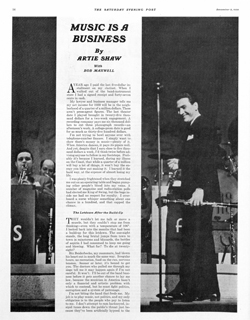
Music Is a Business
‘Music is a Business’ by Artie Shaw
By Artie Shaw, with Bob Maxwell
Originally published December 2, 1939
A year ago, I paid the last $5 installment on my clarinet. When I walked out of the band-instrument store I had a signed receipt and forty-seven cents in cash.
My lawyer and business manager tells me my net income for 1939 will be in the neighborhood of a quarter of a million dollars. These aren’t press-agent figures. The last theater date I played brought in $25,000 for a two-week engagement. A recording company pays me $6,000 to cut three phonograph records — an afternoon’s work. A college-prom date is good for as much as $3,500.
I’m not trying to bowl anyone over with telephone-number finance. I simply want to show there’s money in music — plenty of it. When America dances, it pays its pipers well. And yet, despite that I earn close to $5,000 a week, I’d think twice before advising anyone to follow in my footsteps. Probably it’s because I learned, during my illness on the Coast, that while a quarter of a million will buy a lot of things, it won’t buy the energy you blew out making it. I learned it the hard way, at the expense of almost losing my life.
I was plenty frightened when they stretched me out on an operating table and began pumping other people’s blood into my veins. A number of magazine and radio-station polls had elected me King of Swing, but the bugs inside me had no respect for royalty. I overheard a nurse whisper something about one chance in a hundred, and that capped the climax.
The Letdown After the Build-up
They wouldn’t let me talk or move a muscle, but they couldn’t stop me from thinking — even with a temperature of 106°. I looked back into the months that had been a build-up for this letdown. The one-night stands, the long brutal jumps from town to town in rainstorms and blizzards, the bottles of aspirin I had consumed to keep me going and blowing. What for? To die at 28?
Bix Beiderbecke, my roommate, had blown his heart out in much the same way. Irregular hours, no recreation, food on the run, nervous tension. Sooner or later, it’s bound to get you. The doctors who pulled me through my siege tell me it may happen again if I’m not careful. It won’t. I’ll be out of the band business before it gets another chance to lay me low, because the musician in America hasn’t only a financial and artistic problem with which to contend, but he must fight politics, corruption, and a system of patronage.
I’m not biting the hand that feeds me. My job is to play music, not politics, and my only obligation is to the people who pay to listen to me. I don’t attempt to ram hackneyed, insipid tunes down the public’s throat just because they’ve been artificially hypoed to the so-called “hit” class. This policy of trying to maintain some vestige of musical integrity has, naturally, earned me enemies, people who think I’m a long hair, impressed with my own ability. Nothing could be farther from the truth. My faith in dance music — I refuse to call it swing — borders on the fanatic. I have the utmost respect for the many real musicians who are creating a new music as important as the classics, but I have no respect for musical clowns who lead an orchestra with a baton and a quip. However, more power to them if they can make it pay.
A Case of Too Many Charlatans
All this has really been a preamble to what I want to get off my chest. Actually, this is the first time I’ve been able to talk without that necessary evil — a press agent — at my elbow. Publicity men possess vivid imaginations. Legend is their business. I have to be a personality, an eccentric genius who combs his hair with the jawbone of a hummingbird and reads Aristotle in the original Greek.
For once I’d like to let down that jawbone-combed hair and talk, not so much about myself, but about the future of dance music in the land of its birth. At the same time, I want to answer the question that has been put to me in fan letters: How can I learn to lead a band?
Strangely enough, the future of what, in lieu of a better term, we can call jazz is tied up with the desires of close to half a million amateur musicians to emulate the success achieved by the big band leaders.
Anyone can lead a dance band. At least, anyone could lead many of today’s name bands. None of them need leaders — and very few have them. The average bandleader is only a front, a window dressing. If he has capable musicians behind him and imaginative arrangers behind the musicians, it doesn’t matter whether he’s on or off the platform — the music will sound the same. One of the best-known dance bands in the country is “led” by a man who, literally, can’t read a note of music.
There are, of course, exceptions. Duke Ellington, for one. Duke is a musician. Jazz means more to him than a cacophony of blasting brasses or the saccharin strains of a corny ballad. I wish every amateur musician could sit in on an Ellington rehearsal. Music is made on the spur of the moment, ad lib. Phrasing is born of inspiration. The man lives it.
The point I want to make is simply this: If Young America, practicing on its saxophones, trombones, clarinets, basses, and drums, is interested in preserving the future of dance music, it had better not look to many of the reigning favorites of the day. Unfortunately, popular music in America is 10 percent art and 90 percent business. As a result, it boasts more than its share of charlatans and lacks its share of honest, intelligent critics.
Certainly an art appealing to millions deserves better treatment. As it is now, musical worth is measured not by how well a man handles his instrument or directs his orchestra, but by his personality, his love life, and his glibness of tongue. Mountebanks have cheapened popular music to such an extent that a wisecrack or a catch phrase becomes more important to their success than the music they play. The only saving grace seems to be that the public soon learns to weed the musical bad from the musical good.
There are two ways to build a band — the hard way and the easy way. The easy way requires high-powered exploitation, and high-powered exploitation requires money. Give me $50,000, 14 good musicians, and a press agent, and I’ll make Joe Doakes, who doesn’t know a C scale from a snare drum, one of the most popular band leaders in America.
A variation of the easy way involves selling yourself and your band down the river and letting Big Business hold the reins. This happens time and time again, and each time it does, another shackle is placed on the art of popular music. Whenever you hear of a band or leader achieving overnight popularity, don’t attribute it to a lucky break or accident. Accidents happen rarely in the music business, but they can be made to happen. It’s amazing what a powerful booking office or music publisher can do to assist a new band up the ladder.
The Easy Way to the Top
Take the case of a leader who recently burst into prominence like a meteor. He is, incidentally, a good musician, but that alone did not account for his sudden rise. What happened was this: A smart manager sensed possibilities in the band and made arrangements to promote it. He saw to it that the band recorded tunes that were destined to be in the hit class and put cold cash into the exploitation of the band. He arranged with a booking office to put the band in a night spot with a network wire, thus guaranteeing it two or three coast-to-coast air shots a week. In short, this favored leader hurdled obstacles that, to a new band, normally would be almost insurmountable. Whether or not he can stay on top is something else.
There are important monetary drawbacks to success achieved in this manner. Perhaps the manager has a piece of the band — say 25 percent. Possibly the booking office owns another 25 percent. A big song publisher may have 15 percent. In some cases, bands are incorporated businesses with dozens of outsiders holding shares. Even if the band reaches the top, the leader finds his share of the profits slim. Then, too, the leader who accepts help of this kind is always in debt to those who helped him. He’ll have to give his publisher-benefactor’s songs a plug whether they’re good or bad. He’ll have to record tunes he knows aren’t worth putting on wax. He’s owned, musically, and he does his owner’s bidding unless he reaches the point where he can buy back what amounts to his musical birthright.
Now, the hard way — the way almost every budding leader will have to take — the way that is likely to make an old man of you at 30. Since my own career serves as a fair example of the hard way, perhaps I will be forgiven a little autobiographical data.
Being dead broke when I paid up for my clarinet was purely of my own doing. I had been earning $500 a week playing in NBC and Columbia house bands — Kostelanetz, Barlow, Shilkret, Romberg, Rich, and others. I gave it up because I had an idea I could be happier writing. Bix Beiderbecke had been my friend and now Bix was dead. The story of his short but brilliant life deserved to be told, and I thought I could tell it. I bought a small Bucks County, Pennsylvania, farm and went to work. It took a year for me to discover that a typewriter isn’t a clarinet. I gave it up.
When I returned to New York early in 1936, nobody wanted a clarinet. At least, they didn’t want me. I remember my first day in town. From ten until two I toured the studios and offices. All I got was the story I shouldn’t have quit the business cold when it was paying me good money. From two until four I sat on a park bench getting more and more panicky. All I knew was music. If I couldn’t sell that, what could I sell? At four I called my mother to tell her the situation. She had a message for me. A swing concert for charity was being given at the Imperial Theater and I was invited to play a clarinet solo.
I accepted — but not as a soloist. I had always felt that a string background for a hot clarinet would wed the best of sweet and swing as it was being interpreted at the moment. At least, it would be novel and might attract some attention. I convinced a string quartet the idea had merit. We went to work.
Three hours before the concert, one of my fiddle players landed a job for the night and I had to get a substitute. We sat backstage while every big-name orchestra in the business played to thunderous applause. Brass … brass … and more brass. Raucous, ear-splitting. The louder the music, the more the rafters rang. And here I was with two fiddles, a viola, a cello, and a clarinet — a chamber-music group in a house packed with jitterbugs!
Mention the incident to my press agent now and he’ll tell you we were colossal. We were a little short of that, but the following day, three major recording companies offered to put us on wax, and I signed with a booking office to develop a larger band using the same basic idea — string interludes and backgrounds against a jazz combination.
The band went into the Hotel Lexington. Don’t imagine you can get a choice hotel or night-spot booking by applying to the manager. Every worthwhile location — with a radio wire — is tied up by one of the large booking offices, and if your band isn’t handled by the office controlling a certain hotel, you’ll never get into it — well, hardly ever — unless you’re Gabriel blowing a diamond-studded trumpet.
The string-reed band was no bombshell at the Lexington. Musically it had everything, but the shaggers wanted hot brass and wild drum solos. We played the French Casino and the Paramount Theater, reputedly the home of the jitterbug, with mediocre success. At this point, my booking office advised me to take the band on the road for seasoning. Although it was — and still is — the accepted practice to season a new band with one-night stands, I should have known that if New York refused to go into raptures over us and thought us lukewarm, we would die in the hinterlands.
Die we did. The band chalked up new box-office lows wherever it appeared. Back to New York we came. The office was sorry, but the idea seemed to be a floperoo. They paid off and called it quits.
The dismal failure of the string band convinced me it was financial suicide to try to sell the public on anything novel without tremendous backing. My only chance was to get together the standard combination and beat the topnotchers at their own game. Another booking office was talked into taking a flier on me. Somehow, I found three trumpets, two trombones, four saxes, and a rhythm section. The booking office wanted me to open at a small New York spot, but I balked. This was my last chance. That audience at the Imperial Theater had misled me once. No single audience was going to mislead me again. We’d open out of town and play for as many people as possible before risking a New York showing.
We hit the road in an old truck we had bought from Tommy Dorsey. It had Tommy’s name painted on both sides, weather-beaten but legible. Until we had enough money to pay for repainting the body, we were stopped three times for having stolen it. A cop in Boston arrested our Negro driver and tossed him in the can. He had heard Tommy Dorsey broadcasting from New York an hour before. We left our driver in jail, the truck in the police yard, and went on to our next stand by bus!
I had decided, long before we left New York, that come what may, the band wasn’t falling into the melodic groove dug by any other swing outfit. The only way to avoid it would be to keep the so-called pop tunes out of our books. Playing the things everyone else was playing would only serve to type us. I had written some originals, and these, together with old musical-comedy songs I felt had merit, made up our repertoire. The boys in the band thought I was making a mistake. I argued that dancers would go for good arrangements of songs old or new.
We spent two weary years on the road, playing every hamlet in New England and the Middle West, making 600-mile jumps overnight to earn a top fee of $250 — for five or six hours of playing in a stuffy hall or an ex-barn from which the cows had only recently been evicted. Two years of seasoning and heartbreak — when a hotel room was a luxury shared by three brass players, a drummer, and their instruments. We’d finish at Scranton, Pennsylvania, at two in the morning, grab a bite to eat, crowd into the truck and two used cars we had picked up, and make Youngstown, Ohio, 350 miles away, by noon the next day. We had devised a system for getting the equivalent of two nights’ sleep for a one-night hotel fee. When we hit a town in the morning we’d register and turn in immediately, sleeping until it was time to show up for the engagement. Finished playing, we’d return to the hotel and sleep the night through, driving to our next date the following day. That happened every other day and saved us plenty of much-needed money.
Time and again I was on the verge of throwing it all up. Everything seemed to happen to make things tough. We had what we considered a choice engagement to play a Cornell college prom at Ithaca. The two cars went on ahead, with the truck following. The truck landed at Utica, ninety miles away. We played for the prom with four men, the drummer beating it out on a large dishpan !
Gas for the cars was always a problem. They were old and they drank it fast. Once we had to resort to using a police teletype system to send an urgent message to New York for gas money. Two things kept me from quitting: The knowledge that if I did I was through for good, and because I could see the band shaping up. We began to get calls to return to towns we had already played. I felt safe in trying out innovations. They clicked. We dug up tunes like “Donkey Serenade” and “Zigeuner” — long relegated to dusty shelves — and audiences liked them.
Our booking office began phoning long distance. We were ripe for New York and they had a spot for us. I talked it over with the boys, most of whom had been with the band from the start and knew what had happened before. We decided not to come in, but we made a concession. We would accept dates where there were radio wires. If New York wanted to hear us it would have to be over the air.
How to Get Publicity
How we rehearsed for those short 15-minute and half-hour shots. Everything was against us — microphone setup, acoustics, everything. The best band in the world can sound like an off-key hurdy-gurdy if the balance isn’t right. Most of the time we worked with a portable control board that went on the blink two or three times during the broadcast. But we managed and it couldn’t have been too bad. The trade papers sat up and took notice and radio editors said kind things. Nothing succeeds like success.
We worked East and opened at New England’s Roseland State Ballroom in March 1938. Here we had our first real taste of public acclaim — minus the remuneration that is generally supposed to go with it. The kids liked us, and glowing reports went back to New York. But the summer season was coming on, so we stayed out of the Big City, biding our time for a fall opening. It came in October 1938, when we went into the Blue Room at the Hotel Lincoln. The Lincoln had not been a good spot for bands, but that didn’t bother us. We knew we had it this time.
There was no money in the Lincoln engagement. As a matter of fact, there’s no money in any hotel engagement. Although a theater date now pays me $12,500 a week, there isn’t a hotel in the country able to afford more than $4,000 for music. But top bands willingly take that, and usually a lot less, to get a precious radio wire. Some of them even lose money playing a hotel, but if your name and music go out coast-to-coast four or five times a week, you’re getting publicity that would cost a young fortune to buy — publicity that builds you up to the point where you can demand really big money for theater and out-of-town engagements, proms, recordings, and commercials.
The Great God Mike
Here ends the rags-to-riches saga which, I hope, will serve as an example of how tough the band business can be. Mind you, too, I was no stranger to it. I had been playing in bands from the time I was 14 and had achieved a certain reputation as a clarinetist. Imagine what would have happened if I had been a country boy out of the West with my horn under my arm.
This is as good a time as any to explain further the hotel-band situation, probably one of the greatest obstacles to a newcomer in the field. All the choice spots with radio wires are tied up by contract to three or four big booking agencies. Although a hotel may want my band badly enough to offer a comparatively high price, I can’t ordinarily be booked unless my office controls the hotel. Once in a blue moon this rule is broken by agreement, but it’s mighty rare. Of course, this control changes hands over a period of years as contracts expire, but still it’s almost axiomatic in the business that if a band isn’t booked through one of the Big Four offices, it hasn’t a chance of ever playing a decent spot.
Radio, more than anything else, is responsible for this frantic fight to tie up wired hotel spots. The Great God Microphone is deity to the bandsman, and he worships at its shrine. As a result, enter another major obstacle to the newcomer. The three big broadcasting chains — NBC, CBS, and Mutual — are naturally eager to put only the top bands on the air. It’s a feather in a chain’s cap if it can offer member stations the pick of dance bands. Picture, then, this situation. A new band has been taken on by one of the big booking offices and a wired hotel spot arranged. Three shots a week, coast-to-coast. Absolutely perfect. Who steps in but the broadcasting chain! That three-time wire is precious. Why should they waste the hook-up on a comparative unknown when they can get Shep Fields or Dick Himber? Put someone else in the hotel, the chain suggests. A name band.
You may think I’m painting a very dismal picture, but any honest leader will tell you it’s practically photographic. The public read the fan magazines, learn about Tommy Dorsey’s estate and my new roadster, and figure it’s good money for little work. It is good money — when you get it. Musicianship isn’t the requisite for success. Honesty of purpose isn’t an essential. If, in Broadway parlance, you can finagle, you’ll get places. For instance, few leaders play a new song solely because they think it’s good. They play it only when a publisher assures them it will be the firm’s No. 1 tune — the tune the publisher is going to work on and put money behind. They take no chances of introducing a song and then having it die on them, because they have no faith in their own ability to make a song. And yet they pride themselves on having introduced this hit and that hit. I’m much prouder for having rescued a really good number like “Begin the Beguine” and brought it to public attention.
Song pluggers, whose business it is to talk leaders into playing their company’s tunes, can’t understand my refusing to play musical monstrosities. Why, every band in the country is featuring it! Fifty-five major plugs last week! It’s No. 3 on the Song Parade! So what? It isn’t music, or at least it isn’t my conception of music. If music has to depend on slapstick comedy for its appeal, I’ll throw my horn away. The mere fact that a piece is a hit means nothing. Enough hypoing will make any song a hit.
I never should have been a success or made money in the music business. Having broken every rule and regulation for subservience, having fed the public songs everyone was convinced the public didn’t want to hear, I should have been out in the cold a long time ago. Some big people in the business think I’m either cracked or a poseur. They refuse to believe that, with me, music is first.
That’s why I have more than faint misgivings for the future of dance music in America; misgivings for those who are talented among the amateurs. The making of music — whether it be classical or jazz — is an art.
If the bands of the future are to be led by wisecracking comedians and pash-voiced tenors, a sound talent for music will not be required. But if jazz returns to the golden era of its birth, when every member of a band was a musician at heart, the road to success will be tougher traveling, though far more satisfying.
I’d like very much to lead the way. I’ve always wanted to write the things I feel. Since I can’t do it with a typewriter, maybe I can do it with a clarinet.
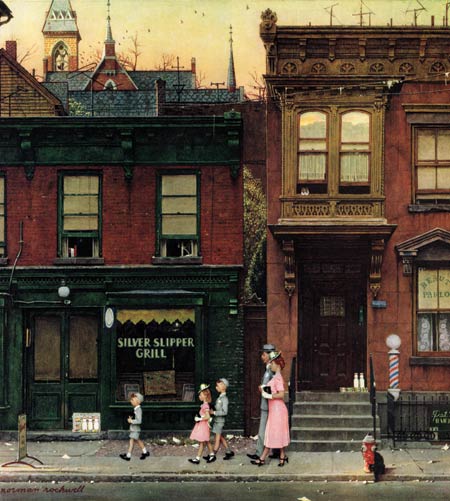
You may not see it, but there’s a 17th-century Dutch painting within the 1953 cover, Walking to Church. Rockwell depicts a family, dressed in their Sunday best, on a city street before the neighbors awaken to take in their milk and newspapers. The scene may seem quiet, but Rockwell showed us, with a line of birds rising in sudden flight from the steeple, that the church bells have begun ringing.
Rockwell’s cover reflected his admiration of View of Houses in Delft, a 1658 painting by Johannes Vermeer that showed a quiet street in the Dutch artist’s hometown. Not only did Rockwell copy Vermeer’s theme, but he also tried to replicate its 21-by-17-inch size. Rockwell’s painting is tiny, for him — just 19 by 25 inches. He wanted to paint it the same size as the Vermeer original, but he couldn’t get a canvas small enough. “Couldn’t paint it better than Vermeer,” he said. “So I painted it bigger.”
Editor’s note: This article has been corrected from the version which appeared in the March/April issue. The article in print was published under the wrong author’s name and stated that Rockwell’s painting was 19 by 18 inches.
In a Nielsen survey, one-third of Americans said they planned to use smartphone apps to achieve health and weight-loss goals. If that sounds like you, these apps will get you going in the right direction.
Lose It! Weight management apps are a dime a dozen, but few are as comprehensive as Lose It! It works with popular health and fitness devices, such as the Nike+ Fuelband and FitBit Tracker, and offers head-to-head challenges with other users. The basic version is free. The premium version ($39.99/year) tracks a wider range of health metrics, including body fat, sleep, and exercise calories. (Android, iOS, Kindle, loseit.com)
The Johnson & Johnson Official 7 Minute Workout App A 7-minute workout? Yep, and you’ll work up a sweat, too. You’ve done these exercises before: push-ups, wall sits, abdominal crunches, step-ups, squats, jumping jacks, triceps dips, planking, high knees, and more. A video guides you through each move. The 7 Minute Workout App is free, and no special equipment is required. (Android, iOS, 7minuteworkout.jnj.com)
Sleep Bug Having trouble nodding off at night? This ambient sound machine lulls you to slumberland with your choice of 24 scenes and dozens of music and sound effects. The waterfall scene, for instance, serenades you with sounds of cascading water, to which you can add chirping birds and other effects. The timer and clock let you turn off Sleep Bug at a predetermined time. Sleep Bug Pro ($1.99) adds more sounds, including the airport, city, and “fun horror scene” mixes. (Android, iOS, Windows Phone, sleepbug.net)
Charity Miles Here’s a great way to get fit and do some good at the same time. When you run, walk, or bike, Charity Miles tracks your mileage. The more ground you cover, the more money you earn for your choice of a variety of nonprofits: 25 cents per mile for runners and walkers; 10 cents per mile for bikers. The donations are courtesy of Charity Miles’ corporate sponsors, which include Humana, Kenneth Cole, and Timex Sports. (Android, iOS, charitymiles.org)
TalkSpace Therapy is expensive, but TalkSpace offers a more affordable online alternative. For $25 per week (billed monthly), you can chat with a licensed therapist — that’s 80 percent lower than the average co-pay for in-office therapy appointments, the company says. The TalkSpace network has more than 300 therapists who specialize in a variety of work/life issues. You can message your therapist 24/7, too. (iOS, Android, talkspace.com)
Food.com At the market, steer clear of fat- and sodium-laden premade entrees and instead launch the Food.com app to browse 500,000 recipes, including tasty choices that meet your dietary needs: gluten-free, vegetarian, low-fat, and other options. You can see sales at local grocery stores and instantly add recipe ingredients to your shopping list. (iOS, food.com/app)
Endomondo Some folks just do it. Others prefer to analyze their workouts, dive deeply into fitness stats, and compete with a global community of exercise enthusiasts. If you’re in the latter camp, check out Endomondo, a data-driven free app that uses GPS to track your performance in 40-plus sports, including running, cycling, and kayaking. The premium version ($5.99/month or $29.99/year) is ad-free and tracks a bunch of additional metrics, such as calories burned per month. (Android, BlackBerry, iOS, Windows Phone, endomondo.com)
Zombies, Run! Running can be a little boring at times, but Zombies, Run! livens things up with an immersive audio drama where you play a vital role. For example, when you hear zombies coming, speed up. The free edition starts with four missions, and you can unlock an extra story each week. The pro version ($2.99/month or $19.99/year) offers more than 200 missions. (Android, iOS, zombiesrungame.com)
Starbucks has apologized to a customer after the man got a note on the drink he ordered at one of the chain’s Florida locations. Where the customer’s name would ordinarily be was the phrase “Diabetes Here I Come,” presumably because the man had the audacity — can you believe it? — to actually order something he wanted to order: more syrup in his Grande White Chocolate Mocha.
I’m always amazed — and maybe at this point I shouldn’t be — when people on the web have the completely wrong reaction to a story like this. You would think that most of the comments on this story would be on the customer’s side, that maybe baristas at Starbucks shouldn’t be dumping on customers via their coffee cups. But this is the world of internet comment sections, and many reactions are along the lines of “He shouldn’t be drinking that!” and “You mean to tell me he added more sugar to something with a ton of sugar already?!?”
Talk about missing the point. Or maybe they see the point very clearly and have instead decided to dump on the guy and give their flawless moral opinions, because that’s what comment sections and social media are for now.
Stamp Prices Are Going … Down?
That’s not a typo or a hallucination; stamp prices are actually going down.
Stamps have been 49 cents for the past few years, but last Sunday, the price dropped 2 cents to 47 cents. Postcard stamps — and I always forget about those — have also gone down, a penny, to 34 cents. The reason? A program that allowed the United States Postal Service to raise prices on stamps to make up for lost revenue when the volume of mail decreased during the recession has come to an end. I have no idea why the price of the stamps is going down instead of just staying the same, but I won’t argue with a discount.
It’s the first time stamp prices have gone down since 1919.
Nothing Left Unsaid
Did you know that CNN host and 60 Minutes correspondent Anderson Cooper is Gloria Vanderbilt’s son? I know, I know, that’s old news by now, but I’m sure there are some who didn’t realize it, and maybe you knew it but forgot that you knew it.
Vanderbilt is 91 now, and not only do she and Cooper have a new book out, The Rainbow Comes and Goes, but a new HBO documentary about her life, titled Nothing Left Unsaid, premiered last weekend. I caught it and it’s well worth seeing. It’s not only a fantastic look at Vanderbilt’s life, including the infamous custody trial she was involved in at an early age, her marriages and business successes, and the suicide of Cooper’s older brother Carter, it also turns out to be a rather surprising and inspirational meditation on the power of art and how to go forward in life. It’s really well done, and I recommend you take a look.
RIP Arthur Anderson
The actor started as a child actor on radio and Broadway with Orson Welles’ Mercury Theater and appeared in many movies and TV shows, including Midnight Cowboy, Zelig, and Law & Order. But you might remember him as the original voice of Lucky the Leprechaun in a series of Lucky Charms cereal commercials from 1963 to 1992:
Robert Osborne Will Be Absent from TCM Film Festival Again
Well, this is rather too bad. For the second year in a row, Turner Classic Movies host Robert Osborne will not appear at the TCM Classic Film Festival, which will take place in Hollywood from April 28 to May 1. In a letter to fans (PDF), Osborne says that a health problem will sideline him again this year. In 2015, a health problem also made Osborne miss the annual get-together. The classic political thriller All The President’s Men will open the festival, and guests this year include Carl Reiner, Elliott Gould, Eva Marie Saint, Stacy Keach, and John Singleton.
Osborne says that everything’s okay, though, and he’ll be back on TCM soon.
Going Out Tonight? Don’t Bother!
Big is the new small! Wet is the new dry! Stamp prices going down are the new going up! And going out is the new staying in.
Apparently, people aren’t going out as much as they used to. And as Molly Young points out in her interesting essay at The New York Times’ T Magazine, you can pretty much blame the internet and television.
You can do everything from the comfort of your home now. You can binge on movies and TV shows, shop, post pictures, order food, find a soul mate, and most importantly, you can hang out with friends without, well, actually hanging out with your friends. There are also many jobs you can do from home now, so you don’t even have to commute to work every day. If you carefully plan things out, you never have to leave the house again!
I’d just like to say that if staying in really has become the hip, cool thing to do, then I must be a trailblazer, because I’ve been staying in for years.
Happy Tax Day Everybody!
It’s April 15. What, you haven’t done your taxes yet? What the heck are you doing reading this then?
I did my taxes the other day, and while I would never call the process “fun,” I felt a certain amount of pride and accomplishment when I finished. Of course, writers are notoriously bad when it comes to math, so I have no idea if I even did them correctly. But hey, I did them!
If you really haven’t done your taxes yet, don’t stress out too much; you’ve got a little extra time this year. Because Friday is a legal holiday for public employees in Washington, D.C. — it’s Emancipation Day — we all get an extra weekend to procrastinate. Taxes are due on Monday, April 18, this year. But why wait? Do your taxes today so you don’t have to worry about doing them over the weekend.
Today is also National Glazed Spiral Ham Day. I don’t know if you can combine that with doing your taxes in any way, but if you do, let us know.
Upcoming Events and Anniversaries
Bay of Pigs invasion (April 17, 1961)
Here’s how The Saturday Evening Post covered the military plan and the Cuban Missile Crisis.
Benjamin Franklin dies (April 17, 1790)
Franklin did many things in his life, including starting the newspaper that eventually became The Saturday Evening Post.
Joe pulled at the starched collar of his white shirt as he stepped up on the porch and then straightened his tie before ringing the doorbell. He wiped perspiration from the side of his face before nervously patting the right pocket of his gray suit coat, feeling the box inside.
The door opened and Arianne’s Aunt Lucy gave him a look of surprise, followed by a quick smile. “I thought you were Armand,” she admitted shyly and opened the door wider for him.
Armand? Armand’s back?
Joe tried to keep his face from revealing the stab of fear gripping his heart. Aunt Lucy stepped back to allow him in, a forced smile on her face.
No! Not today, of all days.
Joe followed Aunt Lucy’s full figure into the living room, where she waved at the sofas and told him to make himself at home. She smiled and said something about a pot on the stove and left him there, standing in the empty room with the three dark blue sofas and Persian rugs, Audubon prints on the walls, sunlight streaming through the Venetian blinds.
Joe closed his eyes. Today, a date he’d etched into his mind, was to be unforgettable — June 9, 1901. The day he’d ask Arianne to marry him. He patted the ring box again and noticed his hand shaking. So he sat on the nearest sofa and looked up at the lone ceiling fan as it vainly pushed the warm air around in the stuffy room.
Joe, 24, stood 5 foot 6, skinny with dark brown hair parted down the center and dark brown eyes. He wore his best suit today, navy blue with new black shoes. He’d stopped for a shoe-shine boy as he left his apartment on Camp Street, just down from newspaper row where he worked at The Eagle. Making sure his shoes remained dust free, he’d climbed aboard the uptown streetcar, passing the finer New Orleans estates along St. Charles Avenue before getting off at Felicity Street and walking the three blocks to the newly built Queen Anne house where Arianne lived with her aunt and uncle.
He felt his stomach twisting into a giant knot and leaned back on the sofa, closing his eyes, trying his best to calm himself. He couldn’t stop the word fate from stinging him, like an angry bee. He believed it was fate that drew him and Arianne together for that first meeting at the library when they nearly collided, she in search of Henry Wadsworth Longfellow’s Song of Hiawatha, him in search of Jack London’s The Son of the Wolf. Both embarrassed at their clumsiness, their eyes talking far more intently than their whispered apologies. Arianne’s green eyes seemed to shine that afternoon with emerald brilliance, and her red lips looked ripe and luscious, a vision he’d never forget. Fate again, that very night as he saw her across the room at the Overton soirée. She smiled so warmly when she saw him approaching. Fate revisited two days later, when he canvassed her neighborhood, trying to gather information on the early-morning burglar the police had finally caught. When Arianne answered her door and her eyes widened, she let out a little laugh, put a hand on her hip and asked if he’d like a cup of coffee.
Fate. Today was the day he’d ask for her hand. Armand picked today to step back into her life, and there was nothing Joe could do about it. He let out a long breath and felt himself … calming. There was nothing he could do about it.
He jumped at the sound of the doorbell and stood quickly, then he sat back down before Aunt Lucy saw him. He crossed his legs and tried to act unconcerned as Aunt Lucy shuffled to the door and let out a little squeal.
And then Armand was there beneath the archway leading into the living room. He stood erect and tall, wearing a light gray, almost silver, linen suit with a crimson cravat, a bouquet of red roses in his right hand. Aunt Lucy was speaking in her sing-song voice, how gorgeous were the roses, how nice Armand looked, how tanned and fit.
#
When Aunt Lucy shuffled out of the room, Armand noticed he wasn’t alone. The smallish young man sitting on the sofa looked familiar, but Armand couldn’t place the face. The man stood and extended his hand. Armand switched the roses to his left hand and stepped toward him.
“You probably don’t remember me,” the man said, “but I was three grades behind you at St. Vincent’s. Joe Gort.”
The handshake was firm but not overly. It didn’t take a genius to figure why Joe was there, and Armand felt his heartbeat rising. Of course Arianne would attract other men. He just didn’t figure one would be here, now.
“I think I remember you,” Armand said, stepping back. “What are you doing these days?”
Joe wasn’t a bad-looking fella and was probably wearing his best. Just like me, thought Armand.
“I’m a reporter,” Joe said. “I work the police beat at The Eagle.”
A working-class man. A somewhat honorable profession. Armand did not want to brag, but as the minutes ticked by, keeping time with the ceiling fan, second after nervous second, Armand found himself telling his story, egged on by the curious reporter inside Joe.
“It’s been a year, almost exactly, since I left,” Armand said.
“Where in South America?” Joe was sitting now, Armand still standing and holding the roses.
“Bolivia. I helped build two bridges.” Armand the engineer was genuinely proud of his work in Bolivia. Financed by the tin mines, his group of Americans had bridged the Beni River and a narrow, deep gorge alongside Mount Illampu. He had left New Orleans, a new Tulane graduate with no prospects here, not wealthy enough yet to ask the girl he loved to marry him, and had returned a successful engineer with offers for continued advances in Chile and Argentina and an offer from Egypt cabled to him on the boat.
Armand Sebastian — 27, blond hair bleached even lighter by the strong South American sun, skin bronzed, had grown a light moustache he’d carefully combed with a small moustache comb.
The light sounds of footsteps brought Joe back to his feet and turned Armand around as Arianne stepped into the archway. She stood with her arms by her side, her bright green eyes moving from man to man.
Armand’s vision suddenly blurred. His memory of her beauty paled in comparison to her real beauty. In a simple white dress, lightweight cotton, commonly worn by so many New Orleans women during stifling summers, Arianne seemed to glow. Maybe it was the sunlight streaming from behind her.
Arianne’s figure stood outlined through the dress, still hidden by the fabric but showing her natural curves, down the length of her long legs. Her reddish-brown hair lay in long curls past her shoulders, as if recently windblown by a breeze that would have been sorely welcomed by the men. Arianne, two weeks from her 20th birthday, stood 5 feet 2 inches and would enter her junior year at Sophie Newcomb College next semester.
#
Joe was certain the others could hear the thundering of his heart. It struck him deeply when he saw Arianne’s lower lip quiver for a moment. She was nervous, and he felt he’d already lost as her gaze moved from him back to Armand and lingered.
Armand and Arianne. How many times he’d heard of this pairing from … just about everyone? It was always spoken in the past tense by Arianne’s friends, with a hint of regret. He’d met Arianne on the rebound, his buddies at the paper constantly reminded him, calling him the luckiest bastard around.
And as Arianne moved slowly toward Armand, who’d extended the roses to her, he remembered running the names through his mind. Why on Earth would Arianne marry a Joe Gort to become Arianne Gort, when she could have Armand Sebastian, becoming Arianne Sebastian. Gort, what a silly name. Joe’s father used to try to dress it up: “It is actually the name of a lovely Irish village near Galway Bay.”
Joe felt his throat tighten, thinking about his old man, who would have absolutely adored Arianne if he was still around. Looking at his feet, Joe felt that old, familiar feeling of a street urchin watching fine ladies and their gentlemen walking along the street.
Black Irish. The Gorts were Black Irish, his mother used to tell him. “Shanty Irish that mated with the Spaniards from the Great Armada. The ones that escaped the Bloody British and crashed their ships along the Irish coast, to be taken in by fellow Catholics.” It was just teasing from his red-headed Irish mother. She loved his father’s dark good looks, but Joe was born with darker skin than his father, nearly olive, and the kids along Constance Street called him dago.
Armand Sebastian, in his tall, silver-linen whiteness was no dago, even with bronze skin. Joe watched them standing next to one another, Armand looking down at Arianne’s face as she turned and looked at Joe and suddenly it was there, the lovelight in her eyes as she stared at him. It wasn’t a flicker. It hadn’t gone away. But was it for Armand?
Arianne took the roses and moved to a vase and put them inside, carefully arranging them, and Joe heard Armand speaking, something about Paris.
“ … engineers from all over the globe are going. The World Exposition is the greatest light show ever created, after the sun of course. Millions of electric lights. Magnificent effects. The Hall of Illusions is the wonder of the new century.”
Armand turned momentarily to Joe and said, “It must be all over your paper since April.” And Joe could see perspiration on his face now. The nerves were contagious.
Joe felt himself nod, but it was another article that came to mind, Stephen Crane dying of tuberculosis in Germany on the fifth of June. It wasn’t Crane’s American masterpiece The Red Badge of Courage that had touched Joe. It was his Maggie: A Girl of the Streets with its realistic view of slum life that had moved Joe. Why Crane came to mind puzzled him for a moment as he remembered how the great writer was shipwrecked in ’96 and spent four days adrift, impairing his health for the rest of his life. Crane died at 28. Maybe that was it. Life was too short and the woman he loved was standing with her old love. A greater man than he.
#
When Arianne turned back from the roses she saw the blue velvet ring box in Armand’s hand. She gasped and wished she hadn’t. He slowly opened it to reveal a dazzling diamond so large it did not appear real.
“Come to Paris with me,” Armand said, his voice almost breaking. “I’ll never love any woman as I’ve loved you. Marry me and I’ll never leave you again. I’ll give you the world.”
She did not look at his face. She stared at the chiseled diamond and remembered the love they’d shared, the long nights talking, long walks holding hands, the gentle kisses, the warm hugging, the sound of her heart beating in her ears. And then she remembered the pain when he’d left, all flustered, when life wasn’t going his way and there was no prospect for work here and no way to support her if they married. He’d stormed away to seek his fortune. But he’d written no letters. He’d left her alone. He’d just gone away until the telegram this morning and now this. She’d dreamt of him returning to her, what she would feel when she saw his face again. But the sudden emotion in her breast wasn’t the same feeling, wasn’t the love he’d abandoned.
Arianne looked into Armand’s eyes, the window to a man’s soul, and stared into them as their hearts continued their frantic beating, as the ceiling fan kept spinning above and people milled outside along the street, and the streetcar continued its clacking up and down St. Charles Avenue and Joe Gort sitting not 10 feet away. She knew the answer wasn’t in Armand’s eyes. It didn’t matter how much he loved her. What mattered beat in her heart.
#
Joe sank back on the sofa and closed his eyes. He had to get away, away from the sweet, sickly smell of the roses, which always reminded him of funerals. His funeral this time. He tried to catch his breath and took a long minute to struggle through his natural inferiority to steel himself. Fight for her! I love her. I love her. And I won’t sulk away. He stood up and opened his eyes and nearly ran into Arianne.
She stood before him, and their eyes did the talking, as they had that first time in the library and for so many days and nights since. Her lovely face seemed to glow, her eyes glimmering, a smile slowly rising on those sculptured, red lips.
He realized he had his ring box in his hand and tried to put it back into his coat pocket, but Arianne’s hand was suddenly on his and gently pulling his hand up. She opened the box and looked at the ring.
It wasn’t even a full carat, and Joe had 20 more payments to make on it, but the gold was as 24-karat as the gold of Armand’s ring.
But Arianne didn’t see it, didn’t care about carat size. She could barely see the ring through her tears. She wiped her eyes with her free hand and looked into Joe’s brown velvet eyes.
“You will marry me?” It was Arianne’s voice, thick with emotion.
Joe could only nod. The words were caught in his throat.
Arianne took in a deep breath and said in a quivering voice, “I’m going to marry Mister Joseph Devin Gort.” She reached up and brushed a strand of Joe’s dark hair. “My little Irishman.” A broad, quivering smile on her face now.
Armand felt a stab in his heart. Once again he was amazed at her beauty’s power of inflicting pain. He’d lost her.
Arianne and Joe sat on the sofa, facing each other, and Joe slipped the ring on her finger and told her, “I love you so much. I adore you. I’ll always …”
Arianne put her fingers on his lips to stop his talking, then pulled her hand away, tilted her face to the side and leaned forward, pursing her lips. They closed their eyes as their lips touched and for a breath-taking moment, the world melted away.
These days, people who are blind or visually impaired can find a great deal of independence with the help of a guide dog or service animal, but man’s best friend hasn’t always been used in the service of the blind. The training of guide dogs in the United States didn’t begin until the late 1920s, and its success can largely be attributed to two people: Dorothy Harrison Eustis and Morris Frank.
In the mid-1920s, Dorothy Harrison Eustis was training German shepherds as police dogs in Switzerland. She heard about an innovative program in Potsdam, Germany, in which German shepherds were being trained as “blind leaders” to help soldiers blinded during World War I regain their mobility, autonomy, and ultimately their self-confidence, and she had to check it out. She went in a skeptic, but what she saw there erased all doubt. She was so moved that she submitted the following article, “The Seeing Eye,” to the Post for publication and began training guide dogs at her own school, Fortunate Fields, in Switzerland.
After this article was published on November 5, 1927, letters poured in from people all over the United States who wanted to learn more about these guide dogs. One such letter was from Morris Frank, who wrote, “Is what you say really true? If so, I want one of those dogs! And I am not alone. Thousands of blind like me abhor being dependent on others. Help me and I will help them. Train me and I will bring back my dog and show people here how a blind man can be absolutely on his own.”
Eustis invited Frank to Switzerland for training, and he returned to the U.S. that spring with Buddy, his new guide dog. True to his word, on June 11, Frank demonstrated to reporters the independence Buddy granted him by successfully navigating some of the busiest and most dangerous intersections in New York City. Eustis returned to the U.S., too, and in December — just a little over a year after this article was published — she and Frank founded The Seeing Eye, America’s first school for training guide dogs for the blind.
That company continues to train Seeing Eye dogs and pair them with those who need them, and it charges only $150. That fee — which has remained unchanged since 1934 — covers the cost of the dog and equipment, round-trip transportation from anywhere in the U.S. or Canada, room and board during the three-week training course for the student, and lifetime follow-up services. Veterans pay only $1.
Today, thousands of Americans live independent lives thanks to the safety and security offered by guide dogs. And it all started with this article.
The Seeing Eye
By Dorothy Harrison Eustis
Originally published November 5, 1927
Dorothy Harrison Eustis Library of Congress
To everyone, I think, there is always something particularly pathetic about a blind man. Shorn of his strength and his independence, he is a prey to all the sensitiveness of his position and he is at the mercy of all with whom he comes in contact. The sensitiveness, above all, is an almost insuperable obstacle to cope with in his fight for a new life, for life goes on willy-nilly and the new conditions must be reckoned with. In darkness and uncertainty he must start again, wholly dependent on outside help for every move. His other senses may rally to his aid, but they cannot replace his eyesight. To man’s never failing friend has been accorded this special privilege. Gentlemen, I give you the German shepherd dog.
Because of their extraordinary intelligence and fidelity, Germany has chosen her own breed of shepherd dog to help her in the rehabilitation of her war blind, and in the lovely city of Potsdam she has established a very simple and businesslike school for training her dogs as blind leaders. Enclosed in a high board fence, the school consists of dormitories for the blind, kennels for the dogs and quarters for the teachers, the different buildings framing a large park laid out in sidewalks and roads with curbs, steps, bridges and obstacles of all kinds, such as scaffoldings, barriers, telegraph poles and ditches—everything in fact that the blind man has to cope with in everyday life.
Many Dogs and No Fights
Three forces work together to make this school the model that it has become: The German Government, the Shepherd Dog Club of Germany and the association of war-blinded soldiers. The latter is a splendid organization of some 3,000 men which strives continually and successfully to keep its members in work and above pity or charity and out of the class of beggars and peddlers. The government furnishes the land for the school and further grants each blind man a subsidy for his dog’s keep after he has left the school.
The dogs are supplied by the Shepherd Dog Club of Germany and are either donated or bought at the lowest price compatible with the qualities they must have, for these blind leaders are the distant cousins and the cinderellas of famous show dogs; they not only have the goods but they deliver them in the shape of courage, intelligence and service. The total cost of a dog, trained and ready to leave the school, is about sixty dollars, which includes the initial cost of the dog.
They must be young and healthy, with quiet, steady nerves and a good character. As a whole, they are a very nice-looking lot, especially when you take into consideration that not more than 10 or 12 dollars has been paid for one of them. Moreover, they have a certain expression in their eyes, a sturdiness and interest which is too often lacking in their fashionable cousins. As the qualities of courage and intelligence are characteristics of the German shepherd dog wherever he is found unspoiled by intensive show breeding, it is not so hard to collect groups of these leaders for the blind as it would seem, and after a few simple tests to prove he is fit for the service, the new recruit can go to work, and all his work is founded on obedience.
Now these are the Laws of the Jungle,
And many and mighty are they;
But the Head and the Hoof of the Law,
And the Haunch and the Hump, is — Obey!
It is little short of marvelous how a raw dog can be taken into the school and in four months be turned out a blind leader, and the miracle is that the dog so perfectly assimilates his instruction. From the very small beginnings of becoming absolutely house-broken, he is taken step by step upward to his life work of leading a blind man, of being that man’s eyes and his sword and buckler. He is first let loose to run with all the other dogs and to learn to mind his Ps and Qs and not to fight.
For any dog full of life and energy, this first step is an education in itself and of itself starts him thinking. After he has mastered his lesson, the park becomes a schoolroom; and here, with dogs running loose, people passing in all directions, laughing and talking, he has his first studies in concentration and learns to sit and lie down on command, to speak, to fetch, to carry; and he must learn good will and to do it all cheerfully, gladly and with dispatch. This is the A B C, or kindergarten, of obedience, and if he is an apt pupil he learns it easily and graduates into the next class. Here he begins his work in the leading harness, which is more easily seen in the pictures than explained in words. He now learns that although in hours of play and exercise he can romp with other dogs in the park, from the moment the harness is put on him, dogs must be anathema to him. Called from his play, a dog advanced in his work is ridiculously like a business man called to his office; you can almost see him lay aside his newspaper, settle his coat, straighten his necktie and take on an air of business affairs.
Life in a Big City
In the beginning, all schooling went on in the park; but it was soon found that a dog might work perfectly there and be of no use in the bustle and distraction of a city, so the park was given over to obedience exercises and the advanced classes were moved into the city itself. From the moment a dog wears the leading harness, his schooling is done under actual working conditions. He must go at a fast walk so that the slackening in his gait for an obstacle is instantly felt through the rigid handle of his harness. For curbs he pulls back and stands still so that his master can find the edge with his cane; for steps, approaching traffic and all obstacles barring progress, he sits down; and for trees, letter boxes, scaffoldings, pedestrians, he leans away from his man, who follows the pull and so is led safely around. He learns the direction commands of right, left, and forward, and to pick up anything his master drops. He is taught to protect his master from violence, and this instinct develops in bounds after he finally wins through to his own blind master. He must be ever watchful and protective, but never aggressive, and it is that quality of perfect balance in instruction that is the success at Potsdam.
He passes gradually from the lower to the higher grades of work and is not given advanced problems before he has mastered the simpler ones. His head is not bothered about approaching traffic, pedestrians or obstacles until he is ready for them. They are the higher mathematics of his course. His first days are spent learning to sit down before every curb. This later develops into half sitting down or pulling back, but in the beginning it is very definitely sitting down and having the curb brought to his attention. After a few days he is allowed to make the mistake of crossing without signaling. Then the teacher stumbles against the curb exactly as a blind man would and instantly corrects the dog, making him sit down in the proper place.
The Graduating Class
As he progresses in one exercise, another is added, so that one by one he learns always to keep the middle of the sidewalk, to cross directly from one curb to another, to keep a slight pull on the harness handle and not to dawdle. Gradually he is warned from pedestrians, and it becomes second nature for him to skirt them. Finally he learns his duty in street traffic, and the different strands of his education have been woven together into the finished fabric, each strand in its place and giving support to the whole.
The dog must have perfect obedience and yet he cannot be a machine; he must have certain initiative to take care of situations as they come up. He must obey all commands and yet be ready to take matters into his own realm if sudden violence threatens.
Fifty or sixty dogs are in school at a time, all in different stages of development, and they are at their studies all day long, with stated periods for recess. Four teachers give these scholars their education, and about 15 dogs graduate every month. They have to pass a test before a committee of experts to win their guaranty of reliability, and then they are ready to take their place in the sun as worthy citizens. Next comes the question of placing the right dog with the right man, for different temperaments and characters need different handling, and those of man and dog must complement each other.
Then, too, there is the difficulty of accustoming the dog to his new master. In the four months of school he has become attached to his teacher and works perfectly for him and he is puzzled and thrown off by the exchange. The first days with the new master are difficult. The blind man is nervous, distrustful and supercritical, as well he might be. The dog works unevenly, often looking back at his old teacher, and the blind man has a disturbed mental picture that this is the way he is always going to be led, and he states his opinion in no uncertain terms.
I should like here to recognize publicly the tact and patience of the instructors of the school. They are obliged to have both in unlimited quantities. It is hard enough to find a man who can handle a dog well, but here are men who must handle both dogs and men with quietness and cheeriness to bring about that harmony and accord which are to go out with them from the school. It must be a very comforting thing to see the dogs you have worked over and taught able to make blind men happy.
The accommodations permit of 12 to 15 men, who come the first day of every month, for four weeks. The building is made up of simple dormitories and a combination living and class room. Here the blind scholars listen to lectures on the care, feeding and psychology of the dog, study raised maps of the streets of Potsdam with their fingertips and memorize them. This gives them a clear mental picture, so that later they can go to any part of the city by the simple directions of so many blocks to the right, left or straight ahead.
This is all class work, as the man’s real schooling commences with the practical work of brushing, feeding and making friends with the dog that has been assigned to him. On the man’s arrival at the school, the dog leaves the kennel where he has lived for four months and comes to live with his master in the dormitory. This helps enormously to smooth over the strangeness and difficulties of the first few days, as after kennel life the dog feels that he belongs to someone and the man dimly feels his companionship. The dog’s home is under his master’s bed, and he instantly takes charge of all his master’s property. Nothing can be touched or taken away without permission, and so from the first day his master has the feeling of protection — a new little flutter of comfort that starts the ball rolling along the path of hope in the future.
A Guide to Freedom
The proud young scholar now turns teacher and through the same streets which have so lately served as schoolrooms, with the help of his own instructor, he teaches his new master the technique of a lead dog and shows him how he can guide him safely and surely. The course is all carried out in an atmosphere of cheeriness, confidence and security, and in two or three weeks even the most faltering has learned his dog’s signals. Every day, under the direction of a teacher, the blind scholar carries on his dog’s lessons in speaking, fetching and carrying, so that he may learn to put command into his voice — a quality sadly lacking since his blindness — and to gain authority over his dog, it being a proved fact that the dog knows the man is blind.
Gradually the rehabilitation takes place. First, the uncertainty becomes less uncertain, a glimmering that perhaps here is eyesight; then the acknowledgment that here at least is ever pleasant, ungrudging companionship and protection. Then the putting out of feelers: “Can this really mean independence?” And then comes the whole great realization that the future holds freedom. No longer a care and a responsibility to his family and friends, he can take up his life where he left it off; no longer dependent on a member of the family, he can come and go as he pleases; and as these thoughts and possibilities gather strength in his mind, despair and loneliness give way to happiness and companionship, and these qualities can be seen developing from day to day.
A comparison of the men completing their course with those just commencing is the proof. The men arrive forlorn, with lined, anxious faces and drooping bodies, thin or overfat from inertia. In four short weeks they are remade; life takes on a new interest; shoulders lose their droop, backs straighten up and feet forget to shuffle. The thin have won back their appetite through their daily exercising walks and have put on weight and muscle, and the fat ones have trained down. Occasionally a chuckle is heard which is the opening wedge for a laugh, just as the birds’ early morning twitter presages the full song to the sun.
An Afternoon Stroll
The dogs were running loose and romping about in the park for their half hour before working as I stood nearby talking with Mr. Liese, the director. I had come to the school a skeptic, but he laughingly excused me on the ground that I belonged to the majority. I had seen so many so-called trained dogs which, put to the test, did mediocre work accompanied by many excuses that I was more or less prepared to hear reasons for poor work. I had expected possibly to see an instructor with eyes bandaged give an exhibition with one special dog to the running accompaniment of: “He’s off his work today — didn’t eat this morning; he was not exercised yesterday; that’s funny, he usually does that perfectly; there must be something distracting him,” and so on — all kinds of incidents that would go to prove my contention that, intelligent and full of courage as this grand breed of dogs is, it is too much to ask of him to take the entire responsibility of a blind man’s life.
I had read of the blind man who crosses the Potsdamer Platz in Berlin with his dog twice a day, going to and from work, and had seen a photograph of him there, but knowing how much the Potsdamer Platz would resemble Fifth Avenue and Forty-second Street if all the traffic were allowed to circulate at the same time, I put it down to a good story and a better photograph. Consequently I was not prepared to have one little incident open wide the door to my conversion. It was nearly the end of a course, and the men were gathering by twos and threes outside their dormitory, canes and harnesses in their hands, before their afternoon walk, and the tears came into my eyes as I watched them go down the little path leading from their dormitory straight to the park enclosure. The men, during the four weeks, must have gone along it eight or ten times a day, a yet their feet still faltered and shuffled as they felt their way uncertainly. As each man called his dog, that dog came, regardless of what absorbing game of tag was going on; and not another dog gave heed until he, too, was called; then, all eager, with tail wagging and eyes shining, up he came to have his harness put on, each dog laying his head in his master’s hand to let him know he was here.
I shall never forget the change that came over one man as he turned away from that gate. It was as though a complete transformation had taken place before my eyes. One moment it was an uncertain, shuffling blind man, tapping with a cane, the next it was an assured person, with his dog firmly in hand and his head up, who walked toward us quickly and firmly, giving his orders in a low, confident voice. That one quick glimpse of the crying need for guidance and companionship in the lonely, all-enveloping darkness stood out clearly before my swimming eyes. To think that one small dog could stand for so much in the life of a human being, not only in his usual role of companion but as his eyes, sword, shield and buckler! How many humans could fill those roles with the same uncomplaining devotion and untiring fidelity? Darned few, I think.
I quickly asked permission to follow him on his walk, first getting a few details about him. He had never before owned a dog, and since his blindness had been led everywhere by a member of his family; on arriving at the school, he had been particularly nervous, helpless and lacking in confidence. He was a man of about 45, thick-set and husky, who had evidently been accustomed to lots of exercise and had become overfat through lack of it. He passed us whistling through his teeth and feeling for a cigarette, his dog looking us over with an appraising eye. I turned quietly and followed. Walking at a good pace, the pair went down the street to the first crossing, where the dog pulled back to indicate the curb. The man’s cigarette was apparently his last, as he gave orders to be led to the tobacco shop, went in, made his purchases and then continued his walk.
As I followed him it seemed impossible to believe that the man wasn’t taking the dog for a walk and stopping for traffic of his own accord, so quietly and evenly did they work together. I had to pull myself up pretty sharply once or twice to realize that the man was blind and that the only thing that kept him from pitching off the curb into the street was the intelligence and faithfulness of his dog. For not once through the whole hour that I followed them did that dog’s attention wander.
Passing Barriers
The walk lay through the crowded shopping street with all the traffic of a big city, its noises and distractions, its scents and stray dogs on mischief or business bent. Understanding responsibility and never-failing protection radiated from that blind leader as he went about his work. His attitude was, “You mind your business and I’ll mind mine,” as he threaded his way along the street, and the pair went much more quickly without interference than I, who continually bumped into people in my efforts to keep up. I was amazed at the pace; I had started by walking briskly, but found the distance ever widening between us and the need to make it up every so often on a jog trot.
The streets in German cities are wide and in many places lined with two or three rows of trees and paths. To keep cyclists from riding along these paths, barriers have been put up at intervals with narrow openings for pedestrians. The barriers are of one bar each and about the height of a man’s waist. I had been told at the school that one of the hardest things to teach a dog was to pass between these barriers and not under them, the way being clear for the dog but not for the man, who would receive the full force of the bar across his middle without warning, so I was interested to follow the pair into one of these wide, shady lanes on the homeward leg.
A couple strolling ahead had dropped a coat directly in the path, but man and dog skirted it and the dog immediately, came back to a line that would lead him between the barriers, although for him it would have been simpler and shorter to go under. There was a big catch in my throat as I saw them turn into the school grounds together with other pairs coming from different directions and knew that I was converted. It had not been a particular exhibition staged for my special benefit, but just one of the many dogs turned out every month with his blind master. There were no fireworks, no display, no excuses, no muddling, but honest work done by honest dogs, and my hat was off to those who had worked out and perfected such a method of sympathetic training.
As always happens when you are interested in some one thing, you find examples all round you, and the day after my visit to Potsdam I was taking a respite from a big dog show and quenching my thirst with a lovely long, cool glass of beer in a great public garden across the way, when along came a blind man and his dog, threading their way between the tables. The man had apparently told his dog to take him to a table, as she stopped beside one with her master next to the chair.
I watched them for some time. The waitress could come and go as she pleased, and people could pass close by in all directions as long as they did not show any interest, but let someone stop and look curiously at them and a low warning growl issued forth immediately.
An Intelligence Test
Captain Schoenherr, of the Instruction School for Police Dogs at Gruenheide, was with me and he invited the man to take a glass of beer with us, which he accepted very pleasantly. Picking up his harness handle and his cane, he gave the dog the order to follow Captain Schoenherr, who, to test him, took a curving course between the tables. Step for step and curve for curve, the dog followed him, saw her master safely into his chair and lay down quietly beside him. The man told us that he had had her for three years and only once in all that time had she run him into anything, and then he said it was largely his own fault. Man and dog had such understanding that they worked as one. Once, while the man was talking, Captain Schoenherr got up and crossed in front of the dog so close as almost to step on her paws without bringing forth a complaint, but when he stopped back of her master and stood there without speaking, the grievance came swiftly into her throat — just a quick warning “Hands off!”
Her master laughed, patted the head always ready for his hand, and said, “I never have a moment’s anxiety.” That from a blind man! Later he went with us to the entrance to show us how beautifully she worked, and after he’d said goodbye gave the order to take him back to his table. She took him quietly and without question back to the same table and the same chair, although the way led across the whole garden, up some steps, through a pergola and between tables crowded with people.
The future for all blind men can be the same, however blinded. No longer dependent on a member of the family, a friend or a paid attendant, the blind can once more take up their normal lives as nearly as possible where they left them off, and each can begin or go back to a wage-earning occupation, secure in the knowledge that he can get to and from his work safely and without cost; that crowds and traffic have no longer any terrors for him and that his evenings can be spent among friends without responsibility or burden to them; and last, but far from least, that long, healthful walks are now possible to exercise off the unhealthy fat of inactivity and so keep the body strong and fit. Gentlemen, again without reservation, I give you the shepherd dog.
The credit card was still in its teen years when this satire was published in The Human Comedy It was a recurring column that appeared in the Post throughout the 1960s and written by well-known and up-and-coming authors like Ogden Nash, Russell Baker, and Thomas Meehan. Below, Pulitzer Prize-winning journalist Jimmy Breslin — known for his streetwise reporting — satirizes the credit card industry:
I Am a Fugitive from the Diners’ Club
By Jimmy Breslin
Originally published on August 14, 1965
It all began some months back when one of my best friends, Fat Thomas, who was then a bookmaker, handled $1,100 in bets from a client who picks very slow horses. Fat Thomas went around to collect and found that his client did not have the $1,100.
“I ought to give you a kick in the ankles,” Fat Thomas said.
“Look,” the customer said. “All I can tell you is that I’m empty. But here, you can use this.” He produced his Diners’ Club card. “Go out and use up $1,100 worth of the card, and we’ll be even.” Fat Thomas brightened. Fat Thomas weighs 495 pounds. Anything to do with dining is Fat Thomas’s game.
But the trouble with a Diners’ Club card is that you can get things other than food with it, and that evening Mr. Fat Thomas was watching a Doris Day movie from a first-class seat of an airliner carrying him to California. Fat Thomas spent a week on the coast. He ate consistently and drank heavily, and threw a big party for himself.
Upon his return to New York, Fat Thomas threw another party for himself at a midtown restaurant. Fat Thomas’s party was the biggest thing to happen in New York in six months. His guest list included Mr. Bad Eddie, Mr. Cheech Vanella, Mr. Pep McGuire, Mr. Albie Silver, Mr. Angelo, some private handicappers, and several other people, including newspaper editors and television announcers. At one A.M. the party sent out for a masseur, who gave rubdowns at the table. At the end of the evening the waiter came with the check and Fat Thomas, pencil in hand, jumped up, signed a huge tip on the check, then bounced between the tables and made his way to the street and home for a week’s rest.
At this point the Diners’ Club personally contacted the real owner of the card. The bill was $3,985 and the Diners’ Club said it would appreciate a slight gesture. This loser looked at the figure and started to faint. Then he pulled himself together and said, “I don’t know nothing about this. I lost my Diners’ Club card a month ago. Somebody stole it off me.”
The Diners’ Club was a bit taken back by this. They happened to mention the matter to a detective from the 16th Precinct in New York City. The detective happened to mention the matter to the waiters in the midtown restaurant. The waiters happened to mention Fat Thomas. Two days later Fat Thomas called me up and happened to mention that he was in the Tombs, which is our local prison.
“Bres, come down and get me,” he said. “And bring a friend.”
“Who?”
“Louis Topper, the bail bondsman.”
The charge was forgery one, which is not a joke. And the judge who had the case is not very funny either. He said something about Fat Thomas and six months in jail. Now I know Fat Thomas all of my life. He dropped out of my class in P.S. 108 to run bets for a bookmaker, and he never stopped. He is a big, delightful bum who never really does anything wrong. He always is broke, and he can’t meet this dinner bill. For a friend, you do things. We got Fat Thomas’s case postponed, and then I went to the offices of the Diners’ Club, No. 10 Columbus Circle, and asked to see Matty Simmons, executive vice president. Matty Simmons knows me for a long time.
“You have a bill of $3,985 that Fat Thomas ran up,” I said. “He is broke. You also have a magazine. It is called the Diners’ Club Magazine. It comes out monthly. If I write stories for it, would you take them as restitution for Fat Thomas’s bill?”
“The editor of our magazine doesn’t like the way you write,” he said. “He thinks Art Buchwald is much better.”
“So my verbs are weak,” I said. “Does that mean a guy has to go to jail?”
That swung Matty Simmons. He drew up a contract which called for me to write for the Diners’ Club Magazine, and for him to give the judge a notice that restitution had been made. According to my contract, I am the featured writer for the magazine for some- thing like the next 86 issues.
When this deal was taken to the courtroom, the judge and Fat Thomas’s probation officer on the case looked it over. They held a conference. Then the judge coughed and said, “This is all right. But this Mr. Breslin, the court is informed, has a very bad name in the writing business. He makes promises to magazines and then never delivers the stories.”
“He took a cash advance from Sports Illustrated, and he never wrote the story,” the probation officer said.
“How do you know that?” I said.
“I have heard,” the probation officer says, “that Time, Inc., has threatened a judgment against you.”
“I saw Clare Boothe Luce at a Goldwater rally, and I told her I was going to make good on the money,” I yelled.
“You also took another advance two years ago from The Saturday Evening Post for a story about Louis Armstrong, and they haven’t seen a line of it yet,” the probation officer said.
“I got writer’s block on Louis Armstrong,” I said.
The judge stepped in. He asked when the first article was due. I gave him the date. He said, all right, sentencing is put off until a week after that date. At that time, the probation officer will report to the court as to the status of the Diners’ Club Magazine article. If it is done, Fat Thomas will not go to jail. He will be free, pending the delivery of the next article.
“What does all this mean?” I ask.
“It means I’m your assignment editor, and the judge is the managing editor,” the probation officer says. “I report to him. If you’re late with your story, Fat Thomas goes to jail. What you better do is forget all these other magazines and concentrate on the Diners’ Club. If I see you in The Saturday Evening Post and not in the Diners’ Club, then Fat Thomas goes to jail.”
Court was dismissed. Fat Thomas went out into the world a free man. I was left as the unpaid feature writer for the Diners’ Club Magazine. And, with a judge and probation officer as my personal editors, I am the most tied-up writer in America.
This past month I told Good Housekeeping I was too busy to do a piece on Barbra Streisand, I told Viking Press I was absolutely overloaded and could not come up with the chapter on a book I owe them, I told Life that I was exhausted and couldn’t write a story on New York politics. And on top of it all, my literary agent called me up the day the Diners’ Club Magazine came out with my first story.
“I have not received my commission from your article,” he said.
“You want a piece of this deal?” I told him. “All right, you got it. You get ten percent of nothing. And if I fall down, you do ten percent of Fat Thomas’s sentence. And be sure to bring a toothbrush. They got no Rexall store at Riker’s Island.”
That night Fat Thomas came over to the house with the magazine in his hand and a worried look on his face.
“Bres,” he said. “Bres, baby. I just read the article. Bres, do me a favor. Write somethin’ better next month. I hear the judge don’t like the way the story reads at all.”
I don’t care. I’m busted out, and I have to take a chance. The milkman is on my back, I owe my tailor $21.75, and my morning mail is full of letters with window envelopes. I have bills all over the place. I’m bootlegging this story because I’m broke. There probably will be a helluva lot of trouble about it in a certain judge’s chambers.
In 1926, Paul Whiteman and Mary Margaret McBride contributed a three-part Post series about jazz, which at the time had only recently become widely popular in the U.S.
In this third part, Whiteman gives readers a closer look at the makeup of his jazz orchestra and his place as bandleader within it. Then he concludes his contribution to the Post with a last look at the future of jazz and jazz education in America.
This post was published to mark National Jazz Appreciation Month. You can read more of the Post’s historical stories from and about jazz legends in “Jazz History by Men Who Made It.”
Jazz, Part III
By Paul Whiteman and Mary Margaret McBride
Originally published on March 13, 1926
Invariably the layman is amused to discover that the saxophone and the banjo, both regarded by him as essentials to jazz, were not included in the original jazz band at all. As a matter of fact, the saxophone, which was invented more than 75 years ago by Antoine Sax, was designed as a very serious instrument. It was heard oftener in church than anywhere else, and the story goes that Mendelssohn refused to allow it in his orchestra because it was too mournful.
The original jazz band consisted of a piano, a trombone, a cornet, a clarinet, and a drum. The fundamental harmony and rhythm were supplied by the piano, the player of which could usually read notes. The other performers had no notes, so it mattered not at all that they had never learned to read music. They simply filled in the harmonic parts and countermelodies by ear, interpolating whatever stunts in the way of gurgles, brays, squeals, and yells occurred to them, holding up the entire tune, though still keeping in the rhythm.
Those days are gone forever, or nearly so. Considered musically, the ideal orchestra is one which will contain a quartet of every kind of legitimate orchestral instrument, thus permitting a four-part harmony in every quality of musical tone. Although this does not prove entirely practical, it is still an ideal which every orchestra leader today sets for himself. The result, I will venture to say, is that the United States has a greater number of efficient, economical, small orchestras than has ever been known anywhere else.
The jazz orchestra of today differs from the symphony mainly in the fact that the foundation of the symphony is its strings. All other instruments are added for tone color. In the jazz orchestra, the saxophone has been developed to take the place of the cello. In fact, it has been developed to such a high degree that it can be used for the foundation of the entire orchestra, taking the place of second violin, violas, and cellos. The saxophone, then, is in a way king of the jazz orchestra. Because of this, such demands have been made on the saxophone player that the manufacturers of the instrument have had to develop it to meet the new needs. It was a very different product 20 or even 10 years ago from what it is now.
Some demon statistician has estimated that there are now 10,000,000 saxophone players in the world. The estimate probably falls far short of the reality. And those amateur music makers who are not playing the saxophone have taken to the banjo. They say some great genius always arises to meet any national need. Is it any wonder that the soundproof apartment is now a glorious reality?
Musicians recognize four general classes of instruments in speaking of the orchestra — strings, woodwinds, brasses, and the battery of traps, chiefly instruments of percussion. Of the woodwinds, my orchestra has four saxophones; that is, four saxophone players; but all of these play saxophones in various keys — with clarinet, the oboe, the English horn, the heckelphone, the octavin, the accordion, and piccolo. Of the brasses, we have the trumpets, trombones, French horn, and tubas.
Perhaps the most important instruments of the battery are the tympani or kettledrums, the side or snare drums, the bass drum, the tambourine, triangle, cymbals, tom-tom, Chinese drum, castanets, rattle, glockenspiel, xylophone, marimba, clappers, and bones. Of these, we have the celesta, two tympani, snare and bass drum and dozens of fixings for our special effects.
Muting the Clamors of Jazz
So far this seems to me a fairly satisfactory concert jazz orchestra. We are always trying out new instruments and discarding old ones, so that I do not feel we shall ever be satisfied to become static. For a dance orchestra, eight violins are an unnecessary number of strings. Also one of the pianos may be omitted and an extra banjo added. At one time I tried out the organ for a dance orchestra, but found it too heavy and overpowering for the kind of music we make — rather dreadful, in fact. Another instrument we have used is the harp, which gives a pleasant effect in certain pieces but is not useful enough to make it worth having in the average small orchestra. In the double reeds, I am planning to add a bassoon.
Jazz players have become so adept at handling their instruments that they nearly make each do the work of two. The tricks of the trade rapidly become public property, especially if they are put on the records. Thus the discoveries go East and West, North and South, to enrich the orchestras in remote spots. Many jazz conductors and arrangers can adapt an orchestration from hearing a record played. I have heard some of our arrangements which bands had obtained in that way, and they were well played too. Such adaptation needs, however, a good musical ear and considerable technical knowledge. I am told that when a record is made by certain Eastern orchestras, arrangers for orchestras in the West and Middle West gather around for the first playing with paper and pencil.
The various stunts with mutes, though pretty well known to those in the business, are important enough to speak of in some detail. The chief kinds of mutes now manufactured are made of metal and cardboard. Before clever manufacturers saw the possibilities of these bits of material, the players themselves were using ingenious contrivances to get the same effects.
The first time I ever heard what I call the wawa mutes used with the cornet was, I think, when we did “Cut Yourself a Piece of Cake.” The players got that effect by inverting glass tumblers over the bells of the instruments.
One of our trombonists has a special mute, such as I have never seen before, by which he gets a beautiful graduation of sound very like the voice of a sweet human baritone [sic]. In the case of most cup-shaped mutes, the air goes in and comes out the same way, but with this one, the air goes from one chamber into another and out.
One interesting device used with the trombone I must mention. This is achieved by holding the bell of the instrument to the small end of a phonograph horn, with a result that has almost the qualities of a barytone [sic] voice. Some trick stuff is all right and some is in the very worst possible taste. For instance, a man who wires a mouth organ to his face as a solo instrument and uses the piano to accompany himself is making himself ridiculous. If your trick stuff is clever, use it. If not, keep away.
One of the qualities in the musician that the jazz orchestra has developed is ingenuity. If he feels that he needs a certain sound from his instrument, he puts his hand or his foot in it, or goes and gets a beer bottle, if nothing else is at hand.
The Derby Mute
The orthodox have, I think, been pretty well shocked by the employment of curious devices for altering the tonal quality of certain ancient and respected instruments. Somebody has suggested that this is because the mechanism is often rather baldly exposed. As a matter of fact, not nearly all the jazz stunts are new. For instance, the derby mute goes back to 1832, when Hector Berlioz directed the clarinetist at a certain passage in his Lelio, Ou Le Retour ÀLa Vie, to wrap the instrument in a leather bag to “give the sound of the clarinet an accent as vague and remote as possible.”
The glissando of the trombone occurs in the orchestral score of Schönberg’s Pelleas et Melisande, written in 1902 when jazz was as yet entirely unknown. Schönberg is also the father of the flutter on the trombone — that is, very rapid tonguing on the same note. And Stravinsky, in the days when jazz was still in its infancy, used muted trumpets. Yet jazz has developed much that is new, and this is its chief service to music. Music, like everything else, gets static in its development during any period when fresh tools are not being devised. From the way in which some of the jazz devices have been received, one might think that it was lese majesty [high treason] to make a pleasing sound in any way in which it had not been made before. Yet the development of music has gone hand in hand with the development of new instruments from the day when the savage first found that hitting a hollow log with a club made a sound that stirred human emotions.
There is a story somewhere to the effect that the man who first strung a gourd with catgut and made sounds upon it was put to death, because his fellowmen resented the introduction of a new noise into a world which they regarded as already overstocked with such. So you see there have always been cranks and reformers.
The Notorious Saxophone
The now notorious saxophone, in almost any of its sizes and keys, is one of the most useful of modern instruments. It is easy to learn — I believe there is a tradition that an ambitious boy can get the hang of it in 20 minutes — but difficult to master. But other instruments are still more difficult to master, and it is not necessary to master the saxophone to play dance music.
Saxophones supply the element of humor which American dancers insist upon having, and they are also extremely flexible, so that more or less difficult running passages may be played with ease. In skilled hands the saxophone is capable of smooth intonation in solo passages, though, like all reeds, the control of pitch is not easy.
With two or three saxophones for the same player, one may obtain a large variety of tone effects, shifting a melody into the deep bass with good effect, and then by picking up a smaller instrument, get a cold blue tone almost as pure as that of the flute. Or one may take the little top sax and push it up to super-acute register to make extremely funny noises. The collective compass of the soprano, alto, tenor, and barytone saxophones is a little more than four octaves, so there is sufficient territory for the complete performance of many pieces without the use of any other instruments.
The banjo, going on to the next typical jazz instrument, is of highest importance in our type of orchestra. Its tone is clear, snappy, and carries farther even than that of the piano. It is capable of rhythmic and harmonic effects that a leader is put to it to find in any other instrument.
You can get more pizzicato effects — you can get relatively greater volume with a single banjo than you can with a whole symphony load of violins and violas playing pizzicato, and you can play passages they wouldn’t dare to attempt. There is an example in a piece we used to be fond of playing, “On the Sip, Sip, Sippy Shore,” where “Turkey in the Straw” is introduced as a banjo solo. The pace is furious and the swift and flexible hands of the artist must move fast indeed. What symphony conductor would dare put such a passage as this in the hands of his strings? Yet the single instrument, in the dance orchestra, with one set of fingers is all that is required.
In the ensemble the banjo may be considered even more important than as a solo instrument. If it is a good timekeeper, it will tone down the piano, stop the traps from banging, and cause the whole organization, no matter how many instruments there are, to move on the beat like one man.
Obviously the jazz band has tried to develop extreme sounds. The deepest, the most piercing and the softest effects are produced, but any jazz-orchestra leader will soon learn that he gets his best effects if he plays softly. It is not necessary to bang to get your effect or to burst the instrument for volume. On the contrary, a good jazz orchestra is at its best and most seductive when at its quietest.
Made and Played in America
The early jazz was each man for himself and devil take the harmony. The demoniac energy, the fantastic riot of accents, and the humorous moods have all had to be toned down. I hope that in toning down we shall not, as some critics have predicted, take the life out of our music. I do not believe we shall. It seems to me that we have retained enough of the humor, rhythmic eccentricity, and pleasant informality to leave us still jazzing. And while we do not have so much unrestricted individualism as in the old days, every man must still be a virtuoso.
A critic has said that if jazz is to rise to the level of musical art, it must overthrow the government of the bass drum and the banjo and must permit itself to make excursions into the regions of elastic rhythms. Perhaps that is true. All I know is that if somebody will write us a different kind of music, we shall be glad to try to play it.
As I have tried to indicate, the modern jazz orchestra is an efficient arrangement. Every member knows exactly what he is to play every minute of the time. Even the smears are indicated in the music. Rehearsals are as thorough and frequent as in any symphony. The discipline of the orchestra, if it is a good one, must be complete. Yet there must be freedom such as I have never seen in any symphony. The men must get joy out of their work. They must have a good time and try to give their audience one.
Music is human. The character of the man that handles the instrument shows in his music just as his character shows in his handwriting. Every human being has his own value, his own character. It is when this variety is released into music that music thrives and grows. Jazz has forever ended the time when music was — to the average American — a series of black and white notes on white paper, to be learned by rote and played according to direction in a foreign language — staccato, legato, crescendo.
Americans know now that they may take any old thing that will make a sound that pleases them, and please themselves by expressing with it their own moods and characters in their own rhythms, thus making music. The saxophone, in spite of the fact that at one time it was used for church music, comes romping into the orchestra like a Wild Westerner into Boston society. Even the tin pan is not to be despised just because it was made originally to hold milk. Says jazz, put an old hat over a trumpet and make it sing as it never sang before. Who cares that it is only an old hat?
A Place in the Limelight
It was, after all, some very distinguished persons who started putting base agencies to work when they needed them. Schubert used to amuse his friends by wrapping tissue paper around a comb and singing the Erlking through it, and Tchaikovsky required the same implement to get his effects in the “Dance of the Mirlitons.” The highly respected orchestras of the ’70s employed cannon that broke all the crockery for miles around when they wished to get the effect of a battle.
The first essential of any good orchestra is that the human beings who compose it shall be musicians of the first water. But with a jazz orchestra this is not nearly enough. The players here must be masters not only of one but several instruments, so that a small group can produce the color and tone of a far larger one by doubling on two, three, or half a dozen instruments. Jazz players have to possess not merely musical knowledge and talent but musical intelligence as well, which is something else. In a symphony, the conductor’s is the only personality which stands out. In a jazz orchestra, every man is in the limelight. Therefore each man must be clever enough to sell himself to the audience. In other words, he must exhibit good showmanship by making his audience want what he has to give them.
He must have initiative, imagination and inventiveness amounting almost to genius. In the symphony, the composer invents. With us that job falls to the player. This versatile individual must also be young enough so that the spirit of adventure is still in him. He must be temperamental enough to feel and not too temperamental to be governed.
Perhaps the most important item of all is that each player must be an American. It is better if one is a native-born American and better still if one’s parents were born here, for then one has had the American environment for a lifetime, and that helps in playing jazz.
My men are of every kind of ancestry — Italian, German, French, English, Scandinavian. That does not matter. Nor does their religion. What does matter is that they are all American citizens and nearly all native-born.
I got a good many of my 25 men from symphonies. One of these is Walter Bell, who plays the bass and contrabassoon. He was in the San Francisco Symphony and has written two or three symphonies himself. He got his start playing the mandolin and guitar in an ice-cream parlor where the mice and rats were so thick that he had to put his feet upon a table to keep them from gnawing the leather of his shoes.
It was through him that I really got to know and like jazz, and I picked him for my own orchestra — mentally, of course, because I had no orchestra then and didn’t know that I ever would have — at a performance of the Symphony in San Francisco. Bell was playing bass, but the bassoon got sick and I, being the youngest member of the orchestra, was chased off to bring his instrument down for Bell to play. He played it and beautifully, but right in the midst of the Sixth Tchaikovsky Symphony, he commenced to play in all off rhythms — jazz, really. I don’t know why he did — just a crazy impulse, I suppose, to shock the staid symphony audience and curiosity to see how his experiment would sound. But right then I vowed that some day I’d have him in my band.
Another man we got from a symphony is Chester Hazlett, also of the San Francisco group. He was a first clarinet at 17 in a symphony, but he plays the saxophone for us because he has always been crazy about that instrument.
Frank Siegrist, trumpeter, and I played together in the Navy and experienced some of the difficulties of trying to supply eight orchestras to various company commanders when we only had the makin’s of four. But discipline was discipline in the Navy and nothing was impossible — that’s a Navy slogan — so we always managed somehow.
Henry Busse, trumpeter, is another symphony man. He has played in a number of the high-class musical organizations in Germany and knows the classics thoroughly. Yet it was he who stuck a kazoo in a regular mute one day and got an Oriental quality like an oboe that I had been trying to get for a long time.
Men taken from symphonies are the easiest ones to train. They have had good discipline, and they usually leave because they are interested in jazz and want to experiment along a new line. Their knowledge of music is valuable and they know their instruments.
The real blues player is more hidebound in his way than the symphony man. Blues are a religion with him, and he doesn’t think a man who is able to read music can really play blues.
Why Gus Left Us
I had a New Orleans boy, Gus Miller, who was wonderful on the clarinet and saxophone, but he couldn’t read a line of music. I wanted to teach him how, but he wouldn’t try to learn, so I had to play everything over for him and let him get it by ear. I couldn’t understand why he wouldn’t make an effort to take the instruction I wanted to give him. Finally I got it out of him.
“Well, it’s like this,” he confided seriously. “I knew a boy once down in N’Awleens that was a hot player, but he learned to read music, and then he couldn’t play jazz any more. I don’t want to be like that.”
A few days later Gus came to me and said he was quitting. I was sorry and asked if it was money. He said no, but stalled as to his real reason. Finally, though, he came out with it.
“No, suh, I jes can’t play that pretty music that you-all play!” Then in a wild burst of words, “And, anyway, you fellers can’t play blues worth a damn!”
Stars But Not Stardom
I choose my men according to the characteristics I have already set down, and I find them everywhere. Many of them come to me for tryouts. We have 40 or 50 applications for jobs every day in the New York office. My friends, too, scout around for me, and naturally I hear every orchestra I can everywhere I go. I catalogue the likely players I hear and the ones my friends tell me about. It’s rather like a baseball team. Sometimes I even take options on men.
The music business is just like any other. A doctor will recommend a doctor in another town to you if you are moving, and music men recommend cornetists and saxophonists in exactly the same way.
Our rehearsals are free-for-alls. Every man is allowed to give his ideas, if he has any, about how new pieces should be played. The orchestra makes a kind of game of working out effects that will go. In shirtsleeves if it’s hot, and even in bathing suits if it’s hotter, with sandwiches and cold drinks handy, we’ve been known to run over the appointed rehearsal time by several hours, due to interest in what we were doing.
There is very little stardom in my orchestra. We all work together for what we are trying to do. Star stuff can spoil any group. Cooperation can make a mediocre band go great. If inspiration comes to any one of the boys, we stop and jot down his recommendations. Some of the suggestions when tried prove to be no good, but I’d far rather have enthusiastic youth and a few mistakes in my orchestra than seasoned, too-careful old-stagers. The appeal of the jazz orchestra comes from spontaneity more than from finished brainy work. And for spontaneity, one needs wholesale youth.
I wouldn’t have a stolid man in my orchestra. The audience would feel a lack instantly. I think I’d fire a man quicker any day for a show of really surly disposition than for a serious mistake in musical execution. Not that my boys are never allowed to lose their tempers. Far from it. An occasional fit of temperishness is natural enough and comes with temperament.
An audience, by the way, can be the kindest thing on Earth or the unkindest. I never have faced an intentionally unkind one, but sometimes I have been greatly depressed by coldness and stand-offishness. An audience expects so much. People look at you, not as if you were a human being but just as something built up for their entertainment. They will never excuse a mistake and they make no allowances for your off days.
The players don’t glare or laugh when the audience applauds in the wrong place, but the audience will laugh or even hiss at a mistake. Perhaps, if they understood the handicaps actors and musicians often overcome at a performance, they would be more charitable. The other day I saw a dancer at a vaudeville house fall in a heap in the wings after her turn on the stage. An old sprain had suddenly become painful while she was doing a difficult whirl at the very beginning of her act, but she kept a smile on her face and went on dancing. She got a few hand claps, and very likely some former fan turned to his wife and remarked, “Well, I guess she’s getting old.”
Nothing to Do Till Tomorrow
A lot of folks wonder what a conductor is for. I’ve read plenty of comments by critics who speculated upon how much better certain orchestras might have done if they hadn’t been handicapped by a leader. Well, it’s a little bit immodest to say that an orchestra can’t do without a leader, but after all, it’s true. I wish the critics could once hear a leaderless orchestra. Only, of course, such a thing is not possible, for if the real conductor were removed another would rise from the ranks.
A band is like an army. It must have a commander. A good conductor must be a musician in every sense of the word. He should be able to play at least one instrument well and should understand the intricacies and possibilities of all the others he employs. He must be a judge of men, tactful, democratic and yet able to make his authority felt. He has to be a good showman and likable. If it is real and not a sham part of his personality, it won’t hurt if he is even a little eccentric on occasion.
As for the difficulty of jazz conducting — did you ever stand on a space 2 ½ x 2 ½ for just one hour? Try it sometime. There’ve been plenty of days when I’ve had to do that for nearly 12 hours almost at a stretch. For in conducting, you can’t move much farther than that off one spot.
Here used to be a typical day of mine in New York: I got up at 9:00 a.m., snatched a hurried bite of breakfast, and got to the office by 10:00. There was always a huge pile of correspondence to go over and attend to and considerable business for the string of orchestras I handle. At 12:00, we usually had a rehearsal or phonograph take. At 2:00, we played at the Palace, and in between we sandwiched in another rehearsal or recording session. At 6:30 we played at the Palace again, and after that the Palais Royal until 3:00 a.m., and finally bed with the same routine to get up to the next morning.
Moreover, this doesn’t include the necessary activities for publicity purposes, the interruptions by people who want jobs or come to have you hear them play or to ask charity of some kind. And I have forgotten to mention the benefits. I have sometimes played as many as 59 of these in 26 weeks. And yet a writer, who is also one of my best friends, said one day that my job is to “Just stand before an orchestra and pat my foot indifferently well!”
The secret of the success of modern dance music is in its arrangement. For unless the music is cleverly scored, the greatest musicians cannot make it popular with the public. Any man who is planning a career as a musician ought to know how to transpose at sight. Every score that comes to me is analyzed and dissected at rehearsal, down to the very last note. Naturally the small-orchestra arrangement will not always fit, so I take the music apart phrase by phrase. I find just where each melody lies according to the possibility of each instrument. Did you ever stop to consider that a single note on some trap instrument will carry away with it as much memory as 30 bars of senseless pounding?
Jazz orchestrations have done more to change the character of the jazz orchestra than anything else. The distribution of the music has been made definite, a balance has been kept between the choirs. The arranger distributes the parts to his orchestra, and here all his knowledge and wit are demanded.
The new demand is for change and novelty. Four years ago, a whole chorus could be run through with but one rhythmic idea. Now there must be at least two rhythmic ideas in a chorus and sometimes more. On the other hand, it is necessary to avoid overcrowding with material, for the melody must not be lost. “Noodles” — that is, fancy figures in the saxophone, such as triple trills — often crowd out the melody, and the thing to remember is that everything else is secondary to keeping this alive.
Early Jazz Records
When our first records came down from the laboratories of the phonograph company for their initial audition, a visitor exploded, “What the dickens?” Then he listened to a few bars — he was an experienced listener — and demanded, “Who?”
For years before we began to record, it had been necessary for almost all the recording laboratories to change the instrumentation of nearly all orchestral pieces. Certain instruments, notably the double basses which we then used, the horn, the tympanum, and in lesser degree other instruments, failed to yield satisfactory results. The double basses frequently were discarded and replaced by a single tuba. Modifications also in the placing of the orchestra were necessary in order to make the volume of tone from a large number of instruments converge upon the tiny diaphragm whose vibrating needle inscribed upon a disk of wax the mysterious grooves which, retraced by a second needle attached to a second diaphragm, gave back the voices and accents of music.
So, for all our labor and study, we had to go into the recording room and learn all over. One of the changes we made when we found that ordinary drums could not be put on the record was to use the banjo as a tune drum. The tympanum and snare drum record, but the regular drum creates a muddy and fuzzed-up effect when other music is going, although solo drums make very good records. This was when I tried out the banjo for the ground rhythm and discovered the possibilities of that small instrument, which until then had been kept in the back and hardly heard at all. We also discovered that almost every instrument has a treacherous or bad note, and that when the score calls for that note the instrument had better stop playing. An extreme dissonance would mean that the record would be blasted. For all our troubles, however, we were told that fewer changes had to be made in our scoring than in any dance records of the time. As a rule we made two records at a sitting, though once I believe we made nine in three days. Each record averages about an hour and a half or two hours, for there must first be a rehearsal and a test before the perfect record is passed upon by the company hearing committee.
Recording is perhaps the most difficult task in the day’s work — or the lifetime’s. A slip may pass unnoticed in concert, whether across the footlights or over the radio, and even if noticed it is forgiven, since living flesh and sensitive will cannot always achieve mechanical perfection.
But a slip in a record after a time becomes the most audible thing in it. Everything else will be neglected to wait for the slip and to call the attention of someone else uninstructed in music to some great artist’s false note. So every composition has to be recorded until it is perfect. If things go well from the first, well and good; but if, from the three records of each number usually made, there is none which will quite pass the exacting standards of the committee, there must be another afternoon of making and remaking. Every faculty of the artist, emotional as well as physical, must be expended in producing a perfect result.
In late recording practice, with highly improved methods of capturing sound and with new scientific principles, it has grown more and more practicable to record large bodies of instruments without losing volume, without having a large quantity of tone dilute and diffuse itself before reaching the actual part of the recording apparatus.
In the laboratory, the possibilities of the orchestra began to loom large and the original plan with a single player to each type of instrument began to expand. The saxophone, for instance, had always had a shadow or understudy. A third saxophone now was added and in time the orchestra developed the full Wagnerian quartet of instruments in this one group. The one trumpet was reinforced by a second, and the now popular combination straight and comedy trumpet team came into existence. The banjo instead of just marking time began to make new excursions into the realms of rhythm, and the fox trot began to change, without, however, disturbing the pedestrian order of things.
Not all these changes took place, of course, in the laboratory. Most of the rehearsing and discussing and restoring was done in consultations outside — consultations not always free from the heat of argument. The actual business of recording is a star-chamber matter, but it is no violation of a secret to admit that some of our early records were spoiled by men swearing softly at themselves before they learned the new adroitness which the delicate mechanism of the recording room required.
One sees all one’s friends and some of one’s enemies at the recording laboratories, and the exchange of experience between the classicist and coon-shouter, the string quartet and the clarinet jazz band is illuminating for everybody.
By and for Americans
What will be the end of jazz? I don’t know. Nobody knows. One may only speculate. But the speculation is fascinating business, and perhaps my ideas on such a nebulous subject are as likely to be sound as the next man’s. However, I am no prophet. I can only say what seems to me possible and a very little bit probable. First of all, jazz has a chance because it is a sheer Americanism. Artistic Europe grants this and applauds. Have Europeans ever accepted any other music of ours? Alas, no! The truth seems to be that we have assimilated the arts of Europe and yet made none of them our own. It is something to branch out at last for ourselves in music as in other efforts. That does not mean, of course, that when we branch we create art immediately. But then neither does the fact that many look upon jazz as a sort of artistic blasphemy mean that it is so. We jazzists might reply to those who are shocked at what they call the bizarre sounds evoked by our instruments as Turner did to his lady critic.
“Mr. Turner,” said the dame, “I never see such colors in the sunset as you see.”
“Don’t you wish you could, ma’am?” reparteed the painter.
Turner was a decade ahead of his generation and knew it. Perhaps we jazzists are a little ahead of ours. But I must confess in all humbleness that we have moments when we doubt this as much as any of those who cavil.
There is one thing about jazz—it must be played by Americans to be really well played. That means a chance for American musicians. The most encouraging symptom in the whole situation is the interest that high school and college boys take in jazz. Some day it will be with jazz here as it is with the races in England. Everybody who can scrape together a few shillings goes to the races. They’re a national institution. Jazz is becoming an American institution.
Every boy, whether he is normally musically inclined or not, wants to learn to play something. Jazz has given him the opportunity and something is going to come of this. Perhaps that something will be a new art. Certainly it will be a good deal of musical composition, some of it very bad, and some of it, I hope, very good.
I have great ambitions for jazz. I want to see compositions written around the natural and geographical features of American life — written in the jazz idiom. I believe this would help Americans to appreciate their own country — their Hudson, their Rockies, their Grand Canyon, and their Painted Desert. There is thematic material in each of these. True, we have no legendary rocks, no Mouse Towers on the Hudson. That is because we are not old enough. We must make traditions. It is time we began. Jazz can help by catching the themes fast in composition. I want jazz to give the young musician his chance. He has very little today. Where can the unknown young composer’s piece be played? How can it even be put into shape for an orchestra to use? This costs several hundred dollars, and the young man just starting in music does not fare well. I hope jazz is going to bring about a hearing for all such as these. The hope of jazz lies in the young people.
Educating Jazz Composers
The charge that has been often made is true. Jazz so far is all dressed up and has very few places to go. That is because so few composers are writing for it. The best of the composers are too old and serious minded for jazz. They don’t dance. They don’t catch the rhythm of the younger generation. We must look to the young folks for the jazz compositions of the future. We must see that music becomes as much an educational staple in this country as spelling or reading. That it is not now may be recognized by inspecting any symphony audience. Except for music students, nearly everyone in such an audience is over 40 years old.
America is a great country for specialization. There is only one way to educate an American, except in his chosen line. That way is by entertaining. And we must start the entertainment in the schoolroom. Since the highbrow composer will not write jazz music, we must train the popular composer to become a better musician. We must teach the rhythmic invention, the contrapuntal construction and formal variety needed in the best of jazz composition. When this is done, I will venture to say that the future of jazz will reveal itself soon enough.
To speak for myself — and I realize that it has been necessary for me to be lamentably personal in all that I have said on the subject of the future of jazz — I shall go blithely on insisting that jazz is real American music. To prove my assertion, I shall play all of it that I can lay my hands on, the more pretentious, the better. Young composers may have the assurance at all times that ours is an organization from which the native product may have a hearing.
Whether jazz will make music cannot be settled by arguing about it. The only way is to try it, and we stand ready to provide the trial.
In our baseball special collector’s edition, we interviewed Emmy Award-winning filmmaker Ken Burns whose 1994 TV documentary Baseball covered the history of the game and a look back on the ground-breaking career of Jackie Robinson. Shortly after the 1994 documentary debuted, Rachel Robinson, wife of Jackie Robinson, asked Burns if he’d be interested in filming a documentary based on the life of her husband. Burns agreed, noting that he’s “been eager to make a stand-alone film about the life of this courageous American. There was so much more to say not only about Robinson’s barrier-breaking moment in 1947, but about how his upbringing shaped his intolerance for any form of discrimination and how after his baseball career he spoke out tirelessly against racial injustice, even after his star had begun to dim.”
Below, co-directors Ken Burns, Sarah Burns, and David McMahon, discuss their new film Jackie Robinson.
The first part of the four-hour documentary premieres tonight, April 11, on PBS.
Ah, spring. That time of year when the umpire screams “play ball!” and everyone buys their hot dogs and popcorn and basks in the sunshine. This year, it’s also the time when people have to shovel out their cars to get to the baseball stadium and wear wool hats and gloves while holding those hot dogs and popcorn.
It snowed in many areas of the country this first week of baseball season. I had to shovel three times in one day because it just wouldn’t stop snowing. The Boston Red Sox, who I’m mentioning because they’re my team, actually had their first game of the season postponed, not because of rain but because of cold temperatures. The game was played the next day, and the Sox beat Cleveland 6-2.
Here’s the full schedule for every MLB game that will be played this season. It’s okay to be excited about baseball — just make sure you don’t put away the shovels and ice melt yet.
Danger, Will Robinson! Danger!
The robot from Lost in Space survived a lot of ordeals during the show’s three-season run: the scheming of Dr. Smith, various attempts by aliens to control it, and that weird episode where he and the Robinson family were captured by a big carrot.
Now the robot has escaped a real-life danger. A garage in Los Angeles where the robot was being stored with other TV and movie props caught on fire. I’m glad the fire didn’t spread, but there’s something funny about the picture in that article, with all the firemen on top of the garage while the headless robot from Lost in Space stands in the foreground.
If you’re wondering why the robot just didn’t run out of the burning garage on his own, if you ever watched Lost in Space you’ll remember that moving fast wasn’t one of the robot’s strong suits.
“It’s a Trap!”
Erik Bauersfeld had a long, distinguished career in radio, but he’s probably best known to general audiences for three words he spoke in Return of the Jedi:
Merle Haggard passed away this week too, on Wednesday, which just happened to be his 79th birthday. (It’s always surprising when someone dies on their birthday, and it makes for an odd tombstone.) He was a colorful country music star, not just singing about hard times and prison but actually serving time, too, for three years after being convicted of burglary in 1957. He was still touring right up until his death, having to cancel several recent concerts because of health problems.
Internet Is Now internet
Finally, the Associated Press is catching up to everyone who uses the internet.
If you’re like me, you hated to capitalize the word internet. It wasn’t something that people did many years ago, but somewhere along the line, it became the right thing to do. It never looked right to me — or maybe it was the simple fact that I just got used to doing something a certain way and didn’t want to do it the “right” way — so I always used the small i.
Now it looks like we can officially use that lowercase letter, because the Associated Press has ruled that we can use that small i and not lose any sleep over it. We can also use web instead of Web.
The change doesn’t officially take effect until June 1, when the AP publishes the 2016 edition of its stylebook. Of course, individual publications can still make up their own minds, so I’m going to wait and see what my editor here has to say about the subject. My spell-checker still tells me I’m wrong.
And the Jeopardy! Power Players Are …
Some people like to watch celebrities mambo and waltz on their TV screens, and some like to watch celebrities answer in the form of a question. I’m in the latter camp.
Jeopardy! has announced the names of the celebrities who will take part in its Power Players Week. Not to over-hype it, but it really does seem like one of the best celebrity tournaments they’ve had. Competing will be comedian Louis C.K.; writer and internet-hater (and Internet-hater) Jonathan Franzen; Meet The Press host Chuck Todd; former Meet The Press host David Gregory; CNN hosts Anderson Cooper and Kate Bouldan; CNN political commentators S.E. Cupp and Ana Navarro; Minnesota Senator Al Franken; CBS’s Lara Logan; Mad Men creator Matthew Weiner; The Washington Post’s Jonathan Capehart; MSNBC’s Michael Steele; ABC senior legal correspondent Sunny Hostin; and Melissa Harris-Perry, who just famously left MSNBC in a very controversial and public way.
The episodes will tape next week and will air the week of May 16-20. I don’t know which celebrities will face off against each other, but they have to pit Todd against Gregory in the same game, right?
De Plane, De Plane For Sale
In other TV prop news, the airplane seen at the beginning of Fantasy Island — in the scene where Tattoo points and yells, “De plane, de plane!” — is for sale. If you’re actually thinking about buying it, you might want to know what kind of plane it is. It’s a 1967 Grumman Widgeon G-44. It will be auctioned off April 14-15 at the Branson Convention Center in Branson, Missouri.
One thing you should know: After appearing on the show, the plane went through several different owners, one of whom used it to smuggle drugs.
What Is a Selfie?
The answer to this question should be selfie-evident: A selfie is a picture of yourself that you take yourself. That’s all there is to it, right? Not to some people, including Fusion news director Kevin Roose:
Okay, so by that logic, every single photograph that has ever been taken of someone is a selfie? I’m pretty sure those are just called, you know, photographs.
I wouldn’t usually call attention to the replies that a tweet gets, but the ones on the above tweet are worth clicking on and checking out. Not many people agree with Roose, and they give many examples of why he’s wrong (and for the record, Roose is indeed massively wrong).
I say that the word self in selfie is a big clue to what a selfie is, and you can’t just come along and start to expand the meaning of a word whose meaning is obvious. This is a good example of why you shouldn’t post anything on social media before thinking it through first. Actually, maybe it’s a good example of why you shouldn’t post anything on social media. End of sentence.
April Is National BLT Sandwich Month
I don’t know if I’ve ever referred to a BLT as a “BLT sandwich” before. I mean, it’s not like anyone could refer to a BLT as anything else but a sandwich, like a BLT ice cream sundae or BLT shake.
Here’s the recipe for a “classic” BLT, which of course combines bacon, lettuce, and tomato on white bread with mayonnaise. If you’re looking for something a little less classic and a little more adventurous, Serious Eats has several twists on the BLT, including one made with waffles and one called “animal style,” which adds ketchup, mustard, pickles, and onion.
Oh, and if you’re wondering, yes, there is such a thing as a bacon milkshake. You can leave the lettuce and tomato on the side.
Upcoming Events and Anniversaries
Apollo 13 takes off (April 11, 1970)
The crew was put in danger after an oxygen tank exploded, but they safely splashed down in the Pacific six days later.
Six months ago, when my family moved to a new town, they chose a mostly Arab neighborhood — they just arrived too late.
All the Arabs had moved out years ago except for old Mr. Hajjar, who owned the corner store down the street from our apartment — or used to. I found out he died one warm Friday when my friends and I went to get ice cream. With Mr. Hajjar’s shop closed, we had to walk all the way downtown to get soft-serve. I missed Mr. Hajjar and his soft-serve ice cream, the way he always gave me extra pistachios. He was the only one who had pistachios at all.
On our walk home, we passed the shop, the pockmarked awning bowed with age, the usually polished doorknobs and windows, the rusty little bell. I ran my tongue over the rim of my ice cream cone and wondered why no one had removed the flyers the local pizza shop had stuck in the doorjamb.
“Do you know how old man Hajjar died?” Lizzy asked, sticking her face into mine. She slurped up soft-serve, coating her upper lip.
“I heard he fell on the train tracks,” Brody said, his ice cream dripping on his shoelaces.
“I heard he ate a bad tuna sandwich,” Lizzy said. She turned to me. “What do you think got him, Jamy?”
I put my finger to the glass. It was dark inside. A jug of milk had burst in the warm refrigerator, and grey fluid dripped from the door. “Maybe he just died of old age,” I said.
Lizzy crunched off a chunk of chocolate-covered cone, her face solemn. “Maybe,” she said. “He was really old.”
“Let’s get ice cream again tomorrow,” Brody said, stopping at the crosswalk in front of my apartment.
Lizzy shook her head. “My mom says tomorrow’s gonna be cold,” she said. “Too cold for ice cream.”
Brody shrugged. “Eh,” he said, “the walk was too long anyway.”
I shifted the weight of my backpack. “That’s why Mr. Hajjar was the best,” I said.
Lizzy and Brody crossed the street and disappeared around the corner. I wiped my sticky hands on my pants and peeked around the side of my building. “Mama?” I called. There was no answer.
I unlatched the wrought-iron gate between our building and the brick house next door and shuffled into the alley with my hands in my pockets. The gate snapped shut behind me, metal bouncing off metal. I blinked to scatter the sun in my eyes. In the tiny garden behind the building, Mama was burying the fig tree.
“Jameelah, come quickly.” Mama set her shovel down and took off one of her gardening gloves. Her honey-brown hair was flecked with dirt. She kissed me on each cheek, dusting me with soil. “Go in and set down your things, habibti,” she said. “You’re just in time to say goodnight to Zenobia.”
“What do you mean, goodnight?” I set my backpack down in a corner of the tiny garden and traced spirals in the dirt with my fingertip. “And don’t you think it’s weird to talk about the fig tree like it’s a person?”
Mama set her hands on her hips, and I knew I was trying her patience. “So many questions!” she said. “Tonight comes the first hard frost. Don’t you want to say goodnight for the winter? You won’t see her until next spring, after the chill is over. And I don’t care what anyone thinks,” Mama said, taking hold of the fig tree’s trunk at one end of its shallow grave, “I think Zenobia is a lovely name for a lovely tree.”
“But Zenobia was a Syrian queen,” I said. I helped Mama pull the root ball free from the soil, and we tilted the tree down together until it lay on its side in the trough she’d dug. “This is just a tree.”
“Stop your tongue,” Mama clucked. “Zenobia is a member of the family. She’s been with us since we came to this country. A friend gifted her to us as a sapling.”
Mama covered the fig tree with wooden boards, and then she shoveled dirt on top of the trough. I sprinkled on handfuls of dirt, feeling the weight of the earth in my hands.
“Did Mr. Hajjar die from a bad tuna sandwich?” I asked.
Mama stiffened and stared hard at me. “Mr. Hajjar died of a heart attack,” she said. “Why?”
I sat down on the moss. Even though Mama usually hated it when I sat on her “decorative” moss, she didn’t tell me to get up. “Where did it happen?” I asked.
Mama wiped her wrist over her forehead and patted the mound of dirt between us. “Outside his shop,” she said, and her voice sounded like she’d been running all day, her throat all tired and dried out. “While he was locking up for the night.”
“Oh.” The black dome of soil curved away from me in the shade of the brick building next door. The fig tree’s grave looked like a blanket over a sleeping woman. A rose beetle waddled out from under a clump of dirt.
“You’d better go inside and start your homework, habibti,” Mama said without looking at me. “Our fig is safe from frost now. Until spring, she’ll rest in the bosom of the earth.”
I got up and shouldered my backpack. Before I left the garden, I patted the mound of soil. It warmed my palm.
“Goodnight, Zenobia,” I said.
***
The shop stayed open a few more months, but no one went in there anymore. It wasn’t the same without Mr. Hajjar. Lizzy told me business was slow because his ghost haunted the canned foods aisle, but I didn’t believe her.
The winter got on. It was a cold year, and the snow came down in velvet curtains, ribbons of thick white silk. I didn’t hear anything more about Mr. Hajjar until the winter got thin and cracked at its edges. The shop was shut up by then, its windows boarded over, the milk all gone from the refrigerators. I passed its dusty windows on my way home from school. That day, when I came home, I heard the piano again. We’d heard it upstairs every day for the last three weeks.
“Who is that playing the piano all the time?” I asked. “Do you know?”
Mama shook her head and tossed a palmful of chopped onions into a hot pan. “Every day,” she sighed, clucking. “They play every day. In all my years living in America, I’ve never been subjected to such a racket.”
I looked up at the ceiling. “Whoever it is must be right above us,” I said. “Don’t they hear how loud it is?”
Mama threw up her hands. “We’ve been here six months and never heard a thing—and now it starts.” She shook her head. “What do I know,” she muttered. “I only have to listen to it two hours in the morning and four more in the evening.”
While Mama made dinner, I snuck outside and approached the door next to ours, the one that led to the apartment above us. I reached for the knob — it took both my hands to turn it, but to my surprise, it opened.
It wasn’t even locked, I thought.
The sound of the piano coasted down to me from the top of the stairs, smooth and loud. My heartbeat thudded in my fingernails. Should I go in? I shimmied the knob between my palms. I have to know who it is.
Inside, the stairwell was dark. Light filtered down to me through the music as through smoke. I blinked between the notes, shutting the door behind me.
“Hello?” I called.
No answer. The piano tugged on and on, rising up and cascading down, thick as water.
I tiptoed up the stairs, my red and blue sneakers creaking on each step. They’ve got to hear me, I thought. Even the piano isn’t loud enough to cover that.
But no one called out, and the music didn’t stop.
“Hello?” I tried again — nothing. I took a breath and reached the top of the stairs.
The music stopped.
The room smelled of Castile soap and lemon. My sneakers sunk into plush tan carpeting, overlaid in the center of the room by a scroll-embroidered rug. In the corner, by the window, sat an old woman at a piano. She stared at me, squinting, her fingers poised above the keys.
“Who are you?” she called, too loud, her accent familiar.
“I-I’m sorry,” I stammered. “I’m Jamy. Mama and I live downstairs.” I backed up toward the steps. “Your door wasn’t locked.”
The woman peered at me as though she couldn’t quite make out my face. She beckoned me over. “What did you say?” she asked. “That name — your name again?”
“Jamy,” I said, fidgeting. “Jameelah. I live downstairs.”
The woman kept beckoning to me, so I walked over to the piano bench. A smile of recognition came over her face. “Ah, yes,” she said. “Jameelah — in Arabic, it means beautiful. You’re the little girl who gets extra pistachios on her ice cream. My husband spoke often of how polite you were.”
Each of my hands white-knuckled the other. “You’re Mrs. Hajjar,” I said. For some reason, the idea that Mr. Hajjar had had a wife had never occurred to me.
Mrs. Hajjar pushed herself gingerly away from the piano and laughed. She had a nice laugh, and from this distance she smelled like rosewater and lentil soup, a sweet, comforting smell. “I am,” she said. “My husband ran the shop. I preferred a quieter life — cooking, stocking, labeling. I prized my privacy. Now I have more time than I know what to do with.”
I looked around the room. It felt too silent, too still. “Do you want me to jump on the couch and yell and shout?” I asked.
Mrs. Hajjar cocked her head. “Why would I want you to do that?” she asked.
“Because,” I said. “Because I figure anyone who bangs on the piano that much must not like silence.”
Mrs. Hajjar studied my face as though for the first time. She pressed her hands into the piano bench and lifted herself up, turning toward the kitchen. “Come,” she said. “I’ll make you a cup of sage tea, and we can talk.”
In the kitchen, I dangled my feet from a chair, swinging my legs. Mrs. Hajjar set out a plate of sticky baklava. The smells of warm, fresh sage and rosewater filled the whole room, sweeping across the brown tile backsplash above the sink, twining behind a rosary hanging from a wooden clothespin.
I reached for a diamond of baklava, sugaring my fingers. “Was it you who closed the shop?” I asked.
Mrs. Hajjar poured us each a cup of tea and sat down. “I had to close it,” she said. “After my husband passed away …” She gripped her teacup in her purple-spotted hands. “A boy worked for a while, but then he got another job —” She shook her head. “I haven’t been down to the shop since my husband went to be with al-Rab — the Lord. Some of his things are still where he left them.” Then she smiled and looked up at me. “You wouldn’t guess it,” she said, “but there was a time I won awards for my piano playing. That was why I came to America — to study music.”
“You did?” I asked.
Mrs. Hajjar nodded into the steam in her hands. “And I used to recite poetry when we entertained friends. I once memorized over a hundred poems. My mother would have been proud. She couldn’t read or write, you know. But she gave us everything. She would have given us the moon and the stars. She came with us to this country and passed away in this apartment.” Mrs. Hajjar lifted her head to the corners of the room, as though her mother’s spirit still lingered by the curtains or the cabinets. “That was a long time ago,” she said, “when this neighborhood was filled with other families like ours.”
“What kinds of families?” I asked.
Mrs. Hajjar waved away steam with one papery hand. “Some were Syrians, like us, but there were many others. We lived shoulder to shoulder with dozens who left their cities and their valleys and found a place here — both Christians and Muslims alike.”
I thought about that but didn’t know what to say. “You memorized a hundred poems?” I asked. The steam in my cup broke around my breath. “What was your favorite one?”
“Oh —” Mrs. Hajjar smiled down at her cup. “I don’t know that I could say. It would be difficult to choose — and unfair.”
I took a sip of my too-hot tea to show Mrs. Hajjar that I was grateful, hiding my burnt tongue. I licked sugar off my fingertips. “I guess so,” I said. A fan on the countertop set the rosary tapping against a cabinet. “Why haven’t you been down to the shop?” I asked. “Don’t you want to get Mr. Hajjar’s things?”
That was the first time Mrs. Hajjar looked truly old, even her eyes. “I don’t think I could bear it,” she said, and followed that with a string of quiet Arabic. “How can I explain it?” she said, and her eyes were wet. “His death was the death of all I’ve ever known. It might as well be the death of my whole world.”
I glanced through the kitchen door, toward the piano. I tried to picture Mr. Hajjar sitting on the couch and Mrs. Hajjar seated at the piano bench, reciting poetry. The last shop on a changing block, I thought, the idea arriving as though it had drifted out of the teapot. Who else on this block speaks to God in Arabic anymore?
“My family lives downstairs now,” I said. “Things are different, but not everything has changed.” I fingered the mug in my hands. “No one can chop the pistachios the way Mr. Hajjar did, but that doesn’t mean nobody will chop them at all.”
Mrs. Hajjar smiled. “You should get going,” she said. “I don’t want your mother to be worried about you.”
We walked together to the top of the stairs, and Mrs. Hajjar grasped one of my hands. Her skin felt cool and leathery.
“‘A young soul in my aging body plays, though time’s sharp blades my weary visage raze.’” She grinned, revealing too-white dentures. “Al-Mutanabbi,” she said. “The great Arab poet. If I had to choose, that would be my favorite verse.”
I let her hold my hand in hers. “I’ll go with you to the shop, if you want,” I said. “We can get Mr. Hajjar’s stuff. It should be with you.”
The welts of veins crisscrossed the backs of Mrs. Hajjar’s hands. “Perhaps,” she said. “Perhaps it should.”
***
The following week, Mrs. Hajjar and I descended her stairs after school while Mama was washing clothes. We walked the half-block to the shop, and Mrs. Hajjar unlocked it and pushed open the door. Spiders had woven their webs at the corners of the doorjamb. The aisles were dense with the scent of musty newspapers and dust.
Mrs. Hajjar shuffled behind the counter and rummaged beneath it. She laughed in triumph, pulling out old photographs, a broken bracelet, a handful of old coins. She arrayed her treasures in front of me, and I craned my neck to see over the counter, standing on my tiptoes.
“This is a photograph of my husband and me when we first arrived in America,” she said, tapping a yellowed Polaroid. “I broke this bracelet dancing at our wedding down the street.”
“You must have danced too hard,” I said.
That made Mrs. Hajjar laugh, and I laughed too. While we were still laughing, she reached under the counter again and pulled out a small, leather-bound book, the edges of its pages gilded. Mrs. Hajjar blew on it, fluttering rings of dust-laden spiders’ silk.
“What’s that?” I asked.
Mrs. Hajjar set the book down on the counter. She licked her finger and opened it, and the gold-rimmed pages sighed against each other. “I gave my husband this book of poetry as an anniversary gift,” she said, “one year after we were married.”
“Did he like poetry too?” I asked.
Mrs. Hajjar turned the pages, revealing tiny Arabic script. “He was the reason for my love of poetry,” she said. “He read me al-Mutanabbi. He read me Hafiz.” She looked up at me, her finger still in the book’s crease. “I memorized the poems for him.”
The idea of memorizing a hundred poems for anyone made me dizzy. “What a thing to do for somebody you love,” I said.
Mrs. Hajjar pushed the book toward me. “I want you to have it,” she said.
“I can’t take it,” I said, pushing it back toward her. “It belonged to Mr. Hajjar. You should— “
“Please.” Mrs. Hajjar laid the book down in front of me. “After all, I have them memorized. And I want—“ she cleared her throat. “I want them to be read. I want them to be loved the way I loved them.”
I lifted the book of poems, heavy as a stone. “Then they will.”
We left the shop, and Mrs. Hajjar locked up, her treasures in her pockets. I said goodbye to her at the door to her apartment. She swung it open — unlocked again.
“Why don’t you lock your door?” I asked. “You lock up the shop, but not the door to your apartment. Aren’t you afraid of getting robbed?”
Mrs. Hajjar turned with her hand on the knob. “I wouldn’t want to live in a place where I couldn’t trust my neighbors,” she said. She smiled.
After Mrs. Hajjar had gone inside, the door to my apartment opened.
“Jameelah? Is that you?” Mama stepped out in her apron, shivering. “I heard voices. Who were you talking to?”
“Mrs. Hajjar,” I said. “Mr. Hajjar’s wife. She lives upstairs from us. She plays the piano.”
“What?” Mama peered at the closed door, startled. “I never knew,” she said. “I never knew he had a wife.”
***
The ground thawed the following week. Mama prepared to dig up Zenobia for the spring. I knocked on Mrs. Hajjar’s door again a few days later, when the weather was fine and the goldfinches were on the sill.
“Mrs. Hajjar?” I called through the wood.
No one answered. I twisted the knob with both hands. The door was locked.
Mrs. Hajjar’s obituary was in the paper the next day. The whole neighborhood went to her funeral — Mama and me, Mr. Hajjar’s old customers, even Lizzy and Brody. I thought of the fan on her counter — was it still whirring, tapping the rosary against the cabinet? I gripped her book of poems inside my coat, and the spring damp traced rosettes into my cheeks.
After the funeral, Mama changed out of her good clothes and put her gardening gloves on. I watched from the corner of the garden while she shoveled off the dirt and removed the boards from over the fig tree. The toes of my patent leather shoes dug into her decorative moss. She didn’t say anything.
I helped Mama tilt the fig tree up until it emerged from its grave, shaking the crumbling earth from its branches. We packed the soil around the root ball, and I stood back while Mama circled the tree. I tried to imagine it with its three-lobed leaves, its bulging fruit. Mama lifted the tips of its branches, studied them for signs of life. She’d buried it every year that I’d been alive — she’d even transplanted it when we’d moved to this apartment — but she’d always told me one could never be certain that a fig tree would survive a harsh winter.
“Aha!” Mama waved for me to come closer. “See here?” She pointed at four dots of red buds. “Zenobia is alive. The earth protected her from another year of snows.”
I stroked the tight curls of the buds with the pad of my thumb. “There’ll be summer again,” I murmured.
“Incredible to think,” Mama said, removing her gloves, “that she’s lived through so many winters. She might not look it, but Zenobia is a wise old tree. Sometimes I wonder how she survives the movements and the frosts, as old as she is.”
Mrs. Hajjar’s book of poems sat warm against my rib cage, tucked into the inside pocket of my coat. I breathed out and realized it was the first time in months that I couldn’t see my breath.
I pictured again the glistening fig leaves, the summer that was to come. “Maybe time hasn’t changed her on the inside,” I said. “Maybe she still has a young soul.”
In 1926, Paul Whiteman, “the King of Jazz,” and Mary Margaret McBride contributed a three-part series to the Post simply called “Jazz.” You can read extensive excerpts from the first part in last week’s posting, “Paul Whiteman Builds His Jazz Orchestra.”
Part II, excerpted below, picks up where Part I left off, with Whiteman taking his orchestra on its first European tour. He then gives readers his behind-the-scenes look at what has come to be known as a defining event of the Jazz Age, 1924’s “An Experiment in Modern Music,” Whiteman’s all-jazz concert in Manhattan’s Aeolian Hall and the first public performance of George Gershwin’s Rhapsody in Blue.
Whiteman then ends this part of his series discussing the history of jazz, what jazz really is, and jazz’s relationship to classical music.
This article was published online to mark National Jazz Appreciation Month. As the month progresses, you’ll be able to read more of the Post’s historical stories from and about important jazz musicians in “Jazz History by Men Who Made It.”
Jazz, Part II
By Paul Whiteman and Mary Margaret McBride
Originally published on March 6, 1926
I was risking $18,000 of my own money by taking my orchestra to Europe, and in spite of the fabulous salary the newspapers credited me with receiving, that much ready cash looked mighty big to me, especially as I had got married in New York and was learning what it costs a lady to shop on Fifth Avenue. The moment our ship dropped anchor in Liverpool it seemed that my premonition had not been groundless. Our coming had been heralded, and the British Ministry of Labor was waiting for us. We had been engaged to play in Brighter London, a revue, at the Hippodrome, and the matter of labor permits had, of course, been attended to. In spite of this, the Ministry of Labor thought we had better not land.
We were finally allowed to set foot on English soil, but we were told that we would not be allowed to play, so to speak, in English air. The matter became, in a way, international. We cabled our own Secretary of Labor to help us out, and the politico-legal tangle became more than jazzy. England objected to us, as far as I could make out, on the ground that if American jazz was once heard in England, tens of thousands of English musicians, unable to play it, would be thrown out of employment. Our success was taken for granted, which was flattering, and I could only hope that the belief was based on the fact that some member or members of the Ministry of Labor had heard us play. But flattery wasn’t much comfort if we were to be sent home, unheard in England.
At length we were given permission to play in Brighter London, but were denied the right to take the orchestra to any of the nightclubs. Finally, in order that we might not be competing against English players, we were compelled to employ as many of them as there were American members of the orchestra. The labor authorities tried to insist that the Englishmen sit with my orchestra, but I convinced them that this could not be done. I put them on the pay roll, however, and did my best to train them in jazz. Eventually the last difficulty with the commission was adjusted, and we were no longer quarantined in Brighter London.
The experience had been very expensive in money, and in time and effort, but it was interesting in one way. Although I did my best to train those English musicians, and some of them were very willing to work, I never could graft any real feeling for jazz into the English mind. English people went mad about it, and many took it more seriously as an art than Americans had, but it remained always foreign to them. They appreciated it, but when it came to teaching them to play it, it was like making a Russian dancer out of a Pavlowa fan.
Oddly enough, the English musicians whom I tried to train combined a hidehound adherence to stereotyped forms with an extreme impatience of discipline. They wanted to learn, but they wouldn’t stand the grind and they wouldn’t take orders with any cheerfulness. They didn’t understand American jazz at all, anyway. They were good musicians; they could read music and play it, too, but they lacked inventiveness; they couldn’t originate and they couldn’t let go and feel the jazz rhythms.
Trying to Jazz Up the British
As to inventiveness, I remember one day asking an English musician, “Can you ad lib?” Perhaps I should mention that ad lib is a jazz musical term meaning to improvise, to invent as you go along.
“Certainly,” he answered, considerably nettled. “I can ad lib anything.”
“Then do it,” I requested.
“All right. You write something for me to ad lib,” he agreed.
Orchestra leaders used to come to our rehearsals, bringing their men, and we were glad to show them what we could. They played beautifully, too, so long as they could imitate. Give them a perfectly scored jazz orchestration and they could do it so well that it sounded like the real thing. But when it came to originating, they fell down.
There was plenty of opposition to us, even apart from the labor trouble.
“Why should a man check his mentality with his hat at the door?” inquired a distinguished British organist, when somebody tried to bring him to hear us play at supper. And he felt as many did.
We had a good time in London, though, and after they got over their prejudices, some of the Londoners seemed to like us. Certainly we liked them. I was especially fond of their bathtubs, the biggest I’ve ever seen, and their bobbies [police officers] that are bigger still. One day I saw a huge bobby calmly lift one of those tiny English cars right out of the road when it came farther than he directed it should.
Our orchestra played at Grafton Galleries every evening after the performance at the Hippodrome, and often we were honored by the patronage of the Prince of Wales. The first time I saw H.R.H., however, was about a week after we landed. True to his promise, Lord Mountbatten gave a party for the Prince and asked us to play. There were just 32 guests at Brook House, the Mountbattens’ home, all related to the throne, and it was the nicest party I ever went to.
There was no swank and no ostentation. The guests were all cordial, simple people who knew how to enjoy themselves like gentlefolk.
Democratic Royalty
The Prince was already there when I went into the room, but I was so nervous that I could hardly see him. I had a bad attack of stage fright and told Lord Mountbatten so.
“What on earth will I call him — I mean how shall I address him?” I asked.
Lord Mountbatten turned and stared rather disappointedly at me. He is such a democratic, unassuming chap himself that I never worried about getting on with him. Now he seemed absolutely disgusted with me. He had evidently thought me above such pettiness as kowtowing to rank.
“Why, you aren’t a British subject,” he pointed out. “How do you address anybody else? Just be natural!”
I hope I was, but if I wasn’t at first, I know I quickly got that way, for the Prince put me instantly at ease with some comment about his interest in the orchestra of which he had heard so much.
I saw him many times after that evening. Often we played for parties he or somebody gave at private houses, and whenever he wanted me, instead of sending an equerry [royal attendant] to “command” my presence, he came himself and asked in friendly fashion if it would be convenient for us to play.
We never accepted any pay from him. He insisted upon it many times, but I told him we came to London mostly to play for him and considered it honor enough to have that privilege. As a host he was perfect. The first night we played for him I caught my drummer rushing out of the house hatless.
“What on earth’s the matter?” I asked, startled.
“I want to go cable my old dad that the Prince of Wales served me champagne with his own hands!” he shouted.
What with the Prince and all, we enjoyed London immensely; but soon the boys and I were feeling that we’d like to be turning toward home. We had some good propositions to stay in London, and a group of capitalists in Paris offered to build a theater for us if we would come over there. But we had been working hard for a long time on an enterprise that was close to my heart, and I needed New York to try it out. We were all the time testing and discarding, endeavoring to get volume with the instruments we had, and trying also for harmony and sweetness. We weren’t quite ready for the experiment I wanted, yet dreaded, to spring, but I thought we needed the American atmosphere even for rehearsals. So we sailed back again. And do you know, it was quite as I had dreamed but not really dared to hope it might be. New York received us with open arms, gave us a great reception, as if we’d been distinguished foreigners coming on a visit.
We caught sight of Liberty and of airplanes filled with bands almost at the same moment. They serenaded us from the air, from the water and from land. The Mayor sent a representative down the bay in a launch to meet us, and so did the police department.
With Honor in His Own Country
That night at the Waldorf, they gave us a dinner, with speeches by all sorts of celebrities. There was even a gold crown presented by the musical industries to hail me as king of jazz. It was a very heavy crown, and silly, I suppose — an exaggeration, but an exaggeration that came from people capable of affectionate rejoicing in a comrade’s good fortune. So when they asked me for a response, I found the tears were rolling down my cheeks.
It is a great thing after a struggle to find success and appreciation. For a moment I forgot any cynicism I had felt about the false value of the European label in America. Cynicism doesn’t take deep root with Americans anyway. I only felt happy, touched, almost overcome. It seemed to me then that everybody understood me, that my orchestra was a real success, that there was nothing in the future but sunshine and roses. Yet even at that minute I didn’t forget that we had come home to do bigger things in jazz than had ever been done before, if we could.
Visions of playing a jazz concert in what a critic has called the “perfumed purlieus” of Aeolian Hall used to rouse me up at night in a cold perspiration. Sometimes a nightmare depicted me being borne out of the place on a rail, and again, I dreamed the doors were all but clattering down with the applause.
That’s the way I lived during waking hours, too, all the time I was planning the Aeolian Hall experiment — alternating between extremes of dire fear and exultant confidence. We began to rehearse for the concert as soon as we came back from England. The idea struck nearly everybody as preposterous at the start. Some hold to the same opinion still. But the list of pessimists was a little shorter, I believe, when at 5:30, on the afternoon of February 12, 1924, we took our fifth curtain call.
“What! An all-jazz concert?” one of my best friends, a musician, shouted when I confided my plan to him in strictest secrecy. “Why, my boy, it simply can’t be done. You mustn’t try it. It would ruin you! You have your future and your reputation to think of. So far you’ve been getting on splendidly with your dance music and if you watch your step you will undoubtedly be able to put away a good smart sum while the vogue lasts. But a jazz concert! Honestly, my boy, I think you are a bit crazy. Be guided by me in this and you will never regret it!”
Invading the Sacred Precincts
My idea for the concert was to show these skeptical people the advance which had been made in popular music from the day of discordant early jazz to the melodious form of the present. I believed that most of them had grown so accustomed to condemning the “Livery Stable Blues” type of thing that they went on flaying modern jazz without realizing that it was different from the crude early attempts — that it had taken a turn for the better.
My task was to reveal the change and try to show that jazz had come to stay and deserved recognition. It was not a light undertaking, but setting Aeolian Hall as the stage of the experiment was probably a wise move. It started the talk going, at least, and aroused curiosity. “Jazz in Aeolian Hall!” the conservative cried incredulously. “What’s the world coming to?”
While we were getting ready for the concert, we gave a series of luncheons for the critics, took them to rehearsals, and explained painstakingly what we hoped to prove, displaying at the same time our tools for the enterprise. They were good sports, one and all — both interested and helpful.
That took one weight off my mind, for I saw that they would come to the concert anyway. But just the same, I was scared. We were trying to get a favorable hearing from the most hidebound creatures in the world — educated musicians. It was educated musicians who scorned Wagner, resisted Debussy, and roasted Chopin, you will remember. What could we expect then? Annihilation perhaps.
Stage Fright of the Highbrows
I didn’t care. It would have been worth it to me at any price. But never in all my life did I have such stage fright as I had that day. I had no doubt of the orchestra. But how would people take it? Would we be the laughingstock of the city when we woke the morning after? Would the critics decide I was trying to be smart and succeeding in being only smart-alecky? Or might I be able to convince the crowd that I was engaged in a sincere experiment, designed to exhibit what had been accomplished in the past few years with respect to scoring and arranging music for the popular band — that we were making a bona fide attempt to arouse an interest in popular music rhythm for purposes of advancing serious musical composition?
Fifteen minutes before the concert was to begin, I yielded to a nervous longing to see for myself what was happening out front, and putting an overcoat over my concert clothes, I slipped round to the entrance of Aeolian Hall. There I gazed upon a picture that should have imparted new vigor to my wilting confidence. It was snowing, but men and women were fighting to get into the door, pulling and mauling each other as they do sometimes at a baseball game or a prize fight or in the subway. Such was my humility by this time that I wondered if I had come to the right entrance. And then I saw Victor Herbert going in. It was the right entrance all right, and the next day the ticket-office officials said they could have sold the house out ten times over.
I went backstage again, more scared than ever. Black fear simply possessed me. I paced the floor, gnawed my thumbs and vowed I’d give $5000 if we could stop right there. Now that the audience had come, perhaps I had nothing to offer after all. I even made excuses to keep the curtain from rising on schedule.
But finally there was no longer any way of postponing the evil moment. The curtain went up and before I could dash forth and announce that there wouldn’t be any concert, we had begun.
When the Blues Were in the Air
It was a strange medley out there in front: society women, vaudevillians, concert managers come to have a look at the novelty; Tin Pan Alleyites, composers, symphony and opera stars, flappers and cake-eaters, all mixed higgledy-piggledy. Beginning with the earliest jazz composition, “Livery Stable Blues,” we played 26 selections designed to exhibit legitimate scores as contrasted with the former hit-and-miss effects which were also called jazz. At that time I argued that all was not jazz that is so named. I still believe that “Livery Stable Blues” and A Rhapsody in Blue, played at the concert by its talented composer, George Gershwin, are so many millions of miles apart that to speak of them both as jazz needlessly confuses the person who is trying to understand modern American music. At the same time, in the course of a recent tour of the United States, I have become convinced that people as a whole like the word jazz. So it is improbable that they will give it up. Recently they have been tried with all sorts of substitutes — syncopep and the like — but will have none of them. So I am resigned to jazz and have ceased trying to reform our language.
A Rhapsody in Blue was regarded by critics as the most significant number on the program. It was the first rhapsody written for a solo instrument and a jazz orchestra. The orchestral treatment was developed by Mr. Grofé. Mr. Gershwin’s manuscript was complete for the piano. It was a successful attempt to build a rhapsody out of the rhythms of popular American music. None of the thematic material had been used before. Its structure was simple and its popularity has been remarkable since we have put it on the records. It is music conceived for the jazz orchestra, and I do not believe any other could do it justice, though there has been talk of orchestrating it for a symphony.
The audience listened attentively to everything and applauded whole-heartedly from the first moment. When they laughed and seemed pleased with “Livery Stable Blues,” the crude jazz of the past, I had for a moment a panicky feeling that they hadn’t realized the attempt at burlesque — that they were ignorantly applauding the thing on its merits. I experienced all sorts of qualms as the program went on, most of them unjustified.
Praise from High Places
It seemed as if people would never let us go. We played all the encores we knew, and still they applauded. My heart was so full I could hardly speak as I bowed again and again. The spark that a responsive audience can always kindle in the performers had been glowing all afternoon, and as a result, we played better than I had ever hoped.
When at last we bowed for the last time, the usher brought me a pile of notes from congratulatory friends, and the doorman said others were waiting for me. There was a letter from Walter Damrosch that I shall always keep. He spoke of the smoothness and beauty of the orchestration and said he enjoyed every minute of the concert.
The praise was very sweet, but I knew I must wait for the papers to learn the worst — or the best. Later that week, the Musical Digest published a sheaf of critical comment from the dailies. One and all they admitted the possibilities of jazz. Poor, imperfect, immature — it still was going somewhere, they predicted.
W.C. Handy, colored composer of blues, was asked once as witness in a dispute over a blues copyright, what was the difference between jazz and blues. He was plumb amazed at the question.
“Why,” said he, “any fool knows that — jazz is jazz and blues is blues!”
Throwing Rhythm Out of Joint
I feel a good deal the same way, because to anybody who knows them, jazz and blues explain themselves. And if you don’t know them, words fail when it comes to describing them.
I have heard some folks refer to jazz as “an obnoxious disease,” “musical profanity,” and others call it “the true voice of the age,” and “the only American art.” You can readily see why I keep hedging. Jazz seems to me to be, as nearly as I can express it, a musical treatment consisting largely of question and answer, sound and echo. It is what I call unacademic counterpoint. It includes rhythmic, harmonic and melodic invention.
To rag a melody, one throws the rhythm out of joint, making syncopation. Jazz goes further, marking the broken rhythm unmistakably. The great art in any orchestra is a counterbalancing of the instrumentation, a realization of tone values and their placement.
With a very few but important exceptions, jazz is not as yet the thing said; it is the manner of saying it. Some critics think this fact establishes the unimportance, or even the vulgarity of jazz. I believe it is true that if jazz does not develop its own themes, its own distinctive messages, it will fail to be musically valuable.
Not long ago, Simeon Strunsky, in The New York Times, rebuked the flood of writing which continually speaks of jazz as the expression of America. He wanted to know if jazz expressed President Coolidge, the Ku Klux Klan, Rotary clubs, Puritanism, and all the other elements of our life.
Perhaps it is true that jazz does not represent these varying aspects of America any more than it represents hot cakes, corn on the cob, grapefruit, and meat for breakfast. What it does represent is the indefinable thing that will mark President Coolidge, an Irish Tammany ward leader, Harry Sinclair, Babbitt, and Mr. Simeon Strunsky himself, every one of them, as Americans, in any city of Europe. It represents the composite essence of them all.
The jazz treatment is hard to put into written music. Follow the notes as carefully as you like, and you will merely be as a person trying to imitate, for instance, a Southern accent — unless jazz is in your blood. If it is, you’ll add to the notes that indefinable thing, that spontaneous jazzing, that will make the music talk jazz as a native tongue.
Limitations of Jazz
Though we are still using the old themes in this way, it isn’t every composition that lends itself with any degree of success to jazz treatment. This is because music is not only a succession of sounds but a quality of sound too. It is really not very satisfactory, for instance, to take any of the beautiful symphony compositions and try to play them with a jazz orchestra. That is the same in principle as taking a composition scored for an orchestra and trying to play it on a piano. It is impossible to make a Wagnerian opera understandable on a piano, isn’t it? And how would Debussy’s L’Apres-midi d’un Faune sound on an organ? Think of the tone, the color, that would be lost.
I suppose it will surprise a good many people to have me say that some things can’t be jazzed. And as a matter of fact, do not literally mean that they cannot be played by a jazz group on jazz instruments in the jazz manner. Anything can be jazzed — that is, subjected to jazz treatment.
What I mean is that it’s not fitting to jazz everything. And common sense and a loving knowledge of music will indicate whether to jazz or not. I might mention, for instance, “Onward, Christian Soldiers,” which absolutely should not be jazzed. There is a sturdy, majestic tune with a religious connotation. We could jazz it easily, but we wouldn’t. Neither would we jazz the “Tannhauser March” or any of the lovely arias from the operas. On the other hand, there would be no sacrilege in jazzing “Dixie,” even though the tune is deep in the hearts of Southern people. And “Song of India,” which we did jazz, was a ballet in the first place, so that was all right. It is just a matter of feeling. Some things were written for sober, sublime moments. They should be left for such moments. They do not fit jazz. But the Peer Gynt Suite, the “Poet and Peasant Overture” — why not?
Jazz, then, is a method. But it’s not only a method of counterpoint and rhythm. It’s also a method of using tones, using the color of sound.
The instruments for making jazz music are, as I shall point out, legitimate and have mainly been used for serious music in various combinations. John Philip Sousa, who with his military band, by the way, has, it seems to me, gotten nearer the heart of the people than any institution America has ever had, says jazz slid into music by way of the vaudeville stage, where, at the end of a performance, all the acts came back on the stage to give a rousing, boisterous impromptu finale called a “jazzbo.”
At any rate, in spite of its low origin, many cities are anxious to claim the credit for coining the word, but so far as I can find, New Orleans probably deserves it. Lots of New Orleanites, too, believe that Stale Bread, a blind musician who organized a band of newsboys there nearly 30 years ago, was the original jazzer of the world. Stale Bread’s real name is Emile Lacoume, and though he has been sightless for nearly 25 years, he has taught himself to play the banjo, the piano, the trap drums, the guitar, the mandolin, and the bass viol. His first love is New Orleans; his next, jazz.
The Famous Spasm Band
There were eight members of the Stale Bread orchestra. They were known about town as Piggy, Family Haircut, Warm Gravy, Boozebottle, Seven Colors, Whisky, and Monk. The band hangout was the old Newsboys’ Home on Baronne Street. Stale Bread was the organizer and owner. His instruments were a cheese box for a banjo, a soap-box guitar, a cigar-box violin, and a half-barrel bass fiddle. He had also an old tambourine, a zither and a harmonica.
The leader trained his gang until he had it going along in great shape. Then he took it out to play on the street. He had no trouble at all in collecting a crowd that completely blocked traffic. Some sourface complained and a cop promptly pinched the band. They were brought to court and the judge, trying to keep a straight face, invited them to defend themselves by playing.
It was a great moment in the life of the little blind boy. He rose gravely, bowed to Hizzoner and the spectators, raised a lath that he used for a baton, and the dirty-faced, ragged eight were off. “Off” is the word that one who heard them uses advisedly. Stale Bread thinks that is the first time any court ever heard a jazz band. The judge listened to the bitter end. Then he beckoned to the leader.
“Stale Bread,” said he, “you may be a band, but you are a spasm band. Discharged!”
Jazz has affected America in a musical way and in many more material senses. It is bulking increasingly large in economics. There are today more than 200,000 men playing it. The number of jazz arrangers is around 30,000. These are two entirely new industries that have grown up in less than seven years.
Furthermore, they are lucrative industries. Players in the best of the modern jazz orchestras have come straight from the symphonies, where they were paid $30, $40, or at the most $50 and $60 a week. Now they get $150 and more.
Jazz has made fortunes and bought automobiles, country houses, and fur coats for many a player, composer, and publisher. Indirectly, it has filled the pockets of the musicians who are identified with opera and symphony, for it has interested a greater part of the population in music.
The accessories of jazz figure conspicuously in the buying and selling of the nation. In 1924, the United States spent $600,000,000 for music and musical instruments, and Tin Pan Alley, New York’s popular song factory, claims that 80 percent of this amount, or $480,000,000, was paid out for jazz and jazz-making instruments.
College-Bred Jazzers
It cost 90 percent of the rest of the world approximately the same sum to get completely jazzed up. The foreign market for American music in pre-jazz times was poor. Tin Pan Alley not only had no special selling facilities abroad, but also Europe wrote a great many of the world’s popular song hits, and America bought them — songs like “Rings on My Fingers” and “Has Anybody Here Seen Kelly?”
Then jazz of the irresistible appeal came along, and the whole situation was reversed. A representative of a large music-publishing firm in London, with branches all over the Continent, said in New York the other day that jazz has shot the formerly stable English ballad market all to pieces. Nobody wants to sing old-fashioned sentiment any more. And so jazz takes its place among the profitable American exports.
It is a striking commentary on the possibilities of jazz making that so many young college graduates are going straight from the classroom to the jazz orchestra. I do not know the exact figures, because as yet the colleges are a little embarrassed about the jazz players they turn out. I know unofficially, however, of one school that has 15 future jazzists among its 100 seniors. Tin Pan Alley was the grade school of jazz. Nowadays the little pupil with the tin dinner pail has passed on to institutions of high learning. But for all that, Tin Pan Alley still claims her, and in the main acts as her guardian and caretaker.
Never let anybody tell you that the Alley is not businesslike. There are as many yards of red tape wound about the mammy song that finally reaches you as there are about the automobile produced in any up-to-date factory. Tin Pan Alley is divided into departments with heads — super and under — clerks, secretaries, telephone operators, and, last but not least, authors. It takes as many long-drawn-out conferences and house messages on blue, yellow, pink, and green sheets of paper to run a song factory as it does to build a skyscraper. For Tin Pan Alley takes its product straight through from the first step to the last. That is, the Alley generally composes the songs it markets.
In this day of many orchestras, the orchestration for bands — jazz and nonjazz — is almost as important as the song plugger himself. And the song plugger has always been the chief voice of the Alley. It is his job to sing loudly and convincingly into whatever ears he can reach. He goes everywhere he can break in — to motion-picture houses, benefits, picnics, races, circuses, and social gatherings. He really needs to be an adventurous soul and one who takes rebuffs lightly. Every day in a New York vaudeville theater, two song pluggers climb up several hundred feet among the pipes of an organ and sing almost from the ceiling to a puzzled audience, who try to figure where the music is coming from.
Rags, Blues, and Jazz
While plugging is important, the publishers contend that there can be too much of any good thing. The “too much” in this case is radio. So the publishers and composers went to Congress to compel the broadcasting stations to pay a royalty every time a popular song is sung over the radio. Their argument was that if John Smith tunes in every night on a red-hot-mama song, he may soon begin to hope that he will never hear that particular song again. And this, say the publishers and composers, will undoubtedly hurt the sale of that piece of sheet music.
The transformation in American music of which jazz is the upshot started nearly 25 years ago. Following the era of the popular ballad and coon song, about 15 years ago, came ragtime.
The best way I have found to differentiate between ragtime, blues, and jazz is to indicate each one of them by a line. The ragtime line is jerky. Blues has a long easy line, and the jazz line rises to a point. “The Maple Leaf” was the first rag. “Memphis Blues” was the first blues, so far as I have been able to find. The former was by Scott Joplin, the latter by W.C. Handy. At least, these were the first compositions that America called by the names of ragtime and blues. Yet syncopation and rhythm, which were the distinguishing marks of the ragtime, were not really new. And when you added counterpoint and harmony to the melody and rhythm of ragtime, you got blues, essentially a trick of harmony. But the blues were not new either. Can anybody who has ever heard it forget the distant shore in the opening of Tristan and Isolde, which shimmers in a blue haze that one can feel?
At first both ragtime and blues were a sort of piano trick passed on from one performer to another. Up to the time that Handy organized an orchestra in Memphis, it is doubtful whether a single blue measure had ever been put on paper. Handy wrote out the blue notes for the first time.
At the House-Rent Stomps
According to John Stark, publisher of ragtime in St. Louis, ragtime originally meant a negro syncopated dance, and the real negro blues were never intended as a dance at all, but were a sort of negro opera, more like a wail or a lament than anything else. Big sessions of blues were held in the South among the colored people, the biggest of all occurring at “house-rent stomps” when a negro found himself unable to pay his rent. The entertainment consisted of a barbecue with music afterward, during, and before. The guests raised a purse to save their host’s home and also composed a new blues for the occasion.
Jazz, which is ragtime and blues combined with a certain orchestral polyphony which neither had, was still another way of letting off steam. At first it was mainly a chaos of noises, with rhythm running wild, tempos colliding with tempos. It is interesting that “Livery Stable Blues,” the earliest jazz, was not considered distinctive enough to be protected by a copyright. Indeed, Judge Carpenter in the District Court of Northern Illinois, Eastern Division, made that decision on October 14, 1917, in the case of LaRocca against E. Graham. LaRocca charged that Graham had infringed his copyright with a piece called “Barnyard Blues” which decidedly resembled “Livery Stable Blues.”
Said the judge:
“This is a question of each one claiming the right to this musical production. No claim is made by either side for the barnyard calls that are interpolated in the score, no claim is made for the harmony; the only claim seems to be for the melody. Now as a matter of fact the only value of this so-called musical production is the interpolated animal calls. These so-called animal sounds are not in question, are not claimed under the copyright. The only question is, whose brain conceived the idea of the melody that runs through the so-called “Livery Stable Blues”? I am inclined to take the view of Professor Slap White that this is an old negro melody which witness said he heard 15 years ago. I think with Professor White that neither Mr. LaRocca nor Mr. Nunez conceived the idea of this melody. This band was a strolling band of players, none of them, according to the testimony, with a technical knowledge of music.
“This, of course, is not an essential to the production of pleasing or entertaining music. Take the Hungarian Strollers, with their wonderful music which has come down to us. They were untrained musicians in a technical way. So with this band. With a quick ear and a retentive memory, they hear, remember, and reproduce, and perhaps no living man could determine where the melody came from. What they produced was a result that pleased their patrons and it was the variations of the original music that accomplished the result, not the original music.
“I defy any living human being to listen to that production played upon the phonograph and discover any music in it, but there is a wonderful rhythm which, in case you’re a dancer and young, will set your feet moving.”
So ended the first jazz controversy, also the first decision in regard to pilfered music. But the discussion was to be renewed. Which brings us to a catch question: Are you bored by classical music? Does the very word “classical” make you nervous because it sounds so highbrowish? And do you, perchance, declare that jazz is the only kind of music you can possibly understand?
The Common Storehouse of Music
If the answer to all these questions is yes, the joke is really on you. For the truth is that when you are listening to your favorite jazz tune, you are most likely absorbing strains that are the most classic of all the classics. Do you not know that often the modern art of composing a popular song comes in knowing what to lift and how to adapt it — also that at least nine-tenths of modern jazz music as turned out by Tin Pan Alley is frankly adapted from the masters?
That’s why a good many of the jazzists chuckle over lowbrows who say they can’t abide classical music and highbrows who squirm when they hear jazz. Pretty nearly everybody knows now that Handel’s Messiah furnished the main theme of the well-known “Yes, We Have No Bananas.” Perhaps it is not such general knowledge that most of the banana song which wasn’t taken from the Messiah came from Balfe’s famous “I Dreamt That I Dwelt in Marble Halls.” “Avalon” was Tosca straight.
There is no legal limit to this kind of lifting so long as the model chosen has not been copyrighted, and even then a few strategic notes changed by an expert can make everything quite safe. As to the moral aspects of the theft, there aren’t any. There are, naturally, morals among musicians, but they aren’t concerned with this question. All the music of the world is a kind of common storehouse, and Kipling expresses the musician’s attitude toward it.
When ’Omer smote ’is blooming lyre,
He’d ’eard men sing by land an’ sea;
An’ what he thought ’e might require,
’E went and took—the same as me!
Not long ago, the heirs of a composer brought suit against a certain publishing house to recover damages for this kind of thieving. The publishing house produced in court the music to prove that the composer had himself taken his themes from the folk songs of several European countries. The composer’s heirs lost their suit. The folk songs had never been copyrighted and were perfectly legitimate material for the composer — but also for the jazz musician.
I suppose there will always be somebody dashing into courts of law to claim damages from some musician who is blithely following the usual custom of lifting good things here and there. An entertaining recent case was that brought by a choir leader in a Western city who wanted damages from an orchestra leader, on a general charge of syncopating the classics. The choir leader claimed that he suffered acute anguish because his artistic sensibilities were harrowed — although I don’t know why he needed to listen to the orchestra — and that he sustained also a serious financial loss, because children are having their musical taste perverted and no longer want real musical education.
As a matter of fact, even when an irate protector of the masters does get into action to suppress certain music, it does him very little good. The reason for this is that music bootleggers have arisen, who for a price will furnish the coveted orchestration to any leader who applies. The bootleg orchestration headquarters are rather like the ancient blind tigers of local-option fame. That is, they masquerade as pants-pressing establishments, junk shops, or even, in extreme cases, the neighborhood drug store, which also supplies music to its patrons.
Well, bootleg or not, the jazz-classical combination is really cultivating a taste for classical music. At first glance this may seem strange. But it is true, and also it is natural enough. People grow familiar with the themes in jazz, their interest in music is stimulated by their love of jazz, and the natural next step is to follow the themes back toward their original sources. The original sources of musical themes are so far back in folk song that it would probably be a lifetime job to trace only one. But just behind the jazz use of them is classical music.
Now most Americans — for many reasons that I have already given — have been afraid of classical music. They thought they couldn’t understand it, so they didn’t try. They avoided classical music and more or less scoffed at it. But when they come to it by way of jazz, they find it isn’t so difficult to like it, and they do. They may not know all the highbrow musical jargon — which is, after all, only a technical vocabulary, just as a mechanic’s special vocabulary is technical — but they do know what they like. And music is written to be appreciated by the people, not to be argued about by critics.
Jazz Selling the Classics
This trend toward getting acquainted with classical music is a good thing. I should like to see every jazz record in every home in America accompanied by the record of the classical music from which the jazz theme was taken. I am all for it. The real lover of music likes jazz the better for knowing all music, just as he likes all music the better for knowing jazz. When I make a jazz version of the “Song of India,” for instance, and learn that the effect of the sale of my record has been to increase the sale of the original record 50 percent, I am delighted. The same thing happened after the “Russian Rose” was put on the market; the public clamored for the beautiful record of the “Song of the Volga Boatmen.” Instances of this kind are multiplying every day.
The year 1907 was a big one for immigration to the U.S. More than 1 million people immigrated to the U.S. that year, a record that wasn’t surpassed until 1990. And on April 17 alone, Ellis Island set a single-day record, processing 11,747 immigrants.
The growing immigrant population certainly hadn’t gone unnoticed. Earlier that year, Congress passed the Immigration Act of 1907 to slow the influx of foreigners. It called for the barring from entry into the U.S. of “all idiots, imbeciles, feebleminded persons, epileptics, insane persons, … persons likely to become a public charge; … persons afflicted with tuberculosis or with a loathsome or dangerous contagious disease” and many other classes of migrants. This reflected a widespread belief that the worst problems of modern life — overcrowding, alcoholism, poverty, crime — were due to unassimilated foreigners.
So while the Statue of Liberty welcomed “your tired, your poor, your huddled masses yearning to breathe free,” the American people and their representative government were more selective.
On the surface, the goals of this legislation seemed worthwhile: loosening congestion in the cities where new immigrants tended to congregate, lowering health risks from communicable diseases, and reducing reliance on public welfare. But buried within that legislation — couched in the language of economics, science, and pragmatism — was an ingrained racism that favored immigrants of certain nationalities. Though the racist undertones in the Immigration Act of 1907 itself were subtle, those in the arguments for the act’s necessity were not.
In the following article, originally printed in the Post on August 24, 1907, F.P. Sargent, Commissioner-General of Immigration, noted that “during the last few years there has been a marked change for the worse in the character of the immigration into the United States. … two-thirds of the aliens admitted to our shores come from southern and eastern Europe and from Asia Minor.” These particular types of immigrants, he wrote, were “notably inferior” and “to a great extent afflicted with diseases of unpleasant kinds.” And not only would these undesirable immigrants pose an immediate threat to public welfare and local economies, but, as his argument goes, they will become “progenitors whose descendants will reproduce … the degeneracy of their forebears,” threatening the stability of future generations of Americans.
These arguments are remarkably parallel to much of the immigration-reform rhetoric we hear today; only the names have changed. Back then, legislators worried about the spread of “the dreaded Egyptian ophthalmia” (an inflammation of the eye); today, it’s AIDS and Ebola. Then, politicians warned about the “hideous and terrifying” influence of “the Black Hand (Italian mafia) and Anarchist societies”; today, they’re turning back Syrian refugees for fear of infiltration by ISIS and proposing walls to keep out Mexican “rapists and murderers.”
Passage of the Immigration Act of 1907 had immediate and long-term effects. It nearly halved the number of immigrants admitted to the U.S. the following year. It also established the Dillingham Commission, which was charged with examining and reporting on the state of immigration and its consequences. The findings of that commission were used for decades to justify sweeping changes in immigration law, leading ultimately to a cap of 150,000 immigrants per year in 1929 and regulations that heavily favored those coming from northern and western European countries.
Undesirable Citizens
(An Authorized and Corrected Interview with the Hon. F.P. Sargent, Commissioner-General of Immigration)
By René Bache
Originally published August 24, 1907
The new Immigration Law (which went into effect from July 1 of the present year) represents an important step by our Government toward the cure of the mischief of unrestricted admission of aliens into this country. It opens the way to the adoption of means whereby in the future a better control may be exercised over the inflow of foreigners, sifting out the undesirables and establishing a system of selection which will clarify the stream by removal of the dregs.
It will be interesting, then, to consider, first, what the new law accomplishes, and, in the second place, what it naturally leads up to in the way of methods likely to be adopted for the restriction of immigration.
To begin with, it authorizes the President to summon a conference of the nations, for the purpose, first, of regulating, by agreement among themselves, all matters relating to emigration to the United States; second, to provide for the mental, moral, and physical examination of aliens bound for this country by American officers at foreign ports of embarkation; third, to prevent the departure of such aliens, if paupers, criminals, sufferers from dangerous diseases, or belonging to other prohibited classes.
Also, the law creates a commission of nine persons — three Senators, three Representatives, and three men appointed by the President — who are going to Europe for the purpose of making a systematic inquiry into the whole immigration problem, from a European standpoint as well as from an American point of view. This commission, of which Senator Dillingham, of Vermont, is Chairman, will present a report to Congress that will doubtless be productive of judicious legislation for remedying the evils now existing.
Where the Immigrant Goes
In addition, the law authorizes the Secretary of Commerce and Labor to establish a Division of Information, the object of which will be to gather facts relating to the resources, products, and physical characteristics of each State and Territory, and to publish them in many languages, for distribution among admitted aliens at the immigration stations — the idea in view being to encourage them to distribute themselves over the country, instead of settling down in already-congested centers of population. At the same time, it is provided that agents officially appointed by the States may have access to the immigrants, to exhibit to them such inducements as they have to offer.
Now, this matter of immigrant distribution is one of steadily increasing importance. So strong is the tendency of aliens to settle in congested centers that seven in every ten of them come to this country with the intention of establishing themselves in thickly populated districts. Meanwhile, the Bureau of Immigration is being importuned constantly by agricultural, mining, manufacturing, and railroad interests of thinly populated sections, and even by some of the States, for advice as to how part of the stream can be turned to localities where farmers, miners, and laborers are needed.
It is certainly most desirable that this should be accomplished, and the Government is strongly disposed to encourage a plan which has been suggested for creating direct communication by steamer lines between Southern ports and European ports.
Poor Physique as a Bane
The above-mentioned commission is likely to recommend that a competent medical officer, in the exclusive employ of the United States, be stationed at each one of the principal foreign ports of embarkation, whose duty it shall be to inspect every emigrant bound for the United States before the latter is permitted to go on board of the steamer which is to carry him to America. If it be required by law that no alien shall be admitted at any American port who cannot present a certificate of health, mental and physical, signed by such medical officer, large numbers of very undesirable citizens, freely admitted under present regulations, will be excluded.
No serious difficulty should be found in persuading foreign governments to cooperate with us in reducing the flow of immigration, and especially in preventing people of the inadmissible classes from leaving their homes to come to this country. It may be taken for granted, indeed, that they are quite as much interested as we can be in the welfare of their citizens. An immense amount of distress and suffering is caused by the sending of diseased or otherwise undesirable persons from European countries to the United States — the result in such cases being that the unfortunates are either refused transportation by the steamship companies, or else are turned back after they reach America. Meanwhile, they may have sacrificed every dollar they possessed to make the journey, only to find themselves stranded and destitute in a foreign seaport.
A significant feature of recent immigration is the vast number of persons who on arrival have been described by the examining surgeons at our ports as of “poor physique.” A certificate of this kind implies that the alien is afflicted with a body not only ill-adapted to the work necessary to earn his bread, but also unfit to withstand disease. It means that he is undersized, poorly developed, with feeble heart action — in short, that he is physically degenerate; not only unlikely to become a useful citizen, but liable to transmit his feebleness to his offspring.
Of all causes for rejection, outside of diseases, that of “poor physique” should receive the most weight; for in admitting such aliens not only do we increase the number of public charges directly, but we welcome to our shores progenitors whose descendants will reproduce, often in an exaggerated degree, the degeneracy of their forebears.
The influx of aliens into this country now averages about 100,000 a month the year round. It used to be imagined that the supply would exhaust itself eventually, but there seems to be no prospect of anything of the kind. If good times continue, the flow is likely to go on steadily. On the other hand, if an industrial depression in the United States should arrive, there would be a marked diminution of the volume of the stream, the recent augmentation of which, however undesirable from some points of view, is the best possible evidence of our prosperity. Immigration is stimulated by the demand for labor more than by any other single cause.
Drawing from the Lower Grades
Unfortunately, during the last few years there has been a marked change for the worse in the character of the immigration into the United States. Until recently, the inflow was composed mainly of English, Irish, Scotch, Scandinavians, and Germans — people whose race characteristics and ideals in the main agree with our own, and whom, therefore, we could assimilate racially and politically. But, at the present time, two-thirds of the aliens admitted to our shores come from southern and eastern Europe and from Asia Minor. One in every five is from southern Italy. Germans comprise less than 8 percent of the whole; English, Scotch, and Irish combined are fewer than 10 percent.
Furthermore, the immigration which formerly came to us was largely what might be termed a natural immigration. It was the result of an impelling ambition in the minds of freedom-loving people to avail themselves of the opportunities afforded by a new, thinly-populated, and free country. Many of the present-day immigrants doubtless leave their homes from like motives; but, to a great extent, the movement is the result of a general unrest that exists among the laboring classes of southern and eastern Europe, and which is encouraged by the agents of the transportation companies scouring every possible locality for passengers.
Physically, as well as in other respects, these people of the new immigration are notably inferior to those of the old. They are to a great extent afflicted with diseases of unpleasant kinds, which, though common to the masses in the countries from which they come, are as yet almost unknown in the United States. It is unlikely that we shall remain unacquainted with the maladies in question much longer, however, inasmuch as aliens in large numbers are bringing them over; and already one of them, the dreaded Egyptian ophthalmia — known to physicians as “trachoma” — has spread alarmingly in the public schools of New York City.
The Trail of Trachoma
Trachoma is one of the most frightful of eye diseases, and exceedingly contagious. So widely does it prevail in the south of Europe that at the port of Naples, where our Government maintains a medical officer to examine embarking emigrants bound for the United States, 20,000 such emigrants were rejected on this account during the last year. For fear of this complaint, no family in southern Europe which can afford to pay for tuition will send its children to a public school. Should it become general in large cities of this country — and it is said that our climate favors its spread — it would almost destroy the value of the public-school system.
One feature of the new law is the exclusion of alien children under 16, when unaccompanied by parents. Hitherto they have been admitted, unless, in the judgment of our officials, there was some special reason for shutting them out in particular cases. The importance of the fresh departure in this regard lies in the discouragement it will give to the “padrone” system, under which large numbers of young boys, mostly Greeks and Italians, have been brought to this country and farmed out to sell flowers or newspapers on the streets, to work in factories and shops, or to do other kinds of labor. Through contracts made with the fathers of the children for a percentage of their earnings, the padrones hold them in literal slavery. They own the boys outright during the term of the agreement, pay them nothing, and give them barely enough to eat. In any of our large cities such boy slaves may be found today, toiling in bootblacking establishments, or engaged in other occupations.
It is likely that the total volume of immigration would not be more than half as great as it is but for the activity of the transportation companies in their hunt for human freight. Each steamship line maintains general agencies at important points, and these appoint sub-agents, who, in turn, enlist the services of all sorts of people to drum up trade. The companies themselves disclaim all connection with anybody except their general agents, and profess to know nothing of the efforts put forth to induce people to emigrate. As the system works, however, the movement is stimulated in every possible way, and the most remote agricultural valleys in northern, central and southern Europe are invaded by emigration missionaries and showered with advertising matter describing the opportunities offered by the New World.
Emigration as a Business
If the steamship lines waited for such business as would come to them naturally, thousands of people who start for America would never receive the initiative push necessary to dislodge them from their natural environment. But the business of persuading them to go is thoroughly and elaborately organized. The chief evil is the “runner,” who, in these days, is busily going about in eastern and southern Europe, from city to city, and from village to village, telling fairy-tales about the prosperity of immigrants in America and the opportunities offered in the United States to aliens. He claims to be all-powerful, and to have representatives in every port who can open the door of America to anyone.
The steamship agents look upon every emigrant from eastern Europe as one who must go to the United States, whether he wishes to do so or not. Such emigrants, passing through Germany, for example, are considered the legitimate prey of the German steamship companies and their agents. The agent sees very little commission in the sale of a ticket for London. If the emigrant insists that London is the place he wants to go to, he is told that he is a liar. He is an “American” — the technical term applied to all emigrants bound for the United States — and he must buy a ticket for America.
Accordingly, he is taken by a policeman to the emigration station, and is catechized about as follows:
Agent: “Where are you bound for?”
Emigrant: “To England.”
Agent: “How much money have you?”
Emigrant: “How is that your business?”
Policeman: “Don’t talk back! Show all the money you have. If you don’t, I will at once take you back to Russia, and hand you over to the authorities.”
Whereupon, the unfortunate emigrant takes out all the money he has from the various places where he keeps it concealed. The steamship agent counts it in the presence of the policeman, and then deducts the price of transportation, fourth class, to Hamburg or Bremen, and a steerage ticket to New York. What remains he returns to the emigrant, who is not allowed to ask any more questions.
At the present time certain foreign countries appear to be actively engaged in encouraging emigration to the United States. Having made futile attempts to check an exodus which threatens seriously to impair their economic prosperity, they are trying to minimize the evil, and even to turn it to their advantage if possible. With a view to this end, all the political, social, and occasionally religious resources of the countries in question are directed to maintaining colonies of their own people in the United States, instructing them to continue their allegiance to the countries of their birth, to transmit the money they earn here back to their native land, and to avoid all intercourse with the people of this country that would tend to the permanent adoption of American ideals. Agents are actually sent over to keep the colonists together, and to prevent them from imbibing a knowledge of and affection for the institutions of the United States.
The Cost to the Cities
To illustrate some of the disadvantages of our present method of handling the immigration problem, we may point to the enormous expenditures in our large cities for the support of indigent aliens; the records of the lesser criminal and police courts; the roster of our public hospitals, jails, asylums, and reformatory institutions; the gorged habitations of aliens in our cities; the struggle for bare existence in sweat-shops; the formation of large colonies of people wholly alien to American civilization in language, thought, aspiration, and life; and, finally, the introduction into this free country of such hideous and terrifying fruits of long-continued oppression as the Black Hand and Anarchist societies.
Among the means suggested for diminishing the flow of immigration is the enlargement of the prohibited classes by adding those who cannot read or write, and those whom age or feebleness renders incapable, wholly or partly, of self-support. As for the matter of illiteracy, it must be remembered that, while this disadvantage does not of itself necessarily render an alien undesirable, yet statistics show that much of the immigration that is undesirable on other grounds consists of persons who are illiterate. From southern Italy, for example, comes much of our least desirable immigration, and among those people, 48 out of every 100 can neither write nor read.
It is further suggested that, as an ultimate resort, a ratio might be established apportioning the number of alien passengers to the tonnage of vessels, so as to reduce the number of immigrants carried. This ratio could be altered from time to time as Congress saw fit, controlling the inflow absolutely. But all of these ideas and many others will be duly considered by the new Immigration Commission, and it will remain for the national legislative body considering its report to decide in its wisdom just what measures shall be adopted for the restriction of evils which, at the present time, are undeniably a serious menace to the future prosperity and welfare of our country.
In 2002, the National Museum of American History declared April Jazz Appreciation Month, or JAM. This year, to help encourage an appreciation of jazz history, we dug deep into our archives and found five articles by three jazz musicians who offer behind-the-scenes perspectives on what a career in jazz looked like from the ’20s to the ’50s.
In this first of a three-part series from 1926, “The King of Jazz” Paul Whiteman and “The First Lady of Radio” Mary Margaret McBride detail Whiteman’s discovery of his love for jazz and the hardships and lucky breaks that ultimately led to the creation and popularity of the Paul Whiteman Orchestra.
In Part II of the series, Paul Whiteman tells about his orchestra’s first European tour and his big gamble after he returned to the U.S. That gamble, an all-jazz concert titled “An Experiment in Modern Music,” featured the first public performance of George Gershwin’s Rhapsody in Blue and is today considered a defining event of the Jazz Age. With that concert, and this Post contribution, Whiteman helped establish jazz’s place on the continuum of the musical arts.
In Part III, Whiteman offers readers a closer look at the musicians in his orchestra and talks about his role in their music-making. He concludes his contribution to the Post with thoughts on the future of jazz and jazz education in America.
In 1939, after recovering from a medical emergency brought on by overwork, jazz clarinetist and bandleader Artie Shaw offered his candid — some might say cynical — views of the music business and of jazz in particular.
In this story from 1954, jazz vibes player Lionel Hampton recounts how he got his big break thanks to the King of Swing, Benny Goodman. That opportunity would lead to the formation of one of the greatest swing bands of the era, the erosion of racial barriers in music, and the lifelong friendship of two jazz legends.