The Grammys’ Best New Artists: Were They?
Sixty years ago this month, The Beatles took home the Best New Artist Award from The Recording Academy of the United States at the 7th Annual Grammy Awards. They, of course, had one of the most monumental careers in music history, but the Best New Artist Award hasn’t always been the most accurate predictor of longevity. Here’s a look at five they got really right, five they got wrong, and a couple of pushes (where it could have gone either way).
Five They Got Right
“When the Party’s Over” by Billie Eilish at the 2021 Grammy Awards (Uploaded to YouTube by Billie Eilish)
1. Bobby Darin (1960)
Other nominees: Edd Byrnes, Mark Murphy, Johnny Restivo, Mavis Rivers
The inaugural winner for Best New Artist, Bobby Darin was a talent who performed in wildly diverse genres. He was as comfortable with rock as he was with country or even swing. Darin was only 37 when he died of sepsis that preyed upon a preexisting heart condition, but he left behind a strong body of work in music and film. In terms of singles, he had four indisputable classics: “Dream Lover” (which he wrote), “Splish Splash” (co-wrote), and two covers that are the most recognizable versions of each song, “Beyond the Sea” and “Mack the Knife.”
2. The Beatles (1965)
Other nominees: Petula Clark, Astrud Gilberto, Antonio Carlos Jobim, Morgana King
At the time, this might have seemed like a risk. In hindsight, it’s perhaps the ultimate music award no-brainer. The Beatles are, well, THE BEATLES. The blueprint for every rock band and every songwriting partnership that came after them, the influence of the Fab Four remains unassailable. When the band’s music became available on streaming platform Spotify in 2016, their songs logged 24 million hours of playtime in the first 100 days.
3. Mariah Carey (1991)
Other nominees: The Black Crowes, The Kentucky Headhunters, Lisa Stansfield, Wilson Phillips
Mariah Carey remains the only artist to have her first five singles hit #1 on Billboard’s Hot 100, so it was pretty easy to predict success in the early going. However, even that gaudy stat didn’t predict that her career would climb like her five-octave range. She’s since added another 14 to her list of #1s, has sold 220 million records worldwide, and emerges from her post-Halloween slumber annually to re-conquer the world with “All I Want for Christmas Is You.”
4. Adele (2009)
Other nominees: The Jonas Brothers, Duffy, Lady Antebellum, Jazmin Sullivan
To be fair, everyone nominated that year has been successful (and, in the case of Duffy, overcame a harrowing ordeal to return to entertainment). But Adele is just Adele. A generational voice who has cut across demographics to be loved by any number of age and cultural groups, Adele has 16 Grammys and is one Tony away from an EGOT. A sales and critical titan, her 21 album from 2011 was #1 on the Top 200 for a record-shattering 24 weeks. Munich had to custom-build a concert hall to accommodate her 2024 shows there. Though she’s taking a break for the foreseeable future, her 120 million albums sold and counting give her the room to take all the time off she wants.
5. Billie Eilish (2020)
Other nominees: Black Pumas, Maggie Rogers, Lil Nas X, Lizzo, Rosalía, Tank and the Bangas, Yola
The first Best New Artist Winner born after 9/11, Billie Eilish was also the first artist born in the 21st century to hit #1 on the Hot 100 and sell 10 million copies of one song (“Bad Guy;” she did it again with “Lovely” in 2023). If Adele has a voice that cuts across generations, Eilish’s voice is defiantly of her generation. Co-writing much of her material with her brother, Finneas O’Connell (who performs as FINNEAS), Eilish has also won two Academy Awards for songs from Barbie (“What Was I Made For?”) and No Time to Die (er, “No Time to Die”). So, no disrespect to the other artists who were nominated, but Eilish is a phenomenon.
Five They Got Wrong
Milli Vanilli performs “Girl You Know It’s True” and wins the Best New Artist (Uploaded to YouTube by Milli Vanilli Rare Videos)
1. Starland Vocal Band (1977)
Other Nominees: Boston, The Brothers Johnson, Dr. Buzzard’s Original Savannah Band, Wild Cherry
Though the four-member band won in 1977 and hosted their own variety show that year, they broke up by 1981, and both couples within the group divorced. “Afternoon Delight” experienced a resurgence in the 2000s thanks to its hilarious deployment in Anchorman: The Legend of Ron Burgundy, but outside of a few reunions, their impact was minimal.
Who Should Have Won: The clear answer here is Boston. One of the best-selling and best-loved debut albums of all time, Boston contained three immediate hits (“More Than a Feeling,” “Piece of Mind,” “Foreplay/Long Time”) and five other songs that have, for the most part, never left rock radio. Even in its first year, Boston was one of the biggest selling debuts in history. One might point to the category’s very unbalanced tilt toward solo winners versus bands, but, in this case, Boston lost to another band. Starland may have won, but in 2025, when you hear that old song, baby, it’s “More Than a Feeling.”
2. Debby Boone (1978)
Other Nominees: Stephen Bishop, Shaun Cassidy, Foreigner, Andy Gibb
Boone’s victory rested primarily on the back of her recording of “You Light Up My Life,” which was from a film with the same name. The song went utterly bonkers on radio and spent ten weeks atop the Hot 100, making it the longest lasting #1 of the 1970s. Though she had country and Christian contemporary hits that followed, nothing matched the success of “Light.”
Who Should Have Won: That’s Foreigner. Their self-titled first album boasted “Feels Like the First Time” and “Cold as Ice” and has been certified 5x platinum in the States. Just 14 months later, they dropped Double Vision, which featured the title track, “Blue Morning, Blue Day” and the all-time banger “Hot Blooded.” Their first six albums were multiplatinum Top Ten hits in the U.S. This is a serious “no contest.”
3. A Taste of Honey (1979)
Other Nominees: The Cars, Toto, Elvis Costello, Chris Rea
A Taste of Honey had spectacular chart success with their #1 disco classic “Boogie Oogie Oogie” in 1978. They would only hit the Top 40 one more time (with a cover of “Sukiyaki” in 1981). A version of the band does still play today.
Who Should Have Won: That’s sort of a three-way tie. You have The Cars, with their effortless New Wave cool. You have Elvis Costello, who exists at the intersection of several genres on top of world-champion lyrics. And you have Toto, who met the world with “Hold the Line” and delivered one of the most popular songs of all time in “Africa.” Take your pick.
4. Milli Vanilli
Other Nominees: Indigo Girls, Neneh Cherry, Tone Lōc, Soul II Soul
Milli Vanilli famously lost their Best New Artist Grammy when it was revealed that Rob and Fab (Rob Pilatus and Fab Morvan) didn’t actually sing on their album.
Who Should Have Won: It would have been a hard call at the time and it’s a hard call now. The other four acts all still record and perform, and all have had degrees of long-lasting success. Indigo Girls probably have the longest-running, most consistent following, and they continually headline expansive tours.
5. Macklemore & Ryan Lewis
Other Nominees: James Blake, Kendrick Lamar, Kacey Musgraves, Ed Sheeran
This one might be controversial, as the duo has had massive success. And “Thrift Shop” is an indisputable classic. But out of their crazy fellow nominees, were they the best?
Who Should Have Won: Ed Sheeran is a global superstar. Kacey Musgraves is one of the leading lights of country and an awards magnet. But Kendrick Lamar is something else. A phenomenon within hip-hop, he’s the only artist of his genre to win a Pulitzer Prize for his lyrics. His work on the Black Panther soundtrack showed his affinity for collaboration. And his overall consciousness-raising subject matter and mind-blowing verbal dexterity make him a leader of his generation.
PUSH
Amy Winehouse plays two from London during the 2008 Grammys (Uploaded to YouTube by Memories Mar My Mind…)
1. Christina Aguilera/Britney Spears (2000)
Other nominees: Macy Gray, Kid Rock, Susan Tedeschi
At the time, Aguilera’s win over Spears was considered something of an upset. Tedeschi, of course, remains terrific, and Gray is ramping back up both in the studio and on the road. Kid Rock’s last Top 40 hit and platinum album were in 2008 on the strength of the Warren Zevon/Lynyrd Skynyrd-sampling “All Summer Long,” but he tours regularly.
But Aguilera and Spears, who performed together as kids on The Mickey Mouse Club, provided the engine for a worldwide teen pop resurgence. With combined worldwide albums sales of 250 million, it’s tough to call who has been bigger in the long run.
2. Amy Winehouse/Taylor Swift (2008)
Other Nominees: Feist, Paramore, Ledisi
This one is tempered by tragedy, because although Winehouse won Best New Artist in 2008, her 2011 passing robbed the world of the heights that she could have hit. In her short time on Earth, she left behind classics like “Rehab,” “You Know I’m No Good,” and “Back to Black” (and those were on the same album). The eternal question for an artist like Winehouse is, “What if?”
And then there’s Swift, a pop phenomenon whose touring apparatus changes the local economies for the cities that she visits. All of her achievements are superlatives. Perhaps ironically at the time, Swift said in an interview that she was certain Winehouse would win, and supported Winehouse’s choice to perform on the Grammys remotely from London as better for Winehouse’s health. (Swift has also been known to toss “Rehab” into the odd set.)
3. Sheryl Crow/Green Day (1995)
Other Nominees: Counting Crows, Crash Test Dummies, Ace of Base
This is one of those weird entries where the nominations hinge on the Grammy rules definition for the category as “a new artist who releases, during the Eligibility Year, the first recording which establishes the public identity of that artist.” Dookie was Green Day’s third studio album. Crash Test Dummies released the successful The Ghosts that Haunt Me in 1991, which featured the widely-played “Superman’s Song.” Ace of Base had an international dance hit with the title track from 1992’s Happy Nation. Technically, the real newbies were Counting Crows with their debut, August and Everything After, and Sheryl Crow, who though well-established as a back-up singer for the likes of Michael Jackson and Don Henley, hadn’t broken out before Tuesday Night Music Club. Based on the overall realm of consistent success, Crow, the winner and eventual Rock and Roll Hall of Fame inductee, could have just as easily been swapped with Hall-mates Green Day, who admittedly weren’t quite new, but did adhere to the spirit of the rules as written by having two under-the-radar discs and one epic breakthrough.
“Spit Not in the Fire” — Words to Live by from the Father of Our Country
George Washington was a man of exemplary character. Yet, while we recognize him as the first President of the United States, few are aware of how Washington’s earliest writings influenced his personal development. As a handwriting exercise when he was 14 or 15 years old, the future Founding Father copied a set of principles first compiled by French Jesuits, which were later translated into English by Francis Hawkins in the 17th century. Beyond a school exercise, these principles served as a code of conduct by which Washington aspired to live his life. Rules of Civility and Decent Behaviour in Company and Conversation details these 110 specific protocols for developing strength of character and social graces.
In today’s often contentious, polarized society, the core principles that influenced young George Washington appear as relevant as ever on the eve of the 250th anniversary of the adoption of the Declaration of Independence and the founding of our nation.
For Washington, The Rules of Civility provided a means of navigating the higher echelons of society, particularly after his education was curtailed at age 11 upon the death of his father. Knowing the rules of what society considered appropriate behavior helped facilitate young Washington’s comfort and ease around others. The tenets for decorum range from advice about personal hygiene, habits, and clothing to table manners, hospitality, and conflict resolution. For Washington, notes historian Louis P. Masur, they provided “a way of being in the world and commanding respect.”
Lindsay M. Chervinsky, executive director of The George Washington Presidential Library at Mount Vernon, agrees, highlighting three ways The Rules of Civility influenced our first President’s behavior:
First, most of the rules are about how to conduct oneself in public. A man’s reputation in the 18th century was his currency — it determined his ability to get a job, buy property, make a good marriage, or interact with other respectable people. Second, rules 56, 73, and 74 focus on the importance of listening. They emphasize that it’s important to allow others to speak without interruption, to surround yourself with those who are ‘men of good quality,’ and to speak carefully and without haste. Third, Washington believed in commitment and service. Rule 82 instructs the reader to undertake activities only if they can actually complete them and to be careful to keep their promise.
Regarding Washington’s comment, “My countenance has never yet betrayed my feelings,” Professor Masur emphasizes, “GW’s comment is as much aspirational as real, but it speaks to maintaining at all times what we might call a poker face.” For Washington, restraint was the order of the day and paramount to directing one’s conduct in society. Not that Washington was immune to outbursts of explosive temper, gaiety, or intimations of underlying passion. Consider, for example, the letter a young and earnest George wrote to Sally Fairfax, the wife of his close friend George Fairfax, when he was engaged to his future wife, Martha. In the letter, Washington called himself a “votary” (devotee) of love and admits “A Lady is in the case,” then describes “the recollection of a thousand tender passages” he wishes he could forget, and speaks of a destiny that divides him from the object of his love.
But more often than not, Washington did his best to keep his feelings in check and adhere to the tenets of proper behavior. These traits would serve him well in social and military situations throughout his life.
Reading through the 110 Rules of Civility is bound to bring a few chuckles and head shaking at young Washington’s stilted, occasionally impenetrable, language and misspellings. Some Rules might seem obvious, such as Rule No. 9: “Spit not in the Fire, nor Stoop low before it neither Put your Hands into the Flames to warm them, nor Set your Feet upon the Fire especially if there be meat before it.” Others are outdated by today’s standards, such as Rule No. 26: “In Pulling off your Hat to Persons of Distinction, as Noblemen, Justices, Churchmen &c make a Reverence, bowing more or less to the Custom of the Better Bred, and Quality of the Person.”
Yet many sound eerily similar to our own parents’ dos and don’ts of expected behavior: “Don’t talk with your mouth full,” “If you can’t say something nice about someone, say nothing at all,” “Cover your mouth when yawning, coughing, or sneezing,” “Stop fidgeting,” and “Don’t stare at other people.” Underlying all is the value of showing respect to others through kindness, courtesy, and compassion.
George Washington’s codes of conduct also appear in literary and film references, both directly, as author Amor Towles acknowledges for the title of his novel, Rules of Civility, and indirectly, as seen through the interactions among characters from different social classes in Towles’ later novel, A Gentleman in Moscow. Even Indiana Jones’ father cites Washington’s Rules No. 22 in Indiana Jones and the Last Crusade: “Show not yourself glad at the misfortune of another, though he were your enemy.”
While cultural changes have upended previously accepted etiquette and manners, many of Washington’s tenets are well worth remembering today (see No. 22: “Show not yourself glad at the misfortune of another though he were your enemy”). It’s worth noting that of all the 110 Rules of Civility among visitors to George Washington’s Mount Vernon website, Rule No. 1, “Every Action done in Company ought to be with Some Sign of Respect to those that are Present,” remains the most popular.
Says Chervinsky, “The underlying lesson of the rules is that our relationships are our most important asset and have to be cultivated and treasured. That is a timeless message.”
Cartoons: Fridge Fun
Want even more laughs? Subscribe to the magazine for cartoons, art, inspiring stories, fiction, humor, and features from our archives.
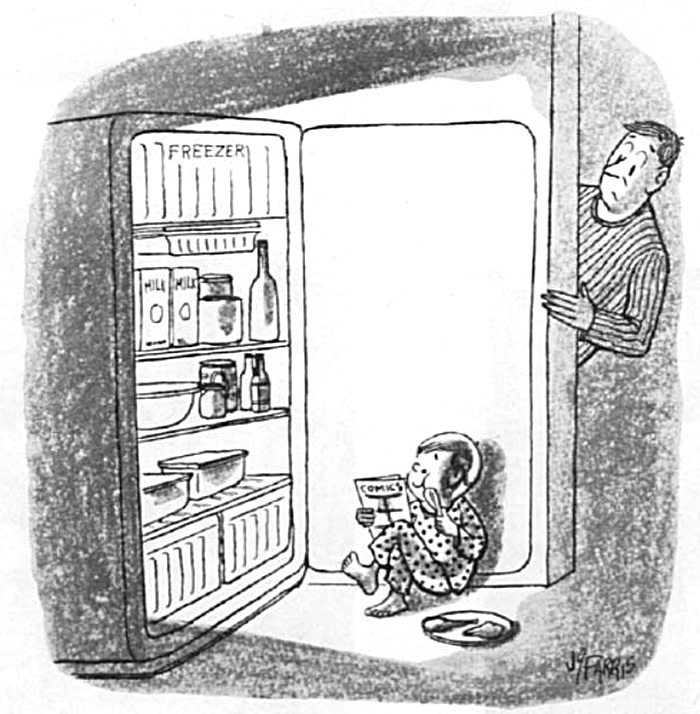
August 20, 1955

Scott Taber
August 17, 1957

Dan Q. Brown
August 3, 1957
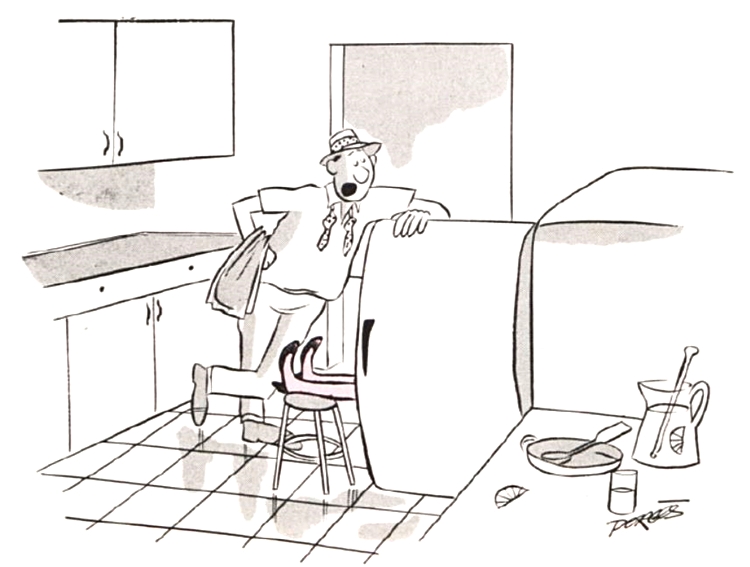
Paul Peter Porges
August 2, 1958

Larry Harris
June 9, 1951

Bob Barnes
January 16, 1960
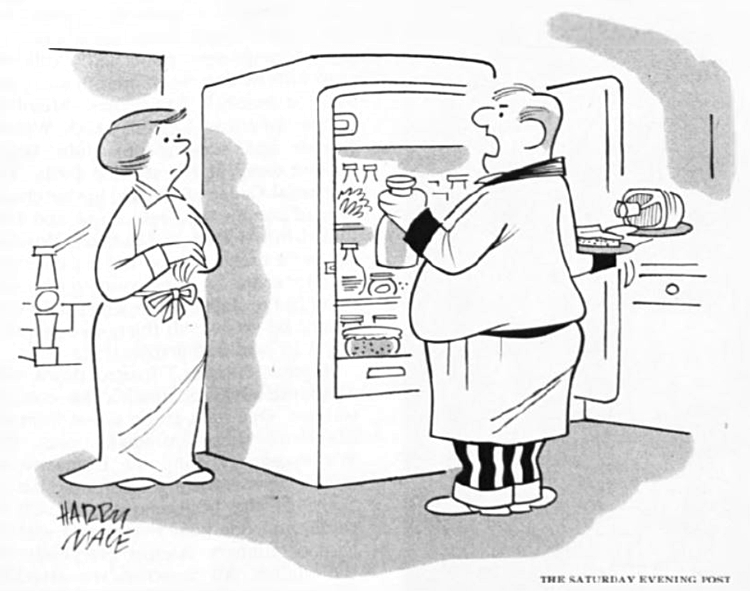
Harry Mace
November 1, 1958
Want even more laughs? Subscribe to the magazine for cartoons, art, inspiring stories, fiction, humor, and features from our archives.
The Fall of Saigon as Seen By a Journalist on the Ground
“I’m kind of feeling my 44 years at the moment,” New York Times foreign correspondent Malcolm Browne wrote to a friend after departing Saigon in April 1975. “This Vietnam stint was the most dangerous and exhausting one I had had there, and leaving the place (ignominiously, on an evacuation helicopter) tore some of my heart out.”
As Saigon fell to the North Vietnamese 50 years ago this month, Browne’s reporting and private correspondence illuminates the tragedy that befell South Vietnam and its people in those final days, shows the resiliency of its refugees, and serves as a useful juxtaposition with the very different but equally heartbreaking U.S. withdrawal from Afghanistan in 2021.
Browne was no stranger to groundbreaking political events. He had served in the Korean War; as a fledgling journalist, he covered the civil rights movement in the South and reported from Cuba on its new revolutionary state under Castro in the late 1950s and early 1960s. The Associated Press sent him to Vietnam in 1961, three years before the Gulf of Tonkin incident that vastly escalated U.S. involvement in the war. Browne’s 1963 photograph capturing Buddhist monk Thích Quảng Đức’s self-immolation remains one of the iconic images of the war.


During his first stint in Vietnam, from 1961-1965, Browne was stationed in Saigon as the Associated Press bureau chief. According to Pulitzer Prize-winning reporter Peter Arnett, who worked with Browne at the AP in Vietnam, Browne represented a shift within the industry. Unlike his fellow AP colleagues who, if they had attended college did so in the Midwest and often at state schools, Browne had graduated from Swarthmore with a degree in chemistry. He cut an imposing figure, towering over his fellow journalists at six-foot-three with wavy blonde hair. Aloof and intellectual, Browne was not “one of the boys,” noted Arnett. Moreover, Browne had the ear of newly appointed AP general manager Wes Gallagher, which also rankled his peers.
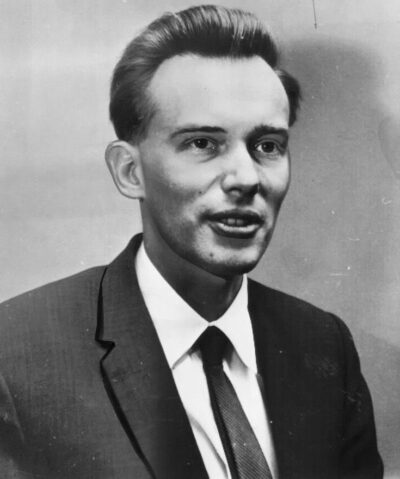

Browne tended to keep his own counsel, adopting an almost detached attitude while submitting 3,000-word stories on the AP wire, which the news organization published much to the annoyance of colleagues who believed the wire service should be providing shorter, more compact accounts, according to Arnett’s recounting in his book, Saigon Has Fallen.
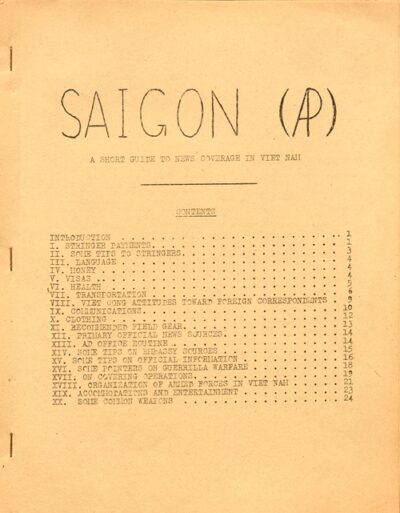
As bureau chief, Browne created the Associated Press Short Guide to News Coverage in Vietnam, a 25-page manual for reporters working within his unit. “If the military had anything similar, it would have been classified,” wrote Arnett. Browne’s work was highly regarded, and he shared the 1964 Pulitzer Prize with fellow foreign correspondent David Halberstam.
While in Saigon, Browne met Huynh thi Le Lieu (Le Lieu), who then worked for the Saigon government’s information ministry. They married in 1966, by which time he had left the AP.
According to Browne, in the late 1950s both the South and North Vietnamese governments recruited Le Lieu; she chose the southern regime but eventually grew disillusioned with its authoritarian turn, later joining the United States Information Service. The move, along with Browne’s sometimes withering coverage of the South Vietnamese government, left them under police surveillance and experiencing harassment, according to Browne’s book, Muddy Boots and Red Socks: A War Reporter’s Life. The Brownes left Vietnam in 1966.
By 1968, he had landed at the New York Times, where he spent the next several years covering events in South America, South Asia, and Eastern Europe. Le Lieu, too, worked for the newspaper as a talented photographer, often accompanying her husband and photographing the events he covered.
In mid-March 1975, the Times cabled Browne, who then was stationed in Belgrade in the former Yugoslavia, asking him to immediately head to Saigon. What followed for the Brownes was a chaotic, heart-rending abandonment of a country they both loved.
By early March of 1975, the North Vietnamese were relentlessly marching south. It became clear that they would be in Saigon soon and that in all likelihood the South Vietnamese government would fall in the near term. The Times wanted Browne on the ground if the capital fell. Having been blacklisted when he last left the country nearly a decade earlier, Browne negotiated his return upon arrival from the home of the United States embassy press chief, gaining entry only after helping a South Vietnamese official arrange his own departure from the country. He, Le Lieu, and fellow Times journalist Fox Butterfield spent the next several weeks working “20 hours a day like automata, dodging bullets, writing and trying to act human, all of it more by inertia than any remaining act of will,” Browne wrote to friends in May 1975. In several letters, Browne described their overall experience as “unmitigated hell.”
Reporting from Da Nang, they watched as boats and barges continually arrived, often carrying death. “On the deck of one barge we counted more than 50 bodies, mostly of children and old people, dead of hunger, thirst and exposure after nine days at sea,” Malcolm wrote to friends. The refugees’ attempt at escape was indicative of the dangers that would befall other Vietnamese people who followed during and after the war. Sometimes referred to as “boat people,” tens of thousands of Vietnamese took their chances on the open seas only to be preyed upon by pirates and the cruelties of nature. Thousands landed in overcrowded, often unsanitary tent city refugee camps in nearby countries.


“Le Lieu and I had a pretty harrowing time those last two months in Vietnam,” he wrote a friend, “and not only because of shells and rockets, but especially the wrench of personal ties.” Her mother, “too old and sick to have survived the ghastly voyage to Guam,” remained behind along with two of Le Lieu’s brothers and their families. Two other brothers with their families did evacuate with Le Lieu, but the couple left behind “thousands of others who had been close to us for so many years,” Browne wrote in a letter. Those who remained, including Le Lieu’s family, regretted it, living out hard lives under the new regime, Browne reflected years later.
The oppressive atmosphere took its toll. Relationships, whether enduring marriages or life-long friendships, were sorely tested. “There were times when even Le Lieu and I were at each other’s throats as we tried to sort problems out,” Browne recalled in his memoir. The final weeks, filled with “savagery and bitterness,” transformed “normally enlightened, fine people into mad dogs, robbing corpses, cutting throats to improve their own chances of survival,” he wrote to a friend shortly after. Cash bribes were common, and some Americans, “swine” by Browne’s account, “promised escape in exchange for money or gold or the sexual favors of women” only to disappear into the crowd. “The weeping of abandoned Vietnamese filled Tan Son Nhut [Airport’s] passenger terminal day and night,” he wrote.
Yet, there was heroism too.
As chronicled in the 2014 Oscar-nominated documentary, Last Days in Vietnam, the C.I.A. had established a black ops service, dubbed Air America, which ferried thousands of Vietnamese to the United States and elsewhere on countless flights in the final weeks before the shocking April 30 fall of Saigon. Air America was a rogue operation that threatened the careers of those involved, many of whom saw the issue in more elemental terms. “Sometimes there’s an issue not of legal or illegal, but of right and wrong,” former U.S. Army Captain Stuart Herrington told the documentarians.

With the Washington Post’s David Greenway, Browne helped dozens of Vietnamese working for the news agencies find seats on these outbound flights. Le Lieu often advised potential refugees on what to expect in America, emphasizing its “political and social greatness,” but also discussing language barriers and the inevitable racism they would encounter, Browne later wrote.
In late April, the North Vietnamese began closing in on Saigon, firing on departing planes and pockmarking the airport’s runway; it became impossible to fly out. The North Vietnamese assault led to horrific scenes as planes carrying hundreds of passengers exploded while taxiing or taking off while civilians ran along the tarmac hoping to jump onto a departing plane while dodging incoming fire.


Though a fictional account, Viet Than Nguyen’s unnamed narrator in his 2015 work, The Sympathizer, captures the horrific poetry of the moment. “Another explosion somewhere on the runway heightened the frenzy.…Men, women, and children caterwauled at an even higher pitch.…Another rocket exploded on the runway a few hundred meters behind us, lighting up the acre of tarmac.…A meteorite shower of rockets and artillery shells was falling on the runways, an apocalyptic light show.”
Reality, though perhaps lacking in description, matched The Sympathizer’s terrible ferocity. South Vietnamese civilian Nguyen Thi Lac remembered his experience laying prone on the ground as rockets fired all around them, the ground shaking and everyone around him crying, in the book Tears Before the Rain: An Oral History of the Fall of South Vietnam: “As I was lying there, I started thinking, ‘Oh no. We are going to die right here on the ground.’”
Nguyen managed to sprint to a nearby plane, scooping up an abandoned baby from the ground, rescuing it from being trampled, caring for it on the flight, and finally handing the child over to its young mother once they had reached the Philippines. The mother, “a teenager…all colorless and sick,” had abandoned the baby believing authorities would not let her leave if she still had it. She feared Nguyen would keep the boy, but instead, Nguyen picked up the baby and handed it to her, imploring her simply to “feed him now.” Despite his ordeal, Nguyen managed to maintain a sense of optimism. “I thought that maybe just the way that I held that little baby, now God would hold us. I started to see how wonderful it was to be alive.”

With the airport runway destroyed, Americans turned to thousands of helicopter lifts, carrying Vietnamese people to U.S. Naval vessels off the coast. Most of these trips were between the U.S. Embassy, besieged by Vietnamese desperate to leave, and the ships anchored offshore. Le Lieu had gotten out on April 28, boarding a flight for Hong Kong. Browne eventually found his way via helicopter to a U.S. supply ship. The numerous U.S. vessels were inundated by countless Vietnamese fishing boats and other ships, all hoping to leave their vessels for Naval ships. It was a scene Browne did not forget. “The sea was…strewn with fires and columns of smoke from scores of sampans, junks, and work boats that had put to sea seeking refuge,” Browne recounted in his memoir. “As navy ships picked people up from the little vessels, the Vietnamese fishermen were setting fire to their own boats.…it seemed like the end of the world.”
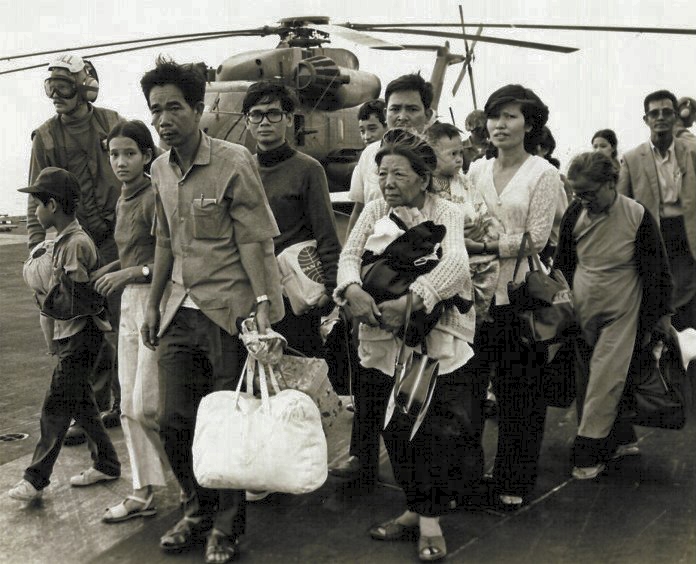

Between Air America and the endless helicopter flights, roughly 130,000 Vietnamese people were safely evacuated. That said, who got out and why was not determined in any orderly or just fashion. “The mass flight of Vietnamese, especially poor ones,” wrote Browne in a letter, “was not based on political considerations or anything rational, it was sheer panic.” While the vast majority of those who escaped deserved the opportunity, there were also a minority among them of drug traffickers, torturers, assassins, and other “undesirables,” some of whom had participated in the C.I.A.’s notorious Phoenix Program during the war.
One of the families Browne helped to evacuate was Times employee Vo Tuan Chan and his wife, Thuy. When Vo’s family did reach the United States, they shuttled from camp to camp along the West Coast. By June, they had established residence in Jamaica Queens. To its credit, the New York Times footed much of the bill for their stay in California and provided them with cash and a temporary job. Vo thanked the Brownes for their help and the Times’ “generous gift.” Amidst it all, he remained philosophical. “[The] [m]ost important thing for us is having enough clothes to wear in winter,” he wrote. Besides, he added, “[o]n top of that my wife is pregnant.”
Reflecting on his departure from Vietnam, Browne lamented its fall. “Much though I sometimes hated the evils of the place, I found in the end that my roots were deeper in Indochina than any other place in the world, and I was crying like a school boy when I said my last goodbyes.”
From 1975 to 1979, roughly 300,000 Vietnamese people made their way to the U.S., establishing themselves in cities and suburbs across the nation, from Little Saigon in Orange County to Eden Center in Northern Virginia, shaping American culture and politics in countless ways. For Vo Tuan Chan, the tragic year ended brightly with the birth of a baby boy.
Born at 8:28 am. Saturday December 6. At nearly 8 pounds and 17 inches, the child was a “big boy” especially since his mother was only 4 11’ and less than 100 pounds. They named him Vo Tuan Chan Viet, “Viet reminds all of us of our origin,” he wrote Browne, “Chan-Viet expresses our hope that he’ll do something for and/or in Vietnam.”
In 2021, 46 years after the fall of Saigon, the present echoed the past when the U.S. withdrew its forces from Afghanistan, hastening the collapse of the Afghan National Security Forces and the takeover of the Islamic fundamentalist Taliban, thus marking the end of yet another long and painful war.
To be clear, 2021 Afghanistan is not 1975 Saigon: They are different countries, different eras, and different people. Yet they share commonalities. Each nation had ousted a global power before U.S. involvement: the French in Vietnam and the former USSR in Afghanistan. Vietnam had been America’s longest war until Afghanistan displaced it, and both were, in the long term, bipartisan military adventures that turned tragic.
Plenty of voices warned that both efforts would inevitably end in failure; whatever one believes in this regard does not obscure the tragedy of withdrawal for Vietnamese and Afghans, particularly those that aided U.S. forces. In both cases, those left behind endured harder lives than those who escaped. American promises, while perhaps sincere in each case, went unfulfilled. A second chance to start over anew in America might have been the best we could offer, and yet, for many, even in that, the United States failed to deliver.
What We’re Reading This Spring
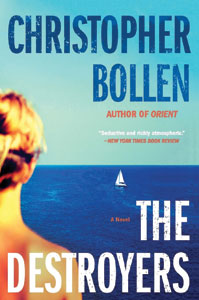
The Destroyers
by Christopher Bollen
Broke and fleeing scandal, a now fatherless Ian Bledsoe escapes to the Greek island of Patmos, where his friend Charlie offers him a lifeline — a high-level job in his yachting business — and introduces him to a cluster of extravagant friends who are drawn to Charlie’s wealth and charisma. The morning after a tense dinner party, Charlie is nowhere to be found. Ian makes it his mission to find his friend but discovers that the island’s beauty is hiding something sinister. Bollen has created a tense literary thriller that examines what extreme wealth and familial expectations can drive people to do.
 God’s Smuggler
by Andrew van der Bijl
First published in English in 1967, God’s Smuggler is the real-life story of how Dutch missionary Andrew van der Bijl smuggled Bibles behind the Iron Curtain. Affectionately nicknamed “Brother Andrew,” he took on the yeoman’s task of sneaking himself and his Bibles into Soviet Bloc countries … and ultimately into the heart of Russia. The account details many of the challenges he and his team faced, from circumventing border security to translating the Bibles into each country’s native language. His tale serves as a stark reminder of the importance of our religious freedoms and that true faith calls us to action.
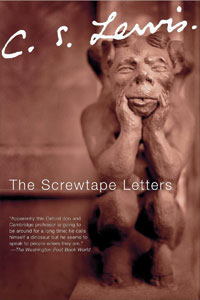 The Screwtape Letters
by C.S. Lewis
In 1942’s The Screwtape Letters, C.S. Lewis — more well-known these days for his Narnia books — imagines a series of letters written by an experienced demon, Screwtape, to his young protegé and nephew Wormwood. Screwtape’s ultimate goal: To teach Wormwood how to manipulate human beings — by taking advantage of human weaknesses like selfishness and a lack of self-awareness — into damning their own souls to eternal hell. Through this odd epistolary, Lewis explores themes of benevolence, kindness, and forgiveness and contrasts them with their importance relative to man’s ideas of sin and Satan, as relevant today as it was more than 80 years ago.
This article is featured in the May/June 2025 issue of The Saturday Evening Post. Subscribe to the magazine for more art, inspiring stories, fiction, humor, and features from our archives.
Missing in History: Civil War Glass-Ceiling-Buster Mary Edwards Walker
“It is the times which are behind me”1
Today there’s nothing unusual about women wearing slacks or voting during elections. All that was forbidden in the 19th century when Dr. Mary Edwards Walker shocked others by refusing to wear corsets, dressing in long pants and demanding women’s right to vote.
The concepts of duty and doing the right thing led Walker to spend her life protesting society’s restrictions on women. Born on November 26, 1832, her parents’ progressive ideas on gender and racial equality inspired Mary to question social injustices and restrictive laws, as told in Sara Latta’s book, I Could Not Do Otherwise: The Remarkable Life of Dr. Mary Edwards Walker.
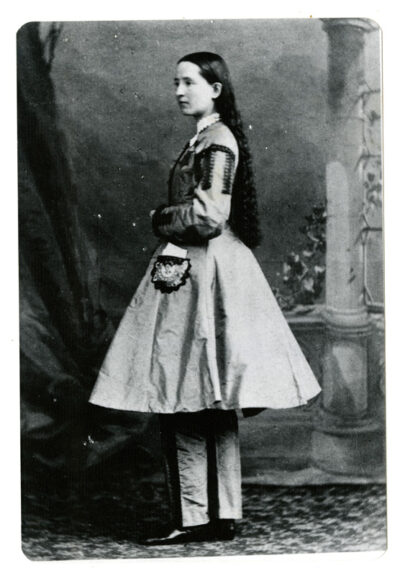
As a teenager working on the family farm, she refused to wear a corset. “No, sir; my waist has never been confined in one of those steel traps; it is just as natured intended it should be – free and unconfined,” Walker later told an interviewer. After teaching school in Minetto, New York, Walker paid her way through Syracuse Medical College despite the bias against woman doctors.
In contrast to conventional medical schools which recommended primitive “cures” like blood-letting and harmful medicines like mercury, the Syracuse Medical College endorsed a type of training known as “eclecticism,” which used herbals and hydrotherapy. (4) There, Walker met fellow free thinker and medical student Albert Miller and married him on November 16, 1855, but refused to use “obey” in her wedding vows and kept her maiden name.
She and Miller started a medical practice in Rome, New York. To fully examine and treat patients meant she had to bend, stoop, or lean over them, but found her long skirts an impediment. To remedy that she shortened her skirts, wore long loose pants beneath them, and joined the feminist dress reform movement begun by Amelia Bloomer. To Walker free-fitting clothes were important to women’s health. She proclaimed, “The snug fit of the waist of the Dress or corsets prevents freedom of motion, of respiration, digestions…circulation of the blood,” according to Latta’s book.
By 1859, after discovering her husband’s infidelity, she filed for divorce and relocated her practice elsewhere in Rome. That same year she began writing on abolition and dress reform for the feminist periodical, The Sibyl: A Review of the Tastes, Errors, and Fashions of Society.
Soon after the start of the Civil War, she tried to join the army as a surgeon. Denied because of her gender, Walker volunteered as a surgeon at a temporary hospital at the U.S. Patent Office. While there, she established the Women’s Relief Organization to aid those visiting wounded husbands and sons. By then she had abandoned bloomers for mid-length skirts worn over trousers and wore her curly hair long to affirm her identity as a woman.

Over the next year Walker cared for soldiers in Warrenton and Fredericksburg, Virginia and then Chattanooga, Tennessee to care for men wounded at the battle of Chickamauga. There, General Henry Thomas, having heard about her outstanding medical and organizational skills, appointed her to the 52nd Ohio Infantry, making her the first female surgeon to be appointed by the U.S. Army. Walker often crossed into enemy territory to heal wounded soldiers and sick citizens.
On April 10, 1864, just after helping a Confederate surgeon with the amputation of a soldier’s leg, she was arrested on charges of espionage and brought to the notorious Castle Thunder jail in Richmond, Viriginia. Upon her release from prison that August, Walker was weak, near starvation, and suffering from an eye infection. After the end of the war, Walker received a disability pension of $8.50 a month for partial muscular atrophy from her time in prison. On November 11, 1865, President Andrew Jackson awarded her the Congressional Medal of Honor, making her the first woman to receive the prestigious award.
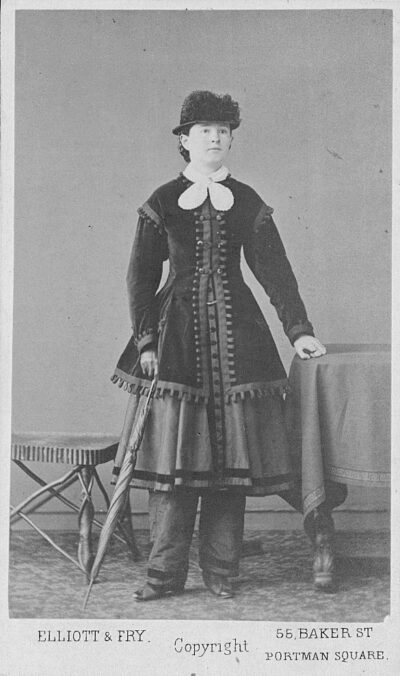
Walker’s eyes were so badly damaged that she no longer practiced medicine and instead focused her energies on dress reform. While arrested in New York, New Orleans, and Kansas City for wearing men’s trousers and overcoats, she continued to press for sensible women’s clothing.
When heckled about her mannish attire, she retorted, “I don’t wear men’s clothes, I wear my own clothes.” In 1870, she worked with the Central Women’s Suffrage Bureau in Washington, D.C. and unsuccessfully supported mass registration for women to vote, according to the book, Mary Edwards Walker: The Only Female Medal of Honor Recipient. A year later she published Hit: Essays on Women’s Rights. Even more sensational was her 1878 book Unmasked or, The Science of Immorality: to Gentlemen, which discussed taboo subjects about human sexuality, including men’s abuse of a woman’s body. “Men treat women as though they had not a single right of existence and but for … sexual gratification, they would not be allowed to live,” she proclaimed in the book’s introduction.
A devoted supporter of the suffrage movement, Walker published “Crowning Constitutional Argument” in 1873 claiming the Constitution gave women the right to vote. In contrast, the feminist leaders of the National Woman Suffrage Association (NWSA) insisted upon the need for a separate Constitutional amendment. Their differing views caused them to part ways.
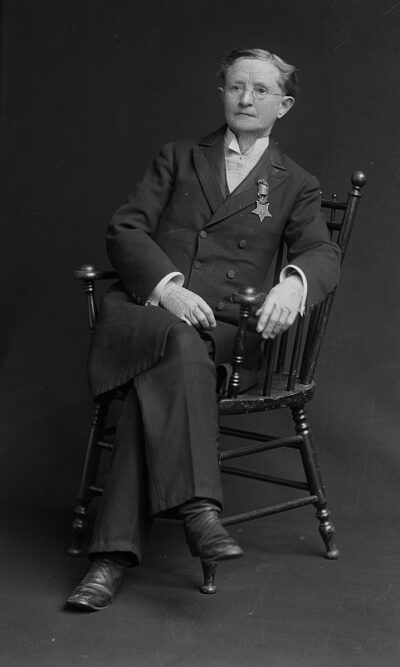
As she aged, Walker’s photos revealed a trim, bespectacled figure, dressed in a man’s shirt, a long waistcoat, trousers, and an occasional top hat, but always with the the bronze Medal of Honor pinned to her lapel. In 1917, after Congress revised standards for the medal for those only in actual combat, Walker’s medal was revoked along with 910 others. Appalled, she petitioned the army generals to reconsider. When they dismissed her plea and demanded she return the medal, she refused.
Instead, Walker continued to wear the medal every day of her life until her death on February 22, 1919, at age 87.
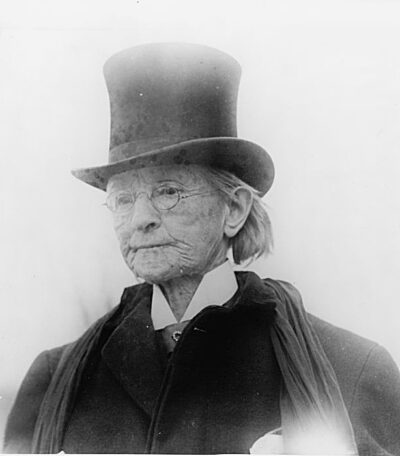
In 1977, Walker’s medal was posthumously reinstated during President Jimmy Carter’s administration through the Army’s Assistant Secretary of Manpower and Reserve Affairs by the Board for Corrections of Military Records.
Other Honors
- During World War II, a Liberty ship, the S.S. Mary Walker, was named for her
- A U.S. Postal Stamp was issued in her honor during the war
- Walker was inducted into the Women’s Hall of Fame in 2000
- Walker was honored with a 2024 American Women Quarter
The Nostalgia for Lost Computer Sounds of the 1990s and 2000s
If you used a computer in the 1990s or 2000s, you probably remember how they sounded.
These noises ran the gamut from the scratchy whirs and beeps of dial-up internet, to the trademarked start-up sound of Microsoft’s Windows operating system, the happy dings of MSN Messenger, or even the pffts and zaps of a dot-matrix printer. Computing remains a sonic experience, with people responding with joy or dread, depending on which sound issues from their device.
People seem to be wired for noise, at a basic level. But it’s not just the need for any kind of background hum.
As neuroscientists have discovered, music and other comforting sounds can help trigger memories in people in profound ways. This is sometimes referred to as “music-evoked autobiographical memory,” and it can even be involuntarily induced. Music can be a particularly effective treatment for certain kinds of memory loss, drawing on something from deep within our minds.
According to a Reddit commentator from the early 2020s, “I can still hear the fans cranking up” on his old PC; the sounds of old operating systems can similarly drive nostalgic reflection, with another remarking that “it’s so calming and welcoming” to hear those once more.
Our brains need sound, but particularly the kind that makes us feel good. So, could the tinny, other-worldly sounds from your old Commodore 64 actually improve your well-being?
Nostalgia for an Old-Fashioned Future
Older technologies — including computers — often trigger desire for a future that looks like the past.
There may just be something inherently more comfortable about imagining a future in which fedoras make a non-ironic return and Art Deco designs are commonplace. It’s at least more optimistic than some of sci fi’s grimmer manifestations.
A positive insistence on the resilience, and even the goodness, of older physical technologies is part of their appeal. This sense of “materiality” of real things and their real presence seems to ground some people during the massive transformations that new technologies portend. Case in point: Many of us remain worried about artificial intelligence, and what it may do to not just our jobs, but our art.
The desire for a more analogue take on the future can be seen in the return of record players and records (the “vinyl revival”) or the millennial fascination with pens and stationary, and a general revulsion to the idea of a fully disembodied future.
The negative reaction to Apple’s ill-advised 2024 ad, “Crush,” which showed beloved analog instruments and devices being crushed into the form of an iPad, is a lesson on the deep-seated love for tangible things that seems to have endured. Samsung made its own ad in response to Apple, featuring a woman playing a busted guitar (implied, in fact, to be a survivor from the Crush ad).
What Lost Computers Sounds Mean for Us Today
The sounds of our youth are tied to memories of supposedly simple times, and to a hopeful belief that machines like computers could make our futures better. Now that our reality is messier, nostalgia for bygone tech can be a calming way to reframe current anxieties. The beeps and pings of yesteryear were mundane, but familiar. They can help fuel a generational nostalgia, even for those who didn’t live through that period.
That’s not a bad thing, as long as we don’t fall for the trap that the past was always a better place. It wasn’t.
Instead, it may be helpful to imagine what kinds of technologies (and their sounds) that might be missed in the future. Perhaps the contained roar of a gas-fueled car starting up (or a hybrid’s low purr), or the whir and whoosh of a dishwasher that’s not connected to the internet in any way, will drive us to a weird kind of wistfulness for the mid-2020s. Or maybe we’ll all be glad we just made it through the decade. It’s hard to predict what we’ll be nostalgic about later. Maybe what counts as nostalgia will change. That’s okay too.
Nostalgia, like anything else, needs to take its time and not show up too soon.
January/February 2025 Limerick Laughs Winner and Runners-up
A club-going plenipotentiary
Is not what you might call adventure-y.
He is quiet, composed,
And is not predisposed
To the yak of the 21st century.
Congratulations to Jeff Foster of San Francisco, California, who won $25 for this limerick based on Transistor Radio in the University Club, James Williamson’s Post cover from September 29, 1962.
If you’d like to enter the Limerick Laughs Contest for our upcoming issue, submit your limerick via our online entry form.
Here are some of our other favorite limericks from this contest, in no particular order:
’Tis a lounge of the noble befit.
There’s no laughter, no words, and no wit.
Lord forbid if some noise
Should startle the boys
And their contest of who can out-sit.—Gennadiy Gurariy, Athens, Ohio
The boy’s manners of course were remiss,
And detracted from otherwise bliss.
But he hadn’t a care
As the club’s richest heir
Since it’s his derriere they must kiss.—Tommy Cardigan, Saint James, Missouri
Am I hearing a raucous refrain?
These young folks can be such a pain.
With speech interdicted,
Our response is restricted
To expressions of tacit disdain.—Jim Johnston, Poland, Ohio
The music the young man was playing
Annoyed the club gents who were graying.
They begged the young mister,
“Turn down that transistor!”
A plea he could not hear them saying.—Justin O’Connor, Leeds, Massachusetts
I’m afraid I cannot interfere,
Though the breaking of rules is severe.
For you see, I’m aware,
That the boy in the chair,
Is the son of the richest man here.
—Jeanne Kaufman, Boulder, Colorado
With all due respect (seems you lack it),
Please dispense with this pestilent racket.
In the interest of silence
Turn off your appliance.
While you’re at it, I suggest lose the jacket.—Skip Russell, Venice, Florida
I don’t know why they said it was wrong.
I was playing a popular song.
And they should remember
That I’m a new member,
Although I may not be for long.—Ronald Vavak, Los Alamitos-Seal, California
“That young man slouching there, all alone,
Seems to talk to himself in a drone.
Tell me, Jeeves, is he mad?”
“Oh, sir, no. It’s a fad.
He is using what they call ‘a phone.’”—Rudy Landesman, New York City, New York
You can groove to your radio’s sound
On your bed, on a bench, on the ground,
But I say what’s the point
If you’re not in a joint
Where you’ll turn a few eyeballs around?—Mark L. Levinson, Herzliya, Israel
News of the Week: Dark City Dames, Baseball Chatter, and Please Don’t Try the Kool-Aid Man Challenge
Read This!
Here are six new books you might want to pick up (and maybe even read after they’re picked up).
Class Clown by Dave Barry. The subtitle for this book by the humorist is “The Memoirs of a Professional Wiseass: How I Went 77 Years Without Growing Up,” and that pretty much describes it.
All the Other Mothers Hate Me by Sarah Harman. A novel about an ex-party girl/rock band member and single mom who decides to investigate when her son is suspected in the disappearance of the rich school bully.
Dark City Dames by Eddie Muller. A beautiful revised and expanded edition of the book by the host of TCM’s Noir Alley and Film Noir Foundation founder. It features interviews with such classic noir actresses as Audrey Totter, Marie Windsor, Ann Savage, Evelyn Keyes, Jane Greer, and Coleen Gray.
Notes to John by Joan Didion. This posthumous work contains notes that Didion wrote to her husband John Gregory Dunne after sessions with a psychiatrist. They were found in a filing cabinet in her office in 2021. (Didion wrote several pieces for the Post.)
The Catastrophe Hour by Meghan Daum. A collection of sharp and elegant essays on such topics as death, money, friendship, dating, and music.
The Business of Being a Writer by Jane Friedman. If you need an all-in-one guide to the modern publishing landscape, you won’t find a better guide than Friedman. (This is an update of an earlier book.)
I Want to Enjoy Baseball Again But I’m Too Lazy
I recently told you that I used to be Babe Ruth.
That was when I was a kid and obsessed with baseball. I played baseball all the time (left fielder and pitcher), watched every Red Sox game, bought baseball cards, bought baseball magazines, and even kept track of games in a scorebook. I cried when the Red Sox failed to win the World Series in 1975 and cried when they finally won it in 2004.
So why does baseball leave me cold now?
Two things: One, I started to play tennis as an adult and that’s now my new obsession (watching it, since I haven’t played in several years). And two, I don’t know anyone on the Red Sox team, and they haven’t done well enough the past several years for me to really pay attention to them.
Garrett Crochet? Trevor Story? Walker Buehler?
Who are these people?
Maybe I’m just a fair-weather fan (which is ironic because I’m not a fan of fair weather) and too lazy to get into baseball again. But if the Red Sox start winning and they get into the playoffs and even the World Series? I’ll start watching.
Oh Yeah!
In some ways, maybe the internet was a mistake?
There’s a new viral challenge going around online, and this time it’s based on old TV commercials. The Kool-Aid Man Challenge takes its cue from the ads where the rotund pitcher of Kool-Aid would surprise everyone by crashing through a wall. Kids are doing the same thing (though not dressed as a pitcher) and violently crashing through fences, vandalizing private property, and probably hurting themselves in the process.
I guess it’s better than the Tide Pod Challenge, but just barely.
Look, if you young people want to do a viral challenge based on a TV commercial, may I suggest the Charmin Challenge? You go into a supermarket and secretly squeeze toilet paper and run out before anyone catches you.
Headline of the Week
“Michigan Man Escapes Quicksand with No Injuries – and a New Girlfriend”
RIP Pope Francis, Will Hutchins, Roy Thomas Baker, Nino Tempo, Don Mischer, Mike Patrick, Mac Gayden, and Patrick Adiarte
Pope Francis – born Jorge Mario Bergoglio – was the first Jesuit and Latin American pontiff. He died Monday at the age of 88.
Will Hutchins starred in the western Sugarfoot, the sitcoms Blondie (he was Dagwood) and Hey, Landlord, and appeared in such movies as No Time for Sergeants and Clambake. He died Monday at the age of 94.
Roy Thomas Baker produced classic albums for such rock bands as Queen, The Cars, Foreigner, Journey, Cheap Trick, and Devo. He died this week at the age of 78.
Nino Tempo had a number-one hit duet with his sister April Stevens in 1963, “Deep Purple.” He started as a child singer with Benny Goodman and played on the albums of other musicians, including Frank Sinatra and John Lennon. He died earlier this month at the age of 90.
Uploaded to YouTube by Daily Doo Wop
Don Mischer produced and/or directed an astounding number of TV shows and specials, including Super Bowl halftime shows featuring Michael Jackson and Prince, Olympic opening ceremonies, Disney specials, Kennedy Center Honors, and Oscar and Emmy telecasts. He died earlier this month at the age of 85.
Mike Patrick was an ESPN play-by-play man and commentator for Sunday Night Football and college sports for over 35 years. He died Sunday at the age of 80.
Mac Gayden was the Nashville guitarist who played with Bob Dylan and co-wrote the classic pop song “Everlasting Love.” He died last week at the age of 83.
Patrick Adiarte appeared in the stage and film versions of The King & I and Flower Drum Song. On TV he appeared on such shows as M*A*S*H and The Brady Bunch (he’s the guy who guides the family in the classic Hawaii episodes). He died last week at the age of 82.
This Week in History
Mae West Sentenced to Jail (April 19, 1927)
Religious groups complained about West’s play Sex and the theater was raided, with several members of the production arrested including West. She was sentenced to ten days in jail but only served eight (she could have just paid a fine but wanted the publicity).
YouTube Launches (April 23, 2005)
Yup, the video site is now 20 years old. There are 20 million new videos uploaded to the site every single day. Here’s the very first one.
Uploaded to YouTube by jawed
This Week in Saturday Evening Post History: “Grandma Catches Fly-Ball” by Richard Sargent (April 23, 1960)

All of the women in this scene look ecstatic while the men … not so much.
Take Me Out to the Ball Game
Hey, I might not watch baseball anymore, but that doesn’t mean I can’t eat the food associated with it.
Jeff Mauro has a recipe for Chicago-Style Hot Dogs, while Rachael Ray has Ballpark Pretzel-Bun Burgers. For a slightly different burger, try these Sweet Hawaiian Mini Burgers from The Beef Checkoff.
Taste of Home has recipes for Homemade Corn Dogs, Texas Chili Fries, and something called Walking Tacos. Ambs Loves Food has Ballpark Beef Nachos. And for a snack/dessert, Delish has these Copycat Klondike Bars and Misfits Market has Ballpark Peanut Popcorn (a.k.a. Homemade Cracker Jack).
Next Week’s Holidays and Events
Morse Code Day (April 27)
Or, if you want to say “Morse Code Day” another way: — — .-. … . / -.-. — -.. . / -.. .- -.–
Mother Goose Day (May 1)
The origin of the term “Mother Goose” actually dates from the 17th century.
Review: Cheech & Chong’s Last Movie — Movies for the Rest of Us with Bill Newcott
Cheech & Chong’s Last Movie
⭐️ ⭐️ ⭐️
Rating: R
Run Time: 2 hours 3 minutes
Stars: Tommy Chong, Cheech Marin
Director: David Bushell
If ever there were artists who were specifically, indelibly a product of their time, that would be the comedy team Cheech & Chong, whose stoned, defiantly profane celebration of America’s 1970s drug culture cruised through the period’s social barriers with bleary-eyed, munchie-chomping, doobie-lighting glee.
The Vietnam War draft was plucking young men off America’s streets, U.S. public figures were repeated targets for gunmen, and women were protesting just to get equal pay — but above them floated Cheech & Chong, oblivious to it all, wrapped in a protective, permanent purple haze.
Cheech Marin and Tommy Chong were the first rock and roll comic act (Bruce Springsteen opened for them). Their movies made more than $200 million at the box office (equal to some $1.6 billion today). Their record albums sold in the millions, and — perhaps uniquely for a comedy team — their singles (“Basketball Jones Featuring Tyrone Shoelaces,” “Sister Mary Elephant”) rocketed up nationwide Top 40 radio playlists.
Cheech & Chong’s Last Movie — mostly a career-spanning documentary; partly a feisty onscreen reunion — does not try to make the case that the team’s classic routines and rambling movies have much to say to 21st Century Audiences. But Cheech & Chong were unquestionably a cultural fulcrum, launching decades’ worth of memorable stoner characters from Jeff Bridges’ Big Lebowski to Otto, The Simpsons’ dazed and confused school bus driver.
Produced and directed by David Bushell (Dallas Buyers’ Club, Eternal Sunshine of the Spotless Mind), the film opens with present day Marin and Chong rambling along a two-lane southwestern desert road in a ridiculously large black sedan with a silver cannabis hood ornament and a California “KP SMOKIN” license plate.
Their initial conversation is worthy of Samuel Beckett:
“Where in the desert, Tommy?” asks Marin, who’s behind the wheel.
“I don’t know, man” says Chong. “He just said the desert.”
“Well, the desert’s a big place.”
“He told me…he said something about a joint.”
They drive on for a beat.
“A joint,” Marin mutters. “Well, you got a joint?”
Turns out Chong, uncharacteristically, has no joint. But he scrounges under the passenger seat and comes up with some gummies, which the two casually ingest.
One can imagine the conversation as a pot-fueled adlibbed exchange from Up in Smoke or Still Smokin’. But decades later, the pair are mellow in different ways: Marin is 78, Chong is 86 (one of his daughters, Robbi, is the film’s producer). They’ve struggled, thrived, fought, split up, reunited, and split up again countless times in the past 50 years — and judging by some of the dialogue documented here, many of those old wounds remain raw.
Almost immediately, the film enters biographical mode. The guys talk candidly about their childhoods — Chong relating early encounters with racism; Marin recalling his sometimes-violent relationship with his father, a Los Angeles cop, and his difficult decision to move to Canada to escape the draft.
They meet up as members of a Canadian improv comedy group. Soon, they discover, of all the material they perform on stage, what gets by far the biggest laughs is drug humor.
Both Cheech and Chong like drugs. And they like laughter. Their formula is set.
There’s almost no footage of the team’s early performances, so vintage sound recordings are matched with animation. In the best Hollywood tradition, after years of struggle and abject poverty, they become overnight sensations thanks to savvy promotion from record producer Lou Adler, who manages to get their first single placed on radio stations nationwide.
Among the charming conceits of Last Movie is the choice to have Cheech & Chong occasionally pull over to the side of their desert highway to “pick up” figures from their past. Those hitching rides in the boys’ back seat include Adler, both of Chong’s wives — and, for one hilarious line, Thomas K. Avildsen, the film editor who was tapped to be the nominal director of the pair’s third, and largely unsuccessful, film.
As you can imagine, those backseat visits can get a little uncomfortable. Adler is happy to ride along while the story arc follows the team’s early success — and his essential role in it. But he says, “This is where I get off,” as the tale turns to Cheech & Chong’s first movie contract — negotiated by Adler — which paid them $25,000 each. The movie grossed more than $100 million.
Despite its unnecessarily long run time, Cheech & Chong’s Last Movie reaches its climax with unwelcome abruptness, just as the pair are beginning to explore the roots of their often-antagonistic relationship. Still, there is undeniable satisfaction in seeing the two old friends stroll into the distance, having finally found the joint in the desert they’ve been looking for.
Barely visible on the screen, Marin pauses by a parked motorcycle.
“Is this Dave’s bike?” he asks.
If you need that joke explained to you, then you might not be the target audience for Cheech & Chong’s Last Movie.
Magic of the the Great Smoky Mountains
To find the kinds of places where rare synchronous fireflies might light the night, you drive west from the North Carolina hamlet of Maggie Valley, turn onto Newfound Gap Road (US 441), and turn again onto one of the many low-lying pull-offs edging this scenic route across the Great Smoky Mountains.
You turn off your headlights, you sit in your car, and you wait a while.
“You need to be patient,” Becky Nichols, Great Smoky Mountains National Park entomologist, tells me. “Look deep into the forest. Let your eyes adjust to the dark, especially around moist, leafy areas.” Or, you can get out of your car and wander down to the stream. If you wait long enough, for a few weeks in late May or early June, specifically between the hours of 9:30 and 11:30 p.m., you just might see them.
They are well worth the wait. On an inky-dark night in late May 2024, my sister and I stood watching this ephemeral wonder: first, a few flickers deep in the woods, and then, thousands of fireflies pulsing their tiny yellow-white lanterns, synced perfectly. It was thrilling and mesmerizing witnessing Photinus carolinus, one of 19 known species of fireflies to live in the Smokies. But what makes these so special is that they are just one of a few species in the world to synchronize their flash patterns. Driving back to the cabin we were sharing about 40 miles from Asheville, my sister and I marveled that of the more than 2,000 species of fireflies, only three are synchronous. Not only had we been lucky enough to see one, we’d shared the experience together.
But four months later, on Friday, September 27, Hurricane Helene barreled through North Carolina, bringing historic rainfall and catastrophic flooding. By December, at least 238 deaths and $124 billion in damage had been attributed to the storm. Extreme winds devasted once-tranquil forests in the Blue Ridge Mountains north of Asheville, and washed-out roads stranded even the hardiest residents. The severe damage to these areas, the region’s worst natural disaster in over a century, is widely known.
The same cannot be said about the forests and valleys just an hour west, in the Great Smoky Mountains. I worried about the rare fireflies we’d witnessed and wondered whether flooding might have wiped out their populations forever. I also worried about the friendly folks my sister and I had met during our travels. Most of the restaurants, diners, museums, and shops in the small mountain towns of western North Carolina are authentic mom-and-pops, relying heavily on seasonal visitors.
“As far as fireflies are concerned, the larvae live underground for a year before they pupate as adults. Undoubtedly there is going to be some impact, especially in the eastern corner of the park, which got hit the worst,” Nichols says, a few months after the storm. “They tend to be in areas with a lot of nice, deep forest leaf litter. If they’re close to streams that flow through the valley, well, all of those streams came way out of their banks. The low-lying areas on the North Carolina side of the park were inundated. So yes, I would expect there will be some impact from the storm, but there will be enough reserves of other larvae. They’ll come back.”

And what about America’s most-visited national park itself, with its ridges upon ridges of forest and ancient mountains straddling Tennessee and North Carolina? While most of the park was far west enough of Helene’s path to escape much flooding, its eastern edges were swamped.
“I live in Asheville but work in the Smokies,” says Joe Yarkovich, a wildlife biologist for Great Smoky Mountains National Park. Although there was significant damage in western North Carolina, “everything in the park got hit way less hard than what you saw around Asheville. There were trees down, and there was some flooding, but if you want to plan a hiking or camping trip in the Smokies this spring, it’s totally doable. Folks don’t realize it, but about 90 percent of the park has reopened.”
Yarkovich, also known as “The Elk Guy,” monitors the Smokies’ fledgling elk population, which has grown to nearly 270 ungulates since 52 elk were successfully reintroduced in the park’s Cataloochee Valley in 2001. Even before the storm, few visitors ventured to the remote Cataloochee Valley side of the park, where my sister and I cautiously maneuvered our rental car up a winding gravel mountain road (without guardrails) to check out the rewilded elk.
It was also here, deep in the dark woods one starlit night, that we found the rare synchronous and even a few “blue ghost” fireflies, the only firefly species in North America that emits blue light … with the help of a wonderful local guide who made us pledge to never reveal the tiny insects’ exact location.
I pledge this vow of secrecy,
so they may live in synchronicity,
forever here until eternity,
my college-professor sister and I solemnly swore, like 60-year-old Girl Scouts. Our guide needn’t have worried. The route was so convoluted in the dark, we couldn’t have retraced it if our lives depended on it. The next day we returned two hours before sunset to see the elk, which were honestly a bit anticlimactic, but still notable since their successful reintroduction in North Carolina. Elk once freely roamed the southern Appalachians before vanishing in the mid-1800s due to relentless hunting and destruction of habitat.


I was concerned about the elk, too, after hearing that Cataloochee Road would be closed indefinitely after Hurricane Helene. But it turns out elk are about as resilient as Appalachian mountain folk.
“As far as the elk population goes, all they had to do was walk uphill and wait for the water to go back down. Believe me, they’re fine,” Yarkovich assures me.
The best place to see these intrepid elk while Cataloochee is closed (the mountain road is undamaged but the road through the lower Cataloochee Valley washed out) is the Oconaluftee side of the park, about a half-hour drive east of Maggie Valley. Even though parts of western North Carolina were heavily impacted by the storm, this spring — specifically May and June — should be an ideal time to plan a trip.
“Stop in at the Oconaluftee Visitor Center,” says Yarkovich. “It’s a great place for wildlife viewing, and there will be a lot happening: the bears are active in spring, and June is elk-calving season. Once the calves get up and start running around testing their legs, it’s very fun to see them. And depending on what kind of hike you’re looking for, the folks there can point out the best trails.”
Western North Carolina’s trout-rich waters have long been a fly-fishing haven. But what about the mountains’ secluded streams and wild fish populations? Would they have been pummeled or, even worse, washed away by Helene’s flooding?
“We’re still covered in trout,” Powell Wheeler, fisheries biologist for North Carolina’s Resources Commission, reassures me. “We have three species here: rainbow, brown trout, and brook trout. Brook trout are the most special to us; they’re our native trout.”
As a fish biologist, Wheeler thinks in terms of fish populations and says that, this spring, the region’s rivers and streams will be fine for fishing. “Even with this level of catastrophic flooding, stream fish are extremely adaptable. It always amazes me that such a delicate-seeming animal can be so resilient.”
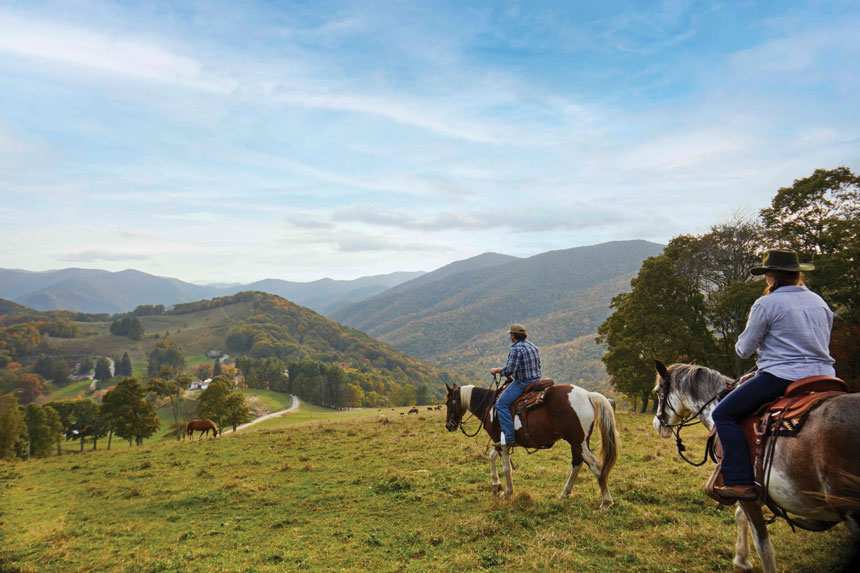
Annie Colquitt, co-owner of Cataloochee Ranch, a 685-acre Smoky Mountain landmark founded nearly a hundred years ago, agrees that spring and fall will not only be crucial for the area’s recovery but excellent times to visit, especially with crowds down. The ranch, which sits at 4,800 feet in a mountain meadow with sweeping vistas, had some trees topple, but no major damage.
“Our first concern was getting in touch with our employees — all were safe,” Colquitt says of the storm. “Next, we started looking at how we could help the region stay strong. We realized that, in the end, what makes Cataloochee so special is not just the place, but the people. Mountain people are the kind of people who show up with chainsaws to help.”
Colquitt and her husband, David, decided to be hugely generous, committing $2 million over the year to the community’s recovery and rebuilding effort. “We wanted to go big because it’s very needed here,” Colquitt says.
The ranch’s chicly restored 1930s cabins and new lodge rooms are open and guest-ready. If you’re staying elsewhere in the valley, you can also drive up to Cataloochee for lunch or dinner at Switchback, the ranch’s delightful restaurant, and then take a horseback ride or hike into the Smokies.
My sister and I did both, riding sure-footed horses Charlie and Dodger up to Smoky Mountain National Park. Our guide Maddie led us past cattle and their newborn calves on a trail through a leafy forest, and then across a high meadow where pink mountain laurel and wild rhododendron bloomed. It was beautiful, the pale blue sky and drifting white clouds, the heart-stirring vistas, the little cattle dog Sadie trotting alongside us. “Every day is different,” Maddie says, twisting in her saddle. “It’s never the same view here; the light is always changing.”
We were so inspired by our ride, we woke early the next morning and hiked back up the trail and into the park. The Cherokee described these mountains as shaconage, meaning “blue, like smoke.” Gazing out at the ridges from where we stood on the high trail, we marveled that they did look bluish in the morning mist shrouding the valleys below.
“It’s a different kind of beauty,” Colquitt tells me later, as we compare east and west. “There are more species of trees in the 800 square miles of Smoky Mountain National Park than in all northern Europe. There is such a richness here in the natural world.”
It’s true. Having grown up hiking California’s rugged Sierra Nevada, my sister and I were floored by the Smokies’ lush biodiversity. “It’s one of the most biodiverse places on Earth,” says entomologist Becky Nichols, describing an ongoing project to catalogue every single species living in Great Smoky Mountains National Park — at last count, 22,143 different kinds of mammals, birds, amphibians, fish, plants, protozoa, fungi, mollusks, and worms.
Just thinking about all that diversity gives me hope. Not to mention the hardy, resilient people who call western North Carolina home. This spring, summer, and fall, you can come visit them and be part of helping the region recover. “All the little shops in these valleys are so dependent on tourism,” says Colquitt. “The damage of travelers not coming back can also be catastrophic.”
For current conditions in the Great Smoky Mountains, check the National Park Service website, nps.gov/grsm, or call (865) 436-1200 for updates and alerts.
See the Smokies

STAY
Boyd Mountain Cabins are ten hand-hewn log cabins just outside Maggie Valley and Waynesville, set on nearly 175 acres — with a Christmas tree farm, hiking trails, and stocked trout stream — that’s been in the Boyd family for more than 100 years. The cabins, which each date back 150-200 years, are furnished with antiques and updated with modern conveniences. Rates range from $200 for a two-person cabin to $500 for a 10-person cabin, per day.
More info: boydmountain.com
Cataloochee Ranch, founded almost 100 years ago, has been one of the East’s favorite ranch resorts since 1933. Spread across the southeastern border of Great Smoky Mountains National Park, the property has been beautifully revamped, reopening in 2024 with warm hospitality, guided family activities, and elevated cuisine. Doubles from $350 a night.
More info: cataloocheeranch.com
EAT
Joey’s Pancake House is an institution not to be missed. Think stacks of golden pancakes, mounds of hashbrowns, Southern biscuits and gravy, eggs, and omelets served by friendly waitresses in a circa-1966 diner.
More info: joeyspancake.com
Frankie’s Italian Trattoria serves classic Italian comfort food — calamari, chicken parm, veal scallopini, wood-fired pizza, lasagna — in an inviting, Old World setting with a full bar.
More info: frankiestrattoria.com
DO
Great Smoky Mountains National Park hosts an annual synchronous firefly viewing opportunity every spring — by lottery — at the Elkmont Campground, on the Tennessee side of the park. Since 2006, the National Park Service has limited access to eight days of predicted peak firefly activity in May and June to reduce traffic congestion. The lottery opens each year in late April.
More info: recreation.gov
The Oconaluftee Visitor Center, located on US 441 two miles north of Cherokee, is the national park’s main welcome and information center for the North Carolina side. Learn about life in the Smokies, from native Americans and early European settlement through the creation of the National Park, at the visitor center museum. The best time for elk-viewing in nearby fields is mid- to late-afternoon.
More info: visitcherokeenc.com/locations/oconaluftee-visitor-center/
Maggie Valley Fly Shop offers guided fly-fishing, from half-day wading to full-day float trips on western North Carolina’s beautiful rivers, as well as fishing retreats from a private lodge nestled in the Nantahala Forest.
More info: maggievalleyflyshop.com.
Kim Brown Seely’s writing has appeared in Travel + Leisure, National Geographic, Sunset, and others.
This article is featured in the May/June 2025 issue of The Saturday Evening Post. Subscribe to the magazine for more art, inspiring stories, fiction, humor, and features from our archives.
When a Car Isn’t Just a Car
After my mom passed away two decades ago, I inherited her 1989 Dodge Aries K-Car.
Frequently, heirs receive a piece of jewelry, the “good silverware,” or the treasured family recipe. In my case, I was grateful to acquire her car. I was still mourning my mom’s loss, and her car brought back warm memories.
“When someone we love dies, we can become oddly attached to the things they leave behind,” writes Elizabeth Kleinfeld, Ph.D., who blogs about grief. “The objects carry more than their material value – they hold stories, memories, and connections.”
This was true for me. I could still smell my mom’s perfume in her car.
The aroma took me back to a wintry evening when the two of us drove 20 miles from our hometown of WaKeeney, Kansas, to my cousin’s ranch for Christmas Eve dinner. As we rode home on moonlit country roads, we chatted about the savory prime rib Cousin Terry had prepared to perfection and our laughter-filled evening with a houseful of cousins.
Small-Town Living at Its Best
The K-Car, a line of cars Chrysler Corporation produced in the ’80s, was designed to be basic and fuel-efficient. My mom’s was burgundy inside and out, with four cylinders and manually operated windows and door locks.
My mom treated that car like a Ferrari.
She wouldn’t drive in the rain or even if ominous clouds hung in the distance; she parked it in the garage and had the oil changed on a meticulous schedule.
My mom purchased the new car shortly after my dad passed away, the first big decision she made on her own.
She didn’t even need to visit the dealership in WaKeeney, population 1,800, where I grew up and where my parents lived for more than 60 years. The owner of Harries Motor Company delivered the shiny new set of wheels to her home on Main Street. She wrote a check, and he handed over the keys.
When it was time to have the car serviced, she left it in her driveway with the key in the ignition and a signed blank check on the front seat.
“They pick it up and bring it back washed and waxed the same day!” she told me, thrilled with the good service.
Navigating Loss
After my mom’s estate was settled, I drove the K-Car from western Kansas back to Denver, Colorado, where I live.
Even though the vehicle was in perfect condition, it was 13 years old, and I crossed my fingers it would make the 300-mile journey.
The odometer showed only 29,000 miles, and I had no idea how she had managed to rack up even that much mileage. She drove to church every Sunday and the beauty shop and grocery store once a week, each only a couple of blocks from her home.
My friend Kristen dubbed my new acquisition Lucille, my mom’s middle name. After that, the car developed, well, a personality.
The radio would start blasting country music out of the blue, and the door on the driver’s side wouldn’t open, so I had to climb into the passenger seat and slide across.
Lucille didn’t have the cushy life in Denver she did in Kansas. My husband and I already had two cars in the garage, so Lucille had to sit outside in the elements. She endured blizzards, hail, falling tree branches, and the harsh Colorado sun.
Let’s just say she was no longer a looker. And it was my fault.
I wondered what my mom would think if she could see the faded paint, dings, and dents.
From Grief to Gratitude
Since Lucille was an extra car, I often loaned her to friends and neighbors. She didn’t take bumps well, and my husband teased that anyone who drove Lucille might want to visit the dentist afterward.
Whenever Kristen’s parents visited from out of state, they drove her Toyota, and she drove Lucille. Kristen’s fix-anything dad repaired the smashed-in taillight and the door that wouldn’t open.
Kristen loved driving Lucille and claims she took corners on two wheels.
As a thank you, in addition to fixing the car’s glitches, Kristen’s parents gave us a gift card to (where else but) Lucille’s Creole Café in Denver.
When we received messages from Kristen’s parents, they would write, “Dear Sherry, Don, and Lucille.”
Friends Jim and Dianne, who worked for the U.S. State Department, would borrow Lucille for several weeks when they were in Denver between assignments. They returned Lucille in pristine condition, having shown her more care than I ever had, and treated us to dinner. We still laugh about the bouncy ride.
With time, my grief transformed into gratitude. I could cherish the memories of my mom without sadness.
No Speedster, but a Sweet Ride
It was fun to tear around in Lucille and not worry about someone dinging the door in a parking lot.
And not once did I worry about being car-jacked.
While I considered Lucille an entertaining ride, onlookers no doubt saw a clunker, and I’m confident she added a decade to my age. When I was behind the wheel, I often noticed other drivers would smile and wave me ahead when I was merging.
I once handed a few dollars to someone holding a sign asking for money while I was stopped at a traffic light in Lucille. Their expression said, “Are you sure you can spare this?”
Cruising Down Memory Lane with Lucille
My husband and I parked Lucille in Denver’s upscale Cherry Creek neighborhood one evening, and when we returned from dinner, we found a flyer on the windshield proclaiming, “We buy junk cars.”
My husband held up the flyer, laughed, and said, “I don’t see any other cars with one of these.”
Lucille failed me only once. I couldn’t open the garage door one frigid morning because the power had gone out, so I drove Lucille to work. She died halfway to my office downtown.
I called my boss and told her I would be late, explaining the reason. She responded by singing, “You picked a fine time to leave me, Lucille,” a lyric from the classic Kenny Rogers hit.
Letting Go
After more than a decade and even a few road trips, Lucille was still going strong. When the odometer turned over 100,000, I patted the dash and said, “Good job, Lucille.”
I thought about my mom and how this would have made her smile.
But Lucille needed serious repairs that would have cost a bundle. The mechanic said if we ever decided to sell the K-Car, he’d love to buy her and fix her up.
Letting go was a tough decision. Lucille was more than a hunk of metal. She was an emotional connection to my mom.
But it was time.
I like to imagine Lucille restored to her former glory. Perhaps she found new life as a convertible with Corinthian leather seats.
I miss Lucille and her quirks. Of course, I miss my mom more. While I can’t explain it, having her car has been a source of laughter and comfort.
Thank you, Lucille. Happy trails.

Women’s Work: Building Justice — The Women Behind the Nuremberg Trials
When Katherine Fite arrived in London in the summer of 1945, her role in the post-World War II justice process was so novel that the New York Times took notice. “Woman joins staff of war crimes group,” the paper proclaimed. Fite told the Times that “she would not know the scope of her assignment until she had arrived overseas, but that she had been conversant with most phases of the work of the State Department on war crimes.” As the quest for postwar justice continued, Fite became one of just a few women lawyers participating in what became known as the Nuremberg Trials.
On May 2, 1945 — just six days before Victory in Europe, or V-E Day — Supreme Court Associate Justice Robert H. Jackson agreed to serve as chief prosecutor. That summer, as Europe emerged from the war, Jackson worked with his team and the Allies to prepare for the first ever international war crimes trials. Fite joined both the negotiations and legal research that led to the August 8 signing of the London Charter, creating the International Military Tribunal.
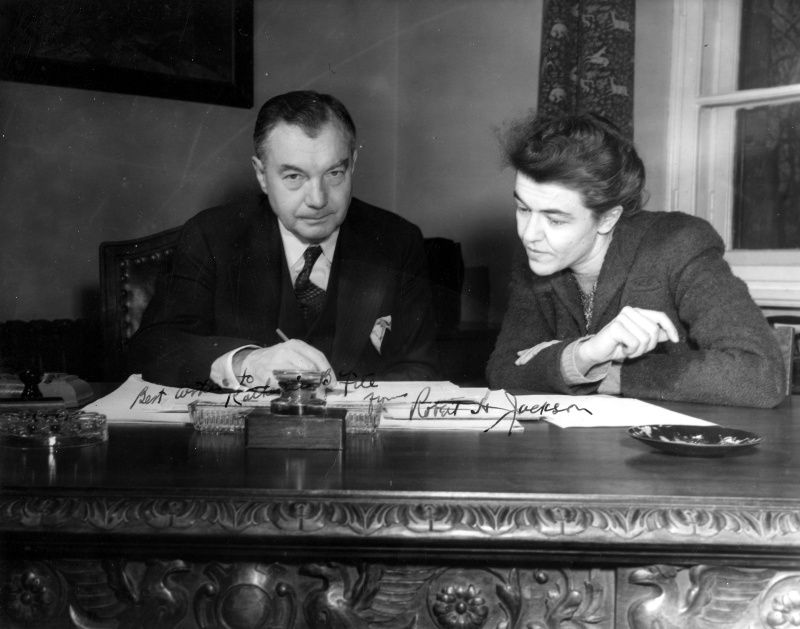
Fite was the only woman lawyer present in the preparation phase. In September 1945, a month before the trials began, Fite toured Dachau Concentration Camp outside of Munich. She wrote home about the experience: “The gardens might well look fertile — human ashes were readily available for fertilizer.” A Polish-Jewish man who had survived Dachau showed her the gas chambers, disguised as shower rooms.
After the first trial, which lasted until October 1946, the United States launched 12 more trials that continued through 1949. Men dominated the courtroom — both as lawyers and as defendants — so women’s contributions were often overlooked. From the beginning, however, the American legal team relied on women’s work in key ways, from Fite’s work in the planning through the execution of the final trials, to Belle Zeck’s foundational work investigating German manufacturer I.G. Farben, to Cecelia Goetz’s key role prosecuting Krupp Industries.
Fite was not the only woman present at the Nuremberg Trials, but she was the highest-level female attorney in the early phases. Harriet Zetterberg was another early participant, the only woman lawyer assigned to the main prosecution team for the first Nuremberg trial, beginning in mid-August and lasting until June of 1946. Zetterberg arrived in Nuremberg in mid-September and prepared trial briefs, including one on slave labor and how it was used as a method to kill. Zetterberg felt the weight of the work, calling the six interrogations she witnessed “extremely interesting — one gets a sense of listening to history in the making.”
While Zetterberg remained with the trial for much longer, Fite was only tasked to work with the planning group for a few months. She returned home at the end of December, going back to her job at the State Department. A month earlier, she had expressed concern that things were being rushed. She once caught a critical punctuation error in the London Charter’s section on crimes against humanity. “More sloppy work,” she told her parents. “So you see it’s not all a glorious, joyous crusade.”
Belle Mayer Zeck was one of the prosecutors on the I.G. Farben case in 1947 and 1948, but she began investigating the company in the summer of 1945 when she worked as a lawyer with the Treasury Department. Like Fite, she was sent to London that summer as preparations for international justice began. I.G. Farben, a major German supplier of wartime materials, was best known for creating Zyklon-B, the chemical used to kill more than a million people in the concentration camp gas chambers. She helped find evidence that I.G. Farben was making money off of the war.

By the time the Farben trial began in 1947, Zeck’s deep knowledge of the company proved essential. She prepared the first version of the indictment against I.G. Farben, served as an associate counsel member of the prosecution team, and explained all of her research findings to the judges. Thirteen of the accused were found guilty of war crimes when the trial concluded.
The Krupp trial, which began in late 1947, focused on a German company known for manufacturing steel and weapons, and accused of using slave labor during the war. American lawyer During the Krupp trial, Cecelia Goetz became the first woman to give part of an opening statement in any of the Nuremberg trials. Goetz provided background on how Krupp had helped Hitler achieve his goals of national expansion, asserted that Krupp had relied on slave labor to do so, and concluded that “the Krupp firm shared in the spoils of conquest.”
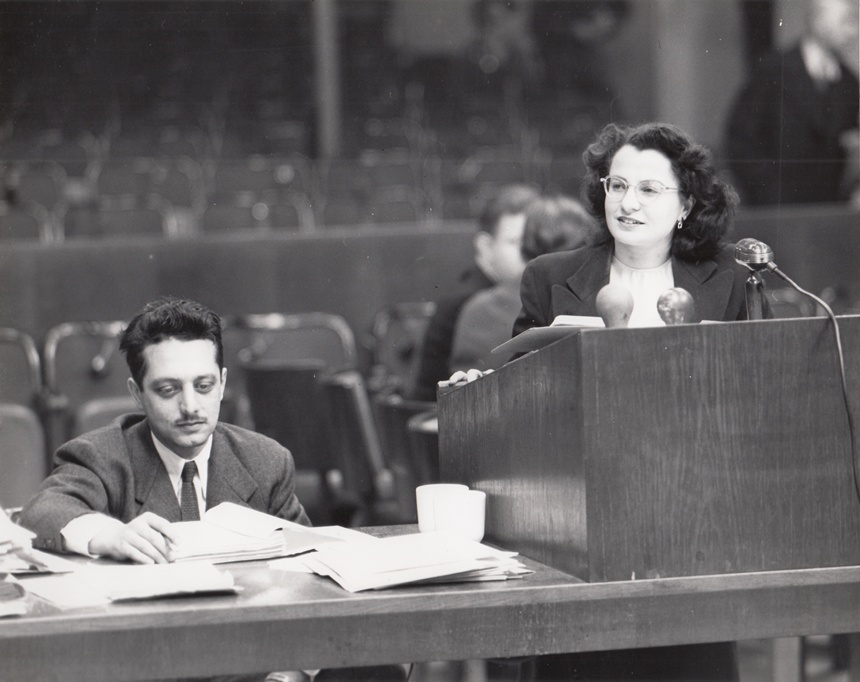
After Nuremberg, Fite, Zetterberg, Zeck, and Goetz returned to the United States; it was rare for any of them to speak much about their experience. In 1995, Goetz spoke up when she participated in a panel at New York Law School that focused on the Nuremberg Trials. Noting that the purpose of the panel was to think about Nuremberg as a standard for later trials, she explained, “I am terribly anxious not to see such atrocities go unpunished. However, I think Nuremberg is a flawed precedent.” She felt that Nuremberg was so important, but the trials had not achieve the outcome that she and others had hoped to see: “The sentences imposed were minimal.”
Even with its shortcomings, the women who participated in Nuremberg saw value in the effort. In a 1999 interview with the Shoah foundation, Zeck reflected on the importance of Nuremberg. “I think we accomplished a great deal where international law was concerned. I think that the Nuremberg principles have become a very important part of international law.” But her experiences at Nuremberg had been trying. “For many years,” she explained, “I maintained the proposition that there were certain experiences that one was better off not to have had…I just felt that [the trial] was a very searing experience…Today I feel that it was really a tremendous experience. Where would anybody like me get that kind of experience?”
Though a turning point in international justice, the Nuremberg Trials were constrained by the politics and prejudices of their time. In July 1945, the Allies decided not to prosecute antisemitism as an ideology, a choice made by Justice Jackson. He did not believe that this was a goal the United States had in mind when it came to justice. The extermination of European Jews was addressed, but the hatred that fueled it — antisemitism — remained unnamed.

The women of Nuremberg knew justice would be difficult, and that the trials were extraordinary — and unfinished. Katherine Fite worried about the errors and rushed procedures. Harriet Zetterberg was immersed in the intensity of interrogations. Belle Zeck called it a “searing experience.” And yet, they helped lay the foundation for modern international law. Their work — and their doubts — remain powerful reminders that justice is always a process, never a finished product.
The Nuremberg Trials didn’t end antisemitism or fully reckon with the ideological roots of genocide. But the women who served in those courtrooms helped build the legal scaffolding we still use to pursue accountability for crimes against humanity.
Cartoons: Shoe Blues
Want even more laughs? Subscribe to the magazine for cartoons, art, inspiring stories, fiction, humor, and features from our archives.
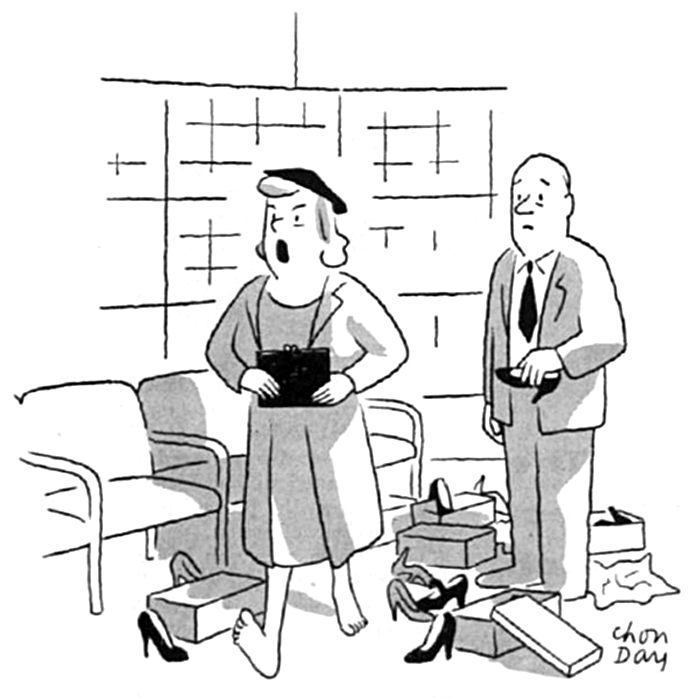
Chon Day
July 21, 1956

Dave Gerard
June 8, 1957
John Gallagher
March 6, 1954
Bob Barnes
January 28, 1961

Salo Roth
November 2, 1957
Larry Katzman
August 31, 1957

John Norment
March 16, 1957
Want even more laughs? Subscribe to the magazine for cartoons, art, inspiring stories, fiction, humor, and features from our archives.
Our World Needs More Stewards
Twenty years ago, I spent a summer home from college working in the gift shop of my local art museum. Selling tea towels with Monets on them was not my idea of a fulfilling summer experience (I’d wanted a curatorial internship), but the job came with one magical perk: opening the museum.
Every morning, I came in through the security entrance in the back and collected my keys from the guard. Then I ascended through the darkened galleries, turning on the lights as I climbed, and ultimately rolled up the motorized gateway at the front of the museum. On the way, I got to be alone with art.
How do I capture what it feels like to stand by yourself in a shadowy room in front of the muted hues of Monet’s Water Lilies and Japanese Bridge, then watch it erupt into color as you turn on the light? It is something like a cross between a curtain being yanked away for a dramatic reveal and opening your eyes after falling asleep in the sun. I could only linger there for a moment, but in that moment, I illuminated this masterpiece and prepared it to be marveled at for the day. In one small way, I got to care for it.
These little acts — opening the gate, turning on the lights — granted me a sense of stewardship over the art. The fact that they were simple tasks performed by a 19-year-old slinging souvenirs is the point. I wasn’t a conservator or a curator, but I got to feel like the art was in my care, too. I was also its custodian.
There is a strong and mutually reinforcing connection between our sense of self and the things that we care for. Who we are is defined in part by the things that we think are worth caring for, and whether we care for these things, in turn, shapes our sense of self. To identify as an environmentalist, for example, involves having a strong interest in the health of our environment, which then makes you want to take an active role in protecting it. To identify as a book-lover involves caring about books, which will dispose you to do things that support book culture (joining a book club, shopping at your local bookstore, volunteering at the library, or simply making time in your life to read).
Like my summer working at the art museum gift shop shows, there are many ways (some small, some surprising) that people can take on a sense of agency for the things they value that reinforces their relationship and sense of responsibility toward them. You don’t need to work for a conservation organization or devote all your weekends to climate activism, for instance, to feel like environmentalism is central to your identity. Even finding little ways to care for the environment (volunteering in a community garden, picking up trash while out on a walk) helps reinforce your sense that being an environmentalist is a part of who you are.
The more that people can involve themselves in caring for the things that matter to them, the more they will also be able to see themselves as caretakers — and the better off those things, from the natural world to the written word, will be.
Advancing a more custodian-oriented culture should not minimize the importance of large-scale institutional actions and the role of specialists to safeguard what we care for. Rather it’s that we need all types of support to do this work. So much of the world’s fantastic richness is found outside of the domains that highly trained experts tend to dominate: encyclopedic museums and national parks and the like. When it comes to the local traditions, regional cuisines, and hidden vistas where you live, you’re probably as well-positioned to help save them as anyone is.
Being a caretaker can be a burden, without a doubt. But seeing yourself as a caretaker is also a generative way of organizing your life, guiding the expenditure of your time and energy to activities of maintenance, repair, and cultivation. These may be viewed as undesirable tasks in a culture that is so obsessively focused on innovating and creating. But they can also be an anchoring source of meaning for those who feel unmoored by a culture that increasingly plays out in digital spaces or is obsessed with the next great idea, often oriented toward securing the future rather than appreciating the present (or the past). When we care for things, we simultaneously cultivate our attachments to the world: We strengthen the bond between ourselves and the things that we care about, and make them that much more central to who we are.
I applied to the museum because I cared about art. The opportunity to do something in support of it helped foster my concern for it. I didn’t end up following a museum path, or even majoring in art history. But that experience helped me recognize the range of ways I could see myself as a custodian of art. Now I teach and write about the philosophy of art, and those too are ways of supporting the arts, of caring about the role that art can play in our lives.
We find ourselves again in a political moment where funding for conservation may be increasingly hard to come by. Those in positions of institutional authority over conservation (whether of art, culture, or the environment) should reach out to their communities and invite them into the practice of caretaking. Because we are going to need more caretakers — more custodians, more stewards, more people who see themselves not only as entitled to but as responsible for all of the amazing objects, practices, and places in our world. Unless everyday people can see themselves as protectors of the many things worth saving, we may quickly find that there is no one left to stand between these wonders and their loss.
Erich Hatala Matthes is associate professor and chair of the philosophy department at Wellesley College. He is the author of What to Save and Why: Identity, Authenticity, and the Ethics of Conservation. This essay originally appeared at Zócalo Public Square (zocalopublicsquare.org).
This article is featured in the May/June 2025 issue of The Saturday Evening Post. Subscribe to the magazine for more art, inspiring stories, fiction, humor, and features from our archives.
Our Better Nature: Start Your Own Victory Garden
It gets your heart rate up, and there are endless creative ways of doing it. Whether it’s your first time, or you’ve been at it since you were young, most agree that even so-so outcomes bring them pleasure. This is about gardening, in case you wondered.
These days, the soaring price of groceries gives us an added reason to grow our own food. During both World Wars, civilians were asked to raise produce at home in what were dubbed Victory Gardens. Promoted with radio ads and now-iconic posters, gardening was framed as a patriotic duty: It beefed up food security and saved fuel that would otherwise have been used growing and transporting crops.

With few ways to push back against high food costs, gardening is one means to score a win. Now is the ideal time to swap a bit of lawn for a veggie patch, or plant greens and herbs in containers on our patio or balcony. Newbies and those who haven’t done it in a while (gardening, I mean) can find success in their Victory Gardens at little cost and with modest effort.
With scads of gardening books out there, it’s easy to feel overwhelmed at first. I’ll lay out some basics here, and point to resources for more information.
Let’s look at your garden’s LAWS: Light, Air, Water, and Soil.
Light
It’s common to be in the dark on how much sun a garden (or proposed site) truly gets. Houses and trees cast shade at various times of day, so one should carefully note at what the time the morning sun fully hits, and when afternoon shadows start to cross it.
This is key because some veggies, like tomatoes, peppers, beans, cucumbers, and basil, need eight or more hours of full sun each day. Crops such as spinach, lettuce, peas, onions, and carrots only require four hours of daily sun. Seed packets, as well as tags in potted and cell-pack plants, will say if a plant is a sun-lover or a shady character.
In class pictures, tall kids go in back so they don’t block others, which is why garden layout matters. Short plants like beets go near the sunniest (southern) edge, and mid-height crops such as peppers go next. Taller veggies like tomatoes are behind them, with the tallest like corn and pole beans in the last row. That way, everybody has enough sun. Seed packets and tags list mature heights.
Air
Good air flow keeps plants healthy, so check seed packets and tags to see how far to space plants and how wide to make rows. Crowded plants trap moisture, which sets the stage for pathogens that rot stems and kill leavers. Trellising crops like cucumbers enhances air circulation around leaves, and saves garden space too. Leaves at ground level can’t dry out quickly after rains, and are more at risk from diseases.
Water
The longer leaves stay wet, the yummier they look to fungal pathogens. Irrigation water should go on the roots, not the leaves. Don’t use sprinklers, except on leafy greens, and then, only in the morning. Water plants at the base with a gentle stream of water, or use a drip-hose.
Mulch is your friend. Whether it’s hay, straw, leaves, or newsprint, mulch conserves water. It also suppresses weeds and adds organic matter to the soil.
Soil
Soils range from heavy (clay) to light (sand). Heavy soils hold water well, but are prone to compaction and poor drainage. This stunts plants and favors root-rot diseases. Light soils resist compaction, but dry out fast. Loam is an ideal soil in between clay and sand.
Either extreme is a challenge for the gardener, but never try to resolve the issue by adding sand to clay, or vice-versa; that’s how bricks are made. Organic matter fixes the matter. Aged compost, rotted leaves or hay, and peat moss are common sources. It’s best not to add more than ten percent by volume.
Soil pH measures how acidic or alkaline the soil is. With few exceptions, most plants do best when soil pH is between 6.0 and 6.8.
Beyond the LAWS, here are some other essential points:
- It’s wise to start small. You can always scale-up next year.
- Look up your USDA Plant Hardiness Zone, which tell you first and last frost dates for your area. Also, not all plants (and bits of advice) are viable in every zone.
- Always plant disease-resistant varieties. Disease pressure is greater than it was in the past due to invasive pathogens and changed weather patterns. If you love certain heirloom veggies, keep growing them, but hedge your bets by adding resistant varieties.
- Take advantage of your Cooperative Extension Service, which operates in every state and territory. Its mission is to provide current, research-based support to agriculture and consumer horticulture. In many places this involves things like nutrition and cooking classes as well. Your nearest Extension office has staff and/or Extension Master Gardeners who can help with soil testing and garden-related questions.
- Look for local online gardening forums. They’re great places to pitch questions and to share your gardening joys and sorrows.
- And finally, here is a top-notch guide for novice gardeners.
I wish all new gardeners victory in your gardens this year, but more than anything, I hope you fall in love with gardening.