The Rental
The problem was one of theme. It should be unique but comforting, playful but not vulgar or loud. With the property’s location, success would be a cinch if they could only hit on the correct décor.
“How about bicycling?” Paul asked. “We’re right near the trails.” He was sitting with Ang in their breakfast nook, drinking his coffee, taking a backseat.
“Too obvious, probably.”
He watched her eyes dance around the listings for short-term home rentals on her laptop screen.
“Yeah, here — Be-spokes Hideaway. It’s just around the corner on Maple Grove.”
“Village artists, then? We could buy up pieces from their shops, hang a few in every room. I could probably talk us into a discount with the exposure we’d give them.”
“Maybe…” He knew this was a brush-off; a polite lie that meant his idea was already vetoed. “I was thinking we’d find some local art once we settled on a theme, but putting the focus on the art district itself? It just seems…”
“Generic?”
She scrunched up her nose. “Is that rude of me to say?”
“Not at all. I was only trying to help. I’m sure you’ll think of it.” He rose and stretched, took his mug to the sink. “I might head over there to see about that bathroom wiring. If you’re interested in doing some deep cleaning, you could walk over with me.”
“Mm,” she said, hunkered down, lost in her search.
After grabbing his toolbox from the garage, he came back through the kitchen to say goodbye to her before heading out. She stopped him with the radiance of her smile.
“I’ve got it,” she said. “Mountain climbing.”
He nodded, drew his eyebrows together. “Well, it probably hasn’t been done, considering we’re two states away from the nearest mountain range. Wasn’t the point to celebrate local culture?”
She tossed her hand. “Most owners do, sure. It doesn’t mean we have to.”
“No, I suppose not. It’s just that it’s all you’ve talked about for months.”
“That’s because I forgot about your mountain climbing things. These rentals are mostly full of kitsch, so kitsch was where my head was. But you have all that real gear — crampons and harnesses and everything, and it’s all just packed away in bins. I see it, Paul. I can see it in my mind.”
“And I’m guessing it looks awesome in there?” He smiled, charmed.
“Ours will be unlike any other rental cottage in the village — unless you have a problem with displaying it. In that case, we can go a different direction, obviously.” She bit her lower lip, awaiting his answer.
“I mean, yeah. It’s fine with me. It will be cheaper, and I’ll be glad to have the extra space in the garage.”
She beamed. “This feels right to me. This feels very right.”
“Hotdog!” he said to be cute, like a kid from an old movie, then he kissed her on the head and set out on the short walk to their rental cottage.
Paul wasn’t an electrician, but he was a master tinkerer, and he saw right away that a loose wire was the culprit behind the flicker in the cottage’s bathroom. “It just happens over time,” he said to himself as he set about tightening the connections. “Even Buckingham Palace deals with loose wiring now and again.”
The job took him 45 minutes, which wasn’t too bad given his shaky hands. He wasn’t quite 65, but sometimes, when he saw his hands tremble, he felt a decade older. A professional couldn’t have done it faster, though. An electrician would likely still be messing around in the back of their truck, searching for just the right conduit coupling, stretching out the job to pad the bill. Not today, bucko. Not while Paul was still upright and able to hold a screwdriver.
When he was through, he checked his work by flipping the light on and off, on and off; then he packed up his tools, raised the toilet seat, and urinated with the bathroom door open. He whistled a little tune as he did, delighted by the cheekiness of taking such liberty. Someday, this place would feel like his, but it didn’t yet, so he felt as if he were flagrantly pissing in the home of a stranger. It was odd to think of himself that way — a stranger to the man he would be in a few months’ time when the rental felt familiar and mundane. That was just the way of things, he supposed.
When he was young and traveling the world — living out of a backpack and convinced that a communal room in a youth hostel was the height of luxury — he couldn’t have been further removed from the man he would become in only a few years’ time, a married desk jockey at the city waterworks, a lifer who put in 33 years staring at the same beige office walls. Hell, until a few months ago, he didn’t expect that he would ever own a second property. It had been Ang’s dream since their early days together, after they stayed at a different rental a few streets over, the one that made them fall in love with this little village in the first place. That was the property she truly wanted, and it was the reason she’d developed her habit of scouring the local real estate listings. In all those years, it never came up for sale. Paul assumed he had put the matter to rest when he agreed to move to a house in the village. He hadn’t, though, not as far as Ang was concerned. She still longed to operate a rental, believing that they would never truly be locals until they could share their charming community with outsiders, the same way it had been shared with them.
Paul was the one who noticed the for-sale sign on this place. It wasn’t her dream cottage, but it would do. Their offer was accepted, and they signed the lease a little over a month ago. Now, finally, as of this morning, they had a theme for their interior design.
Paul was happy for her and pleased that he would have something to do with his time now that he was retired — the thousand little projects that would crop up to keep his hands busy and his mind sharp. He discussed the matter with some of their neighbors over lunch a few months back, and they all confirmed that managing a rental was easier than ever in this time of home-sharing apps. And it was only a certain type of person who visited their village anyway — soft-spoken liberals with a love of health and art and nature. “As long as the toilets flush and the lights turn on, you’ll have nothing but five-star reviews from these hippies,” Tycho Jauch told him. Tycho was a 48-year-old white man with dreadlocks down to his ass, so Paul doubted he meant “hippie” as a derisive characterization.
With the bathroom light fixed, he spent some time puttering around the cottage, opening and closing drawers, testing the fortitude of the trim in each room with the toe of his shoe. Mostly, he was waiting for Ang. He’d mentioned doing a deep clean hoping to plant the seed in her mind. He was willing to roll up his sleeves and do the work himself, but not without her direction. Ang had standards that were mysterious and inaccessible to him, and, if he surprised her by cleaning the place, she would express her gratitude before quietly spending hours redoing the work herself. Eventually, he gave up on her and headed home.
He found her crouched in their garage, digging through boxes. “Look at these spikes and ropes,” she said when she saw him, lifting them above her head for him to see.
“Pitons,” he said, identifying the spikes.
“They’re marvelous. I was thinking we could hammer nails randomly around that longest living room wall then wind this rope around them to make an art piece.”
“Hammer random nails into our new wall?”
“To make an amorphous piece. Don’t worry,” she said, “it will look great.”
As it turned out, she was right. Once she’d hammered in the nails and wound his climbing rope around it, Paul had to admit that it did look great. She’d even looked up a knot-tying video online to secure the pitons here and there as accents. They were just figure-eights; he could have taught them to her, but he supposed she wanted to surprise him. The display was touching, but it was odd for him too, being memorialized in this way while he was still around to see it. “Celebrated” was likely how she would have put it, had he voiced this feeling.
“Well?” she asked, sliding beside him, wrapping her arms around his waist.
“It’s cool. It’s really very cool.”
“Good. There are two more bins in the garage. You can go grab them while I get started cleaning.” Then, with an outstretched finger, she poked him in his ribs.
Once, back in 1983, Paul and his climbing partner, Franco, ascended Utah’s Moonlight Buttress. It wasn’t among his most impressive climbs — he had free-climbed El Capitan in Yosemite and Cerro Torre in Patagonia — but it produced his favorite photo from those years. Franco snapped it just before dusk on their first night, at around 183 meters. They’d stopped for sleep, hanging their portaledges off the rockface. Franco was a few meters above Paul, and he’d peeked his head over the edge of his bedding to gab until dark, like an older brother whispering from an upper bunk after lights out. He told Paul a story about a girl he met in Belgium, a sweet but filthy recounting that left Paul howling. It was then, as his laughter echoed down the cliffside, that his partner took the photo. In it, Paul was lying on his back, his eyes closed, his mouth open, the Beehive State visible at what looked like a million miles below him. He found this photo in the first bin he opened. It was in a cracked plastic protector with a magnet on its backside. A wedge of plastic was missing from its corner, and there was a corresponding crease in the photo itself, though not one that affected the image. Paul was glad about that. Staring at it caused an ache in his shins and shoulders as if his muscles were reminding him that climbing was a young man’s game and not to get any ideas. He could have continued for a decade or two longer than he had, but those days would be well behind him now in any case. He had given them, instead, to Ang and the waterworks. She hadn’t asked him to; that decision had been made by the intensity of their early days together, by the fire that burned for her in his chest.
He placed the photograph back into the bin and then loaded it and the other onto his dolly and toted it across the alley.
Ang got final say over his work that afternoon, but mostly she held her tongue and let him decorate while she cleaned. “Decorate” was, perhaps, an overstatement, since it mostly involved him nailing his gear to the walls — crampons and carabiners, ascenders and quickdraws, and, above the table in the little dining area, his helmet and dull ice axe, everything in the bins other than his boots. As he was finishing up, she came to his side.
“It looks good,” she said, squeezing him around his middle to prove she meant it.
“Are you sure people won’t misread the theme as S&M dungeon?”
She tickled his love handle, causing him to pull away from her.
“Oh, this is a wonderful photo!” she said, lifting his Moonlight Buttress portrait from a side table where he’d laid it. “I’d forgotten it. You look so young and handsome.”
“I was at least one of those things.”
She held the photograph up to his face. “You look the same. Less windburned.”
“More time burned.”
“Aren’t we all?” With that, she kissed his shoulder and headed to the bathroom, carrying bleach and a rag. His photograph was tucked under her arm.
He couldn’t see it, but he heard when its magnet tacked against the metal frame of the vanity mirror. “That’s the perfect room for it,” he said, though he didn’t mean it. He was proud of that photo, and since finding it, his thoughts had mostly been of Franco — wondering where he ended up, if he was even still alive. Not everyone from the old days was. Paul wondered if he could find him on the internet, on Facebook or whatever. What was his last name, though? Boucher? Something like that, something French, though he’d never seen it written. They’d just met at a base camp somewhere or other and found that they got along. It would be great to have a beer with him, but pursuing him wasn’t worth the sadness of learning he was dead. Probably, it was better to leave the past in the past.
“Are you done with this light?” she called to him.
“Yes. Why? Is it flickering again?”
“No, I just thought I heard it buzzing when I turned it on.”
He stared at the wall, at his memories, and shrugged for no one’s benefit. “Some lights buzz a little.” He turned when she popped her head out of the bathroom. She was grinning. Her fingers were hooked into the doorframe, and she was hanging by them into the hallway like a child. “Does that mean we’re ready to list it?”
It took only four hours to book the rental for the weekend. The couple seemed ideal — longtime members of the home-sharing app, nothing but positive feedback in both directions. Ang treated the matter with the seriousness one might employ when choosing an oncologist, vacillating between hitting the button to approve them and scouring the limited available customer data for a reason not to trust them. Paul sat with her in their living room, humoring her for the better part of an hour, then he excused himself to go and rearrange the garage, to address the hole where he’d once stored his past. In the end, she would approve them, he knew. When he finally returned to the house, dusty, with cobwebs on his skin and in his hair, she confirmed that she had.
With his work at the rental done for now, Paul spent the next couple of days reading and walking the village’s hiking trails. In bed, though, on the night before their first couple arrived, he tossed and turned. It was nothing specific, just a general sense of unease that kept him blinking in the darkness of their bedroom, growing jealous of the steady, heavy breaths of Ang’s sleep. It caused him to think of Moonlight Buttress, of how exhausted he had been on that night spent on his portaledge, hanging hundreds of feet above ground, sleeping like a baby; of how the hurt he used to feel from his climbs was so much worse and yet seemingly more manageable than the pains of old age that were his daily reality; and of how Ang had displayed his photograph all the way across the alley, left in the care of uncaring strangers. She hadn’t done anything wrong; he knew that. The photograph was just a stand-in for what really bothered him, something that couldn’t be blamed on anyone, certainly not Ang. Time or life, or possibly just the reminder that we can’t play out every possible version of ourselves to their natural conclusions, that our time on Earth is so very short — these were the real culprits.
He slid out of bed, careful not to wake her, and went to the kitchen for a glass of water. Staring at his reflection in the darkened window, he considered whether his face looked different from how he thought of himself. In his younger days, would he have jumped at the sight of this reflected ghoul, or would he have recognized him, the hollows of his cheeks and eyelids being just a trick of the glass? The hair would be a giveaway, he supposed. He attempted to replicate the photo’s expression of elated merriment but felt foolish and gave up before getting it precisely right.
Instead, he unplugged his phone from its charger, tucked himself into a corner of the room where he couldn’t see his reflection, and typed in Franco Boucher. There were dozens of hits for men with that name, but he still found him right away — or, at least, he found a bald and jowly version of the face in his memory. He was a real estate broker in Tempe. In his headshot, he stared into the void of the internet, wearing a cheesy smile and a funeral suit. Seeing him caused Paul’s heart to race, particularly because he looked so normal — boringly so, as if his life had been as starved for adventure as Paul’s in the time since they parted ways.
He tapped the image, but there was no information other than his office and cell numbers. Tempe was, what, three hours behind them? Four? It was just after midnight in their little eastern village, which surely wouldn’t be too late to reach out to a friend out west. He tapped the cell number and set about composing a text message. Something funny. Something cool. Something that made Paul seem like the man he was when they were still tight, when they regularly risked death together, each of them entrusting their life to the other. He stood for minutes, his thumbs hovering over the keyboard on his screen. What could he say? Are you the Franco Boucher who I used to cheat death with a million years ago? I can’t tell for sure because there’s a fat old man in your work photo.
No. Obviously, that wouldn’t do. Nor would any of the other messages he could think of. He decided that the right course would be to send a picture of the photograph, no text, no explanation. If the man was his Franco, he would understand and respond. If not, he would likely just block Paul’s number, and life would move on.
He hurried to the foyer and stepped into his sandals. Usually, he thought of those slip-on shoes as being part of an old man’s uniform, but they didn’t seem so now. Youth was a mindset, maybe. It certainly felt that way as he hurried out into the night.
The cottage was spooky after dark, quiet and unfamiliar. Earlier, as he’d appraised his displayed climbing gear, it occurred to him that his youth was spread all over those walls like blood spatter at a crime scene. Now, he passed those trinkets without a second thought.
In the nighttime quiet, the buzzing of the bathroom light was undeniable. It stopped him cold, brought him out of his own head. How had he not noticed it earlier? Old ears or a foggy brain, maybe. Happens to the best of us. He stretched and reached and tapped the globe with his knuckle, but the sound persisted. His tools were back home in the garage, and it would be crazy for him to go back for them now. The renters wouldn’t arrive until after eleven, which gave him time to come back at a reasonable hour to fix it. Or maybe there was nothing to fix. Some lights buzz a little, he reminded himself.
After grabbing the photo from the vanity mirror, he took a quick picture of it with his phone’s camera and sent it on its way to Tempe, Arizona. Once done, he replaced the photo. Ang hadn’t been wrong to leave it there. He’d been a hero once, sort of. At the very least, he’d once done stupid things that passed for heroism. He didn’t need proof of it displayed in their home, always in reach to make him jealous of his younger self. Let their guests be jealous of him, that was the better way.
Paul checked his phone once before returning home. He’d received no new messages. It might be that Franco was an early riser and wouldn’t see the message until the morning. Silence didn’t necessarily mean that he had the wrong man.
When he headed out, he opted to leave the light on so that he could judge in the morning if the buzzing was a constant or just something the fixture did while it was warming up. If the latter was the case, there was probably nothing that could be done about it, and he would know not to mess around with it, possibly making the problem worse for the effort.
He checked for Franco’s text a few more times on his walk back to the house, and then again after he crawled into bed, causing Ang to stir and mutter his name before returning to sleep.
The response woke him when it came through several hours later. The phone buzzed on his nightstand — once, then again, and then for a third and final time. He pawed for it with a reflexive movement of his hand. Beside him, Ang snored. The Tempe real estate agent was, indeed, his Franco. He’d sent full paragraphs expressing his excitement to hear from his old friend and climbing partner, asking questions, willfully oversharing in a way that made Paul wonder if his text might have given the man a reprieve from a late-life crisis. Franco asked if he had ever gotten back into climbing, told him how he’d lost a leg in an accident a few years after they’d parted ways and been forced out of the game, mentioned that he’d turned to alcohol for several years but that this had been many years ago. Now, he understood that nothing lasts forever. Nothing but memories and your love for the people you collect along the way.
It would be days before Paul would have the presence of mind to respond or even get to the end of Franco’s texts because it was while he was reading them that the first sirens sounded. Close and getting closer. Ang awoke with a start. Paul was already at the bedroom window by then, staring at the excitement across the alley. She came to the window beside him, looked, gasped, took his hand. He squeezed. The fire burned. His past and her future. In the aftermath, in their new life, when he finally got around to sending his reply, it wasn’t entirely with kindness when he confirmed that Franco was right.
News of the Week: Desi Arnaz, Spelling Bees, and What You Need is Some Good Country Cooking
Read This!
Six new books to read as summer approaches …
Murder Takes a Vacation by Laura Lippman. The award-winning author of the Tess Monaghan series returns with a new book featuring another character from that series. Muriel Blossom finds a winning lottery ticket in a parking lot and decides to take a cruise, where she encounters murder and an art-world mystery.
Desi Arnaz: The Man Who Invented Television by Todd S. Purdum. Arnaz wasn’t just Lucille Ball’s straight man; he was the driving force behind I Love Lucy.
A Mind of Her Own by Danielle Steel. I don’t know how many books Steele has written – it’s over 200 at this point – but they’ve all been written on a manual typewriter!
Buckley: The Life and the Revolution That Changed America by Sam Tanenhaus. A detailed biography of one of the leading conservatives of the 20th century. Buckley himself chose Tanenhaus to write the book.
Cooler Than Cool: The Life and Work of Elmore Leonard by C.M. Kushins. Another biography, this time of the acclaimed author of such novels as Get Shorty, Out of Sight, Rum Punch, Pronto, Freaky Deaky, and Maximum Bob.
The Art of Classic Crime and Mystery Movies by Ed Hulse. A beautifully-designed history of the movie posters for crime, noir, and mystery films, from the earliest productions to the 1970s.
A Nickel for Your Thoughts
This is an update on a story I brought you a while back: the possible elimination of the penny. Well, you can take “possible” out of that sentence as it has become a reality.
While I see the logic behind not spending 3.69 cents to make something worth a penny, especially in this day of everyone using cards and apps to pay for everything, it’s still sad to see Lincoln’s coin go away (though they’ll still be plenty still in circulation and/or in jars in our homes). I would just hate to see us become a “cashless” society.
And as for businesses no longer having 99 cent pricing and rounding everything up or down (probably up), it currently costs 13.78 cents to make a nickel, so we’ll have to wait and see what happens with that.
This Week in AI
This might become a regular feature (unfortunately).
Last week it was Agatha Christie, and this week it’s Orson Welles. The voice of the famed director/actor, who died in 1985, is being used to narrate stories on the Storyrabbit app.
Can’t AI sweep and mop my floor instead of doing stuff like this?
Word of the Week
The annual Scripps National Spelling Bee took place this week, and the winner was crowned (or whatever they do to spelling bee winners) last night outside Washington, D.C.
The last person standing was 13-year-old Faizan Zaki, last year’s runner-up. The winning word? “Éclaircissement,” which, according to Merriam-Webster, means “a clearing up of something obscure” or “an enlightenment.”
Other words the finalists had to spell included “penannular,” “radicicolous,” “daimiate,” and “isopag,” which my spellcheck doesn’t recognize but is defined as “an equiglacial line on a map or chart that connects the points where ice is present for approximately the same number of days in winter.”
Now I have to look up “equiglacial.”
RIP Phil Robertson, Charles Rangel, James McEachin, Rick Derringer, Mara Corday, Peter David, Jeff Margolis, and Gawn Grainger
Phil Robertson was the star of the hit A&E reality show Duck Dynasty. He died last weekend at the age of 79.
Charles Rangel was a Democratic congressman for 46 years. He died Monday at the age of 94.
James McEachin was one of the more familiar faces on TV throughout the ’60s, ’70s, and ’80s, on shows like Tenafly, Matlock, Columbo, All in the Family, Dragnet, and the Perry Mason TV movies. His films include Buck and the Preacher, Fuzz, Sudden Impact, and Play Misty for Me. He died in January at the age of 94.
Rick Derringer was a rock guitarist known for the songs “Rock and Roll Hoochie Koo” and “Hang on Sloopy,” a hit for his band The McCoys. He died Monday at the age of 77.
Uploaded to YouTube by The McCoys
Mara Corday appeared in such films as Tarantula, So This Is Paris, Man Without a Star, The Black Scorpion, and Sudden Impact (with good friend Clint Eastwood, who gave her work in his films so her health insurance wouldn’t run out). She also appeared in many TV shows. She died in February at the age of 95.
Peter David was a legendary sci-fi and comic book writer. He did everything from Star Trek novels to comic books featuring The Incredible Hulk, Aquaman, Spider-Man, and The X Factor. He also co-created (with Lost in Space star Billy Mumy) the TV series Space Cases and wrote for Babylon 5 and Ben 10. He died last weekend at the age of 68.
Jeff Margolis started out holding cue cards for Monty Hall (his uncle) on Let’s Make a Deal and went on to direct the Oscars, Emmys, American Music Awards, and Screen Actors Guild Awards, as well as specials featuring Frank Sinatra, Perry Como, Dolly Parton, Jerry Lewis, and Sammy Davis Jr. He died last week at the age of 78.
Gawn Grainger was a British actor and writer. He appeared in many acclaimed plays as well as TV shows like Doctor Who. American audiences might know him from his appearances on What’s My Line? He also wrote and produced several plays and wrote for British TV shows. He died last week at the age of 87.
This Week in History
Samuel Morse Sends First Telegraph Message (May 24, 1844)
The first message sent was “Who let the dogs out?”
(Actually, it was “What hath God wrought?”)
Brooklyn Bridge Opens (May 24, 1883)
It spans the East River between Brooklyn and Manhattan. It’s also the title of a very underrated short-lived TV show from the early ’90s that should be on DVD but isn’t.
This Week in Saturday Evening Post History: “Does a College Education Pay?” by Francis X. Leyendecker (May 26, 1900)

As high school kids graduate, it’s somewhat comforting to know that the question of whether or not college is worth it isn’t new.
June Is Country Cooking Month
What is country cooking? Well, first, it probably depends on what country you’re talking about.
But this is a U.S. thing so let’s concentrate on those recipes — the down-home, comforting regional foods. Like this Broccoli Chicken Casserole from The Pioneer Woman, the Biscuits & Gravy from Delish, or this Country Fried Steak from Food.com. Country Recipes has Kenny’s Cowboy Beans, Mommy’s Kitchen has Golden Skillet Cornbread, and Food Network has Southern Baked Mac and Cheese.
For dessert, the New York Times has a Rhubarb Pound Cake, The Country Cook has Strawberry Fudge, and Taste of Home has an Apple Slab Pie.
Next Week’s Holidays and Events
National Game Show Day (June 1)
The Buzzr network has expanded the celebration and is calling June National Game Show Month. Their celebration includes the airing of rare episodes of classic game shows.
Since I mentioned Desi Arnaz above, here he is on the October 2, 1955 episode of What’s My Line? (with his wife).
Uploaded to YouTube by What’s My Line?
NBA Finals (June 5)
We don’t know who the finalists are yet, but the first game starts at 8:30 p.m. ET on ABC.
In a Word: I’ll Procrastinate Tomorrow
Senior managing editor and logophile Andy Hollandbeck reveals the sometimes surprising roots of common English words and phrases. Remember: Etymology tells us where a word comes from, but not what it means today.
I very nearly didn’t get this week’s In a Word column written. I could try to attribute this near lapse to my busy schedule, or to the holiday on Monday throwing my internal calendar out of balance, or to gremlins stealing my day planner, but if I’m being truly honest with myself, it was, alas, simple procrastination. Or what some from the early 19th century might have jokingly referred to as tomorrowing.
Though tomorrowing might seem like a less prestigious type of word — from Old English roots lacking the Latin pedigree of procrastination — those who used it were actually revealing that they knew and were playing with the etymology of procrastination, because “tomorrow” is built right into the word.
But don’t worry; I’ll tell you about it today.
The word cras is Latin for “tomorrow,” leading to the longer adjectival form crastinus, meaning “of tomorrow.” The pro- prefix is a common one, meaning “forward.” Put these all together, and you get the Latin procrastinare, which means “moving or putting off until tomorrow” — a verb that, I believe, lets us know that those long-dead Latin speakers of the past were just as lazy as we are today.
From procrastinare and its declensions evolved, by the 16th century, the noun procrastination (in both English and French) and the verb procrastinate. In its early English existence, procrastinate could be used a little differently than it normally is today — it could be a transitive verb.
Some quick grammar nerdery: A verb is transitive if it takes a direct object that receives the action — that is, the subject of the sentence verbs an object. A verb is intransitive if it does not take a direct object — the subject just verbs. Some verbs are always transitive, and some always intransitive, but many can be both. Take, for instance, return: In “Jesus will return,” it’s intransitive; in “Jesus will return his library books,” it’s transitive.
In the past, using a transitive procrastinate, someone might have written a statement like “’Twill not procrastinate my doom” to mean that it will not postpone his doom. (And in fact, someone did write that; it comes from a 19th-century poem called “Too Late” by William Linton.)
Or, to take a more modern example, instead of saying (intransitively) that I’m writing this column close to midnight because “I procrastinated,” I could say (transitively) that “I procrastinated this column” and still be grammatically correct — at least historically. If it sounds odd, and it probably does, that’s because the transitive sense is quite rare today.
But among all these grammar minutiae, the thing to remember is this: I finished this column by deadline, procrastination or not.
Review: The Last Rodeo — Movies for the Rest of Us with Bill Newcott
The Last Rodeo
⭐️ ⭐️ ⭐️
Rating: PG
Run Time: 1 hour 58 minutes
Stars: Neal McDonough, Mykelti Williamson, Sarah Jones
Writers: Jon Avnet, Neal McDonough, Derek Presley
Director: Jon Avnet
The best movies take you to places you’ve never been to meet people you’ve never dreamed of, and for city slickers like me, The Last Rodeo meets those criteria to a “T” with the span of a Texas longhorn.
That’s true, at least, for the movie’s electrifying rodeo sequences, capturing the violent art of America’s original sport. Alive with the jerking, jaw-shattering violence of men improbably trying to stay on the back of a bellowing, bucking bull for eight short, eternal seconds, those scenes leave us holding on to our seats for dear life, digging our fingers into the fabric and croaking, “Whoa!”
If only the film’s human drama were half as compelling. As it is, when The Last Rodeo isn’t thrilling us with moments of hoof-pounding cowpoke action, it abandons us to a frustrating, foot-shuffling melodrama that expects its faith-based throughline to fill in the gaps.
Neal McDonough — whose piercing blue eyes, chiseled features and stony demeanor have made him a go-to guy in dozens of military and cop movies — stars as Joe Wainwright, a former world champ rodeo rider whose life tanked following the death of his spouse (played in flashbacks by McDonough’s actress wife, Ruvé). Rock bottom came 15 years ago, when he tried to ride while roaring drunk, and got a broken back for his trouble.
Joe has long since quit both the sauce and steers, and is now a somewhat stiff-walking Texas rancher. And although he’s a doting father to his grown daughter, Sally (Sarah Jones of TV’s For All Mankind) and adoring grandson, Cody (Graham Harvey), Joe is still angry at the world for the loss of his wife and rodeo career.
Joe’s life becomes even more complicated when he learns his beloved grandson has a brain tumor that requires immediate surgery. The news comes in a way that eerily reminded me of the last time I had my oil changed: Joe and Sally are sitting in the hospital waiting room when a woman with a clipboard comes out, glances over the invoice and declares the tab will run roughly $250,000, after insurance. Will that be cash or charge?
Of course, who’s got that kind of money? Certainly not a washed-up rodeo rider. But Joe has an idea: He’s just been invited to participate in a Legends Rodeo event, happening that very weekend in Tulsa. If he could just climb onto a bull — broken back and all — for the first time in 15 years and defeat the world’s current crop of rodeo superstars, well, he could win the million-dollar grand prize!
It’s a crazy idea, but as they say in the movies, it’s an idea so crazy that it just might work. Joe gets his old rodeo partner, Charlie (Mykelti Williamson, forever embedded in our frontal lobes as Forrest Gump’s business partner Bubba), to take a week off from his job at UPS to help out. Charlie’s ostensible job here is to help Joe train and then be the guy who pulls him out of the way when he tumbles off that bull (hopefully, after the mandatory eight-second mark). But really, Charlie is here to periodically brandish his Bible and find a suitably encouraging passage, causing Joe to stare off into space with those glowing blue orbs and stoically nod his head.
Will Joe prevail at the rodeo? Will Cody get that thing in his head taken care of? Will there ever be any doubt? The chief problem with The Last Rodeo seems to be that its very busy, yet distressingly schematic, screenplay was co-written by director Jon Avnet (Fried Green Tomatoes), Derek Presley (whose new thriller, Tonic, just made a positive splash at Cannes), and McDonough, the film’s star. Indeed, the movie plays as if the three men each devised a separate movie, then Scotch-taped the pieces together: Avnet contributed the human drama; Presley the action sequences; and McDonough, a great advocate of faith-based cinema, the Sunday School lessons.
The result is a film that seems more interested in its themes than its narrative. Most egregiously, the very problem that has been driving Joe back to the rodeo — raising money for his grandson’s surgery — is resolved less than two-thirds of the way through when his old friend, an Oklahoma millionaire (longtime movies bad guy Christopher McDonald) creates a GoFundMe page on the boy’s behalf and promotes it nationwide. After that, Joe’s quest for rodeo glory becomes less a mission of faith and love and more of a selfish act that could result in his daughter having to care for him for the rest of his life.
The Last Rodeo is distributed by Angel Studios, a faith-based company that’s revolutionized the movie business by polling their audiences before greenlighting projects and then funding those films through crowdsourcing. They’ve distributed some pretty good movies about people who find strength and meaning through faith, often re-discovered in the face of trial. (Later this year they will be distributing the childhood fantasy Sketch, one of my very favorite films at last year’s Toronto International Film Festival.)
Anyone can get a sermon by stepping through a church door on Sunday morning. The power of faith-based cinema is in showing how faith — often largely unspoken — quietly informs the lives of the faithful. The best such films reflect the curious ways in which faith can seem to throw up obstacles to the plans of mere mortals while actually guiding them to the best possible, largely unexpected, outcome.
The Last Rodeo breaks that mold, and not in a good way, opting to play more like a throwback to one of Billy Graham’s pioneering-but-preachy World Wide Pictures projects from the 1960s.
That’s called preaching to the choir, and in the long run it’s the difference between filling pews or theater seats.
5-Minute Fitness: Chair Workouts
Dips
1 Sit with feet shoulder-width apart, hands on armrests.
2 Using arms, push body off chair and pause.
3 Lower body back to starting position.
Do two sets of 10-15 repetitions
Seated Chest Stretch
1 Clasp your hands behind back.
2 Slowly lift both arms at the same time, stretching chest muscles.
3 Hold 10 to 15 seconds.
4 Return to starting position.
Do two sets of 3 to 5 repetitions
This article is featured in the May/June 2025 issue of The Saturday Evening Post. Subscribe to the magazine for more art, inspiring stories, fiction, humor, and features from our archives.
Rockwell Files: When All Else Fails
We recently heard from the grandson of this cover girl. Ted Holton Jr. wrote to tell us that Lucille Marie Holton, who graced our November 8, 1947, issue, recently passed away. He told us how much she’d be missed, and how she’d always been proud to have been a Rockwell model.

This cover went through an interesting development. Photographs of Rockwell working with models show an early version where the girl sits quietly, bent over her schoolbooks, with the corner of a crib in a darkened bedroom seen in the foreground. In the next iteration, the girl sits in a chair beside a crib. A toddler is on his feet, holding onto the bar, with his mouth wide open in a scream we can only imagine. The girl sits with her head in her hands, looking heavenward for patience.
He increased her frustration in this version, which shows her at wit’s end, having tried to calm the infant with bottle, rattle, and stuffed animals. Now, in desperation, she’s reading Hints to the Baby Sitter with a look of someone determined not to be outdone by an infant.
In life, Lucille gained plenty of experience with infants, growing up to be a mother, a grandmother, a great-grandmother, and a great-great-grandmother.
This article is featured in the May/June 2025 issue of The Saturday Evening Post. Subscribe to the magazine for more art, inspiring stories, fiction, humor, and features from our archives.
Cartoons: It’s a Date!
Want even more laughs? Subscribe to the magazine for cartoons, art, inspiring stories, fiction, humor, and features from our archives.
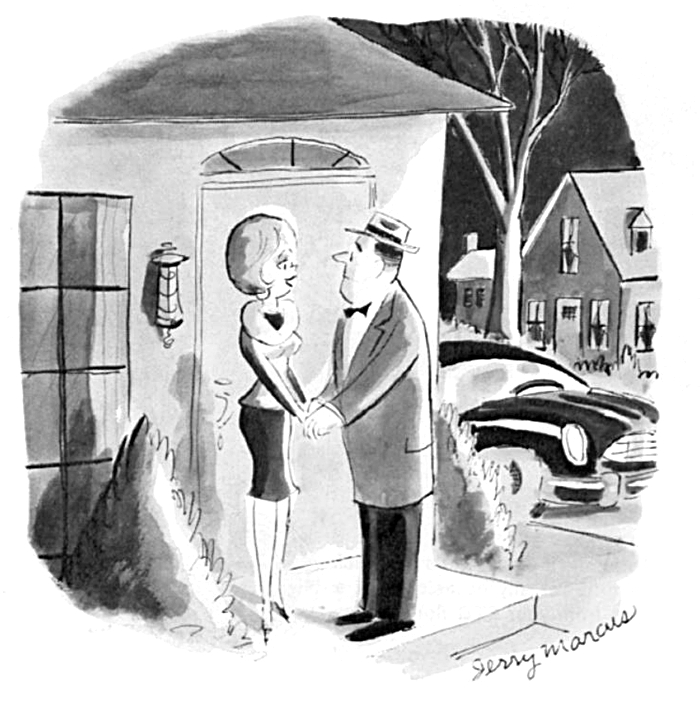
Jerry Marcus
October 19, 1963
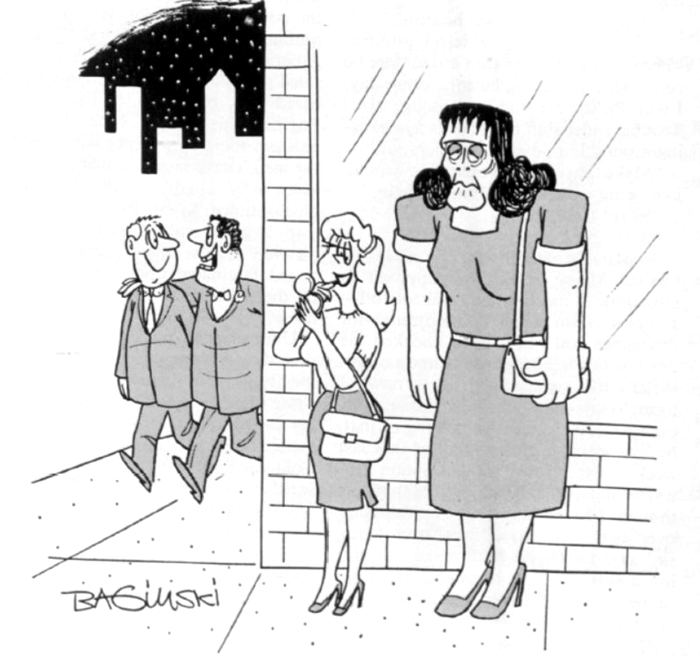
Frank Baginski
September 21, 1963
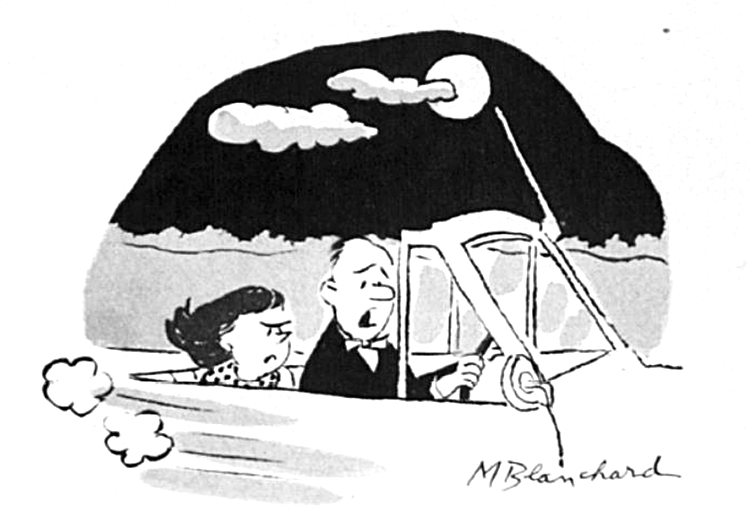
Martha Blanchard
August 27, 1963

Donald Reilly
March 12, 1966

Mort Gerberg
February 29, 1964

Martha Blanchard
December 31, 1966
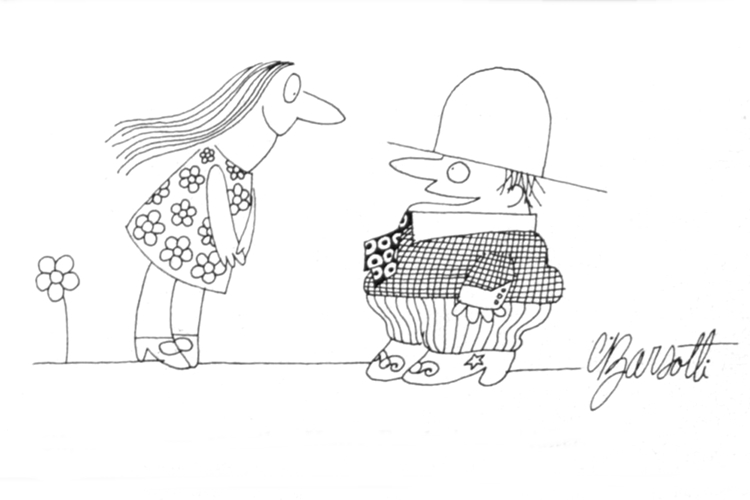
Charles Barsotti
October 8, 1966
Want even more laughs? Subscribe to the magazine for cartoons, art, inspiring stories, fiction, humor, and features from our archives.
Missing in History: The American Photojournalist Who Captured the Heartbreak of World War II
“Suddenly their little voices were silenced…and then we knew.”1
On November 30, 1939, when American photojournalist Thérèse Bonney was in Helsinki, Finland preparing for the 1940 Olympics, the Soviet Army crossed the border with 465,000 soldiers and 1,000 planes and bombed the city. Shocked by the devastation upon its residents, Bonney decided to do something about it. The “something” resulted in her photographing the carnage wrought on the people of Helsinki, especially the mothers and children.

Bonney’s heart-breaking photographs of Finland as well as those from other European countries taking during World War II soon appeared in international newspapers and magazines. But news stories were so easily forgotten, so in 1940 Bonney published a photo-essay book War Comes to the People. That same year the Museum of Modern Art in Manhattan hosted an exhibition of those images. Her photos moved Franklin Roosevelt to send $10 million in aid and Winston Churchill lifted the Atlantic Blockade so Red Cross ships could deliver help to the victims.
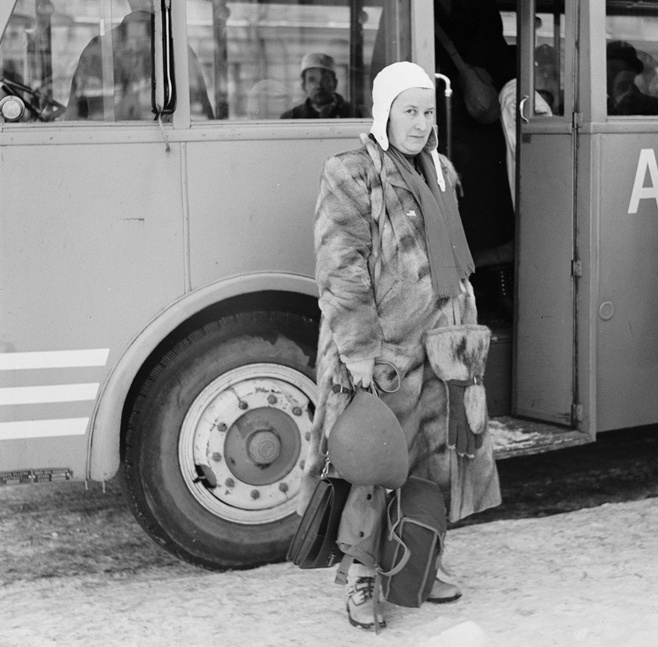
Bonney had been well known since 1924 as the founder of the first American illustrated press service, which initially specialized in stories and photos about European design and architecture. “I have made my headquarters in France since 1918, but I am not an expatriate. I am the dean of the American press corps in Paris. Nobody outdates me,” she proudly told a reporter later in life. Despite Bonney’s long residence in France and newspaper clients in over twenty countries, she was especially concerned about the United States. In The Invention of Chic: Therese Bonney and Paris Moderne, she said, “Our offices, our cars, our clothes reflect modern life, but our furniture and our homes are of the past,” she said, hoping to educate her homeland about European art, fashion, and architecture.

Born Mabel Thérèse Bonney to Anthony Le Roy and Addie Bonnie on July 15, 1894, in Syracuse, New York, she moved with her mother when she was five to California. In 1916 she received a Bachelor of Arts degree from the University of California, Berkeley and a master’s degree the following year from Radcliffe College. Between 1918 and 1919 Bonney studied at the Sorbonne and in 1921 received a docteur des lettres, becoming the youngest person and the fourth woman to earn a degree there. When she completed her doctoral thesis on the “Ethical Ideas on the Theater of Alexandre Dumas” she attracted attention in the Parisian press. “The people treated me like Pocahontas. They trailed me around everywhere and called me ‘La Belle et Grand Américaine,’” she recalled in a New York Times interview in 1976.
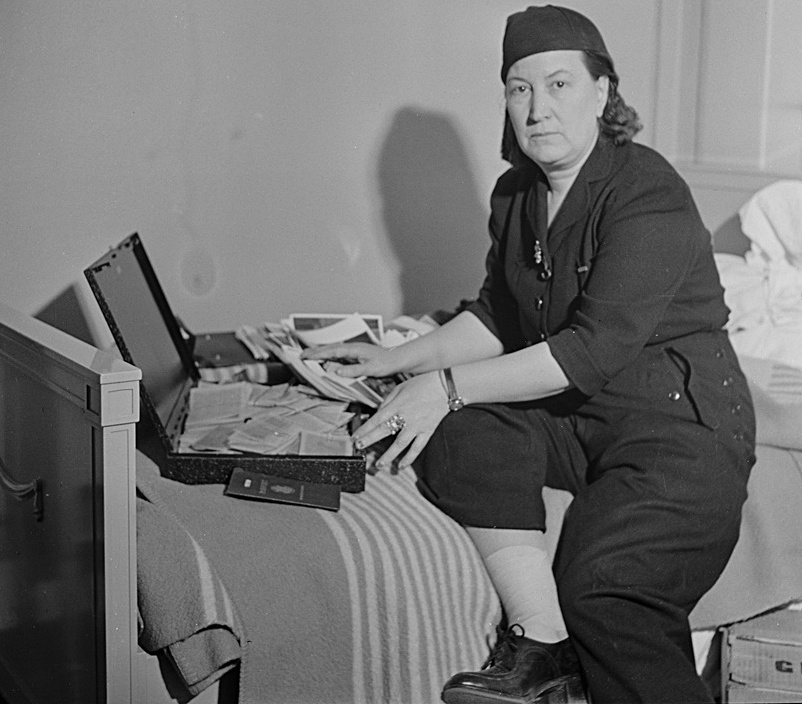
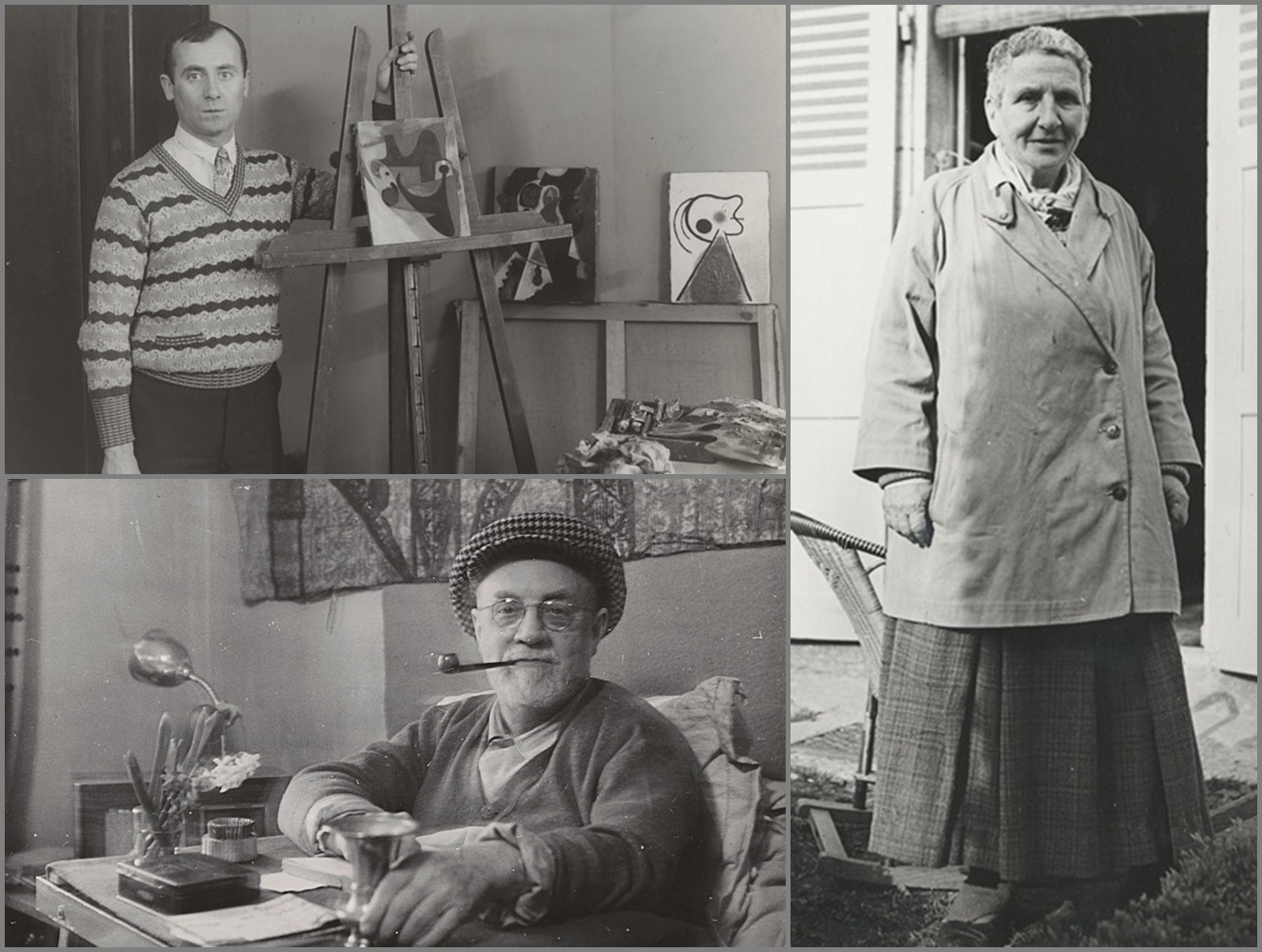
Bonney was not only brilliant but so striking that famous artists like Raoul Dufy and Georges Rouault painted her portrait. Before long she was directing the first international program to send French students to the United States. Yet Bonney was restless, so she started taking photographs of the artists, writers, and designers with whom she had become friends, including Gertrude Stein and Joan Miro.
After Germany’s 1939 invasion of Poland and the USSR’s attack upon Finland, Bonney began “truth raids” to photograph the widespread destruction caused by war. “I go forth alone, try to get the truth and then bring it back and try to make others face it and do something about it” she later told a reporter.
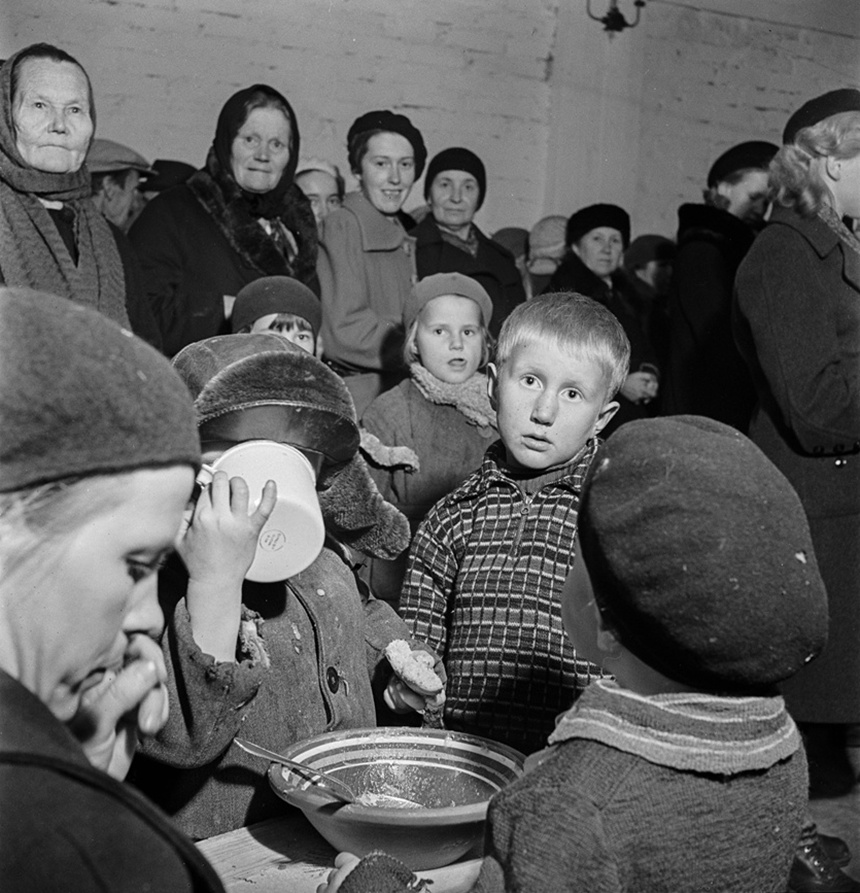
In 1943 Bonney collected other images of the war’s victims in her photojournalism book Europe’s Children. “With my camera I have made this record in France, Spain, England, Sweden and Finland,” she wrote in the introduction. (18) Disturbing photographs of war’s effect upon the young were interspersed with Bonney’s sparse prose such as, “It was not so long ago…the children of Europe led happy lives of home — and play, then — war was declared.” Later in the book she writes, “In wind and rain they beg — they search for food” and “Larders empty ‘no bread — useless to insist’ chalked on bakery doors.” Included, too, were portraits of women: “The mothers of Europe — this woman only forty — like pelicans, have given all to feed their little ones.”

The collection was so powerful that it not only inspired the 1947 MGM movie The Search but also led to the creation of UNICEF.

In the post-war years, Finland awarded Bonney the Order of the White Rose. France decorated her with the Croix de Guerre and the Legion of Honor. But awards meant less to Bonney than action. She provisioned food and supplies to an Alsatian village left in shambles and paid lycee tuition for the son of a vineyard keeper, enabling the youth to subsequently attend college and graduate school.
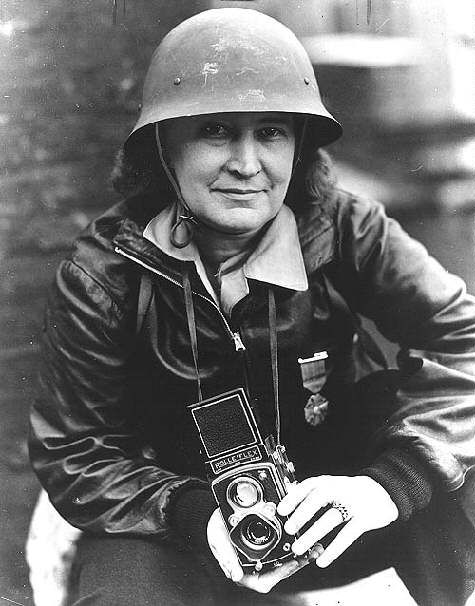

As she aged and witnessed discrimination toward older adults, the feisty photojournalist returned to the Sorbonne to acquire a second doctorate on the aged. She also lobbied in Washington to have Medicare benefits extended to Americans living outside the United States.
In the 1976 New York Times interview, reporter Nan Robertson asked Bonney about her life, and the photojournalist modestly replied that she thought it “could be an inspiration to the young.” On January 15, 1978, she died of heart failure at the American Hospital in Paris.
Art history researcher Caroline Riley observed in 2021, “Bonney’s trail-blazing life had a dramatic impact on the progress of women in the male-dominated professions of photographer, journalist, spy, business owner, and curator.”
Magazine Covers Are Not What They Used to Be
If you were a rock band in 1973, how would you know that you’d made it big? According to the chorus of Dr. Hook and the Medicine Show’s hit song of that year, recognition was properly acknowledged “when you get your picture on the cover of the Rolling Stone.”
Oh, how times have changed. The last time I visited Rolling Stone’s offices, the walls were lined with every cover it had ever published, an incredible galaxy. But the magazine’s agenda-setting swagger has dimmed over the years. Music culture has dramatically changed — and so too has the impact of magazine covers.
In the world of magazines, especially the celebrity “glossies,” there was a time when covers seemed like practically everything for their millions of readers and, of course, the stars and their stressed-out handlers. It would not be an overstatement to suggest they helped both illuminate and steer the cultural tastes of the day. Those of us in the business spent ridiculous amounts of energy concocting covers so compelling that only the most popcult-averse could resist buying copies. And now? Not so much. Not for celeb mags, not for any mags.
What happened? The explanations are simple. First, try finding a newsstand these days. They’ve mostly vanished. In New York City, where once there were about 1,300, that number has dwindled to around 350. When I was editor of a magazine for the magazine industry, we used to say that a cover had perhaps five seconds to capture a shopper’s eye at a crowded newsstand. So, their disappearance — which followed organically from the shuttering of thousands of print magazines over the last decade — means the surviving titles, starved for sales, must run lean. I mean to-the-bone lean. No more knockout covers that cost into the tens of thousands of dollars to make happen. Instead, while we still occasionally see sort-of-slammin’, kind-of-clever, but ultimately conventional covers, few dare to be great.
When was the last time you spotted a cover that jerked you to a halt? Be honest. Most are pretty safe and rely on readily available (read “inexpensive”) photography or software-generated art. Some barely try: all-type covers are commonplace because they don’t ding a publisher’s budget.
My fascination with covers began when I was a teenager. LIFE, Look, Sports Illustrated, and of course The Saturday Evening Post, which featured Norman Rockwell’s illustrations — those were magazines that seemed to hit home runs issue after issue. Along with hundreds of less notable others (New Times, Audience, Eros, Scanlan’s Monthly — all long gone), they filled cartons in my homes until they were destroyed in a flood. I was lucky a few years later to stumble upon a stash of Fortunes from the 1930s; their woodcut covers are regarded as among the most beautiful ever produced. Now, framed, three of them grace a wall in my office.
I no longer collect covers, but I appreciate the imagination and, yes, the privilege that goes into producing the most wonderful — and challenging — ones, then and now. As a for-instance, I recall once participating in a lengthy back-and-forth with Arnold Schwarzenegger about what he’d agree to for an ambitious cover concept. In the end, it was worth the aggravation with Arnie and his team. On newsstands, that cover screamed for attention.
But those were the glory days, as the saying goes. Sadly, they have largely moved on. Like a rolling stone.
In the March/April issue, Cable Neuhaus wrote about the boom in online newsletters.
This article is featured in the May/June 2025 issue of The Saturday Evening Post. Subscribe to the magazine for more art, inspiring stories, fiction, humor, and features from our archives.
The Abominable Tariff
On May 19, 1828, President John Quincy Adams nearly started the Civil War 30 years early when he signed a new tariff into effect.
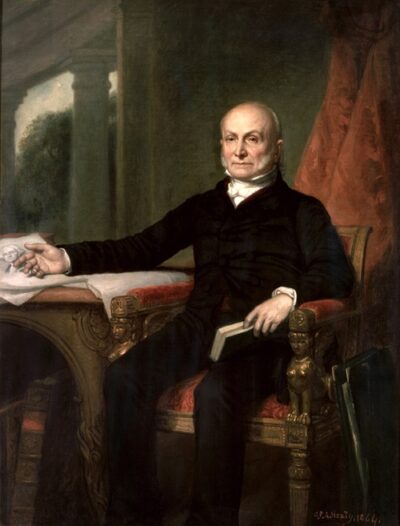

The tariff was designed to help American manufacturers compete against British imports. At the time, Britain’s well-established manufacturers could produce merchandise for significantly less than young America’s industries. It was soon being called the “Tariff of Abominations” as it imposed a 38 percent surtax on selected imports and a 45 percent addition to the cost of some imported raw materials.
Then, as now, consumers paid the tariff surtaxes.
When they heard about the new tariff, foreign governments struck back. Rather than responding with their own tariffs, they simply stopped buying American cotton.
Many Americans were unhappy with the new tariff, but none more than Southerners. The increased cost on imports was intended to help domestic manufacturers, who were generally located in the North. The South hadn’t focused on manufacturing but on agriculture, specifically cotton. Now cotton-exporting states of the South were paying the high price of aiding northern businesses.
The tariff’s unpopularity was a heavy contributor to Adams’s failure to be re-elected in 1828. Andrew Jackson of Tennessee would become president.

.jpg)
John C. Calhoun of South Carolina, a champion of southern rights, had been Adams’s vice president, and he would soon be vice president again in the new administration. Calhoun strongly opposed the tariff and secretly wrote a document titled “South Carolina Exposition and Protest” in December 1828.


Calhoun didn’t claim authorship because he still hoped to run for president. But it was fairly obvious who wrote it.
Rather than just denouncing the tariff, Calhoun claimed that states had the right to overturn federal law. Under this state’s right, South Carolina could declare the tariff invalid within its borders.
Calhoun reasoned that states could overturn federal laws if the federal laws trespassed on their rights. The tariff was unconstitutional because it promoted northern industry at the expense of southern interests. Other southern states — Georgia, Mississippi, and Virginia — agreed with him but took no action.
Jackson responded to Calhoun’s Exposition by declaring that only Congress had the full authority to enact tariffs. Calhoun accused Jackson of despotism. But this was as far as the two men went. Calhoun began working on a tariff revision with Henry Clay, which Jackson hoped would defuse the conflict. A compromise was worked out and a modified tariff was put into effect in July 1832.


But southern lawmakers still weren’t satisfied. South Carolina passed an official Ordinance of Nullification in November of that year, which not only nullified the tariff but also warned that if the federal government used force to collect tariffs, the state would secede from the Union.
Andrew Jackson was the wrong president to threaten with disunion.
Jackson asked Congress to enact at Force Bill authorizing the use of federal forces to enforce the tariff. He sent warships into Charleston Harbor and said he’d hang anyone who threatened nullification or secession, declaring the state was on the brink of insurrection and treason. In a “Proclamation to the People of South Carolina,” he asserted that, contrary to what Calhoun said, the constitution didn’t allow states to decide which laws they’d follow.

Calhoun angrily resigned as Jackson’s vice president.
Later Jackson confided that the problem with South Carolina had never really been the tariff. That was just a pretext. What Calhoun and his backers had wanted all along was disunion and a confederacy of southern states. “The next pretext,” he predicted, “will be the negro, or slavery question.”
America’s Most Unexpected Wine Trails (Part One)
Mention U.S. Wine Trails, and immediately visions of California’s rolling Napa Valley, New York’s dramatic Finger Lakes, or Oregon’s mountain-framed Willamette Valley come to mind.
But as wine growing technology — and America’s appetite for good home-grown wine — explodes, first-rate wine trails have sprung up all over the nation.
Here’s my first article in a continuing series on America’s Most Unexpected Wine Trails.
Idaho: The Lewis-Clark Valley Trail
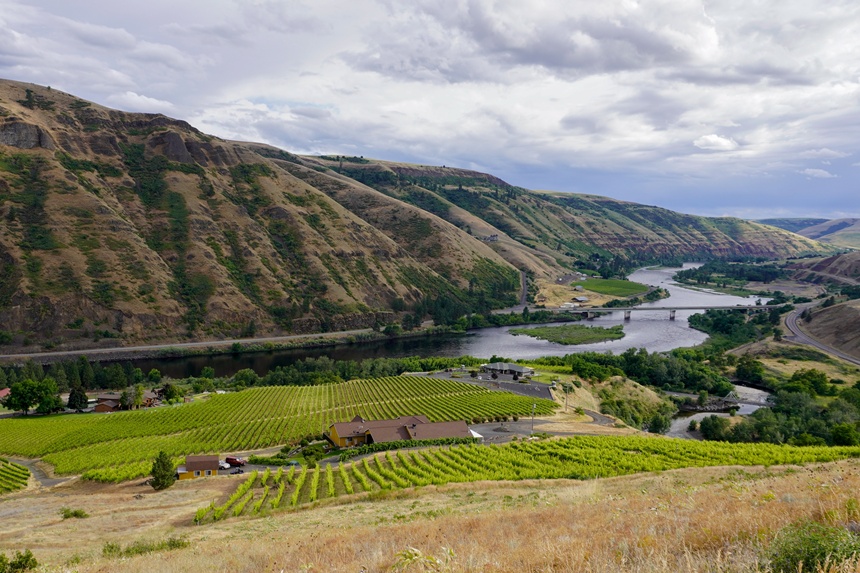
The narrow blue river winds through a steep green valley, far below the tasting room where I am settling in with a fine cabernet sauvignon. At my feet, rows of grape vines plunge toward the water in tight succession, then continue their march up the hill on the opposite bank.
A whisper of wind rustles through the vineyard, accompanying the chirps of chickadees and the soft gurgle of the waters below.
I have experienced a setting almost identical to this one before, sampling the wines of a family vineyard along Germany’s Moselle River. But I am not in Europe, nor California.
I am in Idaho. Yep, the same state whose license plates herald its “Famous Potatoes” is, almost secretly, an emerging destination for travelers seeking the romance of America’s wine country.
That’s because the picturesque Rivaura Estate and Winery, perched in the low-lying mountains east of Lewiston, is no one-off: It’s just one of dozens of similarly picturesque, equally acclaimed wineries stretching along a scenic drive that reaches halfway across the state.
A glance at a map explains why Idaho yields wonderful wines: The Lewis-Clark Valley, which embraces Idaho’s best wine region, continues west across the state border into Washington State’s fabled wine country. The very same Snake River water, the very same sun inclination, the very same Pacific Ocean weather patterns that nurture Washington State’s famous wines also bless this little corner of Idaho.
“The only difference,” a winery owner tells me, “is that 50 years ago someone decided Idaho would be known as The Potato State.”
More than a century ago, Coco Umiker’s family bought a spread of land in western Idaho and grew wheat on it. In 2004, she and her husband Karl, a chemist, planted Clearwater Canyon Cellars’ original vines on that property — the first commercial vineyard in the Idaho portion of their valley.
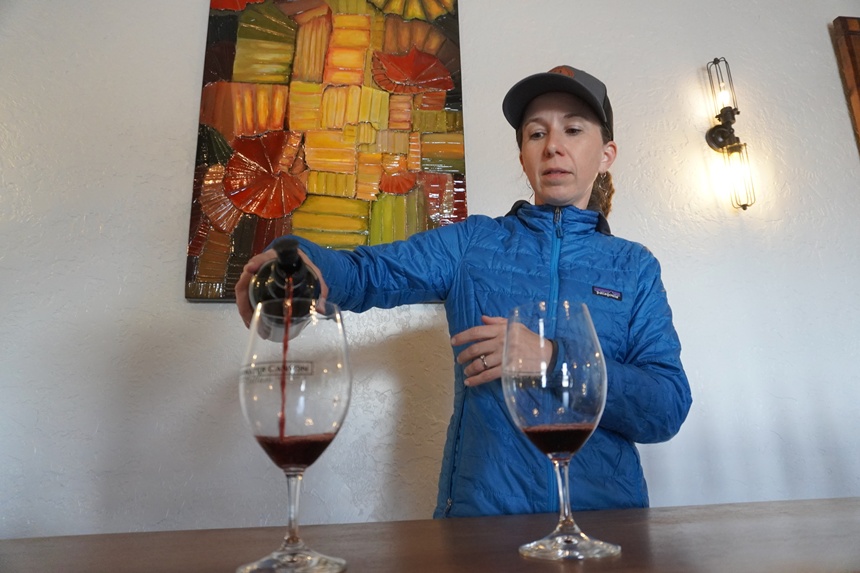
“In the third year we had a little crop,” she recalls. “We made a barrel of wine.”
Since then, the Umikers have been able to boost their production thanks to grapes from nearby growers, but they are scrupulous about using only fruit from their valley.
It’s important. If you ask why it’s important, Umiker will regale you with everything you need to know about drainage and altitude and sediments left in an ancient lake bed.
Like many wine makers, Umiker has an extensive background in biochemistry, plus a doctorate in viticulture. But right now, in the wine tasting room, Coco Umiker is mostly a proud winemaker, pouring a rosé made of all-Idaho grapes and clearly hoping I’ll like it. I do.
“This one is only available through our wine club,” she says. Then she laughs. “A wine club, can you believe it? It seems like yesterday we were out there begging people, ‘Try our wine! Try it! For God’s sake, try it!’”
Through a window, we can see an SUV full of customers disembarking.
“This is better,” she says.
Old Mission and Leelanau Peninsula Wine Trails, Michigan
Driving along this finger of land north of Traverse City, Michigan, I can’t help but notice fields of uprooted trees.
“Cherry trees,” says my companion, a longtime local. “We’ll be seeing grape vines here next year.”
That’s a rather radical statement when you consider Traverse City has long called itself the Cherry Capital of the World (when I arrived here, I came through Cherry Capital Airport). There are lots of apple orchards around here, for sure, but grapes?
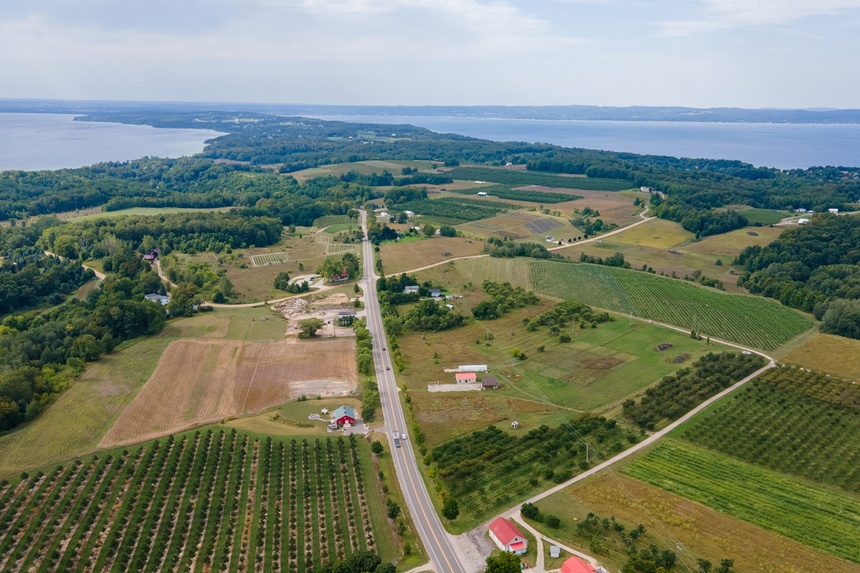
For decades, die-hard vintners elsewhere across the upper Midwest struggled to find grapes hearty enough to survive the area’s frigid winters and quick-ripening enough to produce juice during the notoriously short growth seasons. But about 50 years ago, one local farmer took note of Traverse City’s location, nestled between two long, narrow peninsulas that jut far into the waters of Lake Michigan. The lake’s deep waters moderate the temperature of the sandy hillsides year-round, and especially in the spring and fall, extending the growing season.
Today, more than 40 wineries dot the peninsulas, along with charming inns and bed and breakfasts.
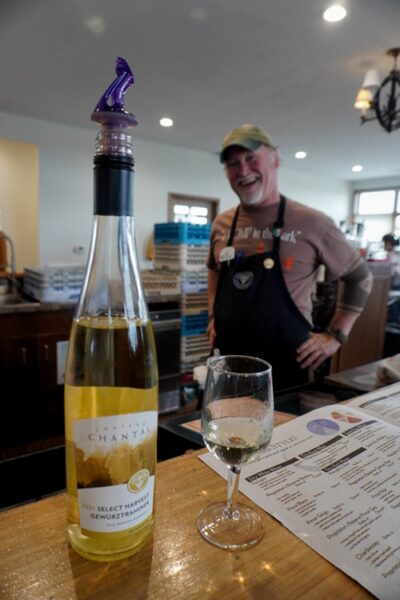
At 45 North Vineyard and Winery, wine maker Jay Briggs points out a sign standing above the vineyard — marking the exact spot where the 45th parallel passes through the property.
“You follow that line that way,” he says, with a touch of awe in his voice, “and you run through Rhone and Bordeaux regions of France. Go the other way and you come to the Willamette Valley in Oregon.
“Being on the 45th parallel isn’t everything in making good wine; but it’s not nothing.”
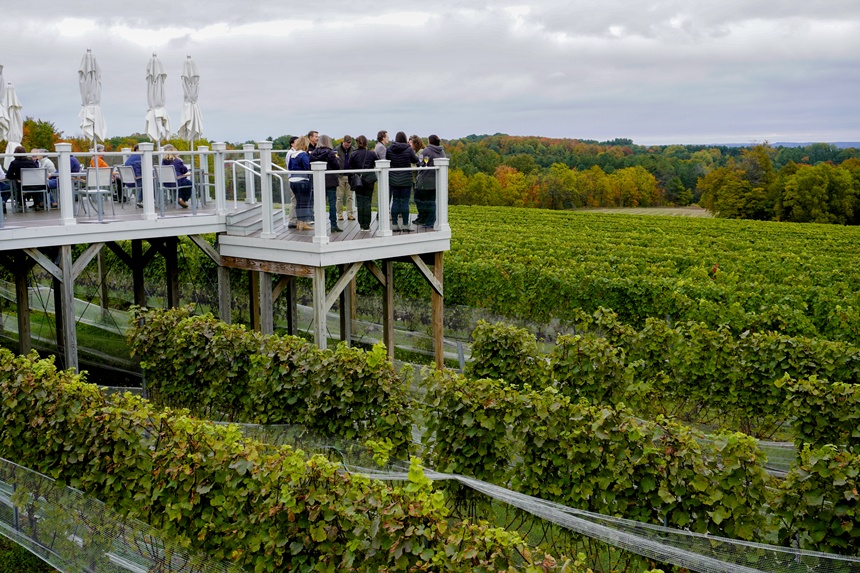
Upper Midwesterners are a rugged lot, of course, but even in this often-harsh climate you’ll still find some echoes of the balmier wine countries. Chateau Chantal, with architecture that echoes a French chateau, offers wine tastings from a large-windowed room overlooking the vineyards and the bay beyond. Brys Estate Vineyard and Winery has a handsome old-school tasting room with leather chairs and couches, plus an elevated outdoor deck that juts out over the sloping vineyard itself.
And then there’s Mari Vineyards, with a re-created Umbrian castle on a hill overlooking Grand Traverse Bay. At a long table in a tasting room, I am sipping a fine glass of Estate 2021 Bel Tramonto and chatting with owner Marty Lagina — onetime owner of a petroleum company, current owner of a Michigan’s largest producer of sustainable energy — and, along with his brother Rick, costar of the reality series The Curse of Oak Island.
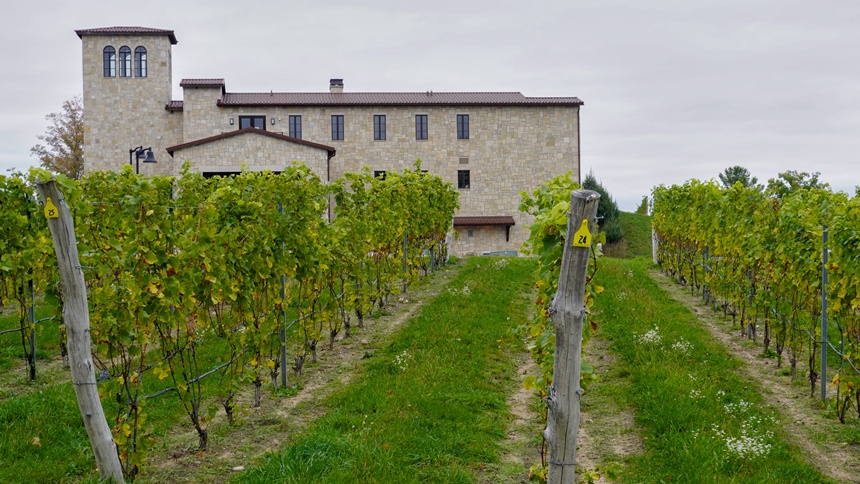
Lagina planted his first row of grapes in 1999 and named the new vineyard/winery after his mother, an Italian immigrant.
“That poor woman,” he says. “She came here from the green heart of Italy, and landed on Iron Mountain in the Upper Peninsula. She must have thought, ‘My God, what have I done?’”
Lagina’s grandmother always made wine — even during Prohibition. She is the inspiration for Mari Vineyards, where Lagina stubbornly — and largely successfully — blankets his hillsides with Old World grapes that few thought could survive up here. Thanks to some cleverly designed, hoop-supported greenhouses, Lagina has extended his growing season long enough to support nebbiolo and sangiovese grapes along with the more standard cabernet franc, merlot and riesling.
But to this day, his most popular wine is one of is first, known simply as “Row 7.” Helping Lagina plant his first vineyard during a hectic weekend in 1999, a group of friends accidentally mixed together a random collection of unlabeled grapes, which grew into a jumble of mismatched varietals.
Unwilling to plow up the row — Row 7 — Lagina simply let the vines ripen and began to make wine from that unruly collection.
And, surprise, people love it.
“I still don’t know what combination of grapes we’ve got up there,” he says. “And I’ve forbidden anyone to try and figure it out!”
The Hill Country Wine Road, West Texas
Driving out along Route 290 east of Fredericksburg, Texas, you’d expect to find some cattle ranches and a whole lot of weathered grassland. What you might not expect are more than 50 wineries and scores of inns and B&Bs flanking the highway.
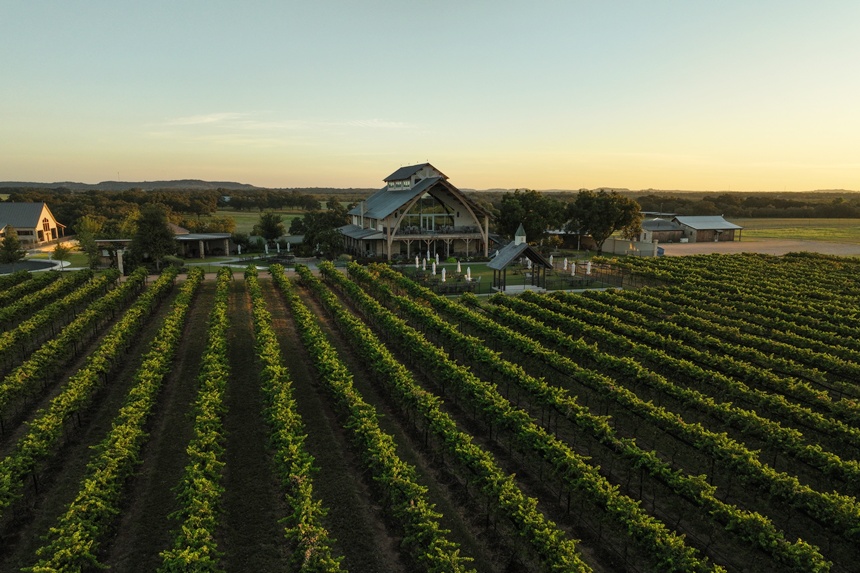
It’s a cool afternoon in early December, one of those rare times of year when the Texas Hill Country sun does not threaten to make your skin peel like a rattlesnake’s. Even now, the wide shade of the live oak and pecan trees is welcome — and so is the crystalline wine I’m holding in a stemmed glass, one of the best tempranillos I’ve ever enjoyed.
This is Signor Vineyards, a relatively new winery run by a family that has farmed and ranched this land for six generations. Signor is a major player in a wine district that is both surprising and, in some ways, inevitable.

A couple of centuries ago, Fredericksburg’s German settlers got right to work making wine from the mustang grapes they found growing in the area. Today, their descendants nurture dozens of varietals, making the most of the region’s challengingly dry and hot climate.
To be sure, Texas’s wineries have to focus on grapes that thrive in hot weather, including petite sirah, but the local champ is undeniably tempranillo, a Spanish grape that, when it comes to grape-killing heat, has a thick skin, and I mean that in a good way.
A drive through Central Texas’s wine corridor offers sumptuous spreads like Signor Vineyards to veritable wine malls, such as the Texas Wine Collective, where several local wineries share a visitors facility, and Texas Heritage Vineyard, an outdoorsy spot that has frequent live Texas music. The more adventurous wine seekers may even chance a visit to the numerous, decidedly modest wineries along the road — some working out of little more than a double-wide trailer.
Fredericksburg is itself a charming slice of Bavaria grafted into the heart of Texas, with quaint hotels and inns. And tree-shaded inns seem to be everywhere (including around nearby Luckenbach, where Willie Nelson holds an annual picnic). A seasonal “Winery Pass” gets you samples at multiple establishments — and private bus service safely shuttles you between tasting rooms.
Lodi, California
For nearly a century, the vast vineyards of Lodi were the wine world’s best-kept secret: The town and its surrounding vineyards provided tons of grapes every year to supply the demands of larger, world-famous wineries, including some in prestigious Napa, a few valleys away.
Then, in recent decades, the growers of Lodi began to take their wine seriously.
“The folks here started to say, ‘Why don’t we have our own wineries?’” a Lodi winemaker told me. Now the Lodi area is home to dozens of boutique wineries, making it an economical — yet undeniably competitive — alternative to nearby Napa.
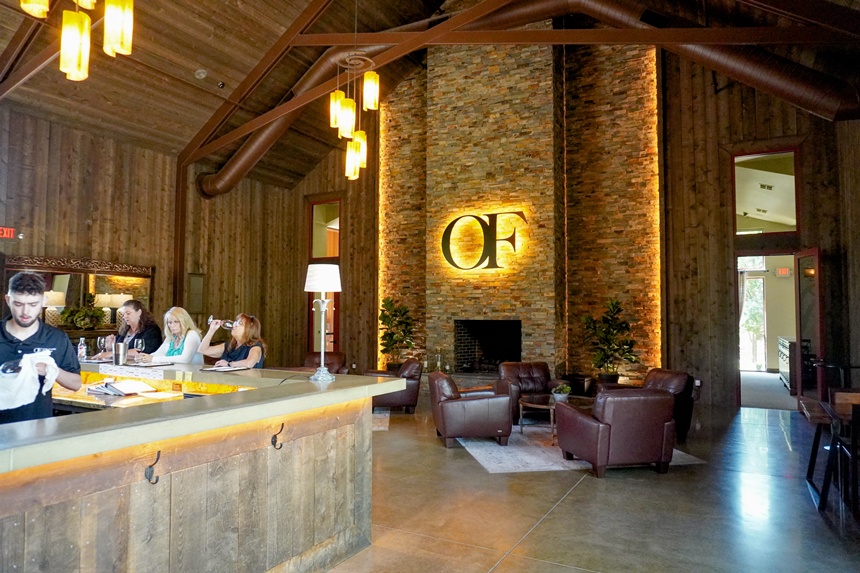
Example: While a wine tasting at a major Napa winery will set you back $75 to $125 a person, at Lodi’s picturesque (and award-winning) Oak Farm Vineyards, you can sample five wines for $20. Sit outside by the vineyard or enjoy the winery’s wood-and-stone tasting room, listening to excited wine lovers’ chatter echo from the high timbered ceiling.
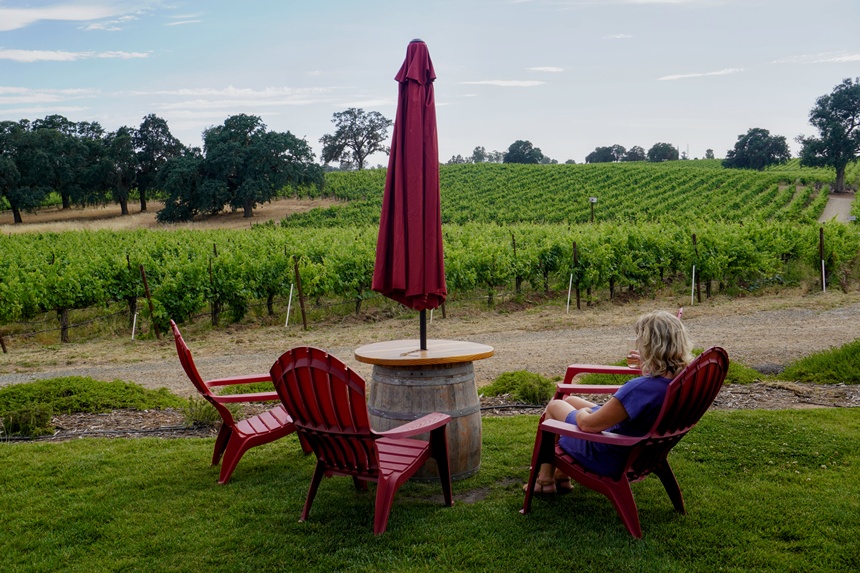
For sunset sipping, you can’t beat Bokisch Vineyards, right in Lodi, where the sky turns red above a gently rising hill of grapevines — and you can raise a toast to yourself, in honor of finding this spot before everyone else did.
News of the Week: Ian Fleming, BarcaLoafers, and 75 Years of Dunkin’ Donuts
Captain Jamaica
Two lost stories by Ian Fleming have been found. A couple of weeks ago it was the Beatles’ lost demo and a couple of years ago it was a Raymond Chandler story. People are always finding things!
One find is a short story titled “The Shameful Dream” and concerns the editor of a London magazine going to an important meeting with his powerful boss. It has been published in the latest issue of The Strand.
The second find sounds a bit more intriguing. It’s a script for a mid-’50s TV series titled James Gunn – Secret Agent. It’s about an American agent who uses Jamaica as his base and is looking for a criminal mastermind named Dr. No.
Hmmm … that sounds familiar.
An American producer wanted to make the show and call it Captain Jamaica (later Commander Jamaica). Douglass Watson was going to be asked to play Gunn, but the series never came to be (Watson went on to play Mac Cory on Another World for many years). Jeremy Duns did the digging and has a fascinating history of the project.
The Case of the Forgotten TV Show
In similar news, did you know there was a syndicated Sherlock Holmes TV series in the 1950s? It was produced by an American company and filmed in France. It lasted for 39 episodes. And every single one has been uploaded to YouTube by the streaming network FilmRise.
Uploaded to YouTube by FilmRise Television
Time to Make the Donuts
I was watching a repeat of Emergency! a couple of weeks ago, and as the paramedics were racing down a Los Angeles street to their next case, they passed a giant Dunkin’ Donuts sign. I had no idea that there were Dunkin’ Donuts locations in California in the mid-’70s!
America has been running on Dunkin’ for 75 years now. The pic above is what the first location in Quincy, Massachusetts looks like. I think all of them should look like that.
Uploaded to YouTube by FM1156
Headline of the Week
“Chicago Sun-Times Prints Summer Reading List Full of Fake Books”
RIP George Wendt, Charles Strouse, Jim Irsay, Gerry Connolly, Joan O’Brien, Brian Glanville, Ed Smylie, Dalene Young, and Walter Frankenstein
George Wendt had many TV and movie roles over the years but is probably best known for his role as Norm on Cheers. He died Tuesday at the age of 77.
Charles Strouse won Tonys for writing the music for such Broadway shows as Annie, Applause, and Bye Bye Birdie. He also wrote the theme song to All in the Family, “Those Were the Days.” He died last week at the age of 96.
Jim Irsay was the longtime owner and CEO of the Indianapolis Colts. He died Wednesday at the age of 65.
Gerry Connolly was a Democratic congressman from Virginia. He died Wednesday at the age of 75.
Joan O’Brien was an actress and singer who appeared in such films as The Alamo, It Happened at the World’s Fair, and Operation Petticoat, as well as TV shows like The Dick Van Dyke Show, The Bob Crosby Show, and Perry Mason. She died earlier this month at the age of 89.
Kathleen Hughes appeared in such films as It Came from Outer Space, The Glass Web, and Mr. Belvedere Goes to College, as well as many TV shows, including a regular role on Bracken’s World. She died Monday at the age of 96.
Brian Glanville was widely considered to be the best football (that’s soccer) journalist and novelist in the world. He died last weekend at the age of 93.
Ed Smylie led the team of engineers that helped to save the crew of Apollo 13. He died last month at the age of 95.
Dalene Young wrote Little Darlings and such classic TV movies as Dawn: Portrait of a Teenage Runaway, Deadman’s Curve, Can You Hear the Laughter? The Story of Freddie Prinze, and Will There Really Be a Morning? She died earlier this month at the age of 85.
Walter Frankenstein and his family hid from the Nazis in Berlin for two years, moving from secret spot to secret spot. He died last month at the age of 100.
This Week in History
Brown v. Board of Education Decision (May 17, 1954)
You’ve probably heard of this landmark case, but are you familiar with two important cases that came before it in 1950, Sweatt v. Painter and McLaurin v. Oklahoma State Regents?
Evangelist Aimee Semple McPherson Vanishes (May 18 1926)
This Week in Saturday Evening Post History: The BarcaLoafer (May 22, 1948)

I didn’t know the BarcaLounger had a sister (or brother) recliner. But I can picture you sitting in one this Memorial Day weekend. Well, not you specifically. I have no idea what you look like. I mean the universal you.
Memorial Day Recipes
I don’t know what you do for Memorial Day weekend – cookout? beach? watch TV? laundry? – but you’re probably going to eat something. Like these Garlic-Mustard Glazed Skewers and Roseanne Cash’s All-American Potato Salad, both from Smitten Kitchen.
The Pioneer Woman has BBQ Chicken Wings and Hawaiian Macaroni Salad, while Country Living has Root Beer Baked Beans and Old-Fashioned Lemonade. Taste of Home has Barbecue Burgers, and you can’t forget hot dogs. Serious Eats has these Hot Slaw Dogs.
And for dessert, Delish has the red, white, and blue Freedom Bark.
Next Week’s Holidays and Events
French Open (May 25)
It now airs on TNT! They’ll have coverage for the next two weeks (along with sister stations Tru and TBS and streaming on Max), and Tennis Channel will have morning roundups and highlights.
Indianapolis 500 (May 25)
Produce
Whenever I smell fresh carrots, celery, or lettuce, the veggies just trucked in from the fields, I think of Wanda. She and her mother would come into the A&P on Saturday afternoons. If I was lucky, I’d get to bag their groceries and be near her. But it wasn’t a sure thing.
“You get to see her at school,” Steve, one of the other box boys, complained. “Here’s my only chance to get her number.”
“You’re not … not even Catholic,” I stammered. “So … so butt out.”
“Jeez, Len, I just want to ask her out, not marry the babe.”
“But her mother’s standing right there.”
Steve grinned. “So! The mom looks pretty bitchin’ to me. If I were 20 years older …”
I envied Steve. At least he could talk with Wanda, while I always felt tongue-tied. I’d stumble through a broken conversation while sacking their groceries, my face burning. I’m sure she noticed because she’d chatter away with her mom, trying to take the pressure off me. And all the while, LaRue, the checker, stared at me with a blank face and shook her head, as if to say, “What an idiot!”
Wanda and I went to Santa Barbara’s only Catholic high school. But in 1964 the girls and boys were taught separately. I think the nuns and priests felt that having classrooms crammed full of teenagers with rioting hormones and sex drives would be distracting and maybe even dangerous. So the only time we could talk with the opposite sex was at lunchtime, down by the Coke machines lined up against the gymnasium wall. Even there I couldn’t get near Wanda, couldn’t separate her from her girlfriends and the crowd of guys hanging around. But every so often I’d catch her looking at me and smiling wryly; it was enough to keep me hoping.
One day at the store, I was surprised to see her in the parking lot, standing next to her family’s car. She waved me over.
“Sorry to bother you, Len.”
“No … no problem. What’s up?”
“You probably know that Steve asked me out on a date this Saturday night.”
I shook my head.
“Yeah, he’s been after me for a while. I’m supposed to meet him here at 6:30 after he gets off work. My mom will drop me off.”
“Uh huh.” That son-of-a-bitch Steve had snaked my fantasy girlfriend. What could I do?
“I know he rides that funny motor scooter around town. Is that what he’ll take me to the movies on?”
I grinned. The image of Wanda clinging for dear life to the back of Steve’s Honda 50 seemed somehow hilarious. But I shook my head. “No, he’ll drive his father’s Plymouth. You … should be fine.”
Wanda let out a deep sigh. “I didn’t know whether I should bundle up and wear jeans or put on a date dress. Riding on that two-wheeled contraption in a dress would be gross.”
I felt like saying, nothing you could show the world would be gross, but settled on a simple nod. The more I thought about it the angrier I got, a good part of it directed at myself. I had told Steve to cool it with Wanda and he’d ignored me. I knew I had no claim on her, but if I had just gotten up the nerve to ask …
That Saturday, Steve brought fresh clothes to work. At 6:30 he hustled to change in the men’s room. I moved through the parking lot quickly, to his swimming-pool-blue Plymouth. I let the air out of its rear left tire — not all of it, but enough for it to go flat as they drove down State Street toward the Fox Theater. I figured nobody would get hurt and it would spoil their first date. I’d have a chance to step in and ask Wanda out. Pretty stupid, right?
“You’re lookin’ sharp,” I told Steve.
“Thanks, man. You’re not pissed, are you? I know you’ve got a thing for Wanda.”
“No … not that much.”
Steve stared at me for a moment then moved toward the Plymouth. Off to the far right, Wanda leaned against her parents’ car. I hadn’t seen her there. She waved at me and grinned, as if setting out on some vacation daytrip. I watched them motor out of the shopping center onto State Street, heading downtown.
I worked all that weekend. Steve didn’t show up for his Sunday afternoon shift. At school the following day I looked for Wanda at lunchtime and couldn’t spot her. But then it was the last week of school before summer break, and a lot of kids who had taken all their finals cut class.
Still no Steve at the A&P. I tracked down Joe Ballent, the store manager.
“Ah, Mr. Ballent, do you know what happened to Steve?”
Joe had buckteeth and spoke in a soft slurred voice. “He was in an accident Saturday evening.”
“Is he all right? What happened?”
“I don’t have details. But he’s in Cottage Hospital.”
“Is it bad?”
“I don’t know. You can check on him after work — I seem to remember visiting hours last until 8.”
“Thanks. I’ll do that.”
But a couple days passed before I got up the nerve to swing by the hospital. They had just transferred Steve from the ICU to the Step-Down Ward. As I entered the room I found Wanda siting next to the bed, wearing a neck brace. Tubes and wires came from Steve’s face and arms. A couple IV stands dripped liquid into his veins. His closed eyelids twitched but didn’t open.
Wanda left her chair and stood before me, her whole body shuddering.
“It was horrible. One moment we were blasting along, then …”
We sat and she continued her story. “We had to hurry ’cause the movie started at 7:15 and we barely had enough time.”
“So he was speeding?”
“Yeah, I guess. When we turned off onto De La Vina, that’s where he lost it.”
“Lost it?”
“Yeah, ya know, the car’s back end swung out and we slid to the left.” Wanda took a deep breath. “The car broadsided a telephone pole. It hit right in Steve’s door.”
“Are you … okay?” I pointed to her neck brace.
“Yeah, I was wearing one of those lap belts. But when we hit, the crash jerked my neck. Didn’t break anything but strained a bunch of tendons and ligaments. The doctors say I’ll have to wear this thing for about ten days.”
“What about Steve?”
“Broken ribs and upper arm. He banged his head against the door pretty hard. They’re keeping him knocked out until the brain swelling goes down. It could be weeks … ”
“Did the police show up? Did they decide what caused the accident?” I feared her answer, the guilt already building inside me, an overwhelming weight that sucked my breath away and left a burning sensation in my chest.
“They’re not sure. One of the car’s tires had gone flat and they think that combined with how fast he was driving caused him to lose control.”
We sat in silence, listened to the beep of machines and watched the rise and fall of Steve’s chest. His face bore several cuts that had been stitched and would likely leave scars. His cheeks sprouted coarse black whiskers, one of those guys who needed to shave twice a day to stay smooth.
Our heavy silence finally got to me and I got up to leave. “If there’s anything I can do, let me know.”
“Christ, Len, I hardly know the guy … and I may not get the chance.”
“Yeah.”
I had to get the hell out of there and fast. The image of Wanda staring at a motionless Steve, the machines beeping, and the soft swish of nurses passing in the hallway freaked me out. Had I caused all of this? Should I confess it to a priest? To the police? To Wanda? To … to myself?
The following week, Joe Ballent hired another box boy to take Steve’s place and told me to train the new guy. I visited Steve one more time in the hospital, just a day or two before they sent him home. He seemed like his normal self. But the pain meds were drugging him out and I didn’t envy his withdrawal from them during recovery.
I didn’t see Wanda for a week or two after the accident. But then there she was, with her mother on Saturday afternoon, without the neck brace and looking as bodacious as ever. I had no problem scoring the job of bagging their groceries. But after all that had happened, I still couldn’t talk with her, still felt like a fool packing canned vegetables, Brillo pads, cake mixes, porterhouse steaks, with the crushable items on top into 40-carry grocery bags and asking her mother, lamely, “Would you like help out with your groceries?”
The summer wore on, dragging me toward senior year and then the great unknown. One Saturday in August, I saw mother and daughter enter the store just as I went on my mid-afternoon break. As I passed the produce section, Wanda stepped out from the end of an aisle. She was by herself. When she saw me she grinned and looked around, as if making sure her mother wasn’t nearby. She grabbed ahold of my arm and steered me toward the swinging doors that led into the produce section’s back room.
“What’s goin’ on? What’s with—”
“Shut up, Len,” she said in a low voice.
In the back room, boxes of vegetables fresh in from the fields towered above us. It smelled like a truck farm on a hot summer’s day. Wanda kept shoving me toward the rear of the room. We turned down a side aisle and ducked into a slot canyon created by shipping pallets of broccoli and eggplant.
We stopped, out of sight of anybody, the air cool around us. She turned toward me, grabbed my head and planted a wet kiss, complete with tongue, on my mouth. She kept at it. I pulled her body against mine and we made out, my first time in high school, clumsy, with noses getting in the way. But we improved.
Finally, she pulled away, gasping, and glared at me. “I’ve been wanting to do that for a long time. Why the hell can’t you ask me out? What am I? Just another babe that comes in the market and you tell filthy jokes about with the boys? You think I like coming here with my m-o-t-h-e-r? Come on, ANSWER ME!”
“I’m … I’m shy.” It was all I could get out.
She moved toward me until our faces almost touched. “Do you want me?”
I nodded.
“Not good enough, Len. Say it!”
“I want you.”
“There, was that so hard?”
“Yes.”
“We’ll have to work on that. Now, ask me out.”
“What?”
“You heard me, ask me out.”
“Do … do you want to go to a movie?”
“Yes, that would be nice. When?”
“Tonight, I’ll … I’ll pick you up … at 6.”
“Good. See, you’re getting better.”
“So where … where do you live?”
“The West Side. I’ll give you my address. Now come here. I’m not done with you just yet.”
We kissed and touched each other for a short while until Wanda said she needed to go find her mother. We walked through shadows toward the swinging silver doors, the odor of produce enveloping us.
“I’ll go out first,” Wanda said, “then you follow after a minute or so.” She gave me one last kiss. “And this time, don’t let the air out of the car’s rear tire. I want to survive our date.”
Review: Jane Austen Wrecked My Life — Movies for the Rest of Us with Bill Newcott
Jane Austen Wrecked My Life
⭐️ ⭐️ ⭐️ ⭐️
Rating: R
Run Time: 1 hour 38 minutes
Stars: Camille Rutherford, Charlie Anson, Pablo Pauly
Writer/Director: Laura Piani
Reviewed at the Toronto International Film Festival
It’s been at least six months since the release of a movie inspired by the novels of Jane Austen, so of course we were long past due for a new one — and the fact that Jane Austen Wrecked My Life is so charming, so life-affirming, so unreasonably fresh, is a tribute not only to the filmmakers, but also to the enduring appeal of an author who last laid down her pen more than 200 years ago.
Camille Rutherford (Anatomy of a Fall) plays Agathe, an aspiring novelist and Jane Austen devotee who, along with her best buddy Felix (Pablo Pauly), co-owns the beloved Paris bookstore Shakespeare and Company. These two are playful pals of the Movieland sort — one of those couples who for years share their most intimate secrets and tease each other relentlessly, never for one second giving thought to the possibility that they might actually be attracted to each other in that way.
Agathe has written the first few chapters of a novel, but now she is hopelessly blocked. Felix, knowing she just needs a kick in the derriere, secretly submits her unfinished book to a Jane Austin fellowship program — which invites her to take up a two-week residence on a British estate.
Reluctantly, Agathe boards the ferry for England, but not before sharing an impulsive goodbye kiss with Felix, an act that makes the two of them wonder if, as Jane herself put it in Persuasion, “There could have been no two hearts so open, no tastes so similar, no feelings so in unison.”
The moment she alights in Blighty, of course, all bets are off. Agathe is met at the pier by a veddy proper Brit named Oliver (Charlie Anson, who played Mr. Hurst in Pride and Prejudice and Zombies and who could well be the love child of Hugh Grant and Benedict Cumberbatch).
Oliver’s first words to Agathe are, “I thought you’d be much older.” Minutes later, he informs Agathe — a woman who has modeled her entire life after Jane Austen’s heroines — that although he is, indeed, Austin’s great-great-great-great nephew, “I just think her work is a little overrated.”
They kind of hate each other. So, we know full well that pretty soon they’ll fall madly, irresponsibly in love with each other.
Agathe is one of those movie authors (I’ve never known one personally) who, when facing writer’s block, stares forlornly at her laptop screen for hours before angrily slapping it shut. She does this repeatedly in the movie’s course — especially whilst (Britishism there) agonizing over her newly discovered but already-divided affections for Felix and Oliver.
Things get even more dicey when Felix, now all romantic and moony, surprises Agathe with a visit just as things are heating up between her and Oliver.
You get the idea: Agathe, the world’s foremost Jane Austen enthusiast, finds herself living a Jane Austen romance on an Austen family estate with her very own Mr. Darcy.
Rutherford makes a perfect Austen woman: independent and smart, and somewhat in denial regarding her hopeless romanticism. The guys are appropriately smitten with her to just the right degrees. Writer/director Laura Piani, a noted French TV writer, manages to evoke the plush spirit of the Regency era without compromising the elements of a decidedly modern tale.
“There are as many forms of love as there are moments in time,” complains the clergyman Edmund Bertram in Austen’s Mansfield Park. Jane Austen Wrecked My Life playfully and affectionately enumerates lots of those forms, in a time far removed from that of the woman whose timeless storytelling inspired it.
Logophile: Define This
- Eric’s approach to cooking is best described as desultory, because he
a. likes it hot and spicy.
b. prefers bland foods.
c. doesn’t work from a plan. - Last night’s casserole was absolutely fetid — it
a. smelled horrible.
b. was packed with nutrients.
c. was widely praised. - With one dish, Eric proved that, in the kitchen, he is nonpareil. He is a chef without
a. taste.
b. equal.
c. skill.
Answers
- c. doesn’t work from a plan.
- a. smelled horrible.
- b. equal.
This article is featured in the May/June 2025 issue of The Saturday Evening Post. Subscribe to the magazine for more art, inspiring stories, fiction, humor, and features from our archives.
Our Better Nature: Mating Is Wild
Meeting romantic partners has always been fraught with issues like the fear of rejection and maybe angst over an ill-timed acne outbreak. With over half of U.S. couples having met online, singles have more potential mates from which to choose, although having too many options can itself cause stress.
At first glance, wild animals have it easy when it comes to finding mates. When female spongy moths are in the mood, they just release a few molecules of sex pheromone, and guy moths flock to them, eager to please. No dating profiles needed. And when a male white-tailed deer encounters a female during her estrus or heat cycle, she’ll hook up with him even if he doesn’t take her to a nice restaurant first. Sounds refreshingly simple compared to our modern dating scene.

The downside for spongy moths is that within a few days, they all die. Most of their lives are spent as caterpillars, and their adult-phase romances are fleeting. For deer, the bucks get free-range sex for about two straight months, after which they’re celibate until the next fall.

While many species are all about hookups, what seems like emotional intimacy can be found in nature, too. Male and female great blue herons pair up exclusively all season, both helping to build the nest and feed the young, and the couple will coo and touch bills affectionately. However, these love-birds break up once their chicks are grown, finding new mates the following year.
Such troubles are petty when you consider the dangers of sexual cannibalism. Female black widow spiders and praying mantises often eat their male suitors right after, or even in the midst of, the mating process. The list of animals that lunch while they love includes a few snake species, notably the green anaconda, as well as scorpions.

Biologists don’t agree on what drives sexual cannibalism. Bizarrely, “mistaken identity” is on the list of possibilities. I suppose if Ms. Mantis swipes right on Mr. Hunk, and Mr. Mediocre shows up instead, that might set her off.
There’s also sexual parasitism, which is equally enticing. Anglerfish, with their needle-sharp teeth and weird fishing poles sprouting from their heads, are creepy by nature. Though many species ply shallow waters and have safe, if boring, sex, deep-sea anglerfish (found between roughly 800 to 8,000 feet down) have a mating ritual that’s beyond horrific.

For ages, only female deep-sea anglerfish were found. The missing-male puzzle resolved when a female turned up with her mate (males are much smaller than females) melded to her like a giant zit. This fusion-mating process was actually filmed in 2018. Here’s the scene: After the usual small-talk (I assume), the male anglerfish bites into the female’s underside and holds on. The female gradually absorbs the male, integrating his blood vessels so that he gets free nourishment. Whether in a state of intimate bliss or abject terror, he slowly melts into her until nothing’s left but his sperm factory, which becomes a permanent sex organ of the female, allowing her to lay fertilized eggs at will.
But males don’t always get the short end of the stick, so to speak. There are at least two kinds of spiders where males occasionally eat older females (I guess cougars don’t fare well in those species). Mating also doesn’t go well for female bed bugs, who actively avoid males. These nasty bugs mate through traumatic insemination, which is exactly what it sounds like. Male bed bugs inseminate females right into their body cavities after puncturing them, resulting in female injury and some deaths.


On the species level, sex is worth the numerous risks and costs because it leads to genetic recombination (in addition to offspring). Advantages include a more diverse, and thus more adaptable, genome. A new adaptation may help a species adjust to changing conditions, or allow it to exploit a novel food source.
All the same, quite a few species “decided” the fuss and muss of locating (and surviving) a mate was too much bother, and went to an asexual family plan where mothers make female babies from unfertilized eggs. It’s a clever trick called parthenogenesis (PG), meaning “virgin creation.” The term has the same root as the Parthenon, the ancient Greek temple dedicated to the goddess Athena Parthenos, or “Athena the Virgin.”
For a species, one of the benefits of PG is that critters can multiply a lot faster than through sexual reproduction, and by so doing, can take advantage of new habitats or food sources more quickly than their competitors. A number of insect species are parthenogenic, especially crop pests like aphids and scale insects. The list of animals known to make babies through PG includes some lizards, turtles, snakes, sharks, and at least one bird.

The downside of PG is that without genetic recombination, the only variety in the genome is from mutations caused by damage to DNA from chemicals, UV rays, or other factors. Parthenogenic species are less likely to successfully adapt to big changes brought by wildfires, floods, or the sudden loss of a favored food.
Given some of nature’s wild options for linking up with a mate, I’ll take the risk of duplicity and disappointment in online dating any time. Now if I can just learn how to photoshop my yearbook picture onto Hugh Jackman’s body for my dating profile, I’m sure I’ll get loads of hits.