In the mid-1800s, as cities were rapidly expanding, it became increasingly difficult to get fresh milk to urban areas. The cows – and their food sources such as grass and hay – were in the country. Slow and unreliable roads and lack of refrigeration made getting the milk into the city difficult and expensive.
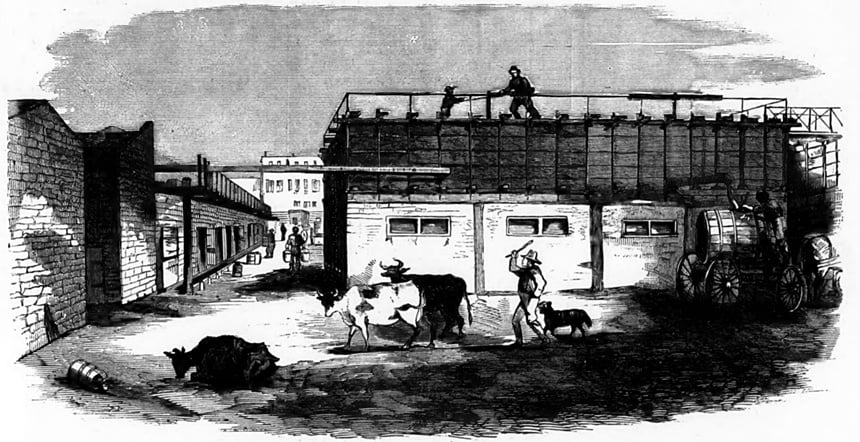
While New York City didn’t have dairy farms, it did have an abundance of two other commodities: distilleries and a drinking public. It was found that dairy cows could be fed the “mash” that had been used to ferment whiskey, for far less than the cost of whole grain, grass, or hay. The whiskey men began to build barns and troughs next to distilleries so the scalding hot mash could be directly dumped into feed troughs. Hundreds of independent milkmen bought dairy cows and paid the distillery six cents a day to feed and milk their cows. The swill milk industry was born.
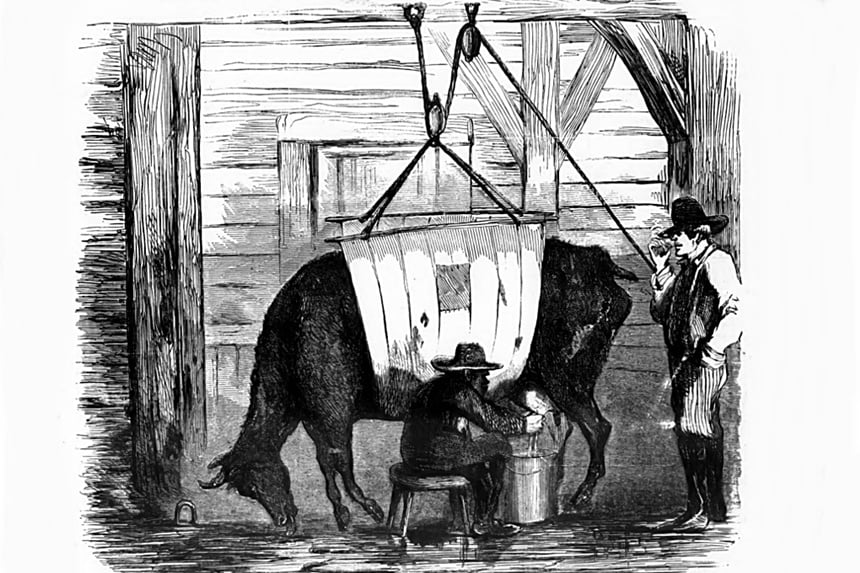
Each cow’s head was roped over the trough. If the cow lay down, it was into its own manure or even the previous occupant’s. Nearly all the cows were diseased. A cow too sick to stand was hoisted upright by ropes overhead and milked until it died. The average life span of a cow here was six months. Carcasses were set out where butchers could buy them for very little.
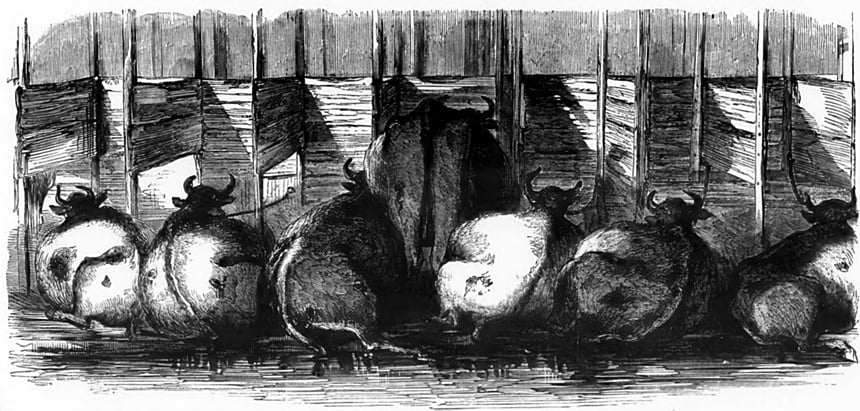
The milk cans were cleaned so seldom many formed a brown crust of manure along the bottom. If a cow had ulcers or pus on their udders, that was squeezed into the cans as well. A pint of water was then added to the milk for every gallon. Chalk was added to restore color. The individual milk sellers would add eggs, honey, salt, more water, or whatever they thought would restore the swill milk to the appearance and odor of natural milk.
Doctors wrote to Frank Leslie’s newspaper after the exposé was published. The doctors condemned consuming swill milk, listing diarrhea, dehydration, cholera and “marasmus,” (a term for acute starvation) causing infants’ deaths.
Meanwhile, hundreds of tons of manure were dumped daily into the Hudson or East Rivers. A distillery barn in New York City had a ditch that sent the manure directly down into the water—and guess where the water in the milk came from.
The barns “belched forth an intolerable and stinking stench.”The stench could be smelled from a mile away.
In the spring of 1858, Frank Leslie’s Weekly Illustrated Newspaper, one of the mass circulation news magazines of the day, published a long exposé of the swill milk business in New York City. Rather than clean up their business, the distillery owners and members of the Board of Sanitation sued Frank Leslie. Although he was arrested several times for slander, Leslie was telling the truth and eventually won all his cases.
The outcry forced the Board to “take action.” Its action was to form a committee to investigate the business. Corrupt incompetence was the chief qualification to be a committee member. The committee reported back that they had found no sanitation hazards.
The distilleries hired chemists to run experiments showing that not only was swill milk not a danger, it was positively heathier for children. The chemists claimed they found the same ingredients in clean milk and swill milk, but of course neglected to mention what other adulterants had been added to swill milk.
Doctors were furious. They were sure swill milk was the cause of thousands of children’s deaths. The medical society pointed out that the Board of Sanitation had reacted much more stringently when yellow fever threatened the city, and the number of deaths caused by the disease was far less than the carnage swill milk created. One of the consistent prescriptions for sick children at the time was to “take them to the country.” Infant mortality was lower there, and some doctors suspected it was due to having clean milk available.
One consequence of the scandal still affects us today. Farmers in New Jersey and New York state formed an association. As a united front, they persuaded railroads to carry fresh milk into cities daily. Railroads found they could also advertise to farmers that they could deliver fresh fruits and vegetables into urban areas.
The era of swill milk came to an end in 1893 when wealthy philanthropist Nathan Straus started a program distributing clean milk. Medical science had progressed enough that more people recognized the need for sanitary food. Finally, the advent of prohibition in 1920 closed the distilleries, bringing an end to a grim chapter in American food safety and animal welfare.
Become a Saturday Evening Post member and enjoy unlimited access. Subscribe now



Comments
Thank you for making us all aware of our history of corruption and how far men can go astray for profit/money.
Helps me to understand what is going on today and the lack of trust in so many of our providers.
It’s disgusting to read all the ways people adulterated food at one time. No wonder many diseases were caught from unsanitary handling of food, especially milk. It’s a wonder there were not more preventable deaths “in the old days” before electric refrigeration.
So horrible to treat these cows that way. Why didn’t Congress or the President step in or were they in the pockets of these producers? Such a sad, cruel, unsafe, and unsanitary existence. Sounds like something from a third world country. I would not have wanted to feed the milk to my children or let alone, consume it myself.
I won’t go into the process here but something similar happens even today with the production of veal. But unlike grown cows, veal production uses young calves being confined in small area stalls in large production barns. SEP: This is a story you should cover. It might open eyes of urban/city dwellers that otherwise would be blind to the facts.
What a horrible, long, ugly chapter in the American food industry. Of curse it’s shocking, but not surprising. There are modern equivalents in that ingredients banned in other nations for the harm they’re know to cause, are allowed in the U.S. for profit, what else? And what else is new? Probably the fact that it’s much less overt than in the 19th century, but still there nonetheless; just spread out more discreetly on a lot more things we consume.
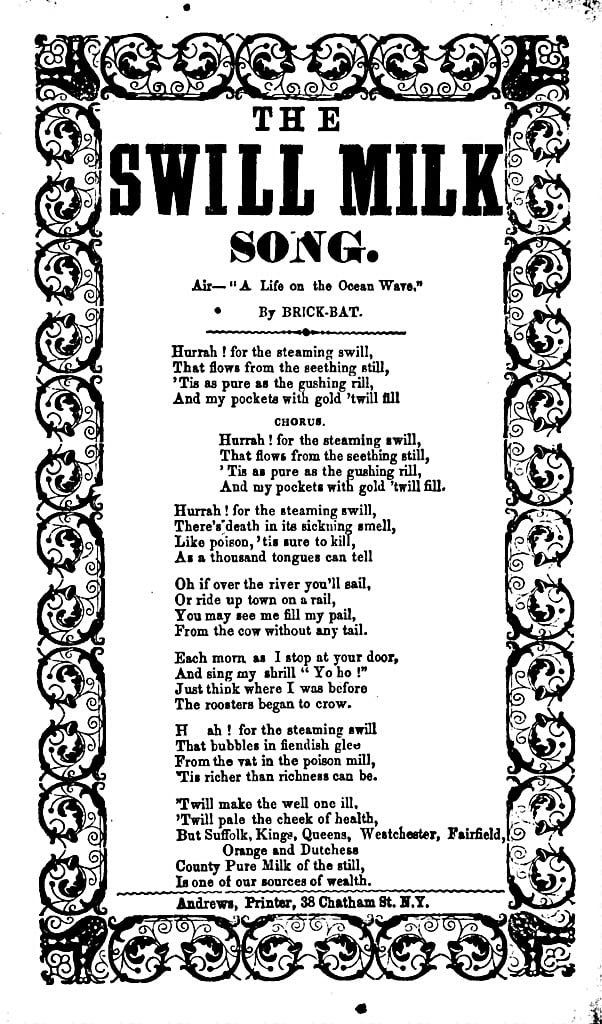
The ‘Swill Milk Song’ lyrics at the bottom from 1860 make the hatred and disgust of swill milk very loud and clear.