At the spot where I am standing, there are my shoes, then there’s 300 feet of ice, then there’s solid rock all the way down to the Earth’s molten core.
It doesn’t get more starkly simple than that when you’re walking on a glacier, the most powerful bulldozer the world has ever seen; a brute force that scours mountain valleys down to their cores under billions of tons of blue ice.
Most of the world’s glaciers are in retreat, which makes getting to them more difficult than ever. But there is still this one, the Athabasca Glacier, a drive-to glacier north of Banff in Alberta, Canada — probably the most accessible one in all of North America — that draws nearly 500,000 visitors every year.
Athabasca Glacier and other sites mentioned in this article (Google Maps)
“I hope no one here is wearing high heels,” says our guide, Janna, as our 10-passenger all-terrain Ice Odyssey vehicle — also known as a “Fat Truck” — bounces along a road of moraine rock toward the white-and-blue expanse of glacier ahead.
“That would be the worst possible footwear choice for walking on a glacier,” she continues, and she sounds like she has first-hand knowledge. “And I wouldn’t recommend flip-flops, either.”
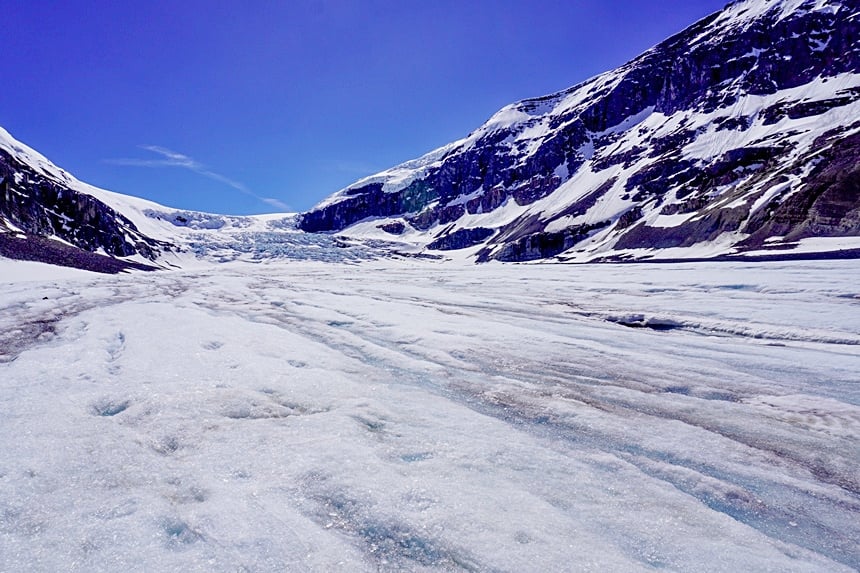
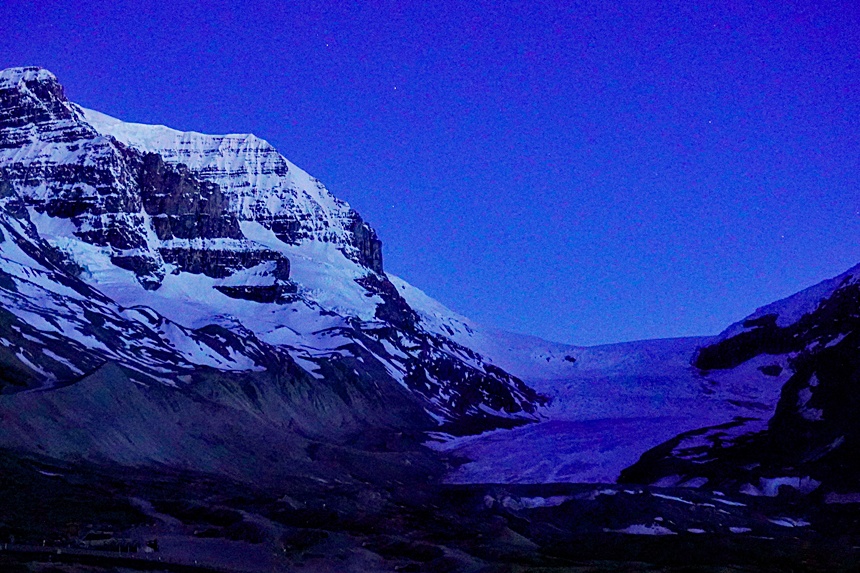
Actually, the ride seems smoother than I’d expected. The view from this cabin is better, too, thanks to large sliding windows on the sides and top. Those roof windows get slid open when we pause on a ridge overlooking the glacier. I stand up, poking my head out, and take in the panorama: A valley flanked by towering, jagged black rock mountains split at its bottom by a sheet of ice, its surface scarred by cracks and crevasses that, even from here, seem ready to swallow an unwary hiker (each year, in fact, more than a couple unescorted hikers meet a frozen end inside one of those crevasses). In the distance, at the high end of the valley, stands a wall of ice; beyond which this glacier joins its mother, the 125-square mile, 1,000-foot-thick Columbia Icefield.
Through the glacial glare, I spot what looks like a tightly packed line of ants making their way up the glacier. A look through binoculars shows them to be humans, of course — roped together, feet shod with spikes, gingerly hiking the 4-mile length of the glacier under the guidance of a local expert. A century ago, that walk would have been a mile longer, as the glacier reached nearly all the way back to the site of the Glacier View Lodge, the departure point for all Athabasca Glacier tours run by Pursuit Collection. (I’m lucky enough to be on one of Pursuit’s smaller, more exclusive Ice Odyssey vehicles. The company also offers more price-friendly visits to the ice field aboard larger, 56-passenger Ice Explorer vehicles.)

“Back inside, please,” chirps Janna. It’s time to continue our drive onto the glacier. We pass a small waterfall and a rushing stream — melt-off from the glacier. A final push of the Fat Truck’s diesel engine and we’re on the ice itself; 10 wheels, independently driven, rolling us onto an icescape that has me looking out for Superman’s arctic Fortress of Solitude.
A few minutes later, the engine shuts off, the rear door of our Ice Odyssey vehicle opens, and we’re invited to clamber down a metal ladder to the icy plain. Stepping off, I feel a little bit like Neil Armstrong: “That’s one small step for a man…and a long slide down if I lose my footing.”

Our guides make sure to let us off at a safe distance from any dangerous crevasses, but we still need to be careful as we avoid stepping into the countless rivulets streaming down the glacier. When the ever-present wind dies down, the air sings with the gurgle of newly melted ice water. The sight and the sound are beautiful, but they come with a somber reality: They are evidence that the glacier is bleeding to death. As if steadily increasing planetary temperatures aren’t doing enough damage, recent forest fires have deposited tons of black soot on the glacier surface, containing even more heat beneath.
“Take a look at this,” says Chris, our driver. He directs my attention to a line of perfectly circular holes that have melted into the surface. At the bottom of each: A deposit of pitch-black granular powder.
“Forest fire soot,” he says. “From last year’s fires.”
Around me, the cold air (not cold enough to sustain a glacier, but still pretty cold) rings with the laughter of people taking selfies and giddily narrated videos for the folks back home. Awestruck as I am by the sheer power and majesty that surrounds me, I can’t help but feel a sense of melancholy.
Janna encapsulates the source of my muted sorrow: “Our glacier has been here for the last 18,000 years,” she tells me. “And now it has just 40 or 60 years to live. In the span of a lifetime, we will lose this glacier.”
After 10 minutes or so, it’s time to clamber back up that metal ladder and into the rover. We rumble back toward home base, climbing the steep incline over the moraine, passing vehicles heading in the opposite direction.
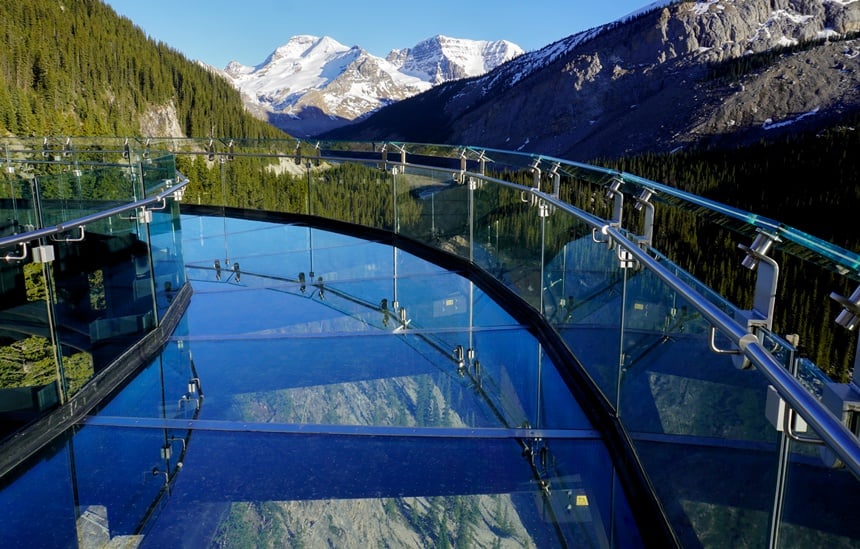
In the coming days I’ll follow the flow of that freshly melted glacial water downstream. I’ll peer over the edge of the Columbia Icefield Skywalk, a glass-floored semicircle that extends over the 918-foot-deep gorge that carries the roaring Sunwapta River, almost entirely fed by the glacier. A bit farther downriver, I’ll walk the stone paths that frame Athabasca Falls, a spectacular cataract of glacial water that lifts a curtain of spray high in the Rocky Mountain air.
Athabasca Falls (Video by Bill Newcott)
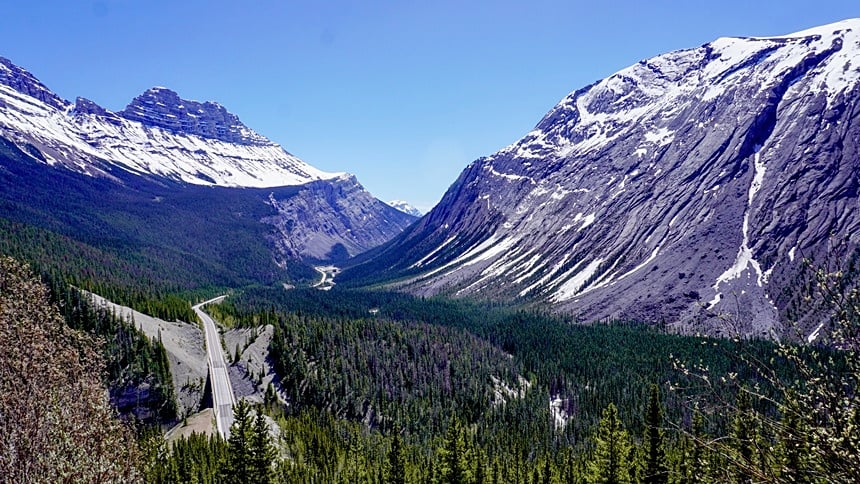
I will marvel to see elk and moose feasting on the new growth that is already beginning to restore a forest devasted by wildfires. I’ll throw on the brakes of my car — again and again — disbelieving the craggy, snow-capped spectacle of Jasper National Park’s Icefields Parkway.
Sixty miles north of here, in the old mining town of Jasper, I’ll ride the Jasper Sky Tram — Canada’s longest and highest aerial tramway — to the top of Whistlers Mountain, from which I’ll trace the blue ribbon of the Athabasca as it winds its way north, its icy waters destined for the Arctic Ocean.

Just over a mountain range from the Athabasca Glacier, I’ll board a tour boat on long, mountain-bound Maligne Lake. After an hour afloat I’ll step ashore for a close look at tiny Spirit Island, so sacred to the Stoney Nakoda First Nation that visitors are forbidden to set foot on it. Still, as the towering nearby mountains reflect on the blue glacial lake waters and Spirit Island’s slender pine trees reach for the passing clouds, it’s not hard to sense the profound importance of this place to people who have lived on this land for millennia.

Tonight, though, I’m staying at the Glacier View Lodge, at the foot of Athabasca Glacier. The sun sets late behind Mount Kitchener, and the northern stars slowly blink into view. True darkness doesn’t fall until nearly midnight on this late spring night, but my patience is rewarded with a surprise appearance by the Aurora Borealis; fingers of green and violet reaching across the sky, occasionally coalescing into undulating, translucent sheets.
Bill Newcott shares images of the aurora borealis from Glacier View Lodge in Jasper National Park. (Video by Bill Newcott)
Yes, the glacier is melting. But nature is eternal.
Become a Saturday Evening Post member and enjoy unlimited access. Subscribe now