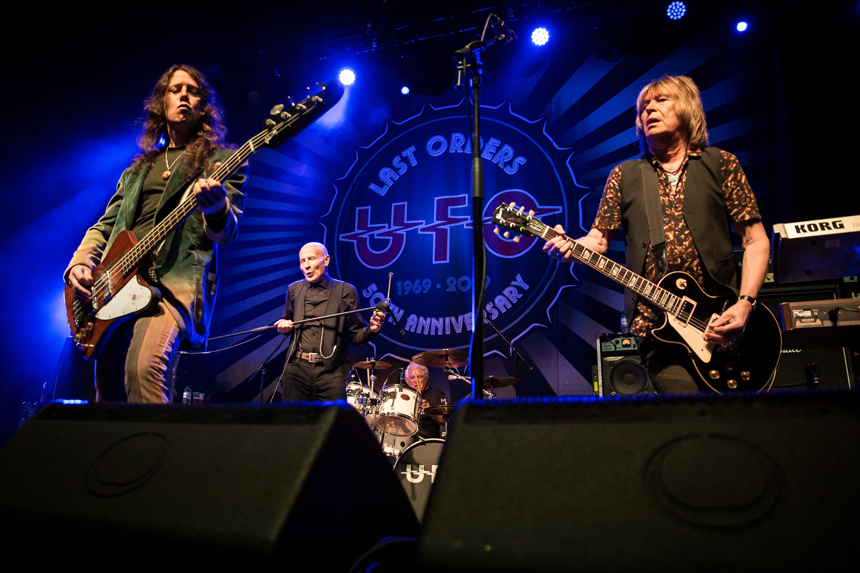
Few cultural forces have a landscape as vast as music. Within that field, it’s possible to have success and longevity while still being overlooked. As this month mark’s the occasion of the 50th anniversary of Rainbow’s debut album, it’s an appropriate time to recognize that outfit and nine other bands who deserve not only more recognition, but room on your playlist.
10. Wishbone Ash (1969-present)
“Hometown” (Uploaded to YouTube by Wishbone Ash)
Wishbone Ash weren’t the first band to deploy two lead guitarists (The Yardbirds had Jeff Beck and Jimmy Page in 1966, for example), but Andy Powell and Ted Turner redefined the approach, making it a feature of the sound. Turner departed in 1974, and Laurie Wisefield filled that spot for the next 11 years. That sound encompassed many subgenres of rock, as the band fits comfortably and simultaneously in categories like progressive rock, jazz fusion, and hard rock, while dallying in blues and folk. Their work can veer from moments that evoke Yes to the Grateful Dead within a single song. Bands as diverse as Van Halen, Eagles, and Iron Maiden have cited them as an influence. Better known in their native U.K. than in the States, they nevertheless cracked the Billboard Top 200 Album Chart in America an impressive ten times (eight studio albums, two live), with 1973’s Wishbone Four hitting #44.
9. Coven (1967-1975; 2007-present)
“One Tin Soldier” (Uploaded to YouTube by I AM)
Coven were a major and formative underground influence in the burgeoning subgenres of metal and occult rock. Apart from the dark themes and equally dark album art, they were the first band to officially “throw the horns” on a record cover (the back of their 1969 debut, Witchcraft Destroys Minds and Reaps Souls). Interestingly, the album’s lead track was “Black Sabbath;” that was eight months before the band Black Sabbath debuted with an eponymous album and opening track (for extra irony, note that one of Coven’s bassists was credited on the earlier album as Oz Osbourne). Coven was also distinctive for having a powerfully-voiced female frontperson, Jinx Dawson. Jinx and the band would appear on American Bandstand in 1971 when their version of The Original Caste’s “One Tin Soldier” from the film Billy Jack hit the U.S. Top 40. After a long layoff, Dawson formed a new version of Coven in 2007 and has been playing ever since.
8. The Sweet (aka Sweet; 1968-1982; 1985-present in different incarnations)
“Fox on the Run” (Uploaded to YouTube by Official Sweet Channel)
Call them glam. Call them bubble gum. Call them rock. Whatever you call them, the fact is that The Sweet (or Sweet, 1973 onward) landed four Top Tens and a #20 in the States between 1972 and 1978. In their native U.K. they were even bigger, with 14 Top 40s in roughly the same span. That period coincided with the group’s classic line-up of lead vocalist Brian Connolly, bassist Steve Priest, drummer Mick Tucker, and lead guitarist/keyboardist Andy Scott; Priest, Tucker, and Scott all had turns at lead vocals. After the band’s dissolution in 1982, there have been various reunions and versions of the band led by one of the original members. Today, Scott still tours leading Andy Scott’s Sweet (the other three original members have all passed). Overall, Sweet deserves credit for their evolving sound and fairly expansive line-up of hits. In 2016, “Fox on the Run” hit the charts again, taking the top on iTunes Rock Chart after the song appeared in the trailer for (and subsequent soundtrack of) Guardians of the Galaxy Vol. 2.
7. Big Star (1971-1975; 1993-2010)
“In the Street” (Uploaded to YouTube by Big Star)
Big Star is an example of a band being significantly influential while also getting “Who?” when you mention them. Their initial style had an obvious ’60s character, which makes sense because lead vocalist/guitarist Alex Chilton had fronted The Box Tops on their three big hits, “Soul Deep,” the #2 “Cry Like a Baby,” and the #1 “The Letter.” But Big Star entered a different orbit, laying down a style and feel that was part of the architecture of the alternative rock that emerged in the 1980s; they were a notable, credited influence on bands like R.E.M. and The Replacements (whose song “Alex Chilton” on 1987’s Pleased to Meet Me was a tribute to the man himself). Big Star’s most well-known song is likely “In the Street,” which was interpolated into the theme of That ’70s Show. “Thirteen” has been ranked in Rolling Stone’s list of the 500 Greatest Songs of All Time; likewise, three of Big Star’s albums (#1 Record, Radio City, and Third/Sister Lovers) have places in Rolling Stone’s 500 Greatest Albums of All Time. Chilton re-formed a version of the band in 1993 with original drummer Jody Stephens, along with Jon Auer and Ken Stringfellow of The Posies; that version continued to perform live and record until Chilton’s passing in 2010.
6. The Runaways (1975-1979)
“Cherry Bomb” (Uploaded to YouTube by TheRunawaysVEVO)
Though they were only together a few short years, The Runaways were deeply impactful in three ways: their music, their trailblazing impact on the female performers who followed them, and the multiple successful careers that spun out of the band. Producer Kim Fowley and songwriter Kari Krome set about assembling an all-girl band, and put together the initial three-member line-up of guitarist/vocalist Joan Jett, bassist/vocalist Micki Steele, and drummer Sandy West. Steele departed early, and the band added guitarist Lita Ford, bassist Jackie Fox (Steele’s first replacement, Peggy Foster, only lasted two weeks), and lead singer Cherie Currie. The band’s self-titled debut album dropped in early 1976 and cracked Billboard’s Top 200 Albums. The women were welcomed into both the American and British punk scenes while opening for acts like Cheap Trick and Talking Heads. Over time and throughout the recording of four albums, the band was afflicted with internal tension and membership turnover. When Currie left, Jett assumed lead vocal duties. While the band was done by late 1979, their legacy would go on. Currie and West continued to perform on their own projects; West passed away in 2006. Steele was a cornerstone of hugely popular group The Bangles. Ford became a metal guitar goddess. Joan Jett would found The Blackhearts and kick off a career trajectory that saw them enter the Rock and Roll Hall of Fame. The Runaways inspired countless other female groups, including The Donnas, L7, and The Go-Go’s. “Cherry Bomb” has long been a TV and film soundtrack favorite, with one of its biggest boosts coming from 2014’s Guardians of the Galaxy.
5. UFO (1968-1983; 1984-1989; 1991-2024)
“The Writer” (Uploaded to YouTube by UFO-Topic)
Last year, Chappell Roan opened her Coachella performance by introducing herself as “your favorite artist’s favorite artist.” That long-running musical gag might actually apply to UFO. While never having runaway success in the U.S., they been a massive influence on rock and metal bands of all stripes by pushing the boundaries of all guitar-heavy genres early in their career. The longest tenured of the band’s 30 official members was lead singer and co-founder Phil Mogg, who sang on all of the band’s albums; the configuration regarded as the group’s “classic line-up” was Mogg, long-timers Andy Parker (drums) and Pete Way (bass), keyboardist Paul Raymond, and guitarist Michael Schenker (an early member of Scorpions, who were founded by his brother and constant member, Rudolph). Throughout the mid-’70s, UFO became the opening act for many major bands, like Kiss, Rush, and AC/DC, and established themselves as a draw in their own right. Over the span of their career, they released 22 studio albums and 17 live records; their highest charting single in the U.K. was “Doctor Doctor” in 1974, while they took “The Writer” to #28 on the U.S. Rock airplay charts in 1982.
4. MC5 (1963-1972; 1974-1975; 1992; 2003-2011; 2018-2020; 2022-2024)
“Kick Out the Jams” (Uploaded to YouTube by Kostas)
There are few opening lines in rock as visceral as, “Right now . . . it’s time to . . . KICK OUT THE JAMS, M————!” MC5 (also known as The Motor City Five) established Detroit as fertile hard rock/proto-punk ground, plowing the furrows for acts like The Stooges. Politically active as well as fast and loud, they had a Rolling Stone cover before their first album dropped. The classic line-up featured Rob Tyner on vocals, the two-guitar assault of Wayne Kramer and Fred “Sonic” Smith, Michael Davis on bass, and Dennis Thompson in the drummer’s chair. Though the band only lasted until 1972 in their first incarnation, they undertook many reunions and reincarnations. The strength of their three albums (their live debut Kick Out the Jams, Back in the USA, and High Time) laid the foundation of their induction into the Rock and Roll Hall of Fame in the musical excellence category.
3. Badfinger (1961-1975; 1978-1984)
Badfinger (introduced by Kenny Rogers) performing “Baby Blue” on Rollin’ on the River (Uploaded to YouTube by danschutz)
Badfinger might be the band that existed closest to the intersection of blessed and cursed. They were the first band signed to Apple Records (who weren’t The Beatles) and had their first hit single written by Paul McCartney; they would also have two members of the band’s best-known configuration take their own lives (and in the same manner). The Welsh band initially formed as the Iveys and had a couple of middling singles. By 1969, the classic line-up was set: Pete Ham (vocals/guitars/keys), Mike Gibbins (drums/keys/vocals), Tom Evans (bass/vocals/guitar), and Joey Molland (vocals/guitar/keys). Apple thought a name change was in order and the band became Badfinger. McCartney set the band up with three songs and a plumb spot on the soundtrack to The Magic Christian. The first song, “Come and Get It,” went Top Ten in the U.S., U.K., Ireland, and Canada, and #1 in New Zealand. Through 1972, the band released three more major hits: “No Matter What” (U.S. #8); “Day After Day” (U.S. #4); and “Baby Blue” (U.S. #14). After management struggles and a move to Warner, the band’s fortunes faltered . Amid financial trouble, Ham took his life in 1975. Later, Molland and Evans relaunched Badfinger, but eventually split and were fronting dueling versions of the group. Following a 1983 row about money dating back to the Apple days, Evans also took his life. Molland toured for years with Joey Molland’s Badfinger until his 2024 passing. The band did experience a resurgence of awareness in 2013 when “Baby Blue” was played over the final scene of Breaking Bad.
2. Rainbow (1975-1984; 1993-1997; 2016-2019)
“Since You Been Gone” (Uploaded to YouTube by Thaapa1)
Also known as Ritchie Blackmore’s Rainbow and Blackmore’s Rainbow, Rainbow was founded by, you guessed it, Ritchie Blackmore. A founding member and guitarist of Deep Purple, Blackmore founded the new group upon his exit from his earlier outfit. The original line-up included four members from the band Elf, notably that group’s lead singer, Ronnie James Dio. Dio left to join Black Sabbath in 1979, and Blackmore and drummer Cozy Powell reconstituted the band with bassist Roger Glover (also formerly of Deep Purple), keyboardist Don Airey, and singer Graham Bonnet. While that line-up only existed for one album, it yielded the U.K. Top Ten hit “Since You Been Gone” (later featured on the soundtrack of Guardians of the Galaxy Vol. 3). Blackmore and Glover rejoined Deep Purple in 1984, but Blackmore quit for good in 1993. He’s since operated multiple line-ups of Rainbow, as well as consistently performing with his band Blackmore’s Night, which features his wife, Candice Night, as a vocalist (the neo-medieval folk-rock of Blackmore’s Night can be heard in the MagiQuest games that are familiar to patrons of Great Wolf Lodge).
1. Three Dog Night (1967-1976; 1981-present)
“Joy to the World” (Uploaded to YouTube by The David Frost Show)
“Shambala” (Uploaded to YouTube by 3DogsLive)
The idea of a band fronted by three lead singers shouldn’t work. And yet, Three Dog Night worked to the tune of 21 straight Top 40 hits. With a sound that incorporated rock, boogie, classic R&B, and some fairly incredible harmonizing, Three Dog Night dominated the early 1970s and yet are rarely discussed today. While it’s true that “Joy to the World” and “One” remain incredibly popular, the OTHER 19 Top 40 hits suggest that the group’s body of work is consistently overlooked. Though the band’s original run came to an end in the mid-1970s among the usual in-fighting and substance abuse that seemingly plagues most bands, they did pull several classic members (including co-founders and vocalists Danny Hutton, Chuck Negron, and Cory Wells) back together in the early ’80s. Wells passed in 2015, but Negron continues as a solo artist, and Hutton fronts the Three Dog Night that still tours today. Incidentally, that name? It’s an Aboriginal phrase referring to the cold; if it’s going to be very cold when the sun goes down, you need to allow three dogs in the bed to keep you warm. That is, a Three Dog Night.
Become a Saturday Evening Post member and enjoy unlimited access. Subscribe now
Comments
The RASPBERRIES!
How about the Grassroots?
Guess it does say “classic” rock, but as well as some already mentioned a couple of underrated ones that springvto mind are Uriah Heap (faves on “Abominog”), and Kansas – eg Carry on the wayward son, Dust in the wind.
If THREE DOG NIGHT isn’t in ROCK HOF,something has to be wrong.Remember that they were actually the number one selling band over the 5 year period of 1969-1974.Anybody for the band Orleans?They have been performing for more than 50 years and making fans happy!!!! Remember that their song STILL THE ONE became the theme for the American Broadcast Company in late 1970’s.
Rare Earth!
Totally agree with Badfinger, but, my No.1 would be Airwaves, although I think the only album released was New Day, all brilliant tracks recorded @ Rockfield Studios in Monmouthshire, Wales, home of Dave Edmunds & Nick Lowe
I would have to add Atomic Rooster into that list.
I have a fantastic friend named Dan Vasc in Brazil. He should be reading this! He is a heavy metal vocalist you must check out!
He is so incredible! Yet I don’t think he is well known- JUST PHENOMENAL!
The Grateful Dead were a REAL band. Never had a set list. Didn’t rehearse, played what they felt like playing. No show was ever the same. Most bands tour to push their most recent album, but the Grateful Dead weren’t into albums. It was all about the music, and the fans. The members of the band were ALL friends, no infighting like other bands. Again – NO show was ever the same! I saw them more than 100 times – lost count after that. I spent many years going to see many various bands, but NONE of them were as interestingly good as the Grateful Dead. The other bands obviously rehearsed and they always had a set list. Not the Grateful Dead – we never knew what they were going to play, and THEY didn’t know what they were going to play until they got on the stage. Garcia and his guitars were wonderful. Weir and Garcia sort of challenged each other with their guitars. The two drummers were the same – challenging each other. The bass player, Phil Lesh, was SO interesting! Their shows were always wonderful, and the Deadheads were all friends – even if we didn’t really know each other – we were all friends. Lots of hugs happening. We would always say “Have a nice show” or “Have a good show” to each other. It was all about LOVE, the music, and shaking our bones. There was NO band like the Grateful Dead and there were NO shows like the Grateful Dead.
Midnight Rider_1969 is quite correct in the summary of probable replacements of this list, however I’m a great fan of Badfinger and Three Dog Night, all from my youngman’s memory.
Boston.
Three Dog Night is one of my favorite bands ever! But you also missed ELO and Bread!
The Guess Who, Johnny Rivers, Tommy James, to name a few. The R & R HOF is a unfunny JOKE
Rainbow should never be considered underrated after producing arguably the greatest Rock album of all time in Rising. Not to mention metal’s greatest ever front man.
That one album shaped and will continue to shape multiple genres for decades
A lot of great mentions in the previous comments including The Steve Miller Band, The Grass Roots and ELO of course! They were/are the successors to the Beatles after all. I got beaten to the punch in mentioning them first.
So here I go with The Cars (the Beatles of New Wave), The Smithereens, Survivor. Styx, Blondie, Steely Dan, The Babys and REO Speedwagon . Not sure if these favorites are considered underrated or not, so I didn’t take any chances.
In my opinion, I wouldn’t say Three Dog Night is underrated. I feel they are still highly regarded, even though their peak years were a ½ century ago. To the list of underrateds I would add Electric Light Orchestra. I think ELO never got as much recognition as they should.
This list lacks many bands which should be on the list. Some of which include The Guess Who, Bachman-Turner Overdrive, Grand Funk Railroad, among others. I know from experience where you live and who your local program directors are at your local radio stations play a huge role of which band and which music is played so therefore many of who you have listed I have never heard of before nor would I be able to remember their music. Also, this should include groups from the 1960s/early 1970s too. So along with what was mentioned I would include The Grass Roots, Toto, Steve Miller Band, Tom Petty & the Heartbreakers, Dave Clark Five, Herman’s Hermits, Gary Puckett & the Union Gap, Tommy James & the Shondells, The Beach Boys, and I’ll stop there for now.