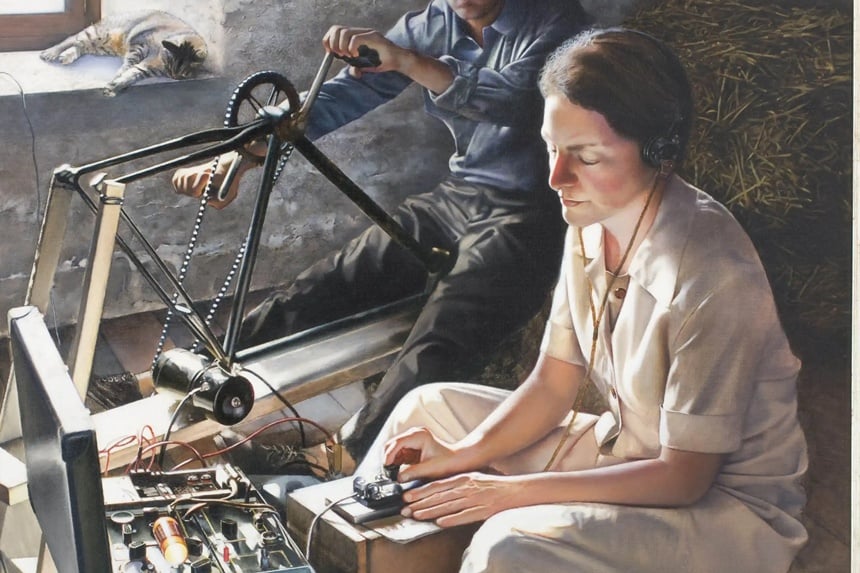
Virginia Hall was always unconventional. “The one thing to expect from Dind (Hall’s nickname) is the unexpected,” read the description in her high school yearbook. Hall’s subsequent life epitomized that as a master spy for the French Resistance.
As a young woman, Hall aspired to a career in diplomacy even though women were rarely admitted to the U.S. Foreign Service. Born in Baltimore on April 6, 1906, to banker Edwin “Ned” Lee Hall and Barbara Virginia Hammel, Hall was expected to become a traditional wife and mother, according to A Woman of No Importance: The Untold Story of the American Spy Who Helped Win World War II; Hall wanted more, and often described herself as “cantankerous and capricious.” After attendance at Radcliffe and Barnard colleges, she traveled to Paris and in 1926 enrolled in the Ecole Libre des Sciences Politiques. She then moved to Vienna where she studied at the Consular Academy and received her degree in 1929, according to The Lady Is a Spy.

Fluent in French, Italian, and German and hoping for a diplomatic post, she accepted a job as a clerk at the U.S. Embassy in Warsaw, Poland, in 1931, then soon transferred to a similar job in Smyrna (İzmir), Turkey. In 1933, while on a hunting trip, she tripped over a fence and shot herself in her left foot. Gangrene set in, forcing the doctors to amputate Hall’s leg just below the knee.
After recovering and being fitted with a wooden leg, which she dubbed “Cuthbert,” the 27-year-old Hall still hoped to become a diplomat. In 1937 while preparing for an entrance exam for the Foreign Service, she received their letter notifying her that “amputation of a limb, except fingers or toes…is cause for rejection,” according to Wolves at the Door: The True Story Of America’s Greatest Female Spy. Hall accepted a brief consular clerkship in Tallinn, Estonia, in 1938 and then returned to Paris. When the Germans invaded France on May 10, 1940, Hall volunteered as an ambulance driver for the French army. After the decisive German victory in the Battle of France, she traveled to England through Spain where she met Englishman George Bellows. Bellows was impressed with her intelligence and bravery, so he gave her the name of a friend who could help her find work in London. What Hall wasn’t told by Bellows is that the friend was Nicolas Bodington, an officer from the Special Operations Executive or SOE, a new British secret service that established resistance groups in Nazi-occupied territory.
After a brief training period, Hall became the second female agent of the SOE’s “F” (French) section sent to France, and the first woman to hold an active field role. Hall arrived in France on August 23, 1941, under cover as a reporter for the New York Post, which enabled her to talk freely with others, recruit workers, and collect information. After settling in Lyon, which became the center of the French Resistance, Hall founded the “Heckler” spy network.
To hide her identity, Hall often changed homes and her appearance and confided in only a trusted few. When a dozen important agents gathered in Marseille that October, she avoided the meeting. As she feared, the Gestapo captured them. That left London without reliable contacts in the field — except for Hall, according to A Woman of No Importance.

The Nazis not only knew that Lyon was the center of the Resistance, but also suspected its leader was an elusive English-speaking “limping lady,” or as the French nicknamed her, “la dame qui boite.” Confusion about her nationality led the Gestapo’s sadistic Klaus Barbie (known as “the Butcher of Lyon”) to reputedly tell his staff, “I would give anything to lay my hands on that Canadian bitch.” A picture of Hall was circulated with the exhortation, “The woman who limps is one of the most dangerous Allied agents in France. We must find and destroy her.”
On November 7, 1942, just before the Allied invasion in North Africa, Hall learned the Nazis were heading to Lyon and was warned to leave immediately. After burning important papers, she fled north to Perpignan near the Spanish Border. There, a guide agreed to help her escape over the steep slopes the Pyrenees, but only if he could take three other refugees to make the trip worthwhile for him. Since the refugees had little money, Hall paid for all of them. Temperatures plummeted, and as the group climbed to 7,500 feet, Hall’s breathing became strained, exacerbated by dragging her artificial leg through deep drifts of snow, which wore her leg into a bloody stump. According to Wolves at the Door, after reaching a safe house, Hall radioed London about her escape, adding “Cuthbert is being tiresome, but I can cope.” Not understanding the reference to her wooden leg, the transmitter replied, “If Cuthbert tiresome, have him eliminated,” which made Hall smile.

Finally, Hall and her allies arrived at the Spanish town of Sant Joan de les Abadesses. There, she and the refugees were arrested for crossing the border without papers, but after Hall contacted the American embassy, they were released.
Once back in London, Hall expected to return to France, but Maurice Buckmaster, chief of the SOE’s F section, refused, insisting her identity was too well known to the Gestapo. Instead she was assigned to the safer location of Madrid, Spain, disguised as a foreign correspondent for the Chicago Times. Once established there, Hall was to find Spanish safe houses and escape routes for French Resistance spies. But she quickly became bored and complained to Buckmaster, “I am not doing a job. I am…wasting time….my neck is my own, and I’m willing to get a crick in it because there is a war on….Well anyhow I put it up to you.” When Buckmaster refused, Hall applied to the newly created American Office of Strategic Services (OSS) and returned to France as a second lieutenant, where she created the SAINT spy network.
Disguised as an elderly woman, Hall roamed the French countryside, served as a wireless radio operator, and trained rural Resistance workers known as the Maquis; their job was to find German defenses, sabotage supply lines, and support the Allies after the invasion of Normandy. On July 14, 1944, Hall moved to the Haute-Loire area of France, discarded her disguise, and established headquarters to aid the Maquis in driving the Germans out of France. Leaders of the Maquis, however, resented her leadership as a woman, leading Hall to complain to the OSS, “You send people out ostensibly to work with me and for me, but you do not give me the necessary authority.”

In April 1945, after the Germans’ final defeat, Hall returned to Paris and resigned from the OSS. Accompanying her was fellow agent Paul Goillot, whom she later wed.
In 1947, Hall joined the new Central Intelligence Agency. Compared to her previous positions, her desk job was a comedown, but one of the few jobs then open to women. A secret CIA file later revealed that while younger colleagues considered Hall a “sacred presence” in a man’s field, according to A Woman of No Importance, they admitted she had been “shunted into backwater accounts because she had so much experience that she overshadowed her male colleagues, who felt threatened by her.
Hall retired at the mandatory age of 60, and died in Rockville, Maryland, at the age of 76.
While modest about her work and the rewards of espionage, Hall once reminded a colleague who was reluctant to return to the war, “You’ll forget how cold you were…you’ll forget all the frights you had, and you’ll only remember the excitement.”
Honors

- On September 23, 1945, General William Joseph Donovan awarded Hall the Distinguished Service Cross in honor of her courageous work to free France. She was one of only two women to receive that honor for their service during World War II.
- In 1988, the Military Intelligence Corps Hall of Fame added her name.
- In October 2020, the first feature film about Hall, A Call to Spy, premiered at the Edinburgh International Film Festival, commemorating the 75th anniversary of D-Day.
Become a Saturday Evening Post member and enjoy unlimited access. Subscribe now

.jpg)
Comments
Dear Editors:
Not to belittle Ms Hall’s achievements, but, you and your readers to find and read the paperback book of
“She landed by Moonlight” a biography of Agnes Pearl Witherton “Pearl:, she led the Resistance in France in WW-2.
She led upwards of 3,000 men towards the end of the war and received a “CBE” from the Queen Mother.
With very atypical Brits stupidity, she got turned for a “Military Cross” AND a “George Medal” two below the
Victoria Cross….only because she was a woman. Its an important read for those wishing to read the actual operations/organizations of the Resistance in France, being led by a Brits womanthe book’s author is Carole Seymour Jones…2014.
When I worked for a municipal power company, my boss led a Polish based Resistance in France to steal a newly
made German Radar Unit, and, a new “Engima machine”…..both of high importance to Bletchley Park intelligence center. He had proof of doing this at his home and of him receiving the “George Medal”.
Wednesday August 6th 1942 the Raid on Dieppe, was predicated on the triweekly milk/freight train along the French coast.
The combined French and Polish Resistance units were supported bythe Royal Marine Commandos who dropped into a resort area where the train was to delivery fresh milk and pick up the empty cans.
The Royal Marine Commandos were dropped of by STOL “Lysanders” from Ramsgate, on a “skip-n-run” on the flat top of the cliffs over looking the beach. The 9 men rolled out the side door just as the Lysander’s wheels touched the grass.
Taking the Germans totally surprise, there was no gunfight, but, the 9 Marines, WERE most useful in helping lift
the otherwise heavy crates out of the freight cars and down to a Free French Coastal fishing boat.
The Poles, my boss, and the 9 Royal Marines all got back across the Chanel to Southampton were they were met by
armored personnel carries that took the crates up to Bletchley Park.
Sadly, other Resistance men were killed after they left, and, their memorial is at the top of the bill from the beach.
But, this is how the date of August 6 1942 was chosen for the Dieppe Raid. Tragically, inter-service bickering made
the major raid a full-blown disaster killing so many Canadians and imprisoning many, any, others.
More details, but, not here.
Sincerely.
Gord Young
Petrboro -ON [Still not in the 51st State !!]
Apologies for the omissions. I believe they have all been corrected.
A lot of dropped words and garbles. Needs to be cleaned up and reposted.