Frankenstein
⭐️ ⭐️ ⭐️ ⭐️
Rating: R
Run Time: 2 hours 29 minutes
Stars: Oscar Isaac, Jacob Elordi, Christoph Waltz, Mia Goth
Writers: Guillermo del Toro (Based on Mary Shelley’s novel)
Director: Guillermo del Toro
In theaters, on Netflix November 7
Reviewed at the Toronto International Film Festival
About 20 years ago, as I sat in a theater watching director Guillermo del Toro’s monster-ful instant classic Pan’s Labyrinth, I said to myself, “This guy should really do a remake of Frankenstein.”
As it turns out, del Toro had been thinking the very same thing — ever since he was a child, in fact. Now, it’s clear that every threatening footstep in Pan, every sword swish in Blade, every aching beat of creaturely longing in The Shape of Water was merely spring training for del Toro’s harrowingly heartfelt vision of Mary Shelly’s grand, grisly cautionary tale.
Drawing from templates ranging from Boris Karloff’s 1930s incarnations of the monster to Kenneth Branagh’s 1994 Victorian spectacle to even Mel Brooks’s respectful 1974 send-up, it is tempting to say del Toro’s version is the definitive Frankenstein, and no one need bother churning out any more iterations. Yet a quick online search reveals that there are, right now, no fewer than 18 Frankenstein movies in production around the world. So there seems to be a limitless appetite for the guy Madeline Kahn affectionately called “Zipper Neck.”
Del Toro’s Frankenstein is told in two parts, bracketed by spectacular prologue and epilogue segments set aboard a sailing ship stranded in the Arctic ice. As a killing winter freeze bears down, man and monster — who have turned up here under the most unusual of circumstances — take turns telling their stories to a transfixed captain and crew.
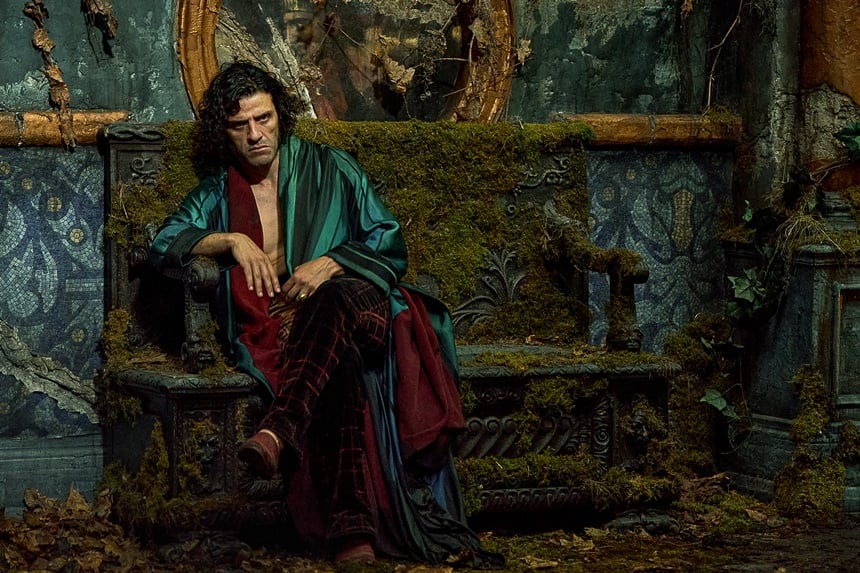
The doctor presents his testimony first: Oscar Isaac, dark-eyed and fragile-looking, stars as Baron Victor Frankenstein, the twisted genius who’s driven by mad ambition to conquer death — without accounting for the painful truth that death wins even when it is driven underground. With strutting confidence and vibrating obsession, Isaac’s Frankenstein shocks and disgusts a gallery of fellow Bavarian physicians when he momentarily re-animates a corpse by surging electricity through its nervous system. Cast out of the professional fellowship, Victor takes up with a wild-eyed millionaire (Christoph Waltz, who does wild-eyed better than anyone since Jack Nicholson) who sets him up in a remote seaside castle, throws a carriage full of money at him, and tells him to get busy resurrecting the dead for real.
Frankenstein films always must contend with the icky notion that the mad doctor is assembling his monster from discarded body parts. Never before, however, has a version confronted the viewer with quite so graphic a scene as the good doctor tromping about his castle calf-deep in severed arms and legs and casually draped entrails, holding eyeballs up against a skull socket to check the fit, and taking saws to bodies with the concentrated élan of a weekend carpenter transforming his basement into a rec room.
Presently, utilizing lightning in a manner that will be familiar to all Frankenstein adherents, the doctor brings his creation to life. He is a hulking, ominous presence, yet imbued with the innocence of a newborn, capable of just a few words — which he nevertheless manages to infuse with layers of meaning, hinting at the intellect that lies beneath the grotesque exterior.
As the monster, Jacob Elordi is the film’s true revelation. His monster is, from the start, a fully realized being who moves seamlessly from adult-size infant to a brooding philosopher obsessed with hatred for his creator. Del Toro, as is his practice, keeps computer generated imagery to the film’s background, relying on masterful makeup, lavish costumes, and ingeniously imagined props to create a convincing screen universe. But as he did with actor Doug Jones in The Shape of Water, here del Toro coaxes from Elordi — despite layers of makeup and prosthetics — a frequently terrifying, often heartbreaking, always compelling performance.
At first, Victor takes a parental pride in his creation. But before long, the doctor discovers that being parent to a 6-foot-7 mountain of man isn’t all birthday cakes and Cub Scout meetings. In fact, things go dramatically south for Monster and Maker to the point where Frankenstein decides to kill his creation not out of scientific concern, but for green-eyed jealousy, as he sees a bond developing between the monster and Elizabeth (Mia Goth), the comely niece of his benefactor. He chooses a particularly pyrotechnical method of dispatching the monster, unaware that his creation has a remarkable amount of staying power.
It’s at about this point that, back on that ice-bound ship, the monster steps forward to tell his story; the saga of his tortured, tormented life wandering the Earth in the years since he and Victor had their explosive breakup. Elordi’s fearsome presence and growling utterance is softened by his lyrical language — a throwback, I couldn’t help but think, to Peter Boyle’s erudite version of the monster in Young Frankenstein. It is during Frankenstein’s deeply affecting second half, presided over by Elordi, that the film truly clicks as not merely a thoughtful monster movie, but a uniquely human adventure drama.
You may watch portions of Guillermo del Toro’s Frankenstein through latticed fingers, but as in all of the director’s finest work, you’ll come away remembering the humanity hidden in the horrible; the beauty baked into the beastly.
Become a Saturday Evening Post member and enjoy unlimited access. Subscribe now


Comments
Don’t screw with “Frankenstein” Hollywood. You don’t change perfection. Boris Karloff got it right the first time. He has been and always will be the true “Frankenstein.” Period.