Cal Whitaker didn’t miss the noise of command, but some mornings, when the neighborhood was still and the flag across the street hadn’t caught the breeze yet, he caught himself listening for it — the clipped yes-sirs, the shuffle of boots, the rhythm of certainty.
Now, retired from the Navy and two years out of his job in higher education administration, the only sound came from a woodpecker tapping the half-rotten fence between his yard and the new neighbor’s. The boards leaned like tired men after a long shift, and Cal figured that was reason enough to fix it.
He’d seen the young woman move in a few weeks earlier, a toddler perched on her hip, a cardboard box labeled Faculty Office balanced in the other hand. She looked like the type who did everything the hard way — not from pride, but from necessity.
Cal had been that kind of worker once, too.
On a Saturday morning bright with the smell of cut grass, he walked to the property line with his hammer, nails, and good intentions.
“Morning,” he said, leaning over the sagging post.
She looked up from her laptop, squinting against the sun. “Morning.”
“Fence is about done in,” Cal said. “Figured I’d shore it up before the next storm takes it down.”
She smiled, polite but cautious. “I appreciate it, but it’s actually my fence. I’ll get to it soon.”
Her tone wasn’t sharp, just matter-of-fact — the kind of voice used by people who’d learned not to owe favors.
Cal nodded and said, “All right then.” He picked up his tools, went back to his side, and, for the first time in years, felt what it was like to not be needed.
That night he sat on the back porch with a glass of tea and the hum of crickets rising from the trees. He’d spent most of his life teaching sailors and later advising students — building order out of chaos, giving purpose to confusion. But now, at 62, he couldn’t even convince a neighbor to let him mend a few boards.
He told himself it didn’t matter, that he had plenty to do — the shed to organize, the gutters to clean — but each morning, he found himself watching through the kitchen window as the fence leaned a little farther toward surrender.
A week later, the rain came. Hard and sideways, the kind that tests every roof and every post. When it finally passed, Cal saw that the fence had given up the fight.
Half of it lay flat, splayed across both yards like a tired man mid-step.
He stood there with his coffee, staring at the wreckage. Then he saw Leah — that was her name, he’d learned — kneeling beside the fallen boards, her son splashing in a puddle beside her. She looked overwhelmed but determined, holding a screwdriver like it was a sword.
Cal grabbed his gloves and hammer, walked over without thinking, and said, “Looks like the storm made the decision for us.”
She sighed, strands of wet hair clinging to her cheeks. “Yeah. I guess it did.”
“Why don’t you let me give you a hand?”
She hesitated, then looked at her son, who was now stomping water onto her shoes. “You really don’t have to—”
“I know,” Cal said. “That’s why I want to.”
Something in his tone softened her resistance. “Okay,” she said finally. “Thank you.”
They worked in silence at first — he pulling nails, she stacking boards. The rhythm felt good, like the steady cadence of a work detail. When she apologized for her lack of skill, Cal told her, “Everyone starts somewhere.”
She looked up. “You sound like a teacher.”
“Used to be,” he said. “Ran programs for veterans at the community college. Before that, 20 years in the Navy.”
Her eyebrows lifted. “That explains the precision.”
He smiled faintly. “Old habits.”
They rebuilt until the light faded and the boy grew restless. When Cal offered to finish it the next morning, she agreed without hesitation this time.
Over the next few days, a quiet partnership formed. They shared tools, coffee, and the occasional story. He learned that Leah taught developmental English at the local college — part-time, no benefits, always waiting for next semester’s contract.
“It’s like rebuilding the same fence every term,” she said one morning. “You fix what you can, and then they tell you to start over.”
Cal understood that better than she realized. “Service has a way of taking more than it gives,” he said.
She looked at him then — really looked — as if seeing a fellow traveler rather than a neighbor.
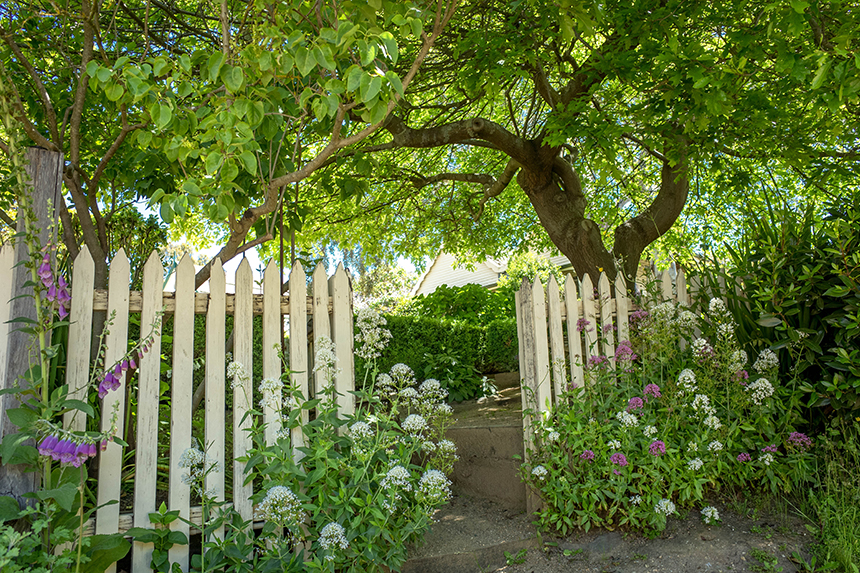
When they finished the fence, it stood straight and strong. But there was a gap — a missing section where the yards met near the oak tree. Leah noticed it first.
“What about here?” she asked.
Cal rested on his hammer. “I was thinking we could put a gate.”
“A gate?”
“Seems fitting,” he said. “Easier to visit, if either of us needs a cup of sugar or a hammer.”
She smiled. “Or help grading essays.”
He chuckled. “That too.”
They built the gate together that afternoon — slower this time, not from fatigue, but because neither of them wanted to finish.
By summer’s end, the two yards blended like one. Her son would toddle through the gate to chase the dog that had adopted Cal’s porch. Sometimes, Leah would bring over leftover pasta or a plate of cookies, and they’d talk about work, weather, and how people lose themselves in what they do for too long.
“Do you ever miss it?” she asked one evening, as they sat on the porch watching the fireflies.
“Every day,” Cal said. “But not for the reasons I used to think.”
She tilted her head. “What do you mean?”
He stared at the horizon. “I thought I missed the authority. The structure. Turns out I just missed being needed.”
Leah nodded slowly. “Yeah. I know that one.”
For a while they sat in silence, comfortable in the way two people can be when they’ve earned it through work and kindness.
That fall, Leah got offered a full-time position at the college — the kind with benefits and an office door that locked. When she told Cal, he grinned like a proud father.
“Guess I’ll be seeing less of you around here,” he said.
“Maybe,” she said. “But I’ll still need a neighbor who knows how to fix things.”
He laughed. “That’s a dangerous promise.”
She extended her hand, and he shook it — firm, respectful, a silent exchange of gratitude.
When she left for work that first morning as “Professor Ames,” Cal stood by the gate, coffee in hand, and watched her car disappear down the road. Then he looked at the fence — straight, sturdy, unremarkable — and smiled.
That night, a knock came at his door. When he opened it, Leah’s little boy stood there in pajamas, clutching a toy truck.
“Mom said I could say goodnight,” the boy said.
Cal crouched. “Well, goodnight then.”
The boy grinned, then pointed. “I used the gate.”
Cal felt something shift in his chest — a small, necessary click, like the final nail driven home.
“Good job,” he said softly. “That’s what it’s there for.”
Become a Saturday Evening Post member and enjoy unlimited access. Subscribe now


Comments
I’m very excited for you Dr. Spencer. It’s an honor to have served with you and I’m grateful for your wisdom and courage. I haven’t had many people have much of an affect on me over the years, but you’re certainly one of them. I talk about you often this time of year. My children and my wife will always be reminded of the kindness of our leaders, such as yourself sir.
I’m inspired. This reminds me of a story my father shared with me. I believe you have a talent that pulls you into the story and demands attention. I hope you submit more stories similar to this one.
Perfectly structured, perfectly warmhearted story. Thank you for writing it!
Great story, Mr. Spencer. I agree with Carmen here. Leah had some defenses up, until the fence fell down, but was then glad she gave Cal a chance; with both realizing their positive commonalities as neighbors.
What a sweet reminder not to allow the busyness of life or our own pride to distract us from what’s more important… human connection.