January 14, 1900
Dear Eloise,
I’ve been laying up to write you for the past week, but I’ve been exhausted. Old Jack warned me before I came up that ice harvesting would whup me so hard that even my cramps would have cramps, and he was right. He usually is.
And I’ll be honest: At first, I didn’t want to write to you because I was still miffed about how we parted. Neither of us said any unkind words, but it was so clear that I was a disappointment to you when I set out to come here. I thought you unfair when you said you didn’t want me to go, that we didn’t need the extra money. I told you that I was just trying to help us get ahead, and I can’t tell you how badly it annoyed me when you said, “Ahead of whom, Wendell? Whom are we racing?”
But now circumstances have arisen that demand I write. I’ve been studying since last night whether to share this news. In some ways it will vindicate you, who told me to stay home, that we didn’t need the extra money. That you were right is no surprise, and it doesn’t bother me to say so. But I know this news is going to worry you too, and I want so much to spare you that, but I feel like I’d be lying to you if I didn’t share what happened, and I can’t abide the thought of breaking trust with you. Not now, not ever.
And besides, my brain is running and can’t settle itself. My thoughts are swirling every which way like the flock of starlings we’ve seen explode from the barnyard fence when our back door slaps shut. As always, when I get like this, I need you to listen and help me sort things out. But you’re not here, so this letter will have to do.
It’s hard to know where to begin my story. Maybe I’ll start with the day I arrived here and met Jerry, the man who had the bunk above me in the bunkhouse. I call him a man, and he certainly worked like one, but he was a kid, maybe 19 or 20. He was a jovial sort, always talking. When he discovered I was a farmer, he started calling me Old MacDonald. When he heard about our children, he started mixing in the name Pops.
He and I were both new, so we pulled the night shift. Nobody likes working then. It’s brutally cold, and when you’re standing 100 yards out on a frozen lake, there’s nothing to break the wind. At first its icy fingers find their way up your sleeves and down your collar, but the brutal assault doesn’t quit all night, and by about two in the morning, the cold doesn’t find its way into your clothes as much as it seems to blow right through them like they aren’t there.
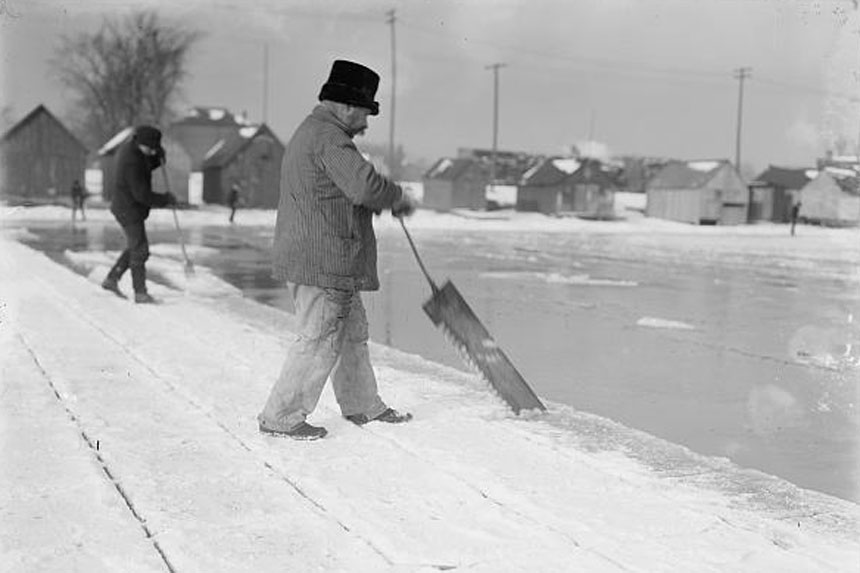
Jerry and I worked mostly as a hand sawyers. During the day, the men on the day shift would use teams of horses to drag scrapers and clear the snow off the ice. Then the horses go over the cleared ice again, this time dragging a plough with tiered blades on it, each blade cutting successively lower into the ice. The horse creates a grid of parallel lines about three to four feet apart. They call this setting the cut. After the horses are done, hand sawyers like me come in to finish the cut.
Finishing the cut sounds a lot easier than it is. I work ten-hour shifts through the cold of the night, pumping up and down like a piston on a steam engine. Holding the saw by its wooden handles, I pull back, drawing a blade as long as my legs through the ice until it is almost free from the water before leaning forward and throwing my full bodyweight into the downward stroke, the teeth of the saw rasping as they eat the ice. Sometimes, if the downward stroke comes in too perpendicular, the saw sticks, and my gut hits the handles so hard it nearly knocks the wind out of me. First couple of days I made this error with some frequency, much to Jerry’s delight, but bruised ribs and practice have improved my method.
I’m reading over my own words and am afraid I may be leaving an unfair impression of Jerry. Let me be clear that Jerry never mocked me. He had a ready laugh that took life as it came, and any absurdity, including his own, would set it off. Give you an example from a week ago. There was a dance at a hall in Crown Point, a town about ten miles northeast of here, and Jerry got it in his head that he was going to the dance. I can still see him leaning over the edge of his bunk, his blue eyes sparkling and his unruly bangs hanging in wild waves toward the floor.
He said, “Come with me, Wendell. What do you say? We’ve got Saturday night off. Let’s go have a few beers and dance with some pretty girls.”
“I’m married,” I reminded him.
“So?” He waggled his eyebrows.
“Happily,” I added.
“Okay,” he said, his smile widening. “Leave the girls to me. Just come along for a few beers. We’ve got a get out of here. For two weeks it’s been nothing but work and this bunkhouse. All work and no play make Old MacDonald a dull boy.”
I stared at him. His forehead was turning pink.
“I think the blood’s rushing to your head, Jerry. Crown Point’s about an hour-and-a-half ride from here by sleigh. That’s three hours of travel, if we can even get our hands on a horse and sleigh, for a couple hours of diversion. By the time we get back, it’ll only be a few hours until our shift starts.”
“Exactly!” His head disappeared, and a moment later his feet swung over the edge of the bed. He dropped to the floor with the silence and agility of a cat, squatting next to me with his elbows on the edge of my bed. He gave my elbow a shake and his grin broadened. “What do you say, Pops?”
Saying no to him would have felt like breaking a child’s heart on Christmas morning. I wagged my head and smiled back at him and said, “I’ll tell you what, if you can get your hands on a sleigh for us, I’ll come along.”
He clapped me on the shoulder and shook my hand. Then he climbed back onto his bunk, and within five minutes I could hear him softly snoring. I thought that was the end of it, but I’ll be damned if three days later he didn’t have a sleigh with a chestnut Belgian mare in the traces. I don’t know how he managed that, and he wouldn’t say. But two hours later, I was in Crown Point, sitting inside a stuffy Central Music Hall beside a dozing white-haired gentleman who was playing chaperone to several nieces. He had a bushy mustache that bristled and twitched as his chin dropped repeatedly into his chest. I first thought this show was to be my whole evening’s entertainment as I waited for Jerry, who danced with over a half-dozen girls.
But I was wrong. Jerry himself became my entertainment. He was the undisputed heart of the dance, a young man with a seemingly bottomless well of good spirits. With a grin that could have pulled laughter out of a stone coupled with manners as polite as the Sunday parlor, he moved various partners through waltzes and jigs, taking a focused and pure delight in each girl he encountered.
His movements were nimble and athletic, and joy radiated from him brighter than the gas lamps that shone from their brackets on the walls. He laughed loudly and freely, leaving every young lady with whom he danced flushed and smiling. He whirled about the floor, the heart beating at the center of the merriment. He had an unflagging energy and constant smile that drew others onto the dance floor until they laughed as loud as him.
As I watched, I keenly missed you, Eloise. I sat there thinking about the last time I took you dancing, and I was ashamed to realize it’s been over four years. Remember our weekend trip to the Lahr’s Hotel to celebrate the New Year? Three straight nights of dancing and laughter. As Jerry danced, I closed my eyes and imagined holding you close again, hearing the rustle of your silk skirt as I swept you about the ballroom, feeling your hand in mine as I inhaled the scent of lavender from where your head rested on my shoulder. Why haven’t I taken you dancing in over four years, Eloise? Every time Jerry swept past me with a new partner, I thought, That should be Eloise and me.
Even as I missed you, however, I recognized what a gift I had received by allowing this young man to drag me away from camp. Even the silver-haired septuagenarian sitting next to me was drawn into the magic, first clapping his hands to the music and then finding himself on his feet, dancing a quadrille with his two nieces and Jerry. The dance over, the man, red with exertion but smiling to beat the band, threw an arm around Jerry’s shoulder and walked him to the bar to buy him a beer. The man turned out to be a judge from the county courthouse, and inside ten minutes, Jerry had received an invitation to Sunday dinner at the man’s house the following week.
I hope now you understand at least a little bit the kind of young man Jerry was, how someone I’ve only known a few weeks could have worked his way into my heart as deeply and quickly as he did.
And I guess that brings me to the events of two nights ago. Still on the nightshift, Jerry and I reported for duty. A sharp north wind cut through our woolen sweaters and waxed canvas coats as we made our way onto the ice. Kerosene lanterns scattered around the ice cast small pools of dim light, a poor attempt to mark the edges of open water. Swirling snow that the wind had scoured from the frozen lake’s surface obscured their light so that they appeared little more than dingy spots of yellow blinking in and out of existence, a poor man’s imitation of the riot of stars, distant and crisp, that pocked the velvet and moonless sky.
I think this was the coldest night we’d worked yet. Two hours into our work, the stars had been swallowed by clouds, and a light snow began falling. We took a break to dry our gloves in a warming shanty out on the lake. Calling it a warming shanty is being generous. The wooden walls had gaps where the air passed through, and the coal brazier inside it probably didn’t raise the air temperature more than ten degrees. Still, it served as a windbreak, and the brazier generated enough heat to dry out our gloves if he hung them right above it.
After our break, we made our way back to the ice field the two of us were working. It was snowing harder now, and Jerry was like a little kid, tipping his head back to catch the fat flakes on his tongue. As we approached the open water, the kerosene lamps showed the dancing flakes.
“Look,” said Jerry as he tilted his chin toward a lamp, his face split wide in a smile. “The angels are throwing us a ticker-tape parade!”
We went back to work, each of us sawing along grooves from the open water back toward the solid ice. After we’d cut four or six parallel lines, we’d stop sawing. One of us would grab the breaking bar, a wedge-shaped piece of steel on a long wooden handle, drive it deep into the one groove still holding the block with a twisting motion, and then pry until the block snapped at the groove. Then the other man would take a pike pole and float the block into the channel where the pushers could take over and move it to the conveyor system closer to shore.
The snow was falling even thicker now, and it was hard to see. Maybe that was why it happened. Maybe it was just fatigue. Whatever the case, I was working the breaker bar, and I’d just snapped a block free. As Jerry was moving that block toward the channel, I rammed the breaker bar deep into the next groove, straddled the tool and twisted the handle while leaning my full body weight back. I felt the familiar build of tension, heard the creaking, and then the ice snapped right along the groove. But somehow I’d positioned myself all wrong. I had one foot on the solid ice and one on the block now floating free. Slowly my legs spread farther apart as my arms flailed. I thought to windmill the breaker bar toward the solid ice, thinking maybe it might grab like a pike so I could pull myself back, but before I could even make the attempt, I was in the lake.
The cold water clamped down on my chest like a vise. I tried to shout for help, but my mouth filled with water. My waxed coat didn’t take on water right away and gathered on the surface, but my pants, boots, and sweater filled like sponges. I bobbed in the water, but something on my right side kept pulling me under, and it took me a moment to realize I was still holding the breaker bar. I let it go and immediately could keep my head above the surface.
Gasping, I paddled and kicked for the solid ice, but every time I reached for the edge and tried to take hold, my hands slid off. I paddled again, but by now even my coat had absorbed the water. I couldn’t quite control my limbs anymore. I think I was calling for help, but I’m not sure. I was so, so cold. I couldn’t really breathe. I wondered briefly where Jerry had disappeared to, but the thought vanished. I could see my arms waving in the water, but I couldn’t feel them. It was like I was looking at somebody else’s body. And that’s when I knew I was looking out from my grave. I didn’t feel panic or even fear. Just a sense of disappointment that this was where and how things were going to end.
The dull light of a kerosene lamp along the ice’s edge flickered, drawing my gaze heavenward where snow continued to fall. It was oddly peaceful, Eloise. Pretty even. Big, fat flakes were dropping like confetti before disappearing silently into the dark water around me. I didn’t want to die, make no mistake, but what we want doesn’t always come into account, does it? And even in that moment, as I kept struggling to stay above water, I recognized there are certainly worse ways to go.
My thoughts turned to you and the kids. I ached for color and warmth, for the scent of recently turned soil and the birdsong of a spring morning. I wanted so badly to be able to tell you all one last time how much I love you. And then you were there, Eloise, as if I had summoned you into existence. It made no sense, and they tell me I suffered hallucinations, but I don’t know who to believe, the doctors or my own eyes. You came walking out of the darkness, out of the falling snow, until you were in the lamp’s circle of light. You were wearing that lilac dress you wore last Easter, and your hair was tied back with the pearl hair pins you wear now and then. You were so beautiful, so beautiful. You knelt on the edge of the ice, and you held a hand toward me. I wanted to reach for it, but my hands wouldn’t listen to my brain. I tried to talk, but I couldn’t get my mouth to form words. You smiled sadly, and you disappeared.
And then Jerry was there, shouting my name. He said more, but his words didn’t make sense to me. I just felt like I was tumbling from a great height. I was outside time, outside myself, watching myself struggle not to drown while Jerry stood on the edge of the ice, waving me to move toward him, calling my name, shouting directions as he plunged his pike into the open water. The wooden pole splashed before me, but I couldn’t lift my arms toward it. They wouldn’t do what I wanted them to. Jerry shouted louder, but I couldn’t understand him.
And then I couldn’t work my legs. I tried, but they wouldn’t work. I couldn’t feel them anymore. The last thing I saw was Jerry in profile, waving frantically toward the shore. I slid down. The waters closed over my head. I thought dimly not to breathe, not now, not ever again.
A tremendous splash jarred me, and the next thing I knew, arms wrapped around my chest, and I felt myself moving upward. I broke the surface, still held in a tight grasp. Behind me, a choking voice whispered through chattering teeth, “I got you, Pops.”
What happened next is a blur to me. Jerry leaned back in the water, his arms still wrapped about my torso, so that my head stayed above water. Through slurred speech, I pushed out an apology, but he shushed me.
“No need to apologize, Pops,” he said. He kept choking on the water and could barely get the words out. “You just hang on for me, okay? You hang on for your honey at home and your kids.”
It seemed like a long time, though they assure me it wasn’t, until three other men showed up. They say they extended a pike and Jerry, who was keeping me afloat while half-drowning himself, kept encouraging me to grab on, but my arms wouldn’t work. On the third attempt, they say Jerry threw out one hand to grab the pike. The hook caught him in the palm and pierced it, but he held on, and they dragged us through the water toward the rim of ice. I was too cold, too weak, to help myself or anyone else. These men grabbed me by the armpits, but the ice was slippery, and they couldn’t gain purchase to get me up and out. They say that Jerry told them to pull on three. As they started the count, he disappeared beneath the water and pushed me from underneath. They say the water there is at least ten feet deep, that there’s no way he could have stood on the lake bottom and pushed, that he must have been a powerful swimmer, because on three they pulled and got just enough help from beneath to get my chest up on the ice, where they could slide me to safety.
That’s the last thing I really remember. They stripped me out of me wet clothes, wrapped me in blankets, and put me in a cot right next to the pot-bellied stove in the bunkhouse. I couldn’t get warm all night, and I kept sliding in and out of consciousness.
I didn’t find out until this morning that when they went back to grab Jerry, he was gone — disappeared beneath the ice.
Jerry is dead, Eloise. He died saving me. My sweater carries his bloodstain, and because of him, I am coming home to you and the kids. I feel grief and gratitude, so tightly bound I cannot tell them apart. I was wrong to leave, and you were right to tell me so. That small man with big plans who went out onto the ice, that’s who I was. But that’s not who I am. And who I am, such as I am, is forever yours. I’ll be home in a week.
With love,
Wendell
Become a Saturday Evening Post member and enjoy unlimited access. Subscribe now


Comments
This story doesn’t sugarcoat any aspects of what a dangerous job Wendell and Jack had out on the ice, at all. It hits all the range of emotions from the touching to terrifying, tragic to hopeful again. The fact it was written in the form of a letter to Eloise is unusual for a story, and also that Wendell wanted his wife to know all the details of this particular time away, and what a close call he had.