Consumer goods, as the recent tariff policies clearly show, play an important role not only in the global economy, but also in shaping foreign policy. Yet, unlike more traditional areas of diplomacy, ordinary people — with their individual shopping decisions — play just as crucial a role as government officials in influencing world affairs.
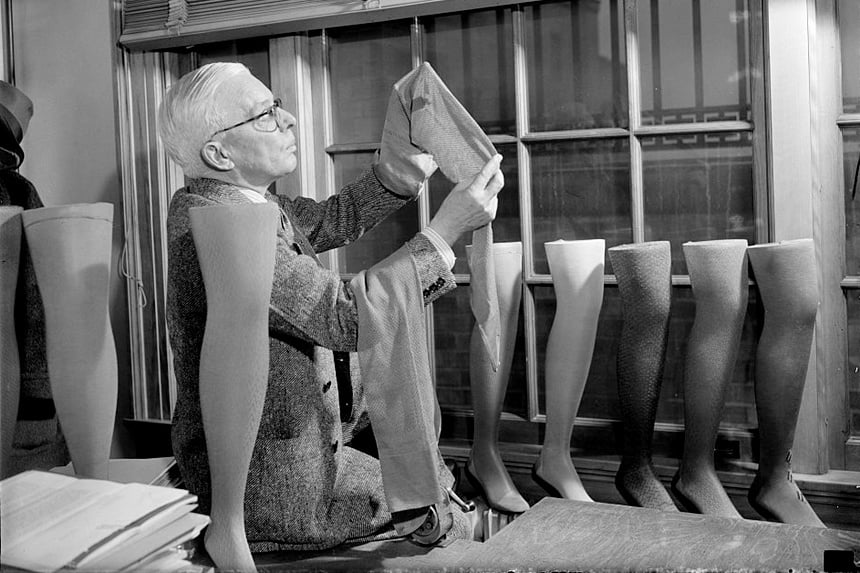
That was the case in the 1930s, when in response to the Japanese occupation of China, Americans turned consumption into a powerful tool to fight fascism, initiating a boycott campaign on Japanese silk. While similar campaigns targeting a range of Nazi goods were around since the early 1930s, the anti-silk boycott that began in 1937 focused on a specific product: stockings.
Although neckties were also made of silk, the boycott campaign specifically targeted women, who were seen as the main group of consumers and thus had the most power. The campaign demonstrated that women were not just passive consumers but rather active agents who could enlist their influence against the Japanese Empire.
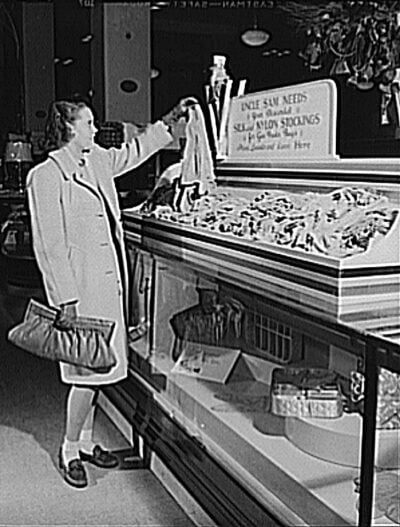
Instead of buying silk stockings, the argument went, women should adopt alternatives. “Make Lisle the Style” went the slogan, calling on women to wear stockings made of cotton lisle or rayon, instead of ones made of Japanese silk.
Boycotters appealed to women’s sense of morality, arguing that by buying a pair of silk stockings they unknowingly contributed to the enemy’s war machine. “Did Your Stocking Kill Babies?” announced one pamphlet from the “Boycott Japanese Goods Committee of Greater Boston,” 1938. “When we wear silk we are wrapping ourselves in the blood and bones of bombed Chinese babies,” commented another columnist.
Public opinion was in support of the boycott. Consumer organizations like the League of Women Shoppers (LWS) and even big chain stores like F. W. Woolworth supported the effort. The coalition ranged from students to Chinese Americans and their supporters to veterans, who vowed to use their consumer power to affect social justice.
However, not everybody was on board. Although the AFL and CIO, the largest trade unions in the country, supported the campaign, they favored the boycotting of Japanese imported silk goods, not raw materials. Hosiery workers, most of them women, claimed that the silk boycott endangered jobs and put a stress on the economy as there were no good alternatives to silk when it came to stockings. They argued that the boycott made them double fashion victims: once by limiting their employment opportunities and again by restricting their fashion choices and the ability to look beautiful.

The debate culminated in January 1938, when more than 600 people gathered in Washington, D.C. for an hour-long fashion show entitled “Life without Silk: A Drama of Fashion.” The event, attended by many of the city’s society women and sponsored by the LWS, aimed to demonstrate that even without Japanese silk, women could still be fashionable.
Outside the venue, however, a group of 300 hosiery workers from Pennsylvania protested, reminding the passing crowds that union-made stockings were an American product, and that buying it supported American workers, even if it was made of imported materials. Even as the press tried to focus on each side’s enlistment of beautiful women flaunting their “shapely legs,” than on their arguments, the issue of stockings moved from the realm of fashion to that of politics.

Indeed, the debate became not just about importing Japanese silk, but what counts as an American-made product and who counts as an American. Boycotters were careful to emphasize that they sought only to bar Japanese goods — which they saw as helping the war effort — not Japanese people. The goal was to promote ethical consumption, using women’s shopping power not as a thing to dismiss but as a path to gain influence on the global stage.

Throughout 1938 and 1939, boycotters organized parades, pageants, and other fashion events that celebrated the fashionable appeal of silk alternative and raised public awareness against silk stockings. At the annual convention of the American Student Union at Vassar College, students organized a bonfire into which they threw their stockings and ties, chanting “Wear lisle for a while. If you wear cotton, Japan gets nottin’!”
While the boycott was effective enough to reduce Japan’s exports of silk by 60 percent from 1936 to 1938, it was mainly the U.S. war mobilization that caused women to abandon silk stockings. The implementation of the L-85 order that restricted the civilian use of fabrics, clothing, and accessories shifted much of the silk production to military use.

However, more than wartime restriction, it was the invention of nylon in 1938 that would turn to be the death knell of silk stockings. While most women would get to wear a pair of nylon hosiery only after the war, the synthetic fabric — marketed as “artificial silk” — would revolutionize the industry.
Yet, if the boycott and its impact are forgotten today, the public debate it spurred shows how much the decision to buy or not to buy a certain product can have serious implications on global relations. Shopping (or boycotting), as a recent Target boycott shows, is not a neutral decision but a political act, often entangled with ethical and moral reasoning.
In a world where fashion and politics constantly intersect with one another, even mundane items like hosiery can turn out to be important. You don’t need to be a seasoned diplomat to make a difference; all you need to do is to visit the store near you.
Become a Saturday Evening Post member and enjoy unlimited access. Subscribe now



Comments
Fascinating info in this feature to be sure. Although I’ve long been aware of the shortages during World War II, this one preceding it, I wasn’t, regarding silk specifically. It is interesting that the invention of nylon in 1938 came about when it did, and was needed. It no doubt turned out to be the economically sustainable (and affordable) alternative to silk the industry needed anyway for the long haul.