In the American holiday calendar, Thanksgiving is the quintessential fall holiday, where families gather to celebrate their good fortune. Bringing together myth and history, the holiday has been associated with colonial New England traditions, the Civil War, and of course Norman Rockwell’s depiction of the Thanksgiving feast in Freedom from Want.

The timing of Thanksgiving — the fourth Thursday in November — also has its roots in the Great Depression, but that decision had less to do with the holiday itself, and more with the day after it: Black Friday.
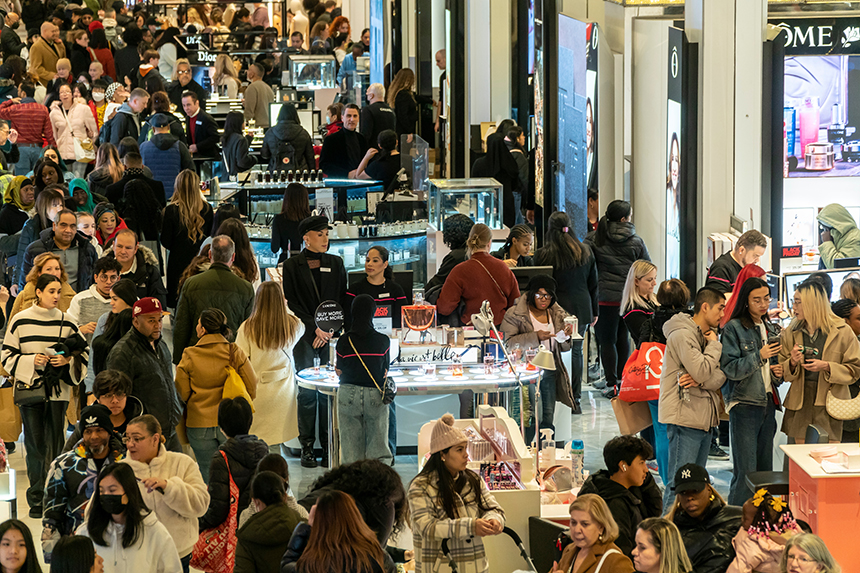
No less associated with the idea of American spirit and abundance, Black Friday has traditionally marked the beginning of the “Holiday Season,” the period leading up to Christmas and the New Year. But rather than embracing the ideas of family and friendship, the day has been characterized by a frenzy of shopping for great deals, buying presents, and boosting the economy.
The frenzy of shopping on Black Friday can become a contact sport (Uploaded to YouTube by CNN Business)
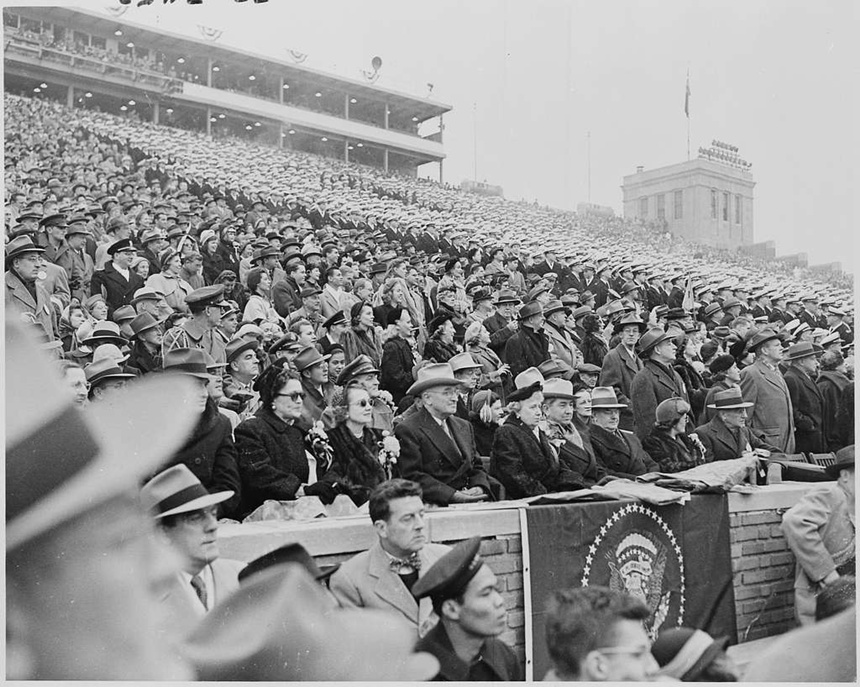
The name “Black Friday” has its own dubious origins, which were rarely positive. For years, “black days” carried with them ominous connotations, especially when it came to the economy. October 24, 1929, is known as “Black Tuesday,” marking the day when the stock market crashed, starting the Great Depression. In the 1950s, the Philadelphia police used the term “Black Friday” to describe the chaos caused by suburban shoppers and tourists who flooded the streets for the Army-Navy football game the day after Thanksgiving. Then, in the 1980s, merchants reinvented the day to signal a shift from operating “in the red” (with a loss) to “being in the black” (making a profit); the term spread nationally.
The commercial associations of Thanksgiving actually go back to the 1920s, when in 1924, Macy’s department store initiated its famous parade. Called at the time “Macy’s Christmas Parade,” the six-mile procession functioned as a promotion for the store and the official start of Christmas shopping. Marching down from 145th Street to Macy’s newest location on Herald Square on Sixth Avenue, a “retinue of clowns, freaks, animals and floats” culminated with Santa Claus riding in his sled and sounding a trumpet. The event soon became the signal for the unveiling of the department store’s holiday shopping windows and the official start of the shopping season.

With the onset of the Depression, boosting the economy became an even more pressing issue. The holiday season, stretching from the day after Thanksgiving to Christmas, offered businesses an opportunity for profits. Every day of sales counted, and businesses sought to prolong the period as much as possible.

In 1939, however, things got complicated. Ever since President Lincoln published his Thanksgiving proclamation in 1863, the holiday was celebrated on the last Thursday of November. But in 1939, November had five Thursdays instead of four, with Thanksgiving falling on the 30th; the holiday shopping season would not start until December 1. Understanding that a longer shopping season would be good for the economy, President Franklin D. Roosevelt decided to move the holiday a week earlier.

Although many retailers welcomed the change, not everyone were happy about it. Calendar makers and university administrators warned of the ensuing chaos. According to Time magazine, football coaches in particular were furious that their November 30th game was no longer a special Thanksgiving event, but a regular weekday match.
Opinions split along party lines, with critics mockingly dubbing the holiday “Franksgiving,” pointing to FDR’s disregard for the sanctity of the date. Republican Alf Landon, whom FDR defeated in the 1936 presidential election, went even further and claimed the act made Roosevelt a dictator: “If the change has any merit at all, more time should have been taken in working it out…instead of springing it upon an unprepared country with the omnipotence of a Hitler.”
Despite the opposition, however, 32 states decided to go along with the change, whereas Texas and Colorado hedged their bets and observed the holiday on both dates. The following year, the change stuck, and merchants and consumers got an extra week of shopping.
It was not clear, however, if prolonging the shopping season really did much to help retailers. In June 1941, Roosevelt himself admitted that changing the date was a mistake, a rare move for a politician, which the press carefully noticed. Congress quickly move to redress the conundrum and in December 1941 passed a bill to officially set the date for the fourth Thursday in November.

If FDR’s efforts in prolonging the holiday season failed, market forces proved more influential than a legislative act. In recent years, the first signs of Christmas — lights, songs, and spice-infused beverages — are popping up on stores shelves in late October or early November, prompting consumers to spend their money long before Black Friday discounts kick in. And the day itself has been extended — first to a four-day-event including “Small Business Saturday” and “Cyber Monday” — to a marketing free-for-all, with Black Friday sales starting as early as October.
Regardless of when Thanksgiving falls, Americans can’t say no to a great deal, and businesses and retailers sure are happy to comply. Yet, calls for boycotting the day all together or using it for non-commercial activities has also gained popularity.
No matter how one chooses to spend time on Black Friday, one thing is certain — the debates around it are not going anywhere for the foreseeable future. And that might make it the most American holiday of all.
Become a Saturday Evening Post member and enjoy unlimited access. Subscribe now


.webp)
Comments
This is fascinating, Einav. Thank you for this special report on the historical roots of a topic we’re mainly/largely familiar with only in the modern sense of the chaos seen in the video above, unfortunately.
Having worked in the retail finance industry I’ve long been familiar with the terms being in the black/red as good and bad respectively, per paragraph 4. I didn’t know about the changes FDR had implemented just prior to World War II. It made sense, and established a definitive routine that’s been followed ever since.
Given the times we live in, the term “Black Friday” is kind of menacing. For myself, I’ve long taken care of getting any needed Holiday shopping done by early November, choosing not to go anywhere the day after Thanksgiving!