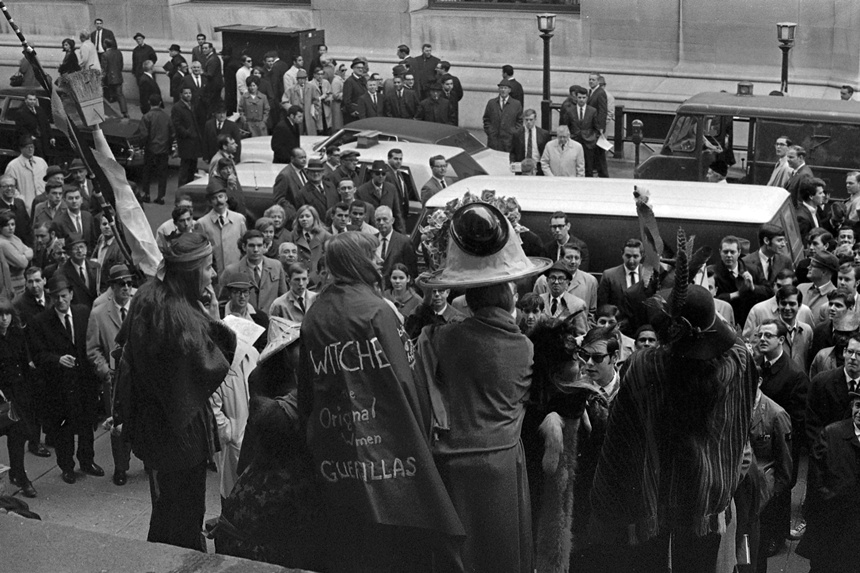
The sight of witches with brooms and cauldrons going trick-or-treating in the streets might be typical for Halloween. But on October 31, 1968, when a group of women dressed as witches descended on Wall Street, they weren’t looking for candy. Instead, they sought to protest the patriarchal oppression of corporate America, represented by New York’s financial district, and connect their goals of women’s liberation to this anti-capitalist critique.
Chanting “Wall Street, Wall Street…Trick-or-treat, corporate elite, up against the Wall Street!” the women placed a “hex” on the stock exchange and the Dow Jones Industrial Average (which did drop unexpectedly the following day). The protest grabbed both media and spectators’ attention.
The feminist women who organized the Wall Street protests were part of a group named WITCH, an acronym for Women’s International Terrorist Conspiracy from Hell. Despite the threatening name, the group was not violent. Their plan was to concentrate on direct action and coordinated protests, also known as “zap action” or “guerilla theater” that sought to grab headlines while delivering their message. According to one pamphlet, WITCH was meant to be “a total concept, a new dimension of women. It means breaking the bond of woman as a biologically and sexually defined creature. It implies the destruction of passivity, consumerism and commodity fetishism.”
In addition to the acronym, group members also adopted the image of the witch, reclaiming it as a feminist icon of resistance and liberation. Instead of representing old, ugly, and dangerous women, feminists saw the witch a precursor to the modern movement of independent women who dared to challenge social norms and use their femininity as a source of power.

The image of the witch was a reference not only to the famous Salem witch trials, but also the more recent McCarthy “witch hunts” of the House Un-American Activities Committee (HUAC). Outraged by the persecution of the Chicago 7 and the exclusion of women from the investigation, WITCH member Rosalyn Baxandall suggested showing who the real radicals were.

Following the Wall Street demonstration, WITCH branches, or “covens,” sprang up across the country, leading similar protests against the capitalist oppression of women. In Washington, D.C., WITCHes “hexed” the inauguration of Richard Nixon, and in Chicago, WITCH members protested Chicago Transit Authority (CTA) rate hikes, chanting, “Witches round the circle go/to hex the causes of our woe/We the witches now conspire/To burn CTA in freedoms’ fire.”
Other chants had more feminist messages, emphasizing women’s fight against oppressive gender roles: “When you mess with women, you’ll be in trouble/We’re convicted of murder if abortion is planned/Convicted of shame if we don’t have a man/Convicted of conspiracy if we fight for our rights/And burned at the stake when we stand up to fight.”
In these demonstrations, the WITCH acronym was adapted to represent the local branch’s goals. After AT&T fired two typists who refused to be called “girls,” WITCH changed into Women Incensed at Telephone Company Harassment. Another WITCH coven changed its name for Mother’s Day to Women Infuriated at Taking Care of Hoodlums, and another changed it to Women Independent Taxpayers, Consumers and Homemakers.
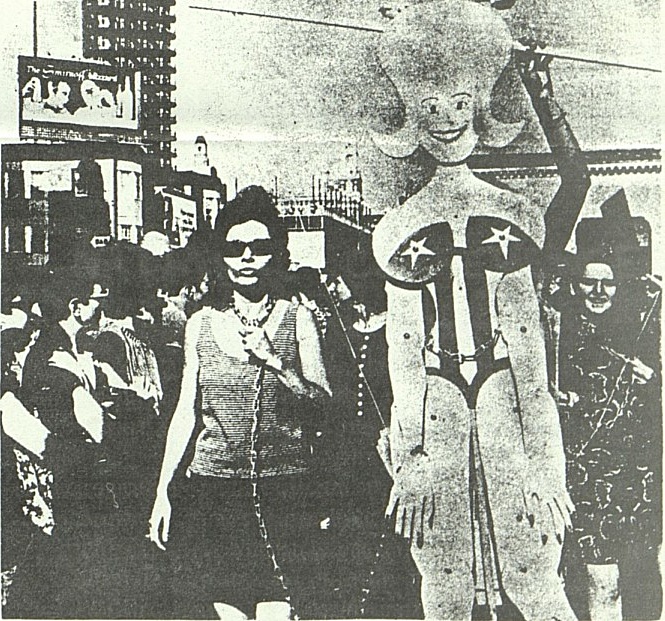
While WITCH’s theatrics and sense of humor appealed to many young feminists, they also drew criticism. In 1969, WITCH members stormed the New York Bridal Fair, wearing black veils and performing an “un-wedding” ceremony in which they declared themselves as free human beings. Carrying signs saying, “Always a Bride, Never a Person,” and “Confront the Whoremongers,” the protest antagonized the very same women it sought to reach out to, causing feminist activist Carol Hanish to criticize this form of action.
Following the failure of Bridal Fair action, activists turned to other feminist causes and organizations, and the group disappeared by 1970.
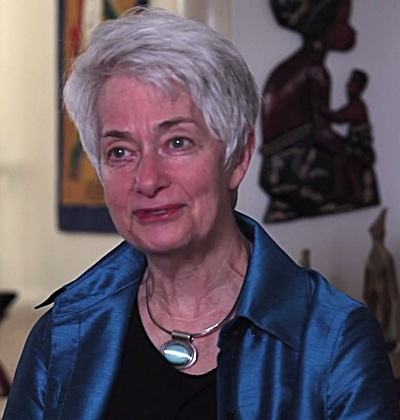
Yet, the legacy of the organization has not been completely forgotten. Witches and witchcraft have continued to maintain their feminist appeal. In 1969, Heather Booth, a WITCH activist in Chicago, went on to found the Jane Collective, an underground network that helped women to get abortions before Roe v. Wade. In the late 1970s and early 1980s, inspired by feminist writings such as Starhawk’s The Spiral Dance, witches found a place in popular culture as strong, independent women. And the character Elphaba in Wicked has reclaimed the image of the “wicked witch” as a beloved feminist protagonist who fights for justice.
Sixty years after its founding, WITCH’s “zap” style of direct action has remained popular with a new wave of activists. Feminist activists in Boston and Portland have revived the organization, staging protests dressed as witches for reproductive rights, against gun violence, and in support of immigrants.

In a WITCH pamphlet from 1969, the group declared that “Witches have always been women who dared to be: groovy, courageous, aggressive, intelligent, nonconformist, explorative, curious, independent, sexually liberated, revolutionary.” As current-day feminists continue to fight for women’s rights while challenging derogatory images of women, they too channel the spirit of the “original” witches, reminding us that they are the granddaughters of those the patriarchy couldn’t burn.
Become a Saturday Evening Post member and enjoy unlimited access. Subscribe now



Comments
Thank you Bob for these anecdotes, really fascinating. And I’m glad you enjoyed reading