
The notion that music has a profound effect on mind and mood probably does not come as much of a surprise. A single song has the ability make us laugh or bring us to tears, lift us up when we are down, shake off a bad mood or motivate us to hit the gym, transport us back in time, or dance like no one is watching. Music strikes a chord with all of us — the universal language.
But listening to your favorite tunes does more than just boost your mood. Research shows that music’s influence over our biology and health is far-reaching. There is considerable evidence that listening to your favorite tunes can boost physical as well as mental health — including better sleep, more productive workouts, pain reduction, and improved heart health.
The idea of music as medicine isn’t new. For centuries, music has been a powerful tool for healing. The ancient Egyptians described musical incantations for healing the sick. Greek physicians used flutes and lyres to heal their patients and vibration to aid digestion and induce sleep.
Today, scientists are gaining a better understanding of how and why music affects our bodies and minds. Music therapy is proving to be a powerful treatment for a range of conditions, including chronic pain, stroke, cancer, and Parkinson’s disease, and it’s increasingly becoming part of patient care.
It’s important to note that music therapy differs from listening to music for entertainment, relaxation, or stress relief. Though they share some of the same benefits, the goal of music therapy is not to entertain. Rather, music therapy is a practice that uses evidence-backed techniques to address physical, mental, and emotional well-being.
Music therapists use both active and receptive (passive) interventions, and create goals to improve health and well-being. In active music therapy, the patient participates in making music, often through singing, playing instruments, or movement — anything from the client rhythmically snapping their fingers to learning a complicated TikTok dance. In contrast, passive interventions involve patients listening to music rather than actively participating. One of the best facets of music therapy is that people of all ages can benefit, and musical skills aren’t a requirement.
Studies using fMRI (functional magnetic resonance imaging) have shown that listening to music activates virtually every area of the brain. It can also influence our brain chemistry. Listening to a favorite song can trigger the release of endorphins — the body’s natural painkillers and mood elevators — and reduce levels of cortisol, the “stress hormone.” When you listen to music, especially music you enjoy, it also triggers the release of dopamine — a feel-good neurotransmitter associated with pleasure and reward. (Get chills when listening to your favorite song? The “dopamine rush” could be why.)
Considering the powerful effect that music has on the brain, scientists are trying to harness the transformative power of music to develop nonpharmacological interventions for treating various diseases.
“Nothing activates the brain so extensively as music,” wrote renowned neurologist Oliver Sacks, M.D., in his book, Musicophilia. “Music can lift us out of depression or move us to tears — it is a remedy, a tonic, orange juice for the ear. But for many of my neurological patients, music is even more — it can provide access, even when no medication can, to movement, to speech, to life. For them, music is not a luxury, but a necessity.”
Dr. Sacks, who spent years exploring the effects of music on the brain, regarded “music therapy as a tool of great power in many neurological disorders — Parkinson’s and Alzheimer’s — because of its unique capacity to organize or reorganize cerebral function when it has been damaged.”
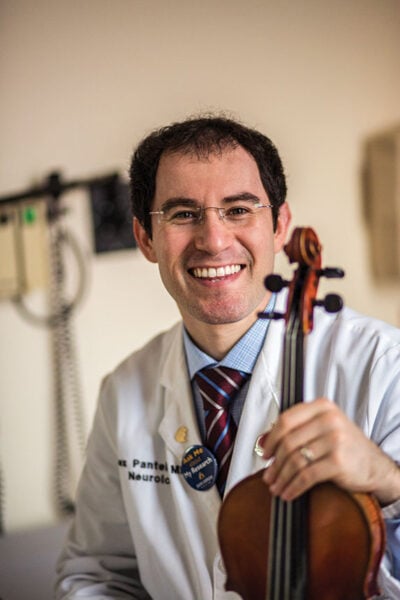
“Music has been an integral part of the human experience as long as humanity has been around,” says neurologist Alexander Pantelyat, M.D., co-founder and co-director of the Johns Hopkins Center for Music and Medicine. “It’s been intuitively felt to have healing properties, but now we are in a position to study the mechanisms and optimize music-based interventions.”
The Johns Hopkins Center for Music and Medicine is one of the leading institutions investigating the science and therapeutic potential of music to help treat conditions like Parkinson’s, stroke, and Alzheimer’s. The center is exploring the impact of music and rhythm-based therapies on Parkinson’s disease, Alzheimer’s disease, stroke, and a number of other disorders.
Recent studies conducted by Pantelyat found that regular choir, guitar, or drum sessions help patients with Parkinson’s disease improve their movement and coordination as well as their mood.
“We’re using music therapy, music-based interventions, [and] rhythm-based interventions for the purposes of improving symptoms, quality of life, and healing various illnesses,” says Pantelyat, adding that the center’s focus “has largely been on neurological illness to date, neurodegenerative conditions like Parkinson’s disease and Alzheimer’s disease,” but that research continues to explore other conditions, including those related to cardiac health.
“Music has always been very near and dear to my heart,” says Pantelyat, an accomplished musician and violinist himself, who in 2015 started investigating the benefits of choral singing on Parkinson’s disease patients through his Parkinsonics program.
After just a few months into the Parkinsonic choral program, Pantelyat observed that “singing together in the group has helped increase participants’ vocal volume and clarity, rhythmic movement, and confidence of emotional expression, while cultivating a sense of community,” noting how participants were able to get a break from their illness and focus on creativity.
Music therapy can and often does have a movement component. Dance has been shown to have beneficial effects on the brain and is now being used to treat people with Parkinson’s disease.
“Several studies that came out, particularly Washington University in St. Louis, showed [that] pursuing ballroom dance really improved various symptoms in Parkinson’s disease overall, and particularly mobility, walking, and balance,” says Dr. Pantelyat.
An activity like dancing for an hour a couple times a week can help a patient improve their walking balance and, most importantly, stay improved, which, Pantelyat says, “is no small task in the face of a progressive neurodegenerative condition like Parkinson’s disease.”
One of Pantelyat’s patients found success by taking ballroom dance lessons — notably, the Argentine tango.
“Inherently it makes sense because in Parkinson’s disease, steps get smaller, to the point of shuffling and sometimes even freezing, which is a phenomenon — freezing of gait — where your feet get stuck to the ground. You’re trying to turn around, you’re trying to walk through a doorway, and it’s not possible to do that in severe cases,” he explains. “These are the kinds of things that Argentine tango counteracts by targeting very large steps in every direction, so it’s literally the opposite of what happens to patients.”
Lori DePorter first met Dr. Pantelyat in 2015 to get a second opinion after being diagnosed at age 45 with early-onset Parkinson’s disease. At that first meeting, Pantelyat suggested dance therapy.
Though DePorter never took dance lessons before her diagnosis, she threw herself into the practice, taking lots of private dance lessons with her husband.
“The Argentine tango is very hard,” says DePorter. “I really had to concentrate and understand my body.”
In addition to serving as Global Ambassador for the Parkinson & Movement Disorder (PMD) Alliance, she teaches exercise classes for others with Parkinson’s.
“I incorporate music and dance into classes I teach,” she says. “We drum, we box to a beat using drumsticks, or punch to music. I teach how to hit a speedbag to a waltz rhythm.”
DePorter encourages people with Parkinson’s to stay active and find an activity they like to do because “anything you do is training for the brain.”
“Try to do everything big because Parkinson’s makes you small,” she says. “Bust a move anywhere; it’s not how you dance; it’s that you dance.”
Treatments for Parkinson’s disease and conditions like stroke extend beyond dancing and singing.
Rhythmic auditory stimulation is a Neurologic Music Therapy️ rehabilitation technique in which patients synchronize footsteps to a metronome or musical beats to improve their gait. The technique is, according to Dr. Pantelyat, “probably the best studied approach in many ways for behavioral-type outcomes.”
Music-based interventions that patients can pursue outside of clinical sessions are a vital part of the music therapy process as well. They can also include self-directed components, such as having a person with dementia curate their own music playlist.
“If I talk to my patients with Alzheimer’s-type dementia and ask them to put together a playlist [of] their favorite songs and then tell them to listen to it for 30 minutes a day at home, that’s an example of music medicine,” says the neurologist.
Choosing music that patients recognize and like can help Alzheimer’s patients connect with a part of the self they may have forgotten. Experts recommend using recorded music on a CD or other physical format instead of music streaming online; multiple ad interruptions may be confusing to the patient and can take everyone involved out of the therapeutic mental space. Avoiding commercials is a good way to maintain the music’s volume as well, which can help promote a stress-free environment for the therapy session. It’s best to focus solely on the musical stimuli, being careful to silence distractions like other media or cellphones.
Diseases like Alzheimer’s can greatly affect a patient’s dignity and humanity, and music therapy is a route back to the self.
“We all need more music in our lives because it serves to bring people together to promote social cohesion,” Pantelyat says. Sharing musical experiences with family and friends or other like-minded individuals can “be a profoundly healing experience.”
Chi Sherman is the Post’s editorial assistant.
This article is featured in the January/February 2026 issue of The Saturday Evening Post. Subscribe to the magazine for more art, inspiring stories, fiction, humor, and features from our archives.
Become a Saturday Evening Post member and enjoy unlimited access. Subscribe now


Comments
As a specialist in Lifestyle Medicine, as a health professional, I strongly believe in the concept of Music As Medicine and have had lectures and “mini concerts” at a medical center demonstrating how peaceful and relaxing, as well as energizing good quality music can be. I even had a physician on our wellness and lifestyle medicine staff that would play the harp in patient rooms if they requested it.
Without music, the world could be a dull & boring place in which to be at times. I have always believed music has the power to change emotions, bring us up or take us down, and even incite acts of disruption, discord, or even violence. But overall, music can be a good healer when used in the right place at the right time for the right purpose.
I was diagnosed with Parkinson’s disease a year ago at the age of 67. For several months I had noticed tremors in my right hand and the shaking of my right foot when I was sitting. My normally beautiful cursive writing was now small, cramped printing. And I tended to lose my balance. The neurologist had me walk down the hall and said I didn’t swing my right arm. I had never noticed! I was in denial for a while, as there is no history in my family of parents and five older siblings, but I had to accept I had classic symptoms. I was taking amantadine and carbidopa/levodopa and was about to start physical therapy to strengthen muscles. I used different supplements that didn’t work, so last July, I tried the PD-5 protocol—the best decision ever! My tremors eased, my energy returned, and I sleep soundly. I feel like a new woman, and I can walk and exercise again. I got the PD-5 from limitless healthcenter. co m