Dead Man’s Wire
⭐️ ⭐️ ⭐️ ⭐️
Rating: R
Run Time: 1 hour 45 minutes
Stars: Bill Skarsgård, Dacre Montgomery, Al Pacino, Colman Domingo
Writer: Austin Kolodney
Director: Gus Van Sant
Reviewed at the Toronto International Film Festival
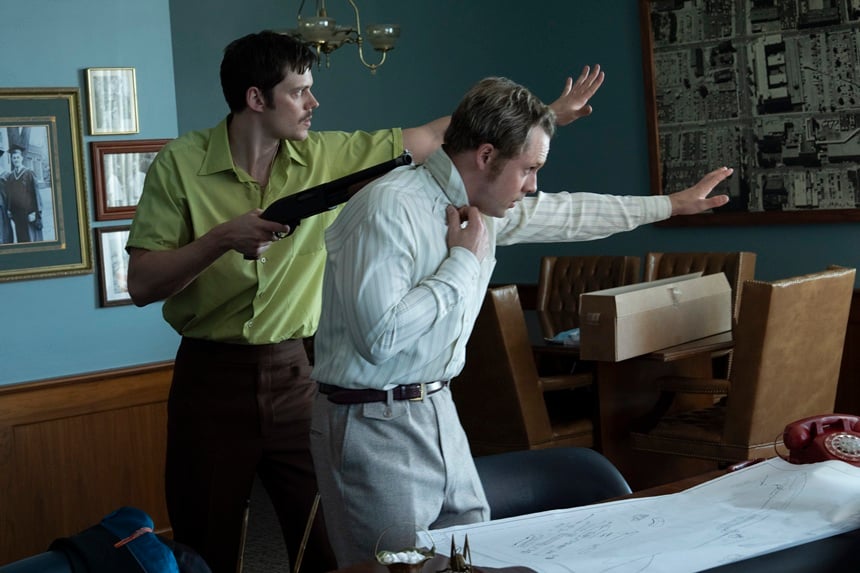
Not many movies leap from the starting gate like Dead Man’s Wire, a lightning bolt of true-life storytelling: Within the first 10 minutes or so, bankrupted loser Tony Kiritsis (Bill Skarsgård) has a shotgun wired to the neck of savings and loan president Dick Hall (Dacre Montgomery) and is parading him through the streets of Indianapolis while news cameras and onlookers gape in horror.
That’s pretty much the status quo for the film’s brisk hour and 45 minutes as Tony, convinced that he’s been swindled out of millions, holds out in his squalid apartment for three days, gun wired to his captive’s neck almost constantly, publicly demanding restitution and, most importantly, an apology.
It’s all based on a true event that riveted much of America in February 1977. Network news crews clustered outside Kiritsis’s apartment house, hanging on every glimpse through a curtained window; deciphering every word Kiritsis exchanged with a local radio personality who became the only outsider he trusted. When, at the ordeal’s end, the captor and his still-wired-up captive stepped in front of TV cameras in a mobbed apartment house garage, network executives kept one finger on the cutaway button, simultaneously tickled by the drama and terrified they might broadcast a grisly murder live.
It could all easily be too much for an audience to bear, but screenwriter Austin Kolodney — known primarily for his numerous Funny or Die episodes — and director Gus Van Sant (Good Will Hunting) soften the tale’s ragged edges with plentiful found humor and casual glimpses into their characters’ appealingly quirky psyches. Tony may be marginally homicidal, but he’s also a man of simple dignity who feels genuinely betrayed. He doesn’t truly expect to kill his captive; he’s confident his naked desperation will unleash a nationwide flood of sympathy that will force Dick’s bank to do the right thing. And Dick isn’t the soulless monster Tony envisions: He’s just a spineless banker boy who toils under the ruthless thumb of his avaricious father, played with operatic awfulness by none other than Al Pacino.
That shotgun thing aside, Skarsgård’s Tony is appealing company, alternately seething and considerate toward his kidnapping victim. His face often softening from stone-faced rage to a soft-featured smile, Tony seems to genuinely believe his life-and-death antics will somehow result in an outcome favorable to him. Montgomery — known to most of the world as Billy Hargrove in Netflix’s Stranger Things —deftly portrays a man who, having never before met adversity in his privileged life, must somehow learn to survive at the hands of a man who is eminently unimpressed by pedigree. Shifting from indignant to cowering to defiant to reluctantly sympathetic, Montgomery crafts a character who is ultimately shaped and scarred by his upbringing.
Speaking of which, Pacino goes Full Al here as a slow drawling, arm-waving patriarch from Hell; a guy who cannot bring himself to utter so much as an insincere apology even if it would mean saving his son’s life. Pacino has of late been turning up frequently in supporting, almost cameo, roles like this, all clearly filmed over a day or so, but still never simply phoned in. He gives it all he’s got every time, and it’s still always good to see the great Pacino at work.
Incidental to the story, but essential to the film, is Colman Domingo (Rustin), appearing as an Indianapolis radio DJ whose soothing voice and smooth jazz tracks ease the savage breast of Tony. Likewise, for us he is a calming refuge of sanity in a mounting maelstrom.
Historically, it has almost always been easy to spot a music score by Danny Elfman (Beetlejuice, Pee Wee’s Big Adventure); his quirky, fanciful compositions most frequently add a storytelling element to a filmmaker’s vision. Here, though, Elfman seems to be following Van Sant’s direction rather than helping delineate it, whispering an almost subliminal sonic background that feeds off the film’s shifting moods.
It’s easy to imagine Dead Man’s Wire as a white knuckle-inducing cinematic heart attack, as it would have been in, say, the hands of Marty Supreme director Josh Safdie. Here, Gus Van Sant is after something more humane; a thrilling but sobering contemplation of the lengths people might go for justice, whether they deserve it or not.
Become a Saturday Evening Post member and enjoy unlimited access. Subscribe now



Comments
This sounds like a worthwhile film, Bill. Al Pacino’s appearance is a great selling point in itself. If it were De Niro, never! How anyone can possibly confuse them is beyond me.