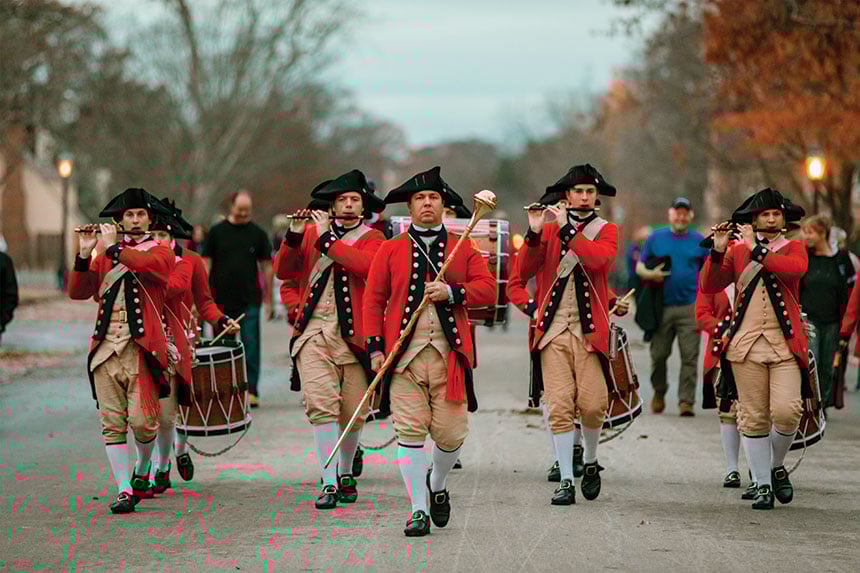
As the United States celebrates its 250th anniversary in 2026, many Americans will travel to Boston, Philadelphia, Valley Forge, and other destinations that played a role in our nation’s founding. While these places invite visitors to stand where history unfolded, only Colonial Williamsburg — marking its own 100th anniversary this year — lets them step into the past.
Walk cobblestone streets just like the Founding Fathers did; listen to costumed historical interpreters share stories of colonial life; learn how tradespeople, like wigmakers, crafted their products; and even sample ginger cakes over a pint at Raleigh Tavern.
But there’s more to Colonial Williamsburg than the illusion of time-traveling back to the Revolutionary War era. Spanning 301 acres and featuring more than 300 restored and reconstructed buildings, the world’s largest living history museum continues to excavate, research, and restore. What researchers are finding adds to the historic narrative and gives us a more inclusive story of the birth or our nation and what it means to be an American.
Williamsburg became the capital of Virginia in 1699 after a fire destroyed the colony’s first capital, Jamestowne. At the time, tobacco fueled the local economy, and people of color made up slightly more than half of Williamsburg’s population. The African Baptist Meeting House was one of the nation’s first Black congregations, while the Williamsburg Bray School was one of the earliest institutions dedicated to Black education in North America.
Because Williamsburg was the capital of the largest and richest colony in North America, most Founding Fathers had a connection to the city. Thomas Jefferson and George Washington served in the House of Burgesses, the colony’s legislature. Benjamin Franklin visited to receive an honorary degree from the College of William & Mary in 1756, and Patrick Henry of “give me liberty or give me death” fame served as the state’s first governor from 1776 to 1779.
The city also rebelled against British authority. On April 21, 1775, before residents heard of the battles at Lexington and Concord two days earlier, fighting almost broke out in Williamsburg when the governor, Lord Dunmore, tried to confiscate the gunpowder stored in the city’s Powder Magazine. Locals called up the militia to try to stop the British sailors, but Peyton Randolph – speaker of the House of Burgesses and the first President of the Continental Congress — and other calmer heads convinced the crowd to back down. If they hadn’t, Williamsburg might have become the site of an early battle in the war.
However, as the war continued, the Revolution’s leaders grew concerned that they couldn’t effectively defend Williamsburg against a British attack and decided to move the state capital to Richmond in 1780. People who worked in government followed; those who remained continued as they always had. Williamsburg froze in time.
Ron Hurst, Chief Mission Officer at Colonial Williamsburg, explains that unlike Boston, Philadelphia, and other major cities that played a role in the Revolutionary War, Williamsburg didn’t have a waterway. It didn’t continue to grow once the government moved to Richmond, so many of the colonial buildings remained untouched for more than 100 years.
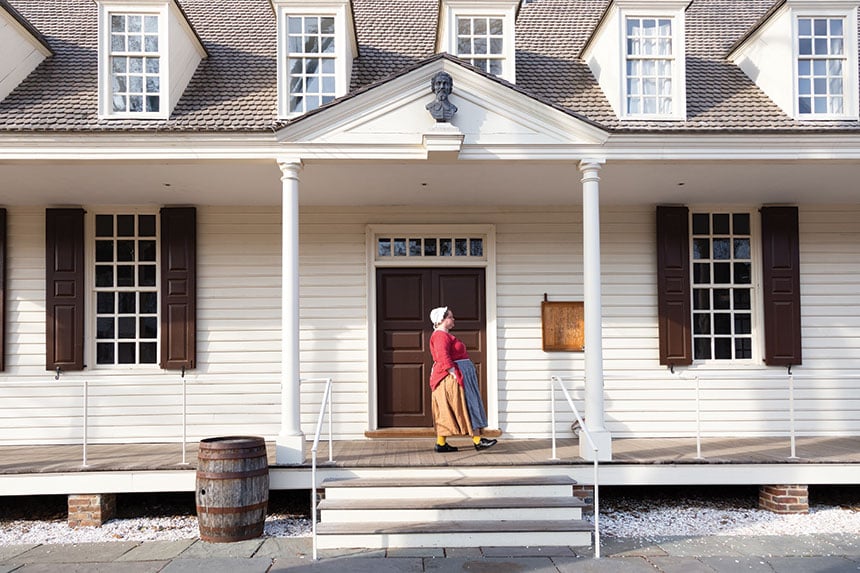
By the early 1900s, residents knew Williamsburg, with its unusually high concentration of historic colonial buildings, was unique. However, restoring those buildings took money they didn’t have. Then, in 1916, circumstances spurred them to action.
That year, DuPont opened a munitions plant nearby to supply weapons for World War I, and workers with money to spend started moving to Williamsburg. For the first time, colonial buildings were at risk of being torn down to make way for new houses, gas stations, and businesses. Reverend Dr. W.A.R. Goodwin — who’d had some success raising money to restore Bruton Parish Church, an Episcopal church in the historic area attended by Thomas Jefferson, George Washington, Patrick Henry, and others — took it upon himself to save Williamsburg.
Goodwin reached out to John D. Rockefeller Jr., and after visiting Williamsburg with his family in 1924, Rockefeller told Goodwin to draw up plans to restore the area and authorized him to start buying property. Restoration officially began two years later in 1926. Hurst says their goal was initially preservation, not education.
But the educational component was inevitable, especially since the first building to open to the public, the Raleigh Tavern, played such an important role in the American Revolution as the site where the Founding Fathers met after Lord Dunmore dissolved the House of Burgesses. Two years after the tavern reopened in 1932, hostesses there became the first staff to appear in period clothing.
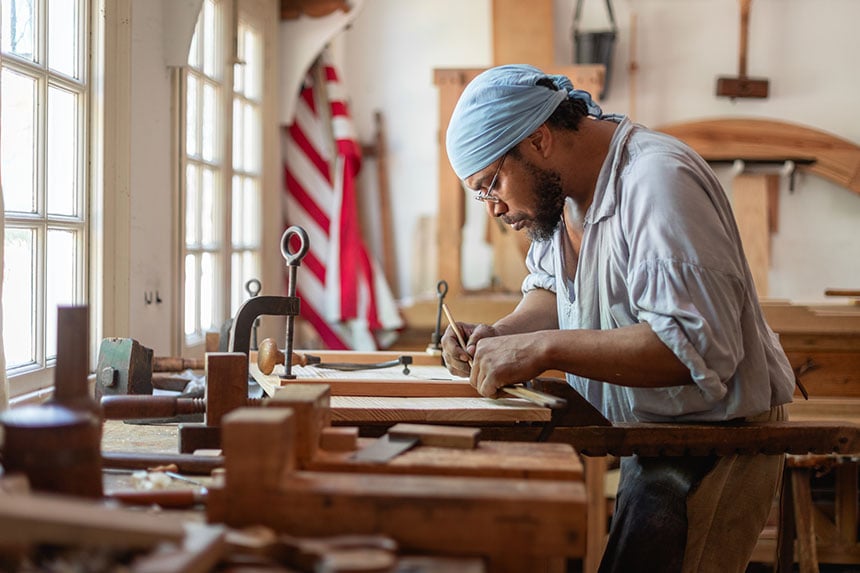
With the passing of the torch from Rockefeller to his son, John D. Rockefeller III, the emphasis on education became even more pronounced. The foundation that now managed Colonial Williamsburg added a historic trades team in the 1930s to demonstrate cabinetmaking, blacksmithing, wig making, candle making, and other important crafts of the era.
In the 1970s, the educational aspect expanded yet again with the addition of historical interpreters who could tell the story of life in 18th-century Williamsburg. Initially, Hurst admits, interpreters shared stories of mostly wealthy white men, such as the Founding Fathers. Today, interpreters tell the stories of all people, including those from all classes, races, and genders.
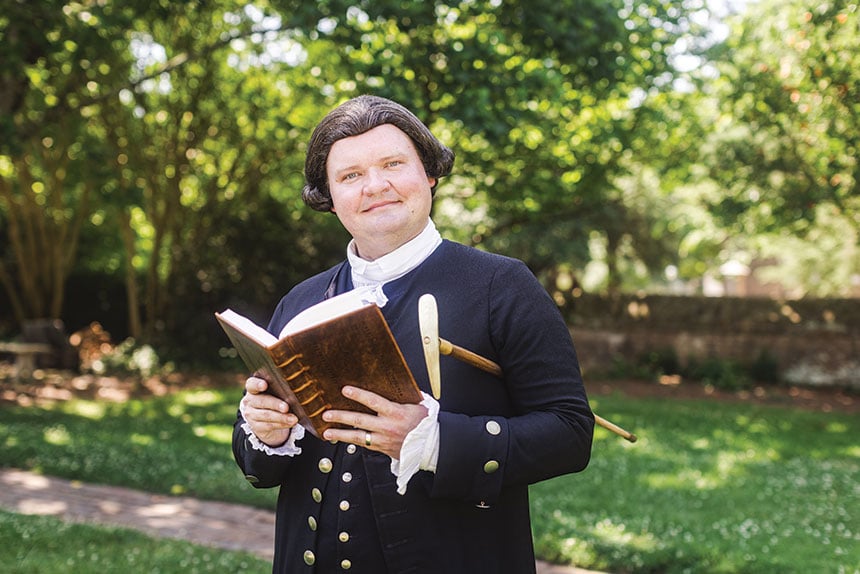
Continued preservation and research has led to Colonial Williamsburg’s evolving narrative, according to Hurst. One hundred years ago, when preservation began, segregation still cast a shadow over the country, and history buried the voices of women and other minorities. That’s changed to an extent today. Technological advances, too, help us to better understand the past. For example, technology can help researchers identify the original materials used to build a historic structure, and as newer and better technologies emerge, we may learn even more, which is why it’s so important to keep researching. When we stop researching, says Hurst, we end the flow of new information, and if that happens, it will be tragic.
“As a society, we need to understand where we come from to understand who we are and where we’re going,” Hurst says.
Based on his observations, people come to Colonial Williamsburg knowing less and less about the American Revolution and colonial times every year; what they see and do here is sometimes their first exposure to America’s origin story. Hurst says Colonial Williamsburg provides people with information about those times, and then it’s up to them to decide what to think about what they’ve learned.
Often, that takes time. Robert Weathers, a Nation Builder actor who portrays George Wythe, believes visitors need to process what they learn while touring Colonial Williamsburg, especially when it comes to stories they may not have heard before.
“People don’t change their mind in front of you,” he explains to other interpreters when they first start at Colonial Williamsburg. However, on more than one occasion, people have sought him on a return visit to tell him that they went home, thought about what he said when they visited before, and now they think differently.
Ultimately, Weathers wants people to know what it means to be a member of a republican form of government and that our nation can’t succeed without their contribution and participation.
“Citizenship is an active role,” he says. “It has to be.”

One of the biggest challenges Colonial Williamsburg faces moving into its next century is shorter stays. Initially, people spent three or four days exploring the buildings, according to Hurst. Now, they allocate just a day to cram as much into their visit as possible. Which is even more unfortunate considering, as Hurst points out, that the Colonial Williamsburg Foundation is currently renovating and restoring more buildings than at any time since the 1960s. In June 2025, the Williamsburg Bray School for free and enslaved Black children opened to the public, and archaeologists are currently working to restore the African Baptist Meeting House, the oldest surviving Black church building in the nation.
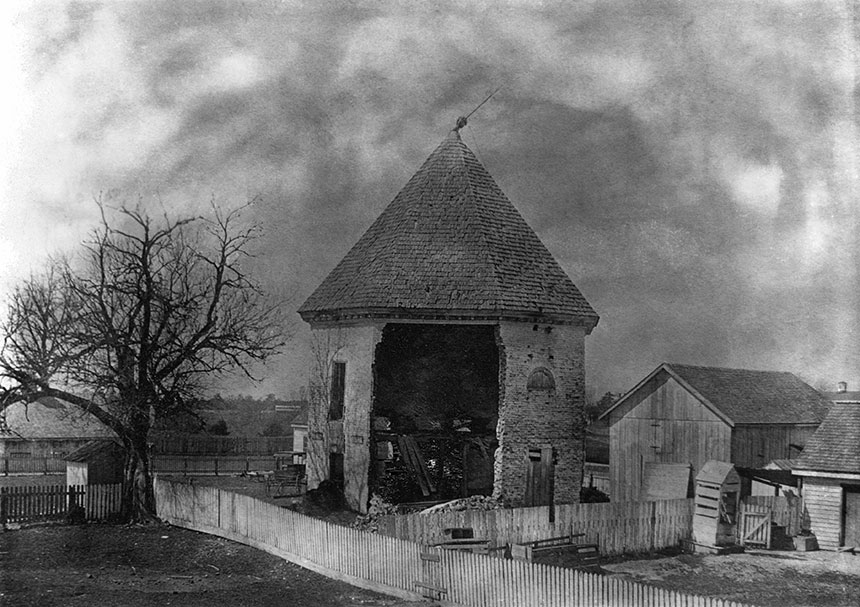
Additionally, archaeologists have unearthed muskets, tobacco pipes, and even the bodies of four Confederate soldiers while recently excavating the Powder Magazine. These and other discoveries have led to reinterpreting the building’s role over the years as well as what it might have looked like during the American Revolution. As a result, Colonial Williamsburg has lowered the perimeter wall and is working to restore its casement windows.
Other significant projects include restoring the Peyton Randolph House stables, improving the historic gardens at the Governor’s Palace, and completing the new Colin G. and Nancy N. Campbell Archaeology Center. The center — scheduled to open in 2026 — will feature artifacts from Colonial Williamsburg’s archaeological collection of more than 60 million items, and will invite guests to interact with archaeologists while participating in hands-on activities.
These renovations and additions complement the Art Museums of Colonial Williamsburg — two distinct museums under one roof. At the Abby Aldrich Rockefeller Folk Art Museum, visitors can view colorful paintings, whimsical toys, carved weathervanes, and other items depicting Americana. Adjoining it, the DeWitt Wallace Decorative Arts Museum showcases a diverse array of artifacts — clocks, furniture, firearms, pottery, and textiles — that are as beautiful as they are functional.
Karen Clancy, a master weaver at Colonial Williamsburg, says the new archaeology center and learning how tradespeople produced everyday items like those contained in the art museums adds another layer to the story of our nation’s birth. For the most part, the Founding Fathers were rich landowners and merchants, so when we talk about their lives, we’re only getting a snapshot of colonial life.
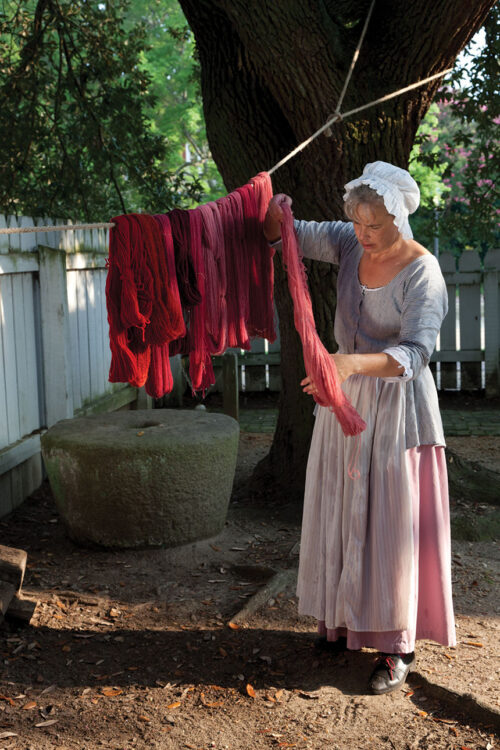
A good number of people during colonial times worked in the trades — fashioning clothes, producing candles, making horseshoes, and performing other essential tasks — and had a substantial impact on the Revolution. For example, Clancy points out that England wasn’t growing its own tea when the colonists dumped it into Boston Harbor, so that act didn’t make a significant financial impact on England. However, England produced much of the world’s fabric. When the colonists began making their own fabrics, England felt the blow. Clancy says that when you interact with tradespeople, you learn these little details that you wouldn’t otherwise. A wigmaker, for example, will explain how wigs are made, why a man might wear one, and why women didn’t.
While visiting in person, even for just one day, is the best way to experience Colonial Williamsburg, the foundation hopes to bring its lessons to a new generation of Americans. One way is through History.org, an online resource that allows private and public teachers to access primary sources and digital assets. Initially, the collection will focus on information related to the American Revolution, but eventually, it will span all of the nation’s history.
On its campus, Colonial Williamsburg will continue to welcome teachers to the Bob and Marion Wilson Teacher Institute of Colonial Williamsburg, where they can learn more about the American Revolution. Online classes offered through the institute reach even more teachers. Additionally, Colonial Williamsburg is working with Google Arts & Culture to make more historical documents and images available to the public online.
For now, the predominant focus is the 250th anniversary of our nation and the 100th anniversary of the destination itself. Colonial Williamsburg plans to celebrate both throughout the year, starting with the publication of the book 100 Years of Colonial Williamsburg. Tailored presentations and programs will discuss the birth of our nation throughout the year, but activities ramp up in May, with Virginia riflemen military reenactments, concerts by Colonial Williamsburg Fifes and Drums, and reliving the 250th anniversary of the Virginia Revolutionary Convention’s motion for independence. The following month features more concerts, the adoption of Virginia’s Declaration of Rights, and Juneteenth celebrations. Then, on the Fourth of July, visitors will hear a dramatic reading of the Declaration of Independence and watch a fireworks display over the Governor’s Palace. Patriotic musical performances continue through July and August.
Mostly, though, Weathers anticipates portraying Wythe this year as he normally does — based on what happened on that day in Williamsburg history. But he does expect to be busier and to interact with more visitors.
“This next year is quite a year,” he says. “I tell people that if you see me in 2026, give me a Gatorade because I’ll need it.”

For more information about Colonial Williamsburg, visit the historic area’s website at colonialwilliamsburg.org. There you’ll find a page dedicated to planning a trip to celebrate the nation’s 250th anniversary.
Teresa Bitler is a freelance travel writer whose work has appeared in National Geographic Traveler, Wine Enthusiast, TripSavvy.com, ShermansTravel.com, AAA publications, and others.
This article is featured in the January/February 2026 issue of The Saturday Evening Post. Subscribe to the magazine for more art, inspiring stories, fiction, humor, and features from our archives.
Become a Saturday Evening Post member and enjoy unlimited access. Subscribe now
Comments
My wife and I toured Boston, Martha’s Vineyard, Vermont, New Hampshire and numerous other places in 2012, which we thoroughly enjoyed, and reading some of your articles bring it all back into focus. Thank you for your magazine and the various writers contributions. It is a shame travel from Australia takes so long, but the memories remain
It really is amazing. The amount of work, time and effort in preserving Colonial Williamsburg is crucial, and all worth it. Our nation is still very young, and we don’t have many comparable ways to step back into history just beyond our front doors like people in Italy, Spain or Greece can, to name three longer established countries.
I was actually there at 10 (youth is wasted on the young) on a 2-day stop in Virginia on our way to Expo ’67 in Montreal. My mom was enthralled by the recent color photo spread in LIFE, and that was it. It was impressive, but not like Williamsburg. I’d love to go again; more than anywhere else.
Amazing. I hope to visit someday. Sounds like a great trip for my Gold Wing.