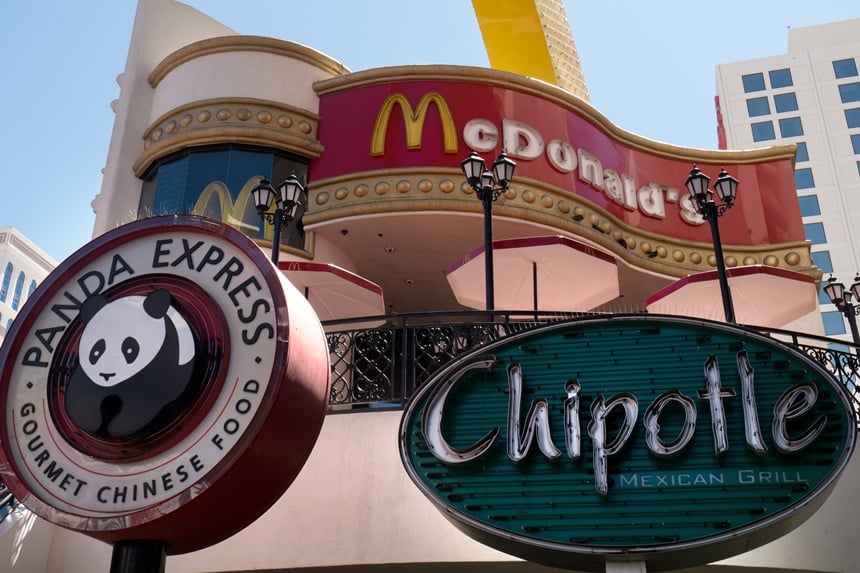
In 1912, America’s first fast food chain restaurant was opened. Known for its affordable prices, coin-operated vending machines, and Art Deco architecture, Horn & Hardart Automat served a variety of foods — ranging from sandwiches to pies — throughout their locations across New York and Philadelphia. Nearly a decade later in 1921, White Castle — the first hamburger chain in the world — solidified the three foundational characteristics of modern fast food restaurants: standardization of quality and performance, the quick rotation of employees, and reliance on investors to franchise their restaurant chains. Today, fast food has turned into a multi-billion dollar industry that is deeply ingrained in modern American life, and for that, one must thank (or blame) advertisements.

Marketing has a much greater impact on its viewers’ diets than one might think. One study shows that exposure to advertisements or food cues can increase psychological and physiological reactivity, including cravings and salivation. Throughout history, fast-food advertisements have created and reinforced attitudes toward food. Needless to say, restaurant advertising has evolved significantly over the years due to cultural shifts and technological advancements, playing a crucial role in the prominence of fast food in the American diet today.

In the early 20th century, restaurants used traditional methods to reach potential customers, primarily word-of-the-mouth and print ads — which were a common medium for food marketing — in local newspapers and magazines. In the 1930s, 20 percent of advertisements in women’s and domestic magazines were for food and drink products. Another early marketing method for restaurants around the early to mid-1900s was matchbooks. With their compact designs and vibrant graphics, these matchbooks constantly exposed individual restaurants without requiring a large budget.
Fast-food restaurants also attempted to gain attention by creating unique interior and exterior designs of the buildings themselves, built to distinguish them from traditional restaurants, increase efficiency, and highlight cleanliness. For example, most fast food buildings had small, white, tiled buildings, and open stainless-steel kitchens — a design that was introduced by one of the most influential early fast food chains, White Castle.

Neon signs — a technology that was introduced to the United States in the 1920s — also became a popular way to attract customers. Originally from France, the neon signs were first introduced to the U.S. by businessman Earle C. Anthony, and a Chinese restaurant called Orange Garden in Chicago was one of the first restaurants to utilize it for advertising.
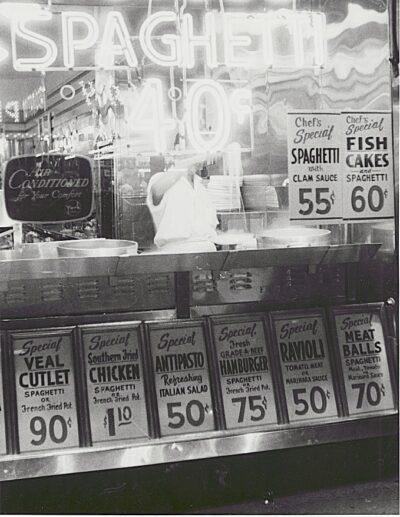
In her 1934 travel guide Curious California Customs, Elisabeth Webb Herrick wrote, “to the casual visitor, Wilshire Boulevard, after dark, is a flashing cavern of Neon signs, most of which are calling attention to eating places.” Since the neon signs had grown so common and were no longer a distinctive feature for businesses, they slowly began to lose their popularity in the 1960s.
The “Golden Age of Television” marked the shift in the 1950s when television became a common part of everyday American life, reaching 90 percent of American households by the end of the decade. With this rapid increase came an influx of advertising opportunities, particularly for food companies, who sponsored programs and promoted their products during commercial breaks. The new medium — which combined moving images, sound, and written text — became a common and effective way to sell a product.
A 1955 commercial for Swanson TV Dinner (Uploaded to YouTube by Vintage Fanatic)
By the 1990s, approximately 50 percent of television commercials were related to food items in the United States. Mascots grew to become a common method for advertising fast food around the same time as the television, giving companies an instantly recognizable and friendly-looking visual brand. In 1948, McDonald’s launched their first mascot, a small chef — dressed in red, white, and blue — named Speedee. The memorable clown mascot Ronald McDonald was introduced over a decade later on a local television commercial, maintaining its spot as McDonald’s official mascot for decades after.

In recent years, food advertisements have skyrocketed. Research done by the University of Connecticut shows that as of now in the United States, food companies spend over $14 billion on advertising each year. This boost is particularly due to the increase of social media usage in youth. Many food companies are investing in digital marketing, rather than relying solely on more traditional outlets such as billboards, radio stations, newspapers, and television. These digital advertisements shape dietary choices significantly, with half of consumers making their purchasing decisions based on influencer or social media posts, rather than nutritional value, with 80 percent of these advertisements promoting unhealthy choices such as fast food, sugary drinks, candy, and more.
Influencer Jordan Howlett, who has 17.2 million followers on YouTube, is known for his “Fast Food Secrets Club.” (Uploaded to YouTube by Jordan Howlett)
Modern fast-food advertising relies on partnerships with public figures and modern technology such as artificial intelligence. For many brands, promotional deals with celebrities and influencers is an easy way to market their products without a significant budget or having to add new menu items. For example, in 2020, Dunkin’ took an existing drink on their menu — a cold brew with whole milk and caramel swirl — and renamed it after TikTok influencer Charli D’Amelio.
Charlie D’Amelio promoting Dunkin’ (Uploaded to YouTube by Charli D’amelio)
These advertisements also tempt more individuals to join restaurant apps or loyalty programs, with the McDonald’s app gaining over 10 million downloads after teaming up with celebrities such as Saweetie, BTS, J Balvin, and Travis Scott. Artificial intelligence has become an intriguing new technology for fast food companies. For example, Yum Brands — the parent company of Taco Bell, KFC, and Pizza Hut — partnered with technology company Nvidia to accelerate its deployment of AI, which resulted in their worldwide sales growing by 5 percent.
What began as simple neon signs and print ads in local newspapers has now transformed into more targeted and widespread campaigns that promote convenient food choices. As technology evolves and exposure to advertising becomes increasingly unavoidable, fast-food marketing continues to shape food trends and personal choices, raising important questions about how advertising influences the way Americans eat.
Become a Saturday Evening Post member and enjoy unlimited access. Subscribe now