Senior managing editor and logophile Andy Hollandbeck reveals the sometimes surprising roots of common English words and phrases. Remember: Etymology tells us where a word comes from, but not what it means today.
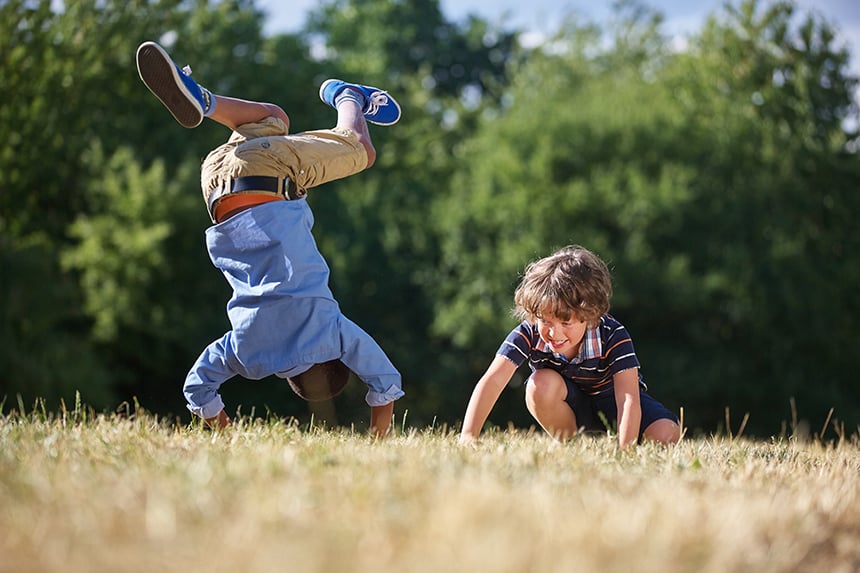
The imminent arrival of spring has some of us wanting to turn somersaults. Though it might sound like there are two seasons mentioned in that sentence, the fact that the first half of somersault has the wrong vowel and the wrong number of m’s isn’t just some shift in spelling; somersault has nothing to do with summer.
However, if you look at the second half of somersault and see glimmers of the word assault, you’re on the right track.
Somersault came into English as a noun in the 16th century, from the Middle French sombresaut, which is probably from the Old Provençal word sobresaut. This can be traced back to the Latin roots super (“over”) and saltus, the past participle of salire “to jump.”
Many an English word has roots in the Latin super and supra, both of which can mean, at base, “over, above, to a greater degree.” There are subtle differences between how the two Latin words were used — like being above something vs. on top of it, or metaphorically vs. physically above — and, quite frankly, I can’t wrap my head around those differences myself. Both forms appear to have come from the same place, though: the Latin supera.
In Modern English, the supra- prefix most often appears in scientific and medical terminology. For example, something above your eye socket is supraorbital. Lay people are much more familiar with the super- prefix in words like supernatural, superstition, and superhero. Also, as I pointed out several years ago, super– has sometimes gotten shortened, making it less obvious in words like soprano, surplus, and surcharge. In somersault, it’s camouflaged even further.
The root of the second half of somersault — salire “to jump” — makes a lot of sense in this context. The original somersault is what we might today call a front flip: an acrobat jumps forward, goes heels-over-head in a complete rotation, and lands on their feet without touching the ground in between. That can be a difficult move to learn, so when children went home, say, after going to the circus, and tried to emulate that feat, they would do the rolling type of somersault that we are more familiar with today.
I mentioned assault earlier. That word’s first syllable is actually ad- (“to”) when it appears in front of most other letters. The rest of the word is that same sault, though; to assault someone is literally “to jump” out at them.
Salire has been a productive seed from which has grown quite a number of English words, though that root isn’t always obvious. Some other “jumping” English words are desultory (de- means “down”), insult (in- “on”), result (re- “back, again”), and salient (which began as a heraldry term describing a jumping animal). Even the word salmon — famous for leaping out of water to go upstream — might literally mean “jumper,” though it has been argued that this merely is a folk etymology.
Lastly is the word sally. Not the name, which is an alteration of Sarah, but the sense of suddenly rushing forward, especially in a military situation. People have been sallying forth since the 16th century, and you can do it now — preferably out to the soft grass to do some somersaults.
Become a Saturday Evening Post member and enjoy unlimited access. Subscribe now
Comments
The title of this column may be the first time I’ve ever seen (or read) the word written out. Even hearing it, almost as rare. I’m not surprised at the Latin and Middle French connections the word has, but somehow (?) thought there could be some German in the mix. The ‘sault’ component related to ‘assault’ or here ‘to jump’ is pretty interesting.
To do a somersault, it’s a pretty quick motion, like jumping someone, so it makes sense. As for somersaults otherwise, I’ll leave the on land kind to the boys in the opening picture. Nowadays, ones off of the diving board into the deep end of the pool are a lot more appealing; especially during this ridiculous March heatwave!