The more you travel, the more you come to understand that every destination has a story it wants to tell; the preferred narrative long-since agreed upon by the locals or favored in shiny handouts printed by the local tourism board.
But if you really want to listen to a town’s heartbeat and learn the unvarnished — often heroic — story of its lives and times, stop in at the historic churches, which have inevitably witnessed moments good and bad, proud and regrettable, and are here to tell you all about them, if you’re so inclined.
Nowhere is this more true than in Key West, Florida, that raucous last stop at the end of the Florida Keys, the anything-goes refuge for peg-legged pirates and boozing writers, street performers and drag show stars. Up and down Duval Street, sunburned aliens from today’s docked cruise ship anxiously seek out the best deals on “Ask Me About My Beer” t-shirts and today’s most irresistible happy hour.
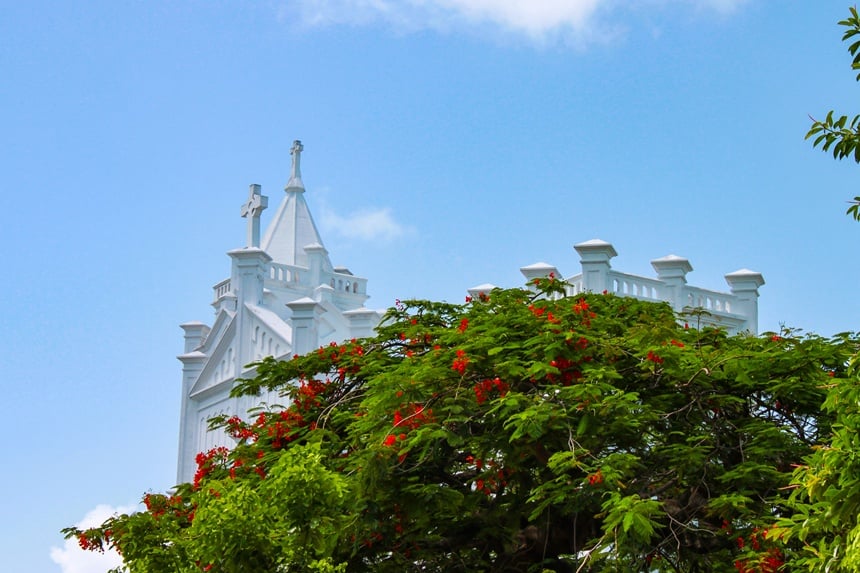
Just a block off the main street, though, in a squat, white-bricked church that resembles a Caribbean island fort, a more nuanced narrative of Key West’s cultural history emerges.
Bahamian Rhapsody: St. Peter’s Episcopal Church

Calvin Allen gestures for me to take a seat in the back pew of the cozy 102-year-old sanctuary of St. Peter’s, Florida’s first Black Episcopal Church. His eyes trace the interior’s lines, from the polished wooden pews to the timbered arched ceiling that frames, in a painting above the altar, a dark-skinned Jesus, walking on water. It takes no imagination at all to assume He’s taking a miraculous stroll on either the Caribbean Sea or the Gulf of Mexico, whose bodies blend just off the tip of Key West.
If Allen seems particularly comfortable here, it’s no wonder: He was baptized in the font just a few feet away from us. Allen left Key West to get a law degree at Howard University in Washington, D.C., but returned to practice in his home town. Retired from the law, he is the lay worship leader of the church, assisting the rotation of priests lucky enough to be assigned Key West duty by the local diocese.

When Allen’s grandparents arrived in Key West from the Bahamas, they immediately sought out St. Peter’s, which had been founded by Black Bahamians on land they bought in 1887. Hurricanes destroyed the first two sanctuaries. This one, built of white, shell-based brick that was fired right on the property, was designed to survive the worst natural onslaught. (In the attic of an adjacent church building, Allen recently found the wooden fragments of what was most likely the first sanctuary’s pulpit.)
“This church was not founded by lawyers and doctors,” says Allen proudly. “It was founded by working people. They built this place with their own hands; brick and wood and glass.”
An outdoor mural, painted on plywood and now being restored, tells the story of that construction project. Men in overalls wield trowels and saws like medieval knights brandishing their weapons. The aspect of the viewer is from below, lending the otherwise humble figures heroic stature.
The mural, and that impressive above-the-altar painting, were created decades ago by Rick Worth, a beloved Key West artist whose work adorns outdoor walls, homes, and public buildings all around the island. The veteran painter recently endured some serious health issues, Allen says, and the entire community has rallied to help pay his medical bills.
“The people in Key West, they just love Rick,” says Allen. “But that spirit of helping people out is also just part of what Key West is all about.”
Worth also painted the church’s intimate, brilliantly colored Lady Chapel — an Anglican tradition that reserves a small worship venue in honor of the Virgin Mary. Across the length of the ceiling sprawls an enormous rendering of Adam’s hand reaching out to the finger of God. The west wall depicts a Black Madonna and child, recalling iconography dating to the earliest years of the church. The east wall’s blue paint is chipping and peeling badly, imperiling a chalice-bearing angel who is barely hanging on. The wall is presumably the planned beneficiary of an ongoing capital improvement drive.

You wouldn’t know it from just walking the neighborhood, but St. Peter’s sits atop the optimistically named Solares Hill, at 18 feet the highest spot in Key West. As such, when a catastrophic storm known only as the Great Havana Hurricane slammed into the island in 1846, survivors crawled up here to hang onto trees and vegetation to avoid being swept away. So, this little patch of island real estate is known for more than one type of salvation.
I leave Allen to his routine of managing the church’s daily affairs. Outside the door, I notice the battered bicycle he uses to get around the island.
“Come back anytime,” he smiles. “We’re always open.”
Open Windows on Eternity: St. Mary Star of the Sea Basilica
History has lost the name of the arsonist who burned down St. Mary Star of the Sea Roman Catholic Church in 1901, but the community-wide outrage that saw local Catholics, Jews, and Protestants alike band together to rebuild the sanctuary is celebrated to this day.
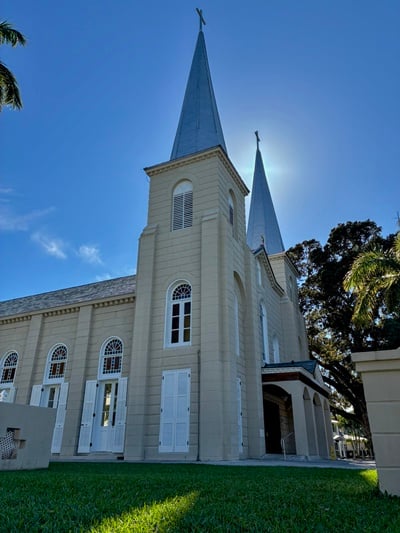
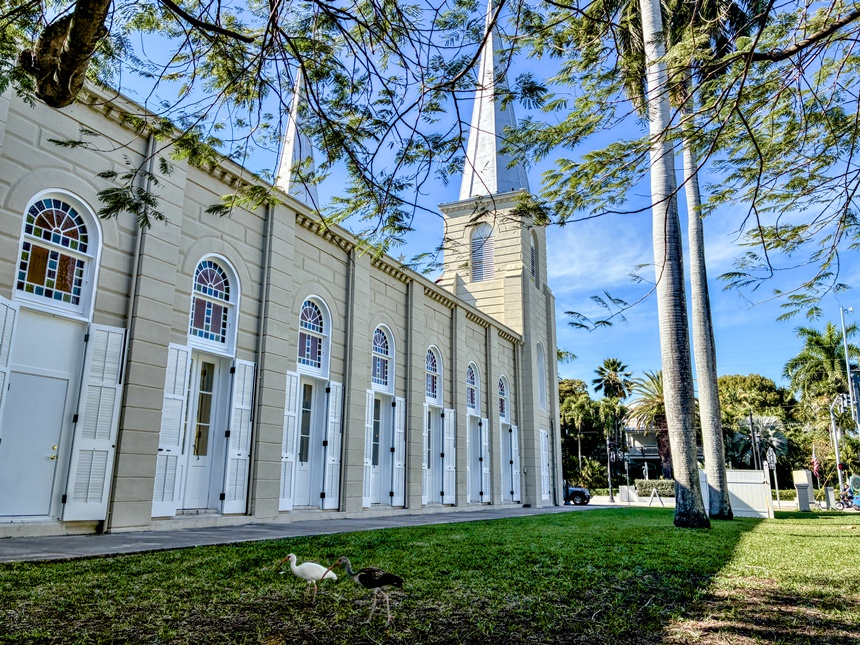
Constructed of concrete bricks fashioned from the island’s coral rock, this one isn’t going up in flames any time soon. The first non-wood Catholic Church in Florida was completed in 1904 and hasn’t missed a Sunday Mass since.
Happily, I find I don’t have to wait until Sunday to seek out a peaceful moment here: Today, like most days, the church is open to anyone who wanders by. I take a spot in the back pew (my favorite spot in any house of worship, it seems) and feel the breeze that wafts across the sanctuary, even on hot subtropical afternoons, thanks to six-foot-tall, wide doors lining both side walls.
I walk through one of the western doors and wander to the back of the church property, toward what looks like a freestanding, rustic stone wall. As I approach, I recognize this as a reconstruction of the Grotto of Lourdes in France: High on the wall is a statue of Mary; kneeling in adoration on the ground below is one of Saint Bernadette.
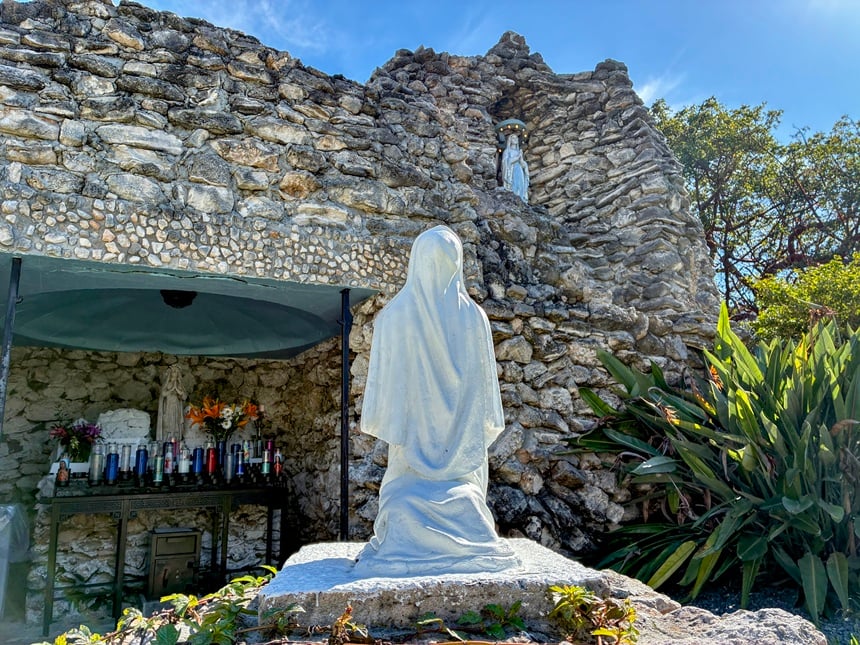
Off to the side I notice a third sculpture, a bronze bust of Sister M. Louis Gabriel who, after surviving three Key West hurricanes, in 1922 commissioned the construction of this grotto in order to seek divine protection from any more storms. As long as the grotto stood, she declared at the dedication, “Key West will never experience the full brunt of a hurricane.”
More than a century later, the promise still holds.
Shalom in Paradise: Congregation B’nai Zion
You might expect South Florida’s oldest Jewish community to be in Miami, but today’s Sun and Fun Capital of the World was just a mosquito-infested swamp when Key West’s Congregation B’nai Zion was founded in 1887. At the time, Jewish Key West businessmen mostly ran pushcarts that were so successful the town’s established brick-and-mortar establishments got the government to impose upon each cart a license fee of $1,000 (nearly $30,000 in today’s dollars). To which the Jewish merchants responded, “Fine. We’ll build our own stores.”

By the 1890s, the B’nai Zion congregation was home to many of Key West’s most influential families, many of whom took active part in supporting the Cuban Revolution led by José Martí. In fact, Martí gave a famous speech from the front porch of one B’nai Zion congregant. (You can stand there, too; that same porch is preserved at Duval Street’s beloved La Te Da restaurant.)
The Congregation’s current home, built in 1969, features six columns symbolic of both the six columns of King Solomon’s temple and the six million Jews who perished in the Holocaust.
History in Stone: Key West United Methodist Church

The oldest still-standing house of worship in Key West is not some humble neighborhood chapel, but one of the island’s most imposing structures: Key West United Methodist Church — known to locals as The Old Stone Church — was constructed of coral, quarried on the church property. The cornerstone was laid in 1877.
In a church meeting hall hangs a grainy photo of a modest wooden structure thought to be the congregation’s previous sanctuary, which stood on this very same site.
“They built the new church above and around the old one, and continued to hold services in there until it was finished,” says Rev. Madeline Baum, the Old Stone Church’s pastor, as she opens a door to the sanctuary.
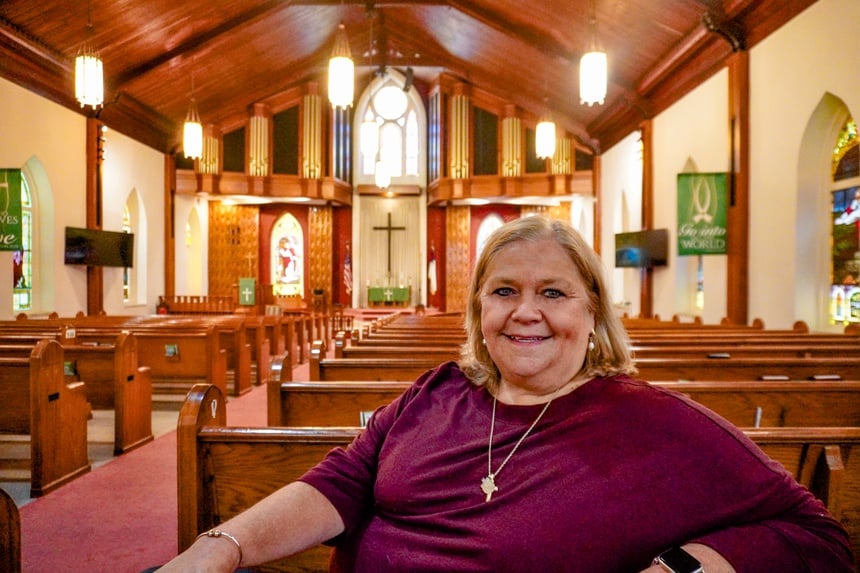
“Then the men dismantled the old church, piece by piece, and carried it out the front door.”
Key West’s once-numerous Methodist churches have largely consolidated within the walls of the Old Stone Church, which sees its attendance ebb and flow with the tourist seasons.
“It’s cool to meet people from all around the country,” says Baum. “One Sunday I met a gentleman after the service who turned out to be the interim United Methodist bishop in South Africa. So, it could be anybody sitting in those pews.”
Key West is, of course, a favorite wedding destination, so Baum officiates her share of nuptials.
“I’ve done a few elopements,” she laughs. And it’s not unheard of for someone to schedule a wedding for the day their honeymoon trip cruise ship will be in town.
The Old Stone Church isn’t generally open aside from services, but Baum says her staff is happy to let visitors in if they drop by the office. Should you do that, please do yourself a favor and ask to see what I like to call “The Head Room.” There you will find, staring at you from two walls, scores of painted portraits representing every person who happened to be a member of The Old Stone Church in 1984. An artist parishioner presented the gallery to the church as a gift.
“It’s a little bizarre; I’ve never seen anything quite like it,” laughs Baum. “I’ve been here three years and sometimes when I walk through there I wonder, ‘Are they watching me?”
Become a Saturday Evening Post member and enjoy unlimited access. Subscribe now