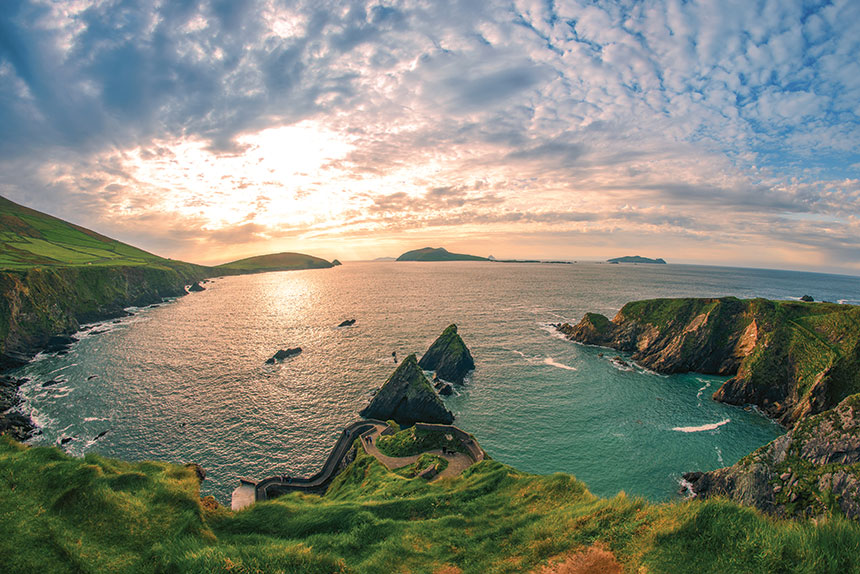
The weather is soft (an Irish expression for mist and drizzle) when I start up the treacherous one-lane road over Conor Pass to the Dingle Peninsula in southwest Ireland. As soon as I hit the gnarly turns carved into the face of the mountain, with a cliff on one side and only an uneven stone wall between my car and the deep abyss beyond, the storm clouds unleash their torrential rage.
I swear the Cailleach — the Old Woman of Dingle who, legend says, created these mountains by dropping rocks from her apron and who rules winter storms — sensed my fear and summoned the tempest for her own entertainment.
With a death grip on the steering wheel and wipers flapping in distress, I tuck into a few wide places to let oncoming cars pass. I pull off at the top to let my blood pressure drop.
As I head down the other side, it seems that I have crossed a threshold into a parallel universe, and I drop into a world with a positively charged vibration.
Rays of sunshine perforate the cloud cover, beaming down in triumph. The landscape gently opens out in invitation, and the friendly Dingle Bay comes into view.
It feels like a homecoming.
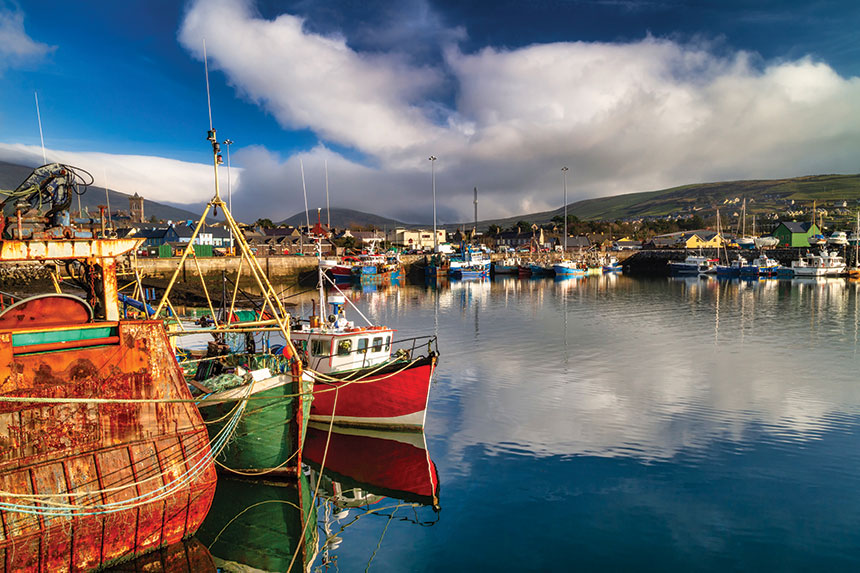
I approach the historic seaport town of Dingle, radiant in the warm evening light at the bay’s edge. Fishing boats festooned with gear are tied up at the marina; traditional shopfronts in red and blue line the streets; and pubs feature now-rare snugs — booths at the end of the bar that the clergy and women use to drink in privacy.
An inexplicable feeling washes over me every time I journey to Dingle.
The energy here is different from the rest of Ireland — it’s concentrated and profound. It stirs a sense of wonderment. Why? Yes, the coastal scenery is stunning, the Irish music scene lively, the cuisine foodie-worthy, and the craic (witty banter) with locals in the pubs is mighty, as the Irish say. But there’s another intriguing layer — according to Celtic lore, Dingle is a thin place.
Often mysterious, isolated, and naturally captivating, thin places are where the veil between the physical world and spiritual realm is nearly transparent, making it easier to connect with something older and deeper, something bigger than our mundane lives. Think of power centers, or thin places, like Sedona, Machu Picchu, Stonehenge, the Ganges River, and the Great Pyramid of Giza — they evoke awe and reverence and, for some people, epiphanies and healing.
The Dingle Peninsula is a thin place thanks to 2,000-plus archaeological monuments dating back 6,000 years — the density and variety of ancient sites is unmatched in Western Europe. The Celts believed the landscape holds the stories and energy of the past, generating that omnipresent, buzzy aura everyone senses in Dingle.
Thinkers, writers, seekers, artists, and entrepreneurs are drawn to Dingle’s vibration of culture and history. Natives and blow-ins (a local term for newcomers) draw inspiration from it and celebrate it with infectious enthusiasm.
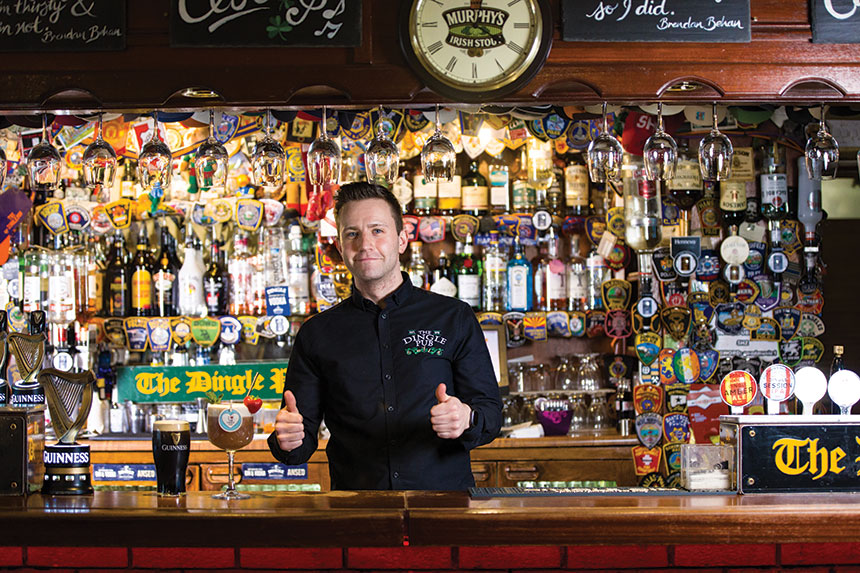
The vibe is supercharged in The Dingle Pub on Main Street when owner David Geaney, five-time World Champion Irish step dancer, parts the crowd, lays down a three-foot-by-three-foot sprung dance floor, and launches into a hell-for-leather tapping sequence to accompany a blistering fast jig on uilleann pipes, concertina, and guitar. The thundering sound, blur of feet, and height of the jumps stuns the crowd to jaw-dropping silence. But Geaney’s obvious grá (Gaelic for love) of dancing is infectious; the crowd starts hooting and clapping along, engaged in the virtuoso performance a few feet away.
The kinetic superstar performs intricate steps and precision heel-toe movements, interspersing kicks, leaps, mid‑air heel snaps, fast spins, scissors in the air — tricks so lightning fast you can’t register what he did, only astonishment. At times, even the clapping and the music cannot keep up with the rapid-fire sound.
“Are you having a good time?” Geaney asks the crowd before launching into his next tap barrage that he ends with high kicks and a bow, breathless and grinning.
I ask Geaney what lights him up about Irish dancing.
“The magic happens when I exactly match the musicians,” says the dancer. “I live for that.”
He’s also captivated by dancing in the pub. “The energy is unbelievable; it’s raw and intimate,” he says. “I get such an adrenaline rush off the crowd.”
That’s saying a lot considering Geaney has toured the world with dance productions and his own shows, performing for massive audiences.
Nighttime revelry is legendary in this town, spearheaded by electrifying, live traditional music sessions. Many pubs reserve the front corner benches for local musicians to meet up informally and play together. Nothing is rehearsed, so every session is different.
Music pours out of the open door at Neligan’s Bar, where you can count on a spirited session that might include up to 15 musicians. Tonight, the accordion player takes the lead, and other musicians join in as they catch the melody and rhythm, layering on until the group hits full force with fiddles, banjo, guitar, tin whistle, and mandolin.
The tempo picks up, the charge in the room surges with it, and then with a nod, players segue to a different reel, and the exhilarating music set continues to a resounding finale.
Between tunes, musicians chat amiably over pints of Guinness. It’s obvious they’re not there to perform for tourists; they’re simply friends playing together, and we get to listen in.
In addition to music sessions, Dingle hosts popular festivals for film, literature, music, and food. Geaney is opening a state-of-the-art dance studio, and actor Cillian Murphy is renovating the historic Phoenix Cinema as an arts center. It’s all part of the culturally dense Irishness here.
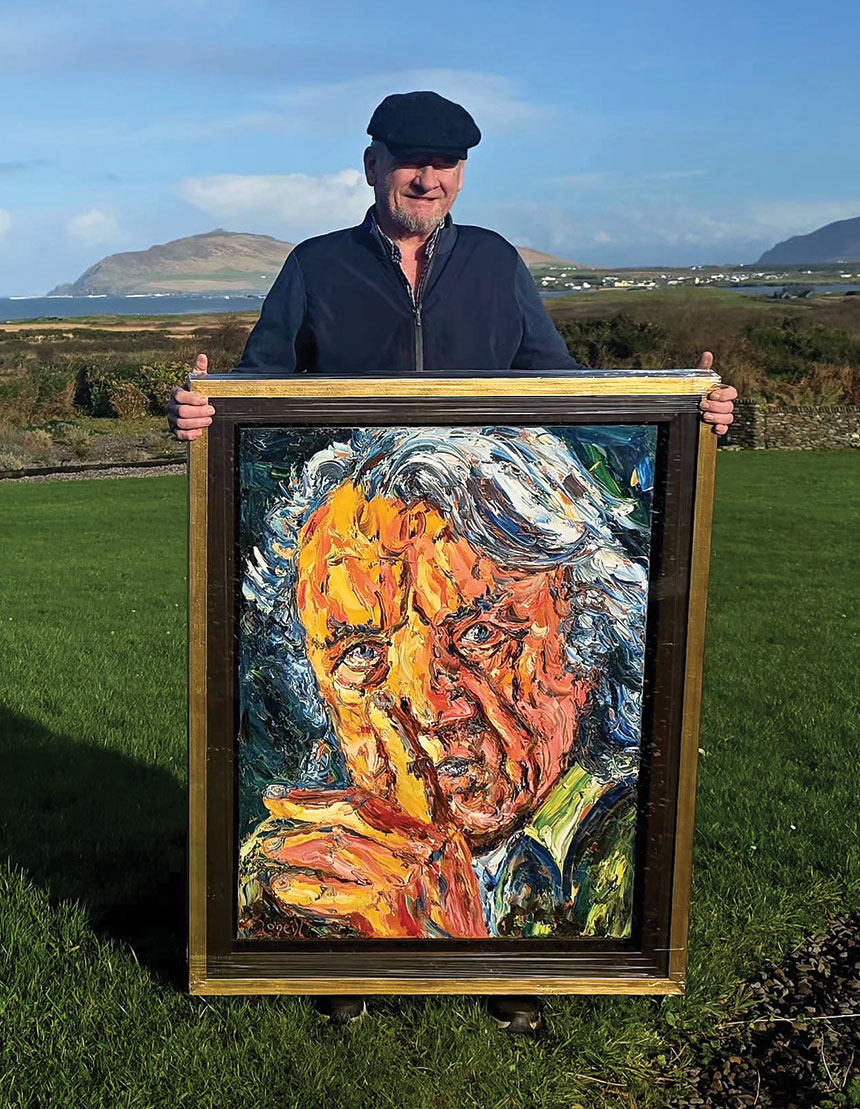
No one captures the essence of Dingle — the constantly shifting light, the flashes of vibrant color, the ethos of the Celts — like painter and sculptor Liam O’Neill, one of the most celebrated living artists in Ireland.
I catch up with him in his famine-era fisherman’s cottage studio in Dingle. Inside are 6-foot-tall, deeply textured oil paintings with an astonishing array and depth of colors. He says the fluctuating light is what he’s chasing in his paintings. “The sun is either just appearing from behind a cloud, or about to be covered up by one,” the artist says.
Though he has painted portraits of Irish politicians, writers, historical figures, and celebrities, O’Neill’s favorite subject is his father working the land where he grew up with 13 siblings west of Dingle town.
Using a palette knife in vibrant impasto style with fluidity and movement, O’Neill honors the rural lifestyle that he experienced as a child. In his paintings, farmers and fishermen work cut turf, stack hay, fish for lobsters, barter at a horse fair, shear sheep, and race horses on the beach. O’Neill’s bronze sculptures feature the same raw, riveting style as his paintings, each with a story. His naomhóg (traditional boat) sculpture illustrates the legend of the rare blue lobster that’s considered a lucky omen to catch; it’s balanced by an oncoming seventh wave, a local term for a wall of water that arises without warning.
As for the source of his creative inspiration? It’s his youth, the scenery around him, and a bit of magic, he says.
“What’s the magic?” I ask.
“If you knew what it was, if you could explain it, then it wouldn’t be magic anymore,” he says. “But you know it’s there.”
Áine Uí Dhushláine must know magic to be able to bake the fluffy spotty bread (raisin bread) that she offers me with a steaming cup of tea. She’s renowned for her homemade bread at Tig Áine, a café in Ballyferriter, and for her art.
Uí Dhushláine’s loose watercolor illustrations depict landscapes with standing stones, ring forts, holy wells, and archaeological sites. She holds up a print with field rows running down a hillside. “This is such a sad landscape — the potatoes there were never harvested; maybe they were diseased during the famine or the tenant farmers were thrown off the land,” she says. “The field’s raised lazy beds still show in the shadows; it’s breaking my heart.”
I’m intrigued by Uí Dhushláine’s prints of holy wells. Pulsing with unmistakeable sacred energy, they’re my favorite ancient sites. The water bubbling upward is an effervescent life force; the trinkets left as offerings add to the ambience; and usually there’s a nearby fairy tree where people tie colorful rags or ribbons for their intentions.
“There are 60 holy wells on the Dingle peninsula, and I’ve sketched many of them,” she tells me. “I’d love to show you my favorite.”
On our way, Uí Dhushláine directs me to pull over as we crest a hill, and points to the spot where she painted the abandoned potato field. A heavy sadness descends on me, the emotion of the famine still lingering. After a moment of silence, she says, “Let’s go; I don’t like being here.”
In his book Listen to the Land Speak, Irish writer Manchán Magan writes, “The bogs, rivers, mountains, and shorelines are more than preservers of old myths, bones, and memories. They are energy banks and time sponges, and what is held within them seeks release.”
When we arrive at Uí Dhushláine’s favorite well, she laments, “Oh, no, I forgot the rags.”
No worries, I tell her: I carry ribbons in my car so I never miss an opportunity for good luck. We choose our ribbons and tie them to a tree branch, soundlessly incanting our wishes. The tree is covered with fraying, colorful strips of cloth, a testament to the still-present pagan beliefs and perpetual optimism.
It can feel like an eternity waiting for a blue-sky day in Ireland, so when the morning dawns uncommonly clear, I hightail it to the marina to catch the ferry to Great Blasket Island. It is the western outpost of Ireland and Europe, and until less than 600 years ago, it was the end of the known world.
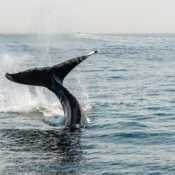
Dolphins swim alongside the boat as the whitewashed cottages and stone ruins clinging to the side of a sloping hill come into sight. At the base of the hill, a crescent beach plays host to hundreds of grey seals basking in the sun and softly moaning in seeming gratitude for the sunshine. I feel the same way.
The guide explains the Blasket story: A century ago, Great Blasket Island was a time capsule of culture and traditions. Because of its relative isolation, the Irish-speaking community preserved its music and storytelling traditions, and a pure version of the language. Gaelic scholars encouraged the islanders to write their stories in their native tongue, providing a window into a vanished world.
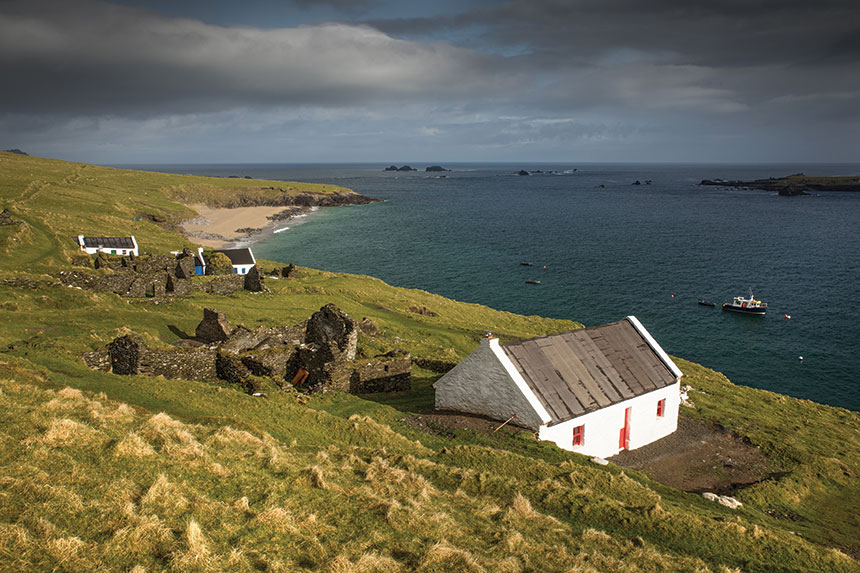
When the population dropped from 176 people in 1916 to just 22 by 1953, the island was evacuated. Displaced islanders like seanchaí (storyteller) Peig Sayers continued to write about their previous experiences, and many of the books have been translated to English. The Blasket legacy is now preserved in nearly 100 books and is showcased in the Blasket Island Center in Dunquin, about 25 minutes from Dingle. The center reveals what it took to survive on the island, the folklore and rituals, and compelling, poignant writing about the loss of home.
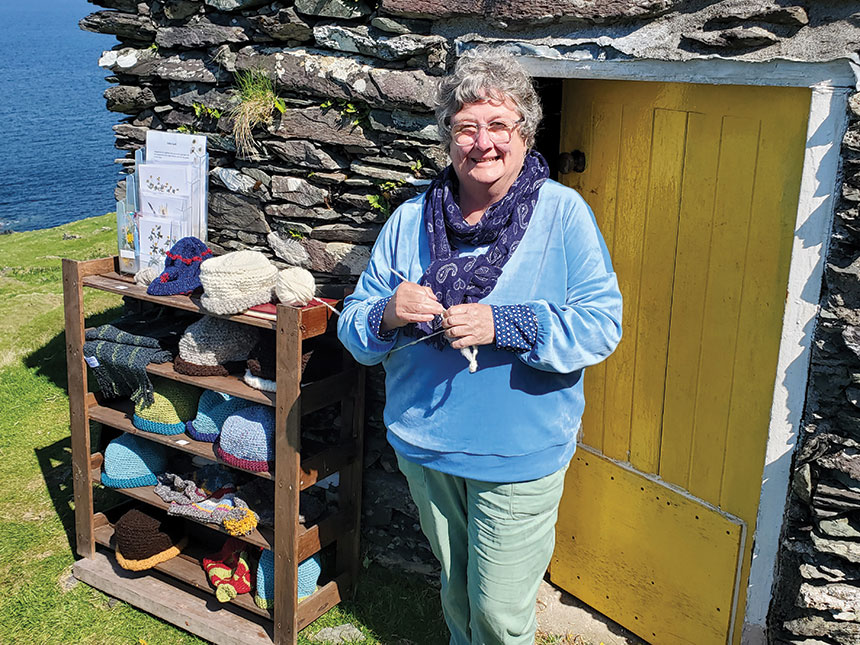
I wander the grass paths upward through the cottages — most of them in ruins. A woman is sitting serenely on a wooden bench at the side of a one-room stone house with a bright yellow door. Sue Redican, a weaver originally from Wales, is crocheting a hat from natural lamb’s wool, and I join her for a chat while her fingers nimbly work the hook and yarn.
“The first time I came out here and set foot on the pier, I felt at home,” says Redican. “I’ve spent my summers on the island since 1987. I just love the peace and quiet.”
She sits outside most days spinning yarn on a wheel or crocheting, greeting day trippers off the boats, and selling her creations from a shelf by the door. Every two weeks, Redican hops the ferry to the mainland for supplies, a sharp contrast to the islanders who had to row three miles across a rough channel. “There’s nothing romantic about those days,” says Redican. “It was hard bloody living here.”
I set off to see the rest of the island along the seven-mile perimeter trail. It’s an easy walk initially, with Inishtooskert — an island resembling a giant lying on his back — for company. The trail begins to veer up the side of a near-vertical grassy slope that drops sharply to the wild Atlantic waters below. The path is narrow, and I’m terrified of heights. I stubbornly navigate the knife-edge, refusing to look down. My destination is a ring fort marked on the map up a side trail.
I tackle the final steep climb and skirt prickly gorse bushes to arrive at the earth-and-stone ring fort atop the precipice. It edges a petrifying drop into oblivion. I imagine a chieftain and his clansmen up here, looking west from their observation post at the demarcation line between the known world and beyond.
Were they scanning the horizon for approaching enemies? Or marveling at the otherworldly power of the skies, the stars, the seas, and the storms here at the intersection of the natural and supernatural, this thin place?
The trail is kind and gentle on the hike back. As I come around the end of the island, a lovely, red-hued evening glow bathes the clutch of cottages. The hill rising behind the abodes is shouldering them from the storms, holding them in its arms. The energy feels like the hug of a benevolent, and wise, grandparent.
Kathleen M. Mangan is an award-winning journalist with dual citizenship in Ireland, where she spends half her time. Her writing has appeared in National Geographic, Food & Wine, and AAA World.
This article is featured in the May/June 2026 issue of The Saturday Evening Post. Subscribe to the magazine for more art, inspiring stories, fiction, humor, and features from our archives.
Become a Saturday Evening Post member and enjoy unlimited access. Subscribe now
Comments
Hi Gillian, that magic is unmistakable, and now you know why!
Cheers, Kathy
An unusual and interesting take on Dingle. I’ve felt the magic all around Dingle and the west, but never read about it before.