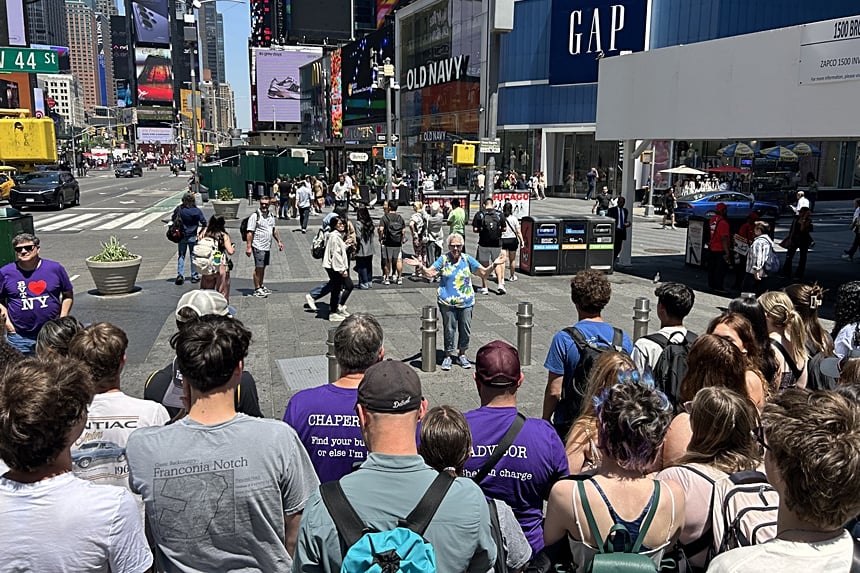
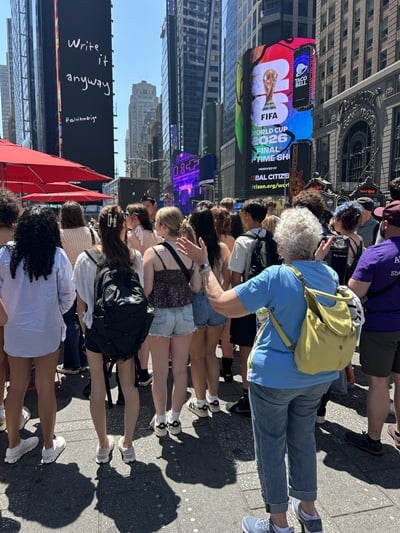
New York City tour guide Paula Schuman reviewed her upcoming three-day itinerary with practiced precision, flagging anything that might disrupt the flow: a street fair in Greenwich Village, a rainy forecast, and a restaurant that might need a gentle nudge to keep dinner on schedule before a Broadway curtain. Her preparation, as always, went beyond logistics. Knowing this would be the lead teacher’s final trip before retirement, after years of traveling together, Schuman planned a celebration to mark the milestone. She arranged a cake, a toast with the group during dinner, and a special song from the venue’s live entertainment. It’s this blend of foresight and personal care that has defined Schuman’s nearly 50-year career, making her not just a guide, but a steady presence who elevates every trip she leads.
That same instinct for care has shaped the arc of her career. Schuman is among the longest-serving licensed tour guides in New York City still active in the field. Since 1976, she has guided hundreds of thousands of students through the city, and at 78, she shows no signs of slowing down. As the company she has worked for since the beginning of her career transitions to its third generation, she has taken on a new role as mentor, passing on the instincts and standards that have long set her tours apart. For Schuman, the work is more than a career; it’s a lasting exchange, keeping her engaged while helping shape how young people see the world.
That sense of purpose has roots that go back much earlier. Paula Rosansky was born in Hartford, Connecticut, the daughter of parents who owned an upscale men’s retail store. Working in the family business, she developed an early appreciation for tailored clothing and the rhythm of retail. Trips to New York to visit fashion markets and showroom appointments left a lasting impression; the city felt vibrant, expansive, and full of possibility. After graduating from a Boston college with a degree in retail business, she fulfilled a promise she had made as a teenager that she would one day live in New York City, moving to the Upper East Side in 1967.
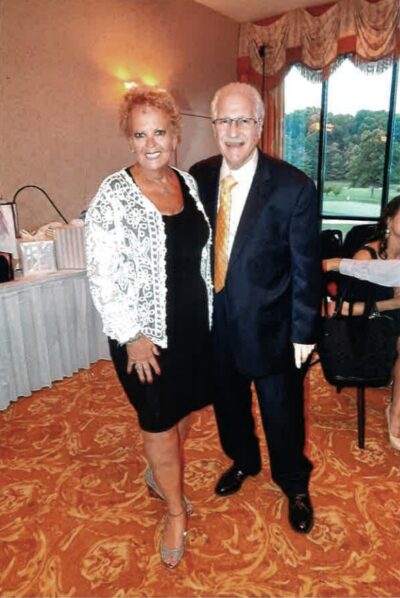
She secured a position at the prestigious B. Altman & Co. department store, rising quickly to the role of buyer. The job took her frequently to the company’s suburban stores while she helped oversee the Manhattan flagship. One Friday evening between trips, she attended a party hosted by a fellow tenant in her building. It was there she met Mel Schuman, a high school science teacher, and the two quickly became inseparable. They married on September 1, 1968, moved to New Jersey, and put down roots in Monmouth County.
In New Jersey, a friendship would quietly set the course for her future. Mel introduced Paula to one of his coworkers, history teacher Marty Abrams, and his wife Linda, who had recently moved to the area. It was through this relationship that an unexpected opportunity emerged — one that would shape the rest of Schuman’s working life.

“Marty came up to me one day,” she recalls, “and said, ‘I know you love New York City…you’re always talking about it. Would you be interested in guiding student groups on day trips into the city?’” At the time, Marty had turned his side venture organizing field trips into a student travel company, Junior Tours, in 1976, and was beginning to expand into New York City. Schuman didn’t hesitate to take on additional work while raising her children at home. But she also knew she needed to know the city better.
So she set out to teach herself. Naturally curious, she immersed herself in guidebooks, studied history, and read at least one New York City newspaper a day to deepen her knowledge. “In the days before cell phones and the internet,” she says, “I read book after book. I’m a reader anyway, so researching was part of the fun.” Eventually, she sat for the city’s Department of Consumer Affairs exam and became a licensed New York City tour guide, a professional requirement to work legally in the field.
As her confidence grew, so did her reach. After leading several groups through New York City and developing her own approach, Abrams encouraged her to expand into Washington, D.C., where his company was also growing. She soon passed the licensing exam there as well. As Junior Tours expanded, so did her itinerary, adding Philadelphia, Boston, Williamsburg, Canada, and other destinations to her roster. What had begun as day trips evolved into multi-day journeys lasting three, four, or even five days. When Marty brought on additional guides, Schuman became the trainer, shaping the standards others would follow.
The job demanded constant improvisation. Over nearly five decades on the road, Schuman has managed everything from stranded buses and delayed Broadway curtains to misplaced students in the days before cell phones.
Once, in New York, a broken-down bus threatened to derail a student group’s long-awaited Broadway night. The students were scheduled to see Wicked, but traffic delays pushed their arrival dangerously close to curtain time. Schuman sprinted to the theater and pleaded with staff to delay the performance until her 150 students arrived. Remarkably, the theater held the curtain for 30 minutes. While everyone saw the show, Schuman rushed to organize boxed dinners from a nearby Irish pub so exhausted students would still have something to eat when they finally reached the hotel near midnight. “It wasn’t until everybody else was settled that I finally sat down,” she recalls.
Then there were the “misplaced” students. “I never called them lost,” Schuman jokes. Before smartphones and GPS, separated students were a regular hazard of student travel. One afternoon in the 1980s, Schuman’s beeper went off after a middle school student disappeared during a Manhattan outing. The boy had walked into a nearby store, pulled out Junior Tours’ emergency contact pamphlet, and asked someone to call the office. “I told him, ‘Don’t move. I’m coming,’” Schuman says. She tracked him down within the hour. “Back then,” she says, laughing, “I spent half my career running around New York finding people.”
During another student trip in the 1980s, a teenager realized midway through a New York orientation film that his wallet — stuffed with spending money — had vanished. Hours later, Schuman’s beeper sounded again. A stranger had found the wallet on a Sixth Avenue curb, spotted the Junior Tours emergency pamphlet tucked inside, and called the office immediately. Every dollar was still there. “It made me proud of New York and New Yorkers all over again,” Schuman says.
Schuman’s work in tourism continued until the attacks of September 11 prompted a reassessment. For a year, tourism in the city came to a standstill as travelers avoided air travel and New York itself navigated a period of profound recovery. “I decided I only wanted to tour New York City going forward,” she says. “I saw the city come together in unity in the aftermath, and it made me love it even more. I wanted to devote all my energy to showing people this extraordinary place.”
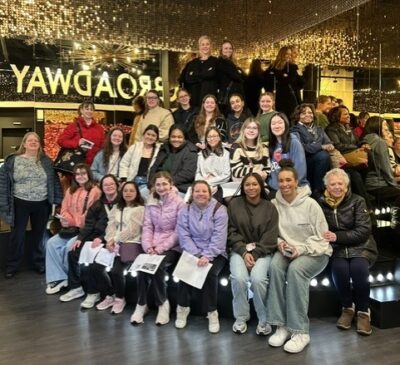
More than two decades later, that commitment hasn’t faded. In 2026, Schuman is one of a handful of guides who has witnessed the city through multiple eras, and it still never ceases to amaze her. “The transformation of Times Square — from what was once a place people avoided entirely to what it is today — is incredible. From the worst to the best,” she says. “The city has gone through its own aches and pains, just like we do as we age. COVID knocked so many places out of work and forced doors to close, but it always comes back stronger than before.”
Still, the job itself hasn’t gotten any easier. When asked whether tour life becomes more difficult with age, she acknowledges the physical demands. “You need to be in good health. New York is a walking city — there’s no way around it — and you’re out in all kinds of weather. It can be exhausting, and the days are long.” But she is quick to point out the advantage of working in a seniority-driven profession. “Simply put, the longer you’ve toured the city, the more you know. And the more you know, the better you are. You only get better with more experience, which tourists respect.” She adds, “This job has kept me both mentally and physically young.”
And that vitality is rooted in something simple. When asked if she still loves being a tour guide, she doesn’t hesitate. “Absolutely!” she says. “My favorite part is working with return groups, when you’ve already built a relationship with the head teacher. There’s nothing like seeing students experience New York City for the first time — that excitement when they come from small-town America into a place like this. It’s one of the best educational experiences they can have. I’ve had students come back to visit, then return for college, and later move here as adults.”
In some cases, those connections come full circle. Earlier this year, a teacher arrived in New York with a student group and immediately recognized her. Years earlier, she herself had toured the city as a teenager under Schuman’s guidance. “She said to me, ‘I had you as my tour guide when I was in high school,’” Schuman recalls. Now, that former student has returned not as a participant, but as the lead teacher bringing her own students to New York. For Schuman, moments like that carry special meaning. “You realize you’ve become part of people’s memories of the city,” she says.
And while technology continues to reshape travel, Schuman remains clear about what cannot be replaced. “There’s nothing like a live tour guide,” she says. “There are safety considerations that an app or AI simply can’t handle the way a live person can. A good guide is there in real time, reading the group, solving problems, and making sure you get the absolute most out of your day.”
That human connection extends beyond her work—and into the relationships that shaped her life. Paula and Mel’s dear friends, Marty and Linda Abrams, have since passed away, and Schuman describes the loss as profound. She knows she owes them an unpayable debt of gratitude for giving her the opportunity of a lifetime. “Linda was like a sister to me,” she says quietly. “And Marty was the best friend and boss anyone could ever ask for.”
Still, she remains closely connected to them through their children and grandchildren, who have carried the Junior Tours business forward. Schuman’s own granddaughter now helps with the tours as well, both as a tour guide and through teaching special workshops geared toward theater-loving tourists.
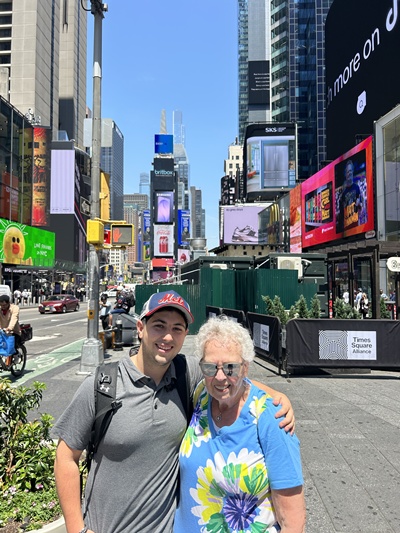
That legacy is something the next generation is keenly aware of. Marty and Linda’s son, Rich Abrams, says of Schuman, “She knows everyone — whether it be the dock workers at the Statue of Liberty, security at the Empire State Building, front desk managers at the hotel — everyone knows her on a first-name basis. Groups pick up on this and know that they are in good hands.”
Paula and Mel have been married for 58 years. While Mel is enjoying retirement after 45 years as a public school teacher, Schuman has no intention of retiring. “You have to love what you do,” Schuman advises. “As you get older, you have less patience for what doesn’t matter, and if you don’t need a job financially, you’ll walk away. You have to love it for it to be worth your while.
“After nearly fifty years guiding others through New York City,” she says, “I will do this forever.”
Become a Saturday Evening Post member and enjoy unlimited access. Subscribe now