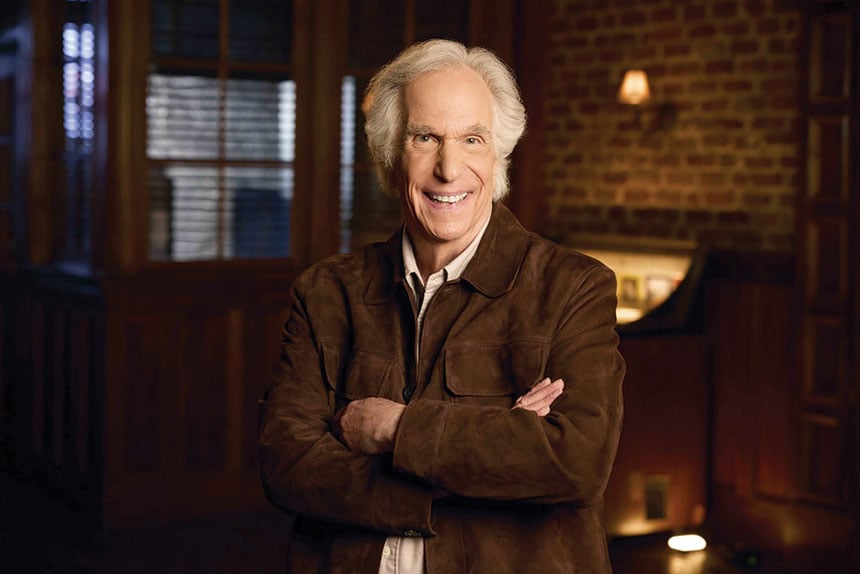
Henry Winkler has returned to TV hosting the History Channel’s Hazardous History, a nostalgia-drenched series that explores the reckless pastimes, dangerous toys, and risky products that were once big fads. Winkler, who rose to fame as Arthur “Fonzie” Fonzarelli on Happy Days, is also reflecting on a far more personal journey — his own hard-won path from struggling student to Hollywood icon. As a young man battling undiagnosed dyslexia and repeated rejection, Winkler transformed perseverance into an extraordinary career spanning more than five decades. Now, the Emmy-winning star is passing on his life lessons to graduates at his alma mater, Emerson College.
Jeanne Wolf: Hazardous History is full of reckless, wild, and crazy moments. Did it make you nostalgic?
Henry Winkler: I wasn’t a thrill-seeker growing up. I never did any of the wild things featured in the series, like cramming dozens of people into a phone booth or sitting on a tall moving flagpole. It’s amazing how far people went. But I did water-ski. When Garry Marshall, who was directing Happy Days, found out, he wrote a water-skiing scene for the Fonz. I came flying onto the beach, and they froze the frame on my smile. Half of that smile is the Fonz saying, “Hey, I made it.” The other half is me thinking, “Holy mackerel — how did I make it?” I also recently went viral on TikTok for zip-lining through a forest. My grandkids talked me into it. That’s the challenge of trying to be a fun grandpa. Not bad for 80. If my knees hold out, I’ll be fine — if not fearless.
JW: The road to success didn’t begin easily, did it?
HW: My early life was like being in a black hole, no handholds, no footholds. I kept trying to pull myself up into the sun, and I kept failing at everything. My parents called me dummerhund, which means “dumb dog.” My teachers, all the adults in my life, said I was lazy and stupid and would never achieve much. Eventually you go, “If they say it, it must be true.” When my problem got a name — dyslexia — it didn’t change anything overnight, but it opened doors that eventually led me to be able to write books and talk to others who were dyslexic and help them to fight back. I never let the dream out of my mind that I would be an actor. Of course, it made acting tougher because I had trouble reading scripts, so I had to memorize a lot more than my co-stars.
JW: You recently returned to your alma mater, Emerson College, to deliver the commencement address. What advice did you share with the graduates?
HW: As I look back on the tough times, and many wonderful ones, it reminds me why retirement isn’t a part of my vocabulary. Live by two words: tenacity and gratitude. Tenacity will get you where you want to go, and gratitude will make you enjoy the journey, no matter how bumpy. Listen to your tummy. Your tummy knows everything. Your mind only knows a few things.
I do believe each of us has a gift to give to the world. Your job is to figure out what your gift is and give it to the world. You don’t know what you can accomplish until you just try. There is no time better than exactly now, at this moment.
—Jeanne Wolf is the Post’s West Coast editor
This article is featured in the July/August 2026 issue of The Saturday Evening Post. Subscribe to the magazine for more art, inspiring stories, fiction, humor, and features from our archives.
Become a Saturday Evening Post member and enjoy unlimited access. Subscribe now