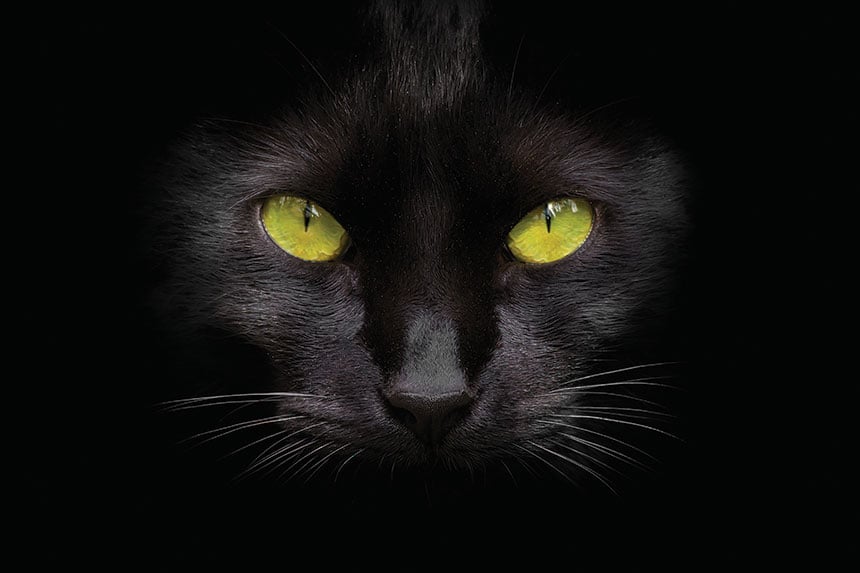
Jinx went missing the day they moved into their new house, but they were busy unpacking and supervising the hired men who seemed intent on banging furniture into every wall, scraping around every corner, and it was evening by the time they realized the cat was gone. Ben was sitting on the floor, staring mystified into a cardboard box. The box contained a fondue set, exactly the sort of inessential thing one acquired in 39 years of marriage, each piece wrapped in newspaper as if its preservation mattered.
Emma appeared at the door holding the cat’s blue bowl. “Have you seen Jinx?”
“Not since this morning.” Ben lifted a ramekin from the box. “Can you tell me why we bothered to pack this junk? We should’ve foisted it off on the boys. At least donated it somewhere.”
“Your mother gave us that fondue set. I doubt the boys would have wanted it. I doubt Goodwill would’ve wanted it much either.” Emma gave the bowl a shake, kibble rattling against the sides. “I’ve looked everywhere.”
“She’s probably just hiding,” Ben said. “She’ll come leaping out of one of these boxes and give me a heart attack,” but 24 hours passed and still no sign of Jinx. They had barely gotten started on the house when Emma hunted up a community Facebook page and composed a notice about their missing cat. She placed an ad on Craigslist, paid for a classified in local rags, papers with names like Village Shopper and Neighborhood Gazette. She located a recent photograph of Jinx and had a bundle of flyers printed at a copy shop and hustled Ben out to post them on telephone poles. She received a number of sympathetic replies on Facebook but no leads. Emma couldn’t sleep. She propped herself up in bed and twisted the sheet between her hands.
“How about I fix you a glass of milk?” Ben said.
No point reminding her that the cat had disappeared before: the time they’d remodeled the bathrooms in their old house, the first time all six grandchildren had slept over. On one of those occasions — Ben couldn’t remember which — she’d been gone for four whole days. At any rate, Jinx was most likely punishing them for disrupting her life and she would return when she was ready, but Emma wasn’t prepared to hear any of that just then.
“I don’t want milk. I want her to come home.”
“Then how about I put a saucer of milk out on the steps?” he said. “For Jinx.”
Emma touched his arm. “Would you?” she said and he swung out of bed and pushed his feet into his slippers and made his way into the kitchen, patting walls for light switches as he went. Nothing was where he expected it to be — a table lamp on the floor, a painting leaned against a chair. So many boxes that it took a few minutes to locate a saucer. He filled it with milk and teetered to the door, careful not to spill. He stood yawning on the porch. Clear sky tonight, plenty of stars. October crispness in the air. Ben was 68 years old. An orthodontist, recently retired. The new house, a refurbished cottage with Queen Anne accents, was considerably smaller than their old house, but they hardly needed all that square footage anymore. They had passed through this town, admired it, on their way to beach vacations with their sons, had returned many times, just the two of them, after the boys had settled into their own lives, strolled its Main Street, dined in its cafés, shopped its galleries and antique stores, stayed at a bed and breakfast not half a mile from where he stood. The town was less than an hour from the coast, out of the way enough that it wasn’t swarmed with tourists but close enough to catch an occasional whiff of ocean on the breeze. Every couple loses sight of their marriage now and then, but Ben and Emma had always managed to find each other in this place. The milk, Ben thought, was more likely to attract raccoons than bring Jinx home, but he set the saucer on the bottom step and called her name.
It was true that Ben had never appreciated Jinx. Her fickleness disturbed him, how quickly she could swing from affectionate to aloof to downright vicious, but he understood that Emma valued the very complexities of personality that Ben found off-putting, that she preferred feline volatility to the easy guilelessness and devotion of the dogs they’d owned when the boys were growing up. He tried not to begrudge his wife’s distraction or the grief he saw welling in her as the first week passed in their new house. He organized kitchen utensils. He carried the fondue set up to the attic. Nudging their life along. He’d imagined lazy mornings and long lunches at the restaurant in the old train depot in town. He’d imagined outings to the beach. He was not an interesting man. He knew that. He’d been the sort of orthodontist who chatted about the weather as he peered into your mouth, the sort of husband who dozed off watching the news. But he was steady and capable of kindness and he could give her this place every day. He shuttled to and from the hardware store to pick up batteries for the smoke alarms, hooks for hanging pictures on the walls. Twice, on the way home, he overshot his street, and once, he made the proper turn but failed to recognize his new house as he drove past.
Emma insisted that he leave a saucer of milk out every night.
“If I could just know,” she said, “if I could just be sure what happened to her — it’s not knowing that’s making me crazy.”
Despite all this, the house was more or less in order by the end of the week, boxes unpacked, carpets unrolled, furniture positioned almost exactly as it had been in their old house, all of it crowded into smaller rooms, the effect of which was disorienting for Ben. He kept banging his shins on things. Tonight, they were working a jigsaw puzzle in the dining room, and he couldn’t shake the feeling that his chair was lower than usual. The same chair in the same place at the same table but he felt off kilter nevertheless.
Emma was drinking red wine, lamplight catching in her glass.
“Luke called today,” she said. “The boys are complaining about Thanksgiving.”
They had two sons, Grady and Luke, and each son had three children, ages ranging from 11 to 4, genders, if you accounted for both families, equally apportioned. Ben looked up from the puzzle and Emma’s face swam in his gaze. All those little pieces sapped his eyes. As his wife wavered into focus, he noticed that her teeth were stained from the wine.
“They think the new house won’t be big enough to hold us all,” she said.
Ben drew a breath in through his nose and sighed his impatience out.
“Tell you what — let’s put everybody up at the bed and breakfast. I’ll pay, if that’s the problem. That bed and breakfast is right around the corner.”
Emma shook her head. “I want grandchildren in this house.”
“Then let them all stay here. We’ll find room. It’ll be like a slumber party.”
“That’s what I said,” Emma told him, “but the boys have their heels dug in.”
“Then let’s you and me go to the bed and breakfast. Let the boys have the house. They can complain all they want while we shack up in peace.”
“Grandchildren,” she said. “In this house. With me.” And she walked into the kitchen and returned with her glass refilled.
He studied her as she tinkered with the puzzle pieces. At any given time, for most of the years that they’d been married, you were likely to find a jigsaw in progress on this table. They took equal satisfaction in the slow reveal, a thousand pieces falling into place as cityscape or natural wonder or masterpiece of art, an old person’s amusement they’d discovered when the boys were young. They had different styles. Ben always did the edges first then worked in toward the middle, but Emma seemed to select pieces at random and fit them together by intuition, almost as if she weren’t replicating the image on the box but creating it from scratch. He’d hoped a new puzzle might provide a diversion from the upheaval of the move. From her worry about Jinx. But now his sons, selfish in the way of all young parents. He’d been that way himself, he and Emma. He wanted to conk their heads together like fools in a cartoon. The edges of the puzzle were nearly complete but Emma hadn’t made much progress.
He glanced at his watch — half past ten. “It’s getting late.”
“You go on to bed,” Emma said. “I’ll finish my wine.”
He didn’t want to leave her alone but he felt like he’d been dismissed. He made his rounds of their new house, shutting off lights, checking the locks. He circled back and hesitated in the doorway behind his wife, but Emma was focused on the puzzle and did not raise her eyes.
He couldn’t remember brushing his teeth or changing into his pajama pants or dropping his head onto his pillow. He couldn’t remember if Emma had come to bed at all. Her face hovered in the dark, her breath reeking sourly of wine. She pressed a finger to his lips and his heart kicked in his chest.
“Is someone — ” he said but she shushed him.
“Listen.”
At first, he couldn’t hear anything over the sound of the pulse beating behind his ears, but then it filtered in, the faintest mewling coming from outside.
Emma rushed off toward the backyard while Ben went to check the front. A great full moon illuminated the street and silhouetted the neighbors’ houses. But no cat. And no more mewling. Just Emma. That voice, the singsong she reserved for grandchildren and the cat, made him grit his teeth. Nothing but the moon out here and wind hissing through the branches, bringing down a rain of leaves.
He raked the leaves, he cleaned the gutters. In the yard next door, a prop headstone with a comic epitaph: Here Lies Dustin Ashes. Store-bought phantoms dangling from the trees. Climbing up and down the ladder left his knees swollen and sore but Ben didn’t mind. He had a system. He’d prop the ladder against the side of the house, mount to the edge of the roof, scoop handfuls of leaves out of the gutter, and toss the leaves over his shoulder. Then he’d move the ladder a few feet and repeat the process. When the gutters were clear on one side of the house, he’d fetch his rake and scrape the leaves onto a tarp, which he’d drag out to the street. He could have hired a lawn service — he’d done just that at their old house — but he took pleasure in the effort, despite his creaking knees, and he liked the way the leaf piles kept getting bigger along the curb and the way stray leaves would get swept up in the wakes of passing cars, swirling along the pavement like living things. He liked the stiffness in his knuckles, the blisters budding on his palms.
He was clearing the gutters along the back of the house when he spotted Emma through the window. She was sitting on the couch in the room they hadn’t yet decided what to call — the den? the TV room? — with her feet on the coffee table and her laptop on her thighs. The overhang of the roof cast a shadow in such a way that he could perceive his wife clearly enough but also see himself mirrored in the glass, reflected branches like scribble marks against his view. Glare from the computer blurred the lenses of Emma’s reading glasses, obscuring her eyes. Absently, she swiped her hair behind her ear. He waved but Emma didn’t notice. He tried to knock on the window but the angle of the ladder made it impossible to reach. He was about to call out to her when she glanced up from the screen and removed her glasses and cocked her head, as if she’d heard something in another room. She set the laptop aside and walked into the kitchen. For what seemed like a long time, Ben kept watching, expecting her to return.
She was prodding cheese sandwiches with a spatula when he tracked her down, tomato soup bubbling in a pot. The very aromas of childhood. How easy to imagine his young sons waiting for lunch, their dirty elbows, their just-washed hands.
“You must be hungry,” she said and Ben slumped into a chair.
Emma poured iced tea, ferried everything to the table. She propped her chin in one hand and stirred her soup. “I’ve been thinking about the day we brought Jinx home. Do you remember? We were at the Farmer’s Market and the animal shelter had a booth?”
The way Ben remembered it, he’d come home from work to find his wife reading in the window seat, a black cat with one white paw draped across her lap. She’d been to the Farmer’s Market alone. This would have been — what? — eight, nine years ago, the boys long grown and gone away. “Who’s your friend?” he’d said and the cat had startled up from Emma’s lap and darted down the hall. They’d spent the better part of the evening peeking under beds, poking into closets, behind shower curtains. The old house had been so big and brick and dense, a monument to what they could afford. The boys had filled the space with racket and mess, with other people’s children who called him sir and couldn’t wait for him to leave the room, but that night, the house was quiet except for their voices, their footsteps, their clicking tongues. “I haven’t named her yet,” Emma said. They’d found Jinx in the laundry room, asleep in a basket of unwashed clothes.
“I remember,” Ben told his wife.
The next day, while Emma was at the grocery store, he called his oldest son, Grady, at the office. Grady was an orthodontist, like his father, though his practice was in Philadelphia. Luke was a public defender in Jacksonville. If you drew a line between those cities, you could plot Ben and Emma’s new house almost exactly in between, each son roughly equidistant from his parents.
“I’ve got a half-gassed 16-year-old waiting in the chair,” Grady said.
“Extraction?”
“What else.”
“Overcrowded?”
“You bet. Should be a cinch but I can’t talk long.”
“I won’t keep you,” Ben said. “I want you to call your mother. I want you to tell her you’ll stay in the new house — all of you — over Thanksgiving.”
“Pop,” Grady said.
“No argument. Your mother needs this. I’m calling your brother as soon as we hang up and I’m going to tell him the same thing. I don’t care if we have to sleep head to foot and four in a bed like — what was that movie? The one where the poor kid finds a magic ticket?”
“Everything all right, Pop?”
“The point is I want every last one of us in this house.”
After they hung up, he dialed Luke’s cell but it rang and rang and he was shunted off to voicemail. He didn’t want to leave a message. He tried Luke’s work number but the receptionist informed him that his son was unavailable. That word exactly. She hardly bothered to be polite, even after he’d identified himself. She took his name and disconnected while he was telling her to have a nice day.
Ben fiddled with the puzzle for a while but he couldn’t concentrate. It grated, requiring his sons to please his wife. He waited 20 minutes before calling again but, according to the receptionist, Luke remained unavailable. Ben was still fuming when he noticed Emma’s laptop on the kitchen counter, that sleek machine. He hit the power button and watched it bloom. Her screensaver: a photograph of all six grandchildren in front of a Christmas tree. Her password: their anniversary plus an exclamation point. He logged into her email account, her inbox brimming with promotional blasts from retail outlets, a request from her alumni association, a reminder that her Volvo was due for an oil change. His phone buzzed in his pocket and Ben’s shoulders jumped, but it was only Luke.
“I was in trial,” he said. “What do you need?”
“What time is it there?”
“Same as where you are, Pop. We’re both Eastern Standard.”
“I know that,” Ben said.
He repeated what he’d told Grady about Thanksgiving. Luke wanted to argue but Ben wasn’t really listening. He’d logged out of Emma’s email and onto her Facebook page.
“Let me talk to Mom,” Luke said. “You sound — I don’t know — you don’t sound like yourself.”
“Your mother is unavailable at the moment.”
Ben broke the connection with his thumb and scrolled through updates from Emma’s friends, her college roommates and her bridesmaids, acquaintances from the old neighborhood, and parents of children who’d grown up with the boys, but more than a few Ben had never heard of or couldn’t recall, people she must have befriended online or in whatever life she led separate from his own. He paged through her photographs — images of their grandchildren, the boys, their wives. A few shots of the cat. Hardly any of Ben, though he shouldn’t have been surprised. He was always waving the camera away when anyone tried to take his picture.
On impulse, he checked her search history. Emma, he discovered, had been combing the internet for accounts of lost animals returning to their masters. In one of these, a missing cat reappeared after 97 days. This particular story took place in Vienna. The cat’s owner had gone to visit her mother in Zell am See, leaving Ludwig — the cat’s name was Ludwig — in the care of a neighbor, and the cat vanished while she was away. Obviously, the neighbor felt terrible. She had opened a window for the breeze and everyone supposed that Ludwig had slipped out of the apartment and down the fire escape. Then one weekend, long after the owner had given up, she heard meowing at the window and there was Ludwig, perfectly healthy, licking his paw like he’d never left. It was assumed that he’d been taken in by someone else for all that time.
He was reading another story, this one about a dog gone missing on a camping vacation only to find its way home across the miles, when he heard his wife’s car in the driveway. He shut down the laptop and hurried it back to where he’d found it just as Emma came through the door bearing grocery bags in each hand.
“Help,” she said.
She’d left the hatch up on her Volvo, bags for him to retrieve. Coffee, apples, English muffins. A pumpkin and Halloween candy. Sack of cat food. Charlie and the Chocolate Factory — the title popped into his head. Emma was rearranging items in the freezer when he returned, the cold misting around her, light making a nimbus of her hair, and he had the impression that his wife was dissolving before his eyes.
The puzzle would become a famous Monet but it remained, for the time being, a patchwork of fragments: stretch of grass, scrap of headland, swatch of bay. They worked in silence, light fading in the windows. He hadn’t mentioned the cat food in her car. He knew he should have pitied her but hours had passed and still no word from either son and mostly he felt ignored. When Emma’s phone rang, he thought: Finally. But there was something off about her tone. “Hello — yes — are you sure? — yes — I can hardly — yes, of course — I can’t thank you enough — half an hour?”
Not one of his sons at all but some stranger who’d seen her classified ad. He wanted to be angry but anger made no sense under the circumstances and Emma was leaning in the doorway with her purse slung over one shoulder. He couldn’t let her go alone. He drove, as if in rain, with both hands gripping the wheel. The neighborhood gave way to a bakery, a barber shop, the hardware store. Then fields cut to stubble. Doves perched on power lines. An old clapboard under the trees, hay bales stacked against the crawl space. Nothing felt right about this but Emma was already out of the car, cats swarming from behind the hay bales and teeming around her legs. She was knocking on the door when Ben caught up.
From inside, a man’s voice shouted, “It’s not locked.”
The smell was overwhelming, like someone had drenched the carpet in ammonia, and more cats came pouring out through the open door and cats from outside were streaming in, the sound of them all mewling at once making it impossible to think. “You phoned about our cat,” Ben said.
“In here.” The man was slumped in a recliner in front of a flickering TV. He was wearing sweatpants but no shirt, his nipples shriveled, his belly like melted wax. He muted the TV with the remote and dropped the footrest and snatched two cats by the scruffs of their necks and held them up for Ben and Emma to examine, one in each hand, their bodies limp, an expression between patience and humiliation playing on their faces. “These him? I got all kinds.”
“Our cat is black with one white paw,” Emma said. “Female. Her name is Jinx.”
He dropped the cats and they zipped away in opposite directions. There were cats on the sofa and atop stacks of old newspaper and under the coffee table. A cat poking its head up from the inside of a boot. The man tipped his chin toward Ben’s feet, a cat threading between his ankles.
“That one answers to Jinx.”
“Let’s go,” Ben said and Emma said, “That cat has no tail.”
“Maybe that one,” the man said, pointing at a cat grooming itself on the mantel next to an empty picture frame. “Take any one you want,” he said. “No charge.”
Back in the car, Emma cried quietly with her head tipped against the window. Night blurred by outside, the lights of houses set back from the road. Emma roused herself as they bumped across the railroad tracks.
“This isn’t the way home.”
“I’m taking you to dinner.”
“Ben, I don’t — ”
“Just let me,” he said. “Please.”
He angled into a parking spot and walked around to open Emma’s door. He’d remembered the restaurant in the old train depot. Why hadn’t they come these last few weeks? Why hadn’t he suggested it? No trains passed this way anymore but there were high ceilings, a brass-railed bar, staff in black bowties. Emma gazed up at him from her seat.
“Please,” Ben said again and he offered her his hand.
That night, he dreamed he’d buried Jinx, his real life receding, his dream-self trudging through unfamiliar woods with a muddy spade over one shoulder. And when he woke, for a moment, he wasn’t sure where he was. His eyes had expected the old house. He stood at the window, gazing out into the backyard. His thoughts swirled in his head. He could almost see them, flitting around like bats. He kept expecting one to land and then it did: Emma. He found her at the kitchen table, warming her hands around a coffee cup, and he was washed with the strangest, the most overwhelming sense of relief. She was wearing his slippers. She was smiling, phone resting in her lap.
“You look like somebody with a secret,” he said.
She’d talked to Grady, who’d talked to Luke. There would be grandchildren in their new house. Everything exactly as she’d imagined. That afternoon they carved the pumpkin, and that evening they finished the puzzle while doling out candy to princesses and ghosts. The puzzle depicted a sandy path sloping down to a small, rough bay. The path was fringed with grass of many colors. The landscape wasn’t particularly beautiful or dramatic, though Ben supposed there was something inviting about the path, the way it beckoned you into the scene.
Luke’s family arrived via minivan on the Tuesday before Thanksgiving, and they claimed all the good places to sleep. The following morning, Grady’s family flew in to the airport two towns further inland, the town with the zoo and the mall and the plethora of chain restaurants. There was some bickering about the beds but it wasn’t bitter and didn’t last. Luke was rangy and fit with his mother’s high forehead, her mouth. Grady was thicker around the middle, but Ben could see Emma in his eyes. Their wives, he thought, looked alike, not so similar as to be disconcerting, more like distant cousins, far-flung branches on the same family tree. In any case, Ben kept addressing them by the other’s name and his mistake became the weekend’s running joke, his sons deliberately mixing up their wives, the oldest grandchildren identifying the wrong woman as their mother, the youngest playing along, all of which exacerbated Ben’s befuddlement and tickled Emma.
The boys brought air mattresses, sleeping bags. Bedding mounded in the corners like nests. There were shoes everywhere. And half-finished cans of soda. And faces lit by the blue glow of apparatuses. It rained every day but one. Even so, Ben couldn’t remember the last time he’d seen his wife so at ease, so utterly herself. Her dinner was a success — turkey and stuffing and sweet potato casserole, pecan and apple pies. In the dining room, the puzzle had been swept away, replaced by crumbs and crooked placemats and wineglasses stained with dregs and napkins draped on the backs of chairs.
On the last day, the only clear day, they drove out to the beach. Too cold for swimming, of course, but Emma insisted. So they bundled into coats and stopped to fill the tanks with gas. Grady drove Emma’s Volvo with Emma riding shotgun, grandchildren piled into back. Luke followed in his minivan with both wives, more grandchildren, Ben. The road out of town traced the river for half an hour before they crossed the bridge, the car alive with chatter, with music. They motored past rental houses and condos and a ridge of dunes along the public beach hiding the wide gray ocean on the other side. An ice cream shop, shuttered for the winter. A splintery boardwalk mounted through the sea oats to the top of the dunes, and there the ocean was revealed, waves rolling in and rolling in, drawing lines of white foam over the sand.
Then they were gone and Ben and Emma were alone again in their new house. He found a phone charger still plugged into an outlet, someone’s toothbrush by the sink. Forgotten things. He carried them to the kitchen where Emma was loading breakfast dishes in the washer.
“What should I do with these?” he said and Emma glanced over her shoulder.
“I guess we could mail them.”
“That seems like a lot of trouble. Whose toothbrush is this anyway?”
“Just leave them on the counter,” Emma said.
They took a walk around the neighborhood. Hurricane shutters, porch swings. The bed and breakfast where they used to stay. No guests lingered on the veranda. This wasn’t the season, Ben supposed. Emma’s flyers had gone brittle and yellow on the telephone poles; Jinx faded to a Xerox copy smudge. Emma plucked them down as they passed and handed them to Ben, who tapped the edges against his knee and bore them in a tidy sheaf all the way home, where he dumped them in the recycling bin and let the lid fall with a clatter.
“Now what?” Emma said.
Her back was to him, her eyes upturned. Almost noon but the sky refused to brighten. It might have been dawn, dusk. He slipped his arms around her waist and pressed his face into her neck. Emma sagged against him as if bracing herself. This is what, he thought, but instead of speaking, he took her hand and led her through the backdoor and across the threshold of their new house.
And later, in bed beside his wife, watching midnight shadows write on the ceiling in a language he could not read, he recalled the particular and tedious pleasure of fitting a mouth with braces, painting each tooth with glue, pressing the brackets into place, tightening the wires first across the upper arch, then the lower, the final smile clear in his mind and worth the ache to come. He’d nearly drifted off when he heard a noise out on the porch. Like a baby crying or a creaking hinge. Emma snored lightly on her pillow. He slipped out of bed and tiptoed to the door. Surely his ears were playing tricks. What he found made him shut his eyes and open them again — a long, slow blink. Jinx was waiting like a figment on the mat, tail brushing side to side. She trotted past him and glanced around, then rose up on her hind legs to sharpen her claws against a chair.
“Ben?” Emma said. “What is it — Ben?”
“You should probably come look for yourself.”
Emma screamed at the sight. She tried to scoop the cat into her arms but Jinx remained standoffish. There followed a clumsy pursuit, Emma trailing the cat from room to room, Jinx allowing Emma to come close before skittering away again. Ben observed all this in disbelief. Finally, the cat consented to be held. Briefly, briefly. Then she wriggled free and scurried under the bed.
“Where have you been?” Emma kept saying. “You poor thing, where have you been?”
There will be questions in this life that go unanswered, mysteries that won’t be solved. This much is certain: Some hours after they’d recovered from the shock and resigned themselves to bewilderment and fitfulled into dreams, Ben woke to find Jinx perched on his chest, the scent of her loamy, wild, her claws pricking through his pajama shirt, her eyes glittering and ravenous in the dark.
Michael Knight is the author of three novels, most recently At Briarwood School for Girls; two collections of short fiction, most recently Eveningland; and a collection of novellas, The Holiday Season. His fiction has appeared in such publications as Esquire, The New Yorker, and Oxford American. Knight, who serves as a judge for the Post’s Great American Fiction Contest, teaches creative writing at the University of Tennessee.
This article is featured in the July/August 2026 issue of The Saturday Evening Post. Subscribe to the magazine for more art, inspiring stories, fiction, humor, and features from our archives.
Become a Saturday Evening Post member and enjoy unlimited access. Subscribe now



Comments
This was an enjoyable story from start to finish. Although it’s centered around the missing cat, it’s really about this couple, Ben and Emma, and their family dynamics going back decades, including their two sons, then and now, and all of their various personalities, of course.
I like the descriptive nature of your writing too, like when Ben is clearing the gutters, and is trying to get his wife’s attention. Also the feeling you were along for the ride (and scenery) on the way to the false lead ‘cathouse’ of sorts, including once being inside.
The return of Jinx will make the new house a ‘home’, at least for Emma. Cats ain’t my thang, but they are hers, and that’s all that matters here. Thank you, Michael.