“How much whisky do we get?” I said.
The tour guide grinned. His name was Duncan Anderson. He was in his mid-30s and stood tall with fire-red curly hair. He spoke with a strong Scottish accent. “Not as much as you’d like, sir. But more than you deserve.”
Everyone laughed. And it wasn’t the first time during our two-hour excursion. Duncan was excellent at his job. He had a gift for communicating. Making people at ease. And he was funny.
“Grab a seat everyone,” he said. “Enjoy the free tastings. Plus, as an exclusive offer, you each get a coupon for 25 percent off. The gift shop just happens to be conveniently located down the hall.”
As if on cue, the crowd cheered. They were like me: American, white, 65 and older. All on vacation and many of Scottish ancestry. And what better way to experience Scotland than by touring a historic whisky distillery.
Only difference between me and the other tourists was that they were married couples, and I was alone. Recently widowed, my wife Helen had passed from a rare type of kidney cancer. She’d battled hard. “Fought the good fight” as she’d say. But it wasn’t enough. Medical procedures, experimental and not covered by insurance, drained our savings. But I had no regrets. I’d have done anything to save her.
We booked the trip a year in advance, despite the doomsayers’ predictions that the Y2K bug would wipe out the transaction — along with all of Western civilization. Timed it for a few months after my December retirement. Something to look forward to, a celebration. Unfortunately, the ink on the reservations was barely dry when we got Helen’s diagnosis. And canceling seemed too fatalistic.
In the end, I decided to use it as a way to honor her life and memory. And as a respite from grieving.
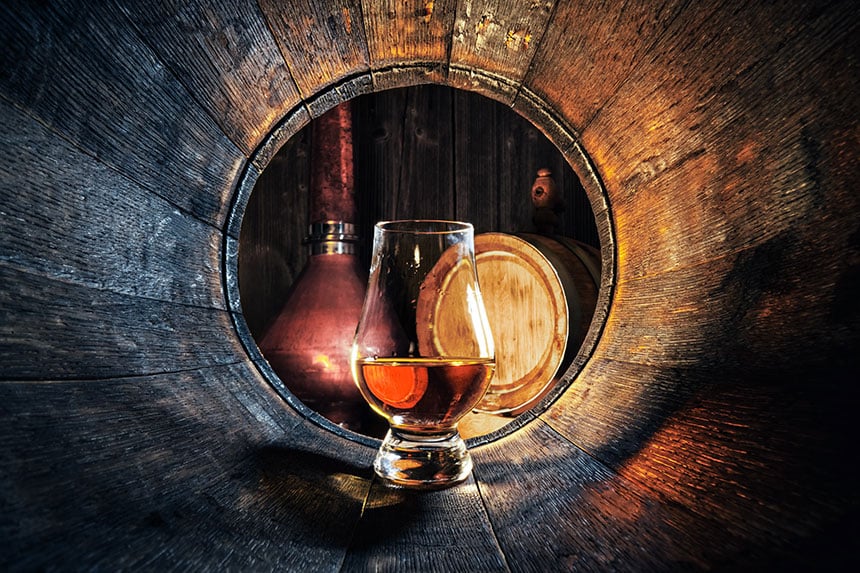
The tastings were pre-poured. The flights included three distinct types of whisky: single malt, blended malt, and blended scotch. We convened in an open room with stone walls, vaulted ceilings, and exposed oak beams. The rustic décor included wooden bar stools and old whisky casks used as tables.
Duncan walked over, a glass in hand. “Cheers!”
“Cheers,” I said, toasting. The smoky malt whisky crawled down my throat, reviving my spirits like a medicinal elixir.
“How’d you enjoy the tour?” Duncan asked.
“Wonderful. I thought I knew whisky, but there’s so much more to learn. You did an excellent job.”
I handed him a cash tip. Twenty dollars American. I’d stuffed the bill in my front pants pocket 30 minutes ago, not wanting to open my wallet in front of everyone.
“Appreciate it, mate.”
I extended my hand. “I’m John Simpson.” We shook.
“Nice to meet you. Let me guess, American?”
I laughed. “How can you tell?”
Duncan looked me over: short-cropped salt-and-pepper hair, goatee, a faltering six feet tall, blue jeans, and a casual collared shirt. I was lean for my age, except for the belly where I carried a few extra pounds. His eyes lingered on my gold Rolex before he put his hand on my shoulder. “Just the accent, mate. Nothing else.”
After Duncan finished his rounds and pocketed his tips, he swung by to chat again. I had rented a car and was in no rush. We spent 20 minutes discussing various whiskies. He regaled me with fun facts about Scotland and things to see and do. He even suggested whisky as a great investment for a diversified portfolio, something I’d never thought of.
In turn, I told him about my ancestry. How my grandparents were from Scotland. How Helen and I had planned this trip before she’d passed. By the end of our conversation, we’d made a real connection.
Duncan handed me his card and an extra coupon for the gift shop. “It was great chatting with you, John. If you need anything while you’re in town, call me.”
“Thanks so much,” I said, beaming. “This has been the highlight of my trip.”
I pulled out an old business card from my wallet. “You have a pen?”
He handed me one. I wrote my phone number on the back.
“Disregard my work information,” I said. “I’m retired from IBM, but if you’re ever in the States, please look me up. We Scots have to stick together.”
Duncan took my card. “We do, mate,” he said with a wink. “We do at that.”
* * *
My phone rang two weeks later. The incoming number wasn’t familiar. In fact, it wasn’t even American.
Weird.
I answered it. “Hello?”
“Hello,” the caller said. “I’m trying to reach John Simpson.” The voice was male with a Scottish accent.
“This is he,” I said with hesitation. “Who’s calling?”
“John, its Duncan. Duncan Anderson, the tour guide from Scotland.”
“What a surprise! I didn’t think I’d hear from you so soon — or ever, for that matter. Are you coming to America?”
“No, mate. I wish I were.”
His voice sounded warm. No surprise. Good old Duncan.
He continued. “Actually, I’m calling because an interesting opportunity opened up and I thought of you.”
“Me?”
I sat down at the kitchen table. After a long morning of yard work, my legs and back ached.
“I know this will sound crazy, John. But hear me out.”
I glanced out the window. Spring in Connecticut. The dogwoods and forsythia were in bloom. Helen adored New England this time of year. “Okay, shoot.”
“Well, I know how much you love your authentic Scottish whisky and I didn’t want you to miss out.”
“Go on,” I said. He’d piqued my interest.
“It’s a special edition of single malt produced under a new label. A subsidiary of our main company. It takes at least three years to age, but this is a perfect time to get in on the ground level.”
I uncrossed my leg, stretched it. “So, they’re doing a pre-order? I’d love to purchase a bottle or two.”
“Not a pre-order, John. They’re looking for private investors to fund the new venture. This could be big.”
I cleared my throat. “Sorry, Duncan. You’ve got the wrong guy.”
“I don’t think so.”
“No, you do. Unfortunately, I’m on a tight budget. The Scotland trip and the distillery were a distraction. A one-time extravagance, I’m afraid.”
“Listen John, this could be a fantastic opportunity for you. Plus, the return could be significant. It would allow you to travel more. Live the life you deserve. Don’t say no quite yet. Let me email you the information and then decide. What do you say?”
I didn’t answer right away. My head was spinning with dreams of restoring my retirement nest egg. Having more than just enough to get by. Enough to really live again.
“John, you still there?”
“Yes, Duncan. Sorry about that. Sure, send me the info. It can’t hurt to look.” I gave him my email address.
“Look for something in a day or so,” Duncan said. “This is all happening fast, but I’ll get you info on costs, as well as the fermentation and distillation process.”
“Sounds good. I look forward to reading it.”
“I like you, John.” Duncan paused. “That’s why I called. If you’re strapped, then this may be just what the doctor ordered.”
I’d had enough doctors for two lifetimes. But somewhere deep inside, I prayed this friendly Scot was right.
* * *
As promised, an email from Duncan hit my inbox two days later. He went into great detail regarding the process to craft this new, premium single-malt whisky. I’m not gonna lie, even though I’m an enthusiast, parts of it went over my head. They planned to use barley from local farms aged in white oak with a secondary finish in French cognac barrels to create a nuanced flavor profile. A $5,000 investment to purchase a single barrel would yield 250 bottles of whisky. Sold at a minimum of $50 per bottle, each barrel would generate $12,500. In a minimum of three years, I’d more than double my money.
That was better than the stock market.
They were only offering this opportunity to a limited number of investors. In addition, there was the strong possibility of selling my barrels before they completed the aging process. Especially if they were in high demand. Which Duncan said was likely.
I stared at the screen on my computer. Tapped my fingers on the desk. I had $85,000 left in my 401(k), plus $25,000 in a high-interest savings account. I also had $10,000 in my checking account. Unfortunately, I still owed plenty on the house. If things got really bad, I could always pawn the Rolex. There was no penalty to liquidate the savings account. At least that would buy me something and provide a much better return than my other investments. I needed to change my trajectory and this was a way to start.
I hit reply to the email and typed out a message:
Hey Mate,
I’m interested! The most I can do is five barrels. Send me the wiring instructions for the $25k, as well as any paperwork I need to validate the sale.
Thanks for thinking of me,
John Simpson
Over the next couple of days, Duncan and I exchanged emails and a phone call or two. By the end of the week, I transferred him the money. I was officially a whisky investor.
Cool. I had something to look forward to again.
Now all I had to do was wait for my luck to change.
* * *
I was finishing lunch, a BLT on toasted rye, when the mailman drove up one warm, midsummer day. When you retire, getting the mail is an actual event, something you look forward to, even though it’s often only bills. I took a last bite of my sandwich and headed for the mailbox.
No bills this time. Just junk mail and a retirement magazine. It’s a sad day when you receive your first AARP solicitation. It screams, “Surprise, you are officially old!” But eventually you don’t mind getting the mailings. After all, the articles are relatable. Sometimes, too relatable.
As was the case that day.
The article was about fraud and outlined schemes targeting older Americans. I almost collapsed when I read how they enticed seniors to buy fake stakes in nontraditional investments, including whisky production. In every case cited, the offer came from overseas. The tell-tale sign of a whisky scam was if you didn’t receive an official document called a delivery order. The whisky barrel equivalent of a car title or home deed.
My hands shook. I bit the inside of my cheek. I’d received information from Duncan: fluff and transfer instructions. But no official delivery order.
I read the last sentence of the article: “For more information or to report a similar crime, contact the National Fraud Hotline at …”
I picked up the phone. I held it so tight my hand turned numb.
My luck had changed all right, only for the worse. I’d been taken. It was time to make a call.
* * *
It took longer than I wanted, but eventually my case was routed to my state’s assistant district attorney. His name was Bryan McDonald and, after some badgering, I convinced him to meet.
I updated him on my situation and he explained that over 150 people had reported similar frauds. Many were seniors from all over the country. Over $13 million stolen to date. And that was just what they knew of. My money, while a sizable portion of my remaining net worth, was just a drop in the proverbial bucket. While the other instances made no mention of Duncan Anderson, he said the use of aliases was common.
“What do you suggest I do then?” I said, flustered.
McDonald leaned back in his leather chair. His small office was on the fourth floor of a government building located in New Haven. Case files littered every shelf and free inch of space. Sunlight peered through the tinted windows, glinting off his metal framed desk. I couldn’t tell if the office was hot from the sun or my embarrassment from being duped.
“Unfortunately, like I tried to say on the phone, there’s not much we can do, Mr. Simpson. I have no authority in Scotland.”
McDonald was my size but younger. Late 40s and dark-skinned. He continued: “And even if we could catch Duncan on American soil, there’s no guarantee we’d recover your money.”
“I’ve got to do something.” My voice trembled.
“I understand your frustration.”
“I just can’t sit around while he takes advantage of innocent people. It’s not right.”
McDonald raised his hands in front of his chest, creating a tent-like shape. The wheels of justice were turning.
“So, you haven’t reached out to Duncan that you suspect anything?” he said, finally.
“No, I wanted to contact the authorities first. He and I haven’t spoken since I bought the whisky. Or thought I did.”
McDonald sat still, nodded. “Maybe we can lure Mr. Anderson to America. But we’ll need a big incentive. And your help. Unfortunately, any contact information from the other cases has gone dead.”
My jaw hurt from clenching my molars. The stress of the last year had caught up with me. I leaned forward in my seat. “I have the time and inclination. And, more importantly, I have nothing left to lose.”
McDonald smiled. “Then in that case, Mr. Simpson — I propose we go fishing.”
* * *
McDonald did his due diligence. A lot more than me, that’s for sure. The subsidiary that Duncan claimed was producing the new whisky, One Shot for the Road, didn’t exist. Never did. And Duncan Anderson was no longer an employee of the distillery I’d visited. In fact, Duncan Anderson was a ghost.
An alias, as expected.
Thankfully, I’d captured a picture of good old Duncan during the tour. As a keepsake, I thought at the time. But when McDonald ran the image through INTERPOL, Duncan Anderson turned out to be Drew Alexander, an Irish con artist with a rap sheet longer than my patience.
How long had he taken advantage of others? Trolled for unsuspecting saps like me? I wasn’t the first, but I wanted to be the last.
Thoughts of revenge — payback — consumed me.
Wrath is one of the seven deadly sins, and I had fallen victim to it. But so is avarice, Duncan’s fatal flaw. McDonald and I were banking on $250,000 to be more than enough motivation for him.
And we were right.
Duncan didn’t answer my emails or phone calls right away. It took him more than a week. But when I lied about having a rich friend named Rory McNeil who wanted in on the whisky deal and had a budget of $250,000, he got extremely interested. Only caveat was that Rory needed to meet in person. This size investment was too much for emails and phone calls. It had to be eye to eye.
“If you land Rory,” I said on our last call, “that will lead to his other friends. Plus, if everything is aboveboard, Rory has agreed to buy me an extra barrel of whisky as a finder’s fee. It’s a win-win all around.”
I laid it on extra thick. I was a better actor than I thought; Duncan — that is, Drew — took the bait. His hubris showed no end. He was scheduled to arrive at Bradley International Airport in Windsor Locks in two days. I’d meet him at the gate and personally bring him to lunch with Rory at the local country club.
Of course, none of that was true. McDonald and the Feds would be waiting at the airport to take him into custody once I made contact. And I’d be wearing a wire in case Duncan said anything else incriminating.
As far as I was concerned, two days couldn’t come too soon.
* * *
The morning of the sting, I met McDonald at his office at 9:00 a.m. Duncan was scheduled to arrive on Delta Flight 1567 at noon. McDonald had arranged to have three FBI agents on our detail: One to remain in the van to oversee the surveillance equipment and two undercover to apprehend Duncan. McDonald would be on site as well. He wanted me to see a familiar face in case I got nervous.
I’m not gonna lie, I was glad he came.
They fitted me with the wire, instructed me on its use, and went over the plan again. We drove a nondescript white van to Bradley International. I was waiting at gate G6 by 11:15. Everyone else manned their respective positions.
Only problem was that when noon came and went, I started to sweat. And when Duncan’s flight finally landed and deplaned at 12:15, he wasn’t on it.
I scanned the airport. McDonald and the two FBI agents stood at their posts. They looked concerned. Maybe Duncan had gotten cold feet. Maybe I came off over-eager and scared him off.
But then my luck turned.
One gate away, diagonally from me, sat a guy with sunglasses and a dark blue baseball cap, a bright red tuft of hair barely visible. No doubt, it was Duncan. Same size and build and shocking crimson mane. No fool, he must have taken an earlier flight to scope things out.
But had he seen me arrive? Had he seen McDonald and the agents get into position?
I turned slightly away and knelt down, pretending to tie my shoe. Just like in the old movies. “Duncan’s here,” I whispered into the wire’s mic. “He’s sitting in Gate 7. Sunglasses and blue cap.”
I stood up. Eyed my team. McDonald and the agents gave a subtle nod. Then Duncan stood and was on the move.
And so was I.
“Damn! He knows,” I said, moving at a clip.
The airport was congested, but I kept my sights locked on the prize. Maybe I could cut him off before he got lost in the sea of travelers. The two FBI agents were 20 yards behind me, McDonald bringing up the rear.
Duncan stole a glance at me. He scowled and walked faster, heading for the exit. Tired of playing the victim, my 65-year-old body shifted into a gear I thought no longer existed.
“Thief,” I hollered, running now. “Stop that man!”
Alarmed and scared, the crowd parted. So much for my cry for help. Where was a good Samaritan when you needed one? But at least there was less concern about losing him. Duncan was in plain sight and running as well.
I’m not sure how I caught up to him: a man 30 years my junior. Nor can I explain how I reached him before the two athletic Feds.
But I did.
Let’s just say I was highly motivated. Even more than a cheating Irish pitchman. Who knows? Maybe Helen was watching over me, encouraging me from beyond to “fight the good fight.”
Either way, when I finally reached Duncan, I leaped, my body flying through the air. All 170 pounds of my weight landing hard on his lower back, forcing him to the floor. He squirmed to get free, but my fists were flying. I hit him repeatedly on the upper back and side of the head.
I didn’t let up until the agents pulled me off.
As they cuffed him, a crowd formed a circle around us. A group of older travelers clapped and cheered.
McDonald patted me on the back. “Looks like you’re a hero, John.”
I smiled. Shook my right hand out. It was going to hurt for weeks. Hopefully, it wasn’t broken.
“And you’re surprisingly fit for a retired guy.”
I rubbed my left knee. It screamed from hitting the rock-hard airport floor. “I guess all those days of yard work paid off.”
* * *
It took time, but Duncan pleaded guilty to stealing $2.5 million from 50 different American investors, whisky fraud being just his latest scheme.
“We may not have captured the king scammer,” said McDonald to me weeks later, “but at least we’ve removed a piece off the board.”
And he was right.
Duncan Anderson (aka Drew Alexander) is serving 20 years in an Irish prison. He is not eligible for parole. Ireland, his home country, requested extradition for his European crimes, and the U.S. brokered a deal to freeze his accounts and assets and return what was due American victims. Eleven months later, $25,000 was transferred into my account.
Since my trip, I haven’t had a sip of whisky, Scottish or otherwise.
No taste for it.
Become a Saturday Evening Post member and enjoy unlimited access. Subscribe now



Comments
Nice job with the story, Jim. Very entertaining! Keep up the good work.
Mr. Focarile, Excellent story, old friend. I hope to get to read more of your stuff soon.
Thanks for taking the time to read it!
Enjoyed the story! Nice work!
Glad you enjoyed it!
Fiction, inspired by real events. The title is a variation of a famous Gaelic proverb.
Great story!! Way to go.