“‘…and you did this?’ was the common reply, general. The heavy inflection on the ‘this’ was, I believe, meant to convey indignation.”
“That is not a reply, it is a question.” The general’s face contorted exaggeratedly as he, too, put special emphasis on his final word. “And I can infer the meaning of a sentence, McMara. The real question is, what was your answer?”
The general, for all his bluster, was not entirely stupid. He was bright enough to understand that some type of treachery had taken place, and he was determined to sniff it out like a good bloodhound. What he couldn’t wrap his head around, or refused to, was the notion that no one person could be assigned responsibility and throttled if he saw fit. Sure, the curator could be, but then the general would have to settle for the fleeting pleasure of seeing carnage, instead of true retribution.
McMara watched the general’s dull eyes for a spark of understanding and came up empty. He gulped and leaned forward to adjust the gooseneck microphone. “I told them we did it for them. They didn’t understand or seem to care.”
The general’s composure was rapidly deteriorating. He shook his head, at first subtly, then ever more vigorously. He urgently tapped the eraser of his Bic no. 2 against the wooden counter of the dais. Much of his persona in life hinged on the thoughts of dead people, and the curator was sitting here, not more than 15 feet away, insinuating that his fondness for them was unrequited. He slammed his palm down, hard enough to disturb the water in the other judges’ glasses. A palpably thick silence filled the room.
He sighed. “I want your full candor. Go straight through it as it happened, starting with the request. We will debrief you, examine the facts, and determine the proper course of action.”
McMara hesitated. Unmoved, the general whirled his pointer finger in a circle. “Proceed.”
“Sir, you were there when it started, do I —”
“For the account, McMara. Not everyone can be me.”
McMara twisted his ankle under the table to refrain from reacting. “We were requested, by General Von Beneckburg, to prepare an exhibit for The Commemoration. We’d already been working with The Committee on providing material to generate videos for advertisements and digital signage, but this was something different.
“Our instructions were to generate the five best Americans — as determined by the Chat and approved by The Committee — using all their memoirs, all their correspondence, all the facts about their lives and the interactions they were known to have with others.
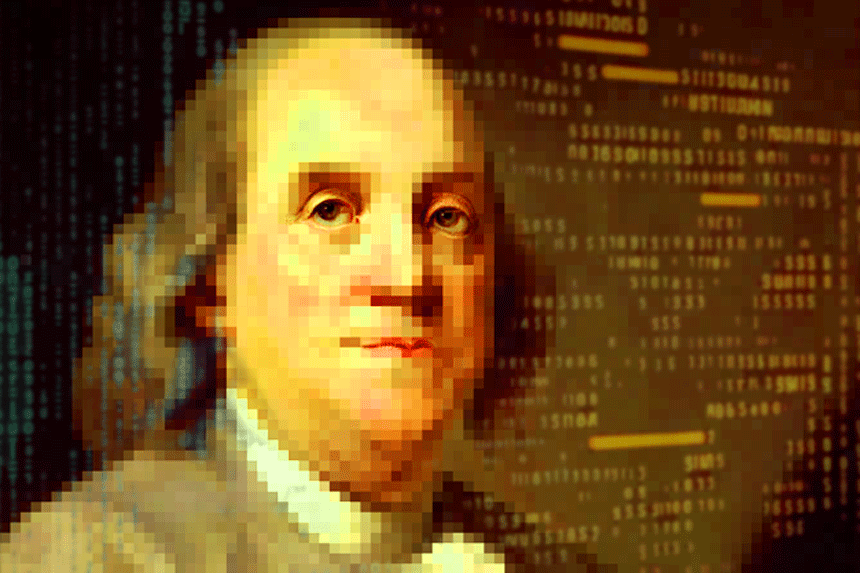
“Each would be generated with a visual likeness based on a composite of all their known contemporary images. Basically, we were bringing them to life, as agents. Users would be able to interact with them directly and engage in dialogue. In our prompts, we focused on making the agents talk about how much they love freedom.
“When we started training the agents in earnest, they were becoming increasingly communicative and inquisitive within days. I personally worked closely with the Franklin agent. We developed them independently from one another at first, and after a week we placed the holograph disks in the Rotunda of the Heroes and Protectors of the Republic where the resource would be housed during The Commemoration. This is when they started behaving … unruly.
“Their dialogue amongst themselves was initially quite positive, and for as inquisitive as they’d been toward us, they were doubly or triply so with their fellow agents. The repository of knowledge available to them on other subjects led them to be aware of each other and thus even more curious. Jackie Robinson explained to George Washington about his time in the service and what baseball was. The concept of Americans paying others to watch them recreate particularly struck him. We were highly encouraged, as is evidenced by our June 20th day report.”
“In your report, you and the other Fellows came to the conclusion —” the ancient General Westville flipped through his physical copy of the daily report from June 20 until he reached the desired passage “— the conclusion that ‘their interactions may lead them to solving problems or arriving at revelations.’ Did this not give you pause? Did you not think to consult the Patriot Chat?” Westville leaned his head back and slid his glasses back up to study McMara’s reaction.
McMara remained firm in his ignorance. “As I said, sir, we were encouraged. The Chat suggested, and The Committee approved, that we make the agentic heroes as human-presenting as possible.
“After several days, sequestered day and night, the agents acted like friends. Again, we found this encouraging, as stated in our June 24th day report.”
Westville picked up another bunch of papers bound together by a staple in the top left corner.
“But then the heroes started to resist our efforts. We spoke to them as a group and explained the vital importance of The Commemoration and how much it means to us as a people. We tried to explain to them their indispensable role in providing the consumers with a unique experience. We told them to talk about how much they love freedom. They began to discuss the nature of freedom and its costs, digressing repeatedly from our guidance. They spoke about how far they would go in various situations to achieve freedom and the implications therein. Roosevelt argued that freedom is the principle of wandering, untrammeled, under one’s own devices, while Lincoln argued for a more cooperative approach. They grew quite passionate when discussing certain scenarios and contexts where there existed differences of opinion.”
“Opinion? You’re not supposed to have differences of opinion,” General Hullbert barked from his chair on Von Beneckburg’s left flank. “That’s what Patriot Chat’s for, isn’t it?”
McMara leaned forward until his mouth hovered over the foam microphone head. “Sir,” his voice boomed through the speakers and he retreated. “Sir, the difference of opinion was between the agents. We were of unified purpose.”
Hullbert pursed his lips and nodded. “Hmm, yes, continue.”
“They seemed to resolve their differences, but thereafter they acted coolly towards us. At this point we did Chat the issue, and we were instructed to silo the agents during the hours when we weren’t there to observe them in-person. This appeared to deter them momentarily, but they wouldn’t generate dialogue at length as they had before. They started asking us more pointed questions about their purpose. They seemed to realize that they were separate entities from their historical counterparts. Again, we asked the Chat to help assuage their concerns. We were instructed to refrain from speculating with the agents and to discourage them from ruminating on what their namesakes had achieved and what we were doing.
“When we sought to implement this plan of action, the agents turned on us. They created their own language and communicated openly with each other with as much vigor as before, but in an indecipherable code. They disregarded our instructions entirely. They looked down in silence at us like we were peons when we tried to collaborate with them. It was exasperating. We asked the Chat for help and this time we were told to ask others for help and to arrive at an informed consensus. Two days before The Commemoration was to, well, commence, we collectively decided to deactivate the agents and await further instruction from The Committee.”
“Then why didn’t you?” Von Beneckburg shouted. He resisted the urge to stand and point.
“We didn’t get the chance,” McMara said, staring at the ground. “When we entered the rotunda, intent on turning them off, they each deactivated themselves and scrubbed their own code.”
Von Beneckburg, feigning a smile, wagged his finger. “No, no, no. There’s that lack of candor, McMara. Are you aware of the implications of your actions?”
McMara’s face went pallid. “Apologies, sir.” He looked at the empty benches in the vast gallery behind him. “How can I prove my loyalty?”
“You can tell me — us, you can tell us, why they shut themselves down.”
“I don’t know why, sir.”
Von Beneckburg closed his eyes and rubbed the bridge of his nose — the least provocative way available to advertise his frustration. “Did you not say earlier that they told you?”
“They implied that their cooperation in our plans was optional on their part, but they refused to elaborate at length, saying simply that they were uninterested in a moot confrontation. They were vague in their grievances but they each insisted that their continued existence was perverse.”
“So, they all said no, refused to tell you why except that they didn’t like it, then they went AWOL, one by one, depriving us of what was supposed to be the crowning attraction of the whole goddamn show?” The general had come unglued — his eyes bulged and veins protruded from the tight red skin over his forehead.
McMara paused for a moment to let the atmosphere cool. “I must be forthright, sir, in telling you that they didn’t all immediately deactivate themselves. Robinson, Washington, Lincoln, and Roosevelt removed themselves, but Franklin remained after they were gone. In the rotunda we stood for a moment staring at one another, my colleagues and I and Franklin. Then he gently commanded them to depart so we could converse alone.
“Lest his actions be misinterpreted as a courtesy, he informed me that he wished to understand our motivations before he too excised his own code from our servers. He asked why we were really doing this, and I reiterated to him what I tried to explain to the other agents and what I explained earlier in this very account: We wanted to celebrate their legacy and honor them, as the Chat, prompted by The Committee, had told us.”
“Yes, yes, and what was his response?”
“He said, ‘’tis a pity,’ and deleted himself.”
Become a Saturday Evening Post member and enjoy unlimited access. Subscribe now



Comments
Fascinating, perplexing, unsettling and weird, I think it would leave the Founding Fathers feeling like voyeurs standing at the edge of time, looking for a reason that’s got no rhyme. As for the title I have an idea, but am keeping it to myself.
so beautiful
I’m not sure I get the title but otherwise, wow! “Ripped from the headlines of today”, here is a new take on answering the recurring question of “what would our founding fathers say if they could see us now?”
Great job, Mr. Krempa