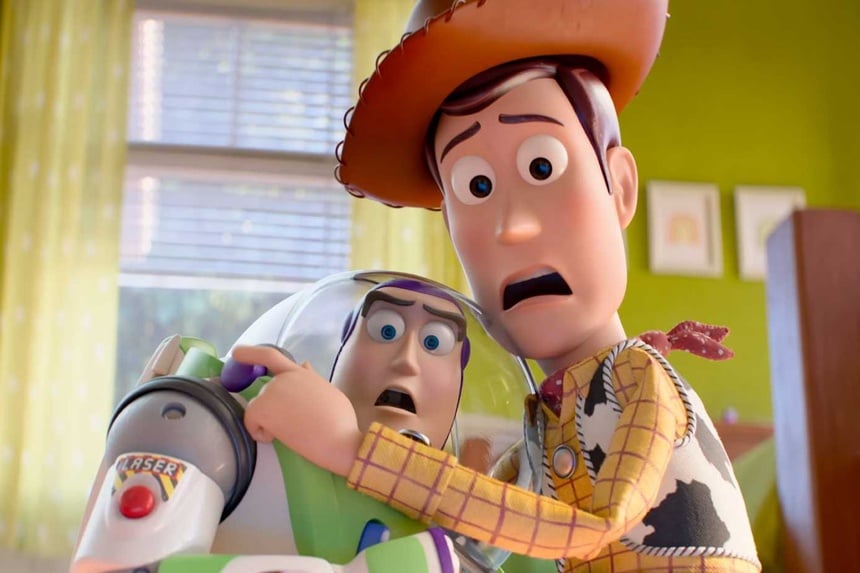
Toy Story 5
⭐️ ⭐️ ⭐️ ⭐️
Rating: PG
Run Time: 1 hour 42 minutes
Writers: Andrew Stanton, McKenna Harris
Directors: McKenna Harris, Andrew Stanton
They’re always funny, they’re always magical, and they never fail to entertain every generation in the audience. But uniquely among just about any theatrical animated franchise you can name, the Toy Story movies have always managed to be about something.
Toy Story (1995), could have settled for being the first fully computer-animated film, but instead plunges into an exploration of the sometimes-rocky nature of friendship – adult male friendship, no less. The sequel – originally intended as a quickie home video release until Disney realized what they had – reflects on the insecurities that accompany being the object of someone’s love. The third installment, which finds the toys’ young owner heading off to college, frets over the trauma of transitions out of our control.
Many feel the Toy Story saga should have ended with that chapter, which seemed to bring the narrative full circle. But Toy Story 4 proved there was still some charge in the series’ batteries beyond the original trilogy as Woody the Cowboy ventures into the world in search of an identity other than that of belonging to someone else.
Now, 30 years on, comes Toy Story 5, tackling a very 21st-century conflict: the seeming death match between the analog and digital worlds. And wouldn’t you know it, whether you’re a grownup nervously eyeing that AI coworker nibbling away at your responsibilities or a fifth-grade Snapchatter who’s forgetting how to interact in the real world, the latest Pixar Parable seems to be reading your mind.
After a thrilling prologue in which a shipping container full of Buzz Lightyear toys washes up on a deserted island (leaving us to wonder how this will ultimately fit into the storyline), we find life proceeding apace for our toy friends, who now live in the cheerily lit bedroom of Bonnie (sweetly voiced by Scarlett Spears), the little girl who inherited the gang from her now-grown-up neighbor, Andy. Woody the Cowboy (Tom Hanks) is still absent, having in the previous installment departed to help his old girlfriend Bo Peep (Annie Potts) rescue abandoned toys, leaving Buzz Lightyear (Tim Allen) and Jessie the Cowgirl (Joan Cusack) in charge of a still-growing cast of supporting playthings including Dolly (Bonnie Hunt), Trixie (Kristen Schaal), Forky (Tony Hale), Rex the T-Rex (Wallace Shawn), Combat Carl (Ernie Hudson) and Hamm the Pig (John Ratzenberger, Pixar’s perennial good-luck charm, back for his 24th Pixar film). Among the newcomers: Pizza with Sunglasses (Bad Bunny).
Initially, the primary storyline here seems to involve Buzz conjuring up the courage to propose marriage to Jessie – but soon the gang is confronted with their biggest threat since that evil neighbor Sid tied a stick of dynamite to Buzz: The arrival of an interactive screen device called Lilypad (The Morning Show’s Greta Lee). Bonnie’s parents, it turns out, were reluctant to succumb to the tech toy revolution, but realized she was being left behind socially by other kids who looked down on her for playing with “dolls.”
The result of this experiment is all too predictable: Bonnie sets her dilated gaze on that mesmerizing screen and, within moments, seemingly forgets she ever even had a tea party with her toy buddies. Soon she’s playing interactive games with unseen friends and gossiping in chats. Finally (somewhat) accepted into the greater circle of connected kids, Bonnie even gets invited to a sleepover – at which the kids promptly slump individually into overstuffed chairs, mouths agape, oblivious to the flesh-and-blood beings sitting an arm’s length away.
The toys, of course, are devastated. Lilypad, haughty as a Silicon Valley tech bro, proclaims a new era of 24/7 playtime and connives dastardly ways to separate Bonnie from her old toy pals permanently. Seeing herself outmatched, Jessie sends out an SOS to Woody (much to Buzz’s chagrin), who arrives to a hero’s welcome (also much to Buzz’s chagrin).
Like all Toy Story installments, this one winds toward its inevitable happy ending like a Hot Wheels car on a looping plastic track. What matters is who’s behind the wheel, and veteran co-writer/co-director Andrew Stanton – who helmed Pixar’s 1991 experimental “Luxo Jr.” shorts – stays resolute in preserving the studio’s “story first” tradition. Along the way everyone from Bonnie and her parents to Buzz and Woody – even Lilypad, who turns out to be more misguided than malevolent – learns a life-affirming lesson in friendship and service to others.
Thirty years is a long time to sustain any kind of entertainment franchise, particularly one that virtually freezes most of its characters at a particular “age” while the world changes around them. By now you might have expected Pixar to have cycled in new voice actors – maybe Colin Hanks for his dad, for instance. But I suspect the studio’s allegiance to every still-living member of the original voice cast is also a profound creative choice; an artful acknowledgement of time passing.
Hanks is still capable of that high-pitched nasal delivery that makes Woody both endearing and borderline insufferable. And Allen’s voice has always had a husky weight that made him sound older when he was younger and now, essentially, age-appropriate. The other veteran voice actors, on the other hand, either cannot mask the wear and tear of their distinguished stage and screen careers or else don’t care to. A somewhat gravely throat, a slightly slurred vowel-consonant combination, an uncharacteristically deliberate delivery of what should be a rapid-fire line; all serve as subtle reminders that, even for toys, the years march on. (An ingenious sight gag has Buzz nearly blinding the gang when he removes his hat – and sunlight reflects off his balding head. “Can someone get him a brown crayon?” one toy asks.)
Most importantly, no one here seems to have lost the through-line of a film franchise that now spans four decades: You’re never too old to play. And, to paraphrase another timeless show biz favorite, “Play’s the thing.”
Become a Saturday Evening Post member and enjoy unlimited access. Subscribe now



Comments
I absolutely loved your review! Was it not Woody though who blinded the gang? Buzz surely would have needed a purple marker.