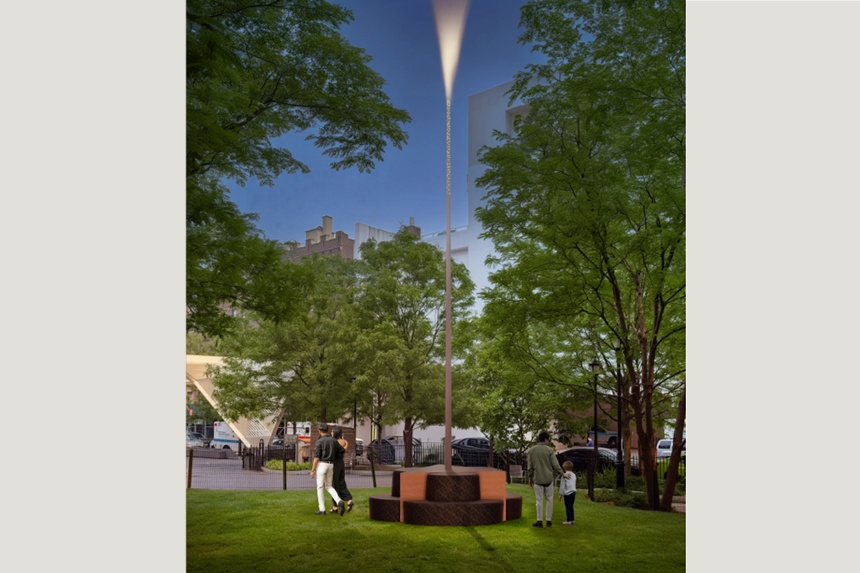
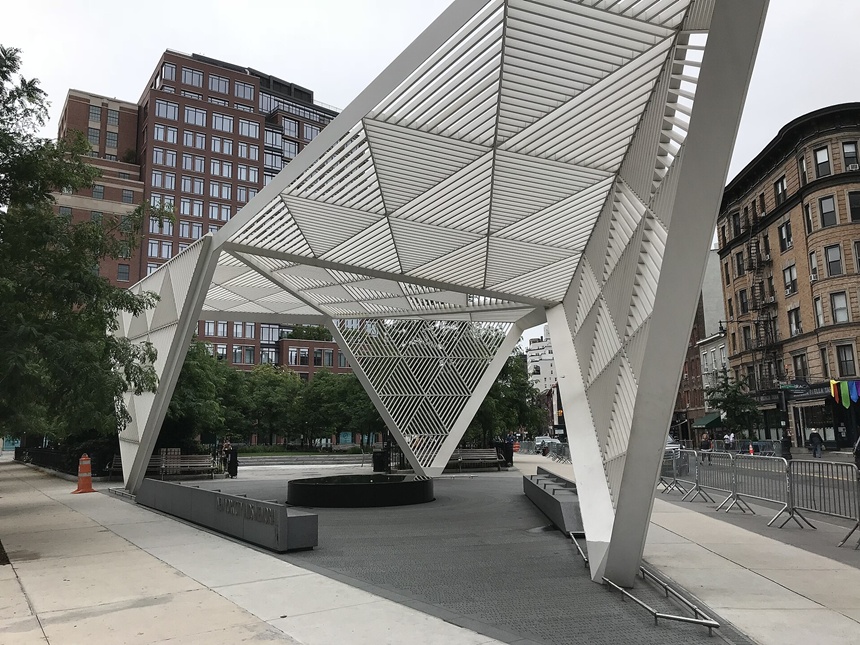
On a corner of Greenwich Avenue where the frenzy of Midtown yields to the quieter cadence of the West Village’s historic streets, a flame decommissioned just a few years ago will soon be lit again.
On June 20 at 3:00 p.m., the New York City AIDS Memorial will unveil Eternal Flame for Scott Burton, a major new public commission by artist Oscar Tuazon. Featuring drag performances, music, and floral installations, the event is less a traditional unveiling than a gathering beside a memorial designed to speak as much to the present as to the past.
The work reimagines a piece by sculptor and performance artist Scott Burton, whose practice in the 1970s and ’80s blurred the line between sculpture, furniture, and social space. Burton’s benches, chairs, and table-like forms were never meant to be viewed at a distance. They were meant to be sat on, lingered with, folded into everyday life — an ethos of use and connection that animates the new work as well.
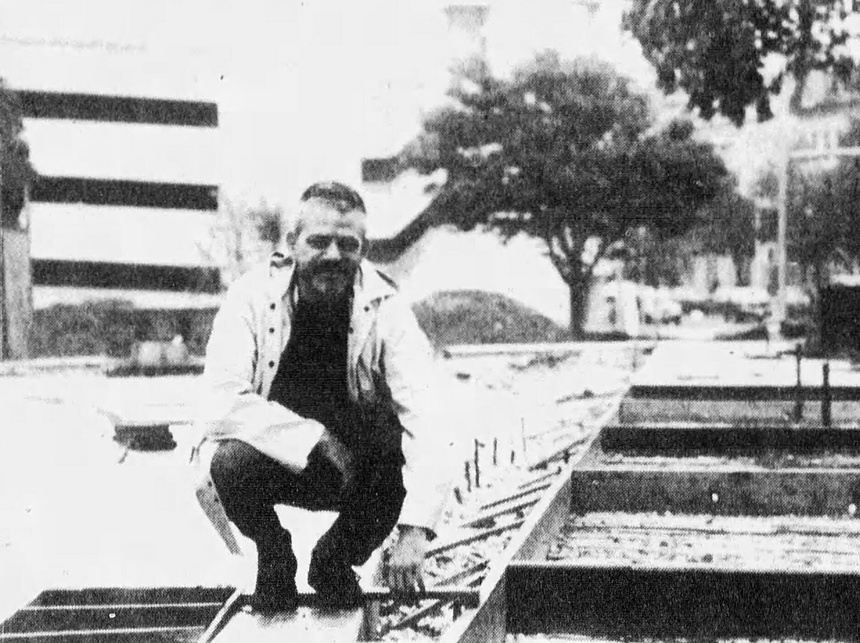
Burton received the original commission through the Percent for Art Program in 1987, but he died two years later of an AIDS-related illness before the work could be completed. He was part of a generation of artists whose art and lives were cut short by the epidemic, reshaping New York’s cultural landscape in ways still being reckoned with today.
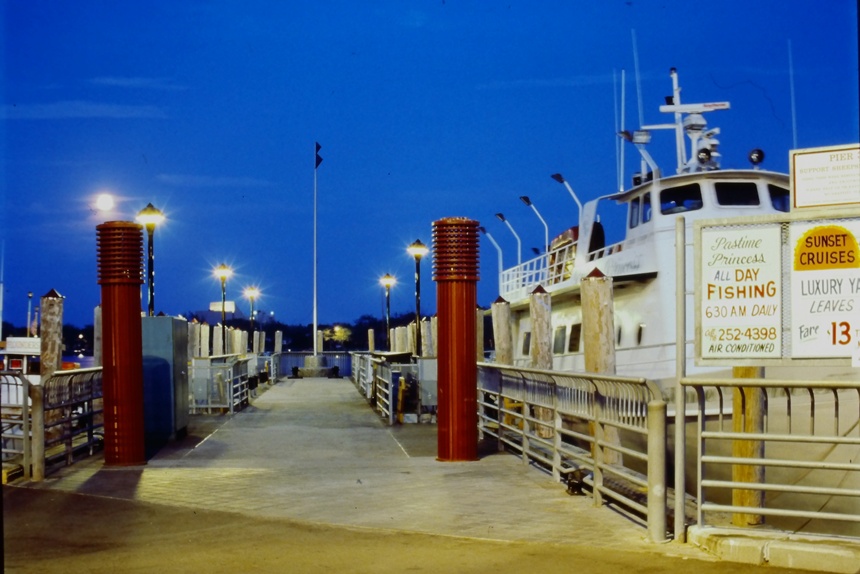
The installation was later finished posthumously by the project’s design and fabrication team. Intended for the Sheepshead Bay fishing piers in Brooklyn, the work consisted of lights and steel benches at the entry to each pier, while wooden ottomans and additional seating at the far end created places to pause and look out over the water. Rising above them, 34-foot poles carried colorful wind-vanes shaped into numbers, visible from Emmons Avenue and the elevated Shore Parkway — turning a functional pier into a subtle system of orientation, rest, and observation. The installation even earned the prestigious “Art Commission Award for Excellence in Design” award. Unfortunately, for decades it endured salt air, storms, and constant exposure. Eventually, damage from Superstorm Sandy and long-term decay led to its decommissioning in 2022.
But like Burton’s legacy, the work has continued to evolve in unexpected ways. Salvaged elements of the installation were preserved by the gallery Olney Gleason and later entrusted to Tuazon, who approached the fragments as material for renewal.
Tuazon is known for large-scale sculptural works that sit between architecture, landscape, and social space. His practice often asks audiences not only to look at art, but to enter it and use it — an approach that mirrors Burton’s own belief that sculpture should function in everyday life rather than stand apart from it.
“When I heard that Burton’s project was being removed,” Tuazon explains, “it was a once-in-a-lifetime opportunity to make a tribute to an artist I consider to be the most significant sculptor of the 20th century.”
This act of reinterpretation places Burton’s work within a broader shift in how cities treat public monuments after trauma.
For example, Fritz Koenig’s Sphere — originally installed as a fountain sculpture at the World Trade Center plaza — survived the collapse of the Twin Towers on September 11, 2001. Damaged but intact, it was relocated and gradually took on a new life as a memorial, carrying meanings far beyond its original function.
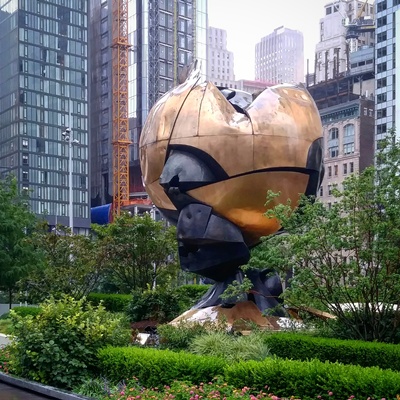
In 2021, Columbia University’s Wallach Art Gallery examined this transformation in The Way We Remember: Fritz Koenig’s Sphere, the Trauma of 9/11, and the Politics of Memory. Reflecting on the sculpture’s shifting meaning, curator Holger A. Klein noted its connection to broader questions about “the role of monuments and memorials in civic society and public discourse, and the function of art and architecture in the mediation of a people’s history and collective memory.”
Like The Sphere, Burton’s work has entered a second life — not because it was preserved intact, but because it was reactivated through loss, relocation, and reinterpretation.
The AIDS Memorial itself, located near the former hospital that housed the country’s first and largest AIDS ward, already embodies this idea of continuity. Since its dedication in 2016, it has functioned not only as a site of remembrance, but as a living public space, hosting performances, installations, and community gatherings that keep its meaning active rather than static. It reflects the present-day reality in which millions are still living with HIV, and each year brings new infections.
Forty million people live with HIV/AIDS, and in 2024 alone, 630,000 people died of AIDS-related illnesses, with 1.3 million newly infected. Globally, progress that once seemed irreversible has grown fragile. Cuts to U.S.-funded programs such as PEPFAR — long the backbone of international HIV treatment — have disrupted care for an estimated 2.3 million people who rely on lifesaving medication. UNAIDS has warned that funding reductions could cause 6 million new infections by 2029, along with 4 million preventable deaths.
Progress that once seemed irreversible is now unraveling, which Tuazon himself points out. But he also offers a glimmer of hope in the midst of this crisis.
“The HIV/AIDS crisis was a failure of institutions,” he says, “something we are seeing again right now, and the antidote is, and has always been, pride, visibility, and community.”
On June 20, the New York City AIDS Memorial will mark its 10th anniversary with the unveiling of Eternal Flame for Scott Burton at the St. Vincent’s Triangle. But what is being marked that afternoon is not only a new installation, but a connection between artists, histories, and unfinished struggles. In the reuse of damaged material, Burton’s insistence on sculpture as something lived with rather than looked at, and in Tuazon’s translation of that language, the piece resists irrelevance and closure.
“I wanted to put the pink triangle at the center of this work,” Tuazon says, “as a memorial to Burton and all the other artists lost to AIDS, and to make this a very tactile, loving, communal space where friends and strangers meet.”
In the West Village, gathered around this reactivated space, memory is not fixed — it is held in public, and made present again.
Become a Saturday Evening Post member and enjoy unlimited access. Subscribe now
.jpg)

