When I lived in Los Angeles, I regarded televised police chases as appointment viewing. In the evening, I might watch a couple of sitcoms and maybe a news program. But come around 11 o’clock, I’d grab a snack and tune in to KTLA, where, soon enough, there’d be a reporter narrating a moment-by-moment high-speed chase from a helicopter high above the city. I would watch, rapt, as police cruisers screamed along freeways and sometimes into the burbs, hoping to capture a fleeing suspect. It was awesome.
Okay, I exaggerate, but just a little. The chases weren’t exactly every-night events. They were frequent, however, and they were always audience grabbers. They still are. And not only in the L.A. basin, although that remains ground zero for the best of breed. This should not surprise, as the City of Angels hosts well over a thousand Highway Patrol pursuits a year. (Crazy as it seems, the first of those in Southern Cal occurred way back in 1992, and it involved … a Volkswagen.)
Today, these are so popular that YouTube streams the Car Chase Channel, devoted to some of the most pulse-pounding videos you’ll ever see. Whether viewed from choppers or police dashcams, the drama is confirmation that this news/entertainment hybrid has matured into a staple of America’s seemingly limitless fascination with spectacle.
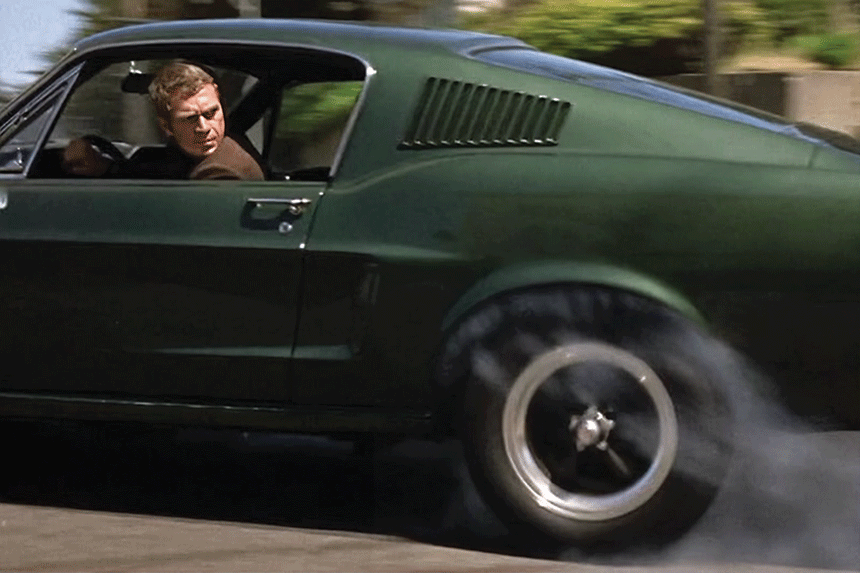
Of course, well before YouTube — even before the internet — epic chases had found their way to the highlight reels of American cinema. Bullitt (1968) and The French Connection (1971) are prime examples. The missing ingredient back then was the thrill of news ’copters going to live, mile-by-mile coverage. Indisputably, no chase was ever as monumentally nuts as O.J. Simpson’s in 1994. With him as the passenger, the Ford Bronco meandered for nearly two hours up the 405 Freeway. The scene was watched by an astonishing 95 million people. Simpson and his driver set a high bar that day for what-in-the-hell! TV, and it supercharged the chase format forever.
It’s been a while since I was an Angeleno. But I still enjoy the chases. Am I proud of that? Not necessarily, but like so many of my fellow humans, I’m drawn to practically any combination of danger and unpredictability — if I’m not physically at risk. The gunfire, the anticipation of a successful PIT maneuver, maybe a rollover crash all make for compelling TV. Will the suspect get away? (Seldom.) Elude capture for hours? (Sometimes.) Crash? (Often.) Die in a shootout? (Occasionally.)
Fundamentally, cops vs. speeding outlaws is just a modern-day take on good vs. evil, an eternal storyline. What lifts it to prominence today is its total unscriptedness. Some of the highly popular Real Housewives TV episodes, by contrast, can be hairy, but they are hardly real. Car chases are Very Real. They tap into the same base instinct that attracts crowds to auto racing: cars may collide, near-misses are guaranteed, you may witness a roll-over wreck in which drivers are momentarily engulfed in flames. Feel free to say otherwise, but audiences want that. We are not an especially sensitive people.
Granted, police chases are not for everyone. Sometimes they end tragically right before our eyes. I well recall seeing one in L.A. that concluded with the suspect committing suicide so impulsively that TV cameras had no opportunity to turn away. Terrible. Yet it’s still talked about to this day. In our videocentric age, that’s the kind of thing that keeps producers — and audiences — coming back time and again.
In the last issue, Cable Neuhaus wrote about the changing meaning of luxury.
This article is featured in the July/August 2026 issue of The Saturday Evening Post. Subscribe to the magazine for more art, inspiring stories, fiction, humor, and features from our archives.
Become a Saturday Evening Post member and enjoy unlimited access. Subscribe now