They say you can’t always have something for everyone. But that hasn’t stopped the folks at the Smithsonian’s National Museum of Natural History from trying.
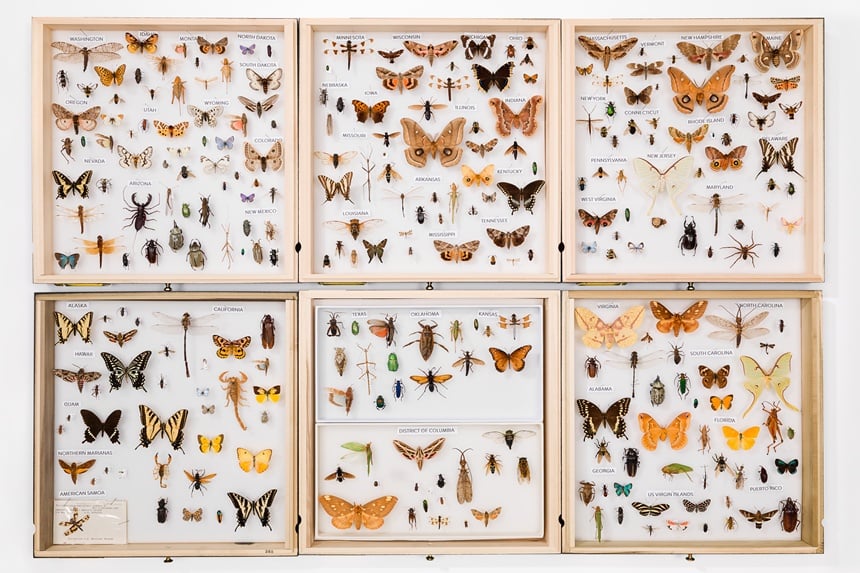
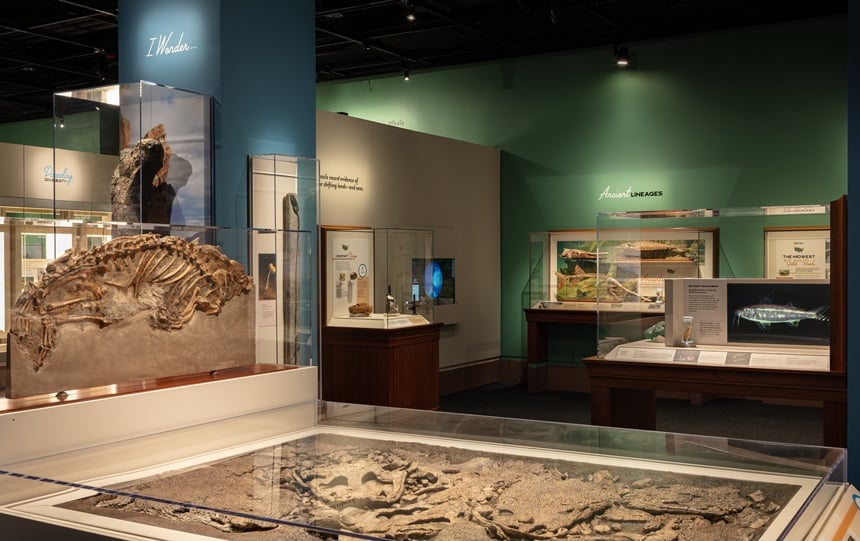
Celebrating America’s 250th year, in late June the Washington, D.C. museum opened “From These Lands: Sharing Our Natural and Cultural Heritage,” a brand-new exhibition promising at least one object from every single U.S. state and territory.
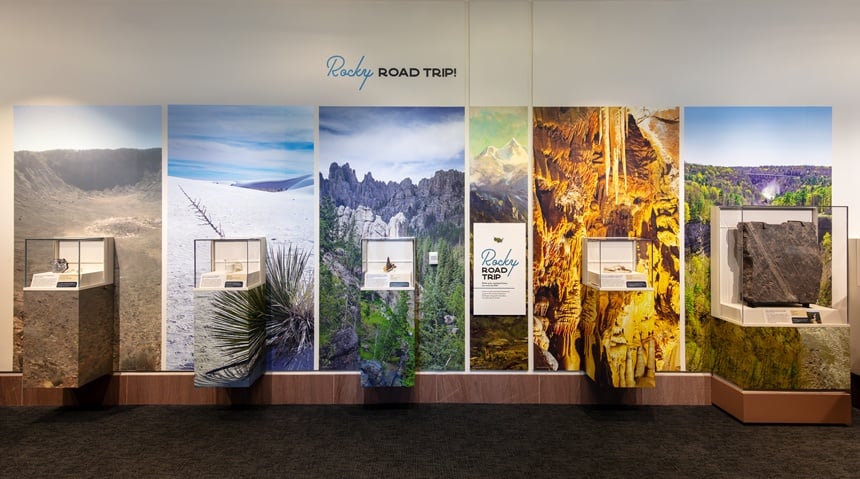
While first-day visitors pressed their noses against glass cases and ran their fingers over “please touch” exhibits, as a proud resident of Delaware I had one mission in mind: Immediately, I started foraging through the artifact-packed gallery for a Delaware horseshoe crab.
A reasonable quest: The horseshoe crab – which is not a crab at all but more closely related to spiders and scorpions – is Delaware’s official state marine animal. They’re not as cute as the dolphins that frolic off our coast, nor as plentiful as the oysters that seem to cling to every coastal rock and dock. But they’ve been around, virtually unchanged, for 450 million years (somehow appropriate for a tiny state with the nation’s fifth-highest percentage of people 65 and over).
There had to be one around here someplace. I was certain. Determined as I was to find a horseshoe crab, though, I kept getting diverted to other irresistible objects, each with an intriguing story of its own.
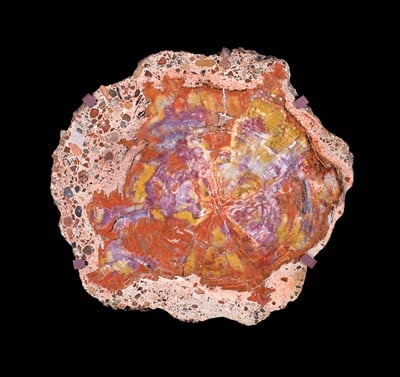
From Arizona, a slice of 219-million-year-old petrified tree, resembling an enormous, polished sliver of olive loaf. From California, a butterfly-shaped brooch made from violet benitoite, the state’s official gemstone – rarer than gold. From Colorado, a legitimate fossilized scrap of century-old newspaper, preserved in stone at the bottom of a calcium-rich spring (why the surviving text includes the word “Senegambian,” relating to a region in West Africa, is anyone’s guess).
Connecticut’s offerings include a robber fly – a sort of giant bumblebee that has no stinger, but, as the museum’s literature helpfully relates, “will pierce the body of its prey and kill it with its paralyzing saliva before landing to suck out the fluids and soft organs.”
And that’s just through the “C’s”.
Clearly, like the Smithsonian itself, the “From These Lands” exhibition is something of a firehose of seriously significant stuff. Luckily, Torben Rick offered to guide me through. As an anthropologist and the museum’s curator of North American Archaeology, he co-curated the exhibition along with Stewart Edie, a paleobiologist and the Smithsonian’s curator of fossil Mollusca.
My first question for Rick was painfully obvious: Of the 148 million objects in the museum’s collection, how did they settle on these few hundred?
He smiled, a bit wistfully.
“We had a lot of discussions with the whole staff,” he said. “A LOT of back and forth.
“Really, the core was, we wanted objects in here that would show connections. In the case of fossils, for instance, we wanted to show connections between fossils and modern specimens.”
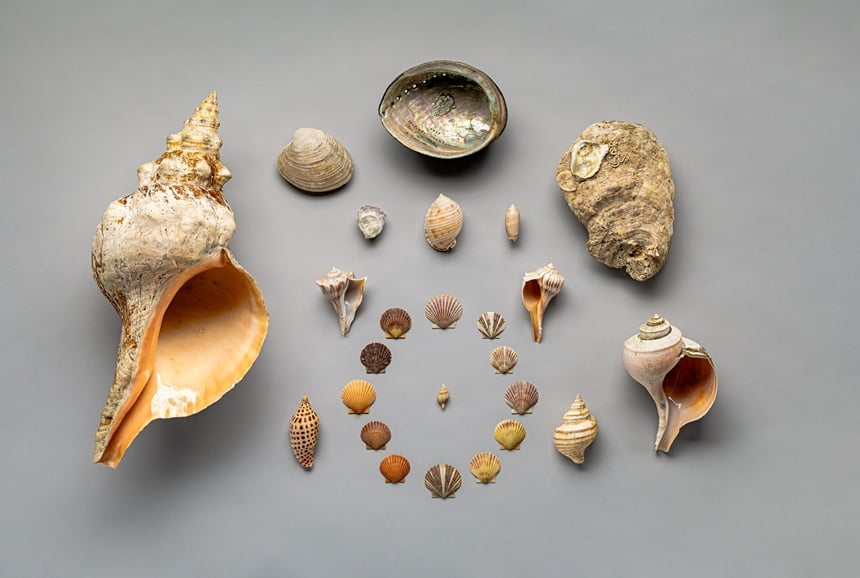
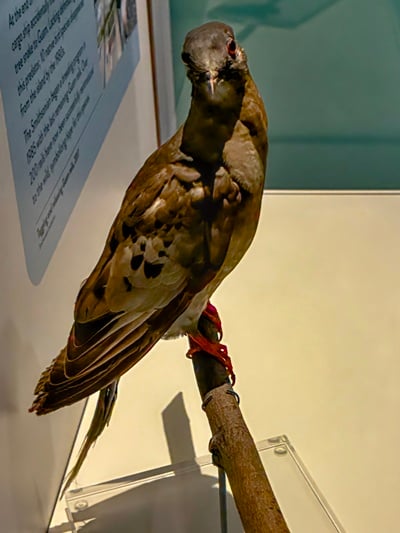
Significantly, the exhibition resists the obvious temptation to proclaim things like “IDAHO: Potato!” when, in fact, potatoes are grown everywhere. So, while the museum’s famous taxidermied specimen of Martha, the last known passenger pigeon, is credited to Ohio (where she died in 1914), the accompanying text clarifies that at one time passenger pigeons flocked by the hundreds of millions over most of the United States. Likewise, the exhibition’s traditional Hawaiian pupu lei contains shells that can be sourced throughout the Pacific. And a plains bison calf is labeled from Montana when everyone knows bison once spanned the nation as far east as, well, Buffalo, New York.
“That’s why our exhibit isn’t organized by state,” said Rick. “We wanted to emphasize that natural history transcends borders. We wanted people to realize how they fit into the natural world, no matter where they’re from.”
Still, I suspected, out of all these specimens there must be an exhibit that hits particularly close to Rick’s heart.
Yep, he confessed, there is one.
He led me to a glass case, near the exhibition’s entrance, dominated by a woman’s outfit: a plain tan skirt topped by a high-necked, elaborately decorated, frilled red blouse.
“We acquired this dress in the early 1930s,” said Rick. “It was made by a Choctaw dressmaker named Maggie Billie.”
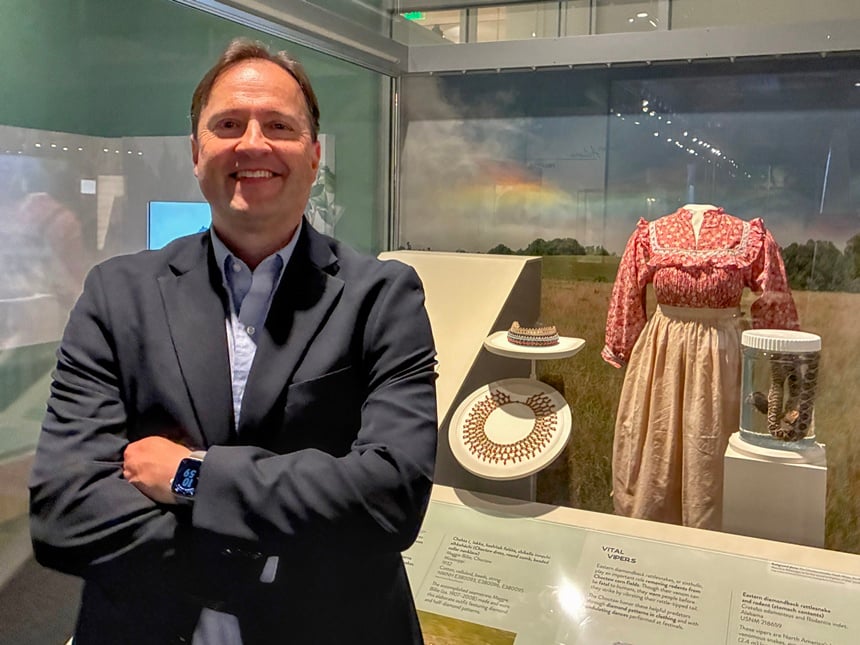
It’s a nice piece of handiwork, sure, but why include this dress in this particular exhibit? Rick drew my attention to the blouse’s flowery print, punctuated by diamond and half-diamond shapes – and then pointed out the horrible-looking creature preserved in a nearby jar.
“That’s a diamondback rattlesnake,” said Rick. “The Choctaw revered rattlesnakes, because they lived in the cornfields, protecting their crops from mice and other pests.
“Of course, they knew rattlesnakes were dangerous – but they also knew the snakes always warned people before biting by rattling their tails.”
Also in the display case is a recent photo of Billie’s grandson performing a ritual Choctaw rattlesnake dance.
“And this is why I love this particular exhibit,” said Rick. “It shows this enduring life-legacy; the connections between people and nature; indigenous knowledge and science.”
Rick smiled in the direction of the dress, a century-old connection.
“Yep,” he confirmed. “It’s perfect.”
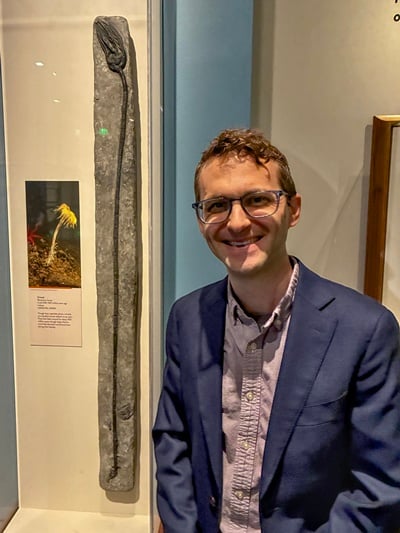
I found the exhibition’s other curator, Stewart Edie, admiring a 5-foot-high fossilized crinoid – a slender-stalked, plant-like animal that lived in the vast sea that once covered much of North America. Although the exhibited crinoid is attributed to Indiana, the sea bed it occupied 350 million years ago reached all the way through Texas to California, and you’ll find fossil remains all along that swath of land.
“What an amazing sight this must have been on the seafloor,” he told me, and I could sense him picturing the thing in real-life, swaying with the tidal currents. “Amazingly, they’re still around. But they’re just barely hanging on as an evolutionary remnant.”
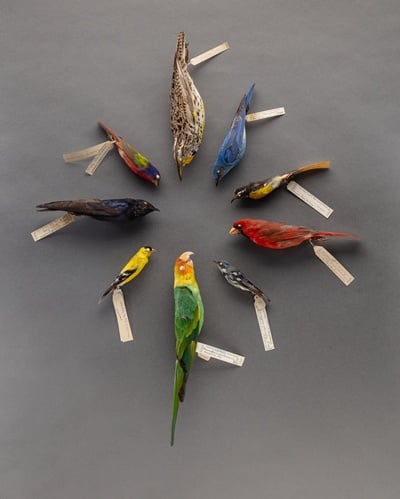
Perhaps the most inclusive of the natural world’s denizens are migratory birds, which we on the ground like to claim as our own on a seasonal basis, but which actually see the entire continent – and sometimes globe – as their home. On one wall of the exhibition hall, an enormous video screen traces the paths of tens of thousands of migratory birds – their hemisphere-spanning movements monitored using tracking devices placed on them by Smithsonian-affiliated researchers.
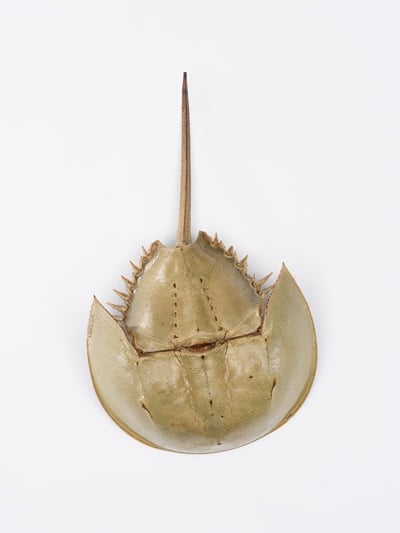
“All along the way, these birds impact the environments they pass through,” said Edie. “Take horseshoe crabs for instance. For millions and millions of years, these guys have been hauling themselves out of the ocean to lay eggs – and now, relatively recently in evolutionary time, these birds start showing up and gorging themselves on those eggs!
“It’s amazing how connected these systems are.”
Edie gestured to a case behind me, and there it was, in all its ugly, beastly glory: a Delaware horseshoe crab, its helmet-like shell and dagger-like legs making it appear as something of a cross between Darth Vader and the face-hugger creature in Alien.
I caught my breath. Nearby were enshrined a Maine lobster, a Mexican free-tailed bat from Oklahoma, an Oregon sea otter skull and the ghastly head of a Texas alligator gar.
But this guy; him I knew personally.
Hello, old friend. Fancy meeting you here.
Celebrating America’s 250th year, the National Museum of Natural History features a brand-new exhibition promising at least one object from every single U.S. state and territory.
Become a Saturday Evening Post member and enjoy unlimited access. Subscribe now