Bobbing between ripples of northern Montana river water, an inch-long, hand-tied fly – fashioned roughly in the image of a surface-skittering spider – is the focus of my attention. The brown-and-purple decoy, topped with a fluff of cottony fiber to keep it afloat, rests at the end of 12 feet or so of fishing line, much of which floats on the wavy water, then rises to my 8-foot graphite pole, its tip lowered close to the surface.
From there, the line loops its way along the pole, through a series of small metal hoops, passing below my trigger finger before winding onto a gray reel that clicks pleasantly whenever I turn its crank to either pull line in or let some out.
A breath of cool, early-summer air is floating downstream, pushing along the small oar-powered fishing boat carrying me and my guide, a cheerful fellow named Killion.
I’m watching that fake spider, which despite its artful design is really a glorified bobber. The real action is happening about two feet below, where cutthroat trout, rainbow trout, and whitefish are curiously inspecting my actual bait: an impossibly tiny imitation fly larvae; an 1/8-inch-long, hand-tied, hooked assassin composed of orange thread, gold wire, and three strands of pheasant feather.
Every 20 seconds or so, I pull my line from the water and flick the pole upward, sending line and lures flying back over my left shoulder. Trying to maintain a single, smooth motion, I swing the pole forward, propelling the assembly in front of me, hoping it will all splash down a good dozen or so feet from my side of the boat.
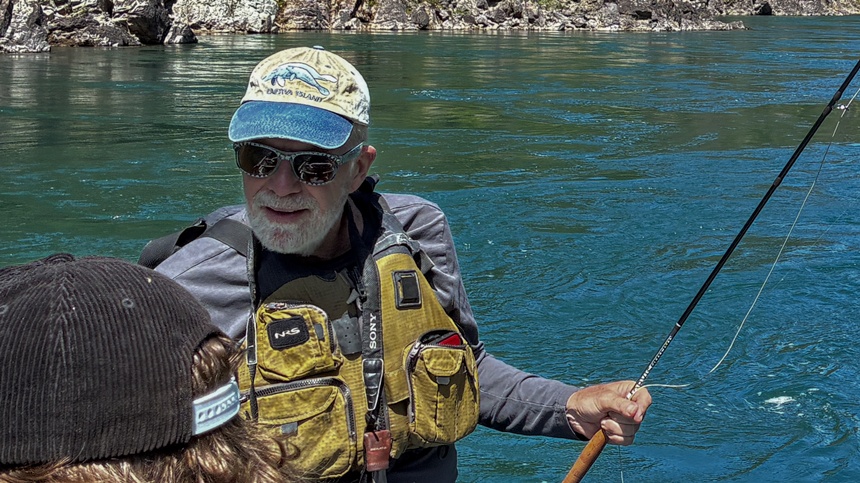
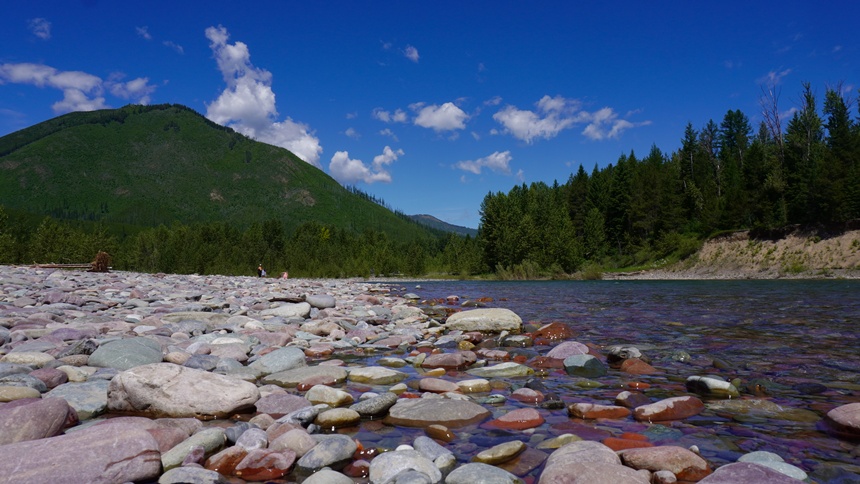
Between casts, I close my eyes and bathe in that breeze. Even through my eyelids, I can sense sunlight playing hide and seek among clouds and the peaks of Glacier National Park, the southwestern boundary of which lies just beyond the left-hand shore. Above the soft gurgle of the middle fork of the Flathead River, a song sparrow sings, a raven rages, and a western warbling vireo, well, warbles.
Please, I pray, don’t let this moment be ruined by some fish taking my lure in its mouth. But, as they say, God laughs: My trigger finger feels a soft tug. I open my eyes in time to see my surface spider lure sink into the drink.
“That’s a fish!” Killian exults. “Set the hook!”
Obediently, I jerk the pole upward. A flash of silver streaks, lightning-like, a few inches below the surface. Following patient yet urgent instructions from Killian, I raise the pole nearly to the vertical. From the waters, like a vacant-eyed Venus, rises a gloriously speckled cutthroat trout.
“It’s a nice one!” says Killian, raising a plastic net beneath the flip-flopping, 8-inch-long fish. “It’s got more cutthroat markings than most of the ones I’ve seen around here.” (Over the past few decades, invasive rainbow trout have been interbreeding with the native cutthroat, endangering the species.)
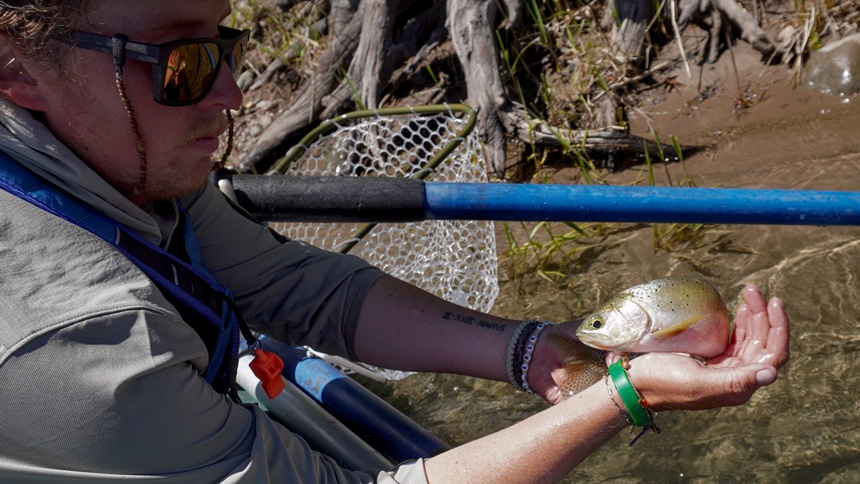
My non-barbed hook has already slipped from the fish’s mouth. A quick tip of the net and he’s gone, disappearing into the depths, no doubt wondering why in the world he falls for that ruse so annoyingly often.
This is, if you have not guessed, my first-ever experience fly fishing. I’d been expecting a deluxe A River Runs Through It-type idyll, wearing waders, standing knee-deep in a gently tumbling stream, lazily sending lures sailing to and fro among fluttering dragonflies.
I was, of course, fantasizing. Even in its wider, calmer stretches, the Flathead carouses through these mountain valleys faster than you might expect. So, I’m glad, for my first attempt at fly fishing, to be floating above the current instead of trying to stand, struggling as the river ran through me.
The pace is slow – almost glacial by the standards of my usual day-to-day whirl. But that’s the point in these parts: Whether you’re rambling on a river, meandering along the steady incline of Going-to-the-Sun Road, or awaiting the approach of a distant mountain goat, northern Montana is a place that reveals itself to you at its own whim, in its own good time.
The snow-dappled mountains of Glacier National Park, touched by clouds and ringed by tall forests, rise in the distance above the low-slung roof of Glacier Anglers and Outfitters, the expedition company that will be taking me out on the Flathead this afternoon. I’ve had a good night’s sleep and a hearty brunch at nearby Grouse Mountain Lodge in Whitefish, where a towering stone fireplace offered a comfy backdrop for a plate of Bananas Foster French Toast that left me uncharacteristically without words.
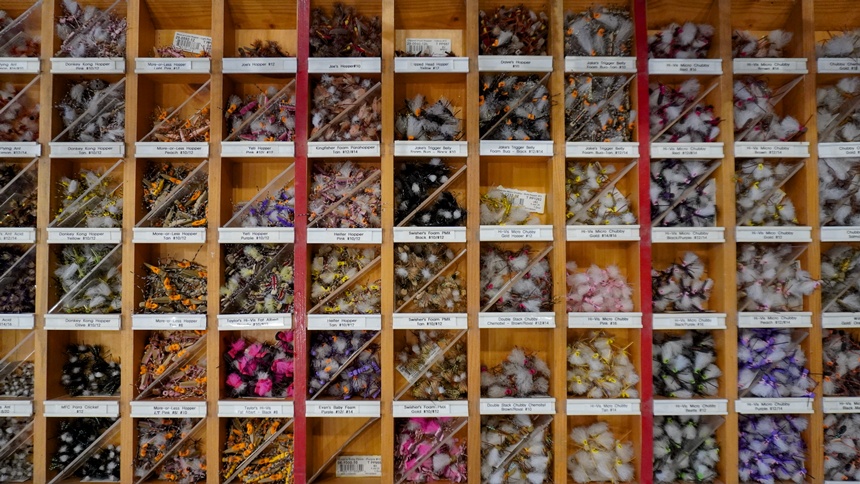
I’m seated in a covered dining pavilion behind the outfitting company’s headquarters, a little nervous about the uncertain adventure that awaits me – but mostly amazed at the contents of a book-sized plastic box that Derek, Killian’s fellow river guide, has carefully set on the table before me.
There, laid out like specimens in a Smithsonian display case, lay upwards of 100 teeny, hand-tied casting flies of varying colors and design, most of them no larger than a fingernail.
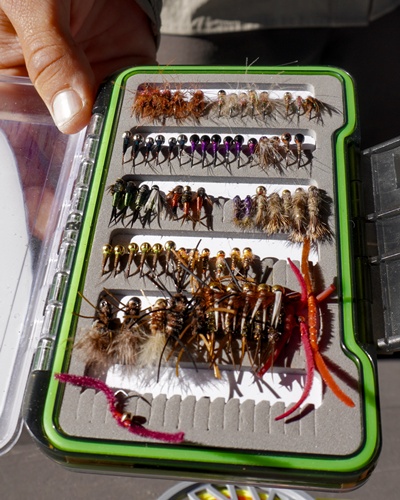
“I tied these ones down here,” says Derek, indicating the larger, more flamboyantly feathered samples. “Believe me, tying your own flies is neither a money saver nor a time saver. You do it because you love it.”
Tying a single fly, even for a sports person with a lifetime of experience, can take up to 15 minutes: meticulously winding orange thread around a hook, fastening fibers of pheasant feather, applying a length of gold wire, and positioning a metal bead to both add weight and simulate a fly’s head.
“You use a magnifying glass, right?” I ask.
Derek smiles. “Mostly, I just squint,” he says.
That kind of patience may seem positively unimaginable to city folk, but really, the only way to truly appreciate life in and around Glacier National Park is to throw your internal stopwatch into the nearest glacier runoff-fed stream and go with the tranquil flow.
Nowhere is this more true, I find, than within the boundaries of the park itself, climbing the steady ascent of Going-to-the-Sun Road – a two-lane, 3,200 feet elevation gain between Avalanche Camp and the Logan Pass Visitor Center. You’ve traveled a healthy length of this road yourself, at least cinematically, if you’ve ever seen Stanley Kubrick’s The Shining: This is the remote stretch Jack Nicholson and Shelley Duvall traverse in the opening scene, leaving civilization behind them as they head toward a not-so-pleasant winter at the Overlook Hotel.
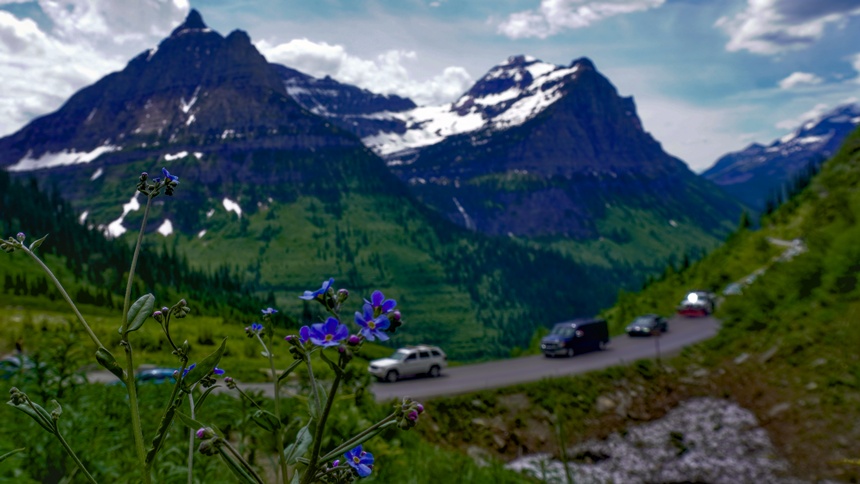
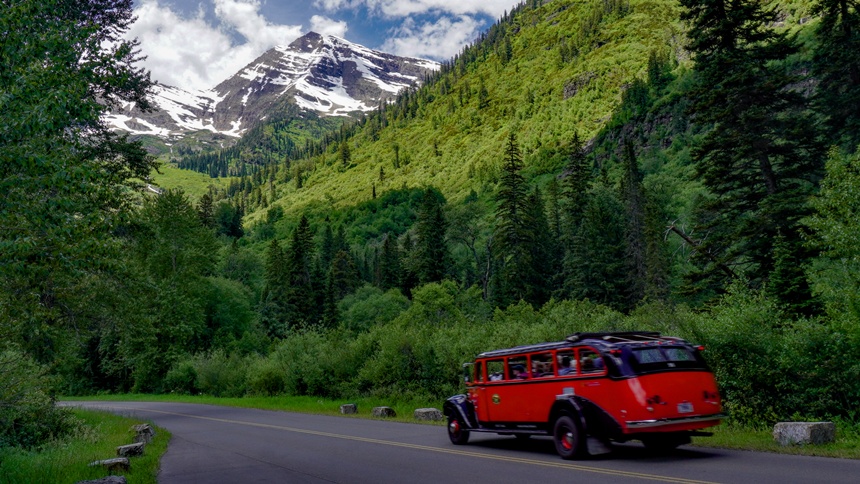
In the film, the family cruises along Going-to-the-Sun unimpeded; in real life you’ll most likely find yourself part of a 16-mile-long caravan; a seemingly endless train of cars and SUVs, each one containing a distracted driver and at least one passenger begging them to keep their eye on the road. (Since 1936, thousands of visitors have opted to be shuttled around the park in 25-foot-long car/bus hybrids called Red Jammers. More than 30 of those original vehicles – retrofitted with automatic transmissions in 1989 – are still navigating the park’s roads.)
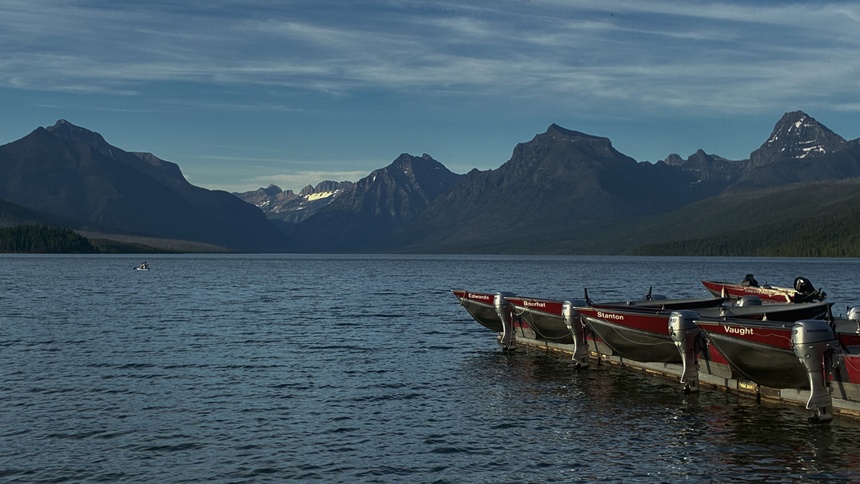
Start out at Apgar Village, a bustling little commercial center on the southern tip of Lake McDonald, impossibly clear with smooth, colorful rocks just below the surface – and a great place to grab a bite at Eddie’s Cafe, where since 1945 visitors have washed down their huckleberry pancakes with a draft huckleberry cream soda or a huckleberry margarita and finished it all off with a slice of huckleberry cobbler (huckleberries are big around here).
It doesn’t take long out of Apgar Village for the scenic jaw-droppers to begin. You may opt to stop at every single one of the dozen or so pull-outs along the way to Logan Pass, but don’t neglect the McDonald Falls overlook, where McDonald creek narrows into a rocky canyon, pushing through in a frothy, roaring torrent. A few miles beyond that, pull into the Avalanche Campground and take a leisurely stroll along the Trail of the Cedars, a one-mile loop – most of it easy boardwalk – through a towering cedar forest.
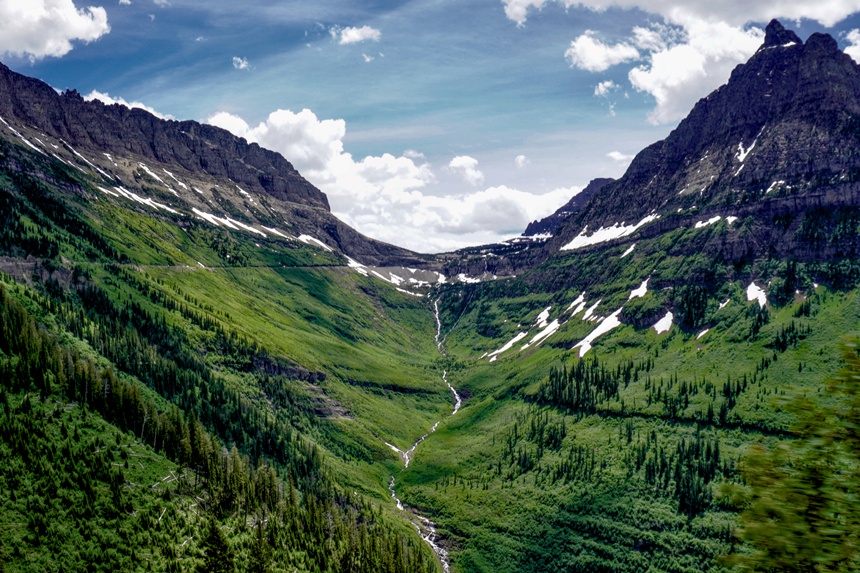
As the road curls ahead, a craggy cathedral of bare rock peaks punctuates the sky. Below, broad green valleys plunge to the banks of a meandering river that, from up here, resembles a dark blue crayon scribble.
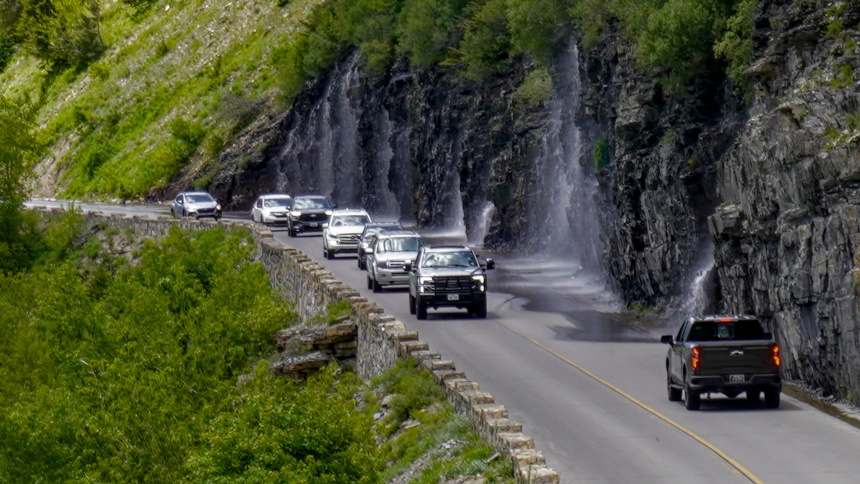
You’ll climb a lot higher – and make one breathtaking hairpin turn – before you reach the road’s most spectacular lookout: Bird Woman Falls Overlook. On the opposite side of the valley, some two miles away, you’ll spot – you guessed it – Bird Woman Falls, a 560-foot cascade that tumbles from a glacier-fed mountaintop stream. The falls are named for Sacajawea, the Lemhi Shoshone woman who guided Lewis and Clark on their expedition. Closer to your car window – almost close enough to touch, actually – are the gushing waters of the Weeping Wall, a 100-foot-long waterfall that splashes directly onto Going-to-the-Sun Road.
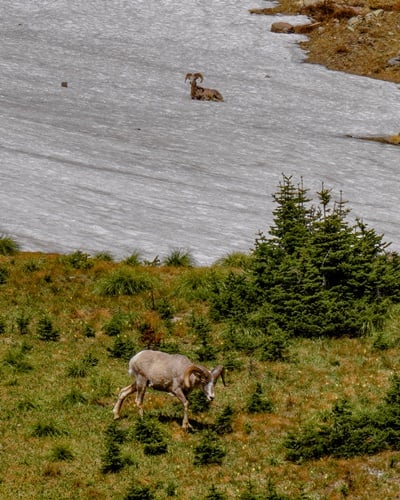
Your ascent to the sun ends at Logan Pass (elev. 6,646 feet), and good luck finding a parking space if it’s the middle of the day. Once you find a slot, be sure to walk the sprawling parking lot’s perimeter in search of Rocky Mountain bighorn sheep, which not only frolic on the icefields and grassy areas surrounding the site, but also occasionally wander down the sidewalk directly outside the visitor center. (Do obey the signs warning against getting closer than 25 yards. Those horns are made for ramming.)
You could continue on to Canada, which begins just a few miles down the hill, but most U.S. visitors turn around at Logan Pass and return to Apgar. And the truth is, the view going down at times seems utterly different from the one you gawked at coming up. You can’t go wrong stopping for dinner at the 115-year-old Belton Chalet, built as a lodge for the old Great Northern Railway (this is as good a place as any to dig into a plate of bison meatballs or elk sausage tortellini).
You can also, of course spend the night at the chalet; I chose to tuck in at West Glacier Cabins, a little village of adorable two-bedroom mountain homes just outside the park gates, each with a comfy interior and a colorful pot of flowers hanging on the front porch.
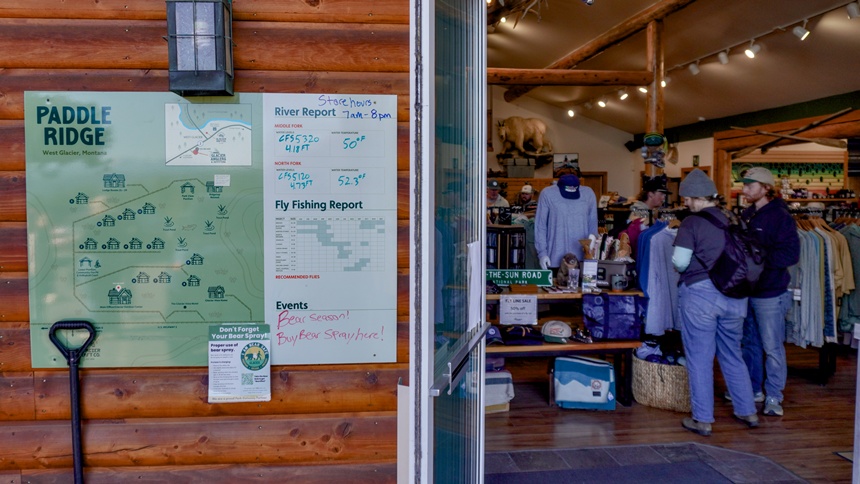
The cabins are also located right in West Glacier Village, where Glacier Raft Company puts in on the Flathead River. On my last full day at Glacier National Park, I once more cast off into the leisurely Flathead current, this time on a raft trip that asks me to wield not a wobbling fishing pole but a sturdy paddle.
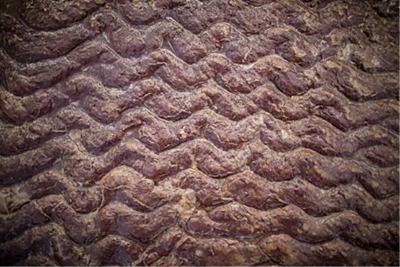
The occasional rapids are fun and decidedly non-scary, but my favorite moments crawl by as the raft drifts lazily along with the current, passing dramatic rock formations with curly patterns marking eons of sedimentation. Beneath the sun-dappled surface I catch occasional glimpses of the same fish whose watery idyll I’ve so recently tried to disturb.
A shadow catches my attention. High above, between me and a brilliant disk of sun, a hawk is catching an updraft that seems to leave it hanging suspended in the sky.
Slow and easy. Both up there and down here, a perfect Montana morning.
Bill Newcott shares scenes from Glacier National Park (Video courtesy of Bill Newcott)
Become a Saturday Evening Post member and enjoy unlimited access. Subscribe now