On the broad lawn that spreads between Cooperstown’s century-old Otesaga Resort Hotel and the emerald blue waters of Otsego Lake, a grandfather and his grandson are playing catch. The boy’s new Rawlings glove is shiny and stiff – his small hand can barely fold the unforgiving leather when the ball comes slapping into the pocket.
The man’s glove, though, has been through it; dark and oiled, pliant as a rose petal, a faded Carl Yastrzemski signature barely visible just above the heel. Granddad proudly points Yaz’s autograph out to me when I approach him after walking down the long stone stairway from the Otesaga’s wide rear veranda.
He lives in Utica, the small upstate city 40 miles north of here. “My grandson and his family live in Tucson,” he says, motioning his glove toward the boy who is now impatiently awaiting the next toss. “They’re up here for a week. I thought he should see the Hall.
“And what better place is there to play catch?”
“The Hall,” of course, is the National Baseball Hall of Fame, a few blocks away. Granddad sends a ball gently arcing toward the boy, and I can tell by his delivery he could sizzle it in there if he wanted to. But baseball is a sport that can be uniquely modulated. And Cooperstown is all about measuring out those moments.
It is probably no coincidence that the Plaque Gallery of the National Baseball Hall of Fame – the room where the sport’s ordained saints are honored with bronze memorials – resembles the interior of a medieval cathedral, right down to the arched nave that perfectly frames the relief portraits of the Hall’s founding fathers: Cobb, Ruth, Wagner, Mathewson, and Johnson.
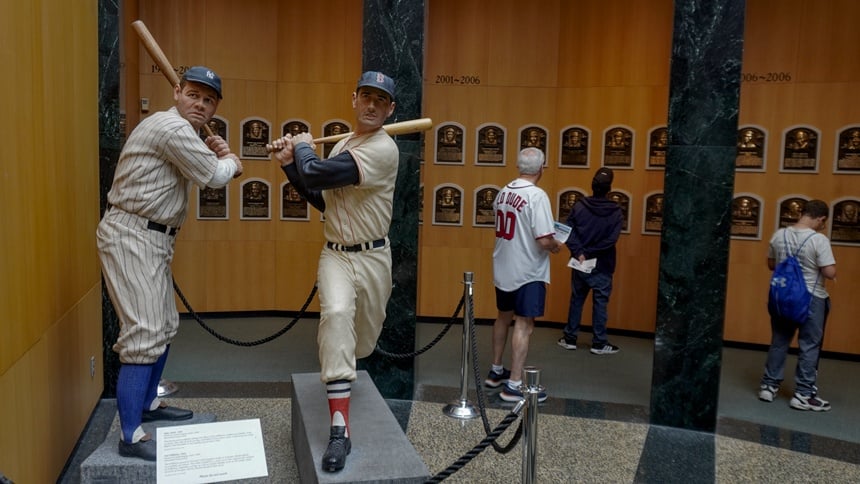
The faithful pilgrims from around the globe speak in respectful, hushed tones. Softly, they read the inscriptions aloud, resisting the temptation to run their fingers across their heroes’ graven images. (As in European churches, there are staff members on hand to whisper, “Please don’t touch.”)
Elsewhere in the three-story museum, lightly used baseballs, lovingly preserved uniforms, tar-caked bats, and scrupulously curated videos trace the history of the game that was, legend has it, invented on a field just a few yards from here, by a fellow named Abner Doubleday (even the Hall acknowledges the Doubleday myth is, most likely, just that).
The Hall of Fame is so thoroughly synonymous with its home town that any given fan will most likely celebrate their hero being enshrined “in Cooperstown,” and leave out of the name of the museum altogether. But this upstate New York village with a three-block downtown was well-known even before the game was hatched, as the home town of James Fenimore Cooper, the man who in the early 1800s invented the American novel with his “Leatherstocking Tales” (his father founded Cooperstown).
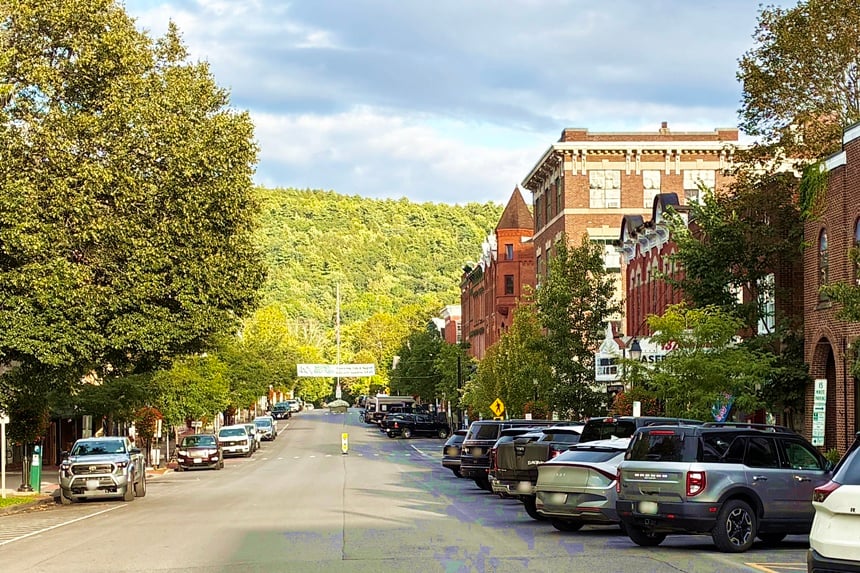
Even for those who don’t know a balk from a base on balls, Cooperstown’s rich history, thriving cultural institutions and gemlike setting warrant a visit that’s much longer than the time it takes to park the car and tour the Hall of Fame. Stick around a few days, and you might not be so anxious to slide back home.
The Other Baseball Museum
You won’t find columns much more impressive than the three-story giants that support the portico of the Otesaga Resort and Hotel, which has been welcoming visitors since 1909 – 30 years before the Hall of Fame opened. Even if you don’t stay here, and instead opt for one of Cooperstown’s many bed and breakfasts or a budget-friendlier hotel a short drive away, you owe it to yourself to sample this taste of classic lakefront elegance.

It’s here that every member of each year’s new Hall of Flame class stays on induction weekend. Don’t ask who stayed in your room – the hotel staff won’t tell you. But that may be just as well; at night you can go to sleep wondering if you’re staring at the same ceiling Hank Aaron, or Mickey Mantle, or Willie Mays did one summer long, long ago.

Don’t leave the Otesaga without stopping at the exhibit of wine glasses that sits in two large display cases just outside the entrance to the hotel’s Hawkeye Bar and Grill. Every year, a stemmed glass engraved with the name and uniform number of each new Hall of Fame inductee is placed in the display. When a player passes away, a white rose is placed in his glass. After a year, the rose is presented to his family.
On this day, there is a white rose in the glass of Pittsburgh Pirate Bill Mazeroski (Number 9), whose legendary 1960 World Series home run buried the hated New York Yankees. I glance at my wife, Carolyn, a Pittsburgh woman. She’s not a particular baseball fan, and she was just 3 when Mazeroski hit his shot. But her eyes linger on that glass and rose, and I have to tug at her arm to move on. That’s baseball for you.
The Other Archive
The Hall of Fame’s mammoth archive is open to researchers – which is to say if you show up asking to see a particular document, someone will head back into the stacks, find it, and bring it out for you to review in a brightly lit, long-tabled room. (This is the point at which I immodestly mention that a photograph I took of a half-empty, yet “sold out,” Dodger Stadium on Jackie Robinson Day in the middle of COVID-19 resides in the Hall’s permanent collection.)
Still, for those of us who envision archives as catacombs choking with the scent of ancient paper, and who imagine ourselves, Indiana Jones-like, blowing the dust off long-unopened volumes, I’ve found the perfect spot, just a few doors down from the Hall.
You have to venture down a narrow passageway and past a baseball-cap-and-tee-shirt shop to get through the open door of Willis Monie Books. But long before you set foot in the place, you’ll sense its still, pleasingly stagnant air. Then comes the sight you’ve already braced yourself for in this cavernous former car dealership: row upon row of old books on wooden shelves – from your initial vantage point mostly baseball books – disappearing into the distance in converging columns. On the endcaps of each shelf hang baseball photos and baseball-related ephemera. Some of the players represented seem familiar enough – I spot my childhood hero, Mickey Mantle, on a rookie bubblegum card. Others are way before my time. Some before my father’s time.
A digital island in this analog ocean is a bright blue computer screen, set on a desk that is otherwise piled high with books and papers. A young woman is busy at a keyboard, typing in queries and pulling up data. I ask if I could, perhaps, speak with the owner.
She turns from the screen and smiles.
“I’m the owner,” she says. Her name is Emily Baker. She is 24. And Willis Monie Books, in business since 1975, has been all hers for almost one month.
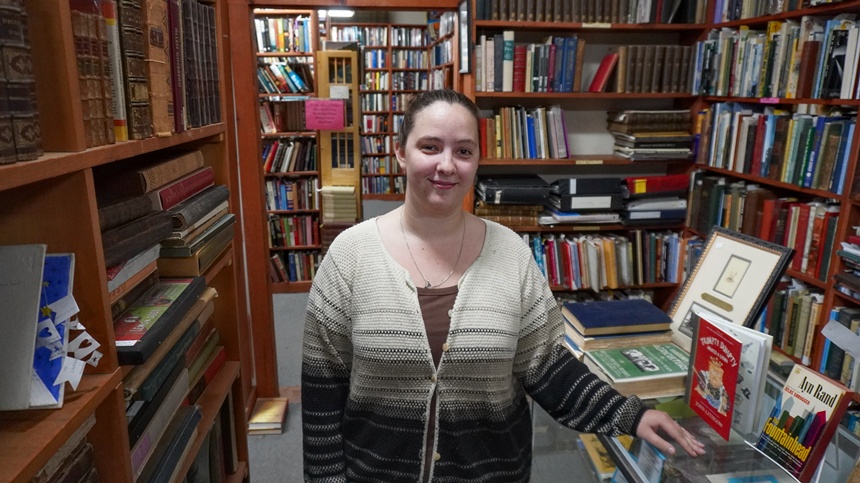
“I started working here when I was 15,” says Emily, stepping out from behind the computer. “And I just never left.”
She grew up not far from here, on her family’s dairy farm. Emily’s brothers still work there.
“When we were kids,” she recalls, “if we were good in church, my brothers got a donut from the bakery on the corner.” (That would be Schneider’s Bakery, which has sat at the same spot since 1887. Get the cinnamon roll. You’re welcome.) Emily’s good behavior reward, on the other hand, was uniquely hers.
“I’d be allowed to come in here and get a book,” she laughs, looking around.
In recent years, store owners Willis Monie and Willis Monie Jr. decided it was time to sell the business. No one else in the family was interested, so they asked their longest-tenured employee if she’d be interested. She was.
“Willis Senior still works here,” Emily says, her eyes so wide I can see the white all around them. “He works for me!”
Willis Monie Books isn’t exclusively stocked with baseball volumes, but understandably that’s what most people come in looking for. That’s why the baseball portion of the inventory is stacked near the front door. But Emily is happy to accept all kinds of books from people’s estates – so long as they’re not recent mass-market mystery paperbacks.
On that computer, Emily says, some 384,000 listings are accounted for.
That’s a lot, I say. That’s nothing, she says.
“We estimate there’s probably close to a million items here.”
That’s a lot of books, and I sort of feel like Emily would like to personally set her hands on each and every one of them. I observe that she seems like an old soul.
“A lot of people say that,” she smiles. “Cooperstown is a good place for old souls.”
The Very Old Apple Press
For those of us who can’t keep a refrigerator running longer than eight or nine years, the notion of a machine that’s been cranking away since 1889 defies imagination. Yet every fall, Bill Michaels dusts off his enormous apple press, straps on the massive drive belt, drops a turbine into the rushing waters of Fly Creek – and gets to work crushing and pressing apples to make apple cider, apple juice, apple butter, apple-cinnamon barbeque sauce, apple jelly, apple salsa, apple fudge…by now you get the idea: If there’s a product you can fashion from crushed and pressed apples, Bill Michaels will fix you up.
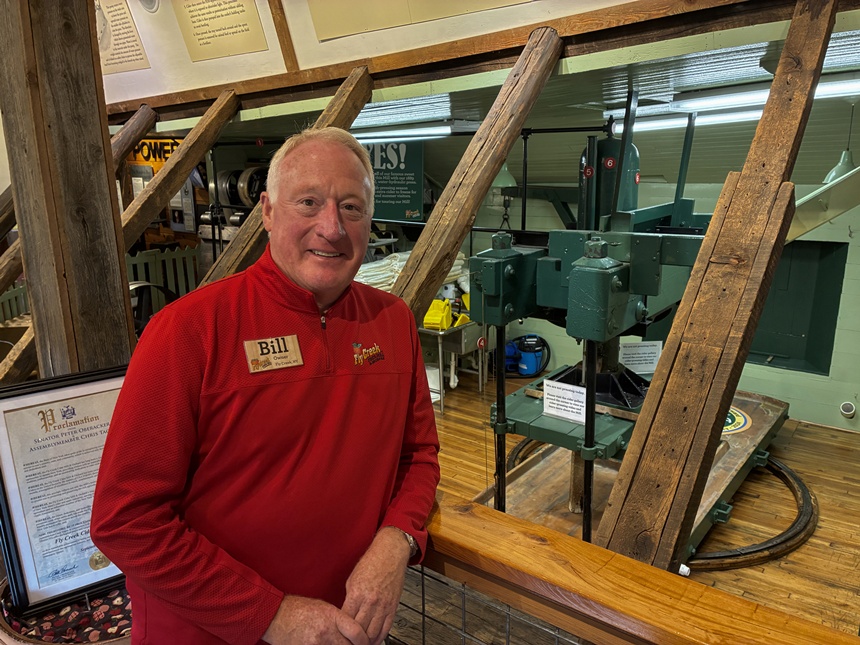
But mostly, since the time Benjamin Harrison was president, Fly Creek Cider Mill has been about apple cider, made the old-fashioned way. Apple growers from all over upstate New York send their crops to Michaels, and from September to November, his press – applying some 1,500 pounds of pressure per square inch – mashes, smashes, and generally mutilates them.
“We make 20,000 gallons of cider a year,” says Michaels, resting one arm on the circular metal tank that houses the turbine. At one time there were no fewer than eight apple pressing mills on Fly Creek. Michaels’ is the last one standing.
Michaels’ parents bought the mill in 1962, mostly because they were charmed by the house that came with it. Dad was a carpenter; mom was a high school art teacher. The apple thing started out as a hobby and grew from there. Bill left Cooperstown to go into the hospitality business, but when his parents retired, the lure of the mill proved irresistible.
In terms of local tourism, Fly Creek Mill is pretty much a perfect fit, and not just because it’s a seven-minute drive from downtown Cooperstown.
As the summer winds down, Michaels tells me, “We’re turning off baseball in a couple of weeks – and the next week we’re turning on apples.”
The Fenimore Museums
I’ve never gone along with the revisionists who want to stuff James Fenimore Cooper into America’s cultural dustbin, embarrassed by what they see as his problematic depictions of Native Americans. Cooper’s critics emerged early — Mark Twain issued one of the most savage attacks in literary history against him: “Cooper has scored 114 offenses against literary art out of a possible 115. It breaks the record.” For my money, as examples of pre-Civil War imagination, capturing the moment when Americans were truly beginning to cast their gaze to the West, Cooper’s Leatherstocking Tales remain essential reading.
Two very different museums at the northwest end of Cooperstown, built on the author’s former estate, bear Fenimore’s middle name. The Fenimore Art Museum, founded in 1899, offers a permanent collection of American art including works of Grandma Moses, Gilbert Stuart, and Benjamin West – plus an expansive collection of Native American art.
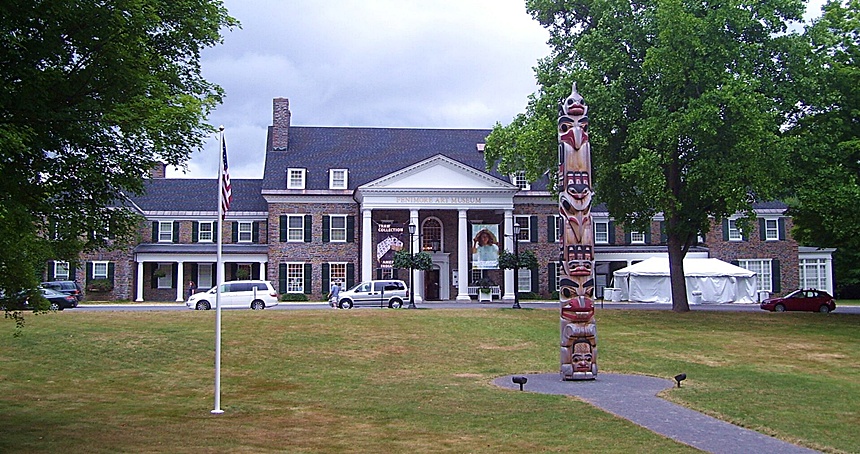
The museum also frequently focuses on photographic art: A recent visiting exhibition, taking up most of the museum’s lower floor, was a retrospective of images by Linda Eastman McCartney, the late wife of Paul McCartney.
If art galleries aren’t your thing, then may I direct your attention to the Fenimore’s sister museum, right across the street from the art gallery: the Fenimore Farm and Country Village. There have been animals and crops on this land since 1813, when gentleman farmer James Fenimore Cooper owned it. Today, besides sheep you can pet and pigs you can oink at, the grounds are peppered with some two dozen historic buildings, moved here from all over upstate New York and restored.
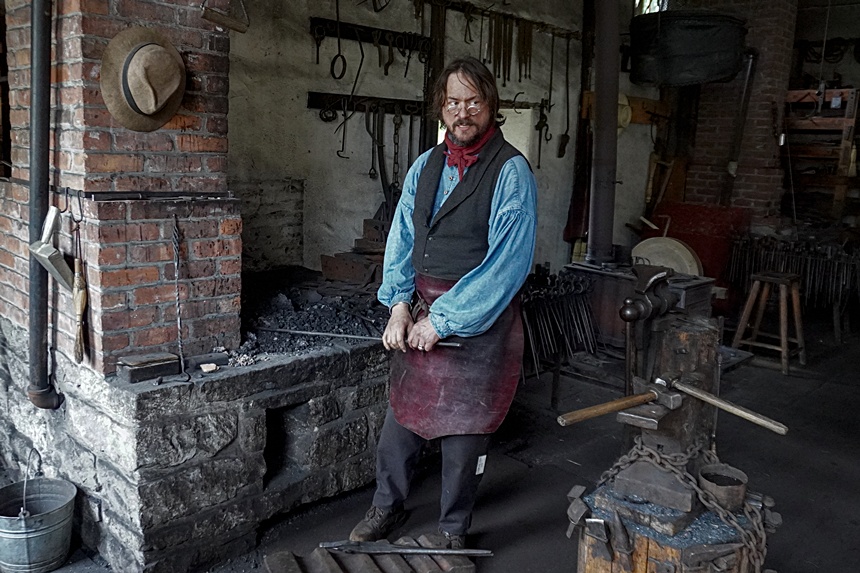
The doctor’s pharmacy is fully stocked with 19th century remedies for what ails you. The doctor’s office seems only slightly less scary than the blacksmith’s shop, where a real-life smithy keeps coming perilously close to a 2,500-degree forging fire – distractedly chatting up observers with apparently no concern whatsoever.
But far and away, the best exhibit at the Fenimore Farm and Country Village lies right near the front door: Because here lies the one and only original Cardiff Giant.
I had actually forgotten the Giant was here, and could not have been more delighted to find it. I’d heard about this guy since childhood: the first great mass hoax in American history (and since then given a healthy run for his money).
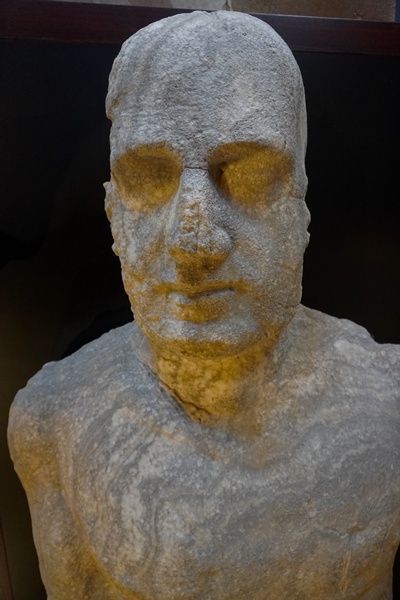
The Cardiff Giant is a 10-foot-long reclining “petrified man,” dug up in 1869 by a team of workers excavating a well in Cardiff, New York. A nationwide sensation resulted, billed by some as proof-positive of giants that, according to one Biblical account, once walked the Earth.
For three months, the Cardiff Giant toured the Northeast, netting up to 50 cents a peek – an astronomical sum at the time.
Finally, a tobacconist named George Hull admitted that the whole thing was a fake. And an elaborate one it was: Hull had hired workmen to quarry a block of gypsum in Iowa, then had a Chicago sculptor fashion a human figure from it. Secretly shipping the statue to Cardiff by train, he had the thing buried behind a barn, then waited a whole year while the grass grew back above the hole. Finally, he hired men to dig a well on the very spot where the giant lay, knowing their equipment would hit it.
In the end, Hull had invested not only well over a year of his time to the hoax, but also the present-day equivalent of $63,000. His motivation: A religious skeptic, Hull simply wanted to prove that people will believe just about anything.
Prominent signs in the museum warn against touching the Cardiff Giant – a nigh impossible ask. I stand a safe three feet away, then walk its length, admiring the chemical stains and pockmarks Hull had added to give the appearance of prehistoric vintage.
The Cardiff Giant is pure Americana: A big dream that people were all too happy to believe.
And a fitting resident of a town that is, in every imaginable way, quintessentially American.
Become a Saturday Evening Post member and enjoy unlimited access. Subscribe now



Comments
During July and August the Glimmerglass Festival with 4 operas is a must. We remain in Cooperstown after the HOF Induction ceremony to attend 2 operas on Monday and Tuesday
Thank you for your Cooperstown travelogue. I make a pilgrimage every fall around World Series time. It allows more room to leisurely stroll around the many attractions. I discovered the Willis Moniz bookstore on my last visit and it was a baseball purist’s dream.
I also recommend visiting the village library across the street. It also houses a small art gallery.
And get your post cards manually stamped with the Cooperstown postmark when sending out those Hall of Fame plaque postcards to your friends back home. You must go to the window for that; otherwise they go to a regional facility and that facility’s city bears the postmark.
Don’t forget to visit the mural as you enter the lobby.
It’s a great little village that you never get tired of.