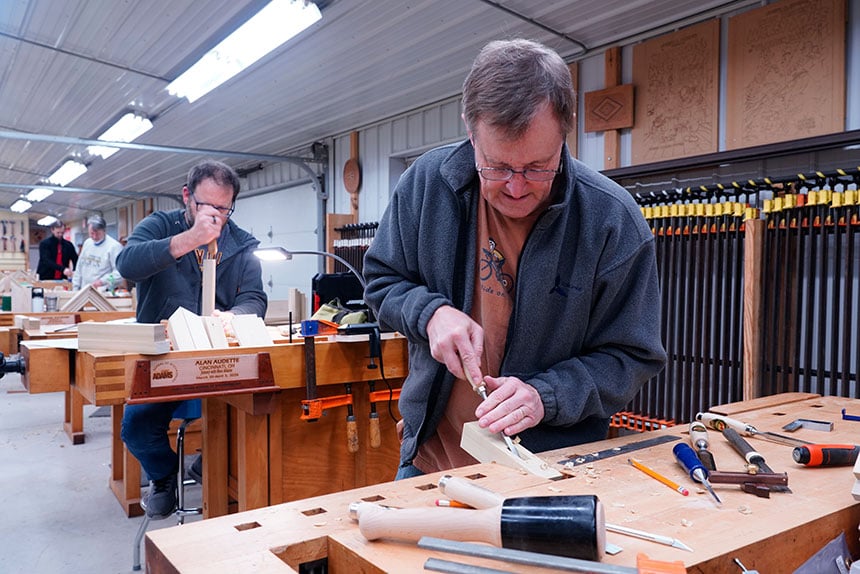
My dad was an amazing woodworker, but an admittedly poor teacher. After he passed, I inherited many of his tools and foolishly sold more of them. In the years since, I’ve gotten more serious about my carpentry hobby, but have relied on YouTube videos for guidance, with mixed amounts of success. Luckily, I discovered an alternative practically in my backyard.
About 40 minutes south of Indianapolis lies a small campus of mostly interconnected buildings, surrounded by cornfields. It doesn’t look out of the ordinary save for the large sign on the side of a building touting the Marc Adams School of Woodworking. The surrounding parking lot is packed and filled with license plates from all over the U.S. — New Mexico, California, Washington, Illinois, Michigan, and more.
On Monday morning, I walked into my classroom for the week; the room was about 40 yards long with two rows of 10 benches on either side. Fluorescent lights shone down. In an even larger adjacent room stood more power tools than I’d ever laid eyes on in one space. Rows of bandsaws, sanders, drill presses, routers, and more. It was enough to make Bob Vila envious.
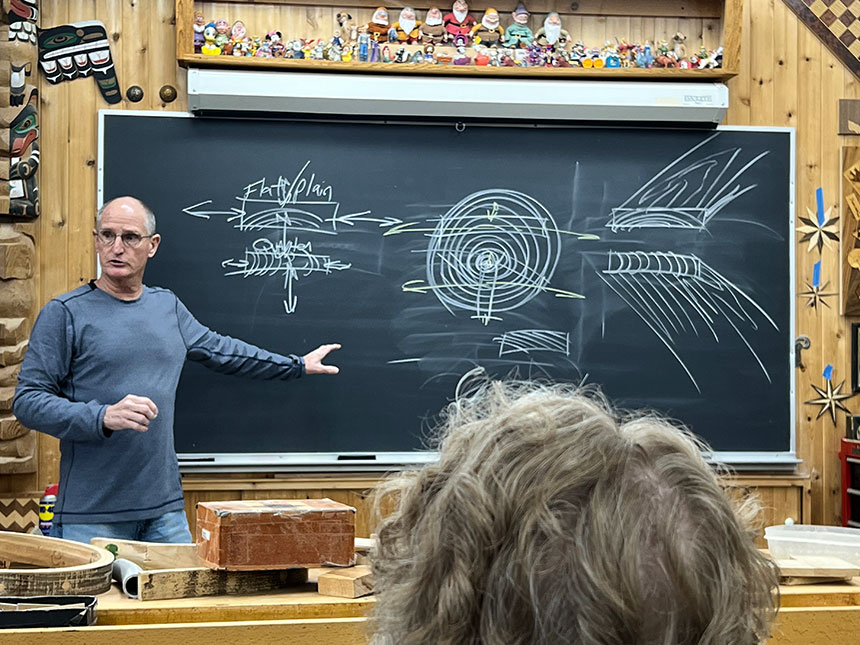
At the front of the classroom was another workbench, a row of folding chairs in the front and a chalkboard behind. At the chalkboard stood the man himself, Marc Adams. Adams is wisp thin and balding, wearing glasses and Hoka running shoes. He looks like a stereotypical college professor, and, in reality, that’s not far from the truth; he has a master’s degree in education. He’s taught woodworking skills across the U.S. and the world, writing multiple acclaimed books and magazine articles. The joinery class I was taking would feel like a Ph.D.-level woodworking course, while I’d barely earned a metaphoric GED.
“My goal with our classes has never been to teach someone how to make a specific item,” Adams says. “We’re teaching technique that over the course of a week can transform your skillset as a woodworker.”
“Watching woodworking videos on YouTube,” Adams continued, “you not only don’t know the credibility of the person teaching, but you’re also missing the personal interaction with the instructor. We can give you immediate feedback, and so can the other students in the workshop.”
Despite Adams’s somewhat “stern headmaster” vibe, that couldn’t be more different than his actual personality. He has a very wry sense of humor and radiates positivity like a nuclear reactor emitting unicorns and puppy dogs. When a student asked a question about a half-lap joint, he burst out into a massive grin and began excitedly sketching it out on the blackboard.
Adams’s joinery class is one of his namesake school’s most popular courses; he estimates he’s taught thousands of woodworkers how to create half-blind dovetails, angled mortise and tenons, and splined miter joints. The goal, he says, is to learn techniques that will transform what might be a regular piece of furniture into a detail-laden heirloom piece that will be handed down from generation to generation. Although my wife and I don’t have kids — the first time Dee met my family, she rightfully determined that my genes shouldn’t be passed on — I’d love for my projects to be fought over by my extended family and friends. Whether I was actually up for the challenge was another story.
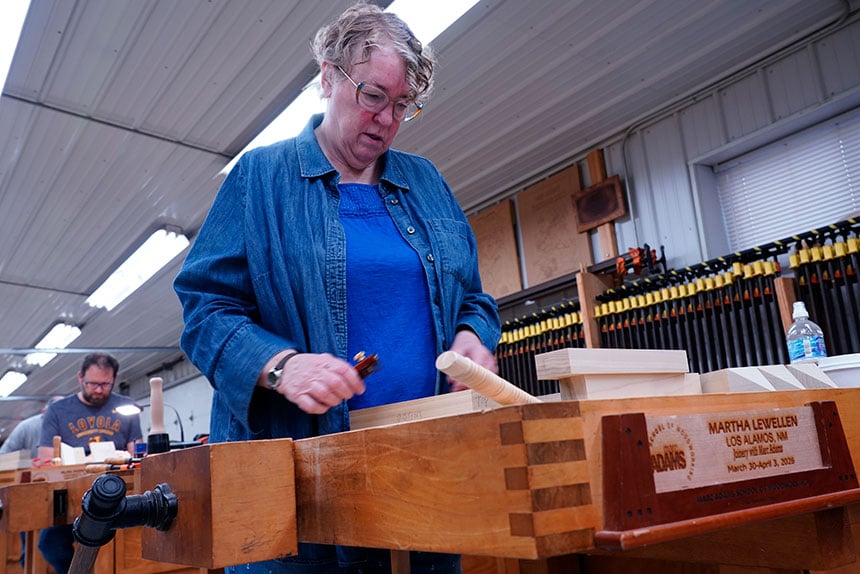
Classes were slated to begin each day at 8 a.m. After arriving late on Monday, I was determined to be the first one in class the next morning. Arriving at 7:30 Tuesday morning, the classroom was already abuzz with activity. Most of my classmates were sharpening their chisels, cutting practice dovetails, or otherwise elbow deep in woodchips.
The pace of the class could be charitably described as “breakneck.” A typical day began with Adams demonstrating a joinery technique, such as a sliding dovetail, with us “oohing” and “aahing” and then trying to copy it for about an hour, with varying degrees of success. Repeat ad nauseum.
Our first task was creating a simple dovetail; basically cutting the ends of the wood boards at tight angles so they fit together like jigsaw pieces. The goal is for the dovetails to be so close-fitting that the boards can stick together with no glue or screws. Precision is key: Cut them too tight, you can’t attach the pieces. Cut them too loose, they won’t hold together and will look sloppy when glued together. My pieces had gaps the size of Rhode Island. I’d never done chisel work before, and it showed. Between my natural impatience and the cheap Amazon tools I’d bought the week before, I was taking off thick chunks and not thin slices, as we were taught.
“It doesn’t matter your skill level,” Adams said, seemingly seeing the flop sweat on my brow at the end of the first day. “Work at your own speed. The only thing that matters is being able to put things together at the end.”
Adams’s assistants, all master woodworkers themselves, stalk the aisles, silently observing our work and offering tips if they see students struggling. I have no issues admitting I struggled. Several of my more experienced classmates were producing practice joints that looked nearly professional, while my work looked like a kindergartner on a sugar bender had discovered a saw for the first time.
Because the nearest restaurant was a gas station serving hot dogs on rollers, the school has its own cafeteria. It was another throwback to the past — standing in line, grabbing a tray, taking the pre-plated meal — protein, starchy side, vegetable — and going to sit at a table with your new friends. It was just like middle school, except we didn’t exchange slap bracelets or mix tapes between bites. Instead of stretching out every moment we could gabbing at the lunch table, we all rushed back to our benches to continue working and learning.
Class officially ended around 6 p.m. each day, but few of us left. The out-of-towners had no place to be other than a lonely hotel room. I was just trying to figure out how everything I worked on turned out so wrong.
On Wednesday night, we had a two-hour presentation about glue. Yes, glue. And while that might sound as fun as watching glue dry to the lay person, the conversations dragged on to nearly 9 p.m. as the enraptured stragglers tossed very specific questions at the guest speaker, like the best cross-species of wood to adhese together or the best temperature and humidity to ensure perfect bonding. It’s fair to say students are obsessed.
The average age of the class is between 55 and 65, Adams says, which is confirmed by the number of grunts when the class stood up from their folding chairs.
“Most students have highly stressful jobs, and this school is their place to get away and be with people who share their passion for creating,” Adams says. “At any given time, we have more doctors on our campus than our local hospital.”
We only had one doctor in my class, but four electrical engineers. There were a couple of retired college professors, including one who was working on a book about trench warfare in World War I. Nearly all of the students had taken multiple courses before this one.
“I’d done mainly machine work before this,” says Chris Hofman, a student from Chicago. “Learning these hand-tool skills from talented instructors in a very supportive atmosphere has been an incredible experience. I loved being able to collaborate — and commiserate — with the other students. It’s been an overwhelming experience at times, but a fantastic one as well.”
Martha Lewellen, from Los Alamos, New Mexico, was a set builder for the Goodman School of Drama back in the mid-to-late ’80s but had gotten away from hammers, becoming a stage electrician for traveling productions. She eventually found her way to the MASW through a glassblowing class, and her love for building and creating was sparked anew. On her workbench, her chisels and tools are neatly mounted on a plywood holder that she built herself specifically for these classes. She’s attended more than 20 classes at MASW since 2019, driving two-and-a-half days each way to get there. For her, every class is like the first day of school.
“I’ve taken so many courses,” Lewellen says, “there’s almost always someone I know in each new class. It’s so exciting to see those familiar faces. I stay in touch with some and have shared Airbnbs and hotel rooms with them. It’s the most fun you can have in the middle of a cornfield in Indiana.”
Now retired, Lewellen says the skills she’s learned have unlocked levels of confidence she didn’t know she possessed.
“This school has given me the ability and courage to create my own designs and [actually build them],” Lewellen says. “I can sign up for a class like this and know that I can figure out how to do joinery.”
This year, MASW will offer more than 270 different classes, typically up to six a week. For beginners, Adams recommends basic woodworking or cabinet-building classes, as well as courses on hand skills and, yes, joinery. In addition to woodworking, the school has a wealth of other classes, like glassblowing, blacksmithing, and even the science of chocolate. Adams’s plan for the school’s future includes lodging for students, additional culinary classes, and courses in gardening.
Adams admits that, in 35 years or so of teaching, he has seen a handful of students who he felt “may do much better in photography.” (As a professional photographer myself, I tried not to be offended.)
Adams is taking a step back this year, handing off the day-to-day aspects of running the school to one of the instructors, so that he can do something he’s never done before: take a class himself.
“I’m always getting pulled away,” Adams says. “I’ll be listening in on a class when someone tells me, ‘Marc, the toilet’s backed up.’ I’ll still be involved with what’s happening at the school, but now I can hopefully take some time and learn myself.”
On Thursday, we had our big challenge: Inside a manila envelope we picked at random was a joint that we hadn’t covered yet in the class. We had two hours to re-create it with absolutely no help from any of the instructors. I was tasked with creating a bridle joint, two interlocking pieces of wood with the secondary piece askew; imagine a diamond superimposed over a rectangle, with the top and bottom of the diamond sticking out.
Luckily, the solution was pretty easy to envision, but the execution was a different story. I spent the first 20 minutes trying to figure out a jig that would allow me to save time using the bandsaw to make my cuts. Then I decided the quickest time saver would be to cut out the middle with a handsaw, then chisel out the excess. It took me 15 minutes, less time than I took trying to figure out an easier way to do the cut.
I was able to quickly cut out the mating top piece with the bandsaw, then spent the rest of my time trying to friction-fit them together. The end result wasn’t the prettiest, but I was happy with it. Presenting it to the class, I felt a sense of accomplishment, like I’d actually proven that I’d learned something during the week.
As the week progressed and chisels slipped, I saw more and more Band-Aids on the hands of classmates; with dozens of tiny slices from my chisel work, my index finger looked as if I’d spent the last five days working in a petting zoo for feral cats. But I also noticed a confidence among us all that was lacking Monday. That included me.
I was far from the best student in the class, but I was still miles ahead of where I had been just a week earlier. I learned so much from Adams and the other instructors that I’m considering taking another class to further improve my skills. I may not be ready to build a Sam Maloof-inspired rocking chair yet — shout out to all the woodworkers reading this and nodding their heads — but friends and family can probably expect to receive a nicely dovetailed box this holiday season … assuming I keep practicing.
To learn more about the school, visit marcadams.com.
Robert Annis is an award-winning outdoor-travel journalist (and certified bear guide!) with work appearing in National Geographic, Outside, Sierra, Men’s Journal, and the Chicago Tribune.
This article is featured in the July/August 2026 issue of The Saturday Evening Post. Subscribe to the magazine for more art, inspiring stories, fiction, humor, and features from our archives.
Become a Saturday Evening Post member and enjoy unlimited access. Subscribe now