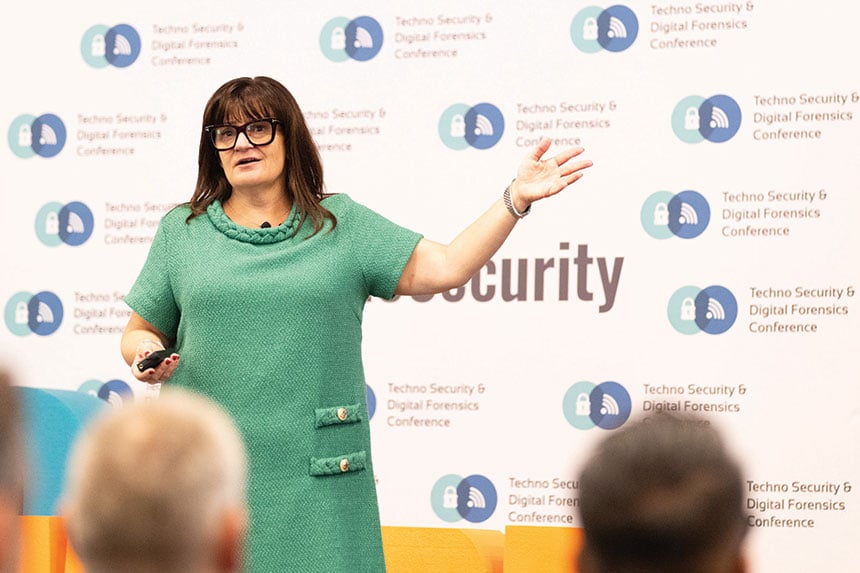
On a dark night in rural Cambodia, Erin West was driving with colleagues near the Vietnam border when they saw enormous bright lights gleaming on the horizon.
“It looked like an NFL stadium,” says West, a former Santa Clara prosecutor and the founder of Operation Shamrock, a California-based fraud-fighting organization.
The site was a mammoth scam compound, still under construction, dubbed the Ace of Spades. A multi-story building stretched for roughly half a mile. Soon, she knew, imprisoned workers would fill those spaces, running online scams, which are a thriving business throughout Southeast Asia. The masterminds behind these operations: Organized crime organizations in China. Their target: You.
“Scammers are contacting you daily,” says West, who has visited Southeast Asia half a dozen times to study the region’s scam industries. “Every person I know has received a scammy text. And it’s being done in these massive compounds.”
Those scammy texts are bait for impostor scams. A text may look like a wrong number. Or perhaps it’s a job offer or a note telling you to pick up a package. Maybe you’ve been contacted through a dating app or social media by someone with common interests. You both travel (you’ve even visited the same places!). You attended the same college. You’re both widows. Whatever the story, whatever the platform, the impostor’s goal is engagement, and to build a relationship, a process that might take months. Eventually your new special someone will tell you about a great investment in cryptocurrency.
The Chinese mob has a grotesque term for these impostor scams: Shā zhū pán. Pig butchering. Fattening a pig for slaughter. And the problem is growing. Americans lost nearly $21 billion in cyber-enabled crimes in 2025, the FBI reported in April 2026, more than double the amount in 2022. Roughly a third of those losses were reported by Americans age 60 and older. Industrial-scale scam centers in Southeast Asia make about $40 billion a year in profits, according to a 2025 report from the U.N. Office on Drugs and Crime.
“We are under attack from a foreign entity that is operating all day, every day, to steal our money,” West says.
That’s why she created Operation Shamrock: To fight back. The mission, she says, “is to educate people so it doesn’t happen to them, to disrupt the bad actors, and to make it more expensive, more difficult, more time-consuming for them to steal our money.” The organization also assists victims. Although recovering stolen money is almost impossible — overseas scammers move assets quickly through hard-to-track channels — Operation Shamrock’s pro bono investigators helped 206 victims to trace and recover $3 million in 2025.
Her fellow fraud fighters admire her work. “Erin is inclusive, highly collaborative, and truly boots-on-the-ground,” says Amy Nofziger, senior director of victim support with the AARP Fraud Watch Network. “She doesn’t sit in an office dictating solutions; she actively seeks them out and works alongside others to make change happen.”
West is well-suited for the job. She grew up in Silicon Valley, majored in journalism and international relations at the University of Southern California, and then earned a law degree from USC. After a series of unsatisfying jobs at law firms, she spent 26 years as a deputy district attorney in Santa Clara. She conducted sexual assault prosecutions for almost a decade but then shifted to prosecuting high-tech crimes.
“I thought I wanted something that was less victim-intense,” she says. “Little did I know what I was getting myself into.”
Initially the focus was identity theft cases; then it shifted to SIM swapping (scammers highjack your phone and access your accounts online). In one case that she prosecuted, a judge authorized the return of over $1 million to eight scam victims.
West was introduced to pig butchering in a case involving a 30-year-old software engineer who’d met a woman online. They planned to get married, but the phony fiancée convinced him to invest in cryptocurrency, which they’d use to buy a house. He lost $300,000 and considered suicide. West prosecuted the case and recovered his money.
As pig butchering crimes grew, she found that law enforcement agencies were ill-equipped to deal with the problem. In 2022, she helped launch the Crypto Coalition, a network which now includes more than 2,400 federal, local, state, and international partners who share information and best practices. The next year, she left her prosecutor position and formed Operation Shamrock.
“I could tell this was a problem that deserved more focused attention,” she says.
That starts with education. People often wonder why victims succumb to scams, but pig butchering frauds are highly sophisticated operations. Scammers learn about you and manipulate you — first emotionally, then financially.
“They use Ph.D.s to craft their scams,” West says. “This is a long con, and the relationship will be tailored for that specific victim. I’ve spoken to people who’ve come out of this and said, ‘It was the best relationship of my life.’ These bad actors are filling a loneliness gap. They’re creating an endorphin rush. A lot of people dismiss it and say, ‘It would never happen to me.’ But maybe they get you when you’ve had a bad day, and all of a sudden ‘Jessica’ shows up in your text and you’re like, ‘Well, maybe I’ll talk to her for a few minutes.’”
Scammers are particularly prominent on Meta platforms, West says. They join fine food and travel groups, hunt for people with money, make friends.
Scam centers are flourishing not only in Cambodia, but in countries such as Myanmar, Laos, and the Philippines. And because the fraud is so lucrative, they’re expanding to new locations. Madagascar. Palau. Sri Lanka. Uganda. The Cambodian government claims that it’s cracking down on scammers, but the operations are relocating rather than closing, West believes.
“The scam industry is now probably half of Cambodia’s GDP,” she says. “The ruling elite are benefiting immensely from this wealth. The government will look the other way when they are getting paid off so handsomely.”
The workers are victims, too, toiling in tall buildings with barred windows. The compounds are usually surrounded by two-story cement walls with barbed wire on top and a single gate manned by armed guards. Workers sleep inside on thin mattresses. Many are foreigners who were lured by fake ads.
“These were presented as legitimate jobs,” says West. “People took typing tests. They were provided with help getting passports and visas, and they arrived and they’re told that they’re scammers. They are forced to work 16-hour days. You have to meet sales goals or you will lose food privileges. You will be beaten. They endure some of the worst torture and …”
She stops. She can’t talk about it. It’s too brutal, she says. But she shares a recent story she heard from a human rights lawyer. He had met with an Indonesian man who’d worked in a compound in Cambodia. The man’s front teeth were gone. Scam operators had knocked them out with a flashlight.
The only way to escape, West says, is to use another organized crime group as a broker and pay a ransom.
West shares these stories in talks around the country. She has called pig butchering “the most compelling, horrific, humanitarian global crisis that is happening in the world today.” She urges the federal government to take action. She wants to see large-scale public awareness campaigns to protect Americans from scams. She admonishes social media companies that accept job ads from criminal organizations.
Certain online companies, West says, “are aware of how bad this problem is, how many false job ads they are selling to the Chinese, and they are accepting that as part of their revenue stream. And there’s the cryptocurrency exchanges, where every dollar that goes through that exchange makes them money. People that we expected to protect us are not protecting us, and companies are profiting immensely from the fleecing of the American population, the global population.”
How can you protect yourself? Look for red flags. Know that scammers will want to move your conversation to platforms like WhatsApp or Telegram where they can’t be observed. Watch for signs of affection waaay too early in the relationship, like calling you pet names, sending you gifts, or expressing love. Don’t invest in anything that you don’t fully understand. And be suspicious of unsolicited messages.
“Assume that any electronic communication you didn’t ask for is a scam until otherwise proven,” West says.
West hears daily from victims and offers resources on OperationShamrock.org. Victims who contact the organization are grateful to be heard, to read survivor stories on the website, and to know they’re not alone. Romance scam victims often lose everything, from their home to their savings. Many are embarrassed and ashamed. They suffer depression. They find it hard to trust others again. But some share their experiences to help others.
“It is uplifting seeing victims talk about what happened,” she says. “People are resilient and that is impressive to me.”
And so she fights on, assisting victims, sharing information, building alliances. Recently she met with two major technology companies that want to help, and she came away encouraged.
“We will be doing something every single day to make the digital world safer for us all,” she vows.
Ken Budd has written for The Washington Post Magazine, The Atlantic, and many more. He is the author of the award-winning memoir The Voluntourist and a host of the literary podcast Upstart Crow.
Become a Saturday Evening Post member and enjoy unlimited access. Subscribe now



Comments
It’s pretty sad doing business online is often a target of fraudsters. I am getting to the point where I am writing checks made payable to any business I trade with, printing my order, then mailing it off to the business’ address. Yeah. It takes more time, effort, and postage. Plus, I’m usually in no hurry for whatever I order. But I feel it is more secure avoiding the electronic transaction over the internet. Also, when I need something more immediate I’ll call using my trusty landline telephone and place my order that way. That way I am avoiding using the internet opening myself up to fraudsters the best way I know how. Case in point: Sometimes doing things the old fashioned ways are the safest and most secure.