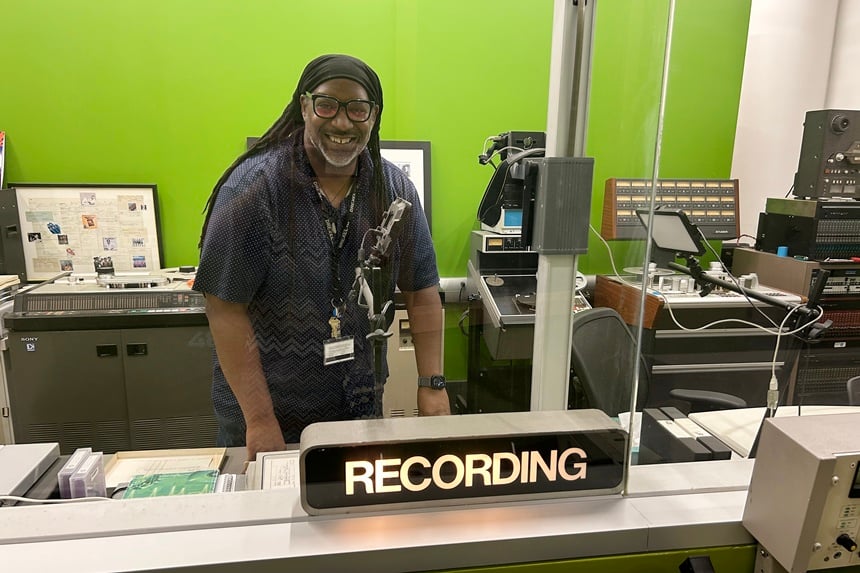
One hour of mentoring can change someone’s life. A lifetime of mentoring can change much more.
In 2009, Grammy-nominated artist, producer, and educator Carolyn Malachi was in her mid-twenties when she attended her first mixer as a new member of the Recording Academy’s Washington, D.C., chapter. She arrived with ambitions that went well beyond being a jazz vocalist. She had music in her head — arrangements she wanted to shape and bring into the world — and she was determined to find the people who could help her make them real.
Apart from the artist who invited her, she didn’t know a soul in the room. So she did what aspiring musicians are often told to do: She networked. She introduced herself, exchanged business cards, and talked with several people, hoping that one of those conversations might lead to a collaboration, a mentor, or simply a second conversation. Instead, the cards went nowhere. The calls never came. The follow-up meetings never happened.
Except for one. James McKinney called.
A Grammy-nominated producer and professional musician, McKinney had spent decades arranging, recording, engineering, and producing music while performing alongside some of the industry’s biggest names. But when he called Malachi, he wasn’t looking for a résumé. He wanted to hear her ideas.
“He’s the one person who followed up with me and took time to listen to the record I made and give me feedback that was unique to me and my goals,” she recalls.
That conversation changed the trajectory of her career.
McKinney and Malachi went on to produce Lions Fires and Squares, whose single “Orion” earned a Grammy nomination for Best Urban/Alternative Performance. Their collaboration grew into a lasting professional relationship, with tours in China and elsewhere. Along the way, McKinney continued pushing Malachi toward higher standards. “He’s a wonderful human being. Every time you’re in a room with him, you’re going to learn something,” she says.

That was just one life James McKinney touched. There would be many more.
That ability to see potential in others is central to McKinney’s story. To understand where it comes from, it helps to go back to where his own story began.
McKinney grew up in Tallahassee, Florida, in a churchgoing family with two siblings. Some of his earliest lessons had little to do with music. He was subjected to racial slurs during elementary and middle school. Once, someone threw a drink at him from a passing car, drenching him as he walked to school. He had to sit through class in wet clothes, carrying not only the evidence of what had happened but the sting of the humiliation.
But those experiences did not define him. His parents gave him a foundation of confidence that allowed him to look beyond other people’s opinions and find communities that believed in his ambitions. “Because my parents supported me, it allowed me to seek communities that supported my ambitions.”
Music became one of those communities.
McKinney immersed himself in every opportunity Tallahassee offered: concert bands, saxophone and piano at church, private voice lessons, elite choirs, and jazz ensembles. His yearbook is filled with photographs of him performing and participating in musical groups.
He also found teachers and mentors who recognized his potential. Through connections at Florida A&M University and Florida State University, musicians and educators encouraged his talent and helped build his confidence.
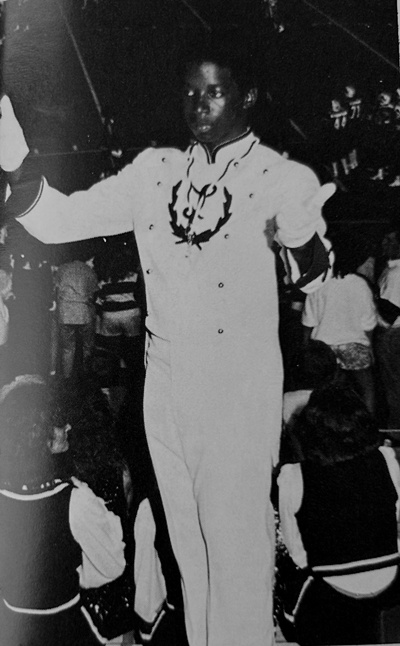
It was a pattern that would follow him to Howard University. McKinney majored in music education, where he found himself surrounded not only by extraordinary musicians but by generations of Black excellence. “Howard has such a strong history of significant African Americans in the whole spectrum of all professions,” he says.
He joined music fraternity Phi Mu Alpha Sinfonia and immersed himself in the university’s student-led performances, exploring everything from jazz and classical music to hip-hop and R&B. Howard gave him room to develop as a musician without forcing him into a single identity.
It also taught him something equally important: Talent alone isn’t enough. The people who challenge you, open doors for you, and believe in you matter.
After graduation, McKinney thought his career was about to take off. His band, where he played keyboards and saxophone and sang, signed a record deal. “I thought my life was set,” he recalls.
Two months later, the label dropped the group.
Instead of abandoning music, McKinney took a job as a payphone technician, testing airport phones six days a week. The unexpected detour revealed another talent: business. He married, rose through the company, and eventually became a vice president.
He used the income to find his way back into music, buying a baby grand piano and building a home studio. At night, he scored and produced music for commercials.
The corporate job gave him financial stability. The studio gave him a way back to the world he had never really left.
He soon discovered that he loved not only performing music but building it. “A music producer helps turn an artist’s musical ideas into a finished recording,” McKinney says. “The role combines creativity, storytelling, and problem-solving.” That can mean orchestrations for horn sections or other instruments, coaching musicians, overseeing recording sessions, shaping a track’s sound, and guiding a project from its first idea to its finished form. “I can hear in my head what I want the final product to sound like,” he says.
For more than two decades, McKinney has worked across that entire process. He is chief operating officer of Eusonia Records in New York and owner of Infinite Icon Enterprises in Maryland, with production credits spanning jazz and R&B. He has twice been Grammy-nominated as a producer and co-writer, for “Loving You” in 2009 and “Orion” in 2011.
His work extends far beyond the studio. He has served on the national board of trustees of the National Academy of Recording Arts & Sciences and as national co-chair of its Producers & Engineers Wing. He has worked in film, television, virtual reality and immersive audio, and has traveled internationally as a cultural diplomat through the U.S. State Department’s American Music Abroad program, touring and teaching in Taiwan, China, Papua New Guinea and Haiti.
In 2026, he produced and recorded Crazy World, an album by the duo ASIS, at Drexel University’s Philadelphia studio. The project reached No. 1 on Amazon’s New Release and Jazz charts in the United States, United Kingdom, and Portugal.
From the outside, the breadth of McKinney’s career can make it look effortless. It wasn’t.
Like many producers, McKinney learned through apprenticeship, and some of the people who shaped him most were willing to tell him exactly where he needed to improve. For McKinney, learning to be a mentor started with a healthy dose of being mentored himself.
From sound engineers to professional musicians to music business movers and shakers, McKinney has learned from the best throughout his career.
Stevie Wonder left a particularly lasting impression.
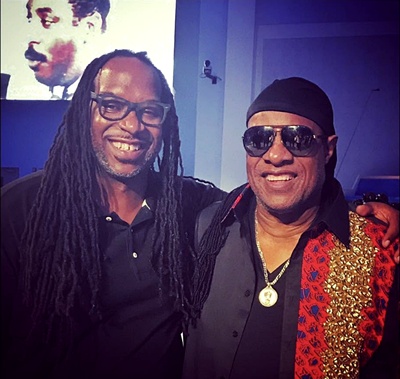
After McKinney performed with Wonder, Wonder asked him why he didn’t play more piano and keyboards. McKinney explained that he loved producing just as much as performing and that the demands of records, gigs, and touring required him to make choices about where to put his energy. Wonder accepted the answer, while McKinney realized he’d just received what he describes as the ultimate stamp of approval.
Each mentor left him with something different, but together they shaped McKinney’s understanding of what a mentor can do. A mentor can challenge you without diminishing you. A mentor can tell you what you don’t know, show you what you haven’t yet seen, and give you the confidence to keep going. Sometimes the lesson comes through instruction. Sometimes it comes through an introduction, a question, or simply watching how someone conducts themselves.
In 2021, he took his own mentorship ability to the next level, by accepting a teaching position at Drexel University. Since joining the school’s Westphal College of Media Arts & Design in 2021, McKinney has found a way to bring virtually every part of his career into the classroom. He teaches students how to work with sound, from digital audio and post-production to arranging, songwriting, and scoring, while also exploring the business and cultural forces that have shaped the music industry, including the history of hip-hop.
For McKinney, teaching is not a departure from his career in music. It is an extension of it.
His work at Drexel has expanded beyond the classroom as well. He has helped shape conversations about the future of teaching and teaching spaces, advises the Multimedia Audio Club, and continues to lecture and present research at universities and conferences on subjects ranging from immersive and spatial audio to the cultural history of hip-hop.
But the credentials and course lists only tell part of the story. Ask McKinney what he loves about teaching, and he talks less about what he delivers than about the moment when a student suddenly understands.
One of his earliest Drexel students, Rafi, arrived with a sharp intellect and an insatiable curiosity about music history. In McKinney’s Hip-Hop Music History course, he kept asking questions long after class ended.
After graduating, Rafi did something McKinney never assigned. Inspired by a class discussion about pioneering hip-hop journalist and producer Robert Ford Jr., he researched Ford’s life and created a Wikipedia page to preserve his legacy.
For McKinney, that was the point.
“They synthesize the lesson,” he says. “They connect it to the thing that brought us both into the classroom.” That moment — when knowledge becomes ownership — is what McKinney looks for in his students. Standing at the front of a classroom, whether explaining the mathematics behind harmony or demonstrating how a rough musical idea becomes a finished recording, he watches for the change. “I realize this every time I see the lightbulb go on in a student’s face,” he says. “You can see it in their eyes.”
And when he stands in front of those students, he thinks about the people who once stood in front of him. “When standing in front of a classroom today, I absolutely think of the adults who stood beside me when I was young.”
His parents taught him resilience. His teachers nurtured his curiosity. His mentors challenged him, opened doors, and sometimes saw possibilities in him that he had not yet seen in himself.
Now he gets to do the same for someone else.
McKinney still arranges and produces music, scores for film, performs, consults, and builds toward his next project from a century-old home where he is creating a music studio.
And the relationship that began at that Washington, D.C., mixer 17 years ago continues. Malachi is now a professor and mentor herself at Howard University. The young musician who once walked into a room hoping someone would notice what she had to offer is now helping the next generation discover what they have to bring into the world.
She remembers the man who called when everyone else’s business card disappeared into the pile. “James has consistently represented authenticity and a tireless dedication to delivering truth through music,” she says. “He’s a wonderful human being, and he leads by example. Every time you’re in a room with him, you’re going to learn something.”
When McKinney is asked what he hopes his students remember about him twenty years from now, he does not mention awards, hit records or famous collaborators. He hopes they remember learning “about being a good human being who contributes to society with their art and with their heart.”
Then he offers what sounds like a summation of everything that brought him here:
“You can’t succeed without mentors.”
Become a Saturday Evening Post member and enjoy unlimited access. Subscribe now



Comments
I don’t usually read articles this long online, but this was worth it. James is clearly a caring person who passed on the knowledge he received, helping future generations as he was helped. Hopefully the next generation will do the same.