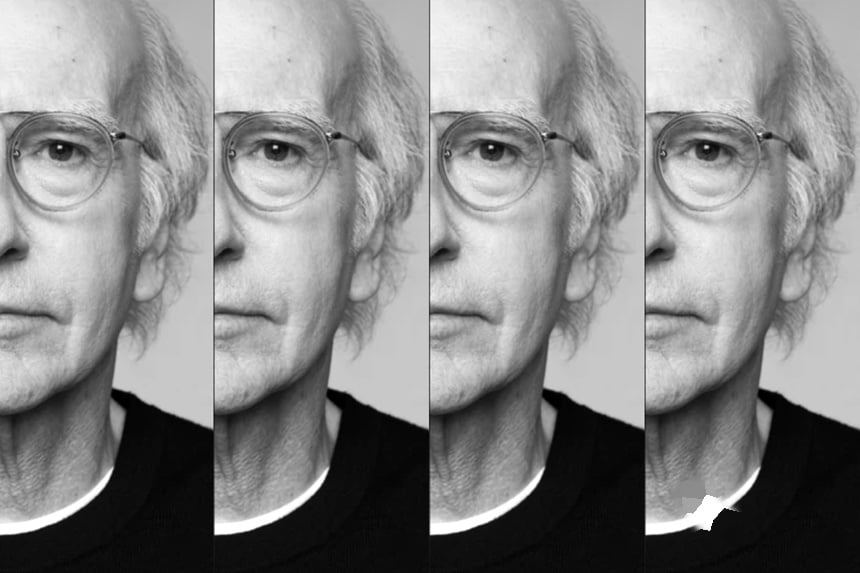
Not for nothing did Blake J. Harris want to write a book about Larry David, the creative force behind two of the most iconic television series of our time, Seinfeld and Curb Your Enthusiasm. “I don’t think I would have been a writer if not for Seinfeld,” he says in a phone interview. “My high school yearbook quote was a Seinfeld quote. My college essay was about Seinfeld’s last episode. That’s how much the show mattered to me. It made me fall in love with storytelling.”
There was just one problem. “I never thought there was a chance in hell that Larry would actually talk to me,” Harris says.

Emails from David heightened his pessimism. “There are far better ways to spend your time,” he wrote in one, sounding very much like the curmudgeonly nitpicker he played on Curb. There’s nothing interesting about me and there’s no interest in me.”
When Harris assured him that the book would be a biography of his work rather than a dive into his personal life, David gave the go-ahead in the most Larry way possible. He emailed: “Oh Jesus. If we must.”
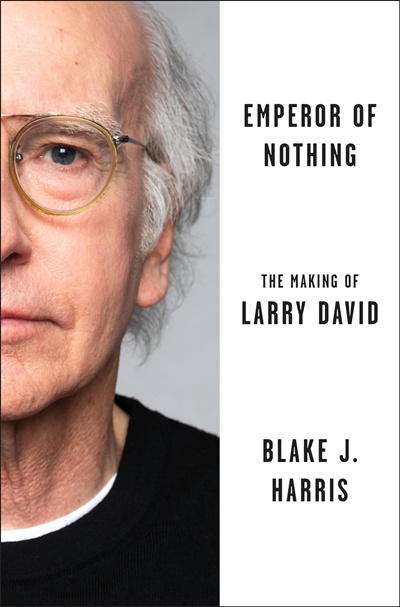
Six years later, the result is The Emperor of Nothing: The Making of Larry David. Like Seinfeld and Curb, it is very much an ensemble piece with David at its center. The focus is on how David creates his idiosyncratic comedy. For those fascinated by process, it is revelatory.
We asked Harris about how he gained David’s trust, what the public gets wrong about him, and how willing an artist infamous for making comedy strictly on his own terms was to cede creative control to his biographer.
Donald Liebenson: Alec Baldwin once joked that Seinfeld’s life is a series of green lights. Not so with Larry David. You write about a project I don’t think many people know about, Norman’s Corner, a failed pilot starring Gilbert Gottfried. On his podcast, Gilbert used to joke that NBC almost didn’t pick up Seinfeld because of Norman’s Corner.
Blake J. Harris: Gilbert had a valid claim that he almost single-handedly sunk the phenomenon that would be Seinfeld. NBC was wary about getting involved with the writer of Norman’s Corner. Larry at that point had no other sitcom experience under his belt, except one episode of It’s Garry Shandling’s Show that he removed his name from, which nobody knew.
DL: How did you set this project in motion?
BH: I had written two books about tech and video games. I decided I wanted to write a book about Larry in January 2020. Fortunately, I had a connection to him through Jeff Schaffer, his long-time creative partner and collaborator. I had written an oral history of the FX series The League, which Jeff and his wife co-created. He agreed with me that there should be a book about Larry and he thought I was the right guy to do it.
While Jeff worked on getting Larry to agree to the book, I started doing research and talking to his colleagues. I spoke with Alan Zweibel, a lovely man and comedy legend in his own right. During our third Zoom call, he asked if I had spoken with Larry yet. I said I hadn’t been too aggressive because I assumed it would not go well, and I like the idea of having hope as opposed to having my hopes dashed. Alan said he thought Larry would love me and he offered to send him an email on my behalf.
This was the moment of truth. I asked Alan to tell Larry that for our first conversation, I didn’t want to ask any questions about Curb or Seinfeld. The only thing I wanted to talk about was the New York Yankees. Larry liked that idea.
DL: How did you finally gain his trust?
BH: Everyone told me that Larry would change his mind [about participating in the book] and stop talking to me. That’s what I expected, but it was largely an organic process. It helped that it was during Covid and he had nowhere to go. The main way I gained his trust was I was always honest. I wasn’t trying to trap him on gotcha questions. It was largely about his work. It also helped early on that he liked my theory on why the Seinfeld finale was so criticized.
DL: Which was….?
BH: For the finale, David wanted to bring back all the supporting characters. My theory was that, in general, it was an elegant clip show. He didn’t know that the finale would be preceded by an actual clip show [of series highlights]. He liked that theory, and when I asked him when we could talk again, he said, “Whenever you want.” That was a good sign.
DL: Curb watchers may think that Larry is just playing himself. How much of TV Larry is like real-life Larry? And did anything about him surprise you?
BH: I would say there is a 90 percent overlap between real- life Larry and TV Larry. The difference is that he is more thoughtful, more considerate of people’s feelings. I was intimidated the first time I got on the phone with him. He said, “Don’t worry, I’m a nice guy.” In that first call, I brought up a few of Larry’s protégés, and he said, “Oh, I love those guys.”
DL: Larry was anything but an overnight success. He was 42 when Seinfeld premiered. What is his relationship to success and fame?
BH: It happened late in his life, so he really appreciates it. After Seinfeld, he was largely able to do whatever wanted to do creatively. That was important to him. The most interesting part about his fame is that his public persona gives him a license to embrace his worst instincts. He told me he was recently at a party and after a half hour, he wanted to leave, but he thought it would be rude. I told him that he could get away with that and he conceded he could, but that he didn’t want to give in to that.
His wife Ashley told me that after they got married, she discovered an unexpected benefit of being Mrs. Larry David. She once made a faux pas to the friend of a friend and wanted to apologize. When that person learned who she was married to, she said, “Don’t worry about it.” Ashley told me it was like having a get-out-of-jail-free card.
DL: How much input, if any, did Larry have in what went into the book?
BH: I wrote a book about a guy who is famously uncompromising and wants creative control of every aspect of a project. When Larry was a stand-up, he had an opening joke: “You seem like a very nice audience. I’m wondering in case I break into some Spanish or French, may I use the familiar tu form with you people? I think usted is going to be a little too formal for this crowd.” This went over most audience members’ heads, but he insisted on opening with it. That’s the one thing you’re not supposed to do as a comic.
Jerry Seinfeld told me that he asked Larry why he would torture himself with that bit when it only got laughs about 30 percent of the time. Larry told Jerry that the joke was funny and if the audience didn’t think so, he didn’t want to perform for them.
So, there was no formal agreement between us, but I told him I would share with him all the material in the book in advance and I would always welcome his feedback. But I couldn’t promise to incorporate his feedback.
DL: What do you hope people take from your book?
BH: There’s so much inspiration to be found in Larry’s story. He was unlikely to succeed for so many years, but when he did, he did it on his own terms. From Larry I learned to not compromise on my work and to fight for what I believe in.
DL: What was his reaction to the book?
BH: After Larry had finished reading the final chapter, he called me. He just said if he could do it all over again, he wouldn’t. I was bummed to hear that and he could tell. He went out of his way to say, “No, you did a great job. I just don’t want people to know about me.”
DL: Not that there’s anything wrong with that. Was there anything he wanted you to take out of the book?
BH: Just the stuff he thought was too nice or embarrassing.
Become a Saturday Evening Post member and enjoy unlimited access. Subscribe now