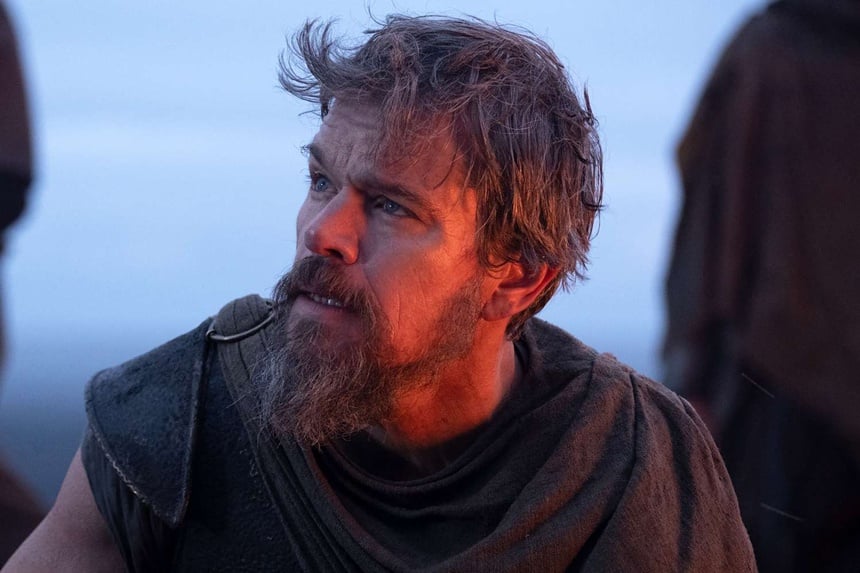
The Odyssey
⭐️ ⭐️ ⭐️ ⭐️
Rating: R
Run Time: 2 hours 52 minutes
Stars: Matt Damon, Anne Hathaway, Tom Holland
Writer/Director: Christopher Nolan
Christopher Nolan’s The Odyssey is a muscular film, and I’m not talking about star Matt Damon’s still-beefy physique, nor the bulging forearms of the men rowing the meticulously recreated Homeric galley that Nolan had built for his epic production.
Nolan’s Odyssey is muscular in that it bears on its broad, bare shoulders 3,000 years of narrative history; eons of retelling and reinterpretation – first as an oral tradition, then in written transcriptions that have always reflected the eras in which they were related.
This incarnation is no exception: Scrupulously faithful to Homer’s poem, this Odyssey nevertheless feels vitally relevant as its hero, bound by the altruistic moral standards of high Greek culture, finds those traditions dashed on the rocks of real-world pragmatism. In an age when life, both private and public, seems to be increasingly transactional, King Odysseus’ uneasiness at achieving perceived justice at any cost seems especially resonant – and his ultimate, conflicted conciliation rings scarily true.
Odysseus’ absence from his home city of Ithaca – first fighting in the Trojan War, then sailing the Mediterranean in search of home – famously took nearly two decades. Bearded and indelibly movie-star-handsome, Damon brings uncommon intensity to the role as writer/director Nolan bounces chronologically from one decade of that journey to another. We first encounter Odysseus as a grizzled old castaway in the care of the beautiful Calypso (Charlize Theron), then as a fresh-faced young military leader conscripting soldiers for his coming war, then as a battle-numbed commander watching, dazed, as his men rape and pillage their way through Troy. (That famous wooden horse gets particularly graphic treatment as Odysseus and his men barely survive their days inside its hollow belly, waiting for the Trojans to take the bait and drag it inside the city gates.)
Then begins the arduous voyage home as Odysseus and his steadily dwindling regiment encounter the colossal Cyclops (rendered all the more terrifying by Nolan’s choice to have the creature’s single, blinking eye stand vertically in the middle of its forehead), followed by the malevolent Circe (Samantha Morton, who somehow convinces us it’s no big deal to turn grown men into pigs), followed by a forest of gargantuan warriors, and next by a collection of singing sirens intent on luring the crew toward their perilous rocky shores. There’s also a treacherous whirlpool to navigate and a man-eating, hydra-like monster to avoid.
And all the time, in a parallel but essential narrative, there remains the woman Odysseus is obsessed with returning to: his ever-faithful wife Penelope (Anne Hathaway), who has spent the better part of a decade fending off a horde of would-be husbands, led by the duplicitous Antinous (Robert Pattinson), who pretends to be a man after Penelope’s heart when, in reality, all he really wants is her throne.
Standing in his way is Penelope’s son Telemachus (Spider-Man’s Tom Holland), who, although he has no recollection of his father, is nevertheless driven to determine the old man’s fate.
Clocking in at nearly three hours, this Odyssey is something of a journey in itself. But Nolan never lets up propelling his story forward, not for one second. Even the quieter interludes remain revelatory, bringing into full relief the universal motivations and all-too-human missteps that make The Odyssey a timeless object of periodic reassessment.
True to his cinematic credo, Nolan (Oppenheimer, Interstellar) avoids whenever possible digital enhancement, even for the most spectacularly fantastical scenes. The result is a hand-made quality that even the most CGI- and AI-loaded movies can’t seem to match.
It’s the actors who are Nolan’s best visual effects: Hathaway’s Penelope is a Bronze Age woman of steel; Holland’s prince fairly bursts with earnest honor; as the villain, Pattinson chews the scenery with necessary aplomb. For all the before-the-fact complaints, Lupita Nyong’o brings beautiful ferocity to the dual role of Helen of Troy and her twin sister – and Elliot Page, who for some reason naysayers insisted was all wrong for the part of the warrior Achilles, actually plays Sinon, the unfortunate soldier Odysseus dupes into presenting the enormous horse to the Trojans with grisly results. Page doesn’t get much to do until later in the film, when he makes a truly galvanizing return as a post-mortem Sinon in the Underworld.
Like Homer’s world of men, women and monsters, Nolan’s Odyssey is a mysterious, sometimes messy marvel from start to finish. You’ll be happy when Odysseus’ odyssey finally comes to an end, but you will also wish you could linger in this world, if only in the hope there is one more sea to cross and one more monster to vanquish.
Become a Saturday Evening Post member and enjoy unlimited access. Subscribe now



Comments
It’s too bad that you start with the phrase, “meticulously recreated Homeric galley.”
Is it?
You’re forgiven. Few people expect movie reviewers, writing for popular, commercial outlets, to be historically informed, and they certainly don’t appear to expect that of themselves. This is a matter you could look into, if it wouldn’t go against your inclinations.
But you did take time enough to use the word “messy” with respect to . . . what? – the historicity of the story? Yes, “The Odyssey” is a fable, a myth, but it’s based on actual events, that occurred in an actual historical period. Does this messiness you refer to include woke, 21st Century Hollywood “inclusive, racially diverse” casting choices? (Choices that excluded actual Greek actors and actresses appearing in the movie?)
I wish I could get a free pass to see this film, something that Nolan appears to receive automatically from the critical community, as he did with his over-praised “Batman” movies, and the soporific “Oppenheimer.”
Fortunately, for ‘the rest of us,’ there remains mountains of excellent critical evaluations of these stories, and Richard Lattimore’s translations of the books: inspiring, and a good time too!