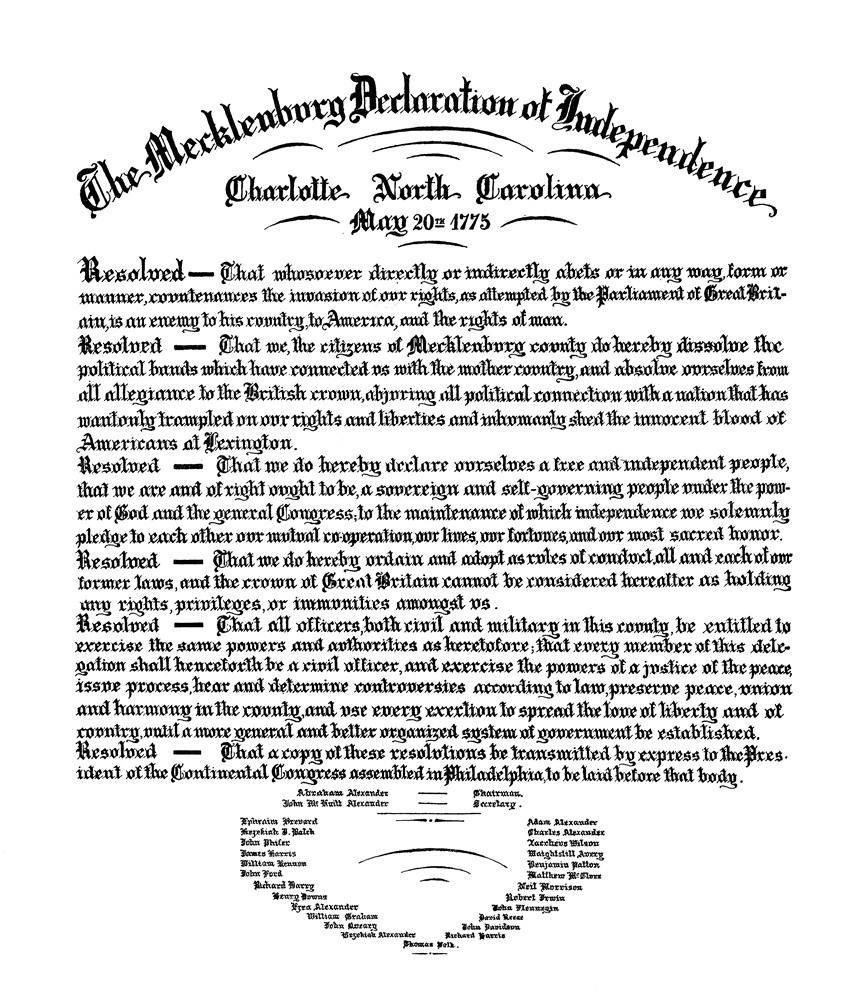
In 1819, the North Carolina Gazette published a letter claiming that more than a year before the Continental Congress passed the Declaration of Independence, North Carolinians in Mecklenburg County had written and passed their own, in which they broke political ties with Britain and declared themselves “a free and independent people.” Some even suggested that Thomas Jefferson had plagiarized the Declaration of Independence from the Mecklenburg document.
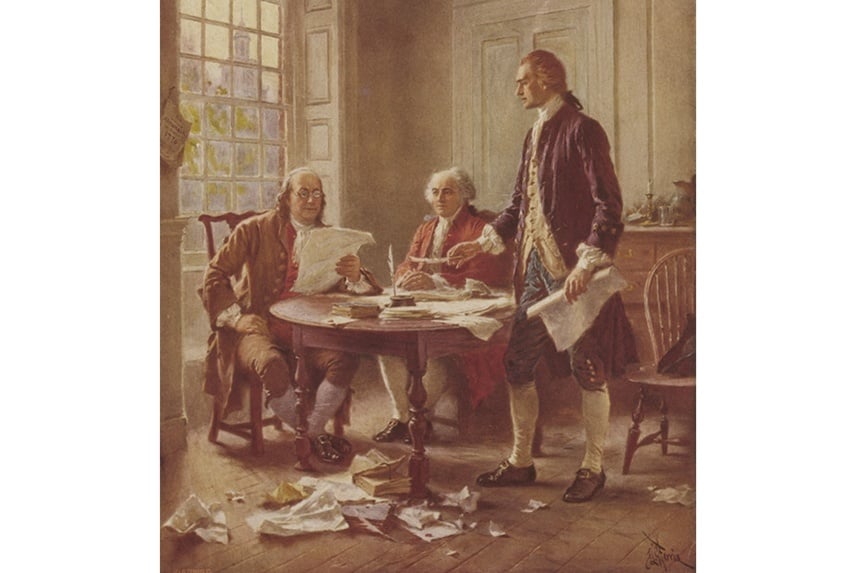
Whether or not the Mecklenburg Declaration actually preceded the Declaration of Independence is not really the point. Rather, the more important insight is the origin of the Declaration of Independence itself, a document born not simply out of the mind of Founding Father Thomas Jefferson, but rather one constructed through discussion and collaboration amid a revolution that both united and divided colonists. Ultimately, the Declaration serves, as Jefferson noted, “as an expression of the American mind.”
After all, if the good people of Mecklenburg County believed they beat Jefferson to the punch, true or not, it underscores the point that the founding document of the nation served as an embodiment of all of its people and not the creation of an elite few.
Indeed, the Declaration was a long gestating collaborative effort. Its ideas developed through decades of conversations among average Americans, their experiences with self-government, and the crucible of revolution. In this process and through the issuing of the Declaration itself, Americans have woven these ideas into and through American history. These are the premises behind the new exhibition at the Library of Congress, The Declaration’s Promise, which opens on July 3. The exhibit spans from 17th century Europe to the 21st century United States and captures the breadth of the American project.
The ideas in the Declaration had many difference sources of inspiration. As countless historians have noted, Jefferson, his fellow revolutionary leaders, and colonists were profoundly influenced by the Enlightenment. “Jefferson was threading together words and concepts that a life of good reading had woven into the fabric of his mind,” writes Library of Congress historian and curator Patrick Hastings. “He was pulling ideas from Locke, Hutcheson, Cicero, Pufendorf, Bacon, Blackstone, and many other political philosophers. And he wasn’t alone; his contemporaries across the colonies were writing similar official statements, proclamations, and declarations, drawing from many of the same sources.”
In his draft, Jefferson not only deployed these Enlightenment ideas from Europe but also drew from the discussions and interactions among colonists over independence and developing American values. For example, Jefferson’s innovation — changing Locke’s natural rights consisting of “life, liberty, and property,” to “life, liberty, and the pursuit of happiness” — was derived from both European philosophy and George Mason’s draft of the Virginia Declaration of Rights.
Political scientist Danielle Allen suggests in Our Declaration that the document was a product of conversations between colonists, political leaders, municipal and colonial legislatures, the Continental Congress, and the drafters of the Declaration — what Allen describes as “patterns of collaboration” that produced the Declaration and also provided for “ongoing collective action in the freshly minted and newly united states.”
Such discussions were not always pregnant with agreement or even good will. Based on correspondence between Thomas McKean and John Adams spanning 1813 and 1814, roughly one third of Americans opposed the Revolution, while the remaining two thirds consisted of ardent supporters and others who recognized that the colonies’ relationship with Britain no longer worked or at least needed serious reform. “Two thirds always had and will have more difficulty to struggle with the one third than with all our foreign enemies,” he wrote to McKean in 1813.
If one assumes Adams was correct and Patriots outnumbered Loyalists, a great deal of ambivalence existed among colonists in between these two poles. Debate between these erstwhile political groupings unfolded under conditions of revolutionary duress, and as the Ken Burns documentary The American Revolution reveals, participants sometimes interacted in violent ways, with much of the violence being perpetrated by overzealous supporters of independence.
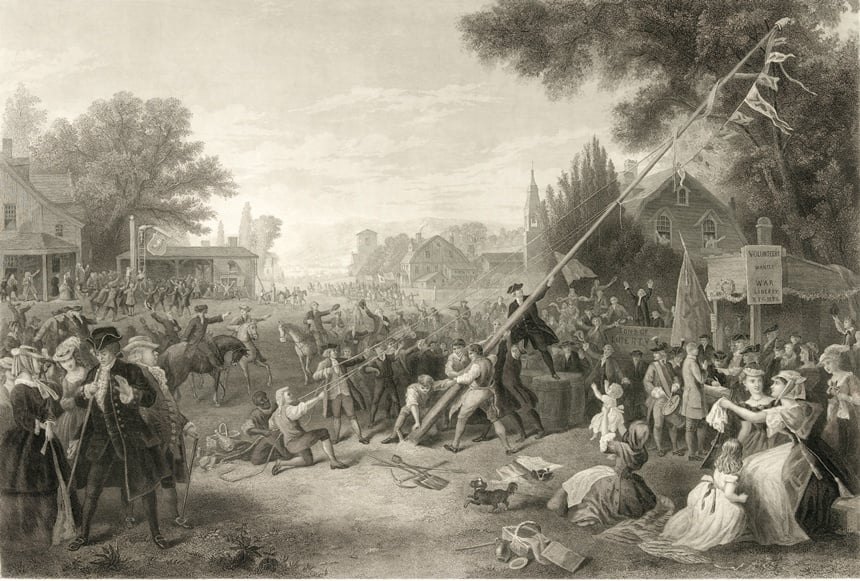
The revolution crystalized colonial thought about independence as it seeped throughout the citizenry. “[T]he language of liberty is contagious and leaky,” historian Jane Kamensky said, asserting that as events unfolded, the concepts at the heart of the Declaration spread further and became embedded among colonists and their leaders. The general politics of the Declaration closely mirrored colonial discourse at the time – sermons, newspapers, pamphlets, and schoolbooks all discussed such matters – such that “the sentiments Jefferson eloquently expressed were … absolutely conventional among Americans of his time,” writes Pauline Maier in her work on the Declaration, American Scripture.
Everyone who participated in this collective discussion can claim authorship, and the process mattered as much as the final product. “The Americans who debated Independence did not need Thomas Jefferson to remind them that the ‘whole point’ of the controversy that had absorbed their lives lay not in the ending of an old regime but in the founding of a better one…” Maier observes. “It took rivers of talk for Jefferson’s words to become the ‘unanimous’ Declaration of the colonies,” concurs Allen.
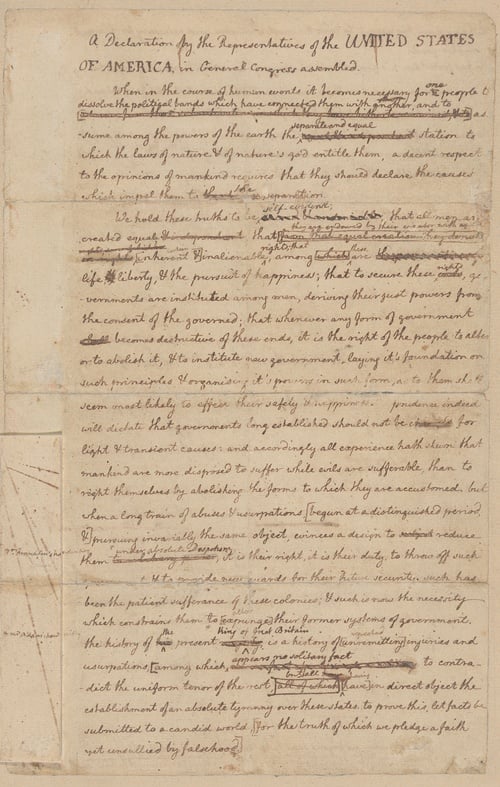
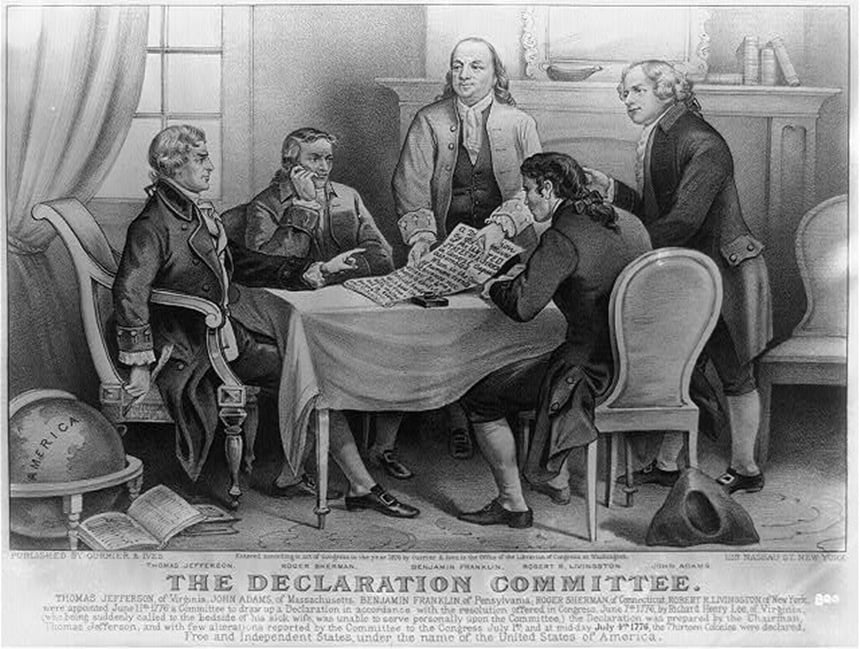
While Jefferson wrote the initial draft, the Continental Congress’s Committee of Five, which in addition to Jefferson included John Adams, Robert R. Livingston, Roger Sherman, and Ben Franklin, edited the document before the larger legislative body took their turn with it. A rough draft of these edits, with annotations in Jefferson’s hand indicating where others had made corrections, is among over 120 items on display in The Declaration’s Promise.
If today we focus on the Declaration’s preamble and its revolutionary promises, in 1776, most observers fixated on its list of grievances. The Declaration’s grievances too reflected the broader American experience. Colonial resistance to the Stamp Act, Navigation Acts, and numerous other attempts by Parliament to draw revenue from the British colonies are well documented examples of Americans of all classes resenting and resisting perceived governmental overreach. The complaints against King George III in the Declaration were as critical to its legitimacy as the preamble.
Political philosopher Hannah Arendt recognized this in her classic work On Revolution. Arendt found the Declaration’s “list of very [specific] grievances against a very particular King gradually develops into a rejection on principles of monarchy and kinship in general.”
In other words, the revolution was built not only on the back of Enlightenment-era political philosophies, but rather from the daily pragmatic requirements of living in the colonies — living made all the more difficult with the King’s foot on their necks. Political power rested on town hall meetings where political engagement, debate, and consensus unfolded toward addressing tangible community issues — taxes, land use, and other issues identified in the grievances. The Declaration’s grievances were an articulation of these practicalities, practicalities upon which colonists grafted political theories; their complaints drawn from their own experiences in self-government gave “action” to revolutionary ideology.
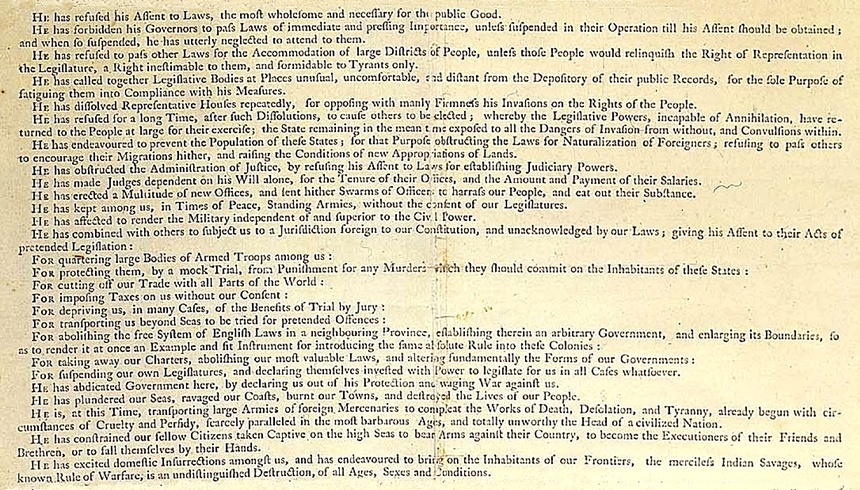
While the list of grievances in the Declaration –27 in total – proved a powerful rhetorical tool, it also foundered on those ideas. North American indigenous peoples are referred to as “merciless Indian savages.” Delegates removed from the final draft Jefferson’s critique of King George III for facilitating the slave trade, which he had characterized as “a cruel war against human nature,” indicating the burgeoning nation’s internal divide over its original sin. And while printer Mary Katherine Goddard appears on a 1777 print of the Declaration, none of its signers are women, and the idea of women having rights is absent.
Arguably, abolitionists, suffragists, civil rights activists, anti-war protesters, environmentalists, and others took the document’s philosophy, its grievances, and its written agency to heart, harnessing its words for both existential and societal good. Though she did not state it as such, Arendt’s argument about the Declaration demonstrates that the protest movements that used the Declaration to achieve the ideas and rights it promised captures one of the document’s enduring traits in that it exists as “one of the rare moments in history when the power of action is great enough to event its own monument.” In other words, the Declaration exists as a memorial to the creation of a new republic in human history itself, but also serves as a permanent reminder of the values and concepts that undergird it. It justified the Revolution, but equally important, it provided “a moral standard by which the day-to-day policies and practices of the nation could be justified,” argues Maier.
In his classic 1992 work, The Radicalism of the American Revolution, historian Gordon Wood summarized the coalescing of Americans around the principles of the revolution. The tribal loyalties of the “Old World” — religion and ethnicity for example — were no longer adequate. Rather, Americans discovered “new democratic adhesives in the actual behavior of plain ordinary people — in the everyday desire to make money and pursue happiness in the here and now.” Two hundred and fifty years later, frayed bindings acknowledged, these adhesives still stick. In the end, it’s not Jefferson’s principles we are living up to, but rather our own. The demand is for us to embody the very Declaration our predecessors drafted with him over two centuries ago. We wrote it, now we need to make sure we live it.
Become a Saturday Evening Post member and enjoy unlimited access. Subscribe now