Originally published July 5, 1947
It was hot in Philadelphia on those days in early July. There was a livery stable near the room where the distinguished gentlemen were sitting. Big, blue-black horseflies buzzed through the windows and bit the gentlemen through their white silk stockings. Handkerchiefs lashed at the flies, but their attack was severe, and the impatience of the sufferers was great. Thomas Jefferson used to say, many years later, that the Declaration of Independence went through the Congress much faster because of the horseflies.
It was July 1776 that we are talking about, of course. And there was something else in the air that made the gentlemen very uncomfortable — something that made them steal a glance now and then at one another’s necks. They joked about it among themselves, but they knew it was no joke. It was the threat of hanging.
Ben Franklin is credited in the history books with saying, “We must indeed all hang together, or, most assuredly, we shall all hang separately.” But this was a standard wisecrack in the Continental Congress long before Franklin is supposed to have said it. Unfortunately, it was all too true. Every man who signed the Declaration knew that he might be signing his own ticket to the gallows.
There is a story about Elbridge Gerry, a short, skinny signer from Massachusetts, and Benjamin Harrison, a big, husky signer from Virginia. About the time the Declaration was passed, [Harrison] said to [Gerry], “When the hanging scene comes to be exhibited, I shall have all the advantage over you. It will be over with me in a minute, but you will be kicking in the air, half an hour after I am gone.” American humor was rather grim around the Fourth of July 1776!
Big Ben Harrison, incidentally, was the strongest of the 56 signers. When John Hancock was elected president of the Congress in 1775, Harrison picked him up, carried him across the room, and sat him down bodily in the president’s chair, roaring, “We will show Mother Britain how much we care for her by making a Massachusetts man our president!” Hancock was no lightweight either — he was a stout Boston businessman with gout in one foot.
Signer Abraham Clark, of Elizabethtown, New Jersey, wrote to a friend after the Declaration was approved: “A few weeks will probably determine our fate — perfect freedom or Absolute Slavery — to some of us freedom or a halter.” He was thinking of his fellow signers when he wrote that last phrase.
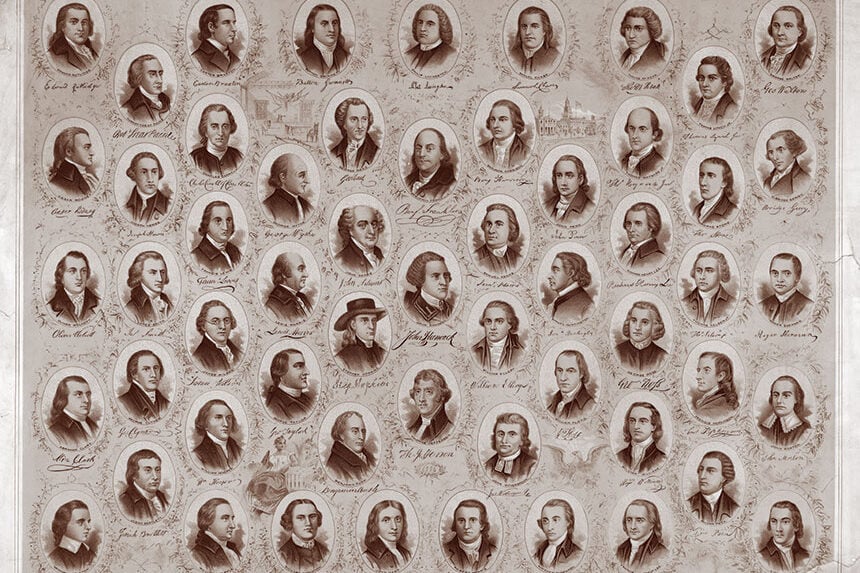
American history usually presents the 56 signers standing in a flag-draped tableau beside a table in Independence Hall, and then says no more about them. But the signers did a lot more than just sign. They were in the thick of the Revolution. The British, naturally enough, singled them out. No signer, as it turned out, was ever hanged. But they were hunted, shot, captured, robbed, and subjected to every conceivable hardship and abuse.
There was the case of signer Francis Lewis, a rich, weather-beaten New York City merchant in his 60s who had seen quite a bit of the world. He was born in Wales, shipwrecked a couple of times, and once captured by the Lake Ontario Indians during the colonial wars with France. According to his story, he escaped being tied to a stake and burned alive because he began talking to the Indians in Welsh — and they understood him! Now he had retired from business and lived in a fine big farmhouse at Whitestone, Long Island.
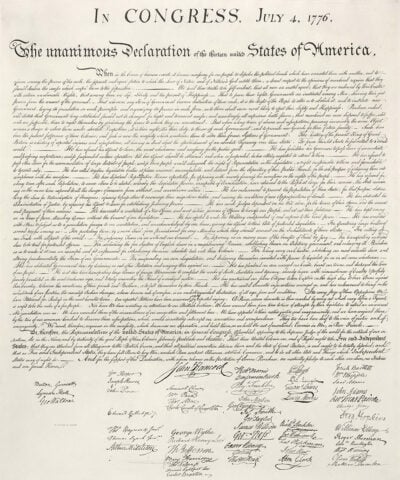
Like most of the other signers, Lewis put his name on the Declaration of Independence on August 2, 1776, rather than on July 4. The document was formally approved on July 4, but not actually signed until it had been engrossed on parchment. A few days after Lewis’s signing, the British and Hessian armies of General Howe landed on Long Island and swooped down on the Lewis household. The occupying troops carried off everything they wanted from Lewis’s house and burned it down. Within a month after putting his name to the Declaration, this signer had lost almost everything.
Later that same year, the British invaded New Jersey and caught a real live signer. He was Richard Stockton, of Princeton, a wealthy, cultured lawyer and landowner who had lived in England and was a personal friend of famous Englishmen like Edmund Burke, David Garrick, and Lord Chesterfield.
When the British took Princeton, Stockton put his wife and family in hiding in another New Jersey town, and took refuge himself in the home of a relative. But in December some local Tories arrested him, dragged him out of bed into freezing weather, and forced him to walk many miles through the snow to Perth Amboy, where he was tossed into an unheated cell and left without food for a day and night. Enemy troops pillaged his house, burned his books and family papers, and drank up everything in his cellar.
The British were eager to make an example of this first captured signer. Stockton was taken to New York and placed in the loathsome Provost Jail, where hundreds of American prisoners of war starved and died. His superb physique and his morale both cracked under the brutal treatment he received. He was persuaded — doubtless under duress which amounted to torture — to sign the amnesty proclamation issued by Howe soon after the capture of New York. This proclamation offered forgiveness to all Americans who would quit the fight and take no further action against the king. This was the nearest any signer came to turning traitor during the whole Revolution. But it would be unfair to blame him too deeply. He was probably a helpless invalid when he signed it. He was certainly an invalid when he returned home the following year, and he died in 1781, after suffering agonies of body and spirit.
The homes and personal property of at least 14 signers were destroyed or badly smashed up during the Revolution. A 15th, Josiah Bartlett, of New Hampshire, had his house burned by Tories even before he signed. Everywhere the British landed along the coast of America, they were sure to find a helpful Tory who could lead them to the house of a signer. On the way to the Battle of the Brandywine, the British troops detoured to the country house of Pennsylvania signer George Clymer, emptied his wine cellar, dumped his furniture out the windows, and set fire to the house. When they moved into Newport, Rhode Island, they burned the home of signer William Ellery.
But this was only part of it. At least nine signers were physically hunted across various parts of the American landscape with the vision of a noose dangling before their eyes. Signer Gerry, for instance, barely got away through a cornfield in his nightshirt.
Then there were the sons of signer Richard Henry Lee, of Virginia. These boys were in an English school when the Revolution broke and couldn’t get away. One day they were informed by their schoolmates that they would soon see their father. When they eagerly asked when and where, they were told that his head would shortly be decorating the walls of the Tower of London. But it never did.
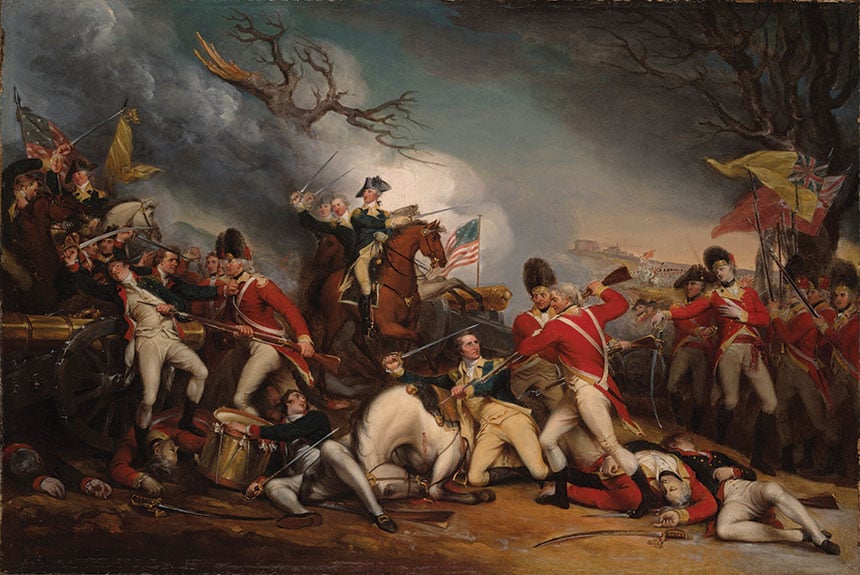
Eighteen of the signers, or approximately one out of three, were in the armed forces before the fighting ended. This was a good showing, for their average age in 1776 was 46.26, and 12 of them served as wartime state governors. At least ten of them got into actual combat, two were wounded in action, and five were taken prisoner.
The biggest bag of signers came at the fall of Charleston in 1780, when three of them — Thomas Heyward, Edward Rutledge, and Arthur Middleton — were seized. Heyward and Rutledge were both artillery captains in the Charleston Ancient Battalion, and Heyward had been wounded the year before in the American victory at Fort Moultrie. Middleton was also serving in the militia. The three signers and a number of other prominent captives were sent to St. Augustine, Florida, and returned home in 1781 by way of Philadelphia. During his exile in Florida, Heyward whiled away the time writing new words beginning “God save our glorious States,” to the tune of “God Save the King.” This became a nationally popular song for a time.
It took a large amount of sincerity and personal courage to be a signer in 1776. We have forgotten by now that there were other members of Congress who were too timid or too Tory-minded to sign the Declaration. There were men who attended on July 1, 2, 3, and 4, 1776, and then quietly disappeared. There were even a few who went over to the enemy.
The 56 who did sign were not, of course, angels in mortal form. They were very human beings indeed, and a few of them turned out rather badly — or so many people thought. Four of them — Robert Morris and James Wilson, of Pennsylvania; Samuel Chase, of Maryland; Gerry, of Massachusetts — engaged in open profiteering during the Revolution.
Morris, who became the financial dictator of the United States, continued his private business while a member of Congress — including government contracts for war supplies on which his profits were guaranteed by Congress. He emerged from the war even richer than when it started. But he also saved the Army by pledging his whole personal credit at a time of great danger.
Chase tried to corner the flour market at a time when American troops were starving. Wilson was the storm center of the worst civil riot of the war. He made himself obnoxious by acting as attorney for Tories and other collaborators in Philadelphia, and he advised rich merchants to ignore local price ceilings and continue with their black market operations. In 1779, a mob of hunger-crazed Philadelphians, led by armed militiamen, stormed Wilson’s house and started a pitched battle in which many were killed or wounded. Wilson and two other signers — Morris and Clymer — were inside the house with other prominent citizens. They had guns and ammunition, for the attack had been widely advertised in advance.
Mounted members of the First City Troop, all young city aristocrats, charged to their rescue and scattered the mob, and none of the signers got hurt. But Wilson skipped town and hid for several days.
The lure of easy money eventually dragged Wilson, Morris, and Chase into bankruptcy and disgrace. Chase lived it down and was appointed a Supreme Court Justice by President Washington. In 1804, however, he faced new charges of political and personal misconduct, being acquitted in congressional impeachment proceedings only after a hard fight.
Morris made out very well until the 1790s, when he began to display delusions of financial grandeur. As senator from Pennsylvania, he tried to corner all the real estate on which the national capital would be built, and also bought up millions of acres of wild Western land. In 1798, his many speculations crashed around his head, and he was locked up in the Philadelphia debtors’ prison. He probably would have died there, except for a federal bankruptcy law which freed him in 1801. He died in 1806, virtually a forgotten man.
Wilson, like Chase, became a Supreme Court Justice. But he continued to speculate in land and manufacturing enterprises, and eventually had to hide out from his creditors while he was still technically on the Supreme Court bench. He took refuge in the North Carolina home of his colleague, Justice Iredell, where he died in 1798 from “a violent nervous fever.”
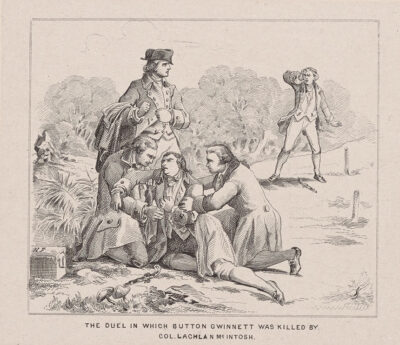
But the first signer to come to a bad end was Button Gwinnett, of Georgia. Even his best friends agreed that Gwinnett was “of an irritable temper and impatient of contradiction.” He had been born in England, made money as a merchant there, and established himself as a Georgia planter. At the time he signed the Declaration, his great ambition was to become commander of the Georgia troops in the Continental Army, but this post went to a more experienced officer, Gen. Lachlan McIntosh. Gwinnett, however, was elected governor of Georgia and proceeded to order McIntosh around, finally engineering an invasion of Florida which was a wretched failure. He then tried to put the blame on McIntosh, and McIntosh denounced Gwinnett publicly as “a scoundrel and lying rascal.”
In those days there could be only one answer to such a statement. Early on the morning of May 13, 1777, the two men met on the outskirts of Savannah with dueling pistols in their hands. They fired at each other from the unusually short distance of 12 feet, and both were hit. But Gwinnett died, while McIntosh lived to tell the tale. Gwinnett’s only claim to fame today is that his autograph has sold for a higher price — $28,000 — than that of any other signer.
Most of the signers died normally in their beds. The disease most prevalent among them, apparently, was what they called “the gout.” Gout was a very respectable and even popular malady then — probably because it was associated with wealth and easy living.
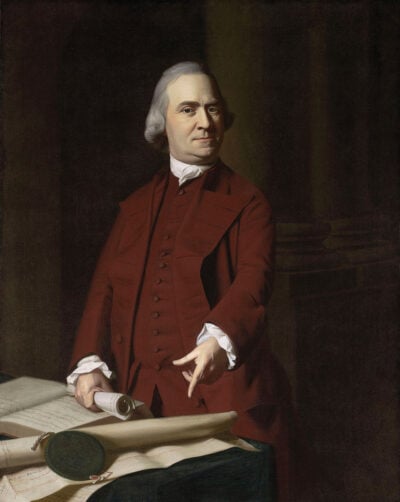
John Hancock, who signed his name “in a large strong hand,” and exclaimed defiantly, “There! John Bull can read my name without his spectacles!” was a famous sufferer from gout. He used “pine buds” as a remedy, and willingly shared his store of buds with other members of Congress. Ben Franklin, who at 70 was the oldest of the signers, wrote to George Washington on June 21, 1776, that “I am just recovering from a severe Fit of the Gout, which has kept me from Congress and Company almost ever since you left us, so that I know little of what has passed there, except that a Declaration of Independence is preparing.” He should have known that, for he was appointed to help write it.
It is little realized that the signers were, almost all of them, very well-to-do men who had much more to lose by revolting than most of their countrymen. When they pledged their lives, their fortunes, and their sacred honor to support the Declaration, they were risking a lot. Signer Charles Carroll, of Carrollton, Maryland, was undoubtedly the richest man in America; when he signed his name, one of the bystanders remarked, “There goes a few million.” Hancock was the richest man in New England. Philip Livingston, of New York, was probably the richest man in that city.
The one really poor signer was Samuel Adams, of Boston, who was broke most of his life. When he left for the first meeting of Congress in Philadelphia, his friends gave him a new suit of clothes and a purseful of gold and silver.
Adams had inherited a prosperous brewery business from his father, but he let it go to ruin while he organized the people of Boston for independence. He was a natural-born political boss and loved to sit around in smoky taverns plotting election strategy. He was too honest to profit personally by his political skill.
A few other statistics may help give a better picture of the signers. Forty-eight of them — or almost all — were American-born. The eight foreign-born signers all came from the British Isles. Twenty-one, or less than half, were university graduates. Most of the rest had received adequate private instruction. Twenty of the signers were lawyers by profession, and 11 more had received some education in the law, giving the legal minds a substantial majority.
It would be a mistake to think of the signers as a group of grim, purposeful men who had nothing on their minds but war and independence. They engaged in the same amount of horseplay, of practical jokes and hair-pulling, of petty little household errands, as any collection of 56 American congressmen today.
Signer Caesar Rodney, of Delaware, is a good example. Rodney was a tall, gaunt man with a tiny head and a face “not bigger than a large apple,” which he partly hid under a mask of green silk because of a disfiguring skin disease. But he was highly respected both in and out of Congress. He went home just before the Declaration was voted on, to stamp out a Tory uprising in lower Delaware. On the night of July 1, 1776, Thomas McKean sent word to Rodney that the Delaware delegation was split 1-1, and therefore unable to vote either way on the question of independence. Rodney came tearing up the next day on a fast horse, riding through a thunderstorm, and burst into the meeting room in his boots and spurs.
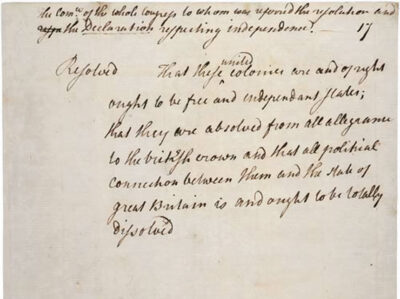
He came at the tensest possible moment. The original resolution declaring the 13 colonies to be “Free and Independent States” had been introduced June 7, 1776, by Richard Henry Lee, of Virginia, and, after several days of debate, had been tabled until July 1. Meanwhile a committee was appointed to draft a Declaration of Independence which would be made public if and when Lee’s resolution carried. Lee had to hurry home to his sick wife at this time, and the job of drafting the Declaration fell mostly to young Thomas Jefferson.
On July 1 the debate was resumed and a test vote taken. The result was nine colonies for independence, two (Pennsylvania and South Carolina) against, one (Delaware) divided and unable to vote, and one (New York) not voting at all, because its Provincial Congress had instructed the delegates not to act on independence. The next day, July 2, another vote was taken. South Carolina switched its vote to independence. Four of the nine Pennsylvania delegates purposely stayed away, so that colony’s vote was also changed.
Then Rodney’s dramatic arrival added Delaware. New York still did not vote, but it was announced — not quite accurately — that independence had carried unanimously. The next day the delegates took up Jefferson’s Declaration, which they debated, revised to some extent, and finally passed on July 4.
As soon as that was settled, Mr. Rodney, from Delaware, had other responsibilities to discharge. He must order new pairs of shoes for his nieces, Betsey and Sally, whose foot measures had been entrusted to him just before he left home.
Signer James Smith, of York, Pennsylvania, was another who had many pleasing and laughable reflections after that summer of 1776. In one convivial week in August he lost “a new Cane … my New Hat & 37 Dollars,” he wrote home to his wife. He recovered his cane at the New Tavern, where he had attended “a Turtle Feast with Mr. Hancock and ye Delegates.”
This “Turtle Feast” was probably staged to celebrate the formal signing of the Declaration on August 2. The turtle was an immense one which had been intended as a special gift to Lord North, the British Prime Minister, but was captured from a British ship by American privateers.
Mr. Smith got his hat back from an American general named Wooster, who had borrowed it by mistake, and the “37 Dollars” were found by a tavern maid “among some Old Papers” in his room. So all his problems turned out well. Mr. Smith, in fact, was having such a good time in Philadelphia that when his wife said she was coming up to see him, he wrote her a dozen good reasons why she should stay home.
Some of the other signers found quieter ways to spend their time. John Adams went to visit a waxworks, and spent an afternoon in Charles Wilson Peale’s “Painting Room.” Thomas Jefferson, who could never pass up a curious sight, paid a shilling one day to see a monkey. He didn’t say what kind of monkey it was — probably some sailor’s pet in a waterfront tavern or lodging house. At any rate, he went to look at the monkey just a few days before he started writing the Declaration of Independence, and noted it carefully in his personal account book: “pd for seeing a monkey 1/.”
During the time he was actually writing the Declaration, Jefferson paid one shilling sixpence for a new pencil, seven shillings sixpence for a map, and six shillings for wine. He also bought a new straw hat for 10 shillings. On the first Fourth of July, either before or after the Declaration was adopted, he went on quite a shopping spree. Jefferson bought seven pairs of women’s gloves for 27 shillings; a thermometer for 3 pounds, 15 shillings; and “gave in charity 1/6.”
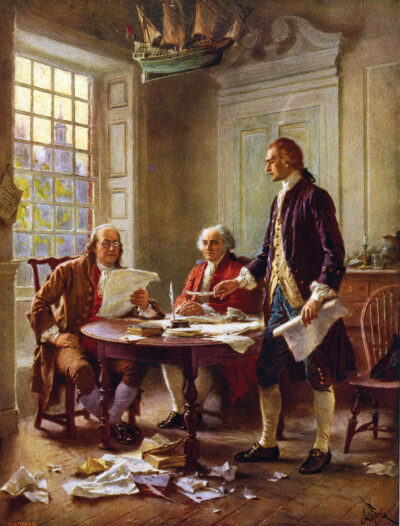
At this time Jefferson was 33 years old, a tall young man with curly red hair who rarely said anything during debates, but was regarded by other congressmen as a deep thinker and a clever writer. There is no doubt that he was very proud of his version of the Declaration, and his feelings were hurt considerably when parts of it were changed or omitted by Congress on July 3 and 4. Old Doctor Franklin tried to soothe him by taking him in a corner and telling him a funny story. But for several days afterward, judging from his letters home, Jefferson was upset and a little angry.
On the sixth, however, he must have felt better, because his little account book showed that he had paid a shilling for beer for the first time since he came to Philadelphia. It is pleasant to think that perhaps this was his modest way of celebrating a very great event. It must have been delightfully refreshing on that summer afternoon.
Roger Butterfield was an American journalist, author, and historian known for his contributions to mid-20th-century popular history writing and his editorial roles at prominent magazines, including Time, Life, and The Saturday Evening Post. This story first appeared in the July 5, 1947, issue of the Post.
This article is featured in the July/August 2026 issue of The Saturday Evening Post. Subscribe to the magazine for more art, inspiring stories, fiction, humor, and features from our archives.
Become a Saturday Evening Post member and enjoy unlimited access. Subscribe now

Comments
This article is great, it brings history to life and makes it real. We had a local retired American History teacher in Glasgow KY read the declaration of Independence on the 4th this year for a crowd of people gathered in a local Coffee Shop to celebrate the Holiday. That helps us, especially the younger generations appreciate this great country. I appreciate your article on how the signers were real people, not just a group of individuals that we really don’t understand the concept of what they did some 250 years later.
Back when I was in school some 60 years ago American History was taught as memorizing dates & a few key figures names to pass a test. That was boring to say the least.
Sadly our public schools (at least in KY) are geared for training the kids to pass a test so the school can get more money. Cursive writing is no longer taught and students graduate unable to sign their names! How far we have fallen as a society but the parents must take the responsibility of teaching their kids if they can’t just lay the cell phone down long enough!
Again thanks for this very interesting history article on this our 250th anniversary!
The very title of Mr. Butterfield’s Post feature is both jarring and haunting, with the article that follows terrifying and shocking, yet not surprising, all at the same time. Rebellion against tyrants is obedience to God.