Higher Power
Years ago, as a much younger man, I worked for a short time on a fishing boat off the Cape. The job was mainly hauling nets and pouring the catch into holds and cleaning the decks. But this was near the whale routes, so every once in a while, when the sea was quiet, I could feel something great and close — but always hidden beneath the surface.
The waves would shudder slightly, and though I could never see it clearly, there was the feeling of a presence larger and closer than it should be. Powerful but hidden. Terrible and beautiful at once.
Sometimes if I looked at just the right moment I could see its shadow. And every once in a great while the shadow would come crashing through the surface — visible for just an instant before being pulled back below.
When I was growing up, my folks had a house near the transformer that was the main electrical line into town. It was a large steel tower draped with thick cables. Most of the time it was silent, just a presence. But if you listened closely you could hear a hum. Some nights, though, I could hear a surge, the electricity, I suppose, much stronger than the weaker wire that was forced to carry it.
And when the demand from the town for light and for heat was too great, the wires would overload. They would hum and moan and the tower would begin to shake. Sometimes it even rained down a shower of sparks.
I would stand at my bedroom window, just a young boy afraid in the dark.
Those nights my father would come into my room, put his hand on my shoulder and say, “Don’t worry. Worry is praying in the wrong direction. It’s just the town … calling out for higher power.”
My father lost his job when I was 16. He found a new one a thousand miles away, but I decided that I didn’t want to move so I ended up living on my own, a kind of runaway.
I got a job — and then another — and then one on the weekends.
That year I met Ray.
Ray was an Irish kid, big heart, drove a souped-up GTO muscle car. He had a deep laugh, the kind that was always trying a little too hard to hear itself, like some part of him was hungry for every scrap of hope and joy he could wrestle free from himself.
Ray’s father was a drunk. Worse, he was a bad drunk. That is, he would drink just enough all week not to get fired but then would really get tuned up all weekend long.
Bad drunks always want to fight. They figure, rightly, that life is unfair — and all they want is to find a way to reach out and somehow hit it.
Like they could beat some fairness into it. Like they could somehow change its mind.
Ray’s father was forever swinging away at life on the weekends. This usually meant putting a load on and getting into a fight at a bar, getting his ass kicked, and then coming home loaded with Bushmills and rage.
This, of course, left only his teenage son to batter.
So trying to punish life, he ended up hitting his only son until he himself became the very unfairness he was trying to beat away.
Each weekend Ray pleaded for the old man — whom he loved — to stop … which was like asking for the world not to spin.
Ray would come to school Mondays, blackened eyes, bruised up, broken jaw wired shut once. He told me that every Monday morning like clockwork he would find his old man in some dark closet of shame on his knees, hands shaking, praying.
Beating up the last person he could reach. Himself.
Always begging for the very mercy he could not find in his own heart. Always pleading those dawns over and over for higher power.
So Ray made himself into a hard guy. What choice did he have? He became the echo of the old man’s punches. And in due time started getting into fights on the street. Got arrested a couple times.
The crime wasn’t his, though. Not really. That was like blaming the echo for the holler.
One night Ray picked me up to go across the state line to buy beer. The back way was full of twisted country roads, the kind that pivot and spin for no purpose, like they were designed by a surveyor driven mad from grief.
We both knew those roads in our sleep, but this night Ray was going way too fast.
I asked him to slow down. But he just stared ahead like he was trying to see something out beyond the reach of the lights.
Then he steadily pushed it up to 40 — 50 — 60 miles an hour.
He turned and looked at me hard like he was trying to say something for which the words had not yet been invented.
And then he switched off the headlights.
I was terrified. He was twisting the wheel back and forth as we hurtled along, feeling our way along that dark unseeable country road.
For about 30 seconds — half a mile or so — all I could see was the shadow of the trees rushing by, calling out for my future to wrap itself around them.
Ray finally dropped to 30 and flipped on the lights. I remember I was trembling. We rode along in silence for a moment, then in a low voice he whispered, “That’s what it feels like … all the time … to be me.”
He dropped me where I was living. But I didn’t go in. Instead I walked the mile back to where my folks used to live near the wires and the tower.
That night I remember the transformer was overloaded. The hum rose like a plea and the wires moaned once more under the weight of the demand. Too many people, I suppose, in the dark, calling out for heat and for light.
I remember the wires finally shuddered, like that was too much to ask. Then a shower of sparks cascaded down. And then silence.
The blackout covered most of the town, including Ray’s house.
His father sat alone in the dark for an hour, then angry once more, stumbled into the basement. He started beating on the circuit box with a screwdriver just as the power surged.
They found him unconscious, fingernails burnt black from the charge. And though the doctors could never find a reason, he didn’t speak for a year. They kept him in the hospital for a couple weeks and because of that he lost his job. The bank took the house and Ray ended up moving in with his aunt, a small bright woman with an incandescent spirit. And the old man became one of the shadows on the streets, a silhouette cloaked in the darkness of his own making.
Ray became a cop. He used to tell me, “They don’t call it police ‘force’ for nothing.”
He found a way to turn the echo of those beatings into a calling.
Every time he answered a 911 call — a wife being beaten, a kid abused, whatever — it was like he himself had become the answer. An imperfect reply to a call for higher power. He became, like all of us, a flawed wire trying to deliver a current stronger than it was ever meant to bear.
I suppose his father’s pleas were finally heard. The terror of those beatings was slowly turned inside out … into mercy … both for and then eventually from his son. But sometimes even the speed of light is too slow. Ray died way too young, of cancer. A soul can live too close for too long to the wires. Overloaded, I suppose.
There’s just so much demand, or as my father would say, so many calling out for higher power.
But that was many years ago and now I live far from that town.
And now some nights when I look at whatever woman has gotten near to me, it makes me think of those power lines. And sometimes I can hear in her the whisper of a higher power.
Some nights I can even feel it stirring in me, like the shadow of something great and unseeable and far beneath the surface.
Last week late at night I was alone on the interstate where it’s straight and flat and predictable. I pushed it up — 70 — 80 — 100 miles an hour, until the chassis and the wires began to rattle and moan. And then I cut off the lights.
I thought for a moment I knew what it felt like to be a whale — hidden from the world — just a shadow. Full of something terrible and beautiful and far beneath the surface rushing along through the dark.
And I wondered why even in the daylight it feels sometimes like a shadowed world is rushing by, calling out for my future to wrap itself around. A world I can only feel and never quite can see.
But worry is praying in the wrong direction.
So some nights I get on my knees in the darkness and search for words that have not yet been invented. Calling out for higher power.
And sometimes when I hold her tight I can feel the rise and fall of her breath — and far beyond my reach, in each of us I suppose — something like a current, trying to meet the demand of all those dark and distant places in us all.
Trying to answer.
With heat and with light.
Featured image: Shutterstock.com
“The Water’s Fine” by John Peter Toohey
A member of the famed Algonquin Round Table, John Peter Toohey also gave Harold Ross the idea to name his magazine The New Yorker, according to Dorothy Parker’s biography. Toohey wrote for magazines for much of his life before working as a theater publicist. His short story “The Water’s Fine,” about a theme park press agent who designs a publicity stunt for his ingénue crush, was later expanded into a novel called Fresh Every Hour. His thrilling, romantic short sets the scene by invoking the 1900s vaudeville hit “I Just Can’t Make My Eyes Behave” and concludes with a climactic chase on dirigible.
Published on November 8, 1919
Jimmy Martin’s heart persisted in acting like the well-known eyes of the young lady in the song. He just couldn’t make it behave. Up to the third week of his summer season as press agent at Jollyland, the big summer amusement park near New York, it had always been a fairly well-mannered and dependable organ, which performed its physiological functions with becoming regularity and which was not accustomed to respond to any external stimuli with anything beyond an occasional slight flutter. To be sure it had acted up a little three years back in connection with a certain dark-eyed beauty who presided over the destinies of the cigar counter up in the Grand Hotel in New Haven, but that had been only a slight attack and it had resumed the even tenor of its ways after a brief interval and had been unobtrusively going through its routine activities ever since.
A most prepossessing young person whose parents had inflicted upon her the name of Miss Lolita Murphy was directly responsible for the alarming symptoms already hinted at. From the precise moment that Lolita came within his ken Jimmy ceased to be a rational being in full control of his faculties; and his heart, in sympathetic accord with the agitated condition of its owner, began to put on an antic disposition and indulged in curious palpitations of a most annoying nature on the slightest pretext. The usual provocation at first was the sight of Lolita herself, but after a day or two even the thought of her produced a cardiac rataplan that would have done credit to the trap drummer of a jazz band.
Lolita, it may be mentioned in passing, lived up to all the implications of the somewhat picturesque cognomen given her by McClintock, the park manager, when Jimmy first pointed her out to his superior.
“She sure is Miss Lulu Looker,” McClintock had remarked emphatically.
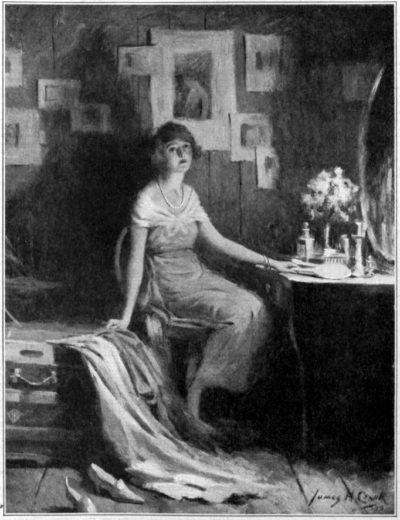
Lolita was all of that and a little more. Jimmy was not a poet, and he was therefore unable properly to voice the feelings he had about her beauty. Had he been one he might have justly said that her cheeks seemed to have been kissed by the rosy flush of dawn; that in her sable eyes there lurked the eternal mystery of night beneath tropic skies; that her dark hair was as fragrant as the spices of Araby and that her lithe figure had all the gracile curves of a bounding antelope. As it was, he contented himself with the frequent repetition of the decidedly unpoetic expression “some gal,” but this represented to him all the ideas noted above and a liberal assortment of others equally glamorous.
Lolita hailed from a small city in Iowa, and ever since the memorable occasion when Maude Adams played Peter Pan in that city for one night only she had cherished a great and overwhelming ambition. Her father ran the drug store next door to the opera house and was a great crony of the manager’s. A number of boys and girls were picked up in each town to play the children in the Never Never Land scene and Lolita’s fond parent had inveigled the manager into selecting her as one of the group. It was a step that father was to regret vainly for many years, but on the night of her debut he was blissfully unconscious of the possibility of any bitter repining in the future and enjoyed the proceedings almost as much as Lolita did.
From that time on Lolita felt the call of the footlights and became convinced that, given the proper opportunities for the externalization of the emotional feelings that lay dormant within her, she was destined to become an international celebrity and the queen regnant of the English-speaking stage. Chauncey Olcott came to town a few weeks later and she persuaded father to work her in as one of the youngsters to whom he sang a lullaby in a high tenor voice down in the “glen,” which is always the setting for the third act of an Irish play.
After that there was no holding her. She became a student at Miss Amanda Holliday’s School of Dramatic Expression, which occupied three rooms on the second floor of the Turner Block on Main Street, and she participated in the semiannual entertainments given by the budding geniuses who were under the tutelage of that small-town preceptress of the arts. Versatility was her middle name. At one time she would play Ophelia in the mad scene from Hamlet, and appear later on the program in a Spanish dance with castanets, a lace mantilla and all the other necessary properties. Six months later she would combine the balcony scene from Romeo and Juliet with an imitation of an imitation of Eddie Foy she had heard given by a monologue artist at the Orpheum Theater.
At the age of nineteen she was the town wonder. The dramatic editor of the Democrat-Chronicle predicted that within a short time “this talented daughter of our esteemed fellow townsman, Henry P. Murphy, seems destined to occupy one of the stellar places in the front ranks of the worthwhile artists of our fair country.”
Lolita moved on to New York armed with a letter of commendation from Miss Amanda Holliday setting forth that she was “worthy of consideration for any role no matter what its importance” and urging theatrical managers “not to neglect this opportunity of obtaining the services of one who is a mistress of the mimetic art in all of its manifold manifestations.” She also carried a full set of clippings from the Democrat-Chronicle, one half of her male parent’s attenuated account in the First National Bank and an overabundant supply of cheery optimism.
The metropolitan managers’ office boys were decidedly cold to the advances of this gifted daughter of the Middle West. They treated her with that air of careless indifference so characteristic of their profession. With one accord all the big and little producers decided to take a big chance and neglect the opportunity which Fate was offering them. They were unmoved by the clippings from the Democrat-Chronicle with which Lolita bombarded them through the mails, and they were callous to the eulogistic outpourings of Miss Amanda Holliday, copies of which accompanied each written request for an interview. Lolita’s cash reserve grew perilously low and disaster threatened. Then on a morning when disillusionment and despair moved in and took lodgings in her soul she saw an advertisement in a newspaper which was like a life buoy tossed to a drowning man.
“Ambitious Young Women Wanted for Stage Work,” it read. “Opportunity Afforded Ambitious Amateurs to Perfect Themselves in Dramatic Technic — Apply Immediately at Manager’s Office, Jollyland.”
Lolita, filled with high hopes, took a trolley to the great playground by the sea. There, Destiny handed her one of those cold douches that are sometimes held in reserve for those whose ambitions o’erleap themselves. The dramatic opportunity promised in the advertisement proved to be what might be vulgarly termed a job.
A great free open-air spectacle was in process of preparation at Jollyland under the supervision of a famous moving-picture director who specialized in that form of animated art technically known as serials. He had personally conducted a gazelle-eyed cinema celebrity known as June Delight through four fifteen-reel affairs of this sort, in which she had been threatened with mayhem, aggravated assault and battery, felonious wounding, and total and complete annihilation at the hands of numerous bands of cutthroats, bandits, thieves and white slavers. In the course of these proceedings she had performed every breath-catching feat that the festive imagination of the director had been capable of conjuring up, and had succeeded by a miracle in keeping out of both the hospital and the obituary columns of the daily press.
Now it was proposed to let the public have a close-up view of this death-defying marvel in the flesh in the act of performing one of her most famous exploits “before your very eyes and for your attention,” as the circus announcer would put it. To permit of this the director had evolved something which he called a dramatic spectacle and had persuaded the management of Jollyland to arrange for its production in a huge, specially constructed open-air auditorium as a special added attraction intended to put a final quietus on the presumptuous efforts of a rival group of showmen who were endeavoring to rouse interest in a new park just opened that summer.
Lolita found herself in a long line of applicants, many of whom were pathetically peaked and undernourished looking, and when her turn came to meet the director she made up her mind to pocket her pride and accept whatever fate offered rather than run the risk of finding herself in like straits. Ambition still fired her soul and she was determined not to return to the little old home town until she could enter it in something at least closely akin to a spirit of triumph. To be sure the opportunity offered her was not particularly roseate. It did not hold forth much promise of either pecuniary reward or even of passing fame, but it meant that Lolita would not have to telegraph home for funds and there was a faint glimmer of hope in a remark made by the director.
“You can mingle in the front ranks of the crowd,” he said. “We’ll pay you eighteen a week. There’ll be only two shows a day.” Then he had looked at her critically. “You’re almost a ringer for Miss Delight,” he concluded. “Maybe if you’re a good little girl I might take a notion to try you out as understudy.”
So Lolita Murphy, the pride of her home city, became a small and almost infinitesimal part of the great outdoor spectacle entitled Secret Service Sally, which was the big sensation of the Jollyland season.
In the role of an agent of the United States Secret Service the charming and fascinating June Delight was swept through a series of thrilling adventures set against spectacular backgrounds depicting scenes in Berlin, Tokio, Rio de Janeiro and other world capitals, and as a culminating feature she was pursued to the roof of a building in London by a howling mob which suspected her of being a spy in the employ of the Central Powers. She was saved from its hands, in the proverbial nick of time, by her fiancé, dashing Lieut. Thurston Turner, commander of the United States Dirigible N-24, who happened to be cruising about the neighborhood at the moment and who effected a rescue by circling his ship round the roof and deftly lifting the young woman into the shelter of the gondola which hung from the great gas balloon just as she was about to be beaten to death by the crowd.
Inasmuch as the spectacle was given in the open air it was possible to use for the purposes of this scene a real dirigible, which was manned by a crew commanded by one Bobby Wilkins, a personable young gentleman from Chicago who had come back from France with a major’s commission, a reputation for dare-deviltry as an aviator surpassed by no other ace in the American service, and a collection of a half dozen assorted war medals bestowed by three grateful nations. Bobby had left a snug berth as assistant to the president of a big varnish company to go into the Army, the said president being a somewhat indulgent parent who had sanguine expectations concerning his son’s commercial and industrial future and who was even now sending him daily wires to the Ritz-Carlton urging him to “cut the cabarets and get down to a solid rock foundation.”
Father labored under the delusion that Bobby was simply vacationing in New York. Had he had an inkling of just what his son was doing he would have — to use the young major’s own expression — “tried for a new altitude record himself.” He couldn’t be expected to know that dictating fool business letters and checking up the new efficiency expert’s monthly report of economies effected at the Dayton plant wouldn’t exactly appeal any more to an adventuresome young man who had been skyhooting through the upper reaches of the atmosphere for nearly two years and dodging German machine-gun bullets.
Bobby had overheard the general who commanded the aviation camp at which he was demobilized remarking about a request made by the moving-picture director that he recommend some aviator for the task of piloting the dirigible which was to play such an important role in the spectacle, and he had offered himself for the sacrifice just as a lark. He found the experience rare sport and until something giving greater promise of adventure appeared in the offing he was determined to go on with it. Twice a day he reached down and plucked up the beautiful Miss Delight as lightly as if she were a fragile doll while the assembled thousands, on the qui vive with excitement, burst into rapturous applause. In order to insure the peace of mind of Robert Wilkins, Sr., Jimmy Martin had consented rather reluctantly, it must be admitted — to respect the wishes of the impersonator of Lieut. Thurston Turner, U.S.N., who had expressed a desire to remain incognito. Otherwise the consequences might have been lurid.
Jimmy itched to give out a story concerning the social and business connections of the young soldier, but he had given his word and, being an ex-newspaper man, that was sacred. He temporarily forgot about Bobby and devoted his spare moments to figuring out ways and means for the sensational exploitation of Lolita Murphy, to whose charms, as previously recorded, he had become a shackled slave from the moment he first glimpsed her at rehearsal.
Lolita, it may be mentioned in passing, was a trifle discouraged at the comparatively slight opportunities for uplifting and otherwise ennobling the American stage offered by her participation in Secret Service Sally. Her name wasn’t even mentioned on the program. She figured under an impersonal heading at the bottom, together with a couple of hundred other young women who were listed as “Berlin citizens, Japanese geisha girls, South Americans, Londoners, etc., etc.”
It needed all the soaring optimism of Jimmy to keep her from slipping into a nervous decline. The press agent had obtained an introduction through the stage director, and his sympathetic interest in her temporarily sidetracked ambitions had won him her esteem and high regard from the beginning. Jimmy was a rapid worker and within three days from the time of their first meeting he had vowed his ardent and palpitating devotion, and though Lolita had not completely committed herself to a reciprocal affirmation she had succeeded, nevertheless, by devious and subtle devices not unknown to her sex, in conveying the distinct impression that the star of hope was visible in the eastern sky.
There came a night when Lolita’s disappointment was past all bearing and when she sobbed out on Jimmy’s shoulders a bitter protest against the fate that had driven her into believing that she was destined to be a great actress. They were sitting on the beach in the moonlight after the show, and off in the murky distance the great Sandy Hook light was blinking like some monster firefly.
“Jimmy,” she said half chokingly, “I just don’t belong. I wish I was back in Iowa.”
“Gosh, that’s an awful wish, girlie,” responded the press agent with a foolish attempt at a pleasantry which he instantly regretted. Lolita drew away from him quickly and flared up.
“Iowa’s all right,” she retorted. “It’s better than this lonesome place.” She lapsed almost immediately into a wistful mood. “It’s just ten o’clock there now and the movies are letting out and there’s a crowd in dad’s store and the fellows are treating the girls to sundaes or just plain ice cream and dad is fussing round and yelling to poor Porky Brooks to get a move on and keep the orders filled, and like as not he’s helping out himself. I want to go back, Jimmy; I want to go back.”
Jimmy touched her gently on the hand and then squeezed it softly.
“Listen, girlie,” he said comfortingly. “I know just how you feel — the cards ain’t runnin’ right and you want to quit the game, but I’m goin’ to cut in with a clean deck and start a new deal. I’m goin’ to fix things so that when you do go back for a visit to the little old home town and the old folks the Peerless Silver Cornet Band is goin’ to be down at the station, and the Mayor is goin’ to speak a few well-chosen words of welcome in the presence of a cheering crowd of friends and wellwishers. Leave it to me.”
Lolita laughed a little in spite of her mood.
“You’re a great little jollier, Jimmy,” she said, “and I’d like to believe you, but somehow I can’t. I’m a nobody, a small-town nobody.”
“But you’re goin’ to be a little Miss Lolita Somebody of the well-known world,” he responded cheerily, “before I get through with you. I’m goin’ to drop you right into the direct center of the front page of every paper in the U.S.A. from the New York Gazette to the Wyalusing, Pennsylvania, Rocket. You’re goin’ to make all the rest of them look like shrinkin’ violets on a foggy afternoon when I finish up with you. You just wait and see.”
“How long have I got to wait, Jimmy?” ventured Lolita, who was adrift in the realms of fancy, carried thither by the soothing cadences of Jimmy’s voice.
“Only until some afternoon when this June Delight person fails to show up. I hear she’s talkin’ of layin’ off for a few days. If that doesn’t happen by the middle of next week, I’ll get to her chauffeur and frame it so that she misses the show. Then we’ll pull the big act. If you’ll promise not to talk about it even in your sleep I’ll hand you a little advance information on the subject.”
Only the silent stars and the discreet moon shared Jimmy’s confidence with Lolita. Its general tone and tenor lifted that despairing daughter of the plains out of the rut of hopeless striving into which she felt she had fallen and filled her with such anticipatory delight that when she said goodbye at the door of her boarding house she impulsively reached forward and kissed him full on the mouth.
“You’re a darling!” she murmured.
“I’ll take an encore on that, girlie,” he replied. And he did.
II
Miss June Delight summoned Manager McClintock to her dressing room just before the Saturday-night performance and successfully simulated the classic symptoms of impending nervous prostration while she sniffed at a vial of smelling salts and submitted to the ministrations of a tired maid who gently massaged her forehead with her fingertips. Miss Delight in a voice that was barely audible informed the manager that she could not possibly endure the trying ordeal of further performances after that evening without a brief period of rest and that she was leaving for a week’s stay at a sanitarium on the following morning.
McClintock gave voice to low moans and flew other signals of distress, but Miss Delight was obdurate to his more or less frenzied expostulations and remarked that though she was disturbed at having to disappoint her dear, lovely, friendly public she felt that her health was the prime consideration. The manager was in a surly mood when he left her to seek out the stage director.
“Who’s the understudy?” he inquired.
“She calls herself Lolita Murphy,” replied the director, “but I understand there’s a certain party connected with the publicity department who calls her even flossier names than that.”
“Jimmy’s gal, eh?” commented the manager. “Well, she’s there with the looks anyway. Has she had a rehearsal?”
“She’s been through the thing roughly with the rest of the understudies, but I can have the whole troupe called for tomorrow morning and we can run straight through. We’ll get out the dirigible and go through with the rescue stunt. We mustn’t fall down on that. The little lady seems to be there with the nerve, but I’d like to try it out.”
Jimmy was permitted to break the news to Lolita. He met her after the performance that night and imparted the glad tidings. When he left her he gave her a final word of caution.
“Keep the little old nerve up, girlie,” he said earnestly, “and we’ll wake up the whole country on Monday morning.”
“I’ll try, Jimmy,” she whispered. “You’re just the — well, just the dearest boy I’ve ever known.” On the following morning Lolita, athrill with excitement and a little nervous, assumed the title role in Secret Service Sally at a rehearsal, to the complete satisfaction of McClintock, the stage director, and Jimmy Martin. The latter watched her with adoring eyes and when she successfully essayed the sensational rescue scene he was moved to wild and clamorous applause, which sounded a bit startling in the great empty auditorium. Under Bobby Wilkins’ expert direction the big clumsy dirigible was maneuvered round the edge of the roof and Lolita was lifted into the car by the former ace with such adroit ease that the whole thing seemed to be simply part of a casual everyday occurrence. When it was over and Lolita had been safely landed back on earth and had received the congratulations of everyone concerned she drew Jimmy aside and clutched at his arm for support.
“I’m ready to faint,” she said weakly. “I believe I would have up on the roof when I saw that big thing coming toward me if that fellow hadn’t grabbed me off so quickly.”
“You need a little nap,” responded Jimmy soothingly. “The worst is over and the best is yet to come. Don’t forget that young Mr. Arthur H. Opportunity has a date with you this afternoon and that the big splash is due tomorrow morning. Now you go in and get a little sleep and I’ll have a talk with my friend the handsome lieutenant. I fixed things with him last night, but I’ve got to go over some details again.”
A few minutes later the press agent was closeted with Bobby Wilkins in the hangar in which the dirigible was housed. The park gates had just been opened for the day and crowds of holiday merrymakers were surging through them in quest of the fifty-seven varieties of feverish and hectic entertainment which Jollyland provided for those in search of diversion.
III
If anyone had called Jimmy Martin a psychotherapist he would promptly have denied the soft impeachment first and then asked for a dictionary and an explanatory blueprint. And yet as a direct result of a random idea which had bobbed into his active mind a few weeks before he was unconsciously serving in that capacity for a large and ever-increasing throng of metropolitan society women of varying ages who flocked to Jollyland in search of a new thrill which he had provided. The winding up of war-charity work which had followed close upon the return to these shores of the larger part of the American Army had turned many of these women back upon their own resources; and their innate restless activity, which had found such an altruistic outlet in new channels for several years, now imperiously demanded fresh excitement, and it was this that Jimmy offered them.
On the occasion in question Jimmy had overheard a coy young debutante who was watching a performance of Secret Service Sally remark to a group of friends who accompanied her that she’d just love to go up on the stage and mix with the crowd! That was enough for the press agent. Ten minutes later, during the intermission, he escorted the entire party behind the scenes, and under his guidance they participated in the London episode which concluded the show. They mingled with the crowd of supernumeraries and entered into the proceedings attendant upon the thrilling dirigible rescue with such gusto that the stage manager gave Jimmy carte blanche to encourage the idea.
It happened that in this particular party were several of the socially elect and the papers next morning carried extensive stories chronicling the event, coupled with the announcement that the park management would, throughout the season, be pleased to extend the privilege of participating in the entertainment to other groups who might wish to take advantage of the opportunity for this unusual form of entertainment. Society seized upon the idea voraciously and Jollyland parties gave a new fillip to the summer season at all the Long Island resorts. Elderly matrons of ample girth vied with the members of the younger set in setting the pace, and in many instances came again and again to become a part of the great spectacle. For the first time in its history Jollyland began to figure in the society columns of the daily press, and great was the prestige which Jimmy enjoyed in McClintock’s eyes as a result.
The particular luminary of the Long Island season at the moment and the prospective lion of the month of August at Newport was none other than the Hon. Betty Ashley, daughter of the second Lord Norbourne, and the most talked about young woman in English society for a period the beginnings of which antedated the war by several years. Before the great European conflagration, the Honorable Betty, though then still in her early twenties, was a European celebrity. Spirited, impulsive and headstrong by nature she had early rebelled against the ultraconservative traditions of her family and had so thoroughly flouted convention that her name was on the tip of the tongue of everyone in the tight little island. She began it by publicly slapping the face of a certain deposed kinglet who had sought refuge and a safe haven in England and whose sole offense had been a mild protestation of love, made at a fashionable garden party.
There had followed her sensational and entirely unarranged presentation of a petition for woman’s suffrage to England’s monarch himself at a formal court reception — an incident which sent her dignified father to his bed for two weeks; her arrest on suspicion of being implicated in a militant attempt to set fire to the House of Parliament and her subsequent acquittal after she had refused to make any defense against a damaging array of circumstantial evidence; her jilting of the Earl of Maidsley in an explanatory and derisive letter to the Times; her winning of the amateur tennis championship; and a host of other incidents of an unconventional nature.
Then the war had come and she had gone over to France in the first months as a motor driver and had still managed to keep in the public eye for five years despite the somewhat considerable amount of attention devoted in the newspapers to the great struggle. She had, for one thing, won a D.S.O. for bravery under fire in the First Battle of Ypres; and she had, for another, been reprimanded in orders for organizing a ball at a certain château occupied by the staff of a certain corps during the absence of the commanding general at a conference at G.H.Q.
Now she had come to the United States for the first time and had materially assisted in putting zest and punch into a round of festive house parties on Long Island given by prominent members of the swiftest-moving coterie of the so-called smart set. Small wonder that when she heard of the expeditions to Jollyland which were enjoying such a vogue she should elect to organize one herself.
“I’m not entirely a rank amateur, my dear,” she confided to her hostess when the party was preparing to depart. “I went on for two nights running in the chorus at the Alhambra last winter on a five-pound wager and I’d have stuck it out for a whole week for the fun of it if the pater’s blood pressure hadn’t been running abnormally high. The old dear would have gone all to smash if he had found out, and he might have if I’d kept on.”
The Honorable Betty, her dark beauty set off by a rose-pink silk sweater and a tam-o’-shanter to match, was in the first car of the string of six which disgorged a laughing crowd of merrymakers in front of Jollyland on Sunday afternoon. They made for the big arena immediately, as it was within a few minutes of the advertised time for the ringing up of the curtain on the great spectacle. The Honorable Betty let it be known to an usher, who was duly impressed by her air of authority, that she craved an immediate interview with the manager. McClintock, still disturbed at the defection of the capricious Miss Delight, responded grudgingly; was apprised of the identity and mission of the distinguished visitor, and sought out Jimmy Martin in great excitement. He found the press agent back on the stage.
“Say, young fellow,” he said enthusiastically, “I’ve got a Monday-morning story for you all ready-made and ready to try on! This Betty Ashley who’s been grabbing off space all over the world for a long time and who’s the big noise with the real folks over here this summer is out in front with a crowd right out of the Social Register and she wants to go on in the London scene. I told her she could. Get busy now and prepare for a general assault on the press.”
Jimmy received this intelligence with a glumness that rather annoyed McClintock.
“What did she want to pick out today for?” he inquired uneasily.
“What’s the matter with today? It’s the best day possible for a good break for us. The papers are always glad of anything that makes a noise like a story on Sunday. What’s the matter?”
“Oh, nothin’,” replied Jimmy absentmindedly; “only I wish she’d waited until the middle of the week. I was kinda figurin’ on — Oh, nevermind; it’ll be all right.”
IV
An acute observer would have detected signs of suppressed excitement in the general demeanor of Jimmy Martin during the progress of the early scenes of the great spectacle in which Lolita Murphy was essaying the leading role for the first time on any stage. He had exchanged his customary cigarette for the solace of a particularly formidable-looking cigar, which he puffed at nervously as he sat in the manager’s box with his cap pulled down over his eyes. His whole body was tense and rigid, and though there was a look of adoration in his eyes there was something more — a vague something that seemed to spell apprehension.
Justice compels the admission that Lolita was doing herself proud. She moved through the thrilling situations of Secret Service Sally with the ease and calm assurance of a veteran and more than merited the applause which the vast holiday audience showered on her. When the curtain rose on the final scene — the one depicting the streets of London — the audience, keyed up to expectant excitement by the gaudy promises of the program, held its collective breath and Jimmy sank his teeth viciously into what remained of his cigar. McClintock slid into the seat alongside of him.
“That gal of yours is sure making good!” he remarked good-naturedly. “If she goes through to the finish as nicely she’ll find a surprise in her envelope on Saturday night. There’s that English society dame and her party strolling along just as if they were back in dear old Lunnon. I had Lawrence, the assistant stage manager, go on with ’em to put ’em wise to all the business.”
The mimic street on the stage was thronged with a motley crowd of supernumeraries who were supposed to represent the populace of the British metropolis out for an airing on a bank holiday. The rose-pink sweater of the Hon. Betty Ashley was the most conspicuous object in view. That patrician lady bobbed in and out among the others, apparently having the time of her life and urging her friends, with violent pantomime, to enter into the festivities with something akin to her own enthusiasm.
Presently the audience heard a murmur pass through the crowd on the stage and Jimmy’s acute ear detected the muffled purr of the motor on the dirigible, which was at that moment maneuvering for position and awaiting its cue two hundred feet in the air just behind the backs of the last row of spectators. The press agent grabbed the railing in front of him and leaned eagerly forward. He was watching the right side of the stage.
A motor car shot out of the wings through a lane in the crowd. In it sat Lolita Murphy in the role of queen of the American Secret Service. It was plain that she was simulating great anxiety and that she was being followed. She looked apprehensively over her shoulder and the audience could catch excited shouts of “Stop her! Stop her!” A gigantic bobby stepped directly in the path ahead of the car and drew his revolver. The chauffeur pulled a lever and the car stopped abruptly. A man on a motorcycle came dashing up.
“Arrest her!” he shouted and he sprang from the saddle. “She’s a German spy from the Wilhelmstrasse.”
Lolita looked about furtively, poised herself for just a moment and then leaped out of the car, overturning an athletic super and making for a doorway as the crowd broke into frenzied cries of “Kill her! Kill her!” The incident had been rehearsed with the utmost regard for actuality, and as the mob surged after the suspected spy the vast throng of spectators swayed with excitement like a field of tall grass in a breeze. Lolita reached the safety of the doorway by almost the fraction of an inch and disappeared. The crowd poured in after her and McClintock caught Jimmy’s arm as he caught sight of a vanishing flash of rose-pink.
“Damned if that English dame isn’t right in at the death!” he said excitedly. “She’s going up on the roof.”
Jimmy didn’t reply. He was watching the roof of the make-believe building with eyes that were strained and staring. As Lolita emerged from the hatchway and plunged forward with a fine gesture of despair, he looked back over his shoulder for a moment and noted that the N-24 was slowly swinging forward and that the alert and eager face of Bobby Wilkins was visible over the edge of the car which hung from the rear of the big balloon.
Lolita held out appealing hands and gave voice to cries for assistance. The crowd, in the vanguard of which was a lady in a rose-pink sweater, with cheeks that were flaming and with eyes that were dancing, swarmed up through the opening and surrounded the suspected spy. The supernumeraries’ voices became a blended babble of inarticulate cries and 3,467 spectators watched the developments in a tense silence.
Nearer and nearer swung the great dirigible. Lolita was now in the hands of the mob, with which she struggled fiercely. As the N-24 swung round the corner of the roof she turned as per instructions, but Jimmy noticed with a gasp of concern that she had turned in the wrong direction and that she was making her way to the wrong side. She was evidently bewildered. Bobby Wilkins was leaning out of the car with his arms outstretched and was beseeching her to run toward the other side of the roof. In another five seconds the dirigible would have passed on and the spectacular finish of the big show would be ruined. McClintock swore softly. Jimmy sat as one entranced.
Some of the supers were pushing Lolita to the other side, but she seemed to be in a panic and struggled with them as if still acting the earlier scene. At this juncture Jimmy noticed that a lady in a rose-pink sweater had run to the edge of the roof, just above which the dirigible was moving, and that she was holding up her arms. His cigar dropped from his mouth a second later when he saw Bobby Wilkins grab her outstretched hands, swing her clear of the roof and pull her into the car as the great dirigible finally cleared the scenery building and in quick response to the hand of the pilot in the front car nosed her way upward at a higher rate of speed. The curtain fell and the repressed excitement of the great audience found vent in tumultuous applause. The thing had happened so quickly that there were apparently few who had noticed that the wrong young woman had been saved from death by the timely arrival of Lieut. Thurston Turner, U.S.N.
“What a whale of a story!” chortled McClintock, gripping Jimmy’s arm so fiercely that the press agent winced with pain.
“Yes, isn’t it?” responded Jimmy dreamily as he watched the N-24 winging her way over the park and out toward the sea. The spectators had risen from their seats and were applauding again as a big American flag was unfurled from the rear car of the dirigible.
The balloon kept on its way toward the ocean, and as McClintock noticed that it didn’t make the turn it usually did when it reached the giant roller coaster that ran along the shore a puzzled expression came over his face. If he had looked at Jimmy sharply just then he would have observed the first beginnings of a pleased smile tilting the corners of the press agent’s mouth. A minute passed and the great yellow gas bag receded farther and farther in the distance. McClintock stepped down and borrowed a field glass from a spectator. He glued his eyes to it for a few moments and then dropped his arms. His face had gone pale.
“His motor’s dead,” he said weakly, “and he’s drifting out to sea. The propeller’s stopped and he’s being carried out by this land breeze. We’ve got to do something — we’ve got to get help of some kind.”
The manager was plainly worried. He pressed the glass on Jimmy, who had followed him out of the box, and the latter watched the clumsy balloon, now at the mercy of the stiff breeze which had blown up, slowly but surely disappearing in the opalescent haze which hung above the line where sky and ocean seemed to meet. The owner of the glasses had overheard McClintock’s remark and had passed the word on to his neighbor. In two minutes the news had spread through the great crowd, and thousands of eyes were focused on the drifting speck, which presently vanished. McClintock pushing Jimmy before him started for the main office and found himself surrounded by an excited group of men and women. An upstanding chap in a British major’s uniform who wore a cap on which was the red-velvet band of a staff officer stepped forward.
“We’re Miss Ashley’s friends,” he said with a touch of feeling in his voice; “and we’ll do everything we can to assist you. She’s a bit untamed, sir, and she shouldn’t have done that wild foolish thing, but she’s the best woman alive for all that, and now that she’s in danger we’re going to help you see her out of it. Has that dirigible got a wireless on board?”
“No,” replied the manager. “There wasn’t any need for one. Since it’s been here it’s never been more than a mile or two away from the hangar before.”
“That’s bad — damned bad,” responded the officer. “Of course maybe they’ll be able to fix the engine, but we can’t take chances on that. If you’ll let me use your telephone I’ll call up our embassy in Washington and get them to get in touch with the Navy Department. We’ll have all the ships in range of the Arlington station on the lookout in an hour.”
The thoroughly sobered group of pleasure seekers who had accompanied the Honorable Betty to Jollyland two hours before followed McClintock and Jimmy Martin into the offices in the administration building and talked in low voices while the major began to fuss in the telephone booth with the long-distance operator. Some of the women were weeping.
V
In the seclusion of his private office Jimmy telephoned a press syndicate, the police and the nearest United States lifesaving station, in the order named, while McClintock, who was plainly tremendously worried, paced restlessly up and down the floor, pausing occasionally to glance out of the window at the broad expanse of sky and sea, in the vain hope that some sight of the lost dirigible might greet his eye. Just as Jimmy began calling up the metropolitan newspaper offices in a fine frenzy of excitement both men heard the office door slam violently. They turned in unison and found themselves confronted by Lolita Murphy. Gone were the shy manner, the demure smile and the air of coy ingenuousness. Her cheeks were flushed, her eyes were blazing, and her whole manner indicated that she was in what is generally referred to as a “state of mind.”
“Hello, girlie,” Jimmy called out pleasantly. “What’s the matter?”
“Don’t you dare girlie me, Mr. James T. Martin!” retorted Lolita in a voice that she was palpably trying, with a great effort, to keep at an even and menacing tone. “Don’t you dare to speak to me again! I came in to tell you that and to let you know that even if I do come from a small town I can’t be fooled by any New York — by any New York — bunko man!”
Her voice broke on the last word and tears came into her eyes despite the struggle she was making to hold herself in hand. Jimmy came toward her, but she waved him off hysterically. McClintock watched the proceedings in amazement.
“What’s the idea, Lolita?” began the press agent beseechingly. “I don’t get you. I don’t understand.”
“Don’t try to tell me that,” ran on Lolita, who was now half sobbing. “Don’t try to tell me that you didn’t turn me down when that English girl came into the park with all those society people and that you didn’t get together with that Wilkins fellow to have me left there so you could get a better story out of it with her. You fixed it all up and you can’t tell me that you didn’t because I just know, that’s all. I have a sweater on under my dress so’s I wouldn’t catch cold and I had milk chocolate in my pocket and I’d written home to mother about its going to happen and telling her not to worry about anything she might read in the papers the first day, and now nothing’s happened at all to me and I’ve been made a fool of and it’s all your fault and if you ever try to come near me again or speak to me I’ll slap your face, Mr. James T. Martin, I’ll slap your face. Do you hear me, Mr. James T. Martin, I’ll slap your fresh little face!”
She was gone before Jimmy could remonstrate. The door closed behind her with a more reverberating bang than the one which had heralded her entrance. Jimmy dropped into the nearest chair and gazed vacantly into space. McClintock shook him roughly by the shoulder.
“Say,” he shouted, “what in the name of glory is this all about?”
“She handed me the mitt, Mac — she’s handed me the mitt, and she wouldn’t even let me explain,” responded Jimmy brokenly. “It’s the real heart-throb stuff this time, Mac, the real heart-throb stuff. I had everything framed up for her, and this English jane just drops in like a joker tannin’ wild and wins the hand.”
“You had what framed?”
“Why, this drifting-out-to-sea stunt,” replied Jimmy in a dead voice.
“This drifting out to sea — You don’t — you can’t mean that this thing is a plant!” gasped the manager incredulously.
“Of course it is!” returned the press agent with something of the old note of self-assertiveness in his voice. “I had it all fixed up for Lolita, and now this society dame is goin’ to get away with all the headlines. When I saw Wilkins pull her into the car I didn’t think he’d go all the way through, but it looks as if he’s decided to. There’s no use worryin’ about it. Every little thing is comin’ out all right — and, say — don’t forget to remember that it’s goin’ to be some story now — some story!”
“Just let me get this big idea through my head,” persisted McClintock. “What happens next?”
“Of course his motor hasn’t really gone dead,” replied Jimmy. “He’s just ordered his engineer to shut it off so they can drift with the wind. That was all framed up between us. He’ll probably turn on the gas again and cruise round out of sight of land for a couple of hours and shut off his engine every time he sees a ship comin’ in sight. That’ll be an alibi for the story. When the little old sun starts to sink in the west he’ll turn that big bag toward the Jersey coast and he’ll make a landing just before dark at a place we picked out yesterday morning. He’s going to lay under cover there, and we’ll keep the country guessin’ all day tomorrow.”
“But someone will see him land,” criticized the manager.
“I don’t think there’s a chance of that,” replied Jimmy jauntily. “We picked out a spot that’s as lonesome lookin’ as an iceberg. There isn’t a house within two miles and there’s nothin’ but marshland all round. There’s one little place right in the center that’s high and dry. That’s where he lands. Wilkins has got his car planted a couple of miles away and his chauffeur is goin’ to be right on the job in a rowboat — you see there’s a little creek that runs through the swamp — and the girl is goin’ to be taken away in the boat and slipped away to a hotel — that is, Lolita was goin’ to be slipped away and was goin’ to keep dark until she got the signal to appear again. Maybe this society queen’ll be game enough to go through with it just for the fun of the thing.
“We were goin’ to keep the agony up until tomorrow night at the earliest, and maybe until the day after tomorrow. Then Wilkins was goin’ to telephone that he’d just landed after bein’ tossed about in the air and all that, and Lolita was goin’ to have a nervous collapse and be interviewed in bed by a flock of reporters with a couple of trained nurses and three doctors hovering round in the offing. You can fill in the other details yourself. Anyhow, it’s a grand little notion for a story, even if this Betty Ashley person doesn’t come through. We’ll know about that tonight.”
“How so?”
“Why, the chauffeur has instructions to telephone me the minute he gets to the hotel. That ought to be not later than nine-thirty.”
“Why didn’t you tell me all about this beforehand?”
Jimmy smiled a bit guiltily before replying.
“I had a hunch that maybe you’d put the kibosh on the whole scheme because I was featurin’ a certain party too much,” he responded. He grew serious again for a minute and a far-away look crept into his eyes. “Say, Mac,” he went on, “I had a number that called for the grand prize and I’ve lost the ticket. It’s rotten luck. From the way she spoke a few minutes ago I’ll bet I don’t ever get out again, not even on probation.”
“That’ll be all right,” consoled McClintock. “I’ll fix that part of it for you. It’s a great story even if the Hon. Betty Ashley doesn’t go through, and if she does — why, if she does it’ll be the biggest thing ever pulled off in this country. Think of that for a little while.”
The press syndicate and the metropolitan newspapers were inclined to be a bit skeptical of the facts which Jimmy telephoned them at the outset, but outside confirmation was forthcoming promptly and within two hours after Maj. Bobby Wilkins and the Hon. Betty Ashley had disappeared in the general direction of the open sea the story was the sensation of the summer in journalistic circles.
A squad of picked feature writers invaded Jollyland in quest of detailed particulars concerning the events leading up to the beginnings of the ill-fated balloon trip; seven sob sisters motored to the palatial home at which the Honorable Betty was a house guest and interviewed a weeping and distraught maiden aunt of that lady, who had been acting as a submissive chaperon and who was certain that when “dear Ned, her father, hears the news he’ll froth at the mouth and have a stroke”; cables were frantically dispatched to London instructing correspondents to break the news to dear Ned and watch the results; city editors pawed over assortments of photographs of the beautiful heroine and conferred with art-department heads as to the most suitable ones to use for decorative layouts; dozens of leg men were sent out to points along the Jersey and Long Island coasts with directions to watch for any possible news of the return of the balloon and to keep on the lookout for any pleasure-yacht owner who might have seen the dirigible after she passed out of sight of land; the Washington offices were instructed to post a man in the Navy Department all night long to watch for any wireless news that might come flashing back from the torpedo-boat destroyers which at the urgent solicitation of the British Ambassador were to be sent out to scour the sea in search of the missing airship, and it was unanimously decided at editorial councils in every office to let the story lead the paper the following morning unless some great unforeseen national or international calamity transpired in the meantime.
Jimmy Martin became the focus point of more importunate news gatherers than he had ever fancied in his wildest dreams would assail him for information, and when a delegation of correspondents from a half dozen London papers looked in on him at eight o’clock and told him that they had been instructed to rush as much stuff as the cables would carry he almost passed into a trance.
“Mac,” he confided to the manager when the English correspondents had gone, “I feel like the fellow who looked at the giraffe and said, ‘There ain’t no such animal.’ There ain’t no such story. It’s a dream.”
“Well, I’ve left instructions that we’re not to be called,” returned McClintock. “Let’s dream a little more.”
In the star dressing room on the big stage of the open-air auditorium Lolita Murphy was getting ready for the evening performance of Secret Service Sally and was making a brave effort to control herself. She was as forgotten as yesterday’s newspaper, and the realization of it sent great tears of bitter disappointment coursing down her rouged cheeks into the make-up box on the little table in front of which she sat.
VI
It was nearly midnight when Bobby Wilkins’ chauffeur reported over the telephone to Jimmy Martin and McClintock, who had been keeping anxious vigil in the office all night.
“There ain’t a sign of him,” he said hurriedly. “I waited right where you told me to wait and if he’d been anywhere within a couple of miles I could have seen him after it got dark. The moon has been shining bright for a long time and I had a pair of glasses with me. I’m afraid it’s all up with him if he hasn’t landed someplace else along the coast. It’s tough for all of us if anything’s gone wrong, ain’t it?”
The chauffeur was instructed to make another trip to the selected landing place and to stay there until dawn, when relief was promised. Jimmy was pale and overwrought when he hung up the telephone receiver and turned to McClintock.
“If he had landed any place else,” he remarked, “he’d have made every effort to get to a phone. He’d know we’d be worried. Gee, Mac, supposin’ somethin’s happened to ’em. If there has, little old Robert B. Remorse’ll be my side partner for life. He told me he’d be prepared for all emergencies and he’s there with the nerve, but maybe they ran into a squall or something. Why’d I ever think of this stunt? I’ve got too much imagination, Mac. I’ve got to teach it to lie down and behave.”
The two sat up all night, smoking incessantly and discussing the variety of fates which they fancied might have overtaken the adventuresome Bobby Wilkins and his distinguished fellow passenger. Jimmy called up one of the newspaper offices every fifteen minutes for news, but there wasn’t any worth mentioning. The dirigible had not been sighted by any ship with which the navy wireless had been able to get into communication and the half dozen destroyers sent out to search for it were reported to be without definite information.
The entire country seethed with the story in the morning. The press syndicate had carried fifteen hundred words into every newspaper office in every city of importance from coast to coast, and the big dailies in Chicago, Philadelphia and Boston had three and four column stories from their metropolitan correspondents, liberally illustrated with pictures of the Honorable Betty, who was one of the most photographed women of her time. McClintock, who had no knowledge of Jimmy’s promise to keep Bobby Wilkins’ real name out of print, had blurted it out to a group of reporters in the evening, and the salient facts concerning the modest wearer of six war medals were incorporated in all of the accounts. Robert Wilkins, Sr., forgot that he was a mere business machine, wiped a few tears out of the corners of his eyes, looked tenderly at a picture of a curly-headed boy he always kept in one of the drawers of his desk, and started East on a special train.
The total haul in the New York morning papers was seventy-six columns of solid reading matter and thirty-eight photographic illustrations. Every angle of the story was covered in great detail and in addition to the main narrative there were extended biographical sketches of the Honorable Betty and of Bobby Wilkins. There were cabled stories from London concerning the festive career of the former which contained an expression of deep concern from the British premier. There were also cabled eulogies of the one-time ace from personages no less important than the American commander in chief in France and the generalissimo of the Allied Armies. All in all, it was the most spectacular feature story in years and the greatest achievement in the history of American press agentry. McClintock admitted that much when the first editions came in.
“Jimmy,” he said, “it’s a dog-goned shame that you’ve got to lie low and never get any credit for this. Still, you’ve got company. I was reading in the paper the other day that there’s a well-defined rumor that the more or less celebrated covenant of the well-known League of Nations was finally framed up by a clerk in the British Foreign Office. You can drop over later on and take a little drink with him and cry it all out on each other’s shoulders.”
Jimmy’s only response was a mournful attempt at a smile. He lit another cigarette, jerked out of his chair and began to swear softly as he walked up and down the room. He made a vicious lunge with his foot at a wastebasket and kicked it through the door into the next office. Then he took off his soft hat, rolled it into a lump and slammed it down on the floor with a wide sweeping gesture.
“I don’t mind that so much,” he said testily. “After landin’ a smear like that, though, I’d kinda like to have a good time with myself for a few minutes. I’d kinda like to throw a few assorted flowers up in the air and let ’em drop on me, but I’m so gosh-darned worried about what’s actually happened that I can’t have even that much fun.”
His anxiety increased as the day wore on and the early editions of the evening papers, which played up the story even more extensively than the mornings, failed to buoy him up. There was still no word of the N-24 and Navy Department officials in Washington were reported to be gravely alarmed at the possibilities.
At noon the British Embassy gave out the announcement that a “distinguished person” had cabled for detailed information and had begged to be kept in hourly touch with the developments. Flaming headlines carried the legend: King Anxious About Lost Dirigibles. Upon reading this, three rival publicity promoters, who had suspected the presence of the fine Italian hand of Jimmy Martin in the proceedings from the beginning and who had forgathered for lunch in their favorite club, simultaneously started out on a joint jamboree that was to become a memorable minor historical incident in the turgid annals of the White Way. It offered the only means of escaping from the tragic feeling of profound and passionate envy that surged up from the very depths of their beings.
At three o’clock as Jimmy, red-eyed and haggard, nodded at his desk between telephone calls, a messenger boy dropped a cablegram in front of him. He tore it open and gazed at this cryptic message:
“HAMILTON, BERMUDA.
“JAMES T. MARTIN,
“Jollyland Park,
“Coney Island, N. Y.
“Come on in — the water’s fine — give my regards to Lolita but can’t say I’m sorry it happened as yet.
BOBBY WILKINS.”
Jimmy gave a second look at the heading and rushed into the next office, where McClintock was snoring sonorously on a sofa. He shook the manager savagely and waved the cablegram in front of his eyes.
“All’s right with the world, Mac!” he shouted joyously. “They’ve landed in Bermuda. Can you beat that fresh son of a gun doin’ a thing like that? What’s the big idea, I wonder?”
McClintock grabbed the message and read it hurriedly.
“I guess maybe he’s mailing the answer,” he remarked. “It beats me. You’d better get a wire off to him asking for particulars.”
The shrill summons of the telephone brought Jimmy back into his own office the next moment. The voice of his friend, Lindsay, the day desk man of the press syndicate, came over the wire in crisp staccato sentences.
“Got some news for you,” he said. “It’s going to make this morning’s headlines look sick. Here’s the way our first bulletin reads:
“WASHINGTON, D. C., July 7 — The British Ambassador has just given out the following cablegram received from the Governor-General of the Bermuda Islands: ‘Please announce to press the marriage this morning in St. John’s Chapel, Hamilton, of the Hon. Elizabeth Ardsley Ashley, eldest daughter of the Earl of Norburne, of London, England, to Robert Benjamin, Jr., only son of Robert Benjamin Wilkins, Sr., of Chicago, Ill., U. S. A. The ceremony was entirely informal.’
“I’m ordering three thousand words from our Bermuda correspondent,” went on Lindsay, “and I’m having London break the news gently to dear old dad. I suppose if I come down on Sunday with the wife and the kiddies you could slip us into a few of your side shows?”
“Say,” responded Jimmy exultingly, “you’re goin’ to get a life pass good for each and every attraction within the big inclosure. Excuse me, won’t you? I’ve got to write out a request for an armistice to a certain party. You see I’ve just figured out what the bridegroom meant in a wire I got five minutes ago.”
As he hung up the telephone and swung round in his swivel chair the door leading into the hall opened ever so gently and the pale and tear-stained face of Lolita Murphy peered through the opening. Jimmy gazed at her, open-eyed, as she came slowly into the room. He noticed that she had a crumpled bit of paper in her hand.
“Jimmy,” she said timidly as she held out her arms in appealing suppliance, “I’m just a — just a foolish small-town kid. I didn’t understand, I didn’t understand.”
Jimmy in a daze took the paper which she held toward him. It was another cablegram. He smoothed it out, and the peace that passeth understanding settled down upon him as he read these words:
“HAMILTON, BERMUDA.
“LOLITA MURPHY,
“Jollyland Park,
“Coney Island, N. Y.
“Won’t it ease your disappointment a little to know that the mad impulsive thing I did yesterday and the rash act I have just committed in the chapel have transformed me into quite the happiest woman alive? Bobby has told me all about everything and he fears that you may think your friend Mr. Martin had a finger in the pie. He had nothing to do with it, my dear — it was just fate. Bobby is wiring some advice to Mr. Martin. See that he heeds it. Our best regards to you both.
“ELIZABETH ASHLEY WILKINS.”
McClintock coming into the room just then tiptoed out again and closed the door softly behind him, thus proving himself to be a gentleman of singular tact and discretion.
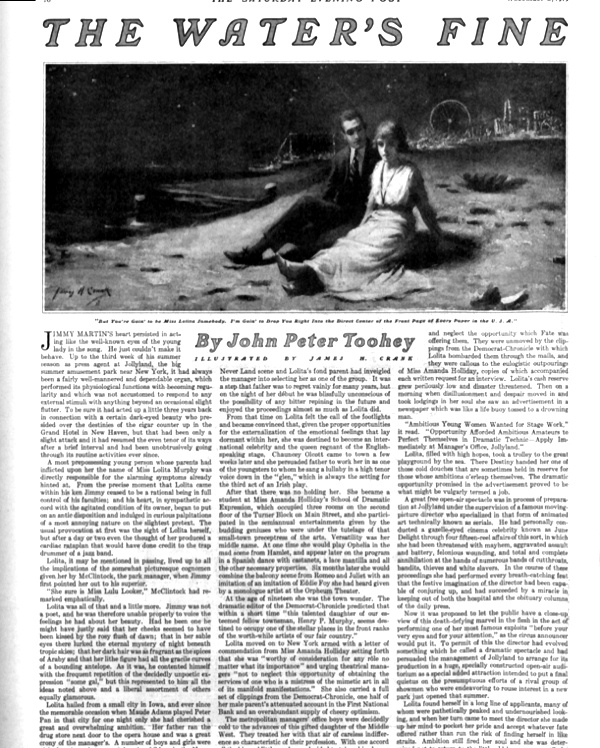
Featured image: Illustrated by James H. Clark / SEPS
Out Among Cypress and Lilies
Two days in an aluminum, flat-bottomed fishing boat, and Bam had not spoken, except for the most cursory, abrupt, and unavoidable replies. His muteness began before they crossed the long bridge between Indiana and Kentucky. Denny had counted: Bam used two-syllable words fewer than five times on a three-hour drive and in one complete day of fishing on Reelfoot.
So on the second day of fishing, anchored inside a bed of lily pads and near a fallen cypress tree, Denny gathered his boldness and attacked Bam’s aggressive quietness. “So you know? Of course you know. But nothing has changed. Between us,” he said, all in a burst, not turning to look at Bam. When he did not reply, Denny repeated, “Nothing,” and fled again into his own silence.
Bam and Denny fished the shallower, northeast end of the lake every summer, the first week after school dismissed. Bam’s vacation could float — he owned the garage. Denny’s teaching locked him into the summer. Their first year, 18 ago, they obsessed with jokes about cottonmouths, and their nervousness kept them from fishing under the cypress trees. Bam, always the pilot, never allowed their boat to get crowded against lilies or banks. Every wet, twisted tree root looked like coiled death until you got real close. And if you glided in near enough to see that the root was just that, a root, and a real snake you didn’t see took exception to your proximity, you were screwed. So back then, they anchored in the open waters of the lake, clear of the fish.
But as the years and trips mounted in number, experience bred casualness. Boldness and courage increased. Locals claimed that no sportsman had ever been snakebit.
This year, something other than Reelfoot’s banks, trees, and plants frightened them.
Shallow waters for a shallow friendship, Denny thought in less than charitable moments. A vague, weak friendship built around the solid relationship between their wives, Janice and Margie. The women’s closeness injected durability into the friendship of the men, and the fishing trip expressed their connection more definitely than anything else the men did.
Janice and Margie had grown up on the same block. They took identical courses in high school, enrolled in the same nursing school, and joined the same sorority. Neither had a sister, so they promised the role of maid of honor to one another before they had settled on husbands. Janice committed to Bam first; Denny took his time asking Margie. After achieving their RN’s, the women worked the same shift at the same hospital and had lunch together almost every day. All four had attended the same high school and college. Bam pledged the trendiest fraternity on campus. Bam and Janice had been dating for two years before college, and when Margie and Denny started hanging out at the university, the guys’ friendship slowly moved beyond vague reminders, “Yeah, you live on the east side, right? You were in Cordon’s physics class with me?” But they never became conversationalists, even as their girlfriends became their wives and the women’s closeness thrust them together.
When together, they never talked a lot. Men fishing speak to one another in bursts, about their cars or their baseball teams or their golf scores. Bam and Denny maintained a steadier conversation through long hours on the lake than at any other time of the year. Until this trip, when Bam now refused to speak.
Denny’s question remained unanswered for over 10 minutes. Bam reeled in a line, taking care not to hook a lily pad, vegetation that looked elegant and floated weakly on the top of the water, but which was actually so fibrous and tough that it might break his eight-pound-test line. The pole showed no sign of a hooked fish. He discovered his bait missing — stolen by a talented, finned diner — so he reached for the yellow-and-white cricket tube in front of him, staring at his angling partner’s back with a coldness that Denny could feel even through the heat of the summer day. “You’re a fool,” Bam finally said, retrieving one of the squirmy bugs for his hook. “Everything’s changed.”
Denny swiveled on his chair and knocked his tackle box over on its side as he turned to face Bam. “Tell me how,” he demanded. Bam scowled, and Denny said, “Don’t act like it’s obvious. It’s not obvious to me. How has anything — between us — changed?”
Bam flicked his cricketed line back into the water, toward the cypress log, wanting to fish away from the lily pads. The log, less likely to snag and break his line, looked like a haven for bluegill, bass, or crappie. After setting the drag on his line, he put the rod down, leaning against the side of the boat, and said, “You’re kidding, right? You can’t see it?”
“No, I’m not kidding. How has anything changed between you and me?”
“Jesus, Denny! I was in your wedding. We’ve been friends since we were in college, been down here for almos’ 20 years straight, slept in the same room together, and you’ve been lying to me.”
“Oh,” Denny said. “That’s what it’s about. Sleeping in the same room with a fag.”
“I never said that,” Bam replied. “I never use that word.”
“You used to,” Denny said. “Back when you think I should have told you the truth.”
After some silence, Denny continued. “How’d I lie to you? I lied to Margie — for a long time. Not as long as you might think. But this stuff didn’t concern you, and if Margie hadn’t told Janice, you’d never have known. We don’t go around talking personal stuff with each other. I don’t know anything about the private parts of your marriage.”
A 14-inch crappie — a surprise catch this late in the season — interrupted their conversation, dragging Bam’s orange-and-black bobber underwater.
Both men knew it was a crappie before Bam landed the fish. Crappie accept their fate immediately when hooked and allow themselves to be dragged in without resistance. Bluegill and cats fight all the way to the boat, with muscle and fear in the water and with barb and fin in the boat. After landing the silver and black speckled fish, Bam expertly removed the red, barbed hook from the crappie’s lacy mouth and pitched it into the cooler with the seven or eight other fish he’d have to clean at the end of the day. He’d caught all but one of them. Then he prepared his line again and returned to silence.
Denny finally said, “I’m not a crappie, Bam.”
Bam’s brow creased in thought, but Denny didn’t see it, again facing in the opposite direction, watching a bobber that floated inside a mass of lily pads. He heard concentration in Bam’s voice though, when he replied to Denny and said, “I have no idea what in hell that’s supposed to mean.”
“It means I’m tired of being dragged through my life, tired of feeling hooked, tired of not fighting back, of giving up!”
Bam immediately responded this time. “Seems to me that’s exactly what you’ve done. Given up.”
Denny rotated his seat to face Bam again. “Explain.”
“You’re not even trying anymore. Margie told Janice you’ve moved into Benjy’s bedroom, you don’t even touch her anymore. That sounds like giving up to me.”
“You think if I try hard enough, I’ll be straight?”
Bam did not answer.
“I’ve been trying that my whole life. Hasn’t worked. So if you mean I’ve given up on faking, given up on something that wasn’t working at all — well, then I guess you’re right. And if I kept on faking, I’d be just like that damn crappie. Hooked and dragged. I can’t do it anymore.”
He scuffed his feet against the flat aluminum of the boat’s bottom and, without thinking about what he was doing, tightened the anchor rope by his side. “I want — no, I need the people who care about me to know, to know me, not everybody in the world to know. I’m giving up on being dragged through life — and I’m giving up on pretending to be something I’m not.” He sat silently for a moment and then said, “And I’m afraid I’m getting gutted at the end of the day.”
Denny rotated again on his seat, adjusted his line and discovered he was snagged on the lily pads. “I don’t have that many friends,” he said. “So I wish you could see that this has nothing to do with you. You don’t have to hate me in order to be loyal to Margie. And Janice. Even Margie doesn’t hate me.” He broke the line and left the bobber floating in the center of the lilies.
An hour of silence ensued. They moved their boat two times, assenting to the changes of location with grunts, pulling up the anchor and using the gentle power of a small trolling motor to wind their way through cypress trees.
Denny gave up on further conversation until Bam broke the silence and said, “I don’t hate you. But I don’t understand it. I’m sorry, I don’t. So I don’t know if I can adjust. It doesn’t matter if Margie’s mad at you or not, she’s hurt, bad, and that’s sure as shit because of you.
“I can’t tell if you want people to know or not, but she doesn’t. She’s scared Benjy’ll be able to tell, ’cause of you living in his room. But I hear you saying you want your friends to know, and her biggest fear is her friends knowing.”
“It is. Her biggest worry, I mean,” Denny replied. He jerked his smallest combo and laughed, reeling in a bluegill no bigger than a pack of sweetener. As he unhooked it and gently released it back into the warm water, he continued, “I think we’ll be able to put his room back into shape whenever he visits. All I do is sleep there. I wouldn’t need to move anything but a phone charger and a few books. And if you were listening, I said I want people who really care about me to know, and that’s a perilous low number. I’d never have told you.”
Good fishing calls for good watching, staring without losing focus, interpreting movement and responding to it. The art of angling is the art of being comfortable with silence and stillness. They sat and stared and thought for another quarter of an hour before Bam said, “You don’t think I care about you?”
This time Denny’s reply came quickly: “Only if I stay the person you want me to be.”
“No, only if you stay the person you always said you were!” After several seconds, “I didn’t mean that. I don’t think I did, at least. But here’s something I do not get. You been sleeping in that bed with her for 25 years. Why can’t you just keep on doin’ whatever it was you were doin’?”
The art of angling covers uncomfortable silence, too. The men sat silent again, over a quarter of an hour, until Denny responded. “Margie keeps thinking that this is somehow about her. That if she does the right thing, makes the right move, wears the right nightie, it’ll be different. There isn’t anything she can do, Bam. It’s not about her. She wants to fix something that can’t be fixed, something that I don’t even think is broke anymore.”
He spat into the water at the side of the boat and watched the spit bubbles slowly drift away. “I used to think I was broke,” he said, “but I can’t stand the pressure. The pressure of thinkin’ I can do something about it. The constant sayin’ no, and her tears. I just can’t. I don’t know how I’ll stand it if Benjy comes home and stays any time at all.”
“Can’t you fake it?” Bam asked.
“No, I can’t,” Denny said. “Faking is how I lived my life up to here. And every time, every damn time, it was driving a corkscrew into my stomach and twisting it. Something supposed to be wonderful just hurt. I can do without it, especially at my age, but I can’t fake it anymore. Nuh-uh. Never again. I’d rather pick up that cottonmouth over there and be done with it.” He pointed to a dead cypress twenty yards away, where a wet, intricately-patterned serpent rested, tightly wrapped around the tree’s base.
“Damn, that one’s big,” Bam said.
In the motel room, for the second time in their fishing trip history, the second time in two nights, Bam wore full-length sweat pants to bed, and he changed into them in the small, uncomfortable, steamy bathroom. Denny, already showered and in white briefs, climbed under his covers as fast as he could, turned away from Bam, and cried hot and shameful tears, as silently as possible, into the pillow he brought from home. But he couldn’t weep in total silence, or chose not to.
“What the hell are you crying about?” Bam barked from the other bed, turning the lamp between them back on.
“Nothing. Leave me be,” Denny said, but the sob was in his voice now.
“You said nothing’s changed. But you ain’t cried in front of me since your mom’s wreck.”
Denny squeezed the pillow at his side tighter and cried harder.
“C’mon, Den,” Bam said, and Denny noted that his voice did really sound like Bam’s voice that time. “What gives?”
Denny turned to face Bam, careful not to lower the covers he had pulled all the way to his nipples.
“All I want,” he said through his ripe tears, “all I hope, is to be who I am, and to find out that my friends would still be my friends if they knew the real me. I knew Margie’d be hurt and mad, and I told her we could split up, she could have everything, I’d be the villain, the bad guy, the asshole. She could say whatever she wanted to say about me, I wouldn’t defend myself, contradict her, or ever slam her. And she knows I’ll keep my word. On that.” He raised up on one elbow and mirrored Bam’s position in his bed.
“But here you are, my best friend, and I knew you’d be disappointed and maybe mad, too, but I kept sayin’ to myself, ‘He’ll get over it, he’ll come around,’ but I never thought, I never thought one time you’d act like you aren’t safe around me, that you’d feel like I wanted to come on to you or something, and don’t say that’s not what you’re thinking. You never wore that much to bed ever until last night. And you never felt like my seeing you in your underwear would be like porn, either.” A long pause. Then, “Hell, Bam, I don’t even like blonds. And I really don’t like blonds named after Flintstones.” A short laugh.
Bam laughed, too, like he was supposed to, and he thought about denying everything that Denny had said, but Denny had always been the most perceptive, and he’d called it exactly right.
“I don’t know what to do about it,” Bam said, his voice suddenly raspy, phlegmy, and he fell back into the bed. “But you crying won’t help me figure it out. Go to sleep now, okay? Den? Okay?” After a minute or two: “And he was a little Rubble, not a Flintstone.”
The next day, their last day, blossomed cold, rainy, wet above and wet below. Cypress trees offered some shelter, but Bam motored them to a ditch that cut between one finger of the lake and another. He remembered an overhanging sycamore tree that would give greater protection than the smaller cypress trees, not only from the rain but also against the brisk morning wind. They caught nothing and sat for an hour, hunkered down in a silence uncomfortable in every way one could imagine comfort.
Denny hoped the cold and wet might move their departure up by some hours, but the rain slackened and Bam reeled in a two-pound blue cat, caught on what had to be a dead minnow by the time it worked. The wind softened and warmed at the same time, and it wasn’t long before they’d shed their upper-body gear.
“So. What do you think about me?” Bam asked.
Denny scrunched his lips, the way his students imitated in mockery, the way he did when he was thinking hard. He took his time to answer.
“Same I’ve always thought about you,” he said. “Sometimes you’re a real jerk. Think you’re the boss of everybody around you. Most of the time, you’re about the same as everybody else. Time’s made us good friends. Time and our wives. Is that what you mean?” He paused for ten, fifteen seconds. “Or are you asking if I’m queer for you?”
“No,” Bam replied, too quickly. “No, I mean, not … hell, Denny. Yeah.”
“I’m not,” Denny replied. “You know the computer term firewall?”
“Yup.”
“I’m an ace at building them. Personal firewalls. Around things I can’t allow myself to think about.”
After some silence, Bam chuckled. “So I’m not good enough?”
Denny swiveled and shot Bam a questioning look. “Are you — oh, this is you being a jerk.”
“Nah, I’m pulling your leg. But you gotta understand the question. What have you been thinking about me all these years? Any guy’s gonna wonder about that.”
Slowly. Carefully. Denny spoke: “I can’t say what was goin’ through my mind when we were in high school, college. If I ever thought — dirty thoughts — about you, I know I was tryin’ not to. I was tryin’ all the time back then to be straight. But, well, you know. I’m sure you noticed girls other than Janet. Marriage did give me a lot more control. And I’m not attracted to every man I see.”
Bam caught another fish, a smaller cat, and then said, “You have a boyfriend on the side?”
“No.” Denny decided to rework his heaviest set of gear. The drag had been messed up since yesterday, and he could think, talk more precisely while he clipped and reeled and fastened and baited. “I don’t do well with real guys, Bam. Or, I haven’t yet. I create men and fall in love with them, but the real ones never work out. You’d be the worst. Whoever it is I create, the guy I build the fantasy on busts it. He’s never as romantic, never as nice, never as loving, sometimes never as masculine as I need him to be. So nothing lasts. I write this story in my head, with him as the main character, and then he doesn’t stick to his part and I have to wad it all up and throw it away. I think it’s because — at least partly because — I have been living this two-person life. Dr. Jekyll and Mr. Gay.”
“Denny.”
Denny swiveled and again and saw that Bam was looking straight at him.
“It must be hell. I’m smart enough to know that. But I’m not deep enough — kind enough? — I’m not smart enough to know how to handle it. Scares me a little. What if I’m something else that I can’t hold in, hold back, and if it’s okay for you to up and be somebody you’ve never been, to me at least, then what if I can’t stick to who I’m supposed to be?” He looked away from Denny, because their locked eyes revealed too much. “I’m probably not expressing it very well. I really don’t hate you. And I believe you about me. But no matter what you say, everything’s different. It scares me.”
Denny soon noticed that the wind had stopped altogether and the surface of the lake was glass-like. They became as still as the lake, and after two or three more fish, Bam said, “You ready to call it?” and Denny said, “Yeah.”
Bam opened the cooler and dumped the five cats and two bluegill back into the lake. The cats would survive. Other cats would eat the dead bluegill. Denny wondered why Bam had returned them to the water, but he knew. Bam needed it to be over, needed to get in the truck and head for home.
They motored back to the dock and motel, showered the rain and lake and fish off, packed and stowed their gear and returned their keys.
June, who owned the motel, opened the register for the following year and asked, “You want to make your reservation for next year, Mr. Fields?”
Denny knew next year’s dates and would have spoke up, but Bam spoke first. “We’ll be in touch.” He reached up, rang the bell that always sat on the counter to summon June from the back, and then walked out to his truck.
Featured image: Shutterstock.com
The Hawk
In the spring of 1963, Nick Sperakis had been working as a real estate salesman for Doukas Realty on Chicago’s South Side for about a year. He had been hired for the position because his wife’s uncle was a close friend of the owner, Cleon Doukas.
The only knowledge of real estate Nick had was from purchasing the bungalow where his wife, Margo, their six-year-old son, Peter, and he lived. Nick had sold insurance, however, and expected that selling experience would help him. The morning he was to start work at his new position, his wife sought to reassure him.
“You’ll do fine, Nicky,” Margo said. “You are personable and you get along well with people. Once you gain experience and confidence, I’m sure you’ll do very well.”
Nick began his sales position in the spring. They were well into summer before he made his first sale, of a modest bungalow in Chicago’s Woodlawn area. Margo and he celebrated by bringing in a sitter for their son and going to dinner at one of the city’s elegant restaurants.
Then the sales drought returned. Nick struggled several additional months without making another sale. The advance against earnings the firm had agreed to pay him for a year had only a couple months to go.
The owner of the realty firm, Cleon Doukas, had a volatile temper, and a day did not pass without his unleashing his wrath on a hapless secretary or salesman. Hearing the angry shouting from Doukas’s office, employees stared in silence at other employees, grateful they weren’t the poor devil getting lashed.
On a Friday afternoon in early September, an office secretary came to tell Nick that Cleon Doukas wanted to see him.
Having expected the summons for weeks, walking to the owner’s office, Nick feared he was going to be fired.
Cleon Doukas was short and beefy, with a bald bulldog head that made him resemble Mussolini. His office was permeated with the scent of a pungent male cologne.
“How are you, Nicholas?” Doukas motioned Nick to the chair across from his desk. “How is your good wife, niece of my dear friend?”
“She’s fine, Mr. Doukas.”
“And if I remember correctly, you have a son. How is he?”
“He’s doing well, Mr. Doukas, thank you for asking.”
Doukas sat back in his swivel chair. He stared at Nick in silence.
“I like you, Nicholas,” Doukas finally spoke. “You have a pleasing personality. You have it in you to become a good salesman but, as I see it, you aren’t living up to your potential. To put it candidly, you lack the instinct for combat.” He paused. “That may sound melodramatic, Nicholas, but it is true.”
Doukas paused.
“Do you know, Nicholas, what the word ornithology means?”
“Something to do with birds,” Nick said.
“That is correct,” Doukas said. “It is that branch of zoology that deals with birds. I find that world fascinating because the behavior of birds resembles in many ways the actions of humans.”
Nick listened intently.
“The bird that most fascinates me is the hawk,” Doukas said. “The hawk preys upon and kills doves and pigeons, chickens, rabbits, even small pigs.” Doukas paused, his voice gaining fervor. “The hawk even attacks dangerous reptiles such as rattlesnakes! The bird glides above the snake, stalking it, and then swoops down and clutches the rattlesnake in its talons. The hawk eats the rattler while it is still alive!”
Doukas paused to draw breath.
“Hawks once hunted only in the country, but they have become bolder, venturing into cities. With prey harder to find, hunger makes them fiercer. I predict the day will come when they attack and feed on humans!” Doukas’s eyes glowed. “God help poor humans when we enter the reign of the hawk!”
Doukas’s voice had grown hoarser and he poured water from a pitcher on his desk into a glass. He took a long swallow as Nick waited tensely for him to resume.
“Do you know how many real estate salesmen are at work in Chicago?” Doukas’s voice grated in Nick’s ears. “Thousands! Yes, thousands, and all of them trying desperately to sell their properties. Don’t delude yourself, Nicholas; to survive in this jungle, you must become as fierce and merciless as a hawk!”
Doukas paused again for breath. When he spoke again, his tone was quieter.
“I’ve spoken about you to Aristotle Brakas,” Doukas said. “I’ve told him of my great hopes for you as a salesman and asked him to take you under his supervision. Aristotle is a battle-scarred real estate veteran who will show you how our business really works.”
“Thank you, Mr. Doukas.”
Nick rose to leave the office; Doukas called him back.
“Remember what I said,” Doukas spoke somberly. “Do not delude yourself about what you must do to survive. When your spirit wavers, think of your wife and son. Eat or be eaten! Kill or be killed!”
Aristotle Brakas was a small, lean-fleshed man in his 60s who remained a shadowy figure to Nick. He wasn’t an employee, but he was in the office every day, consulting with the veteran salesmen on the buying and selling of properties. Brakas was often in the conference room, joining buyers and sellers in the closings.
When Nick first met Brakas, he felt as if the man’s eyes were scales assessing the importance of the person he was meeting. Nick felt quickly dismissed as being of no use to Brakas.
The morning after the warning from Doukas, Brakas came to Nick’s desk.
“The office just got a new listing, a nine-room, single-family house in Hyde Park,” Brakas said. “The lady who owns the house is Greek and belongs to the Greek church that Doukas attends. She asked for his help in selling her property. Come with me and we’ll take a look.”
Hyde Park was the South Side location of the venerable University of Chicago. In the area surrounding the sprawling campus, students and faculty competed vigorously for housing. Salesmen in the office had told Nick that Hyde Park was choice real estate and sold quickly.
The property Nick and Brakas came to inspect was a large, front-gabled house on Blackstone Avenue, south of 57th Street. While imposing in size, the exterior of the house showed signs of wear and neglect. Sizeable patches of paint on the siding had peeled away, while shutters on the windows had broken slats.
Nick averted his eyes from Mrs. Langos as he lied. “As Mr. Brakas indicated, the market is a little weak right now,” he said. “There are other problems, Mrs. Langos.”
A garden beside the steps leading up to the front door held a cluster of late summer flowers with their petals wilted. A rutted dirt driveway along the side of the house ran to a garage in back.
“Let’s take a look at the garage before we go in,” Brakas said.
They walked the driveway to the garage and entered the side door. In place of a car, the garage was littered with old cans of paint, bundles of tied newspapers, and several pieces of weather-battered lawn furniture.
“We’ll need to lower the price because of the wretched condition of the outside of the house,” Brakas said, frowning. “And the mess in here is another markdown.”
They walked back to the street and ascended the steps to the front door. Brakas rang the doorbell. Moments later, the door was opened by a small, gray-haired lady in a plain black dress who appeared to be in her late 70s or early 80s. She had fine features and bright eyes, and her pale cheeks were given color by twin pats of rouge.
“Mrs. Langos?” Brakas asked.
“Yes …”
“Good morning, my dear lady!” Brakas said, his voice warm and jovial. “My associate Nicholas Sperakis and I, Aristotle Brakas, are here representing Cleon Doukas of Doukas Realty. Mr. Doukas has instructed us to offer you every assistance you require in selling your house.”
“Mr. Doukas told me last Sunday in church that he’d send someone to help me.” Mrs. Langos dabbed at her eyes with a tissue as she stepped back and motioned them inside. “Mr. Doukas is such a devout Christian. He is greatly respected by everyone in our parish.”
“We all feel the same,” Brakas said earnestly. “Those of us fortunate enough to work with Cleon regard the man as we would Jesus Christ!”
Mrs. Langos led them from the hallway into an adjoining parlor that smelled musty and looked unused. The couch had worn flowered cushions, the carpeting was a faded and stained Persian rug, ornate brass lamps on the end tables bore patches of corrosion. On the mantel above the fireplace were half a dozen framed photographs and a large oval-faced clock that, in the silence, Nick heard ticking.
Mrs. Langos gestured Nick and Brakas to armchairs. She sat in a wooden rocking chair across from them, folding her hands nervously in her lap.
“I am a widow now, you see.” Her tone was plaintive. “I lost my beloved husband, Yiannis, about six months ago. He had what Dr. Sotos called a megale syncope, a ‘great stroke.’ One minute my heart’s companion was alive, in the next minute the Lord had taken him from me.”
“To lose the spouse of a lifetime is a devastating experience,” Brakas said, his voice somber and consoling. “Nicholas and I offer you our heartfelt condolences.”
“Thank you,” Mrs. Langos sighed.
“We ask you that you think of us not merely as salesmen who will sell your property,” Brakas said, “but as supportive and beloved friends who have come to assist you in your time of grief.”
Nick marveled at how sympathetic and sincere Brakas sounded. For a flustered moment, he wondered if he was misjudging the man.
“You will want to inspect the house,” Mrs. Langos said. “My caregiver, Jennifer, left a little while ago. She could have shown you around, but she won’t return until this evening.”
“That will not be necessary, dear lady,” Brakas said. “We have seen the exterior and the garage and only need to take a look at the basement. We have sold identical houses in Hyde Park, which is, as you probably know, a highly valued location. Of course the property must be reasonably priced.”
“I don’t really want to leave my home,” Mrs. Langos said, “but it has gotten too difficult for me to live here even with my caregiver. I’ve fallen three times in the last four months. After my husband’s death, before a caregiver joined me, I lay on the floor once for eight hours before a neighbor heard my cries and came to help me. My son, Alexander, who lives with his family in Vermont, is distraught. He writes and phones several times a week insisting I come live with them. My son married a Swedish girl, a nice girl, and they have a darling child, my granddaughter. But to tell the truth, Mr. Brakas, I don’t feel comfortable in their house. The food Ingrid cooks is different, and she doesn’t observe our Orthodox faith. Of course, I would have preferred my son marry a nice Greek girl.”
“I feel exactly as you do, Mrs. Langos,” Brakas said fervently. “My son, Dimitri, married a lovely girl, a fine wife. But, she is of the Jewish persuasion. However good she is, she will always be a xeni, a stranger outside our heritage and faith.” Brakas paused, his voice somber. “Someday, a day I fear not too far-off, when I can no longer live alone, I may face what you are facing now.”
“Thank you, Mr. Brakas,” Mrs. Langos said. “Your sympathy and understanding heart touch me deeply.” She paused. “But I’m being a dreadful hostess. Forgive me for not asking sooner. Would you have a cup of tea and a sweet?”
“Please, don’t bother,” Brakas said.
“I have baklava that I made last night.”
“My dear lady!” Brakas said fervently. “I haven’t the courage to ever refuse baklava!”
Mrs. Langos rose and walked from the room.
Brakas leaned toward Nick and spoke in a whisper. “We’ll give the house a selling value around $45,000,” he said.
“I think it would bring quite a bit more,” Nick said. “Last month, Frank Briggs in our office sold a house similar to this one a few blocks from here for $65,000.”
“Do as I say!” Brakas spoke sharply. “If she objects, remind her the garage holds space only for one car, that the exterior of the house needs new shingles and painting. Tell her the furnace shows signs of ruptured hoses and leakage.”
“We haven’t even seen the basement yet.”
“It doesn’t make any difference!” Brakas said impatiently. “Tell her we’ve seen leakage running below the basement door and that the furnace and water heater will have to be replaced.”
Mrs. Langos returned carrying a tray with two cups of tea and two small platters holding pieces of baklava. They sipped the tea and ate the baklava, which Brakas praised effusively, calling it “delicious” and the “best baklava I’ve ever tasted!”
When they spoke about the selling of the house, Nick told Mrs. Langos the price her home should be listed for was $45,000. Mrs. Langos expressed dismay.
“I was hoping it would bring considerably more than that,” Mrs. Langos said. “My neighbor, Sophia Reckas, sold her house farther up the street, just as large and in much worse shape than mine, for $60,000.” She paused. “My husband and I lived frugally on our Social Security checks. Our house is all the estate we had. I hoped not to go to my son as a pauper, but able to pay my own way.”
Once again, she dabbed the tissue at her eyes.
“Dear lady,” Brakas said. “I wish we could get double that amount for you! But we are at the mercy of the housing market. Is that not so, Nicholas?”
Nick averted his eyes from Mrs. Langos as he lied. “As Mr. Brakas indicated, the market is a little weak right now,” he said. “There are other problems, Mrs. Langos. A house this large should have a two-car garage. There are drainage marks outside the cellar door indicating that a number of times, the basement has flooded.”
“I had that flooding problem fixed!” Mrs. Langos cried. “I paid more than a thousand dollars!”
“Basement flooding can never really be fixed,” Brakas said. “In time the flooding returns until the water heater and furnace are corroded and damaged and need to be replaced.” He paused. “Now if you wanted to wait a year or two, we’re expecting a stronger market. Your lovely home would bring a much better price.”
“My son won’t let me wait,” Mrs. Langos said woefully.
“Rest assured, dear Mrs. Langos, we’ll sell your house quickly for the best price we can, so you can begin a new life with your beloved family.” Brakas drew a folded contract from his jacket pocket. “Now if you’d be good enough to sign this agreement, which merely says that you are authorizing Doukas Realty to act as sole agent for the sale of your fine property, Nicholas and I will be on our way.”
Brakas placed the contract on a coffee table beside Mrs. Langos. He handed her his pen and held the page for her as she signed.
“You are now in our competent and loving hands, dear lady,” Brakas said and he gave Mrs. Langos a courtly bow.
For several days after the visit to Mrs. Langos, Nick felt depressed and upset at how he and Brakas had been duplicitous in appraising the house’s worth.
Several times Margo asked him what was wrong. He considered telling her what had happened but shame kept him silent.
For the following weeks, he watched the office purchase and sale listings. On Monday of the third week, once again going through the listings, Nick recognized the Hyde Park address and read that the Langos house had been sold to Midwest Investments for $42,000.
Nick was shocked at the ridiculous amount. He considered confronting Brakas, but instead spoke to Frank Holmes, one of the senior salesmen, about the sale.
“Don’t tell anyone I told you and get me in trouble,” Frank said. “Midwest Investments is owned by Aristotle Brakas.”
Nick had suspected some kind of deception and he was outraged at having been deceived.
“Will the house be offered for sale through our office?” Nick asked.
“Midwest sells its own properties,” Frank said, “so don’t expect to see the transaction listed in our office records, and don’t be surprised if it sells for a good deal more than Midwest paid. This is the way Brakas operates.” He paused. “I’ve got a friend working in the Midwest office. I’ll get in touch with him and find out when it sells.”
Less than a week after their conversation, late one afternoon with most of the office staff gone and Doukas’s office dark, Frank came to Nick’s desk.
“That Hyde Park house we spoke about,” he said, “my friend told me it has just sold.”
Nick waited to hear the price.
“$70,000,” Frank said.
Nick was stunned. He had expected the house would sell for more than the price they had given Mrs. Langos, but he hadn’t anticipated that wide a range. Thinking about the nearly $30,000 they had stolen from the widow, Nick was swept by shame.
That evening Margo asked Nick why he seemed so depressed. He was tempted to tell her everything but decided not to reveal the sordid transaction. He’d think about it and take some action. If he did nothing else, he’d tell Brakas that it was the last time he would participate in such a deception.
The following morning, Nick had an early showing of a property and arrived in the office in midmorning. A secretary brought him a sealed legal envelope bearing his name.
“Mr. Brakas was in earlier and said to give this to you,” Myrna said.
“Thanks.” Nick stuck the envelope in his jacket pocket and rose, walking to the small restroom in the rear of the office. He locked the door and sat down on the closed lid of the toilet. He opened the envelope and found inside five crisp, new thousand-dollar bills.
His first reaction was awe at holding that much money in his hands. Then he felt anger at Brakas for making him part of such a deception. Finally, he wondered what he should do.
For a little while Nick sat there, pondering and assessing. There wasn’t any way to conceal the truth that what he and Brakas had done was dishonest. There was no way to make amends. Without stopping his part in the scam at the beginning, trying to give the money back now would probably cost him his job and might even get him arrested.
On the other hand, Margo and he could certainly use the money, more than he’d earned in the previous three months. He was certain many other salesmen were practicing similar deceptions. If Brakas and he hadn’t been the ones to deceive the widow, another salesman would have done so. Doukas had told him real estate was no place for mercy.
Even as he felt outraged at being deceived, he understood such a transaction wouldn’t be the last. He lacked the courage to return to the role of victim. He would lament his failure to do his job honestly and then do what Brakas and others like him were doing. He had a family to feed, clothe, and house. His first responsibility was to them. However wretched he might feel about the deception and abuse of others, his family came first.
Someone knocked on the door. Nick did not answer. When they knocked a second time, he called out, “In a minute.”
He had to leave the restroom. But his legs felt as if they were burdened by weights. He struggled to rise, got to his feet, reached for the knob of the door.
He caught a final glimpse of himself in the restroom mirror. Startled, he noticed the mirror wasn’t reflecting his face but the face of Cleon Doukas, a beaming smile smeared across the owner’s florid cheeks.
This story is featured in the November/December 2019 issue of The Saturday Evening Post. Subscribe to the magazine for more art, inspiring stories, fiction, humor, and features from our archives.
Featured image: Shutterstock.com.
The Mansion
My wife and I were in consensus on how and where we first met. I was riding the subway when the doors slid open at Sheppard Station and she boarded in a dazzling party dress. Her eyes swept the interior and then hovered over the red seat next to mine, and her legs took her to it. That was the version sans sentimental tropes. My version. Hers, much longer and more adorned, was the one we’d chosen to tell people.
What my wife didn’t know, however, was why I was sitting where I was sitting.
It was thanks to some stranger three rows ahead, with whom I’d initially been seatmates. I was staring blankly at the opposite row of empty seats when the man farted. There was no question it was him; it wasn’t me and, at the time, no one else was in our proximity. I peered at him, expecting some apology even if veiled in a gesture. None came. I moved away to escape the smell, or the ensuing embarrassment, and I picked a seat that soon sealed my destiny.
Flash forward five years. I’d have forgotten that episode, it would have been as insignificant a cause as any other contributing factor — me deciding to brush my teeth again before heading out, my wife having a slice of pizza on her way to the station, et cetera — had I not seen the farting man on exactly the same line again, on a seat against the wall. Despite the brevity of our first encounter, I easily recognized his giraffe neck, high forehead, and eyes; especially the eyes, a pale pair fiercely fixed on the windows across the train, as if they were TV screens displaying the most exciting show. He was wearing shades of blue, more on the darker end, perhaps even the same clothes from the past, as if he’d been waiting for my return five years on that same train.
A handful of passengers were scattered in sparse spots, leaving me with several options. I chose against sitting next to him. It’d have been weird. Perhaps the workings of my subconscious were saving me in case history repeated itself exactly. Finally, I descended on a seat across the aisle, close enough to address him without the need to yell.
It took me two stops, Davisville and St. Clair, to work up the nerve. He’d crossed his legs, his hands resting on his upper thigh.
“Excuse me … um, do you remember me?” I asked.
He studied me and shook his head no.
I scrutinized him again. No, I wasn’t mistaking him for somebody else. He had the same curly black hair, sunken cheeks, and oblong face.
“Last time I sat beside you … you farted.” I whispered the last part.
He chuckled, unashamed. “That sounds like something I’d do.”
Emboldened by his insouciance, I told him what that incident led to. “You’re the only one who knows about this. Not even my wife.”
“Take that as my gassy contribution to your love life,” was all he had to say.
We laughed. It seemed it was the end of the story, but I was just getting warmed up. It was like I was meeting our matchmaker five years later.
So I told him how, at parties, my beautiful wife — I actually said beautiful, as if to stress the gaping change in my life — would steer the conversation towards the line, Have you heard how we met? And after registering a satisfactory number of curious faces while gulping down her wine, she’d croon, Oh, that would take the whole evening. Then, she’d embark on the story that grew more romantic and less real with each retelling.
Friday night. November 6, 1998. I’m all dressed up going to a house party in Rosedale. Objective: finding the One. I had a tip that there’d be lots of U of T art grads. It turns out that the One isn’t at the party. Then, she’d glance at me.
Through the years, I’d learned how to hold up my end of her performance. Taking hints from her lines, I’d roll my eyes, raise my eyebrows, lift my hands upwards and flaunt other gestures that might please the audience.
She’d continue, I get on the train at Eglinton and right away find an empty seat. Guess who’s sitting on my left? A rhetorical question. Her thumb would point at me, her eyes shut for a moment. Bookworm that I was, even with only four stops I couldn’t resist opening my book. Guess what it was? The Great Gatsby. And what page was I reading? Gatsby standing on his porch staring into darkness, with his hands in his pockets regarding the silver peppers of the stars. Her fingers would swim in the air, forming quotations, before aiming towards me. And then this guy next to me tells me it’s his favorite. So we talk, and I get to my stop. Not his. I say nice to meet you and he’s like, “I can get off too and walk from here. The weather is nice.” He was going to the college and it was freaking cold.
Right then, I would utter my practiced line, In my defense, it was only freaking cold to her in that short dress she wore hoping to bait U of T nerds.
She’d wave a hand, inviting the audience to ignore me and conclude her account: that we ambled together, that I helped her with the address in the streets carpeted with golden leaves still shiny from the rain, the setting sun — or the visible part of it — reddening the horizon. She decided not to go to her party, ditching all the artsy guys, so we continued walking, we found ourselves hungry, we searched, we found the Keg Steakhouse.
“Now every year on November the sixth we go to that Keg to celebrate our anniversary,” I told the man. “We don’t care much for our official anniversary.”
The man listened throughout, never allowing any entrance or exit at the stops to distract him. It was maybe his attention that kept me going, even if there was no clear hint of amusement, neither of joy nor of surprise. He didn’t interrupt me, no requests to elaborate, no pleads to recap. My pace seemed to be ideal. Or didn’t matter at all.
“Your wife treasures that night it seems.”
“She does.”
“Which Keg is it?”
His first sign of curiosity so excited me that I didn’t care how that could be relevant to the story. “This one is called The Mansion, because it’s a heritage building from two centuries ago.”
“The Mansion,” he whispered. His face contorted into lines around his eyes and on his forehead, like he was fishing something from his memory. “And you said November the sixth?”
He was more attentive than I’d thought. “Yes.”
“She’d be very disappointed if she found out her mansion is built on a fart. Maybe I should blackmail you.”
I jerked back my head. “What?”
“I’ll walk into The Mansion on November the sixth. Find you and your beautiful wife. You’ll notice me and walk me to the bathroom and will sign a check for the amount I’ll ask for then. If you refuse to do so, I’ll introduce myself and will tell her what you just told me. The unromantic part, I mean. The stinky part.” He droned on as if he was reading an obituary from a paper, bereft of any sense of enthusiasm or self-indulgence. There was finality in his words, like he couldn’t help it.
The train stopped at Queen Station.
I staggered to my feet. “This is my stop.”
It wasn’t. I left the car and turned. As the train lurched forward, through the shuffling passengers, I spotted him, still and straight, beaming at me.
There’s a fine line between amusement and obsession, and before I knew it, I’d slipped into the latter. The man’s face made appearances in my life, the nonchalant way he carried himself, the whole incident of seeing him again. It crept gradually, stealthily, ubiquitously. While at work or at home. Talking with my wife, making love to her. None more irritating than a feather’s tickle until she said she’d booked our “anniversary.” Same place, same time.
It was then that the man’s bulging eyes materialized, in an expression of vague undertone, asking me, Maybe I should blackmail you?
He knew nothing about me, no address nor a phone number, not even a name to look up online. All he had was the name of a restaurant and a date on a calendar.
I’d never told anyone about the original incident, even in the early days when I figured the young woman I’d met on the subway was but another girlfriend with an expiration date, when I would’ve laughed at anyone claiming how our destinies were about to intertwine. I didn’t divulge it to my guy friends who insisted on hearing how we’d found each other.
I considered changing the date, but if the man cared enough to go all the way to The Mansion only to find me, he could do the same on the day after and the day before. Then, if he could spare three days for such a mission, why not try it for a week? A week would lead to a month, and a month to a year. Why not while away his time in a restaurant instead of wandering the subway? A madman’s imagination has no limits. And by madman, I mean myself.
My wife would say, This might be the last year we go to The Mansion.
Dazed and frightened, I’d ask, Why?
The baby is coming, she’d say, remember? I’d sigh with relief before hearing her say, This dinner will be different. Again, I’d be at a loss, feeling exposed, until she’d ease my puzzled look: Wine — can’t drink it.
And it didn’t end there. Whenever she invited me to feel her belly, I’d place the palm of my hand on her skin, musing over the wonder of creation until the yet-genderless fetus would kick a bump and I’d cringe with the idea that this very creature, soon to be the love of our lives, wouldn’t have had a chance had it not been for the man on the subway, an association powerful enough to ruin the moment, to rewind our life, the fetus back to nothingness, to take me and my wife to where we were five years ago.
Or, where we were not.
Five candles were burning in thick, tall glasses. The table was in one of the rooms on the second floor. As we walked, I perused the many corners in that restaurant with sweeping glances. Then, I managed to guide my wife into sitting on the chair facing the wall. I could maintain my vigil from the other side; send the man a raise of eyebrows, mouth a pleading no, if it came to that. All assuming I could recognize him fast enough. I’d never seen him standing or walking. I wasn’t even sure if he was short or tall. He was a god who only sat on his throne on the subway, intervening in the lives of mortals, giving them things only to take back on his whim.
I had prepared a few topics to make sure I wouldn’t turn up suspiciously quiet. Once we received our drink order (her Coke, my Merlot), I started on the name, the favorite topic of any expecting parents. Then, leaving it at a roster of several incongruent names, we talked about mat leave, daycare, the possibility of hiring a nanny, and all the normal things that people at our stage in life would talk about. We envisioned our future, the next two or three years at least, while I monitored the landing in front of the stairs; the arrival of any new guest side-tracked me for a second before my wife pulled me back into conversation.
Our food arrived in all its aromatic glory. As was her habit, she began to meticulously cut each steak in half so that we could share. Digging into the food slowed our namedropping game. At some point I forgot about the threat I’d come prepared to fight off.
I remembered it only when, in a swift turn of conversation, she said, “I’m really glad that we met the way we did.” She sandwiched my hand between hers across the table. “I know I’ve said it a million times. But there’s something magical about our story. Perhaps this obsession borders on morbid curiosity, I don’t know. But it’s beautiful, isn’t it?”
I swallowed and looked around as if we were in the man’s earshot. He was the jack-in-the-box who would appear to hear my confession at last. I clinked my recently filled wine glass against hers.
“It is beautiful. I wouldn’t change it for anything in the world,” I said, and I meant it.
It brought a smile to our faces. And something else: A foul smell crept up to my nose. I turned my head around. People were immersed in their red meat and conversation, and so was my wife, unmindful of what I was sniffing.
The smell stayed until it was overtaken by the burn of our candles when they flamed out and the aroma of the coffee that arrived to see us off.
It’s been 17 years. I have never heard from the farting man again, have never run into him on the subway either. But the smell still returns. Only I can feel its presence. It appears occasionally, whenever I make up small lies, when I raise my voice, when I flirt with a colleague, when I have ice cream by myself.
But that’s fine. I’ve made my peace with it, as long as it’s not too strong or too lasting.
We still go to the Keg Mansion, though after the 10th year they refused to give us candles (fire hazard). My wife still tells the story of how we met to the very few who don’t know it. And I’ve kept my stint as her assistant, employing my nods and gestures and inserts. Our daughter, en route to college soon, is the loyal audience to our story, a perpetual fan. Yet, in order to find boys, she prefers more convenient means. She slumps on the sofa for hours and swipes mug shots left and right. Her mother glares at her, advising her to wait for an unforeseen flame. If you don’t believe me, she tells her, ask your father what it feels like to find your partner romantically. They both turn to me and I concur with an irrefutable bob of my head as I hold my breath.
Featured image: Shutterstock
Basalt
Heat waves wiggled skyward above the blacktop. Elliott stood on the highway’s fringe and gazed northward toward Canada then south across the central Washington steppe. Ancient patches of black rock that had hardened from the lava streams of distant volcanoes interrupted the rolling grasslands. He retrieved his almost-empty canteen and took a swig of hot water.
Elliott had hitchhiked that same route in 1967, moving north toward Calgary, to a life beyond the reach of America’s Selective Service and its military draft that had stolen his friends away to Vietnam. But a decade later, President Carter granted the draft dodgers amnesty and Elliott headed home.
The August sun burned through his straw hat. Sweat ran down his forehead and dripped into his eyes. He removed his sunglasses and wiped his face with the sleeve of his work shirt. Elliott remembered his past ten years spent moving from farm to farm, dancing fields of wheat stretching across Alberta’s flat plains, quivering images of tall grain elevators, a Canadian National freight streaming eastward.
A semi roared past, its backwash blowing Elliott farther onto the highway’s shoulder. The silence returned, broken only by the occasional gust of wind. Over a low rise, a vehicle approached from the north. It kicked up dust and left a rooster’s tail to mark its progress. Elliott turned to face it and stuck out his right arm, thumb extended. He could make out a single occupant in the blue Cadillac convertible with its top down. The car blasted past him. He turned to watch it disappear. But the Caddy slowed, pulled off the road, and came to a stop. The driver twisted in his seat and waved him on.
Grabbing his knapsack and guitar, he hustled down the highway toward the Caddy. The driver was a big sloppy man, his gut extending forward in a series of sloped terraces until wedging itself under the steering wheel. He wore a Hawaiian shirt and white slacks, his head topped by a Seattle Mariners baseball cap.
“How far ya goin’, buddy?” the driver asked.
“A couple of states south of here.”
“Well, I’m goin’ to The Dalles. Ya know where that is?”
“In Oregon, on the Columbia, about a hundred miles upriver from Portland.”
“That’s the place. You got a driver’s license?”
“Yes. Canadian.”
The big man raised an eyebrow. After struggling to open the door and climb out, he walked around the car to Elliott and stuck out his hand.
“My name’s Frank. If you want a ride, you’ll haveta drive.”
“I’m Elliott … and no problem with the driving.”
Elliott climbed in, moved the driver’s seat forward, adjusted the mirrors, and eased the lumbering car onto the highway. Frank had raised the side windows so the wind noise didn’t bother them.
“Just keep her at 75 and she’ll purr all day long.” Frank leaned forward, opened the glove box, and took out an almost-full bottle of Jack Daniels. Elliott caught sight of a snub-nosed revolver lying amongst a clutter of what looked like traffic tickets.
“You’ve been waitin’ out there long?” Frank asked.
“A couple of hours.”
“Why the hell did you take the inland route? There’s a lot more traffic near the coast.”
“I’m coming from Calgary.”
Frank seemed to consider that bit of information, all the while taking swigs from the fifth of whiskey. They drove in silence. The sun turned the landscape golden in the hot afternoon. Frank slouched, his pale pink belly sticking out below his shirt, seatbelt nowhere in sight. Elliott watched the highway and constantly checked the rear view, looking for the inevitable state trooper to pull out and fall in behind them. But the route remained deserted and the miles rolled past.
Frank finally broke the silence. “So … so what were ya doin’ in Calgary?”
“Working … at the University … as a night janitor.”
“Huh. You don’ sound Canadian, sound more like one of them hippie kids from Californication that came through here in the ’60s. Don’t see many hitchhikers anymore.”
“I’ve just turned 30. I think that qualifies me as an adult.”
Frank glowered at him but offered Elliott the bottle. He took a long pull and handed it back.
“Yes, I moved to Calgary in ’67. This is my first trip back to the States.”
“So you’re one of them draft dodgers?”
Elliott let out a deep breath. “Yes … it was the only thing I could do.”
“No it wasn’t.”
Elliott stared straight ahead, hoping that the questions would stop. Is this what it’s going to be like, being treated like a coward, a traitor, a deserter? Wasn’t being exiled punishment enough? Maybe I came back too soon. Maybe I shouldn’t have come back. The roar of the Caddy’s tires grew louder. Elliott glanced at the speedometer; it was pegged at 85 but the big car continued to pick up speed. The white lines on the two-lane highway became a blur. He sucked in a deep breath and eased off the gas.
He glanced sideways at Frank, who stared straight ahead while sipping his whiskey. “So Frank, why are you out here all by yourself?”
Frank shook his head, as if coming out of a dream. “I’m a small-time plumbing contractor. One of my suppliers is in The Dalles … drive there couple three times a year.” He took a long pull from the bottle. “My son, Eddie, used ta come along. I was teachin’ ’im the business.”
Elliott sensed that they had edged into treacherous emotional territory and shut up. Frank stared into his lap and played with the bottle’s paper label. A blast of wind hit the Caddy. Its right rear wheel slipped onto the shoulder and the car slid sideways for a moment before Elliott straightened it out, his heart racing faster than the big V-8 engine.
Frank hadn’t budged. He tilted the bottle skyward then spoke: “Eddie was a good kid, a fine boy. And he knew his duty. All the men in our family know our duty. I served in World War II and again in Korea. My Pop served in World War I.”
“My family’s the same,” Elliott murmured.
“Except you.” Frank flashed him a murderous look.
“Yes, except me.”
“You know when Eddie got his draft notice, he was excited to go. They sent him to the DMZ, assigned him to a field artillery battery, 155 howitzers I think.”
Elliott took his foot off the gas and let the big car slow. His mind went back to the revolver resting in the glove box, within easy reach of its drunken owner. If I’ve got to bail on this guy, I need to be going slower.
Frank continued talking into the air. “Maybe if all you idiots hidin’ under rocks in Canada had gone to Vietnam, my Eddie might still be alive.”
“How did he die?” Elliott asked, immediately wishing he hadn’t.
“A sniper got ’im … never saw it comin’ … just sittin’ there next to his gun … waiting. Was in Vietnam just two weeks.”
“I’m sorry that you lost your son, Frank. I’m sorry anyone had to die in a war that never should have happened.”
“Well, at least he did his duty … unlike creeps like you who cut and ran.”
“Adding more dead Americans to the toll wouldn’t have solved anything. And the protests helped stop it.”
Frank turned sideways in his seat and glared at Elliott. “Don’t you care about honor, about duty?”
“Sure I do. But there was nothing honorable about Vietnam.”
“You sayin’ my boy died for nothin’?”
“No, I’m not saying—”
Frank lunged for the glove box, grabbed the revolver, and pointed it at Elliott. “I don’t need no snot-nosed punk telling me about honor and duty. You deserted your duty and country. They shoot deserters, ya know.”
“Take it easy, Frank, take it easy.”
Elliott gripped the steering wheel. The Caddy continued to slow. He braked and pulled to a stop on a wide turnout. Mt. Rainier graced the western horizon. Elliott turned toward Frank and stared into the drunken man’s eyes.
“Frank, that war hurt all of us … believe me.”
“The hell you say. I’m drivin’ alone through this wasteland while my son’s underground in Arlington. What have you lost?”
Elliott gazed across the plain then lowered his head. “I … I lost my father. He died while I was in Canada and I couldn’t go to his funeral. I lost most of my friends … scattered to who knows where. I lost ten years of my life working the fields south of Calgary. I lost my purpose in life. I hope to find it someday. I lost my … my home.”
Frank snorted. “That ain’t nothin’. Eddie was my only kid. His mama ran off when he was small. He was the only thing I had and now he’s gone. And here you are, preachin’ … preachin’ purpose in life. What’s my purpose?”
Frank’s gun hand shook. He raised the revolver and pointed it at Elliott’s face, his eyes wide and staring, mouth open, as if ready to howl with rage and sorrow. Elliott watched Frank finger the pistol’s trigger. Time and movement slowed. Frank seemed to see the gun for the first time. His hand calmed and he closed his eyes.
Elliott lunged forward and batted the pistol out of Frank’s hand. It flew into the dry brush. The two men stared at each other, shaking, breathing hard. After a few moments, Frank remembered his bottle. He refused to look Elliott in the eye. Elliott opened the driver’s side door and vomited onto the gravel. The smell made him feel even sicker and he breathed through his mouth, long rasping gasps. His head pounded and he longed for a quiet dark place away from all that sunlight. Finally, he eased the car back onto the highway and they continued their push southward, not saying anything.
Near sunset, they crossed the Columbia and entered The Dalles. Elliott pulled the Caddy to the curb in front of a downtown hotel that looked perfect for traveling plumbing contractors. He shook Frank awake and climbed out of the car.
“Hey, man, thanks for the ride.”
Frank yawned and sat up in his seat. “Yeah, sure, kid.”
“Sorry about your gun.”
“I’m not.” Frank grinned. “You be careful goin’ home. This ain’t the ’60s. There’re some angry people out there.”
Elliott walked west along the highway. To the north, the broad Columbia flowed silently below barren bluffs. Snow-capped Mt. Adams caught the last rays of sunlight, lording it over the hard basaltic steppe, far from the gentle SoCal beaches of Elliott’s home.
Featured image: Shutterstock
“Home-Brew” by Grace Sartwell Mason
With more than 80 short stories and eight novels, Grace Sartwell Mason’s thematically diverse work found many publications in the period before and after World War I. Though her fiction and criticism has slipped through the cracks of familiarity over the years, her story “Home-Brew,” about the secretive and adventurous family of a budding New York writer, was an O. Henry Award finalist.
Published on August 18, 1923
Content Warning: Racial slurs
“Of course, they’re all dears, my family,” said Alyse; “but as fiction material there is nothing to them; no drama, you know; no color; just nice, ordinary, unimaginative dears. They’re utterly unstimulating. That’s why I can’t live at home, and create. They don’t understand it, poor dears; but what could I possibly find to write about at home?”
She crushed down upon her hair, with its Russian bob, a sad-colored hat of hand-woven stuff, and locked the door of a somewhat crumby room over the Rossetti Hand-Loom Shop, where she worked half time for a half living. A secondhand typewriter accounted for the other half; or, to be quite truthful, for a fraction of the other half. For her father, plain George Todd, helped out when the typewriter failed to provide.
She then betook herself on somewhat reluctant feet to the nearest Subway. For this was her evening at home with her unstimulating family; and though she was fond of them all, her predominating feeling for them was a mixture of amusement, tender tolerance and boredom. Moreover, they lived in Harlem, which was a deplorable wilderness, utterly lacking in atmosphere and a long, long way from the neighborhood of the hand-loom shop.
In the Subway, miraculously impelled through the bowels of the earth, Alyse — or Alice, as she had been christened — refrained from looking at the faces opposite her. The Subway does something curious to faces. It seems to drain all life out of them; it strips from them their defensive masks and exposes the deep and expressive scars of existence. A secret and hidden soul comes out in each Subway face. But Alyse averted her eyes.
“Dear me,” she sighed, “how dull they are! Isn’t there any beauty left in the world?”
Her father and his chum, Wally, were just ahead of her as she came up from the Subway depths. They were wending their way to their respective homes, having come up from downtown together, as was their invariable custom. Alyse gazed at their middle-aged backs without seeing anything unusual about them. Just two plodding men, getting tubby about the waist, with evening papers under their arms, walking along, not saying much. But when they reached George Todd’s door they would look at each other, and the passerby might well have stopped and taken off his hat, as before something rare and soul-satisfying. For here was perfect peace in friendship.
But all they said was: “S’long. See you tonight, ol’ hoss.” Or, “See you t’morrow mornin’, Georgie.”
Alyse had heard the tale of her father’s miraculous reunion with Wally so many times that it meant nothing to her. It seemed that as boys they had lived within two doors of each other in a small New England town, and they had been inseparable. First thing in the morning and last thing at night they were whistling outside each other’s windows; they owned a dog in common; and when George had scarlet fever, Wally nearly died from anxiety. Then, at sixteen, life had borne them in different directions. Wally drifted finally to Alaska and George got a job in New York. For a time they corresponded, but after a while letters began to come back to George marked Not Found, and then in a roundabout way he heard of Wally’s death.
Although George Todd was happily married, with a growing family, he admitted that the world would never seem quite the same to him with Wally out of it. Then came the happening that convinced him there are mysterious and unexplainable things in the world, say what you like. He was coming home from work one night, walking from the Subway rather more slowly than usual and enjoying the spring twilight, when in some strange way his heart stirred. He remembered how on evenings such as this he and Wally used to play a game in which one tossed a ball over the house to the other and gave a peculiar call. The middle-aged George declared that all of a sudden he could hear this call, and wanting to fix it in his memory, he endeavored to imitate it by whistling its rather melancholy intervals.
And at his whistle a man walking in front of him suddenly whirled and stared at him. It was Wally — Wally, with a newspaper in his pocket and a bundle of shirts from the laundry under his arm. He had been living within half a block of George for two years.
When her father told this story to Alyse he always at this point gave her an affectionate poke.
“Now there’s a story for you, Allie. You write up about Wally being washed out to sea and given up for dead and working his way around the world, and finally settling down in Harlem right next door to his old chum. And that about the whistle. What was it made me think of that old call?”
Alyse would explain that it was coincidence, and coincidence was the lowest form of literary life. She was patient about it, but there was nothing stimulating to her creative imagination in Wally and that come-and-find-me voice he had listened to half his life. Still less was she stimulated by her father, George Todd, owner of a feed and grain business of the most eccentric instability. He was a dear, and she loved him; but she hoped as they all sat down to supper that he wouldn’t begin to joke her about her work or offer her the plot for a story.
It was a spring evening and the dining room windows were open to the two lilac bushes which Alyse’s mother had nursed for years in the narrow, sooty backyard. The room was filled with an unreal light, as if the air was full of golden pollen dust. And something else, invisible and palpitant, was in the air of the homely room, something not to be seen but only sensed. Some intense preoccupation a sympathetic eye could have noted in three of the faces around the table.
“Well, well, we’re all dressed up tonight,” said George Todd, unfolding his napkin. “Look at Miggsy, Allie. Won’t she knock somebody’s eye out tonight?”
Alyse looked at her young sister, Mildred, aged sixteen. Mildred blushed, fidgeted, pouted entreatingly at her father. She was a thin little beauty, with a soft cloud of corn-silk hair about her face. In her red mouth desire and wistfulness mingled. Tonight her eyes were stretched and brilliant. She twitched at the table silver and appeared to have no appetite.
“Eat your spinach, dearie.” Her mother’s eyes brooded over her tenderly. “I thought you liked it creamed.”
“I do, but — Goodness, mother, is that clock right? I must fly!”
“But there’s chocolate pudding for dessert, dear.”
“Now, Miggs, finish your dinner. Why be so fidgety?”
Mildred looked in desperation from her father to her mother.
“But I don’t want any dinner, please! I — I have to be there early. Please let me go now, mother.”
She danced from one foot to the other, the secret excitement in her eyes threatening to change to anger. She had spent most of the time since she came home from school that afternoon in front of her mirror, and she was now exquisitely polished, powdered and perfumed. From under the fluff of hair over each ear an earring of blue to match her eyes dangled.
Alyse disapproved of the earrings and of the general effect of Milly tonight. She made a mental note to speak to her mother about letting the child go out so many evenings. But beyond the earrings and the general overstrung and overdressed effect she did not penetrate. She made no attempt to interpret the secret excitement in her young sister’s eyes. The affairs of a girl of sixteen were too inane and foolish to be taken seriously.
At the table when Milly had gone flying up the stairs there remained Alyse, her father and mother, Eddie, twenty-one, and Aunt Jude. Alyse glanced around the table and suppressed a sigh. The monotony of the lives of her family sometimes oppressed her. Take her mother, for instance. She seldom went outside the house except to church or to an occasional motion picture with Wally and George. All day she did housework or looked after Grandma Todd when Aunt Jude was at work. She did not have a cook because of a queer passion for feeding her family herself. But when she had them all there in front of her, ranged around the long table, and she had put onto their plates the well-cooked, savory dishes they liked, she would sit, eating little herself, looking from one to the other with her slightly anxious, tender glances, while gradually an expression of peace and satisfaction stole into her face; and Alyse wondered what her mother was getting out of life.
 Take Eddie, also. No one, except perhaps his mother in odd moments, ever got a peep-in at Eddie’s thoughts. Alyse was of the opinion that he didn’t have any. There had been a time when she had tried to bring Eddie out by coaxing him down to her rooms over the hand-loom shop and introducing him to some of the girls she knew. But those clever and voluble maidens had abashed Eddie unspeakably, and Alyse had let him lapse back into his own plodding life. He apparently had no imagination. Soon after he left high school he had gone to work for a seed house downtown — George Todd badly needing help that year with the family expenses — and there he still was. Alyse hadn’t the slightest idea what were his amusements. Saturday and Sunday afternoons he generally disappeared, and when asked what he had been doing, he had been to a ball game or just taking a stroll around. He subscribed to a marine journal, which seemed strange reading for a packer in a seed house.
And there was Aunt Jude. Really, when you considered everything, what had Aunt Jude to live for?
Judith Todd was at that moment preparing a tray for Grandma Todd, who was having one of her faint spells and declined to come down to supper. With her long, slender fingers moving deftly, Judith made the tray inviting with the china she had bought especially for it. She had hurried her own supper so as to have plenty of time for the tray, and she moved from the table to the sideboard with the air of detached and ironic competence she sometimes wore when she was, as Alyse said, spoiling Grandma Todd. She was George Todd’s younger sister, thirty-eight, a spinster with the reputation of having been in her youth very high-spirited, adventure-loving, and moreover with a streak of queerness about her. As, for instance, her ambition to be a sculptor. In those days and in the Todds’ native village a girl might as becomingly have wanted to be a circus rider. It was said there had been some stormy scenes over days wasted in the attic with messy clay. But finally life itself had put a bit between her teeth — life and her mother’s well-timed heart attacks. Her father had failed in business and died, George had married early, and the brunt of taking care of her mother had fallen to Judith.
After a while she had brought her mother to George’s house, which helped George out with expenses and enabled Judith to make a living for herself. It was the nature of her job that convinced Alyse there couldn’t be anything in that old story about Aunt Jude’s having wanted to be an artist. It was such an absurd job. She worked for one of those concerns that produce novelties — favors, table decorations, boudoir dolls — designing many of these silly fripperies, often making them with her own hands. She had remarkable hands.
If she had an ounce of talent, Alyse decided, how could Aunt Jude go on, year after year, squandering herself on these silly and often grotesque objects? Alyse felt that it would have killed her to have so degraded her talent.
But Judith actually appeared to get a certain amount of fun out of the dreadful things. She would bring home samples of her handicraft and bedeck the supper table with tiny fat dolls in wedding veils, droll birds and beasts in colored wax, and so on. And in one of her high moods she could set the family to laughing with a single tweak at one of these grotesqueries. On these occasions a gay and malicious sparkle would come into her dark eyes, and her laugh would be high and reckless, rather like a person who has taken a stiff drink to ease up an ancient misery.
Two evenings a week she went out, no one knew where. Alyse had seen her once at the opera, leaning far out from the highest gallery, a frown between her brows, seeming to watch rather than to listen, with a wild brightness in her dark eyes. The general impression of the family was that these regular evenings away from home had something to do with her work. On these particular evenings there was always a breathless air about her. She would hasten in from the street, and as she climbed the stairs to her mother’s room her face would stiffen as if for conflict. For Grandma Todd resented these evenings.
“Traipsin’ off,” she called it. “Lord knows where. Something will happen to you, coming home alone after ten o’clock. I don’t think you’d better go out tonight, Judith. My heart has been fluttering this afternoon. If I have to lie here worrying all evening I shall probably have a bad spell.”
And then into her daughter’s face would come the expression of a person swimming painfully against the tide. Love and pity had overcome her at every turn of her life, until at last she had almost nothing of herself left, except her freedom for these two evenings. As if the call of them was more imperative even than her long habit of abnegation, she fought for them with a sort of desperation.
Tonight as she arranged her mother’s tray her fine hands trembled a little; she looked more than ever as if she were straining at a leash. There was an unusual color in her face, a sort of flame, which for an instant attracted Alyse’s attention. Aunt Jude, she reflected, must have been almost beautiful when she was younger, before the expression of half-defiant endurance came into her face. Her dark hair was still lovely, with its blue-black shadows. Over her brow was a white lock, which she took no pains to conceal. She wore it rather like a defiant banner, and it went well with a certain gallant air she sometimes had.
As soon as supper was finished the family began to melt away. Wally called for George Todd and they went out. They admitted, grinning, that they were going to an express-company auction of unclaimed packages. It was one of their pet forms of entertainment, and they frequently brought home queer bundles, which they opened with shouts of amusement. Alyse thought they were dears, but rather foolish. She could not guess that when they started out of an evening arm in arm they became boys again, and forgot that life had been a somewhat niggardly affair for them.
A moment later Miggs made a dash for the door, pulling on her long gloves. Her face was flushed and exquisite under her modish hat.
“I’ll have Eddie come around to Jane’s for you, Milly,” her mother called to her.
A shadow of fright and annoyance came over Miggs’ face.
“No, please don’t, mamma. Jane, or somebody, will come home with me. Besides, we — we may go to a movie. Don’t fuss over me, mamma. I’m not a baby.”
Then she darted back into the room, caught her mother’s head in her slim arms, snuggled her little powdered nose into her neck.
“Oh, mamma, I’m all right. I’m just so full of pep tonight I’m — I’m snappy. Don’t you worry, darling.”
And licking her scarlet lips, glancing once more into the mirror of the old-fashioned sideboard, she was off — a hummingbird caught in a mysterious gale.
Then appeared Aunt Jude, her jacket over her arm, the tray in her hands. Her dark eyes were feverishly bright, but her face looked pale and strained. Would they mind just cocking an ear now and then toward mother’s room? She would probably drop off to sleep soon, though she had made up her mind she wouldn’t.
“But I must go tonight,” she said; “just tonight. Perhaps after this I — won’t be going out Tuesday and Thursday evenings.”
She stood still, staring down at the tray she had put on the kitchen table. Then she threw up her head with the familiar defiant movement, made a sound as if of scorn at her own weakness, and shrugging herself into her old blue serge jacket, she, too, darted out into the evening.
Eddie stood by the window. He stooped to look up at the dark blue of the night sky — a gesture habitual with him — fiddled wistfully for a long moment with the shade, and then pulled it down as if resolutely shutting something out. But a moment or two later he took his hat down from the hall rack, muttered to his mother “Be back early,” and slid out the front door, as if suddenly afraid of being late for something.
The house fell silent. Alyse’s mother put a dark-red spread on the dining-room table and placed her darning basket under the light.
“Now this is cozy,” she said happily. “We’ll have time for a nice visit. Tell me about your work, dear. I’ve been hoping maybe you’d feel like coming home to stay as soon as you’d got some material to work on. Of course, I understand,” she added humbly, “you have to have something to inspire you.”
“That’s exactly it, mother. I must know interesting persons. It’s very important to be stimulated. Sometimes I’ve thought that if I could only go to Russia or Austria or some place where there is a sense of crisis, a — a vividness, you know; strife of souls. That’s what I want to study. You see, mother? And, of course, here at home — ”
Her mother sighed.
“I know we’re all pretty ordinary, and nothing much happens, here at home.”
She looked apologetic, as if she realized the family’s limitations and wished she could offer something more interesting to her talented daughter. She dropped the old darning egg into the heel of a sock. The homely house was very quiet.
And a few miles farther south Milly was running breathlessly up the Subway stairs, an eager, half-frightened Proserpine coming up from the bowels of the earth into flowery meadows, into the glare of the electric flowers of Broadway.
And a few blocks north Judith Todd stood in a dark doorway and whispered: “I mustn’t hope for anything. If nothing comes of tonight, I can go on. But, O, God, make something come out right for me at last, at last!”
And Eddie —
At about this moment Eddie’s mother was rolling a pair of his socks into a neat ball. She sighed unconsciously.
“Sometimes it seems to me,” she said, “as if Eddie has never really waked up. I can’t express it the way you would, Alice; but as if he was driving himself — dumb, you know.”
“Doesn’t he like his job?”
“I don’t know. He never says. But sometimes he looks — And then there’s that Haskins girl. I’m afraid he’s let her push him into being engaged. I wish I knew — he’s so silent lately … When he was a little boy he used to lie on the floor by the hour, so happy, drawing pictures of ships.”
Ships! Alyse had never noticed them, but they lay like a fringe about the tall city, slowly rising and falling with the tide, lying there waiting to be unloosed to the seven seas. But Eddie knew they were there. All the miles of wharves he knew, from Sunday and evening rambles, from noon hours when he went without food to stand looking at some lovely visitor from an unknown port. And now at this moment he was making his way as fast as he could to say farewell to one that had become the very core of his heart.
More eagerly and more swiftly than he ever had made his way to the Haskins girl he traveled toward the North River. Just before he reached the corner beyond which he could look down upon the river he felt his heart grow cold with the fear that sometime during the day she may have slipped out to sea. It seemed to him that if she had gone he could not bear it; and yet he told himself that tomorrow night she would not be there; they had begun to ship her cargo.
But when he had rounded the corner, there were her masts against the deep blue of the night sky — five masts, the beauty! He had seen them two weeks before one night when he was leaning over the wall of Riverside Drive, and his heart had leaped. He had made his way down to the wharf alongside which the schooner lay, and stood there studying her, feasting his eyes on her. The tall cliffs of houses towered above her, but she smelled of many cargoes and of the sea. He could imagine her furled canvas slowly shaking out to the breeze, the deck tilting. The mate had come up on deck with his pipe and talked to him over the side.
Next evening Eddie was there again, and the mate invited him on board; he talked about the schooner as a man might about a wife whose very faults he loved. And Eddie had asked him questions which had been storing up in his heart since he was a boy. He could talk to this man Jennings, for they had a passion in common. Evening after evening they leaned over the deck rail or sat in the cabin, smoking and talking, and a deep friendliness developed between them.
Tonight when Eddie came to the edge of the Drive he did not hurry down as usual to the wharf where the schooner was tied up, but stood looking down at her. In his brain there was a misery and a battle. They were working overtime down there, loading the last of a general cargo, and that meant they would take advantage of the first tide. Tomorrow she would be gone, off to the River Plate. He shut his eyes hard and gripped the wall against which he leaned.
Tomorrow he would go downtown as usual in the Subway, and all day long he would be nailing up boxes in the basement of the store, and in the evening he would go around to see Lily Haskins. Under his breath he uttered a sound between a groan and an oath. He felt bewildered when he thought of Lily. He gazed at the five masts against the sky and they were like a shining vision beside which Lily Haskins was but a dull unreality. Was it actually true that he was going to marry, to go on all his life nailing up boxes as if they were his own coffin?
His feet carried him slowly down toward the wharf. He must say goodbye to Jennings, no matter how much he shrank from going on board the schooner again, and as he went down the long stairs he was wondering at the stupidity of his own life. Why hadn’t he talked things over with someone? Perhaps someone else could have told him whether he was really obliged to marry Lily. But he guessed that he had always been dumb. Life had gone on within him, half alseep, in the dust of the packing room, until he and Jennings and the schooner became friends.
And after that he had awakened, but he was still dumb. Perhaps if years ago he had begun to talk about what he wanted to do — But that year when he was eighteen, and making his secret plan to join the Navy, was the year dad’s business was so poor. He couldn’t desert him when he was so hard pressed. Perhaps later, when dad had got on his feet, he might have broken loose, if only he had believed in his dream; if he hadn’t been afraid of being laughed at.
His thoughts went still farther back, to the days when he used to cover immense sheets of paper with pictures of ships, full-rigged, with each detail as correct as he could make it from pictures he had seen.
He remembered looking up one day from his drawing with a sudden vision in his heart and crying out, “When I grow up I’m going to be a sailor!”
And someone, he could not remember who, had laughed. For a long time they called him Yeave-Ho. The door of his heart through which this cry had gone out had closed.
If he had cared less about his dream, the door would not have closed so tightly, perhaps; or if there had been anyone in his world who did not regard the sea as merely a blue blur in a geography.
Well, if a man was a sensitive fool, he had only himself to blame. He closed his lips more tightly and went on down the wharf. Two fellows passed him with bundles over their shoulders. The crew was going on board. In the light of torches the last of the cargo was being hustled on board. The light streamed upward and touched the masts; the vessel moved slightly with the tramping of feet and the lifting of the tide. With the lights, the shouting and movement of men, the schooner seemed to rise on tiptoe, eager and expectant.
In a shaft of light stood Jennings, checking off the crew as they came aboard. Down the wharf came the captain, a man behind him carrying bags and bundles. As soon as he climbed on board, Jennings could be seen showing him a telegram, and the captain frowned. Eddie, his habitual diffidence overcoming him, shrank back into shadow; but presently when the captain had gone into the cabin, Eddie moved over to the edge of the wharf and called, “Goodbye, Mr. Jennings! Just thought I’d come down to wish you — wish you — ”
But before he could finish, Jennings leaped and grasped his shoulder.
“Eddie! By cricky, boy, you look good to me! Look here!” He waved the telegram under Eddie’s nose and dragged him on board. “Look here, it’s Providence sent you down here just now. Petersen’s in hospital. We’re short a hand. My boy, it’s your chance! You’ll never have a better one. How about it? You’d have time to get your dunnage. Le’s see — tide will be right in two hours and fifteen minutes; all the time in the world. What say?”
The night reeled and rocked around Eddie.
“Tonight!”
The mate drew him forward, whispering, “Look here, you know as much about a vessel now as Pete ever did. You were born for the sea, and that’s the truth. This is your great chance to get your apprenticeship — good captain and a dandy vessel.”
Eddie stared about him while his heart pounded. He looked down the long lines of the schooner, he heard the masts faintly creaking and whispering in the rising wind, he smelled the unforgettable smell of a ship, and he choked with longing. He thought of his mother, but not at all of Lily Haskins. Could his father do without him? Would they all think he had gone crazy? Would they laugh? And at that instant the wind ruffled the water, the smell of the sea came stealing up the river, and the deck rose under his feet, an imperceptible movement to anyone not tuned to the sea. But to Eddie it was as if his heart itself turned over. His heart was like a seed, long buried in the dark and cold of the earth, which has been pushing blindly upward, and now at last sees the sun. His hand on the smooth curve of the mast tingled and drank in the feel of the ship, while into his soul there poured a new steadiness, a clean new certainty. His dumb boyhood was over and his beloved was under his hand.
Alyse yawned and her thoughts came back from her novel about Russia as her eyes fastened themselves on the chiffon stocking her mother was carefully mending.
“Really, mother, it’s ridiculous the way Mildred dresses. And ought she to go out every night? When I was sixteen I didn’t want to do anything but read.”
Her mother smiled and sighed.
“I wish to goodness Milly would sit down at home with a book. But she says life is so much more exciting than books. She told me the other day that she had to live her own life.”
“Life!” Alyse laughed scornfully. “That baby!”
It was at about this moment and several miles farther downtown in a dancing place called Poppy Gardens that Mildred, the baby, was on the verge of learning something about life. She was also being called an infant, but in quite a different tone.
“I’d jus’ soon tell the world,” said Dion Delanoy, holding her closer, “that you’re some little dancer, baby.”
And at the half-lazy, half-insolent caress in his voice, Milly thrilled with rapture and with discomfort. But it was very queer — there seemed to be two of her. One was intoxicated with delight and wonder, and the other held herself cool and aloof and, looking on, curled her lip. Overhead in the ceiling electric bulbs were stuck like pins in a cushion. When you tilted your head back so that your cheek touched your partner’s shoulder, all these lights reeled and swam after you around the room, and the floor undulated in long flat waves. When you floated through the green spotlight, Dion Delanoy’s eyes, like large shoe buttons in an ordinary light, became queer and sinister. When at the other end of the room the red spotlight washed over you, his pale dusky skin with the blue tinge from shaving had a bloom like an exotic fruit, and he became beautiful; he became what she had come out to meet, a romantic hero.
And she had reached that brief, glamorous season when there must be a hero to worship or one goes hungry and thirsty. When she had seen him in a bull fighter’s costume, with the footlights performing their nightly miracle with him, her hunger had fed itself upon him. Jane Tremont had been almost as bad, but it was her note he had answered, and she alone whom he had invited to meet him in the Peacock Alley of a Broadway hotel. It was Fate, his choosing her and not Jane, and it could only mean that they were meant for each other.
Having only just begun to learn about life, Milly didn’t suspect that the trysting spot Delanoy had chosen could be neatly overlooked from a balcony, and standing here, he could scrutinize his latest conquest and decide whether or not he cared to keep the appointment. He had been a bit taken aback by Milly’s youth, but it happened to be a dull evening. And besides, in the dressing room, heavy with the odor of stale powder, Milly had used a forbidden lip stick. He could not possibly know that in spite of her desirous lips her heart was pounding with fright.
But now, since they had danced for half an hour, fright had given place to this queer mixture of emotions; elation, dizzy wonder — she, Mildred Todd, dancing with a famous dancer, or at any rate a nearly famous dancer — hadn’t he had a dance practically alone, with the spotlight once directly on him? — and a curious undercurrent of vague unhappiness, as if already she had said good-by to someone she had shrined and now had lost. And those two individualities into which she had divided, the one whose lip curled sometimes, who looked on, not happy and yet not unhappy — homesick, rather — and the other, confused, ecstatic and silly.
“I feel funny,” thought Mills, “and nothing is quite like I thought it would be.”
Then the next minute she thrilled when someone behind them said “That fella’s Dion Delanoy.”
They had iced drinks at a sloppy table in a room off the dancing floor. He poured something into her glass from a flask, under the table. She became dreadfully sleepy and wished she were home and in bed. Then the lights around the dancing floor grew suddenly brighter and danced, and everything was gayer. Dion Delanoy became again a hero, and she knew that she herself was very wicked and beautiful. The cool half of her gave her lips one final curl of scorn and retired to an immense distance. The vague ache of disillusion left her too. She saw herself engaged to Dion Delanoy, giving a theater party in a box, and afterward taking Jane behind to meet him. He was her hero. He was marvelous. She clung tight to this thought, as if she knew that once she let it go she could not stand him.
And they wandered down to the street and into a taxicab. The drive was a flash and blur of lights, with Dion Delanoy holding her uncomfortably close. The taxicab increased her sense of wickedness, and she thought of a word she had recently added to her vocabulary — “insouciance.” She was convinced that she had a great deal of it, and as for Dion Delanoy he was magnificent with it. If only the cool and critical half of her would drop behind, and take with her the dim sense of sadness that was so oddly like homesickness.
“Wouldn’t it be perfectly terrible if I should cry?” thought Milly.
The cab stopped in front of a studio building.
“Friend of mine let me have his studio,” murmured Delanoy vaguely. “Let’s go up and start the phonograph.”
Milly hung back.
“I — I ought to go home. It’s getting late.”
He laughed at that, without any particular merriment in his watchful eyes.
“Aw, baby — that’s what you are, a baby.”
There was no taunt that could have hurt Milly more deeply. She looked up at him pleadingly, when an incident, small but important, as many small incidents are, occurred. Two markedly elegant young women approached and passed, perfuming the air. They bowed and smiled at Delanoy. He swept off his hat with a gesture nicely combining hauteur and suavity. In the light from the apartment-house doorway he looked for the first time that evening as she had seen him on the stage.
“Evelyn’s looking all to the good tonight,” he said, gazing after the two young women with a careless appraisal.
“You don’t mean Evelyn Beverly, of the Follies, do you?”
“Sure,” he replied, rather too quickly; “old friend of mine. She and I was dancing up here in Jack’s studio last night. Come on. Don’t pretend you’ve never been out after dark before. That kind of bluff makes me sick.”
She felt a desperate necessity not to displease him, this godlike being so handsome as he stood frowning down at her. And she would die rather than let him think her less endowed with insouciance than Evelyn Beverly. Meekly, with her lips parted childishly and her flower-blue eyes very wide, she followed him to the elevator.
In spite of Alyse’s contempt for coincidence, it does happen in life. For instance, there was the sprig of lilac in the buttonhole of the negro elevator boy. As Milly stepped out of the elevator this bit of flower, stuck so casually in a buttonhole, sent a sort of message to her brain. On the supper table at home that night there had been a sprig or two from the bush in the back yard. Her mother had always been foolish about that bush, coaxing it, feeding it, ever since Milly could remember. And now the perfume of lilac acted like a reagent in Milly’s subconscious mind. As she watched Dion Delanoy searching his pockets for his key, bending over the keyhole, it was as if her vision for the first time that evening was quite clear.
And nothing can be more merciless than a young girl’s scrutiny. Milly saw the ignoble back of his head, his hair sleeked back with pomade, a slight sprinkling of dandruff on his coat collar, the pinched-in waist of his coat, his commonplace hand, not too clean. He smelled slightly of the barber shop and of toilet water.
She was kept waiting only a few seconds, but in this interval a romantic hero died. liked his necktie. She had a sudden, furious distaste for this cheap stranger, and her heart ached too. She wanted dreadfully to be at home. But she felt helpless; she couldn’t think what to do next or how to get away. Delanoy had at last got the door open. He opened it, turned to her.
 And at that instant behind a door at the end of the short hall a woman laughed low and happily.
“Why,” exclaimed Milly, “that sounds exactly like Aunt Jude!”
Judith Todd, when she had left the house and her mother behind her, became as usual a thing with wings on her feet. She flew toward the Subway entrance, her dark eyes eager, her chin outthrust, her tall figure leaning forward as if the waiting to get there was intolerable. Sometimes she took a quick and happy look up at the sky, as a girl may who is hastening to meet a lover.
At Columbus Circle she came up to the surface and walked quickly across to a certain somewhat shabby studio building. Usually she could not reach it quickly enough; but tonight she passed the door twice, and finally stepped into the shadow of another doorway to have it out with herself. She told herself that tonight was not different from any other Tuesday or Thursday night, and she was a fool to be so excited. But all day it had hung over her, a prescience that this was the most important hour of her life. She longed for it and she dreaded it terribly. If it brought her disappointment, it would be no ordinary disappointment; it would mean the death of something in her without which her life would become merely an existence — hope. Tonight she realized that she had never really lost it — hope — and an undying belief in her own genius.
But tonight could kill them both, or it could turn them into strength and glory. She clenched her hands in the pockets of her old serge jacket and set her lips in their lines of endurance.
The colored boy in the elevator smiled at her and eyed the sprig of lilac in her buttonhole. She had taken it from the supper table and completely forgotten it until this instant.
“Looks like summer’s comin’,” he drawled.
She held the flower out to him.
“For luck,” she smiled.
Then at the top floor she went on down the short hall to the door behind which every Tuesday and Thursday night she came to life.
With her hand on the knob, she heard voices within. She shrank back. So, already it was here, the life or death of her hope, waiting there beyond the door. She had expected to have a half hour to herself, to quiet in work this sickening tremor of her heart. Well, nothing for it now but to harden herself for whatever verdict those voices in there would soon utter. She threw her head back defiantly and opened the door.
Three men were in the high, bare studio, standing about a long table. They turned toward her at the sound of her entrance, and one of them, a tall, thin man of forty, with quiet eyes and a sensitive mouth, came quickly forward to meet her. But she looked past him toward the table on which stood ten or twelve little figures, some of them still mere lumps of clay. Not even in this moment could she keep her eyes from them, the objects into which she had poured herself in delight and in suffering.
The tall man, John Richmond, followed her glance with understanding.
“You see, I got them back safely; and these gentlemen asked to meet you.”
He presented them, and at the name of one of them she flushed — Ybarra. She knew him by repute as a Fifth Avenue art dealer whose galleries were noted for the cleverest and most daring of the exhibitions. The second man stood a little without the circle of white light that beat down from overhead. He appeared to her as merely a little grizzled man, and the name, Mr. Purcell, meant nothing to her, until stepping toward the table and thus coming under the light, some feature or gesture arrested her attention sharply. She caught her breath and fixed her eyes on him in a startled stare. George Jean Purcell. She knew him now. She had seen him in his box at the opera one night. A girl sitting next to her in one of the topmost balconies had pointed him out. A fabulously rich man, and a discriminating collector. She had often longed to see the inside of the little white marble gem which was his private museum.
Something like terror invaded her. She had an impulse to gather them up in her arms, those bits of clay which were part of her, to protect them from the eyes of these two men who could command so much of the beauty of the world. She gripped the back of a chair, while a defiant glare came into her bright dark eyes.
The little grizzled man touched one of the clay figures. It was a study, a fantastic interpretation of a famous tenor in one of his most picturesque roles.
“You knew him very well, didn’t you?”
She smiled her fleeting, ironic smile.
“From the top gallery. Once I bribed an usher to let me into the dress circle.”
George Jean Purcell and Ybarra, the art dealer, looked at her sharply.
“My dear young lady,” cried Ybarra, “do you mean to say none of these people sat to you?”
“To me! Why should they? And, anyway,” she added, “I didn’t want them to sit to me. These are not portraits. They’re — bits of what goes on inside of me, I suppose.”
Ybarra started to speak, but Purcell held up his hand. He looked from Judith Todd to the bits of clay on the table. The tallest were perhaps fourteen inches, figures of famous men and women, of little shopgirls, of an ancient hag of a woman, of a blind mail, Fantastic, gay, sinister and pathetic, each one had its authentic breath of life. They had been done with the lightness of touch, the half-bitter whimsicality of a genius that is afraid of itself. And into them there had been poured the hunger and the rebellion of long repression.
George Jean Purcell shot a keen glance from under his gray brows at the woman who stood clutching the back of a chair, trying to keep defiance in her eyes. He noted the old serge suit, carelessly worn, the unfashionable hat; and over and beyond these details he observed the lines of endurance about her mouth, which could not obliterate its humor. He also saw the rather bitter keenness of her dark bright eyes.
“Spinster,” he thought; “iron-bound sense of duty; starving for proper soil to grow in. What miracle was it that let her do these amazing things?” And aloud he said, “How did you happen to wait until now?”
She looked as if she thought the question a little stupid.
“I never had time or a place to work in, where I could do as I liked.”
“You have ties, obligations?”
She smiled without bitterness.
“I have to make a living; and I have a mother with a weak heart, who can’t realize I’ve grown up.”
“You know you have genius?”
Her face became gay with a touch of impish humor.
“I know. It’s God’s little joke with me.”
Purcell chuckled grimly.
“You’re not giving anything away, young lady.” He offered his hand. “I’m going to leave you with Ybarra and John. They’ll tell you what I want you to do. And I hope, for the sake of an old man who treasures beauty wherever he can find it, you will accept their advice.”
Without another glance or word he walked briskly out.
The instant the door closed on him, Ybarra seized her hands with an exuberant Latin gesture.
“Congratulations, my dear young woman! I’ve never known old George Jean to go so far for native talent.”
She looked past him appealingly at John Richmond, her face white.
“What does he mean?”
John Richmond detached Ybarra and himself took her hands and looked into her eyes. “Judith Todd, it means the end of the long road; it means a fair chance at last. You know, don’t you, that when George Jean Purcell puts in an order for an artist’s work, he’s got a pretty canny idea that that artist has a future? Isn’t that so, Ybarra?”
“It has meant just that several times in the past.”
“Very well, that’s that,” said John Richmond. “Now, you’re to finish up a certain number of those figures — yes, yes, we know you can’t afford to have them cast, but Mr. Purcell will attend to that. In return you will sell him six that he chooses. I believe he gave you a check, Ybarra? Perhaps if she sees that she’ll believe us.”
But though they put in her hands the slip of pale-green paper with its figure which exceeded her earnings for a year in the novelty shop, she did not look at it. Instead, her burning gaze clung desperately to John Richmond’s face.
“You’re not fooling, are you? You wouldn’t be so cruel as that, would you?”
Richmond’s eyes blurred. He made a signal to Ybarra, and the dealer slipped out of the room, murmuring something about an engagement.
“Remember,” he said as he went out, “one of my galleries will be ready for your exhibition in the autumn.”
With the sound of the closing door, Judith Todd collapsed upon a chair. She was not the crying sort of woman; tears hurt her as they do a man; but now the floods rushed over her. All the years when she had borne the pain and the wonder of her gift alone, all the years when it had been denied, were in that flood. And John Richmond went down on his knees. He held her racked body close, murmuring his deep sympathy and understanding. But presently, when she had grown calmer, she tried to draw herself away, looking much ashamed.
“I’m a frightful fool, letting go like this; and I haven’t thanked you yet. If you hadn’t lent me this studio, if you hadn’t encouraged me — “
“Don’t, Judith! You know — I’ve told you — ever since that rainy Sunday afternoon in the Museum, when I saw you prowling around the Rodin things like a hungry ghost, and finally got up courage to speak to you because your face had such longing in it — ever since then I’ve believed in you.”
“Yes, you’ve believed in me,” she whispered, as if the wonder of it were something she could never fathom. “The first one to believe in me.”
“But more than that,” he went on in a low voice. “I’ve loved you.”
She shrank a little and put up her hand.
“No, no, that can’t be so! Look at me, a shabby old maid. I know! I haven’t got young nieces for nothing; and I’m considered a bit queer too. That has always been rubbed into me too. But it doesn’t matter now. You don’t need to think you love me, for I have so much now. A chance to work, unashamed — and your friendship. I — I shall be content with that; I don’t ask more than that.”
“Judith, don’t you know it’s a privilege to love you? Don’t you know you’re wonderful, in your courage and strength? Don’t you know you’re beautiful?”
All the light and amazement there was in the world seemed to be in her enormous eyes.
“It is too much,” she whispered, “to be offered love and fame all in one hour. I’m afraid. I’ve never been afraid before, but now I’m scared. I’m afraid of waking up.”
He drew her to her feet.
“Come and look at something real and you’ll know this is no dream.”
Together they stood beside the long table and bent over the little figures so vital and so gay, which were the soul of Judith Todd squeezed out of her by the drab discipline of the years, turning itself at the first touch of encouragement into these vivid and mordant fragments.
“How did you do it?” he cried. “How did you get underneath the surface like that, as if you had stripped off the smooth skin and seen what was rioting underneath, the ridiculous and sublime fantasy of the soul?”
It was then that she laughed, low and happily.
“Because I am like that — all smooth and gray on the surface, and underneath amazing — little colored worlds within worlds, always something dying and something else being born. No one ever is commonplace, underneath. Why, take my family — at the supper table we sit, a dull family in a narrow house in a Harlem street. But if you watch with patience and insight, you see worlds opening up behind each pair of eyes, longings, incredible dreams — ”
She stopped abruptly, her eyes fixed on the door.
“What is it?” he asked.
“I thought I heard my name. Wait, let me look. Someone out there — ”
She threw open the door. A sleek young man dropped his hand from the arm of a girl who sprang forward with a cry of the frankest relief, “Aunt Jude! I want to go home with you.”
The socks and stockings were all darned and they lay neatly folded in a ring around the darning basket. The evening noises in the street outside were stilled, and the narrow house in the Harlem street was quietly breathing, waiting. Alyse yawned, looked at the clock and put on her sad-colored hand-loomed hat. Another evening practically wasted. Of course, she had a sense of having done her duty, and it was nice to spend a peaceful evening with mother. But from the point of view of literature she had got nothing out of it. Families were mostly like that, nice as something to come home to occasionally, but utterly unstimulating to the imagination.
“Mother, do you suppose father could afford to send me to Russia — ”
And just there the telephone rang. It was her father, and he told Allie to tell her mother not to be worried if he was a bit late getting home. The fact was, he chuckled, he and Wally had got arrested.
“Arrested! Father! What for?”
“Well, you see,” he explained, “Wally bid on a package at the express-company auction, and we were taking it away down a side street, sort of dark, you know, when the darned thing dropped and broke. A policeman came snooping along just at that minute and he ran us in.”
“But why, why, father?”
“I guess he thought we were bootleggers, because Wally, for a joke, kind of helped it along, and — ”
“But what was in the package, father?”
“Well, that was a joke on us,” said George Todd, and she could hear his appreciative chuckle over the wire. “You see, there was two dozen bottles of hair tonic in that darned package.”
Alyse hung up the telephone with a disapproving face.
“You might know that if anything happened to father it would be something ridiculous,” she sighed.
Illustrations by R.M. Crosby
Iron Monsters
The monsters never build up much steam as they travel between the Western towns — 40 mph is their top speed, but they usually go between 20 and 30. We who live on these behemoths don’t require that they get anywhere quickly. We only require that the realms through which they rumble are mysterious and lonely.
Tourists accept that with alacrity. They like that about us, though the lives they live back East are the opposite of ours. In the Northeast, they’ve got the Silver Lines to speed them through metropolises that stretch across entire states, at close to 200 mph. In the Southeast, the Steel Lines still use coal in burners that are much more efficient than those of their ancestors. I hear that in Florida and the coastal cities of California, they’re building the Carbon Lines, which are elevators rather than trains. They will go up to and down from low orbit.
We on the Iron Lines use steam to power our trains, and though our predecessors would be dazzled by the process we use to generate that energy, our lives resemble theirs much more than they do those of our cousins on the other lines. We are mavericks and nomads. Many of us are hermits. Ninety percent of our land is untrammeled by anything other than boots or hooves. Our cowboys are mostly Navajos, Hopis, and Apaches; and Indigenous people own 60 percent of the Iron Lines. Most Easterners don’t know that, but you’d damn well better believe — we do.
I’m the descendent of white train engineers who lost most of their money in the Great Market Crash way back in the 20th century, so basically I’m a working stiff. I’ve found courtesy and respect to be good default settings, regardless of whom I encounter, so I was already on good terms with Nelson Begay when he sat down on the bench next to me in the Panorama Car. I knew he didn’t require a greeting or even an acknowledgement. If he wanted conversation, he would speak first — and that’s what he did.
“You have a good reputation,” he said.
“I’m glad to hear it.” I didn’t look directly at him. Easterners will stare right into your eyes and wonder why a Westerner flinches from that intrusion. They think you’re weak if you can’t look at someone directly. Our white ancestors used to think the same thing, but they learned the hard way that the shy people who were already living here were anything but harmless. We eventually adapted to their ways. Respect goes a lot farther than bluster.
“Got a job for you from the Allies,” said Nelson, meaning the Allied Indian Nations of the Southwest. The Allies take a lot of flak from First Nations people for using Indian to identify, but the Allies ignore it. Disagreement was the norm between tribes before white people got here. I suspect it’ll be the norm long after we’re gone.
“They need a good sweeper?” I did my best to mimic the neutral tones that came more naturally to Nelson than they did to me.
“That’s exactly what they need.” His tone didn’t change, but I could tell I hadn’t fooled him. He knew I was puzzled. There were plenty of good sweepers cleaning the Iron Line. Plenty of bad ones too, but everyone knows who they are, and it’s easy enough to get a good job done if you need one. “It has to be a foreign woman,” he said, “and she has to have respect.”
I didn’t take foreign woman personally; he simply meant that I wasn’t Navajo (or Tohono O’odham or Yavapai, or whatever the client turned out to be).
“I’ve known you longer than anyone else,” he said. “I can recommend you.”
Nelson and I had known each other since kindergarten, when we started at the same boarding school. Unlike most schools, ours was mobile — it was on a train, and we traveled with it from place to place. We had been very proud of that fact, and we had felt lucky. Later we found out how mixed that luck was, but I still didn’t regret going to that school, and I suspect Nelson didn’t either, despite the price both of us were still paying.
“I’ll do my best,” I said.
“I know,” he replied.
After that, we continued to sit together and watch the scenery. Ancient volcanoes had shaped Arizona, creating rich mineral deposits. Our train huffed and puffed through the mountains near Bisbee, past the mines that had long since ceased operations and become tourist attractions. We passed derelicts of those old times, some of which dated back to the 1880s. We had voted to keep those artifacts in place, so we could see where our ancestors rolled, and on what precarious machinery they had done it, and what a wonder it was that they had done it at all.
Nelson pointed at the wreck of an ore car with his lips. “My great-grandfather died on one of those. Got between the cars when they were fully loaded.”
“My great-grandfather was a lineman,” I said. “They busted him down from engineer. He broke his back and then drank himself to death.”
“Plenty people still do that,” said Nelson.
Plenty did. Not Nelson, and not me, but we both had family who ended that way.
“In Prescott,” said Nelson, “I’ll introduce you to Russel Tsosie. He’ll tell you what to do.”
After that we sat quietly together, just as we had done all the way through boarding school, Nelson and me, side by side. The Iron Monster would have a lot of territory to climb between Bisbee and Prescott, through mountain ranges, descending to 1,500 feet above sea level and then climbing again to 7,000 feet. Most of the Easterners sitting in that car with us would get bored long before we got there.
Nelson and I outlasted them all.
Russel Tsosie might have been about 50 years old. The way he was dressed told me he wasn’t a townie, but he also wasn’t a train dweller. That meant he was one of the tribal people who lived in the Wide Open, herding sheep and cows and farming. Easterners are often surprised by how much silver and turquoise people like Russel display on their fingers and belts and around their necks. They don’t realize that tribal people own all the land and all of the associated leases in five states. Russel might ride a horse when he was tending his land, but he drove a top-of-the-line ATV or a fully loaded truck everywhere else.
“Somebody made a mess” was the first thing he said to me. The quiet authority in his voice told me something else about him — he was a medicine man.
I blushed. If he was telling me about the problem, it meant white people had probably caused it. “The mess needs to be cleaned up, then.”
“Yes,” said Russel, “but you have to get to it first, and there are some obstacles.”
What are the obstacles? a person from back East might ask. A townie would be just as likely to make that mistake. Ask a question like that to the wrong person, and you are going to get your answer way later than someone who has the courtesy to wait for the speaker. This was a lesson I learned back in kindergarten, so I exercised a bit of discipline.
“I need you to wear this,” said Russel, handing me a woven tunic and a sash. “It’s okay to put it on over your other clothing.”
Fortunately for me, that was just jeans and a T-shirt, so I wouldn’t suffocate in the extra layer. I slipped the tunic over my head and tied the sash as well as I could, expecting advice from Russel about how that should be done — but he kept silent.
“Walk over here,” he said when I was done, and I followed him off the train. We disembarked onto the main platform in Prescott, into a crowd of people enjoying a book festival (also a balloon and a food festival, depending on whom you asked). We ambled along the sidewalk in the sunshine, smelling the cooking odors from food booths and listening to the townies talk too much about nothing. A lot of tourists swelled the crowd, but plenty of local people milled around too, including Indigenous people who lived in Prescott. Those were the people Russel paid the most attention to. Finally he pointed with his lips. “Walk through those women and see if they’ll let you pass.”
“Okay,” I said. “What if they don’t?’
“Then come back here and see me. I’ve got a backup plan.”
I started out with some confidence. The women in question were Indigenous and were wearing fine clothing by Native American designers. My simple tunic looked pretty humble in comparison, so I thought maybe they wouldn’t notice me. After all, there were several white women milling around in the crowd near them, and the fashionable women seemed oblivious to anyone who wasn’t Indigenous. That’s not an uncommon behavior along the Iron Line — people can be pretty tribal around here — so I didn’t take it personally. I even thought it might work to my advantage. But then a young Navajo woman looked directly at me and stepped into my path.
“Why are you dressed like that? You’re a white woman.”
I thought about saying, Russel said I could! but that sounded pretty lame. Her calm, confident tone made me feel tongue-tied. Finally I said, “I didn’t know I wasn’t supposed to.”
An elderly white woman stepped into my space. “Ignorance is no excuse. If you can’t be bothered to educate yourself, don’t appropriate clothing that belongs to other cultures.”
“Okay,” I promised. “I won’t do it again.”
“You need to take that off,” said the Navajo woman.
She was so disapproving, my hands shook as I untied the sash. I pulled the tunic over my head and then tried to hand it to her, but she just stared at me as if I were a bug. Finally the elderly white lady took pity on me and grabbed the clothing. “I’ll find out where this belongs,” she said, with considerable authority, and she wheeled and marched away.
The Indigenous women stared at me until I backed up and scurried back to the train. Russel was waiting for me.
“They made me take off the clothing,” I said, feeling as if I had already failed him. “Those women were furious. They said I had no right to wear those things.”
“That’s what I needed to know,” he said.
“So — you’ll need to find someone else?”
“Nope. I needed to see if they knew what they’re talking about. They don’t know. That tunic was made for a foreign woman. You were supposed to be dressed that way. These people who live in the towns are the ones telling people what’s right and wrong around here, but they don’t know what that is. They’re so focused on the damage in one place, they’re not seeing the damage in another. You still willing to do the job?”
I didn’t have to consider for long. My curiosity was stronger than my common sense. “Sure.”
“We’ll wait for those women to go inside. They’ll be too busy to pay attention to you. You can walk right past them.”
Turned out — he was right about that.
Most tourists never venture beyond the narrow towns along the Iron Line, which were first built to accommodate miners, railroad workers, and traders, and later to appeal to travelers looking for the sorts of things they were accustomed to seeing in adventure magazines. We have plenty of saloons, trading posts, hotels, and museums, and that’s where most people visit.
We also have natural sites that outsiders are allowed to visit. We have many more that people are not allowed to visit, and what I found at Red Rock Natural Park reminded me why that tends to be true. Most people are respectful when they visit our wild places, but some people are not. When I climbed out of my ATV, the damage was apparent.
I said a little prayer. I don’t intrude into the religions of the tribal people, but sometimes they tell me general stuff. If you’re visiting a place that doesn’t belong to your ancestors, you need to apologize. You need to ask permission and show respect. So I put my hands together and inclined my head.
“Spirits,” I said, “I want to repair the damage the bad people did. Please give me permission to enter. I will do my best.”
Silence is the answer to any prayer, but you can read a lot into it. I lifted my head and turned a critical eye on my surroundings.
The sandstone rocks for which this park was named had been laid down millions of years ago, formed from dunes that had once stretched over the entire Colorado Plateau. Their petrified outcrops loomed over the Eastern horizon, a six-mile hike away — a fortuitous arrangement, since people would have to walk for a while before they could disfigure the rocks. Most vandals aren’t that energetic, and those that are would be likely to run into rangers once they reached those outcrops. This near edge of the park was relatively flat, a woodland of cottonwoods and willows, next to a creek that would eventually empty into the Verde River. Birds chattered at me and ground squirrels spied like nosey neighbors. Usually, it was the sort of place that should heal your soul.
The people who had invaded that refuge had partied like people who are trying to prove they’re better than the people they’re visiting. They had smashed their beer bottles and thrown trash everywhere. It made me mad — but it was your basic clean-up job, and I knew a little elbow grease would go a long way, here.
I had to laugh. Was it my good reputation that got Nelson Begay to recommend me?
Well, sort of. It was my good reputation as a sweeper. I’m very thorough. And thorough is what I believed the spirits in the place wanted from me. I rolled up my sleeves. Then I picked a spot and got started.
Maybe you think that job was about the trash, but that was only half of it. The paper and plastic would have disintegrated — even the glass would have disappeared as sand and grit blew over it, or water washed it into basins. It was the disrespect that bugged the spirits of that place.
It’s the disrespect that bugs me, too. So I zeroed in on everything that didn’t belong, plucking it off the sacred ground with my grabber, sweeping and raking, dumping the debris into bags that I loaded onto my cart. I worked until the light was fading. I would have worked until the moon came up, if that had been necessary, but eventually I could look around me with satisfaction and believe that the mess had been cleaned up. All traces of the disrespectful aliens had been obliterated.
I was about to leave when a feeling came over me. I put my hands together one more time. “Thank you for letting me be into this wonderful place,” I said.
I was talking about more than just that holy spot. In my mind and in my heart were the wide open spaces, the red and gold rocks, the crooked trees that bent over the canyons like tourists trying to get a good photo. I loved those places so much I could scarcely express it. I had to settle for a short prayer.
Maybe the spirits like them short and sweet, because the birds sang me out of there like a happy ending.
I understood why a foreign woman had been necessary for that job. Sometimes it’s not enough to clean up vandalism. You need to apologize, and you need to mean it. The vandals never would, but no one expected them to. I and every other person who lived on the Iron Line had a price to pay for our passage. It was that simple.
“It’s done,” I told Russel. His sharp eyes missed nothing as he assessed my sweaty and dusty condition. Hard work done outdoors leaves its marks.
“I’ll tell your bosses,” he promised.
When I smiled, he smiled back at me, and I knew I had done okay. My paycheck would reflect the extra work. My reputation would, too.
I was happy to get into the shower, once I got back on the train. An Indian taco filled up the hole in my belly better than just about anything else you could imagine. Night was well advanced by the time we got underway again. We steamed toward Grand Canyon, with a blaze of stars overhead. I sat in the Panorama Car and waited for the Milky Way to wheel into sight. After a while, Nelson joined me.
Nelson and I may have more in common with each other than we do with our respective clans. We are train folk. We live on the Iron Monsters. We’ll die there, too.
Yet between Nelson and me, there’s a little more than that.
“You know those old movies where the Indian boy and the white girl fall in love?” Nelson said, after a while.
“Yes.” Because I hadn’t just watched those movies, I had lived a few of them.
“There they are, at the edge of a canyon,” said Nelson, “and he’s trying to tell her how he feels, but he doesn’t have the words. And she tries to bridge the gap between them, but she doesn’t know how. And your heart breaks for them, because you know their worlds are just too different, even though they live in the same place.”
“I know,” I said.
For several moments, we simply watched the landscape crawl by. I thought he might be finished talking, but Nelson spoke again. “When you’re young, all of that seems so tragic. Then you get older. You realize how happy you are just sitting in the same car with her.”
I smiled. “Maybe you decide love isn’t that heart-stopping place at the edge of a canyon. Love is that comfy seat in the Panorama Car, where you can watch the world go by and talk about old times together.”
“Maybe you decide that,” said Nelson.
Together, we watched the Milky Way rise over the Iron Line, and counted our blessings. You wouldn’t know it to look at us, but they outnumbered the stars.
Featured image: Shutterstock.com.
Winter Wheat
That fall my brothers and I would be sowing the fields on our own for the first time. Dad was working extra shifts at the ceiling-tile factory with the threat of layoffs ever present. One night he sat us down and said, “Wheat’ll be yours to get in the ground. Work together.” That was it. Derrick was 18, Darren was almost 14, and I was 10 and proud to be included. “Questions?” Dad said. He was so spare with words that every one he did speak seemed significant. He looked at us, his eyes like round black stones. I envied the manly hair on his arms.
Derrick told him we understood.
“Listen to your brothers,” Dad instructed me, and then he was out the door to the factory.
The winter wheat went into the ground around late September, as soon as the flies were dead and gone, and it sprouted quickly, the green shoots hibernating beneath the snow until the spring sunshine ushered them into adulthood, when sturdy heads of grain would click together in the wind like thousands of tap dancers. Each afternoon my brothers and I would get off the bus and shuck our starched blue denims in favor of Carhartt pants made supple by work. The weather was still warm enough that we could wear just our white T-shirts until the sun went down.
It was on one of those sunny fall afternoons that we met our new neighbor Kenny Pound. My parents were cash-renting our farm, which meant we were working someone else’s land and getting little of the profits in exchange for doing all the labor. Dad was still at work, putting in overtime, and Mom was filling in for someone at the grocery store when Kenny pulled up in his truck. Our sisters, Dina and Dana, had chores to do in the house, and Dad had left us a note saying we needed to get at least 30 acres seeded by nightfall. Kenny walked over as we were filling the planter with dusty wheat seed. He had recently begun cash-renting the farm up the road, from the same landlord as we were. We knew someone had moved in, but we weren’t prepared for a man with a thick beard and dark-brown hair that hung well below the collar of his flannel shirt.
“Looks like our new neighbor is Bob Seger,” Darren said under his breath.
“I can see you men have what it takes to fill the coffers,” Kenny said in greeting. I looked to Darren and Derrick and could tell that they, too, barely knew what this meant. My brothers each ripped open another bag of seed and dumped it into the planter, but I couldn’t take my eyes off our new neighbor. He wore real cowboy boots, not steel-toed lace-ups like ours, and he didn’t wear a seed-company cap, leaving his hair free to blow in the autumn breeze. He introduced himself with a broad smile and immediately pitched in to help. My brothers shrugged and went on working. Once the planter was filled, he asked if we needed anything else. We were about to start seeding when an old station wagon pulled into the field and Kenny’s wife, Sarah, got out with a baby on her hip and several paper lunch bags in her hand. She waved as if she knew us.
We all sat and ate peanut-butter sandwiches and drank ice-cold pop for longer than we should have while Kenny told us how they’d been living on a commune near Denver, Colorado, but he was from Indiana and had missed it so much that they had to come back. The baby boy Sarah held had the same thick, dark hair as Kenny, who wasn’t shy about showing his love for his son. He cradled the tyke and kissed the top of his head and laughed whenever he blew spittle. The whistles of a bobwhite along the fence line traveled over the empty fields to us, and Kenny said the bird was calling for its young. “You know, they’ll starve themselves and go without water trying to feed their children.” Just then a flock of birds burst into the evening sky, looking like little black brush marks before disappearing completely. Kenny took the baby’s bottle from Sarah and fed him. We’d never seen our dad hold a baby. He rarely even hugged us, though sometimes on your birthday or Christmas he might grab you for a quick embrace. Kenny acted as much like a mother as he did a father.
After Sarah and the baby had gone home, Kenny handed Derrick a cassette tape of Prince’s Controversy. “Listen to ‘Let’s Work,’” he said. “It’ll make the time go faster.” Then he winked and climbed into his truck. “I’ll be back tomorrow!” he yelled as he bounced over the furrows and turned onto the highway.
The next morning before school, Mom gave Derrick one of Dad’s notes, scratched with such intensity that the pen had nearly torn the paper. He read it aloud: “No dawdling. You only got 20 drilled.”
“Just do your best,” said Mom, clad in her polyester uniform from the grocery store. She worked the deli, shaving pound after pound of meat we couldn’t afford. In her spare time she’d draw or sew or crochet scarves for us that were so long they trailed along the ground like a bride’s train. Right now she was in the bathroom talking about herself in the third person: “Your mother’s got to get this hair colored!” She grabbed her car keys and kissed us all goodbye while our sisters packed our lunches.
After Mom left, Derrick said he’d listened to the Prince tape. He shook his head and announced: “Not for everyone’s ears.” I knew he meant it wasn’t for my ears, which only made me want to listen to it more. I was about to whine when Dana said there was a man at the door, and we all turned to see Kenny standing on the porch, the sleeping baby in his arms and a diaper bag over his shoulder. He asked if he could come in, mouthing the words so as not to wake his son. I jumped up and opened the door. Kenny stepped inside and whispered to the girls, “You must be the sisters.” Dina and Dana blushed. I noticed he wore a puka-shell necklace, and his chest hair was as black as crow feathers.
Dana asked why he had a baby. Her perplexed look seemed to express how we were all feeling.
“Because he’s mine,” said Kenny, gently pushing the baby’s pacifier back into his mouth. “I’m his daddy.”
“But he’s got a momma, too, right?” Dana asked. “Why doesn’t she have him?”
Kenny grinned and said he would tell Dana all about it later if she and Dina would watch the baby after school while he helped Derrick, Darren, and me get our wheat into the ground.
“You don’t have to help us, Mr. Pound,” said Derrick. “Dad gave the job to us to do. We’ll be fine.”
“Call me Kenny. And I know you can handle the work.” The baby started to rouse, and Kenny removed a bottle from the bag, held it to his cheek to check the temperature, and gave it to his child. “What I was hoping,” he said to Derrick, “is that we could help each other.” He offered to help us get our wheat drilled, and then we “men” could assist him with his. I nodded enthusiastically, happy to be considered one of the men. Kenny said he would ask our folks first, of course, and he would pay Dina and Dana for the babysitting. He needed their help only because Sarah was driving to Kokomo and back to take nursing classes. He put the baby on his shoulder and patted his son’s back rhythmically until the child let out two burps. “I’d better get out of your way,” Kenny said. “Don’t want you to miss your bus.”
Derrick curtly said that he drove us to school.
Kenny praised Derrick for taking care of his brothers and sisters, which caused Derrick to squint suspiciously at him. Kenny told us all to have a wonderful day and left.
“Let’s hope he doesn’t act that way around Dad,” Derrick said as Kenny buckled his son into a car seat and bent to kiss his brow.
That afternoon after school, Kenny handed the baby and the diaper bag over to the girls and paid them each five dollars. Mom seemed bewildered and told Kenny the girls would watch the baby without pay, but he insisted and said he considered it an honor to have his son cared for by “such fine women.” Dana giggled.
We changed our clothes and went to work with Kenny in the fields. The air was cool and smelled of wood smoke and manure. Around dinnertime Mom brought us steaming bowls of chicken and dumplings. Kenny ate around the chicken but slurped the broth and gobbled the dumplings. As it grew dark, we started to climb back on the tractors, but Kenny pulled us aside. “You boys are lucky,” he told us, nodding toward the gravel driveway, where Mom was pulling away in the station wagon. “You got a family here.” He stood straighter. “There’s nothing more valuable in all the world.”
I was a pudgy kid, and I stood on my tiptoes and sucked in my gut to look leaner. We’d been raised to be stoic and reserved, slow to show emotion, but now, in the cool of the evening, Derrick and Darren cautiously began to smile. Kenny drew us in for a hug just as our father’s headlights illuminated the field, bouncing when he drove over ruts. Panic shot through me. I pictured him and Kenny in a brawl like the ones I’d seen on Bonanza — split lips and bodies flailing about before someone pulled the panting men apart.
The night air had a bite to it, and trees rustled in a breeze.
Derrick, Darren, and I stepped back from Kenny, but not before Dad had seen the hug. He killed the pickup’s engine but left the bright headlights on to see by. His steel-toed work boots hit the ground like the flat of a shovel on wet cement, and I shielded my eyes from the headlights’ glare. Kenny stepped forward, his hand extended. “You must be Mr. Crandell,” he said. I was glad he didn’t try to embrace Dad — or, worse, slap him five. They shook hands. Dad dropped his cigarette on the ground and crushed it out in the soft loam. He looked around as if searching for an explanation for the scene he’d come upon: a young man hugging his boys.
“Why don’t you tell me what’s going on here,” Dad said to Kenny.
Kenny patted our father on the shoulder. Dad glanced at the hand as if it were laced with nitroglycerin. “Nothing, sir,” said Kenny. “I’m helping the boys get your wheat in the ground, and I’m hoping they’ll do the same for me.”
Dad lit another cigarette as Kenny explained the arrangement. When he was done, Dad nodded, seeming to inspect Kenny’s puka necklace and hippie beard. The ember of his Salem Light glowed bright red.
“If you’ve been helping the boys get the wheat sowed,” Dad said, “they’ll return it likewise.” Then he turned away and slogged back to his pickup. “Get your work done so you can help the man,” he called over his shoulder to us.
For the next four days we worked with Kenny, and we loved it. The afternoon sun was golden, and the sky was an enormous blue bowl. It was hard not to smile when he told us what a good job we were doing and how he hoped his boy would grow up to be like us. As we drilled the seed into the earth, which had just the perfect degree of dampness, we listened to Kenny’s music. He had dozens of cassettes he’d made, the tracks listed in precise cursive writing. On the fourth day, our fields planted, we drove the equipment over to Kenny’s. He was sowing 80 acres, and the time flew by.
Just after dusk on the seventh day, all the winter wheat, Kenny’s and ours, was sown. His wife brought us spiced cider and hot biscuits. We sat on the tractors and ate and laughed as Kenny told us how he’d once covered 40 acres before discovering he hadn’t put seed in the planting drums, so the only thing he’d sown was air. His wife had the baby swaddled in a fuzzy blanket, and Kenny held him and kissed his forehead. It still stunned me: Here was a man who used his back to make his living, and yet he also showed affection and talked about his feelings. Kenny handed the baby to his wife and told her he’d be home before long. Then he asked us if we’d ever seen the river on a night like this. He pointed to the moon. “Come on,” he said. “It’s just a short walk.”
We followed Kenny over the soft topsoil and into a ditch planted high with fescue to keep erosion at bay. The night air had a bite to it, and trees rustled in a breeze. We slipped along a fence line and down a hill to the edge of the water, its glassy surface mirroring the moon.
“Would you look at that,” said Kenny.
I waited for him to show us something. Then it dawned on me that Kenny had brought us to the water just to see the moon’s reflection. We didn’t speak. While we stood there, Kenny recited some lines of a poem about the smell and taste of leaves, the stories they held. Then he told us we shouldn’t be afraid to live the life we each decided was right for us. I looked to Darren and Derrick for some clue as to what they were thinking, but they seemed slightly dazed. After a while Kenny said, “Fellas, I sure have enjoyed working with you this past week.” His voice caught, and he wiped his eyes. “Can’t wait to work many more seasons with you.”
Derrick and Darren seemed glad when we made the short walk back to the field, but I secretly wished we could have stayed there by the water.
A couple of nights later, as we were falling asleep in our twin beds in the room we shared, I asked my brothers if they missed working with Kenny. The bedroom remained quiet, and I didn’t ask a second time. Maybe it was because Kenny had shown us something about being men that we had yet to understand, or maybe my brothers were embarrassed at how loving Kenny was with his son and us and how solemn and reticent our own father had always been. I lay there that night and hoped I would have the courage to follow Kenny’s example someday, but I also wanted to be the sort of man my father respected and admired.
For the rest of that fall, Dad had less overtime at the factory, and we worked with him more on the farm. I’d sometimes catch a wistful expression on Derrick’s or Darren’s face that I read as a desire for the work to be more fun, or for some encouragement, maybe even a hug at the end of the day. But we labored with Dad as we always had: mostly in silence, with a seriousness that now seemed almost cruel.
One weekend, as we spread straw for the hogs in advance of a cold night, Dad rounded a corner and found us singing a song from one of Kenny’s tapes, with me standing on a bale and crooning while Darren and Derrick played pitchfork guitars. Dad stood and stared at us while we scrambled back to work. For a second I thought I saw him open his mouth to say something, but he only licked his lips and coughed before walking back to the tractor.
“That was close,” said Derrick as Dad drove away, the tractor spewing black diesel exhaust. We returned to our task with renewed solemnity, but before long we were kidding around and praising one another’s work once more.
It was early November when we learned of Kenny’s death. The maples and sycamores were bare, the last fields of corn stark and empty. We’d been done with our own harvest for a couple of weeks and were grateful for some downtime. Derrick had mentioned just the day before that we ought to ask if Kenny needed any help. We hadn’t seen him in more than a month. The last time had been at the grain elevator, where Kenny had hugged us in front of our father’s friends, men with shaven faces and scoured work boots and pressed denim shirts. Kenny still wore his puka-shell necklace and had a tiny braid behind one ear. He talked about his wife and baby, telling us we’d all get together after the first snow and go sledding. He even suggested our folks come along. We could hardly picture our father lying on a Flexible Flyer, wind blowing his cap off, his cheeks red.
That afternoon in November, Dad asked if we wanted to go take a look at the sprouting wheat. We eagerly agreed. The wheat had been ours to get into the ground, and we were proud of it. As we put on our boots and gloves, Dad seemed unsure about the wisdom of what he’d just asked us to do. He forced a smile and gave us each a pat on the back as we exited the house. Mom and the girls were grocery shopping for a big post-harvest meal that night. The weather was bitter and gray. We walked the length of a pasture and over another fence line to the periphery of one of our fields: 40 acres carpeted in a perfect kelly green, a testimony to our labor. Blackbirds hopped over the verdant landscape.
“Boys,” Dad said, “that young guy, Kenny … ” He rubbed his hands together and looked at us standing in the cold. His voice grew softer. “It’s a damn shame. He slipped, they said. He was picking corn alone. Didn’t have much of a chance.”
We all knew what a combine could do to a person. My vision blurred, and the tears came fast. Derrick kicked the ground and closed his eyes tight while Darren looked away and walked in a circle. “I know,” said Dad. It was clear he was trying to offer up a side of himself that we needed just then, but he was unaccustomed to giving consolation. “Come on, now,” he said, and he pulled me to his chest. I sobbed, and he made a soothing sound that I’d heard him use to calm sows in labor. Then he handed me his handkerchief, and I blew my nose. Derrick and Darren wiped their eyes with the cuffs of their jean jackets. “I’m sorry,” said Dad. “I know you boys were fond of him.”
With that he started to walk along the edge of the field, and we followed. Halfway down, Dad stopped and surveyed our work. He said we’d done a fine job getting the wheat in the ground. The following summer we would harvest it together.
Two days later Dad drove us to Kenny’s funeral. He told Sarah that we’d plant her fields and harvest them, too. He even patted the baby’s head. On the drive home Dad told us a story we’d never heard, about a time when his brother had nearly been killed by a team of draft horses. “You never know,” he said.
We drove on, past fields of winter wheat on either side of the road, all that beautiful green that would lie dormant under the white snow, safe from the subzero cold until spring, when the sun would return, and it would grow again. In the fall the grain would be separated from the chaff, which would be plowed under, as it had been so many times before.
Featured image: Shutterstock.com
This article is featured in the September/October 2019 issue of The Saturday Evening Post. Subscribe to the magazine for more art, inspiring stories, fiction, humor, and features from our archives.
60-Year Bath
That summer, the gender-neutral change room changed everything. The university, accused of being behind the times, finally put one in. For Professor Mulligan, it was amnesty enough to come around on purchasing a campus aquatics membership. It was a way to avoid the posturing, the testosterone, the groupthink of “bros” in the men’s room. Not to mention the mindless, aggressive music spewing from Bluetooth speakers in there these days. Also important: private stalls. You weren’t out in the open. You weren’t exposed.
The professor, a portly fellow, portlier in fact with each passing semester, didn’t undress in front of people. There was a vulnerability, a certain shame in being on display. That afternoon, in his stall, Mulligan loosened his tie, unclipped his suspenders, and unbuttoned his sweat-stained dress shirt, unleashing mayhem. To the tune of two bulging rolls of belly fat and a pair of droopy breasts, all of it topped with matted gray chest hair. This wasn’t who Mulligan was supposed to be — he felt out of place in his own body. Did he have regrets? Who didn’t?
“Professors of psychology don’t have any fewer demons running around inside than anyone else,” Mulligan was known to lecture. “We’re able to identify them, put names to them, that’s all.”
And he didn’t necessarily mean clinical names. Mulligan gave his demons people names. Harley, for example, was the part of Mulligan that ate too much, the part fixated on consumption, on overconsumption. The addict. As a child, it was food. As a teen, as an adult: cigarettes, alcohol, then opioids. Now, as a senior — after nicotine patches, Alcoholics Anonymous, and three stints in drug rehab — Harley was back to food. Harley, the gluttonous slob, was effective, though. Damage control was a tough racket, but Harley was a world-class trauma assassin, burying fear and insecurity beneath thick greasy mounds of fast food and potato chips. It sounded silly, but personifying internal psychological processes, caricaturizing them, somehow made it feel like there was a team within, somehow made Mulligan feel less alone. In a weird way, it helped him understand who he was.
Mulligan pulled on a black T-shirt because going out onto the pool deck topless was not an option. Imagine if one of his Gender and Development students saw him in such a state, half-naked, defenseless like that.
Swimmers in goggles and latex caps filled all eight lanes of the Olympic-sized pool. Their strokes varied, but all cut through the water expertly. One end to the other and back again. With purpose.
Mulligan turned to the therapeutic hot pool. It was empty. The sign there suggested consulting your doctor before entering. It warned that more than 10-15 minutes in the hot pool was potentially detrimental to your health, that prolonged “enjoyment” could cause disorientation.
The lifeguard, a muscular kid in a mesh tank top, watched Mulligan in a way that made Mulligan feel like he was doing something wrong. Was it the T-shirt? Were T-shirts not allowed? Mulligan raised his hand and the kid nodded at him like the two of them had known each other forever.
The first step into the scalding water immediately reminded Mulligan of the baths his mother ran for him as a young boy, how unbearably hot she always made them, how long it took for him to ease his way in, how impatient she was with the whole ordeal. This is a bath, she’d say. Baths are hot. This is how you get clean.
Mulligan took another step — down to knee depth — and stopped again. He stared out the window at a tree, a thin stick of a thing by the walkway to the parking lot. Scraggly branches and wilting leaves drooped in the sweltering heat. The twig-like tip flopped to the side — like it was giving up.
One more step and the water was all the way up Mulligan’s thighs, perilously close to his scrotum. He stood there for what seemed like hours, and he would have stood there a few hours more had a swimmer not gotten out of the main pool, peeled off his goggles and cap, and walked over to the hot pool behind Mulligan. Feeling the pressure to get out of the guy’s way, Mulligan took the final step — waist level — and his hands instinctively moved to his submerged crotch. It was futile protection — screen door on a submarine came to mind — but Mulligan’s hands stayed there. It was psychological.
The swimmer stepped all the way in and sat right down, waterline at his nipples. Just like that. Like it was nothing. Mulligan, XXL shirt stretched tight across his belly, took a deep breath — then a few more — working up the nerve to sit.
Then he sat. Nerve endings across his body — a hundred thousand of them — under siege from the intense heat, sent a hundred thousand distress signals to whatever part of his central nervous system was in charge of pain management. There was a rush of blood to his head, a pleasant tightening around his brain — reminiscent of a warm opiate buzz. Then a sort of weightlessness, a drifting of consciousness, an altered state: Mulligan overload. He turned to the sign on the wall: No person having a communicable disease or open sores shall enter the pool. Suddenly drained, Mulligan’s eyes rolled back in his head.
Communicable disease. Mulligan’s mother had died of pneumonia. All that time she spent in the hospital. Weeks. But it felt longer than that. Like years. He stayed with her, all night, every night, at her bedside. Those nights were long. Time had a torturous way of stretching out. The sound of his mother struggling for breath, the crackling of her windpipe, it was unbearable. All Mulligan could do was sit there. Watch his mother wither, sink into the bed. And through all of it, he never worked up the nerve to talk to her, to really talk to her, to explain to her who he really was. Morbid maybe, but his secret would have been safe; it would have died with her. Instead, she died and there was an entire part of her only son she never knew.
Mulligan opened his eyes.
The water in the pool was still very hot, but he’d at least gotten over the shock. He’d acclimatized. He’d get out soon — more than 10 to 15 minutes was potentially detrimental — but for now he enjoyed it.
Another lifeguard, a young woman in a canvas fishing hat, whistle in mouth, flutter board under arm, patrolled the deck. She paced with self-assuredness. Comfortable in her own body. Reminded Mulligan of Pauline, a student in Gender and Development. He admired Pauline. She was sure of herself. She knew who she was.
Mulligan was in the hot pool alone. The guy, the swimmer who’d peeled off his goggles and cap, gotten into the hot pool with Mulligan, was gone. The waterline was at the guy’s nipples. The waterline was at Mulligan’s nipples. And everything underwater moved on its own. His shirt rippled with the current of filtered water shooting out of jets. His liver-spotted arms floated and bobbed, a dissociation of the limbs, a disconnect between movement and conscious thought. Mulligan was an expert on dissociation: authored a textbook, had personal experience, invented a character to represent the part of him responsible for disconnecting from thoughts and feelings, the part that spearheaded efforts to check out mentally when Mulligan was triggered. This was Spencer, the scrawny trembling twerp who always had an escape plan, who always had the white flag cocked and ready. Spencer, second in command in Trauma Suppression, dealt with what Harley couldn’t bury beneath food. Mulligan was open about his internal cast of characters — his team — in class.
“You’re allowed to make a little light,” he was known to lecture. “Take this stuff too seriously and you’ll cripple yourself under the weight of it.”
What Mulligan wished he’d have been open about was his identity. He wished he’d never kept it a secret in the first place. Pauline, the young woman in Gender and Development, wasn’t afraid to open up about her identity. She came to see Mulligan during his office hours, went right into it, told him everything. Pauline had been born Paul. But even as a child — for as long as she could remember — she knew that wasn’t who she was. She knew she was a girl, a young woman. And she told people about it. Without hesitation. It would have been safe for Mulligan to reciprocate, to open up to Pauline about his own identity, but he couldn’t work up the nerve. Instead she left Mulligan’s office and Mulligan envied her from a distance.
Soaking in the hot water made Mulligan feel healthy: blood flowing, pores sweating out toxins. He pictured little particles — nicotine remnants, lingering alcohol and opioid debris — exiting his body, his inner custodian, Dana, the unappreciated diligent worker, toiling away, deciding what stayed and what went. This was a bath. This was how you got clean. And 10 to 15 minutes wasn’t going to do it: Mulligan had 10, 15, 30, 60 years of damage to undo. Maybe he’d just stay. Maybe he’d soak for as long as it took. He’d already been here a while. Look how dark it was getting. Look how chilly: students pinching coats shut, hurrying to the parking lot. Look at that tree by the walkway, its branches stripped clean of leaves. Look how it stood firm in the whipping wind. Mulligan sank down, shoulders in the water, happy to be in out of the cold, and breathed easy.
Mulligan had breathed easy when he finished AA. He wasn’t a model member. He went through with it, said all the right things, but never took any of it seriously. Everything about it: the patronizing tone, the Jesus stuff, the sheep who ate up the Jesus stuff, the general embarrassment of being there, being one of those people. Mulligan thought of himself as the rogue member, the outsider, the one who was above it, who didn’t need it. He got sober, though — his inability to identify with group members who’d lost jobs and gone to jail minimized his own problem. And showing up, going through the motions, participating when prodded was somehow enough.
The three boys across from Mulligan in the hot pool were drinking. They sipped from cans of All Nighter, an energy drink the university had banned from campus ages ago. Mulligan looked at the lifeguard, a scrawny kid in a ball cap, to see if these boys and their drinks were going to get the boot. The lifeguard, meek and nervous-looking, watched the hot pool from afar. He saw what was going on. Didn’t have the stomach to do anything about it. Like Spencer, Mulligan’s inner escape artist, his coward extraordinaire. The boys drank their sugar-loaded drinks, their testosterone fuel, and raged about the difficulty of their commerce courses: taxation this, inventory accounting that.
Making a “searching and fearless moral inventory” was Step Four. They had circle time in AA. Talked about their feelings. Mulligan made up a bunch of stuff about having a family, being divorced, drinking because he lost custody of the kids. What else was he going to do? Spill his secret? Expose what Harley and Spencer had spent a lifetime supressing and avoiding? To that room of real-life Harleys and Spencers? Because those were the people who were going to understand what it was like to live a lie? Okay, maybe they were exactly the people to understand. The point was: the AA gang — generously tattooed, excessively pierced — wasn’t the gang Mulligan wanted on his side, the first to know that he felt like an alien in his own body, that this god they were all so fond of screwed up with Mulligan at birth, that Mulligan, crippled under the weight of everything, never worked up the courage to live his life the way he was supposed to. Maybe Mulligan should have told them though. Times were changing. Kids nowadays knew who they were and they were coming right out with it, addressing gender dysphoria like it was nothing. Like goddamned heroes.
This was the best Mulligan felt in a long time. Just needed a good long soak to loosen him up. His shirt seemed to be loosening up. This was what it felt like to be in shape: your shirt wasn’t stretched tight, you had some breathing room. It was dark outside and Mulligan could make out his reflection in the window. And — weird — he didn’t hate what he saw. He almost looked young. Almost looked clean.
Every so often, new people appeared. And, just like that, they were gone. Some would push the button to start the jets. The jet at Mulligan’s lower back numbed the base of his spine.
Lifeguards came and went. Alternating watches. Rotating shifts. Periodically sampling the water, testing chlorine levels. It was a constant fight with the pH, a delicate balance. They all knew him by name: Professor Mulligan, The Soaking Man.
Nights would be the hardest. When distractions disappeared. When you were alone with your thoughts. When time had a torturous way of stretching out.
Then there was the winter. It would come with a vengeance. Blizzards, squalls — storms of people’s lifetimes. There would be a tree outside, a thick beast of a thing by the walkway to the parking lot. Snow would pile on its sturdy branches but they’d hold the weight. Those branches were in it together: units with roles, cogs in the machine, contributing to the whole. A team. Forging an identity.
Mulligan sank down, water at his chin, a vantage point that made it look like the water level had risen, like the tide had changed. His shirt rippled with the underwater current. Mesmerizing how it moved on its own. Reminded Mulligan of how he often felt: passive, affected, lacking any say in the matter. It certainly summed up suffering through puberty: having no control over the way his body transformed itself. It was during puberty that his mother stopped letting him into the women’s change room at the public pool. You’re too old for that, she said. They’ll think you’re a pervert. So then it was the men’s room. Where grown men undressed in the open. Where everything hung out. The overwhelming wrongness of that.
Mulligan fixed on his rippling shirt, letting the current happen to it. Felt nice that the shirt was loose on him, that he was swimming in it. Felt nice to be young, to be healthy. Felt invigorating. And he wasn’t going to take it for granted this time.
Soon spring would come. That tree would bud again. And — even if just a little, even if imperceptibly — it would be stronger than it was before. After enough time it would grow taller than the building. Out of its shadow. Cast a shadow of its own. Because showing up, going through the motions, was somehow enough.
Featured image: Shutterstock
Better
I
We decided to get better when we found out we were pregnant.
I was never interested in getting upgrades. They might be helpful, I thought, but I had no reason to change. I wasn’t perfect, but I was good enough. You were skeptical of all the flashing lights and touchscreens, which seemed more vanity than improvements. Most upgrades were marginal advances over whatever they replaced; it was hardly worth the cost and surgery to become only slightly better.
Seeing the positive results of the pregnancy test, suddenly thinking of a family for the first time, upgrading no longer felt like such a bad idea.
We weighed the benefits against the risks. We surveyed our many faults. You imagined your bad knee slowing you as you chased our child around the playground near our home. I pictured myself scheduling doctor’s appointments, playdates, and family vacations with the tap of a finger, a few commands to an internal computer, instead of tracking everything on the calendar we taped to our fridge. It seemed the difference between an abacus and a smartphone: next to the upgraded parents, so would we.
We went in for our first appointment later that same month.
II
We both had areas to improve. All the late nights of coding left you with early carpal tunnel, and just thinking of lifting a child made your wrists ache. You did not want to worry about your grip failing at the wrong moment.
I wore thick glasses growing up, then switched to contacts in my 20s. Squinting at screens all day at work only made things worse. I imagined waking in the night and fumbling for my glasses, or watching from a deck chair as our child played in a swimming pool, afraid to join in and risk losing my contacts in the water. I knew about LASIK, of course, but learned that newer procedures could bring my eyesight far past 20/20.
We found an upgrade center near our house and scheduled appointments for a Friday afternoon. A quick consultation, a stack of paperwork, a few thousand dollars. Thirty minutes trying not to flinch as lasers shined in my eyes. Two technicians working on your arms as you stared at the parking lot outside, too squeamish to watch. It was quicker than visiting the dentist.
After a weekend of recovery, your old wrist guards joined my contacts in the trash.
As we began to better ourselves, our child formed and grew. The baby was not a baby yet, more zygote than fetus, still weeks from writing its presence into the world. We discussed its journey like the reports of an explorer moving through strange lands. Now it was stitching chromosomes into place. Now it was forming a brain, a spine, a heart. Tiny eyes and hands. All of it smaller than a grain of sand.
The early years were the most important, we knew. One slip, one drop, one ill-timed glance away could lead to disaster. The slightest mistake might cascade down decades.
Our first upgrades were a nice start, but fixing poor vision and strengthening weak wrists were more corrections than improvement, adjustments that brought us only back to normal. If we wanted to be good parents, if we wanted to protect our child, we would need to be much better. We would need to be perfect.
III
Over the next few months, we installed all the common upgrades one by one, as if completing a series of homework assignments. You cured tinnitus with a set of synthetic eardrums, banishing forever the ring that overtook your hearing. I added expandable metal plates to the soles of my feet, then reinforced my arches with fiberglass bands. Soon I could walk for an entire day without stopping every few miles to sit.
Hunching at a desk all day gave your back cricks only a chiropractor could twist free. I pulled a muscle in mine moving a few years ago, and still spent a few weekends each year flat on the couch. With a few quick injections, technicians added titanium powder to strengthen our spines. Buttons beneath our lowest vertebrae sent electric currents up our backs to magnetize the metal, locking the upgrades in place. With the upgrades active, we could carry three times our bodyweight.
We cut away inefficient parts to become less biology-dependent. I installed a computer in the palm of my left hand; swiping the flex-screen, I made calls, sent emails, and accessed parenting videos much more quickly than powering up a laptop or tablet. You replaced two molars with porcelain-encased sensors that sent nutrition information about everything you ate and drank to your phone in real time. Our new fingertips measured the body temperature and heartrate of whomever we touched, scanning for danger.
Our child swam larger in the black and white ultrasound images as we improved. We collected printouts at every appointment and created our own flip-book. Still months away from consciousness, our child was performing a complex ballet. Blood cells cohered into a network of nerves, organs, and muscles. A skeletal structure formed underneath translucent skin. The unique whirls of palms and footprints etched onto tiny hands and feet. The hair, eyebrows, and fingernails we would see every day. A small heartbeat already echoing through our thoughts.
IV
We watched videos of full replacements online instead of sleeping at night. Swimmers with flipper extensions somersaulted through blue oceans, nimble as dolphins. Skiers cruised pitch-black slopes, their night vision showing the trails clear as day. Climbers traded hands for icepicks, feet for crampons, and raced like giant spiders up the frozen waterfalls. A man who lost both legs in a car accident made his third ascent up Mount Everest, while simply walking up a stalled escalator might leave us both out of breath.
We repaired weary joints with carbon-fiber implants. Reinforced wires wreathed our muscles. Subdermal sensors communicated with our home to raise the lights and temperature as we entered a room and then power everything down again as soon as we left. Magnets in our wrists vibrated to tell us our distance from each other, erasing the worry of becoming lost in crowded markets, grocery stores, and shopping malls.
You upgraded your entire right hand to a better model, one that would never tire, fumble, or shake. Gyroscopes whirring silently inside your new fingers coordinated movements so fluid most would never guess the hand synthetic. I traded my left eye for a powerful computer. Facial‑recognition software cross-referenced each stranger I passed against police databases to glow halos only I could see that told me their level of threat.
Still the pregnancy raced onward. Our internal clock, our countdown hurrying toward the day our child would emerge soft and pink and vulnerable into the world, ticked steadily louder. Suddenly every television show centered on a robbery, kidnapping, or murder. Our newsfeeds overflowed with missing children. In the videos of distraught parents we watched, in the articles about shattered families we emailed each other, we saw only our futures.
V
Our child grew from the size of an eraser school children use to scrub errors from workbooks to nine inches long, and nearly two pounds. In our new ultrasounds, we learned his gender, and even made out individual fingers and toes. The videos we watched told us measuring his brainwaves would show the same patterns of sleep we cycled through each night, dreams and all. We learned to lower our voices after dusk.
We fed capsules of slow-release vitamins and supplements into body ports grafted to our sides. Our chemical levels balanced, we no longer needed coffee each morning. We stayed focused all day, fell asleep quickly each night, and slept soundly until dawn.
Microchips near our hearts waited to dispatch ambulances the instant we suffered heart attacks, seizures, or strokes. A body-wide network of batteries captured the kinetic energy our movements created and recycled it to power our upgrades, making us nearly self-sufficient.
One month before the birthdate, doctors implanted microprocessors the size of aspirin tablets directly into our brains. Once we recovered, we no longer felt the upgrades strung throughout us as blank spots, areas on our internal maps uncharted and remote, but as pieces of ourselves instead. Like they had been there all along.
The implants would be our last procedures before the birth, however. We were both disappointed. We were better off than when we started, but still so far from perfect. We had so much left to do. But ready or not, our child was restless to enter the unsafe world.
VI
Afterward, we would replay the day over and over, trying to pinpoint exactly when everything went wrong.
Was it the drive to the hospital, swerving to stay on the updating map our GPS promised was the fastest route, that bumped something loose? Or during labor, as we moved through the final steps? The birth, perhaps, in a tangled umbilical cord, a sudden lack of oxygen, a spreading infection? Or was it foretold long ago by a defect in our genes, a problem in our chromosomes, an irregularity passed down into a miniature heart?
Later, we learned it happens more often than people think. One in every 200 pregnancies, according to some estimates. Most parents never find out what went wrong during the slip from mother to the world that left their baby quiet and still, spreading their silence to everyone in the delivery room.
My upgraded eye saved image after image. Your fingertips downloaded the exact feeling of our motionless baby’s weight. We would access those files hundreds of times over the next few months. We would watch the videos on our computer screens, our mobile phones, the backs of our eyelids as we waited for sleep each night. Replaying the pictures, we examined in slow motion the moment that stopped our hearts.
In the video our child is perfect in every way: tiny fingers curled toward his palms, eyelashes delicate above his closed eyes, his face furrowed as if in sleep. Perfect, except for his stillness. Even years later, watching for the thousandth time, we lean toward the screen. We hold our breath. We almost give up hope. But then a tremble moves through him. His eyebrows draw together. His small head rocks from side to side and he gasps in one long breath. His eyes open. In the moment before his cry unfreezes us, we relive it again: what no amount of technology will ever replace.
Featured image: Shutterstock.com
Skin and Teeth
The public pool is no place for a girl whose body is still a work in progress. Especially when the Buchanan boys are here. Mimi can’t walk past them without sucking in her stomach, can’t move an inch without second-guessing her limbs, can’t even breathe without wondering if she’s inhaling right.
The boys are three chaise longues over, puffing their skinny chests and shooting Super Soakers at each other. Every so often, they look over at the girls, probably to check if they’re still paying attention. Both parties play a game of looking and not looking at each other until Mimi can’t take it anymore.
She’s stuck here as long as Bethany and Nadia get their thrills from making eye contact with the boys. Nadia’s mom isn’t coming to pick them up for almost three hours. Her own parents are at a wedding in Scottsdale, and if she were to walk home, it would take over 40 minutes, a death sentence under the Arizona sun.
Mimi begins her private act of rebellion by escaping to the little café behind the changing rooms that is nothing but an open window offering coffee, soda, chips, and candy. The only thing the place has going for it is the outdoor seating area, which gives expansive views of desert mountains punctured with cacti. From a bored teenage girl with wheat-colored hair and messy liquid eyeliner, she buys a Coke and a bag of sour cream chips. Sugar and sodium, carbs and trans fats — Mom would kill her.
The only other person around is an old woman absorbed with scribbling in a notebook. Mimi exhales, letting out her gut, then chugs down half the Coke. She shovels the chips into her mouth as if someone will take them away if she doesn’t eat fast enough. When the bag is empty, she feels a mixture of satisfaction and guilt.
She still has a little belly, like a baby. Despite her recent growth spurt, she’s waiting for width in all the right places. At least she has her legs, long and tanned, her selling point, which she shows off as long as she has her towel wrapped around her upper body.
Her friends can have the Buchanan boys. What does she care? She doesn’t stand a chance with Ben anyway. Bethany already fills out B cups, underwires and everything. Nadia will always be adorable with her too-big eyes on a too-small face.
But the image of one of her best friends going out with Ben crushes her ribs like a car compactor.
She knows neither of them actually likes Ben. They prefer Strand Buchanan, his older brother, who is handsome in a Disney-channel-star kind of way. Mimi likes Ben, even though he has Dumbo ears and a too-wide mouth — because he has Dumbo ears and a too-wide mouth.
But it only matters who Ben likes. Mimi is a flower to be picked or crushed beneath his feet. Her role is to watch and wait, without appearing as if she is watching and waiting, while quietly angling herself to be seen.
It’s all so exhausting, and Mimi needed a break. She pats her belly like a gluttonous old man. She can breathe again.
She picks up a copy of The Arizona Republic left on the table and reads it slowly to kill time. The lead story is on the black bear she keeps hearing about. Hikers kept leaving the bear food on the trails, and he came to associate humans with food. In recent months, the bear had chased hikers on two separate occasions. Luckily, no one was injured. When wildlife officers finally tracked him down on a trail after receiving a tip, one of them shot him dead.
Mimi studies the black-and-white photos. In one, the dead bear is limp on the ground while two uniformed men loom over him. Another photo captures the rage of animal rights protestors with fake blood on their hands, mouths open mid-scream. They’re quoted arguing that the bear could have been tranquilized and relocated to a remote area. But the wildlife officers defended their actions: The bear would always be a threat to humans no matter where he went. This was their only option.
Mimi isn’t sure who she agrees with. The officers had a point, but the bear wasn’t at fault. She considers this from more angles, all the possibilities that could have led to a peaceful solution. Captivity in a zoo? No, zoos were jails for animals. Death was better. Maybe —
“Hey, Mimi.”
She whips her head around to see a boy her age with wet brown hair. He wears only blue swim trunks with a white towel casually thrown around his shoulders. Water drips down to his bare feet, and he holds a bottle of Coke.
Mimi’s eyes widen, but she manages a hello back.
“I see you’re reading about my dad,” Ben says.
“I am?” She looks at the bear in the photo. “Your dad’s a bear?”
She feels stupid as soon as she says it, but fortunately, he laughs, under the impression she’s joking. He steps closer until she can smell the chlorine on his skin and hair. Sees the green flecks in his hazel eyes. How his lashes are thicker than any girl’s, his skin creamier than caramel. It’s unfair.
Ben points to one of the two men standing over the bear.
“That’s my dad,” he says proudly.
This is the part where she should act impressed, but Mimi finds herself saying, “Was he the one who killed the bear?”
“Yup. Shot him, straight between the eyes.”
Mimi swallows. She looks down at the photo of the bear again, so limp and sad, a pile of furry skin.
“If he didn’t have a gun, my dad could have killed it with his bare hands. Ka-pow!” He punches the air to demonstrate.
“Really?”
“Yeah. My dad’s a black belt in karate. I’m a brown belt right now, so I’m almost there.”
“Could … you kill a bear?”
“Yup. Bears are dumb. Here’s a tip. If you ever see one, just raise your arms as high as possible to make yourself seem bigger than you are. Then start yelling and making noises. That’ll scare it away.”
“Oh. Wow.”
“They’re dumb that way,” Ben repeats. “That’s what makes them monsters. They can attack anyone for any reason. What if it wanders into town and attacks kids in a playground or something?”
“That wouldn’t be good.”
Ben nods. “My dad’s a hero. They should give him an award for saving the city.”
But he killed him, Mimi thinks and immediately pushes the thought away.
“Yeah.”
Ben slowly walks around until he stands directly across from her. The cheap plastic table separates them, but they stare at each other for a second that feels like eternity. A field of electricity wraps around them. He takes a swig of his Coke.
After he swallows, he opens his mouth as if to say something else, but he just grins. Despite her shyness, she can’t help but smile back.
“Well, I better get back,” he says.
“Okay,” she says. “See ya.”
When he’s gone, Mimi breaks out into the biggest smile of her life.
Ben Buchanan sought her out. Spoke to her. Even tried to impress her. They were bound by eye contact and mirroring smiles. And he even bought a Coke, same as her. If that doesn’t mean they’re simpatico, she doesn’t know what does.
She finds it impossible to read the rest of the paper. Instead, her eyes glaze over at the desert mountains as she replays her interaction with Ben over and over. She can’t wait to tell her friends.
On second thought, what if they embarrass her? They don’t even know she likes Ben.
This will have to be her secret for now.
She wonders if Ben will be her first boyfriend. Her first kiss? She giggles to herself. She can stay at the public pool forever as long as Ben is here.
When she’s back in her chaise longue, Mimi bites her bottom lip to suppress all the smiling she wants to do. She keeps her sunglasses on, and the sky looks bluer still. She lies there for a minute, an hour, she doesn’t know.
Bethany breaks Mimi out of her dreamy trance. “Oh. My. God.”
Mimi sits up and follows her friend’s gaze. She recognizes the shaggy-haired blond boy who just arrived. He’s scrawny and pale, with arms comically darker than his torso and legs, looking like a white Ken doll whose arms have been replaced with arms from a brown one. She’s so distracted by the severity of his tan lines that it takes a moment for her to see the real source of Bethany’s surprise.
Joe is holding the hand of a girl half his height and twice his width. A girl who is, to put it bluntly, fat.
She wears an oversized straw hat and a black one-piece swimsuit with white polka dots, as if to emphasize her roundness. When she takes off the hat, Mimi sees that it’s Martha. Not that it would’ve been hard to recognize her. Everything about Martha is round, even her facial features: round eyes, round lips, round nose. If a caricaturist were to draw her, a series of circles would suffice.
Joe lives at the end of Mimi’s block and is a year older than her. He is constantly skateboarding past her house. Martha is in her homeroom and a couple of other classes, a nice girl, although obviously not in her circle. Mimi waves at them from across the pool. They wave back as they lay out their towels on their chairs.
Bethany turns to Mimi. “Did you know about this?”
“Not a clue.” Mimi shrugs.
“How did this happen?” Bethany asks as if it is Mimi’s fault.
Mimi understands her friend’s shock. While Joe isn’t as hot as Strand, he’s friendly and outgoing, one of the most popular guys at school. He should be with some cool skater girl. Weight issues aside, Martha is still too homely, someone Mimi imagines would make a great nurse or mother of five someday. She never imagined her paired up with anyone. Not even with Dan Brewsky, the fattest guy she knows, because he is a terrible person who goes around calling girls wenches and smells like BO and grape slushies.
“Good for her,” Nadia says.
They watch the new couple step into the water, Joe leading Martha by the hand. They continue to hold hands even in the pool. In that moment, Mimi feels a stab of jealousy. She doesn’t want Joe, but she does want a cute boyfriend not unlike him. Martha is fat while everyone else works so hard not to be. How is it fair she snags him?
But Mimi talks herself out of these petty thoughts. She channels Nadia’s generosity. Good for her. Good for them.
“Hey, Joe,” Strand yells from the pool deck. He’s sitting, calves in the water. “Did you find your new girlfriend in a pig pen?”
Mimi’s breath catches in her throat. Nadia audibly gasps, while Bethany snorts.
The Buchanan boys and their cronies laugh out loud. Even Ben, his beautiful profile in crooked mirth.
“Why didn’t you bring her a float,” Ben adds. “Or maybe all her fat’ll keep her buoyant.”
Buoyant. At least he has a good vocabulary, Mimi thinks bitterly. Her cheeks burn from secondhand embarrassment.
Martha’s face crumbles, and then, lips quivering, she quickly gets out of the pool and scurries away.
Joe looks from Martha to the boys, torn whether to chase after her. His face is a deep scarlet, adding another color to his bizarre palette of skin tones. He cusses and swims over to Strand, grabbing his ankles to pull him into the water. Strand only laughs as if he is being tickled.
Amidst a whole lot of splashing, the other boys jump in. Mimi has never seen Joe lose his cool or anything remotely close to anger. He looks like a devil to be reckoned with, even against five boys. The boys never descend to his rage, laughing and using group effort to dunk Joe’s head in the water.
“They’re going to kill him,” Nadia exclaims.
Mimi is frozen. She wants to do something, but what?
Luckily, the lifeguard, a high school boy, blows his whistle. “Hey, hey! Knock it off. Buchanan, I see you.”
Strand sticks his tongue at him. “He started it.” But he obeys. The boys follow, letting Joe go.
Joe quivers alone in the water, breathing heavily. Depleted, he slowly swims back to his side of the pool. He grabs the two towels, his bag, and Martha’s.
When he’s gone, Mimi exhales. She didn’t realize she has been holding her breath all this time.
“Poor thing,” Nadia says.
“Yeah, but Martha Owens?” Bethany scoffs. “Really, Joe? He should have known what he was getting into.”
“It’s so humiliating,” Mimi says.
“At least it’s not us,” Bethany says. “She should know better by now.”
Nadia and Mimi don’t disagree. Bethany goes back to her Cosmopolitan. Nadia scrolls through her phone.
Mimi removes her sunglasses and sighs. She reapplies sunscreen on her legs for the sake of something to do. As she rubs the thick white cream into her thighs, she notices the webbing of her green and blue veins. She’s mesmerized. The more she stares, the more prominent and peculiar the veins appear, a glimpse at the machinations beneath her shell. It is almost disgusting. Funny how she never noticed them before.
“Maybe we should go soon,” she says to Nadia.
“My mom can probably pick us up early,” she replies. “I’m hungry now anyway. Are you guys hungry?”
“I’m always hungry,” Mimi says.
Even Bethany nods.
When it’s time to go, they walk past the boys. She doesn’t hesitate to meet Ben’s eyes. He smiles. She doesn’t.
At In-N-Out, Mimi eats enough grease to send her mother into a conniption fit. Nadia’s mom is not one to care, though, having a few extra pounds on her. She lets them know they can order more if they’re still hungry.
The girls decide to split another box of animal-style fries.
“I really shouldn’t,” Bethany says, but she never stops shoving fries into her mouth.
Mimi’s stomach grows to pregnant proportions. Luckily, she’s wearing a baggy gray sweatshirt.
“It’s like we haven’t eaten for weeks,” Mimi says before taking a long sip of her Coke.
“I’ll have to run more laps tomorrow,” Bethany says. “I wonder how much Martha eats every day to get that fat.”
Nadia rolls her eyes. “Come on, Beth. That’s so mean.”
“What? I just want to know so I never get that big myself.”
Nadia tells her mom what happened with Martha at the pool today, tears rimming her eyes.
“Those boys sound like hyenas.” Her mom shakes her head. “Unfortunately, you’ll meet people like that at every age.”
“Cruel people?” Mimi asks.
“People who act like gatekeepers to other people’s happiness. They don’t gain much except control. Never give them the satisfaction.”
“But what if they have a point?” Bethany asks.
Nadia’s mom regards her gently. “I have a philosophy in life. People can do whatever they want as long as they’re not hurting anyone else. If someone enjoys food a little too much, what does that have to do with me? But if someone’s callous to others, I do have a problem with that.”
Bethany blinks at her as if she’s computing this information. She never stops eating the fries.
When Mimi gets home, she takes a shower. If she has her way, she’ll never step into another public pool again. She’ll stick to showers. She would take three showers a day if her parents wouldn’t tease her about putting the entire state of Arizona in drought.
At night, she stares at the popcorn ceiling longer than she needs to even though she’s tuckered out. She thinks how ugly popcorn ceilings are, like upside down dirt painted over.
When she finally drifts into the unconscious, her thoughts wander to inane places.
What if all humans had translucent skin? Thin, like the skin beneath their fingernails. No hair would be needed because their bodies wouldn’t need the protection. They would be exposed and fragile, but the world would also not be a hard place. Their glass-like shells would display the inner workings of their greens and blues and reds. The state of their beating hearts. The levels of pollution in the blood. Not to judge and be judged but to detect what’s wrong so it can be fixed.
People wouldn’t rely on the body to know who they’re attracted to. Everyone would look more or less the same, all with busy, grotesque bodies. The only way to know each other would be to get to know each other.
Maybe the teeth could stay. They could still eat. It wouldn’t be a crime. Everyone in the world would eat as much as they want, growing into fat, translucent balloons. Eating could make them lighter, buoyant, their bodies floating higher and higher into the sky until the sun obliterates everything with light.
Featured image: Shutterstock.com
Papa
At midday in the early summer Jack stood alone in the driveway. The pavement was hot against the soles of his feet. He had been at it for some time when his father came out very serious.
“Jack, go inside,” said his father.
Jack kept on, looking down at his feet. Above him the sun was spread out full and all around the sky was clear and blue to the ends. In the distance there was the sound of boys playing all the time.
“Not right now, Papa,” Jack said. “I’m working on my feet.”
His father moved towards him. “Go inside,” he said. “I won’t say it again.”
Jack put both feet to the pavement. He did not feel the heat now. It wasn’t important. He looked up at his father, his eyes squinted to the sun.
“But Papa,” he said, “you know how the other boys like to run when it’s hot out. I need to get my feet ready. If I don’t get my feet ready —”
“I know it,” his father said, all the severity in his voice gone out. “Another day. Go inside, please.”
Jack saw there was no game to play. He walked back to the house.
When he reached the door, Uncle Jim was coming out. Uncle Jim was a big man. He was always smoking Marlboro cigarettes.
“Go on inside, Jackie,” Uncle Jim said. “We’ll be back in soon. We’ll make lunch. Banana and peanut butter sandwiches. You know how we like those.” He put his hand on Jack’s head. “Go on.”
“Okay,” Jack said, moving past Uncle Jim into the house. He was glad to have something to do.
In the house, Jack went to his mother’s bedroom. The door was closed. She had not come out all morning. She had not been happy for a long time.
Jack went to the kitchen. He brought a chair from the dining room and set it down in the pantry. The chair was heavy and when it met the wooden floor he wished he had set it down so there was no attention. When he found the bananas, he came off the chair and saw his father standing in the kitchen.
“Hi, Papa,” Jack said timidly.
His father put one hand on the counter, leaning against it, the other hand on his waist. His face was serious again. He said, “What did I tell you about standing on that chair?”
Jack did not answer.
“Go on,” said his father, “what did I tell you?”
“Don’t do it.”
“Why?”
“It’s dangerous.”
“That’s right.”
Jack held the bananas up with both hands. He showed his father. “I had to get the bananas, Papa. Mom has been in her room all day.”
“I know it,” his father said, now forgiving the boy. He came over to Jack, pulling him in close and pushing the hair back off his forehead. “Were you careful?”
“Yes, Papa.”
“Good.” His father walked into the pantry. He came out with the jar of peanut butter. “You’ll need this, too.”
“Thanks, Papa. I forgot about the peanut butter.”
His father picked him up playfully, holding him suspended over his head. “You forgot about the peanut butter? That’s the best part!”
Jack laughed as his father lowered him to the floor. He knew it was all right.
After he had settled, Jack looked up at his father soberly. “What is Mom doing in there?” he asked.
“I don’t know,” said his father. “She’ll be out soon, I’m sure. Don’t bother her, please. We can’t bother her today.”
“Okay.”
When his father moved towards the garage, Jack spoke again. “Papa?”
“Yes?”
“Will you go check on her?”
His father did not look mad but not happy either. It was a lot to ask. “Sure,” he said. “Stay here.”
Jack listened from the kitchen. He heard his father knock softly on the door. The door did not open. There was silence for a long time until Jack heard his father speak through the door. At first he could not make it out, but the voices grew louder. His father was asking her to come out. She spoke louder each time and each time his father repeated calmly, “Please come out, please come out.”
Then Jack heard his name. He listened closely. He heard the door open and heard his mother, her voice now cool and without emotion, say to his father, “You tell him why,” and then the door shut and it was over and there was nothing else between them.
When Jack’s father returned to the kitchen he walked past the boy, opening the door to the garage. He stopped in the doorway. His back was to Jack when he spoke. “Stay inside for a bit,” he said. “It’s too hot to be running around outside today.”
The door shut and Jack stood alone in the kitchen.
Some time later the men came in from the garage and sat down at the big table. They were ready to eat. Jack went into the kitchen to put the sandwiches together.
“What are you doing in the garage?” Jack asked.
Both men looked over at Jack, then back at each other. Uncle Jim spoke first.
“Working on the old car,” he said.
“What’s wrong with it?” Jack asked.
“We’re just fixing it up, that’s all,” he said. “You see, Jack, even things like the old car, things that seem to be going on all right, sometimes they need fixing up. That’s how it is with old things.”
“Oh,” said Jack. Now he looked at his father. He wanted to know what it all meant. But there was nothing else. The men sat at the table, looking at each other deliberately. They were speaking with their eyes.
Jack brought the sandwiches to the table and set them down eagerly.
“Thanks, Jackie,” said Uncle Jim. “These look good.” Uncle Jim bit into a sandwich. Jack watched him finish it, chewing it up quickly.
“That was good,” said Uncle Jim. “Thanks, Jackie.” Then Uncle Jim looked over at Jack’s father. “Tell him,” he said.
“What?”
Uncle Jim said nothing. Jack’s father looked at him, confused. Then he understood it. “Oh, no,” he said. “Not now.”
“Go on,” Uncle Jim told him. “You said you would.”
“Knock it off, Jim.”
“Tell him. The boy needs to know how it’s all going to go.”
Jack’s father picked up a sandwich. “Not now,” he said, biting into the sandwich. He would not look at Uncle Jim.
All the time Jack was watching the men talk and trying to understand it.
“You’ll have to, eventually,” Uncle Jim said.
Jack’s father was looking straight ahead, chewing. When he finished, he said, “Not now, Jim. Leave it alone.”
“Fine,” said Uncle Jim. He stood up and walked back into the garage, closing the door behind him.
Jack’s father watched Uncle Jim go out. Jack sat quietly at the table. His father looked across the room for a long time thinking.
“Papa?” Jack said after a while.
His father looked at him, but still he was thinking. “Yes?” he said it hesitantly.
“What did Uncle Jim mean, ‘Tell him’?” Jack asked shyly. He wasn’t sure if it was right to ask it.
“Oh, it’s nothing,” his father said. “Your Uncle Jim was being funny. You can’t always listen to him. Uncle Jim, he’s always being funny like that.”
“Oh,” said Jack.
For a while they sat at the table not speaking. It was very difficult for Jack to keep the silence so long but he was sure it was not his turn now.
His father finished his sandwich and pushed the plate forward.
“Jack —” he stopped. He was trying to get into it.
“Yes, Papa?” Jack said to get him going.
His father rolled the bottom of his glass in circles on the table. “Never mind,” he said. “I should be getting back to the garage.”
“Okay,” Jack said.
His father stood up from the table. “Remember not to bother your mother,” he said.
“Okay, Papa.”
Then his father was gone again into the garage.
The afternoon passed. Outside it was beginning to grow dark and still the men had not come in. Jack had not seen his mother, either. He waited in his room, listening for anything. It was late when he heard the men. In the hallway he met Uncle Jim.
“Jackie, what are you doing up still?” Uncle Jim said in a low voice.
“Looking for Papa.”
“He’s in his room. You should go back to bed. It’s late.” Uncle Jim nodded towards Jack’s bedroom.
“I need to see Papa.”
“You’d better not tonight,” Uncle Jim said. “Go on to bed.”
Jack looked up at Uncle Jim. The smell of cigarettes was heavy and Jack didn’t want to argue any longer. “Okay, Uncle Jim,” he said. “Goodnight.”
“Goodnight.”
Jack went to his room. He lay on his bed for a long time watching the ceiling fan go around. He liked the soft buzz the fan made and the cool air on his face. He listened for stillness across the house and when there had not been any new sounds for some time, he went to his father’s bedroom.
As he neared his father’s bedroom he could hear it through the door. He put his ear to the door, listening until he was sure. Then he pushed the door open enough to see it. His father was sitting on the far side of his bed. His head was in his hands, his back was to the door.
Jack watched his father, the only man he really knew, crying on his bed. He watched for a long time that way. But after a while he began to understand it and then he didn’t want to see it anymore. The curiosity was gone and there was only the feeling that it would not change, not any of it. He pulled the door closed and went back to his room.
After he had turned off the lights and got into bed he pulled the blanket tight to his chin. Lying still against the silence he watched the moonlight float in and now for the first time he felt very much alone. He thought of Papa, and he wondered if it is right for men to cry like that when they know so much.
Featured image: Shutterstock.com.
The Jewel Room
Endrick stood there, 40 feet below dust devils and the hot sun, in one hand the rope, in the other a lantern — turned low, for the moment, to save oil. He stood on a rudimentary lift — a round wooden platform so small, to fit the narrow shaft, that there was room enough, barely, for his feet. Tied to a ring in the middle of the platform was a rope which rose upward, out of the shaft, over an iron crossbar, and around a spool which, turned via a crank one way or the other, raised the platform, or lowered it.
The rope. Holding it tightly with one hand, Endrick wished that it was only a little thicker, and not so frayed, in places. It was, after all, the only thing that kept him from plunging another 40 feet to the bottom of the shaft.
And men did fall. Very rarely, Endrick was told. But something about the way Paddys, the old man, had said this — lowering his voice a little, and his eyes — caused Endrick to wonder. He nearly asked his employer what happened to the men who did fall, but checked himself. It was better not knowing.
Endrick and the platform had been still for nearly a minute, as Paddys, locking the crank, took a midway break essential to his age. But now, his rest over, the creaking of the spool resumed, and the platform again began to lower. Soon Endrick could see nothing but the lantern itself, and beyond that the odd crystal glimmer of quartzes that was so much like the twinkling of stars that he felt, for a moment, that he must be in an open field, with the whole night sky spread before him.
The shaft was 80 feet deep, and it would take, according to Paddys, twice as many turns of the handle to deliver Endrick to his destination. Indeed, a second or two after hearing his employer’s shout of close, the platform struck the ground with a jolt.
The darkness deepened as Paddys leaned over the mouth of the shaft and cried: “All’s well, friend?”
“Yes.”
“And you need nothing?”
“No. No, I don’t think so.”
“Then I’m off. Some business, in the village. Eleven, I’ll come wind you up. We’ll go for a drink, ah? And you’ll show me your treasures.”
“I’ll do my best.”
Endrick was sure he heard Paddys say, “I’m counting on it,” after his silhouette vanished.
Though the shaft itself was narrow, at a distance of 10 feet from the bottom it broadened, so that it had, on the whole, the shape of a long-necked chemical flask. There was a cavity on one side of the flask, which proved (Endrick thrust his lantern within it) to be a tunnel of considerable length. This was the Jewel Room, as Paddys called it, a new excavation that was to be the focus of Endrick’s attention.
The young man swung the bag from his back and retrieved from it a clawed instrument similar to a hand tiller. His objective wasn’t to dig — all the debris that could be removed from the shaft had been — but merely to scratch at the walls, scanning these for a telltale azure gleam: sapphires. It was tedious work, and dirty. The Room narrowed with distance, and Endrick knew he’d soon have to crouch, then kneel, and at last sit, as he moved from one end to the other.
Endrick set to work. Nearly three hours later, the fruit of his labor was a single diminutive blue stone. He dropped this into the drawstring pouch in his pocket, retrieved his water jar, and sat a minute drinking in the dirt, peering at the unexplored end of the Jewel Room, and wondering if his luck there would be any better.
At the extreme end of the Room — it was difficult to make out — was a scattering of rubbish (cigarette ends, empty jars) and a heap of rags that looked almost like the body of a man.
No … It was the body of a man.
Endrick crawled forward — for the ceiling here was low. He held out the lantern.
Yes. A man’s body. A lean man, and tall, and covered as much by dust as clothing. His wide-open eyes seemed almost to gaze back at Endrick.
“Hello,” said the man.
Endrick’s heart bounded out of his mouth, nearly.
“Hello,” he said back, at last.
Silence.
“How long have you been down here?”
More silence. And then:
“Three days,” said the man. “Three hundred days.” He gave a low chuckle.
Endrick looked the man over. His left leg was resting at an unnatural angle. His trousers … They were saturated with blood.
“Are you — broken?” Endrick asked, gently.
“I’m not broken,” said the man, with a laugh. And then: “I’m broken. All over, I expect.”
“In pain?”
The man showed his teeth.
“Can you move?”
He nodded. “I dragged myself. Back here. Can you guess why?”
Before Endrick could answer, the man turned his head to one side and rubbed his tongue against a broad, smooth stone embedded in the wall. The stone was beaded with moisture.
“I’ll get you out of here.”
“What you’ll do,” said the man, “if you have any brains in your head, is go about your business. Is” (wincing, lifting a finger) “to take my own stones, and then go. There’s a dozen here,” tapping his pocket, “that I gathered on the last day. He knows. It’s why he sent you.”
Endrick stared at the man for a minute, then said: “I think that if I took you by the waist, I could drag you to the lift and — ”
“Get away from me!”
The man kicked at Endrick with his right leg and a shout — of pain or rage, Endrick was uncertain. “Just leave me.”
“I won’t leave you.”
“Let go,” said the man, kicking first with his good, and then his injured leg, the scream of pain from the last shooting through the tunnel like a nerve.
Endrick listened this time, though not for his own sake. He crawled backward until there was room enough to sit upright.
“It’s simple,” he said, breathing heavily. “You lie still, and I drag you to the lift and — ”
“And what? There’s room enough, barely, on the lift, for one man. I can’t stand.”
“I’ll help you,” said Endrick.
The man shook his head.
“What’s the good of it? If I could stand, even then, if we could squeeze ourselves both onto the platform, the balance, the weight must be just so, or we’ll both fall. The board’s thin. The rope would never hold.” Grinning, “It’s a long way down.”
“Something could be done.”
“By who?”
“Paddys.”
The man only laughed.
“Even if he could,” he went on, stopping Endrick before he could speak, “if he wished to, he’d never have the strength, not at his age, to lift the two of us. And he wouldn’t wish to.”
“Why not?”
The man again showed his teeth, the only clean part of him.
Endrick got onto his hands and knees. He crawled a few paces. “Whether you like it or not,” he said, “I’m going to help you.”
The man laughed. He swore. He laughed again — and was silent.
Dragging the man from the tunnel was a difficult enough task, and one not lightened any by his screams, his lapses into resistance, the occasional kick. In time, though, the two of them cleared the mouth of the Jewel Room and reached the middle of the main shaft, where the platform lay in a dim circle of light.
They rested a while, in silence. Then:
“Can you sit up?” asked Endrick.
“No,” said the man. “I don’t think so.”
“You were sitting when I found you.”
“I can’t.”
“Do it anyway.”
With assistance from Endrick, who held his shoulders, the man did, at last, with a long moan, sit up.
“Good. Your right leg. Is that one good enough to stand on?”
“Hardly.”
“Have you tried?”
The man only glared.
“Try it now.”
He did — and roared.
“I won’t do it,” he said. “It’s murder.”
But Endrick only positioned himself behind the man and, grasping him under the arms, lifted him upright.
“Now grab the rope,” he said, once the groaning and the dust had settled together. “Grab the rope, and I’ll help you onto the platform.”
The man groaned a little more, but obeyed, collapsing against Endrick’s chest.
“What now?” he rasped in Endrick’s ear.
“We wait. It’s past eleven. Paddys will be back soon.”
“Who?”
“Paddys,” Endrick repeated.
The man shook his head. “He won’t come back.”
“He will. Any minute.”
Five minutes passed. Another five. Another ten.
“I don’t know your name,” said Endrick.
“Your name,” the man repeated, dreamily. He’d lost, Endrick surmised, a great deal of blood. He considered jostling the man, but didn’t want to aggravate his pain. They needed to hold still, besides. To keep their balance.
They waited, it felt, forever. There was occasional talk — vague questions, on Endrick’s part, answered always, it seemed to him, in riddles — but this grew more and more scant, and lapsed, at last, into silence.
The man’s eyes were closed now. He’d grown so heavy. Endrick was considering the wisdom of sitting, when —
“All right down there?” came a voice from above, as a shadow passed over the men.
“Yes,” cried Endrick. “I’m ready.”
“On the platform?”
“Yes.”
“Find anything?”
On Endrick’s shoulder, the man either laughed, or whimpered.
“I’m ready,” was all Endrick said.
“All right,” said Paddys, backing away from the hole. “Hold on.”
The rope quivered. At last, though slowly, it began to move.
“You’re heavy,” said Paddys, grunting.
“Fool,” whispered the man. “Foolish. Fool.”
They were ascending, Endrick guessed, at less than half the usual rate. The spool yelped with every crank.
A cry from above: “I can’t hold it! You’re too heavy! I can’t hold.”
With his free hand, the man reached down, retrieved something from his pocket, then stuffed it into Endrick’s.
“No,” cried Endrick.
The man showed his teeth.
“I can’t hold!” cried Paddys again.
The man relaxed his grip on the rope. It became difficult, now, to support him, to keep balanced. The platform began to tip.
“You’re too heavy!”
Endrick looked into the man’s eyes. There was light enough, now, to see them. They were so full of dust … Endrick couldn’t discern their color.
He let go of the man’s waist.
A moment later, far below… a soft sound.
Silence.
Endrick very quickly found his balance.
“Better,” came the voice of Paddys, above. “Much better. It’s easier, now. It’s easy.”
Endrick held very still. In a minute, there would be sunlight on his face.
Featured image: Illustrated by Rolli.
“The Thread of Truth, Part II” by Erle Stanley Gardner
When he died, in 1970, Erle Stanley Gardner was the best-selling American fiction author of the century. His detective stories sold all over the globe, especially those with his most famous defense attorney protagonist, Perry Mason. His no-nonsense prose and neat, satisfying endings delighted detective fans for decades. Gardner wrote several stories that were serialized in the Post. In Country Gentleman, his 1936 serial “The Thread of Truth” follows a fresh D.A. in a clergyman murder case that comes on his first day on the job.
Published on October 1, 1936
District Attorney Douglas Selby and Sheriff Rex Brandon, both newly elected in a bitter campaign which swept Sam Roper and his henchman out of authority in Madison City, agreed that they must not muff their first important case. For while The Clarion, and incidentally the lovely young reporter, Sylvia Martin, were loyally supporting Selby, the opposition newspaper, The Blade, was alert for a chance to blast the fighting young newcomer into disgrace.
The death of Rev. Charles Brower, apparently of an overdose of sleeping potion, in Room 321 of the Madison Hotel did not look like an important case. Sleek George Cushing, manager of the hotel, insisted that the little minister had died a natural death. Selby thought so, too, until Mrs. Charles Brower arrived to declare positively that the man was not her husband. Yet the minister’s effects included many things identifying him as Charles Brower, including an unfinished letter in his portable typewriter addressed to the wife, who was repudiating him.
There were also in the dead man’s belongings an expensive camera; a sheaf of clippings about Shirley Arden, famous actress of Hollywood, less than one hundred miles away; and another batch of clippings concerning litigation in the Madison City courts over the Perry estate.
Who was the little minister, if he were not Charles Brower? Douglas Selby set out to find the answer. He discovered that the impoverished minister had left, in the hotel safe, a rose-perfumed envelope containing five thousand dollars. He discovered that Shirley Arden, incognito, had occupied a fifth-floor room, from which Selby himself had seen the minister emerge on the day before his death. And then — the examining physician reported the cause of death — a murderous dose of morphine.
VII
Selby rang Sheriff Brandon on the telephone and said, “Have you heard Trueman’s report on that Brower case?”
“Yes, I just talked with him. What do you think of it?”
“I think it’s murder.”
“Listen, Doug,” Rex said, “we’ve got to work fast on this thing. The Blade will start riding us.”
“That’s all right. We’ve got to expect to be roasted once in a while. But let’s chase down all the clues and see if we can’t keep one jump ahead of the knockers. Did you get in touch with the San Francisco optician?”
“Yes, I sent him a wire.”
“Better get him on the telephone and see if you can speed things up any. He may be able to give us some information. Now, here’s another thing. Room 323 had been rented to a Mr. and Mrs. Leslie Smith, of Hollywood. I told Cushing to get their address from the register. I wish you’d get that information; telephone the Hollywood police station and see if you can get a line on the couple. If you can’t, wire the motor-vehicle department and find out if a Leslie Smith, of Hollywood. owns an automobile, and get his residence from the registration certificate. Also, see if a Leslie Smith had a car stored in one of the garages near the hotel.”
“Of course,” the sheriff pointed out, “he might have been using a fictitious name.”
“Try it, anyway,” Selby said. “Let’s go through the facts in this case with a fine-tooth comb. They can’t expect us to be infallible, Rex. Lots of murders are never solved, even in cities where they have the most efficient police forces. What we have to guard against is slipping up on some little fact where a Blade reporter can give us the horselaugh. Figure the position we’ll be in if The Blade solves this murder while we’re still groping around in the dark.”
“I get you,” Brandon said grimly. “Leave it to me. I’ll turn things upside down and inside out.”
“One other thing,” Selby said. “When you get George Cushing in the sweatbox, he’ll probably give you some information about a certain picture actress who was in the hotel. You don’t need to bother about that. We don’t want any publicity on it right at the present time, and I’ve been in touch with her manager. They’re going to be up here at eight o’clock tonight at my office. I’ll find out if there’s anything to it and let you know. You’d better arrange to sit in on the conference.”
“Okay,” Brandon said, “I’ll get busy. You stick around and I’ll probably have something for you inside of half an hour.”
As the district attorney hung up the telephone his secretary brought him a telegram from the chief of police of Millbank, Nevada.
Selby read:
ANSWERING YOUR WIRE MARY BROWER FIVE FEET FOUR INCHES WEIGHT ONE HUNDRED SIXTY POUNDS AGE AS GIVEN TO REGISTRATION AUTHORITIES FIFTY-TWO RESIDES SIX THIRTEEN CENTER STREET THIS CITY LAST SEEN LEAVING FOR RENO TO TAKE PLANE FOR LOS ANGELES REPORTED TO FRIENDS HUSBAND HAD DIED IN SOUTHERN CALIFORNIA WAS WEARING BROWN SUIT BROWN GLOVES AND DARK BROWN COAT TRIMMED WITH FOX FUR STOP CHARLES BROWER ECCENTRIC PASTOR NO DENOMINATION CONDUCTED STREET SERVICES FOR YEARS THIS CITY AND DENVER WORKED WITH DELINQUENTS AND UNFORTUNATES STOP RECENTLY HAS BEEN SOLICITING FUNDS FROM BUSINESSMEN AND OTHERS TO ERECT NONDENOMINATIONAL CHURCH STOP LARGEST CONTRIBUTOR WAS STOCKBROKER IN DENVER WHO HAD KNOWN BROWER FOR YEARS BECAME FINANCIALLY INVOLVED THROUGH UNFORTUNATE SPECULATION AND CREDITORS THREATENED TO ATTACH CONTRIBUTION IN BROWER’S HANDS UPON GROUND DONATION NOT COMPLETED UNTIL CHURCH CONSTRUCTED STOP BROWER WITHDREW MONEY FROM BANK AND DISAPPEARED CLAIMING NERVOUS BREAKDOWN FRIENDS BELIEVE HE IS SEEKING TO AVOID DISASTROUS LITIGATION AND WILL RETURN WITH CONTRACT FOR BUILDING AWARDED STOP IS FIVE FEET SEVEN INCHES TALL WEIGHS ONE HUNDRED THIRTY FIVE POUNDS HAS GRAY EYES AND HIGH CHEEKBONES REGISTERED AS REPUBLICAN GIVING AGE AS FIFTY-SIX DRIVING SMALL NINETEEN TWENTY EIGHT SEDAN LICENSE SIX FIVE FOUR THREE EIGHT LAST SEEN WEARING BLUE SERGE SUIT SOFT COLLAR SHIRT BLUE AND WHITE TIE AND TAN LOW SHOES HAS SMALL TRIANGULAR SCAR BACK OF RIGHT EAR
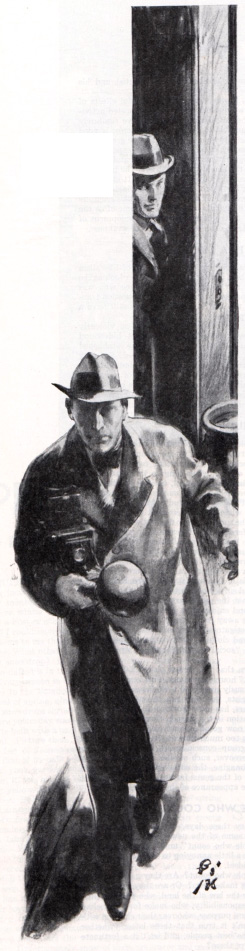
Selby looked at the wire, nodded and said, “There’s a man who knows his job.”
Amorette Standish let her curiosity show in her voice.
“Were you wondering if she really is Mrs. Brower?”
“I was,” he said.
“And the dead man?” she asked. “Was he Mr. Brower?”
“I don’t think so. The woman says he isn’t, and the description doesn’t fit. Ring up the coroner and ask him to look particularly for the small triangular scar mentioned in the wire. I don’t think he’ll find it, but we’ll look anyway.”
As his secretary took the telegram and left the room, Selby got to his feet and began a restless pacing of the office. At length he sat down at his desk and started scribbling a wire to the chief of police at Millbank, Nevada.
“Ascertain if possible,” he wrote, “if Brower had a friend, probably a minister, between forty-five and fifty-five, about five feet five inches, weight about hundred and twenty, small-boned, dark hair, gray at temples, small round bald spot top and back of head. Interested in photography. Probably had made several fruitless attempts to sell scenarios Hollywood studios. Interested in motion pictures. Last seen wearing black frock coat, well-worn and shiny black trousers, black high shoes. Eyes blue. Manner very self-effacing. Enunciation very precise, as though accustomed public speaking from pulpit. Owns Typco portable typewriter. Wire reply earliest available moment. Important. Thanks for co-operation.” Selby gave the telegram to Amorette Standish to be sent. His telephone was ringing before she had left the office. He took down the receiver and heard Sheriff Brandon’s voice.
“Have some news for you, Doug,” the sheriff said.
“Found out who he was?”
“No, not yet.”
“Talk with that optician in San Francisco?”
“Yes. He got my wire, but had been pretty busy and had just hit the high spots going over his records. He hadn’t found anything. I don’t think he’d been trying very hard. I put a bee in his bonnet, told him to check over every prescription he had in his files if necessary. He said the prescription wasn’t particularly unusual. I told him to make a list of every patient he had who had that prescription and send me a telegram.”
“What else?” Selby asked.
Brandon lowered his voice.
“Listen, Doug,” he said cautiously, “the opposition are going to try to put us on the spot.”
“Go ahead,” Selby said.
“Jerry Summerville, who runs The Blade, has imported a crack mystery man from Los Angeles, a fellow by the name of Carl Bittner. He’s been a star reporter for some of the Los Angeles dailies. I don’t know how much money it cost, or who’s putting it up, but Summerville put in the call this morning and Bittner is here in town now. He’s been asking questions of the coroner and trying to pump Cushing.”
“What did Cushing tell him, do you know?”
“No. He pulled a fast one with Cushing. He said he was a special investigator and sort of gave Cushing to understand he was from your office. Cushing talked a little bit. I don’t know how much … Suppose we could throw a scare into this bird for impersonating an officer?”
“Special investigator doesn’t mean anything,” Selby said slowly. “Let’s go slow on bothering about what the other people are doing, Rex, and solve the case ourselves. After all, we have all the official machinery at our disposal, and we’ve got a head start.”
“Not very much of a head start,” the sheriff said. “We collect the facts and the other fellows can use them.”
“We don’t need to tell them all we know,” Selby pointed out.
“That’s one of the things I wanted to ask you about. Suppose we clamp down the lid on information?”
“That’s okay by me.”
“All right, we’ll do it. Now here’s something else for you. Mr. and Mrs. Leslie Smith are phonies. They gave an address of 3350 Blair Drive. There isn’t any such number. There are about fifty automobiles registered to Leslie Smiths in various parts of the state.”
“Okay,” Selby said after a moment, “it’s up to you to run down all fifty of those car owners.”
“I was talking with Cushing,” Brandon went on, “and he says they were a couple of kids who might have been adventuring around a bit and used the first alias that came into their heads.”
“Cushing may be right,” Selby rejoined, “but we’re solving this case, he isn’t. It stands to reason,that someone got into the minister’s room through one of the adjoining rooms. That chair being propped under the doorknob would have kept the door of 321 from opening. Both doors were locked on 323. I’m inclined to favor 319.”
“But there wasn’t anyone in 319 at the time.”
Selby said, “Let’s make absolutely certain of that, Rex. I don’t like the way Cushing is acting in this thing. He’s not co-operating as well as he might. Suppose you get hold of him and throw a scare into him.
“And here’s something else,” Selby went on. “I noticed that the writing on the letter which had been left in the typewriter was nice neat typewriting, almost professional in appearance.”
“I hadn’t particularly noticed that,” the sheriff said, after a moment, “but I guess perhaps you’re right.”
“Now, then, on the scenario, which was in his briefcase,” Selby pointed out, “the typing was ragged, the letters in the words weren’t evenly spaced. There were lots of strike-overs and the punctuation was rotten. Suppose you check up and see if both the scenario and the letter were written on the same typewriter.”
“You mean two different people wrote them, but on the same machine?”
“Yes. It fits in with the theory of murder. By checking up on that typing we can find out a little more about it. Now, Rex, we should be able to find out more about this man. How about labels in his clothes?”
“I’m checking on that. The coat was sold by a firm in San Francisco. There weren’t any laundry marks on his clothes. But I’ll check up on this other stuff, Doug, and let you know. Keep your head, son, and don’t worry. We can handle it all right. G’by.”
Selby hung up the telephone as Amorette Standish slipped in through the door and said in a low voice, “There’s a man in the outer office who says he has to see you upon a matter of the greatest importance.”
“Won’t he see one of the deputies?”
“No.”
“What’s his name?”
“Carl Bittner.”
Selby nodded slowly. “Show him in,” he said.
Carl Bittner was filled with bustling efficiency as he entered the room. Almost as tall as Selby, he was some fifteen years older. His face was thin, almost to the point of being gaunt; high cheekbones and thin lips gave him a peculiarly lantern-jawed appearance.
“I’m Bittner,” he said. “I’m with The Blade. I’m working on this murder case. What have you to say about it?”
“Nothing,” Selby said.
Bittner raised his eyebrows in surprise. “I’ve been working on some of the large dailies in Los Angeles,” he said. “Down there the district attorney co-operates with us and gives us any information he has.”
“It’s too bad you left there, then,” Selby said.
“The idea is,” Bittner went on, “that newspaper publicity will frequently clear up unexplained circumstances. Therefore, the district attorney feels it’s good business to co-operate with the newspapers.”
“I’m glad he does.”
“Don’t you feel that way?”
“No.”
“There’s some chance we could identify the body, if you’d tell us everything you know.”
“Just what information did you want?”
“Everything you know,” Bittner said, dropping into a chair, lighting a cigarette and making himself thoroughly at ease.
“So far,” Selby said, “I have no information which would enable me to identify the dead man.”
“Don’t know anything about him, eh?”
“Virtually not a thing.”
“Wasn’t he mixed up with some Hollywood picture actress?”
“Was he?”
“I’m asking you.”
“And I’m asking you.”
“Don’t some of your investigations lead you to believe there’s a picture actress mixed up in the case?”
“I can’t very well answer that question.”
“Why?”
“As yet I haven’t correlated the various facts.”
“When do you expect to correlate them?”
“I don’t know.”
Bittner got to his feet, twisted his long mouth into a grin and said, “Thank you very much, Mr. Selby. The Blade will be on the street in about two hours. I’ll just about have time to get your antagonistic attitude written up against the deadline. Call me whenever you have anything new. Good-by.”
He slammed the door of Selby’s office triumphantly, as though he had succeeded in getting the district attorney to say exactly what he wanted said.
VIII
Selby switched on the lights in his office and read the terse telegram he had received from the chief of police at Millbank, Nevada:
BROWER HAD MANY FRIENDS AMONG MINISTERS IMPOSSIBLE IDENTIFY FRIEND MENTIONED FROM DESCRIPTION
He consulted his wrist watch. Shirley Arden and Trask should arrive to keep their appointment within fifteen minutes.
Selby spread out The Blade on his desk. Big headlines screamed across the front page: SHERIFF AND DISTRICT ATTORNEY BAFFLED BY CRIME. NEW AND INCOMPETENT OFFICIALS ADMIT HELPLESSNESS — REFUSE AID OF PRESS — UNIDENTIFIED CLERGYMAN MURDERED IN DOWNTOWN HOTEL!
There followed a more or less garbled account of the crime, but that which made Selby’s jaw clench was a column of “Comment” under the by-line of Carl Bittner, written with the technique of a mud-slinging metropolitan newspaper reporter.
“When the district attorney, Selby, was interviewed at a late hour this afternoon,” the article stated, “he admitted he had no information whatever which would be of any value in solving the murder. This, in spite of the fact representatives of The Blade have been able to uncover several significant facts which will probably clear up the mystery, at least as to the identity of the murdered man.”
“For some time a rumor has been rife that a prominent Hollywood picture actress figures in the case, that for reasons best known to himself District Attorney Selby is endeavoring to shield this actress. Pressed for information upon this point, Selby flew into a rage and refused to answer any questions. When it was pointed out to him that an identification of the victim, perhaps a solution of the crime itself, depended upon enlisting the aid of the press, he obstinately refused to divulge any information whatever, despite his admission that he was groping entirely in the dark.
“It is, of course, well known that whenever the breath of scandal fastens itself upon any prominent actress great pressure is brought to bear upon all concerned to hush matters up. The Blade has, however, pledged itself to discover the facts and give the news to its readers. It is to be regretted that the district attorney cannot recognize he is not a ruler, but a public servant. He is employed by the taxpayers, paid from tax moneys, and has taken an oath to faithfully discharge the duties of his office. He is young, untried and, in matters of this sort, inexperienced. Citizens of this community may well anticipate a carnival of crime as the crooks realize the type of man who has charge of law enforcement.”
“During the campaign, Selby was ready enough with his criticisms of Roper’s methods of conducting the office; but now that he has tried to take over the reins, his groping, bewildered attempts to solve a case which Roper would have taken in his stride, show only too well the cost to the public of discharging a faithful and efficient servant merely because of the rantings of some youth whose only qualification for the position is that he wants the prestige which goes with the title.”
A bitter column on the editorial page dealt with the fact that, as had been predicted by The Blade, Rex Brandon and Douglas Selby, while they were perhaps well-meaning, were utterly incompetent to handle a murder case such as the mysterious death of the unidentified clergyman. Had the voters retained Sam Roper in office, the editorial said, there was little doubt but what that veteran prosecutor would have by this time learned the identity of the dead man and probably had the murderer behind bars. Certainly the community would have been spared the humiliation of having a sheriff and a district attorney engage in such a comedy of errors as had resulted in bringing to an unfortunate woman the false information that her husband was dead. Roper would undoubtedly have made an investigation before jumping at such a false and erroneous conclusion.
Selby squared his shoulders.
All right, they wanted to fight, did they? Very well, he’d fight it out with them.
He heard a knock on his door and called, “Come in.”
The door opened and Selby saw a man nearly six feet tall, weighing well over two hundred pounds, smiling at him from the doorway.
The visitor wore a checked coat. His well-manicured hands adjusted the knot of his scarf as he smiled and said, in a deep, dramatic voice, “Ah, Mr. Selby, I believe? It is a pleasure.”
“You’re Trask?” Selby asked.
The big man bowed and smiled.
“Come in,” Selby said, “and tell Miss Arden to come in.”
“Miss Arden — er — er — unfortunately is not able to be present, Mr. Selby. As you may or may not know, Miss Arden’s nerves have been bothering her somewhat of late. She has been working under a terrific strain and … ”
“Where is she?” Selby interrupted, getting to his feet.
“At the close of the shooting this afternoon,” Trask said, “Miss Arden was in an exceedingly nervous condition. Her personal physician advised her … ”
“Where is she?”
“She — er — went away.”
“Where?”
“To the seclusion of a mountain resort where she can get a change in elevation and scenery and complete rest.”
“Where?”
“I am afraid I am not at liberty to divulge her exact location. The orders of her physician were most explicit.”
“Who’s her physician?”
“Dr. Edward Cartwright.”
Selby scooped up the telephone. “You come in and sit down,” he said to Trask; and, into the telephone, “This is Douglas Selby, the district attorney, speaking. I want to talk with Dr. Edward Cartwright in Los Angeles. I’ll hold the wire.”
Standing with his feet spread apart, his jaw thrust forward, the receiver of the telephone held in his left hand, he said to Trask, “That’s what I get for giving a heel like you a chance to double-cross me. It won’t happen again.”
Trask strode toward him, his eyes glowering with indignation. “Are you referring to me?” he demanded in a loud, booming voice. “Are you calling me a heel? Are you intimating that I double-crossed you because Miss Arden’s health has been jeopardized by overwork?”
“You’re damned right I am,” Selby said. “I’ll tell you more about it when I’ve talked with this doctor on the telephone.”
Into the telephone he said, “Hello! Rush through that call.”
A woman’s voice said, “Doctor Cartwright’s residence.”
Selby listened while the long-distance operator said, “The district attorney’s office at Madison City is calling Doctor Cartwright.”
“I’m afraid Doctor Cartwright can’t come to the telephone,” the woman’s voice said.
Selby interrupted. “I’ll talk with whoever’s on the phone,” he said.
“Very well,” the operator told him.
“Who is this?” Selby asked.
“This is Mrs. Cartwright.”
“All right,” Selby said, “this is Douglas Selby. I’m the district attorney at Madison City. You put Doctor Cartwright on the telephone.”
“But Doctor Cartwright has given orders that he is not to be disturbed.”
“You tell Doctor Cartwright he can either talk on the telephone or I’ll have him brought up here and he can do his talking in front of a grand jury.”
“But — you couldn’t do that,” the woman protested.
“That,” Selby remarked, “is a matter of opinion. Please convey my message to Doctor Cartwright.”
“He’s very tired. He left orders that … ”
“Convey that message to Doctor Cartwright,” Selby said, “or I’ll get a statement from him which will be made at my convenience rather than at his.”
There was a moment’s pause and the woman’s voice said dubiously, “Very well, just hold the phone a moment.”
Trask interrupted to say, “You can’t do this, Selby. You’re getting off on the wrong foot. Now I want to be friendly with you.”
“You,” Selby told him, “shut up. You promised me to have Shirley Arden here at eight o’clock. I’m already being put on the pan for falling for this Hollywood hooey. I don’t propose to be made the goat.”
“If you’re going to be pasty about it,” Trask said with an air of injured dignity, “it happens that I know my legal rights in the premises and . . .”
A man’s voice said “Hello” on the telephone, and Selby said, “Shut up, Trask … Hello! Is this Doctor Cartwright?”
“Yes.”
“You’re the Doctor Cartwright who attends Shirley Arden, the picture actress?”
“I have attended her on occasion, yes.”
“When did you last see her?”
“What’s the object of this inquiry?”
“Miss Arden was to have been in my office this evening. She isn’t here. I want to know why.”
“Miss Arden was in an exceedingly nervous condition.”
“When did you see her?”
“This afternoon.”
“What time?”
“About three o’clock.”
“What did you tell her?”
Doctor Cartwright’s voice became very professional. “I found that her pulse was irregular, that her blood pressure was higher than should have been the case. There was some evidence of halitosis, indicating a nervous indigestion. She complained of migraine and general lassitude. I advised a complete rest.”
“Did you advise her specifically not to keep her appointment with me?”
“I advised her not to engage in any activity which would cause undue excitement or nervousness.”
“Did you advise her not to keep her appointment with me?”
“I advised her to seek a secluded mountain resort where she could be quiet for a few days.”
“Did you advise her not to keep her appointment with me?”
“I told her that it would be unwise for her to … ”
“Never mind that,” Selby said, “did you tell her not to keep her appointment with me?”
“She asked me if it wouldn’t be inadvisable for her to subject herself to a grueling interrogation after taking an automobile ride of some hundred miles, and I told her that it would.”
“Specifically, what did you find wrong with her?”
“I’m afraid I can’t discuss my patient’s symptoms. A matter of professional privilege, you know, Mr. Selby. But I felt that her health would be benefited by a complete change of scenery.”
“For how long?”
“Until she feels relief from some of the symptoms.”
“And what are the symptoms?”
“General lassitude, nervousness, a severe migraine.”
“What’s migraine?” Selby asked.
“Well, er — a headache.”
“In other words, she had a headache and said she didn’t feel well, so you told her she didn’t need to keep her appointment with me, is that right?”
“That’s putting rather a blunt interpretation on it.”
“I’m cutting out all of the verbal foolishness,” Selby said, “and getting down to brass tacks. That’s the effect of what you told her, isn’t it?”
“Well, of course, it would have that effect and … ”
“Thank you, doctor,” Selby said tersely, “you’ll probably hear more from me about this.”
He dropped the telephone receiver down between the prongs of the desk phone, turned to Trask and said, “The more I see of this, the less I like it.”
Trask pulled down his waistcoat and became coldly dignified.
“Very well,” he said, “if you’re going to adopt that attitude, may I suggest, Mr. Selby, that in the elation of your campaign victory, you have, perhaps, emerged with a swollen concept of your own power and importance?
“As Miss Arden’s manager, I have received advice from the very best legal talent in Los Angeles as to our rights in the matter.
“Frankly, I considered it an arbitrary and high-handed procedure when you telephoned and stated that Miss Arden, a star whose salary per week amounts to more than yours for a year, drop everything and journey to your office. However, since it is her duty as a citizen to co-operate with the authorities, I made no vehement protest.
“The situation was different when it appeared that Miss Arden’s nerves were weakening under the strain, and that her earning capacity might be impaired if she complied with your unwarranted demands upon her time. I, therefore, employed counsel and was advised that, while you have a right to have a subpoena issued for her, compelling her attendance before the grand jury, you have no right to order her to appear for questioning in your office. Incidentally, it may interest you to know that a subpoena, in order to be valid, has to be served in person upon the witness named in the subpoena. I think I need only call to your attention the fact that Miss Arden has virtually unlimited resources at her command, to point out to you how difficult it would be for you to serve such a subpoena upon her. Moreover, she is under no obligation to obey such a subpoena, if to do so would jeopardize her health. You are not a physician. Doctor Cartwright is. His diagnosis of the condition of Miss Arden is entitled to far more weight than your hasty assumption that her headaches and nervous fits are unimportant.”
“I’m sorry to have to talk to you this way, but you asked for it. You’re a district attorney in a rather unimportant, outlying county. If you think you can pick up your telephone and summon high-priced picture stars, who are of international importance, to your city, quite regardless of their own health or personal convenience, you’re mistaken.”
Trask thrust out his jaw belligerently and said, “Have I made myself clear, Mr. Selby?”
Doug Selby stood with his long legs spread apart, hands thrust deep in his trousers pockets. His eyes burned steadily into those of Trask.
“You’re damned right you’ve made yourself clear,” he said. “Now I’ll make myself clear. “I have reason to believe that Miss Arden was in this city, registered in the Madison Hotel under an assumed name. I have reason to believe that a man who was murdered in that hotel called on Miss Arden in her room. I have reason to believe that Miss Arden paid him a large sum of money. Now you can force me to use a subpoena. You may be able to keep me from serving that subpoena. But, by heaven, you can’t keep me from giving out the facts to the press.
“You’re probably right in stating that Miss Arden’s salary per week is greater than mine for a year, but when it comes to a showdown, the ability to dish it out and to take it isn’t measured by salary contracts. I’m just as good a fighter as she is, just as good a fighter as you are — and probably a damned sight better. And you’re going to find it out.
“You’ve done a lot of talking about Miss Arden’s importance, about the fact that she’s an internationally known figure. You’re right in that. That’s the thing that gives you these resources you boast of, the money to hire bodyguards, to arrange for an isolated place of concealment where it would be hard to locate her with a subpoena.
“You overlook, however, that this very fact is also your greatest weakness. The minute the press associations get the idea Miss Arden may be mixed up in this case, they’ll have reporters pouring into town like flies coming to a honey jar. I didn’t want to make any public announcement until I’d given Miss Arden a chance to explain. If she doesn’t want to co-operate with me, that’s her lookout.”
Selby consulted his wrist watch. “It’s twelve minutes past eight. I don’t think Miss Arden’s got to any part of the state where she can’t get here within four hours’ fast driving. I’ll give you until midnight to produce her. If you don’t produce her, I’ll tell the press exactly why I want to talk with her.”
Trask’s face was a wooden mask, but his eyes showed a trace of panic.
“Young man,” he said, “if you did that, you’d be sued for criminal libel and defamation of character, you … ”
“You’re wasting time talking,” Selby said. “If you’re going to get Miss Arden here by midnight, you’d better get started.”
Trask took a deep breath, forced a smile to his face, came toward Selby.
“Now, listen, Mr. Selby,” he said in a conciliatory tone, “perhaps I was a little hasty. After all, you know, our nerves get worn thin in this picture business. Miss Arden’s trip to Madison City was highly confidential, but since you’re interested in it, I think I can explain to you just why she came and … ”
“I don’t want your explanation,” Selby interrupted coldly, “I want hers.”
Trask’s face flushed. “You mean to refuse to listen to what I have to say?”
“At times,” Selby said, “you’re rather good at interpreting the English language.”
Trask fumbled for a cigar in his waistcoat pocket.
“Surely,” he said, “there’s some way in which we can get together. After all … ”
“I’ll be available until midnight,” Selby interrupted. “In the meantime, Mr. Trask, I don’t think I need to detain you.”
“That’s final?” Trask asked, clamping his teeth down on the end of the cigar and giving it a vicious, wrenching motion with his wrist to tear off the end.
“That’s final,” Selby said.
Trask spat out the bit of tobacco as he reached for the doorknob.
“You’ll sing a different tune when we get done with you!” he said, and slammed the door behind him.
Selby called Cushing at the Madison Hotel.
“Cushing,” he said, “I want you to ask all of the regular roomers on the third floor if they heard any typewriting in 321 on Monday night or Tuesday morning. It’ll probably look better if you ask them.”
Cushing said, “This is giving the hotel an awful black eye, Doug. That publicity in The Blade was bad — very bad.”
“Perhaps if you’d kept your mouth shut,” Selby said, “the publicity wouldn’t be so bad.”
“What do you mean?”
“Some of the information must have come from you.”
“Impossible! I didn’t give out any information.”
“You talked to the chief of police,” Selby said. “You know where he stands with The Blade.”
“You mean the chief of police is double-crossing you?”
“I don’t mean anything except that some of the information in the newspaper didn’t come from the sheriff’s office, and didn’t come from mine. You can draw your own conclusions.”
“But he has the right to question me,” Cushing said, “just the same as you have, Doug.”
“All right, then, he’s the one to complain to, not to me.”
“But in your position, can’t you hush the thing up?”
Selby laughed and said, “You can gather just how much chance I have of hushing things up by reading the editorial page in The Blade.”
“Yes,” Cushing said dubiously, “still … ”
“Quit worrying about it,” Selby told him, “and get busy and question your guests on the third floor.”
“I don’t like to question the guests,” he protested.
“Perhaps,” Selby suggested, “you’d prefer to have the sheriff do it.”
“No, no, no; not that!”
“Then suppose you do it.”
Cushing sighed, said, “Very well,” in a tone which contained a complete lack of enthusiasm, and hung up the receiver.
Selby had hardly put the receiver back into place when the phone rang. He picked it up, said “Hello,” and heard a woman’s voice, a voice which was rich, throaty, and intimately cordial.
“Is this Mr. Douglas Selby, the district attorney?”
“Yes.”
“I’m Miss Myrtle Cummings, of Los Angeles, and I have some information which I think you should have. It’s something in relation to the murder case which has been described in the evening newspaper.”
“Can you give it to me over the telephone?” Selby asked.
“No.”
“Well, I’ll be here at my office until midnight,” he said.
There was something hauntingly familiar about the woman’s voice. “I’m sorry,” she said, “but it’s absolutely impossible for me to leave. For reasons which I’ll explain when I see you, I’m confined to my room, but if you could come and see me some time within the next half hour, I think it would be very advantageous for you to do so.”
“Where are you?”
“I’m in room 515 at the Madison Hotel. Do you suppose you could manage to come to my room without attracting any attention?”
“I think so,” he said slowly.
“Could you come right away?”
“I’m waiting for several rather important calls,” he said.
“But I’m sure this is most important,” she insisted.
“Very well,” Selby told her, “I’ll be over within ten minutes.”
He dropped the receiver back into place, put on his overcoat and hat. He closed and locked the office door, but left the light on, so that Rex Brandon would know he expected to return, in case the sheriff should call at the office. He parked his car a couple of blocks from the Madison Hotel.
It was one of those clear, cold nights with a dry wind blowing in from the desert. The stars blazed down with steady brilliance. The northeast wind was surgingly insistent. Selby buttoned his coat, pushed his hands into the deep side pockets and walked with long, swinging strides toward the hotel.
Luck was with him when he entered the hotel. Cushing was not in the lobby. The night clerk was busy with a patron. The elevator operator apparently saw nothing unusual in Selby’s visit.
“Going up to campaign headquarters?” he asked.
Selby nodded.
“Gee, that sure was something, having a murder case right here in the hotel, wasn’t it?” the operator said, as he slid the door closed and started the elevator upward.
Again Selby nodded. “Know anything about it?”
“Just what I’ve heard around the hotel.”
“What did you hear?”
“Nothing, except this guy took the room and was found dead. Cushing says it couldn’t have been a murder. He says it was just a case of accidentally taking the wrong kind of dope and that The Blade is trying to make a big thing of it. The Blade’s had a reporter snooping around here.”
“Chap by the name of Carl Bittner?” Selby asked.
“That’s the one. He’s got the boss sore at him. Cushing thought he was one of your men … and there’s things about the dump that Cushing don’t want printed.”
“What things?” Selby asked.
“Oh, lots of things,” the boy said vaguely. “Take this guy, Trask, for one. Anyone would think he owned the joint. And there’s a room on the fifth floor they never rent. A dame comes and goes on the freight elevator.”
The elevator stopped at the fifth floor.
Selby handed the boy a half dollar. “Thanks for the information,” he said. “I don’t want to be interrupted. I came here because I wanted to get away from telephone calls and people who were trying to interview me. Do you suppose you could forget about taking me up here?”
“Sure,” the operator said, grinning. “I can forget anything for four bits.”
Selby nodded, waited until the cage had started downward before he made the turn in the corridor which took him toward the room at the end of the corridor which they had used as campaign headquarters. When he saw there was no one in the hallway, he tapped gently on the door of 515.
“Come in,” a woman’s voice said. Selby opened the door and stepped into the room.
He knew at once that Shirley Arden had arranged every detail of the meeting with the training which years as an actress had given her.
The door opened into a sitting room. Back of the sitting room was a bedroom. In the bedroom a rose-colored light shed a soft illumination which fell upon the actress’ face in such a way that it turned the dark depths of her eyes into mysterious pools of romance.
She was attired in a tailored suit of pearl gray. Its simplicity was so severe that it served to center attention upon her face and figure. Had she been ten years older, she would have worn a gown so gorgeously designed that a woman looking at her would have said, “How wonderfully she’s dressed!” But with that pearl gray tailored outfit, men, looking at Shirley Arden, would only have said, “What a beautiful figure she has! How wonderful her eyes are!”
She was seated on the arm of an overstuffed chair, one gray-stockinged leg thrust out at such an angle that the curves caught the eye. Her lips were parted in a smile.
And yet, perhaps as a result of her Hollywood training, she overdid it. Perfect actress that she was, she underestimated the intelligence of the man with whom she was dealing, so that the effect she strove for was lost. Had she remained seated on the arm of the chair just long enough to have given him a glimpse of her loveliness, and then got to her feet to come toward him, he would have been impressed. But her very immobility warned him that the effect had been carefully and studiously planned.
“So,” Selby said, vigorously kicking the door shut behind him, “you were here all the time.”
She didn’t move. Her face was held so that the lighting did not change by so much as a hairline of a shadow. It was as though she had been facing a battery of lights for a close-up.
“Yes,” she said, “I was here. I didn’t want to talk with you unless I had to. I’m afraid Ben Trask didn’t handle the situation very diplomatically.”
“He didn’t,” Selby said. “How about your nerves?”
“I really am very nervous.”
“And,” Selby said, “I suppose the idea was to send Ben Trask over to bluff me. If he’d reported success, then you’d have actually gone into hiding.”
“I didn’t want to take any chances,” she told him. “Can’t you understand? Think what it means to me. Think of my position, my public, my earning capacity. Gossip is a fatal thing to a picture star. I couldn’t afford to have it known I was questioned in connection with the case.
“Ben is a very strong man. He’s always been able to dominate any situation he’s tackled. He makes my contracts for me, and it’s an open secret they’re the best contracts in Hollywood. Then he met you — and failed.”
She waited for the full dramatic value of that statement to manifest itself. Then, with that slow, supple grace which characterizes a stage dancer, she straightened her leg, swung it slowly forward, came to the floor as lightly as thistledown and walked toward him to give him her hand.
“It’s delightful, Mr. Selby,” she said, “to find you so human.”
His fingers barely touched hers. “It depends,” he told her, “on what you mean by being human.”
“I’m certain you’ll listen to reason.”
“I’ll listen to the truth,” he said, “if that’s what you mean.”
“After all, aren’t they the same thing?”
“That depends,” Selby said. “Sit down, I want to talk with you.”
She smiled and said, “I know I’m in your city, Mr. Selby, under your jurisdiction, as it were, but please permit me to be the hostess and ask you to be seated.”
She swept her hand in a gracious gesture of invitation toward the overstuffed chair beneath the floor lamp.
“No,” Selby said, “thank you, I’ll stand.”
A slight frown of annoyance crossed her face, as though her plans were going astray.
Selby stood spread-legged, his overcoat unbuttoned and thrown back, his hands thrust deep into his trousers pockets, his eyes showing just a trace of sardonic humor beneath a grim determination.
“After all,” he said, “I’m doing the questioning. So if anyone is going to sit in that chair beneath the illumination of that light, it’s going to be you. You’re the one who’s being questioned.”
She said defiantly, “Meaning, I suppose, that you think I’m afraid to let you study my facial expressions.”
He shrugged his shoulders and said, “I’m not wasting time thinking about it. Your facial expressions are going to be studied whether you like it or not.”
“Very well,” she said, and dropped into the overstuffed chair, carefully adjusting the light so that it beat down upon her face. Her smile was the smile of one who bravely faces injustice, nor was there any narrowing of the eyelids as her lips parted. “Go ahead, Mr. District Attorney,” she invited.
Selby stood staring at her steadily. “It happens,” he said, “that I saw that same expression in ‘Love Life.’ It was, I believe, the way you looked at your prospective father-in-law when he came to give you money never to see his boy again.”
She lost her fixed smile. For a moment there was blazing defiance in her eyes. Then her face became as a wooden mask.
“After all,” she said, “it’s the same face. And it would naturally hold the same expressions that you’ve seen in pictures.”
“Well,” he told her, “I’m not interested in your facial expressions. I’m interested in your answers to certain questions.”
“Go ahead and ask the questions.”
“You were here in the hotel Monday morning, were you not?”
“I was.”
“In this room?”
“Yes.”
“Why did you come here?”
“On a matter of business.”
“What was the business?”
“I decline to answer that question. It’s a confidential matter.”
“With whom was your business to be transacted?”
“I also decline to answer that question.”
“Have you seen photographs of the man who was found dead in room 321?”
“No.”
Selby pulled a photograph from his pocket, strode toward her and thrust it out in front of him.
“Look at it,” he said.
It was a moment before she lowered her eyes, as though schooling her face against showing any expression; then she glanced at the photograph, raised her eyes to his and nodded a slow, solemn nod.
“Know him?” Selby asked.
“I saw him.”
“Where?”
“In the hotel.”
“What part of the hotel?”
“In this room.”
Selby sighed and said, “Now that’s a lot better. When did you see him?”
“It was some time in the morning, shortly before ten o’clock, I think.”
“What was he doing?”
“He was talking with me.”
“What name did he give you? Was it the name under which he was registered, Charles Brower?”
She shook her head and said, “No, that wasn’t the name.”
“What name was it?”
She frowned thoughtfully for a moment or two and then said slowly, “No, I’m afraid I can’t remember what the name was, but I know it wasn’t Brower. It was something that sounded like Larry, or something of that sort. I think it had a ‘Larry’ in it.”
“In the last name?”
“Yes.”
“You’re sure it wasn’t the first name?”
“No, it was the last name. I don’t think he told me his first name.”
“Why did he happen to come into the room here?”
“He knocked on the door. I went to the door to see who it was.”
“Had you ever seen him before?”
She hesitated once more for a moment, then very decisively shook her head and said, “No, I had never seen him before.”
“But you let him in?”
“Yes.”
“Are you accustomed to admitting strangers to your room?”
“I want you to understand my position, Mr. Selby. You’re an educated man. You’re different from the rabble. You can appreciate the position of an actress. I’m really not my own boss. I’m owned by my public. One must, of course, use discretion, but, if you could have seen this man when he was alive, you’d have realized how harmless he was. And yet, harmless isn’t exactly the word I want. He was inoffensive, but it wasn’t merely a passive futility, if you understand what I mean, it was … well, he seemed to be at peace with the world and to be noncombative.”
“And so you let him in?”
“Yes.”
“What reason did he give for knocking on the door?”
“He said that he’d seen me come in, that despite my attempt to avoid recognition he had realized who I was. He’d seen me get out of the automobile in front of the hotel and followed me to the freight elevator. In some way he’d discovered that I was in this room.”
“How long was it after you’d taken the room that he knocked on the door?”
“Less than half an hour. Perhaps fifteen minutes.”
“If he’d seen you taking the elevator, why didn’t he knock immediately?”
He told me that he realized it was an intrusion upon my privacy. He’d been trying to make up his mind to do it for several minutes. He said he’d stood outside of the door for several minutes before he knocked.”
“What time was this?”
“As nearly as I can place it, about a quarter to ten.”
“What did he want?”
“It was pathetic,” she said. “He wanted me to do a certain type of play which he said would be of great benefit to many people. He was so earnest that I couldn’t refuse to give him an audience. He said that he’d been one of my ardent admirers ever since I’d appeared on the screen. He’d seen me in every part I’d played.”
“Go on,” Selby said.
“He had a script which he’d written. He said that he’d been intending to come to Hollywood to present it to me personally.”
“Do you remember the title of this script?”
“Yes.”
“What was it?”
“It was titled, ‘Lest Ye be Judged.’”
“Did you read it?”
“I glanced through it.”
“Thoroughly?”
“No, just casually.”
“Why didn’t you read it thoroughly?”
“In the first place, I knew that it would be no use. In the second place, I could tell from almost the first glance that it was hopeless.”
“Why was it hopeless?”
“The way it was written, the theme of it, everything about it.”
“What was wrong with it?”
“In the first place, it was propaganda. It wasn’t a play, it was a sermon. People go to churches to hear sermons; they go to theaters to be amused.”
“Did he want to sell you this?”
“No, he wanted to give it to me … Well, I don’t know whether he would have put a price on it or not … You see, the conversation didn’t get that far. He told me that he had consecrated his life to the service of humanity and he thought that this was a duty I owed to my fellow beings. The conversation was all on that plane, if you know what I mean.”
“Yes,” Selby told her, “I know what you mean.”
“Well, he showed me this script and asked me if I wouldn’t take it and use it as my next vehicle.”
“What did you tell him?”
“I explained to him that I was under contract to the studio; that I had absolutely nothing to say about plays; that the studio selected such plays as they thought would make good vehicles for me. They did that through a purchasing department which specialized upon that very thing. They didn’t allow me to even make suggestions, except minor suggestions at conferences where the continuity was being worked out.”
“Then what happened?”
“He tried to argue with me for a little while, but he soon realized that I was telling him the truth, that I had absolutely no power to select the plays in which I was to appear, that a recommendation from me would be virtually valueless.”
“And what did you tell him to do?”
“I told him he would have to submit it to the Hollywood office.”
“Did you tell him you thought the Hollywood office would turn thumbs down on it?”
“No. I didn’t want to hurt his feelings. He was so earnest, so wrapped up in his play, it was really pathetic.”
The face of the actress showed an expression of sympathy, her voice was vibrant with emotion.
Staring at her, Selby was gripped by conflicting emotions. He knew, on the one hand, that she was a skillful actress, fully capable of portraying any emotion she chose; on the other hand, he realized that it would be exceedingly difficult for anyone who was fabricating what had happened at that interview to simulate such an emotion. Her manner radiated complete sincerity and that warm, rich sympathy which a broad-minded woman of the world would have held for the pathetic little parson who had brought his hopeless scenario to her.
Moreover, everything she had said tallied with the facts as Selby knew them. He hesitated a moment, then said, “That’s a very beautiful purse you have, Miss Arden.”
“Yes, isn’t it?” she exclaimed at once. “It.was given to me by the director who handled my last picture. I’m proud of it.”
“Do you mind if I look at it?”
“Not at all.”
She handed it over to Selby, who studied it, apparently lost in admiration for its beauty.
“How does it open?” he asked.
“This catch,” she said, “on top.” She snapped open the catch.
Selby peered inside, saw bills, lipstick, coin purse, handkerchief and compact.
“If you don’t consider I’m taking too much of a liberty,” he said and, before she could stop him, pulled out the handkerchief. He could hear her gasp as he raised the handkerchief to his nostrils.
Selby couldn’t tell the brand of perfume, but he did have a sufficiently discriminating sense of smell to know that this perfume was entirely different from that which had scented the five one-thousand dollar bills which had been found in the envelope the dead man had left in the hotel office.
“What’s the matter?” she asked with cold enmity. “Were you looking for something?”
“I was,” he told her, “interested in perfumes. I think that perfumes are indicative of personality.”
“I’m so glad you feel free to be perfectly informal,” she said sarcastically.
There was an awkward silence as he restored the handkerchief to her purse and handed it back to her.
“Was there,” she asked at length, “anything else I could tell you about the man?”
“I don’t know. Is there?”
“Not that I can think of.”
“Did he tell you where he was from?”
“Some little town in the northern part of the state, I think, but I can’t remember that.”
Selby stiffened to attention and said, “You mean in Nevada?”
She raised her eyebrows, then shook her head and said quite definitely, “No, it wasn’t in Nevada, I’m certain of that. Some little town in California.”
“And you can’t remember the name of the place?”
“No, it was in Northern California somewhere — a Riverdale, or something like that.”
“Riverview?” he asked.
She shook her head and said, “No, that wasn’t it; but there was a river in it, I think.”
“Your memory seems to be rather faulty, doesn’t it?”
Her laugh was throaty and musical. “The first time a fan stopped me to tell me how much he enjoyed my acting and asked for my autograph, I could tell you everything about him — what he had on, what he looked like, where he came from and all about him.
“Gradually I came to accept it as a part of the profession, and now … well, I won’t say that I’m bored, because one is never bored by expressions of appreciation from the public, but put yourself in my position. I’m called on to use every ounce of my energy in keeping fit, in acting, in being spontaneous and vivacious whenever I’m seen in public. I have to remember literally hundreds of newspapermen, cameramen, directors, supervisors, film executives and agents. Then there are quite a few people I meet whom I never expect to see again. They’re like — like telegraph poles whizzing by when you’re traveling on a Pullman train, if you know what I mean.”
“I see,” he said.
“They tell me things about themselves and I smile at them sympathetically and work my eyes; but all the time I’m thinking about my last income-tax return, how long I’m apt to be working on this present picture, whether the director is going to listen to what I have to say about the way I should say ‘Farewell’ to my lover in the picture, or whether he’s going to insist on doing it according to some standards which don’t register with me.
“I give the fan my autograph and turn loose my best smile on him. I know I’m never going to see him again, and he’s in sort of a daze anyway, dazzled by the mental concept of celebrity which he’s conjured up to wrap around me as an aura.”
Selby watched her narrowly and said, “You have rather a neat trick of turning phrases.”
“Have I?” she asked, smiling dazzlingly. “Oh, thank you so much.”
“I presume now,” he told her grimly, “if I’d only ask for your autograph the interview would be complete, and I could pass out of your life with the mental classification of a human telegraph pole whizzing by your Pullman car.”
She pouted and said, “Don’t say that.”
“Isn’t it true?”
“Certainly not.”
“Why not?”
She lowered her eyes and said slowly, “I don’t think any woman who ever came in contact with your powerful personality would readily forget you.”
“Our contact,” he said dryly, “has been rather remote and somewhat difficult to obtain.”
“Which,” she countered swiftly, raising her eyes to his, “is the main reason I will never forget it. Ben Trask is a wonder when it comes to working things. He’s good at diplomacy and at fighting. He can be either high-hat, belligerent, or very suave. He turned loose everything he had on you and it never even dented your armor. When Trask came back and told me that I had to submit to questioning, he was licked. The man was all washed up. I was literally thunderstruck. It’s the only time I’ve ever known him to make a complete and ignominious failure. I’d have remembered you even if I’d never seen you. And this has been far from a pleasant experience, you know.”
“The meeting with me?” he asked, eyes studying hers.
“Not that,” she said, smiling; “you know I didn’t mean it that way. I meant the worry and the anxiety.”
“Why the worry, if you merely met this man in such a casual manner?”
“Because,” she said, “he was killed. That was a shock to me. Whenever you talk with anyone and then learn of his death, you’re shocked. And, I may as well confess, there was a purely selfish reason. Competition is so keen among the stars that we must have a one-hundred-percent potential audience in order to get by. In other words, it takes all sorts of people to make a world. There are reformers, crusaders, fundamentalists, profligates, intellectual people and dumbbells. Whenever we do anything which antagonizes any one particular class, we narrow our potential audience by just that much.
“For that reason, no matter how great a star’s success may be, she never dares to let people get to gossiping about her. Moreover, because, in the past, scandals have been hushed up by the use of money and influence, whenever an actress’ name is connected with anything out of the ordinary, the public always feels that the real facts were hushed up. No matter how complete the subsequent vindication may be, there are always the ‘wise’ ones who will smirk and wink to show that they weren’t fooled any.
“If my name is connected with that of a murdered man, the big majority of newspaper readers would always remember the one item of gossip and entirely discount everything that might be said by way of explanation. People all over the country would glance at each other across the dinner tables and say, ‘Well, I see Shirley Arden’s company managed to quash the investigation on the Madison City murder. I wonder how much it cost them?’”
Selby said slowly, “I see.”
“So,” she said, laughing, “you can understand my attitude and something of my anxiety.”
Selby nodded. “Well,” he said, “I guess that about covers everything.”
She got to her feet, gave him her hand and said, “Will you believe me when I say it was a real pleasure to have met you, Mr. Selby?”
“Thank you,”, he said. “And, by the way, where did you get the five one thousand-dollar bills which you gave this minister?”
He was watching her as a hawk watches a moving clump of grass in front of a rabbit burrow. Coming as it did, his question took her by surprise. He saw her shoulders heave as she gave a quick gasp, but her face didn’t change its expression by so much as the twitching of a muscle. She raised gravely questioning eyes to his and said in a low, level voice, “Five one thousand-dollar bills? Surely, Mr. Selby, you’re making some mistake.”
“I don’t think I am,” he told her. “I think you gave this man five one thousand-dollar bills.”
“Oh, but I didn’t.”
“You didn’t?”
“Why of course not! Why, whatever put any such idea as that into your head?”
“I had an idea that you might have done so.”
“Why, he was just a poor country minister. I’ll venture to say he’s working on a salary of less than a hundred dollars a month, and probably gets that paid partially in produce. That coat he was wearing was shiny, and worn quite thin at the elbows. Everything about him spoke of the pinch of insufficient finances. His collar was frayed, his shoes had been half-soled at least once, perhaps twice. His shirt had been mended around the neck, his tie was all frazzled at the edges.”
“You seem to remember a lot about him,” Selby said thoughtfully, “for one who has forgotten so much.”
She laughed and said, “Once more I must ask you to indulge in consideration for my psychological processes, Mr. Selby. Men who tell me how much they admire my acting are quite numerous, but it’s not very often one comes in contact with a man who’s so completely genuine, so whole-heartedly sincere as this man. Naturally, as a woman, I noticed his clothes.”
“And you didn’t give him any money?”
“Why certainly not. Good heavens, if you had only read that scenario.”
“I did read it,” he told her.
She laughed and said, “Well, that’s the answer to your question.”
Selby said slowly, “I may want to question you again. I’m not going to bother you to come up here, but I may come to see you. Where can I find you?”
“You can get me on the lot. Simply ask for Mr. Trask.”
“And get another run-around?” he asked.
She laughed and said, “Not from Ben. He knows when he’s licked.”
“And you’ll be where I can reach you through the studio?”
“At any time. I’ll leave word with the operator to connect you with Mr. Trask, and Benny will see that you get in touch with me … In fact, I’d really like to. You know, in our world of make-believe it’s not often one comes in contact with a personality which has no pretense.”
His eyes showed the question in his mind.
“You see,” she said, rushing into swift speech, “it isn’t that we’re four-flushers so much as we’re actors and actresses, and we deal in worlds of acting. Therefore, it becomes easy to simulate emotion. Therefore, frequently one finds it easier to pretend surprise or regret or interest, or perhaps anger, than to solve the situation by some other method. One unconsciously uses one’s natural weapons, just as a deer escapes danger by flight and a porcupine by thrusting out its quills.”
He laughed and said, “Well, Miss Philosopher, do you classify me as a deer or a porcupine?”
“As a very prickly porcupine,” she said. “When your quills are out, Mr. Selby, you’re exceedingly difficult to deal with.”
“Well,” he told her, “I’ll try and be more tractable in the future.”
“And if you’re in Hollywood, you will give me a ring?”
“If anything else turns up about which I want to question you, yes.”
“And must it be an official visit?”
“Surely,” he said, puzzled, “you didn’t mean otherwise?”
“Why not? I told you that I meet so few men who have no pretense in their make-up that it’s refreshing to meet someone who hits straight from the shoulder and never backs up.”
“Aren’t you depending a lot upon rather a hasty judgment of character?” he asked.
She laughed again and said, “If you could only have seen yourself standing with your legs spread apart, and your chin pushed forward! You looked like a man who expects to have to wade right through an avalanche and who is perfectly willing to do it.”
“Perhaps that,” he told her, “is just a pose.”
“No,” she said, “I know too much about poses. And you still haven’t answered my question. Must it be an official visit?”
“It’s rather unlikely that I’ll be in Hollywood,” he told her. “The duties of my office keep me chained down pretty well to this spot.”
“Very well,” she told him, with some indefinable expression in her dark eyes. “I won’t press the point. I’ve never had a legal training, but I can still tell when a witness is evading the question.”
She was standing close to him now, and, as she raised her eyes, he seemed to feel drawn as toward some powerful magnet. It was as though he had been staring into an inky pool which had suddenly widened and risen toward him.
He laughed uneasily and said, “As though you ever had to give an invitation twice.”
“Am I to take it that’s an acceptance?” she asked.
He bowed low over her hand and said, “Yes. Good night, Miss Arden.”
“Good night,” she said, and her voice held a rich, throaty timbre.
He left the room, gently closed the door behind him, and took two or three deep breaths before the matter-of-fact environment of the familiar hotel corridor recalled him to the duties of his everyday existence.
He walked to the elevator, and was just about to press the button when he sensed surreptitious motion behind him. He flattened himself in a doorway and stared back down the corridor.
Carl Bittner had climbed up the stairs. In his right hand he held a camera and a battery photo-flashlight. Slowly, cautiously, he tiptoed his way down the corridor.
Selby waited until the reporter had rounded the bend in the hallway, then he rang for the elevator. In the lobby he paused to telephone room 515.
“Be careful,” he warned, when he heard Shirley Arden’s voice on the wire; “a newspaper photographer is stalking the hallway.”
“Thanks,” she told him, “I’ve got my door locked.”
“Has anyone knocked?” he asked.
“Not even a tap,” she replied, “and thanks for calling.”
Puzzled, Selby left the hotel to fight his way into the windy night.
IX
Sylvia Martin was waiting in front of the locked door of Selby’s office.
“Thought you were playing possum on me,” she said. “I’ve been knocking on the door. I even tried a kick or two.” And she glanced ruefully down at the toes of her shoes.
“No,” Selby said, “I was out on what might be described as an emergency call.”
“Anything new?” she asked.
He shook his head.
“Why is it,” she asked, “that a friendly paper doesn’t get any of the breaks, while the opposition scores all the scoops?”
“Meaning what?”
“Meaning,” she said, “that there’s something going on at the Madison Hotel.”
“What makes you think so?”
“A little bird told me.”
“I’d like to know more about your little bird.”
“If you must know, it’s someone who advised me that Carl Bittner, the crack reporter whom The Blade has imported to scoop you on a solution of the murder case, received a mysterious telephone call and then went rushing over to the hotel, carrying a camera.”
“Well?” he asked.
She said, “Let’s go in and sit down where we can talk.”
Selby unlocked the door. She followed him into his private office, perched on the edge of his desk, kicking one foot in a swinging circle.
“Come on,” she said, “what’s the lowdown?”
“I’m sure I couldn’t tell you.”
“Have I got to wait until I read about it in The Blade tomorrow night?”
“The Blade won’t publish anything about it.”
“Don’t ever think they won’t. You’re acting like an ostrich, Doug, sticking your head in the sand and kidding yourself you’re hidden from view.”
“I’m sorry,” he said, “but there’s nothing I could tell you, Sylvia.”
“Why?”
“In the first place, what makes you think there’s something to tell?”
“Don’t kid me, Doug, I know there is. I suppose I can go over to the hotel and dig it out myself, if I have to, but it does seem to me that … ”
She broke off the sentence, but her foot swung more rapidly and in a wider arc, until she seemed to be viciously kicking at the atmosphere.
Selby said, “I’d like to, Sylvia; I’d like to take you into my confidence, but you’ve got your job and I’ve got mine. You’re representing a newspaper. It’s your duty to gather publicity. Anything that you get will be spread on the front page of that paper. I have to take that into consideration.”
“We supported you during the election. Don’t we get anything in return for it?”
“Certainly you do. You get any of the breaks I can give you.”
“A lot that means,” she said bitterly. “The city editor put me on this murder case. I’ve known you for years. I’ve fought for you ever since you turned those twinkling blue eyes of yours on me and smiled. The newspaper I represent helped put you in office. What do we get in return for it? Not one damned thing!”
She blinked her eyes rapidly.
“Please don’t cry, Sylvia,” he begged. “You don’t appreciate my position.”
She jumped to her feet and said, “You make me so mad I could cry. Don’t you see the position you’re in? Don’t you see the position that I’m in? Don’t you see the position my paper’s in?”
“I think I do.”
“No you don’t. I’ve been assigned to cover the activities of the district attorney’s office in connection with this murder case. I’m making a lamentable failure of it. The things I’ve found out could have been put in my city editor’s eye without making him so much as blink. The opposition newspaper has imported a crack reporter. That means I’m being pitted against a trained investigator from one of the big metropolitan dailies. It’s an opportunity for me to do something big. It’s also an opportunity for me to become the laughingstock of everyone in the newspaper business. I need every advantage I can get. And about the only advantage I’m supposed to have is your friendship.”
“Sylvia, I’m going to do everything I can for you, but . . .”
“That stuff makes me sick,” she declared. “You know as well as I do that you’re concealing something. You’re good enough to conceal it from me because I’m fair enough to trust you; but you’re not smart enough to conceal it from The Blade because they’re fighting you and are out on their own, getting their information independently.”
“What makes you think that they’re going to get any particularly startling information?” he asked.
“Will you swear to me that your business at the Madison Hotel wasn’t connected with some angle of this case?”
“No,” he said frankly, “it was.”
“And you saw someone there?”
“Naturally.”
“Whom did you see?”
“I can’t tell you.”
“Why not?”
“Because I can’t.”
“Why?”
“It wouldn’t be fair.”
“To whom?”
He thought for a moment and then said lamely, “To the taxpayers, to the prosecution’s side of the case.”
“Bosh!” she told him. “You’re protecting someone. Who?”
“Suppose I should tell you,” he said, “that some person had become involved in this case who was entirely innocent of any connection with it except one brought about through casual coincidence? Suppose I should further tell you that the newspaper-reading public wouldn’t believe that such was the case if it were given any publicity? Suppose, because of my official position, I’d been able to get a complete and frank statement of facts, given to me in a sacred confidence? Would you want me to betray that confidence to the first newspaper reporter who asked me?”
She shook her head impatiently and said, “Now I’ll do some supposing. Suppose there’s an angle to this case which is going to be given inevitable publicity? Suppose the story is going to be published in a hostile newspaper tomorrow night? Suppose we’re going to be scooped on the thing? Don’t you think it would be more fair for you to give me the news than to withhold it?”
“But you wouldn’t want me to violate a confidence, would you?”
“Wouldn’t it be better for the person who gave you that confidence to have the facts correctly reported in a newspaper which didn’t deliberately try to distort them in order to belittle you?” Selby was thinking that over, when the telephone on his desk rang. He picked up the receiver and said “Hello.”
“Where the devil have you been?” Rex Brandon’s voice rasped over the wire. “I’ve been trying to call you at intervals for the last twenty minutes.”
“I took a quick run over to the Madison Hotel to investigate a development there.”
“Find anything?”
“Nothing that I can discuss with you now. It’s something we should talk over a little later. What have you got — anything?”
“Yes, I’ve got what may be a lead.”
“What is it?”
“I’ve been talking with that optician in San Francisco on the telephone. He’s got a long list of names who have that same prescription, or correction, or whatever it is you call it. Among them are two ministers. One of them’s a Reverend Hillyard, from some little church in San Francisco, and the other’s a Reverend William Larrabie, from Riverbend, California.”
Selby’s voice betrayed his excitement. “Hold everything,” he said. “That last name is the one we want.”
“How do you know?”
“From some checking up I’ve been doing. I know that the man’s name has the syllable ‘Larry’ in it and that he comes from a town in California that has a ‘River’ in its name.”
“Okay,” Brandon said. “What do we do next?”
TO BE CONTINUED (READ PART III)
Illustrations by Dudley Gloyne Summers
“I’ll Get Even” by William Fay, Part One
William Fay was a short story writer for the Post in the mid-1900s. He specialized in stories about crime and the city, many of which he adapted for TV in the electronic era. His detailed descriptions of seedy city life in a tale of deception and violence couch some foreshadowing in this gritty serial. “I’ll Get Even” is a two-part story about a man who loses his wealth and the unlikely scenario that leads him back to the money.
Originally published on July 15, 1950
He drove his car into the tunnel from the Jersey side and came into Manhattan as a pilgrim might come to Mecca, Jerusalem or Rome. The streets of home, he thought, with all the magic they once held for him, and they led him uptown until “No Parking” signs defeated him. He was obliged then to turn about and leave the car in a parking lot near 23rd Street.
“Ya’ll be long, Mac?” the attendant asked.
“A few hours, maybe; till the shows are out.”
He took a nickel from his pocket and went into the subway and wondered was the nickel too fat or the coin slot just too small. It took a moment to remember having heard the five-cent fare had left New York and that the new machine was hungry for a dime. He didn’t mind the extra nickel, but he subconsciously resented any changes inflicted on New York City in the time he’d been away. He wanted all the sights and sounds and things that he was able to recall, including the five-cent fare, and even, if it could be redeemed, La Guardia’s nine-gallon hat. Because New York was what he had come back to see — and foolishly, perhaps, as though the city were an album of pictures whose pages, merely glimpsed again, could yield to him a measure of the good things he had lost.
He put a penny in a gum machine and looked at himself in the machine’s grimed mirror without marked pain or approval. An express rolled by on a center track; the express came heaving and bang clattering its way, so that the station trembled, if possible, and without his knowing it, his hand touched the glass frame of the photo with a kind of reverence. This was the magnet, stronger than the rest, that had drawn him back to town — to see her once, if only from the dark anonymity of a paid-for seat, and that, he reasoned in good conscience, was not too much to ask.
Back on Broadway he paid a speculator twenty dollars for a single seat to the show. He put the ticket in his pocket and wondered about having dinner in some spot where it wasn’t likely that he would be recognized. But he didn’t have dinner anywhere. The strings of curiosity and all too bitter recollection tugged at him and drew him north, past 46th and 47th streets, the bitterness increasing as he walked, his mood becoming one of spit-in-your-eye defiance, his footsteps tapping out a kind of warning
“Trouble, trouble,” but he kept on walking, anyhow.
It was inevitable that he stop outside the Bowling Club, on a street just off Broadway, if only to make certain the place was still there. And it was there, all right. Arrows within a bold electric sign blinked off and on, making it clear to potential clients that the alleys were in the basement. 20 — MODERN ALLEYS — 20, the bright sign said. A man leaned idly against the entrance, scratching his back on the doorsill.
“They ain’t bad alleys,” the man said, “if you’re wonderin’.”
“I’m not wondering,” Danny said. He kept looking at the sign. “I ought to know. I used to own the joint.”
And because curiosity pressed stronger than mere prudence — though for no other reason clear to himself — he opened the door of the Club.
He stood at the head of the stairs. He could hear somebody’s laughter, big as a bomb burst, and wonder to himself what was so funny. He could hear the shuffle of soft shoes on the smooth and polished wood of the alleys, the long roll of the ball, and then the full blast of the pins in wild eruption.
He took a few steps down the stairs. Eight years, he thought. His left hand gripped the railing at his side, his other hand ‘swung free. He raised the free hand and looked at his strong, square knuckles — the armament of a fool, he warned himself. Eight years since he had swung the hand into the round and silken features of a man named Allie Fargis — a stupid reprisal, it had been, but all he could do at the time.
A few more steps. It had not been his conscious intention to come here, Danny was aware, though how much of each man’s time is spent in lying to himself, he could not say. His adult view that atonement via the muscles was the silliest and cheapest form of justice was something he still believed. Except that in this circumstance he didn’t trust himself. Don’t be a chump and land in jail, he thought, or in an alley with your head cracked like a dish. He was already at the bottom of the stairs.
This was not a crowded hour. A few men stood at the fairly distant bar, none of their forms familiar. A fat man and his companion were using Alley 6, the fat man sweating and merry, and the owner of the big laugh that had volleyed to the street. The fat man bowled with power and competence, his suspenders dangling from his pants.
Danny sat in a wide, newly upholstered chair in the spectator section. Only Alley 6 was now in use. A man swept cigarette stubs and scraps of paper into a catch-all pan at the end of a stick. Another man was placing empty pop bottles in cases, but Danny saw none of the boys who once had worked for him.
There’d been changes made in the bowling club, but none so radical, he supposed, as the changes time had wrought in the fabric of himself. Eight years ago? But how could it be that long, when it all kept playing over like a record in his head? No detail dimmed with time. No pages missing from the script.
“Hey, Danny!” someone had called. He’d been in a restaurant on Broadway — and occupied there with the cherry cheesecake, coffee and such strangely named places as Gasmata, New Britain, and Papua, New Guinea, where, according to the papers, the Japanese had landed to make a jolly time for no one but themselves.
He’d looked up, from the headlines and pictures. The headlines and the pictures and the world news tumbled into each man’s every day with such impact in 1942 that it was hard for a guy to keep straight in his head the name of the horse that won the second race at Hialeah.
“Danny, ol’ boy.”
“’Lo, Charlie.”
“Danny, ol’ kid,” said Charlie Binns, and Charlie, a theatrical agent, sat down. Charlie smiled broadly. He sighed. He patted the big envelope he placed on the table. He took a fork to Danny’s cherry cheesecake.
“Imagine runnin’ into you, ol’ boy.”
All right, imagine, Danny conceded; he had not seen Charlie in four hours, anyhow.
“And I could have waited another four hours.”
Charlie Binns collapsed. “You kill me, Danny.”
“Just hand me the fork, without my cheesecake on it, Charlie, and I will happily stab you to death.”
“Ol’ Danny,” said Charlie with commercial affection.
Old Danny in your hat, and that was the good thing about it. He was young. He was young and cocky and chesty as a robin that had stolen worms from eagles. He was twenty-four, and would have had the world in his pocket, if it didn’t seem at the moment to be in Hitler’s. He owned the bowling club and an uptown haberdashery shop; he owned half a race horse and one third of a fighter; he was such a helluva young man on the Broadway scene that he had once been worth nearly half the money that people imagined him to be worth.
“Runnin’ into you like this,” said Charlie, “when I have a perfect hot cake of a proposition — well, an opportunity, let’s say, kid — that only two real friends could sit down man to man an’ talk about… You listenin’, Danny?”
He had not been listening, really. He’d been looking around. Uniforms were blooming in the days of February, 1942 — not so plentifully as later, perhaps, but in conspicuous numbers, and khaki, in the scheduled stops of the town, had become more honored than mink. There was excitement, drama in the air; and fear there was, too, though the fear was dwarfed by the national muscle that all good people seemed willing to flex together. Danny waved to friends. He saw Georgie Jessel, seated with his mother; Georgie waved; Jimmy Durante, Milton Berle; band leaders he knew. He waved to a good-looking man named Allie Fargis, who sat at a table with a better-looking woman. An important fellow, this Allie Fargis — for reasons not very clear — but always pleasant; charming, even. And there was a little girl named Ruthie, a ballet dancer. She waved to him, and Danny waved to her. Show people. If not his kind of people yet, then the kind he wanted to know. Show people and show business — the soft spots in his heart and in his head.
“What’s that, Charlie? What are you trying to sell me?”
“I said this is it; the play you been lookin’ for, Danny. I say if a man wants to be an angel for a show, an’ make a medium-sized mint, let’s say, for puttin’ up a lousy fifty grand — an’ especially if he’s a sweet an’ personal friend — well, I wanna give ‘im the best kind of wings to start with, don’t I?”
“Do you?”
Charlie passed the bulging envelope. “Read it! I dare you!”
Danny grinned. He shook his head. He pressed the envelope back on its bestower.
“This angel escaped through his halo, Charlie. Sorry. I’m gonna outsmart my draft board any day now by enlisting. So that even if this bundle was a Camembert an honest man could take the lid off, Charlie, I wouldn’t be —”
That was when he saw Caroline Shane for the first time. She was standing with a soldier, not far from their table. She wore no mink. No Hollywood goggles. No conspicuous assistance from a drugstore. Nothin’. Just a girl in a camel’s hair coat buttoned high, with her hands in the slanting pockets of the coat and the color of the cold night in her cheeks. Her hair was soft and abundant and tumbled to her shoulders. She smiled at him then, a little nervously, but as though she knew who he was, and the soldier might have been a double-decker sandwich on a plate, for all that Danny noticed him in that first moment.
But Charlie Binns stood up. “Danny, I want you should meet the author of this play, this terrific piece of work Danny,” said Charlie, “this is David Bowen.”
“Well, hello.”
“And this,” Charlie said, presenting the girl, “is a friend, but high class, Danny — an intellectual friend, you might say, of the author.”
“On the level?” Danny looked at the two young people. “You’re always hearing something new these days,” he said. “What’s an intellectual friendship, Charlie?”
His tone might have been more cynical than he intended it to be, and David Bowen answered him. “I think Charlie’s trying to say that an intellectual friendship is his idea of the best arrangement that can be made with a girl whose family has raised her carefully, who is determined and absolutely certain to stay that way, and is also bright in the head. That help?”
“I think so,” Danny said. “In fact it cooks me like a blintze. And, incidentally, I wasn’t trying to be smart.”
Things improved then.
David Bowen and the girl sat down. Private Bowen, of the United States Army, was dark and slender — a tall, thoughtful boy, hardly older than Danny himself, and not entirely at home or beautiful to behold in the random tailoring provided by the Army.
“David’s at Camp Dix now,” Charlie said, “an’ it lets him get into town once in a while. He is doin’ a perfectly sensational job at Camp Dix… How about that, David?”
“I’m doing a sensational job dunking underwear in the laundry,” David said; “the Axis is worried.”
“Always modest, always modest,” Charlie said. “And Caroline here, this little girl, has consented to read a few bits from the script — the more sensational parts, that is — doin’ maybe four, five characterizations, like a one-man band, the darlin’, just to rough you in on what a quality piece o’ work we got here, Danny.”
“You’re an actress, Miss Shane?”
“From morning till night,” Caroline Shane said levelly, “I am acting, sir — like yeast.”
“Radio,” Charlie explained. “Aye-em an’ ef-em, from aye-em to pee-em. The best. An’ for dramatic experience —”
“A station you never heard of, in Long Island City,” Miss Shane said.
“Shut up,” Charlie said. “Excuse me… Well, Danny, look, I figured July 15, 1950 maybe we would all go up to your apartment an’ let you see for yourself why there’s a fortune in this thing.”
Danny said nothing for a moment. The reasonable, prudent thing to say to any Broadway party with a package was “Get lost.” But he was looking at the girl, and at the soldier, too; and quality of any kind had a way with him.
“What have I got to lose?” he said.
“My money?” He called for the check and enjoyed the role he was playing. They had walked out of the restaurant, the four of them, past all the celebrated people who knew his name and fattened his pride, past the cheesecake and the sturgeon and the pickles and the marinated herring — past Allie Fargis, even, who looked up and said to him brightly, “It’s nice to see you, kid.”
“It’s nice to see you, Allie,” Danny had said — a long time ago, when he was very young, and had that gaping hole in his head.
He lighted a cigarette and looked around the almost-empty bowling club. He knew very well that this was April, 1950, and that there was nothing he could do to make liars of clocks and calendars.
David Bowen’s first play was in rehearsal by April of that other spring. It was a topical drama, timely as a Wac’s hat, and challengingly called A Million Miles From Munich, and if it wasn’t so good as Danny thought at the time, it wasn’t a turkey, either. It had vitality and conviction and it reflected the thoughtful decency of the young man who wrote it. For Danny’s part, he tumbled dollars into the production without complaint or qualm, and for more elevated reasons than the one most quoted by Charlie Binns: “This ain’t a play, Danny; it’s a mint in three acts.”
His love for the theater was valid. He had been a star-eyed goon for its magic, and a starch-shirted regular at first nights, since, at the age of seventeen, he had run the hot dog, lemonade and popcorn concessions on a string of ferryboats and made more money than was necessarily good for a parentless, knock-about kid who, by the general standards, ought to have been in school.
“I suppose I always wanted to be a big shot,” he said one afternoon to Caroline Shane.
“But you are a big shot, Danny.”
“Me?”
“How big is big?”
“I’m a mug,” he said.
It was a half-pout, really, designed for drawing reassurances from her that he was perfectly wonderful. This was a fault in himself that he recognized. But he had made the statement with sincerity, too, and mainly because in the two months he had known Caroline and David he had come to consider his own bizarre and dollar-catching career as honest, perhaps, but not exactly edifying. It was certainly not the sum of things he once believed it to be. Too often they talked of matters he didn’t know about — not the theater, for here he was well read and almost too knowingly glib, but all the other things they had learned by studying when he was peddling popcorn, punching noses, hawking and promoting himself toward the dazzling goal of a wardrobe filled with $100 suits and, it seemed to him now, a half-filled head. He told her these things.
“You see what I mean?”
“I think so, Danny; yes. I think you’re studying to be a snob, instead of being yourself. But you’re you, and you’re growing, Danny, and you’re original and brave and generous and —”
“And what?” he said.
Well, she didn’t say just what. They were seated on the floor of his living room — Caroline, himself and Charlie Binns — at least supposedly occupied with various sketches that stage designers had submitted. But work had not progressed. David, with the crucial matter of Army underwear at Camp Dix, had not been able to attend. They listened for a while to the radio news. Charlie said it was too much to expect a man to think on a day like this. He said that what Hitler needed most was a rousing kick in his silly mustache, and then walked off to the ball game.
“Well,” Danny said, “we were talking.”
“About the sets,” she said.
“Not about the sets.”
She was very close to him, sitting on the floor, legs folded under her, a wisp of hair dangling in attractive disorder, a yellow pencil clamped in fine teeth, her fingers smudged a little from the sketches.
“Then let’s try to talk about the sets,” she said.
Just the two of them, and the springtime walked in through the wide and welcoming windows in a single stride. It hovered about them while the curtains moved at the windows and the light breeze touched her hair. And they couldn’t talk now. They were suddenly no good at it. Caroline looked away from him, the sketches crinkling when she shifted her legs. It wasn’t news to either of them that the moment had been building.
“Look at me,” Danny said. “Try it once, for laughs.”
Then she raised her gaze to his. Her large eyes were soft and full of him. He took the damp pencil from her mouth.
“Who’s laughing?” she said.
Then he kissed her, for the first time. Not very boldly, but lightly, almost experimentally, with reverent tenderness. Her breath was warm and her eyelashes touched his cheek. And after a little while she stood up and said to him, “This would be the right time, darling, for us to go for a walk, and for you to buy me a soda — pineapple, maybe, with vanilla cream.”
He ached all over. “You’re not fooling?”
“This is no time for fooling,” Caroline said.
A few nights later, David Bowen looked across a table at the two of them. Time had made him a better dressed soldier and his shirt was now only two sizes larger than it should have been around the collar. He wore the single chevron of a private, first class, and a fair imitation of a smile.
“So it’s love,” he said. “You can’t fight City Hall. Why tell me you’re sorry? And who’s surprised? Me?” David looked away. “I didn’t want to tell you this, kids, but I’m in love with a Wac at Camp Dix. You can send us a piece of the cake.”
It really hurt him no more than a swallowed bayonet. Caroline kissed him and Danny just sat there. There wasn’t much you could say to someone like David. The logical thing was to build a statue of the guy and have it placed in a public park.
Danny walked through 48th Street the following day and stopped at the bus depot. He had misgivings, but was determined to be direct. He walked up to Patrick Shane, who was on duty checking the outgoing busses, and said to Caroline’s father, “This is for your daughter.”
The three-carat stone in its solitaire setting gleamed like a torch in the daylight. Patrick Shane scratched the back of his head.
“Put a blinker on it,” he said, “or you’ll blind the girl. We’re not fancy people, son.”
“You don’t like it?”
“Yes, I like it well enough. Who wouldn’t? But the only thing about me that ever shone like that stone, Danny boy, is the seat of me pants. It’s yourself she’ll be getting, more than the ring.”
“She could do better,” Danny said.”
I suppose she could, at that, but she could do a lot worse, too, if she tried real hard.” Patrick Shane then gave his attention to Bus No. 14, bound for Cleveland. He came back in a few minutes. “When’s the big event, Dan?”
“After the show opens in New York, we think, and before the Army wins me.”
“A war bride? My little girl?”
“I know what you mean, but it’s one of those things,” Danny said. “It’s the way we feel about it, anyhow. I wanted to ask your permission. Your blessing, kind of. They tell me that’s the way nice families like to have it done.”
“You’re marrying each other,” Patrick Shane said, “and the blessing’s God’s business more than it’s mine. I hope He takes care of you both.”
Danny walked back to the bowling club, where Charlie Binns was sitting in the office. Charlie had things in his hands.
“These ain’t score cards,” Charlie said brightly. “These are bills. Accounts payable, angel, an’ like I always said, you gotta spend a few dollars to reap the golden whoilwind. Forty-four hundred an’ twenty-six bucks. We go into Philadelphia for the tryout this week end, kid. We’ll wake up Benjamin Franklin. You don’t have to do any of the hard work, kid; all you have to do is loosen up your arm an’ write a nice little check for these items.”
But Danny kept his hands in his pockets. “I can sign a check as well as a Rockefeller, Charlie. My only trouble is that I haven’t got any money.”
Charlie Binns looked like a kid around whose neck Santa Claus had suddenly bent the electric trains. Danny enjoyed his expression, but also chose to be merciful.
“I mean I haven’t got it at the moment, Charlie. Next week we’ll be all right, but there’s a little matter of converting assets.”
“Assets is different,” Charlie said. “Assets I am willing to discuss.” But he remained suspicious, wary. “How about that fighter you’ve got a piece of? That meatball — what’s-‘isname?”
“He’s fighting for the Army, Charlie, for thirty dollars a month. I can’t take a percentage of that, can I?”
“I don’t know,” Charlie said. “Did you try? And how ’bout your race horse?”
Danny shook his head. He put his feet on the desk. “Gotham Girl?” It hurt a bit, but it had to be faced. “She broke down at Pimlico a week ago, Charlie. She was the fastest three-legged horse in the race and I had a bundle on her too. There’s a nice bill from the trainer in the second drawer on the left.”
“Hell, I’m sorry, Danny. Honest. I’m not the worst ghoul in the world. I don’t always feel as commercial as I sound. How ’bout the haberdashery shop?”
“At the moment,” said Danny, “business stinks,” and he wasn’t fooling. “We don’t carry khaki.” And yet he saw no blackness of prospect that could not be brightened readily enough. He looked around his office. “I can always sell this place, can’t I?”
“But this is your living, kid. The alleys are bread and butter.”
“Where I’m going, Charlie, they feed you for free. You get a nice brown suit and new shoes when you need them. You know Allie Fargis, don’t you?”
“What about him?”
“Well, he’s a nice guy.”
“Is he?” Charlie, somehow, did not look convinced. “Why is he a nice guy?”
“Because he’s willing to buy this place for sixty thousand dollars, as is.”
“Allie? Did you talk this over with the district attorney?”
“Look, Charlie; that’s the way too many people are — suspicious all the time. Imagination has ruined more reputations than whisky. He’s been nice to me, so I say he’s a nice guy. I don’t want his pedigree; I want his dough, and ten days from now we’ll be using it to open the show in New York.”
It was, to be sure, a pleasure to do business with Allie Fargis. Good manners are a dividend in any relationship, and because a man took bets on horses, it didn’t necessarily mean he was a thief. Bookmakers, like undertakers, had essential services to offer.
“Any objection to cash?” said Allie.
Danny grinned. “Do I look queer?” There was a three-o’clock train to be made to Philadelphia. “Just count it out,” he said.
The nice crisp stuff. Mostly in hundreds. Green as lettuce; $60,000. The undebated asking price of the bowling club, lock, stock and long-term lease on the basement of the building. The landlord, satisfied, and the landlord’s wife, were witnesses.
Allie’s lawyer was a pleasant fellow too. They all had a drink. “You sign on the X’s, Mr. Meade; it’s simple as ticktacktoe.”
The landlord and his wife departed.
“Well, good luck with the show, kid,” Allie Fargis said.
“I think we’ll have good luck.”
“And, of course, it’s none of my business,” Allie said, “but if I were you, I wouldn’t just carry that money around like a loaf of bread. Do you have a safe-deposit box?”
But it was a Saturday afternoon and the banks were closed. Danny thought about this for a moment and there wasn’t much time for catching his train. Allie Fargis made no suggestions. It was Danny who looked up at the wall safe, no longer his own.
“Would you mind?” he said.
“Hell, no, kid; not if you don’t. Help yourself. My lawyer’s a crook,” he added disarmingly, “but you’re the only one who knows the combination. I think we can all relax.”
As Allie’s lawyer had said, everything was simple as ticktacktoe. Like spreading mustard on salami. Like shooting a duck in a tub. And the curtain went up at the Philadelphia tryout and a few hours later came down. Danny sat with David Stern, and between them, perhaps, they had seen the play a few too many times.
But the people liked it in Philadelphia. The distinguished critic from one of the Philadelphia newspapers did not stand up and whistle with glee. But he came seeking David, and shook his hand, and said to them both, with solemn approval, “I’m afraid you’ve got something pretty good here, boys. I think that with a little bit of fixing they’re going to like it in New York.”
They celebrated unwisely, the two of them, and Caroline put them to bed. The cast was threatened with eviction from one of the city’s best hotels. It was one of the gayest Sundays ever known… in Philadelphia.
Danny walked into the bowling club on Tuesday. He walked in a kind of personal cloud. He stopped at the head of the alleys and called to one of the pin boys, “Set ’em up!” for no particular reason. He was by his own admission the weirdest bowler New York had produced since Rip Van Winkle, but he let one go, for luck. The ball thumped on the boards and rolled erratically. Five pins were tumbled.
“Three more than my average,” Danny said.
“Who are you?” somebody inquired. The somebody was large, of obvious Broadway extraction, but as yet unknown to Danny.
“I’m a jack rabbit named George,” Danny said. “I’m the boy who owned this place till Saturday.”
“Today is Tuesday, Mac; don’t try t’ louse up the alleys.”
“And who are you?”
“They call me Sugarboy,” the big man said.
“You work here?”
“I work here. So?”
“So go sit on this thing till it hatches.” He placed the bowling ball in Sugarboy’s hands. He walked the length of the alleys and opened the office door.
“Hello, Allie.”
Allie Fargis sat at the desk. “Mr. Show Business, huh?” said Allie. “How’d everything go?”
“Like a B-Twenty-nine, Allie; we’re in, I think. Say, who’s that meatball outside?”
“Sugarboy?”
“I don’t mean Uncle Don.”
“Sugarboy,” Allie Fargis said, “is a kind of insurance policy I picked up cheap, if you know what I mean.”
“No, Allie; I don’t know what you mean.”
But misgivings were settling heavily inside him, like three dollars’ worth of gum drops. He stepped over to the small safe in the wall, seeing that the plaster has been disturbed around its edges and thus far hadn’t been replaced. His hand went to the dial and turned and turned and turned it in the formula he knew. But nothing happened.
“Allie,” he said. “Allie, boy.” He spoke with deliberate control, though his hand trembled on the dial.
“You mean the combination, kid? Well, naturally, I had it changed. You can’t afford to take chances these days, and I’ve got a pal with a reputable firm. Double time for working on Sunday, I had to pay the bum, just for a new combination.”
“Open it, Allie — open it!”
“What’s the use of getting excited?” Allie asked. He opened the safe very simply and the safe was very empty.
“The first of April was weeks ago,” Danny said. “Practical jokes are out of season, Allie. Where’s the sixty thousand dollars? Where’s the money I put in the safe?”
Allie looked at him with mock surprise.” You mean you’d be silly enough to put that kind of money in somebody else’s safe?” Allie’s smooth face was pitiless, his eyes amused. “How many witnesses did you have, kid?” As simple as that, and his expression told the rest. “Unofficially,” he added, “I’d say I bought the place pretty cheap.”
It added up, didn’t it? No witnesses, because the landlord and the landlord’s wife had only seen Danny with the money in his hands. They hadn’t seen him put the money in the safe. The other witness was Allie’s lawyer.
“It’s funny you should have these delusions,” Allie said, “when my own lawyer saw you walk out with the cash.”
Danny hit him then. Danny, more than a little bit crazy, swung his fist in a crushing arc that spun and staggered the smiling man before him, and sooner than Allie could topple to the floor, he hit him again, and again, the large body changing the direction of its fall and collapsing heavily, the left side of the blank face then colliding with the metal edging of the desk.
Allie Fargis lay as though dead, the side of his face opened wide as a hatcheted melon. Danny stood over him, his fist still throbbing with the contacts it had made.
I killed him, he thought; the guy is dead. And he almost didn’t care.
The office door opened and Sugarboy Spartano stepped inside. His long jaw hung loose in an imbecilic stare.
“Come near me, you meathead, and I’ll kill you,” Danny said softly. He walked toward Sugarboy with a paperweight clenched in his fist, and Sugarboy, his own hands empty, backed away. “You’d better call a doctor,” Danny said.
He kept on walking. He paused at the top of the stairs, close to the street. He clung to the railing there, remembering Allie Fargis’ face, and not knowing whether to run away or go directly to the police.
He went home and phoned Charlie Binns, “I want to see you, Charlie; come over.”
He sat for a while, seeking to assess the likely cost of his trust in Allie Fargis, and his sense of stupidity and personal shame became greater than his rage had been.
“Go to the cops?” said Charlie Binns. “Well, I dunno. First of all, you didn’t kill the guy; I checked on that. He’s in Polyclinic Hospital, and if you wait a bit, the cops’ll come to you. Allie’s no dope; he’ll use the law as far as he can, so why be in a hurry to get yourself locked up? Think again, Danny. You have no one to testify you put the money in the safe?”
“No one,” Danny said.
“Then you know something?” Charlie looked at him sadly, without rancor. “You’re a nice kid, Danny; I always liked you. And I hope the Army’s able to fit you to a brand-new set of brains.”
David Bowens play didn’t open in New York. Risk capital was rare around Broadway at the war’s beginning, and angels all too few. A topical drama, subject to changes in time and public appetite, A Million Miles From Munich never opened anywhere.
But Allie Fargis survived very well. Charlie Binns found out on the same afternoon that a warrant had been issued for Danny’s arrest. Life could prove sweeter in some other part of the country, Charlie suggested.
“I’ll speak to Caroline and David. Hell, I know how you feel. And thanks for the moonbeams,” Charlie said.
Danny took a train to Boston. He walked into a recruiting station there. And the Army wasn’t too fussy in 1942.
Yes, there’d been changes made, all right, in the bowling club. Danny could see that a fancier set of lights had been installed, and the price per game had been raised a dime. The bar, it occurred to him, if distant still from where he sat, had been moved about twenty feet forward from its original position. He wondered, naturally, what was currently in back of the bar, in the additional space that had to be there, and a man coming out of a door that had not existed eight years before gave him a pretty fair idea, even though the door itself bore the vaguely innocent lettering, SUPPLIES.
Other men left the supply room in the next ten minutes, but they left discreetly, in couples or singly, as though by mannerly schedule, and they were obliged to pass the place where Danny sat; some of them groomed a bit too perfectly, none of them shabby; attitudinal and poised men, these, walking with short steps, both the winners and the losers; wise guys, “I’ll-fade-the-other-five-C’s” kind of people. Danny kept staring into his lap, his back to them, himself in the shadows. He hoped he was not noticed as they passed.
After a little while he got up from the chair and casually walked the length of the place. Having no better, more sensible destination, he went into the men’s room and mechanically washed his hands. He tugged at a roller towel and was ashamed to find his fingers trembling. He did not think of himself as a brave man, nor as an especially resourceful one. But when he went outside again and looked around, he was convinced he had attracted no one’s close attention. Just in front of him was a door marked OFFICE; and it was a curious thing that by doing no more than putting a hand into a pocket he was able to produce a key that once had fitted this door — a kind of useless relic he had retained from the days when the alleys had been his. Any other thought about the door and this particular key would be preposterous. Well, wouldn’t it?
Don’t be a chucklehead, Danny boy. There’s not a chance.
But the temptation was strong at least to try, and curiosity stronger still. How could you tell if you didn’t try? He could hear only the fat man’s laughter, hah, hah, booming, and he could see nobody near. Very carefully then, very softly, he put the key in the lock; he turned the key and the door came open, not even squeaking, but yielding like a curtain to the pressure of a hand.
There was no one in Allie Fargis’ office. He closed the door behind him. He stood there. The room bore more of an executive look than it had possessed in the days of his own tenancy. But this was consistent with the man who occupied it now, since Allie Fargis had more style than a forty-dollar necktie. And the single photograph on the polished desk was of Allie himself. The wall safe was in the same position it had always occupied. A noiseless electric clock said: 7:34. A new door had been built into the wall he was facing, and this connected — because it had to connect — with the space so innocently labeled SUPPLIES.
He sat at Allie Fargis’ desk in fascinated muse. The tension mounted. Nobody here at all, he thought; just me, but with the quiet hanging heavy as a shroud. And what he would do when someone came into the room, he did not know. What if one or more of Allie’s personal and muscular monkeys came in? There was no answer to that one either.
So he sat facing the new door, waiting. He began to sweat, and knew that he was sweating. He opened the top drawer of the desk; just papers. Another drawer; about two dollars in change and a bottle of aspirin tablets. A third drawer then; an automatic pistol, stubby, polished, efficient-looking. It was not the kind of item that consoled him, but he put it in his pocket, preferring it to be in his possession, if possessed it had to be.
A key turned in the door and the door came open a little bit. He stood half out of the chair, then compelled himself to settle back. The key was; withdrawn from the lock; he could hear it being withdrawn. The door came open all the way, but slowly, before the pressure of Allie Fargis’ shoulder; and Allie came into the room, his large hands holding a square foot of money, and his eyes, understandably, on the money alone. Allie let the door swing closed behind him before his glance came up to meet the image of the man behind his desk.
“Hello, Allie.”
Allie Fargis dropped most of the money. It fell to the carpeted floor in tidy stacks, as lightly as tumbling kittens, and the big man’s loose mouth just stayed open in a kind of aching, stupid stare, as though the mouth would never close again or ever make a sound again. And it was this way with Danny, too, for there was a numbness in his head that made it feel like a squeezed squash, and when sound came out of it, it came as a surprise.
“When you get your breath, Allie, don’t scream. Drop the rest of the money, Allie; drop it.”
His own voice, but it was more as though he eavesdropped than participated, and there was not in him for the moment strength to rise; it was a moment so different from any conceived in the dreamed or fancied dialogues eight years of thinking- about a meeting with Allie Fargis had provided. The money was the difference. The money, the money, he realized; the money was, of course, the thing so fantastically unexpected. Because never had he been able to picture Allie standing before him like a two-legged Irish Sweepstakes.
“Drop it all, Allie. Now step away from it.”
He was able finally to stand up and to walk around the desk with some fair imitation of assurance, and with the gun in his hand like a prop in a play. He was able to walk on the fat rug, over the big fat money, with Allie backing away from him, with Allie trying so very hard to bring blood and life into the sick, dead smile on his face.
“You’re rollin’ yourself the wrong kind of hoop, boy,” Allie said. “There’ll be people in here in a minute. Maybe five or six of them.”
“I’ll take my chances, Allie. Why don’t you call them now?”
“You’re a laugh a minute.”
“Am I?”
They looked at each other and Allie didn’t think he was a laugh a minute. Old memories did more than stir; they spun like tops, and there was little comfort in the past. Allie Fargis was a large man in his forties — a handsome and even a pretty man. The scar that ran the length of his left cheek could have been made by tailor’s chalk, and it was surely not the disfigurement it once had promised to be. This was Allie Fargis, still the barber’s delight, and by weight of the information gathered by Danny in the years between this evening and the last time they had met, one of the feared, unjailed and important thieves of the town. Hit him, Danny told himself; hit him, hit him, hit him. It was the only thing to do. You either hit him or shot him, because you couldn’t ignore the money, and the money belonged to you.
“Look, kid,” Allie said. “Be smart.”
Then Danny hit him; not with the gun, but with a smashing right hand, once, twice, and then again, the last two punches piercing Allie’s raised hands in their not very knowing posture of defense. And he was very good at hitting Allie Fargis. He could put his heart into the work. The big man crumbled forward and Danny caught him, let the weight down easily. Allie Fargis wasn’t fooling. He was out.
Danny gathered up the tumbled stacks of money, no doubt intended for deposit in the wall safe — tidy packages of odd denomination, with nice bank wrappings around them, their separate totals legibly marked: “$1000, $750, $2500” — convenient for rough addition of the whole amount. He did not think they would total $60,000, but they did. There was even a little left, and this he tossed on the desk. He took a newspaper from the seat of a chair and spread it wide, in triple thicknesses, and wrapped it up as well as haste would allow.
He opened the door through which he had entered, but saw no one. More frequently now than when he had come in, he could hear the crash of action on the alleys, the smash of the heavy ball, the clatter of the pins. Business was improving. He walked at a controlled and held-together pace the length of the bowling club, his nondescript package under one arm. He knew it was not yet eight o’clock, but customers were coming in as he was going out. He saw Sugarboy Spartano, but Sugarboy did not see him. The urge to spring was almost overwhelming, and restraint was a kind of physical pain.
He did not run. Logic told him to get away; he’d got the money back; it was his. He hadn’t dreamed that in ten thousand years he’d get it back. Leave the car where it happened to be, at Twenty-Third Street, in the parking lot. It was an old heap, anyhow, and if he were stopped and the money found on him, he couldn’t prove he hadn’t stolen it from Allie.
Was he thinking clearly on these things? Or was he muddleheaded now, as he had been eight years before?
Ahead of him on 48th, he saw the coast-to-coast bus depot, and the big jobs wheeling in and out of it, their destinations known to him: Chicago, Detroit, St. Louis, Denver — and a posted notice that said very clearly: “Once a bus crosses building line, it is not permitted to stop and pick up passengers.”
This, then, he thought, might be the way. He thought this because he did not at first see Patrick Shane, the traffic foreman of the depot, who emerged now in his uniform from behind one of the busses. A tall and weathered-looking man, was Patrick, straight as a stick at the age of sixty-five.
Danny saw him barely in time to avoid being recognized. Automatically, he got away from there, walking faster with his package, not knowing for the moment what means of escape from Allie Fargis and Allie’s dear boys ought to be employed. Two we ten got out of a taxi in front of a restaurant. Danny stepped into the cab. The driver looked at him.
“Where to?”
“Penn Station,” Danny said.
At Penn Station, for a dime dropped into a slot, he was able to acquire a twenty-four-hour lease on a squarefaced locker, No. D-324, the third row, seventh from the left, and into it he tossed, as one might heave a burdensome, newspaper-wrapped pair of overshoes, exactly sixty thousand dollars. He put the key in his pocket and heard it clink rather merrily against the key that had opened Allie’s office door. It was a pleasant feeling. It was good. But it didn’t wipe away the shame of running from Allie Fargis with money that was his own. Why had he come to New York, anyhow? To see one show? To gape, lovelorn, at Caroline? Yes, that was why, he admitted to himself; it was exactly why, but how much was it worth?
He had a glass of milk and a sandwich at a lunch counter in the station and tried to make up his mind. He walked outside the station and the big clock at the east end said it was 8:17 o’clock — twenty-three minutes to curtain time.
Run now, Danny? Get out of town? Live to see your old age, Danny? With money in the bank? Who, me? He felt the theater ticket in his pocket. He called another cab. “The Judson Theater,” Danny said.
Illustrations by Geoffrey Biggs