Norman Rockwell Crashes the New York Art Scene
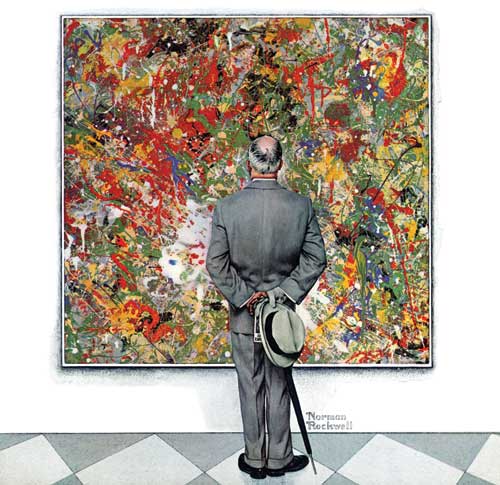
One afternoon in July 1968 Rockwell picked up the phone in his studio and heard a voice at the other end talking intently about mounting a show of his work.
“I’m sorry,” he said, “but I think you have the wrong artist.”
He was speaking to Bernie Danenberg, a young art dealer who was in the process of renovating a space in New York that would open that September. His speciality was established American masters of the 19th and 20th centuries and his personal style was intense. A trim, voluble man in his 30s with oversize glasses, he owned a Bentley convertible (“Ming blue,” as he described it) and was seldom without a cigarette.
The next morning Danenberg drove up to Stockbridge with Larry Casper, the low-key manager of his gallery. Rockwell had instructed them to drive straight to the Red Lion Inn, across from his house, where he stored about a dozen paintings. The arrangement allowed him to minimize interruptions from people who insisted on seeing his work. It was peak vacation season in the Berkshires and tourists in wicker chairs were on the inn’s long porch when the dealers arrived. “The paintings were in there, in that room right by the entranceway,” Casper recalled. “Important pictures were hanging all over the place.”
Using the pay phone in the lobby of the inn, the dealers called Rockwell and said they were across the street. Could they come over and see him? Within a few minutes, they were striding into his red-barn studio. They explored the place as if it represented a never-excavated archaeological site, seeing treasures everywhere.
A small, lovely painting was lying on a table, Lift Up Thine Eyes. Set outside a Gothic church in Manhattan, it portrays a crowd of urbanites rushing by with lowered heads, oblivious to the uplifting message that a young man on a ladder is posting on a sign outside the church. Danenberg offered $2,500 for it. Rockwell told him to just take the painting and he may have actually meant it. “I got paid for it once. I don’t need to be paid again.” He meant he had been paid by The Saturday Evening Post.
Danenberg was persistent, and by the end of the visit, Rockwell had agreed to not only accept a check for Lift Up Thine Eyes but to allow the dealer to schedule an exhibition of his work at the gallery that October.
Rockwell still owned most of his paintings, especially the major ones, and Danenberg needed to figure out which pictures to borrow for the exhibition. Rockwell referred him to the Berkshire Museum in Pittsfield, where he kept a few dozen works. Then he made a phone call to Stuart Henry, the museum’s director. “I have a misguided art dealer here who thinks I am an artist,” Rockwell said in his deep voice. “Humor him. Open the museum.”
To read the rest of the article, excerpted from American Mirror: The Life and Art of Norman Rockwell by Deborah Solomon, pick up the Jan/Feb 2014 issue of The Saturday Evening Post on newsstands, or:
Purchase the digital edition for your iPad, Nook, or Android tablet:

Subscribe to the print edition of The Saturday Evening Post:

The Homecoming
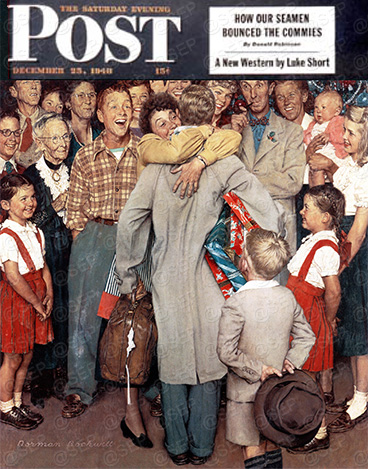
The Homecoming Norman Rockwell December 25, 1948
Parents will tell you nothing makes holidays more enjoyable than visits from their grown-up children. In 1948, Rockwell created his vision of a happy Christmas reunion by gathering all three of his boys in a single painting. We see the back of his oldest son, Jerry, receiving a joyful hug from his mother, Mary. To the left of Mary, in a plaid shirt, is son Tommy. Youngest son, Peter, appears on the far left wearing glasses. To Mary’s right, with that ubiquitous pipe, is happy Dad, who occasionally made cameo appearances in his paintings.
To make this scene of the homecoming even more joyous, Rockwell added friends and neighbors from his community in Arlington, Vermont. Many of these people appeared on other Rockwell covers, like the little boy holding the hat, who was the main character in Rockwell’s A Day in the Life of a Boy. Rockwell also used the boy’s baby sitter—the blonde girl on the far right—and his mother and baby brother, who was dressed in a pink sweater. The little girls in red jumpers are actually one girl—the daughter of Rockwell’s doctor—who was so cute, he painted her as twins.
Rockwell’s good friend and fellow Post artist, Mead Schaeffer, is at the very top left. His daughters, who posed for Rockwell are also shown: blonde Lee is just left of Norman, redheaded Patty, stands to the right of Tommy. And what family gathering is complete without a grandmother? Happy to pose for the role was none other than Grandma Moses, who started painting at 67. “When I knew her,” Rockwell wrote, “she was over 85 years old, a spry, white-haired little woman. Like a lively sparrow.”
Rockwell chose his subjects carefully. He wanted to create a scene both familiar and poignant, one that would resonate with families who had known recent (and lengthy) wartime separations. Even today, Rockwell’s homecoming evokes the spirit of welcome we’d like to see waiting for us when we come home for the holidays.
Readers’ Favorite Rockwells
We want to hear about your favorite covers from The Saturday Evening Post, whether illustrated by Norman Rockwell or another Post artist. This week we’re reviewing Rockwell favorites from readers and our own staff.
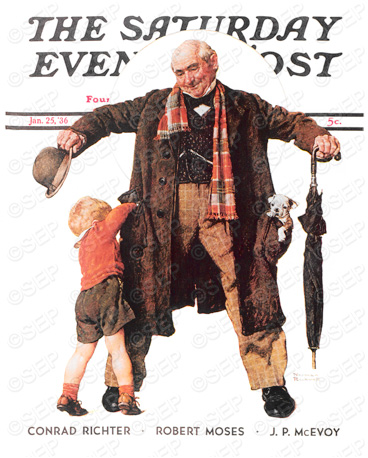
The Gift
Norman Rockwell
January 25, 1936
Helen Palmquist of Lincolnshire, Illinois, went right for a fun one: “My favorite is the little boy looking in Grandpa’s overcoat, not realizing a puppy is in the other pocket.” Rockwell had his beloved Uncle Gil in mind when he created this 1936 cover. Uncle Gil was something of a scientist and inventor, Rockwell wrote in My Life as an Illustrator. “But he did have one eccentricity, he got his holidays mixed up. On Christmas day, with snow on the ground and a cold wind in the trees, Uncle Gil would arrive loaded with firecrackers to celebrate the Fourth of July. On Easter he would bring us Christmas gifts.
“He always had a kind of Christmas spirit about him—jovial, warmhearted, shouting, ‘Warm, Norman, warm!’ as I approached a hidden present and ‘Hurrah!’ when I found it. … I don’t think I have ever enjoyed any gifts as much as I used to Uncle Gil’s.”
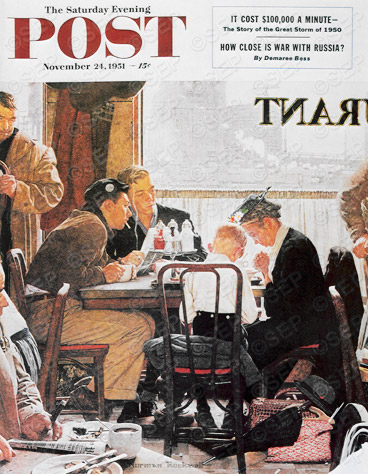
Saying Grace
Norman Rockwell
November 24, 1951
Saying Grace is the favorite of Nicole Beer from our staff in Indianapolis, Indiana. “It reminds me of my grandmother even down to the way Rockwell painted the lady’s hands. I remember being a kid and always praying in public with her before we ate. Everyone would always stare at us and it would make me embarrassed. I hated it as a kid but as an adult, I am so thankful for her and the example she set. I can only hope I am as bold with my faith as she was.”
Saying Grace has an interesting history. Click here to read about which of Rockwell’s sons appears in this illustration and how fellow Post artist George Hughes’ discouragement drove Rockwell to complete this painting.
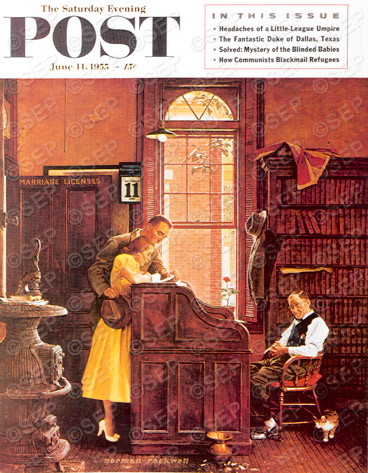
The Marriage License
Norman Rockwell
June 11, 1955
“There is only one that stands head and shoulders above the rest in terms of sheer beauty and deep meaning—The Marriage License,” writes Barbie Thompson of Calgary, Alberta.
“Manning this department, no doubt years before these two lovebirds were even born,” writes Barbie of the elderly clerk, “[he] has seen it all and therefore knows this path all too well—the Good and the Bad, the Happy and Not-So-Happy Endings. The only personal warmth for him now comes from his kitty, those well-smoked cigarettes, and the well-chewed loose tobacco targeted to the spittoon, and the slow-burning, unseen embers from that ancient cast-iron stove.”
Barbie may be more right in that last sentence than she knows. Anne Braman, daughter-in-law of the gentleman who posed as the clerk, wrote in a 1976 Post article that her mother-in law had died the year The Marriage License was painted.
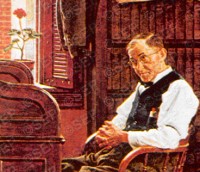
Close-up of elderly clerk.
“Mr. Rockwell—knowing my father-in-law Jason C. Braman—realized how upset he was, and he thought if he could get him to model it would give him something new to think about.”
Rockwell was right about the new activity having a therapeutic effect on the widower, wrote Anne, “As soon as the The Marriage License appeared on the cover of the Post, people recognized him immediately. When his friends commented to him about the cover, he would say, ‘Would you like for me to autograph your copy?’ And he would. When I told Mr. Rockwell about this, he was quite amused.”
[Anne Braman modeled for Rockwell as the schoolteacher in the 1956 cover Happy Birthday Mrs. Jones. Read more about her here.]
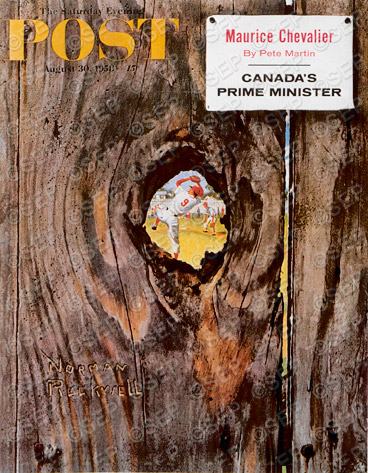
Knothole Baseball
Norman Rockwell
August 30, 2958
“I love all baseball covers, but I find this one particularly interesting,” writes Cris Piquinela one of our Post staffers.
“First off, I don’t think most people looking at this cover would think it is a Rockwell. There are no children or people visible, no characteristic facial expressions. However, what I like about this cover is that it forces me to ‘create’ or imagine the scene in my head. I can’t see the person looking through the hole, but I imagine a freckled, redheaded, barefoot kid. At the same time, I can sense the excitement of the pitch, a great hit by the player at bat, and the entire crowd going crazy. This cover does not tell me what I am looking at … it forces me to imagine it. Plus, I love only having a small piece of the image shown to me.”
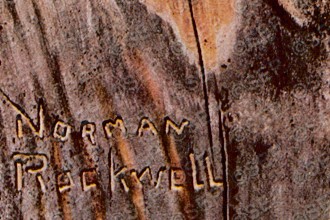
Rockwell’s carved signature.
It is also interesting to note the way Rockwell “carved” his signature in the painting.
A special thank you to readers (and Post staff) for telling us about your favorite Rockwell covers!
Visit our online gallery to review Post covers by your favorite artist.
Coming soon in our Readers’ Favorites series: readers’ favorite covers from Rockwell’s neighbor, friend, and fellow Post artist George Hughes. If you have a favorite George Hughes cover (and there are 115 to choose from) we’ll be glad to feature it.
View covers by George Hughes here, then email us your name, along with the title and date or just a good description of your favorite piece at [email protected].
Rockwell’s Favorite Model, Part III
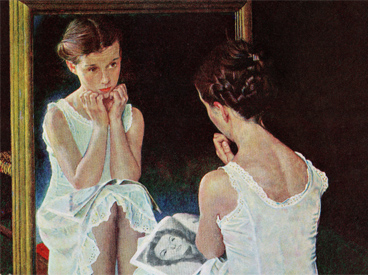
March 6, 1954
“He is a genius with a childlike heart, a man who leaves a lasting imprint on people as well as on canvas,” Mary Whalen Leonard told the Post in 1976. We spoke with her again recently to ask about one of Norman Rockwell’s most respected paintings—and about the artist himself.
Mary’s pose seems “apprehensive, as if she understands that womanhood is upon her and fears that she is not quite ready,” writes art expert Karal Ann Marling in her 1997 book, Norman Rockwell. However, young Mary didn’t have a clue.
“I was only in fifth or in sixth grade, and I wasn’t a kid who was at all interested in growing up. I was just having a good time,” Mary says.
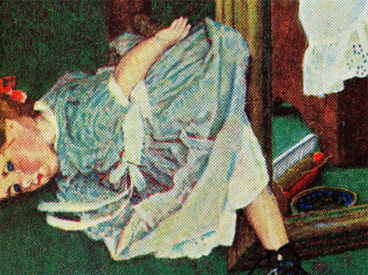
He tried to explain the concept behind the forgotten doll: “You’ve tossed away your doll—you no longer play with dolls.” But Mary, who describes her younger self as a tomboy, says, chuckling, “I was saying to myself, ‘Yeah, I never did that anyway.’”
Rockwell knew that Mary wasn’t grasping the idea, so he tried again, “Now, Mary, don’t you ever stand in front of a mirror and wonder what a beautiful woman you’re going to be? I can remember standing in front of a mirror, combing my hair, wondering how handsome I was going to be.”
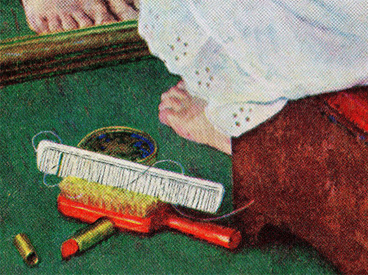
“And quite honestly,” she laughs, “that didn’t make any sense to me because Norman wasn’t handsome! So I didn’t relate to that. I mean I couldn’t get into it. So I think he just told me to think about being a beautiful woman and what I might do with my life. But it did not connect with me.”
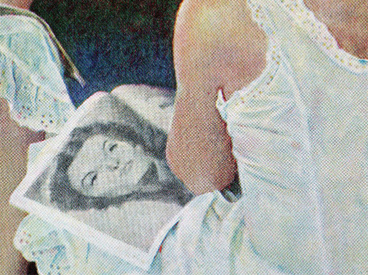
Mary tells us Rockwell felt he had made a mistake including the magazine featuring sexy movie star Jane Russell. “He regretted it deeply. Norman got a lot of criticism—remember this was in the ’50s—that said, ‘Is that all a little girl can dream about is becoming a movie star?’”
“I should not have added the photograph of the movie star,” Rockwell later said in Marling’s book, “the little girl is not wondering if she looks like the star but just trying to estimate her own charms.”
In what would become one of his most respected paintings, Rockwell captured the poignancy and uncertainty of growing up despite the fact that Mary “had no idea what he was talking about.” For decades critics had dismissed Rockwell as simply a popular commercial illustrator. Today, many have concluded that some of his works, however, transcend freckle-faced boys at the ole swimmin’ hole and secure his standing today as a true artist. Girl at the Mirror is such a painting.
Mary, who describes this painting as “very different than most of Rockwell’s covers,” compares the subtle use of color and lighting with another of Rockwell’s finest works. “In The Marriage License,” she explains, “you think you’re going to concentrate on the couple getting their license, but really what you find yourself looking at and being drawn into is the sweet, dear man [the elderly clerk]. Because that’s where the light is, on his face.”
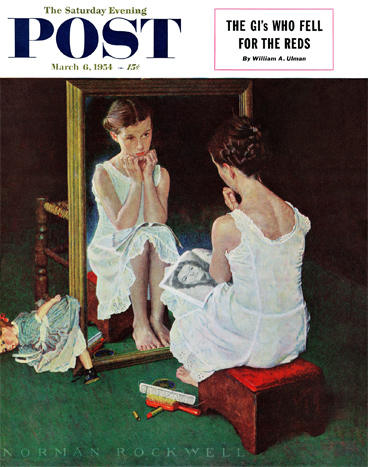
March 6, 1954
By the time Girl at the Mirror was published, Rockwell had moved from Vermont to Stockbridge, Massachusetts. “He wrote me a little note and told me it was going to come out. He sent me a photograph I posed for.”
Mary never knew why Rockwell called her his favorite model, but he had quickly become one of her favorite people. “I kept in touch with him until he died. He always sent me a little note at Christmas time and told me he missed me.”
See Mary today as she talks about the artist in this video, courtesy of the Norman Rockwell Museum.
Rockwell’s Favorite Model, Part II
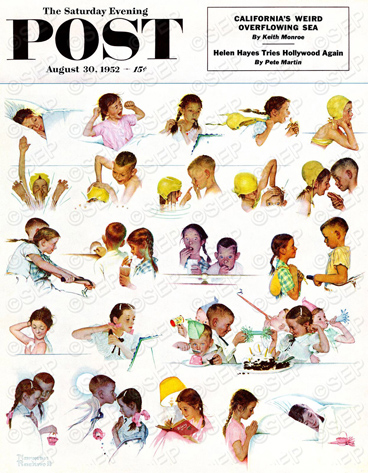
Day in the Life of a Girl
Norman Rockwell
August 30, 1952
Rockwell said he enjoyed working with 9-year-old Mary Whalen, who “could look sad one minute, jolly the next, and raise her eyebrows until they almost jumped over her head.”
“He was very inclusive; he wasn’t authoritarian, telling me what to do,” Mary says. “It was, ‘OK, this is what we’re going to do today.’ He would act it out for me.
“I was reserved and he would just sort of pull [the expressions] out of me by laughing or clapping or stomping his feet or jumping up and down and making me laugh, that kind of thing. And I just felt such a part of what was happening. As a kid, I liked to be a part of something. He knew what he wanted and he knew how to get that out of you. And then when he got [the right expression], he would just shout, ‘Oh, that’s wonderful! That’s wonderful!’”
For the 1952 cover, A Day in the Life of a Girl, Mary gave Rockwell over 20 wonderful expressions.

“It took a week,” Mary tells us, to shoot all the scenes for the 1952 cover. Beginning with getting out of bed, A Day in the Life of a Girl is done sequentially, like a movie reel. Photographer Gene Pelham took dozens of shots, as the artist posed his models.
“When I posed for A Day in the Life of a Girl,” Mary tells us, “I got up early, my mother combed my hair, did my braids, and off we went [to Rockwell’s studio].” The first thing Rockwell said to them was, “We’re going to mess up Mary’s hair,” and with that he tousled her tidy braids.
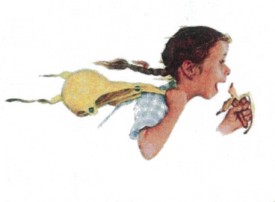
The first six scenes were completed that first day. For this flying out the door on her way to go swimming look, her mother had to hold her pigtails back, while someone else pulled back her swimming cap. When the angles were just right, “Rockwell would yell, ‘Get it!’” Mary says, and Pelham would snap away.
The scene below depicts the old story: Boy meets girl, boy tries to drown girl, spunky girl bawls him out, and then gives him a taste of his own medicine. Ah, young love!
The boy in the love story is Chuck Marsh, another model with a wonderfully expressive face. He was in the earlier Rockwell cover, A Day in the Life of a Boy.
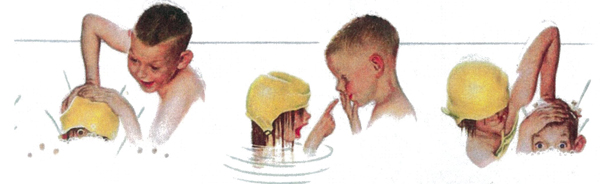
In real life, Mary tells us, she and Chuck never posed in a pool—it was all done in the studio. And when we asked about the dripping wet hair, Mary gave us a glimpse into the glamorous world of modeling: “They poured a bowl of water on me.”
The kids never pushed each other’s heads down either. “We used a bronze bust to lean on … to get the elbow right,” Mary reveals, then adds, “I went to the Rockwell Museum three or four years ago, and they still had that bust in his studio!”
[You can tour the artist’s studio at The Norman Rockwell Museum in Stockbridge, Massachusetts, or take the online tour here.]
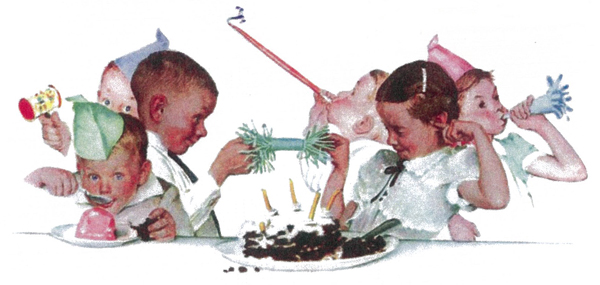
Gradually, boy and girl become friends, go for a bike ride and a movie, and then we find them at a birthday party. In this scene, Mary is wearing a party dress Rockwell bought for her. But what sounds like an act of kindness was most likely the artist’s insistence on just the right details. As an example, he shopped several furniture stores for the exact chair he wanted for his delightful Easter Morning cover from 1959.
The party scene involved more models, including Mary’s twin brother, Peter; and Chuck Marsh’s little brother, Donnie, whose mission was simply to devour the cake and ice cream. Donnie’s single-mindedness about the treats made for a difficult day’s shoot, Mary recalls.
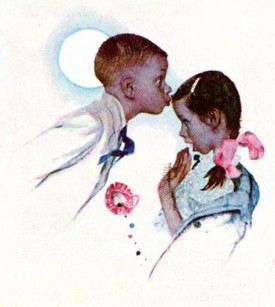
Ten-year-old Chuck Marsh noted that this scene was the “toughest time” he ever had posing. He liked Mary very much, but no how, no way was he going to kiss a girl. “Mr. Rockwell finally gave up trying to get me to kiss her,” he said, and the artist posed the two separately. Getting the smooch just right involved Chuck leaning toward—you guessed it—that bronze bust. Who knew the head of a Classical figure could be so utilitarian?

At the end of this long day, Mary is dressed for bed and writing in her diary, no doubt about that moonlit kiss. And the painting is almost complete.
But there was a problem when Rockwell reached his final scene. With the deadline almost upon him, he remembered the many complaints he had received about one aspect of A Day in the Life of a Boy—before retiring for the night, the boy did not say his prayers. So Rockwell called the Whalens and said, “You’ve got to get Mary down here!”
Because the prayer scene was added, another scene was taken out, Mary tells us. Deleted was a charming scene of Mary and Chuck smiling and thanking their hostess (the birthday girl in the pink hat in the party scene above). But the day is done, bedtime prayers said, and Mary drifts off to sleep with a smile on her face and a party favor beside her.
Previous: Rockwell’s Favorite Model
Next: The third and final installment of Rockwell’s Favorite Model, featuring a coming-of-age cover many feel is one of the artist’s finest works.
Classic Art: Growing Up with Rockwell
Melinda Pelham Murphy, a daughter of Norman Rockwell’s photographer Gene Pelham, grew up around Rockwell’s studio. She talks about being a Rockwell model and the artist’s famous chair and offers a fond remembrance of Rockwell’s wife.
The Babysitter
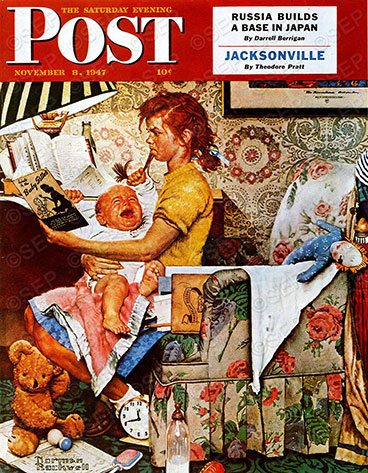
The Babysitter
Norman Rockwell
November 8, 1947
We would like to say that no babies were harmed in the making of this classic Rockwell cover, but the baby may disagree. During Melinda’s first modeling job, as the crying infant in The Babysitter, the artist and photographer couldn’t get her to cry, so someone stuck her foot with a pin. “My mother told me she always felt terrible about that, but it was what it was.”
“Obviously I was too small to remember anything,” she says. “But somewhere I have a photograph of me that Dad took … and I can see my mother’s image. She’s standing and I’m looking at her, and I am sort of looking sad like, ‘Oh, help me!’” Like many illustrators of the period, Rockwell began by painting live models. But around the mid 1930s, he used photography to capture the scene he would sketch out for a painting, calling the model back if necessary.
The Babysitter shows Rockwell’s ability to capture a dizzying array of details, making it one of those paintings where viewers may pick up something new each time they look at it. And still Melinda brought a fresh detail to our attention: “There’s a pin, an actual pin in the painting. The pin is in the diaper that’s hanging over the chair. He put it right through the canvas, he didn’t paint that in there.” It’s a delightful bit of Rockwell whimsy we were unaware of. Melinda has another viewpoint: “When I found out that I was stuck by a pin and I look at that painting, I wonder if that was the pin that did the deed and then he put it in the picture,” she says, laughing.
Despite the prickly offense, Melinda has a good sense of humor about the situation. In fact, she says she (along with the model baby sitter, Lucille Towne Holton) got involved in keeping the painting where the artist wanted it to be. Rockwell gave the original to the sixth graders of Taft Elementary in Burlington, Vermont, in memory of a student who died of leukemia. The school closed in 1978, and the painting was stored in a local bank. In 1995 appraisers determined it would be worth about $300,000. This was welcome news to the cash-strapped school system, which considered an auction. Former classmates protested and were offered an alternative: raise $300,000 and the painting would remain in town. Many townspeople got involved, and Melinda reports, “We raised the funds and it stays forevermore! It’s at the Fleming Museum; and every time my granddaughter goes there, she says, ‘That’s my grandmother!’ She gets a kick out of it.”
Rockwell Ads
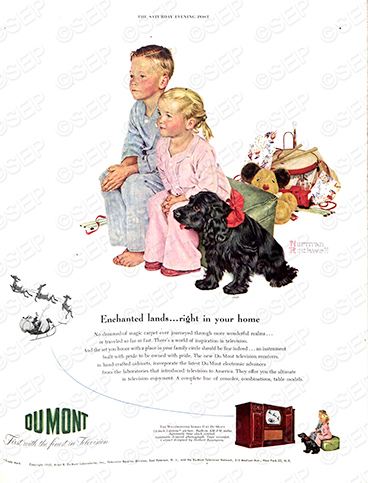
Du Mont TV Ad
Norman Rockwell
December 9, 1950
We first saw Melinda on a recent episode of Antiques Roadshow, where she was having Rockwell artifacts appraised, including a print of this 1950 Du Mont TV ad featuring her at about age 5. The print was accompanied by a note addressed to her father: “…to reimburse your daughter for the long session of posing. Give her my thanks for helping me out. Sincerely, Norman.” We called to ask her about her memories of the artist.
“I do remember him! I remember very well,” Melinda says, although she was only about 5 or 6 when he moved away from her small town in Vermont. “My sister always says to me, ‘I don’t know how you remember all that, I don’t remember these things.’ Maybe I just paid more attention or maybe I just have a different brain. And my sister didn’t pose for him that often.”
What she remembers was a kind man with a fondness for Cokes. This was a treat because soft drinks were limited to “special occasions” at home. But Rockwell had a Coke machine and the models could help themselves on breaks.
Melinda also recalls that Rockwell was particular about the pose he wanted for this ad. “He was very detailed in the way he wanted you to sit,” she says. And sit she did, for 15 hours. The time “would be broken up,” Melinda says, “so he might be working with the boy or the dog, and they didn’t need me” for a while. She remembers the artist’s wife Mary Rockwell who “would take me into the house so I wasn’t just sitting in the studio all that time. She was great about leaping into the breach. I can remember getting a dish of ice cream.”
“It was a long day,” Melinda says, “but Mary took me on a walk. I remember we walked down the back road, and it was a dirt road that ran along the river. And I remember picking ferns with her and then we went back to her garden and got some zinnias.” Melinda’s mother was laid up with an injury at this time, “and I brought her home this bouquet of flowers that Mary had ‘helped’ me put together. She did it all herself, I was very small, but I remember picking the ferns. She was really very sweet. She was a lovely lady. I have very fond memories of being there as a child.”
Blank Canvas
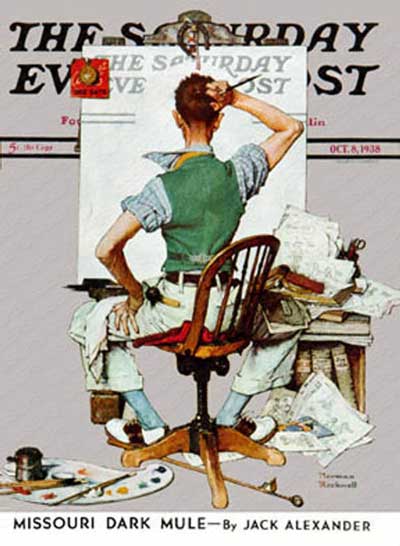
Blank Canvas
Norman Rockwell
October 8, 1938
Painting and drawing appraiser Alasdair Nichol was a bit surprised when Melinda also brought a chair to his table at the Antiques Roadshow, suspecting she had been sent to the wrong area. But when Melinda explained that the chair had belonged to Norman Rockwell and had been depicted in the iconic 1938 cover we see here, he understood. Rockwell’s photographer, Gene Pelham (Melinda’s dad), took the chair after the artist threw it out.
“Dad never threw anything away,” Melinda says. He would salvage discards or “Norman would get these things and say, ‘Here, Gene, take this. I don’t want it.’ Norman was not a hoarder or collector, I don’t think, unless it was something he felt he would need in the long run for paintings—costumes and things.”
But the salvaged chair was special. “To think of the amazing paintings that he did when he was sitting in this chair,” appraiser Nichol said. To see how the cast away chair was evaluated, we have a link to the appraisal, courtesy of the Antiques Roadshow.
Thank you to the Antiques Roadshow for the link to the episode featuring Melinda and to the Norman Rockwell Museum for their assistance in contacting her.