100 Years Ago This Week: Advertisements from December 9, 1916
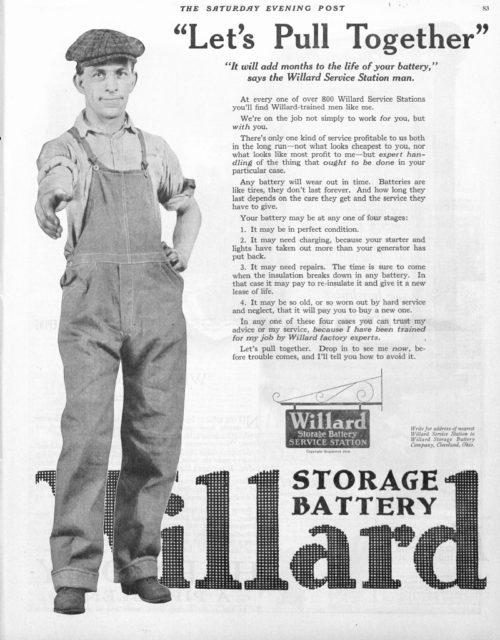
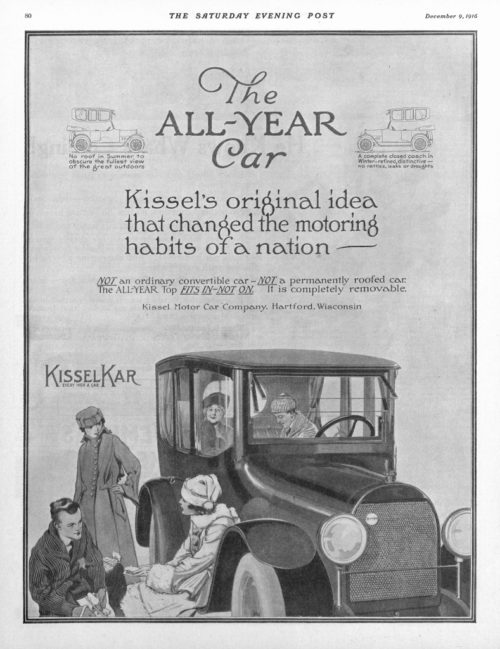
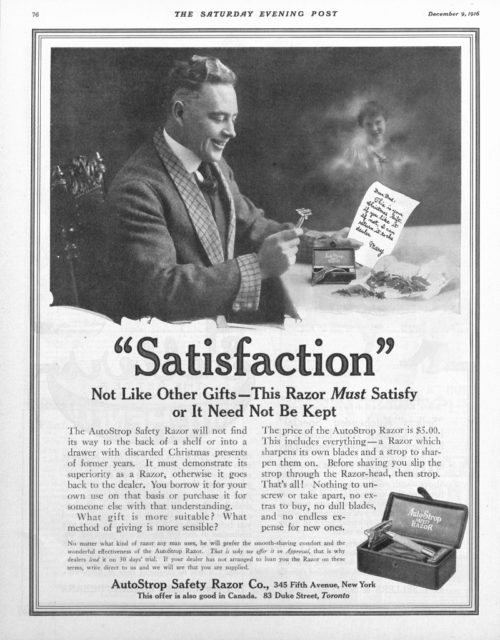
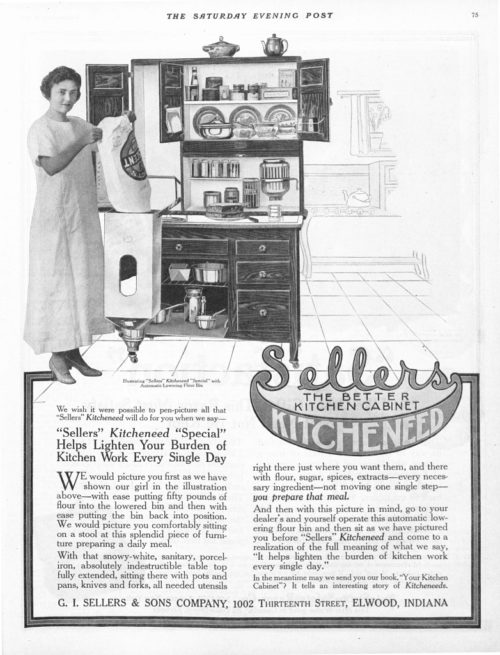
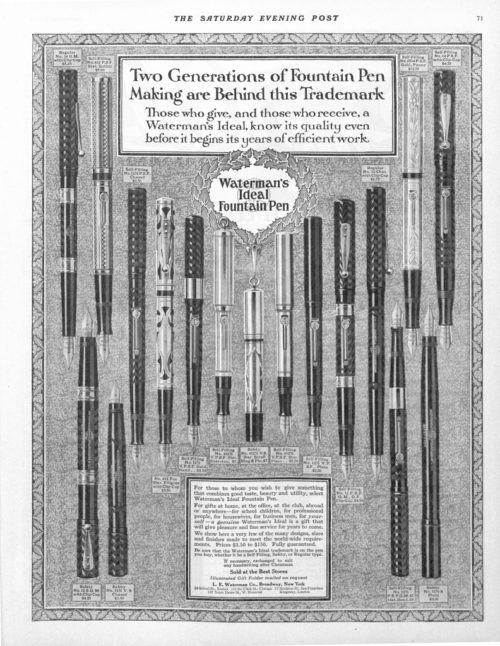
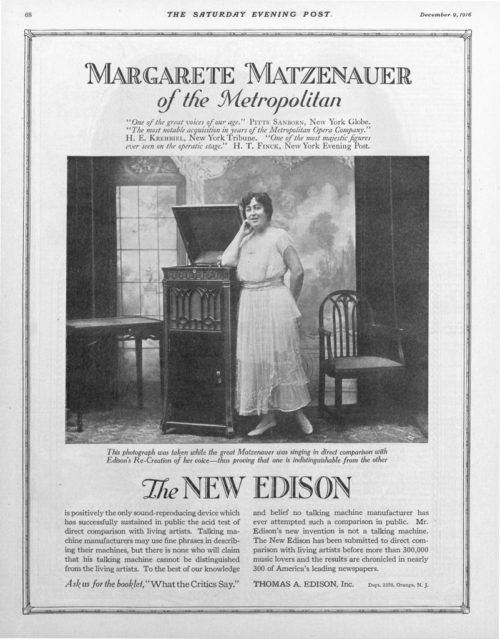
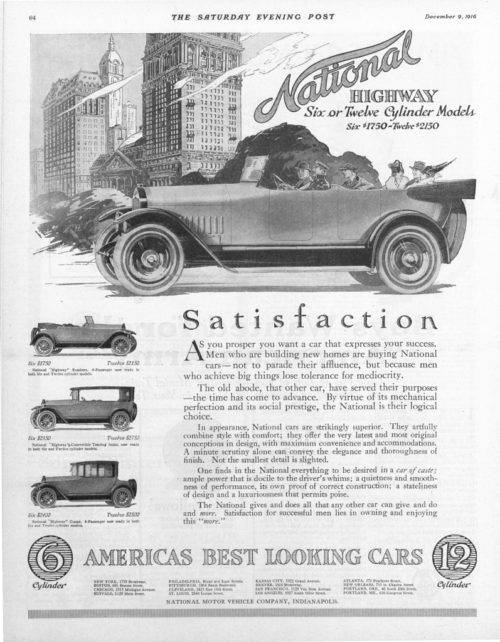
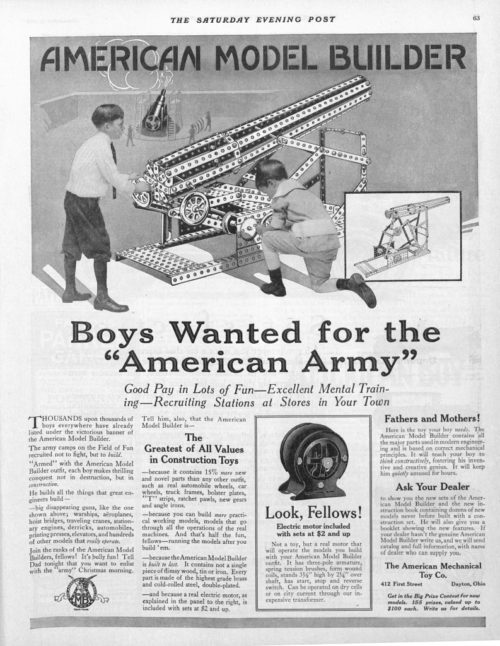
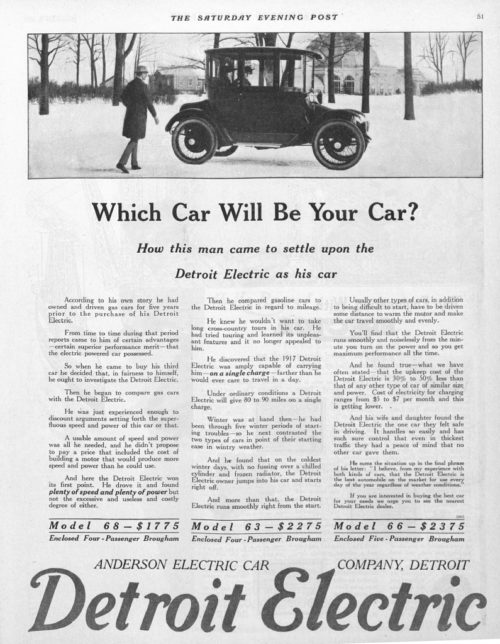
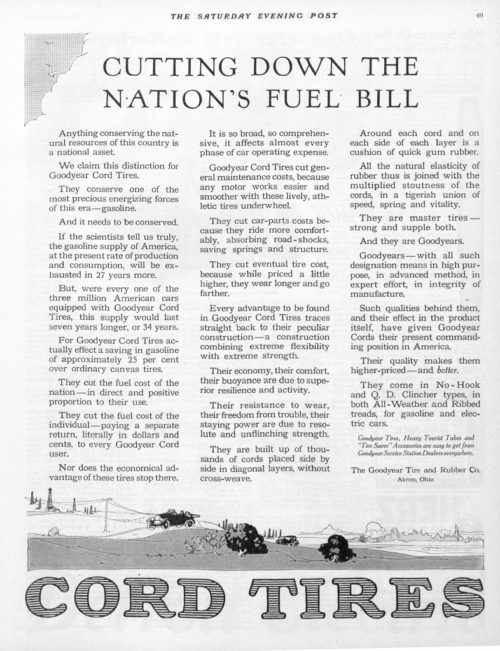
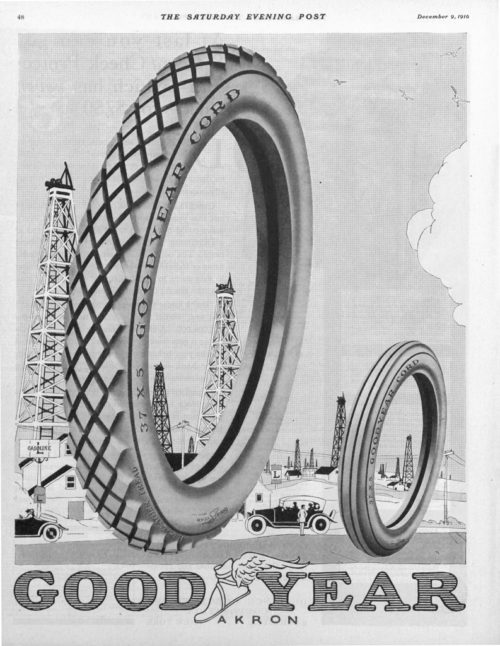
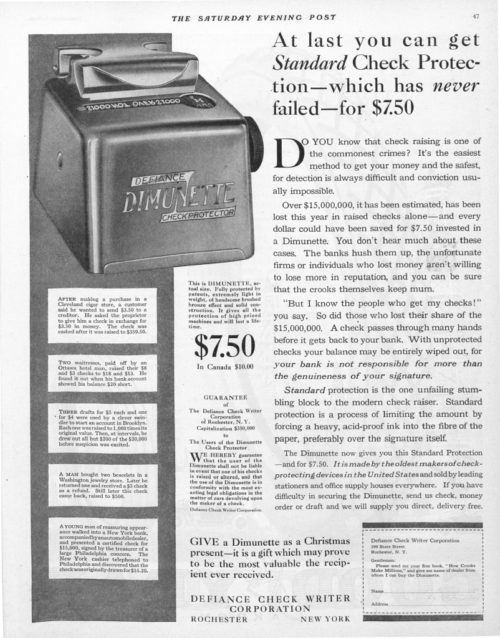
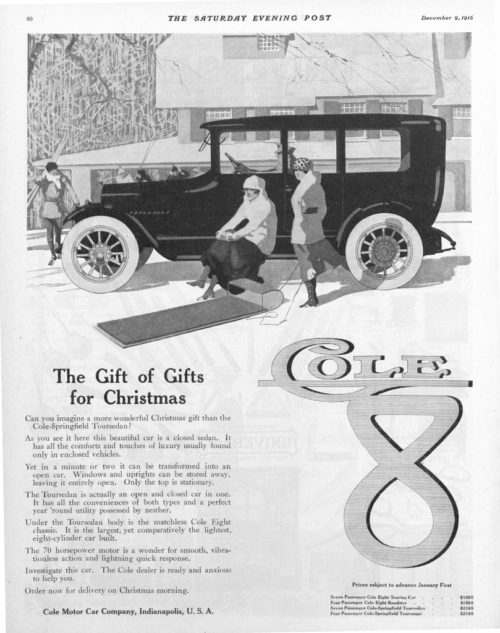
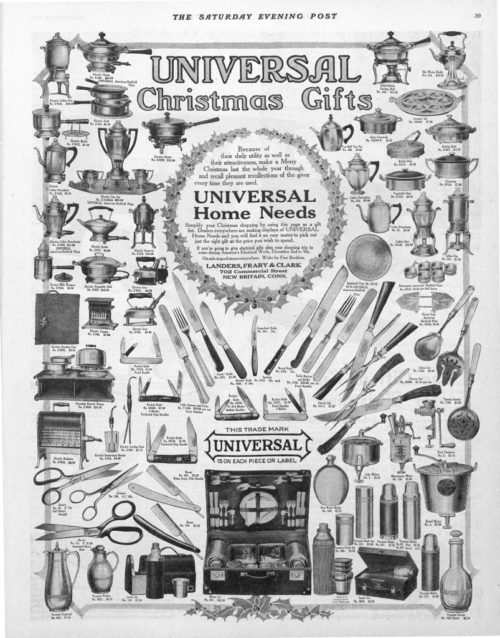
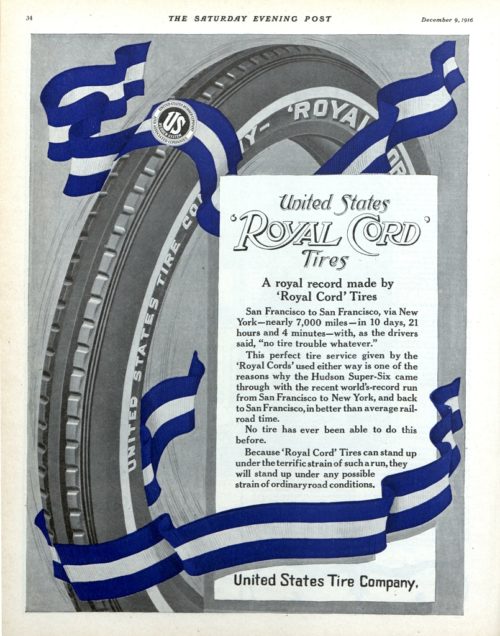
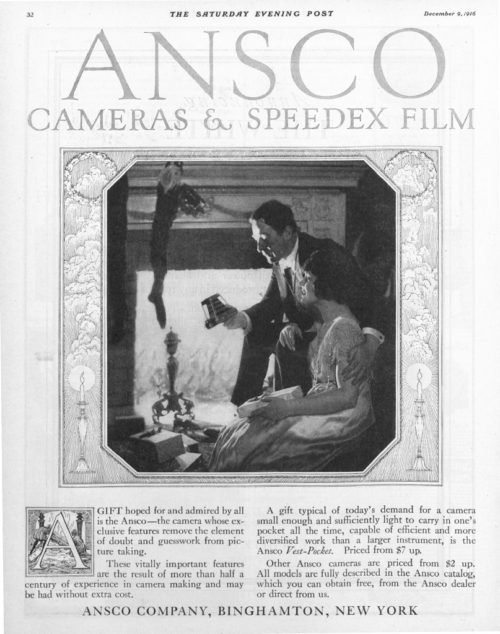
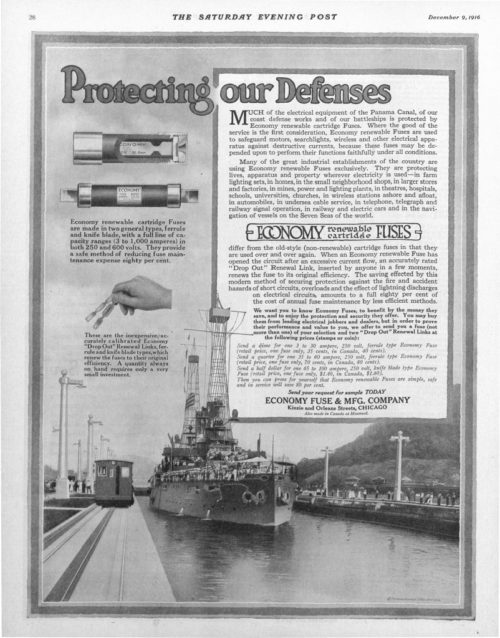
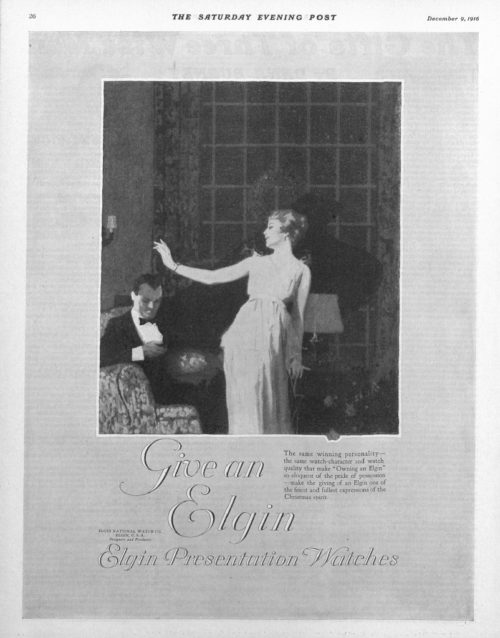
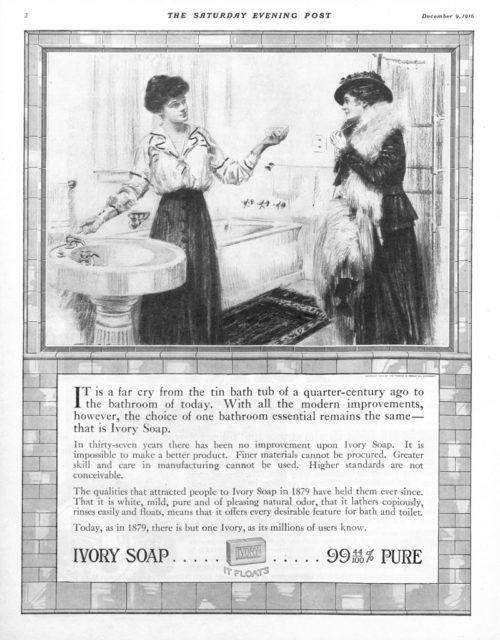
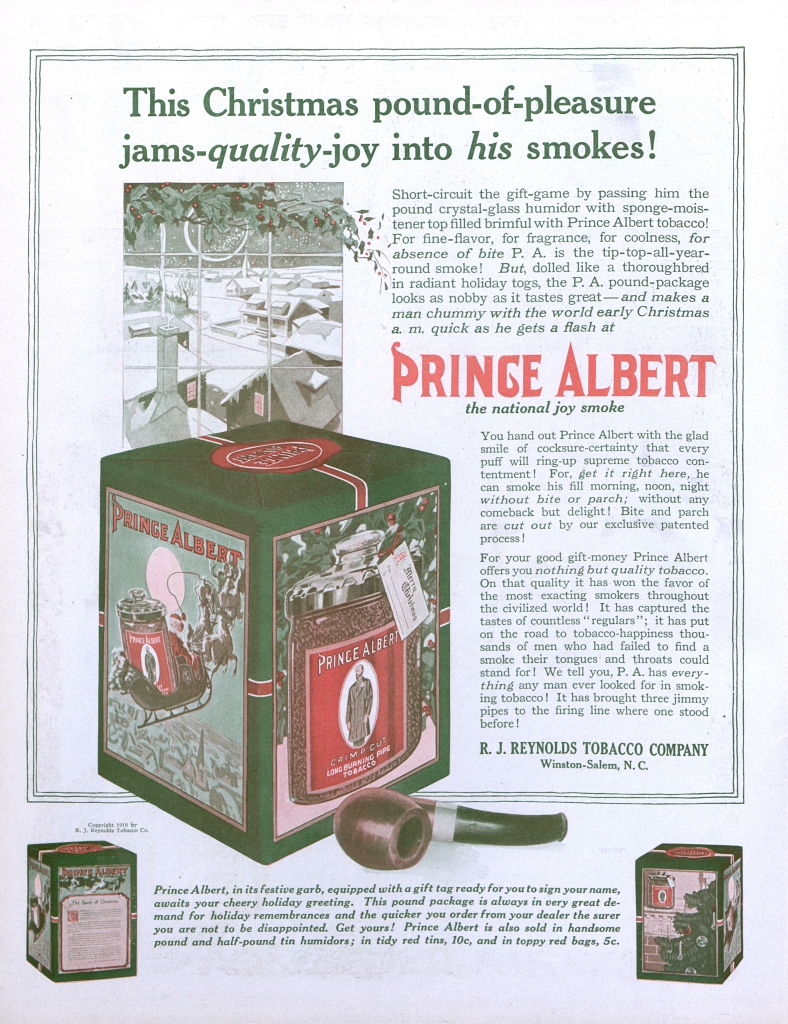
Some things haven’t changed in 100 years – in 1916, people still eagerly shopped for presents. What they shopped for, however, has changed a lot! Go back in time with these ads from the December 1916 issue of the Post.
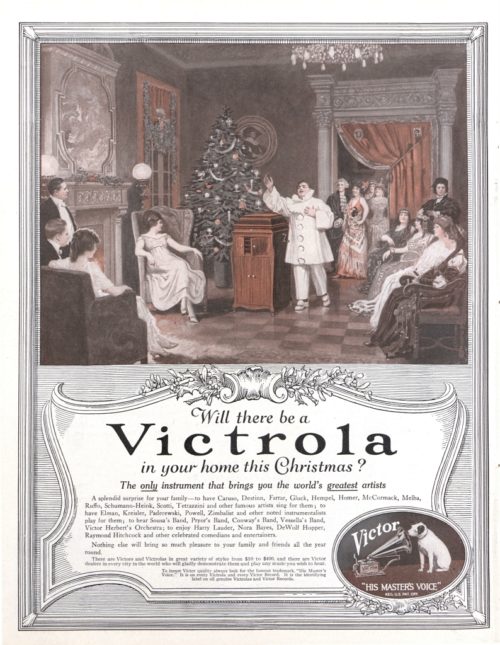
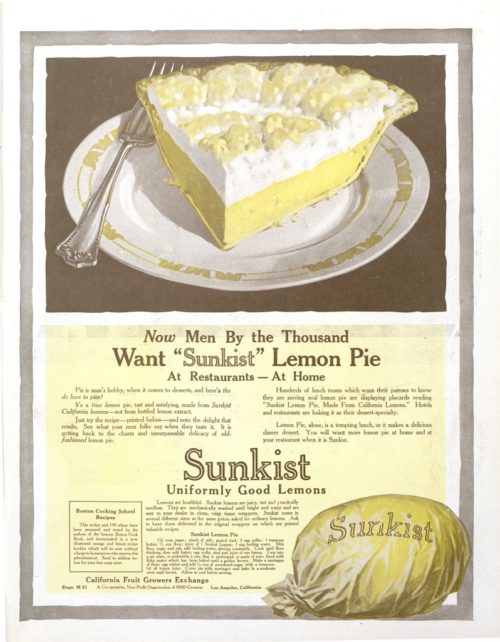
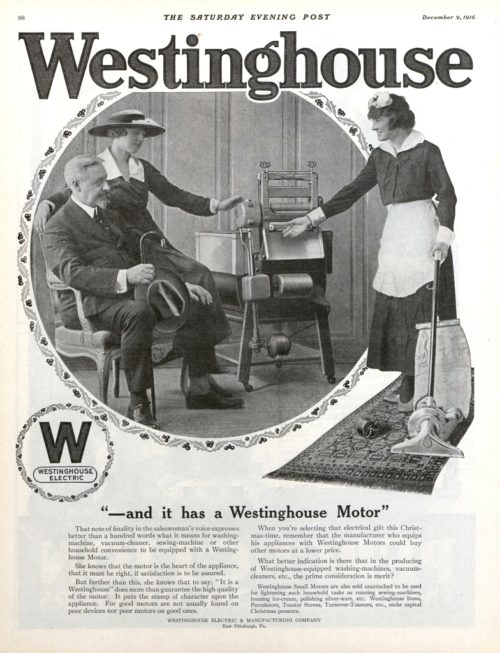
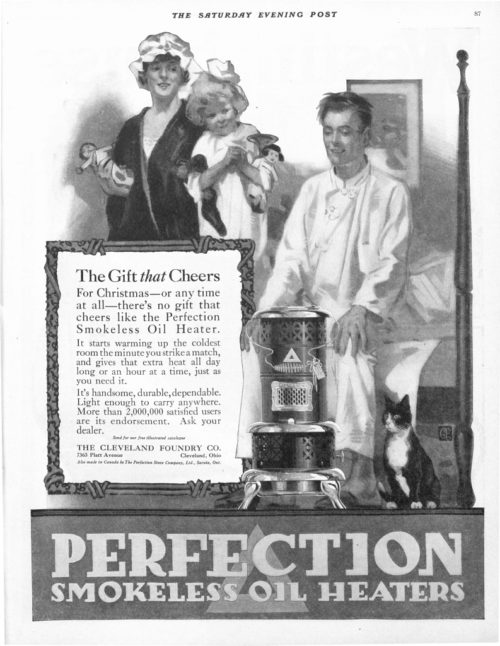
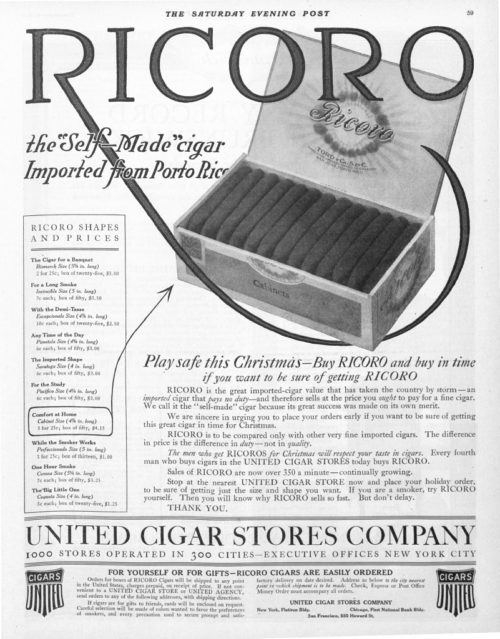
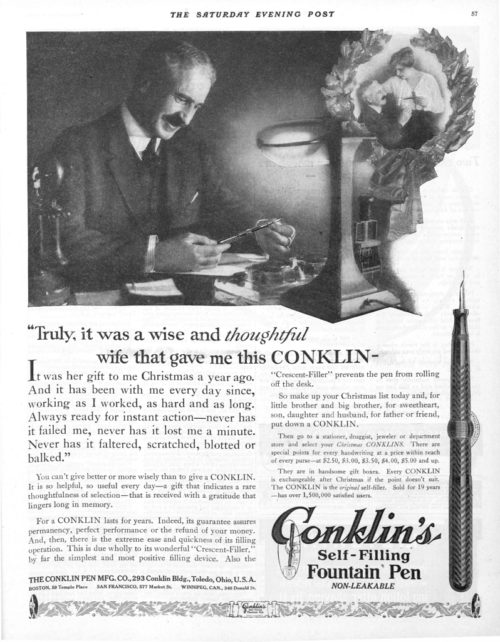
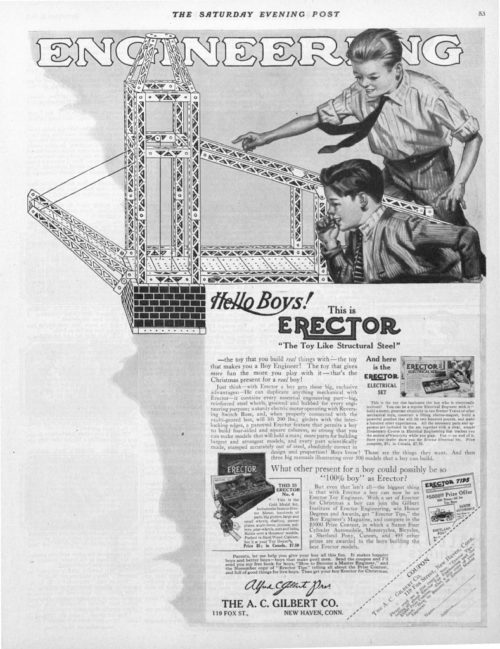
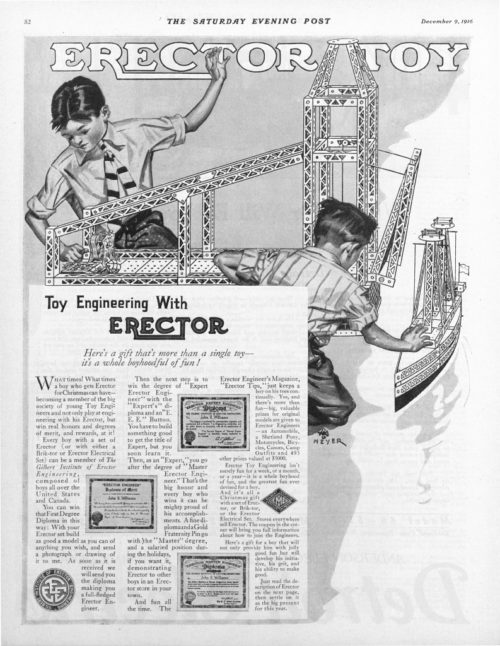
Art Gallery: Holiday Glamour
This holiday season, we bring you 33 portraits of women from the pages of the Post, from 1920s beauties to 1950s fashion plates, all wishing you season’s greetings and winter cheer!
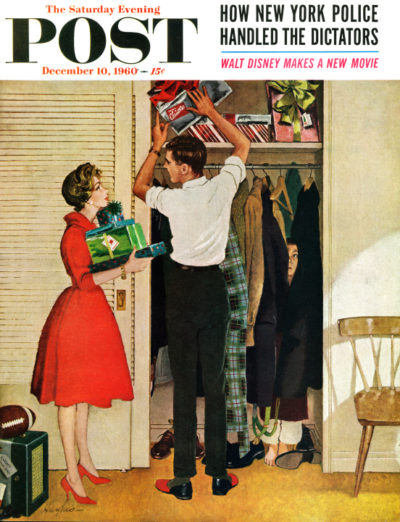
George Hughes
December 10, 1960
Sneaking away while the house is asleep, this couple stashes away their Christmas gifts.
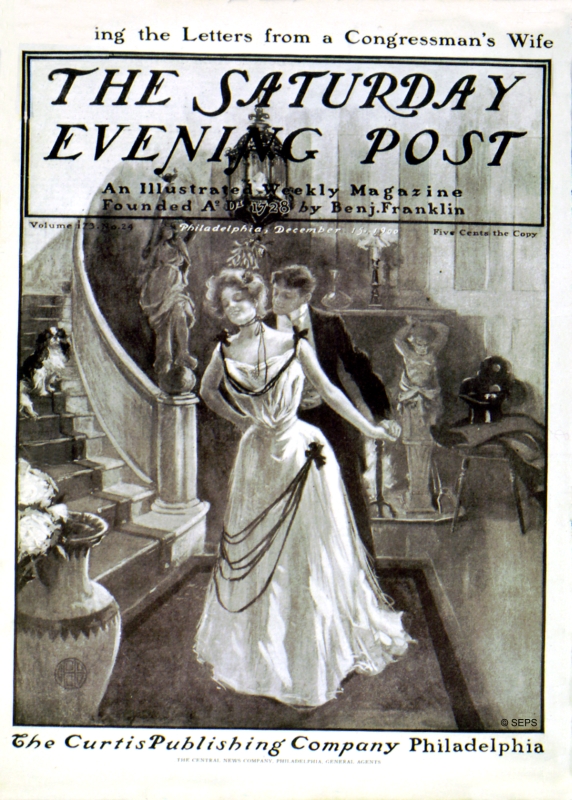
December 15, 1900
Lavish parties and formal garb say sophistication, but this couple whisks each other away to steal a kiss under the mistletoe.
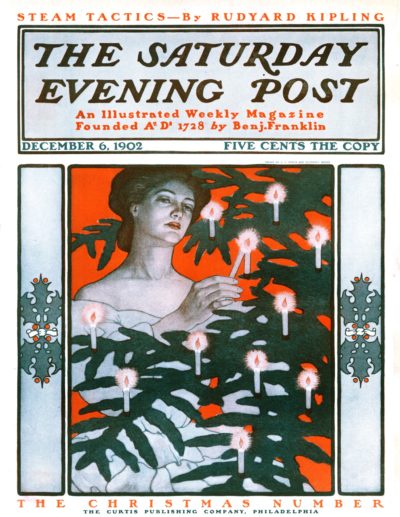
J.J. Gould & Guernsey Moore
December 6, 1902
The warm candlelight from the tree makes this Christmas beauty radiant.
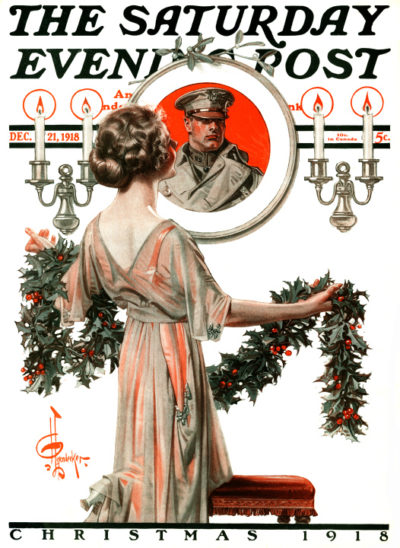
J.C. Leyendecker
December 21, 1918
They may be celebrating the holidays miles apart, he’s still the focal point of her celebration.
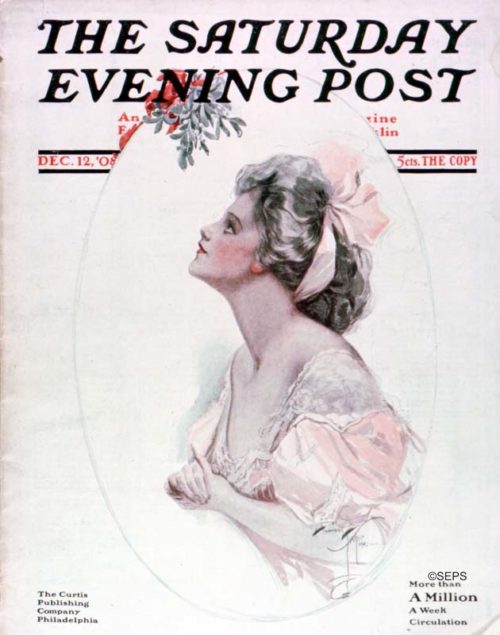
Harrison Fisher
December 12, 1908
This woman hopes for kisses from Christmases future.
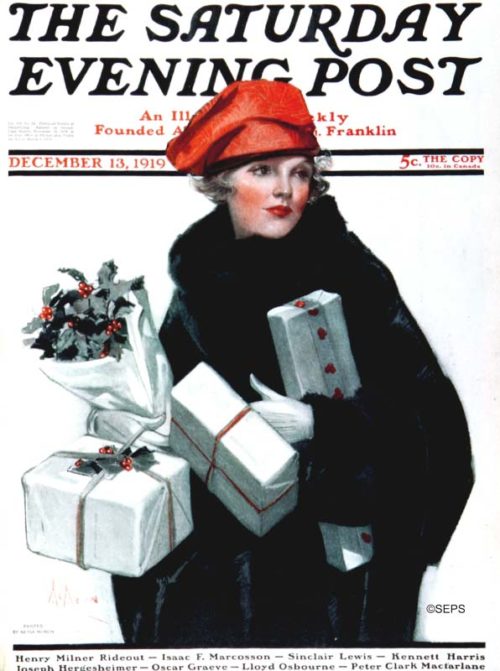
Neysa McMein
December 13,1919
Arms overflowing with parcels and holly, she can’t remember if she bought the pipes for Grandpa Joe.
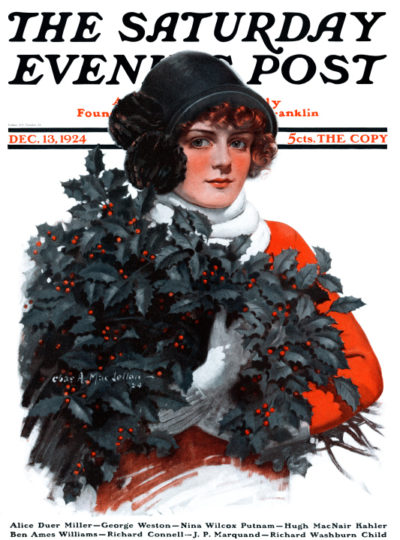
Charles A. MacLellan
December 13, 1924
This merry maid has boughs of holly to spare.
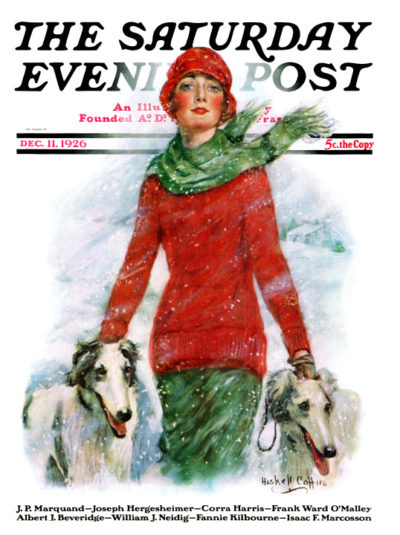
William Haskell Coffin
December 11, 1926
Cheeks chilled to rosy red, there is no better way to enjoy the snow than a stroll with your two best friends.
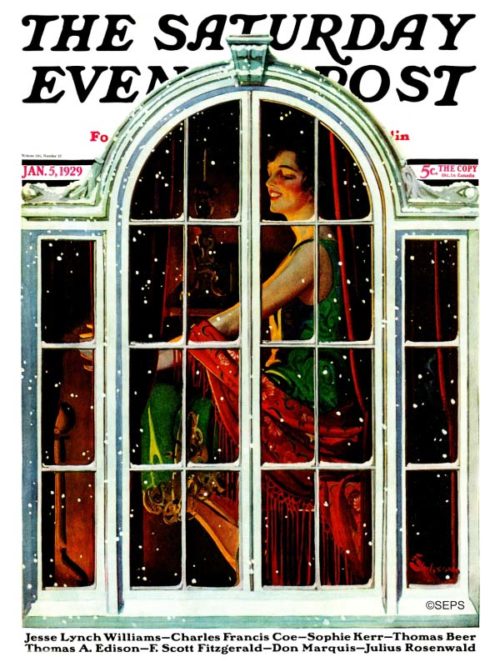
E.M. Jackson
January 5, 1929
This festive flapper is cozy indoors while the snow piles up outside.
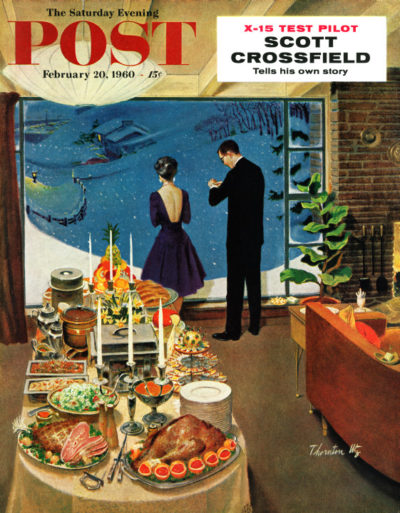
Thornton Utz
February 20, 1960
This hostess awaits her guests on a wintry evening.
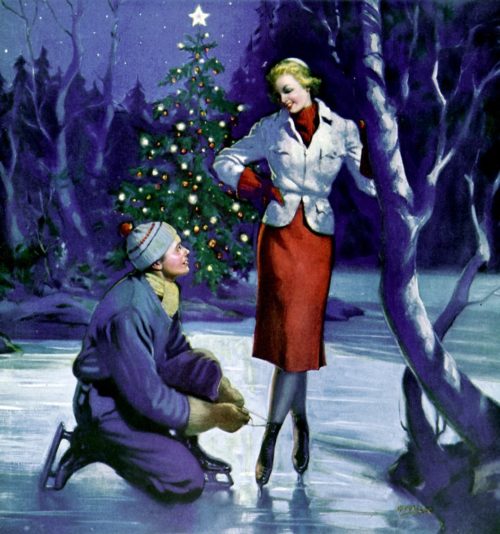
Manning de Villeneuve Lee
December 1, 1937
Late nights in the winter are perfect for ice-skating…and maybe something more.
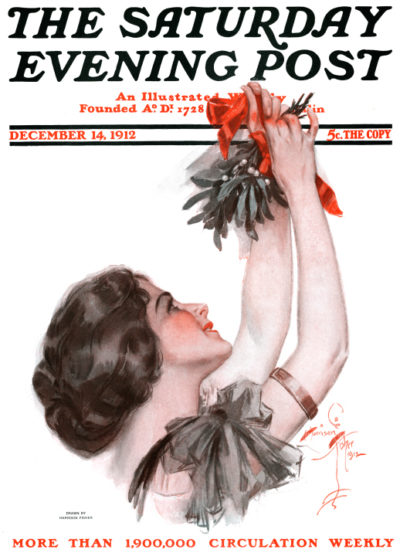
Harrison Fisher
December 14, 1912
This elegant lady puts the finishing touches on the mistletoe.
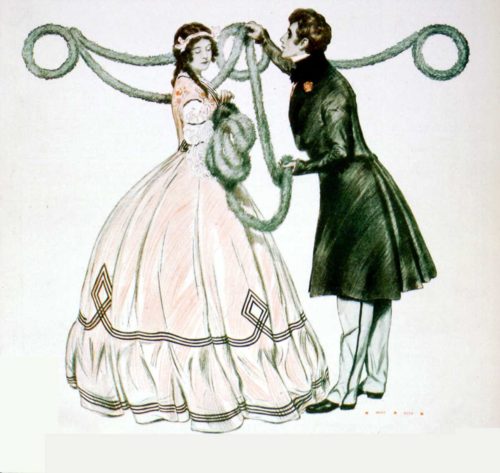
Henry Hutt
December 20, 1902
There’s no better way to get into the holiday spirit than hanging garland with the one you love.
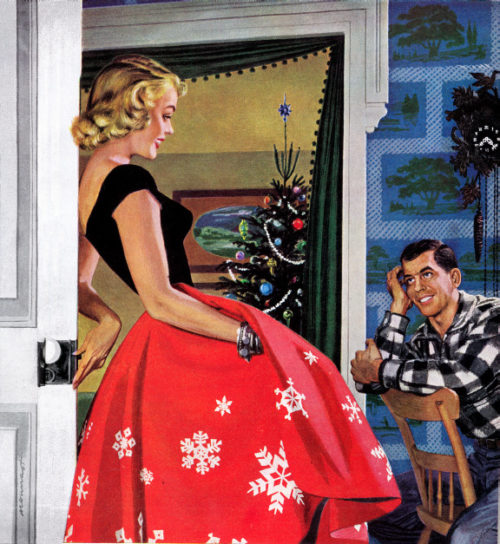
Paul Nonnast
December 01, 1954 (Country Gentleman)
There is no time like the holidays for romance.
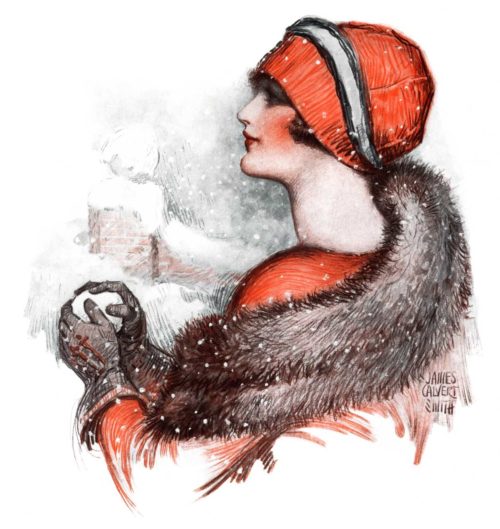
James Calvert Smith
January 17, 1925
This holiday lady is eyeing the next victim of a playful pelting.
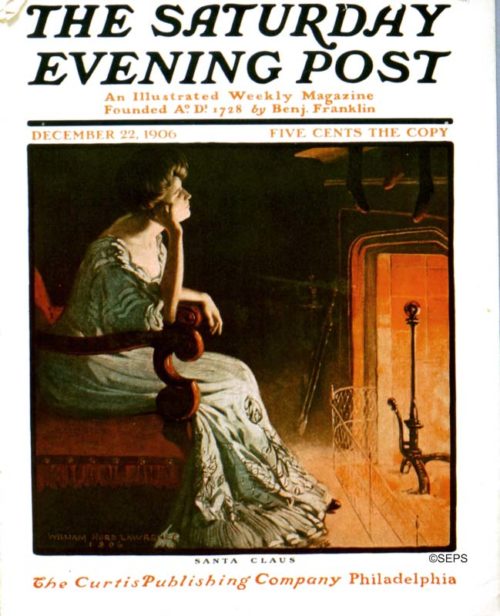
William Hurd Lawrence
December 22, 1906
For some, snuggling up next to hearth and enjoying the solitude is a far better way to spend the holidays.
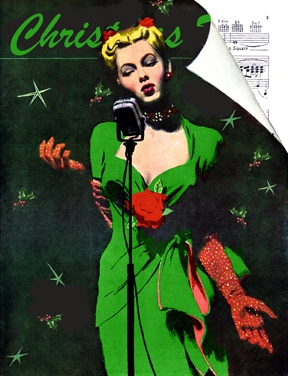
Al Parker
February 03, 1945
With a microphone and her sultry voice, she performs a stunning rendition of “Christmas Time.”
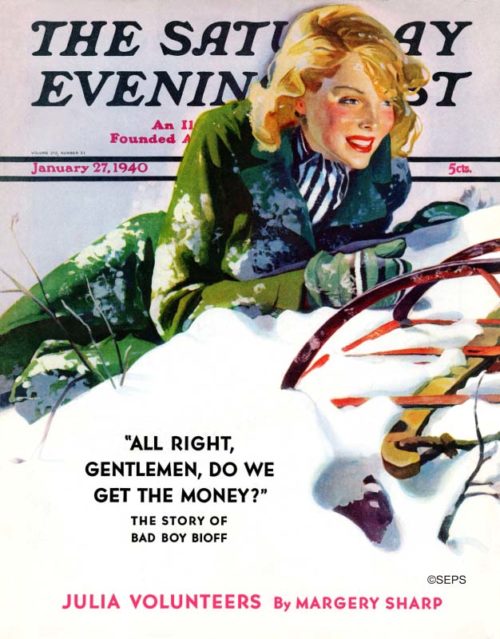
Dominice Cammerota
January 27, 1940
Who said kids get to have all the fun?
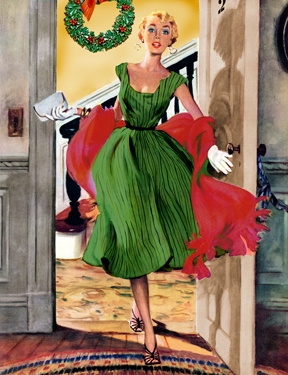
Ernest Chiriaka
February 06, 1954
She’s almost late to her own party!
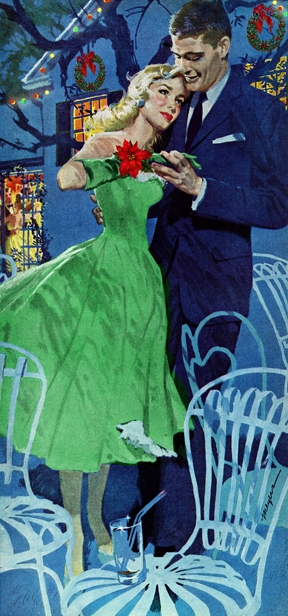
Robert Meyers
April 20, 1957
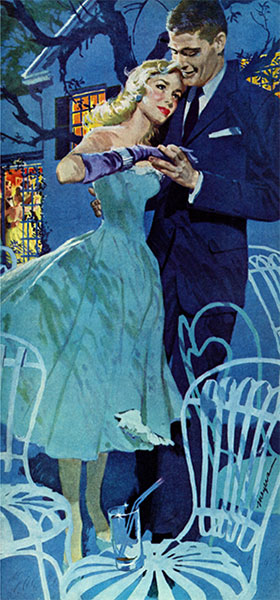
Holiday romance takes the chill out of the coldest nights.
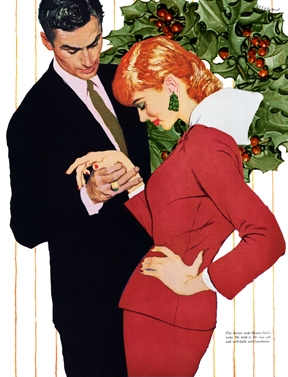
Joe deMers
March 31, 1956
A quiet moment before the whirlwind.
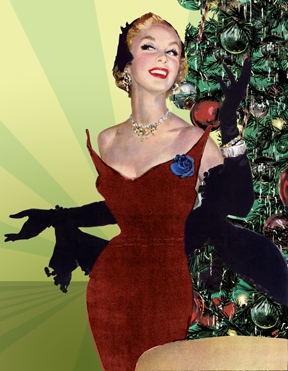
Joe deMers
August 05, 1950
She recounts her encounter with her admirer at the park.
R.G. Harris
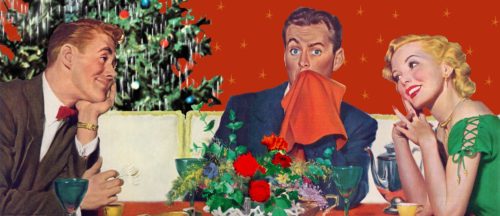
May 12, 1951
When he asked his best friend to join him for dinner he never expected to be the third wheel on his own date.
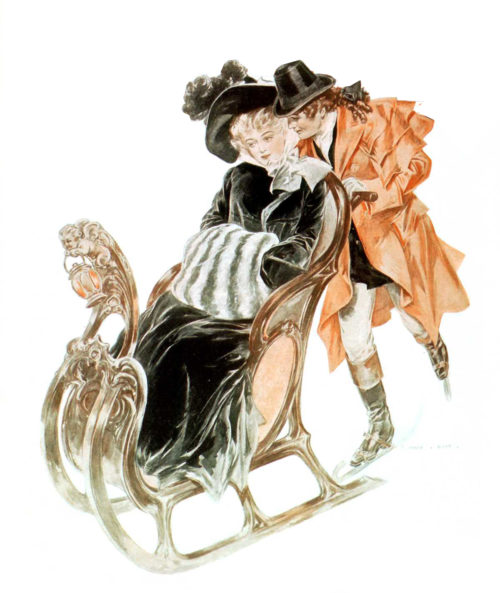
Henry Hutt
December 30, 1905
With fresh snow covering the ground, sleigh rides make the perfect escape from the festivities.
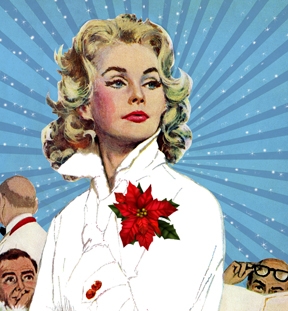
Coby Whitmore
May 07, 1960
Poinsettia pinned and hair curled, this winter wonder catches the eye of all the guys.
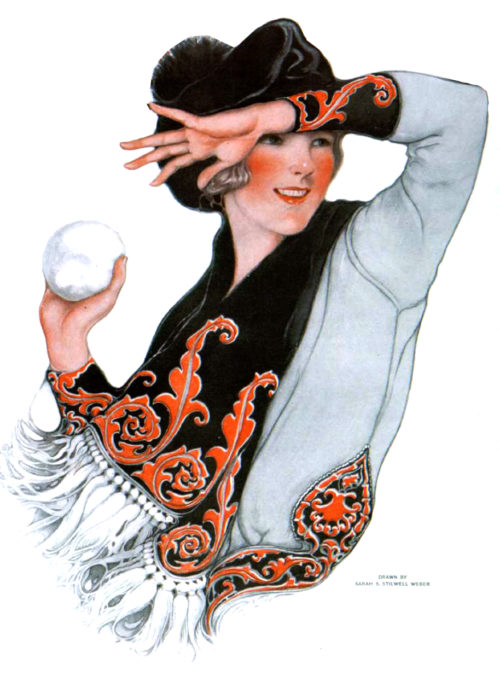
Sarah Stilwell-Weber
March 03, 1917
This winter-clad socialite prepares to thrash any who threaten her fashion.
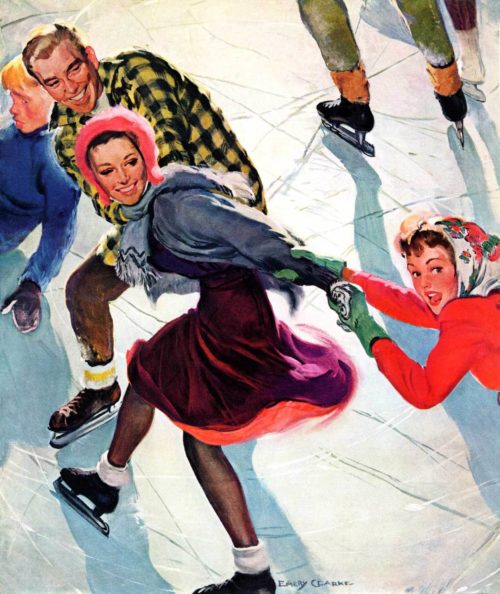
Emery Clarke
March 02, 1940
She sails with grace across the ice.
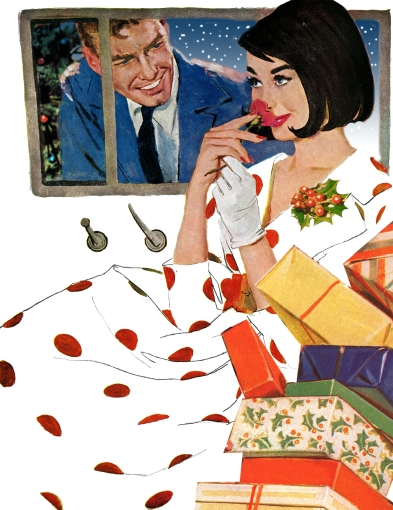
Coby Whitmore
October 24, 1959
Out of all of the gifts she received, her favorite was the rose.
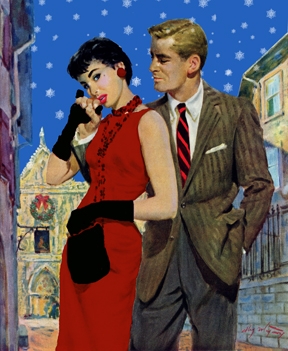
Coby Whitmore
August 20, 1955
The best way to enjoy a fresh snowfall is with someone who can hold you close.
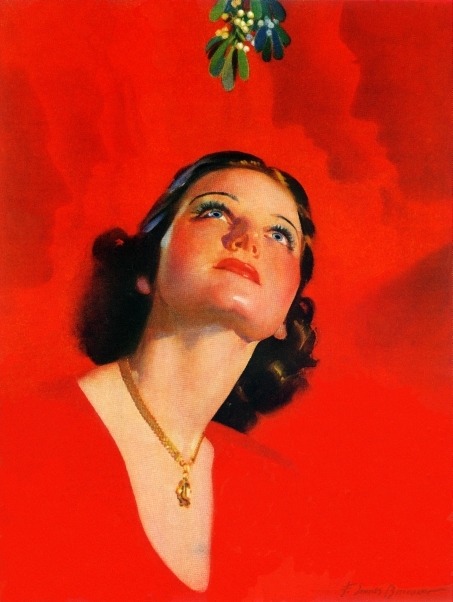
F. Sands Brunner
December 01, 1938 (Country Gentleman)
Waiting for someone under the mistletoe.
Joe deMers
April 15, 1950
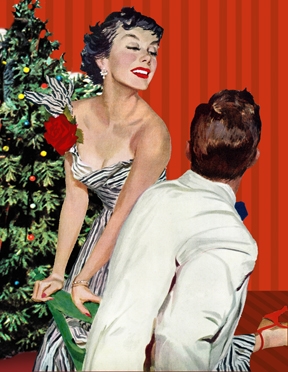
She coaxes him over for a midnight dance.
Bob Hilbert
February 21, 1953
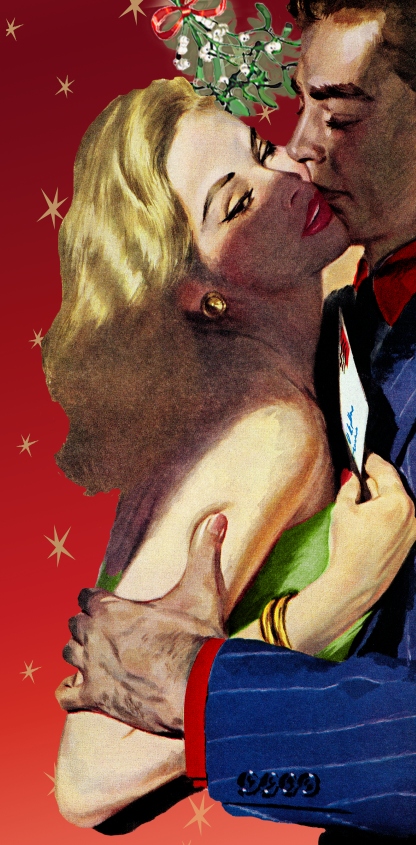
The letter in her hand doesn’t stave off this mistletoe kiss.
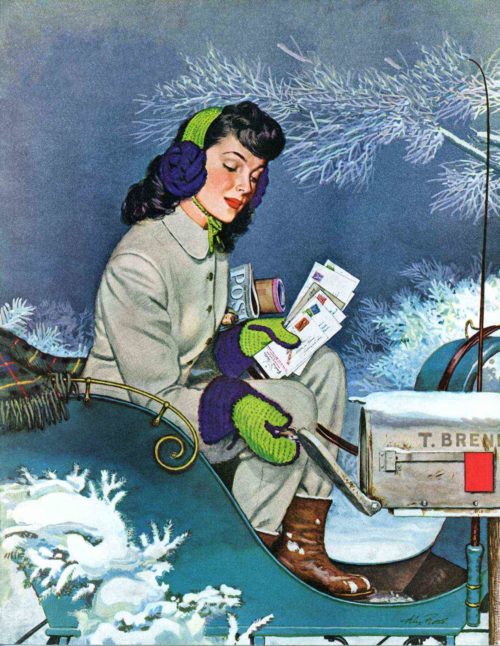
Alex Ross
January 29, 1944
This postwoman is delivering season’s greetings in spite of the snowfall.
Vintage Advertising: Selling Luxury
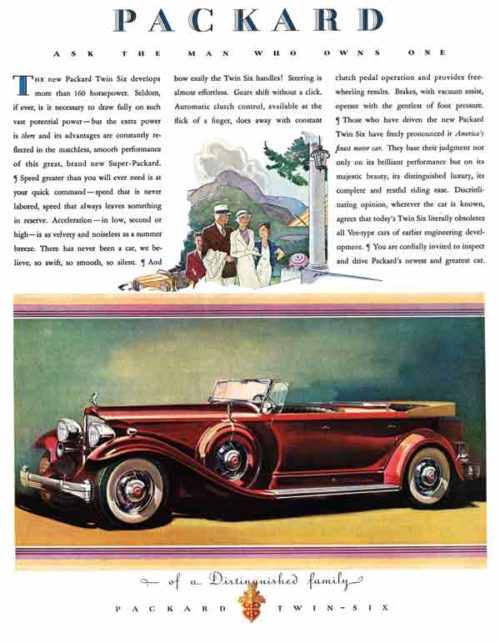
Though long gone — production ceased in 1956 — Packard automobiles are still remembered for their elegance and engineering. In their day, they had a reputation for sumptuous style and fine craftsmanship. And high price.
Beginning in the late 1920s, the Packard Motor Company ran a series of colorful ads in the Post that displayed not only the car but the glamorous life associated with it. These innovative ads paid tribute to artists and adventurers or showed consumers in elegant attire in exotic places to emphasize Packard’s appeal “for a discriminating clientele.” And all Packard ads included the slogan that only a confident manufacturer would make: “Ask the man who owns one.”
The slogan first appeared in 1901 —the concept of associating a consumer product with an aspirational lifestyle was groundbreaking at the time and has been the model for many an ad campaign since.
Also see our image gallery of Classic Car Ads: The Packard.
Puppet Pitchman
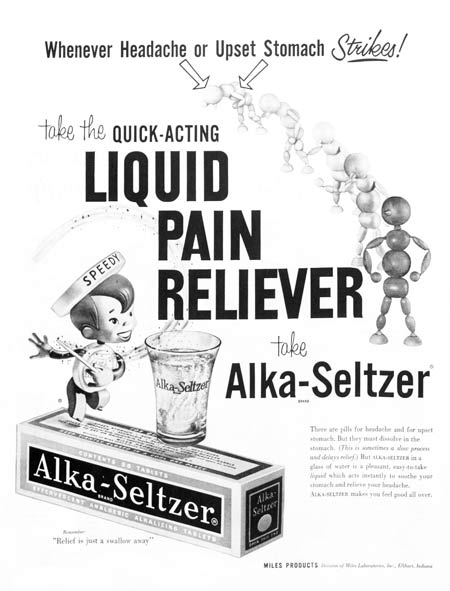
The Dr. Miles Medical Company faced tough competition when it introduced its pain-relieving antacid, Alka-Seltzer, in 1931. The market leader was a product called Bromo-Seltzer, which had been on the market since the 1890s. For years, both Alka-Seltzer and Bromo-Seltzer ads appeared in the Post, using a dry, factual approach to tell how their product offered relief for colds, indigestion, headaches, or, as was delicately hinted, hangovers.
Then, in 1951, Alka-Seltzer introduced a new spokesman: a puppet character named Speedy, named for the product’s new “speedy relief” campaign slogan. The puppet had an Alka-Seltzer tablet for its body and wore another tablet as a hat. Not long after appearing in magazines, an animated version of Speedy started showing up in television ads. For years, Americans heard his high, nasal voice singing, “Plop, plop, fizz, fizz. Oh, what a relief it is!”
The original Speedy puppet was lost en route to the Philippines in 1971 and discovered five years later in an Australian warehouse. For a while, the popular puppet was insured for $100,000; today, it is stored in a vault in a Beverly Hills bank.
Would You Trust Him With Your Sandwich?
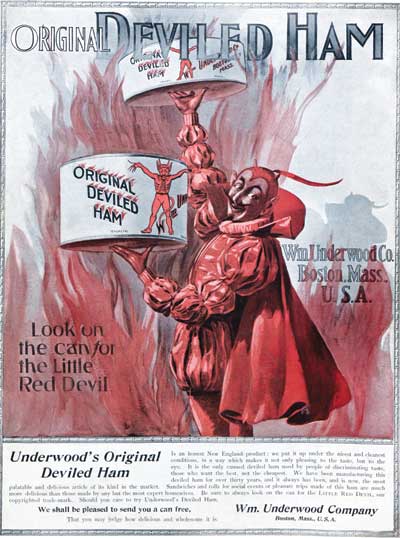 He may not look it, but the devil you see on cans of Underwood’s Deviled Ham is now 146 years old, which makes him the oldest food trademark in America.
This advertising mascot was created by the William Underwood Co. of Boston back in 1870. When the company was founded in 1822, it had specialized in producing condiments, such as mustards and pickled vegetables. Then it created a new food from ground ham and seasonings. Its spiciness suggested an infernal name, and “deviled” ham was born.
The original mascot sported long claws and a scowling gaze above a long, satanic mustache. Today, he’s a smiling cartoon figure who holds a harmless-looking pitchfork.
Underwood was a pioneer in the canning industry. As early as 1836, it began packing its products in steel cans with tin linings because the companies that made its glass jars couldn’t keep up with the demand for Underwood’s goods. Consequently, Underwood’s canned foods made their way west with pioneers and across Civil War battlefields with Union soldiers.
In his 1902 Western novel, The Virginian, Owen Wister wrote that “portable ready-made food” was a valuable aid to Western settlers, and a calling card of civilization in Wyoming’s cattle country. Watching cowboys provisioning themselves for the trail, Wister “grew familiar with the ham’s inevitable trademark — that label with the devil and his horns and hoofs and tail very pronounced, all colored a sultry prodigious scarlet.”
Scary Giant Finds His Gentler Side
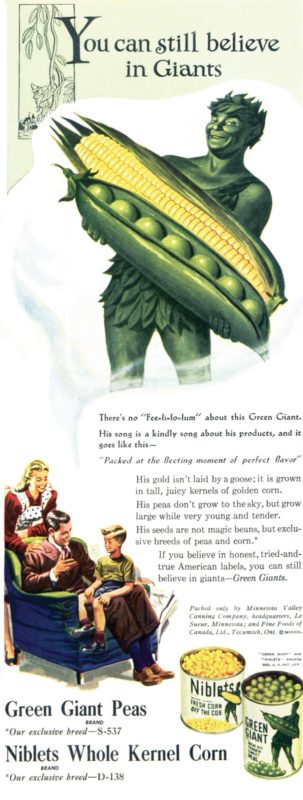 Created in 1928, the Green Giant was originally a mascot of the Minnesota Valley Canning Company.
The character was created to sell their unusually large green peas. In early print ads, the giant looked more like a wild-haired caveman who wore bearskins and a solemn expression. Then a young Leo Burnett gave him a makeover — a green, leafy suit, green skin, a big grin, and the word Jolly in front of his name. But he was still a bit frightening.
In 1958, when he first appeared in TV ads, one of the copywriters observed that “when you try to move the Giant around and really show what he looks like, he comes off a monster. The baby cries and the dog goes under the bed.” So the Leo Burnett ad agency created his signature “Ho, ho, ho” laugh. And to make him even more approachable, he got a companion, the Little Green Sprout, in 1972. The changes helped turn the monster into something downright lovable.
The canning company, now the Green Giant Company, is today the largest vegetable brand in the world. And the Green Giant has been named one of the top 10 ad icons of the 20th century by Advertising Age magazine.
A Rockwell Mother’s Day
The American holiday Mother’s Day came about chiefly due to the efforts of one woman, Anna Jarvis. After the death of her mother in 1905, she conceived of a day honoring all mothers. The first Mother’s Day celebration occurred in 1908. In 1914, President Woodrow Wilson signed a measure establishing the second Sunday in May as Mother’s Day.
Throughout the 20th century, mothers have taken center stage on our covers and in our magazine. As a special tribute to moms everywhere, we present this collection of Norman Rockwell covers where moms and grandmas play a starring role:
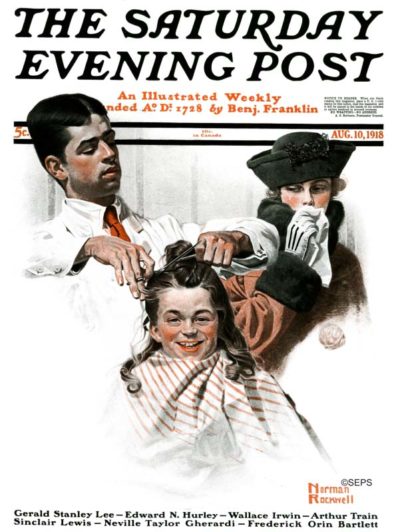
August 10, 1918
This momma’s boy is absolutely thrilled to be losing his luxurious locks, but his mother mourns more than just the loss of those curls: her little boy is growing up.
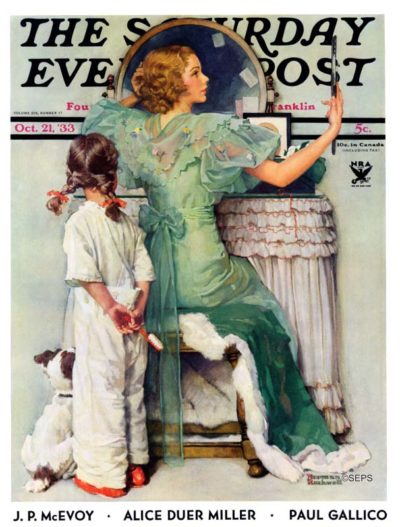
October 21, 1933
When this cover was published in 1933, a mother in Rockwell’s New Rochelle neighborhood thought the girl in pigtails looked just like her daughter — so much so that she framed the magazine to hang on her wall. Years later, Rockwell found out and gave the nostalgic mother the original oil painting.
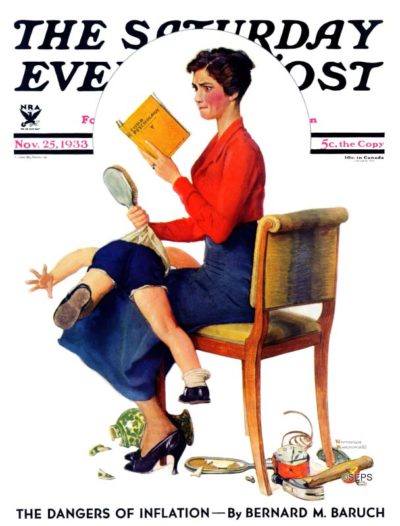
November 25, 1933
Resisting the urge to wallop her child for researching the aftereffects of a hammer on household objects, this mother jumps to a psychology book for help. The scene, we’re told, may have been inspired by actual events in the Rockwell household. When this 1933 illustration was published, Norman and Mary Rockwell’s oldest son, Jerry, had just reached the “terrible twos.”
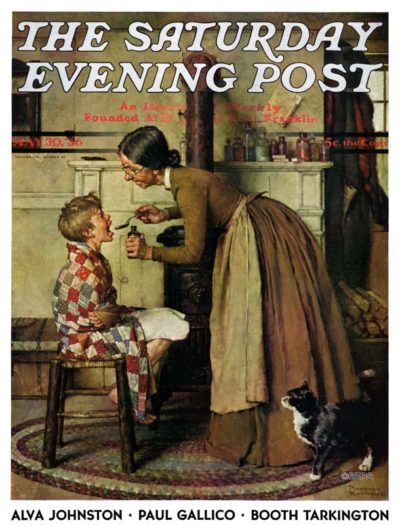
May 30, 1936
Tom Sawyer’s mothering Aunt Polly and her force-feeding “quack cure-alls” prompted Rockwell to create this cover in 1936. The image also appeared in a reprint of Mark Twain’s The Adventures of Tom Sawyer, which Rockwell illustrated for Heritage Press that same year.
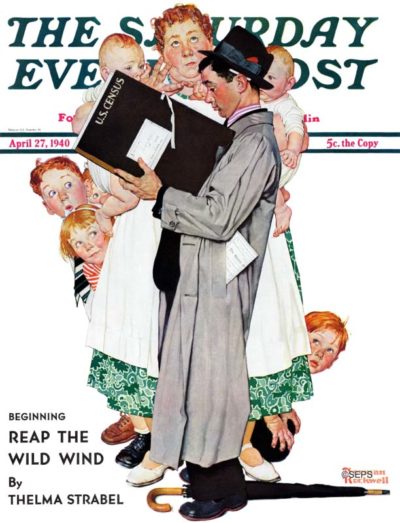
April 27, 1940
Remembering kids’ birth dates can be tough, especially if you can’t recall just how many kids you have. While this mom attempts to count off those birth dates, a passel of kids peeks out from behind her to catch a glimpse of the strange man who’s writing it all down in a large black book. The scene, which takes place in California according to the census book, graced the Post cover in 1940, when the bureau was conducting its 16th census of the United States.
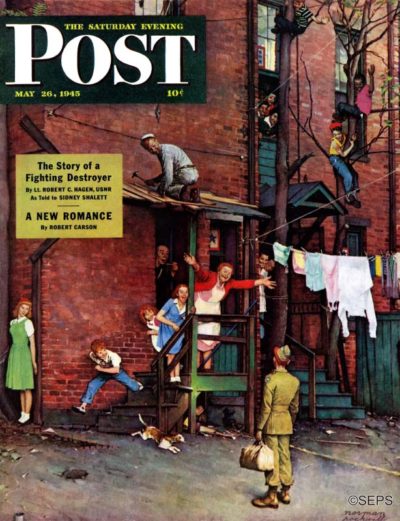
May 26, 1945
This 1945 painting of a young GI returning to the open arms of his mother is one of Rockwell’s most celebrated. The idea for it came to Rockwell after he read a series of 1944 Post articles written by Charles “Commando” Kelly and Pete Martin.
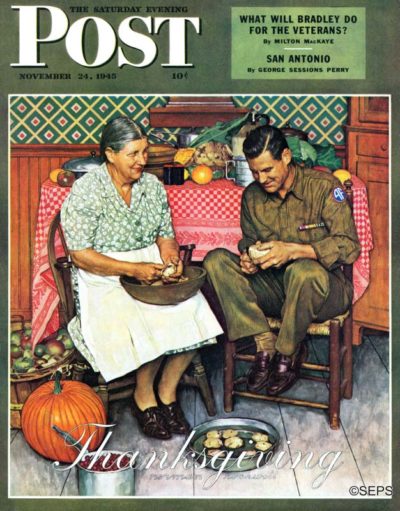
November 24, 1945
During World War II, Rockwell illustrations like this one boosted the spirit of America, especially in mothers of sons fighting overseas. Perhaps what made this one all the more touching for Post readers was knowing that the models in this homespun scene were an actual mother and son pair — Alex Hagelberg and her son, Dick, a bombardier who flew 65 missions over Germany.
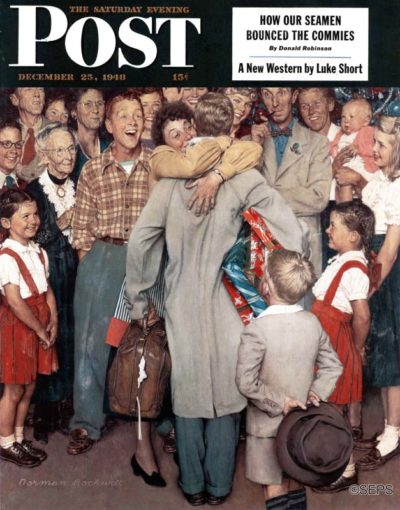
December 25, 1948
Another happy scene featuring a true-to-life family. Mother Mary Rockwell hugs and welcomes oldest son, Jerry, home. To her right, the boy in plaid is middle son, Tommy, and to her far right, in glasses, is youngest son, Peter. Artist Rockwell stands at her left. And between the two younger boys stands another famous painter — and mother of five — Grandma Moses.
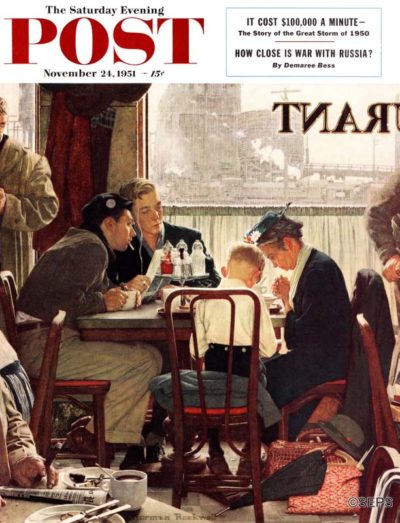
November 24, 1951
One of the best-known of Rockwell’s works, this painting of a grandmother and grandson praying in a diner was voted the Post readers’ favorite cover in 1955. Though May Walker, the woman who posed as grandmother in this painting, died just five days before the issue appeared on newsstands, she did get to see the painting completed. People who knew Walker well told the Post that posing for this cover was one of the most enjoyable moments in her life.
Vintage Advertising: They Launched and Lost the TV Industry
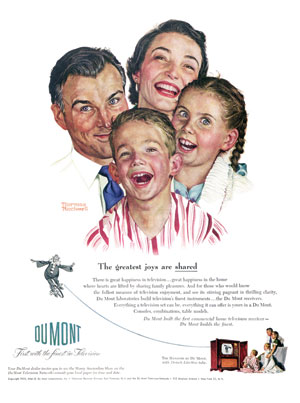 Allen B. Du Mont made television broadcasting possible when he developed a revolutionary picture tube that wouldn’t burn out in 25 hours — the tube’s previous lifespan. In 1939, he made the first consumer sale of a television set. But he realized that he’d never sell many TVs until there was regular, scheduled programming. So Du Mont launched its own television network, broadcasting live television shows and transmitting them across telephone lines to stations in 32 cities. By 1948, the Du Mont network was airing some of the country’s top shows, including The Original Amateur Hour — the American Idol of its day.
But Du Mont faced growing competition from NBC and CBS. Unlike his competitors, he didn’t have the income from a radio station to fund his television broadcasts. Then, the FCC changed the rules for allocating television channels, and Du Mont was blocked from new markets unless it broadcast in the UHF range. Meanwhile, GE and RCA were selling TV sets at a fraction of Du Mont’s price. When Du Mont went out of business in 1956, America was left with just three networks until Fox premiered in 1985.
Vintage Baseball Ads: You Can’t Play Without the Proper Equipment
To celebrate the start of another baseball season, we’re offering several galleries of vintage baseball-themed ads.
Our first gallery offers early advertisements for baseball equipment and uniforms.
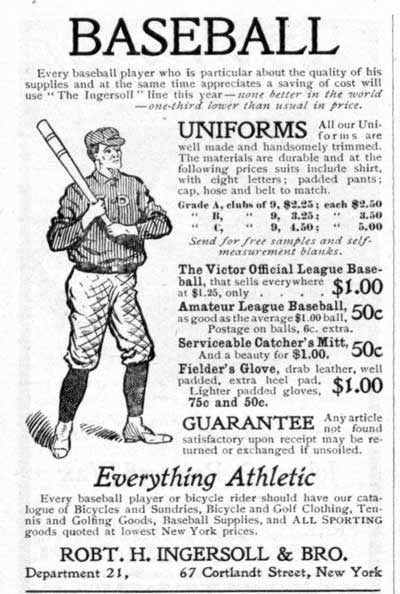
The Ingersoll store in New York was founded by Robert J. Ingersoll, who got his start selling watches, which included the popular $1.00 watch. Note that the uniform comes in three grades of quality, and that the catcher’s mitt at 50 cents is “serviceable,” but the $1.00 model is “a beauty.”
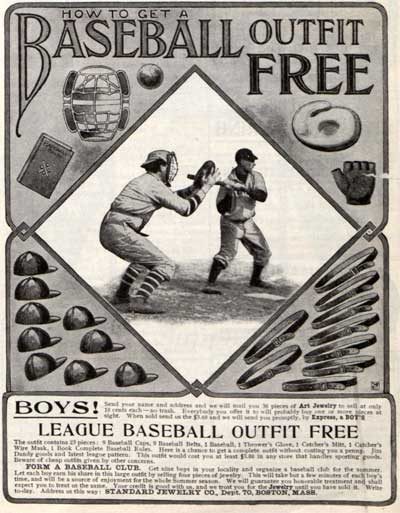
It seems improbable that boys would make good jewelry salesmen, but the Standard Jewelry company was betting they’d be desperate enough to sell 36 pieces of “art jewelry” to get a uniform. Despite the low, 10-cent price, the advertiser assured the boys these jewelry pieces were “no trash.”
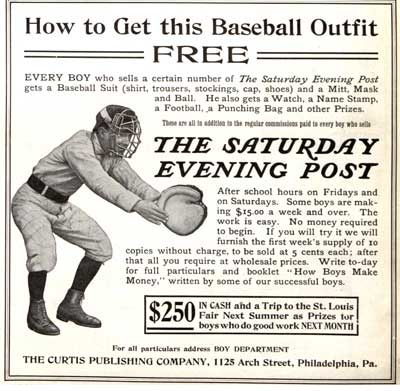
Even The Saturday Evening Post got into the uniform-premium game. During the first half of the 20th century, baseball equipment was a popular prize for boys and girls who sold the Post door-to-door. (We still hear from former Post-boys and Post-girls who got their start in business by selling our magazine long ago.)
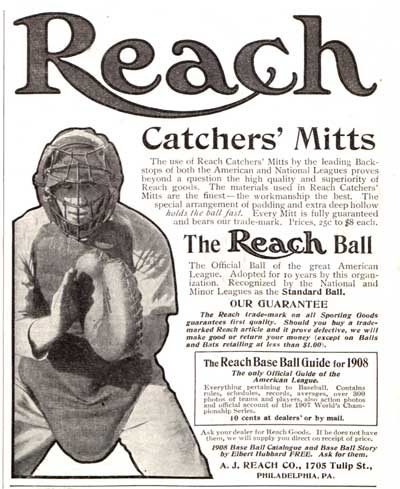
A.J. Reach was one of the first people paid to play baseball professionally. In addition to holding a position with the Philadelphia Athletic Baseball Club, he ran a tobacco shop and hand-stitched baseballs. By the late 1800s, his company also began manufacturing baseball gloves. Reach became so prosperous that, upon his retirement, he started his own ball club, the Philadelphia Phillies.
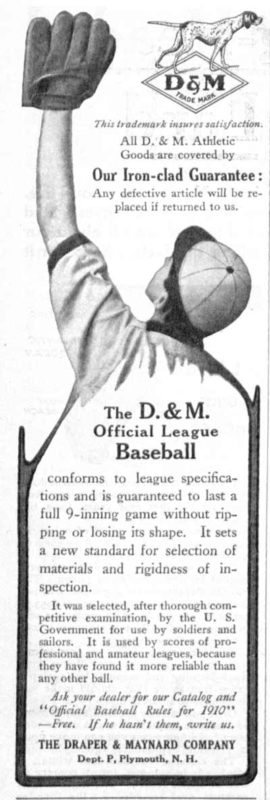
The Draper & Maynard Company started as glove manufacturers. But in the late 1890s, a player on the Providence Grays broke two fingers in a baseball game. He fashioned a protective glove for his hand using a model developed for teamsters. From that start, the company launched a famous line of sporting goods.
The promise that a D&M baseball would last nine innings “without ripping or losing its shape” says something about the quality of baseballs in those days.
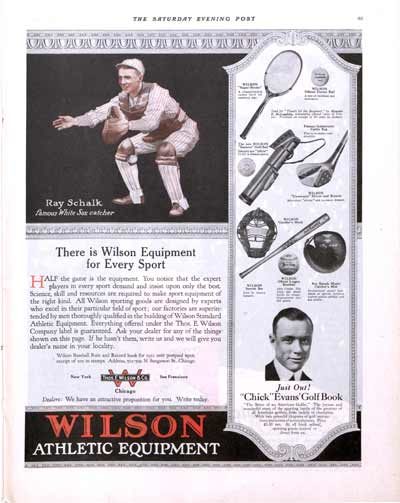
Wilson Sporting Goods began as a company that used slaughterhouse byproducts to make tennis-racket strings and baseball shoes. When Thomas E. Wilson took over the company in 1915, he branched into the baseball uniform business before expanding into making equipment for nearly every other sport.
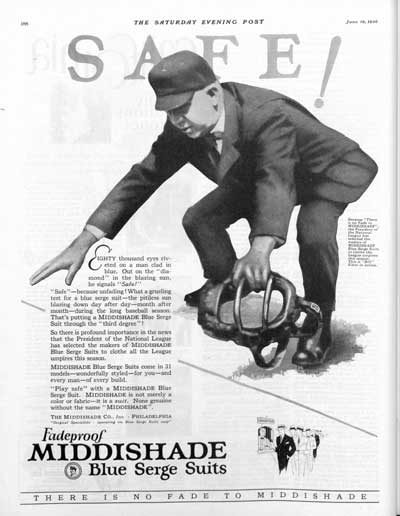
Major-league umpires have it easy today. They’re allowed to wear lightweight, casual shirts and pants. In the old days, they had to wear a dark blue serge suit, complete with coat and hat (in addition to a mask and chest protector), in the summer sun. The Middishade Clothing Factory was making suits until 1986, long after umpires began wearing a more reasonable uniform.
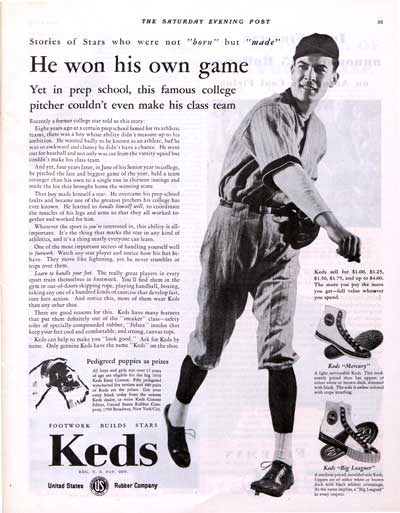
When U.S. Rubber introduced a line of rubber-soled athletic shoes in 1916, it intended to call them Peds (Latin for “foot”). Fortunately, that name was already in use, so the company decided on Keds. This ad is a good illustration of how much has changed in running shoes. It also shows how much has changed in promotional contests for kids. What sporting-goods company today would promote an essay-writing contest? And give 50 wire-haired fox terriers as prizes?
Vintage Advertising: Selling the National Parks
Long before there was a National Park Service, Americans were travelling to the parks on horseback and in stagecoaches. But at the turn of the century, the railroads began building spur lines to the parks and lodges for park guests. And they started advertising their park routes to Post readers. The ads ran well into the 1950s, when families preferred to reach the parks in the family car.
The old rail lines dropped passenger service long ago, but their routes to the parks are now served by Amtrak, which provides transportation to 237 of the National Park Service’s properties.
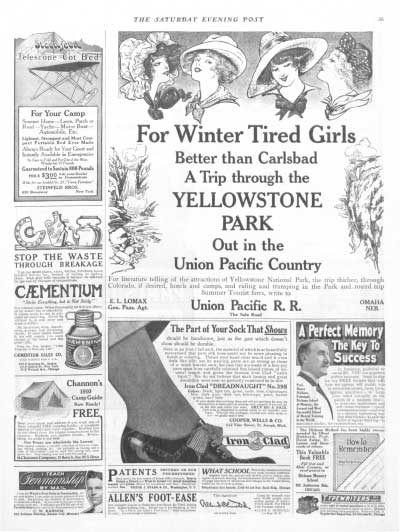
June 25, 1910
When it was established in 1872, Yellowstone Park was accessible only by horseback or carriage. Consequently, the park had only 1,000 visitors a year. By 1902, the Union Pacific Railroad had started passenger service to the park, carrying travelers from the Idaho Falls station to the park entrance in a stagecoach. Shortly before this ad appeared, however, it had opened passenger service on a line from St. Anthony, Idaho, to the park’s west entrance.
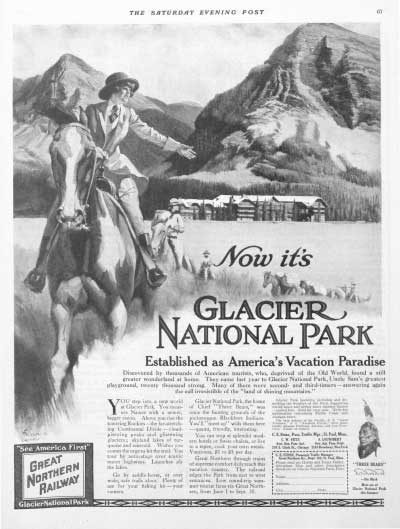
April 29, 1916
The Great Northern Railway Company, created in 1889, grew across the Great Plains from St. Paul into North Dakota, Montana, Idaho, and Washington. When the railway recognized the appeal of Glacier National Park, it built stations at the park’s west and east entrances, its rail line crossing the continental divide. It also built Glacier Park Lodge, which is shown in the background of this ad.
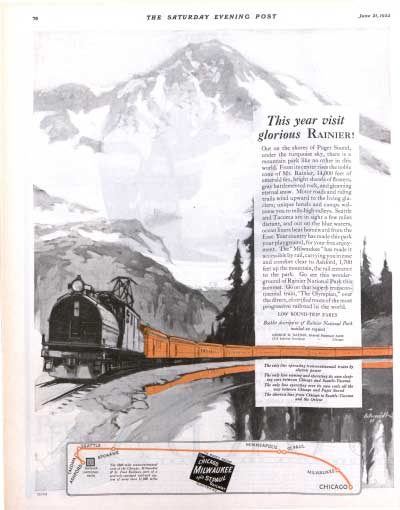
June 21, 1924
The Milwaukee Road was proud of its electric locomotive service when it was introduced in 1919. They staged public demonstration to show that its Class EP-2 electric engine could out-pull steam locomotives. This electric engine pulled the Olympian, the company’s passenger train that ran from Chicago to Seattle, stopping at Rainier National Park.
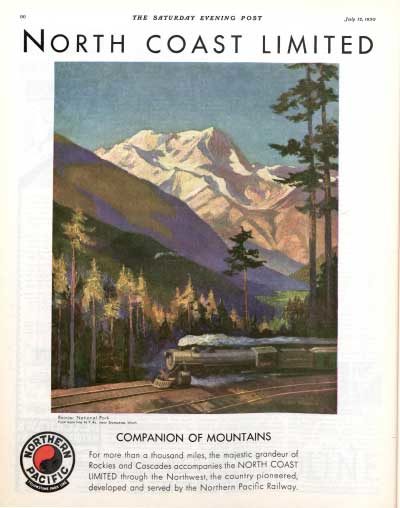
July 12, 1930
The North Coast Limited operated between Chicago and Seattle from 1900 to 1971. When this ad appeared, the Limited was making its 2,331-mile run in 63 hours — incredibly fast for that time. The Northern Pacific had also just upgraded the passenger cars, adding barber and valet service, separate bath and showers for men and women, and even radios on board!
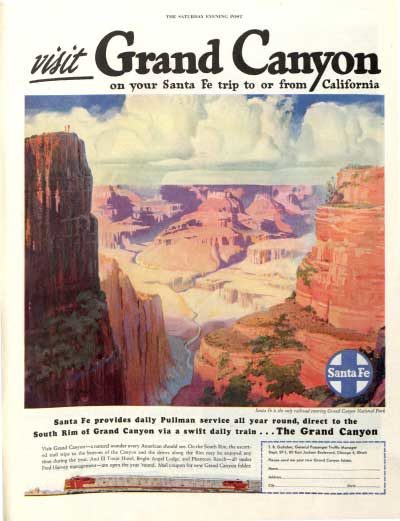
October 25, 1947
The Santa Fe first built a spur line from Williams, Arizona, to the Grand Canyon in 1901. In 1905, it completed construction of the famous El Tovar Hotel, operated by the Fred Harvey Company. It was located right on the South Rim of the Canyon, just 300 feet from the railroad station.
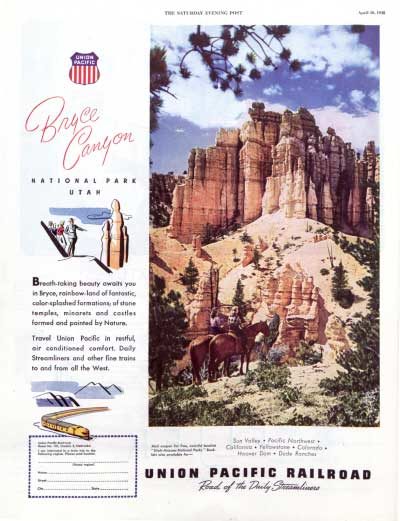
April 10, 1948
The Utah Parks Company, run by the Union Pacific Railway, managed several inns and lodges in Cedar City, Utah. From there, rail passengers would be driven by bus to Zion National Park, Bryce Canyon, the North Rim of the Grand Canyon, and other sites.
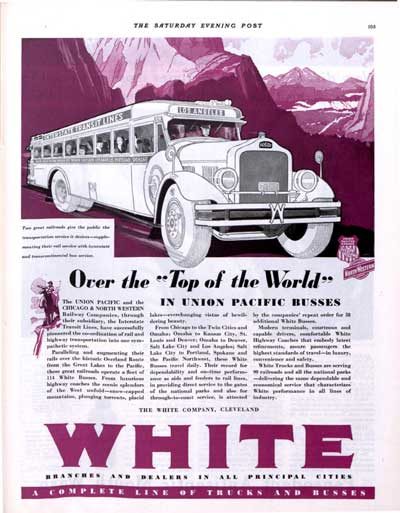
June 20, 1931
Starting business as a sewing-machine manufacturer, the White Company began making vehicles in 1900 and continued until 1980. The company developed its buses specifically to provide passenger service through the national parks. They were unique for their canvas tops, which could be rolled back for sightseeing in good weather. Today, 43 White buses are still providing transportation at Glacier and Yellowstone, as well as Gettysburg National Battlefield.
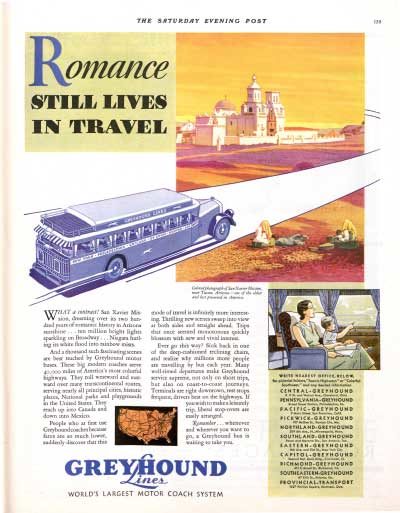
March 29, 1931
Greyhound Lines began in 1914, when an out-of-work car salesman offered rides to miners who wanted to hit the saloons in Alice, Minnesota. Within four years, his company had grown into a profitable 18-bus company. By the year of this ad, the company had combined 100 different bus lines and was offering service over 40,000 miles. Travelers often chose to take the bus because it was cheaper than the train.
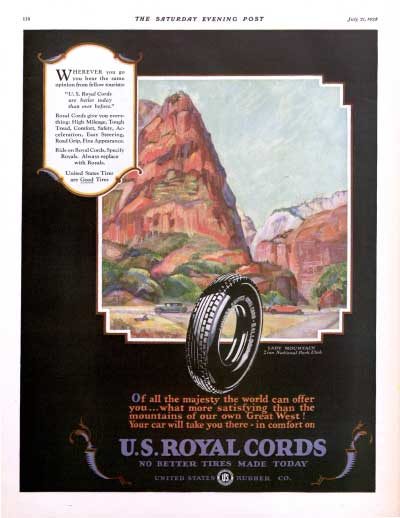
July 21, 1928
It would have been an intrepid motorist who drove the family to the parks back in the 1910s. The western roads were often unpaved and filled with debris. Blowouts were a frequent, time-consuming annoyance to passengers. By the late 1920s, though, tires had become smaller and wider. The new profile made riding more comfortable. And reinforcements by cord fiber in the rubber made them more durable.
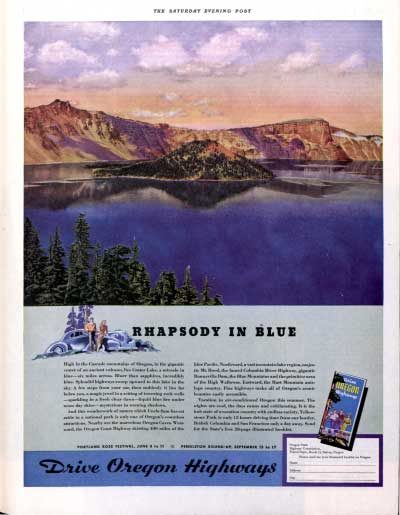
April 23, 1938
By 1938, federal programs like the CCC and WPA had expanded and improved the country’s highway system. For Americans fortunate enough to afford the car and gas (10 cents a gallon), the national parks were never more accessible.
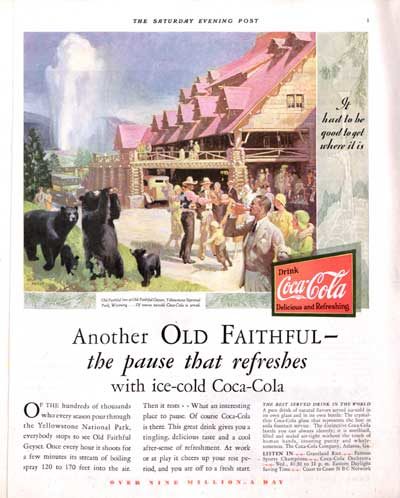
June 13, 1931
The Old Faithful Inn, shown in this Coke ad, was built in 1905 and was operated by the Northern Pacific Railroad. Today, the park takes measures to keep bears and tourists far apart. Visitors are strictly warned against feeding bears — or giving them soft drinks.
Celebrate Women Artists: Frances Tipton Hunter
One of Frances Tipton Hunter’s earliest memories is of herself at age 3 drawing over her grandmother’s wallpaper. Losing her mother at the age of 6, Hunter and her brother moved to Williamsport, Pennsylvania, to live with an aunt and uncle. Education was an important part of Hunter’s artistic life; she attended the Philadelphia Museum School of Industrial Arts and the Philadelphia Academy of the Fine Arts, graduating from both institutes with honors. While still a student, Hunter began to illustrate children’s fashions for department stores. The success allowed Hunter to move to New York where she continued her illustration career.
Along with her work in the Post, Hunter illustrated fashion catalogs and advertisements for children’s clothing as well as illustrating for other publications including Collier’s, Good Housekeeping, and Ladies’ Home Journal. Her subjects were most often children with cherubic features. Hunter tried to capture the happiness and innocence of youth, inspired by memories with her mother. Hunter’s work made her one of the most well-known artists of the 20th century, with paper dolls and picture books of her work being sold. With a style similar to Norman Rockwell, Hunter captured the ideal American childhood. Along with her18 covers for The Saturday Evening Post, Hunter’s drawings were nationally recognized from the 1920s to the 1950s.
In her first Post cover, Hunter put her best foot forward with this adorable couple. Hunter never had children of her own, so used her work to create adorable flashes of childhood innocence.
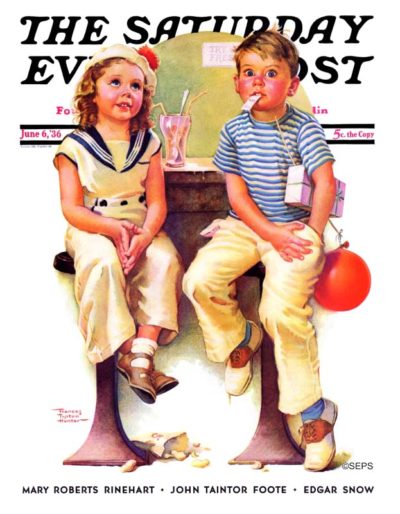
Frances Tipton Hunter
June 6, 1936
Post editors came up with this cover idea of a boy not wanting new long-johns, and Hunter loved it. For inspiration, Hunter waited in a department store waiting for the right mother/son pair to sketch.
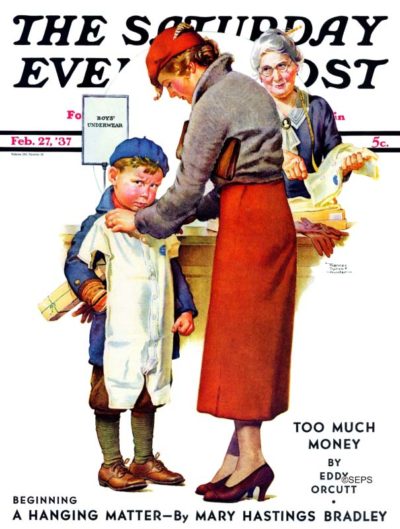
Frances Tipton Hunter
February 27, 1937
This young man wasted no time taking over his sister’s playhouse. With the dolls strewn across the ground, a Keep Out sign on the door, and his toy gun loaded, he will defend his new headquarters.
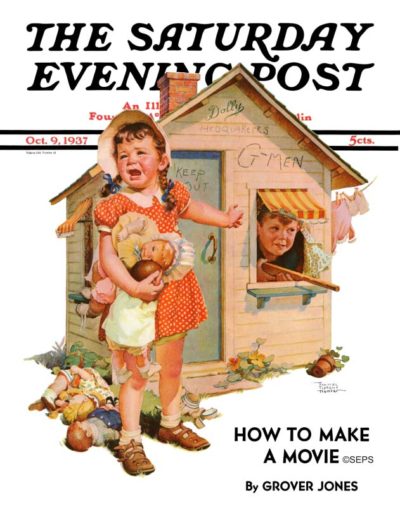
Frances Tipton Hunter
October 9, 1937
This little girl is trying to impress her mother; her blonde curls match the woman’s in the chair. But her hands give away her nerves as they flap by her sides.
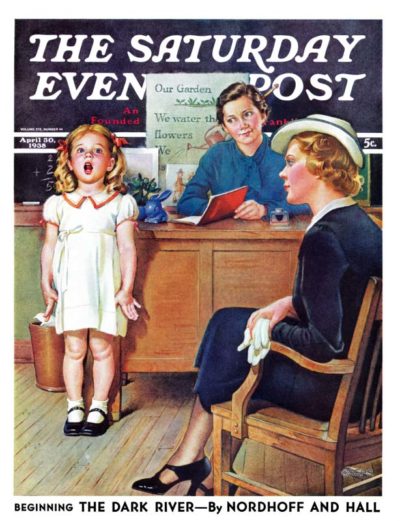
Frances Tipton Hunter
April 30, 1938
A quick glance may give the impression of an angelic children’s choir. Closer inspection will reveal a black eye and a bandaged head and fingers on the two boys up front.
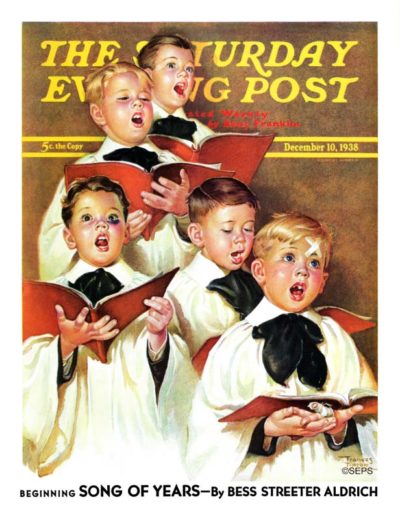
Frances Tipton Hunter
December 10, 1938
Most kids grow about 2 inches each year, so this mother likely has a lot of work ahead of her.
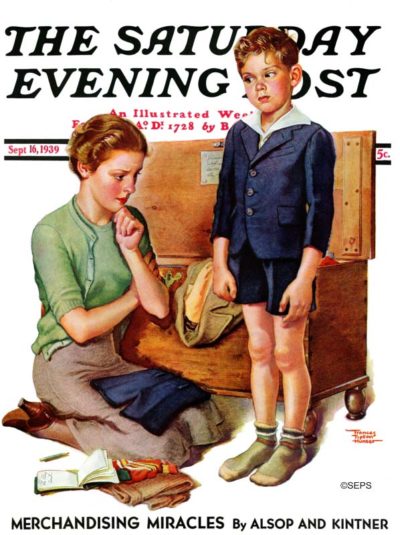
Frances Tipton Hunter
September 16, 1939
In this cover, Hunter depicted adolescence. You can see the math problems the young man should be paying attention to floating in the background.
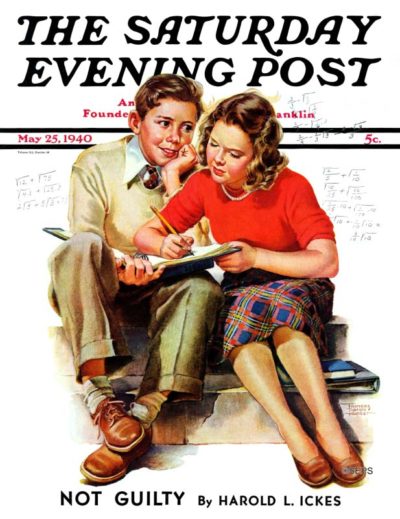
Frances Tipton Hunter
May 25, 1940
While the adults behind these kids concern themselves with more important matters, these kids don’t care. Their mission is simply to enjoy a ride on the trolley.
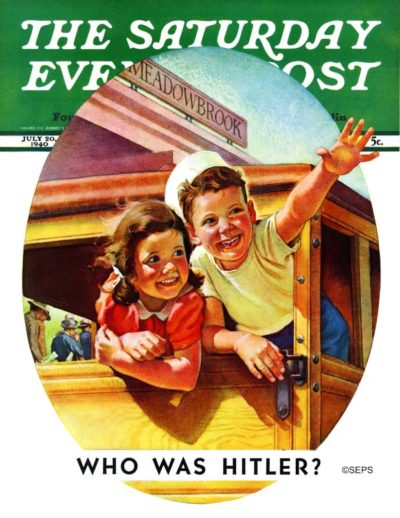
Frances Tipton Hunter
July 20, 1940
Celebrate Women Artists: Ellen Pyle
Ellen Pyle is proof that illustrating can be like riding a bicycle. A student at the Drexel Institute in Philadelphia, one of the top art schools in the country, she studied with famed illustrator Howard Pyle. There she also met her teacher’s brother, Walter Pyle, who would later become her husband.
Showing promise even as a first-year student in 1895, Pyle published her first of many illustrations. She went on to find success illustrating children’s books and magazine articles, but in 1905 chose to give up her career to focus on motherhood. Reflecting on this in a 1928 Post interview, she said, “Probably people vary a great deal, but I found that when there was a young baby in the family … it was not practical for me to spend all day in the studio. One or the other had to take second place.”
But when her husband Walter died in 1919, Pyle needed to support her four children and so turned back to art. The Saturday Evening Post was the first magazine to accept her work, and by the end of her career, she had illustrated a total of 40 Post covers. Her children and neighbors often modeled for her paintings that portray traditional American life.
“The girl I am most interested in painting is the unaffected natural American type,” Pyle said in her 1928 interview with the Post, “the girl that likes to coast and skate in winter, who often goes without her hat, and who gets a thrill out of tramping over country roads in the fall.” This girl definitely fits the bill.
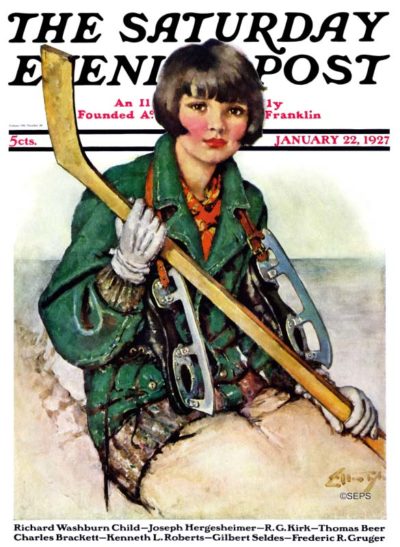
Ellen Pyle
January 22, 1927
This cover is a great example of Pyle’s use of brilliant color and loose, broad brushstroke-style.
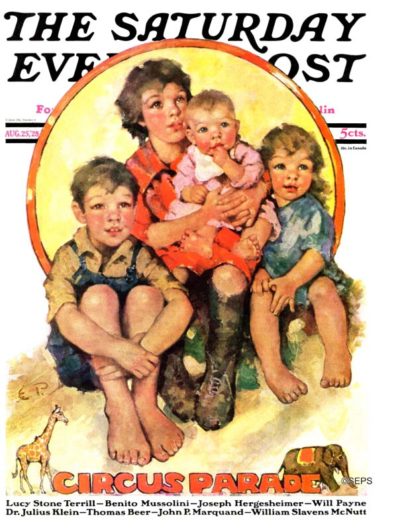
Ellen Pyle
August 25, 1928
Art certainly ran in the Pyle family. Ellen Pyle’s daughter Katie modeled for this cover, and her two oldest children, Walter Jr. and Ellen, became artists themselves, and her youngest, Caroline, married into the Wyeth family of artists.
Ellen Pyle
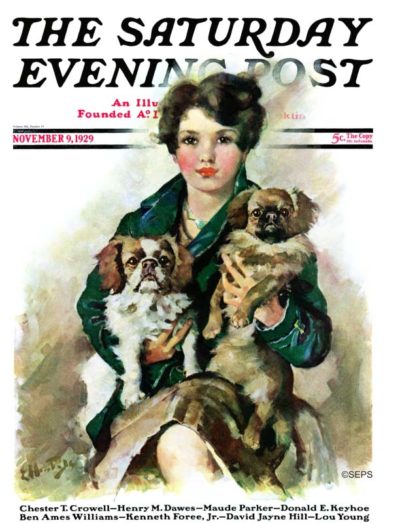
November 9, 1929
The grays surrounding this pair shadow the scene but the bright colors of the fruits and vegetables in the basket offer promise of a warm home-cooked meal.
Ellen Pyle
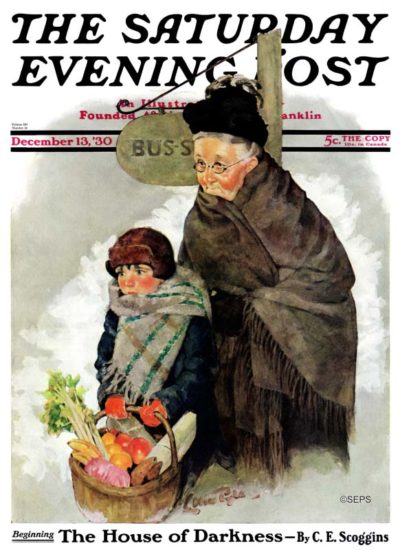
December 14, 1930
The most interesting thing about this cover isn’t the woman driving a convertible in the snow, but the child who’s glancing back at us wondering the exact same thing.
Ellen Pyle
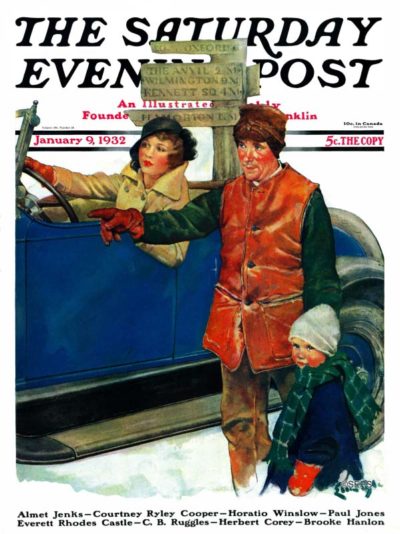
January 9, 1932
Reprinted on the Post in 2007, this cover prompted reader Sara Chatzidakis to write us with some background on the image. It turned out the little Post girls were Chatzidakis’ mother and aunt, who modeled the scene for their neighbor, Ellen Pyle.
Ellen Pyle
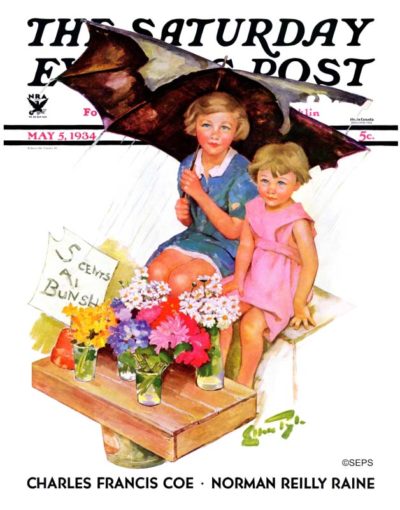
May 5, 1934
One of Pyle’s covers of everyday life, it’s the details that make this piece stand out. You can see the disappointment on the man’s face as he looks back at the tire after reading the sign “5 Miles to Mac’s Garage.” Looking at those diagonal lines going across the page, this will be one wet trip.
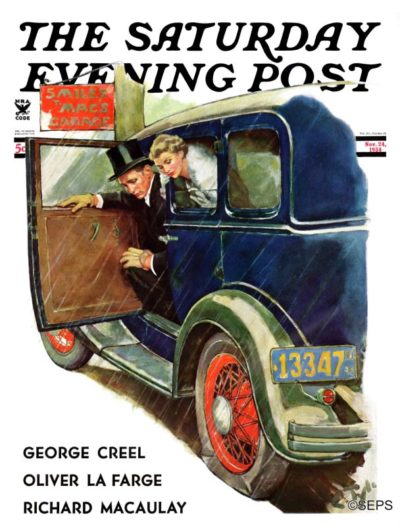
Ellen Pyle
November 24, 1934
Pyle tried to hide her signature in her paintings, making them the same color as the work itself so they blended into the background. Her signature here appears in the right-hand corner and matches the grass.
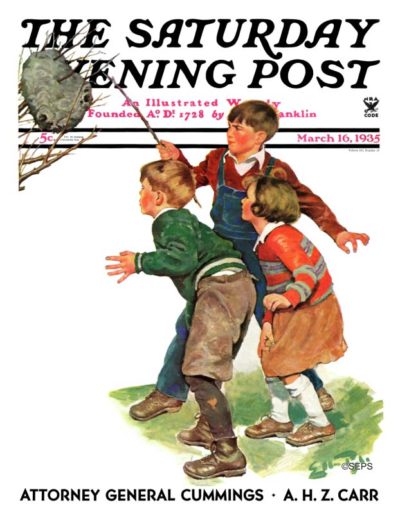
Ellen Pyle
March 16, 1935
Celebrate Women Artists: Neysa McMein
Born in Illinois as Marjorie McMein, this cover artist left the Midwest, changed her name to Neysa, and turned herself into the quintessential New York woman. McMein was modern and independent; she fought for women’s right to vote and worked overseas during World War I creating posters for the U.S. and French government. Back in New York, she lived above Carnegie Hall where she held parties for her friends, many of whom were famous, including Irving Berlin, Charlie Chaplin, Dorothy Parker, and Richard Rodgers.
McMein was most famous for her portraits, and painted presidents Warren Harding and Herbert Hoover. Her portrait illustrations were drawn for magazines and advertising; McMein even drew the first Betty Crocker illustration for General Mills in 1936, launching the brand. Her work for magazine covers, including McCall’s, Collier’s, and 60 covers for The Saturday Evening Post, portrayed young women of the 1920s as we picture them today, stylish and full of life.
Known for her portraits, McMein stuck with what she knew for her Post covers.
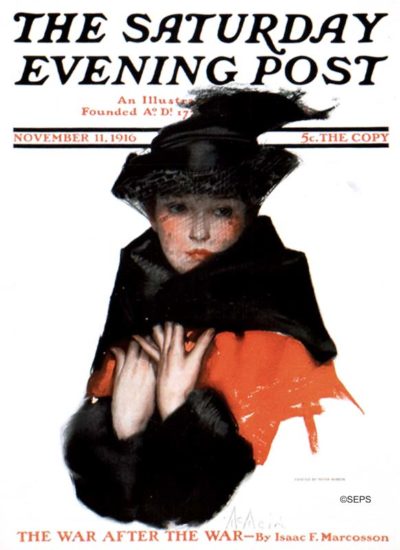
Neysa McMein
November 11, 1916
Before you think this is a portrait of Amelia Earhart, know that she didn’t get her pilot’s license until 1923. McMein’s young aviator captured the possibilities for women pilots, who only just began flying in 1910.
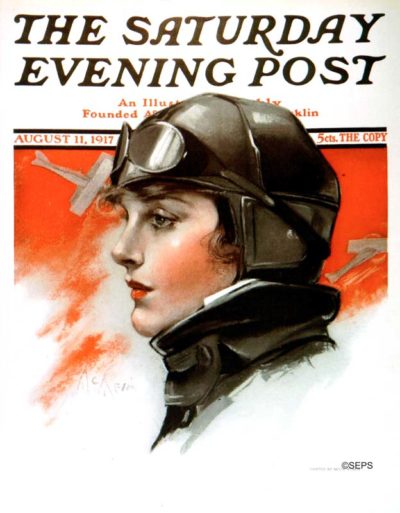
Neysa McMein
August 11, 1917
While the model looks forlorn, her dress is amazing. The details McMein drew include sheer sleeves with rosettes on the end and a flowing skirt. You can almost see each individual layer of fabric.
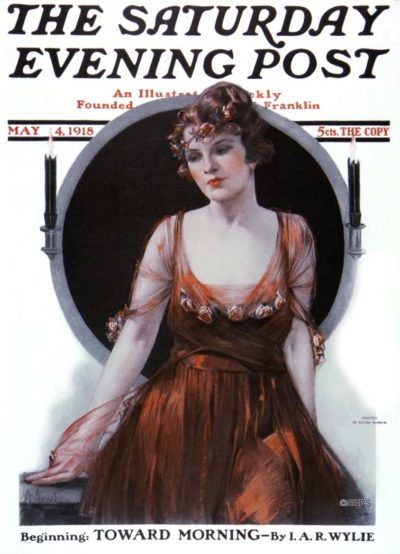
Neysa McMein
May 4, 1918
The U.S. ratified the 19th Amendment on August 18, 1920, giving women the right to vote. McMein, a long-standing suffragist, helped the Post be ahead of history when this cover published March 6, 1920.
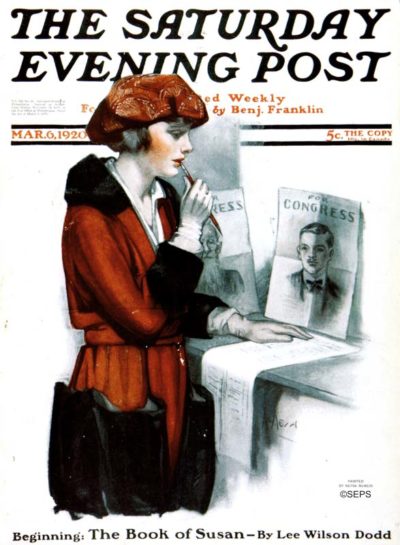
Neysa McMein
March 6, 1920
This young woman perfectly captures the Bohemian look of artists in the 1920s.
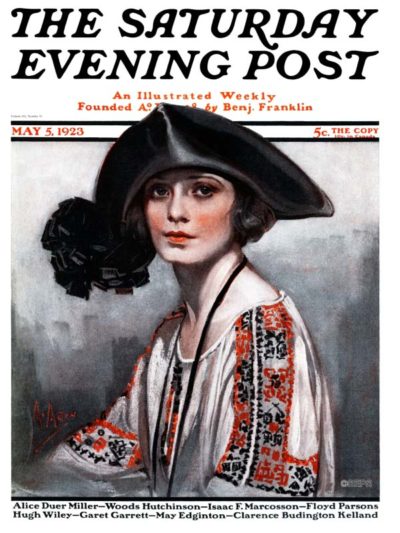
Neysa McMein
May 5, 1923
The pillbox hats this duo is sporting were brand new in the 1930s. Since then, celebrities Jacqueline Kennedy and Catherine Middleton have brought the look back in fashion time and again. In this particular style showdown, who wore it best?
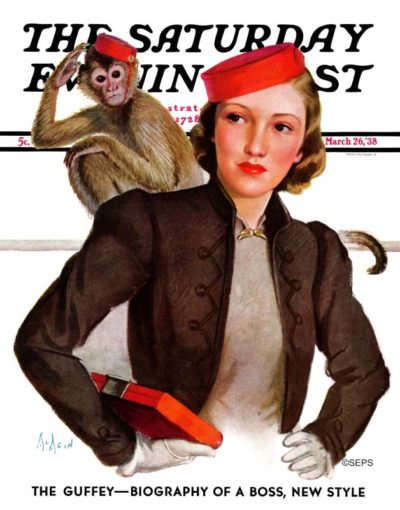
Neysa McMein
March 26, 1938
No other McMein cover includes the bright purple and teal seen in this dress thanks to changes in printing. The Post began issuing four-color covers in 1926, giving artists more color options to use in their paintings.
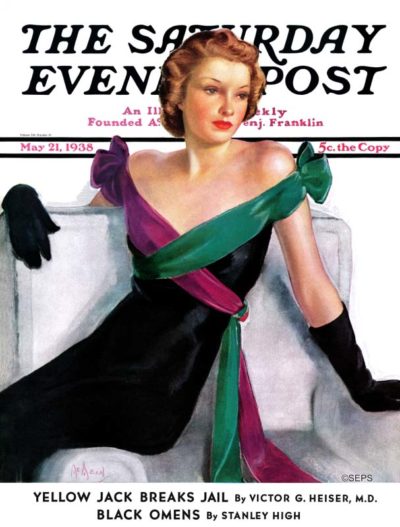
Neysa McMein
May 21, 1938
One of McMein’s last covers for the Post features many aspects from her previous work. It is a woman’s portrait with a scene around her and detailed clothes. If you look closely, you’ll see the coat is made entirely of fur.
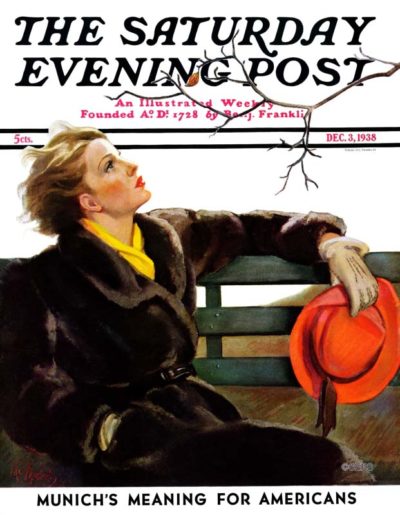
Neysa McMein
December 3, 1938
Celebrate Women Artists: Sarah Stilwell-Weber
Sarah Stilwell-Weber was one of The Saturday Evening Post’s most sought after artists. She even turned down Post editor George Horace Lorimer’s offer to have regularly scheduled pieces because she didn’t want to work on another’s deadline. Between 1904 and 1925, her work was featured on over 60 covers of both the Post and The Country Gentleman (a sister publication of the Post).
A student of famous illustrator Howard Pyle and the Drexel Institute in Philadelphia, one of the top art schools in the country, Stilwell-Weber captured a lighter side of the Victorian Era and the early 20th century in her work. Her young subjects were often on the move, playing games and exploring the world around them. Her mentor, Howard Pyle, told her never to marry, as it would interfere with her artistic life. However, she ignored him and married anyway.
While the children are forming their own marching band, Mom and Dad wonder if Santa takes returns.
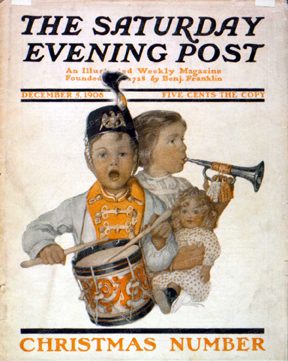
Sarah Stilwell-Weber
December 5, 1908
Forget flower crowns, these girls made a flower cape for their May Day parade grand marshal.
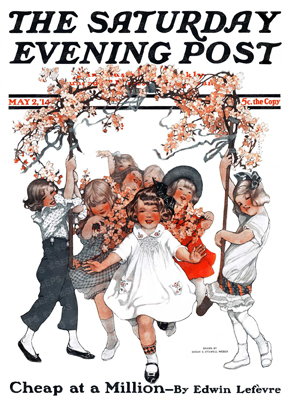
Sarah Stilwell-Weber
May 2, 1914
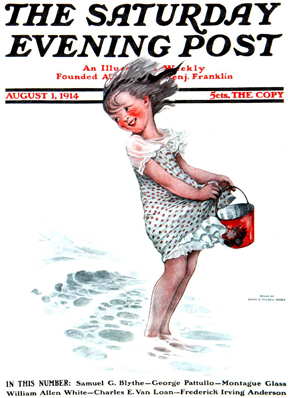
Is there anything better than splashing in waves, soaking up sun, and building sand castles?
Sarah Stilwell-Weber
August 1, 1914
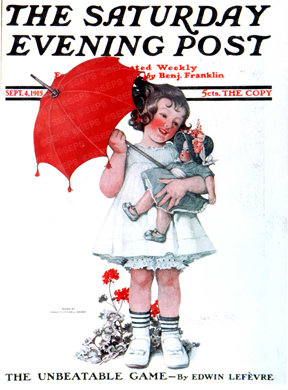
In the early 1900s, the Post covers were printed with a “duotone” two-color process: black and another color, usually red. This process is what makes the umbrella, flowers, and rosy cheeks on this little girl and her doll pop.
Sarah Stilwell-Weber
September 4, 1915
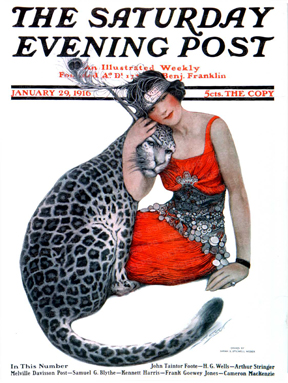
House cats are just too tame. This stylish young woman dared to make a leopard her pet.
Sarah Stilwell-Weber
January 29, 1916
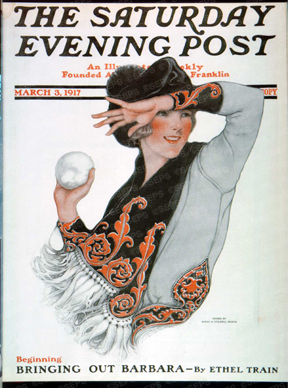
While many Post covers just show portraits of pretty young women, Stilwell-Weber adds life and movement to the traditional medium. This woman joins in the children’s fun after a stray snowball almost hits her.
Sarah Stilwell-Weber
March 3, 1917
Rolling her way straight into your heart, this tot on wheels is ready for a hug.
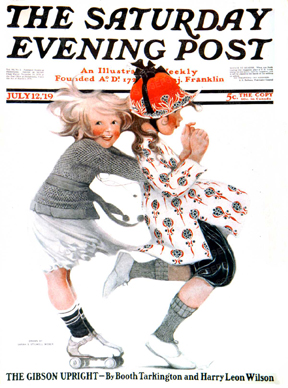
Sarah Stilwell-Weber
July 12, 1919
With that mischievous grin, this little one could be gathering momentum to jump or complete a loop-de-loop over the tree branch.
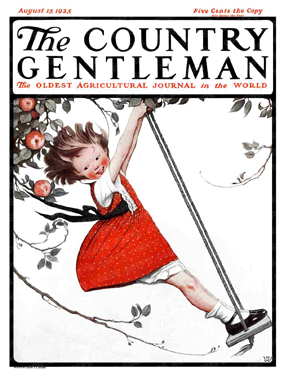
Sarah Stiwell-Weber
August 15, 1925
The Art of Robert Meyers – from Wild West to Romance
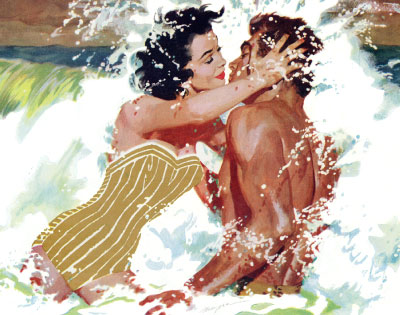
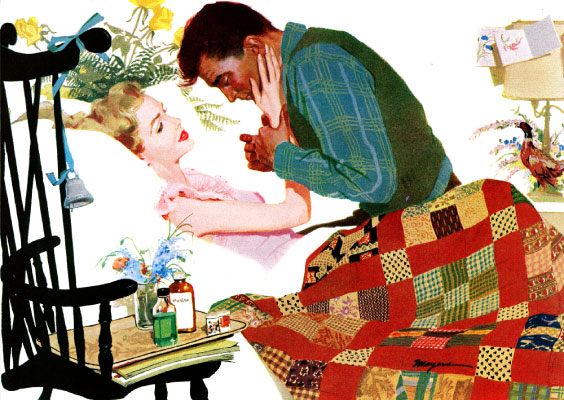
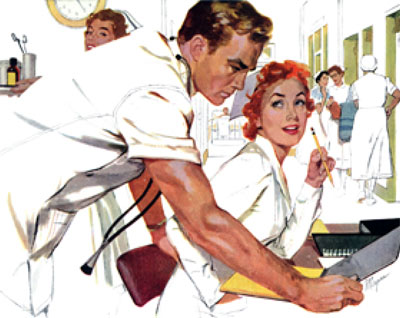
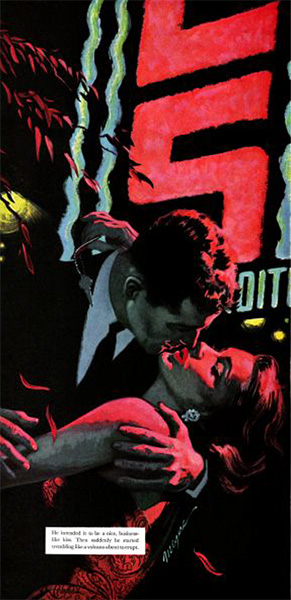
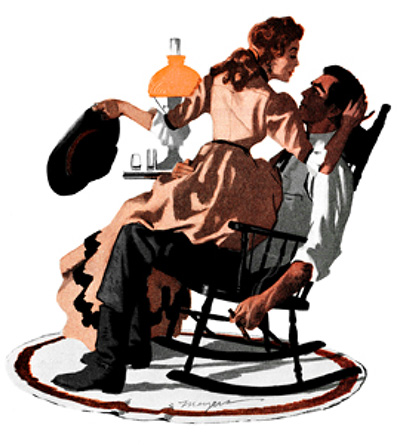
In the 1950s and ’60s, the name Robert Meyers was a familiar one to readers of The Saturday Evening Post. In just 10 years, Meyers published 94 pieces of artwork in the magazine. He illustrated mostly romance and mystery, but his expertise actually fell into a completely different genre.
Growing up in a strict family of accountants, Meyers became fascinated with Western America while watching cowboy films, immersing himself in a completely different culture than the one he was familiar with in New York City. His family was surprised when, instead of carrying on the family occupation, he asked to go to art school. After attending multiple art and fashion universities, he began to illustrate children’s books and Western paperbacks.
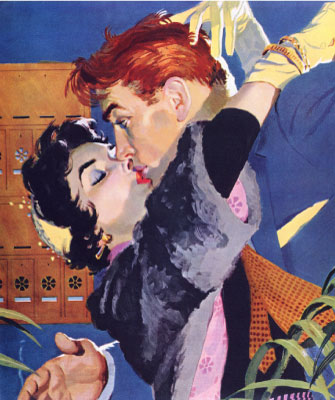
His career at the Post began in 1952, when his employer, Charles E. Cooper Studios, introduced him to the job. He went on to illustrate stories like “The Girl Next Door” by Steve McNeil, with a scene in which a bathing suit-clad girl surprises a lucky man with a kiss. Meyers uses a unique color story of ocean blues and electric yellows, and dramatic waves crashing into the couple to tell the romantic story. Many of Meyers’ illustrations from the Post involve couples in embraces or men fawning over female characters.
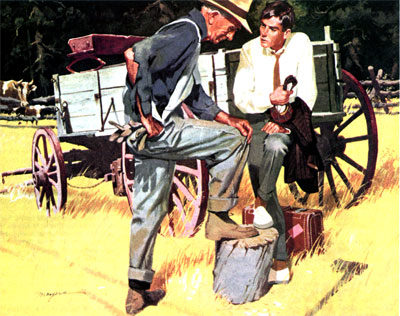
Meyers’ love for the Wild West also appeared in the Post alongside stories like “The Boy Left Home” by John Randolph Phillips. In the scene, a young man in business attire talks with an older farmer. With a suitcase at the young man’s feet, he prepares to ask the farmer if he can stay, having run away. Meyers uses intricate detail to paint the farm scene, down to the old-fashioned wagon and cows grazing in the background. Meyers was, perhaps, referring to his own childhood, and this illustration reflected the struggles of going against his own family’s wish for him to become an accountant.
In the 1960s, the Post decided to slowly decrease the number of illustrations in the magazine, making Meyers look for other opportunities to make a living. He decided to live out his love for Western culture and moved his family to Wyoming. There he operated a dude ranch and was an active cattle rancher. His artwork during this time focused on painting his family hard at work at the ranch and on his personal life in the West. In 1970, he was inducted into the Cowboy Artists of America.
Gallery

Ads You’ll Never See Again: Kids Can Sell Anything
Advertisers have used adorable children to sell things for over a century. This gallery of vintage Post ads shows kids being used to sell some very kid-unfriendly products, from light bulbs and motor oil to shaving cream and cigarettes.
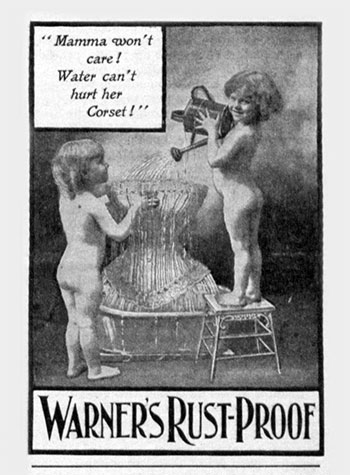
Bigger Problems Than a Corset
The lucky mother mentioned in this 1900 ad won’t have to worry about a rusty corset, leaving her more time to worry that her little girls are running around the house naked.
The Saturday Evening Post
March 17, 1900
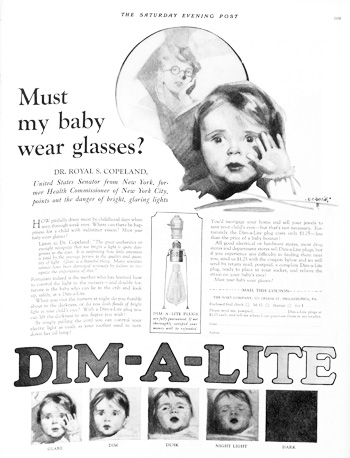
Bright Lights, Big Problem
This 1925 Dim-a-Lite ad shows that you don’t have to “mortgage your home and sell your jewels to save your child’s eyes” from “the danger of bright, glaring lights.”
The Saturday Evening Post
March 14, 1925
How Children Are Like Cars
Why would a sick child want a sealed piston ring? According to this ad from 1938, so he wouldn’t need so much oil.
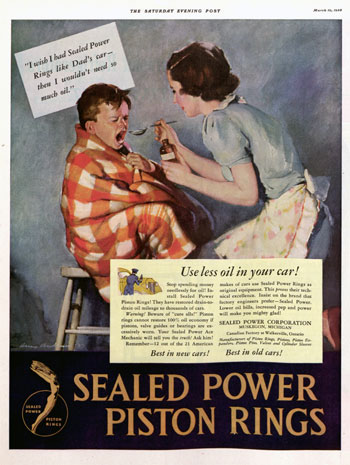
The Saturday Evening Post
March 19, 1938
Don’t Grab the Wrong Bottle
No, you should not feed motor oil to a baby, nor should you fill your car’s crankcase with milk. That’s as true today as it was in 1938, when this ad appeared.
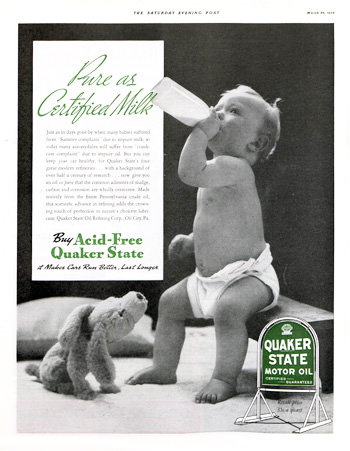
The Saturday Evening Post
March 26, 1938
Sweet Nutrition
This ad from 1941 hopes you’ll get your baby started early on foods “enriched” with dextrose, which “increases their energy-value.”
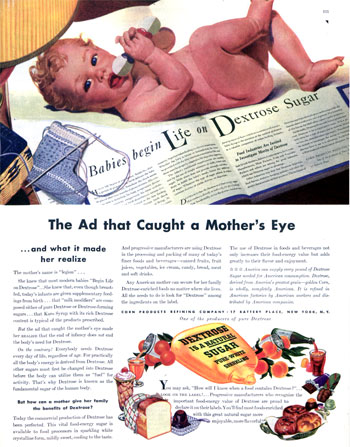
The Saturday Evening Post
April 5, 1941
Look Who’s Talking
In April of 1942, this baby tells a convincing story about how her family is happier ever since they switched to Palmolive soap. Even dad’s shower-singing is louder!
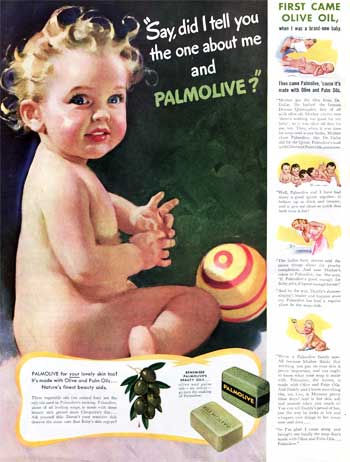
The Saturday Evening Post
April 18, 1942
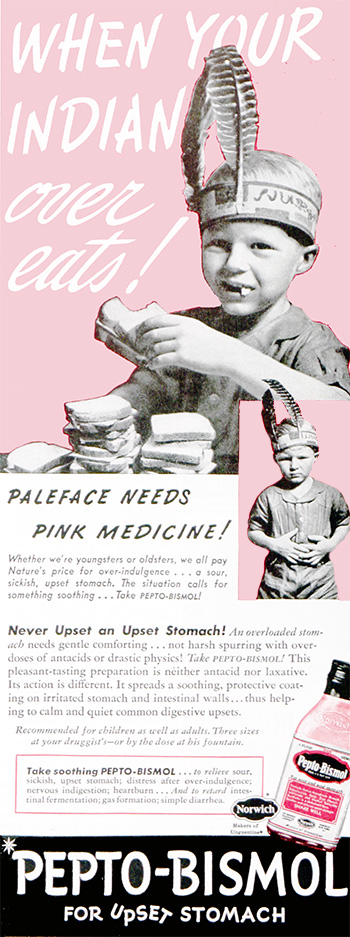
Pink Product for Pale-faced Pipsqueak
This ad from 1942 shows how Pepto-Bismol can help an over-indulging child get back to playing Tonto pronto.
The Saturday Evening Post
May 9, 1942
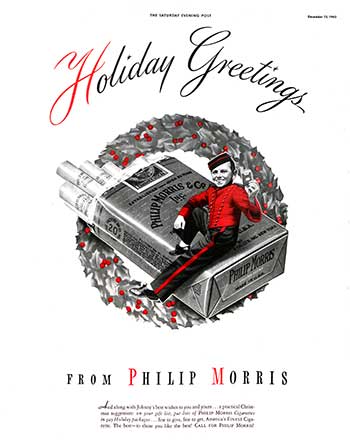
A Smoky Christmas
In 1942, nothing said “Merry Christmas” quite like a young boy in a bellhop’s uniform perched on top of a gigantic pack of cigarettes.
The Saturday Evening Post
December 12, 1942
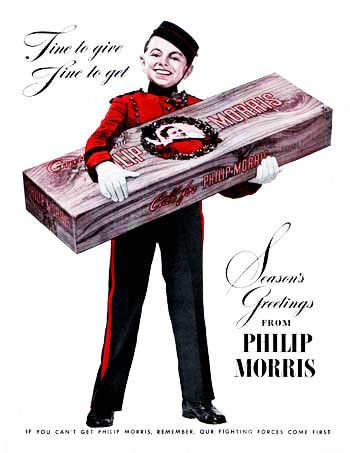
Quite the Stocking Stuffer
During the 1940s, Philip Morris ran a whole series of ads featuring this young bellhop. This ad notes that cigarettes are “fine to give, fine to get,” but it’s unclear whether the boy is giving or receiving.
The Saturday Evening Post
December 9, 1944
Editor’s Note: When we collected the vintage ads for this gallery, it didn’t occur to us that these images could be anything but what they appeared to be: A cigarette ad campaign that centered on a young boy. We were wrong. The bellhop in these ads, Johnny Roventini, was born in 1910 and began working for Philip Morris as a radio and television spokesman in 1933. It seems he was a popular figure in his time — well-known enough even to get an obituary in The New York Times after he died in 1998.
According to that obituary, Roventini had “a pituitary gland disorder that halted his development…and left him with a 12-year-old’s body for the rest of his life.” There’s no telling whether readers in the early 1940s would have recognized Johnny Roventini in these ads or seen only a boy. Most likely, it was a bit of both. Still, we don’t expect to ever see a cigarette ad campaign quite like this ever again.
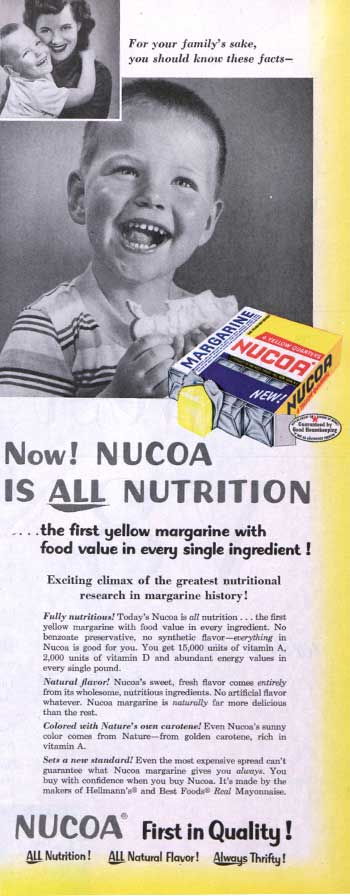
All-Nutritious Margarine
This kid really loves white bread spread with margarine, which, according to this 1953 ad, contains only things that are good for you. (Now if only we could teach him to chew with his mouth closed.)
The Saturday Evening Post
January 17, 1953
Leaves You Soft As …
Sure, shaving with Barbasol will make your skin as soft as a baby’s, but with this 1953 ad, we’re all imagining the mess this kid will make when he gets his hands on that tube.
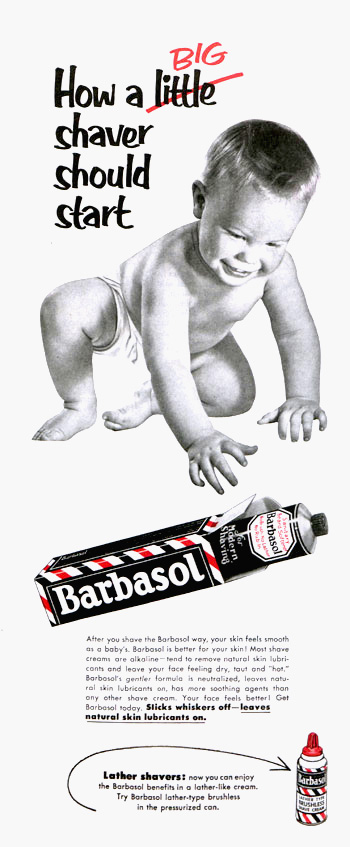
The Saturday Evening Post
March 28, 1953
Clear and Present Danger
In the category Child Endangerment for the Sake of Advertising, this campaign might take the gold. This ad from 1953 is just one in a series that showed photos of children encased in cellophane.
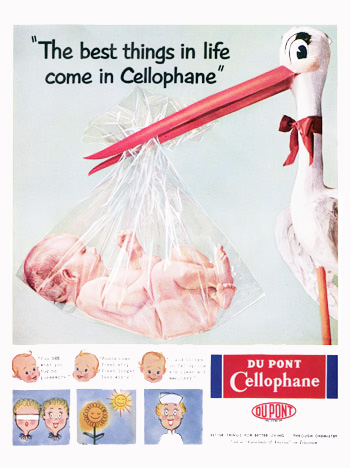
The Saturday Evening Post
August 29, 1953
A Shortening Life
In 1959, chicken fried in Mrs. Tucker’s Shortening was the meal of choice for freckle-faced girls in gingham dresses.
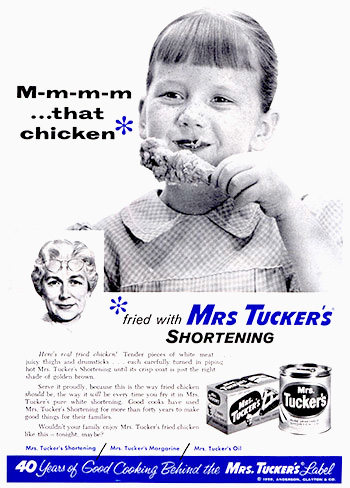
The Saturday Evening Post
December 12, 1959
Polio Sells
In this 1960 insurance ad from Metropolitan Life, these boys aren’t so much plunging into the water as they are jumping toward the word POLIO. Children and fear: a perfect pairing for an ad campaign.
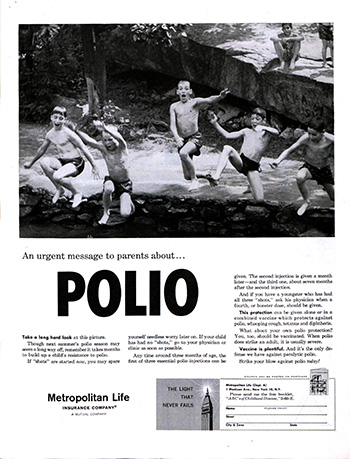
The Saturday Evening Post
March 12, 1960
Hit the Road Early
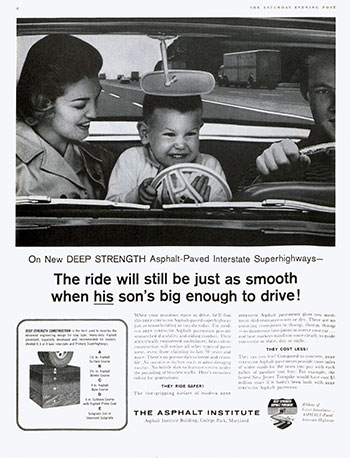
Though the claim the Asphalt Institute makes in this 1960 ad would be disproven time and time again, this young driver-to-be from a land before mandatory seatbelts and child restraints is just adorable.
The Saturday Evening Post
August 6, 1960
The Marlboro Baby
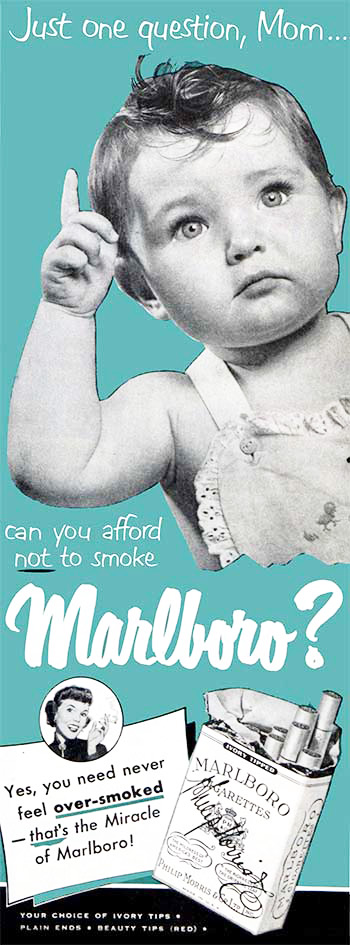
Even the Marlboro Man was once a baby. The early 1950s saw a whole series of Marlboro Baby ads, like this one from 1950.
The Saturday Evening Post
October 21, 1950
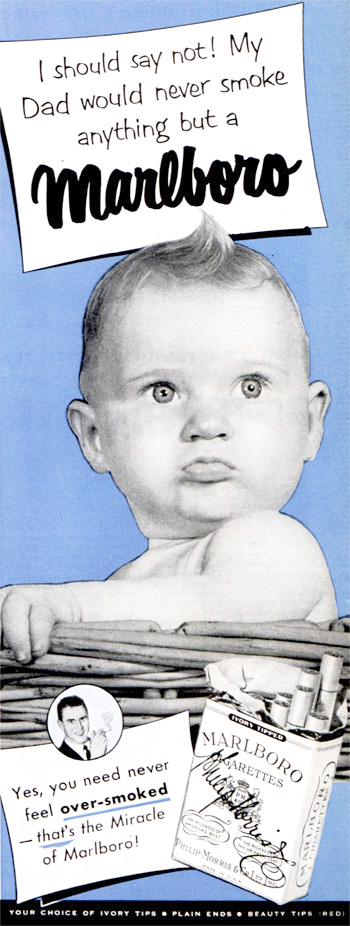
The precocious child in this 1951 ad already knows what brand of cigarette he’ll smoke when he’s older.
The Saturday Evening Post
June 30, 1951
Coming Soon from The Saturday Evening Post: Ads You’ll Never See Again
A special collector’s edition of The Saturday Evening Post filled with ads from the past that will delight, entertain — and sometimes shock — with images and concepts that are thoroughly inappropriate today. You’ll cringe when you see babies wrapped in then-brand-new cellophane. You’ll laugh out loud at Santa promoting a cigarette brand. You’ll wince at an ad that threatens housewives with a spanking for failing to complete their domestic chores. More than just an entertainment, the special issue offers a snapshot of attitudes about gender, childrearing, and marketing in an era that most readers will remember all too well.
It’s too early to order, but if you might be interested in purchasing this product, please click here and we’ll send you a notice when the special issue is available.