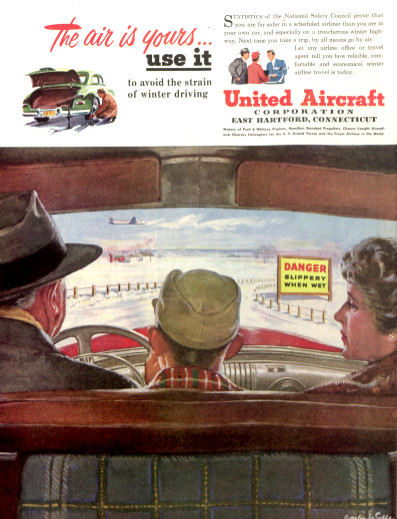
Richard “Dick” Sargent
Occupations: Artist, illustrator, portraitist
Schools: Moline High School, Moline Illinois Art School, Corcoran School of Art, Phillips Memorial Gallery
Studio Work: Printing and Engraving Plant, Advertising, Freelance
Art Genre: American Art
Marital Status/Family: Wife Helen and son Anthony
Richard “Dick” Sargent, one of The Saturday Evening Post’s most prolific illustrators, was a Midwesterner born in Moline, Illinois in 1911. His early career in art began just after his graduation from Moline High School, when he went to work for a local printing and engraving plant. While there, Sargent attended night classes at the Moline Illinois Art School, the foundation for his future career as an artist.
As his artistic prowess developed, he advanced further into creating professional artwork for advertising firms and later, a solo career as an artist and illustrator. The artist worked in advertising for over 20 years, starting in 1928, prior to making a name for himself as a freelance illustrator. During this time period, Sargent further honed his artistic skills by taking classes at both the Corcoran School of Art and the Phillips Memorial Gallery in Washington, D.C.
By the time Sargent headed out into the world to make a name for himself as a solo artist, he had started a family. They later provided inspiration for some of his most successful works of art. He married his sweetheart, Helen, and had a rambunctious, mischief-prone redheaded son named Anthony who was often depicted on the cover of The Post. The suburban life they built together established the perfect model for scenes of 1950s Baby Boomer households in everyday situations of suburban American life.
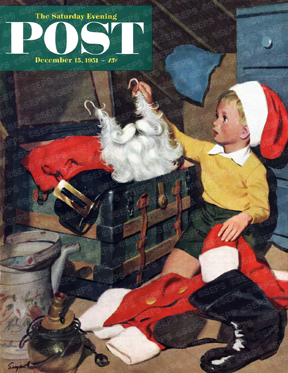
Richard Sargent
December 15, 1951
In 1951, Sargent completed his first Saturday Evening Post cover, “Truth About Santa”, for the December 15th Christmas issue. While Sargent’s popularity grew through The Saturday Evening Post, he also received illustration work from magazines such as Fortune, Woman’s Day, Photoplay, and American Magazine. Americans adored Sargent and his art for the ability to show a pregnant scene with an open-ended conclusion that commented on the situational comedy of life.
In addition to his work as a magazine illustrator, Sargent also received special commissions that afforded him the opportunity to travel the world. In 1954, the USO sent Sargent to Korea to entertain troops fighting in the Korean conflict. He later remarked, “We’d put on civilian clothes to work in- the boys would get such a kick out of seeing somebody in good old stateside civvies.” He spent six weeks flying throughout the country where he met with American soldiers and created art for them to send home to loved ones.
Sargent caught the “travel bug” on his trip to Korea and again vacationed out of the North American continent to Paris, France in 1959. He used his wife as a model in many works he created there to highlight Parisian life and landmarks. By the 1960s, photography had taken the place of illustration in magazine cover art. This caused the couple to move to the Andalusia region of Spain to live out the rest of their days in peaceful retirement. Sargent died suddenly in 1978 at the age of 67.
Covers by Richard “Dick” Sargent
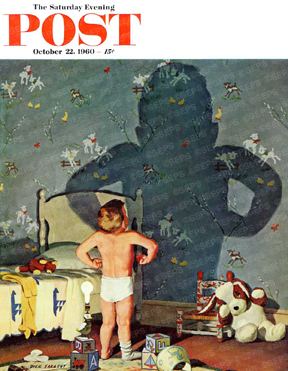
Big Shadow, Little Boy
Richard Sargent
October 22, 1960
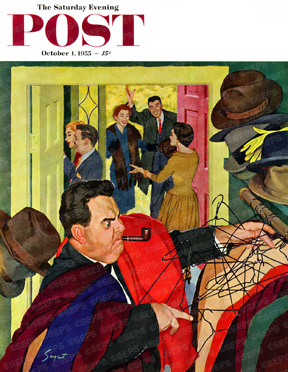
Tangled Coat Hangers
Richard Sargent
October 1, 1955
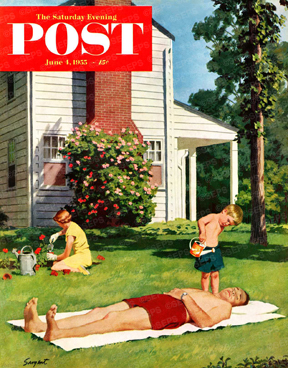
Watering Father
Richard Sargent
June 4, 1955
Ellen Pyle
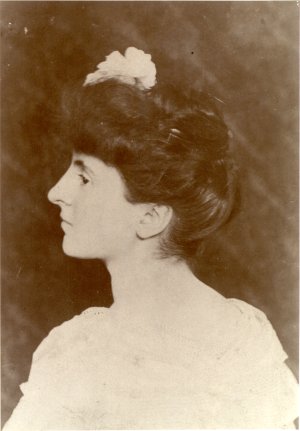
In the 1920s flapper era of parties and glamour, no Saturday Evening Post artist covered the period of graceful elegance like Ellen Bernard Thompson Pyle. Born in Germantown, Pennsylvania on November 11th, 1876, Pyle had a slow-building rise to fame that spanned many decades between her art studies and her working years as an artist.
Pyle began her art studies at Drexel Institute (now Drexel University) in 1895. While there, she studied under Lydia Austin and Charles Graffy. She was at the top of her class, earning a spot in Howard Pyle’s summer art school at his studio in Chadds Ford, Pennsylvania in 1898 and 1899. It was at Howard Pyle’s summer school that she joined a group of prodigy illustrators including N.C. Wyeth, and met her future husband Walter Pyle, who was helping his brother Howard.
The story of her relationship with Walter was complicated, and ruled over much of her time away from her lifelong passion creating art. Though the two met at Walter’s brother’s summer art school, it was years before they would reconnect. Walter was 17 years Ellen’s senior. At the time the two met, Walter was also married to another woman.
Having finished her formal education, Ellen moved home to live with her parents and was working as an illustrator from her makeshift home studio by 1901.
In 1903, Walter’s first wife died. Six months later, he called upon Ellen and within the year, the two were married. The two moved to Wilmington, Delaware. Ellen took time away from art to raise her growing family. The two, madly in love, had three children, son Walter Pyle, Jr. (1906) and three daughters Ellen (1907), Katie (1911), and Caroline (1914).
Ellen’s husband, Walter Pyle, was a wealthy businessman who owned a feather factory in the northeast. In 1918, the family moved to their newly purchased 40-acre farm, Westbrae in Greenville, Delaware. Shortly thereafter, Walter suddenly died of Bright’s Disease a year later in 1919 at the young age of 42.
Ellen, then widowed, returned to working as an artist in order to provide for her many children. Walter’s sister Katherine sent three of Ellen’s illustrations to The Saturday Evening Post in 1922, two of which were immediately selected by The Post’s famous editor, George Horace Lorimer.
Over the course of the next decade and a half, Pyle completed forty covers for The Saturday Evening Post, illustrations for Parents’ Magazine, Literary Digest, Pictorial Review, Everybody’s Magazine, and 10 dust jackets for books by author Berta Ruck. Ellen Bernard Thompson Pyle died of a heart condition on August 1st, 1936, at the peak of her career as a working artist.
Today, many of her illustrations remain housed in private collections including those built by her living relatives. In 2006, an original Saturday Evening Post illustration was rediscovered through the television series Antiques Roadshow where the work was appraised with a value between $25,000-$30,000. In 2009, her great-grandchildren organized a “career retrospective” show at the Delaware Art Museum.
Covers by Ellen Pyle
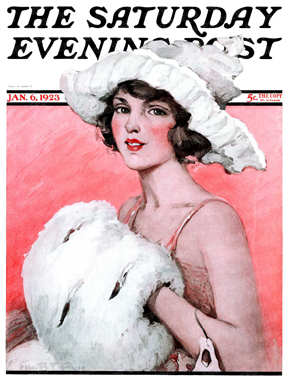
Ermine Muff
Ellen Pyle
January 6, 1923
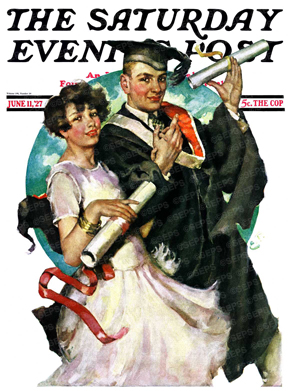
Graduating Couple
Ellen Pyle
June 11, 1927
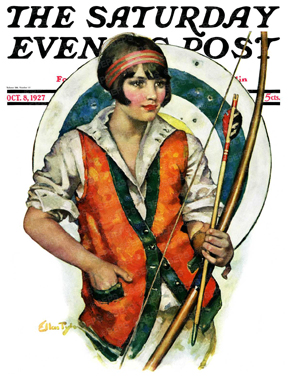
Target Practice
Ellen Pyle
October 6, 1927
J.C. Leyendecker
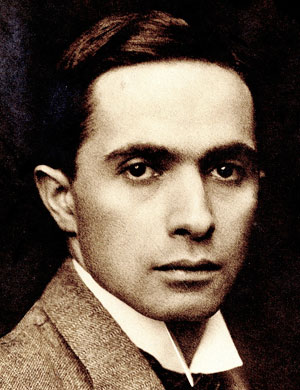
While those familiar with The Saturday Evening Post often think of Norman Rockwell as its most prominent illustrator, his mentor, Joseph Christian Leyendecker, made the Post an iconic magazine. Through his illustrious career as a popular cover artist, The Post rang in the early twentieth century with dozens of J.C. Leyendecker’s babies, advertisements, and holiday illustrations.
Born to Peter and Elizabeth Leyendecker in Montabaur, Germany on March 23, 1874, “J.C.” Leyendecker emigrated from Germany to Chicago, Illinois with his family in 1882 at the age of 8. His close relationships with his two brothers, Francis Xavier and Adolph, along with sister Mary Augusta, would later impact the adorable infant and adolescent depictions of his most famous illustrations.
Having a natural talent for art, Leyendecker and his brother, Frank, studied and worked together on small projects wherever they could find them. At the age of 15, Leyendecker apprenticed with J. Manz & Co. Engraving in Chicago. He learned quickly, rising to a job as Associate Illustrator under his Chicago Art Institute instructor, John Henry Vanderpool. Vanderpool had studied, researched, and even published a book on human anatomy, passing on to Leyendecker much of what artistic anatomical knowledge was available at the time.
By age 19, Manz & Co. had given Leyendecker a solo contract to illustrate sixty images for a client’s private bible, demonstrating utmost faith in his artistic abilities. In early 1896, the artist won a magazine cover competition for Century Magazine, which elevated his artistic brand to national fame. By autumn, J.C. and his brother Frank had enrolled at the Académie Julian in Paris, France. J.C. Leyendecker quickly rose to prominence while in Europe, earning a spot in a major painting exhibition at The Salon Champs de Mars in 1897. The brothers returned to Chicago in 1898 and together opened a studio for two years before moving their firm to New York City in 1900.
Over the course of his artistic career, Leyendecker completed 322 illustrations for The Saturday Evening Post and countless others for magazines such as The American Weekly, Success, and Collier’s. Not only did the artist work for magazines, he also created some of the most successful advertising campaigns in American history.
His ingenuity led to serial popularity, whether by the continuation of his New Year’s Baby theme for The Post as started in the magazine’s December 29, 1906, edition, or his invention of the debonair Arrow Collar Man while working for Cluett, Peabody & Co. in 1905. His work for Arrow Collar single-handedly increased the company’s sales to $32 million a year, making it the nation’s most successful men’s clothing company.
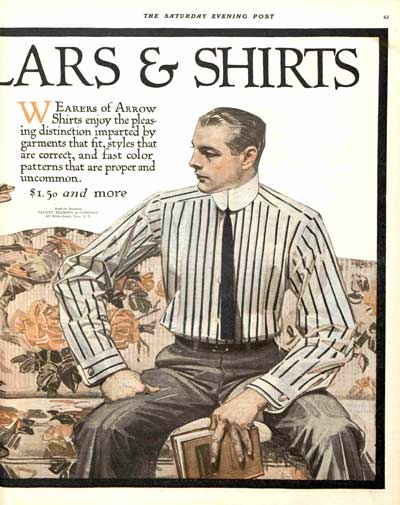
Leyendecker’s strong models defined manhood for an entire generation. His artistic reach knew no bounds. His famed illustrative depictions range from calendar holidays to collectable artwork of cherubim babies, relatable American life, and sports and war heroes. In some ways, Leyendecker happened to be a trained artist in the right place, at the right time. His work brought him financial success and international notoriety during the golden age of American illustration.
In 1914, he built a home in New Rochelle, New York where he lived with his brother Frank, sister Mary, and the original Arrow Collar model Charles A. Beach. Beach lived in the house as Leyendecker’s live-in secretary, business manager, and partner. J.C.’s brother Frank eventually moved out of the house in the early 1920s (possibly due to jealousy over his brother’s fame) and died of an overdose in 1924. Leyendecker’s popularity and financial success not only survived, but thrived during The Great Depression and World War II era.
By 1945, editorial changes at The Saturday Evening Post cut his once unbreakable relationship with the magazine. He had spent much of his earned income and returned to shopping his illustrations during the pre-eminent rise of photography.
Leyendecker lived a solitary life, keeping his family and friends close. He was never a recluse, yet shied away from public engagement. His home in New Rochelle was once known for boisterous and enjoyable parties. The grounds contained a large garden complex complete with roaming chickens and ducks where artists could trade ideas and discuss technique.
J.C. Leyendecker outlived many of his friends and, by the time he died of a heart attack in 1951, had only five individuals attend his funeral. Norman Rockwell and three of Leyendecker’s favorite male models acted as pallbearers. Leyendecker had faced some financial struggles toward the end of his life when the popularity of periodicals and illustrated covers declined. He still managed to leave a sizeable inheritance of $60,400 to his sister and 49-year live-in partner, Charles Beach. They, now famously, sold many of his life’s works in a yard sale in the gardens of the New Rochelle house for as little as $75 a piece.
Thus went the works of one of “the most popular illustrator in America,” the mentor to Norman Rockwell. Since his death, Leyendecker’s works have been rediscovered and purchased publicly and privately. In 1977, Leyendecker was deservedly added to the Society of Illustrator’s Hall of Fame. As for where his works have ended up, the Haggin Museum in Stockton, California, now holds more than 50 of his original works and continues to collect new finds.
Covers by J.C. Leyendecker
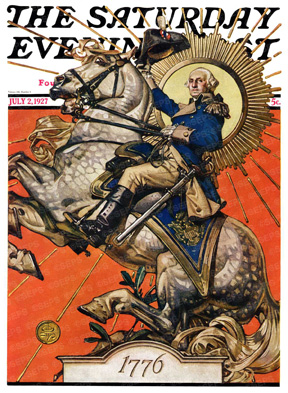
George Washington on Horseback
J.C. Leyendecker
July 2, 1927
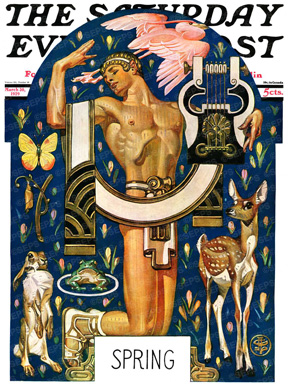
Spring 1929
J.C. Leyendecker
March 30, 1929
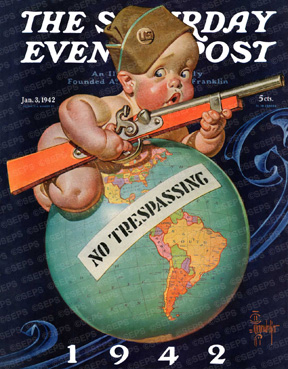
No Trespassing
J.C. Leyendecker
January 3, 1942
George Hughes
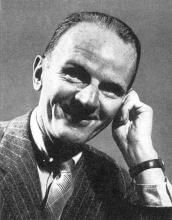
Born in New York City in 1907, George Hughes grew up in the epicenter of twentieth century art and advertising. He stayed in the city until adulthood, skipping college to attend the National Academy of Design and the Art Students’ League in the city.
After having finished his education, he provided freelance illustrations to the fashion industry including works for Vanity Fair and House and Garden. In 1936, the automotive industry drew him away from New York to Detroit. He worked in a stable job, contracted as a special designer, a Mechanical Designer for car companies. He disliked the industry, and shortly thereafter moved back to New York City.
Upon returning to the city, he had a short-lived first marriage and joined the Charles E. Cooper Studio. He created art and copy for the firm, and was eventually picked up as a talent for representation by American Artists. He quickly remarried. This time, love lasted a lifetime. He married a woman named Casey, and the two had a total of five daughters.
In 1942, Hughes caught the eye of Saturday Evening Post Art Director, Ken Stuart. Hughes had created a simple illustration for an interior fiction piece in the magazine. Stuart then commissioned Hughes for a series of WWII portraits of American generals titled “These Are the Generals.” This collection brought Hughes early national fame, and the Post kept tabs on his developing work for later possible covers.
With a growing family, Hughes and his wife decided they needed more living space. It was time to leave New York’s urban sprawl. George knew that Arlington, Vermont was growing in popularity among American artists. The Schaeffers, the Rockwells, and the Athertons were all family friends who lived there. In 1946, George and Casey bought a small farm near the other artists.
Their apparent reasons for purchase included the scenery and good business. The Hughes’s wanted to cultivate an air of artistic sophistication, forcing themselves into the popular artist group. Their plan paid off as Hughes soon became a recurring Post cover artist.
Hughes once remarked that he enjoyed sailing in summer, duck hunts in the fall, and skiing in winter. Arlington, Vermont turned out to be the perfect place to build his life. The Hughes’s developed lasting friendships as well. George often ran into Norman Rockwell in downtown Arlington. Rockwell would ask George’s opinion on his sketch ideas, but constantly painted the opposite of George’s advice in his final draft. The situation became a running joke between the two artists.
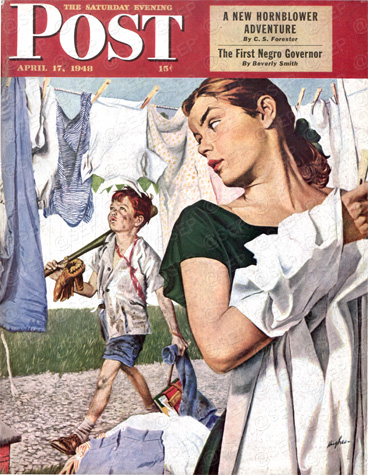
George Hughes’s first Saturday Evening Post cover was on the April 17th, 1948 issue. From that point on, Hughes had a successful career in the art world. He completed a total of 115 Post covers, along with illustrations for McCall’s, Woman’s Day, American Magazine, Reader’s Digest, Good Housekeeping, and many more.
Hughes, more than any other Post artist except Rockwell, survived the rise of photography. His last Post cover was July 14th, 1962 until he completed one more for the magazine revival in 1971. In the 1970s, he switched professions in the art world to become a successful portrait artist. He lived a full life, and died in 1990. During his lifetime, Hughes had seen his work on display in the Detroit Museum, the Pennsylvania Academy of Fine Art, and the Art Institute of Chicago.
Covers by George Hughes
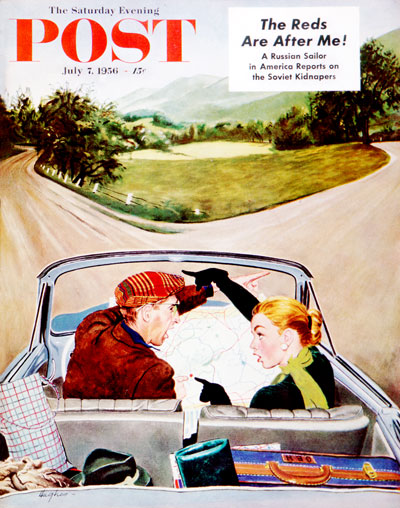
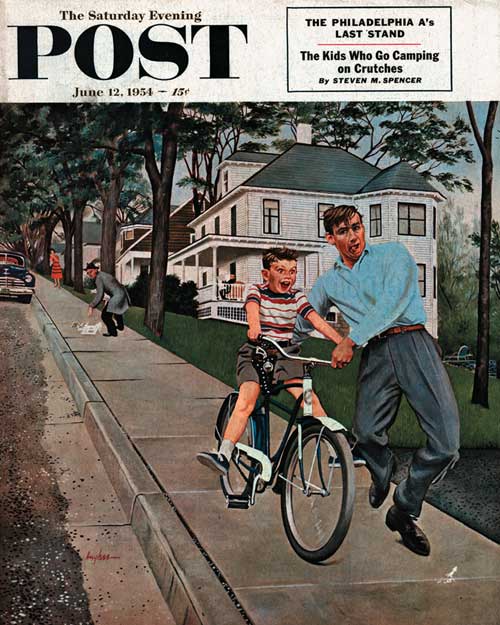
George Hughes
June 12, 1954
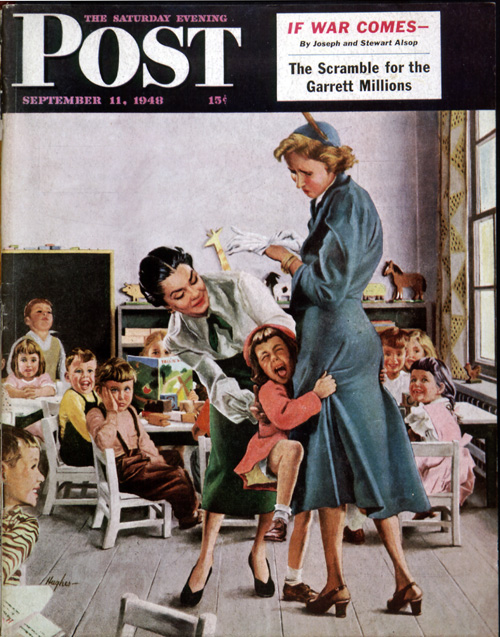
by George Hughes
September 11, 1948
John Falter
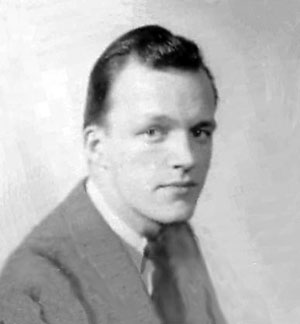
“As for a painting, it has to be a love affair every time. If you aren’t in love with what you are trying to put on your canvas, you better quit.” —John Falter
John Falter was a born and raised Midwestern illustrator, originally from Nebraska. Born in 1910 in Plattsmouth, Falter moved to Falls City in 1916 for his father’s job. From an early age, Falter found art and illustration attractive.
Even as a young man, the artist marketed his skills, creating a comic strip called “Down Thru the Ages” for the Falls City Journal. The Journal’s cartoonist, “Ding” Darling, happened to be a Pulitzer Prize-winning artist who encouraged Falter in his illustrative work.
Falter graduated high school in 1928, and chose to continue his artistic education at the Kansas City Art Institute. While studying in Kansas City, he eventually won a scholarship allowing him to continue his art education at the Art Students League in New York City at the height of the Great Depression.
Covers by John Falter
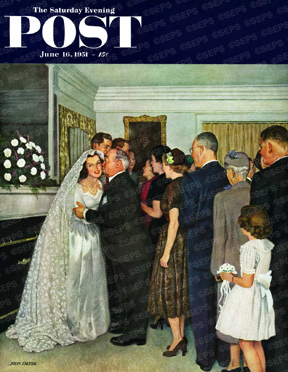
Receptions Line
John Falter
June 16, 1951
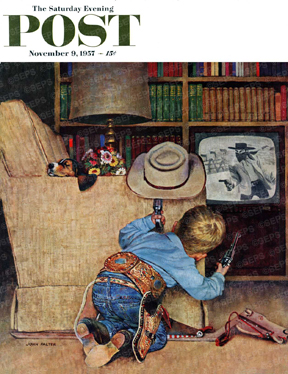
Good Guys Wear White Hats
John Falter
November 9, 1957
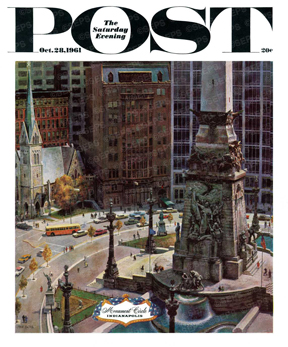
Monument Circle
John Falter
October 28, 1961
Work was initially scarce, however, the artist survived creating cover illustrations for “pulp” magazines. He, like so many other illustrators of his time, moved to the unofficially labeled “illustrator’s colony” in New Rochelle, NY.
Success arrived in a flurry once Falter opened his own illustration studio based out of New Rochelle, acquiring commissions from magazines and advertising firms in the city. He drew inspiration from his idol, Norman Rockwell, who lived nearby.
By 1932, at the age of 22, John Falter met and married Margaret Huggins of Emporia, Kansas. In 1956, John Falter’s first marriage ended in divorce. His illustration career stabilized and he eventually picked up consistent work from Liberty Magazine in 1933, completing three illustrations a week.
Falter picked up more advertising work, accumulating a stable of clients ranging from Gulf Oil and Four Roses Whiskey, to Arrow Shirts and Pall Mall Cigarettes. At the height of his illustration career, Falter was working for McCall’s, Life Magazine, Look, Good Housekeeping, and Cosmopolitan. The consistency of this advertising work allowed Falter the free time to experiment in his art, picking up other media such as easel painting in oils and watercolors.
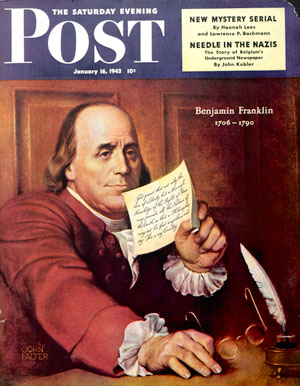
By John Falter
January 16, 1943
His first cover for The Saturday Evening Post was a portrait of Benjamin Franklin for the January 16, 1943 issue. One of The Post’s youngest contributors, Falter amassed a large portfolio of Post covers, completing 129 covers over the course of his life. His works, much like those of Norman Rockwell, are simple observations of every day American life which may have otherwise gone unnoticed if not picked apart by a skilled artist.
By the time America entered both of World War II’s wartime theaters in the Pacific and in Europe, Falter had enlisted in the Navy where he was put on special assignment to design recruitment posters specifically for women. Completing over 300 posters, Falter’s works are now famous for dealing with the “loose-lips-sink-ships” theme. He was even commissioned, while in the service, for illustrations depicting American Medal of Honor recipients on twelve covers of Esquire Magazine.
In 1956, his first marriage ended in divorce. In 1957 he married his second wife, Mary Elizabeth “Boo” LaRue Wiley. She brought three stepchildren from her first marriage into his life — Elizabeth “Lisa”, Sarah, and John “Jay.” In 1958, the couple had a daughter, Suzanne.
Though popular in the 1940s and 1950s, illustration fell into decline during the 1960s. John Falter was able to adapt and find an even more profitable line of work in portraiture and western art during the late 1970s and 1980s. He was inducted into the Illustrators Hall of Fame in 1976 and made a member of the National Academy of Western Art in 1978. In April of 1982, Falter suffered a stroke and died from complications within a month’s time. He left behind a wide artistic legacy ranging from cover art and advertising, to murals, portraiture, prints, and paintings in a wide variety of media and genres of art.
More on John Falter:
Museums: John Philip Falter Museum in Falls City, Nebraska
Birth: February 28, 1910
Education: Kansas City Art Institute, Art Students League of New York City, Grand Central School of Art
Family: Married Mary Elizabeth LaRue Wiley; stepchildren Elizabeth, Sarah, and John; daughter, Suzanne
Residences: Plattsmouth, Nebraska; Falls City, Nebraska; Kansas City, Missouri; New York City, New York; New Rochelle, New York; Philadelphia, Pennsylvania
Occupations: Artist, Illustrator, Portraitist, Painter, Book Cover illustrator, printer
Style/Genre: American Art, Western Art
Death: May 20, 1982
Stevan Dohanos
Stevan Dohanos, born May 18, 1907 in Lorain, Ohio, grew up as a great admirer of Norman Rockwell, going so far as to copy his Saturday Evening Post cover illustrations in crayon that he sold to friends, relatives, and co-workers. Little did Stevan know, he would develop a close personal friendship with Rockwell as his own art graced the Post’s cover 123 times over the course of his lifetime.
Dohanos was the third of nine children born to Hungarian immigrants Elizabeth and Andras Dohanos. His upbringing in a midwestern steel town would later influence the cultivation of his artistic style showing the normalcy and realism of American life. While inspired by Rockwell’s talent, Dohanos became an “American Realist” who depicted everyday life as it was. He was most heavily influenced by the work of Edward Hopper, and chose not to idealize American life the way Rockwell did.
Dohanos realized his love of art fairly early in life, selling calendars and illustration copies for $1.00 to $3.00 apiece while he worked in a grocery store and later at an office job. He began his formal education by taking correspondence classes through the International Correspondence School. Soon after, the artist took night classes at the Cleveland School of Art where he received a scholarship to complete his formal art studies.
During and after art school, the young Dohanos worked in a Cleveland advertising firm, then travelled around the country painting wall murals before heading to New York City to work as a commercial artist. He eventually moved to the artist colony of Westport, Connecticut where he found inspiration in the everyday lives of his neighbors.
While working in the city, Dohanos picked up advertising work from clients such as Four Roses Whiskey, Maxwell House Coffee, Pan Am Airlines, Cannon Towels, Olin Industries, and John Hancock Insurance. His work was featured in Esquire, Medical Times, McCall’s, and Colliers prior to his first successful submission to The Saturday Evening Post. In September of 1938, he married his longtime sweetheart, Margit Kovacs, and had two children, Peter and Paul.
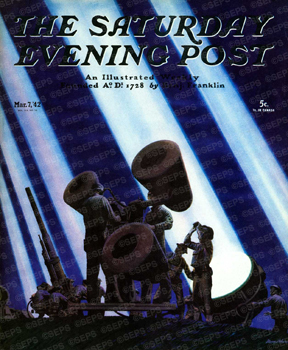
Stevan Dohanos
March 7, 1942
His first Post cover, the March 7, 1942 issue, was a well-received wartime image of air raid searchlights from an artillery battery. Throughout the 1940s and 1950s, the artist’s workload for The Post increased, garnering a contract for roughly a dozen covers a year.
During World War II, Dohanos aided the war effort by painting recruitment posters and wall murals for federal buildings. He also designed stamps for the federal government, starting during the Roosevelt administration, and staying in the profession the rest of his life.
As magazine covers turned toward photography and away from illustration, Dohanos quickly changed careers. He did film art for such classics as White Christmas and was the chairman of the National Stamp Advisory Committee where he oversaw the art design for over 300 stamps. He held the position throughout the administrations of 7 presidents and 9 Postmaster Generals. His depictions include presidential portraits, the now collectible NATO commemorative stamps from 1959, and the 1967 John F. Kennedy commemorative stamp.
Stevan Dohanos found beauty in everyday life, choosing to focus on “the location and trappings of the American dream, not those who populated it.” Elevated to lofty status as a famous Saturday Evening Post illustrator, Dohanos’s works now garner the walls, halls, and galleries of The Cleveland Museum, The New Britain Museum of American Art, The Pennsylvania Academy of the Fine Arts, Dartmouth College, The Whitney Museum of American Art, and various federal post offices across the United States. He died July 4th, 1994 at the age of 87.
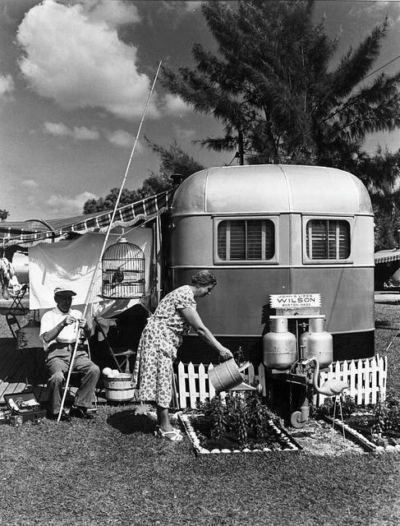
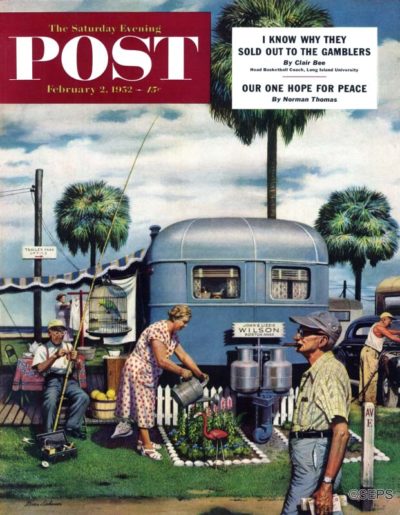
Stevan Dohanos hewed closely to the photo that he used to create this homey Florida scene for our February 2, 1952, cover.
Covers by Stevan Dohanos
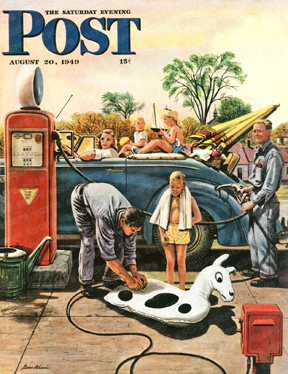
Inflating Beach Toy
Stevan Dohanos
August 20, 1949
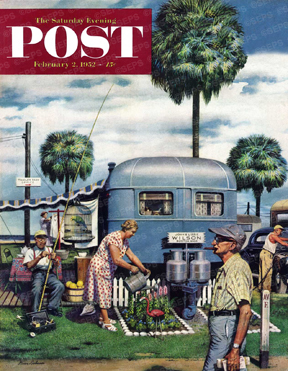
Trailer Park Garden
Stevan Dohanos
February 2, 1952
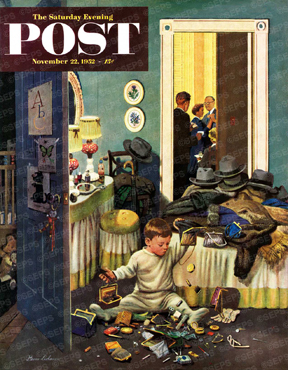
Toddler Empties Purses
Stevan Dohanos
November 22, 1952
John Clymer
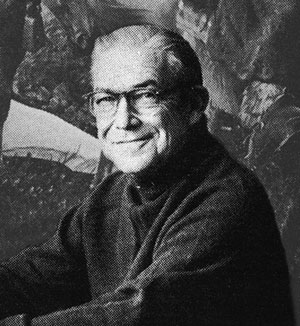
John Clymer began his life on the west coast, but spent much of his career out east working in illustration and advertising. Born in Ellensburg, Washington in 1917, Clymer grew up fascinated by natural art at the foothills of the Cascade Mountains. Over the course of his life, he nurtured his love of nature and eventually became most famous for his depictions of the iconic American west. His parents, John and Elmira Clymer, lived simple lives owning a greenhouse and florist business together.
John was not an academic child. He preferred doodles and staring at the landscape outside the classroom window over paying attention to adults. In his youth, the local Presbyterian pastor halted his own sermon to tell John, who was sitting in the back, to stop drawing in the hymnals.
Covers by John Clymer
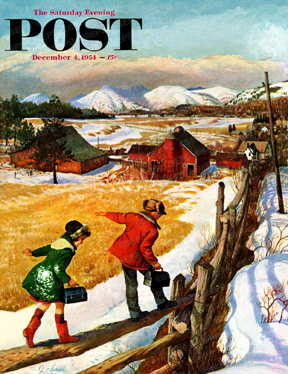
Walking on the Fence
John Clymer
December 4, 1954
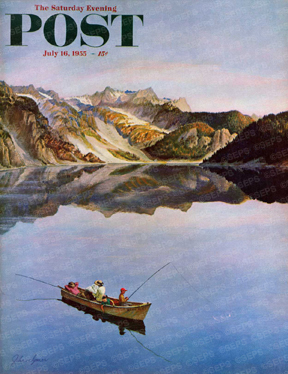
Fishing on Mountain Lake
John Clymer
July 16, 1955
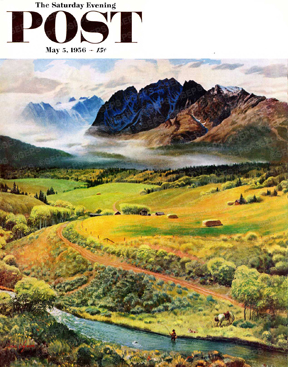
Rocky Mountain Fly Fishing
John Clymer
May 5, 1956
John’s interest in art began when his parents subscribed to magazines offered by a traveling salesman. At the onslaught of viewing those first professionally illustrated images, John Clymer knew he wanted to be an artist. Since there were no art schools nearby, John joined a federal correspondence course. While still in high school, his friends and classmates encouraged his budding talent. He designed local advertisements for the town rodeo, and even received commissions from Colt Firearms.
Upon graduating high school, Clymer moved up to Vancouver, Canada where he spent eight years illustrating for various Canadian magazines and advertising firms and attending art school classes at night. As his popularity grew, Clymer realized that the most profitable work was on America’s east coast.
In 1932, Clymer married his childhood sweetheart, Doris, and together the two moved to the artist’s colony of Wilmington, Delaware. John went back to school, choosing to study commercial art at the Wilmington Academy of Art. His professors there were some of the greatest names in American illustration, including N.C. Wyeth and Frank Schoonover, each a former student of the great Howard Pyle. After five years there, John and Doris moved to Westport, Connecticut in 1937.
By the 1940s, Clymer’s career on the east coast had taken off. He provided illustrations to such magazines as Argosy, Woman’s Day, Field and Stream, and his first Saturday Evening Post cover on the January 31st, 1942 issue. Clymer created over 80 covers for The Saturday Evening Post between 1942-1962, often portraying patriotic or western scenes.
Once World War II began, Clymer joined the Marine Corps with his artistic partner, Tom Lovell. At age 35, the artists were a little too old to fight on the battlefield. The two were assigned jobs creating illustrations for the Marine Corps magazines Leatherneck and The Marine Corps Gazette.
After the war, John returned home to focus on raising his children and creating new art. Alongside his successful magazine illustration business, John had a large stable of advertising clients including White House Scotch Whiskey, The Pennsylvania Railroad, and The Chrysler Corporation.
With the decline of illustration, Clymer and his wife moved to Jackson Hole, Wyoming in 1970 and stayed there the rest of their lives. He kept a studio out there where he produced paintings of the landscapes and imagined iconic western scenes.
In 1976 he received the prestigious Prix de West Award from the Academy of Western Art. He also received medals from the Cowboy Artists of America, Western Artist of the Year from the National Wildlife Art Collectors Society, and in 1988, he received the Rungius Medal from the National Museum of Wildlife Art.
The artist died in 1989 and has been named a member of the Royal Canadian Academy of Arts. Today, many of his famous paintings and illustrations rest in The Clymer Museum of Art in his original hometown of Ellensburg, Washington.
John Atherton
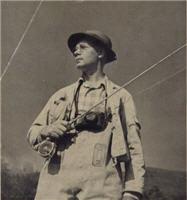
John Atherton was born on June 7, 1900 in Brainerd, Minnesota, but his family moved to the West Coast shortly after his birth. John spent his high school years in Spokane, Washington, where he derived great satisfaction from nature. These elements would emerge in Atherton’s oil paintings as well as his commercial work in the years to come. Nature would also become a place in which John could collect his thoughts and refresh his creativity.
Atherton’s first recollection of an interest in art came when he painted a portrait of his aunt and received a favorable response. John completed his art education from the California College of Arts in San Francisco. In the process, he also worked in the surrounding studios developing his oil painting techniques. A first prize award of five hundred dollars financed John’s trip to New York, which helped launch his career. Atherton accomplished his first one-man show in Manhattan in 1936. His Painting, “The Black Horse” won the three thousand dollar fourth prize from among 14,000 entries. This painting now hangs in the Metropolitan Museum in New York.
As his career began to unfold, John Atherton found a rhythm that allowed him to develop his work in the both the artistic and the advertising arena. On November 2, 1926, he married Maxine Breese. Over time, the couple found themselves migrating to Westport, Connecticut which boasted an artistic community that rivaled none other. John Atherton’s first cover for The Saturday Evening Post was created in 1942, and continued with regularity until 1961. After a grand tour of the United States, this would become home for John’s wife Maxine and daughter Mary. The Atherton’s socialized with fellow artist, Mead Schaeffer and his wife which often lead to a variety of excursions which provided subjects to expound upon on canvas. The community provided not only a social outlet, but also a creative environment to cultivate and express his ideas.
It seems fitting that John Carleton Atherton would die as he lived, in tune with nature. His death occurred while he was salmon fishing in New Brunswick, Canada in 1952 at age 52.
Covers by John Atherton
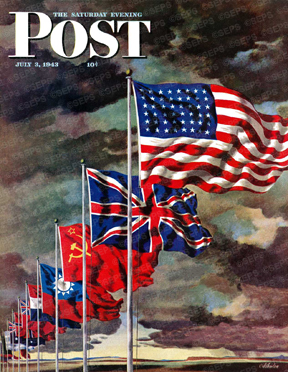
Allied Forces Flags
John Atherton
July 3, 1943
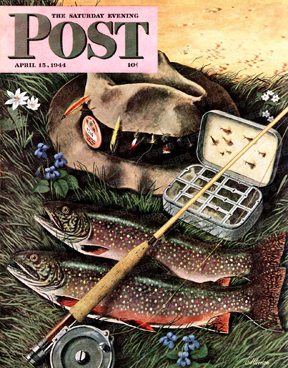
Fishing Still Life
John Atherton
April 15, 1944
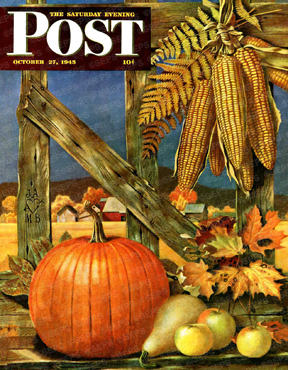
Fall Harvest
John Atherton
October 27, 1945
Beyond the Canvas: Just Add Water
John Hyde Phillips
August 12, 1939 © SEPS
The thought of waves crashing on the beach, the warm white sand, the hot sun, and wading into cool waters makes the daily 9-to-5 bearable. However, we only seem to consider the best beach moments. We conveniently forget the hassle of what it takes to get there.
Throughout history, covers on The Saturday Evening Post have brought those dreamy thoughts down from tropical blue skies and white clouds. The beaches of Post covers deal in a humorous realism. They explore the tiresome preparation involved in reaching coastal paradise.
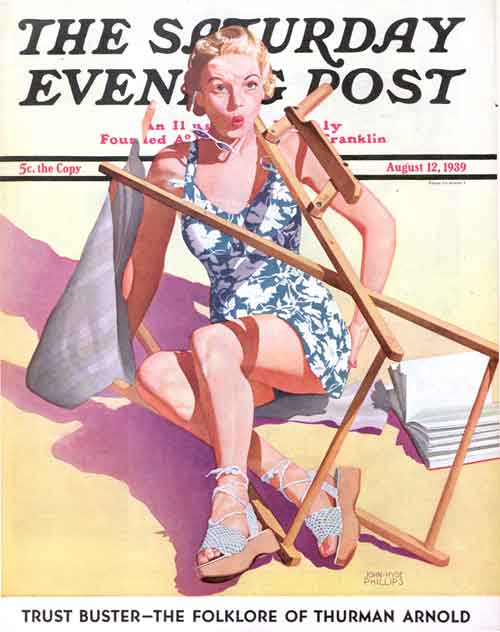
This narrative began with “Broken Beach Chair,” the August 12, 1939 cover by John Hyde Phillips. Flimsy chairs get in the way of enjoying the sun. A woman puckers her face in a mix of surprise and embarrassment as she hits the ground. Either it’s been a while since that chair left storage, or beach supplies were just as cheap then as they’ve ever been.
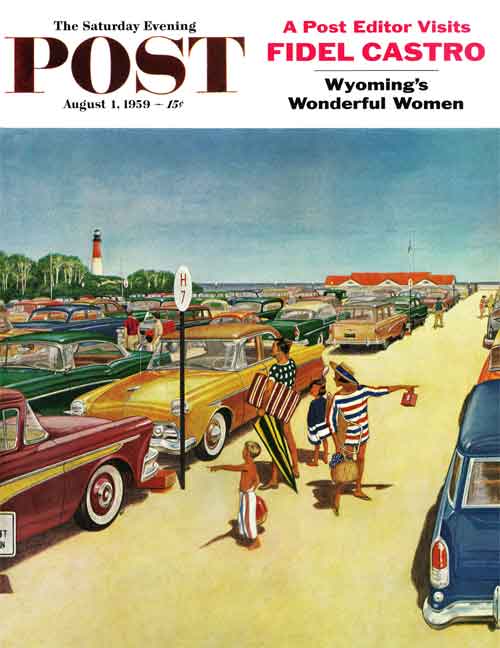
James Williamson’s August 1, 1959 cover, “Beach Parking Lot,” expands on this difference between expectation and reality. Before they can reach the promised relaxation of a lounge chair, sand-bound hopefuls bumble through cars and cabanas.
Parents are loaded down, carrying their children, umbrellas, beach toys, books, bags, towels, lotions and creams, wallets, hats, and other miscellaneous gear. And once beachgoers reach the sand? There’s the trouble of finding an open spot to drop the lot and set up camp. Even on vacation there’s work to be done.
And of course, the warming glow of the sun isn’t all it’s cracked up to be. Kurt Ard’s August 16, 1958 cover “Sunscreen?” reminds us the sun’s charm has a way of turning malicious. A pale man rests in relaxation, but his skin is covered head-to-toe in heavy, sun-blocking fabric. Even a thin veneer of newspaper drapes over his robed chest to protect himself from what could be a nasty sunburn.
Despite the frustration and misfortune that a beachside vacation can cause, all is not lost. George Hughes’s “Couples at the Beach” from August 2, 1952 shows us the value of a day at the beach. Fun in the sun is multi-generational. Kids play in the sand. Couples picnic. Adults unwind appreciatively. Retirees leisurely enjoy what for them is a normal stroll along the shoreline.
The beach is worth the struggle, worth fighting for a spot in the parking lot, traversing the hot pavement, applying sunscreen, and getting a seat. It’s a paradise people work toward all year, and nothing can ruin the beach.

Kurt Ard
August 16, 1958 © SEPS
James Williamson
August 1, 1959 © SEPS
John Hyde Phillips
August 12, 1939 © SEPS
Protect and Serve
1958 © SEPS
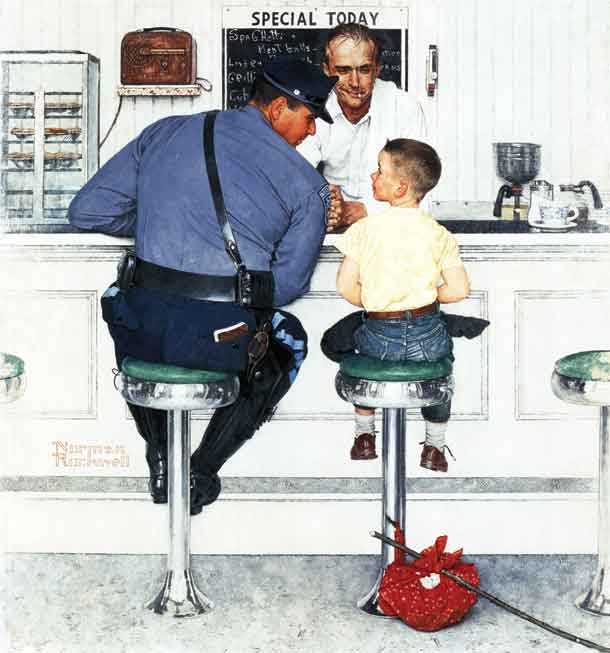
Rockwell’s famous painting The Runaway depicts a child literally on a pedestal–well, barstool–surrounded by a protective and understanding community.
The setting is pristine; this is no ordinary diner. It’s the Platonic ideal of a diner, where the floor is immaculate, the counter gleams, and even the waiter’s clothing and towel are unsullied.
The only prop that suggests a disturbance is the wannabe hobo’s stick and handkerchief.
Normally a scene featuring a runaway child evokes anxiety. Instead, Rockwell’s painting radiates comfort and safety in the form of a triangle of protection surrounding the boy. To the left is the fatherly state-police officer, at the top is the counterman, and to the right is an empty coffee cup, suggesting another good Samaritan had been sitting there not long ago. Perhaps the anonymous diner made the initial call to police and then stayed with the boy until the officer’s arrival. The complete narrative depicts a cocoon-like community taking shifts to watch over a child in trouble.
In the painting, Rockwell portrayed an idyllic version of small-town America. In his sweet, safe universe, no child is ever in danger and no task is more pressing for an officer of the law than to spend a morning with a young runaway. After appearing on the September 20, 1958, cover of the Post, The Runaway began to grace the walls of countless diners and police stations throughout the country.
Fun fact: The Runaway was staged in a Howard Johnson’s restaurant in Pittsfield, Massachusetts. Rockwell later removed all traces of the chain restaurant in favor of a simple blackboard listing the daily specials often found in country diners “to suggest the kid had gotten a little further out of town.”
Beyond the Canvas: Golf Takes Root in American Culture
Penrhyn Stanlaws
June 9, 1928. © SEPS
Golf arrived in the United States as a sport for the wealthy, even though the country club pastime originally came from Scottish shepherds in the Highlands.
Over the course of the twentieth century, golf’s popularity grew in American culture, and as its notoriety expanded, the sport trickled down the social ladder to become an iconic activity of casual business and suburban relaxation.
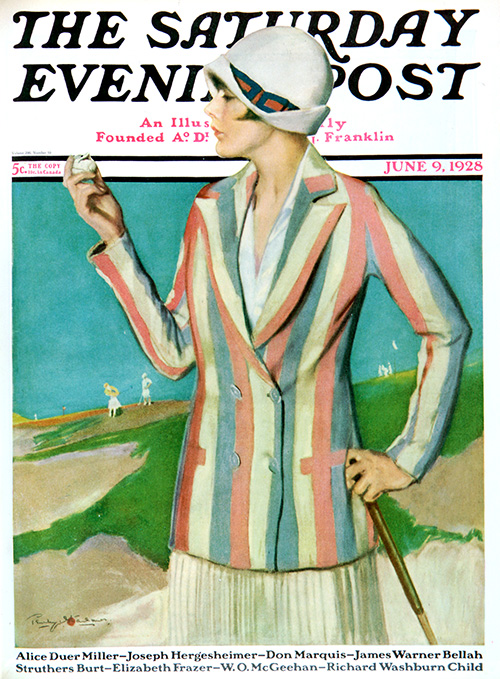
Three Saturday Evening Post covers, “Woman in Sandtrap” by Penrhyn Stanlaws from June 9,1928; “Golf Driving Range” by John Falter from July 26, 1952; and “This Car Needs Washing” by Amos Sewell from October 3, 1953, document the growth of golf in America from luxury haute-couture sport to chore-shirking fun for all.
“Woman in Sandtrap” is a 1920s era, Gatsby-esque watercolor that depicts a formally dressed female athlete out for a sporting day on the links. Her aristocratic attire of sport coat, skirt, and hat complement her determination to take the game seriously.
By the 1950s, golf had emigrated from the wealthy country clubs to middle-class America via the maturity of young, teenage caddies into active adult males. The once-boys of America who worked for tips as bag carriers had, by the 1950s, now mastered the game. These men had spent entire childhoods walking the country’s greatest courses, learning the game, and watching the players.
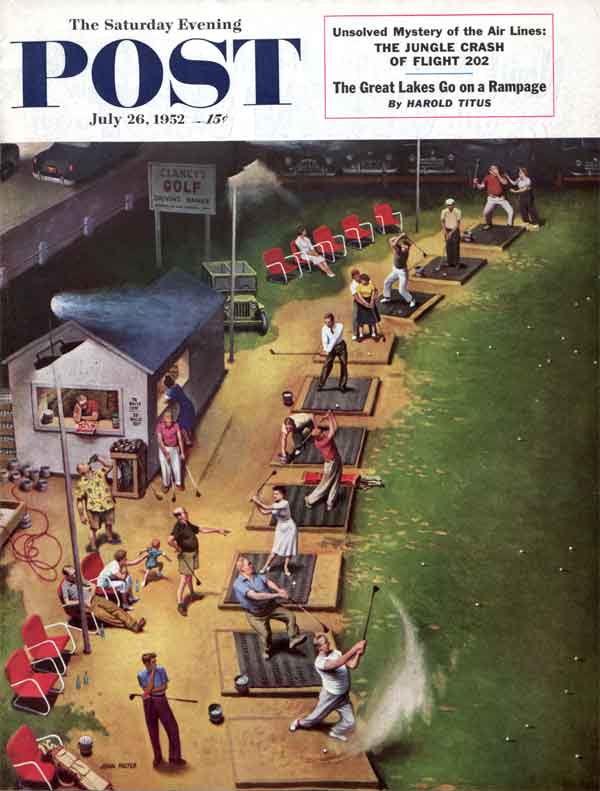
John Falter
July 26, 1952. © SEPS
Falter’s “Golf Driving Range” amplifies this socioeconomic change in the sport’s athletic base. The sport moved from the aristocracy, who had time in their day for such leisurely activity, to the American middle class.
Falter illustrates the wide breadth of working class America practicing its swing by evening lamplight. Along the line of swings, a professional gives lessons, a wife reads a magazine while she waits for her husband, a couple is out on a date, a family takes turns, and men and women practice their drives.
These middle class Americans gather at the driving range after working hours on a weeknight. This isn’t the best time to hit the driving range since daylight is optimal for spotting the tract of a golf ball in motion, but these players are devoted. They show up after work to practice at the range so that they have all day to play the actual 18-hole game over the weekend.
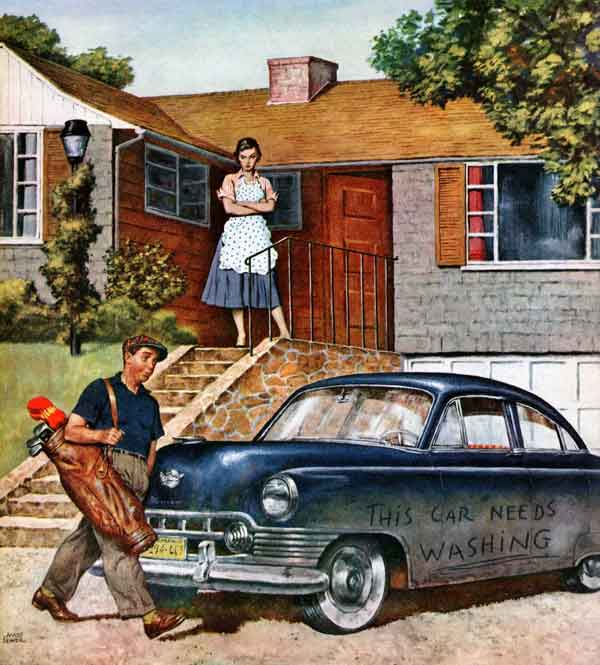
Amos Sewell
October 3, 1953 © SEPS
Sewell’s cover “This Car Needs Washing,” makes a joke out of the commonplace nature of the sport in American popular culture. Also painted in the 1950s, this piece shows a husband willfully ignoring his wife’s dust-drawn message to clean the car. He neglects his assigned chore in favor of an afternoon on the greens and fairways. The husband whistles in feigned absentmindedness, an attempt to pretend he hasn’t noticed his annoyed spouse at the door.
Even today, this image resonates with suburban America. Golf is now so beloved by the country that most could understand why a weekend of golf would be well worth the ensuing anger for shirking chores.
Golf, as a single-athlete sport, has become a game for the whole country. Couples, parents and children, single individuals, friend groups, and business associates all head out to talk, drink, and play when the weather’s right.
Beyond The Canvas: Dad, Interrupted
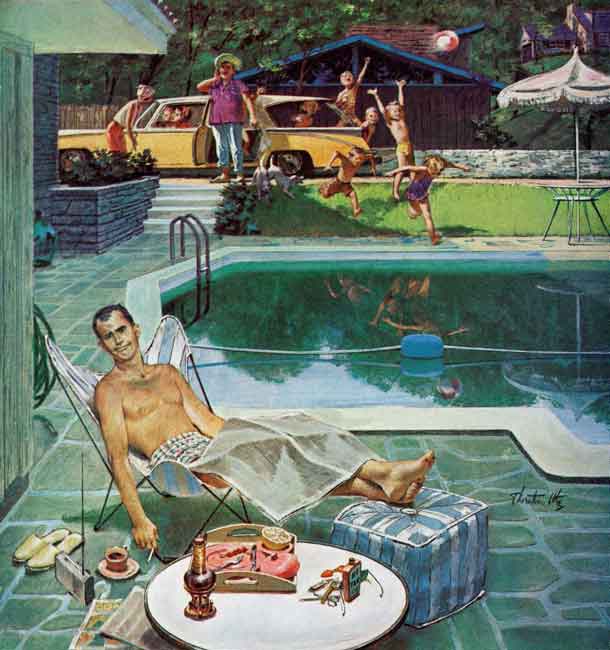
Thornton Utz
July 22, 1961 © SEPS2014
Father’s Day, a commercial holiday if ever there was one, tends to be associated with family harmony. Isn’t dad just the best!
But dads are real people with real emotions. Sometimes, when a dad has a lovely tranquil day planned, something spoils it, and then you better look out.
Thornton Utz’s July 22, 1961 cover, “Unwelcome Pool Guests,” (not intended as a satire on Father’s Day, by the way) perfectly conveys this kind of moment.
Utz, a master of family drama, uses the man’s facial expression to convey the general feeling of the scene we’re witnessing–annoyance. What was supposed to be a relaxing day lounging outside has quickly turned to a family pool party fiasco.
Next to the man, the artist illustrated the hallmarks of a day spent relaxing. We see a tuned radio, morning slippers, coffee cup and saucer, breakfast tray (complete with grapefruit half), lit cigarette, newspapers, suntan oil lamp; lotion, tanning eye covers, sunglasses, and most importantly, the man’s set-aside unstrapped watch. He’s shirtless, unadorned, and hoisting his feet upon an ottoman as he sinks into the sling of a pool chair.
The man has nowhere to be on such a warm and sunny weekend. It is early morning, the sun hasn’t even risen over the roofline of the house enough to warm the pool naturally. Our homeowner has taken his breakfast outside by the pool to read the Saturday paper. There’s not a single ripple on the reflective water.
This pool takes up the majority of the illustration’s canvas for a symbolic reason. The barrier of crystal stillness is all that separates the homeowner from the ensuing chaos of splashing and yelling approaching from the parked car at the far edge of the illustration’s frame.
His clean and tidy yard, his happy, tranquil world, is about to become quite the mess. A man hollers from the car, barely restraining two dogs. Eight children run, if you count the leg still in the car, and adults slowly clamor out of the vehicle.
Whether these arriving individuals are extended family, friends, or even just local neighbors, everyone looks ready to have a good time–except the pool’s owner. But the arriving guests are clearly close enough in their relationship to the pool-lounger to feel that their presence could never be a bother.
While family and family-centered activities are wonderful memory-crafting events, sometimes dads just want to relax and have some much-relished alone time. So this Father’s Day, get the father figure in your life a card and a gift, and maybe a little time off. Remember that a little relaxation might just be the most appreciated gift of all.
Vintage Christmas Tech Ads from The Saturday Evening Post
These ads might seem quaint now, but the products in them were on the cutting edge of technology in their day. Typewriters, radios, refrigerators, black-and-white TV sets: each of these was once as recent as smartphones, tablets and Chromecast are today.
The 1940 Frigidaire ad featuring Santa Clause includes a price tag of “Only $116.50,” the equivalent of almost $2,000 today. The 1948 Admiral “Triple Thrill” ad for an all-in-one entertainment center featuring a TV, radio, and phonograph player lists a price of $549.50. That’s over $5,300 in today’s dollars.
They’re an icon now, but Christmas lights were still new in 1922.

Before the Macbook…

You mean Sony didn’t invent headphones?

A gift for the whole family from RCA.

Many ads found a tenuous tie between electric lights and Jesus’s birth.

This 1929 ad uses Art Deco style to sell modern appliances.

That’s an oddly specific letter to Santa.

They’ve been playing holiday music on the radio for at least 70 years.

Westclox: “Give the gift of time.”

Clocks and watches used to be common Christmas gifts.

Here’s a hot pun:

By 1938, RCA already had decades of history.

That’s almost $2,000, once you adjust for inflation.

A shift to military production didn’t stop advertisers during WW2.

Imagine coming home to this:

Portable typewriters were the laptops of their day.

This ad has a watch idea for everyone.

Even in 1957, typewriter technology was still advancing.

This ad series from GE boasts the latest technology from fifty years ago.

Making home movies in 1966.

And now you can watch TV everywhere you go.

Beyond the Canvas: Rockwell’s April Fools’ brings laughter in a serious time
Norman Rockwell once said, “I showed the America I knew and observed to others who might not have noticed.” Most of Rockwell’s covers are subtle opportunities to stop and look at the innocent, decent normalcy of American life. On three April Fools’ Days throughout the 1940s, Rockwell took a chance showing a surreal America no one knew, and he certainly made us notice.
After spending six months working on the serious Four Freedoms paintings, the ideas for which came from a speech by President Roosevelt, the April Fools’ covers were a welcome moment for Rockwell to take a step back from war and celebrate joyous laughter.
The covers turned seemingly innocent depictions of American life upside-down with hundreds of topsy-turvy injections of laughable absurdity. The first of the paintings appeared on April 3, 1943; the second on March 31, 1945; and the final April Fools’ Day cover on April 3, 1948. The scenes are simple Rockwell “Americana”: an elderly couple playing chess, a man fishing while leaning against a tree, and a girl shopping for a doll – all comically, nonsensically twisted.
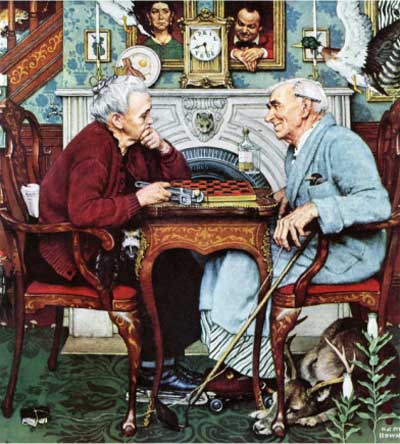
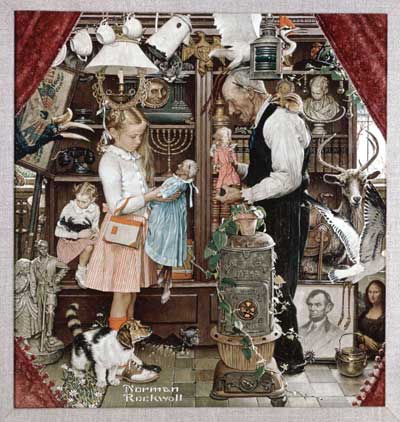
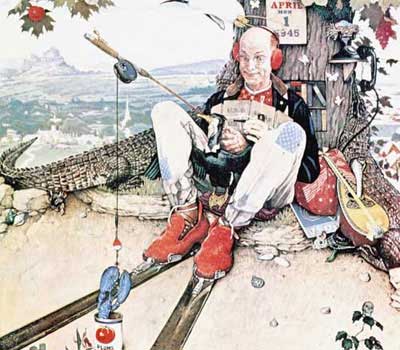
American sensibilities had become more serious with the onset of World War II. Rockwell’s former models – children at play, in a store, at the doctor’s office – had grown into young men and women who were asked to serve their country. Although Rockwell would later return to paintings of children, everyday lives were turned upside-down by this new reality. Small-town simplicity had been traded for the construction of war machines, rations and collected supplies, and various means of an entire nation aiding the war effort.
Seeing the April Fools’ covers from the newsstand, or as they arrived in the mail, provided just as much fun for the viewership as Rockwell had taken in designing the illustrations. People could find each and every absurdity on their own or with a group, pointing out the various April Fools’ Day quirks and gaffes. They worked well as clever talking points to bring individuals, families, communities, and the nation together, coaxing them to pause, to put aside the feelings of seriousness and frustration that consumed the country.
The covers worked so well that by the time the third was published, finding the jokes in Rockwell’s April Fools’ Day art became an exciting game Post readers eagerly awaited. To this day, these three covers mesmerize viewers and bring a quick bout of laughter. See how many April Fools’ jokes you can spot and check your answers in the image below!
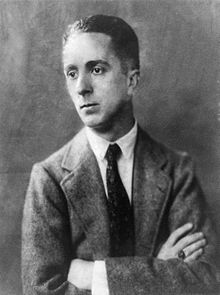
See answers to all of Rockwell’s April Fools’ covers here.
Beyond the Canvas: “The Critical Young Man” by Coby Whitmore
Click here to purchase artwork from Coby Whitmore at Art.com.
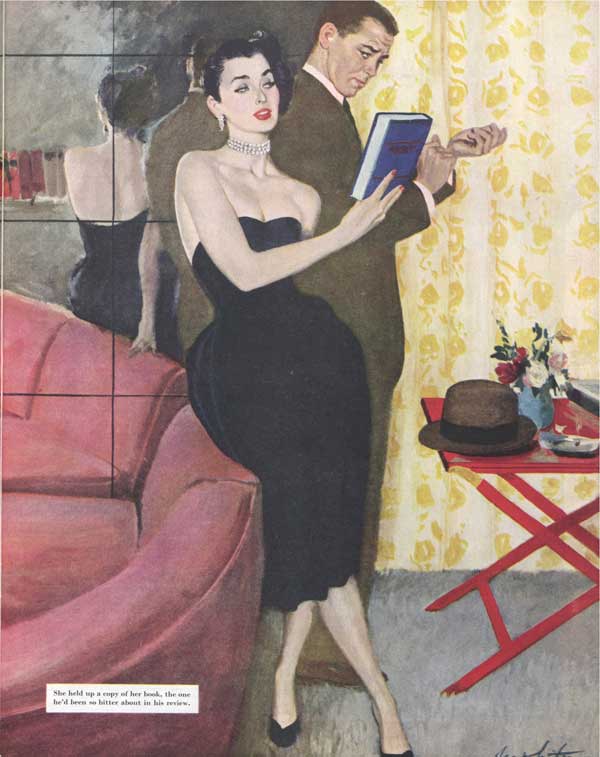
To understand Whitmore’s illustration from “The Critical Young Man,” you must first understand the theme of story. The tale revolves around a judgmental literary critic, Harvard Smith, who lambasts an author’s book for using an image of a scandalous dress on the cover.
The author, Edna Cloud, believes the critic must be a tiring old man, so under the guise of an alias, she flirts with the critic to understand him. She is shocked to find an intelligent man her own age, and she later reveals her identity by wearing the infamous dress on her first date with Smith.
Whitmore’s illustration cuts to the moral of the story by focusing on this moment: Edna Cloud shows Harvard Smith that he was wrong to judge her book–and Edna herself–by the cover.
Whitmore’s work is filled with visual symbolism that shows the viewers how the two characters are feeling internally. Edna Cloud and Harvard Smith stand back to back in the center of the frame, and each side of the apartment mirrors the respective characters’ emotions. Edna stands in front of a mirror that reflects her bare back and uncovered shoulders to the viewer, which tells the viewer that she’s open-minded. Harvard Smith, on the other hand, is a professional critic; he’s rigid, closed off. He believes in boundaries and strict moral values. Whitmore uses the character’s dress and mannerisms to convey to the reader that these people are total opposites.
If you look at Harvard Smith’s face, you’ll notice that it’s contorted; his eyes scan the back of the dress, Edna, and the book. The illustration captures the moment where we aren’t quite sure if he’s figured out that the woman he’s come to know is the same woman who wrote the book he judged so heavily.
Whitmore’s illustration takes the viewer to the climax of the story: Edna Cloud’s plan has taught Harvard Smith a timeless lesson: appearances can be deceiving.
Eight Winter Driving Ads from the Early 20th Century
Early January’s sci-fi-sounding ‘polar vortex’ dropped thermometers well below zero and dumped countless tons of snow from New Mexico to Maine. Flights were cancelled, power lines went down, and across the country, road travel became either impractical or impossible.
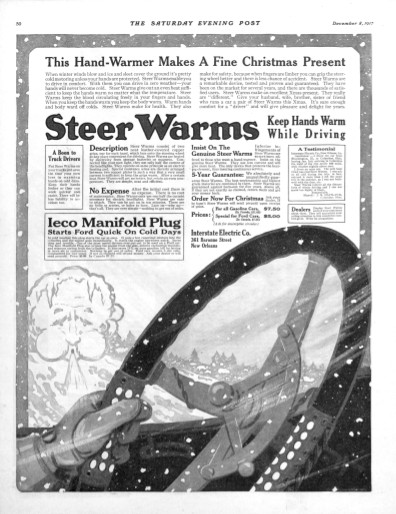
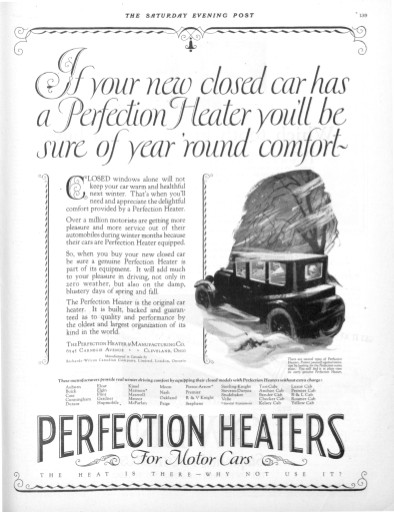
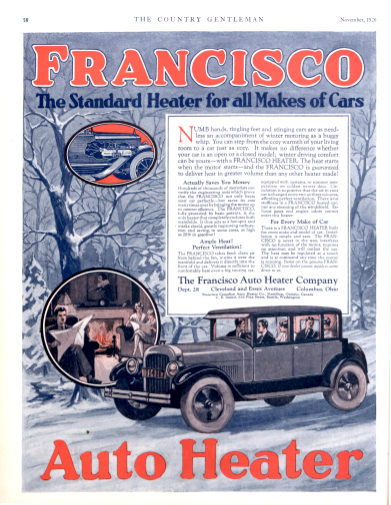
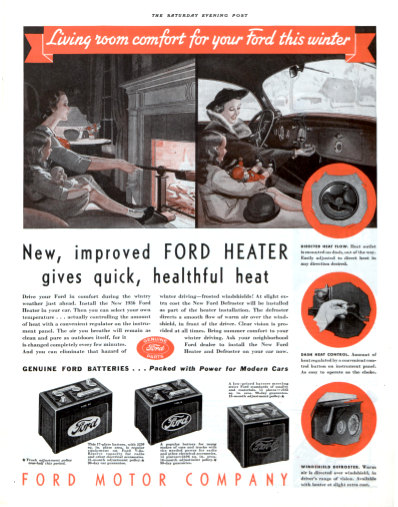
In short, it was sucked for drivers, but you might draw comfort from how much more comfortable winter driving has become in the past few decades. Heaters, defrosters, and even closed roofs were novelties in cars, as you’ll see in these advertisements from the The Saturday Evening Post and our sister publication, the former Country Gentleman.
You know it’s cold when you invent a way to electrocute yourself to stay warm.
Winter on the outside… Living room on the inside!
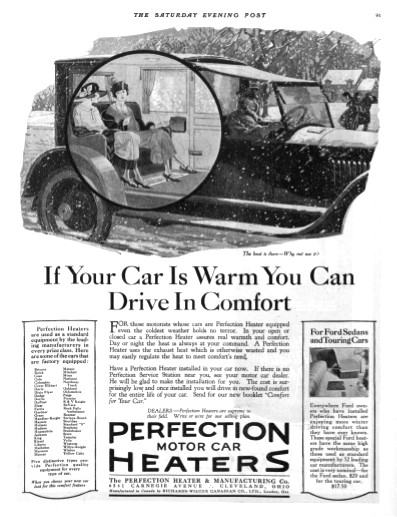
Once upon a time, closed-roof cars were pretty novel.
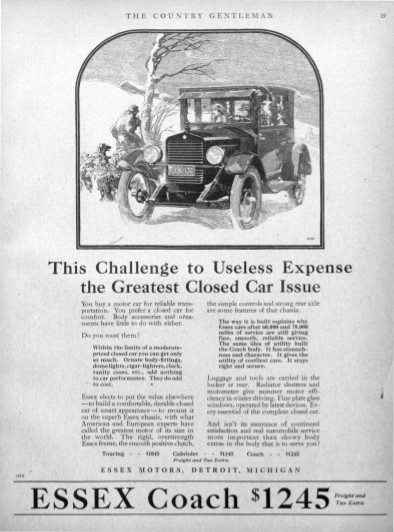
“The heat is there — Why not use it?”
It’s just like sitting by the fireplace…
Again, the fireplace promise of “living room comfort” in your car.
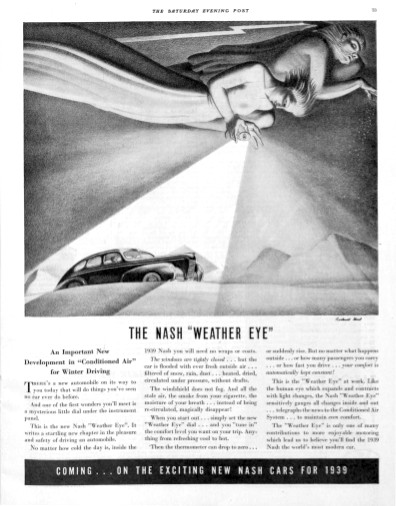
Who knows what this “Weather Eye” does?
When the roads are rough — Why not just fly?