News of the Week: Advice for Graduates, Ugly Dogs, and How to Make Firecracker Strawberries
Be Kind, Save Money, and Wear Sunscreen
It’s that time of year when young people are graduating from high school and college. It’s also the time of year for commencement speeches and general advice for those graduates before they go off to summer jobs, a new city, or the career they’ve chosen.
We’ve all read (or at least heard about) the classic essay by Chicago Tribune writer Mary Schmich that is often attributed to either Kurt Vonnegut or director Baz Luhrmann (it doesn’t help that the essay at the paper’s site doesn’t have Schmich’s name on it at all). She gives some great advice: wear sunscreen, keep in touch with friends and family no matter where you live, do not read beauty magazines, remember the compliments you receive, and forget the insults. That’s all great advice no matter what age you are.
But there are other pieces of advice that young people would be smart to heed. Gretchen Rubin, author of The Happiness Project, has 12 rules she tries to follow, which include being polite and fair and not letting the perfect be the enemy of the good. Frances Bridges at Forbes says that things are going to get harder before they get better, and you should always be smart about your money; and writer George Saunders suggests that, no matter what you do in life, err in the direction of kindness.
I would add to that a few I’ve learned. One is that good credit is more important than love (you’ll find love, but you don’t want to start out by messing up your credit); working is usually better than not working; and if you meet people who tell you that your high school or college years will be the best years of your life, don’t listen to them, because that’s just depressing.
Also: If you ever find yourself on The Price Is Right, never bid one dollar unless you’re the last bidder. The person after you will just bid two dollars and you’ll look like an idiot.
Zsa Zsa
One person’s ugly is another person’s cute, but I think that even people who tend to lean toward the latter have to admit that this dog is pretty darn the former.
Zsa Zsa, a 9-year-old English bulldog from Minnesota with questionable facial and body features, won the annual World’s Ugliest Dog contest last week. She and her owners won $1,500 for capturing first prize.
I think it’s the mouth, those teeth, and that darn giant tongue that’s always hanging out.
Something You Don’t Know About Superman
Shortly after reading Troy Brownfield’s great piece on the 80th anniversary of Superman, I came across an interesting little factoid on how kryptonite entered the Man of Steel’s world.
The voice of Superman on the Adventures of Superman radio show was Bud Collyer, whom you may also know as the host of To Tell the Truth (the ’60s version, not the current monstrosity on ABC). The writers came up with kryptonite, which paralyzes Superman, so Collyer could have some time off from the show. Since all Superman would be doing that week was moaning and groaning, they just got another actor to make those sounds.
It’s funny how something that is so closely associated with Superman actually made its first appearance on the radio show and not in the comic book.
The Words We Always Misspell
My friend Ken Levine has a fun post at his site about the words he always misspells (a word that itself is one I’m sure a lot of people misspell). We all go through this, even if we’re good spellers in general. There are just some words that get us every time. For Ken, it’s privilege, jeopardy, and pigeon.
I once lost a grade school spelling bee on Massachusetts. I spelled it correctly, but forgot to say “capital M,” and my English teacher wouldn’t give it to me. Still bugs me 40 years later. Thanks a lot, Mr. Pike.
Three words I always misspell are miniscule, pasttime, and reccommend. See?!
RIP Harlan Ellison, Charles Krauthammer, Donald Hall, Richard Harrison, Dan Ingram, Deanna Lund, and Koko
Harlan Ellison was a highly influential and opinionated writer and editor who changed the world of science fiction, fantasy, and pop culture in general over the past six decades. He wrote thousands of short stories, novels, novellas, essays and columns. He also wrote for several TV shows including Star Trek (the classic episode “City on the Edge of Forever”), The Outer Limits, The Man From U.N.C.L.E., the 1980’s reboot of The Twilight Zone, and Babylon 5, as well as the movie A Boy and His Dog. Ellison died yesterday at the age of 84.
Here’s Ellison’s official site, where you can read what fans and friends are saying in the forum.
Dr. Charles Krauthammer started out in the field of psychiatry after graduating from Harvard Medical School but found a second career as a conservative writer and pundit. He got his start as a speechwriter for Walter Mondale and also wrote for places like The Washington Post and The New Republic, and was a commentator on Fox News. His terrific book of essays, Things That Matter, sold over a million copies. Krauthammer had been paralyzed since a college diving accident, but he actually succumbed to cancer last week at the age of 68.
Donald Hall was a poet and essayist who was U.S. poet laureate from 2006 to 2007. He died last Saturday at the age of 89.
Richard Harrison was “The Old Man” on the popular History Channel series Pawn Stars. He died Monday at the age of 77.
Dan Ingram was a veteran New York disc jockey. Some people even call him the best disc jockey of all time. He started at small radio stations in the late ’50s and went on to work at such places as WABC, WKTU, and WCBS. He died Sunday at the age of 83.
Deanna Lund was an actress probably best known as Valerie on the sci-fi television series Land of the Giants. She died last Friday at the age of 81.
My two favorite stories of Koko the gorilla who learned sign language? She once destroyed a sink, and when her handlers came into the room to find out what had happened, Koko signed to them that the cat had done it. And there was the time that Mr. Rogers visited Koko and she took off his shoes, because that’s what he always did on his TV show. Koko died last week at the age of 46.
Quote of the Week
“Man, summer is going to suck.”
—Meet the Press host Chuck Todd, on the upcoming political battle to replace retiring Supreme Court Justice Anthony Kennedy
This Week in History
First TV Western, Hopalong Cassidy, Premieres (June 24, 1949)
It’s hard to believe now, but at one point, westerns were the most popular genre of TV show, with a staggering 26 shows on the air in 1959. At first the Hopalong Cassidy series was just edited versions of the films, but NBC later created original episodes. William Boyd played the cowboy and became so popular that it led to a theme park, magazine covers, and endless merchandising.
George Orwell Born (June 25, 1903)
Here’s what the Post had to say about Orwell’s classic novel 1984 in 1972.
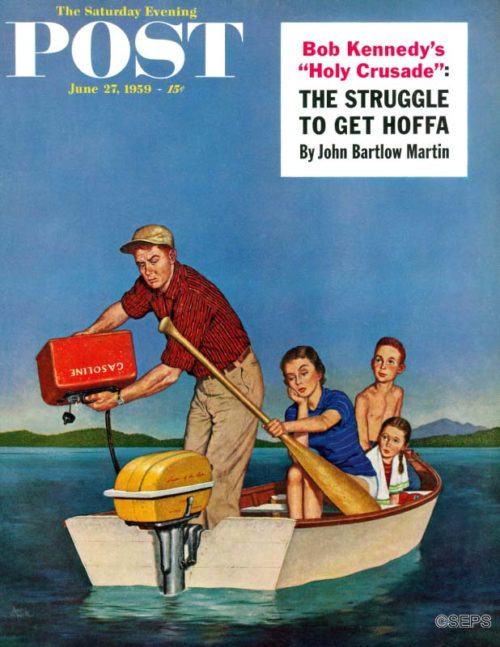
This Week in Saturday Evening Post History: Row, We’re Out of Gas (June 27, 1959)
Amos Sewell
June 27, 1959
I’ve been on a boat exactly one time in my life, about 35 years ago — a boat a lot like the one featured in this Amos Sewell cover. And I think I had as much fun as the family in this boat seems to be having. We didn’t run out of gas, I’m just not a boat guy.
July 4 Recipes
At Christmas we see a lot of red-and-green-oriented recipes, and on Halloween it’s orange and black. For the Fourth of July the colors are obviously red, white, and blue. Sometimes you can tell the recipe creators are really stretching things to make ordinary foods with those colors, but I think I found a few that look pretty fantastic.
How about these Firecracker Strawberries, which are first soaked in vodka and then decorated with marshmallow (that’s the white) and sprinkles (for the blue)? Or how about Ina Garten’s Flag Cake, which looks like it might take a while to decorate but is rather impressive? If you’re looking for something savory rather than sweet, how about this Red, White, and Blue Potato Salad? The blue color is actually purple potatoes, but we won’t tell anyone if you don’t.
It’s odd when a holiday lands smack in the middle of the week, but maybe that will give you an excuse to take Thursday and Friday off, too.
Next Week’s Holidays and Events
World UFO Day (July 2)
It’s on July 2 to mark the day that a spacecraft (supposedly) crashed in Roswell, New Mexico, in 1947. You can go to the World UFO Day site to become an official ambassador, or you can just watch Earth vs. the Flying Saucers again.
Wimbledon Begins (July 2)
The top seeds for the tournament at the All England Lawn Tennis and Croquet Club are Roger Federer and Simona Halep. They’ve also given Serena Williams, whose ranking dropped considerably after missing a year to have a baby, the 25th seed.
By the way, you don’t have to call it the All England Lawn Tennis and Croquet Club. But make sure you say Wimbledon and not Wimbleton.
The New Nomads: Living Full-Time on the Road
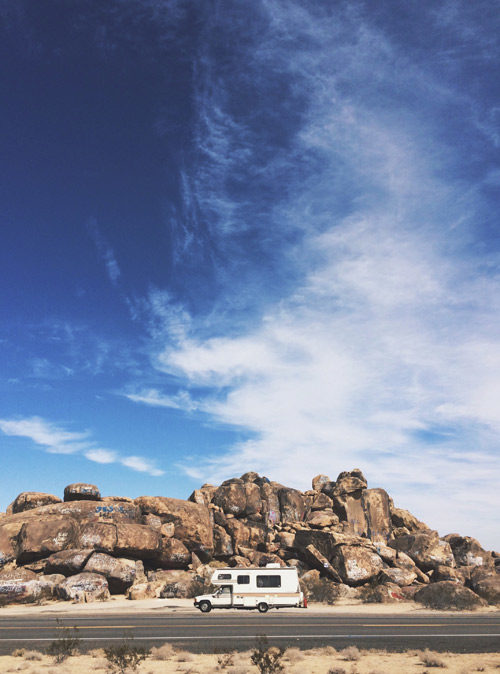
In Drayton, North Dakota, a former San Francisco cabdriver, 67, labors at the annual sugar beet harvest. He works from sunrise until after sunset in temperatures that dip below freezing, helping trucks that roll in from the fields disgorge multi-ton loads of beets. At night he sleeps in the van that is his home.
In New Bern, North Carolina, a woman whose home is a teardrop-style trailer — so small it can be pulled with a motorcycle — is couch surfing with a friend while hunting for work. Even with a master’s degree, the 38-year-old Nebraska native can’t find a job despite filling out hundreds of applications in the past month alone. She knows the sugar beet harvest is hiring, but traveling halfway across the country would require more cash than she has. Losing her job at a nonprofit several years ago is one of the reasons she moved into the trailer in the first place. After the funding for her position ran out, she couldn’t afford rent on top of paying off student loans.
In San Marcos, California, a 30-something couple in a 1975 GMC motorhome is running a roadside pumpkin stand with a children’s carnival and petting zoo, which they had five days to set up from scratch on a vacant dirt lot. In a few weeks, they’ll switch to selling Christmas trees.
In Colorado Springs, Colorado, a 72-year-old van dweller who cracked three ribs doing a campground maintenance job is recuperating while visiting with family.
There have always been itinerants, drifters, hobos, restless souls. But now, in the third millennium, a new kind of wandering tribe is emerging. People who never imagined being nomads are hitting the road. They’re giving up traditional houses and apartments to live in what some call “wheel estate” — vans, secondhand RVs, school buses, pickup campers, travel trailers, and plain old sedans. They are driving away from the impossible choices that face what used to be the middle class. Decisions like: Would you rather have food or dental work? Pay your mortgage or your electric bill? Make a car payment or buy medicine? Cover rent or student loans? Purchase warm clothes or gas for your commute?
For many, the answer seemed radical at first.
You can’t give yourself a raise, but what about cutting your biggest expense? Trading a stick-and-brick domicile for life on wheels?
Some call them “homeless.” The new nomads reject that label. Equipped with both shelter and transportation, they’ve adopted a different word. They refer to themselves, quite simply, as “houseless.”
From a distance, many of them could be mistaken for carefree retired RVers. On occasions when they treat themselves to a movie or dinner at a restaurant, they blend with the crowd. In mindset and appearance, they are largely middle class. They wash their clothes at laundromats and join fitness clubs to use the showers. Many took to the road after their savings were obliterated by the Great Recession. To keep their gas tanks and bellies full, they work long hours at hard, physical jobs. In a time of flat wages and rising housing costs, they have unshackled themselves from rent and mortgages as a way to get by. They are surviving America.
But for them — as for anyone — survival isn’t enough. So what began as a last-ditch effort has become a battle cry for something greater. Being human means yearning for more than subsistence. As much as food or shelter, we require hope.
And there is hope on the road. It’s a byproduct of forward momentum. A sense of opportunity, as wide as the country itself. A bone-deep conviction that something better will come. It’s just ahead, in the next town, the next gig, the next chance encounter with a stranger.
As it happens, some of those strangers are nomads, too. When they meet — online, or at a job, or camping way off the grid — tribes begin to form. There’s a common understanding, a kinship. When someone’s van breaks down, they pass the hat. There’s a contagious feeling: Something big is happening. The country is changing rapidly, the old structures crumbling away, and they’re at the epicenter of something new. Around a shared campfire, in the middle of the night, it can feel like a glimpse of utopia.
As I write, it is autumn. Soon winter will come. Routine layoffs will start at the seasonal jobs. The nomads will pack up camp and return to their real home — the road — moving like blood cells through the veins of the country. They’ll set out in search of friends and family, or just a place that’s warm. Some will journey clear across the continent. All will count the miles, which unspool like a filmstrip of America. Fast-food joints and shopping malls. Fields dormant under frost. Auto dealerships, megachurches, and all-night diners. Featureless plains. Feedlots, dead factories, subdivisions, and big-box stores. Snowcapped peaks. The roadside reels past, through the day and into darkness, until fatigue sets in. Bleary-eyed, they find places to pull off the road and rest. In Walmart parking lots. On quiet suburban streets. At truck stops, amid the lullaby of idling engines. Then in the early-morning hours — before anyone notices — they’re back on the highway. Driving on, they’re secure in this knowledge:
The last free place in America is a parking spot.
There’s no clear count of how many people live nomadically in America. Full-time travelers are a demographer’s nightmare. Statistically, they blend in with the rest of the population, since the law requires them to maintain fixed — in other words, fake — addresses. No matter how widely they wander, nomads must be officially “domiciled” somewhere. Your state of residence is where you get vehicles registered and inspected, renew drivers’ licenses, pay taxes, vote, serve on juries, sign up for health insurance (except for those on Medicare), and fulfill a litany of other responsibilities. And living nowhere, it turns out, means you can live anywhere you want, at least on paper. So many folks opt for residency in the places with the fewest hassles — Florida, South Dakota, and Texas, which lack state income taxes, are longtime favorites — and use mail-forwarding services to stay in touch. The rules for becoming a South Dakotan are especially laid-back. Spend one night at a local motel and register with a South Dakota mail forwarding service. Then show both receipts to the state department of public safety and you’re in.
Many of these people call themselves workampers. One of them — a man I’ll call Don Wheeler — defined that term with great flair, writing in a Facebook direct message to me:
Workampers are modern mobile travelers who take temporary jobs around the U.S. in exchange for a free campsite — usually including power, water, and sewer connections — and perhaps a stipend. You may think that workamping is a modern phenomenon, but we come from a long, long tradition. We followed the Roman legions, sharpening swords and repairing armor. We roamed the new cities of America, fixing clocks and machines, repairing cookware, building stone walls for a penny a foot and all the hard cider we could drink. We followed the emigration west in our wagons with our tools and skills, sharpening knives, fixing anything that was broken, helping clear the land, roof the cabin, plow the fields, and bring in the harvest for a meal and pocket money, then moving on to the next job. Our forebears are the tinkers.
We have upgraded the tinker’s wagon to a comfortable motor coach or fifth-wheel trailer. Mostly retired now, we have added to our repertoire the skills of a lifetime in business. We can help run your shop, handle the front or back of the house, drive your trucks and forklifts, pick and pack your goods for shipment, fix your machines, coddle your computers and networks, work your beet harvest, landscape your grounds, or clean your bathrooms. We are the techno-tinkers.
The people Wheeler described make up an impressive labor force. Kampgrounds of America (KOA), a major employer of workampers, hires some 1,500 couples each year for its resorts and franchises across the country, a representative told AARP. Workamper News, a bimonthly magazine whose website features a popular job-listing service, claims to reach 14,000 members, with more joining all the time.
Of all the programs seeking workampers, the most aggressive recruiter has been Amazon’s CamperForce. “Jeff Bezos has predicted that, by the year 2020, one out of every four work campers in the United States will have worked for Amazon,” read one slide in a presentation for new hires.
Workampers are plug-and-play labor, the epitome of convenience for employers in search of seasonal staffing. They appear where and when they are needed. They bring their own homes, transforming trailer parks into ephemeral company towns that empty out once the jobs are gone. They aren’t around long enough to unionize. On jobs that are physically difficult, many are too tired even to socialize after their shifts.
They also demand little in the way of benefits or protections. On the contrary, among the more than 50 such laborers I interviewed in my first year of reporting on workampers, most expressed appreciation for whatever semblance of stability their short-term jobs offered. Take 57-year-old Joanne Johnson, who was dashing upstairs at Amazon’s Campbellsville facility when she tripped and fell, striking her head on a conveyor-belt support bar. She was bandaged up at AmCare — an in-house medical facility — and then rushed to an emergency room. The episode left her with two black eyes and nine stitches along her hairline. “They let me continue working. They didn’t fire me,” Johnson recalled warmly.
I wondered why a company like Amazon would welcome older candidates for jobs that seem better suited to younger bodies. “It’s because we’re so dependable,” suggested Johnson. “We know that if you commit to something, you do your best to get that job done. We don’t take days off unless we have to.” (While recuperating from her head wound, Johnson missed only one scheduled workday. It was unpaid.)
The folks who run CamperForce reiterate the belief that older workers bring a good work ethic. “We’ve had folks in their 80s who do a phenomenal job for us,” said Kelly Calmes, an administrator for the program in Campbellsville, during an online job seminar hosted by Workamper News. “The benefit to our workamping population being, for the most part, a little bit older is that you guys have put in a lifetime of work. You understand what work is. You put your mind to the work, and we know that it’s a marathon; it’s not a sprint. It’s kind of like The Tortoise and the Hare. We have some of our younger folks who will race through. You guys are pretty methodical — you just kind of work as you go, and work as you go — and at the end of the day, believe it or not, you both cross the finish line at about the same time.”
Many of the workers I met in the Amazon camps were part of a demographic that in recent years has grown with alarming speed: downwardly mobile older Americans. Monique Morrissey, an economist at the Economic Policy Institute, spoke with me about the unprecedented nature of this change. “We’re facing the first-ever reversal in retirement security in modern U.S. history,” she explained. “Starting with the younger baby boomers, each successive generation is now doing worse than previous generations in terms of their ability to retire without seeing a drop in living standards.”
That means no rest for the aging. Nearly nine million Americans 65 and older were still employed in 2016, up 60 percent from a decade earlier. Economists expect those numbers — along with the percentage of seniors in the labor force — to keep rising. A recent poll suggests that Americans now fear outliving their assets more than they fear dying. Another survey finds that, although most older Americans still view retirement as “a time of leisure,” only 17 percent anticipate not working at all in their later years.
“Over the last generation, we have witnessed a massive transfer of economic risk from broad structures of insurance, including those sponsored by the corporate sector as well as by government, onto the fragile balance sheets of American families,” Yale political scientist Jacob S. Hacker writes in his book The Great Risk Shift. The overarching message: “You are on your own.”
All of which is to say that Social Security is now the largest single source of income for most Americans 65 and older. But it’s woefully inadequate.
Nearly half of middle-class workers may be forced to live on a food budget of as little as $5 a day when they retire, according to Teresa Ghilarducci, an economist and professor at the New School in New York City. “I call it ‘the end of retirement,’” she said in an interview. Many retirees simply can’t survive without some sort of paycheck.
Millions of Americans are wrestling with the impossibility of a traditional middle-class existence. In homes across the country, kitchen tables are strewn with unpaid bills. Lights burn late into the night. The same calculations get performed again and again, over and over, through exhaustion and sometimes tears. Wages minus grocery receipts. Minus medical bills. Minus credit card debt. Minus utility fees. Minus student loan and car payments. Minus the biggest expense of all: rent.
In the widening gap between credits and debits hangs a question: What parts of this life are you willing to give up so you can keep on living?
Like the nomads, millions of Americans are being forced to change their lives, even if the transformations are less outwardly radical. There are many ways to parse the challenge of survival. This month, will you skip meals? Go to the ER instead of your doctor? Postpone the credit card bills, hoping they won’t go to collections? Put off paying electric and gas charges, hoping the light and heat will stay on? Let the interest accumulate on student and car loans, hoping someday you’ll find a way to catch up?
These indignities underscore a larger question: When do impossible choices start to tear people — a society — apart?
It’s already happening. The cause of the unmanageable household math that’s keeping people up at night is no secret. The top 1 percent now makes 81 times what those in the bottom half do, when you compare average earnings. For American adults on the lower half of the income ladder — some 117 million of them — earnings haven’t changed since the 1970s.
This is not a wage gap — it’s a chasm. And the cost of that growing divide is paid by everyone.
A deepening class divide makes social mobility all but impossible. The result is a de facto caste system. This is not only morally wrong but also tremendously wasteful. Denying access to opportunity for large segments of the population means throwing away vast reserves of talent and brainpower. It’s also been shown to dampen economic growth.
The most widely accepted measure for calculating income inequality is a century-old formula called the Gini coefficient. It’s a gold standard for economists around the globe, along with the World Bank, the CIA, and the Paris-based Organization for Economic Cooperation and Development. What it reveals is startling. Today, the United States has the most unequal society of all developed nations. America’s level of inequality is comparable to that of Russia, China, Argentina, and the war-torn Democratic Republic of the Congo.
And as bad as the situation is now, it’s likely to get worse. That makes me wonder: What further contortions — or even mutations — of the social order will appear in years to come? How many people will get crushed by the system? How many will find a way to escape it?
***
Excerpted from Nomadland: Surviving America in the Twenty-First Century by Jessica Bruder. © 2017 by Jessica Bruder. Used with permission of the publisher, W.W. Norton & Company, Inc. All Rights Reserved.
Jessica Bruder is an award-winning journalist whose work focuses on subcultures and the dark corners of the economy. She has written for Harper’s, The New York Times, and The Washington Post. Bruder teaches at the Columbia School of Journalism.
This article is featured in the July/August 2018 issue of The Saturday Evening Post. Subscribe to the magazine for more art, inspiring stories, fiction, humor, and features from our archives.
March/April 2018 Limerick Laughs Winner and Runners-Up
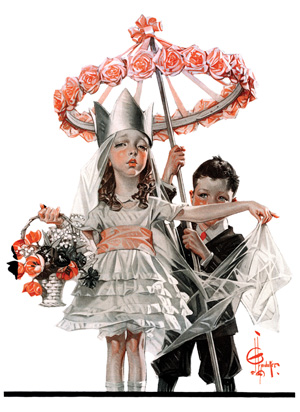
The little girl started to preen.
She wanted by all to be seen.
Said the boy, who was skittish,
“You are not even British
And therefore could never be queen.”
Congratulations to Elaine Person of Orlando, Florida! For her limerick describing J.C. Leyendecker’s June 11, 1921, cover image, she wins $25 and our gratitude for a job well done.
If you’d like to enter the Limerick Laughs Contest for our upcoming issue, submit your limerick via our online entry form.
Here are some of our other favorites, in no particular order:
Proud Mary has just been selected
As “Queen of the May,” as expected.
With her manner quite dour
And a visage so sour,
It’s for sure she won’t be re-elected!—Catherine Darling, Sandy Hook, Connecticut
Pretending that she is a bride,
The girl struts with absolute pride.
Meanwhile for the groom,
There’s impending doom:
When she said no kissing, she lied!—Angie Gyetvai, Old Castle, Ontario, Canada
I’m having a very bad day
As escort to Queen of the May,
A terrible mission.
I’d rather be fishin’
Or any place far, far away.—Gene Newman, Parsippany, New Jersey
Promenading to “Here Comes the Bride,”
The little gent’s role wounds his pride.
But to carry her train
Seems a much lesser pain
Than to be the groom trapped by her side.—Marcia Gunnett Woodard, Swayzee, Indiana
I might as well boldly confess:
I’ve a frog here to slip down her dress!
Will she be far too proud
To denounce me aloud?
Probably not is my guess.—Karen Cox, Readyville, Tennessee
In the gown, she will leap off the page.
With her rouge, she disguises her age.
It’s a shoot for an ad,
And her brother is mad
Since his pay is the minimum wage.—Ryan Tilley, Altamonte Springs, Florida
The circle of roses defined her,
While the flowers and flounces remind her:
Though she’s serving as Queen
And her realm is serene,
She’s ignoring that young lad behind her.—John & Elsa Morrow, Oakdale, Minnesota
Little “bride,” with her cheeks blushing red,
Announced that she’s soon to be wed.
Little “groom” just behind her
Is quick to remind her
He’d rather keep dating instead.—Gay Peterson, Loda, Illinois
He’s just a most unhappy fella,
There toting his sister’s umbrella.
While she reigns in glee,
It’s obvious he
Sings misery’s tune a cappella.—Carolyn Banks, Martinsburg, West Virginia
Good Morning, Captain Kangaroo! And Happy Birthday
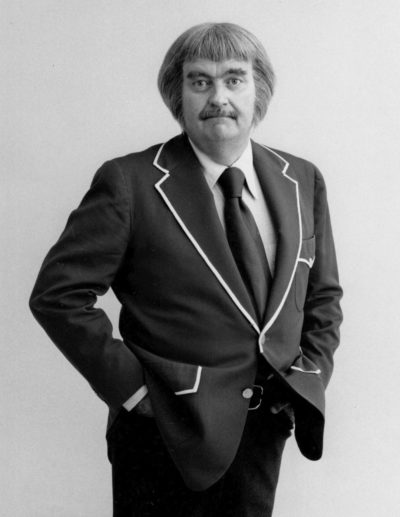
He reached the summit of children’s programming, and today, his picture is buried on Mount Everest. Bob Keeshan, better known as Captain Kangaroo, would blaze an Emmy-winning television trail that influenced generations of viewers.
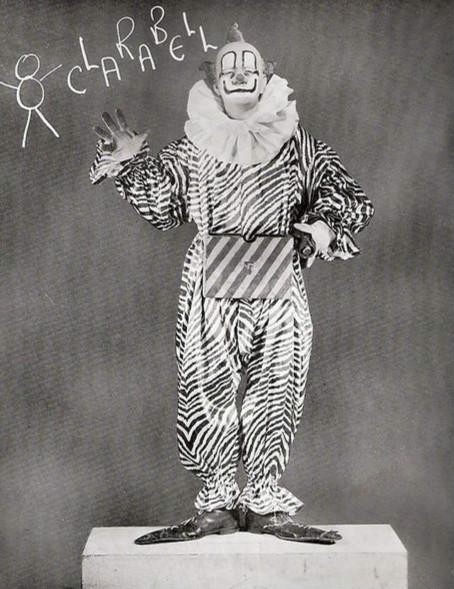
Keeshan was born in 1927 and made his first TV breakthrough in a sort of famous anonymity. He played the original Clarabell the Clown on the wildly successful Howdy Doody show on NBC, debuting as the character in 1948. Clarabell only communicated by honking horns (once for yes, twice for no), but nevertheless became hugely popular. Keeshan kept the role for four years.
While working on other programs, Keeshan and his friend Jack Miller pitched a show and character called Captain Kangaroo to CBS. The character drew his name from the extremely large pockets, reminiscent of a kangaroo’s pouch, on his naval-style coat. The captain inhabited the Treasure House, later simply called The Captain’s Place, which was the base for a rotating series of characters, puppets, cartoons, and guests. Keeshan cut a distinctive figure with his blonde hair, mustache, and bright coat (originally blue, but red from May 17, 1971 onward).
The show debuted as a weekday morning program on October 3, 1955. It would go through various iterations over time, including a switch from a one-hour to half-hour format in 1981, followed by a move to weekends in 1982. Nevertheless, it was extremely popular throughout its nearly 30-year run. Keeshan made over 9,000 episodic appearances as the Captain. Perhaps remarkably, he was still winning Emmys for Outstanding Performer in Children’s Programming and Outstanding Children’s Entertainment Series into the 1980s.
The original Captain Kangaroo theme, “Puffin Billy,” by Edward White.
Part of the appeal of the show came from the rotating cast of characters. Mischief-making puppet Mr. Moose and his friend Bunny Rabbit had a habit of making ping-pong balls rain on the perennially unsuspecting Captain. The puppets, along with the Captain’s coat, dwell today at the Smithsonian.
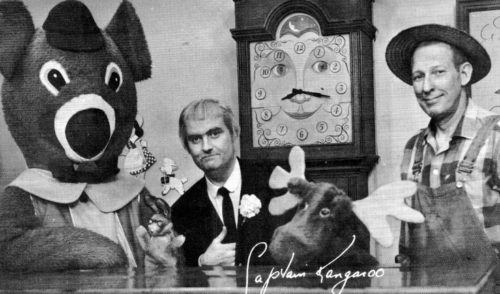
But it was Keeshan himself that held the whirl of activity together. His performance maintained a gentle and calm demeanor that the performer said was meant to echo the relationship between children and their grandparents. Off-screen, Keeshan drove advocacy for children’s programming and testified in matters related to tobacco advertising and other issues that he believed negatively impacted children.
By 1984, Keeshan declined to renew his contract, ultimately due to the timeslot reductions and shuffling facing the show. Nevertheless, he returned to CBS the following year for a Captain Kangaroo and Friends prime-time special and as host of the CBS Storybreak program. He later published a memoir, Good Morning, Captain, in 1995.
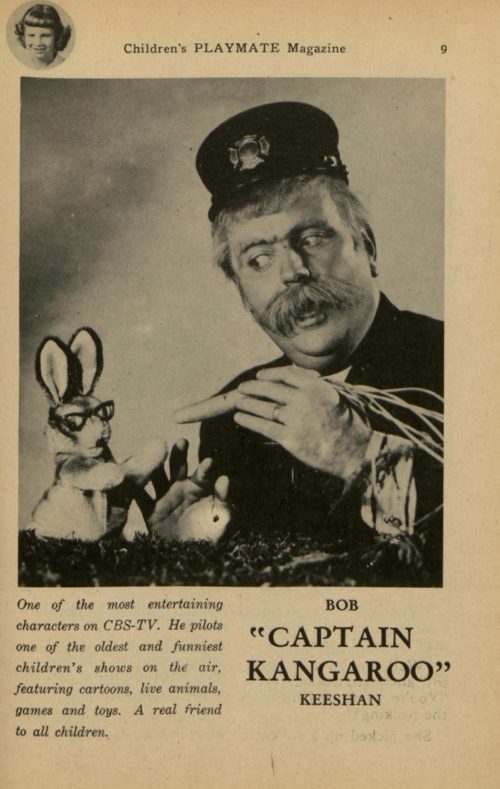
Keeshan died in 2004, leaving a vast television legacy. His grandson, Britton, forged a legacy of his own by being the youngest person at the time to reach the top of all Seven Summits, the tallest mountains on each continent. When he reached the top of Everest, Britton buried a picture of himself and his beloved grandfather as a tribute. It’s fitting that a man that reached such heights in his life should be remembered at the top of the world.
Are Drive-In Movies Making a Comeback?
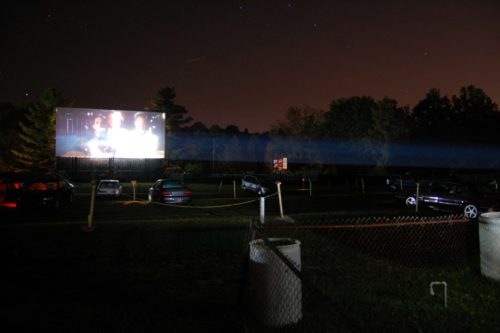
Summer nights and movies remain a perfect match. Blockbuster season brings out the biggest films and stars, but it’s also the prime time for that most American of cinematic venues: the drive-in. This month, we mark the 85th anniversary of that simple, but quietly revolutionary, idea of watching a film from the comfort of your own automobile.
In their heyday, drive-ins made for a unique family movie-going experience. Locations frequently included playgrounds, picnic tables, and other attractions that enticed families to arrive early. Costs could be lower per carload than buying individual tickets, making it more affordable. By the end of the 1950s, more than 4,000 drive-ins dotted the landscape in the U.S. For many, it become a regular, and iconic, event to head to the drive-in on the weekend.
The idea officially came to life on June 6, 1933. Richard Hollingshead of Camden, New Jersey, was trying to solve the problem of the discomfort that his mother experienced in traditional movie theater seating. Hollingshead worked for his father’s company, Whiz Auto Products. His mother’s dilemma and his natural workday surroundings coalesced into a vision of an outdoor screen where you could take in a film from your own car.
From that premise, Hollingshead experimented with projectors and screen types. He tried to figure out ways to deal with rain, as well as calculating what the ideal spacing between cars should be. Hollingshead received a patent for his idea in May of 1933, which led directly to opening Park-In Theaters in Camden the following month. The charge? One quarter per car and an additional quarter for each person.
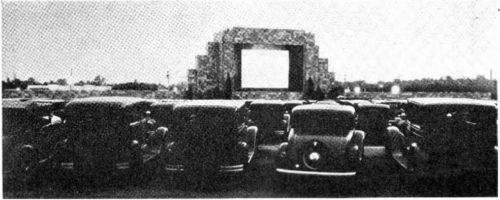
When Hollingshead’s patent was overturned in 1949, drive-ins exploded in popularity around the country. Thousands of new outdoor theaters popped up throughout the U.S., many of them specializing in so-called “B-movies,” as theater rentals for classier fare tended to be cost-prohibitive. Brandon Peters of the Cult Cinema Cavalcade podcast said that this material helped sell the drive-in to Middle America. He explained, “For genre fare, it was largely beneficial to the Midwest and smaller town crowd that lacked a 42nd Street where grindhouse, Italian horror, and other types of films with double-features were a 24-hour a day experience.”
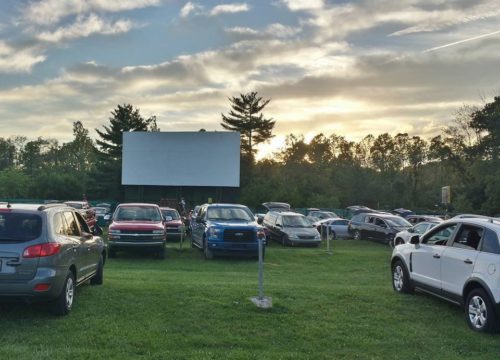
(@CenterBrook Drive-In, Martinsville, IN)
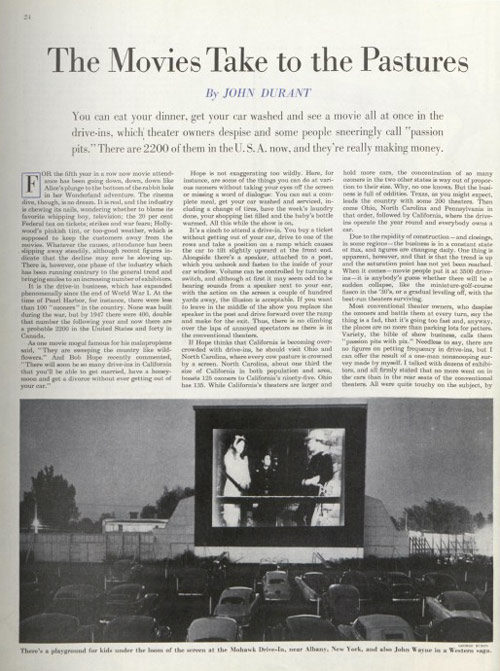
An article from the October 14, 1950, issue of The Saturday Evening Post looked at the popularity of the drive-in, including their reputation as “passion pits” (a notion parodied to some extent in the film Grease). This reputation seemed to be built in part on conventional theater owners who decried the drive-in as a fad and looked for ways to undermine an innovation that was draining customers to other locations.
The fortunes of the drive-in took a downturn in the 1980s as factors like cost, competition from larger, more comfortable cineplexes, and advances in picture and sound technology took their toll. A regular theater could more easily install new projectors and equipment that kept up with the expectations of the studios in terms of sound and picture, but it was more of a challenge for the drive-in setting in terms of the overall expense
Drive-ins continue to operate in all but a few states. Though far below the estimated peak of around 5,000 outdoor screens during the 1960s, the 348 remaining drive-ins continue to be a regular choice for families. Organizations like the United Drive-In Theatre Owners Association work to get the word out on the format.
And new drive-ins do occasionally appear. The Moon-Lite Drive-In Theater in Terre Haute, Indiana, expects to open in the near future near the original site of the North Drive-In, which closed in 1988. Proprietor Brent Barnhart grew up in Terre Haute and saw many social media posts from people that missed the North. He was in a unique position to do something about it, however, as he owns three conventional cinemas and acquired the Starlite Drive-In in Bloomington, Indiana, last year.
“[I’d] drive by that screen and think ‘What if?’,” Barnhart said. He explained that drive-ins still work because “they are sort of few and far between. They’re a destination, an experience, a place to bring your children and grandchildren. The concept is just still really cool . . . you can spread out your blanket and chairs and take in a movie under the stars.”
North Country Girl: Chapter 58 — Jobless in NYC
For more about Gay Haubner’s life in the North Country, read the other chapters in her serialized memoir.
My second Michael, my second true love, had tossed me to the wayside; I was too much baggage for him to handle on his pilgrimage to New York City in pursuit of his art. I was rescued by my Minneapolis pal Mindy, who had been my travel companion on that fateful Spring Break in Mexico.
After years dedicated to serious partying, Mindy had finally given herself a good shake and found her way back to college; she was taking classes during the day and waitressing at night. Mindy’s roommate was gone for the summer, so I would take over her tiny bedroom until she came back.
I dropped my two suitcases holding all my worldly possessions, fell into Mindy’s arms, and had a good cry. Mindy blotted my face with her waitress apron and said, “It will be fine. You will be fine. No more crying.” I gave her a trembling smile as she headed out to work and ordered myself to do all my heart-broken sobbing in bed or in the shower, anywhere Mindy couldn’t hear me and pity me.
Most of the time Mindy was gone, off to class and work, and I was left alone in her small but light-filled apartment. I spent my first days sprawled weepy on the couch, all the more sorry for myself that I didn’t have a single one of Michael’s blues albums to listen and cry to, songs of betrayal and abandonment, of false-hearted lovers, songs that would let me wallow in my sorrow. Eventually I gave myself a good talking-to and ventured out into the only thing that could soothe my ruptured soul, my favorite thing in the world: a Minnesota summer, balmy languid days that last till nine, when the sun finally says good night and sinks away.
Mindy lived a short walk from my beloved, glorious Lake Calhoun (now known as Bde Maka Ska), a just-right-sized expanse of sky blue water dropped in the center of Minneapolis. Lake Calhoun was surrounded by the softest grass, the leafiest trees, and had a tiny sandy beach with a lifeguard chair, rowboats to rent, and a snack bar.
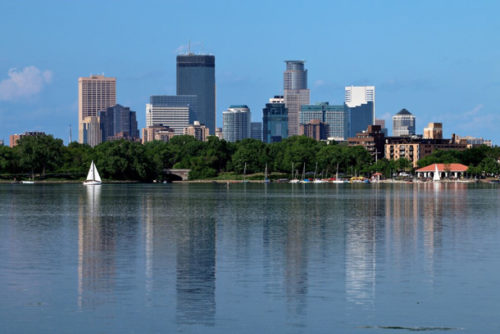
I could have registered for fall classes at the University of Minnesota, I could have looked for a job, but I was mesmerized by summer, as sweetly familiar as a favorite childhood book and as fleeting as a dream. Chicago summers had been all sweat and steam and stink; here in Minneapolis I could dip in the lake during the day and slip into a sweater at evening.
I read whatever magazines and books were lying about Mindy’s apartment, swam in Lake Calhoun, and tanned on that little stretch of sand, lunching on Popsicles from the snack bar. I watched couples making out on blankets and cried as only a jilted young lover can cry. I made sure there were chips and bread and cold cuts and six-packs of beer in Mindy’s fridge, and ignored my dwindling savings that I had no prospects for replenishing. I waited for the phone to ring.
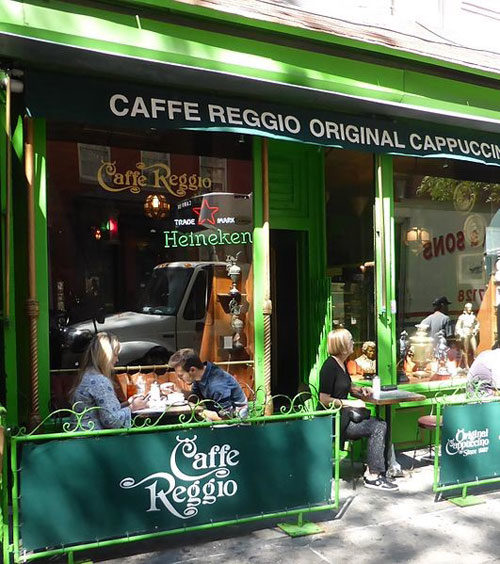
The phone did not ring, but a three-page letter from Michael arrived. Most of it was on the wonders of New York City: The art museums, the Modern, the Guggenheim, the Whitney, and the Metropolitan where you could pay just a penny to get in. The subway, which, unlike Chicago’s El, actually took Michael everywhere he wanted to go, once he figured out the confusing lines and local versus express stops. The dozens of different languages Michael delighted hearing on the street every day, the sneaky thrill he got eavesdropping on the German or Russian or Yiddish speakers. His sublet’s neighborhood of Greenwich Village, where there were jazz and folk and blues clubs, and outdoor cafes on every corner.
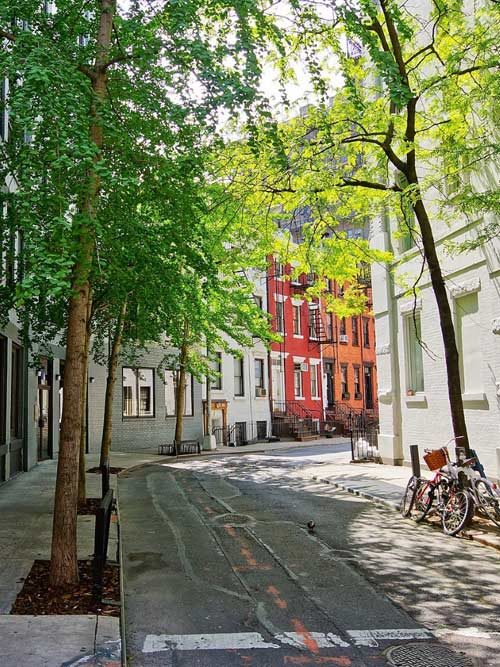
It was the Summer of Sam, the summer of the Bronx burning, of the hot August night of blackout and looting, the summer New York City teetered on the edge of bankruptcy. Michael was oblivious to the dangers, the dirt, the looming disasters. “You would love New York,” Michael wrote, “and I miss you so much.”

I wrote back, mostly about how much I missed him, as I had no other news outside of what flavor Popsicle I had eaten for lunch. Our letters criss-crossed the country, full of love and longing. I read Michael’s letters aloud to Mindy, always a sympathetic ear, on the few nights we spent together. She sipped the beer I gratefully supplied and flipped through the magazines she never had time to read.
“You’re going to New York,” Mindy assured me. “Wouldn’t it be cool if you got a job here?” and she held up the latest issue of Viva magazine, with the pouting face of minor starlet Barbara Carrera on the cover.
As Mindy predicted, the long-distance call and the summons to New York finally arrived. I heard Michael sniffling, he had a catch in his voice. “I am so sorry, I don’t know what I was thinking of, I love you, I want to be with you, please come to New York. The place I’m staying in is really small, I’ll find someplace for the two of us, it’s going to be great, please say you’ll come.” A tsunami of joy washed over me and I started to cry too. I had missed Michael dreadfully. For weeks my mind and heart had been unmoored, drifting through the dark seas of rejection and loss. Now I was rescued, swimming toward a lifeboat of love, Michael holding out his hand to pull me in.
I opened my pink Samonsite suitcase to pack up the bikinis and cutoff jeans I had been living in, and there on the top was my modeling portfolio. I leafed through the acetates holding the garishly lit and cheaply printed photos of me in surgical scrubs or lounging on a hideous “Rent-to-Own” plaid couch or eating a McDonald’s Filet-O-Fish, my own mouth gaping like a bass, and knew I had zero chance of finding modeling work in New York. I had to get a job, and the two skills I had were waitressing and magazine writing.
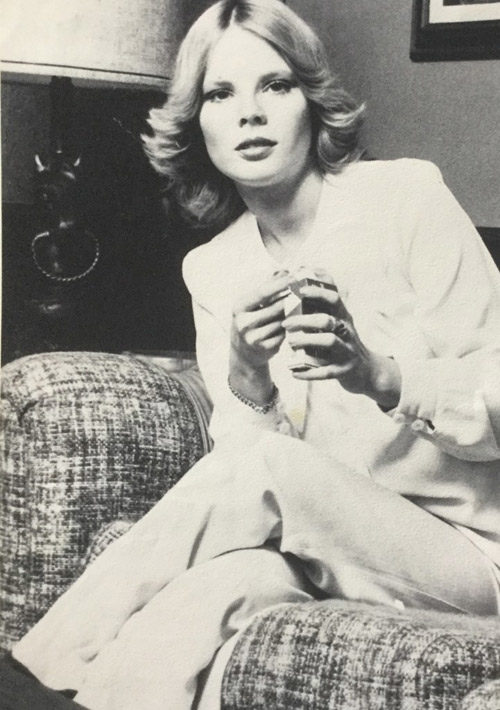
Under my modeling portfolio was a manila envelope with everything I had written for Oui. I sat on the floor and replaced all the photos of me with these short humor pieces and girl sets, placing the few that carried my byline at the front, and the most titillating girl-on-girl photos at the back of the portfolio.
A silvery bell of an idea popped into my head. I picked up the phone and called Los Angeles, mentally promising Mindy a few extra beers. I got my old Oui editor, John Rezek, on the phone and made quick work of the how-are-you small talk; it was long-distance daytime rates and I really didn’t care how much progress had been made on his epic poem about the first dog in space.
I said, “I’m moving to New York. I want to find a job at a magazine. Do you know anyone I can send a resume to?” John didn’t. He had never worked in New York. But Oui editor Gerald Sussman had, and he was standing right there. John put Gerald on the phone.
“Hi Gay, yeah listen, give Gordon Lish at Esquire a call. We’re great friends. Just mention my name and he’ll see you, help you out.”
Gerald’s connection at Esquire, the same magazine that had lured Michael to New York, was a good omen, a blessing on my next move to Greenwich Village and into what had to have been the Guinness World Record’s smallest studio apartment. It was in a brick building on West 10th Street, which confusingly runs perpendicular to West 4th Street. Michael’s sublet was a single room that held nothing but a convertible couch; we when unfolded the bed (which we did immediately) it took up the entire space, wall to wall. The bathroom had a shower, sink, and toilet you had to sit on sideways if you wanted to close the door. The kitchen was an alcove where a half-size two-burner stove and dorm fridge huddled against a sink, lit dimly by the apartment’s only window, which had never been washed and overlooked an airshaft. It was still the perfect cozy nest for reunited lovers, but if two people had to share it indefinitely, there would be knives at the throat. Michael said, “It’s just till the end of the month, then we’ll move into a bigger place.”
In the still light and sultry September evening, Michael walked me up Eighth Avenue to Chelsea, which was all bright, cheap Cuban-Chinese restaurants, a long-gone cuisine that specialized in ropa vieja and fried rice. All along the side streets, card tables, folding chairs, and wooden crates were set up for what Michael told me were never-ending domino games; each game had twice as many kibitzers as players. We turned left on 20th Street and threaded our way through the domino tables to the middle of the block. Michael held me by the shoulders and placed me on the far right of an iron gate to peer inside past the grey stone front building. “See the courtyard?” he asked. “We’ll be living in the carriage house in the back. It’s called a mews.” Carriage houses and mews sounded so romantic we had to hurry back to the love nest, promising ourselves that we would come back to dine at La Tas de Oro or Mi Chinata as soon as we could afford it.
Financially, we were running on fumes. I had left Chicago with $800, which had been drastically reduced by thank you groceries for Mindy, rowboat rentals, snack bar Popsicles, and a plane ticket to New York. Michael was broke; landing that Chelsea apartment (monthly rent $400, the same amount as James’ luxury high rise back in Chicago) had required two months’ security, plus electricity, phone, and cable, which Michael had balked at until he discovered that no television in Manhattan could get reception without it, and Michael needed old movies and the National League.
The day after our lovely, loved-filled reunion, I invested in a stack of likely magazines and a ream of typing paper, balanced my trusty Smith Corona on my knees, and started sending resumes and cover letters out into the void, addressed, as John Rezak had advised, to each magazine’s managing editor. While I typed, Michael perched next to me on the folded-up couch, drawing board across his lap, cross-hatching an illustration for the next Harry Crews column; this would bring in $250, which was exactly what Michael had to pay out in child support.
“I’ll waitress,” I told Michael. “I’ll waitress until I get a real job,” positive that within a month or two I would be snapped up by a magazine. It turned out that it was harder to get a waitress gig than land a job in publishing. Every Greenwich Village bar and restaurant recognized me on sight as a non-New Yorker, and therefore a rank amateur. I never even got to fill out an application. The manager would say, “Where was the last place you waitressed? Minneapolis?” as if my last job had been slinging goat curry in Karachi. I was even rejected at every single one of the Village’s coffee shops, whose owners thought delivering a fifty-cent cappuccino to a table was beyond my capabilities.
It took me a week of non-responses to my resumes and being given the bum’s rush at bars before I worked up the desperate nerve to cold call Gerald Sussman’s friend. I gave myself a pep talk: I could do this. I had banged uninvited on the doors of dozens of photographers. I had threatened a receptionist with a can of Reddi-Whip. I had smuggled drugs from Mexico! I could phone a perfect stranger and ask him for a job. I called Esquire and was connected to Gordon Lish, who like everyone else in the world back then, picked up his own phone. “Hello?” said a plummy voice. I took a deep breath.
“Hello Mr. Lish, my name is Gay Haubner and I was a writer for Oui and Gerald Sussman told me to call you to see if I could interview for a job at Esquire.”
I sounded like a squeaky cartoon mouse rushing through a nursery rhyme at a recital.
“Well,” Gordon Lish drawled. “Then I better see you. Come up tomorrow at eleven.”
Rockwell Video Minute: New TV Set
When Americans were first getting TV sets in their homes, Norman Rockwell was there to capture the moment perfectly.
See all of the videos in our Rockwell Video Minute series at www.saturdayeveningpost/rockwell-video.
12 Underused Produce Picks That Will Revolutionize Your Side Dishes
An abundance of flavors awaits you as soon as you can work up the gumption to snatch that odd-looking root vegetable or unrecognizable leafy green from the grocery shelf. Expand your culinary horizons with confidence by swapping in some produce stars you didn’t know you needed.
1. Daikon radish

These giant root vegetables are popular in most Asian cuisines, where they are often pickled or stir fried. You can prepare them in the same manner as carrots: roasted, grated into slaws and salads, or cooked into stews and soups. Daikon radish is easy to grow in the garden, and it even improves your soil.
Recipe: Japanese salad
2. Persimmons

An oft-overlooked fall fruit that is native to most of the eastern U.S., persimmons are perfect for Midwestern Thanksgiving sides and desserts. Persimmon pudding is a classic dish, but these sweet tomato lookalikes can be used caramelized in salads too.
Recipe: Persimmon cookies
3. Celeriac

At first glance, this celery root might look hideous, but underneath the tough skin is an ivory flesh full of nutrients and dietary fiber. The tuber can be fried or roasted like potatoes or mashed and puréed for soups.
Recipe: Celery root puree with pear anjou
4. Fennel

This unique vegetable has enjoyed popularity in recent years as chefs recognize its versatility. The mild licorice flavor of raw fennel fronds and bulbs are a tangy addition to salads, but chopped, roasted bulbs take on an excitingly sweet flavor that begs to be paired with seared fish filets.
Recipe: Apple and fennel salad
5. Chayote squash

Even though this Mexican gourd has been cultivated for centuries, you may have only recently started seeing them in grocery stores. Chayote is the poster child for squash versatility, taking on any flavors you can throw at it. Sauté it with cumin and paprika, or make stuffed chayotes in lieu of stuffed green peppers.
Recipe: Chayote pie
6. Turnips

If you’re tired of constant potatoes, try swapping in some low-carb turnips for your next mashed or roasted side. The tuber and the greens of this easy spring grower deliver a mustardy kick. You can even chop some raw and serve them on your next vegetable tray.
Recipe: Spinach and turnip soup
7. Kohlrabi

Another easy-going brassica that’s showing up in more and more farmer’s markets, kohlrabi excels in Indian curries. The bulbous head can also be grated into slaws or even sliced, battered, and fried like zucchini.
Recipe: Curtis Stone’s homemade-chicken-soup-makes-me-feel-better soup
8. Chard

The nutritional value of this colorful green rivals that of spinach and kale, but somehow chard never received the same attention. Its unique sweetness and antioxidant properties make it a no-brainer for sautéing, creaming, and even raw-eating.
Recipe: Turkey and cider-braised greens
9. Yuca (cassava)

Baked yuca fries are an exciting, sweet alternative to the potato variety. You can find these ancient tubers at most international or Latin American grocery stores. After scoring and peeling yuca, cook them any way you would a potato.
Recipe: Baked yuca fries
10. Watercress

Even if you’re not treating hair loss or bronchitis, this little leafy green packs a big, peppery punch in soups, salads, and everything else. Serve fresh watercress snippets on your star dishes for a glorious presentation at your next dinner party.
Recipe: Roasted pumpkin salad
11. Jicama

This Latin American produce favorite adds an apple-like crunch to a variety of dishes. Chop it up thinly (after peeling) and add it to guacamole or salsa, or make jicama matchsticks for spring rolls and garden wraps.
Recipe: Jicama dill “potato” salad
12. Pawpaw

The native tree fruit that delivers the taste of the tropics in the temperate U.S. is still, somehow, a relative secret in America’s kitchens. The flesh of pawpaw fruits is a cross between a banana and a mango, which means you should be taking advantage of this native in breads, pudding, and ice cream as soon as possible.
Recipe: Pawpaw pudding
Post Travels: 5 Top Spots to Snorkel with Kids
Sunshine, warm water, and a glimpse at the colorful life teeming below the surface of the sea often add up to a vacation highlight. Safety is always at the top of parents’ minds, so choosing snorkel spots that are fun and comfortable for kids takes priority. Here are five snorkeling spots where you can make a splash with the kids — and don’t forget your underwater camera!
1. Black Rock, (Pu’u Keka’a) Maui

Snorkeling doesn’t get much easier than Maui’s Black Rock. Green sea turtles, known as Honu in Hawaiian, are regulars off this popular stretch of Ka’anapali Beach. Getting some quality bonding time is as easy as dropping your towel in the white sand, popping on snorkel gear, and walking into the water. Gentle waves make observing turtles easy. When kids (or parents) get tired, a spot to rest and warm up is just a few flutter kicks away on the sand.
2. Kealakekua Bay State Historical Park, Island of Hawaii

Located on the Big Island, Kealakekua Bay State Historical Park is where British explorer Captain James Cook landed in 1779 (and died about a year later; a white obelisk near the shore memorializes his death). Crystal clear water makes it easy to catch sight of multi-colored fish, coral of every shape and size, and spiny sea urchins. It’s also not uncommon to see spinner dolphins swimming in the bay. Families will want to make the trip by boat, with a tour provider, as it’s a long hike to the water, with a 1300 foot elevation gain on the way back.
3. Stingray City, Grand Cayman

Arguably one of the most popular ways to spend a day in the Cayman Islands, Stingray City is one of those spots you need to see to believe. Along with plenty of boats and people, you’ll be able to see numerous stingrays swimming in the sandbars long before you actually make it in the water. Once wet, expect to feel a bit of fear and excitement the first time a stingray bumps up against you. These friendly rays have grown accustomed to their visiting fans, as well as the food that comes with arriving tour boats. Water is typically shallow enough for most school-age kids to stand, and watching stingrays glide through the water with seemingly little effort is a highlight.
4. Gibbs Cay, Grand Turk

Grand Turk has its own version of Stingray City, and it comes with the perk of being along the shoreline of an uninhabited island. Gibbs Cay is located about a mile off the eastern coast of Grand Turk, and is a popular stop for snorkeling tours. Rays, hoping guides come with plenty of fish and squid to share, appear whenever a boat arrives. Because of its beachside location, Gibbs Cay is ideal for kids or parents who might be apprehensive about taking the plunge with a large group of rays. Being steps from soft sand makes it easy to get in and out of the water as comfort allows.
5. King’s Bay, Crystal River, Florida

Unlike other snorkel experiences, when you swim with manatees, they seem to be just as taken with you as you are with them. During the winter season, the Crystal River National Wildlife Refuge is believed to be home to North America’s largest herd of wild manatees. Located on Florida’s Gulf Coast about an hour and a half to the north of Tampa, it’s the only spot in the United States where people are allowed to swim with manatees. Unlike traditional snorkeling, you don’t wear fins. Manatees aren’t known for speed, and sudden movements can scare off even the most curious of the bunch, so the less you move, the more likely you’ll make a new friend.
Regardless of where you snorkel with your family, always keep safety in mind, avoid any actions that might disturb animals, and enjoy from a responsible distance.
Your Weekly Checkup: Should You Get Lasik Surgery?
“Your Weekly Checkup” is our online column by Dr. Douglas Zipes, an internationally acclaimed cardiologist, professor, author, inventor, and authority on pacing and electrophysiology. Dr. Zipes is also a contributor to The Saturday Evening Post print magazine. Subscribe to receive thoughtful articles, new fiction, health and wellness advice, and gems from our archive.
Order Dr. Zipes’ new book, Damn the Naysayers: A Doctor’s Memoir.
I have worn glasses since I was a teenager and have often been tempted to undergo a Lasik procedure to get rid of them. After reading the latest articles, I’m glad I didn’t.
Lasik, an abbreviation for laser-assisted in situ keratomileusis, refers to a type of surgery to correct near (myopia), far (hyperopia) and blurred (astigmatism) visual abnormalities. Ophthalmologists use a laser to reshape the cornea, the clear round dome covering the front of the eye, to improve its focus of light on the retina at the back of the eye.
The Food and Drug Administration approved the first lasers to correct vision in the 1990s. Roughly 9.5 million Americans have had laser eye surgery to rid themselves of glasses and contact lenses. Because of adverse side effects, the procedure has lost popularity for many in the U.S., dropping from about 1.5 million surgeries in 2007 to 604,000 in 2015, but has rebounded to about 700,000 surgeries last year, according to the New York Times.
Complaints of bad outcomes after Lasik surgery date back at least ten years, when patients complained of eye pain, blurred or double vision, with a rare person even being driven to suicide. A recent study updated those adverse events, finding that, while Lasik surgery decreased the prevalence of preoperative visual symptoms and dry eyes, nearly half of the participants reported new visual symptoms after surgery and almost one-third developed dry eyes for the first time. The authors noted that “patients undergoing Lasik surgery should be adequately counseled about the possibility of developing new visual symptoms after surgery before undergoing this elective procedure.”
Most Lasik surgeons maintain that soreness, dry eyes, double vision, and other visual problems usually subside within months, and that the risk of serious long term adverse events is uncommon. A review of almost 100 Lasik articles several years ago found that only 1.2% (129/9726) of patients were dissatisfied with their Lasik surgery and that symptoms like halos and excessive glare may worsen in the short term but improved over time, except in the rare patient. But even five years later, some patients may experience dry eyes at times, painful or sore eyes, sensitivity to light, or difficulty driving at night, according to a 2016 study.
Whether to have Lasik surgery is a personal decision. Before deciding, you should consider that modern lasers have improved patient-reported visual outcomes, but undertaking a surgical procedure still has some perils, especially when attempting to correct a problem easily solved by glasses or contact lenses.
Doctors joke that the only “minor surgical procedure” is that being done on someone else. For me, life has enough risks and unknowns without looking for more; I think I’ll keep wearing my glasses.
“How We Marched through Georgia” — A Union Soldier’s Tale of the Civil War
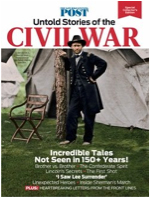
This article and other stories of the Civil War can be found in the Post’s Special Collector’s Edition, The Saturday Evening Post: Untold Stories of the Civil War.
—This account appeared in the May 20, 1961, issue of The Saturday Evening Post.
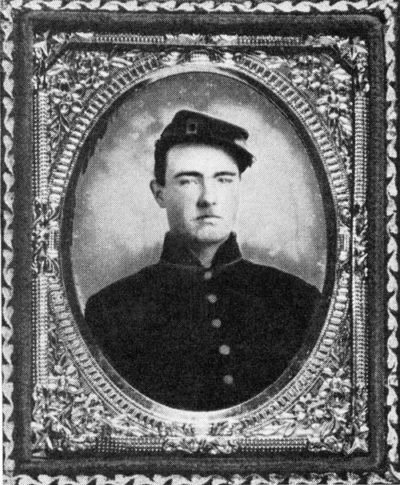
Robert Hale Strong was just 19 when he marched off to the Civil War with the 105th Illinois Union Volunteer Infantry and lived through grim fighting in the Georgia-Carolinas cam- paign. In his letters home, he told with brutal realism but unflagging good humor of humanity under fire and American courage of both sides. The following article is excerpted from that manuscript, later published under the title A Yankee Private’s Civil War.
* * *
We were under fire every day for about a month between Buzzard Roost and Atlanta, Georgia. I don’t mean that we were in a big battle every day, but were in a fight or skirmish on the picket line, always firing at one another. All the way to Atlanta was a series of fights. We did not always have it our own way; the Rebs were as stubborn as mules.
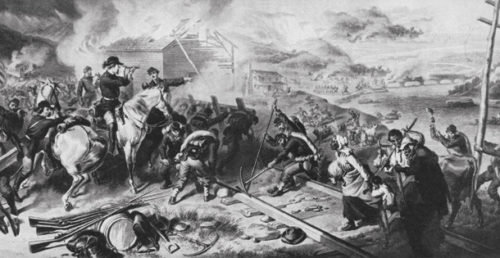
One time the enemy’s range was extra good, I remember, and their shells and bullets kept us dodging busily. You must understand that it was no real use to dodge, as the balls would either hit or pass us quicker than we could dodge. Old Col. Dustin saw the boys dodging, and he sung out, “Stop that dodging. Stop it, I say!” Just then along came a shell pretty close to his head. He was on horseback, and he bowed his head almost to the saddlebow. The boys laughed, whooped, and yelled. The colonel straightened up and said, “Well, d—n it, dodge a little, then.”
That same day, it seems to me, we experienced the heaviest musketry and artillery fire that we had all through the war. We fought them all day. They were on an elevation, and it is a fact that after we were relieved and started to the rear we could see round shot roll along the ground with enough force to tear off a man’s foot, as one negro discovered who tried to stop one with his foot. About then I found I had lost my knife and my pocketbook. I started to go back to the rail fence where we had been, to look for them. When I got nearly there, I found the Rebs had taken possession, and I lost all desire to recover my property.
The second day of the fight, we had been advanced to- ward the enemy in the shape of an upside-down V, with our troops at the point and Rebs on each side and in front. We were in timber. Across an open field we could see the Rebs massing about 80 rods away for a charge. The 102nd Illinois, armed with Spencer rifles, seven-shooters, were deployed in front of us as skirmishers. As the Rebs would advance, the 102nd boys would open on them with their seven-shooters and pretty soon, back they would go, only to rally and try again. We could hear their officers cursing them for cowards to run from nothing more than a thin line of skirmishers.
Shortly after they quit coming for us, Gen. Joe Hooker rode up, looked around and asked, “Who has command of these troops?”
Brig. Gen. William T. Ward said, “I have, sir.”
“D—n you, sir,” says Hooker, “don’t you know you have got these boys in a trap? The enemy are on three sides of them and prepared to charge on each side. Recall everybody but skirmishers and tell them to fall back quietly — don’t let a tin cup rattle to tell the Rebs that we are moving.” So we got out of that, but it was a close call.
During the first part of the Atlanta Campaign, I messed with Matthias Stephens and Ernst Hymen, both good, quiet, religious boys. One night, after advancing and driving the enemy all day, my mess had gone to our pup tents, and we were talking about the probability of a battle on the morrow. I used some strong language about the enemy and about our having to work so hard on short rations. Stephens checked me, saying, “Don’t talk so. Some of us will be killed tomorrow in the fight.”
Well, early the next morning we began a running fight, with the enemy falling back slowly. In advancing, we took advantage of all the shelter we could get, behind logs or stumps. My position was on the right of the company, being one of the tallest boys, but of course in that kind of advance ranks are not kept very true. It got to be a pretty hot fight. I heard someone call out, “Strong — Bob Strong!”
Before I could answer, someone else says, “The man call- ing you is out there in front of the line.” I saw the hit man shudder and lay his head down on his arm. I knew he undoubtedly was killed, for if only wounded he would have called further for help.
The Rebels refused to be driven any farther for hours. It was nearly sundown when they pulled out and we advanced. Our boys all gathered around the fallen man in our immediate front. Sure enough, it was one of my messmates, Ernst Hymen. He was shot directly through the top of his head and probably never knew what hurt him. Our orders were to push on after the enemy, but a few of us remained, dug a pit and wrapped Ernst in a blanket in his lonely grave.
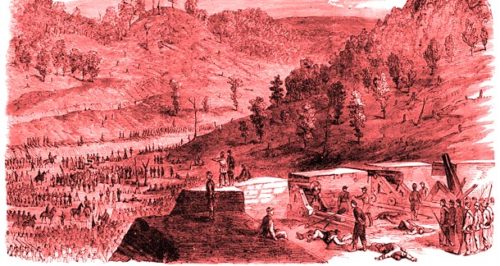
One day during a battle our brigade was ordered from center around to the right of the enemy. We marched just behind entrenchments filled with Yankees and across a field where we could see the enemies’ breastworks. We watched them working their artillery, with their shell and shot whistling over and among us. At the rear of the regiment were the major and Dr. Potter, brigade surgeon. If we saw a shell coming low, the men in line with it would lie down. One came along, striking the ground and rebounding. Dr. Potter with others was directly in line. Some lay down. Dr. Potter laughed at the boys. The shell struck the ground just in front of him, rebounded and took the top of his head off. As it hit him, a little puff went up from his head, and he fell dead. Then the shell struck the ground a few feet beyond him and stopped, with the fuse hissing. One of our boys ran to it and poured water from his canteen onto the fuse, putting it out and thereby probably saving many lives at the risk of his own.
At that point we were ordered to support a battery. As we came in sight of the battery, the Rebs, in three lines, They were about as near it as we were. We went on the run to save it. How those gunners did work those guns! At every discharge we could see holes open in the Johnnies’ ranks, but they closed up and kept on coming. When we reached our place behind the guns, the Rebs were not more than 100 feet away. Even in our hurry and great danger we handled our rifles as if on drill. Every man reached his place, pointed toward the enemy, and began firing. The Rebs were not more than 60 feet away. They went down like a boy shooting into a flock of blackbirds. It checked the charge, and the Rebs fell back. Our boys sent up a big cheer, then the battery boys had to shake hands with such of us as they could reach.
The enemy infantry having pulled back, their artillery began firing at us. Our battery returned the fire. We of the infantry lay down so as not to catch any more of the shot and shell than we could help. It was said there were 700 dead and wounded in our front. I know it looked as if we could walk over men without putting foot to the ground.
After our battery opened on them, the enemy scattered. Then we were ordered to do a thing that I thought then, and think now, was a foolish, foolhardy thing. Our music struck up, and with arms at “shoulder” we marched in a solid square out into that open field, the bands playing Be- hold the Conquering Hero Comes. There we stood at “rest,” supposing all the time that the Rebs would open fire, as we were in plain view of them.
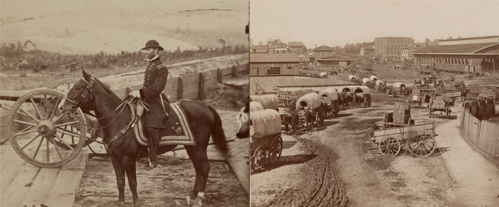
We lay down, expecting we were now safe for the rest of the day. Scott was marching up and down in front of us, declaiming some funny piece to amuse us, when the Rebs began to shell us. Scott kept on declaiming, and the boys kept on laughing. Then, with a heavy shock, a big shell struck within ten feet in front of our company and buried itself in the ground. We just held our breaths, expect- ing it to explode. Scott threw himself on the ground. I flattened myself out on the ground, until I seemed to have made a hole in it. May- be you can imagine what the suspense was, waiting for some of us to be killed. Of course, all this happened quicker than you can read it. After perhaps a minute Mark Naper lifted his head, his eyes big as saucers, and said, “Why don’t the — thing bust?” That made us laugh. As far as I know, the shell never did explode.
We became so used to noise — the firing of guns and can- non, the yelling and cursing of teamsters and artillerymen, and the blaring of bugles — that when permitted we would lay down and go to sleep amid it all and only our brigade bugle call would rouse us.
On the famous march from Atlanta to the sea we traveled light. Three days’ rations were issued to each man. Fifteen days’ rations for each man was put into wagons. We were ordered to form forage squads and to live off the country or go hungry. We did both at times, often having nothing to eat for 24 hours. Commonly our rations consisted of sowbelly — fat salt pork — and hardtack. We got four large hardtacks — crackers so dry as to resist all action of the weather — as a day’s ration. We had coffee, too, and sometimes sugar. At times we would draw what was called desiccated vegetables, a mixture of peas, beans, cabbage, turnips, carrots, onions, and beets, with grass to hold everything together, and dried and pressed. A piece an inch square would swell and swell into all the soup a man could eat. It was not to be despised. Our coffee generally was parched. Sometimes we would boil the berries whole, save and dry them later and trade them to the natives for corn bread, milk or butter. It was a fair exchange for some of the pies we got. Nobody but a soldier or an ostrich could digest them.
During this time we could draw no clothing, and ours was nearly worn out and did not pretend to cover our nakedness. I have foraged women’s shoes and stockings and worn them too. The mountain women had good-sized feet and wore heavy calf shoes, so I did not do so bad.
Our orders, while out foraging, were to capture all Confederate soldiers, seize all horses, burn all cotton and all Rebel government stores, but not to molest any citizens who remained at home and to respect all private property except for horses, mules and forage for man and beast. As far as I know, the order was respected.
Many times in Georgia we and the Rebs — after skirmishing and shooting at each other all day — arranged our own private truces. Once we stripped off, swam to a sand bar in the middle of a little river and traded our coffee for their tobacco. When we lay for a time along the Chattahoochee River, we agreed not to fire at each other except by officers’ orders and, if such orders were given, to notify the other side before firing. We told each other across the river, about 20 or 30 rods wide, that if we did kill a man once in a while it would have no effect on the war as a whole, that it was all nonsense.
One evening just before sundown, as both sides were taking it easy, a Rebel officer galloped up on his horse and began cursing and swearing at his men for not shooting the d—n Yankees. “Talking with them, are you?” he yelled. “Begin firing and shoot the hell out of them.”
We could hear everything he said and took up our guns. The Rebs yelled, “Hunt your holes.”
Little Charley Hapgood of our regiment, a splendid shot, says, “I’ll fix him.” We all stood watching as Charley fired. The Rebel officer threw up his arms and fell dead.
We cheered and cheered and called, “Say, Johnny, is it time to hunt our holes yet?” and they said, “No, he was a damn fool anyway and deserved what he got.”
Later on I also had some trouble with one of our own officers, a general, no less. In our corps, the Twentieth, one division consisted in part of Eastern troops under Maj. Gen. John W. Geary of Pennsylvania. Geary was a martinet, much stiffer with his boys than we of the West could stand. He frequently threatened to arrest us while foraging and confiscate our forage. He was cruel, too, in exacting full discipline of his men. I have many times on the march passed his camp and seen men with a cord tied around their thumbs, standing on tiptoe with their arms stretched above their heads and their thumbs tied to the limb of a tree. It was an ugly sight, and more than once our boys cut the men down.
My run-in with Geary came one morning when I was walking back from the advance guard with a message. About halfway, Geary and his adjutant rode up. I saluted and stepped aside to let them pass. Halting his horse, he asked, “What in hell and damnation are you doing here?” I told him. “You’re a damned liar, you are skulking,” he replied. “About face and go with us until we meet your command.” I told him that he was mistaken, that I was obeying orders already and could not obey him. He swore he would cut me down and drew his sword. His adjutant moved to draw a pistol.
I cocked my gun and said, “Sew, or I’ll kill you both where you are.” I then repeated my story and begged their pardon for my conduct.
Geary remarked to the adjutant, “I expect we were too fast,” and to me, “I believe you, and I am sorry for my anger.” He went one way, and I went the other.
Picket or guard duty was fun for the boys, for they not only got away from camp but had a chance to catch up officers. One time I stood sentry close to the enemy lines. Oh, how it rained! The mud was half knee-deep. Just as the morning began to get gray, I saw out in front of us a man slipping along from tree to tree, followed by several more. He passed post after post until he came to mine. He had on an old slouch hat, pulled well down over his face to keep the rain off, and a rubber blanket, high boots with spurs and a sword at his side. Well, I says to myself, it is Sherman, but he must come in like anybody else.
As he got in front of me, I called to halt him. At first he paid no attention, so I cocked my gun and says, “Halt! Come in or I’ll fire.”
Sherman and his staff put their hands up and came up to me, all of them. Sherman shook hands and said this was the only post but one to halt him, and that other posts let him go as soon as they knew him. I said, “Our orders were to halt everything that moved in our front.”
He said, “You did right,” and said he was out examining the lines. When he left, I saluted him, and he and his companions returned the salute. He was a nice general. Wherever he went, the boys would give three cheers for “Old Tecump” or for “Billy T,” and he would grin and wave his hat to us. He could joke too. There were lots of foreigners — Germans, Irish and others — among our troops. Once when the Rebs stopped us near Atlanta, I heard that Sher- man shouted command-like, “Attention, creation! Forward by nations and flank them!”
While marching through the public square at Smithfield, North Carolina, we saw Sherman seated on a big block. Behind him was an elevated platform with a rail, and in the center of it a tall and stout post with rings and cords attached. The platform was the auctioneer’s stand where he knocked off slaves to the highest bidder. The post was the whipping post. Just as we came up to Sherman, he cast his eyes toward this platform and waved his hand toward it. In just one minute, we had it torn down. Someone struck a match, and the whipping post was no more.
As we hurried by him, we asked, “How’s that, general?”
He grinned and said, “Good job.”
In Richmond a large section had been burned, and for blocks and blocks the weeds and grass were growing where houses had been and between paving stones. It was a picture of desolation and ruin. The country beyond Richmond was so bare that orders were very strict against foraging, but the boys had innumerable excuses when found with a pig, goose, or chicken. The goose tried to bite, so had to be killed. The chickens crowed to the tune of Dixie, so had their necks wrung. Pigs squealed for Jeff Davis, and soldiers could not stand that!
Then we marched for hours across the field of the Battle of the Wilderness, which lasted for days. We could tell by the graves how far charges went, and where Rebels and Yankees had stood. The dead were barely buried. It seems terrible to think of it now, but the boys would kick a skull out of the way as indifferently as if it had been a stone. Some would pick up a skull with a bullet hole in it and speculate about it.
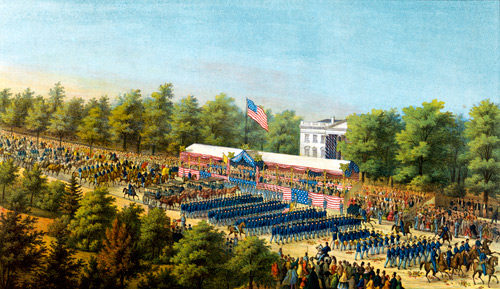
At the end of it all the Army of the Potomac, in white gloves and collars, with new uniforms, with their buckles and eagles bright as stars, paraded through Washington past the grandstand which contained President Johnson, generals Grant and Sherman and many others. The next day we of the West had our parade. We had been ordered to draw new uniforms. At the last moment our regiment packed them away. Instead of smart knapsacks, we had our blankets rolled up and hanging over our shoulders. We were so tanned we looked almost black, with worn uniforms and all kinds of hats, but our guns were always clean and bright. There was not a collar or pair of white gloves among a thousand men. There was as great a contrast between us and the “feather-bed soldiers” as possible. But when we halted in front of the reviewing stand, everybody cheered like mad. We stood there, as indifferent as an old maid to the voice of flattery.
“How We Marched Through Georgia,” May 20, 1961
Curtis Stone’s Green Bean and Cherry Tomato Gratin

Curtis Stone’s Green Bean and Cherry Tomato Gratin is a delicious way to add vegetables to your diet.
Green Bean and Cherry Tomato Gratin
(Makes 8 servings)
- ½ cup macadamia nuts
- ½ cup panko bread crumbs
- 3 tablespoons olive oil
- 1 ½ lbs. green beans, ends trimmed and cut diagonally in half
- 3 medium shallots, thinly sliced (¾ cup)
- 2 tablespoons drained capers
- 1 ½ teaspoons finely grated lemon zest
- ⅓ cup extra-virgin olive oil
- 2 tablespoons fresh lemon juice
- 1 pound cherry tomatoes, halved
Directions
- Preheat oven to 400°
- In food processor, pulse nuts for 10 seconds, or until they resemble fine crumbs. In medium bowl, mix nuts, panko, and 2 tablespoons olive oil. Spread mixture on small baking sheet and toast in oven, stirring occasionally, for 4 minutes, or until golden. Set aside.
- Meanwhile, bring large saucepan of water to boil over high heat. Add beans and cook 4 minutes, or until bright green and just tender. Drain and transfer beans to large bowl of ice water to cool completely, then drain well, pat dry, and transfer to large bowl.
- Heat medium saucepan over medium-low heat. Add remaining 1 tablespoon olive oil, then add shallots and sauté 2 minutes or until tender and pale golden. Add capers and lemon zest and cook 2 minutes, or until fragrant. Stir in extra-virgin olive oil and lemon juice and then add cherry tomatoes.
- Add tomato mixture to green beans. Season to taste with salt and pepper, and gently toss to mix. Transfer mixture to 9-inch baking dish. Sprinkle breadcrumb mixture over top.
- Bake gratin for about 12 minutes, or until heated through. Serve.
Make-Ahead: Recipe can be prepared through step 3 up to 1 day ahead. Cover separately and refrigerate, then proceed with step 4 when ready to assemble and bake gratin.
Nutrition Facts
Per serving
Calories: 251
Total Fat: 21 g
Saturated Fat: 3 g
Sodium: 92 mg
Carbohydrate: 15 g
Fiber: 4 g
Protein: 3.7 g
Diabetic Exchanges: ¼ starch, 2 vegetables, 4 fat
Excerpted from Good Food, Good Life by Curtis Stone. Copyright © 2015 by Curtis Stone. Excerpted by permission of Ballantine Books, a division of Random House LLC; Photo by Ray Kachatorian.
Healthy Weight, Healthy Mind: Why Making Demands on Yourself Won’t Help You Reach Your Goals
We are pleased to bring you this regular column by Dr. David Creel, a licensed psychologist, certified clinical exercise physiologist and registered dietitian. He is also credentialed as a certified diabetes educator and the author of A Size That Fits: Lose Weight and Keep it off, One Thought at a Time (NorLightsPress, 2017).
Do you have a weight loss question for Dr. Creel? Email him at [email protected]. He may answer your question in a future column.
In the last few posts we’ve been reviewing thoughts that might interfere with achieving health goals. This week we will explore why making demands on yourself won’t help you reach your goals.
The psychologist Albert Ellis is famous for telling people to “stop shoulding on yourself.” I can’t think of an area in life where the word “should” is used more often than with diet, exercise, and weight management.
- I should get up early in the morning to work
- I should take my lunch to
- I guess I should join the gym
- I know I shouldn’t eat so much ice
- We should get back to shopping from a grocery
- I should just tell my husband not to buy me
Why do we use this word? In some situations, the word should may bring good results by reminding us of things that are right and most consistent with our beliefs. I should study for my test instead of going out with my friends. Once you say this you know you’ll feel guilty if you go out. Since you don’t like feeling guilty, you stay home even though you don’t want to. Doing well on the test reinforces your strategy to use the word should.
But sometimes, should is a way we superficially deal with a situation to make us feel a little bit better. If I am talking to my dentist and say, “I know I should floss more often,” this statement probably won’t lead to action. It’s used to relieve the embarrassment I feel for all the problems with my teeth. This type of should makes me feel like I’m doing something, even when I’m not and have no intention to. In a situation like this, using should takes the pressure off, but may actually make it less likely that I’ll change my behavior.
If you want to manage your weight long-term, shoulding yourself is not the best strategy. As in the dentist example above, it may actually prevent us from doing what’s important. Even if you have short-term success guilting yourself into action, this won’t be effective in the long run. Even if it worked, who wants to feel guilty or pressured all the time? Telling yourself you have to do something strips away your perception of freedom and can lead to feeling disgruntled and even angry.
Imagine if the Christmas-time bell ringer for the Salvation Army stopped you at the grocery store, shook his fist at you, and said, “I know you have enough money to contribute to help us. You should stop thinking so much about yourself and your family and give to those who barely have enough to eat or don’t have a home to live in.”
How would you respond? I suspect you’d react in one of two ways: Either you’d walk on by (even if you were considering a donation before he started his diatribe), or you’d feel guilty enough to reluctantly throw some cash into the red container. No matter what you decided to do, you wouldn’t feel good about the bell ringer—and next time you’d probably use a different entrance to avoid the red kettle.
No one likes being strong-armed, so why do it to yourself? Telling yourself you should eat and exercise in a certain way will make those activities less desirable. You’re almost certain to (1) rebel against yourself, or (2) engage in exercise and dieting with a chip on your shoulder. Either way, you won’t be able to keep this going very long.
In a way, you’re telling yourself you aren’t smart enough, good enough, or disciplined enough to make choices based on what you truly want.
If I tell myself, “I should have an apple, not the cake,” I end up losing no matter which food I choose. If I eat the apple I feel deprived. If I eat the cake I feel guilty. If I eat both of them I feel even worse.
Maybe you substitute a different word for should:
I have to
I need to
I ought to
I’m supposed to
These phrases yield the same results. If we want to make lasting behavior changes and feel good about it, we need to stop talking to ourselves that way. Be nice to yourself. A simple change in words can make all the difference. Instead of using those demanding should words, try something like this:
I could have the apple or I could have the cake.
I could go to the gym or I could stay home.
I can take the elevator or walk up the stairs.
I could order dessert or wait until later.
You are giving yourself a choice — not a command. With this approach you can weigh the options, looking at the pros, cons, and consequence of each decision. Sometimes you might decide on the cake, but you needn’t feel guilty if you figured out how it could work within your larger goal of being healthy. If you decide on the apple you don’t need to feel deprived, because you decided it was the best decision.
As you go through the day, watch for the times you “should” yourself and try viewing these situations as a choice.
Dollhouse
“Donnie doesn’t deserve Deborah’s doll collection. I mean, look at the oaf. His hands are like a pair of uncooked ham hocks, slopping about.”
“Oh please, Sarabeth, y’all need to just split them or something. Deborah wasn’t just your Grandmama.”
“That’s not the point Crystal. You think if Papa George had some famed football card collection or somethin’, Donnie would be fine to split ’em? It’s not right.”
“And if you sell ’em? How right is that?”
The two women, clad in pastel debutante dresses bobbed in and out of the shade but even that couldn’t put a stop to the mixed stench of fresh-cut grass and B.O. that fermented across the estate lawn. The funeral procession was barely recognizable now, and to any outside onlooker, it could have been Derby Day. Not a drop of black was in sight and mint juleps sweated in every hand as laughter chased away the tears that had dripped down rosy cheeks a few hours prior.
“That’s not the damn point, Crystal.”
“Goodness, Sarabeth, it’s hardly noon.”
“Cut it, Crystal, you miss a putt and Satan himself jumps in your mouth.”
Crystal huffed and excused herself to the “little ladies’ room.” Sarabeth slurped at the mint dregs before some cousin from some other cousin came up to extend condolences.
“Auntie Deborah sure will be missed, Sarabeth. I’m so sorry fer yer loss.”
“Thank you for the kind words, and thank you for commin’, Jeffery.”
“You gonna sell those dolls? Donnie told me they’re famous or somethin’. Double their weight in gold he said, he did.”
“Well now, it’s a bit early for those kinda thoughts. And if I may say, a touch disrespectful to Grandmama Deborah, right Jeffrey?”
“Oh. Yes. Sorry, Sarabeth, I meant no disrespect.”
Sarabeth waved him off and took her leave, weaving in and out of the guests like a rattlesnake, nodding to the heads of hands that grazed her shoulder as she went.
The bar, her destination, and for that matter, the sun, were suddenly blocked by a wall named Donnie.
“You been avoiding me, Sis?”
“We all need our space to grieve, Donnie, and speaking of which, you’re in mine.”
Donnie took a step closer. Aftershave and sweat barreled down from his bald head to assault her nostrils. Like a simulated dance, Sarabeth took one step back.
“I’ve got no interest in the house, Sara — I just want the dolls. So be a doll and take whatcha yer given.”
“Awfully suspicious those dolls got your attention. I cannot seem to recall this same fascination back when we was kids.”
“And what … you share Grammie’s obsession? You just want them dolls to play and photograph?”
Crystal appeared and grabbed Sarabeth’s arm.
“The pastor needs to see you, honey, has some papers for you to sign.”
“I’ll come too.”
“Entertain the guests Donnie — flash that big toothless grin of yours. It’s just payments. And change that shirt — looks like some cloud passed by and pissed on yah”
Sarabeth turned on her heels, the grass twisted beneath, groaning in protest. She followed Crystal up the patio and into the house where the Pastor had been communing with Christ and the bottle. She snatched the papers out of his tee-tottering hand and signed away the fees in a flourish.
“Thank you, Pastor Jonathan. I just know that our Deborah was lookin’ down on that service as an angel with her hands on her big heart. It was wonderful. Our family cannot thank you enough.”
“It wass my pleasure. The parish will miss Deborah’s generous —”
“Excuse me, Pastor, but I must get back to the party. Funerals allow no rest to the livin’. Please, let Crystal know if you need anything else.”
Sarabeth left the pastor to finish his favorite pastime. She took a turn away from the voices outside and scrambled up the over-varnished stairway, her heels click-clacking against the chipped cherrywood. She passed the first room, a veritable ghost town of old furniture, each piece covered by a white, now yellowed sheet. A loud creak announced her presence to the collection, but not one head turned to acknowledge her entrance.
Sarabeth let out a long sigh and shut the door behind her. It was like being at another party, but where no one noticed you were there. The dolls were arrayed like a battalion, waiting for orders. While most took up floor space, the far-end wall acted as a doll pedestal with several of the 17-inch mannequins encased in glass prisons.
Sarabeth walked to the pedestal and took out her sage-green handkerchief to wipe the dust. Unlike many strewn along the wall, that carried warm memories of imagining far-off worlds that now seemed even farther away, the doll Sarabeth stared down held only reminders of reprimands and black bruises. The lifelike doll was a girl with plaited auburn hair and blue-gray eyes that matched the sash and accents on her lace-sleeved white dress. It wore a plain straw hat and a set of white shoes and stockings. Her face was set in an unusually mature expression and her ears, Sarabeth’s favorite part, were pierced. It was thought to have come from an experimental mold made by German toymaker Lewin Kersting in the late 1880s. Being a mold, there were no other known examples, making it one of the rarest, most valuable dolls in the country.
“Grammie is barely cold and already you got her rollin’ in her grave.”
“The guests boo you off the lawn, Donnie?”
“I’m just checking up on my collection.”
“The last time you checked out the collection you were lookin’ up skirts.”
“Your smart mouth isn’t gonna get you out of this one, Sis. Hell, you thought it was gonna get you out of this town but look atcha, still here, still stuck with all us southern trash yous always been so sick of.”
“Then why don’t yah just give me the damn dolls and let me leave, Donnie? You sure as hell won’t miss me.”
“The will.”
“The will what?”
“Don’t yah find it a wee bit odd that every little thing Grammie owned was spit and spotted minus dem dolls? And the whole lot of us family knows them dolls were her pride and joy.”
“Use your brain, Donnie. Time ran out on her to make the decision. Easy as that.”
“Mighty convenient. Pride and joy as they were, Grammie knew their worth. Bigger than this estate.”
“This estate is hardly worth a pence or two,” Sarabeth said, setting the Kersting doll down on the sunken floorboards with the rest. “Look around, it’s deader than our Grammie. As much as I’d like to explain what math is, I don’t think there’s enough time on this God green Earth. Now let’s go, we must tend to the troop.”
She smoothed the doll’s dress with one, two motions of her hands and tucked its hair behind its ears before turning to glare at him. Then she shot out the door like a Confederate cannon.
Donnie listened for her heels on the steps before backing up and giving the doll nearest him the hardest kick he could. The doll smashed into the opposite wall, a literal rag doll. Its golden wig, ripped off from the force, lie at his feet. He made a point to stomp on it as he left.
Sarabeth waved off the bartender’s deft attempt to put mint in her glass. She took the julep and downed it before it had a chance to sweat.
“Another.”
“Ma’am, if I may …”
“You may not. And make it like you would were I a man.”
“Y-yes, ma’am.”
“There you are — should have known you was gonna be by the bar, hiding away from family.”
Sarabeth turned and grimaced. “Speaking of, I didn’t see you at the funeral, Uncle Reed.”
“I overslept and by the time I had breakfast — ta-da — it was time to celebrate her life instead of mourn it.”
“You always had a nose for the party.”
“You got that right, baby. You always loooved my parties if I do so recall.”
“Hmmm. Are these your condolences? If not, I can accept them as such, and you can go hit on one of our more distant cousins.”
“Take one trip up north to that city and yah come back a bitch, spoutin’ the same shit stereotypes.”
“The difference — we both know you.”
Uncle Reed smirked and pushed back his sweat-streaked, thinning hair.
“You know that brother of yours is in some trouble?”
“That brother of mine’s been 6’6, 24 stone since he was 16. Combine with a brain the size of a bran flake, he’s the recipe for trouble.”
Uncle Reed picked up a bottle at the bar, giving Sarabeth a wink. He turned to go.
“This trouble is a little bit bigger than Donnie. You should ask him about it.”
“Your drink, ma’am.”
Sarabeth took the julep, no mint, and headed toward the lakefront. It was a beautiful property, worth a little more than a pence or two. But after nearly two centuries, the buildings that called the land home had nearly given in to the nature it had once colonized. Sarabeth kicked pebbles into the light lake wake. Across it were houses just like her Grammie’s. Some older, some newer, but from here, they were all the same. Tiny boxes enclosing fears, joys, and mysteries.
“Hey gurl! Now what in the good lord’s name are you doing down here all by yerself?”
“The noise gets to you on a day like today, Crystal.”
“You poor thing — I know you and Deborah were close.”
“That’s a liberal use of close, Crystal, and we are a very, very conservative family.”
“I just meant …”
“I know what yah meant, Crystal, and I know yah meant well. Here in the south it’s just family, family, family. But what if
your family is no good? What then?”
“Sarabeth … I don’t think —”
“I know what the good lord says. But he’s pretty lax on the details, is he not?”
“I …”
“Crystal, you know my family from afar. You see us from a pretty little window atop a pretty little house. But we ain’t that — Do you know Donnie’s in trouble?”
“I …”
“For god’s sake Crystal, tell me. The dolt’s still family, brainless or not.”
“They says he’s gotten himself in a bit of drugs?”
Crystal stared at her shoes like they were a pair of hypnotic yo-yos.
“Crystal. What do you mean — he doin’ or sellin’?”
“Sellin’, but from what I hear, he’s mostly owin’.”
“Mother of pearl. How did this happen? And please, do spit it out this time.”
“Look hun, there ain’t much to do in this town. You can only fish, hunt, and screw for so long before your heart goes searchin’ for something else.”
“I don’t think the heart goes searchin’ for drugs, Crystal. This damn town is nothing but a burden on all who walk its streets.”
“Beth, the heart needs fillin’, it doesn’t discriminate with what. More importantly, this new fentanyl isn’t like heroin or cocaine from our day. It’s no burden, it’s a death sentence.”
“Fentanyl?”
“Yeah, it’s one of those super-powered opiates, pills. It’s what makes it so damn easy. Just last week, Bobby, you remember him right — yeah, just last week he overdosed. It was his first time.”
“Crystal, is Donnie getting people killed?”
“He ain’t no murderer if that’s what you mean, but, he ain’t no nun neither.”
“Thanks Crystal.”
“Where you going?”
“Where you think?”
Sarabeth marched back toward the increasingly raucous party. A band had materialized and begun to play at the top of the patio, gathering a hoard of guests now stomping along. She padded on past and into the house where she found Donnie nursing a bottle of whisky in the kitchen all to himself.
“You got some splainin’ to do.”
“I’m up and sick of talking dolls — them lawyers can decide.”
“You got no business deciding what’s right or not. And I ain’t talking about the dolls. I’m talking ’bout this side business of yours that’s getting people killed — and from the sounds of it, you could be next.”
“I ain’t doin’ those drugs.”
“You ain’t payin’ ’em off, neither. How could you be so stupid? — Don’t answer that.”
Sarabeth took the bottle out of his hand and poured herself a shot, shooting it back.
“How much do you owe?”
“Couple hundred grand or so.”
“Jesus criminy, Donnie. Why, tell me why?”
“It seemed easy — put money in, get double the money back.”
“Yes, a brilliant business acumen you got there.”
“I am sick and tired of you calling me stupid, Sis.”
“Well stop acting stupid then. You are how yah act.”
“Uncle Reed said it was sound.”
“I knew there was someone worse behind this.”
“At least he’s around.”
“Are you listening to yourself? I don’t shoot myself in the head just ’cause guns are around. Uncle Reed thinks for himself not for the family.”
“Then you and him share something after all.”
“We share many things, but that is not one of them. I left because had I not, you would have ended up selling me an overdose just like Bobby.”
“I don’t understand.”
“You don’t need to. I had my reasons.”
“Had your reasons for what?”
Uncle Reed sauntered into the room, his thumbs hooked on the inside of his faded Levi belt loops.
“We were just talking about you, Uncle Reed. About how you been corruptin’ Donnie here for your own gain.”
“I didn’t gain a thing — I made proper introductions was all.”
“You are the worst thing that’s ever happened to this family and an absolute disgrace to the human race.”
Uncle Reed smirked and walked right up to Sarabeth so she could smell the stale whisky from his breath and mustache.
“Why am I the worst? Hmm? You gonna tell everybody?”
“Tell everybody what?”
“Nothin’, Donnie. If it ain’t clear by now, it don’t matter.”
“I don’t understand.”
“It ain’t like that’s an unfamiliar feeling.”
“Shut your mouth, Uncle Reed. I’m the only one who gets to speak to Donnie that way.”
“Everyone thinks it so — what’s the difference? Now, Donnie, I came here to find you, because I’ve got a mighty fine plan that will scrub your debts as clean as a fresh spittoon.”
“Don’t listen to him, Donnie.”
“Please Sarabeth, go play bridge or somethin’ and let the men speak. We can talk later if you want.” Uncle Reed winked.
“I’d leave you to it if I wanted you both dead but that’s only half the truth.”
“Leave us, Sara. I got myself into this, I gotta get myself out.”
“I …”
Sarabeth stopped herself, leaving the two men huddled over the kitchen island, whispering between a bottle. She wrapped right around to the servant’s kitchen and placed her ear to the door and listened as Uncle Reed divulged his plan.
“… we use the dolls to smuggle the latest shipment up to Birmingham. The demand up there is huge, I’m telling yah! Way bigger than the crawfish down here. And hey, those dolls are worth some cash, right? So we can just sell …”
Sarabeth removed her ear from the door and headed upstairs.
“You leavin’ already?”
“It’s been a long day, Crystal. I’m gonna grab a nap back at the hotel — I’ll see you later.”
“You better. A bunch of us are headed down to Brother Frankie’s to continue the festivities.”
“Brother Frankie’s — got it. It was good to see you.”
“Always good to see you, Sarabeth.”
“Glad someone thinks so.”
“Oh, Sarabeth. The only one who made you an outcast in this town was you. Everyday I’d see your Grammie and she’d ask if I’d spoken to you.”
“Crystal …”
“No, Sarabeth, you need to hear this. I mean look around. Back when we was kids, this place shined, and today, that shine was back. You could feel it, yah know? Grammie’s dying wish was to bring you back to this town, your family back together, and it took her dying to make it happen. Stay awhile, you may remember a few things you liked.”
“Crystal — I don’t know what to say. Thank you. I’ll see you at Frankie’s.”
“I sure hope that’s true.”
The big band had been replaced by an old radio, the party long since danced down to Frankie’s. Donnie and Uncle Reed sat on the wood panels, placing dolls in boxes.
“Where’s that famous one your Grammie always fawned over?”
“Huh?”
“Oh, come on, you know the one, the rare one.”
Chicago, 399 miles. Behind the wheel of her rented Chevy pickup, Sarabeth turned down the radio as Billy Ray Cyrus accosted the sound waves. Country wouldn’t be heard as much where she was going, and that wasn’t a bad thing. On the next seat over, the Kersting doll sat, buckled up with the same expression she’d had for a good century or so.
“He won’t get to you, too.
News of the Week: The Sounds of Summer, Ghost Towns, and 10 Recipes (Yes, 10!) for Onion Rings
Beep! Crack! Vrooooom!

I don’t have air conditioning in my apartment, so in the summer I keep my windows open all the time. I live in a neighborhood with a lot of businesses and traffic, not far from both downtown and the highway. That means, unlike during fall and winter, every sound that happens outside, I hear in my apartment. I hear the big rig trucks as they go past my windows, the cars speeding through the intersection, the fire trucks, even people as they walk by and engage in conversation (something that can get rather boisterous on a Friday or Saturday night after they’ve had plenty of liquid refreshment). Oh, and a lot of car horns. Right this moment, there’s a guy in a Toyota in front of my building with his hand on the horn, impatient about something or someplace to go.
We always think of the differences in seasons only when it comes to weather (a crack of thunder almost made me jump out of my shoes a couple of nights ago), but what we hear is different too, and summer brings its own sounds, whether it’s a baseball meeting a baseball bat, the music of a Ferris wheel, or the march of a parade going by. I don’t mind the sound of any of those things, because unlike car horns, they’re associated with happy things. But all I can think about on this first full day of summer, the day when the kids are ecstatic and everyone’s thoughts turn to warm temps and shorts and barbecues, is that I can’t wait until the day a few months from now when I close my windows and everything gets a little quieter.
I could write about the smells of summer too, but I’d rather not think about those.
Hey, Let’s Buy a Town
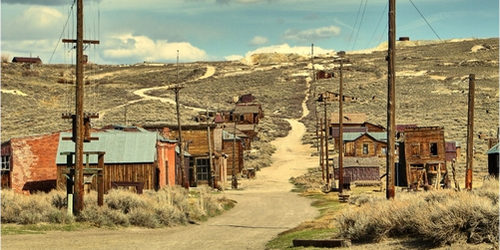
Do you have an extra $925,000? Have I got a ghost town for you.
Cerro Gordo, an abandoned mining town in California five hours north of Los Angeles, is for sale. It was founded in 1865 (the year Lincoln was assassinated) and was once the state’s largest producer of silver and lead.
You get 314 acres of land, plus 22 buildings, including a hotel, a saloon, and a chapel. You can shoot your own westerns there, or if you’re really rich (which I assume you are if you’re spending almost a million dollars on a town), you could fix it up and actually make it a non-ghost town again, one were people live and work. Imagine owning a town!
We could start a GoFundMe page for it. Who’s in? We could rename the town “Postville” or “Rockwell.”
Abraham Lincoln for Sale
Ghost towns aren’t the only historic things up for sale. Several of President Abraham Lincoln’s items are on display at the Lincoln Presidential Library and Museum in Springfield, Illinois, and many of the 1500 artifacts, including his hat, gloves, and pen, might be put up for auction to help pay off the museum’s loan debt. Needless to say, not everyone is happy about it. Here’s the story from CBS This Morning.
Corresponding for 40 Years … Via Cassette Tape!

I’ve talked many times here about old-fashioned correspondence and communicating with friends and family in ways that don’t involve a smartphone or social media. I was talking about handwritten letters and using the landline telephone. Not for one second did I ever think that people still corresponded via cassette tape.
That’s what these two Massachusetts women have been doing for 40 years. They started it after one of the women moved away (and to bring this back to something I mentioned above, they started it the day Elvis Presley died, August 16, 1977). Sure, they could use email or texts, but why stop something fun you’ve been doing for over four decades, where you can actually hear each other’s voices and keep up a tradition?
I’m all for this. The only question I have is, where the heck do you buy cassette tapes? I think I know where to get typewriter ribbons more than I do cassette tapes.
RIP D. J. Fontana, Matt “Guitar” Murphy, and Georgann Johnson
J. Fontana was Elvis Presley’s drummer. He played on such classic songs as “Hound Dog,” “Don’t Be Cruel,” “Heartbreak Hotel,” and “Jailhouse Rock” and appeared with Elvis on The Ed Sullivan Show and the famous “68 Comeback Special” in 1968. He died last Thursday at the age of 87.
Speaking of Elvis, here’s Bill Newcott on a new DVD set of the King’s best movies.
Matt “Guitar” Murphy was another music icon, a legendary blues musician probably best known for his work in The Blues Brothers. He also played with such people as Muddy Waters and Howlin’ Wolf. He died last Friday at the age of 88.
Georgann Johnson was a veteran actress who had regular roles on Dr. Quinn, Medicine Woman, and Mr. Peepers (she played Tony Randall’s wife). She also had roles in movies like Midnight Cowboy, Shoot the Moon, and the classic nuclear war TV movie The Day After. She also appeared in many Broadway productions. Johnson died June 4 at the age of 91.
Quote of the Week
“Not very tall. Or big. Just sayin’. I kinda liked it. Sort of.”
—a reviewer of the Great Wall of China, one of the quotes in this smart New York Times piece about the world of negative online reviews
This Week in History
Stan Laurel Born (June 16, 1890)
My favorite story about Oliver Hardy’s partner involves Dick Van Dyke. He accidentally came across Laurel’s number in the phone book one day. It was a long shot that it was actually the Stan Laurel, but … it was! He was living in an apartment in Santa Monica. Van Dyke and Laurel talked on the phone and became good friends. Van Dyke even gave the eulogy at Laurel’s funeral in 1965.
Statue of Liberty Arrives in New York (June 17, 1885)
Here’s what Lady Liberty looked like when she arrived at New York Harbor (click through to see the enlarged photos on Twitter):
#OTD in 1885, the Statue of Liberty arrived at the New York Harbor. Designed by French sculptor Frédéric Auguste Bartholdi, this massive copper statue became a symbol of freedom and opportunity to immigrants arriving from overseas. #oldestallies #fromthearchives pic.twitter.com/8AxscAxouz
— Embassy of France in the U.S. (@franceintheus) June 17, 2018
This Week in Saturday Evening Post History: School’s Out (June 21, 1958)
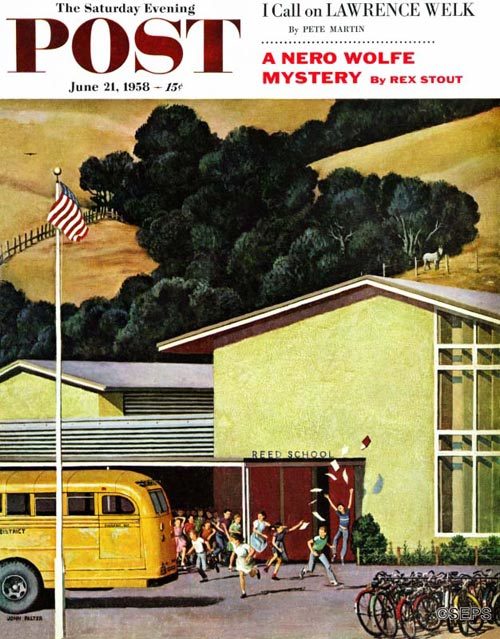
John Falter
June 21, 1958
I love the composition John Falter has here. He could have concentrated on the kids in close-up, their faces locked in big smiles. But he decided to do it from a little further away, capturing the school’s flag, the bus, and the bikes in the rack. If you look closely, you can see one of the kids throwing papers in to the air in celebration.
By the way kids, it’s already June 22. Enjoy the summer now, because you’ll be back in school before you know it!
Post Writers You Should Read
On the cover above is a Nero Wolfe story by Rex Stout, titled “Murder Is No Joke,” which was serialized in the Post in three different issues: June 21, June 28, and July 5, 1958. The story was later retitled “Frame-Up for Murder” and was part of the novella collection Death Times Three, released in 1985. You can read it for free at the Internet Archive.
After two films and several radio adaptations, there were two different TV shows based on Nero Wolfe, one a short-lived A&E series starring Maury Chaykin and Timothy Hutton and the other an even shorter-lived NBC series starring William Conrad and Lee Horsley, as well as various TV movies and pilots that never went anywhere, including one that was supposed to star Orson Welles.
Today Is National Onion Rings Day
Onion rings are a summer food, right? You can get them everywhere, but I associate them with carnivals and amusement parks, something you have along with fried dough and corn dogs and cotton candy on a stick. Something in a box you hold in your hands as you walk around the fairgrounds, looking for the next game to play or ride to ride.
They come in two distinct varieties: crunchy and wimpy. The crunchy are thick and crispy and really hold up. The ones I get in a local restaurant are thin and limp and just not the same (though they sure are tasty). Of course, you can make your own at home, too. Here are ten recipes — some with eggs in the middle and some wrapped in bacon — from the National Onion Association.
On a related note, yes, there is a National Onion Association.
Next Week’s Holidays and Events
International Body Piercing Day (June 28)
If you’ve ever wanted to pierce you body, today is the day to do it.
Did We Say That? The Dangers of Women Playing Basketball
A 1903 Post editorial warns that allowing girls to play sports will lead to the ruin of feminine character.
The development of a fondness for athletics among girls has been a noteworthy feature of life in this country during the last decade, and it is not strange that it should be attended by manifestations of misdirected energy and bad taste. From anxious mothers, from teachers, and from physicians earnest protests are being made against the tendency to encourage girls to think that they are just as well adapted to the athletic life as boys are.
As to the adaptability of girls to physical exercise, there is something to say on both sides, but the weightier opinion on the part of physicians seems to be that the girl is so different from the boy in temperament and constitution that though a moderate amount of exercise of the right kind and under the right conditions is immensely beneficial, excessive training, overexertion, and the influences of publicity are detrimental to her physical and mental well-being.
All this ought to be sufficiently obvious to any intelligent person who stops to reason about the matter. The trouble is that when athletics for girls became the fashion the majority of parents did not stop to reason about it, but allowed their daughters to do as the other girls did; and there were always enough girls of independent ideas to take the lead and set an example that the others were only too ready to follow.
A reaction against this state of things was sure to come, however, and it has already begun. Even basketball — a game supposed to be particularly suited to girls — has come under the ban. Miss Lucille Eaton Hill, director of physical training in Wellesley College, is convinced that competitive athletic contests for young girls, and especially interscholastic basketball matches, are exceedingly injurious to the players physically, and tend to “a general lowering of the standards of womanly reticence and refinement.” Miss Hill has been studying the conditions of athletics for girls in some of the New England schools, and she finds a great deal to condemn. In one school the girls had formed an association and were training themselves in running and jumping with the aid of boy coaches and without supervision by the school authorities.
The moral of all this is that if parents desire their daughters to be given the right sort of physical training to fit them for lives of usefulness and honor, they must see that the task is entrusted to competent instructors.
—“Athletics for Girls,” Editorial, November 21, 1903