Innocent Days on the Internet
“The Internet can and will change your life.”
Readers who saw those words in a 1997 Post article might have easily dismissed them as journalistic hype. The Internet was still quite young and unexplored in those days. It gave little indication it would grow into the force that would reshape America’s economy, politics, society, education, and arts.
It had been developing slowly and quietly. While the first tests of the Internet took place in November 1969, as late as 1993, there were only 50 websites in operation. The first secure online purchase wasn’t made until August 1994 (when a Web developer bought a copy of Sting’s CD Ten Summoner’s Tales.)
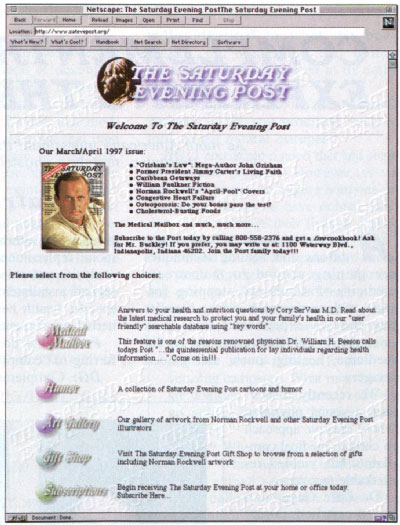
Web traffic was climbing steadily, though, and the number of Internet users doubled every year. By 1997, over 70 million people around the world were online. But this was still less than 2 percent of the planet’s population. Large sections of Americans were only vaguely aware of this thing called the World Wide Web. The Post article, “Trekking the Internet,” probably introduced many readers to such terms as “HTML” and “browser” and “URL” (“pronounced ‘You Are Ell,’” the authors helpfully added).
We’re now so accustomed to the Internet that it’s amusing to read the authors’ comments on basic operations. “You can ‘save your place’ on the Web and create a list of your own favorite sites. The list of personal favorites is usually referred to in the software as the … Bookmarks section.”
Though some of the players they describe have passed from prominence — America Online’s WebCrawler and CompuServe’s NetLauncher — the Internet is still much as they described it then: “fascinating, stimulating, and thought-provoking … also silly, irreverent, and mundane.”
The biggest difference between then and now, though, is the Internet’s attitude toward commercialization. The article reported that Internet users and service providers would tolerate no advertising on the Web. When two attorneys sent a spammed advertisement to thousands of newsgroups in 1994, the Internet “responded swiftly and with considerable ferocity. All messages originating from [the lawyers] were intercepted and destroyed. Their fax machine was swamped by a flood of dummy calls, effectively disabling their machine. Their service provider was also deluged and cut off [the lawyers’] service. … They went to another service provider who offered them the same discourtesy.”
Perhaps it was naive to think the Web could remain commercial-free. Back in the 1920s, many Americans had expected radio would remain free of advertising, and America’s airwaves unsullied by singing jingles for scouring powder and deodorant. But radio went commercial, as did the Internet.
Unlike radio, however, the Internet allows users to intercept and block the advertising sent at them. Ad blockers are becoming so efficient that advertisers are starting to worry.
It’s likely that ad blocking will change the amount and type of advertising we see on the Web. But then, change is perhaps the only constant in the digital world.
A Salute to Veterans
Tributes to the military have long been portrayed on covers of The Saturday Evening Post, from situations serious to humorous. In honor of Veterans Day, we would like to share some of our favorites.
The first Post military cover? An action depiction of U.S. soldiers on horseback in the Philippines.
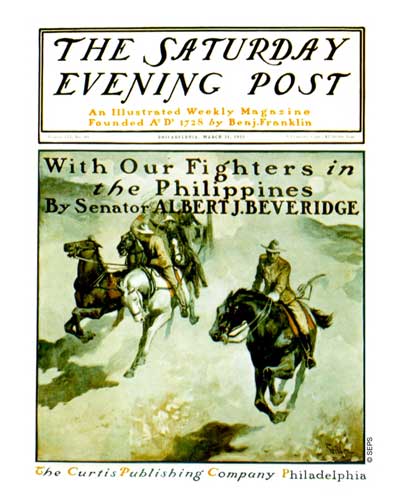
George Gibbs
March 31, 1900
He’s in the Army now. A seldom seen cover from December 1942 by John Atherton shows a faithful dog and a photo. From the uniform, we can guess where its master is. We hope he returns home soon – Spot is itching to go hunting.
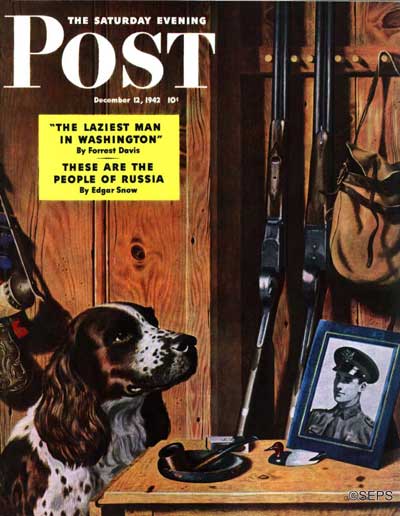
John Atherton
December 12, 1942
The enlisted also included members of the Women’s Army Corps (WAC), as shown in the cover from 1942 by an artist named Gilbert Bundy.
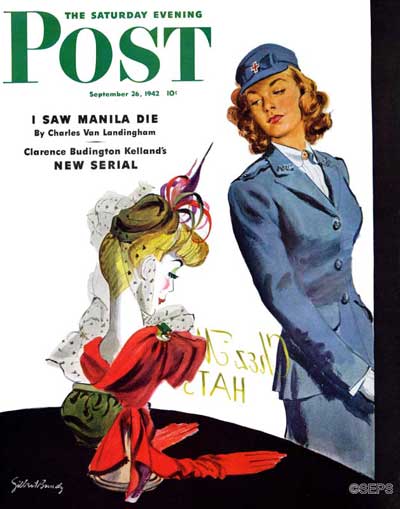
Gilbert Bundy
September 26, 1942
A WWI soldier shares a humble Christmas meal in this endearing 1917 cover by the prolific J.C. Leyendecker.
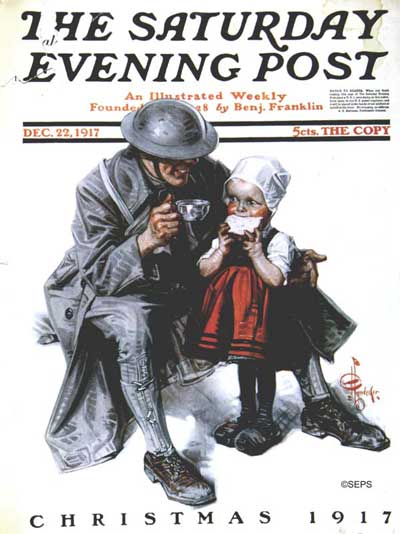
J. C. Leyendecker
December 22, 1917
On the May 14, 1927, cover by E.M. Jackson, this sailor accomplishes an important mission overseas — finding a genuine American hot dog!
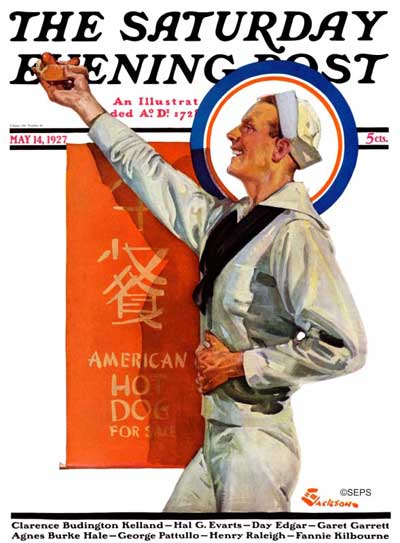
E.M. Jackson
May 14, 1927
Celebrating soldiers, sailors, and marines, the 1937 cover by John Sheridan captures all three with a parade below in their honor.
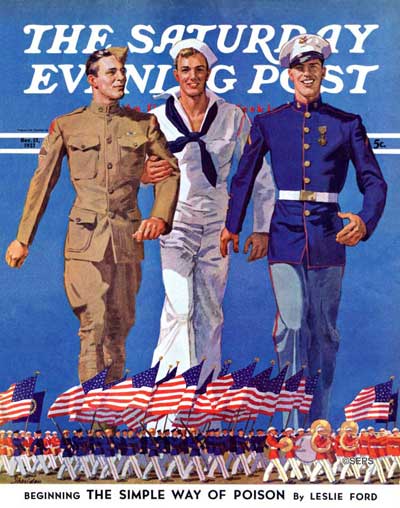
John Sheridan
November 13, 1937
Norman Rockwell honored the military during the WWII years with several covers of the “every soldier” he named Willie Gillis. We’ve shown Willie’s military adventures before, but not this one from 1941. Rockwell’s famous private is home on leave, snuggled under the quilts and enjoying the luxury of sleeping late. The sign above the bed echoes our ardent wish for all our military men and women: Home Sweet Home.
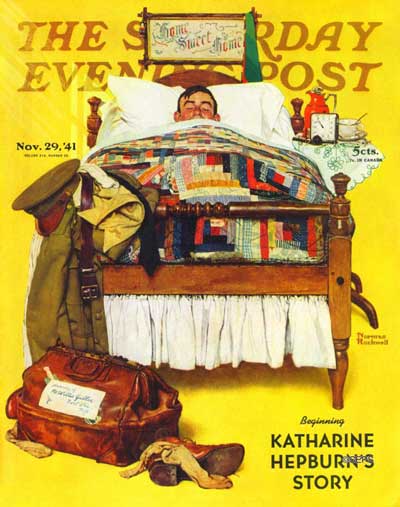
Norman Rockwell
November 29, 1941
After Forest Gump, actor Gary Sinise became an advocate for wounded soldiers. Check out Jeanne Wolf’s interview with Sinise from the September/October 2014 issue here.
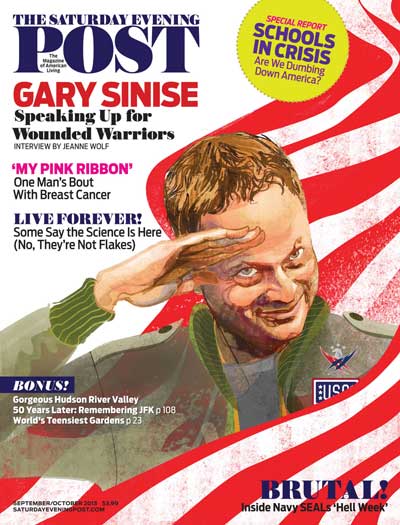
John Jay Cabuay
September/October 2014
Vietnam Vets: ‘Why We Chose to Serve’
It’s not unusual for vets in uniform to be stopped by strangers and told how much their service is valued, especially around Veterans Day. But Americans weren’t always grateful to the men and women who served in the military. In the late 1960s and early ’70s, some treated Vietnam veterans with indifference or even blatant hostility.
The country had been generally supportive of the Vietnam War in its early days. An October 1965 Post survey found 65 percent of Americans ready to extend the Vietnam War another four to five years. And 59 percent were willing to escalate it, “even if it means bombing Hanoi and Red China.” But enthusiasm faded as the country learned the harsh realities of the fighting. In time, some Americans extended their resentment of the war to the men who were fighting it. The war became an uncomfortable fact, and its veterans were given scant recognition for their service.
Below, five Vietnam veterans share thoughts about service to country, the public’s reaction to their service, and how it shaped their thoughts on war today.
Charles Boland, Corporal, USMC
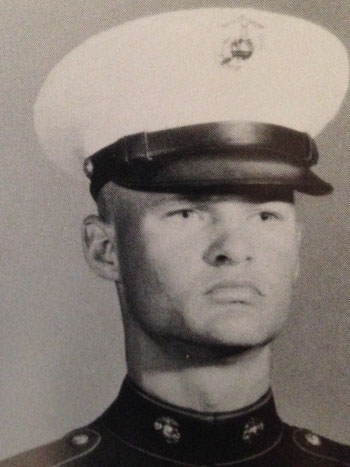
Making a choice: “I knew the chances were quite high that I’d be drafted, and I always wanted to be a Marine. … There is no other service with its history of the esprit de corps. When you enlist in the Marines, you’re changed forever.”
Public reactions: “I was wounded, evacuated, and sent home. … I remember being confronted by a woman. She asked me how I’d been hurt. When I told her I’d been wounded in Vietnam, she said, ‘I wish you’d been killed.’ Until then, I hadn’t been confronted by hatred.
“People walk up to you now and say, ‘Thanks for your service.’ But some vets get mad when they hear this. They tell me they get the feeling what’s really being said is ‘thank you for serving so I didn’t have to.’”
Serving the country: “Just paying your taxes is like buying a substitute to take your place in the Civil War. … I think there should a greater sense of service to country … in the Peace Corps, in communities, assisting other people, volunteering at VA hospitals to free up the staff, not just in the military.”
Reflecting on the war: “Too many people are willing to go to war at the drop of the hat. They’re not really willing to look at what’s going on.”
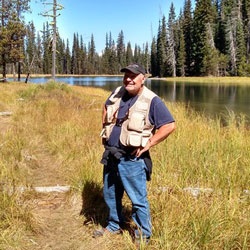
Dave Beyerlein, Infantry Sergeant, USMC
Making a choice: “I joined in March of 1966 with a buddy in Portland. The Marines grew me up and gave me respect for authority.”
Public reactions: “There was no respect for time spent and sacrifices made. We caught a lot of crap from people. At least one person called me a baby killer.
“It took decades for America’s thinking to come around so people could recognize that we [veterans] were just slobs who got caught in the war. Problem is, it took a lifetime to for that to happen.”
Serving the country: “I believe everyone should spend two years in service to our country. If you’re just along for a free ride, you don’t understand what you’re getting for free. It doesn’t have to be the military; it can be any service. But it gives you ownership. It will give you a different perspective and you’ll value your citizenship more.”
Reflecting on the war: “I’m so antiwar now it’s crazy. The war we were in was totally worthless. It was what, 58,000 dead? And now Vietnam’s one of our trading partners, and they’re still communist.”
Randolph Schiffer, First Lieutenant, USMC, Commander, USN Reserves
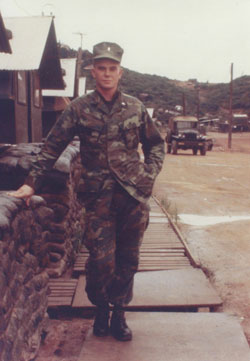
Making a choice: “For young men in America in the 1960s, the Vietnam War was the central issue. … I wanted to face this issue squarely. … I [joined the Marines] to make a statement to myself about duty, honor, and loyalty to country.”
Public reactions: “I was accepted at three top-tier medical schools before I went, but when I returned two of those three refused to reaccept me, as did seven others to which I applied. The sentiment in the medical schools was exemplified by the admissions committee feedback given to me in person by Harvard. ‘We’re not taking you because you’re a Vietnam veteran,’ they said. When I asked what specifically it was about the veteran part, they said, ‘We just don’t think a Vietnam veteran could do the work at Harvard Medical School.’
“There has been a complete inversion in Americans’ attitude toward veterans. People who return from the Mideast war can’t walk into a room without hearing ‘thanks for your service.’ I didn’t hear that when I came back in 1972.
“I believe what we’re seeing here is the national guilt and shame about the way they treated people like me in the 1960s. … Now I get admiration for my service, but it was a long road to getting it.”
Reflecting on the war: “Eisenhower said the most powerful military force is an aroused democracy. We don’t have that now. … The wealthy, powerful, and white, in many cases, are saying ‘I don’t want to serve in military.’ We have a professional military. It’s smaller and better paid, but not diverse enough to be representative of the country.”
Ted Decker, Corporal E4, USMC
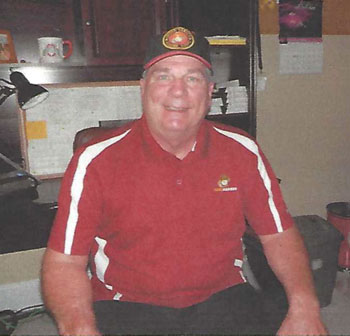
Making a choice: “I’d decided that, if I was going to serve, I’d serve as a Marine … all the while knowing there was a good chance I was going to Vietnam. … I take great pride in it [my service]. But military life is not for everyone. We, as a nation, have to respect people who do that. It’s a hard life.”
Public reactions: “Back then, vets were looked on with disdain. Vets today are treated with more respect. I think we paid for it.”
Serving the country: “I had a chance to see different cultures, and I realized that ours is a great country. I didn’t appreciate the simple things until I had to do without them. … I think every young man or woman should spend at least a year in service, in some form, whether in the Peace Corps or some such organization.”
Reflecting on the war: “After the death and atrocities I’ve seen, I wonder why God spared me. I came close to death so many times. But when I look at my son and three grandsons, I know.
“I don’t think we should ever forget Vietnam. What that war did was make us a nation that’s afraid to act until it’s too late. We keep waiting and hoping things will get better.”
Andres Vaart, Captain, USMC
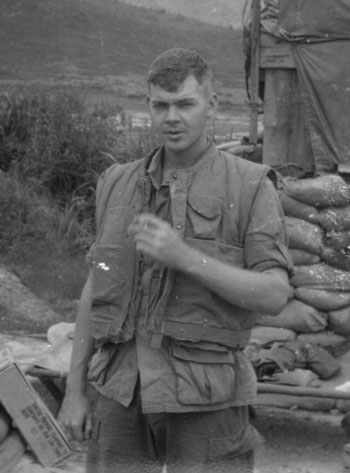
Making a choice: “I was an immigrant [from Estonia]. My mother and I were fortunate enough to get to the U.S. in 1950. I felt strongly that military service was the right thing, knowing what it was like to be occupied by Soviet Union. … I was interested in joining the Marines. I knew we’d be going to Vietnam, but I would be going into service to fight communism. It didn’t matter where.”
Serving the country: “To me, the idea of universal service to the nation is a very reasonable one, whether in the military or somewhere else.”
Reflecting on the war: “In those days, there was one big enemy. We got used to the big enemy we had to unify to oppose. Now I wonder if we got into that habit of thinking: We now leap to the idea of that one big thing, whether it’s the Chinese, Islam, or general terrorism.
“I sometimes wonder about the most powerful nation on earth being the most fearful nation. I think we should respond to challenges with something other than fear — rather a sense of acceptance and some confidence we know how to deal with problems.”
The Art of Forgetting
Beyond the ribbon of asphalt that wends through the landscape, Isabelle sees a man, young and darkly handsome. His arms open in welcome and he smiles, a sweetly amorous smile that makes her heart beat faster. It has been so long since she has seen him, kissed him. Her lips tingle with delicious anticipation.
“Grandmama?” a small voice whispers close by, shattering the vision.
The man evaporates into the soft afternoon light. No! Stay! she thinks, but he fades away.
Isabelle’s hand tightens on the carved wooden cane by her side, and she levers herself upright, cheeks pink with embarrassment. She doesn’t like it when she falls asleep in the car; napping reminds her that she’s old.
“Oui.” She blinks at the little girl, her great-granddaughter, standing beside the open car window. She knows this girl, she recognizes the pigtails, the lively brown eyes. But what is her name? Babette? Blanche? No, no, that isn’t it. Some days it is impossible to remember the right word.
“Mama says the picnic is ready. She says to come eat.”
Whatever this child’s name, she looks just like her mother at the same age. Isabelle smiles at her. “Je viens.” The pigtails bounce as the girl dances away.
Isabelle eases out of the car. A chill passes over her when she looks around. The car is pulled to the side of a stretch of winding road, which brackets the green fields with dark parentheses. An occasional tree punctuates the hillsides curving around. She knows this landscape instantly although she hasn’t been here in decades. She stiffens her spine and looks away, refusing to see.
She follows the dancing girl, her gaze fixed on the child’s exuberance. In the grassy field ahead, a woman and another child — a tow-headed boy— kneel on an outspread blanket.
The family picnic basket, traditional wicker, squats in the middle of the red plaid. Both are old but still serviceable, like Isabelle herself. Grains of sand from their favorite beach cling to the much-repaired basket, along with leaves and grass — an accumulation of nature’s mementos from a lifetime of Sunday picnics.
Isabelle’s trousers make a whisking sound as she walks. She focuses on the small noise, pretending this is just another Sunday, just another picnic site.
The little girl — Brigitte? Bernadette? — pats a small stool resting on one corner of the blanket. “Here, Grandmama! Sit with me!”
“No, I want her to sit with me!” the boy blurts from his corner.
“Jacques, Bella. That’s enough, you two. No arguing. Please sit, Grandmama,” says the woman — her granddaughter Renée — while rummaging deep inside the basket.
Bella? Isabelle feels a thrill of delight — her great-granddaughter is her namesake. How could she forget this?
Jacques sticks out his tongue at his sister. Smiling, Isabelle lowers herself to the embroidered stool, her knees creaking in protest.
Renée unpacks numerous small containers from the basket. Jacques bounces in his corner, as eager as a puppy.
“Doucement, doucement,” Isabelle tries to calm him, “ça viens!” It comes.
Renée offers Isabelle the first filled plate, and they share a tiny smile at the crestfallen look on Jacques’s face.
“I would like some of that … that …” Isabelle searches for the word, “the consommé, s’il te plait.”
“Consommé? Grandmama, we didn’t bring soup.”
“No, no, that’s not what it’s called. Um … in the round box?”
“The cheese? The Camembert?”
“Oui. The cheese.” Isabelle waits for Bella or Jacques. One of them will tease her now — a new tradition of these family picnics, making light of her spotty memory.
“Can I have some consommé too, please, Mama?” Bella asks. She and Jacques giggle.
Isabelle laughs with them. It is amusing how words elude her. Like mischievous children, they hide behind each other and offer up strange replacements. A sign of aging, her doctor has said, nothing to be worried about. He calls it “a memory retrieval error” and reassures her that she isn’t developing dementia. So she laughs at the absurd words, choosing to find humor in her frailty.
Consommé indeed, Isabelle smiles and accepts a slice of Camembert from her granddaughter.
A flicker of movement in a nearby tree pulls her gaze, a pert little squirrel sits on a branch, head cocked as if to say “what are you doing here?” The creature’s pose reminds her where she sits: The place she has refused to remember for decades. The place where she left him. No, the place that had stolen him.
She looks away down at the blanket where Renée slices another wedge of cheese and tucks it onto a plate along with grapes and fresh rounds of bread. The food smells delicious but Isabelle can’t swallow. A lump in her throat, solid and unmoving, won’t allow it.
The curves of the roadway behind her will not be ignored; they push and prod, testing her. The memory she abandoned here inches closer, but it’s not whole, it’s filigreed with empty spaces where Isabelle has deliberately removed the most poignant strands. She pushes them away but they persist in waking up, vying for her attention, wanting to weave back into place and be whole again.
Filaments begin to slip through the barrier she erected so long ago. Thread by thread, detail by detail she remembers and rebuilds the memory; his loving touch, his laughter, his quirky smile, the bounce in his step, the crooked little finger that embarrassed him. Faster and faster the memory grows until the blockage dissolves entirely and he stands before her: her husband, long dead. Dead in a traffic accident on this very road.
She has pushed his memory away, hiding from his absence, unwilling to be without him yet unable to leave him behind.
He stands before her, his little smile promising an afternoon’s pleasure in his company. Today, she has been given a gift of memory from the landscape that took him away in that one terrible moment. She fills her eyes with the sight of him, so young, so exciting.
“I have missed you so much, Jean,” she whispers to his shade. He blows her a kiss and winks mischievously.
“Hmmm? What’s that, Grandmama?” Renée looks up.
“His name was Jean. Your grandfather.” Isabelle is embarrassed that her voice shakes a little when she speaks. After so many years, she should be able to say his name. She feels his breath upon her cheek and closes her eyes to enjoy it.
“My grandfather? You never talk about him.” Renée’s face pales beneath her tan.
“I was just remembering him.” I still love him, Isabelle thinks, smiling at Jean, still smooth-cheeked, still unbearably handsome.
Renée gasps and lurches to her feet, “Oh, Grandmama! I am so sorry! It happened here, didn’t it? I didn’t realize, Maman never told me where. I would never have brought you here if I’d known.”
“It was a long time ago.”
“Is this where Grandpapa died?” Jacques whispers to Bella who shrugs, staring up at Renée now tossing containers into the picnic basket in a jumbled mess.
“I’m so sorry!”
“Ce n’est pas grave. It is okay.”
“Are you sure? We can go somewhere else.” Renée searches Isabelle’s face.
Isabelle turns away from Jean’s memory, sweet as he is to look at, and gazes beyond their car at the dark strip of asphalt. She sighs, a deep exhalation which leaves her trembling.
She hadn’t planned to return, never wanted to see this place again. But here she is, staring at the road she has hated for more than five decades; the road that had taken her beloved Jean away from her and Sophie. Sophie had been so young, she barely remembered her father. Now even Sophie is gone, another loved one taken far too soon.
Staring at the black curves weaving through the tall grass, Isabelle sees it is only a road after all. Jean is not here, he hasn’t been here for a long while. He is in her heart where he has always been. Isabelle hasn’t lost him, not entirely. She’d only hidden him for a while; the way words hid from her now, a trick of her mind.
“It is only a … rivière? Ruban?” She can’t think of the word for the dark surface twisting among the hills.
“It’s a road, Grandmama!”
“Yes, it is only a road. Now, pass me the consommé, s’il te plait.” Isabelle waits for the children’s giggles to perfume the air.
Behind her, Jean laughs too. It’s lovely to hear his laugh again.
News of the Week: Warp Speed, Way Too Much Media, and the Wonderful Wah Wah Machine
To Boldly Stream Where No One Has Streamed Before

It has finally happened. A new Star Trek TV series is coming. Only it won’t be on “TV.”
CBS has announced that they’ve hired Alex Kurtzman, producer and writer of the recent Star Trek films as well as shows like Alias, Fringe, and Sleepy Hollow, to be the executive producer of a new Trek series that will debut on CBS in January 2017. After the first episode airs on CBS, the series will run exclusively on its online streaming service, CBS All Access.
This won’t be a remake or reimagining of shows or movies that have come before. It will be an entirely new show, with new characters and new missions, though set in the same Star Trek world (the original series timeline or whatever timeline the new movies are set in). Because Kirk and Spock are still appearing in the feature films, you won’t see them here. But maybe they can refer to them once in a while. The new crew can say things like, “Hey, this is just like that time that Kirk had to …” You don’t see Iron Man helping out the Agents of S.H.I.E.L.D. either.
This reminds me of when Howard Stern left terrestrial radio and went to SIRIUS XM. A lot of people who weren’t subscribers suddenly became them when Stern went to satellite radio. He brought millions to the service, and maybe that’s what CBS is hoping when Star Trek goes to CBS All Access. While these network streaming services have a place and they’re becoming more popular every year, they haven’t quite hit the mainstream yet. Most of us still get our TV shows on our televisions, with a little Hulu/Netflix/website viewing mixed in. It will be interesting to see how many people pay for this and if a younger generation even wants to watch Star Trek every week. I would just make sure that they make it so it’s something hardcore Star Trek fans will like and not just something “new.”
When Do They Sleep?

A new study by Common Sense Media shows that teens spend an average of nine hours a day on media. That includes smartphones, video games, computers, social media, television. That means they spend more time on devices than sleeping.
The study also shows that teens really love to multitask, because many of them use social media or text or watch TV while they’re doing their homework. Though that’s probably not teen-specific. A lot of adults do it too. I bet you’re watching TV or talking on the phone while you’re reading this, aren’t you?
I guess this is what happens when we can carry our media around with us 24/7. Our lives and media are one and the same now. There’s no separation anymore.
Stars Become Hearts
Speaking of teens and social media, Twitter can be a lot like high school, and this week that became even a little more evident.
People who use the social media service know that there have always been stars you can click to favorite something. It was a good way to show someone you liked a post without having a like button like Facebook has (though a lot of people who favorite your post don’t necessarily like it, it might include a link to something they want to read later). But apparently a star just wasn’t the perfect icon because the people at Twitter have changed the stars to hearts. Longtime Twitter users do not heart it:
What are these drippy "hearts" replacing "likes"? I have to think harder about committing to such ardent fealty now… #TwitterLuddite
— kentucker (@kentucker) November 3, 2015
I work at @twitter but even I can’t believe how we replaced a completely value-neutral term like “favorite” with something so loaded.
— Peter Seibel (@peterseibel) November 3, 2015
Now, a lot of people might not see what the big deal is. Hearts, stars, who cares? But I think it indicates what direction Twitter might be going in and how they see the service as a whole. Hearts are something you see on Tumblr or personal blogs, something you click if you like someone’s cat photo, and it would be nice if Twitter could differentiate itself. Of course, as someone who doesn’t use Twitter anymore — and even when I did I was very stingy about what I favorited, instead relying on retweets — I don’t really care if they replaced the icons with green clovers, blue diamonds, or another Lucky Charm shape. But you have to wonder why Twitter would make a decision like this instead of working on the many other problems they have.
By the way, make sure you heart this column on our Twitter feed!
RIP, Fred Thompson, Al Molinaro, and Charles Herbert
There aren’t many people who can have a long, successful acting career and a political career too, but Fred Thompson did. In fact, a lot of people who enjoyed his work on Law and Order and in movies like Die Hard 2, The Hunt For Red October, Secretariat, and In the Line of Fire might not have even known he was a Tennessee Senator for almost a decade (and an attorney during the Watergate hearings). After an unsuccessful run for president in 2007, Thompson went on to guest star on shows like The Good Wife, Allegiance, and Life on Mars. He died of lymphoma at the age of 73.
You know Al Molinaro from two iconic sitcom roles: as Al’s Diner owner Al Delvecchio on Happy Days and his role as Murray the Cop on The Odd Couple. He also spent many years as the commercial spokesman for On-Cor frozen foods (“With taste and more it’s On-Cor”). Molinaro passed away last week at the age of 96.
One interesting aspect about Molinaro’s career is that he actually became wealthy before he even became an actor, from investing in real estate. He started acting because he enjoyed it.
Charles Herbert? You might not know the name but you’ve seen the child actor in many movies, including The Fly, Houseboat, Please Don’t Eat the Daisies, The Boy and the Pirates, and 13 Ghosts, as well as TV shows like The Twilight Zone, Wagon Train, Lassie, and The Fugitive. He passed away from a heart attack at the age of 66.
The Hollywood Reporter’s obit for Herbert has some insight from his friend (and Houseboat co-star) Paul Petersen of The Donna Reed Show.
Your Cat Is Trying to Kill You
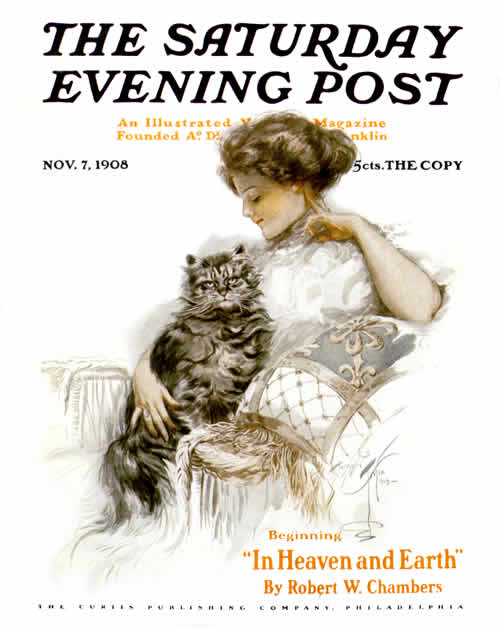
Harrison Fisher
November 7, 1908
Cats can be aloof and eerily quiet and seem not to be especially friendly (even if they do make for some great magazine covers), but did you know that they’re actually murderous?
According to researchers for the University of Edinburgh and the Bronx Zoo, domestic cats have many of the same characteristics as lions and wildcats and snow leopards, especially when it comes to being aggressive and being neurotic. If they could, they’d kill you. I knew that’s what they were thinking when they were just sitting in the corner and staring at me.
One psychologist even says that we’re letting “little predators” into our homes, and they can be “fantastic, sweet companions … until they turn on you.” That actually sounds like the tag line for a new horror movie.
They’re fantastic, sweet companions … until they turn on you.
The Cats. Starring Ryan Reynolds and Christina Hendricks. Coming 2016.
So, to summarize: Cats are evil, dogs are awesome.
The Wah Wah Machine
The new animated Peanuts movie opens today, and as part of the marketing for the movie the studio has created a site for the Wah Wah Machine. You know how in Peanuts TV specials and movies you never hear the adults talk in a normal voice, and instead you get sort of a trombone-ish mumble? Now you can type words into the Wah Wah Machine and whatever you type will come out as “wah wah” Peanuts talk.
And because I’m a guy and guys are eternally 12 years old, I typed in a few naughty words to see if the machine would accept them. Try that yourself and see what happens.
In related news, Snoopy received a star on the Hollywood Walk of Fame this week.
Today Is National Nachos Day

I know someone who just likes cheese on his nachos. No salsa, no guac, no sour cream, no refried beans, no jalapenos, just melted cheese on top. I’ve often suggested he just buy a bag of Doritos instead.
But if you do like a little bit more on your tortilla chips, how about trying one of the 50 nachos recipes from Food Network? The variations include Buffalo Chicken, Greek (with feta and olives), Cheesesteak, Pretzel, and even Frank and Bean.
I often make nachos using Triscuits. I’d like to say I came up with the idea myself in a flash of culinary brilliance, but actually I just ran out of tortilla chips one night and didn’t want to go to the store because I was already in my sweatpants and had to use whatever was available (and I’m sure I’m not the first to think of it). They’re quite good though.
Upcoming Events and Anniversaries
Margaret Mitchell born (November 8, 1900)
We all know how popular the 1939 film edition Mitchell’s Gone with the Wind became, but Clark Gable was afraid of taking the role of Rhett Butler.
Veterans Day (November 11)
This is the day, of course, that we celebrate our military heroes.
George Patton born (November 11, 1885)
The Saturday Evening Post Archives Director Jeff Nilsson on D-Day: The Century’s Best Kept Secret.
End of World War I (November 11, 1918)
Did The Saturday Evening Post actually see the coming of The Great War?
Robert Louis Stevenson born (November 13, 1850)
You can read Stevenson’s classic novel The Strange Case of Dr. Jekyll and Mr. Hyde for free at Project Gutenberg.
July/August 2015 Limerick Laughs Winner and Runners-Up
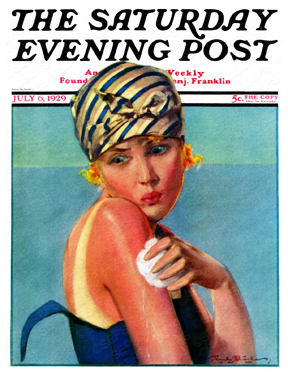
We think of the ’20s as nifty,
Though brokers on Wall Street were shifty,
And this flapper, for one,
Couldn’t ward off the sun
In the absence of SPF-50!
—Jeff Foster, San Francisco, California
Congratulations to Jeff Foster! For his limerick describing Penrhyn Stanlaws‘ illustration Sunburned Sunbather (above), Jeff wins $25 — and our gratitude for a job well done. If you’d like to enter the Limerick Laughs Contest for our upcoming issue, submit your limerick via our online entry form.
Of course, Jeff’s limerick wasn’t the only one we liked! Here are some of our favorite limericks, from our runners-up, in no particular order:
She planned a whole day at the beach,
A book and a soda in reach,
But her eyes closed in sleep,
No one said a peep,
And now she’s as pink as a peach!—Jean MacIver, Keystone Heights, Florida
Loretta would constantly boast
That HER tans were better than most.
Her bragging subsided,
When a child confided …
“That lady reminds me of toast.”Said Larry the Lifeguard, “Have Fun,
But don’t fall asleep in the sun!”
The late Mrs. Corning
Ignored Larry’s warning
That, “sharks prefer people WELL-DONE.”—Guy Pietrobono, Washingtonville, New York
She was boating, enjoying the view,
And the temperature reached 92.
She burned really bad,
And now she is sad.
Which makes the gal red, white, and “blue.”—Joyce Petrichek, Finleyville, Pennsylvania
It seemed like such a good notion
To spend all day by the ocean
But I’d trade all the fun
I had in the sun
For a gallon of calamine lotion!—Joe McMann, Katy, Texas
There once was a girl named Lorraine,
Who looked at white skin with disdain.
She thought that a tan ,
Would get her a man,
But all that she got was some pain!
—Angie Gyetvai, Old Castle, Ontario, Canada
The sun is a vile, ruthless mobster;
I’m burnt to a crisp like a lobster.
Oh, my, how I sizzle!
My beach day, a fizzle…
Some ointment? I’ll take a great gob, Sir.—Lorraine Ray, Aiken, South Carolina
A fair-skinned young blonde went to Maui
In search of a tan that was Wowie!
Just a half-hour roast
Turned her into burnt toast.
Cool witch hazel eased not her owie.—Claudia Kohlbrenner, Libertyville, Illinois
When Madge changed her first name to Scarlett,
She dreamed of becoming a starlet.
A very dark tan
Was part of her plan,
But now Scarlett really is Scarlet.—Robert Boston, Clive, Iowa
The Power of Prayer
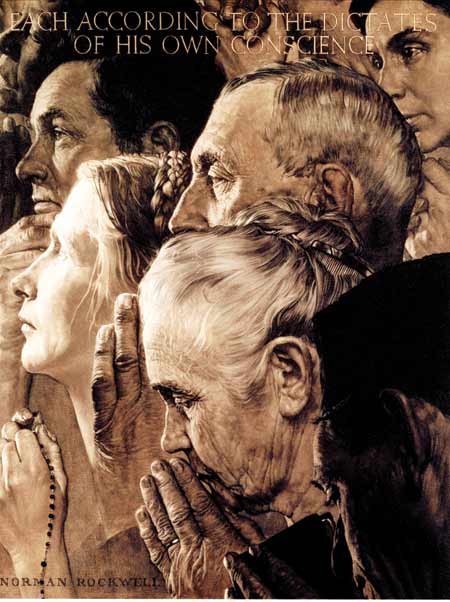
Norman Rockwell
The Saturday Evening Post
February 27, 1943
Sitting in the 250-year-old Quaker meetinghouse high in the mountains of Vermont, I can almost touch the deep, round silence that connects those who have gathered here for worship this beautiful winter morning. The handful of men and women scattered on the old benches sit with their heads bowed, hands resting quietly in their laps or tucked under one of the hand-knit afghans placed around the room to counter the morning chill.
Most of those present have their eyes closed, and one, I suspect, is fast asleep. But another is looking thoughtfully out one of the two-story windows toward the forest, and another, hands lifted up, eyes closed, gently sways back and forth. A log shifts in the old wood stove. The silence shifts as well, and slowly eyes open and meet, smiles appear, and hands reach out one to the other in greeting.
Praying with others can be a richly textured experience. Whether it’s done in the silence of a Quaker meeting or as part of a group singing an ancient melody with its origins deep in the sands of the Negev, communal prayer is often a joyously multidimensional experience that  moves us into a new space. “Prayer is a doorway to God,” explains Brent Bill, Quaker pastor, director of the New Meetings Project for Friends General Conference and author of the 2014 book Finding God in the Verbs: Crafting a Fresh Language of Prayer. “It’s an opportunity to open ourselves, engage in an authentic dialogue, and get as close to God as possible.”
Rabbi Elie Kaunfer, executive director of the Mechon Hadar education center in New York and author of Empowered Judaism, agrees. “In Jewish practice, men and women are required to pray three times a day in a group called a minyan,” he says. It can be a rigorous schedule for those unaccustomed to it, but, he adds, “it’s been my experience that being in a room where dozens of people are praying together pushes me to a different place. It allows me to ride the enthusiasm of others, concentrate better and focus more on prayer.”
Nor is the effect limited to the minyan. Catholics who stand and clasp hands to recite the Our Father prayer report the same experience, as do Protestants who respond in unison to biblical readings from the pulpit, Quakers who sit silently in God’s presence, and Muslims who kneel shoulder to shoulder in daily prayers.
When Edgar Hopida, communications director for the Islamic Society of North America, hears the afternoon call to prayer over his office intercom in Plainfield, Indiana, for example, he welcomes the opportunity to walk downstairs to the building’s prayer room, remove his shoes, and stand, shoulder to shoulder, with others to pray. “I’ll be stressing at work, and then I get into prayer, and I realize — ‘Yeah, I can get through this day,’” Hopida says. “Prayer with others helps me focus on the divine and those with whom I pray.”
The power of group prayer is one that Debbie Eaton, head of women’s ministries at the 20,000-member Saddleback Church in Southern California, sees every day. Whether she’s praying with one other woman or 450, the result is the same.
“When I’m praying with someone, particularly with someone who is struggling, judgment just goes away,” Eaton says. “They could be telling me the most horrible thing, and I just see them in the light of love. I can sense God holding that person — and I feel such joy, peace, and love.”
A few miles up the California coast, Carolyn Taketa, director of small groups at Calvary Community Church in Westlake Village, shares Eaton’s perspective. “There’s a sense of unity, power, care, and support in communal prayer,” she explains. “In a small group that prays, it doesn’t matter that you’re a CEO, that you have special needs, or that you’re homeless. All that stuff gets stripped away. There’s just you, your friends, and a clear sense of God’s presence.”
She sighs. “There’s such power, beauty, and simplicity in that.”
When a friend in Taketa’s prayer group shared that her marriage was over, for example, the group cried with her for the loss of her husband, the pain to her children, and the bad choices that had been made as the marriage unraveled. “Then we made a circle around her and supported her with prayer,” Taketa says. “We stood in God’s presence. And when we finally lifted our heads, there was a deep sense of peace.”

Murray Kimber
The Saturday Evening Post
November/December 2009
“Even those who don’t define themselves as religious or who see themselves as nontheist seem to sense that something powerful is going on” when they experience prayer in community, Bill says. Even when it’s something as simple as sitting with others as they bless a family dinner, or hiking up a hillside in silence with a group of friends, many nontheists sense a presence. “Some of us call it God, others call it Greatness or Higher Power, or they don’t label it at all.” Bill smiles. “I’m easy with that.”
Although communal prayer offers a powerful way to connect with the divine, those who actually sing prayers in community suggest that communal prayers expressed through music may transcend just about everything else. “The place that I’m able to go when song is a part of the prayer is much more intense,” Rabbi Kaunfer says. In fact, “sometimes I think of the experience as transcending cognition.  There are so many words in Jewish tradition, and the music takes me outside of the intellectualization of the prayer text to a different spiritual place.”
That place is one regularly inhabited by musician Joey Weisenberg, creative director of the Hadar Center for Communal Jewish Music, a faculty member at several Jewish seminaries, and the prayer leader of Brooklyn’s oldest synagogue. One day he’s teaching cantorial students and student rabbis, the next day it’s a children’s choir. Then he’s leading Friday night and Saturday morning services. There’s a Jewish choir the next day, next week a workshop in Wisconsin, and every Tuesday night he and his band are on deck at Kane Street Synagogue. And that doesn’t touch on the days he’s in a recording studio laying down tracks that feature the hundreds of niggunim — ancient prayer melodies that replace words with nonsense syllables — that he’s rescued from the past.
The niggunim remind him of the riffs he heard played in the blues bars where he grew up in Milwaukee — and with their unique ability to speak the wordless language of the soul and perhaps touch the divine, the niggunim are his passion.
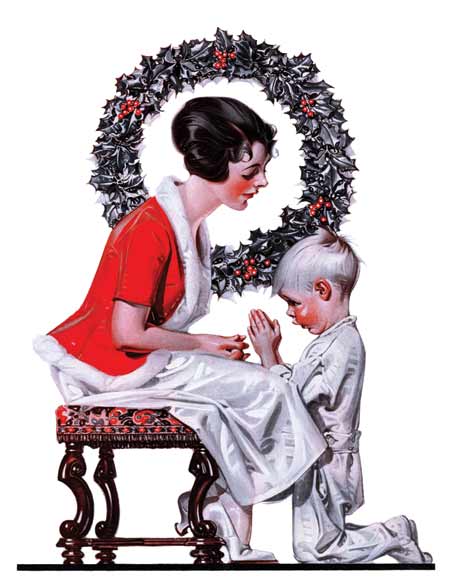
J.C. Leyendecker
The Saturday Evening Post
December 24, 1921
“The whole purpose of prayer is to crack open our hearts, our hardened hearts, just a little bit,” explains Weisenberg, “and music is perhaps the best tool I’ve ever seen — I’ve ever experienced — for opening up a heart. It can prune away the shells that we have around ourselves so that, as we sing together, the harsh exterior of ourselves begins to be cut away.”
Eventually, says Weisenberg, as we become more vulnerable, as we learn to listen deeply to the music and one another, the wordless melodies will offer us an actual experience, in real time, of the divine.
Sitting in my study one morning as I finish this story and listen to an MP3 of Weisenberg’s music, the sun slowly rises over the mountain that shelters my cottage. The woods that surround my clearing etch their shadows on snow that has yet to melt, and the soft sounds of chickadees and titmice near my open window make their way into the room.
Eventually, the music I’m listening to slows, then fades. Only the deep, rich silence of Presence surrounds me.
Post contributor Ellen Michaud shares thoughts on how prayer unites us:
News of the Week: Hurt Hands, Hot Dogs, and Halloween
Jimmy Fallon Is Now Officially Out of Hands
Maybe it would be a good idea if Tonight Show host Jimmy Fallon simply didn’t leave the studio.
Back in July, Fallon badly hurt his left hand after falling in his kitchen. This week, Fallon injured his right hand after tripping over a woman who was kneeling down at an event put on by The Harvard Lampoon in Cambridge, Massachusetts. Fallon was in town to accept the Lampoon’s Elmer Award. He was carrying a bottle of Jägermeister at the time, fell, and his hand landed on the broken glass. He was taken to Massachusetts General Hospital and luckily the injury wasn’t nearly as bad as last time.
He really puts the fall in Fallon, doesn’t he?
Breaking News: Nobody Knows What’s in Hot Dogs

This wasn’t a good week for meat lovers. Just when we heard that the Worldshut Health Organization is now going to classify the bacon, beef, and processed meats we’ve been eating as carcinogens — even if some of the reports have been misleading — we also got word that the hot dogs we’ve been eating all these years might have some things in them that we, well, don’t want to eat.
Clear Food, a testing lab, tested 75 brands of hot dogs and sausages and found that 14.4 percent had problems, some “hygienic” and “substitution” issues. Hygienic means that a non-harmful element was introduced to the hot dog, such as human DNA, which was found in 2 percent of the hot dogs tested. Now, I don’t know how finding human DNA in hot dogs can be considered “non-harmful,” but that’s how it’s classified. Substitution means that there’s something in the hot dogs that isn’t listed on the label.
And those vegetarian hot dogs you’re eating to be healthier? Ten percent of those tested contained meat.
Janet Riley, president of the National Hot Dog and Sausage Council (yes, there’s a National Hot Dog and Sausage Council) says that she has questions about how the tests were conducted, and that any hygiene or ingredient issues could have been introduced to the hot dogs by the staff of Clear Food or by the way the tests were performed and how the samples were handled. She also calls the scary report “silly” and accuses Clear Food of looking for publicity.
Four brands did get a passing grade: Butterball, McCormick, Eckrich, and Hebrew National. Expect a run on those brands at your local supermarket.
RIP, Maureen O’Hara
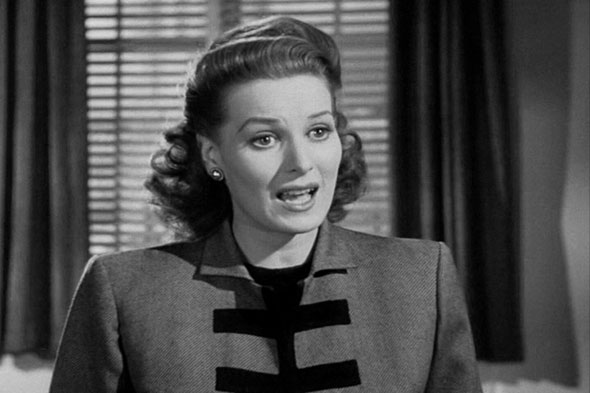
If I were to pick my two favorite movies, they just might be two Christmas movies: 1946’s It’s a Wonderful Life (yes, a common choice but it really is a terrific film) and 1947’s Miracle on 34th Street. The latter starred the beautiful Maureen O’Hara, who passed away at her home in Boise, Idaho this week at the age of 95.
Turner Classic Movies will be running a 24-hour tribute to O’Hara on November 20, with such movies as McClintock!, The Hunchback of Notre Dame, Big Jake, and The Quiet Man.
Sherlock Returns on January 1
There’s a great Sherlock Holmes television series, but it’s not the one on CBS. Elementary is … fine, I guess, a passable entertainment, but it’s not great. That would describe the other Holmes and Watson show on television, PBS’s Sherlock. Filming doesn’t begin on the fourth season (or “series” as they say in England) until the spring, but they did film a 90-minute special that will air on both the BBC and PBS on January 1. That’s a first for the show (it usually airs first on BBC and then later on PBS). Here’s the trailer. The show is set in modern times but this episode, “The Abominable Bride,” is set in Victorian England for some reason. It would be great if they don’t even explain why:
Also for the first time, the episode will be shown in select theaters, with 20 minutes of additional footage.
Vintage Words Are Making a Comeback
Have you noticed that there are a lot of words from decades ago that we don’t use anymore? Language evolves, and some words just vanish as the decades go by, replaced by whatever words we’re all using at the time.
Using Google’s Ngram, which tracks the number of times words are used in print, a researcher discovered that many older words are making a comeback. People are actually using words like “fortnight” and “smitten” and “amidst” and “dapper” again. There’s a chance some hipsters are using these words ironically, but hey at least they’re being used.
There are many words and phrases I’d love to see come back. “Cockamamie.” “Old hat.” “Aces.” “Cahoots.” “Scram.” “Geezer.” “Hoosegow.” Those words are better than any Internet slang or LOL, and if some of them returned it would really be the bee’s knees.
Is Saying “You’re Welcome” Rude?

Crazy question, isn’t it? In what world would saying “you’re welcome” after someone says “thank you” be considered rude? Not to sound like an old man, but it’s coming from you meddlesome kids!
In this Boston Globe essay, Murray McClellan reveals that he recently learned from his son and the son’s girlfriend that saying “you’re welcome” is something you just shouldn’t do. Apparently, saying “you’re welcome” is now looked upon as the equivalent of saying “you owe me one,” an “acknowledgement of an uneven balance of power,” and it’s just plain rude.
Maybe some people don’t want to use the phrase for some reason, but calling it rude?
Now, I’ve noticed that in some situations people actually don’t say “you’re welcome,” Like after the NPR interviews that McClellan mentions (or any interview) where the interviewer says “thank you for being here,” the interviewee won’t say “you’re welcome,” they’ll instead say “my pleasure” or “thanks for having me.” But certainly the phrase “you’re welcome” can and should be used in other, traditional situations we all have, right?
I really do think this is an age thing, a generational thing, and specifically pushed by the tech/business world. In the same way I’ve noticed people start off their answer to a question by saying “So …” which is one of the oddest language things I’ve ever heard.
At this rate, it won’t be long before “thank you” disappears too, and all manners will be gone. We’ll just grunt at one another or stay home so we don’t have to interact with anyone anymore. It’s easier to just type “thx” or “k” in an email (because typing the “o” is too labor-intensive) than to communicate normally. What a cockamamie world this has become.
The Return of the Phone Booth

I miss phone booths, or maybe I miss the idea of phone booths. I’ve gotten sick of hearing other people’s cell phone conversations while at the supermarket, the bank, the movie theater, the street corner. Nobody seems to understand that everyone around can hear what they’re saying. I know what people are having for dinner, what problems they’re having, and even what medical procedures they’re going to be having soon.
But maybe the phone booth is coming back. Or at least a certain kind of phone booth. The new ones don’t have phones in them (unless they’re decorative — a retro touch), they’re more like little rooms so people can have some privacy when they’re on their cells. Several companies are beginning to install the booths in their offices.
This is a fine idea. Now Superman and Supergirl will have some place to change again.
Boo!

This year for Halloween I’m going as the same thing I’ve dressed as for the past several years: Guy Who Doesn’t Get Any Trick-or-Treaters So He Eats All the Candy Himself.
Assuming the planet isn’t destroyed by an asteroid and you’re planning a party, how about trying some of these Ghouly Cupcakes from Food Network? Or how about these Tarantula Tacos? You can even top off the evening with a Jack-o’-Lantern Cake.
Now, if you want a really scary recipe, how about this creepy Frankfurter Macaroni Salad Loaf thing? Oh God, it includes … hot dogs!
Upcoming Events and Anniversaries
Don’t forget to “fall back” this weekend
Before you go to bed on Halloween night, turn your clocks back an hour (and here are some things that might be smart to check after the clocks are changed).
Flight of the Spruce Goose (November 2, 1947)
Howard Hughes’s giant wooden plane only made one flight and is now housed at the Evergreen Aviation and Space Museum in McMinnville, Oregon.
Laika the Dog launched into space (November 3, 1957)
The three-year-old female was the first animal to orbit the Earth.
King Tut’s tomb discovered (November 4, 1922)
Was a curse unleashed when Howard Carter and his crew entered the tomb?
Will Rogers born (November 4, 1879)
Everybody has a Facebook page these days, including the acclaimed American humorist.
John Philip Sousa born (November 6, 1854)
He wrote “The Stars and Stripes Forever,” the music that’s played during every Fourth of July fireworks display.
Deadly Signals
As we sped through the heartland night, the car’s crackling radio kept all our minds on the war in Manhattan:
“Enemy now in sight above the Palisades,” said the radio newsman, the fear penetrating his professional veneer. “Five … Five great machines. First one is crossing the river. I can see it from here, wading the Hudson like a man wading through a brook … A bulletin’s handed to me … Cylinders are falling all over the country. One outside Buffalo, one in Chicago, St. Louis …”
“Doozer of a news flash,” sighed Judith, shivering in the passenger seat. “Who could be behind it, Henry?”
“Bet them cylinders are German. Hitler’s got the scientists to pull this off.”
“Germany’s too far,” said Bill leaning in from the backseat. “Gotta be closer, Canada or Mexico.”
“Yeah, it could be the Canucks, couldn’t it? Bastards.”
“Poisonous smoke drifting over the city,” continued the reporter, a cough in his throat. “People in the streets see it now. They’re running towards the East River, thousands of them dropping in like rats …” His words suddenly cut away.
I fiddled with the volume knob, growing more annoyed. Annoyed because we’d missed the beginning of the broadcast, because we didn’t know who was attacking our sovereign nation, because the radio was cutting out in these backwoods; and most personally annoyed because the whole thing distracted us from our plans. Murder isn’t an undertaking you try half-focused. I know. I’d done it before.
I looked over at Judith, my only fem three years now. So innocent-looking with her farm-girl hair and doe-eyed baby blues. I’d told Bill she was cheating, though, dynamiting Rob Fingers when I was away. I’d said I couldn’t be no cuckold, and we had to do something about it. Now! Bill, unthinking ape that he is, went along.
Hope it worked.
Electric lights came through the trees. I pulled into one of the last roadside stores that sold booze before we crossed into the dry counties of Missouri. The place was a worn-out dump, single gas pump in the mud, undersized jack-o’-lanterns by the door.
I said I’d be a minute, then exited the Roadmaster and went inside. At the counter the clerk and another fellow listened attentively to their radio, another news flash coming in:
“… Washington for a special broadcast on the national emergency …”
I shuffled to the back, ignoring the cardboard ghosts and adverts for candy, and found what I wanted: duct tape and beers. Returning to the counter, the clerk rang me up without a glance.
“Sounds pretty bad,” I said.
He shrugged, “Not so bad.”
From the radio came a stately, familiar voice begging the people to remain steadfast, to have faith in the military, to pray to God for America.
Roosevelt? Futz, it had to be him. Who else spoke like that?
“Yeah, not so bad,” I said sarcastically and left.
I put my goods in the trunk, next to my shotgun and spade, then went around and got inside. Judith and Bill had the radio off.
Good. No distractions.
Work time.
We arrived in the bleak, post-harvest cornfield. I turned off the engine, shut down the lights.
“What are we doing here?” asked Judith innocently.
“It’s a party. Everyone out.”
A minute later, I was at the opened trunk while the others stood on the bare ground nearby. I’d just loaded the gun when Bill grabbed Judith’s arm.
“Got any last messages for Rob Fingers, Judy baby?” he shouted.
I raised the gun. “Step away from her Bill.”
His face drained of color, but Bill did as he was told.
“What’s this about, Henry?”
“I told you she mighta been cheatin’. Not that I believed.” With my free hand I tossed a roll of tape to Judith. “You been set up, Billy-Boy.”
She bound his hands from behind, then fastened tape across his mouth. All the time I kept my sights squarely on him. We led Bill to the hole Judith and I had dug yesterday, told him to sit. She tied his ankles, then kicked him into the ditch with a giggle.
“You see, Bill, Prohibition’s long over, but we ain’t pardoned for those crimes. You been chirping to the coppers.” I stood at the edge, barrel aimed at his forehead. “Nobody cuts a deal at my expense.”
Judith laughed. Then a masculine voice shouted: “What are you doing here, son?”
I glanced over my shoulder. Back by the car stood a man in overalls, a farmer by the look of him, pointing a rifle right at me. Behind him were another three men similarly dressed and armed.
I dropped my shotgun. “Just a party, fellah. Why you here?”
“Hunting little green men,” he said, glancing down in the ditch. His eyes turned colder. “But you don’t look like Martians.”
“We’re from Cleveland.”
“Just as bad.”
They used my own duct tape to bind me, threw me in the backseat of their car while two more followed with Judith and Bill in mine. It was a long, uncomfortable trip into town. Despite having interrupted a murder, all their thoughts were on the radio. The Martians had taken America’s cities and were expanding into the countryside, our armies destroyed in a matter of minutes.
It seemed impossible, yet perversely gave me hope. The government would need men to fight the invaders. My record showed I was good with a gun, a natural leader, a big macher — they’d want me in the resistance. I might get out of this a hero …
But then Mr. Orson Welles came on, told us the broadcast was over. That it had all been a Halloween production. The newsmen, Roosevelt, were actors. No Martians, no invasion of any sort. All faked. The farmers laughed with embarrassment and relief. It became a joke even as they felt ridiculous for hunting radio extraterrestrials.
Not me. I sat silently the chump and remained so as we pulled up to the Hannibal police station.
—
All excerpts from the radio play of The War of the Worlds by Howard Koch have been used with the permission of Peter Koch.
Butterball Turkey Talk-Line Memorable Calls
Throughout its 34 years, Butterball has had many memorable moments (and nearly 3 million calls) — from a woman who set her stove on fire to the men who put fires out for a living. The following are a few favorites from the Butterball Turkey Talk-Line:
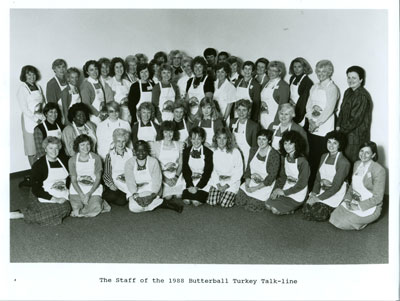
- Hot Turkey… A New Jersey fireman called the Talk-Line while cooking dinner for his entire firehouse to ask where he should insert the meat thermometer into his turkey. After the home economist explained the proper technique, she suggested he log on to Butterball.com to get free Butterball recipes as well. He was interested in trying the recipes, but was worried that should any of his co-workers find out, he might lose his “macho” image. After all, what would his fellow firefighters think if they discovered he now knew as much about roasting Butterballs as he did fighting fires?
- Turkey Treasure… After discovering a turkey from 1969 in his dad’s freezer, an Alabama man called the Talk-Line to ask about the best way to cook the 30+ year-old bird. Although the Talk-Line staffer recommended the open roasting pan method to cook most turkeys, this time she suggested that the first step was to purchase a fresher fowl! This same gentleman also had in his freezer: the top of his wedding cake and a snowball from every snowstorm he’d experienced in Alabama.
- Third Times a Charm…One caller was well versed at walking down the aisle, but not so versed when it came to cooking her Thanksgiving turkey. The caller explained to Carol Miller, 20+ year Talk-Line veteran, Thanksgiving with her first husband was a bust since she forgot to thaw the turkey. She blundered Thanksgiving with her second husband when the foil pan she was using bent and slipped out of her hands leaving the feast on the floor. She was hoping the third time would be the charm so she called the Butterball Turkey Talk-Line to make sure she was doing everything right!
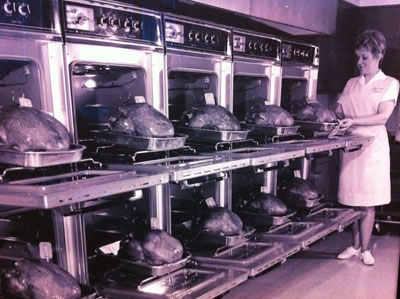
(Courtesy of Butterball) - State Bird…When a Talk-Line staffer asked a caller what state her turkey was in – meaning how thawed was it, the caller responded with “Florida.”
- All in the Family… A woman in her seventies, cooking Thanksgiving dinner for the first time, called for help because her mother said she was tired of cooking and it was time her daughter learned how to prepare the Thanksgiving meal.
- Cat’s Got the Turkey?…A newlywed’s parents arrived for their first Thanksgiving meal. One of the dads noticed the turkey thawing in the sink in cold water with a dish drainer and a rubber mat on top of it all. Her dad inquired why she was thawing the turkey that way. She said – that was the way her mom thawed the bird. The mother said – well, yes, but we HAD a cat!
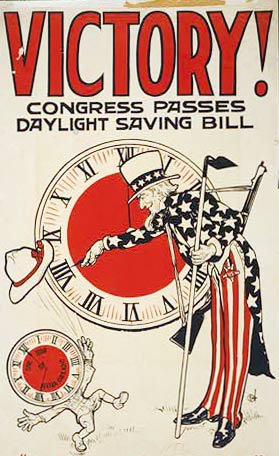
Fiddling with the Clock but Leaving the Calendar Alone
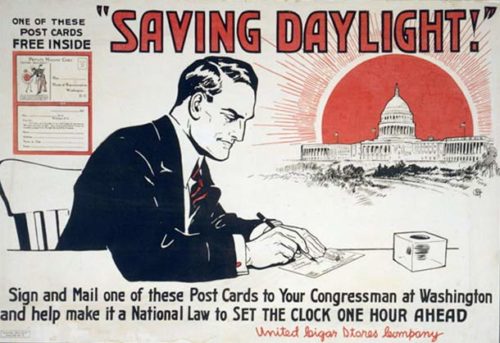
This weekend, as we set our clocks back to Daylight Standard Time, many of us may ask ourselves, “Why, exactly, do we do this?”
Or, “Who decides when we change our clocks?”
Or, “Why is it called ‘Standard Time’ when it’s only in effect for four months out of twelve?”
The official reason for setting clocks back one hour is to save energy. By moving our daily activity toward the hours of maximum sunlight, we use less energy for lighting. Or so the argument goes. But one study has found energy savings are far lower than expected. And another found energy consumption actually increased with Daylight Saving Time.
Despite the questionable benefits of Daylight Saving Time (DST), America seems resigned to disrupting its daily schedule twice a year.
Certainly Congress appears to like the idea. Since making DST a permanent, nationwide standard in 1966, legislators have steadily expanded its yearly length from 27 weeks to 34 weeks.
Given Congress’ enthusiasm for fiddling with the clock, it’s surprising that legislators haven’t tried reforming the calendar. Congress has already reassigned two presidential birthdays to a more convenient time. Perhaps they might want to consider bringing order to our 263-year-old Gregorian calendar with the 13-month calendar.
At present, our year is divided into irregular months or 30, 31, and 28 days. In contrast, the international fixed calendar would neatly divide the year into 13 months, all beginning on a Sunday and ending on a Saturday, and all having 28 days. The extra month, called Sol, would be sandwiched between June and July. The only variations would be December 29, a holiday at the end of the year called not, as logic would have it, Sunday, but instead Year Day and a June 29, known as Leap Day, every four years.
Back in the 1920s, the idea drew the support of George Eastman, founder of the Eastman Kodak Company. Having made a fortune in the early photographic industry, Eastman was hardly an impractical dreamer. He strongly supported the 13-month calendar and believed, as he wrote in a 1928 Post article, it would soon become the international standard “because the world moves inevitably toward the practical.”
The reformed calendar had several benefits, he claimed:
- It would standardize the schedules for debt and interest payments.
- It would let business owners accurately compare monthly revenues between years.
- Scheduling employees would be easier with the same number of work days and weekends in each month.
- Holidays could be moved to Mondays so that workers could enjoy two-day weekends.
This last benefit shows how dated the idea is. Most employees in 1928 worked six-day weeks. The 40-hour workweek only became a standard practice with the passage of the Fair Labor Standards Act of 1938.
Technology has achieved some of the other benefits. Computers enable businesses to set schedules and manipulate data between months of uneven length.
The 13-month calendar was part of a trend toward efficiency that arose in the 1910s, the same trend that brought standardized time to the country. But 20th-century Americans didn’t want too much efficiency. They balked at losing variety and spontaneity. Which is probably why they never embraced the highly uniform 13-month calendar. Among other things, it would set their birthday to the same day of the week every year. It was, perhaps, too predictable. We seem to like some variation in out time keeping.
Which, perhaps, is why we willingly change our clocks twice every year.
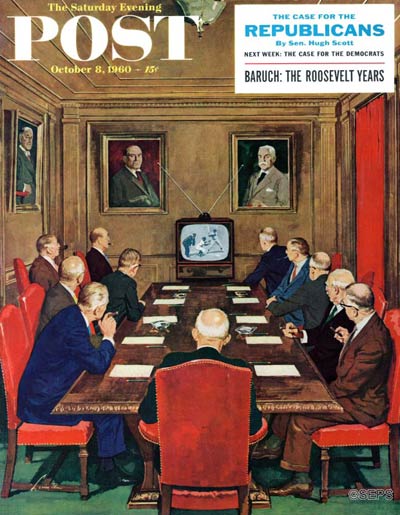
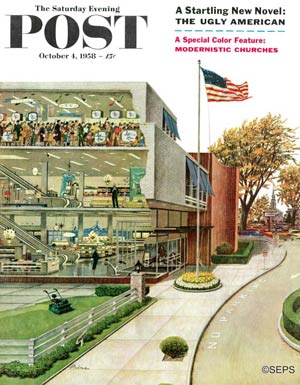
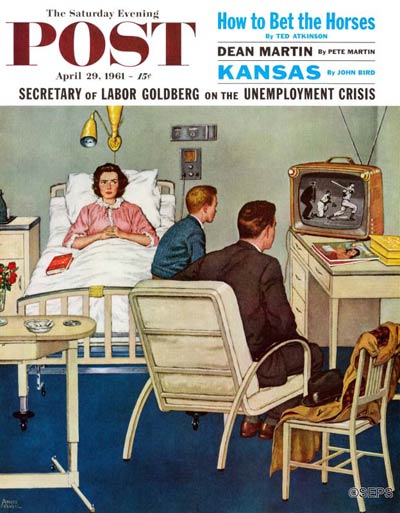
World Series
Whether a Mets fan, a Royals fan, or a disheartened Cubs fan — let’s face it. No one is completely immune to the lure of the October jamboree.
Serious Business
When the Series is on, pretty much everything stops.
Lonie Bee
October 8, 1960
Benjamin Kimberly Prins
October 4, 1958
America’s Fall Tonic
by Bozeman Bulger
The Saturday Evening Post, October 3, 1931—This October tonic, sipped for a week or 10 days, helps to locate old friends and create new ones, loosens the vocal cords, and causes excessive though pleasant loss of sleep.
The greater the business depression, the better this tonic seems to taste. Your American sports lover, or just plain American, may tighten up on some expenditures, but when it comes to settling his baseball championship and seeing it well done, he simply cuts the strap on his bank roll and lets go. Even those who cannot attend to the matter in person suffer bites from the germ. They huddle around radio sets, telegraph offices, and bulletin boards.
In the World War, soldiers in far-off France were able to forgo immediate interest in battles while taking a sip of the Series by telegraph and airplane bulletins. High-ranking generals who provided this tonic are said to have enjoyed a liberal sip themselves.
What Matters
Family’s important, and romance is great—but right now there’s a game on.
Amos Sewell
April 29, 1961
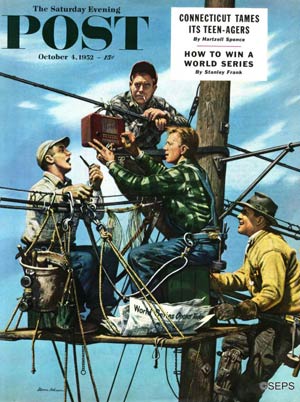
Stevan Dohanos
October 4, 1952
World Series Poison
by Stanley Frank
The Saturday Evening Post, October 3, 1942—Considering the caliber of players involved, the World Series has produced a great deal of shockingly bad baseball. Ridiculous boners are committed in World Series competition for a thoroughly understandable reason. The players are under enormous pressure. The greatest stars blow apart at the seams. There is something terrifying in the realization that every move is a focal point for second guessing, that every gesture is under critical scrutiny. How severe is this pressure?
“Greater than the fan will ever know or a ballplayer will ever admit,” the Yankees’ [manager] Joe McCarthy declares. “Every man responds differently to the World Series and there’s no way of telling in advance how he will react. He doesn’t know, himself. It’s like being held up by a guy with a gun for the first time. No man knows what he’ll do until he goes through the experience.
“The simple truth is that no ballplayer takes the World Series in stride. You hear — I’ve told it to teams myself — that the World Series is just another ball game. That’s nonsense. There is nothing in baseball to compare with the tension of the World Series and nothing can prepare a man for it. Some stars curl up under the pressure and others are stimulated.”
Precarious Perch
What risks will a young boy take to get a good view of the game?
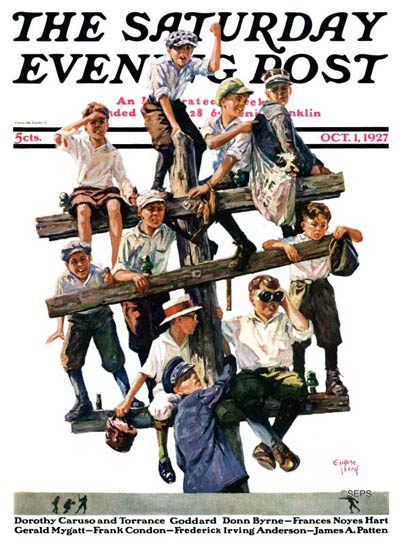
Eugene Iverd
October 1, 1927
Catch and Release
For a few years during WWII, civic duty trumped self-interest. Fans lucky enough to catch a ball were encouraged to throw it back, so it could be given to those in the armed services.
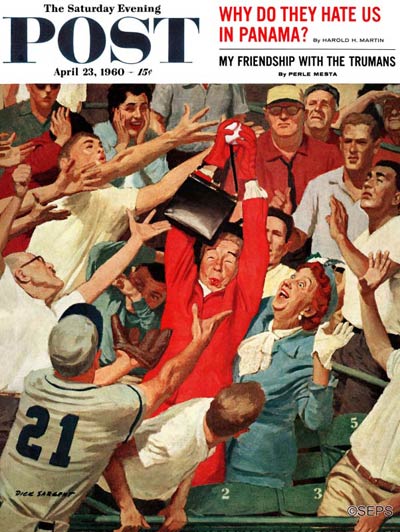
Richard Sargent
April 23, 1960
Field of Vision
Sometimes it’s worth fighting for a reasonable line of sight.
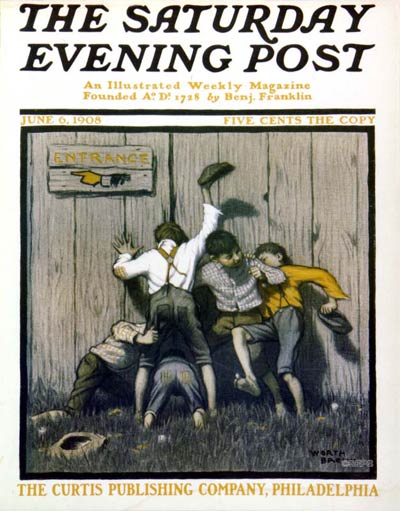
Worth Brehm
June 6, 1908
Memoirs of a Monster
In 1962 the world’s most famous bogeyman, Boris Karloff, looked back at his 30-year career in horror.
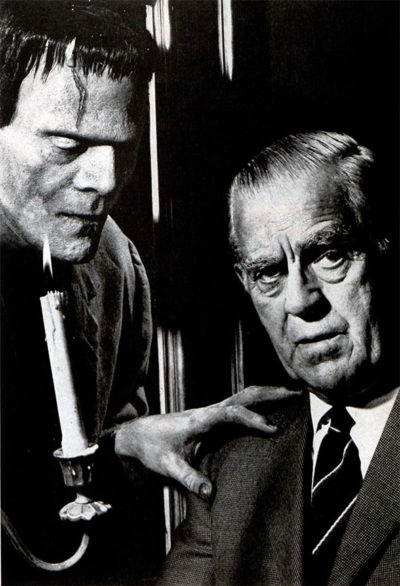
It is not true that I was born a monster. Hollywood made me one. That was 31 years ago, and I have lived menacingly ever after. While some potential victims have eluded my fangs, claws, and other assorted horrors, I myself have found it almost impossible to escape monster roles.
Take the memorable time in 1947 when I was offered the part of the gentle Professor Linden in a forthcoming Broadway production of The Linden Tree. I was delighted — but the playwright, J.B. Priestley, was not. “Good Lord, not Karloff!” he told producer Maurice Evans. “Put his name up on the marquee and people will think my play is about an ax murder.”
I cabled Priestley in London:
I PROMISE YOU I WOULD NOT HAVE EATEN THE BABY IN THE LAST ACT.
Upon that solemn assurance, he withdrew his objections. The part was mine. But The Linden Tree folded in less than a week, and I’ve always been haunted by the thought that possibly Priestley was right after all.
On rare occasions I have managed to step out of character: As jovial Father Knickerbocker in a Shirley Temple Storybook television show; as a wise Seneca chief in Cecil B. DeMille’s The Unconquered, and in my favorite role of the kindly Gramps in On Borrowed Time in stock. But even then I felt that the audience was waiting for me to unmask and exterminate the rest of the cast.
An Ordinary Childhood
Such morbid expectations also appear to shadow my offstage life. If I stroll into the garden, spade in hand, the postman is almost certain to quip, “Disposing of another body, Mr. Karloff?” Groucho Marx’s standard greeting to me is, “How much do you charge to haunt a house?” Bright young advertising men are forever soliciting testimonials from me for such things as devil’s-food cake.
Actually I am assured that I was a quiet infant, and a gentle boy. No whippings by cruel stepparents scarred my childhood. No sadistic governesses read me horror stories by flickering candlelight. My childhood as William Henry Pratt in the serene London suburb of Enfield was extraordinarily tame. Both my parents died during my childhood. I was reared by one amiable stepsister and seven stern older brothers, who knew exactly what I was going to be — a government servant in the family tradition. But my scholarship, or lack of it, during four years at Uppingham, a boarding school that I attended in 1902–06, bespoke my disinterest in any profession based upon higher learning.
Actually my macabre career was already settled. At the age of nine, I had appeared in a Christmas-play version of Cinderella. Instead of playing the handsome prince, I donned black tights and a skullcap with horns and rallied the forces of evil as the Demon King. From then on I resolved to be an actor.
At Kings College, London, years later, the first-term reports amply reflected the fact that I had attended more plays than classes. I was, in fact, fast becoming a disgrace to the family name. In those days black sheep were exported to Canada or Australia. When I blithely flipped a coin in the family solicitor’’s office, the unfortunate losers were the Canadians.
At 4:30 one morning, a month or so later, I found myself in a Canadian pasture, halter in hand, wondering how to round up four reluctant horses.
A week or so later, at Vancouver, British Columbia, I landed a pick-and-shovel job with the B.C. Electric Company — $2.80 for a 10-hour day — digging drainage ditches and clearing land.
Mumbling and Bumbling
Then one day in an old copy of Billboard, I came across the advertisement of a theatrical agent in nearby Seattle. His name was Kelly. I went to him and shamelessly told him I’d been in all the plays I’d ever seen, that I was forced to retire to Canada temporarily for my health, and was now hale and ready for a comeback. Two months later, while chopping trees, I received a brief note, “Join Jean Russell Stock Company in Kamloops, B. C.—KELLY.” I left my ax sticking in a tree.
On the train I concocted my stage name. Karloff came from relatives on my mother’s side. The Boris I plucked out of the cold Canadian air. I had finally become an actor, but I mumbled, bumbled, missed cues, rammed into furniture, and sent the director’s blood pressure soaring. When the curtain went up, I was getting $30 a week. When it descended, I was down to $15. The play, significantly now, happened to be Molnár’s The Devil.
I learned the acting trade during the next six or seven years, playing vintage pieces like East Lynne and Charlie’s Aunt all over western Canada and the United States, and living on eggs fried on inverted pressing irons in “no cooking” boardinghouses. Then I wandered into movies, via a $5-a-day extra role as a swarthy Mexican soldier in a Doug Fairbanks Sr. film, His Majesty, The American. For the next eight or nine years, I played extra and small featured roles when things were good, loaded cement sacks in warehouses when they weren’t. At 42 I was an obscure actor playing obscure parts. I quit writing home — for I had nothing to write about.
My big break came while I was downing a sandwich-and-tea lunch in the Universal commissary. After a string of sweet-and-kindly roles, I had played the diabolical Galloway, the convict-killer in The Criminal Code. Someone tapped me on the shoulder and said, “Mr. Whale would like to see you at his table.” Jimmy Whale was the most important director on the lot. “We’re getting ready to shoot the Mary Shelley classic, Frankenstein,” Whale said, “and I’d like you to test — for the part of the monster.”
It was a bit shattering, but I felt that any part was better than no part at all. The studio’s head makeup man, Jack Pierce, spent evenings experimenting with me. Slowly, under his skillful touch, the monster’s double-domed forehead, sloping brow, flattened Neanderthal eyelids, and surgical scars materialized. A week later I was ready for the test. I readily passed as a monster.
To fill out the monster costume, I had to wear a doubly quilted suit beneath it. We shot Frankenstein in midsummer. After an hour’s work I would be sopping wet. I’d have to change into a spare undersuit, often still damp from the previous round. So I felt, most of the time, as if I were wearing a clammy shroud myself. No doubt it added to the realism.
The scene where the monster was created, amid booming thunder and flashing lightning, made me as uneasy as anyone. For while I lay half-naked and strapped to Doctor Frankenstein’s table, I could see directly above me the special effects men brandishing the white-hot scissorslike carbons that made the lightning. I hoped that no one up there had butterfingers.
Frankenstein was the first monster film of any consequence ever attempted. That, plus the sensitive theme of a man, Doctor Frankenstein, playing at God, made the then-powerful Hayes office hesitate to release it. But director Whale had filmed it with restraint and delicacy. It finally was released for its premiere on December 6, 1931, at Santa Barbara. I was not even invited and had never seen it. I was just an unimportant freelance actor, the animation for the monster costume.
Then my agent called one morning and said, “Boris, Universal wants you under contract.” I thought, Maybe for once I’ll know where my breakfast is coming from, after more than 20 years of acting. I soon found myself mildly famous — although not by name. On a motoring holiday in France, for example, I lost my way. In the dreadful remains of my schoolboy French, I inquired in a tiny village butcher shop. The proprietor looked me in the face and exclaimed, “Frankenstein’s Monster!” That sort of thing has lasted for 30 years.
A Ghoul Gains Followers
In a Hollywood studio baseball game, Leading Men versus Comedians — my category escapes me at the moment — everyone fled in mock horror when I batted, allowing me to lumber around the bases for a home run. At radio-show rehearsals the orchestra hissed me realistically, and I leered back. Columnists imaginatively concocted the Karloff cocktail — one sip sent the drinker into shock. Monster fans mailed me such birthday gifts as voodoo dolls.
Not everyone, however, felt enthusiasm for monsterism. Some parent and civic groups felt Frankenstein was too horrifying for children to see and should be limited to “adults only.” The children thought otherwise. On the very first Halloween after the film’s release, a crowd of laughing pint-sized ghosts and goblins rang my doorbell and invited me to join in their trick-or-treat rounds. As I wasn’t appropriately costumed, I had to decline. Over the years thousands of children wrote, expressing compassion for the great, weird creature who was so abused by its sadistic keeper that it could only respond to violence with violence. Those children saw beyond the makeup and really understood.
Frankenstein transformed not only my life but also the film industry. It grossed something like $12 million on a $250,000 investment, started a cycle of so-called boy-meets-ghoul horror films and quickly made its producers realize they’d made a dreadful mistake. They let the monster die in the burning mill. In one brief script conference, however, they brought him back alive. Actually, it seems, he had only fallen through the flaming floor into the millpond beneath and could now go on for reels and reels.
The watery opening scene of the sequel, The Bride of Frankenstein, was filmed with me wearing a rubber suit under my costume to ward off chill. But air got into the suit. When I was launched into the pond, my legs flew up in the air, and I floated there like some sort of obscene water lily while I, and everyone else, hooted with laughter. They finally fished me out with a boat hook and deflated me.
In March 1933, I returned to England. My two eldest brothers, Ted and Fred, had retired from Indian Civil Service and were living in London. Jack had been transferred from China to take charge of Far East affairs in the Foreign Office.
A little later I got a surprising reaction from my staid and proper British brothers. Some friends from Hollywood were in London, and before they left for home we gave a sort of joint cocktail party. All went well until a newspaper photographer approached me. “I understand you’ve some brothers here,” he said. “Could we get a photograph or two?”
I was appalled. I thought, How am I going to break this to them? They won’t approve at all. I got them off in a corner and mumbled, “Awfully sorry about this but, you know, publicity and all that. I swear I’m not responsible for the photographer being here. But, well, to cut it short, they want to take pictures of us. They want us in the next room, lined up against the mantelpiece.”
Jockeying for Position
Well, you never saw such a stampede. The three reserved, distinguished elderlies — Ted, who’d been judge of the High Court in Bombay; Fred, who’d administered an entire province in India; and Jack, who’d been chief magistrate of the Consular Court in Shanghai — all but got stuck in the door getting through. And there was quite a to-do about who was to stand where. I fought to keep my composure, but inwardly I was laughing.
Returning to Hollywood, I played the monster in Son of Frankenstein — my third and last such role. Others perpetuated him in later films. In a switch, I twice took the part of Doctor Frankenstein myself and found it comfortable to be less loaded with makeup.
Next I became a succession of crazed scientists. The formula was successful, if not original. The scientist would set out to save mankind. His project would sour and he with it. In the end he’d have to be destroyed regretfully, like a faithful old dog gone mad. The scriptwriters had the insane scientist transplant brains, hearts, lungs, and other vital organs. The cycle ended when they ran out of parts of anatomy that could be photographed decently. While it lasted I:
- Robbed graves in The Body Snatcher.
- Slew with an ax as the leering executioner Mord, in Tower of London.
- Frightened my enemies to death in The Walking Dead.
I also:
- Cheated the hangman in The Man They Could Not Hang.
- Invoked the curse of the pharaohs as a vengeful mummy in The Mummy.
- Aggravated the hells of 18th-century prison life as the warped warder in Bedlam.
- Ruthlessly pushed dope to little Jackie Cooper as a dope peddler in Young Donovan’s Kid.
I must confess that I didn’t accept this constant and continual madness quite placidly myself. Once, during the crazed scientist cycle, I said wearily to the producer: “These things are all right, but don’t you think we should perhaps spend a little more in the writing, or change the format?” He was in an expansive mood. He opened his desk drawer and pulled out a great chart. “Here,” he said, “here’s your record. We know exactly how much these pictures are going to make. They cost so much. They earn so much. Even if we spent more on them, they wouldn’t make a cent more. So why change them?”
During my most monstrous years, I naturally associated with such aristocrats of Hollywood villainy as Bela Lugosi[LINK?], Lon Chaney Jr., Peter Lorre, and John Carradine. Offscreen I found them to be the gentlest of men.
One of my own most terrified moments came in 1940, when the noted playwrights Lindsay and Crouse offered me the part of Jonathan in the Broadway production of Arsenic and Old Lace. Keep in mind, I’d never acted on Broadway, but only in the sticks, or in films. What really sold me on taking the part was a line of Jonathan’s in his first scene. He’d just murdered a kindly motorist. Another character says, “He was a nice chap, that man who gave us a lift. You shouldn’t have killed him. Why did you do it?” And Jonathan replies, “He said I looked like Boris Karloff.”
I expected that a line like that, spoofing me so early in the play, would disarm any New York audience. Then I began wondering: Would it? Could I put over a big stage role? By the time I arrived in New York, I was almost shaking from sheer fright. I’d rushed through a hard week at Columbia studios, then taken an all-night flight East. At the theater they handed me a script, and we did something I’d never done in stock or repertory — we sat down, cast and director together, and read cold turkey. I was so tired, and so frightened of my New York role, that I began to stutter — something that always besets me when I’m tired. I rehearsed in stutters for three days, continually thinking that it would cure itself. But instead it grew worse. The third night I wandered the streets of Manhattan wondering what to do. I thought I’d have to walk up to the management and say, “I’m very sorry. I’ve made a mistake, and so have you. I’ve got to get out of your play. Do I owe you anything?”
I walked some more and thought, If I do that, honest though it is, I’ve certainly had it in New York and haven’t done myself an awful lot of good in Hollywood either. Somehow I’ve got to go through with the play.
At 5:30 a.m. I returned to my hotel, catnapped briefly, then went to rehearse. I’d always stuck on the word “Come” in my first line. Now I walked on, took a deep breath and said, “Come in, doctor.” Not a stutter. By that evening all was okay. The show’s reviews were better than okay. It was a big, beautiful hit, and we settled down for a long, happy run of about 1,400 Broadway performances.
Later I played Captain Hook, the villain with the wicked, steel-hooked arm, to Jean Arthur’s Peter Pan on Broadway. At the end of the first act at matinees, we’d peek from behind the curtain and watch the kiddies leaping hopefully off their seats, trying to fly like Peter Pan. After the show I’d corral as many as my dressing room would hold and ask, “Would you like to try on my hook?” Even little blond angels would reply, “Yes, sir.”
They’d turn to the mirror, put on the most terrible face they could make and, without fail, take a terrific swipe at themselves in the glass. Far from being frightened by the villainous Captain Hook, they had caught on to his fun and pomposity. For it is a fundamental instinct of kids to play games, and they knew very well that the swordplay, the ominous crocodile, the poisoning of Peter Pan, and all the assorted stage violence was just a game just good, scary fun.
Villain by profession though I may be, however, I must say that my approval of good scary fun does not extend to shows where blood and guts are sloshed about wholesale, simply to create nightmares.
A Black Sheep No More
Nowadays I find time to play occasional light comedy in Milquetoast roles, to give syndicated radio advice to parents on child rearing and even to make phonograph recordings of childhood favorites such as Mother Goose and The Reluctant Dragon. Occasionally someone asks me if I regret my years as a monster, if the role hasn’t been like an albatross around my neck.
Rubbish! Thanks to the monster, I’ve worked steadily at the work I love best. And I’ve been well paid — in more ways than with money. Here I am, 75 years old this month, no longer the black sheep of the Pratt family, still hard at work, still enjoying life to the fullest. With my wife Evie I commute some 12,000 miles between my old stamping grounds in England and this country. But I must admit one unfulfilled longing. I would love to be in a play in London.
The only time I ever trod the boards there was in a benefit for the Actors’ Orphanage, doing a comedy sketch with Hermione Gingold. Even at that, I was absolutely thrilled. But if I never get to do the “real” thing in London, it would be indecent for me to grumble.
After all, I’ve always been a very happy monster.
“Memoirs of a Monster” by Boris Karloff, as told to Arlene and Howard Eisenberg, The Saturday Evening Post, November 3, 1962
Healthy Indulgences

Holidays are about celebrating what’s most important in life, and at the top of my list is the health and happiness of my friends and family. I always treat them to “good for you” gifts that also feel decadent and indulgent. Here are a few of my favorite healthy holiday gift baskets that are sure to get raves.
Healthy Indulgences: Put together a collection of luscious treats packed with nutritious perks. My favorites: toasted or spiced almonds; sweet, tart dried cherries; top-quality extra-virgin olive oil; local honey; bottle of red wine; selection of dark chocolate.
Tea for Two: A cup of hot tea is one of life’s simple pleasures, and to top it off you even get a healthy dose of antioxidants. For a simple but thoughtful gift, gather an assortment of tasty teas that will help your loved ones stay warm and relax during the holiday season.
Breakfast Basket: One of the things I enjoy the most about holidays is having the time to lounge around in the morning with my family, relaxing in our pajamas. A breakfast basket is a great way to share some of the things that help make those holiday mornings. Try homemade muffins, like my Better Blueberry Muffins; a jar of apple butter; bottle of pure maple syrup; fresh oranges or clementines; and package of exotic coffee.
Dark Chocolate Pretzel Clusters: Chocolate is one of the first things that come to my mind when I think of indulgences. For a decadent, homemade chocolate treat, try my Dark Chocolate Pretzel Cluster. They look gorgeous packed in a little gift box.
Click here for Ellie Krieger’s Pumpkin Bread with Cranberries recipe.
Purchase the digital edition for your iPad, Nook, or Android tablet:

To purchase a subscription to the print edition of The Saturday Evening Post: 
Opening the Door to Happiness

Psychiatry is at a historic turning point. The profession is finally taking its rightful place in the medical community after a long sojourn in the scientific wilderness. The National Institute of Mental Health reports that one in four persons will suffer from mental illness in their lifetime. You are more likely to need services from psychiatry than any other medical specialty. Yet far too many people consciously avoid the very treatments now proven to relieve their symptoms.
A few short generations ago, the greatest obstacles to the treatment of mental illness were the lack of effective treatments, unreliable diagnostic criteria, and an ossified theory of the basic nature of the disease. Today the single greatest hindrance to treatment is not any gap in scientific knowledge or shortcoming in medical capability but the social stigma.
Though we live in a time of unprecedented tolerance of different races, religions, and sexual orientations, mental illness — an involuntary medical condition that affects one out of four people — is still regarded as a mark of shame, a scarlet letter C for “crazy,” P for “psycho,” or M for “mental.” Imagine you were invited to a friend’s wedding but unexpectedly came down with an illness. Would you prefer to say that you had to cancel because of a kidney stone … or a manic episode? Would you rather offer as your excuse that you threw out your back … or suffered a panic attack? Would you rather explain that you were having a migraine … or were hungover from having gone on a bender?
A few years ago, I gave a talk at a luncheon in midtown Manhattan about mental illness to raise funds for psychiatry research. Afterwards, I circulated among the attendees — smart, successful, and outgoing people who had all been personally invited to the event by Sarah Foster, a prominent socialite whose schizophrenic son had committed suicide some years ago while a senior in high school. They chatted over poached salmon and Chablis, openly praising Sarah’s selfless efforts to raise awareness about mental illness — though none of them admitted any direct experience with mental illness themselves. Instead, mental illness was treated like the genocide in Sudan or the tsunami in Indonesia: an issue highly deserving of public attention, but one quite distant and removed from the patrons’ own lives.
Several days later, I received a call at my office. One of the attendees, an editor at a publishing company, asked if I could help her. It seemed that she had lost interest in her job, had trouble sleeping, and frequently become very emotional, even tearful. Was she having a midlife crisis? I agreed to see her, and eventually diagnosed her as suffering from depression. But before she made the appointment with me, she insisted I keep it completely confidential — and added, “Please don’t say anything to Sarah!”
—
From the book Shrinks: The Untold Story of Psychiatry
Purchase the digital edition for your iPad, Nook, or Android tablet:
To purchase a subscription to the print edition of The Saturday Evening Post:
Help Unwanted
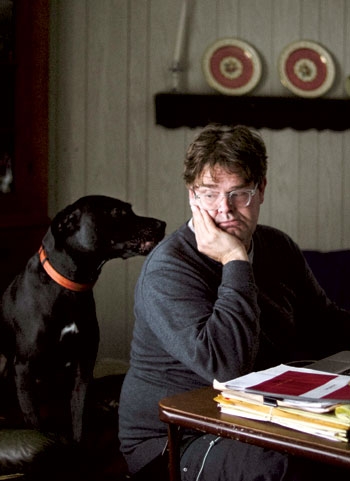
(Photo by Mark Kauzlarich)
My mother is standing with her purse open, clutching one strap and staring at a framed watercolor of a field of flowers as if it were a window, as if it were her window. She looks as if she were home, surveying the yard and the roses, monitoring her sister Alice’s comings and goings, worrying that Alice has been invited someplace she has not.
But this is not her window. This is just a picture in a frame; the flowers are not pink, not her roses, and this is not her home. This is something else to her; this place for old people to come to is giving up, whatever words I use. This is the stop where everything she knows is left behind and she won’t go quietly. She won’t let go of home. It is her most sentimental quality, one we share, our attachment to our place. She has not lost this longing: Her mind has not altered radically or broken in two; it’s more that the surface, the coating, has been rubbed away a bit. You can see more of what is there, the hard and soft, but she is still my mother and she still does not surrender. Or maybe this is how I need to think about her — unconquerable.
I rush up to retrieve her purse, which is full of dirty Kleenexes, loose charge cards, and an old Vuitton billfold I bought her in the city when she came to see The Lion King and I left the tickets in a suit I spilled syrup all over and sent to the dry cleaners. We have argued for hours about this trip to Tiger Place, which I have characterized — to her and myself — as simply an outing for information’s sake.
As she sits on the couch outside the administrator’s office, she glares at me as if being sold into white slavery, gearing up for a battle I don’t have in me. She knows that if she fusses enough, I will fold and give up this whole idea.
Waiting for our tour, Betty rummages in her purse, pretending to disregard the passersby, little ladies in groups, little birds in running shoes, who squint at her, assessing the new recruit. Betty just stares down at her old sandals, slowly pulls her feet back under the chair.
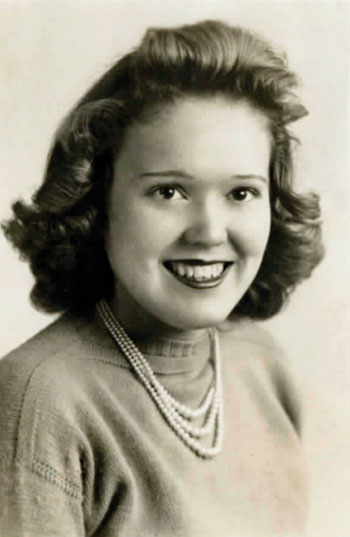
Photo courtesy George Hodgman
Everyone thinks Tiger Place is Betty’s best option. At the very least, even if she remains at home for a while longer or even permanently, we need a safety net, a plan in case she is suddenly beyond my care. The good places have waiting lists, and she needs to be on one, to be prepared. She has always dreaded the idea of winding up at Monroe Manor, the senior citizens’ home in Paris, Missouri, where Mammy, my grandma, lived before her death.
Tiger Place is a cutting-edge facility that attracts retired professors or the parents of professors. For my mother, who does not see how lucky she would be to get admitted here, this cast is not a selling point. When Jackie, our guide, mentions the lectures by visiting scholars, Betty looks pained, bored in advance. She is not the type to sit and listen. At church, a few ministers back, she developed the habit of holding up her wristwatch when the old man got long-winded.
“What is that?” she asks as I gaze at the lecture schedule. When I explain she asks if she will be able to get a gin and tonic.
She may not even be accepted for admission. Residents must show that they are able to care for themselves and become part of the community. There is a list of criteria that people admitted here must meet. Betty, inclined to fall inside herself, to just not register the goings-on around her, to refuse to do what she is asked, may be beyond assisted living here. But I don’t want her to fail further and wind up somewhere dismal. Dementia or Alzheimer’s facilities would be the end of her.
Without the stimulation of active people, she would fall fast and fade. But I can’t say these things to her, and she won’t see that I am just trying to take care, to be the strong one now. For her.
At Tiger Place, there are chairs upholstered in cheerful shades that make Betty grimace, and carpet that, unlike our own, shows no spills. The residents are mostly younger and in better shape than my mother. Would she mix well, I wonder, try to socialize or hide in her room? Would she dress in the morning or just stay in her robe, as she does if I do not force the issue? Would the ladies, gathered in cliques, understand or shun her because of her eccentricities? I just don’t want to see her hurt.
Dragging her feet down the hall, Betty looks a little sad, like the kind of old lady she has never let herself become. But she steels herself, trying to get through this day, to cooperate a little. My cousin Lucinda has joined us to help out, and Betty is more docile with her on hand.
No matter how I try to position Tiger Place as a fun-filled new lifestyle, as a relaxing relief from burdens, Betty will not participate in these fictions. She will not speak or comment as we are shown the studio, one-bedroom, and two-bedroom units that, empty for display, are okay but not especially inviting. “These rooms are empty,” she tells Jackie, who says that of course she would bring her furniture from home. “I would never bring my furniture here,” Betty exclaims. She doesn’t want to break up the house. Maybe because there is no place for most of her things to go.
Our basement is piled with stuff. Late at night, I inspect everything as I listen for Betty to call out. I see what is ahead, picture the furniture lined up in the yard, all for sale — the antiques, chests with marble tops and tables, the candleholders, cups and saucers, the cloisonné, the brass tea set, the row of Japanese ladies from the top of the piano.
“Remember,” Betty always says, “those are hand-painted.”
Everything is for sale. Off to others. Someday soon. All the old things that witnessed everything, all the days and nights of our lives. I don’t have a place for them; this is a regret I have. The life that I’ve carved out is not equipped with extra rooms or empty cabinets. If Betty moves to Tiger Place, we may have to sell the house for financial reasons, depending on how long she lives.
I glance at Cinda, who has been the major reason for my maintaining a hint of sanity in the last few months. She looks at Betty and then at me as if to say, “What were you expecting?” I don’t know. The Golden Girls?
“Is she a craftsperson?” Jackie asks, but Betty, who rolls her eyes at this, does not knit or embroider.
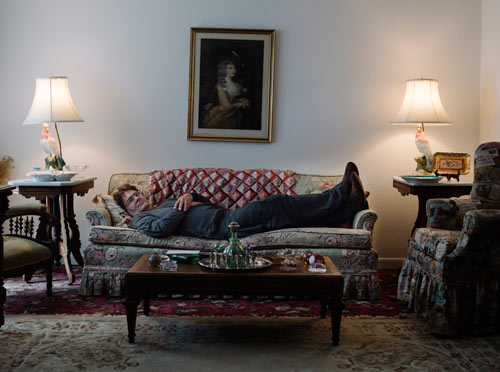

She does not tat or sew and is not the type to linger over the creation of a lap robe. She cannot see well enough, nor does she have the patience. She is irritable, and now sometimes a challenge. Though she tries her best, she cannot always remember names. How can she make friends if she cannot call their names out? Who will come and sit by her? She has no hobbies; she once had friends instead. But now the country club in Moberly, where the couples of her generation once gathered for dinners, is gone, torn down. Moberly is no longer a place where many people can afford a country club. My mother grieved for months.
I try to smile at Betty, but she looks away. I try to walk with her, but she won’t let me be The Son.
“Please let me do for you,” I want to say. “Please let me help you. Maybe I can surprise you, make this all a little easier.” But she has to do everything on her own or it is cheating, breaking a rule. She suddenly looks tired and whispers to me that she just wants to go home, but Cinda and I guide her toward the exercise area. Betty eyes an exercise bicycle as if it were a guillotine. Staring at me, perturbed, she shakes her head. Nor does the prospect of yoga in a chair arouse her enthusiasm. “What kind of thing is that to do?” she asks.
“I want to go home,” she whispers to Cinda. “I want to go home.” So do I, but we can’t. We have to forge ahead. I have to lead; it’s my responsibility. Braving her resistance to public endearment, I kiss her head, but she pulls it away. “You won’t let him leave me here, will you?” she asks Cinda. I realize that she believes I have brought her here to abandon her. This is actually what she thinks. She believes I want to run away and leave her. Clearly I am, in her mind, the Joan Crawford of eldercare.
“Tonight,” I tell her, “we’ll buy peaches; we’ll go to the Junction for prime rib. We’ll do whatever you want.” But she will not listen. Perhaps because she feels I hold power over her, I am the enemy. When I turn to face her, she still refuses to look at me at all. She smiles at Cinda, her new ally, the one she considers persuadable, as I resist the urge to fold into the yoga chair and begin a round of chanting.
Watching Betty at Tiger Place, Cinda looks at me and seems for the most part amused. Again and again, she saves us: She knows the right questions to ask, makes a note or two as Jackie explains the walking tests administered each month, the bus for church pickups and shopping trips, the stages of care: Stage One, Stage Two. There are four stages. I think I may be a Seven.
When I manage to come up with an inquiry that actually seems on point — “Is there anyone to make sure she takes all her pills in the morning?” — Betty interjects, “I can take my own medicine.” But she doesn’t, and every time I hold them out she asks the same question: “What are these? Who said I had to take so many?” She acts like taking pills is some sort of hard labor.
Jackie introduces my mother to a woman with a fancy blouse passing by. “Do you play bridge?” Betty asks. When the woman, who looks a little startled, shakes her head, Betty turns away from her, stares at me coldly. I have promised cards.
“Older people eat small meals,” says Jackie as we head into the dining room for lunch. “They don’t get hungry like we do.” Cinda is a little taken aback, as am I. My mother eats enough for a camp of lumberjacks in the Maine woods. Betty asks of the lunch, “Are they going to charge us for this?”
Jackie overhears and assures us that the meal is complimentary. “Well,” Betty says moments later, staring down at what seems only the suggestion of a hamburger, “it better be.
“Don’t you offer to pay,” she whispers to me.
After lunch, we sit for a while in a courtyard filled with flowers. It’s a lovely place and some of the apartments have screened-in porches that look out onto this area. Sitting by the flowers, Betty rests, focusing on the blossoms. For years she has taken flowers to people from church who are sick and alone. Hour after hour, I have watched her standing by the kitchen table, arranging the stems.
“Who tends to these?” she asks Jackie. “It looks like they do a pretty good job.” It is her one concession.
The trek through these halls has worn her down and lunch has certainly not satisfied. “Did you get a look at that hamburger?” she asks me. I say nothing. “No bigger than a half dollar,” she adds.
Maybe I should just give up and let her be, I think, stay here in Paris, Missouri, see her through for as long as it takes. Then I tell myself I am an idiot for always going soft. That is not what the real Betty, who would have run me back to New York with a pitchfork, would have wanted me to do. She would have ordered me to live my life. Of all the changes that have transpired in my mother, it is her new belief that I should give everything up to stay with her that is the most surprising. This tells me just how worried she is, how much she cannot bear to leave her home.
Betty looks so woebegone when I explain to Jackie that I want us to go on the waiting list that I cannot look back at her. It is just a backup — I keep repeating this, trying to make myself believe this, to make Betty understand, but she just shakes her head as Cinda and I follow Jackie into the office to get the form to fill out and write a check. We have to do this. We have to make sure she has a pleasant place if she must leave home.
Betty will be number eight on the list; she can waive entry three times before she is taken off the list. Before she actually enters, she will have to undergo an assessment designed to test her level of self-sufficiency and “cognitive functioning.” The application fee is a nonrefundable $1,000, which I do not tell my mother about.
When I return to her side, she says again, “I want to go home.” She rests her hand on mine just for a second. “Please, George,” she says. “Please.”
I think Betty will never live at Tiger Place. She is falling too fast. Soon, I am afraid, she will be beyond movies with popcorn or exercise bicycles, though maybe she will remember flowers. Maybe she will find herself, on some future morning, running her finger along the glass of a painting in a hall she does not recognize, recalling in some corner of her mind the fat buds of her mother’s roses growing in her old front yard. On Facebook, a lady wrote that the days she gets to be with those she loves are “gold-star days.” I often tell Betty that these are our gold-star days. I have tried to make them special so she can carry pieces of these times in her memory. I am trying to pack her bag with things that might draw her back to herself someday.
I wonder if she will remember the cinnamon toast I make on Friday mornings. I wonder if she will recall Mammy washing her hair in rain — water from an old tin pan.
All the way home from Columbia, I break the speed limit. I want to check on the dog. I want to put an end to this day. My mother is mostly silent. She can no longer deny what is happening, and she is plotting, planning her attack. As we travel, Betty’s mood shifts. Suddenly, she is nice, so nice, too nice. Butter wouldn’t melt in her mouth. She asks me if I need money. I turn the radio up. It is Reverend Lucius Love’s gospel hour. I need some lifting up.
When I was in high school, a man named Harold Long preached at the AME church, across the tracks from the white part of town, even then. One of his sisters, whose first name I wish I could remember, was in my mixed chorus class. She was big; her feet bulged out below the straps of her shoes. Stepping up on the bleachers winded her. But I always listened for her. There were all our voices singing together, and there was her voice, full of church, and the people she had come from, and feeling. Her emotion changed the face of an ordinary day, and I was drawn by it. If there was ever a time when I was convinced there was a God in the universe holding out his hand to me, it was when the Long sisters performed “I Believe.”
“If you stayed in Paris, you could keep that dog,” Betty declares suddenly, eyes glinting as if she has just been dealt a winning hand at the bridge table. She is playing for freedom. I have always enjoyed watching my mother in action. There is love and there is survival. At the moment, the latter can be her only concern. She will do whatever is necessary. Her independence is at stake. Her everything. Home.
I don’t want to take away her home.
“Can’t we just go on the way we are, just a little while longer?” she asks. “It won’t be forever.”
“You look pretty healthy.”
“I could die tomorrow.”
“I told you to get a flu shot.”
The ensuing moments do not fly by.
“Mother, can’t you see that I am trying to do everything I can to make you happy? Trust me, please. I’ll take care of you. I will do right by you.”
“I know,” she says. “I know.” And I think she actually believes it, that I can do it, that I can make it, somehow, okay. Outside it is so hot that steam is rising from the highway.
When I was in high school, I brought Mammy, very old then and not far from her death, home from the doctor in Columbia on an old country road. Her eyes never left the window; it seemed as though she was watching something, though she could barely see. Whatever it was, it pleased her. Finally, she spoke. “Look at all those pretty cows,” said my grandmother, the old woman who still remembered the farm. The blades of the windmills still turned slowly in the breeze off the fields in her mind’s eye.
“Look at those little calves,” she said, directing my attention to the window. But the pastures we were passing were empty. There was nothing there but the strip of highway running toward Paris and the room at Monroe Manor where she lived by then.