3 Questions for Marc Maron

Marc Maron defines what he does as “comedy of introspection and personal struggle.” He obsesses over other comics who get network shows or on the cover of magazines, where he feels he belongs. He describes himself as an “abusive, selfish, needy, angry a-hole” who is “bitter and misunderstood.” But with all his complaining, he’s doing very well. He travels the country doing stand-up. His half-million listeners make his WTF podcast one of the most successful on the Internet. His IFC show Maron is in its second year. He’s written a successful memoir, Attempting Normal. And he’s enormously popular with people in their late 20s and 30s who can relate to his rants.
The Saturday Evening Post: In your book you write that you grew up in an emotionally crippling household. Is that the fuel that fed your desire to become a stand-up comedian?
Marc Maron: My father was erratic and absent. My mother was self-consumed. She and I fought a lot. She was very obsessed with her appearance and with weight and her own place in life and who she was. A lot of that was projected onto me. Most of my concerns as a child were how fat I was getting and what pant size I was going to wear and how embarrassed I would be about my mother’s behavior, her peculiar eating habits, her weird vanity, her sexuality. She never did anything right — like pick me up on time. It was always embarrassing. So I often sought negative attention just to get attention. Humor was something I used when I wasn’t paralyzed with discomfort or not feeling like I fit in.
SEP: Your early career was a struggle. People didn’t “get” you. What made you continue on when it must have been so tough along the way?
MM: Once I started defining my comic personality, it was aggressive. I wanted to provoke, to make people uncomfortable. I believe life is fundamentally unfair. You reach almost daily, if you let yourself, a sense of futility. So raging against that was something I thought everyone could relate to. As it turned out, it’s a very fine line between raging and self-pity. And that’s not compelling. The struggle is to overcome that. Being self-effacing, on the other hand, is a popular comedic archetype: the shlub. But if you add anger and a sense of entitlement to that, it becomes repugnant. My curiosity, my humor, has always been driven by the fact that I was missing something. Or that someone else had figured something out that I hadn’t. Or why is it easier for that guy than for me? It really isn’t fundamentally easier for anybody — a lot of time luck or opportunity plays into it. Some people are luckier than other people. Some people deserve things other people don’t. It isn’t that complicated.
SEP: How did you eventually find your audience?
MM: What happened with me is I gave up. I had to assess who I was and realize that maybe I’m not going to be an important comic. Maybe I’m not going to get a TV show. That was heartbreaking. After being divorced twice and assessing the flaws that I had that hobbled me, I started thinking, Who the %$#& are you? So acknowledging that I had failed and not thinking of anything else I could do, I turned to this [making podcasts]. I can’t help but be raw and honest and this format lends itself beautifully to that. [The podcast] seems to have a profound effect on people. Ultimately, I wasn’t looking for money or to be a rock star, I was looking to be relevant and to be seen.
America’s 10 Best Beaches
I’m on my hands and knees scouring the beach for diamonds. It’s a picture-perfect summer day: sunny and warm, with practically no humidity and maybe the biggest blue sky I’ve ever seen. The beach is heavenly, with that sugar sand you find in the tropics, framed by a dune forest protecting the scrub-shrub habitats of nesting songbirds.
Diamonds — well, actually, beautiful, translucent pieces of quartz — are abundant, but that’s only a small part of the draw. There’s the privacy (it’s one of the region’s most sparsely populated beaches); the splendid bird watching (rated by Audubon as one of the best birding sites in the nation), and that special sand. Who knew that this slice of paradise — Higbee Beach in Cape May, New Jersey — is within a five-hour drive of one-third of the U.S. population?
The plain truth is the United States is a treasure trove of these magnificent hideaways. Following are some of the best in the country, selected with a bias toward geological uniqueness, magic, and unspoiled beauty. All you need bring is a towel and a picnic.

1 Pauoa Beach
Where: Kohala Coast, Hawaii
Wow factor: Ever dream of bathing in champagne? The beach fronts a postcard-worthy coral reef cove, where cooling freshwater springs bubble up from the bottom of the warm Pacific Ocean, making you feel like you are swimming in a bathtub filled with Fizzies. Later, while lounging on the warm sand, dig your feet down deep and feel the freshwater spritzing up.
Sand: The expanse of soft, pearl-white granules is flecked with colorful bits of coral, shells, and lava.
What to collect: Souvenir photos. Removing the lava that has bubbled up along the beach is illegal; worse, doing so is cursed by Pele, the Hawaiian goddess of fire.
Local lore: A five-minute walk from the beach is the Puako Petroglyph Archaeological Preserve with over 3,000 engravings. Archaeologists believe these petroglyphs depict life events of the local culture thousands of years ago.
When to go: Anytime. Daytime temperatures hover in the 70s and 80s year-round.
Stay: The beach resides on the grounds of the Fairmont Orchid (fairmont.com/orchid), which offers rooms with ocean views and private lanais.
Eat: Innovative farm-to-fork Pacific Rim fare is almost beside the point compared to a sunset show at Napua Restaurant (napuarestaurant.com); dinnertime guests get to watch stars light up the Kohala coastline after seeing the sun melt into the Pacific Ocean.
2 Bandon Beach
Shutterstock
Where: Bandon, Oregon
Wow factor: Sandwiched between dense forest and the Pacific, the beach offers dramatic views of rock pillars (known as sea stacks) jutting from the ocean, as well as small islands inhabited by nesting seabirds, birthing seals, and more. Don’t be surprised if you happen upon a sea lion having a splash.
Sand: Fine heather-toned grains pack well for castle building.
What to collect: Agates. At least 20 varieties including carnelian, moss, and cloud.
Local lore: According to legend, the curious rock formations along the beach were formed when a mountain chief brought his daughter to the shore for the first time. Ignoring the warning that looking at the evil ocean spirit Seatco would turn her to stone, the daughter wandered the beach and was frozen in place.
When to go: Year-round. Frigid water and wind prohibit this from being a swimming beach; come dressed in layers as storms can kick up unexpectedly.
Stay: Every room and private cottage at Windermere on the Beach (windermereonthebeach.com) have beach access and panoramic views of the Southern Oregon coastline.
Eat: Bandon’s best scene for a sunset cocktail is The Loft (theloftofbandon.com), which sits atop the High Dock building and serves exquisite Pacific Coast-fusion cuisine.
Shutterstock
3 Pfeiffer Beach
Where: Big Sur, California
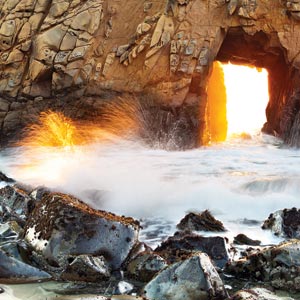
Wow factor: Front and center in the crashing surf is Keyhole Rock, a gargantuan arch with waves hurtling through the center split. In winter, catch it just before dusk and see the setting sun cast its final rays through the keyhole.
Sand: The purple sand, located at the north end of the beach, draws its unusual color from manganese garnet fragments, eroded from deposits in the hills, that become finely ground as they wash onto the beach from the creek above.
What to Collect: Well, the sand, for starters. Diligent beachcombers can often find sizable chunks of manganese garnet that has been washed from the cliffs above onto the beach. But note: Digging into the rock face is prohibited.
When To Go: Wind gusts are common here year-round, but less harsh during the drier months, June–October.
Local lore: Big Sur’s dramatic landscape has been the setting for countless feature films, including according to Hollywood legend the famous kiss between Burt Lancaster and Deborah Kerr in From Here to Eternity.
Stay: For comfort and panoramic views, you can’t go wrong with Post Ranch Inn (postranchinn.com). The more adventurous will stay in the treehouse lodgings stilted nine-feet above the forest floor, where there’s still plenty of luxe with spa baths, fireplaces, and wood decks facing the forest.
Eat: Cliff-dwelling eatery Nepenthe (nepenthebigsur.com) was once a cabin owned by Orson Wells and Rita Hayworth. Now it’s the ideal spot for mojitos at sunset.
4 Cape Hatteras Lighthouse Beach
Shutterstock
Where: Buxton, North Carolina
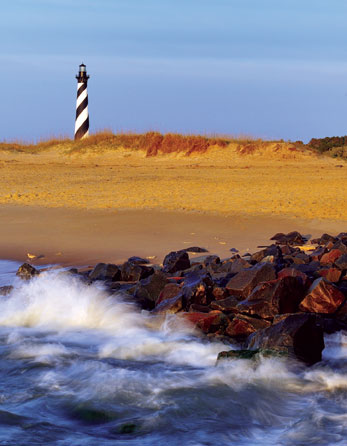
Wow factor: The beach is part of a narrow barrier island jutting 30 miles into the Atlantic, so its landmass is forever changing. What’s most striking, however, is the “magic fairy dust” that gets kicked up with each shuffling step in the sand. At night, you’ll find yourself surrounded by a spellbinding blue-green sparkle caused by microscopic phytoplankton that glow when disturbed.
Sand: The cape is a convergence of two major ocean currents, the cold Labrador Current from the north and the warm Gulf Stream, which grind bivalve shells into fine, soft particles.
What To Collect: Shells galore — knobbed whelks, Scotch bonnets, augers, baby’s ears, and more.
Local lore: The Grey Man of Hatteras is a shadowy ghost who walks the beaches. As the story goes, he’s the spirit of a sailor who perished at sea.
When To go: Beach weather here spans spring, summer, and fall, thanks to the Gulf Stream that blows warm breezes in chillier months. Locals especially love autumn, with its lazy Indian summer afternoons, but the threat of hurricanes lurks through September.
Stay: The waterfront Inn on Pamlico Sound (innonpamlicosound.com) is a boutique hotel with island-style guest rooms, an oceanfront swimming pool, complimentary kayaks, and a gourmet restaurant.
Eat: Come to Dinky’s (villagemarinahatteras.com/DinkysGenInfo.html) for the local catch, and you’ll be treated to the best show on the island — sunset.
National Park Service
5 The Beach at Sunken Forest
Where: Fire Island, New York
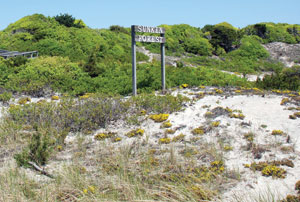
Wow factor: Just over the dunes behind this uninhabited beach on the famous barrier island between Great South Bay and the Atlantic Ocean is a rare maritime forest of stunted plant clusters, visible from a boardwalk. This stunted, or “sunken,” effect is caused by saline mists from the ocean.
Sand: The soft, reddish sand is made up of fine white quartz, laced with minute red garnet and black flecks of magnetite.
What to Collect: Sand. If you want to amuse your kids, take a magnet to it and show them how the particles magically float up.
Local lore: Historians and locals have debated the origin of the name Fire Island for decades. Many believe that it was a misspelled translation of Five Barrier Islands from a 17th-century Dutch map. (The number of inlets changes periodically with the weather.)
When To Go: Late spring to early fall is when the beach is warm and the forest in bloom. The ferry from Sayville, Long Island, to Sailors Haven runs only mid-May–mid-October.
Stay: No hotels in Sunken Forest. But a few miles (and short water taxi ride) down the island is the chic Palms Hotel in Ocean Beach (palmshotelfireisland.com).
Eat: If you stay in Ocean Beach, try Maguire’s Bayfront Restaurant (maguiresbayfrontrestaurant.com), as much for the spectacular sunset views as for the cuisine.
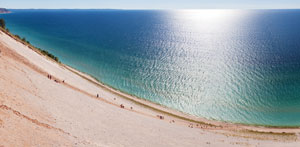
6 Peterson Beach
Shutterstock
Where: Sleeping Bear Dunes National Lakeshore, Michigan
Wow factor: Once named “the most beautiful place in America” by Good Morning America, Peterson Beach fronts Lake Michigan’s crystal blue Platte Bay. From the shoreline are unobstructed views of Sleeping Bear Point and Empire Bluff’s billowy sand dunes, formed during the last ice age. Some dunes soar as high as 450 feet.
Sand: While most of the Great Lakes have rocky shorelines, this beach is known for its powdery, golden sand.
What To Collect: You’ll find plentiful samples of Michigan’s state stone, the mottled Petoskey stone (fossilized rugose coral). Take pictures; the National Park Service doesn’t allow removing natural elements from the park without a permit.
Local lore: The Native American-inspired Legend of Sleeping Bear holds that a mother bear and her two cubs were driven into Lake Michigan by a forest fire. After swimming for hours, mother bear reached the shore first and perched on a bluff to await the cubs, but they soon tired and drowned. The Great Spirit Manitou created two islands to mark the spot where the cubs disappeared and a solitary bluff representing the mother bear.
When To Go: While each season brings distinctive hues and vistas, summertime offers the most tolerable water temps (up to mid-60s) for swimming.
Stay: The lakefront Homestead (thehomesteadresort.com) offers a range of resort activities and lodging options.
Eat: Blu (glenarborblu.com), with panoramic views of Sleeping Bear Bay, incorporates local provisions into its eclectic menu.
Shutterstock
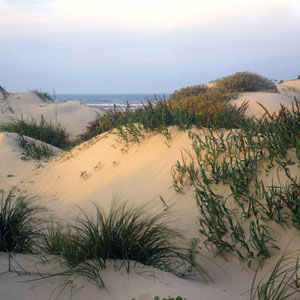
7 Padre Island National Seashore
Where: North Padre Island, Texas
Wow factor: The longest undeveloped barrier island in the world stretches 113 miles between the Gulf of Mexico and Laguna Madre, one of the world’s few hypersaline coastal lagoons. Unlike kitschy and crowded South Padre Island, no hotels or businesses clutter the untainted seashore bordered by a narrow dune ridge, coastal prairie, and tidal flats. The beaches are quite desolate, populated by rare, protected wildlife, including endangered turtles and some 380 species of birds. The highway ends 10 miles in, so adventurers in four-wheel-drive vehicles must cross the sand from one beach to the next.
Sand: Billowy white sand, laden with exquisite shells.
What To Collect: Shells — common arks, cockles, and quahogs — and colorful coquina mostly found on Big and Little Shell beaches. Park Service permits the removal of up to five gallons of shells per day.
Local lore: Padre Island is reported to be a prime hiding spot for pirate gold. (Too bad the National Park Service prohibits the use of metal detectors.)
When To Go: As one of the southern-most spots on the mainland U.S., even December can bring warm days. Considering the staggering heat and humidity of summertime and hurricane threat into the fall, locals prefer the months of February–April when precipitation is low and temperatures often hover around 70 degrees.
Stay: The modern oceanfront Sandpiper Condominium (sandpiperportaransas.com) is a welcome respite after a day of trekking around Padre’s primitive shoreline. The resort offers well-stocked units with kitchens and balconies, a pool, and beach loungers.
Eat: Snoopy’s Pier (snoopyspier.com) is a family-owned, beachfront eatery serving local catch prepared with family recipes.
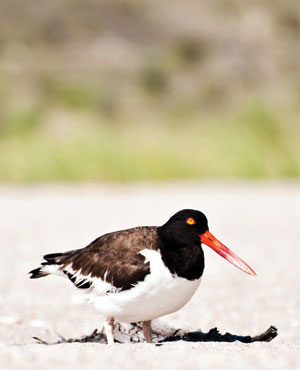
8 Higbee Beach
Shutterstock
Where: Cape May, New Jersey
Wow factor: Cape May’s sugar-sand beaches are considered among the cleanest in the nation, sparkling clean, in fact. Some of that sparkle comes from sand laced with Cape May Diamonds — gorgeous, translucent quartz. The stones wash up on Higbee Beach from the upper reaches of the Delaware River. Higbee, at the tip of Cape Island, also contains the area’s only remnants of coastal forest, protected by dunes up to 35 feet high.
Sand: The shoreline is blanketed with that downy white-blond sand normally associated with Caribbean beaches.
What To Collect: Those diamonds, of course. The largest wash ashore during winter months, when the current is strongest.
Local lore: Kechemeche tribe believed the diamonds possess supernatural powers.
When To Go: May–mid-October.
Stay: Congress Hall (caperesorts.com/hotels/capemay/congresshall) is a sprawling, historic beach resort still operating in grand style.
Eat: The Washington Inn (washingtoninn.com), in a restored 1840s plantation house, features a menu of continental fare that changes daily to incorporate the local harvest.
Shutterstock
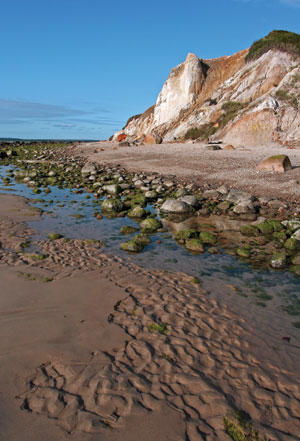
9 Moshup Beach
Where: Martha’s Vineyard, Massachusetts
Wow factor: Moshup (aka Gay Head or Aquinnah) is one of the few places on the East Coast where you can catch the sunset — rather than sunrise — from a sandy beach. This secluded shoreline of white sand and crystal-clear water is sometimes tinged red by the surrounding russet-colored clay Aquinnah Cliffs, encasing eons of ancient animal and marine fossils — whales, horses, even camels — in their auburn grooves. Smattered around the beach are age-old rocks worn smooth by the crashing tide, and pieces of lignite — scientists say from the Cretaceous period. The most scenic time is sunset, when the cliffs glow with terracotta hues.
Sand: Surrounded by multi-hued rocks and clay cliffs, the soft, white sand takes on a variety of shades throughout the day.
What To Collect: The brightly striated glacial rocks, fossils, and mud (with legendary healing powers) are protected property, so capture them with your camera only.
Local lore: Native Wampanoag tribal folklore attributes the unique geology to a giant named Moshup. He hunted whales and threw them against the cliffs; their blood turned the clay red and their remains are those fossils found today.
When To Go: Most visitors and businesses operate around the seasonal ferry schedules, which run from Woods Hole or Falmouth with regular service mid-May–mid-October.
Stay: The cozy guest rooms of the cliff-dwelling Outermost Inn (outermostinn.com), owned by musician James Taylor’s brother Hugh, provide spectacular three-way vistas spanning the Nantucket Sound.
Eat: In a rural garden overlooking the ocean, Beach Plum Inn (beachpluminn.com) incorporates local provisions into imaginative dishes.
10 Henderson Beach State Park
Shutterstock
Where: Destin, Florida
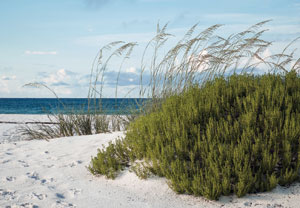
Wow factor: The beach here is known for its whitest-of-white, sugary sand. Plus, great fishing.
Sand: The ground-quartz sand washes down from the Appalachian Mountains via the Apalachicola River out into the Gulf of Mexico. From there, the sand drifts west in the currents, much of it settling here.
What To Collect: Dune rosemary, an edible, non-endangered Florida scrub, that sprouts fragrant lavender flowers in springtime.
Local lore: Destin calls itself the World’s Luckiest Fishing Village. Perhaps that’s because the continental shelf comes closer to shore in Destin than anywhere else in the state, allowing anglers to reach every depth of fishable waters more easily.
When To Go: April–May and September–November are when ocean temperatures range a comfortable 60–80 degrees.
Stay: Henderson Park Inn (hendersonparkinn.com), Destin’s only B&B on the beach offers romantic guest rooms overlooking the beach, gourmet breakfasts, box lunches, beach chairs, umbrellas, and bicycles.
Eat: For Gulf-shore gastronomy, accented with a Creole flair Louisiana Lagniappe (thelouisianalagniappe.com/destin) is a longtime local favorite. Hush puppies, jambalaya, blackened shrimp etouffee, it’s all here.
News of the Week: Seinfeld, Summer, and Sharknado 3
What’s the Deal with Jerry Seinfeld?
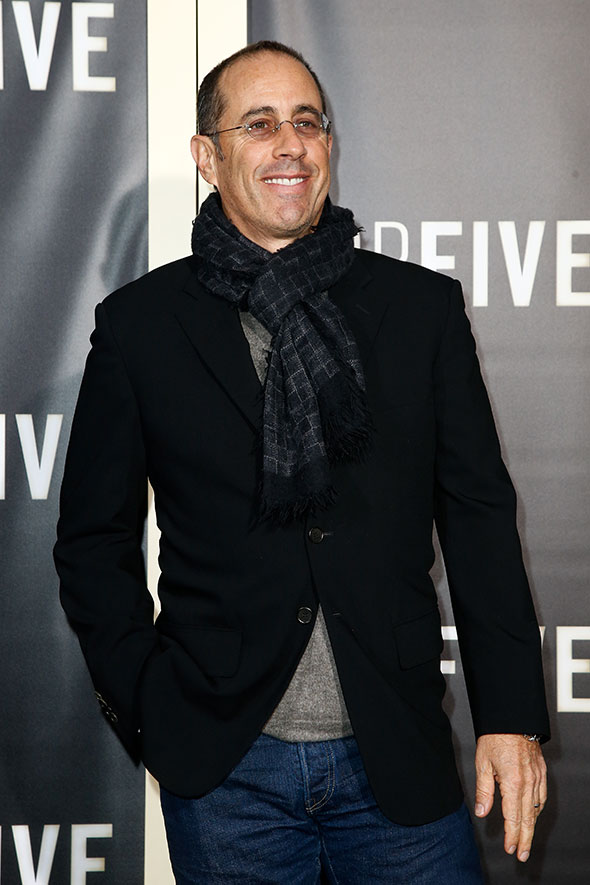
If you were to make a list of the 1,000 most controversial comedians, Jerry Seinfeld would come in at 1,001. But apparently a lot of people are irritated by the veteran comic lately. During interviews with ESPN’s Colin Cowherd and Seth Meyers on Late Night, Seinfeld remarked that he no longer performed at colleges because of a “creepy PC thing.” Seinfeld has discovered that younger people — including his daughter — “just want to use these words. That’s racist, that’s sexist, that’s prejudice. They don’t know what the hell they’re talking about.”
Of course, many people (mostly on the left) have jumped on Seinfeld’s comments and declared him “bizarro” and “sad,” “cranky,” and they’ve even said that he doesn’t know what he’s talking about because he’s just a rich white guy. They’re saying that he’s getting this push back because his jokes just aren’t that funny, which isn’t true and also really misses the point. He even got a lesson in comedy (yes) from a college student. Because it’s up to someone in their early 20s to not only tell Jerry Seinfeld how to be a comic these days, but how to be a comic in the right way for the right reasons.
The world’s gone mad. What is so wrong about what Seinfeld is saying? And is it even a big deal to begin with? Has Seinfeld ever even been political in his humor, either in his standup or his TV show? He’s not coming from the right on this (and it’s funny that the right is suddenly trying to adopt Seinfeld as one of their own, as if Seinfeld had been a “liberal icon” or something). Not everything has to be “political,” even if the “P” in “PC” stands for that word. He’s simply making a personal observation, the same one fellow comic Chris Rock made not too long ago. I don’t even think that Seinfeld was being incredibly specific in his criticism. There’s a bigger point to be made — even if Seinfeld doesn’t realize he was making it — about how the world is now in general. And all of those articles I linked to above and the TV commentaries and all the snark being thrown at Seinfeld on social media right now simply prove his point. And I wonder if the critics even understand that.
This isn’t the first time Seinfeld has been involved in a controversy like this. Last year he was criticized for not having enough women and minorities on his Comedians in Cars Getting Coffee series. Never mind that the criticism was instantly made ridiculous by simply watching the show. Seinfeld said at the time that he didn’t do comedy “by census,” as if everybody had to be represented all the time, like a checklist. He got the people he knew and the people he thought were funny, saying he had “no interest in gender or race or anything like that.” There was no agenda behind it at all. Of course, the nuttier regions of the Web twisted around what he meant and went after him for that too.
So much yada, yada, yada.
The First Day of Summer
Norman Rockwell
July 13, 1940
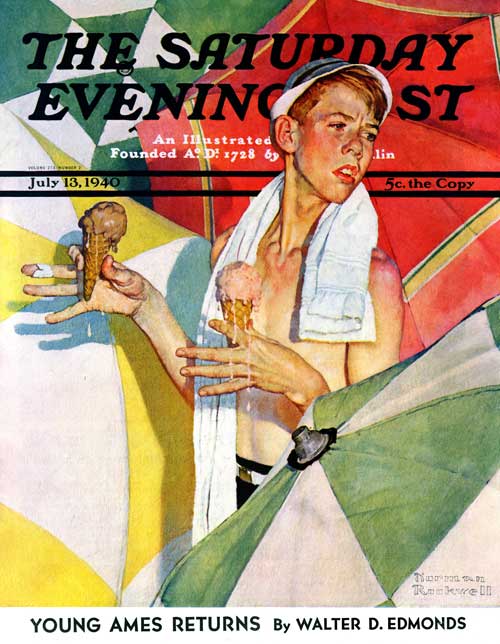
Summer is the only season where it feels like the season before it even officially starts. It’s already been rather warm, I bet you’ve either had a cookout or gone to the beach, and we’ve put in our screen doors and air conditioners already. You don’t really get that with fall, winter, and spring. They don’t “feel” like their seasons fully until the seasons actually arrive.
Anyway, the first day of summer is this Sunday. And if you’re keeping track and like countdowns, the exact time it starts is 12:38 p.m. EDT.
Just When You Thought It Was Safe to Turn On Your TV …
… comes another Sharknado flick. The third one is set in Washington, D.C., and Orlando, Florida, and it’s called Sharknado 3: Oh Hell No!
The cast lists for these movies are getting bigger and more elaborate. Sure, this one has Ian Ziering and Tara Reid (who were in the first two), but we also get David Hasselhoff! Frankie Muniz! Penn & Teller! Kathie Lee & Hoda! Mark Cuban! Ann Coulter! Jerry Springer! Dame Judi Dench! Okay, she’s not in it. But there is Bo Derek!
At this point these movies are strictly being made for people to have a ball with on Twitter. Please note that in this movie, Mark Cuban and Ann Coulter play the president and vice president of the United States. That might be a more unrealistic scenario than killer sharks inside a tornado. It premieres July 22 on Syfy.
Robot Wakes Up on Comet, Phones Home, Tweets
The robot Philae, which landed on Comet 67P/Churyumov-Gerasimenko back in November, surprised scientists this week by waking up and sending a transmission back to Earth.
Hello Earth! Can you hear me? #WakeUpPhilae
— Philae Lander (@Philae2014) June 14, 2015
After a harder-than-expected landing on the comet, the battery lasted for 60 hours and then ran out of juice. Turns out, the robot has a solar-powered backup battery that finally got enough sunlight. Now scientists are rushing to get information from the robot because they don’t know how long it’s going to stay active.
Monica Lewis: 1922–2015
You might not be able to place the name right away, but you knew Monica Lewis. Besides being the voice of Chiquita Banana for many years, Lewis was an acclaimed singer and actress. She was one of the guests on the very first episode of The Ed Sullivan Show in 1948 (along with Dean Martin and Jerry Lewis), performed at The Stork Club, sang with Frank Sinatra, turned down Ronald Reagan’s marriage proposal, and appeared in such movies as Earthquake, Charley Varrick, and Airport ‘77 and TV shows Make Room For Daddy, Peter Gunn, Remington Steele, and Jimmy Kimmel Live. Lewis passed away last week at the age of 93. Her autobiography, Hollywood Through My Eyes, came out in 2011 and might be a book to add to the summer reading list below.
Lewis was very active online too. Just a few weeks ago, I exchanged messages with Monica on Twitter. It’s always sad when the years go by and more and more of classic Hollywood is going away. RIP, Monica.
New Books
Harrison Fisher
August 5, 1911
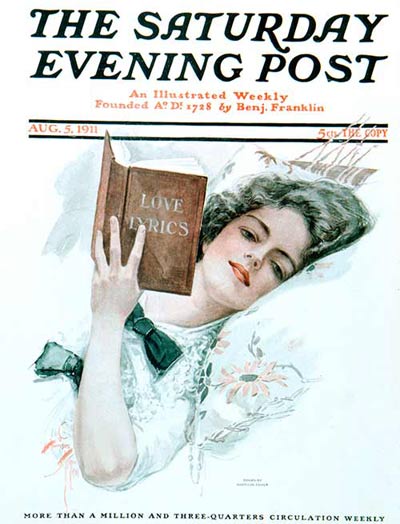
Is there really a difference in the books we read during the summer and the books we read in the winter? There’s this common wisdom, almost a default position, that the books we bring to the beach or vacation or read on our decks should be “lighter” or “less serious” than the books we read other times of the year. I don’t know if that has to be true, though. I mean, I’m not going to drag a giant Webster’s Dictionary to the beach (if you’d even find me on a beach in the first place), but just because it’s summer doesn’t mean we have to put our brains on vacation too.
Some new books you might want to check out:
- One Man Against the World
, Tim Weiner’s look at the life and political career of Richard Nixon.
- David McCullough has a look at The Wright Brothers
.
- Jeff Shaara’s The Fateful Lightning
, the final book in his Civil War trilogy.
- Neal Stephenson speculates on what would happen if we knew when the world was going to end in his new novel, Seveneves
.
- Erik Larson’s Dead Wake
, about the sinking of the Lusitania, is out tomorrow.
- Harper Lee’s Go Set a Watchman
, the prequel to To Kill A Mockingbird, comes out on July 14.
- And Sue Grafton is up to the letter X in her Kinsey Milhone private-eye series, and the new novel, actually titled X
, will be released on August 25.
Oh, and if you do want something you don’t have to think about that much, the newest Fifty Shades of Grey book came out yesterday.
Today is National Martini Day

Sure, you could make the classic James Bond martini, but the original martini was made with gin. You can also try a Dirty Martini, a Chocolate Martini, or an Earl Grey Martini, made with Earl Grey tea.
You could try a variation on the martini, created by Bond himself in the 1953 novel Casino Royale (and in the 2006 movie of the same name). It’s called the Vesper, named after Vesper Lynd, the woman Bond works with in the story.
Like his traditional martini, it’s shaken, not stirred.
Upcoming Anniversaries and Events
Father’s Day (June 21)
It’s this Sunday, so don’t forget! There’s even an official Father’s Day website set up by the U.S. government.
U.S. Constitution ratified (June 21, 1788)
Wikipedia has a detailed timeline on how the Constitution was drafted and ratified, including pictures of the original document.
President Franklin Roosevelt signs the G.I. Bill (June 22, 1944)
SEP Archives Director Jeff Nilsson has a look at the bill FDR signed during World War II, originally called the Serviceman’s Readjustment Act.
George Orwell born (June 25, 1903)
The Guardian has an intriguing look at how Orwell’s classic novel 1984 was written.
Pearl Buck born (June 26, 1892)
You can read Buck’s most famous novel The Good Earth for free at the Internet Archive.
President Truman orders troops to Korea (June 27, 1950)
The New York Times On This Day section has the front page story on Truman’s ordering of U.S. troops to Korea.
Remembering for Grampa
“Mom, how was Grampa today?”
“Well, Jake, he’s not feeling too well.”
“Does he have a cold?”
“No,” answered Jacob’s mother as she pulled the comforter up to his chin. “No, he has a different kind of illness.”
“Like the flu?” Jacob’s eyes were wide as he watched his mother in the low light.
“He has trouble remembering things. Sometimes he forgets where he is. Other times he forgets peoples’ names…”
“Does he forget your name, Mom?”
“Sometimes, yes.” Jacob’s mother got up from the edge of the bed and stooped by the door to switch on the fish nightlight. A dull glow fought to be seen, then won the battle when the ceiling light turned off, sending a long shadow across the bed as Jacob’s mother walked over to his small desk.
“How can he forget a name like Mom?”
“I don’t know how he forgets. Some people just forget when they grow older.”
“Oh.” Jacob watched as his mother tidied up his desktop and put his folders into his backpack. She plucked from one of the pockets a plastic pencil sharpener which she popped open over the trash can, tapping the side to release the day’s shavings.
“Mom?”
“Yes, Jacob?”
“Will you tell me a story about Grampa?”
“Maybe another night.”
“Please.” Jacob shuffled beneath the blankets, acting restless to get his mother’s attention.
“Will you tell me one about when he was your dad?”
“He still is my dad, Jacob.” The blankets were straightened once more.
“I mean when you were a little girl.”
“Hmm.”
“Please, Mom.”
“Well …”
“Maybe if you tell me, I can remember it for Grampa.” Jacob’s mother sat back down on the bed and brushed the hair from his forehead before folding her hands in her lap. Her face bore the sadness of her father; the sweetness of her son.
“Well, I guess I can tell you one quick story. You know the old playhouse at Grandma and Grampa’s house? The one where Goliath lived?”
“Yeah,” Jacob’s face lit up at the name of the Rottweiler.
“Well, when your aunts and I were little girls, I guess I was about 5, Grampa told us he was going to build us our very own log cabin. It was going to have real windows and a door, which locked and a shelf inside for each of us. He had already built us a little table with chairs, and we were all so excited that we could finally have tea in our own little cottage with our own little garden beside. Well, one Sunday Grandma took us to church, and we stopped at my grandma’s house and ate lunch before going home. When we got home, Grampa had all four walls up and the roof nearly done.”
“Grampa didn’t go to church?” Jacob asked.
“No,” his mother replied, “Grampa didn’t go to church back then.”
“Was he Jewish?”
“Why would you think Grampa was Jewish?”
Jacob thought for a minute, then answered with, “David Schneider is Jewish and he doesn’t go to church. He goes to a temple.”
“Oh, I see. No, Grampa wasn’t Jewish like David Schneider.”
“Did he believe in God?”
“Yes. He just didn’t go to church.”
“Oh.”
“Would you like me to finish the story?” his mother asked.
“Yes, please.”
“Okay. Anyway, Grampa had the roof nearly done, and we wanted to go inside and start playing. He told us we had to wait in the house because there could be nails on the ground and he didn’t want us stepping on them. I think he really just wanted to be alone while he worked.” Jacob’s mother looked down at him, snuggled up under the covers.
“So, we went inside as we were told and stood at the back window and watched as he nailed shingles onto the plywood roof. It was so exciting to see that little house coming together. The three of us standing there felt as princesses about to get our very own castle. We watched and waited and soon the door was up, then the windows. When he finished hanging planter boxes in front of the windows, Grampa gathered up his tools and put them back in the garage. Returning, he got down on his hands and knees and picked up any errant nail or splinter he could find. He made his way around the corner of our little log cabin, and we stood there thinking he would jump out and tell us we could come out and play. What happened instead was Grampa came running from behind the cabin doing a strange dance.”
“What happened? Why was he dancing?” Jacob’s eyes, tired as he was, grew wider upon hearing that his grandfather would do anything so wild and untamed.
“Well, Grampa danced around and kicked up dirt and was hootin’ and hollerin’ and swatting his legs. Gramma ran out from the kitchen just before he trampled her vegetable garden. Grandma swatted Grampa’s legs, too, and then Grampa ripped his shirt clean off. We couldn’t see what the problem was from the window, but he was covered in ants. He kicked off his pants and the two of them whirled about as they slapped and swatted and swiped until every last ant was off of him. We had never seen anything like it. We ran to the kitchen door as Grandma and Grampa came in; his legs were covered with red bumps, and he was out of breath. Grandma plopped him down in his seat at the table and fetched him a glass of lemonade.”
“What happened next?” Jacob asked. “Was Grampa okay?”
“Being Grampa, he shrugged off what had to be a lot of pain and discomfort and he went back to the bedroom and threw on some fresh, ant-free clothes before heading down to the barn for something to spray on the ants. Again, playtime was delayed. Grandma didn’t want us getting covered in bug killer.
“A couple hours later, though, when Grandma was doing laundry, Grampa ushered the three of us out to our cabin. We were so excited to see the inside. He had even hung up a couple of pictures for us. Grampa could only stand up without hitting his head on the ceiling in the center of the cabin, but the table he made sat there, so he had to stoop when he was inside. We invited him to tea and he accepted our invitation. We had so much fun as he told us about the ants from his point-of-view. Hearing him tell it, you would have thought it was a comedy act.”
“I wish Grampa could remember that story.”
“Me, too, Jake. He wasn’t having fun when all those ants were biting him, but he told that story every chance he got. It’s not everyday you get ants in your pants.”
Jacob lay there with his head sunk into the pillow as his mother reminisced. She placed her hands on the bed, about to get up, when Jacob spoke.
“Mom?”
“Yes, dear?”
“Was Grampa always nice before he got sick?”
“He was like any dad, I guess. He was as kind and loving as they come. He spoiled us and made gifts for us in his workshop, and he helped us with our homework. He could be stern, too, if he needed to be. He was a good dad.”
“Was he like Dad?” Jacob rolled onto his side.
“In many ways, yes. In other ways, they are completely different.”
“What ways are they different?”
“Well, your Grampa could play instruments.”
“Dad can’t play any.”
“That’s true now, though your dad played the trombone all the way through high school.”
“He did?”
“Yes. I think that was one of the things Grampa liked about your dad when we first started dating. He thought a man should be able to read and play music.”
“What did Grampa play?”
“Oh, there was the harmonica and the banjo and the mandolin and the piano and, my favorite, the fiddle.” Jacob’s mother played an invisible violin while she spoke. “He would play at parties and family gatherings. My favorite time was always at Christmas. Every year he and I would put on a little show and we would play Christmas carols and hymns. I would play the piano as accompaniment to his fiddle. That was one of those things I had with my dad that my sisters didn’t. It’s kind of like how you and your dad go hiking and camping, while your sister and your dad have the sailboat.
“Anyway, between Thanksgiving and Christmas, Grampa and I would practice together whenever we had the chance. We would play for hours some days. Christmas Eve, though, was our big concert. All of the family from all over would come for dinner, and we would play afterward and people would dance and sing along. Even with so many people there, I still had my dad all to myself. Those few weeks every year of practicing together, and that one night performance, are my favorite memories of Grampa.”
Jacob’s mother looked sad and tired as she bent to kiss his forehead. She gave his blankets one last adjustment, and stood up to leave.
“Goodnight, Jake.”
“Mom?”
“It’s time for you to get to sleep.”
“But, Mom,” Jake paused, waiting for his mother to turn around in the doorway. “I think Grampa will be happy that we won’t forget his stories.”
“Me, too, Jake. Me, too.”
WWII: What Happened to France
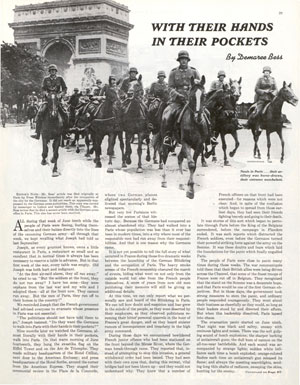
The news from Europe stunned America: On June 22, 1940, France surrendered to Germany.
Just six weeks earlier, Nazi Germany had sent its army into Holland and Belgium. In response, the French army moved north to meet the German advance, and British troops joined the fight. But by June 15, the Germans were marching into Paris. Six days later, the French government signed an armistice with the Nazis.
Americans wondered how this could be. They recalled how during the Great War 25 years earlier, France and Great Britain had stopped an invading German army. The two Allied forces pinned the Germans on a battle line 450 miles long for four years. And despite losing over a million soldiers, France ultimately defeated Germany.
But now, in this new war, Germany’s army pushed Britain’s army all the way back to the English Channel. The British only escaped capture when a hastily assembled fleet of 800 boats withdrew them to England.
Now alone, France struggled on, hoping to avoid the fate of Poland, Norway, Denmark, Luxembourg, Holland, and Belgium. But on June 22, France, too, surrendered to Germany.
In the U.S., the Nazi’s swift victory caused many to reconsider their neutrality. Dismissing the Nazi threat was easy when they presumed France and Great Britain would stop Hitler. But now, with France occupied, one less nation stood between the U.S. and Germany. Great Britain remained defiant and free, but many Americans thought the country had little chance of surviving.
So what had happened to the French?
Post contributor Demaree Bess was in Paris, looking for an explanation. He didn’t find many answers. He didn’t find many Parisians, either. The government fled the capital, along with much of the city’s population. In “With Their Hands in Their Pocket,” Bess describes his days in an eerily empty city awaiting the German conquerors.
Today, you can find several explanations for the French defeat. The most obvious, of course, is the German army, which spent 20 years preparing for the second great war.
When World War I ended, Germany was left with little food, rampant inflation, a government in chaos, and crippling penalties imposed by the Treaty of Versailles. In their grief and anger, many Germans found it easy to believe the myth that Germany had been betrayed by treacherous Germans. As Germans loudly demanded the right to re-arm their nation, the German military began secretly training the next generation of warriors. Given time, training, and weapons, Germany could return to France and defeat it.
Meanwhile, across the border in France, there was no interest in more war. The French found little pleasure in their victory, which they’d purchased at the cost of 1.3 million dead. The nation went back to work, but this proved difficult with so many men missing.
The French government in these years poorly served their citizens. Bitterly divided by political factions, France proved unable to develop an effective policy for national defense. However, it built a massive military structure in anticipation of the next war. It has become the symbol of narrow-minded planning.
It was the Maginot Line; a system of forts, bunkers, and observation posts along the border it shared with Germany. When completed, these hundreds of buildings were considered the most advanced fortifications ever built. France believed the line was impregnable; the country no longer needed to fear German invasion.
Unfortunately, the line left two entry points wide open. At its northern end, its defenses ended where the French border entered the Ardennes Forest. French authorities believed no defense was needed in this area because rivers, broken ground, dense woods, and winding roads made the Ardennes impassible to a modern, mechanized army.
Beyond the Ardenne lay the border with Belgium. The French didn’t extend the Maginot Line into this area because they had a mutual-defense treaty with the Belgians. If Germany invaded Belgium, the French army would cross the border to fight alongside their allies. But as war approached, Belgium declared its neutrality. Hastily, the French and British began extending the Maginot Line to the coast.
On May 10 as French and British troops rushed into Belgium to engage the Germans, another German army group, with a million men and 1,500 tanks, rolled through the impassable Ardennes Forest to strike at the rear of the Allies. The end came soon afterward.
Today some Americans firmly believe France was defeated because it simply did not defend itself. The French army, for the most part, simply surrendered when they saw the Germans. The accusation is conveniently revived whenever Franco-American relations turn hostile.
The problem with the French-didn’t-fight theory is that it doesn’t explain the 290,000 French soldiers who were killed or wounded in only six weeks of fighting.
What a Man’s Gotta Do
Fatherhood
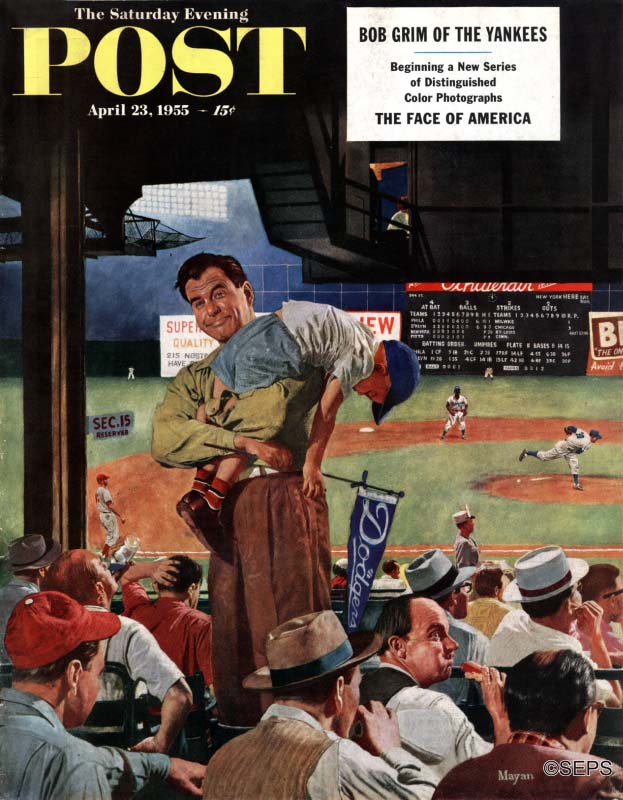
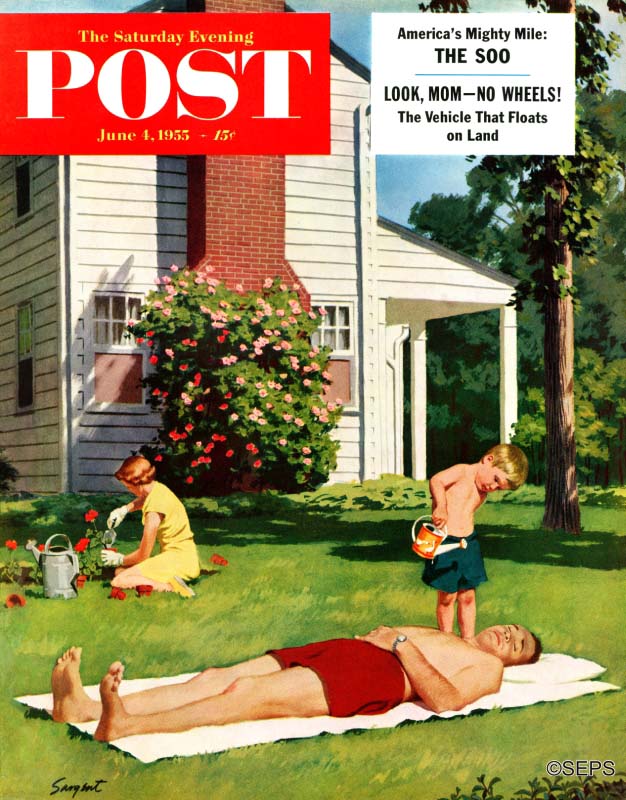
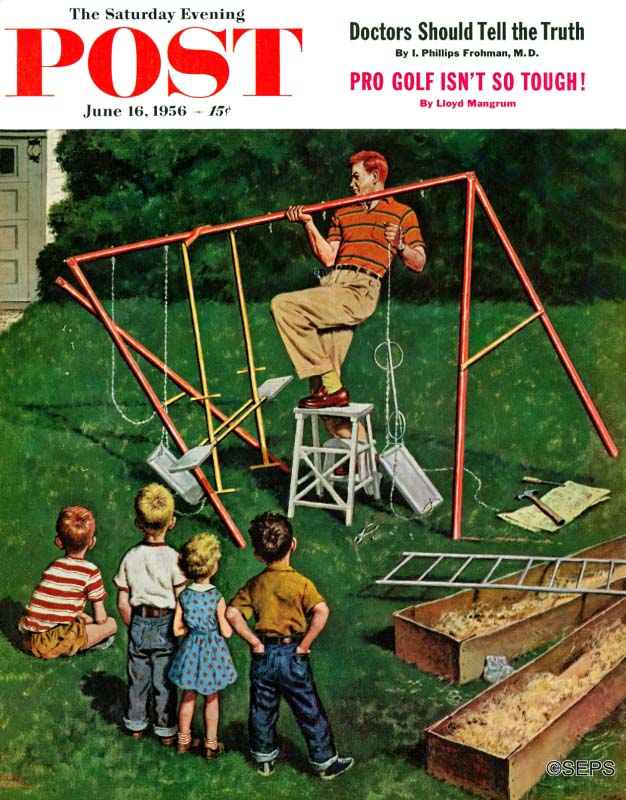
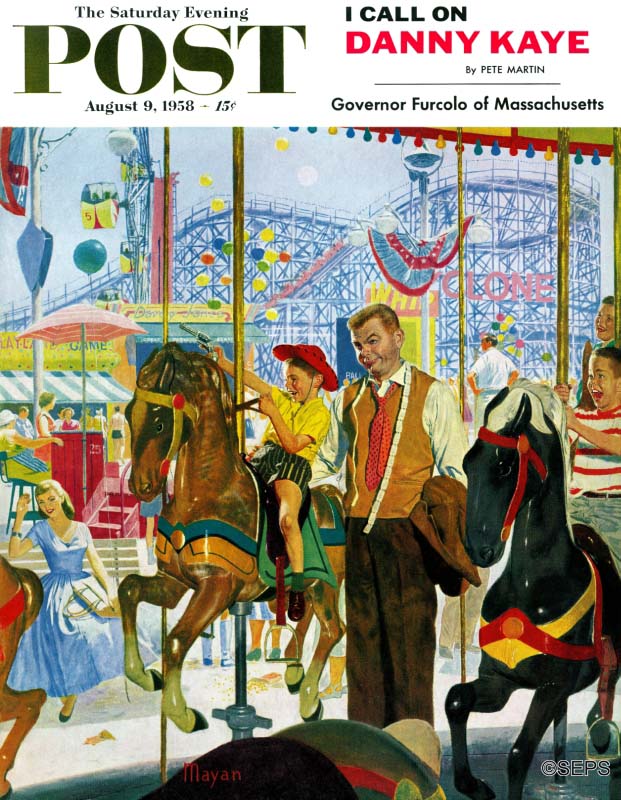
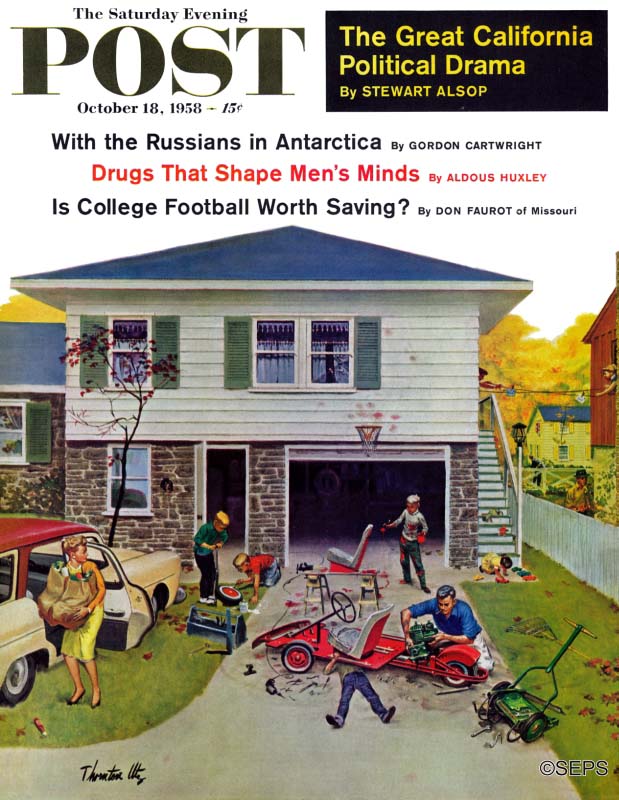
Dad’s role, as depicted in midcentury America, was to be the breadwinner, play the occasional game of catch, and generally set a good example for his boys. And, oh yes, no one else can give the son “the talk,” unpleasant though it clearly is for both of them.
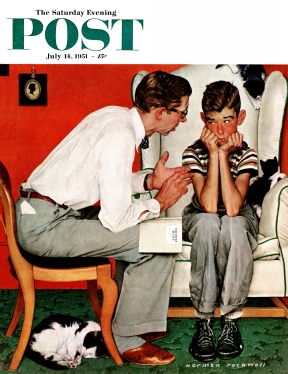
Norman Rockwell
July 14, 1951
Get this framed at Art.com
Nightwatch
It wasn’t common to see fathers caring for babies in public; but in the privacy of the home, dads had to step up, if not always happily. In 2:00 Feeding (below), our subject appears tiny and trapped, the design emphasizing his isolation from the world outside.
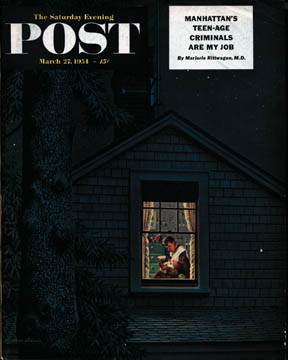
Stevan Dohanos
March 27, 1954
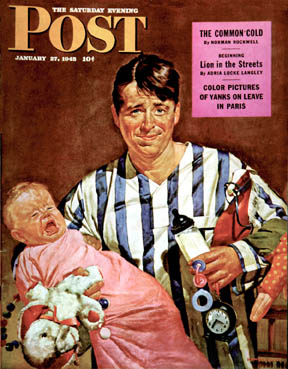
Howard Scott
January 27, 1945
Unhappy Campers
Precise composition supports the narrative in these two amusing paintings of dads oppressed by duty. In Dad, the Fish are Biting (below), notice how contrasting wishes are suggested with shadow, one side dark, the other light.
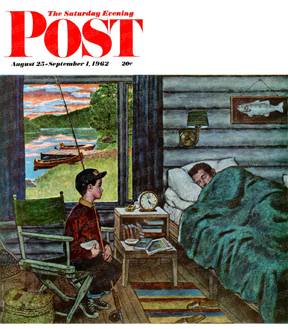
Amos Sewell
August 25, 1962
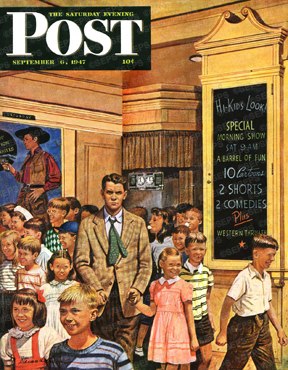
Stevan Dohanos
September 6, 1947
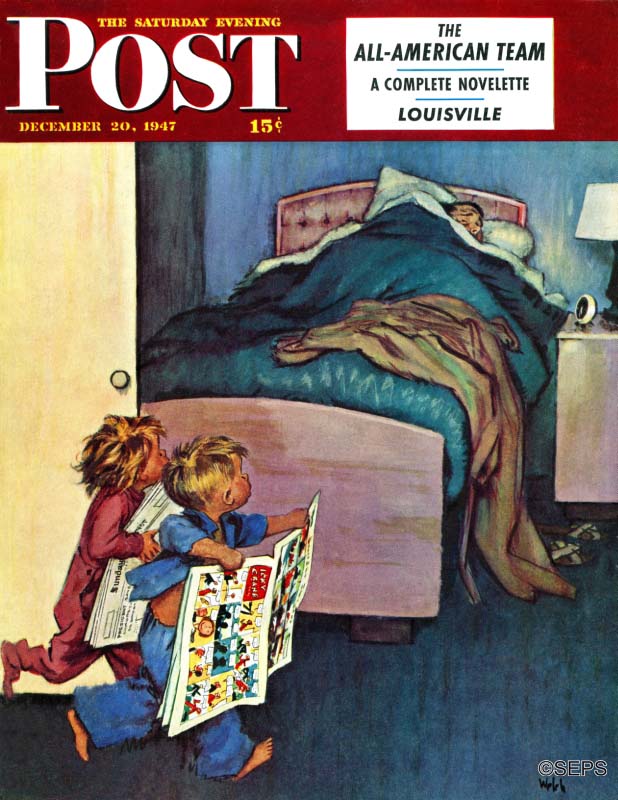
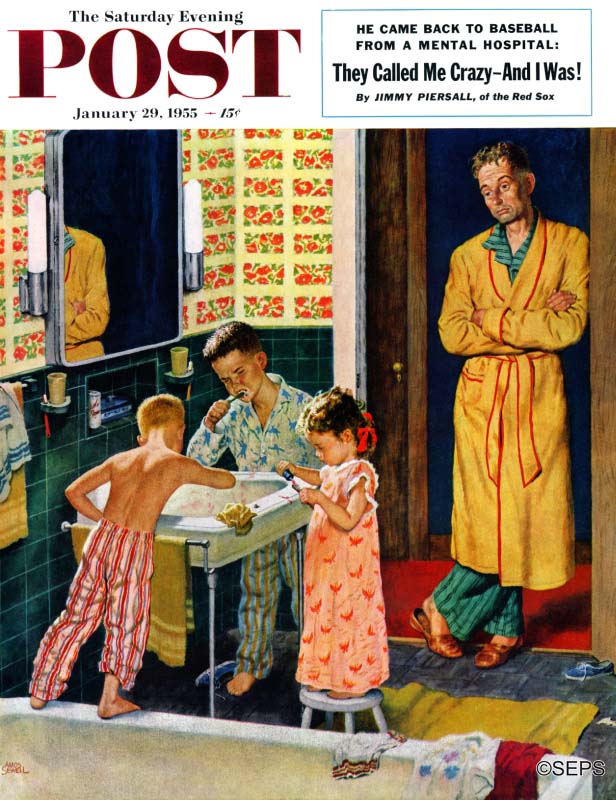
More fathers on the covers of The Saturday Evening Post (click on the covers to see larger image):


The Daddy Factor
From World War II through the 1960s, the few psychologists and other “experts” who thought about fathers believed that their main contribution was to be role models for gender appropriate behavior by their sons. They were supposed to teach their sons what it meant to be a man, as they usually put it. A few researchers thought it might be nice to measure that effect to see whether there was truly a correlation between masculinity in fathers and masculinity in their sons. (Masculinity refers to what we traditionally think of as male characteristics: toughness, power, status, sturdiness in a crisis, a willingness to take risks, and to ignore what others think.) The link should have been easy to find, but it wasn’t. There was no consistent connection between a father’s masculinity and his son’s. This posed a challenge to the conventional wisdom. If fathers weren’t helping to make boys into men, then what role did they have?
The problem was that nobody had asked why boys might want to be like their fathers. Presumably they would want to emulate their fathers only if they liked and respected them and had warm relationships with them. When researchers decided to look for that, in the 1960s, they discovered that the relationship between father and son was crucially important. When a father had a warm relationship with his son, that son would grow up to be more like his father than sons who were not close to their fathers. A father’s own masculinity was irrelevant; his warmth and closeness with his son was the key factor.
This was one of the first indications that fathers have a particularly strong influence on children’s social development. Interactions between fathers and their sons and daughters that are playful, affectionate, and engaging predict later popularity in school and among peers, perhaps by teaching children to read emotional expressions on their fathers’ faces, and later on those of their peer group. Harsh discipline by fathers, on the other hand, has been linked to later behavior problems in their kids.
These early discoveries prompted careful examination of fathers and their influence on their toddlers and school- age children. And one of the areas in which researchers looked for the influence of fathers was in the development of language. I’ve always thought that watching children learn to talk is one of the highlights of parenting. It’s a hallmark of their lives during their first few years. They learn to make their wishes known — often emphatically known. What begins in infancy with gestures and sounds develops into competence with language by around age 3. Fathers are proving to be an important part of this process, as Lynne Vernon-Feagans of the University of North Carolina and her colleague Nadya Pancsofar at the College of New Jersey are finding out.
They have done some of the most interesting work looking at children’s language development in both middle-class and poor, rural families. They’ve found, to their surprise, that not only are fathers important for children’s language development, but that fathers matter more than mothers. For example, when fathers used more words with their children during play, children had more advanced language skills a year later. In particular, they found that fathers’ use of vocabulary when reading picture books to their children at 6 months of age were significantly related to the children’s expressiveness at 15 months and use of advanced language at age 3. This held true no matter what the mother’s educational level was or how she spoke to the children.
When I spoke with Vernon-Feagans about her findings, she said she was surprised by the difference between mothers and fathers. She had thought they would be equally involved in encouraging their children’s language development. Why would fathers be more important in this regard than mothers? The hypothesis is that it’s because mothers are more attuned to their children, typically spending more time with them than fathers do. That makes mothers more likely to choose words the kids are familiar with. Fathers aren’t as attuned to their kids, so they use a broader vocabulary, and their children learn new words and concepts as a result.
Vernon-Feagans thought there might be another factor at play as well. Because fathers usually spend less time with their children, they are more of a novelty. That makes them more interesting playmates. “I do think our children see it as very special when they do book reading with their fathers,” she said. “They may listen more and acquire language in a special way.” The effect of fathers on children’s language continues until they enter school.
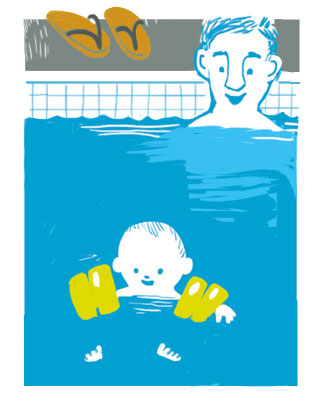
Illustration by Hadley Hooper
But fathers contribute to their children’s mental development more broadly than just with respect to language. They also influence their children’s intellectual growth, adjustment to school, and behavior, as Catherine Tamis LeMonda of New York University and her colleagues discovered. They were interested in the influence of fathers on language in families involved in Head Start, a pre-school program for low-income children. The researchers watched fathers’ interactions with their children — and, separately, mothers’ interactions with their children — during a period of free play when the children were 2 years old, and again when they were 3. They found that these were mostly good parents. They challenged the assumption by some researchers “that low-income parents primarily engage in authoritarian exchanges with their young children and that fathers are harsh disciplinarians.” And the sensitivity of the parents, their positive regard for their children, and the intellectual stimulation they offered predicted that the children would do well on tests of development and vocabulary later on.
Supportive parenting on the part of fathers was linked to a boost in children’s intellectual development and their language abilities. Fathers’ good behavior also improved the behavior of mothers with their children — an interesting indirect effect of good fathering. But the importance of father’s income varies from one study to the next. Daniel Nettle of Newcastle University found that wealthier fathers produced a greater rise in their children’s IQs than did similarly active low-income fathers. Nettle doesn’t say why this income disparity exists. It might sound discouraging, but it suggests that improving men’s educational or financial status would confer benefits not only on them but on their children as well.
But that’s not to say that fathers in poorer families have no influence; they do. In 2011, Erin Pougnet, Alex E. Schwartzman, and their colleagues at Concordia University in Montreal set out to assess fathers’ influence over children’s intellectual development and behavioral problems by looking at low- to middle-income families in which the fathers lived apart from their children, which is the case in about 22 percent of Quebec families. These families have reduced incomes, and the children are less likely to graduate from high school. The researchers looked at the data on the children when they were 3 to 5 years old, and again when they were 9 to 13 years old. They found that the presence of fathers in the home was associated with fewer of what are called “internalizing” problems — depression, fear, and self-doubt — in their daughters … but not in their sons. It was unclear why that was the case. And the children of fathers who exhibited more positive kinds of control, such as reasoning, scored higher on a measure of nonverbal intelligence called performance IQ. How fathers exert these effects is still being teased out. But clearly one way they do it is, again, through play. Mothers, who generally spend more time with their children, are seen by their kids as crucial sources of well-being and security. Children are more likely to think of their fathers as playmates. So it’s not too surprising that infants respond more positively to being picked up by their fathers, because they suspect that means it’s playtime.

“Fathers often use objects in an incongruous way,” writes Daniel Paquette of the University of Montreal. During rough-and-tumble play like this, fathers tend to use playful teasing to “destabilize children both emotionally and cognitively,” which children like — despite the seemingly ominous implications of the word “destabilizing.” It might not sound like a good idea, but this destabilization could have a critical function. It could be helping our children confront one of their principal challenges: the need to learn how to deal with unexpected events. “Children’s need to be stimulated, pushed, and encouraged to take risks is as great as their need for stability and security,” says Paquette.
Fathers’ unpredictability helps children learn to be brave in difficult situations or when meeting new people. In one study of 1-year-olds taken to swimming class, researchers observed that fathers were more likely to stand behind their children, so that the children faced the water, while mothers tended to stand in front of the children, the better to make eye contact. From this and other studies, he concluded that fathers may be especially important in supporting their children as they move from the family to the world outside the door. And one of the first and most important unfamiliar environments that children encounter is school. Children who make the transition from home to school more easily, who are free of behavior problems and relate well to their peers and teachers, are more likely to do well in kindergarten and elementary school.
One of the most convincing summaries of fathers’ contribution to children’s development comes from Sweden. Researchers at Uppsala University wanted to know if there was evidence to support arguments for more parental leave for fathers and for other measures that would increase the involvement of fathers in child-rearing. They collected 24 of what they thought were the best studies of father involvement and children’s outcomes. The studies were longitudinal, meaning they followed fathers and their families over at least a year. Such studies are generally more persuasive than those that simply ask families about current or past practices in the home. And when the data from a number of studies is combined and analyzed together in what’s called a meta-analysis, it can sometimes produce clearer results than can any single study alone.
The researchers found a wide variety of beneficial social and psychological effects stemming from fathers’ direct engagement with their children. Children whose fathers played with them, read to them, took them on outings, and helped care for them had fewer behavioral problems in the early school years, and less likelihood of delinquency or criminal behavior as adolescents.
Much of the evidence linking fathers to their children’s social competence comes back to the way they play with their children. You might notice a recurring theme here. Play changes as children grow older; tickling and chasing toddlers is gradually replaced by teaching kids to ride a bicycle, playing catch, riding roller coasters, and other more sophisticated kinds of play. (In my case, when my kids were teenagers and ready for Batman: The Ride at Six Flags, I was too terrified to join them. I still feel bad about that.) Play changes, but it remains a central part of the interactions between children and their fathers throughout childhood.
Ross D. Parke, of the University of California, Riverside, whose research has focused largely on the social development of children, thinks the way a father plays is the key to healthy development in kids. He says that when fathers exert too much control over the play, instead of responding to their children’s cues, their sons can have more difficulty with their peers. Daughters who were the most popular likewise enjoyed playing with their fathers and had the most “nondirective” fathers. The children of these fathers also tended to have easier transitions into elementary school.
Children whose fathers took turns being the one to suggest activities and showed an interest in the child’s suggestions grew up to be less aggressive, more competent, and better liked. These were fathers who played actively with their children, but were not authoritarian; father and child engaged in give-and-take.
The importance of play might be connected to the demands it places on both fathers and children to recognize one another’s emotional signals during fast-paced, intense activity — which is what children also need to do with their peers. Fathers should spend as much time as they can with their toddlers and school-age children. And they shouldn’t feel compelled to prop flash cards in front of them or read sixth-grade books to third-graders.
They should spend more time playing.
Excerpted from Do Fathers Matter? What Science Is Telling Us About the Parent We’ve Overlooked, published in June by Scientific American, an imprint of Farrar, Straus, and Giroux LLC. © 2014 by Paul Raeburn. All rights reserved.
What Kind of Father Was Norman Rockwell?
What to do with Father’s Day?! Why is Mother’s Day easier? Chocolates, flowers, brunch, and a card and Mom is usually satisfied. Fathers can be more difficult, they don’t mean to be — their gifts sometimes require more thought; more of a search is involved when thinking of a way to show our love and appreciation for Dad. Why? Often, depending on the generation we grew up in, our relationships with our fathers may not be quite as demonstrative and immediate as they are with our mothers, yet they are as deep, layered, and important. No matter how progressive we get, we will still look to our fathers to help teach us how to move and operate in the world — we look to them for those specified tools in learning how to fully function and flourish in this dizzying and increasingly complex world.
In this past year and a half of investigating my grandfather’s life and work, one important aspect I needed to explore and discover was what kind of father Norman Rockwell really was. The Rockwell biographers have invariably painted him as a negligent dad, totally self-absorbed. Yet in my grandfather’s paintings, a very different kind of father emerges — a father who is present in his children’s lives.
Norman Rockwell began painting in the earlier part of the 20th century when the roles between men and women were more clearly and restrictively defined. Yet what kind of father do we see in some of his most beloved paintings? My two favorite fathers NR painted are the man sitting on the running board of an old truck with his college-bound son in Breaking Home Ties (1954) and the father holding a newspaper, standing over his sleeping children with his wife in Freedom from Fear (1943).
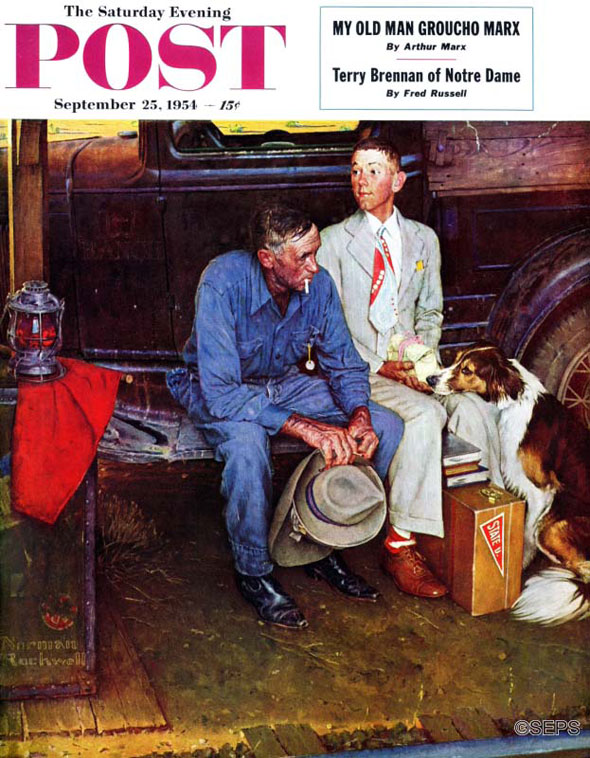
The idea for Breaking Home Ties apparently came from Pop’s sadness about his two younger sons leaving home for college and his oldest entering the Air Force. The loss felt by father and dog is palpable and contrasts with the quiet expectancy of the young man waiting for his ride and the future ahead of him. NR started the story idea with the mother, father and son but then changed it, leaving the mother out of the final painting — more deeply and clearly portraying the unspoken bond between father and son. Nothing needs to be said — it is all in the collapsed body language of the father, the erect carriage of the son, and the loving, forlorn face of the the dog pressed into his leg, hoping against hope to make the young man stay. The dark earthy tones with the pops of red convey the mood instantly. The red flag under the lantern reminds us of the excitement of the coming train. That red is picked up in the son’s socks and tie and in the college sticker on his bag. The careworn, weathered face of the farmer father, a cigarette dangling from his lips, denoting a certain toughness or reserve that covers a gentler, more emotional side. What says it all? The father clinging to both of their hats — his broad-rimmed, more utilitarian hat and his son’s newer, more contemporary fedora. The father’s worn boots; the son’s new, carefully polished shoes. The farmer, the passing generation; the son, the aspiring next generation.
Breaking Home Ties was completed during the darkest period in the family history. A few years before my grandmother, Mary, had a breakdown, which shattered the whole family. The father’s collapsed torso in the painting is a true indication of how my grandfather must have been feeling at this time. With all of his boys leaving home, perhaps NR also felt abandoned, at a loss.
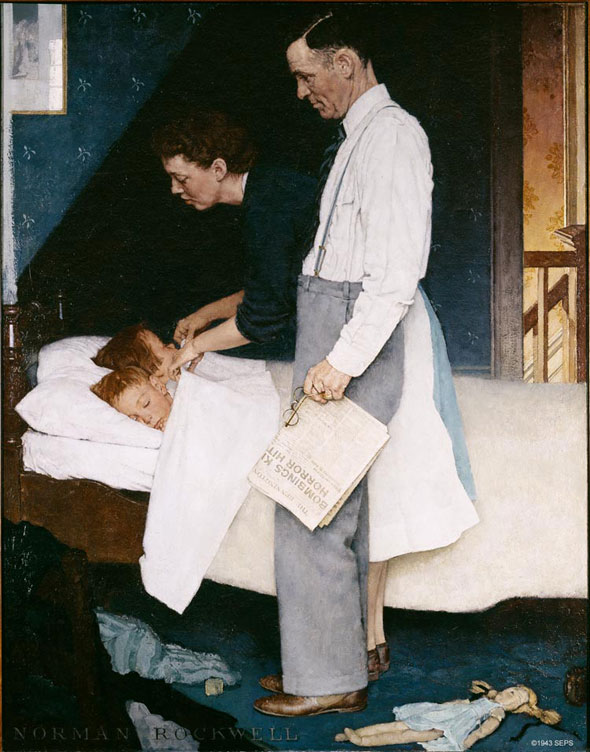
I adore the father in Freedom from Fear. He has a quiet strength about him, which his straight posture conveys, yet there is an unmistakable kindness in his face as he looks on as his wife carefully pulls the blanket and sheet up to cover and protect their children. This father is a thinker, a reader, his attire hints at an office job. The paper displays the horror that is occurring in the world in contrast to the safety and comfort of their home. The extraordinary care that NR put into creating the tangible softness and warmth of the blanket. The light coming from downstairs further instills a feeling that all is well. This father is a reassuring presence — he has answers, or if he doesn’t, he will consider and reflect and come to a discerning judgment and understanding. This is a father you can count on.
My grandfather was not close with his own father — his father was wrapped up in his dependent relationship with NR’s mother, a very needy woman who was a hypochondriac. She was the one in the family who required and received most of the attention.
I discovered that Pop, on the other hand, was surprisingly considerate, thoughtful, and generous with all three of his sons. He was around more than most fathers; he was nearby in his studio and enjoyed having the boys watch him paint (although that could get very boring for them!) and often used them as models. NR built a smaller version of his studio in Vermont for his oldest son, Jarvis — supporting Jarvis’ artistic talents and financially supporting him. In his notes to family members, my grandfather shows remarkable consideration — in one letter Pop expresses his intention that his youngest son Peter’s fiancé be welcomed into the family just as my mother, Gail, had been when she married my father, Tom. NR wrote charming birthday poems to my father that I found among our papers. He also helped my father out at the beginning of his writing career by having him assist with the NR Autobiography. At a time when most fathers were solely work driven and expected the woman to take care of the household and children, my grandfather was involved in the lives of his sons in participatory ways. He helped my uncle, Peter, with his artistic endeavors, even pushing a joint project that he wasn’t very enthused about, despite his great reservations about Peter’s aspirations as a sculptor because of the potential difficulty in making a living. True, the family rarely went on vacation. But NR was simply not the neglectful father he’s been made out to be. Yes, my grandfather was a driven, incredibly focused artist and the household did revolve around his work, but unlike some other artists, he did not shirk his duty as a father. In fact, he was known to say, “Once you have children, you’re never free from worry.”
Our fathers do the best they can. Let’s celebrate Dad by making his favorite food — black bean soup and fresh cornbread? — or going for a hike together (check for ticks please!). It’s the simple moments spent together that really count and remain with us.
Warmest wishes to all fathers … especially my own Dad.
AR
News of the Week: Needless Words, Noir, and Knitting in Public
Stop Using These Words!
This Mashable article is kinda lame. Oh, I’m sorry, that’s one of the words I’m not supposed to use anymore, according to the article (“lame,” not “kinda”).
Now, I’m sure we can agree that there are some words on that list we’d best be advised not to use (though I’ve never used “derp” so I don’t mind continuing to not use it). At the same time, I hope we can also agree we don’t need some sort of incredibly PC word police to tell us what words we need to stop using. People are taking to Twitter to shame people into not using these words anymore, which is the place modern society does its shaming now, I guess. I’m also a bit confused how not using these words make you a better “ally.” What exactly are “ally skills”?
Incidentally, Word Police is a new show coming up this fall on CBS. It’s like CSI, only with dictionaries.
The Summer of Darkness
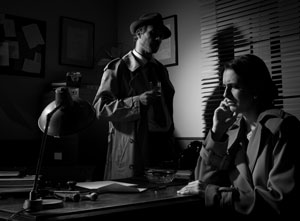
That sounds like a great title for a crime novel or film, which is appropriate because that’s the name of the noir film festival you’ll see on Turner Classic Movies every Friday this summer (it actually started last week). Hosted by noir czar Eddie Muller, the slate of films you’ll see all day every Friday until the end of July will not only include such well-known classics as Out of the Past, Detour, Laura, and The Maltese Falcon, but also several that you don’t see that much, plus a couple that will be making their debuts on the network: 1950’s Woman on the Run and 1949’s Too Late for Tears. Both have been fully restored by Muller and the Film Noir Foundation.
TCM has created a fantastic site for the event. Not only can you get the complete schedule, you can learn all about noir and even visit the special gift shop they’ve set up, where you can get all your noir needs, from fedoras, lighters, and cocktail glasses to a like-new 1941 Lincoln Continental. It costs $50,000, but it might be fun to click the “Add to Cart” button even if you don’t plan on buying it.
The Summer of Darkness is going on right now, even as you read this. So hurry up, rush, rush to your TV sets! Or however you kids watch TV these days.
Matt Damon Is a Martian
Oh, maybe I should have said SPOILER ALERT, but I don’t think it’s a secret. Actually, the title of Damon’s new movie, The Martian, is a little misleading, as you can see from the trailer for the Ridley Scott movie.
This could be an intense, dour plot, but it looks like there’s a lot of humor thrown in too (it’s based on the novel by Andy Weir). I bet this will be a hit, if moviegoers aren’t gun shy about trusting yet another big-budget space movie.
Eating Spaghetti? You’re Doing It Wrong
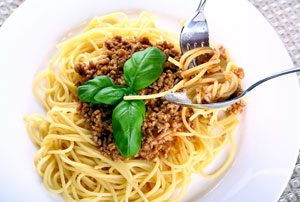
Don’t you just hate Internet headlines like that? Headlines that not only insult you but actually want you click on them after they insult you, and then you find out you’re not even doing the said thing “wrong.” How did we ever get by in life before Web articles told us the “right” way to do things?
The thing we’re all doing wrong this week is … eating spaghetti, apparently. This comes from Miss Manners, someone I like because I find her wise, clever, and extremely funny too. But Miss Manners, you’re way off base here! She says that it’s “crude” to eat spaghetti with a fork and spoon. Real Italians simply twirl the spaghetti on their fork using the plate.
Now, as you’ll probably guess by my last name, I’m a real Italian, and my family has always used a fork and spoon. I’ve never heard of the fork and spoon method as being wrong or socially unacceptable. Not only do you get a more perfect twirl, you can hold the spaghetti on the fork using the spoon for a second before you put it into your mouth. It’s not that twirling it on the plate is “wrong” either. To each his own (and there’s certainly nothing “crude” about using a spoon!).
Next week: Straws. YOU’RE USING THEM WRONG
World Wide Knit in Public Day
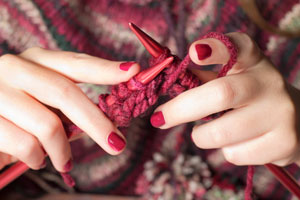
I’ve always been fascinated by people who knit (I live an exciting life). You watch them, and it seems like they’re geniuses. They take yarn and move their hands really fast with a couple of sticks and BAM, a sweater is formed. It looks like something I could never learn to do in a million years, a combination of physics and magic and artistry that also happens to look really relaxing. My mother used to crochet, and for years I thought crocheting and knitting were the same thing. They’re not.
Tomorrow is World Wide Knit in Public Day. So if you’re really good at knitting (or want to be), get out your gear and head to the subway, a park bench or the beach and show everyone how proud you are of your knitting. You have to do it in public though. Remember that.
You can go back to doing it in private on Sunday.
Upcoming Anniversaries and Events
Stars and Stripes adopted (June 14, 1777)
Here’s how we got the stars and stripes and colors on the American flag.
First U.S. roller coaster opens (June 16, 1884)
It was called the Switchback Railway and it opened at Coney Island in Brooklyn, New York. It went six miles an hour and cost a nickel to ride.
War of 1812 begins (June 18, 1812)
SEP Archives Director Jeff Nilsson on the memorable line in American history, “Don’t give up the ship!”
Paul McCartney born (June 18, 1942)
The SEP has covered the Beatles extensively over the years, ever since their invasion of the U.S. in 1964.
Julius and Ethel Rosenberg executed (June 19, 1953)
Wikipedia has a detailed history of the crimes the Rosenbergs committed that led to their execution.
Gregory
Five years ago, we found Gregory, a russet-toned guinea pig with unusually large eyes, at one of those “big box” pet stores that seem to be everywhere, high-ceilinged, cavernous emporiums with aisle after aisle of merchandise. He was furtively rooting in the bedding at the bottom of a tall, rectangular cage that seemed intended for birds, rather than ground-dwelling rodents. When I knelt for a closer look he backed into a purple plastic igloo and bugged his eyes at me. One of his ears hung limp. It was notched down the center as though it had been split and then healed. He had scratch marks on his muzzle, hatches of white skin showing through the brown fur. I stood and backed away from the cage.
I caught my husband Bob’s eye and frowned. He grimaced back in unspoken agreement. We did not intend to bring this battle-scarred guinea pig home with us.
“How about some lunch?” I said, with forced cheeriness.
“Yeah, yeah,” he said. “I could eat. Burrito World?”
We both looked to Rachel, our daughter, 11 at the time. Burrito World was her favorite. But she didn’t seem to have heard. She’d slumped to the linoleum, feet splayed out beside her, fingers laced through the cage’s metal bars.
“Can I hold him?” she said.
“Really?” I said. “Maybe they have others.”
“Mom.”
“What?”
“He can’t help it,” she said. “It’s not his fault if he got in a fight.”
There was a hitch in her voice, and her eyes were bright with hope.
The clerk, a gangly young man with a weak chin, claimed not to know much about the brown guinea pig’s personal history.
“I’m thinking he was sent over from another store,” he said, which sounded vaguely ominous.
“What if he’s a biter?” I said.
“Mom.”
“I can’t return your money,” the clerk said. “But we’ll take him off your hands. Just bring him back if you don’t want him. No problem.”
Rachel sat in the backseat on the way home, a cardboard box with a handle and two rows of air holes on her lap.
“What’s your name, little one?” she said, peering in at her new pet.
We both glanced at our youngest child in the rearview mirror. She was the last of five, the only one still at home and our one child together.
**
Cavies, the more proper name for guinea pigs, belong to the genus Cavia. They are naturally social creatures. Which was why we were in search of another. Harold, our daughter’s other cavy, had recently lost his two cage mates, first Jelly Bean and then Skittles, with little warning, at least none that we’d noticed. Harold, the lone survivor, had impractical long, curly hair. No bigger than a packet of tissues when we got him, he was a birthday gift from my mother a year prior.
On a spring Saturday, not long after we brought Gregory home from the pet store, Rachel was in the family room, setting up an obstacle course for the pigs’ daily exercise regimen on the area rug that ran the length of the couch. She lifted segments of plastic pipe from their habitat and placed them in a zigzagged pattern from one end of the rug to the other. Gregory and Harold chattered and squeaked when she removed their plastic igloos to place at either end of the course. Gregory’s squeak was a high-pitched blast that sent Harold racing around his half of the cage, searching for cover. He shoved his nose beneath a rumpled towel and wriggled under until he was a lump of pink terry cloth.
A quarter of the family room, cordoned off with a low wire fence, was given up to the pig habitat. We’d lined the floor with plastic sheeting and towels, and liberally sprinkled the area with fresh hay. The room smelled like a barn. Rachel’s three cavies used to roam the structure freely, but since Gregory, the cage had been split down the middle. He hadn’t hurt Harold, but the clucking and teeth chattering and the way he sidled around the smaller pig, nipping and flicking his nose in the air, were worrisome.
Rachel snapped carrots into chunks and set them between the segments of pipe to lure the pigs from one end of the course to the other. She retrieved a spiral notebook from the hearth and turned to a fresh page, smoothed it with her hand, then drew two grids, one for Harold and one for Gregory.
“Your turn first,” she said, lifting Harold from his side of the cage. He inched his nose forward and stretched out to full length before venturing into the first segment of black pipe and capturing the carrot at the other end.
“Good job,” Rachel said, as he chewed industriously. She placed a check mark in the first box beside Harold’s name, glanced up at the clock over the television and made a note of the time.
SpongeBob yammered in the background as I loaded the dishwasher. Out the kitchen window, Bob stood atop a ladder, trimming the tall bushes that shielded our yard from the neighbor’s. I waved. He grinned and pumped the pruning shears in the air.
“Hey, sweetie,” I said. “It’s a beautiful day. How about you call Susie? You girls could ride bikes to the park or something. I could pack you a picnic.”
She didn’t look up from her notebook.
“Rachel.”
“I’m busy Mom.”
“Susie had you over. It’s our turn.”
“Right.”
I’d had to work late the prior week and asked Susie’s mother if she could keep our daughter after basketball practice. Bob could have picked her up, but it was a chance for the girls to spend more time together. Rachel hadn’t had a good friend, a “real” friend, since fourth grade.
She started Gregory on the course. Harold sniffed the carpet, snuffling up tiny bits of ground carrot that had fallen from his mouth. The two pigs seemed to pay no attention to one another.
“You have to make an effort if you want to make friends,” I said.
Rachel dropped the notebook onto her lap and crossed her arms over her chest.
“Maybe I don’t want to. Not everyone is like you.”
Harold scrabbled across the wood laminate flooring and darted under the couch. Gregory sniffed the air and took off after him, his body an elongated brown streak. Harold screeched and dug frantically at the floor as Gregory cornered him. Rachel flung herself down on her belly and thrust her arm under the couch. With a startled cry she pulled her arm back out and stared at a bloodied fingertip.
I grabbed the broom from the kitchen cupboard and swished it beneath the couch. When Harold darted out, I scooped him up and set him back in the cage. Rachel captured Gregory and held him close, his nose just beneath her chin.
“It’s okay, little one. I know you didn’t mean it.”
She smoothed Gregory’s fur until his frantic chattering became a guttural, trilling sound. When she returned him to the cage Gregory crossed to the fence that separated him from Harold. The two pigs sidled close to one another so that the lengths of their bodies touched through the wire mesh. Harold fluffed out his hair and cooed. Gregory responded with his throaty trill.
“See, they love each other,” she said, more to herself than to me. “Gregory just never learned how.”
I fetched a Band-Aid and some Neosporin from the hall cupboard. Beside her on the couch, I swabbed and wrapped her fingertip tight.
**
The summer before Rachel started high school, she found Harold on his side. His feet formed two Xs on the cage floor, as though he’d been trotting in his sleep. After a burial ceremony in the backyard she retreated to her room and closed the door. When I tiptoed upstairs to let her know dinner was ready, she stirred from a fetal ball to pull the covers up over her head.
Downstairs, Bob and I kept the TV off and listened for her step on the stairs. The big house, which had been filled to capacity with four teenagers and a newborn when we first moved in together, echoed with her absence.
“No more,” I said. “Gregory is the last one. Ever.”
Bob looked up from his magazine and smiled, a meager effort that only reached the corners of his lips.
**
Gregory began to lose weight, seemingly going the way of Skittles, Jelly Bean, and Harold, who’d all reached a point where they lost interest in food. Like the others, we took him to the veterinary clinic near our house.
“Guinea pigs are like cows. They eat continuously,” the vet said. “Once the stomach loses its ‘prime’ there isn’t much you can do. Try to tempt him with his favorite foods.”
A matter-of-fact woman of late middle age, she gave us a concentrated high-nutrition green food. Per her instructions, we mixed the pungent powder with water to form a mash and attempted to feed him with a baby spoon. When that proved fruitless, we experimented with a liquid medicine dropper. Aside from not eating, Gregory was alert and active. I asked the vet if there wasn’t something else that could be done for him. She suggested we find a practice that specialized in “exotics,” a category that encompassed the smaller mammals, birds and lizards.
The Greenbrier Animal Hospital, where we brought Gregory next, boasted several vets with rodent experience. An earnest young vet with thick glasses in black frames palpated Gregory’s skin, stretching it between her fingers, and said he was badly dehydrated.
Gregory was admitted, hooked up to intravenous fluids and fed the concentrated green mash every four hours. The expenses mounted. But we’d determined to do whatever we could for him. Rachel was scheduled to fly to Washington, D.C., for a school trip in a week. If Gregory didn’t turn a corner, she’d be in no shape to go.
After Gregory spent four days in the hospital, the bespectacled vet was cautiously hopeful. Gregory was hydrated, taking the food well, and he’d begun to poop again.
“That’s a good sign,” the vet said, poking at a poop pellet with her fingertip. “The trick is to get the system moving again.” She gave us instructions for maintaining the every four-hour feeding schedule and for monitoring his stool, both for quantity and shape—sickly pig pellets resemble broken chromosomes rather than uniformly shaped lozenges.
Gregory came home from the hospital.
**
We put Rachel on the airplane with promises to nurse Gregory as if our lives depended on it.
The first shift was mine. When the alarm buzzed at 2 a.m. on the night she left, I slipped into my robe and set up the guinea pig feeding station on the couch — six plastic syringes filled with the green super food nestled in a bowl, and several towels. I swaddled Gregory like a baby, only his head sticking out; held him with one hand; and slowly pressed the plunger into a corner of his mouth, allowing him time to gulp and swallow.
Since our first encounter at the pet store, I’d never really trusted Gregory and had rarely held or patted him. I assumed he’d claw and struggle. Yet once I’d mastered the technique, his small body went limp beneath the towel. His tiny hands were still and his big brown eyes never left mine. After I emptied each syringe, I wiped his muzzle clean with a damp washcloth. In the quiet, darkened house, the tick of the clock and the scrape of the syringe on the bowl the only sounds, I willed life into his 20 ounces of ragged skin, bone, and fur.
**
After a few days, Gregory was greedily sucking down his green food but still unable or unwilling to eat on his own. Though we’d vowed no more guinea pigs, Bob and I decided that if having a companion could make the difference, it was worth a try.
We visited the Humane Society that Saturday. We’d called ahead and knew there were three adolescent brothers left from a litter. They were white with varying patterns of orange splotches and pink eyes. A tattooed and pierced volunteer brought them to us in one of the visitation rooms. We sat on the floor, gave the guinea pig brothers their freedom, and observed as they followed one another nose to tail, snuffling tufts of animal hair that swirled in the corners. One of the three broke away from the others to sniff my pant leg. He didn’t skitter back to the pack when I stroked his back.
Over the phone, Rachel approved our choice and named him Marmalade Jam. We brought Marmalade home. Bob set him in the cage. We breathed a sigh of relief when Gregory sidled closer to the fence between them and settled there.
**
When Rachel’s week in D.C. was over, I was to meet her at the Washington airport so that we could travel together to New York City to spend an additional week with her older sister, a last hurrah before high school. Hours before I was to board the airplane, it was clear Gregory was not yet on the mend. He stuck beside Marmalade yet still wasn’t eating on his own. After his middle of the night feeding, I opened my laptop.
I searched websites dedicated to guinea pig care and dug deeper into the causes of loss of appetite in cavies. Numerous possibilities were offered — stress, infection, dietary and environmental changes. None seemed to apply to any of the four guinea pigs we’d watched languish and die. Clicking through more sites and scrolling down, I stumbled on “malocclusion,” a condition where the guinea pig’s teeth, which continue to grow throughout their life, have overgrown to the extent that they trap the tongue and prevent the pig from chewing and swallowing. There were graphic photographs of guinea pig mouths stretched wide, and of the surgical clamps and clippers used to correct the condition.
I swaddled Gregory, held him under the light, delicately inserted a finger into either side of his mouth to part his black lips, and peered inside. His tongue was thick and humped up, trapped by his teeth. Gregory wasn’t lonely, stressed, or anorexic. Eating was a physical impossibility. I wondered if it had been the same for the others. Shaky with anger and frustration at what we’d put him through, hospitalization and days of pointless, hand feeding, I waited for morning to call the “experts” at the Greenbrier Animal Hospital.
With a new diagnosis, Gregory was admitted for surgery.
I left for the airport.
**
In Manhattan’s Bryant Park, Rachel and I staked out a patch of weedy grass for a free outdoor movie, James Dean in Rebel Without a Cause. She held onto our spot while I bought supper. Returning with sandwiches from a street vendor, I’d just caught sight of her when my cell phone rang. It was Bob. Rachel searched my face and though I said nothing and thought I’d kept my expression blank, she knew. Gregory had survived the surgery. He’d seemed to rally and had even nibbled at some lettuce. Yet he died while Bob was at work. Likely the surgery came too late.
We speed walked from the park to our hotel. Rachel led the way. I struggled to keep pace beside her. That night, in a tiny high-rise hotel room, she wept, heaving and hiccupping until she was out of breath. Long past midnight, the TV screen a senseless blur, I worried Rachel would never stop, that she’d reached a point where she couldn’t.
“Please, sweetie,” I said. “Try to sleep. Someone’s going to call security.”
I was surprised no one had.
**
Rachel is now a high school junior. In 18 months she will leave us and go off to college.
One evening, the first week back at school after winter break, Rachel allowed herself a breather between physics homework and a paper about the Manhattan Project. We sat beside one another on the couch watching television. Marmalade was an orange and white lump on her chest.
“Did you hear from Kathy at all during the break?” I said.
Kathy is her current “best” friend, a girl she eats lunch with every day and shares a number of classes but whom she rarely hears from outside of school.
“Whatever,” Rachel said, with a shrug. “We texted at Christmas and New Year’s. I’m over it. She is what she is.”
She ruffled Marmalade’s fur and leaned her head on my shoulder.
“It’s not that I want to be popular or anything,” she said. “I just think it would be nice to have a real friend, someone that wants to talk to me, to be with me, you know, on their own, without me always initiating it. That’s a thing, isn’t it?”
**
We have learned a few things from eight years of guinea pigs.
Rachel is diligent in feeding Marmalade mainly roughage, plenty of hay, to keep his teeth ground down. And should he stop munching, should he excrete a misshapen pellet, we’ll know to look in his tiny mouth for answers.
Marmalade is not so physically commanding as Gregory. He stays where he’s set, stares with pink piggy eyes, munches carrots and hay with stolid determination, and makes endearing noises when he’s petted. Yet even he, a mostly inert ball of fur, has taught us what Rachel knew all along.
What matters most is being there.
Opinions from the Archive: Eleanor Roosevelt and Her Cousin Alice
Plainspoken Eleanor
Excerpts from “On My Own” (five-part series) by Eleanor Roosevelt, The Saturday Evening Post, February 8–March 8, 1958
On Churchill
He was frequently at the White House during the tense years of the war and he and Franklin had many interests in common — not counting winning the war — so that they enjoyed each other’s company. They could talk for hours after dinner on any number of subjects. My husband, however, was so burdened with work that it was a terrible strain on him to sit up late at night with Mr. Churchill and then have to be at his desk early the next day while his guest stayed in his room until 11 a.m. I suppose I showed my concern about this at the time, and the prime minister probably remembered it when he said to me, “You don’t really approve of me, do you, Mrs. Roosevelt?” Looking back on it, I don’t suppose I really did.
On Khrushchev
I had a long talk with Khrushchev at his vacation home in Yalta. Like all men who have acquired power, you know he is ruthless. He appears to be a pleasant man who is articulate and quick, but basically he is shrewd and cautious.
On Nixon
I regard Mr. Nixon as a very able and dangerous opportunist, but since 1952 he has learned a great deal. He now knows the importance of gaining the confidence of the people. … This still does not make me believe he has any strong convictions.
On Kennedy
A friend of Sen. [John F.] Kennedy came to me with a request for support [for his 1956 VP bid]. I replied I did not feel I could do so because Sen. Kennedy had avoided taking a position during the controversy over Sen. Joseph McCarthy’s methods of investigation. … “I think McCarthyism is a question on which public officials must stand up and be counted,” I added.
Later, Sen. Kennedy came to see me. I told him exactly the same thing. He replied … that the McCarthy condemnation was “so long ago” that it did not enter the current situation. But he did not say where he stood on the issue and I did not support him.
Snarky Alice
Alice Roosevelt quotes excerpted from “The Sharpest Wit in Washington” by Jean Vanden Heuvel, The Saturday Evening Post, December 4, 1965
On President McKinley
[Hearing of the assassination] my brother Ted and I danced a little war dance. Shameful! Then we put on long faces. … I was a very disagreeable young person — very disagreeable.
On Eleanor
On the night of Franklin’s election for president in 1932, Eleanor was found weeping in the hotel. When asked what was the matter, she replied, “Now I’ll have no identity.”
I don’t really believe that Eleanor came into her own until after Franklin’s death.
On Franklin
Always liked Franklin, was amused by him. We had a very gay time together. … He very possibly wouldn’t have emerged if my father [Teddy]hadn’t emerged, and my father might not have emerged if Czolgosz hadn’t killed McKinley. Who can tell? Were it not for Czolgosz, we’d all be back in our brownstone-front houses. That’s where we’d be. And I would have married for money and been divorced for good cause.
On Goldwater
[At] a birthday party in honor of Eisenhower, Goldwater assured us that when the Eisenhowers were in the White House no one did the twist in the historic East Room and no one had been thrown into a pool fully clad. I thought to myself: This is where I come in. … I mentioned that in 1905 I was on a steamer going across the Pacific; a canvas tank was rigged up on the deck. One day I appeared in a linen coat and skirt, and some friend dared me to go in like that. I said, “Let me take off my shoes,” and I dived in. I told Goldwater all this. His only response was a murmur.
On the Kennedys
They’re one for all and all for one among themselves, which is quite different from our family, who were completely individualistic. What an extraordinary upbringing they had. Everything was put behind the boys so that they could concentrate on power and success.
Hissing Cousins
The president might have insisted that “the only thing we have to fear is fear itself,” but he evidently forgot to check with his wife first. Eleanor was something of a nervous wreck on March 4, 1933, her first Inauguration Day as first lady. She stood, shivering and apprehensive, as Franklin leaned on their son James’ shoulder and walked deliberately from the East Portico of the Capitol out to the center of the inauguration platform, 146 daunting feet away. While his landmark “fear itself” speech took only 15 minutes, the ensuing parade stretched for six miles and several hours. “The crowds were so tremendous, and you felt that they would do anything — if only someone would tell them what to do,” Eleanor recalled. “It was very, very solemn, and a little terrifying.” The president wouldn’t budge until the last of the 40 marching bands had filed by, but she had to leave early to get back to the White House to greet the 1,000 guests invited for afternoon tea and sandwiches (though 3,000 actually showed up). Later that night, the woman who had dreaded dances and cotillions her entire life would leave Franklin behind again to attend the inaugural ball.
And that was the easy part of the day. A few hours earlier that same evening, she had endured the most fearsome event, when the extended Roosevelt family arrived to celebrate its latest White House triumph. There were 75 of them in all for a buffet dinner, and not a drop to drink. (Prohibition wasn’t repealed until December.) The invitation list was drawn up by Sara Delano Roosevelt, FDR’s mother, who sat near her Franklin in the small drawing room, swollen with pride and expensive jewelry, waiting to welcome the guests. Eleanor discarded the usual first-lady protocol and greeted the visitors herself at the door, among them cousins Teddy and Helen Robinson and Archie Roosevelt from her side; cousins Laura and Lyman Delano and Aunt Kassie Collier from his. And then came Cousin Alice.
At first, no one knew exactly how to react. After all, this was a party for a victory Alice had tried to snuff out like a kitchen fire. The indomitable Sara chatted with her amiably; Alice had the good sense to limit her conversation to praising the current President Roosevelt, as opposed to the previous one (aka Alice’s father). Then she walked over to Eleanor. Alice thought her cousin could use a few pointers. “You’ll be able to learn after a while how to handle affairs like this,” she told Eleanor, glancing around the roomful of their collective kin. “I’ll help you if you like.” Not everyone appreciated Alice’s condescending brand of goodwill. “Mother expressed her thanks, her nervousness mounting under her cousin’s patronage,” said Eleanor and Franklin’s son Elliott. “Almost two years of widowhood had done nothing to curb [Alice’s] style or her irresistible compulsion to lord it over Mother.”
Alice’s lifetime claim on the White House was as strong as ever in 1933. She didn’t only drop by on Franklin’s first day. She had also been there the day before to visit the previous residents — the Hoovers. Alice said she wanted to take Paulina, her 8-year-old daughter, over to say good-bye, but there was clearly a dose of morbid curiosity in her motivation. “They looked like figures from waxworks, they looked so unalive. Poor, stiff, bruised, wounded,” she said. “That was the third of March. The next night — dinner at Franklin’s! Dinner at the White House! Riots of pleasure! All of us there, all of us having a good time. It couldn’t have been a more incredible contrast.”
Alice must have been in a very small circle of people in history who were invited to visit the outgoing president on his last day in office and the man who defeated him on his first. The fact that she showed up to celebrate with the extended family wasn’t entirely shocking, though given her rabid support for the Republican ticket it was a little like a player from the losing Super Bowl team dropping by the winners’ locker room to guzzle champagne. In the years that followed, what surprised and puzzled onlookers was that Alice kept coming back. Faced with the grim reality of now being an “out-of-season” Roosevelt (a phrase coined by Alexander Woollcott), she had two options for dealing with the rise of her Hyde Park relatives: make peace with them (as her brother Kermit did), or take a vow of ice-cold hostility (her brother Ted’s route). Naturally she chose both options. She cursed nearly every one of Franklin’s policies and mercilessly mocked Eleanor, all the while accepting virtually every invitation to the White House. The more belligerent members of her immediate family were disgusted by her willingness to associate with the White House usurpers. “I could not help feeling that it was like behaving in like fashion to an enemy during a war,” said Alice’s devoted brother Ted, who rarely disagreed with her on anything. “More so, for enemies generally only fight for territory, trade, or some material possessions. These are fighting us for our form of government, our liberties, the future of our children.”
For her part, Eleanor had expected to follow the same below-the-radar path as the previous first ladies. “I knew what traditionally should lie before me,” she said. “I had watched Mrs. Theodore Roosevelt and had seen what it meant to be the wife of the president, and I cannot say I was pleased by the prospect.” Her enforced vow of monotony lasted exactly two days. On the Monday after the inauguration, Eleanor conducted a press conference in the Red Room. That was noteworthy on its own; no first lady had ever held her own White House press conference before. Eleanor also added a twist: she only allowed female reporters to attend. It was her form of affirmative action, a way to underscore the disadvantages women faced in most professions, including the media. The first conference attracted 35 female reporters, some of whom had to sit on the floor because there weren’t enough chairs. Eleanor arrived carrying a box of candied fruit and passed it around as if she were hosting a neighborhood bridge party. There was a decidedly clubby feeling at her conferences. She focused on topics she felt would interest women and pledged not to answer anything blatantly political, which she insisted was the president’s realm. When she seemed to stray too close to hot-button territory, it was the women reporters who would sometimes caution her by yelling out, “Oh, Mrs. Roosevelt, you’d better put that off the record!” The female press corps developed a strong (and some would say unprofessional) sense of loyalty, even devotion, to her.
It’s no wonder that Edward Bok, TR’s old friend and the editor of the Ladies Home Journal, commissioned Alice to write an article called “The Ideal Qualifications for a President’s Wife.” Journalistically, it was inspired casting. After all, who better to opine on Washington tradition — and how to break it — than Princess Alice. She took a poke or two at her cousin, but she wrote in a sort of invisible ink, focusing on Eleanor’s means — her noblesse oblige and obsession with saving the world — rather than her actual policy choices. If Eleanor was overstepping her boundaries as the president’s wife, Alice certainly wasn’t going to say so directly, even as she reminded readers that the first lady was still fair game. “There is always the possibility,” she warned, “that people will say, ‘We didn’t elect her. What is she horning in for?’”
Eleanor horned in because, like her uncle Ted, she knew the value of a bully pulpit. A meeting with the first lady, or just her brief presence at an event, could shine a light on an issue or problem she cared about. In addition to her own priorities, she continued her now-familiar role as her husband’s stand-in. In New York, as the wife of a governor in a wheelchair, she was obligated to travel from one corner of the state to the other; as the wife of a president in a wheelchair, she had to do it on a national scale. In her first year as first lady, she logged 38,000 miles (and even more the next). She was the first first lady to travel by airplane, though she was perfectly happy using less stylish modes of transportation. She frequently spent the night on a train, sometimes sleeping in her seat if a sleeper car wasn’t available.
In November 1933, she made the cover of Time magazine (more than six years after Alice earned that honor). The apt headline was “Eleanor Everywhere.” The Time cover had been published to coincide with the release of Eleanor’s book of essays called It’s Up to the Women, an odd mix of platitudes (“For every normal human being, fresh air is essential”) and impassioned arguments about the role of women in the country and the world. She wasn’t the only Roosevelt moonlighting as an author. The same week that Eleanor’s book was released, Alice published her long-awaited autobiography, Crowded Hours (a favorite phrase of her father’s). Derived in large part from a series of articles Alice had written for the Ladies’ Home Journal, Crowded Hours was a fairly bloodless political memoir. Still, the book sold well, in large part because Alice had said so little for the record over her 30-plus years of celebrity. Crowded Hours was at the top of the nonfiction best-seller lists for every city east of the Mississippi on November 13, 1933. That was the week Eleanor’s book hit the stands. It’s Up to the Women only made the list in Washington, where it beat out Crowded Hours for the top spot.
As it turned out, the cousins’ books were only an introduction to what became a long-running media sparring match. The next round, ironically, was touched off by Will Rogers, world-famous actor, writer, vaudevillian, and wit. Rogers was one of a handful of prominent people who was a friend equally to Alice and to Eleanor. In August 1935, the 55-year-old Rogers was touring Alaska with the famed aviator Wiley Post when their plane crashed on takeoff, killing them both. His column, Will Rogers Says, had been a fixture in American newspapers for 13 years, read daily by 40 million people. Suddenly the McNaught Syndicate needed another pithy, informed, well-known writer to fill Rogers’ space. McNaught’s founder, V.V. McNitt, thought Princess Alice was just the woman for the job. The trouble was, as much as Alice admired writers, she didn’t enjoy writing herself. The drudgery didn’t appeal to her, though she’d never say that in so many words. “I shall never write another book,” she’d later joke. “My vocabulary is too limited.” But McNitt pursued her for months, and he finally prevailed. Alice’s appeal was strong enough that more than 75 newspapers bought her column sight unseen.
What Alice Thinks debuted in January 1936, and just as McNaught had hoped, she zeroed in on all aspects of the New Deal. But while Will Rogers had been a master at bringing the high-and-mighty down to the level of the average Joe, Alice was such a deep Capitol Hill insider that she was practically entombed. In What Alice Thinks, she would launch into an attack on boondoggles at Passamaquoddy or the persecution of General Hagood, all with the assumption that her readers were as in the know as the guests at her A-list dinner parties. Less than two months into her run many readers were wondering just what was Alice thinking?
What Alice Thinks looked all the more ponderous next to a new column by another celebrated Washington woman: Eleanor. When word spread that a column from Alice was in the offing, the editors at the United Feature Syndicate were eager for a column by the first lady that could compete. But they weren’t sure that the multitasking and peripatetic first lady could pull it off. At the time of its launch, only 25 papers bought the column, which was called My Day.
The early columns were chatty slices of the first lady’s daily life, both in her official capacity as a White House hostess and as a mother and grandmother. But what made My Day stand out was the context. Many of her mundane stories might sound unexceptional in the social-media era, but no one had ever pulled the curtain back like that before on a world so close to the president. Discovering that the first lady of the United States had a lot in common with the average housewife was a revelation.
While Alice’s lens was tightly focused on Washington, politics, and the dance of legislation, Eleanor’s was a broader and softer report on the people and events that whirled through her active life. If Alice spent one day squawking about cabinet secretaries fighting for their share of WPA funds, on that same day Eleanor might recount her trip to the District of Columbia Training School for Delinquent Girls. Alice was the cynic to Eleanor’s idealist, the same roles they had played since they were teenagers. “I am trying terribly hard to be impartial and malevolent at the same time,” she told Newsweek when her column debuted, “but when I think of Frank and Eleanor in the White House I could grind my teeth to powder and blow them out my nose.”
Alice was perhaps the only woman on the planet who referred to the president as Frank. Naturally, she was more formal to his face. “I called him ‘Franklin,’” she said. “He used to wince, as if he’d prefer me to call him ‘Mr. President.’ That would annoy him, you see. But we had a very good time together.” Which is to say, she had a good time needling him, and he tolerated — and maybe even appreciated — her outrageous sense of humor.
Eleanor found herself caught in her cousin’s web, too, thanks to her cousin’s gift for mimicry. With her teeth thrust out, her jaw tucked in, and her voice ratcheted to a quivering upper register, Alice’s take on Eleanor came across as something like a talking horse just out of a proper British finishing school. Her act started as a cocktail party trick, but soon became infamous enough that Washington gossip columnists would report whenever Alice added new features to it. Marion Dickerman recalled being at a White House luncheon when Eleanor asked Alice an awkward question: “Alice, why don’t you give one of your impersonations of me now.” Dickerman recalled that the always self-assured Alice seemed, briefly, uneasy before performing the routine that had been generating guffaws at parties across the capital. Eleanor obligingly laughed along. If she was hurt, she didn’t give Alice the satisfaction of responding. “The most helpful criticism I ever received,” Eleanor wrote, “was a takeoff of me on the radio done by my cousin, Alice Longworth. She did it for me one afternoon and I could not help being amused and realizing that it was a truthful picture, and that I had many things to correct.”
Not surprisingly, the Washington chattering class started predicting Alice’s exile from the White House once and for all. The story became such a hot topic that the reporters at one of Eleanor’s weekly press conferences asked if it were true. Eleanor denied it categorically. But Alice herself told a different story. Years later, she insisted that Eleanor dropped a series of hints to stay away:
“When Eleanor came to the White House, she said to me, ‘You are always welcome here but you must never feel that you have to come.’ So, [I went] with great alacrity and enthusiasm and had a lovely, malicious time. Then a little while later I had another communication from Eleanor. ‘I’m told that you are bored at coming to the White House, and I never want you to be that, so …’ So I wrote her a very cheerful reply, saying, ‘How disagreeable people are, trying to make more trouble than there already is between us, and of course I love coming to the White House. It couldn’t be more fun and I have always enjoyed myself immensely, etc., etc.’ Needless to say, she never asked me there again.”
It was true that Alice could test the limits of her cousins’ tolerance. When James Roosevelt proposed that his father appoint Alice to some unnamed government commission, FDR’s reply, “which I shall censor somewhat,” Eleanor told a friend, “was: ‘I don’t want anything to do with that woman!’” But the invitations to the White House kept coming. Several newspapers reported that Franklin and Eleanor invited Alice to the White House on February 12, 1934. That was Alice’s 50th birthday, and Eleanor knew that her cousin would enjoy celebrating the landmark at her old home.
It had always been Eleanor’s nature to try to smooth over disagreements that might rattle family harmony. But she could easily have abandoned her peacekeeper role. After all, she was the one now sitting in the White House. She was the one whose column had become a success nationwide, appearing in 62 papers by 1938. On the other hand, by June 1937 Alice’s career as a columnist was put to bed, 18 months after it began.

Hitting the Road
More than 164,000 miles of highway stretch across the United States, the world’s fourth largest country. With that much road crossing 3.5 million square miles, it’s no wonder summer road trips are one of this country’s most popular pastimes. Here’s a collection of our favorite covers of Americans hitting the open road.
Hitting the Road on these covers of The Saturday Evening Post (click on the covers to see larger image):

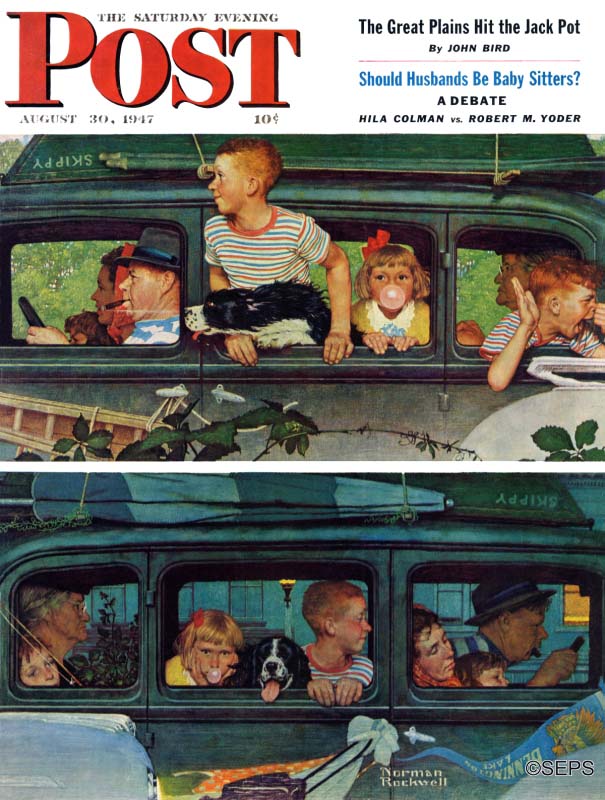


The TED Talk Juggernaut
Ryan Lash/TED
Talk is cheap. Except, I should say, if you hope to attend the annual TED Conference — famous for its masterfully crafted Talks — in which case you’ll lay out 8,500 bucks for the privilege. And only if your application is accepted, which it probably won’t be. Because you’re not actually a big-shot global paradigm-shifter, are you? However, should you be among the chosen few, you’ll witness five days of live, mostly brilliant presentations about … well, that’s the whole point. You never know.
All of these performances — er, Talks — are artfully videotaped, after which they enter the eternal slipstream of the World Wide Web. There are some 2,000 of these videos now. Over the last 30 years they have grown into a significant cultural phenomenon.
In principle, the purpose of the Talks is to showcase innovative ideas. Before its mission broadened, TED stood for Technology, Entertainment, Design. All well and good. But many of the Talks nowadays are clearly pitched to astonish audiences as well. Online, you are free to watch any of them, at no charge. Millions do. It takes but a few minutes, for instance, to screen Pamela Meyer’s “How to Spot a Liar,” which has been among the most widely admired Talks ever. Or you could check out “Looks Aren’t Everything. Believe Me, I’m a Model,” which has been another favorite. Among the least popular Talks online is one that explains how to dry your hands with a single paper towel. Some people paid big money to see that in person.
A major Talk, by TED standards, might go 18 minutes. A short one, just three minutes. Three? I’ve gagged on a bad piece of tuna longer than that. (Note to self: Consider developing “A Sea of Trouble: Don’t Let Fish Choke You Up” as a TED Talk.)
Understandably, it’s a big deal if you’re asked to address a TED crowd. A successful Talk can lead to fame, a book contract, even stalkers. Speakers are selected by TED’s curatorial team. “We look for someone who has knowledge to share and can deliver it in a way that resonates,” says Tom Rielly, TED’s community director. Yet no one, no matter how celebrated, gets up on that perfectly lit stage without prior coaching by TED’s staffers. Few risks are taken, though Rielly admits to a few dud Talks (“We’re not perfect”). Oh, and another thing: There’s no compensation. You walk the Talk for the honor of it. Actor Richard Dreyfuss’ handlers were at first dismissive. Thanks for the invite, but no cash?! In the end, they relented. This account was relayed to me by a Californian who’d once been an executive with TEDx. 
TEDx gatherings are licensed offshoots of the high-voltage annual conference. If less expensive to attend and less star-studded, they can be equally life-altering. Take Jack Abbott, a San Diego ad-agency executive who was so knocked over by TEDx Talks (“a vacation for my mind, heart, and soul”) that he ditched his career to begin anew. Today, he’s CEO of Intelligent Light Source, which markets high-tech illumination for indoor plants.
“It was an evolution from thinking to doing,” he told me. “I saw that I could effect change by getting off my ass.”
In Australia, an Internet retailer of retro merchandise has made a practice of watching one Talk every morning of the year — “before I get out of bed” — and analyzing it in her well-read blog. “I love the age we live in, but let’s face it, we’re being spoon-fed how to think,” Vanessa Rose, the blogger, said in an email to me. “TED Talks present new ideas that can be really beneficial to the world.”
Dispensing novel ideas as if they were M&Ms has predictably drawn plenty of critics, mostly among the chattering classes. There’s been lots of good-natured ribbing, too. The Onion, which specializes in snarky satire, has produced a killer send-up of a TED Talk, titled “Ducks Go Quack, Chickens Say Cluck.”
Meanwhile, I notice that TED.com’s Talk of the Day, as I write this, is “Got a Wicked Problem? First, Tell Me How You Make Toast.” Seriously. Okay, I’m game.
News of the Week: Graduation, Google Pants, and the Grabbing of Drones
Advice for Graduates
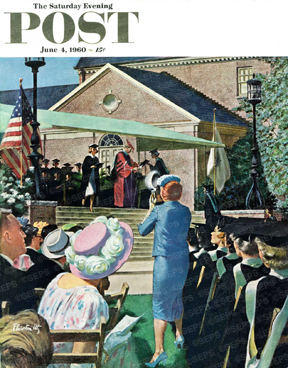
College Graduation
Thornton Utz
June 4, 1960
It’s graduation season, with lots of young people leaving college and going off into the “real world.” It’s also the season for advice to those graduates and commencement speeches.
CNN has a rundown of the celebrities and politicians who have made commencement speeches the past month, including Robert DeNiro, who spoke at New York University’s Tisch School of Arts; Anthony Hopkins, who spoke at Pepperdine University; and former Secretary of State Condoleezza Rice, who spoke at William & Mary.
My favorite commencement speaker this year just might be Stephanie Courtney, who spoke at the Binghamton University in New York. You might know her better from these commercials.
Google Glass Is Sooooooo 2014

If you’re like me, you often find yourself sitting on your couch, watching television, wearing your ordinary pants, and you look down at those pants and wonder: Why aren’t these digital?
Google is developing what they call “smart fabrics,” clothing that can actually function in the same way a touchscreen does. So with just a touch or a swipe of your fingers you can control your laptop, your phone, maybe even the music or lighting in your house or other appliances. I’ve been hoping one day that someone will make a sweatshirt that will help me control my toaster remotely.
Earthquake!

Could the earthquake and tsunami depicted in the current box-office champ San Andreas actually hit California? Yes, say scientists. So run, run away to Maine, Californians!
Okay, it might not happen exactly the way it happens in the movie, with utter and complete destruction of everything, everywhere. But scientists say that not enough attention is being paid to faults that lie offshore of Southern California and the faults should be taken more seriously. It’s not just the famous San Andreas Fault that people have to worry about.
Part of me would love to experience an earthquake. Is that weird? Not a big one, of course, just something that would make me feel the shaking a bit. On a related note, I got this for Christmas one year when I was a kid. After the first couple of times it wasn’t really fun to play with anymore.
Drones: 1, Pop Singers: 0

You can put this in the same category as “don’t stick your foot down a garbage disposal” and “don’t stick your tongue in a fan.” Singer Enrique Iglesias tried to playfully grab a drone that was filming his concert performance in Tijuana, Mexico. He promptly got his fingers sliced and a very bloody shirt and had to go offstage to get bandaged up. He came back and played for another 30 minutes and then stopped the show because he was still bleeding. He later had surgery on the hand to repair the damage and will continue his tour on July 3.
What’s remarkable is that you can see in the video that Iglesias grabs the drone a first time and gets hurt, but he still decides to grab it a second time. The moral here? Never grab a drone.
Don’t Go on Waikiki Beach at Night
I went to Hawaii in 1989. I’m not a warm weather person at all, but I really enjoyed it. A few nights we walked along Waikiki Beach (one night encountering a bunch of guys in their underwear swimming in the water), which is something I’m sure a lot of people do, especially if you don’t like the heat of the sun during the day.
Or should I say “used to do.” Police are now giving citations to people who go on Waikiki Beach and nearby parks at night. It’s an effort to crack down on homeless people who have gathered in the area in large numbers.
It’s not really the amount of the fine, it’s the fact that some of the people being fined are actually tourists who are unaware of (or don’t care about) the law. The fines go on your permanent police record (which could be a problem if you’re from out of the country and want to come back in the future), and if there’s a court date set for a hearing, you have to be present for that. If you don’t show up — which some tourists might not be able to do because they live out of state —there might be a criminal warrant issued.
I guess what I’m saying is if you want to hang out on Oahu at night, maybe you can try the Magnum, P.I. house. You’ll have to make arrangements with the new owners though.
National Ketchup Day
Yes, today is the day we celebrate ketchup! Also: catsup! Though I’m not sure if anyone spells it that way anymore. Not sure if ketchup is something I would bother to make myself, but if that’s something that strikes your fancy, Epicurious has a recipe. I don’t know, it seems like more trouble than it’s worth.
Did you know they sell ketchup in stores now?
Upcoming Anniversaries and Events
The Belmont Stakes (June 6)
American Pharoah, who has already won the Kentucky Derby and the Preakness Stakes, goes for the Triple Crown. The race starts at approximately 6:50 p.m.
Secretariat wins the Triple Crown (June 9, 1973)
The last horse to win the Triple Crown did it 42 years ago.
Judy Garland born (June 10, 1922)
Did you know there is a Judy Garland Museum in Grand Rapids, Minnesota and an official international fan club endorsed by Garland herself?
John Wayne died (June 11, 1979)
The Duke has his own official web site (not to mention his own small batch bourbon).
President Reagan’s “tear down this wall” speech (June 12, 1987)
Here’s a transcript of the historic speech the President made in West Berlin, Germany.
Anne Frank born (June 12, 1929)
This is the site for the official Anne Frank Museum in Amsterdam.
A Nice Piece of Tenderloin
Coins are jingling in my hat as I blow the first note of Moonlight in Vermont.
I hold my saxophone askew and wink at the little girl bending over my hat.
She smiles at me. Sunrays are reflecting like gold in my saxophone.
The little girl skips off. A lady with a shopping bag takes her by the hand.
The reverberation is beautiful in the pedestrian underpass to the shopping mall. I’m making more money than I expected. Almost 30 Euros yesterday.
The F-valve is sticking. I’m going to have my sax repaired if I have to do this much longer.
“… permit, I said!” I hear.
I look up.
A police cap!
An ugly tremolo resounds in my note.
“Do you have …” he says. And again something about a “permit.” He gives me a grumpy, impatient look.
I’m in the middle of the bridge; I can’t stop now. It would ruin the song!
He’s speaking again. He’s looking so angry.
So I stop after all. “What?”
“I asked if you have a pavement artist permit … Holy cow, Burt?”
If I imagine him without the cap … “Right!” I point at him. “A nice piece of tenderloin.”
“Of course.” He smiles. “Suddenly, you were closed last week.”
I sigh and shrug. “I couldn’t pay my suppliers anymore.”
“The new shopping mall?”
I nod. “Since they opened it, my turnover has more than halved.”
“Are you bankrupt?”
I nod.
“Why didn’t you move there, just like the bookshop and whatnot? The town council reimbursed moving expenses, didn’t they?”
“Moving expenses?” I shake my head. “That was a joke. Tim from the bookshop doesn’t have a cold store. Cost me a hundred thousand Euros 15 years ago. The council didn’t want to compensate me for a new one.”
He frowns. “Why not?”
“It was written off five years ago, so it’s officially worthless. According to the council, I had to invest in a new one anyway.”
“And did you?”
“Of course not. A cold store will easily last 40 years, till past my retirement.”
“But what are you doing here?”
I shrug. “I have to put food on the table for my kids. And their tuition has to be paid.”
“But if you’re out of work, you can get welfare, can’t you?”
“Not if you’re self-employed and a homeowner. I’d have to sell my house first and live off that.”
His jaw drops.
“I used to gig around in jazz clubs as a student. So I thought …”
He’s looking at the ground. “Jesus, I didn’t know the council tore people down like that.”
“They won’t bring me down. I’m healthy and fortunately I can do more than being a butcher.” I pat my saxophone.
“But you can’t play here. And you need a pavement artist permit.” He puts his hand onto my shoulder. “Do you know the Impasse?”
“That alley behind the art gallery?”
“We check street musicians only if we get complaints and that bicycle repair guy here hates music. But we never get any complaints from the Impasse. So if you go there …” He winks.
“Thanks!” I unfasten my sax. “And if you come to my place tonight around eight … I still have a nice piece of tenderloin.”